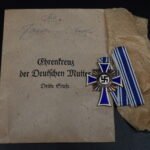
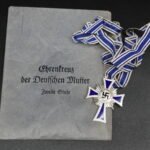
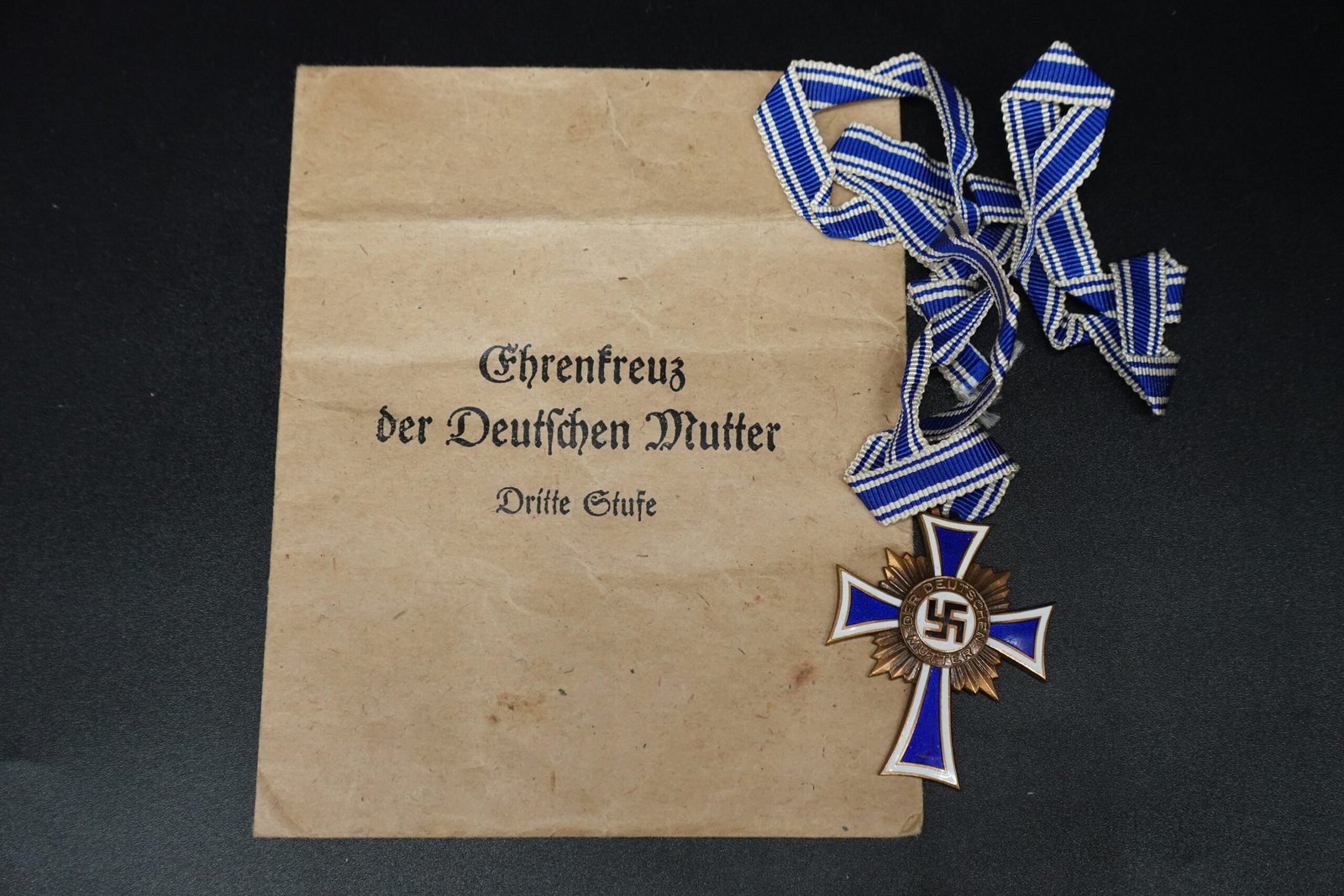
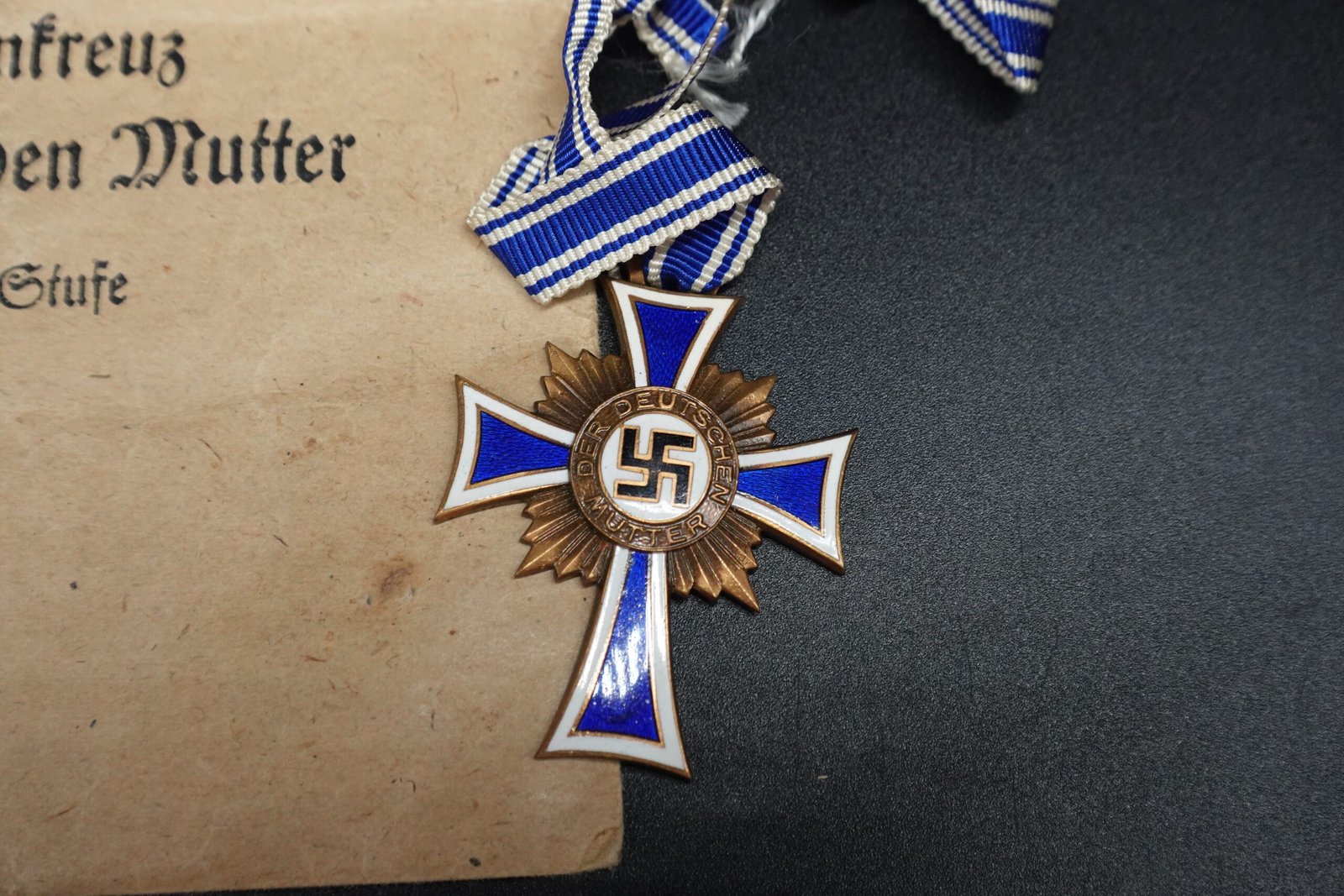
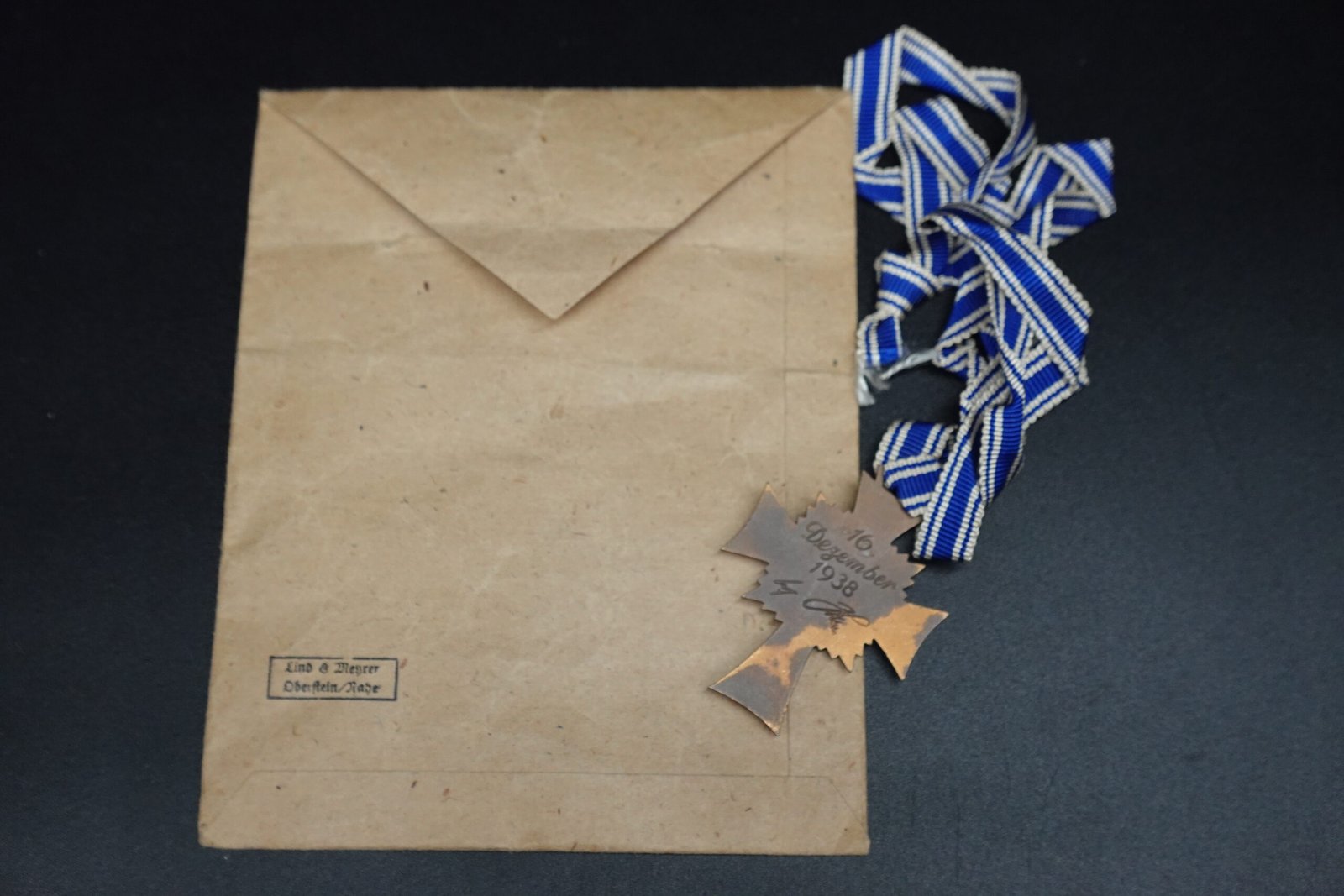
Mutterkreuz in Bronze (“Mother’s Cross in Bronze”) with Lind & Meyrer, Oberstein Pouch
€85,00
Authentic example of the Mutterkreuz in Bronze (“Mother’s Cross in Bronze”), awarded in recognition of motherhood, moral conduct, and the raising of multiple children.
This bronze class example is constructed in tombac with enamel inlay and retains its original bronze finish. It is complete with its full-length ribbon, still retaining its original cellophane wrap.
The set is accompanied by its original issue pouch by Lind & Meyrer, Oberstein, which is preserved in near mint condition. The front of the pouch bears period handwritten markings, most likely denoting the original recipient’s name.
Overall, a well-preserved and complete example showing expected light age-related wear consistent with period use.
The Cross of Honour of the German Mother (Ehrenkreuz der Deutschen Mutter), commonly known as the Mutterkreuz (“Mother’s Cross”), was a state decoration introduced by the government of Nazi Germany to recognise mothers considered to have made exceptional contributions to the German nation through childbirth and child-rearing.
The decoration was instituted by decree on 16 December 1938 and awarded from 1939 until 1945. Eligibility was primarily granted to German citizens (Reichsdeutsche), and later extended to ethnic German women (Volksdeutsche) in incorporated territories such as Austria and the Sudetenland.
The award was issued in three classes based on the number of children raised:
Bronze Class: 4–5 children
Silver Class: 6–7 children
Gold Class: 8 or more children
Recipients were selected according to strict eligibility criteria, intended to recognise women considered exemplary in motherhood and moral conduct.
The decoration was worn suspended from a narrow blue-and-white ribbon, typically measuring approximately 60–70 cm in length, and was worn on the neck. No alternative form of wear was permitted under the official regulations.