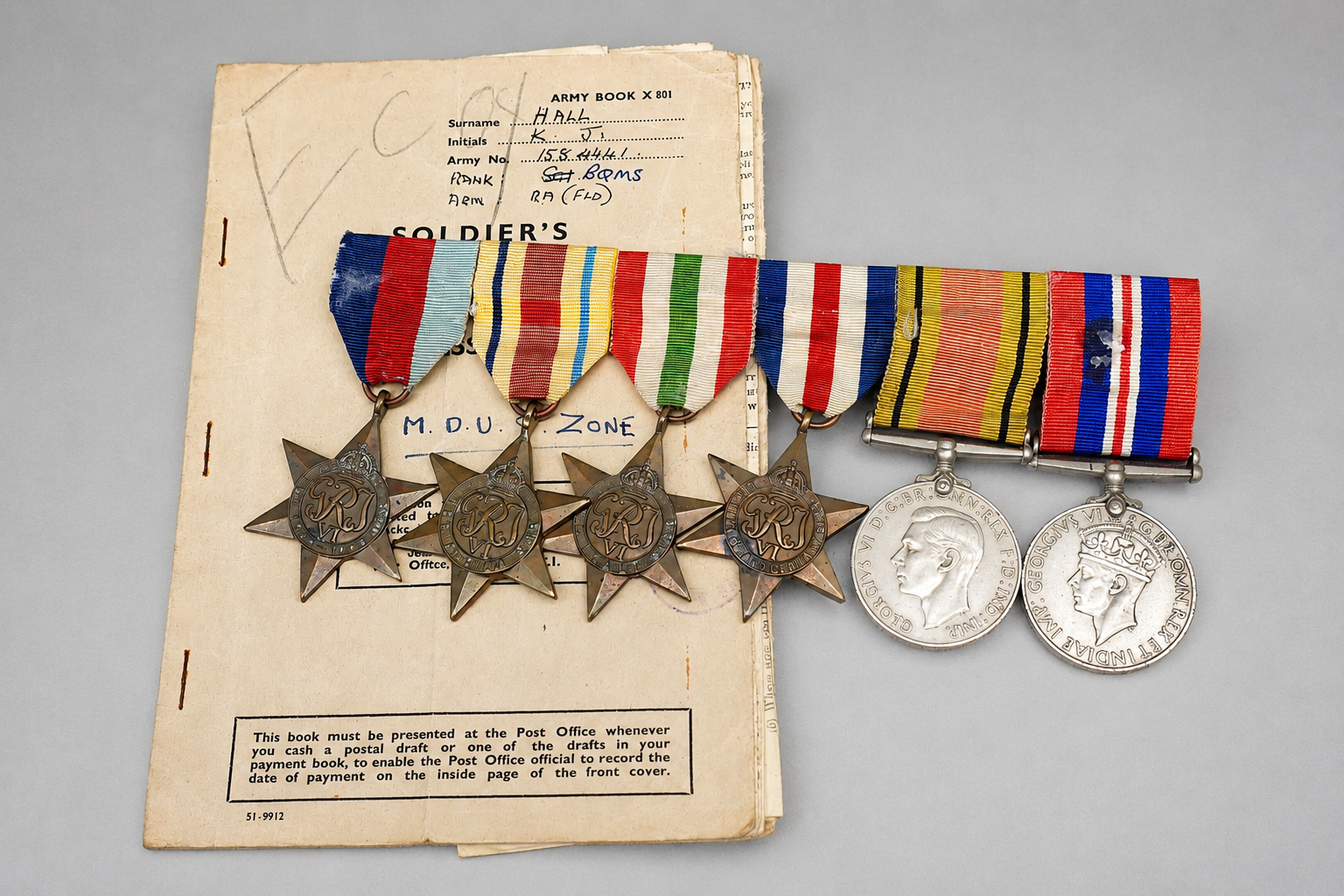
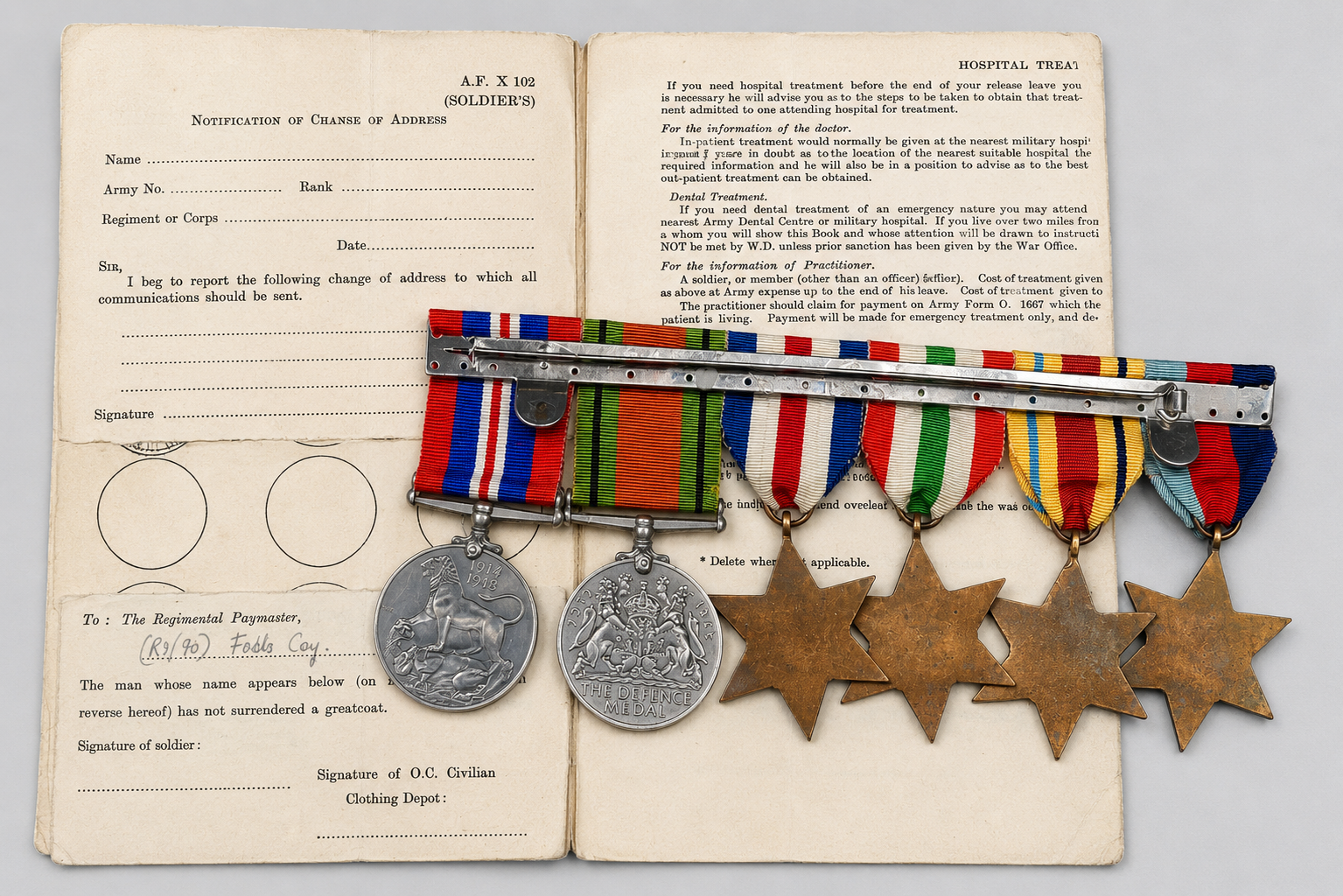
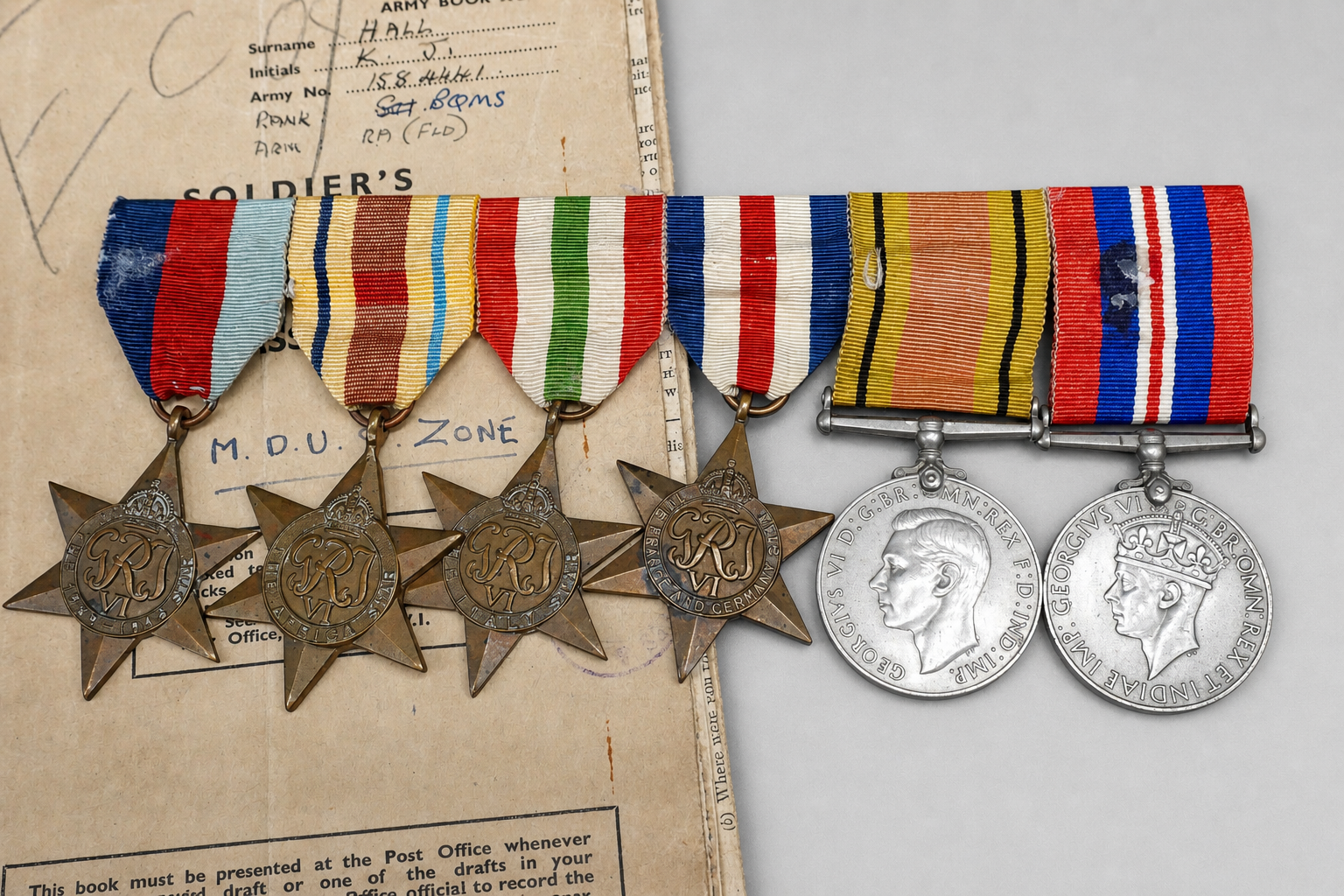
Authentic British Second World War mounted medal group of six, comprising the 1939–1945 Star, Atlantic Star, Italy Star, France and Germany Star, Defence Medal, and War Medal 1939–1945, mounted as worn on the original bar and accompanied by the Soldier’s Release Book.
The group is attributed to Battery Quartermaster Sergeant Hall, who served with the 91st Field Regiment, Royal Artillery, a Territorial Army unit associated with the 5th Infantry Division. The regiment saw extensive active service throughout the war, providing vital artillery support across multiple major theatres.
The medals include:
- 1939–1945 Star – for early operational service
- Atlantic Star – for service connected to the Battle of the Atlantic
- Italy Star – for service in the Italian Campaign, including the fighting at Battle of Monte Cassino
- France and Germany Star – for service in North-West Europe
- Defence Medal – for non-operational service
- War Medal 1939–1945 – for full-time wartime service
The 91st Field Regiment was mobilised in 1939 and initially deployed to France with the British Expeditionary Force. Following evacuation and reorganisation, it served in the North African campaign before taking part in the Allied advance through Italy, including operations around Monte Cassino. As a field artillery regiment equipped with 25-pounder guns, it played a key role in supporting infantry assaults and engaging enemy positions.
In the later stages of the war, the regiment was deployed to North-West Europe. By March 1945, it was operating under XXX Corps and took part in the Rhine crossing during the final Allied advance into Germany.
The group therefore reflects a highly experienced artillery NCO with confirmed service in:
- North Africa
- Italy (including Monte Cassino)
- North-West Europe (Belgium and Germany)
The medals are mounted as worn on their original bar and display an even, attractive patina. The ribbons show light age-related wear consistent with period use.
Accompanied by the original Soldier’s Release Book, offering strong research potential and clear attribution, significantly enhancing collectibility.
Condition: As shown in photographs.