



Shop
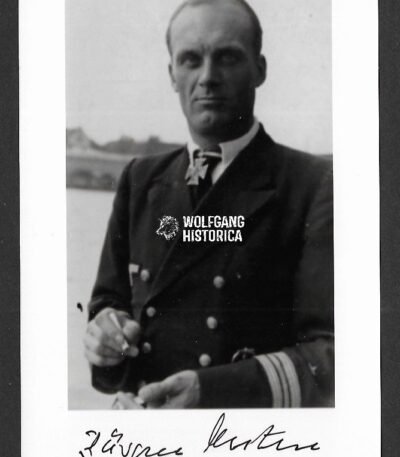
Jürgen Oesten – Kommandant of “U-106”
€30,00Original Postwar Signature on a Postwar Photo of Jürgen Oesten. Kapitänleutnant Jürgen Oesten (24.10.1913 in Berlin-Grünwald † 05.08.2010) earned the Ritterkreuz des Eisernen Kreuzes on March 26, 1941 as Kapitänleutnant zur See und Kommandant of U-boot “U-106”. Condition as seen. Postcardsize.
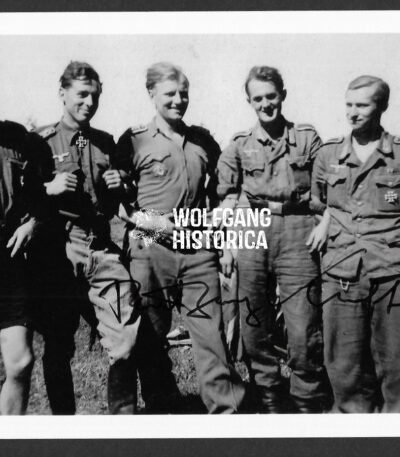
Paul-Georg Kleffel – Panzer-Aufklärungs-Abteilung 3 (3. Panzer-Division) (A5-Size)
€20,00Original Postwar Signature on a Postwar Photo of Paul-Georg Kleffel. Hauptmann Paul-Georg Kleffel (07.09.1920 † 09.02.2020) earned the Deutsches Kreuz in Gold on November 16, 1943 as Oberleutnant in the 4. Kompanie/ Panzer-Aufklärungs-Abteilung 3 and the Ritterkreuz on May 4, 1944 as Oberleutnant und Kompaniechef of the 4. Kompanie/ Panzer-Aufklärungs-Abteilung 3 of the 3. Panzer-Division. Condition as seen. Large A5 size.
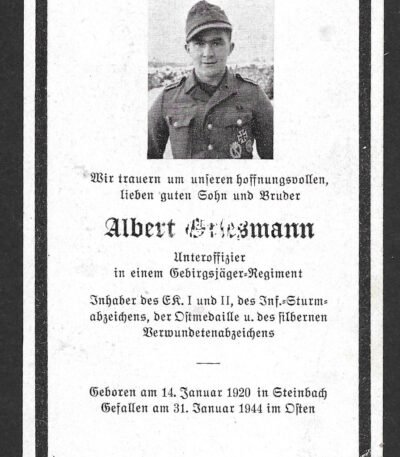
Death Card: Gebirgsjäger-Regiment (Top Photo)
€10,00Original Death Card (“Sterbebild”) of a Gebirgsjäger, who served with a Gebirgsjäger-Regiment. Condition as seen.
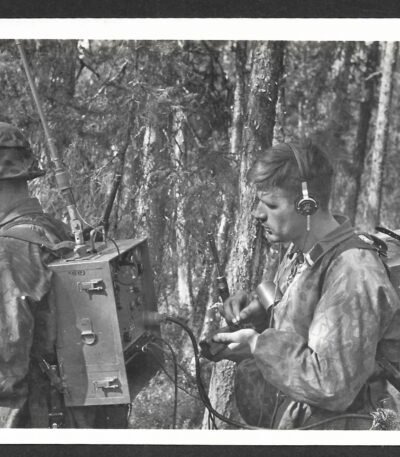
Waffen-SS Postcard “Kampf der SS-Gebirgsdivision Nord in Karelien”
€65,00Original Waffen-SS Postcard “Kampf der SS-Gebirgsdivision Nord in Karelien – Unsere Funker im Urwald” by SS-Kriegsberichter Slapak. Postcardsize. Condition as seen.
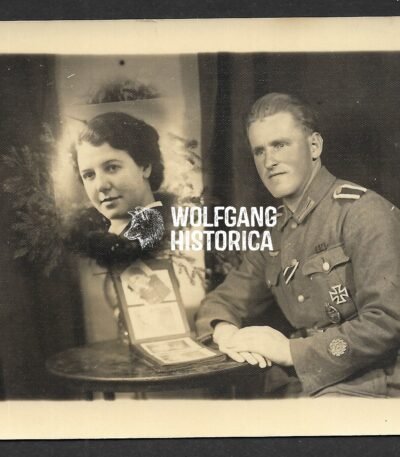
Studioportrait Wehrmacht Soldier wearing EK1, PAB & KBA
€15,00Original Wehrmacht (Heer) studioportrait of a NCO wearing awards (Eisernes Kreuz 1. Klasse, Panzerkampfabzeichen in Bronze and Kraftfahrbewährungsabzeichen). Postcardsize. Condition as seen.
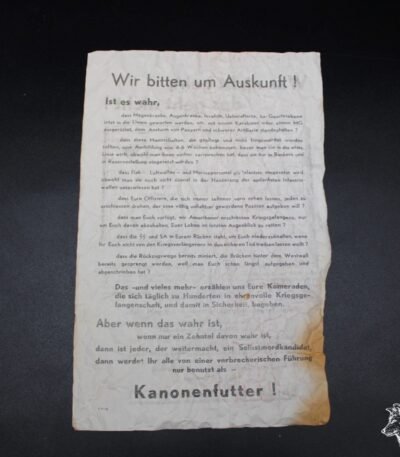
US Airborne Propaganda Leaflet (Wir bitten um Auskunft)
€25,00Original US airborne propaganda leaflet which were dropped on the Germans troops on the Western Front. Condition as seen.
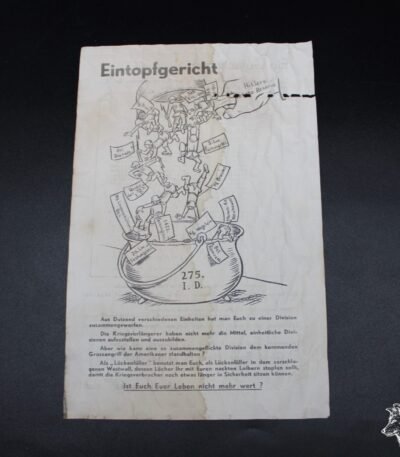
US Airborne Propaganda Leaflet (275.Infanterie-Division)
€25,00Original US airborne propaganda leaflet which were dropped on the Germans troops on the Western Front. Condition as seen.
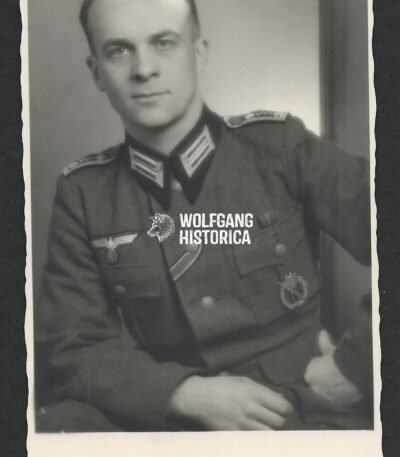
Studioportrait Wehrmacht Medic wearing ISA
Original price was: €15,00.€10,00Current price is: €10,00.Original Wehrmacht (Heer) studioportrait of a Doctor/Medic (see shoulderboards) wearing awards (Infanterie-Sturmabzeichen). Postcardsize. Condition as seen.
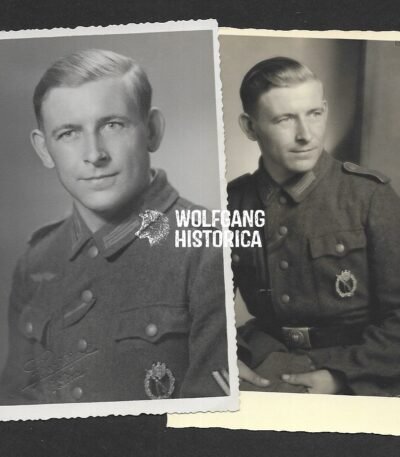
Studioportrait Wehrmacht Soldier wearing ISA (Linz)
€20,00Original 2x Wehrmacht (Heer) studioportrait of a soldier wearing awards (Infanterie-Sturmabzeichen). Taken in Linz. Postcardsize. Condition as seen.
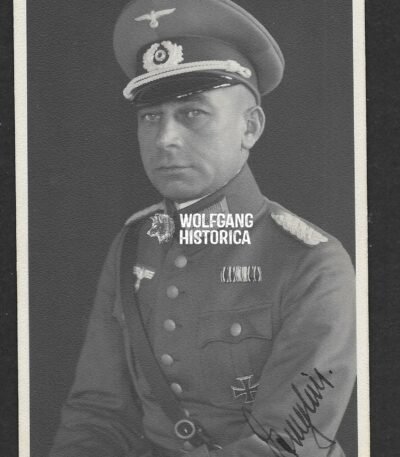
Studioportrait Wehrmacht Officer wearing EK1
€15,00Original Wehrmacht (Heer) studioportrait of an officer wearing awards (Eisernes Kreuz 1. Klasse) with signature. Postcardsize. Condition as seen.
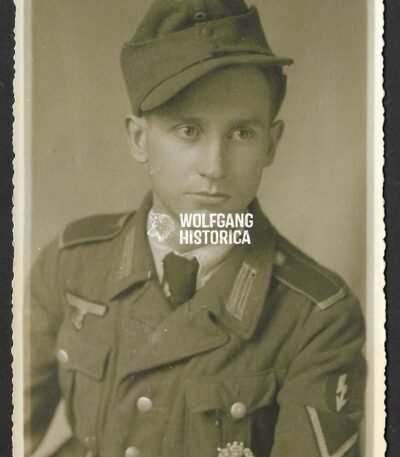
Studioportrait Wehrmacht Soldier wearing ISA
Original price was: €15,00.€10,00Current price is: €10,00.Original Wehrmacht (Heer) studioportrait of a soldier wearing awards (Infanterie-Sturmabzeichen) and Funker cloth badge. Postcardsize. Condition as seen.
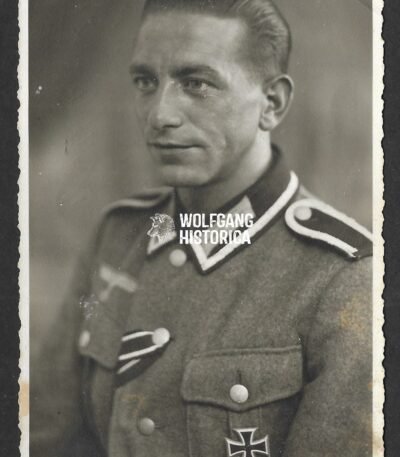
Studioportrait Wehrmacht NCO wearing EK1
€15,00Original Wehrmacht (Heer) studioportrait of a NCO wearing awards (Eisernes Kreuz 1. Klasse). Postcardsize. Condition as seen.
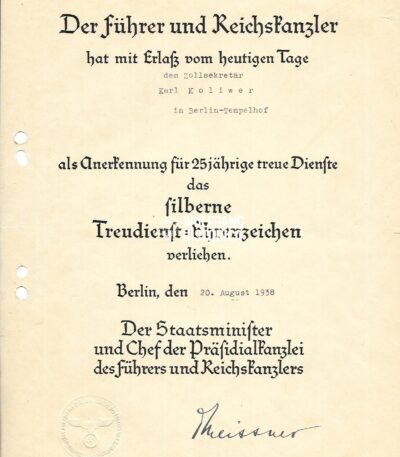
Faithful Service Medal “25 Years” Award Document – Zollsekretär in Berlin-Tempelhof
€40,00Original award document for the 25 jährige Silberne Treudienst-Ehrenzeichen (25 Years Faithful Service Medal) which was awarded to a Zollsekretär in Berlin-Tempelhof. Document is an A4 Size and bears the facismile signature of Otto Meissner. Condition as seen.
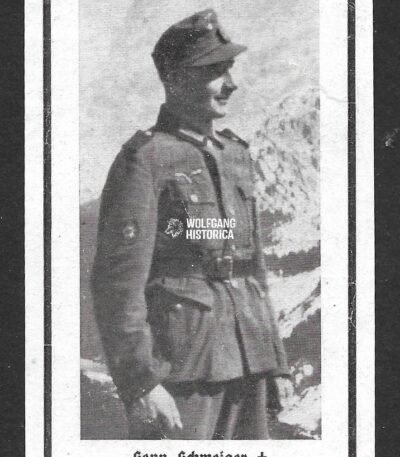
Death Card: Gebirgsjäger-Regiment 98 (1. Gebirgs-Division) (Top Photo)
€20,00Original Death Card (“Sterbebild”) of a Gebirgsjäger, who served with the Gebirgsjäger-Regiment 98 of the 1. Gebirgs-Division. Condition as seen.
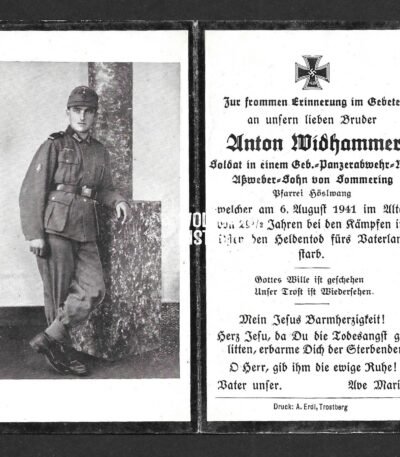
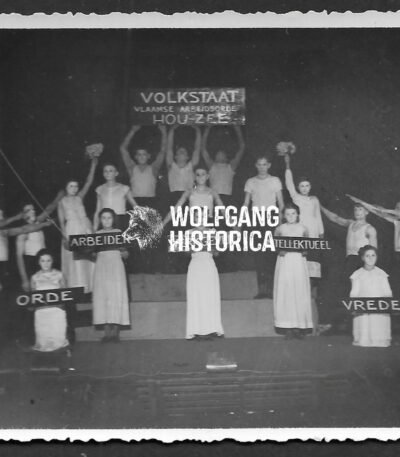
Photograph of a Flemish National Event
€10,00Original Photograph taken during a Flemish National ceremony or event “Volksstaat Houzee”. Postcardsize.
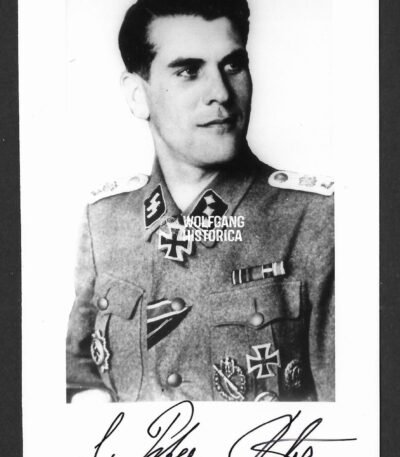
Gustav-Peter Reber – “LSSAH” and XI. SS-Panzerkorps
€40,00Original Postwar Signature of Gustav-Peter Reber. Reber earned the Deutsches Kreuz in Gold with 1. Kompanie/ SS-Panzer-Grenadier-Regiment 2 “LSSAH” and the Ritterkreuz as Cdr. of Stabsquartier/ XI. SS-Panzerkorps. Good condition. Postcardsize.
Also Führer Kampfgruppe, Kessel von Halbe. Actions in Halbe pocket ; before breakout awarded by Gruppenführer Wagner , approved by Obergruppenführer Kleinheisterkamp, K.G. XI. SS-AK. No proof possible with existing BArch documents ; according to Krätschmer (letter to von Seemen from 07.08.1980) the award was made together with the OL for Kleinheisterkamp and was announced via radio message from FHQ in Berlin to 9. Armee (Kessel von Halbe) on 28.04.1945 ; the incoming radio messages of AOK 9 from april 45 are not existing anymore ; the wireless radio connections to the Führerbunker in Berlin were interrupted since April 28th, 05.00hours in the morning ; the OdR Ordenskommission decided about this case in 1981 with the result : “RK ja, 28.4.1945” (Source: Traces of War)
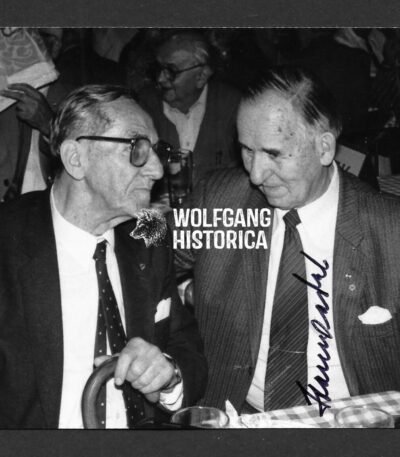
Albert Stenwedel – 13. Waffen-Gebirgs-Division der SS “Handschar”
€45,00Original Postwar Signature on a Postwar Photo of Albert Stenwedel. SS-Sturmbannführer Albert Stenwedel (10.09.1908 † 29.07.1997) was an early volunteer for the SS (SS service number 28 762) and earned the Ritterkreuz on May 3, 1945 as SS-Sturmbannführer und Kommandeur of the II. Bataillon/ SS-Freiwilligen-Gebirgsjäger-Regiment 27 “Handschar” of the 13. SS-Freiwilligen-Gebirgs-Division “Handschar”.
Knight’s Cross: “On the 01-02.04.1945 Sturmbannführer Stenwedel and his Bataillon distinguished themselves while holding a crossing over the Murr river. Despite a lack of support from heavy weapons they were able to defend their positions successfully against overwhelming enemy forces, and by doing so they secured the safe passage of the rest of the 13. SS-Freiwilligen-Waffen-Gebirgs-Division “Handschar” over the Murr river. Stenwedel was recommended for the Knight’s Cross as a result.”
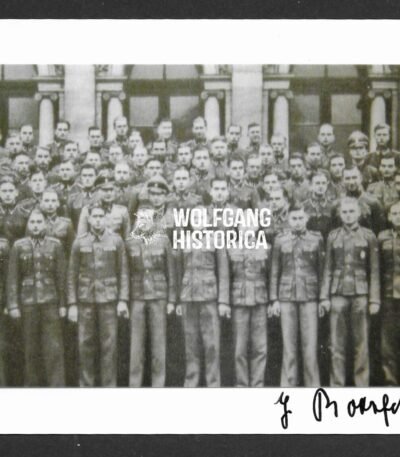
Joachim Boosfeld – 8. SS-Kavallerie-Division “Florian Geyer” (RK+NKIG!)
€40,00Original Postwar Signature on a Postwar Photo of Joachim Boosfeld. SS-Hauptsturmführer Joachim Boosfeld (01.06.1922 † 19.06.2015) earned the Deutsches Kreuz in Gold on December 30, 1944, the Nahkampfspange in Gold on February 21, 1945 and the Ritterkreuz on February 21, 1945 as SS-Obersturmführer und Chef of 4. Schwadron/ SS-Kavallerie-Regiment 16 of the 8. SS-Kavallerie-Division “Florian Geyer”. Postcardsize.
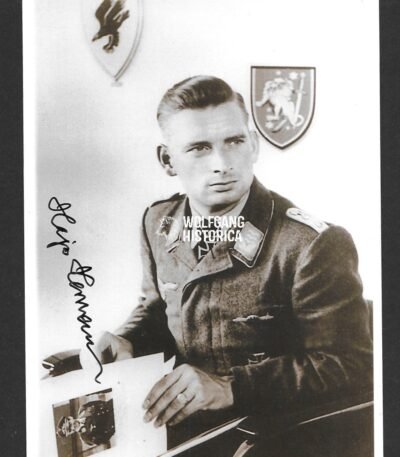
Hajo Herrmann – Kampfgeschwader 4, 30 & Jagdgeschwader 300 (Schwertern)
€25,00Original Postwar Signature on a Postwar Photo of Hans-Joachim “Hajo” Herrmann. Oberst Hajo Hermann (01.08.1913 † 05.11.2010) earned the Ritterkreuz des Eisernen Kreuzes on October 13, 1940 as Oberleutnant und Staffelkapitän of the 7. Staffel/ Kampfgeschwader 4, the Deutsches Kreuz in Gold on June 5, 1942 with Kampfgeschwader 30 “Adler”, the Eichenlaub on August 2, 1943 as Major und Kommodore of Jagdgeschwader 300 and the Schwertern on January 23, 1944 as Oberst und Inspekteur of the Deutschen Luftverteidigung. Condition as seen. A5 size!
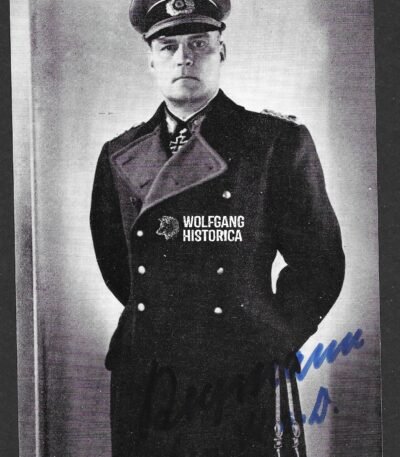
Hellmuth Reymann – 13. Luftwaffe-Feld-Division & 11. Infanterie-Division (Eichenlaub)
€45,00Original Postwar Signature on a Postwar Paper Photo of Hellmuth Reymann. Generalleutnant Hellmuth Reymann (24.11.1892 † 12.12.1988) earned the Deutsches Kreuz in Gold on November 22, 1941 with Infanterie-Regiment 205, the Ritterkreuz on April 5, 1944 as Generalleutnant und Kommandeur of the 13. Luftwaffe-Feld-Division and the Eichenlaub on November 28, 1944 as Generalleutnant und Kommandeur of the 11. Infanterie-Division. Good Condition. Measuring: Postcardsize.
Provenance: This signature comes from one of the largest postwar signature collection I’ve ever commissioned. This collection was started by a Waffen-SS Veteran, Werner H., in the 1950’s until he passed away.
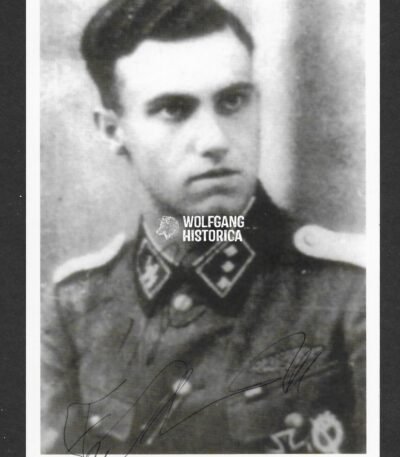
Friedrich Blond – SS-Panzergrenadier-Ausbildungs- und Ersatz-Bataillon 1 “LSSAH”
€40,00Original Postwar Signature on a Postwar Photo of Friedrich Blond. SS-Untersturmführer Friedrich Blond (29.04.1920 † 24.05.2009) earned the Ritterkreuz des Eisernen Kreuzes on April 28, 1945 as SS-Untersturmführer with the 12. Kompanie/ SS-Panzergrenadier-Ausbildungs- und Ersatz-Bataillon 1 “LSSAH”. Condition as seen. Postcardsize.
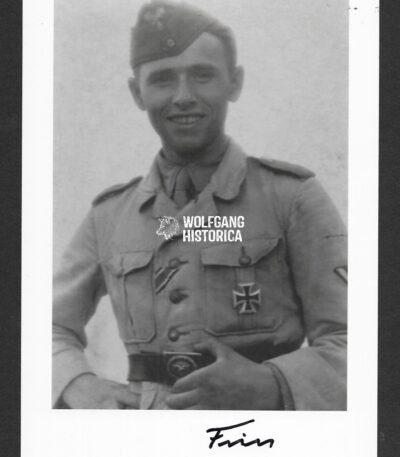
Herbert Fries – Fallschirm-Panzerjäger-Abteilung 1 (Pantherturm!) (A5-Size)
€30,00Original Postwar Signature on a Postwar Photo of Herbert Fries. Leutnant Herbert Fries (01.03.1925 in Waldmühlen † 06.01.2014 in Rennerod-Emmerichenhain) earned the Ritterkreuz des Eisernen Kreuzes on September 5, 1944 as Gefreiter und Geschützführer in the 2. Kompanie/ Fallschirm-Panzerjäger-Abteilung 1 of the 1. Fallschirmjäger-Division. A5-Size! Condition as seen.
Awarded for his achievements as the gunner of a “Pantherturm” along the Via Casilina road (specifically near Piedimonte). He destroyed 7 allied tanks on the 21.05.1944, 6 more on the 22.05.1944 and finally an additional 7 on the 24.05.1944. After this the crew of the Pantherturm (christened “Schlafmütze” or sleepyhead) blew up their gun and retreated north with the rest of the German defenders. Fries was recognized appropriately for his total of 20 tank kills during this short time period in a critical area of the battle.
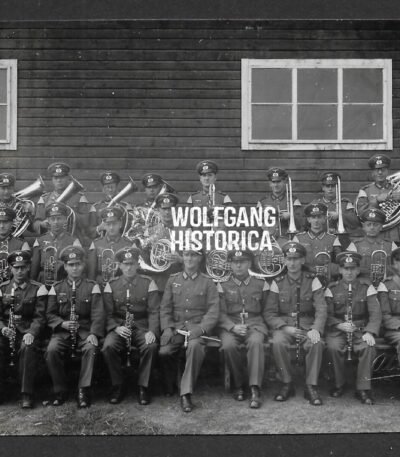
Groupphoto Musikzug/ Infanterie-Ersatz-Regiment 45
€25,00Original groupphoto of the Musikzug/ Infanterie-Ersatz-Regiment 45. Postcardsize.
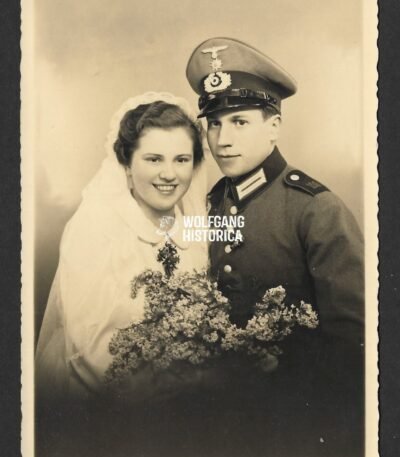
Studioportrait of Soldier from Gebirgsjäger-Regiment 100
€10,00Original Studioportrait of a Gebirgsjäger wearing numbered shoulderboards with cypher “100”. Postcardsize.
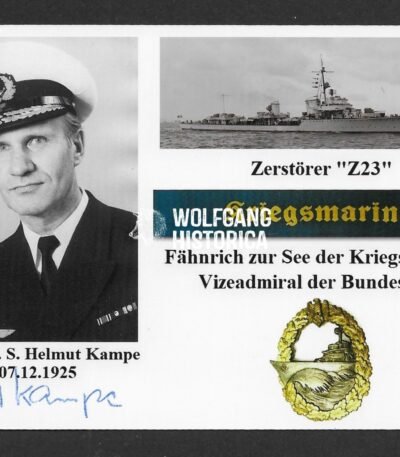
Helmut Kampe – Zerstörer “Z23”
€15,00Original Postwar Signature on a Postwar Photo of Helmut Kampe. Fähnrich zur See Helmut Kampe (07.12.1925 † ) served with the Zerstörer “Z23”. Postcardsize.
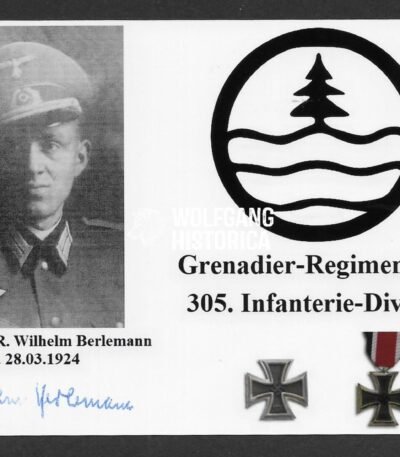
Wilhelm Berlemann – Grenadier-Regiment 578 (305. Infanterie-Division)
€15,00Original Postwar Signature on a Postwar Photo of Wilhelm Berlemann. Leutnant Wilhelm Berlemann (28.03.1924 † ) served with the Grenadier-Regiment 578 of the 305. Infanterie-Division. Postcardsize.
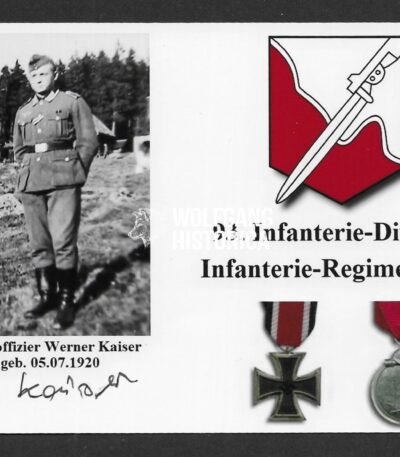
Werner Kaiser – Infanterie-Regiment 272
€15,00Original Postwar Signature on a Postwar Photo of Werner Kaiser. Unteroffizier Werner Kaiser (05.07.1920 † ) served with the Infanterie-Regiment 272 of the 93. Infanterie-Division. Postcardsize.
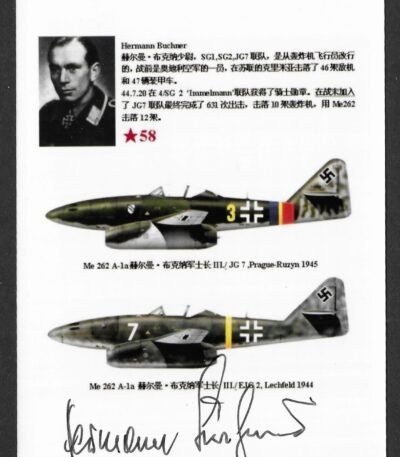
Hermann Buchner – Schlachtgeschwader 2 “Immelmann” (Me262 Pilot! 12 Victories with the Me262!)
€30,00Original Postwar Signature on a Postwar Photo of Hermann Buchner. Oberfeldwebel Hermann Buchner (30.10.1919 in Salzburg † 01.12.2005 in Linz) earned the Deutsches Kreuz in Gold on October 17, 1943 and the Ritterkreuz des Eisernen Kreuzes on July 20, 1944 as Oberfeldwebel und Flugzeugführer in the 6. Staffel/ Schlachtgeschwader 2 “Immelmann”.
During World War II, Buchner logged 631 combat missions, of which 215 on the Messerschmitt Bf 109E, 396 on the Focke-Wulf Fw 190, and 20 on the Messerschmitt Me 262. He was shot down five times, including two bail outs with a parachute, and was wounded twice. Buchner was credited with 58 aerial victories—46 on the Eastern Front and 12 flying the Me 262 in Defence of the Reich. As a ground attack pilot, he was credited with the destruction of 46 tanks and one armoured train. Read more about Hermann Buchner (Wikipedia)
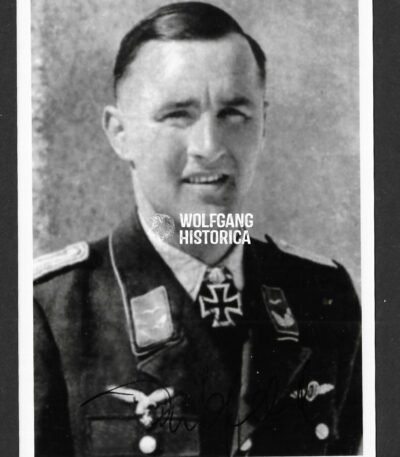
Adolf Dickfeld – Jagdgeschwader 52 (Eichenlaub)
€35,00Original Postwar Signature on a Postwar Photo of Adolf Dickfeld. Oberst Adolf Dickfeld (20.02.1910 † 17.05.2009) earned the Deutsches Kreuz in Gold on January 22, 1942, Ritterkreuz on March 19, 1942 as Leutnant und Flugzeugführer in the 7. Staffel/ Jagdgeschwader 52 and the Eichenlaub on May 19, 1942 as Leutnant und Flugzeugführer in the 7. Staffel/ Jagdgeschwader 52. Postcardsize.
He achieved 133 aerial victories.
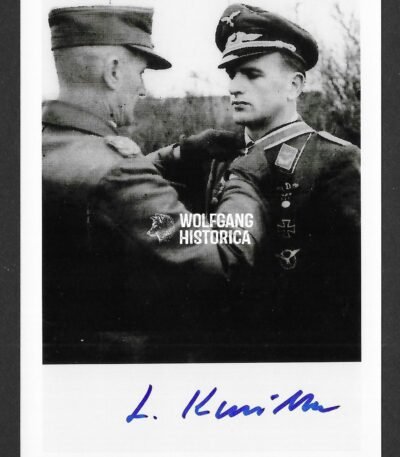
Lothar Kmitta – Nahaufklärungsgruppe 5
€17,50Original Postwar Signature on a Postwar Photo of Lothar Kmitta. Leutnant Lothar Kmitta (19.01.1921 in Glatz † 13.05.2009 in Garmisch-Partenkirchen) earned the Ritterkreuz des Eisernen Kreuzes on November 18, 1944 as Leutnant und Flugzeugführer in the Nahaufklärungsgruppe 5. Postcardsize.
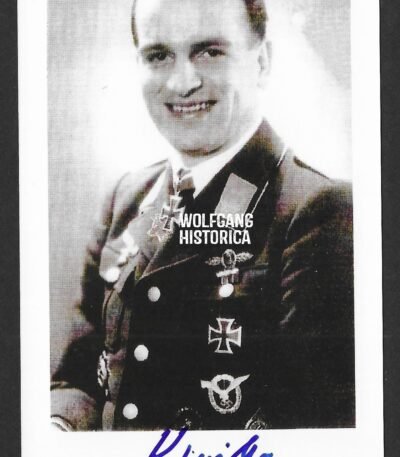
Lothar Kmitta – Nahaufklärungsgruppe 5
€17,50Original Postwar Signature on a Postwar Photo of Lothar Kmitta. Leutnant Lothar Kmitta (19.01.1921 in Glatz † 13.05.2009 in Garmisch-Partenkirchen) earned the Ritterkreuz des Eisernen Kreuzes on November 18, 1944 as Leutnant und Flugzeugführer in the Nahaufklärungsgruppe 5. Postcardsize.
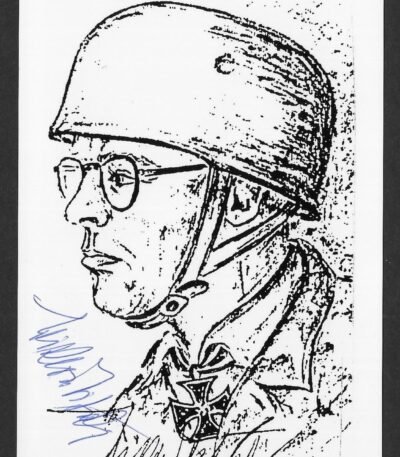
Viktor Vitali – Fallschirmjäger-Regiment 4
€20,00Original Postwar Signature on a Postwar Photo of Viktor Vitali. Oberleutnant Viktor Vitali (03.04.1920 † 06.01.2012) earned the Ritterkreuz des Eisernen Kreuzes on April 30, 1945 as Leutnant und Zugführer in the 5. Kompanie/ Fallschirmjäger-Regiment 4 of the 1. Fallschirmjäger-Division. Good condition. Postcardsize.
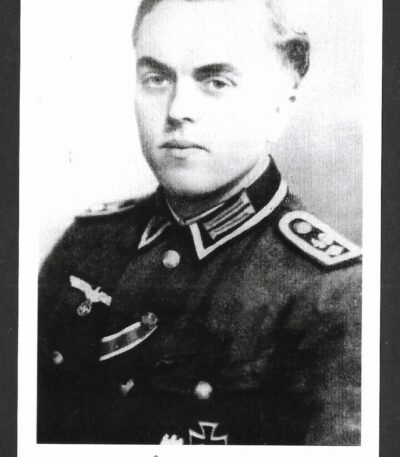
Georg Peschel – Jäger-Regiment 49 (28. Jäger-Division)
€15,00Original Postwar Signature on a Postwar Photo of Georg Peschel. Oberfeldwebel Georg Peschel (30.05.1917 in Neu-Schlesing † 12.10.2011 in Diez) earned (no evidence to confirm) the Ritterkreuz des Eisernen Kreuzes on May 11, 1945 as Oberfeldwebel und Zugführer of the 10. Kompanie/ Jäger-Regiment 49 of the 28. Jäger-Division. Postcardsize.
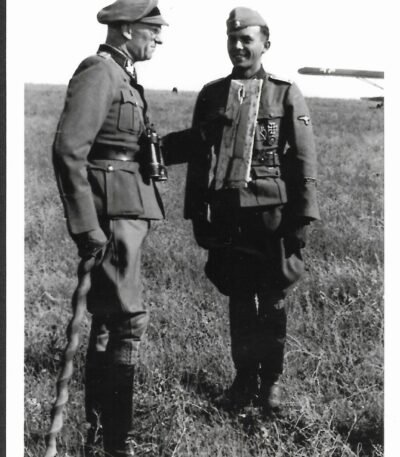
Eberhard Heder – SS-Panzer-Pionier-Bataillon 5 “Wiking”
€45,00Original Postwar Signature on a Postwar Photo of Eberhard Heder. SS-Sturmbannführer Eberhard Heder (30.06.1918 † 18.11.2017) earned the Deutsches Kreuz in Gold on March 11, 1943 as SS-Obersturmführer with the 3. Kompanie/ SS-Pionier-Bataillon 5 “Wiking” and the Ritterkreuz on November 18, 1944 as SS-Hauptsturmführer und Führer of the SS-Panzer-Pionier-Bataillon 5 of the 5. SS-Panzer-Division “Wiking”. Postcardsize. Condition as seen.
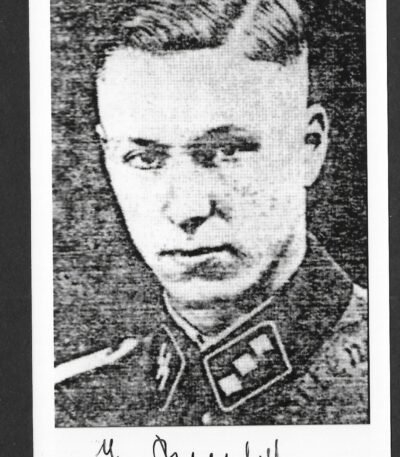
Joachim Boosfeld – 8. SS-Kavallerie-Division “Florian Geyer” (RK+NKIG!)
€50,00Original Postwar Signature on a Postwar Photo of Joachim Boosfeld. SS-Hauptsturmführer Joachim Boosfeld (01.06.1922 † 19.06.2015) earned the Deutsches Kreuz in Gold on December 30, 1944, the Nahkampfspange in Gold on February 21, 1945 and the Ritterkreuz on February 21, 1945 as SS-Obersturmführer und Chef of 4. Schwadron/ SS-Kavallerie-Regiment 16 of the 8. SS-Kavallerie-Division “Florian Geyer”.
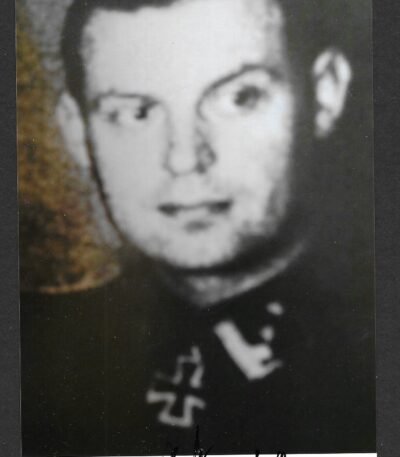
Günter Wanhöfer – SS-Pionier-Bataillon 54 “Nederland”
Original price was: €45,00.€35,00Current price is: €35,00.Original Postwar Signature on a Postwar Photo of Günter Wanhöfer. SS-Sturmbannführer Günter Wanhöfer (18.11.1916 † 07.08.2015) earned the Ritterkreuz on August 27, 1944 as SS-Hauptsturmführer und Kommandeur of the SS-Pionier-Bataillon 54 of the 23. SS-Freiwilligen-Panzer-Grenadier-Division “Nederland”. Postcardsize. Condition as seen.
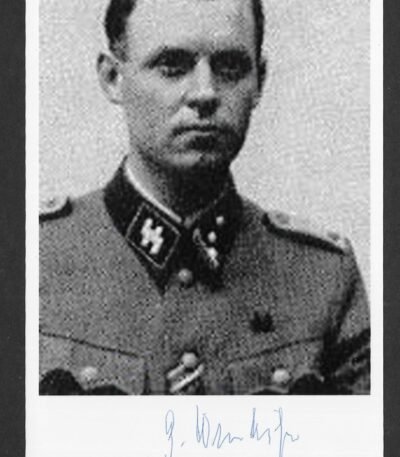
Günter Wanhöfer – SS-Pionier-Bataillon 54 “Nederland”
Original price was: €45,00.€35,00Current price is: €35,00.Original Postwar Signature on a Postwar Photo of Günter Wanhöfer. SS-Sturmbannführer Günter Wanhöfer (18.11.1916 † 07.08.2015) earned the Ritterkreuz on August 27, 1944 as SS-Hauptsturmführer und Kommandeur of the SS-Pionier-Bataillon 54 of the 23. SS-Freiwilligen-Panzer-Grenadier-Division “Nederland”. Postcardsize. Condition as seen.
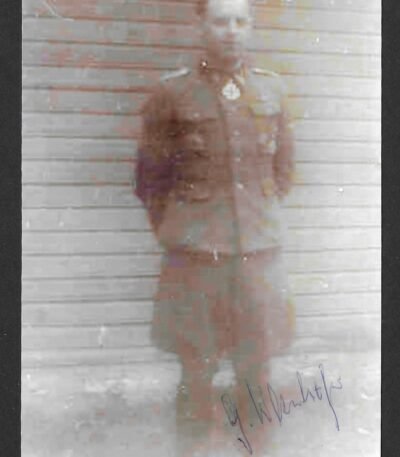
Günter Wanhöfer – SS-Pionier-Bataillon 54 “Nederland”
Original price was: €45,00.€35,00Current price is: €35,00.Original Postwar Signature on a Postwar Photo of Günter Wanhöfer. SS-Sturmbannführer Günter Wanhöfer (18.11.1916 † 07.08.2015) earned the Ritterkreuz on August 27, 1944 as SS-Hauptsturmführer und Kommandeur of the SS-Pionier-Bataillon 54 of the 23. SS-Freiwilligen-Panzer-Grenadier-Division “Nederland”. Postcardsize. Condition as seen.
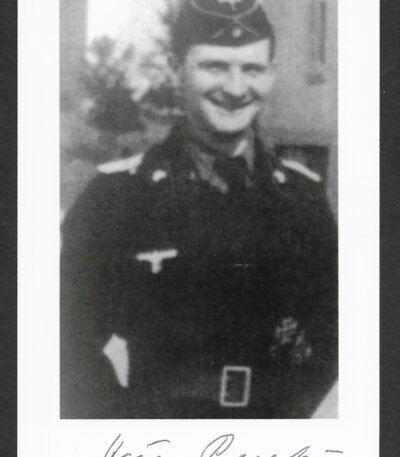
Heinz Beutler – Panzer-Regiment 2
€20,00Original Postwar Signature on a Postwar Photo of Heinz Beutler. Oberleutnant Heinz Beutler (23.12.1915 † 26.09.2010) earned the Ritterkreuz des Eisernen Kreuzes on February 14, 1942 as Oberleutnant und Chef of the 3. Kompanie/ Panzer-Regiment 2 of the 16. Panzer-Division.
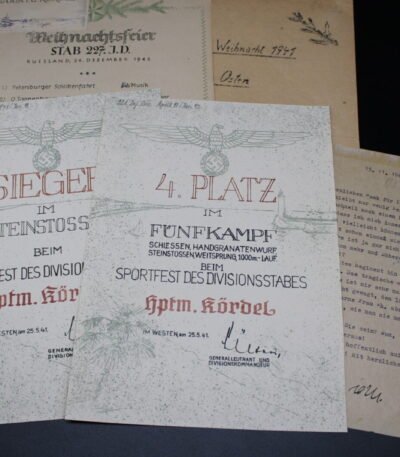
Small Document Group of Dietrich Kördel (227. Infanterie-Division, Earned Anerkennungsurkunde)
€50,00Original small document group of Major i.G. Dietrich Kördel who served with the 227. Infanterie-Division and is still listed as Missing in Action. He was decorated with the Anerkennungsurkunde for “hervorragende Leistungen auf dem Schlachtfelde am Ladoga-See vom 12. bis 18.01.1943”. Condition as seen.
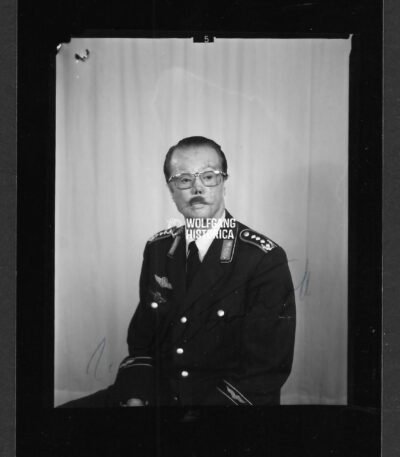
Johannes Steinhoff – Jagdgeschwader 52 & 77 (Schwertern, 176 Victories!)
€75,00Original Postwar Signature on a Postwar Photo of Johannes Steinhoff. Oberstleutnant Johannes Steinhoff (15.09.1913 in Bottendorf † 21.02.1994 in Wachtberg) earned the Ritterkreuz des Eisernen Kreuzes on August 30, 1941 as Oberleutnant und Staffelkapitän of the 4. Staffel/ Jagdgeschwader 52; the Eichenlaub on September 2, 1942 as Hauptmann und Kommandeur of the II. Gruppe/ Jagdgeschwader 52 and the Schwertern on July 28, 1944 as Oberstleutnant und Kommandeur of the Jagdgeschwader 77. Condition as seen. Postcardsize.
Walter Kupinski achieved 176 victories during the Second World War. He also flew the Me 262!
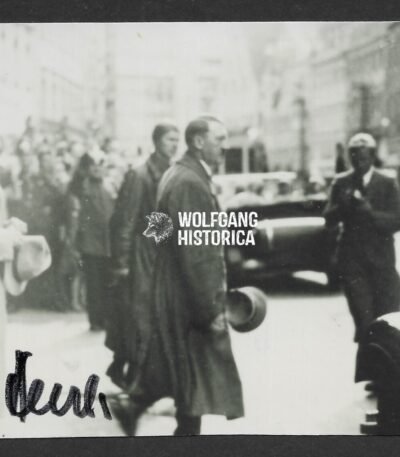
Hermann Henle – Werfer-Regiment 70
€15,00Original Postwar Signature on a Postwar Photo of Hermann Henle. Major Hermann Henle (10.07.1916 † 16.03.2008) earned the Ritterkreuz des Eisernen Kreuzes on September 19, 1943 as Hauptmann und Führer of the II. Abteilung/ Werfer-Regiment 70. Condition as seen.
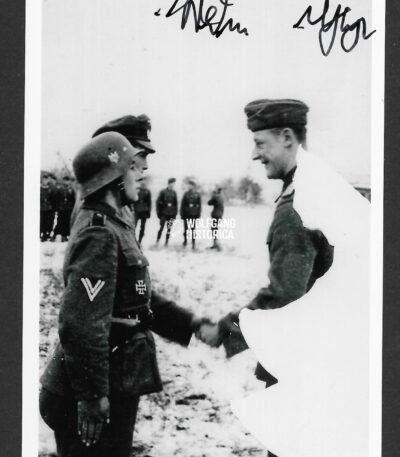
Waldemar von Gaza – Panzergrenadier-Regiment 66 (Schwertern)
€35,00Original Postwar Signature on a Postwar Photo of Waldemar von Gaza. Major Waldemar von Gaza (06.12.1917 † 13.01.2014) earned the Ritterkreuz des Eisernen Kreuzes on September 18, 1942 as Oberleutnant und Chef of the 2. Kompanie/ Panzergrenadier-Regiment 666 of the 13. Panzer-Division, the Eichenlaub on January 18, 1943 as Hauptmann und Führer of a Kampfgruppe der 13. Panzer-Division and the Schwertern on October 3, 1943 as Major und Führer of the Panzergrenadier-Regiment 66 of the 13. Panzer-Division. Condition as seen. Postcardsize.
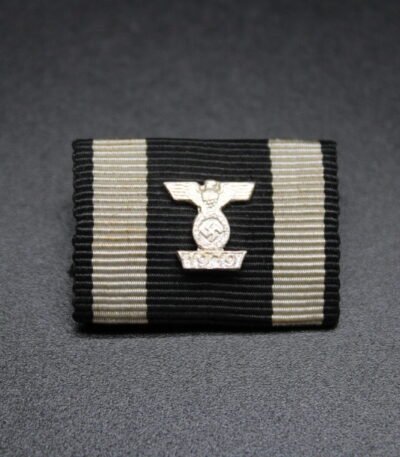
Ribbon Bar: Wiederholungsspange 1939 für das Eiserne Kreuz 2. Klasse 1914
€80,00Original single ribbon bar for the Wiederholungsspange 1939 für das Eiserne Kreuz 2. Klasse 1914 (Repeat Clasp 1939 for the Iron Cross 2nd Class 1914). Condition as seen. Comes from a jewelers hoard that was recently found!
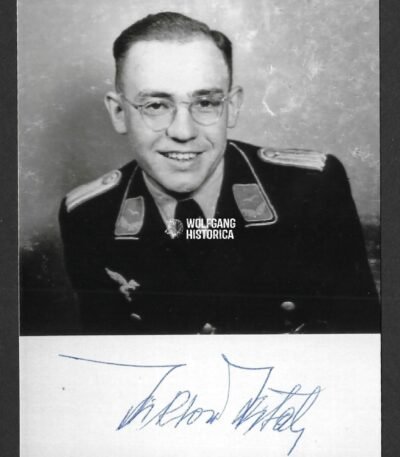
Viktor Vitali – Fallschirmjäger-Regiment 4
€25,00Original Postwar Signature on a Postwar Photo of Viktor Vitali. Oberleutnant Viktor Vitali (03.04.1920 † 06.01.2012) earned the Ritterkreuz des Eisernen Kreuzes on April 30, 1945 as Leutnant und Zugführer in the 5. Kompanie/ Fallschirmjäger-Regiment 4 of the 1. Fallschirmjäger-Division. Good condition. Postcardsize.
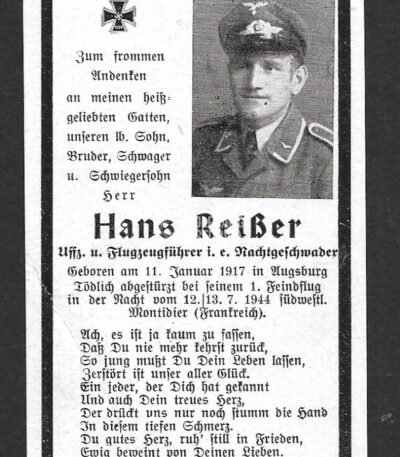
Death Card of Nachtjäger (Me 410 “Hornisse”) in Kampfgeschwader 51
€45,00Original Death Card (“Sterbebild”) of Unteroffizier Hans Reißer, who served as Nachtjäger in 5. Staffel/ Kampfgeschwader 51. He flew the Messerschmitt Me 410 “Hornisse” and crashed in Montidier, France in July 1944!
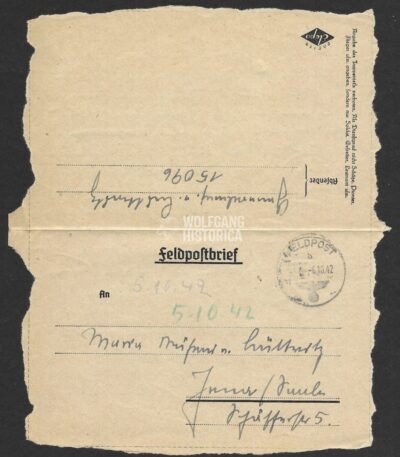
Feldpost of Smilo Freiherr von Lüttwitz (26. Panzer-Division) (Schwertern)
€125,00Original Feldpost of Smilo Freiherr von Lüttwitz. General der Panzertruppen Smilo Freiherr von Lüttwitz (23.12.1895 in Straßburg † 19.05.1975 in Koblenz) earned the Ritterkreuz des Eisernen Kreuzes on January 14, 1942 as Oberst and Kommandeur of 4. Panzer-Division; the Eichenlaub on March 16, 1944 as Generalleutnant und Kommandeur of the 26. Panzer-Division and the Schwertern on July 4, 1944 as Generalleutnant und Kommandeur of the 26. Panzer-Division.