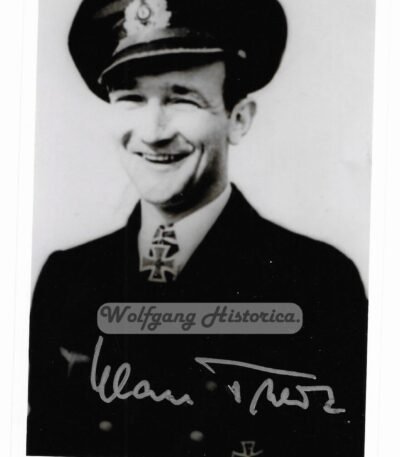
Ernst Barkmann – SS-Panzer-Regiment 2 “Das Reich” (Normandy)

60,00

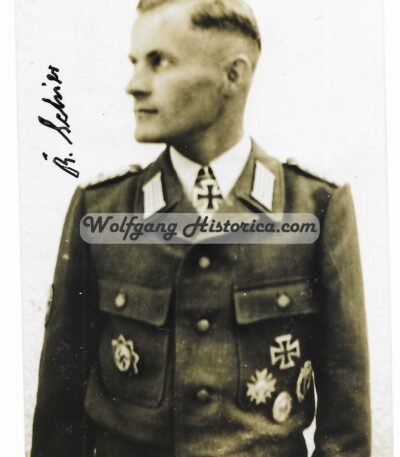
Original Postwar Signature on a Postwar Photo of Ernst Barkmann. SS-Oberscharführer Ernst Barkmann (25.08.1919 in Kisdorf † 27.06.2009) earned the Ritterkreuz des Eisernen Kreuzes on August 27, 1944 as SS-Unterscharführer und Panzerkommandant in the 4. Kompanie/ SS-Panzer-Regiment 2 of the 2. SS-Panzer-Division “Das Reich”. Postcardsize. Condition as seen.

Kurt Sametreiter – SS-Panzerjäger-Abteilung 1 “LSSAH”

65,00

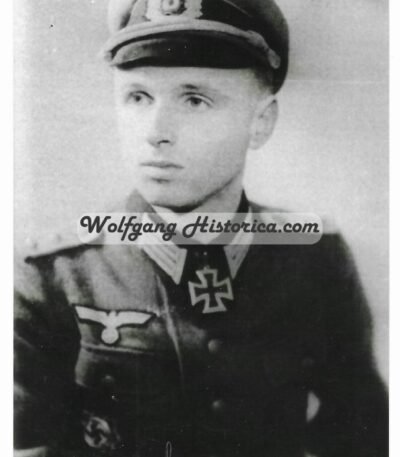
Original Postwar Signature on a Postwar Photo of Kurt Sametreiter. SS-Untersturmführer Kurt Sametreiter (09.04.1922 † 28.01.2017) earned the Ritterkreuz on July 31, 1943 as SS-Oberscharführer und Zugführer in the 1. Kompanie/ SS-Panzerjäger-Abteilung 1 “LSSAH” of the 1. SS-Panzer-Division “LSSAH”.

Max Wünsche – SS-Panzer-Regiment 1 “LSSAH” & 12 “Hitlerjugend” (Eichenlaub)

180,00

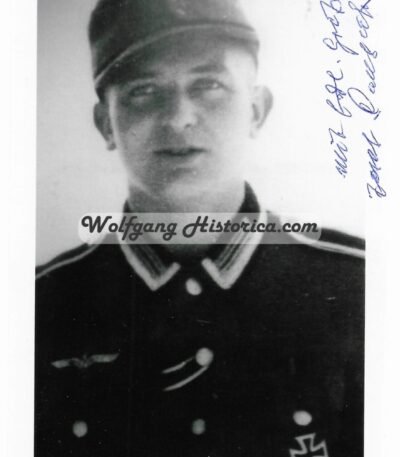
Original Postwar Signature on a Postwar Photo of Max Wünsche. SS-Standartenführer Max Wünsche (20.04.1914 † 17.04.1995) earned the Ritterkreuz des Eisernen Kreuzes on February 28, 1943 as SS-Obersturmbannführer und Kommandeur of the Stab der I./ SS-Panzer-Regiment 1 of the 1. SS-Panzer-Division “LSSAH” and the Eichenlaub on August 11, 1944 as SS-Obersturmbannführer und Komanndeur of the SS-Panzer-Regiment 12 of the 12. SS-Panzer-Division “Hitlerjugend”. Size: 20x25cm.

Max Wünsche was born on 20 April 1914 in Kittlitz. In July 1933 Wünsche joined the SS. In 1935, he graduated from SS-Junkerschule at Bad Tölz and was promoted to Untersturmführer. Wünsche was then posted to the Leibstandarte SS Adolf Hitler (LSSAH) as a platoon leader. In October 1938, Wünsche was assigned as an orderly officer for Hitler. In that role, Wünsche joined the Führerbegleitkommando (the SS bodyguard unit), which provided personal security for Hitler. In January 1940 he was again posted to the LSSAH, as a platoon commander in a motorcycle company under the command of Kurt Meyer, for the invasion of the Netherlands and the Battle of France. In December 1940 he became an adjutant to Sepp Dietrich during the invasion of the Balkans (Operation Marita) and the invasion of the Soviet Union (Operation Barbarossa). In February 1942 Wünsche was given the command of the LSSAH Sturmgeschütz (assault gun) battalion. In 1942 Wünsche completed the General Staff training course at the Staff College in Germany and was promoted to Sturmbannführer. In September 1942 he was posted to the LSSAH and resumed command of the Sturmgeschütz battalion; in October he assumed command of a battalion in a panzer regiment of LSSAH. His battalion’s first action was at Kharkov in 1943. On 25 February 1943 Wünsche’s battalion went into action against a defensive position manned by the Soviet 350th Rifle Division. Supported by artillery and a company of SS grenadiers, Wünsche’s battalion attacked and overran the Soviet front lines. Wünsche’s assault would lead to the destruction of 47 artillery pieces and anti-tank guns. For his actions during the battles for Kharkov, Wünsche was awarded the German Cross in Gold and later the Knight’s Cross, both in February 1943. In June 1943, Wünsche was transferred to a new division forming in France, 12th SS Panzer Division Hitlerjugend, to take command of the 12th SS Panzer Regiment. On 6 June 1944, the Allies landed in Normandy (Operation Overlord) and the division was committed to action on 7 June. The division was later trapped in the Falaise pocket, where on the night of 20 August, Wünsche escaped on foot. He was wounded and taken prisoner by British soldiers. Wünsche spent the rest of the war as a prisoner of war in camp 165 at Caithness, Scotland, a special camp for high-ranking German officers. In 1948 Wünsche was released and returned to Germany. He died in 1995.

Read more on Max Wünsche (Wikipedia)

Alfred Czech – Youngest EKII Recipient (“Downfall”) (Greeted by Hitler)

100,00

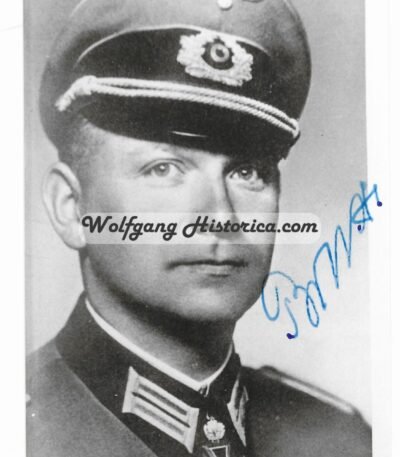
Original Postwar Signature on a Postwar Photo of Alfred Czech (Alfred Zech). Alfred Czech (12.10.1932 † 13.06.2011) earned the Eisernes Kreuz 2. Klasse in April 1945. Condition as seen. Postcardsize.

Fritz Darges – SS-Panzer-Regiment 5 “Wiking” & Personal Adjutant of Adolf Hitler

40,00

Original Postwar Signature on a Postwar Paper of Fritz Darges. SS-Obersturmbannführer Fritz Darges (08.02.1913 in Dülseberg † 25.10.2009 in Celle) earned the Ritterkreuz des Eisernen Kreuzes on April 5, 1945 as SS-Obersturmbannführer und Führer of the SS-Panzer-Regiment 5 of the 5. SS-Panzer-Division “Wiking”. Condition as seen. NOTE: The signature is written on a paper on which a photo in pasted!

He served as an Adjutant to Martin Bormann and later was a personal Adjutant to Adolf Hitler. After his death a manuscript with his memoirs was published. Read more on Fritz Darges (Wikipedia)

Karl-Heinz Euling – SS-Panzer-Grenadier-Regiment 21 (Arnhem, Nijmegen)

55,00

Original Postwar Signature on a Postwar Photo of Karl-Heinz Euling. SS-Hauptsturmführer Karl-Heinz Euling (16.08.1919 † 14.04.2014) earned the Ritterkreuz des Eisernen Kreuzes on October 15, 1944 as SS-Hauptsturmführer und Kommandeur of the I. Bataillon/ SS-Panzer-Grenadier-Regiment 21 of the 10. SS-Panzer-Division “Frundsberg”. Condition as seen.

Remi Schrijnen – 6. SS-Freiwilligen-Sturmbrigade “Langemarck”

35,00

Original Postwar Signature on a Postwar Photo of Remi Schrijnen. SS-Unterscharführer Remi Schrijnen (24.12.1921 † 27.07.2006) earned the Ritterkreuz on September 21, 1944 as SS-Sturmmann und Richtschütze in the 6. Kompanie/ 6. SS-Freiwilligen-Sturmbrigade “Langemarck”. Condition as seen.

Knight’s Cross: “On 29.07.1944 Schrijnen was serving as the crew of a Pak 40 in the middle of a major Soviet tank/infantry attack. His position was hit by a heavy artillery barrage, with several rounds impacting just 10 metres behind the gun. Schrijnen was hit by several shell splinters, but the four other crewman all became casualties. Under the weight of the Soviet attack the order was given to withdraw. Schrijnen however disobeyed the order and remained behind to cover his comrades. Despite being wounded, exhausted and vastly outnumbered he was still able to knock out 4 T-34s and 3 IS-2s before his gun was destroyed. Later, counterattacking German forces found Schrijnen unconscious on the battlefield. He would receive the Knight’s Cross for his actions this day as well as for prior successes as an anti-tank gunner.”

Heinz Jürgens – SS-Polizei-Panzeraufklärungs-Abteilung 4

35,00

Original Postwar Signature on a Postwar Photo of Heinz Jürgens. SS-Hauptsturmführer Heinz Jürgens (21.03.1917 † 07.07.2008) earned the Ritterkreuz des Eisernen Kreuzes on May 9, 1945 as SS-Hauptsturmführer und Kommandeur of the SS-Polizei-Panzeraufklärungs-Abteilung 4 of the 4. SS-Polizei-Panzergrenadier-Division. Condition as seen. Smaller size.

Hans Hauser – SS-Panzer-Grenadier-Regiment 4 “Der Führer”

45,00

Original Postwar Signature on a Postwar Photo of Hans Hauser. SS-Sturmbannführer Hans Hauser (31.01.1916 † 21.11.2001) earned the Ritterkreuz des Eisernen Kreuzes on May 6, 1945 as SS-Sturmbannführer und Kommandeur of the I. Bataillon/ SS-Panzer-Grenadier-Regiment 4 “Der Führer” of the 2. SS-Panzer-Division “Das Reich”. Condition as seen. Postcardsize.

Josef “Sepp” Lainer – SS-Panzer-Grenadier-Regiment 4 “Der Führer” (RK + NKIG!)

50,00

Original Postwar Signature on a Postwar Photo of Josef Lainer. Josef “Sepp” Lainer (13.03.1920 † 04.09.2002) earned the Ritterkreuz des Eisernen Kreuzes on October 8, 1943 as as SS-Oberscharführer und Zugführer in the 3. Kompanie/ SS-Panzer-Grenadier-Regiment 4 “Der Führer” of the 2. SS-Panzer-Division “Das Reich” and the Nahkampfspange in Gold on October 15, 1943 as SS-Hauptscharführer und Zugführer in the 1. Kompanie/ SS-Panzer-Grenadier-Regiment 4 “Der Führer”. Smaller size. Condition as seen.

Walter Schmidt – SS-Panzergrenadier-Regiment “Westland” (Eichenlaub)

55,00

Original Postwar Signature on a Postwar Photo & Letter of Walter Schmidt. SS-Obersturmbannführer Walter Schmidt (28.01.1917 † 28.07.2000) earned the Ritterkreuz on August 4, 1943 as SS-Hauptsturmführer und Kommandeur of the III. Bataillon/ SS-Panzergrenadier-Regiment “Westland” and the Eichenlaub on May 14, 1944 as SS-Hauptsturmführer und und Kommandeur of the III. Bataillon/ SS-Panzergrenadier-Regiment “Westland” of the 5. SS-Panzer-Division “Wiking”. Condition as seen. Smaller size.

Kurt-Peter Müller – SS-VT, “Prinz Eugen” & V. SS-Freiwilligen-Gebirgskorps

65,00

Original Scarce Postwar Signature on a Postwar Photo of Kurt-Peter Müller. SS-Brigadeführer und Generalmajor der Waffen-SS Kurt-Peter Müller (10.03.1894 in Offenburg † 11.02.1993 in Pfullingen) served with the SS-Verfügungsdivision,  7. SS-Freiwilligen-Gebirgs-Division “Prinz Eugen” and V. SS-Freiwilligen-Gebirgskorps. Condition as seen. Smaller size.

Heinz Werner – SS-Panzer-Grenadier-Regiment 4 “Der Führer” (Eichenlaub)

0,01

Original Scarce Postwar Signature on a Postwar Photo of Heinz Werner. SS-Sturmbannführer Heinz Werner (02.12.1917 † 08.08.1978) earned the Ritterkreuz on April 21, 1944 as SS-Hauptsturmführer und Kommandeur of the III. Bataillon/ SS-Panzer-Grenadier-Regiment 4 “Der Führer” and the Eichenlaub on May 6, 1945 as SS-Sturmbannführer und Kommandeur of the III. Bataillon/ SS-Panzer-Grenadier-Regiment 4 “Der Führer” of the 2. SS-Panzer-Division “Das Reich“. Condition as seen. Smaller size.

Karl Ullrich – Pionier-Bataillon “Totenkopf” & “Theodor Eicke” (Eichenlaub)

0,01

Original Postwar Signature on a Postwar Photo of Karl Ullrich. SS-Oberführer Karl Ullrich (01.12.1910 † 08.05.1996) earned the Ritterkreuz on February 19, 1942 as SS-Sturmbannführer und Kommandeur of the SS-Pionier-Bataillon “Totenkopf” and the Eichenlaub on May 14, 1944 as SS-Obersturmbannführer und Kommandeur of the SS-Panzer-Grenadier-Regiment 6 “Theodor Eicke” of the 3. SS-Panzer-Division “Totenkopf“. Last commander of the 5. SS-Panzer-Division “Wiking”. Smaller size.

Fritz Wilhelm Schütter – 2. SS-Panzer-Division “Das Reich” & Book Author

25,00

Original Postwar Signature on a Postwar Card of Fritz Wilhelm Schütter. SS-Hauptsturmführer Fritz Wilhelm Schütter (24.09.1912 in Halle † 02.05.1992) served with the 2. SS-Panzer-Division “Das Reich” and was Abteilungsleiter beim Chef des Fernmeldewesens im Reichsinnenministerium. He was the author of Männer der Waffen-SS: Der Weg einer Truppe. Postcardsize. Condition as seen. Several available.

Wilhelm Bittrich – II. SS-Panzerkorps (Normandy, Market Garden) (Schwertern)

0,01

Original Scarce Postwar Signature on a Photo of Wilhelm Bittrich. SS-Obergruppenführer und General der Waffen-SS Wilhelm Bittrich (26.02.1894 † 19.04.1979) earned the Ritterkreuz des Eisernen Kreuzes on December 14, 1941 as SS-Oberführer und Kommandeur of the SS-Panzergrenadier-Regiment “Deutschland”, the Eichenlaub on August 28, 1944 as SS-Obergruppenführer und Kommandierender General of the II. SS-Panzerkorps and the Schwertern on May 6, 1945 as SS-Obergruppenführer und Kommandierender General of the II. SS-Panzerkorps. Condition as seen.

Between August 1942 and February 1943, Bittrich commanded the SS Cavalry Division Florian Geyer, in rear security operations (Bandenbekämpfung, literally: “bandit fighting”) in the Soviet Union. From July 1944 until the end of the war Bittrich commanded the 2nd SS Panzer Corps in Normandy, during Market Garden and in Hungary.

After his arrest in May 1945, Bittrich was extradited to France on charges of having ordered the execution of 17 members of the French Resistance. He was tried, convicted and sentenced to five years in prison. Following his release from prison, Bittrich became active in HIAG, a revisionist organization and a lobby group of former Waffen-SS members and served as chairman during the 1970s.

Paul “Papa” Hausser – SS-Oberst-Gruppenführer (RK+EL+SW!)

0,01

Original Postwar Signature on a Postwar Photo of Paul “Papa” Hausser. SS-Oberst-Gruppenführer und Generaloberst der Waffen-SS Paul Hausser (07.10.1880 † 21.12.1972) earned the Ritterkreuz on August 8, 1943 as SS-Gruppenführer und Kommandeur of the SS-Division “Das Reich”, the Eichenlaub on July 28, 1943 as SS-Obergruppenführer und Kommandierender General of the II. SS-Panzer-Korps of the 2. SS-Panzer-Division “Das Reich” and Schwertern on August 26, 1944 as SS-Oberst-Gruppenführer und Oberbefehlshaber of the 7. Armee for achievements during the Battle of Normandy. Postcardsize. Condition as seen.

Paul-Albert Kausch – SS-Panzer-Regiment 11 “Hermann von Salza” (Eichenlaub)

75,00

Original Postwar Signature on a Postwar Photo of Paul-Albert Kausch. SS-Obersturmbannführer Paul-Albert Kausch (03.03.1911 in Jädersdorf † 27.10.2001 in Ingelheim) earned the Ritterkreuz des Eisernen Kreuzes on August 23, 1944 as SS-Obersturmbannführer und Kommandeur of the SS-Panzer-Abteilung 11 “Hermann von Salza” and the Eichenlaub on April 23, 1945 as SS-Obersturmbannführer und Kommandeur of the SS-Panzer-Regiment 11 “Hermann von Salza” of the 11. SS-Freiwilligen-Panzergrenadier-Division “Nordland“. Condition as seen. Postcardsize.

Oakleaves: Awarded for his leadership of the SS-Panzer-Regiment 11 during the final battles around Berlin. In the fighting east of and inside the city the unit destroyed 487 enemy tanks and was the backbone of many defensive battles, such as that on the 18.04.1945 west of Reichenberg (6 km north of Buckow). Here, out of a force of 70 Soviet tanks attacking from the Ringenwalde area, 50 were destroyed.

Paul Senghas – SS-Panzer-Regiment 5 “Wiking”

55,00

Original Postwar Signature on a Postwar Photo of Paul Senghas. SS-Hauptsturmführer Paul Senghas (31.01.1916 † 06.11.1996) earned the Ritterkreuz des Eisernen Kreuzes on December 11, 1944 as SS-Obersturmführer und Führer of the I. Abteilung/ SS-Panzer-Regiment 5 of the 5. SS-Panzer-Division “Wiking”. Condition as seen. Postcardsize.

“On the 18.08.1944 the enemy advanced towards the Warsaw-Radzymin-Wyszkow road with massive forces and strong air support. At the time the 5. SS-Panzer-Division ‘Wiking’ was located along the general line Roszcep-Trojany-Debynki. At the time SS-Obersturmführer Senghas stood as the leader of the Stabskompanie along with the supply units of the I./SS-Panzer-Regiment 5 in Zazdroso (1.5 km east of Niegow).

At 11:00 he received a message which reported the Russians as having broken through in battalion strength to a point 1 km east of the railway embankment. A wide gap existed towards the left neighbour, and there was the danger that the Russians would block the main road and thrust into the left flank of the Division. Recognizing this danger, Senghas made the decision to engage the enemy with the handful of men in the supply units at hand (despite their lack of heavy infantry weapons) and bring the Russians to a halt.

Going into position at the railway embankment, he let the Russians approach to within very close range and then smashed their attack. Reinforcements could not be brought up, and so Senghas defended with his handful of men for the remainder of that day and also the two following days, fighting off strong enemy attacks with only rifles, sub-machine guns and close combat weapons. During this time 2 Panzer IVs, which had been in the repair shop and were only conditionally operational, were brought into the fight. 2 Sherman tanks and 1 T-34 were destroyed immediately after they appeared. The Russians took heavy losses in men and ceased their attacks.

By his own initiative and personal devotion to duty, Senghas thus brought the 3 days of close combat to a conclusion. An enemy breakthrough was prevented and the danger to the left flank of the Division removed. Senghas is one of the oldest Eastern front combat veterans, who has mastered many critical situations through swift decisiveness and bold action while ruthlessly demanding the utmost of himself.”

Heinrich Debus – SS-Panzer-Aufklärungs-Abteilung 5 “Wiking”

60,00

Original Postwar Signature on a Postwar Photo of Heinrich Debus. SS-Hauptsturmführer Heinrich Debus (30.06.1921 † 05.03.1996) earned the Ritterkreuz on May 4, 1944 as SS-Obersturmführer und Führer of the SS-Panzer-Aufklärungs-Abteilung 5 of the 5. SS-Panzer-Division “Wiking”.

Max Hansen – SS-Panzergrenadier-Regiment 1 “LSSAH” (EL+NKIG)

0,01

Original Postwar Signature on a Postwar Photo of Max Hansen. SS-Standartenführer Max Hansen (31.07.1908 † 07.03.1990) earned the Ritterkreuz on March 18, 1943 as SS-Sturmbannführer und Kommandeur of the II. Bataillon/ SS-Panzergrenadier-Regiment 1, the Eichenlaub on April 17, 1945 as SS-Standartenführer und Kommandeur of the SS-Panzergrenadier-Regiment 1 of the 1. SS-Panzer-Division “LSSAH“ and the Nahkampfspange in Gold on March 12, 1945. Condition as seen.

Walter Harzer – 9. SS-Panzer-Division “Hohenstaufen” (Arnhem)

0,01

Original Scarce Postwar Signature on a Postwar Photo of Walter Harzer. SS-Standartenführer Walter Harzer (29.09.1912 † 29.05.1982) earned the Ritterkreuz on September 21, 1944 as SS-Obersturmbannführer und Ia of the 9. SS-Panzer-Division “Hohenstaufen“. Harzer is famous for his role defeating the British at Arnhem! Condition as seen.

Read more about Walter Harzer (Wikipedia).

Johannes Göhler – SS-Reiter-Regiment 1 “Florian Geyer”

45,00

Original Postwar Signature on a Postwar Photo of  Johannes Göhler. SS-Sturmbannführer Johannes Göhler (15.09.1918 † 21.02.2003) earned the Ritterkreuz des Eisernen Kreuzes on September 17, 1943 as SS-Obersturmführer und Kommandeur of the 4. Schwadron/ SS-Reiter-Regiment 1 of the 8. SS-Kavallerie-Division “Florian Geyer”. Condition as seen.

Wilhelm Keilhaus – SS-Division “LSSAH” & Chef Fernmeldewesen Himmler

150,00

Original Scarce Postwar Signature on a Postwar Photo of Wilhelm Keilhaus. SS-Brigadeführer und Generalmajor der Waffen-SS Wilhelm Keilhaus (11.12.1898 in Hohenstein-Ersthal † 11.01.1977 in Karlsruhe) earned the Deutsches Kreuz in Gold on April 29, 1942 as SS-Obersturmbannführer und Ia with the Stab/ SS-Division “LSSAH”. Postcardsize. Condition as seen.

Hugo Eichhorn – SS-Panzer-Pionier-Bataillon 5 “Wiking”

55,00

Original Postwar Signature on a Postwar Photo of Hugo Eichhorn. SS-Obersturmbannführer Hugo Eichhorn (11.02.1911 † 27.05.1992) earned the Ritterkreuz des Eisernen Kreuzes on January 15, 1943 as SS-Hauptsturmführer with the Stab/ S-Panzer-Pionier-Bataillon 5 of the 5. SS-Panzer-Division “Wiking”.

Knight’s Cross: “On the 08.01.1943 SS-Hauptsturmführer Eichhorn first defended Orlowskaja against a regimental-sized attack on his own initiative with 2 weak Kompanien. Then, in a counterthrust of his own, he smashed the enemy’s 550th Regiment. Through this Eichhorn has exhibited an example of the highest devotion to duty, and through his independent actions he once again brought the important road/railway junction firmly under friendly control. Over 700 enemy dead were counted. 5 artillery pieces, 3 heavy anti-tank guns, 1 heavy AA gun, 8 anti-tank rifles, 22 MGs, numerous small arms and 30 horse-drawn wagons were also captured.”

Hermann Buch – “Der Führer” & 2. SS-Panzer-Division “Das Reich”

35,00

Original Postwar Signature of Hermann Buch, Officer of the 2. SS-Panzer-Division “Das Reich”. Reference below from Author Michael Miller.

Friedrich Hermann Robert Buch
SS-Hauptsturmführer

Born: 16.02.1920 in Scheuern/Gernsbach.
Died: 12.11.2012 in a retirement home near Budapest, Hungary. He had resettled to that country with his family on 15.09.2000.

NSDAP-Nr.:
SS-Nr.: 357 263 (Joined 01.11.1938)

Promotions:
SS-Untersturmführer
SS-Obersturmführer
SS-Hauptsturmführer

Career:
Adjutant of SS-Kradschützen-Bataillon/SS-Division (mot.) “Reich”.
Kompanieführer of 3. Kompanie/SS-Kradschützen-Bataillon/SS-Division “Reich” (mot.).
Kompanieführer of 15. Kompanie/SS-Panzer-Grenadier-Regiment “Der Führer”/SS-Panzer-Grenadier-Division “Das Reich”.
Severely wounded, then on convalescent leave.
Assigned to Verwaltungsdienst (administrative service) at SS-Junkerschule Bad Tölz.
Divisions-Adjutant (IIa) of 2. SS-Panzer-Division “Das Reich”.

Postwar Activities:
00.00.1945-00.00.194_ In Allied captivity.
00.00.19__-00.00.19__ Editor of Der Freiwillige (the Waffen-SS veterans publication).
22.10.1971 Founded the “Vereinigung der Freunde der SS-Division ‘Das Reich’” (Assocation of Friends of the SS-Division “Das
Reich”
) in Rosenheim.

Decorations & Awards:
1939 Eisernes Kreuz I. Klasse
1939 Eisernes Kreuz II. Klasse
Infanterie-Sturmabzeichen in Bronze
Verwundetenabzeichen, 1939 in Silber
Verwundetenabzeichen, 1939 in Schwarz
Medaille “Winterschlacht im Osten 1941/42”
Goldenes Hitler-Jugend Ehrenzeichen
Ehrenwinkel für alte Kämpfer

Karl-Heinz Ertel – SS-Panzer-Grenadier-Regiment 49 “De Ruyter” (“Nederland” Division)

55,00

Original Postwar Signature on a Postwar Photo of Karl-Heinz Ertel. SS-Hauptsturmführer Karl-Heinz Ertel (26.11.1919 in Brambauer † 25.01.1993 in Langenberg) earned the Ritterkreuz des Eisernen Kreuzes on August 23, 1944 as SS-Hauptsturmführer und Adjutant of the SS-Panzer-Grenadier-Regiment 49 “De Ruyter” of the SS-Freiwilligen-Panzer-Grenadier-Brigade “Nederland”.

Ritterkreuz: “Following heavy retreat battles, on the night of the 25./26.07.1944 the Tannenberg Line between Orphanage Hill and the Gulf of Finland was occupied by the Regiment 49 ‘De Ruyter’. The Regiment had the mission of holding this line against all enemy attacks. The enemy commenced an immediate assault with a much greater number of divisions, which were aided by strong tank, artillery and air support. In a sacrificial battle, the Regiment succeeded in defeating all enemy attacks with extremely high losses for the foe. In this major struggle the commander of the Regiment, SS-Obersturmbannführer Collani, fell in battle. In this moment of crisis his adjutant, SS-Hauptsturmführer Ertel, took over leadership of the Regiment. Undeterred by the strong enemy fire from tanks, rocket launchers, artillery and aircraft, he repeatedly went to the hotspots of the fighting. From these points he inspired officers, NCOs and men to offer up their greatest possible resistance via his own exemplary behaviour. Even after being wounded by a shell splinter to the face he remained with the Regiment and maintained a firm grip over its command. His crisis-proof, exemplary attitude was of immeasurable value to the Brigade in the hours of its greatest test on the battlefield. He significantly contributed to the prevention of the intended enemy breakthrough against Reval.”

Walter Gerth – SS-Artillerie-Regiment 3 “Totenkopf”

0,01

Original Postwar Signature on a Postwar Photo of Walter Gerth. SS-Sturmbannführer Walter Gerth (14.12.1914 † 10.01.1995) earned the Ritterkreuz on March 31, 1943 as SS-Obersturmführer und Chef of the 7. Batterie/ SS-Artillerie-Regiment 3 “Totenkopf” of the 3. SS-Panzer-Division “Totenkopf”. Condition as seen. Postcardsize.

Hanns-Heinrich Lohmann – “Norge” & “De Ruyter” (Eichenlaub)

75,00

Read more about Hanns-Heinrich Lohmann (Traces of War).

Paul “Papa” Hausser – SS-Oberst-Gruppenführer (RK+EL+SW!)

0,01

Original Postwar Signature on a Postwar Photo of Paul “Papa” Hausser. SS-Oberst-Gruppenführer und Generaloberst der Waffen-SS Paul Hausser (07.10.1880 † 21.12.1972) earned the Ritterkreuz on August 8, 1943 as SS-Gruppenführer und Kommandeur of the SS-Division “Das Reich”, the Eichenlaub on July 28, 1943 as SS-Obergruppenführer und Kommandierender General of the II. SS-Panzer-Korps of the 2. SS-Panzer-Division “Das Reich” and Schwertern on August 26, 1944 as SS-Oberst-Gruppenführer und Oberbefehlshaber of the 7. Armee for achievements during the Battle of Normandy. Postcardsize. Condition as seen.

Max Wünsche – SS-Panzer-Regiment 1 “LSSAH” & 12 “Hitlerjugend” (Eichenlaub)

0,01

Original Postwar Signature on a Postwar Photo of Max Wünsche. SS-Standartenführer Max Wünsche (20.04.1914 † 17.04.1995) earned the Ritterkreuz des Eisernen Kreuzes on February 28, 1943 as SS-Obersturmbannführer und Kommandeur of the Stab der I./ SS-Panzer-Regiment 1 of the 1. SS-Panzer-Division “LSSAH” and the Eichenlaub on August 11, 1944 as SS-Obersturmbannführer und Komanndeur of the SS-Panzer-Regiment 12 of the 12. SS-Panzer-Division “Hitlerjugend”.

Max Wünsche was born on 20 April 1914 in Kittlitz. In July 1933 Wünsche joined the SS. In 1935, he graduated from SS-Junkerschule at Bad Tölz and was promoted to Untersturmführer. Wünsche was then posted to the Leibstandarte SS Adolf Hitler (LSSAH) as a platoon leader. In October 1938, Wünsche was assigned as an orderly officer for Hitler. In that role, Wünsche joined the Führerbegleitkommando (the SS bodyguard unit), which provided personal security for Hitler. In January 1940 he was again posted to the LSSAH, as a platoon commander in a motorcycle company under the command of Kurt Meyer, for the invasion of the Netherlands and the Battle of France. In December 1940 he became an adjutant to Sepp Dietrich during the invasion of the Balkans (Operation Marita) and the invasion of the Soviet Union (Operation Barbarossa). In February 1942 Wünsche was given the command of the LSSAH Sturmgeschütz (assault gun) battalion. In 1942 Wünsche completed the General Staff training course at the Staff College in Germany and was promoted to Sturmbannführer. In September 1942 he was posted to the LSSAH and resumed command of the Sturmgeschütz battalion; in October he assumed command of a battalion in a panzer regiment of LSSAH. His battalion’s first action was at Kharkov in 1943. On 25 February 1943 Wünsche’s battalion went into action against a defensive position manned by the Soviet 350th Rifle Division. Supported by artillery and a company of SS grenadiers, Wünsche’s battalion attacked and overran the Soviet front lines. Wünsche’s assault would lead to the destruction of 47 artillery pieces and anti-tank guns. For his actions during the battles for Kharkov, Wünsche was awarded the German Cross in Gold and later the Knight’s Cross, both in February 1943. In June 1943, Wünsche was transferred to a new division forming in France, 12th SS Panzer Division Hitlerjugend, to take command of the 12th SS Panzer Regiment. On 6 June 1944, the Allies landed in Normandy (Operation Overlord) and the division was committed to action on 7 June. The division was later trapped in the Falaise pocket, where on the night of 20 August, Wünsche escaped on foot. He was wounded and taken prisoner by British soldiers. Wünsche spent the rest of the war as a prisoner of war in camp 165 at Caithness, Scotland, a special camp for high-ranking German officers. In 1948 Wünsche was released and returned to Germany. He died in 1995.

Read more on Max Wünsche (Wikipedia)

Rudolf Enseling – SS-Panzer-Regiment 2 “Das Reich” (Normandy)

0,01

Original Scarce Postwar Signature on a Postwar Photo of Rudolf Enseling. SS-Obersturmbannführer Rudolf Enseling (30.08.1914 † 25.01.1977) earned the Ritterkreuz des Eisernes Kreuzes on August 23, 1944 as SS-Obersturmbannführer und Kommandeur of the I. Bataillon/ SS-Panzer-Regiment 2 of the 2. SS-Panzer-Division “Das Reich”. Postcardsize. Condition as seen.

Herbert Schulze – SS-Panzer-Grenadier-Regiment 4 “Der Führer” (RK+NKIG)

0,01

Original Postwar Signature on a Postwar Photo of Herbert Schulze. SS-Sturmbannführer Herbert Schulze (01.04.1914 † 02.02.1992) earned the Ritterkreuz on December 16, 1943 as as SS-Sturmbannführer und Kommandeur of the II. Bataillon/ SS-Panzer-Grenadier-Regiment 4 “Der Führer” of the 2. SS-Panzer-Division “Das Reich”. He also the Nahkampfspange in Gold on November 9, 1943. Postcardsize. Condition as seen.

Gustav Lombard – SS-Reiter-Regiment 1

0,01

Original Postwar Signature on a Postwar Photo of Gustav Lombard. SS-Brigadeführer Gustav Lombard (10.04.1894 † 18.09.1992) earned the Ritterkreuz on March 10, 1943 as SS-Obersturmbannführer und Kommandeur of the SS-Reiter-Regiment 1 of the SS-Kavallerie-Division “Florian Geyer”. Good condition. Measuring: Postcardsize.
Read more about Gustav Lombard (Wikipedia).

Rudolf von Ribbentrop – SS-Panzer-Regiment 1 “LSSAH” & 12 “Hitlerjugend” (Kharkov, Kursk, Normandy & Ardennes!)

0,01

Original Postwar Signature on a Postwar Photo of Rudolf von Ribbentrop. SS-Hauptsturmführer Rudolf von Ribbentrop (11.05.1921 in Wiesbaden † 20.05.2019 in Ratingen) earned the Ritterkreuz des Eisernen Kreuzes on July 15, 1943 as SS-Obersturmführer und Führer of the 6. Kompanie/ SS-Panzer-Regiment 1 of the 1. SS-Panzer-Division “LSSAH” and the Deutsches Kreuz in Gold on August 25, 1944 with the 3. Kompanie/ SS-Panzer-Regiment 12 of the 12. SS-Panzer-Division “Hitlerjugend”. Condition as seen. Postcardsize.

He participated in many of the most famous battles of World War II: Kharkov, Kursk, Normandy, Falaise and the Ardennes!

Amandus Ahlf – SS-Panzer-Aufklärungs-Abteilung 1 “LSSAH”

0,01

Original Postwar Signature on a Postwar Photo of Amandus Ahlf! SS-Unterscharführer Amandus Ahlf (05.05.1923 † 23.07.2018) who served with the Flakzug/ SS-Panzer-Aufklärungs-Abteilung 1 “Leibstandarte-SS Adolf Hitler” of the 1. SS-Panzer-Division “LSSAH“. Wounded in Charkow. Condition as seen.

DOUBLE SIGNED: Albert Frey & Wife Lotte Frey – SS-Panzer-Grenadier-Regiment 1 “LSSAH” (Eichenlaub)

0,01

Original Postwar Signature on a Postwar Photo of Albert Frey and his wife Lotte Frey! SS-Standartenführer Albert Frey (16.02.1913 † 01.09.2003) earned the Deutsches Kreuz in Gold on November 17, 1941 with SS-Infanterie-Regiment “Leibstandarte-SS Adolf Hitler”, the Ritterkreuz on March 3, 1943 as SS-Sturmbannführer und Kommandeur of the I. Bataillon/ SS-Panzer-Grenadier-Regiment 1 “LSSAH” and the Eichenlaub on December 29, 1943 as SS-Obersturmbannführer und Kommandeur of the SS-Panzer-Grenadier-Regiment 1 of the 1. SS-Panzer-Division “LSSAH“. Condition as seen.

KIA Waffen-SS Soldbuch – Battle of Berlin with Regiment “Norge” of “Nordland”!

0,01

Original KIA Waffen-SS Soldbuch of SS-Panzergrenadier Karl Müller who was Killed in Action on April 23, 1945 in Berlin-Biesdorf.. only 6 km away from the Führerbunker! He first served with the SS-Regiment Falke before serving with the 6. Kompanie/ SS-Panzergrenadier-Regiment “Norge” of the 11. SS-Freiwilligen-Panzergrenadier-Division “Nordland” during the Battle of Berlin! Super rare. Condition as seen.

Waffen-SS KC Holders book filled with ca. W-SS 140 Signatures!

1.995,00

Original literature book “Their honour was loyalty : an illustrated and documentary history of the Knight’s Cross holders of the Waffen-SS and police 1940-1945” by Jost W. Schneider! Containing circa 140 signatures almost all exclusive Waffen-SS Signatures. Only a few are Wehrmacht ones who were subordinated to Waffen-SS units. Includes rare signatures of Erich Göstl, Josef Diefenthal, Wolfgang Gast, Kurt Wahl and many more…! Incredible time capsule. Book belonged to a former W-SS veteran.

Otto Günsche – Adolf Hitler’s Personal Adjutant (WIA 20 July Plot, Führerbunker)

0,01

Original Postwar Signature on a Letter of Otto Günsche. Otto Günsche (24.09.1917 † 02.10.2003) earned the Verwundetenabzeichen “20. Juli 1944” in Schwarz and was a member of the Leibstandarte-SS Adolf Hitler before he became Adolf Hitler’s personal adjutant. Condition as seen.

With the end of Nazi Germany imminent, Günsche was tasked by Hitler on 30 April 1945 with ensuring the cremation of his body after his death. That afternoon, he stood guard outside the room in the Führerbunker where Hitler and Eva Braun committed suicide. After waiting a short time, Hitler’s valet, Heinz Linge, opened the study door with Martin Bormann at his side. The two men entered the study with Günsche right behind them. Günsche then left the study and announced that Hitler was dead to a group in the briefing room, which included Joseph Goebbels, General Hans Krebs, and General Wilhelm Burgdorf. Günsche had the table and chairs in the study moved out of the way and blankets were laid out on the floor. Hitler and Braun’s lifeless bodies were then wrapped in blankets. In accordance with Hitler’s prior written and verbal instructions, his and Braun’s bodies were carried up the stairs and through the bunker’s emergency exit to the garden behind the Reich Chancellery to be burned. Having ensured that the corpses were burnt using petrol supplied by Hitler’s chauffeur Erich Kempka, Günsche later left the Führerbunker after midnight on 1 May. On 2 May 1945, Günsche was taken prisoner by Soviet Red Army troops that were encircling the city and flown to Moscow for sharp interrogation by the NKVD.

Rochus Misch – “The Last Witness” (Führerbunker, Bodyguard of Adolf Hitler)

75,00

Original Postwar Signature on a Postwar Photo of Rochus Misch. SS-Untersturmführer Rochus Misch (29.07.1917 † 05.09.2013) served with the 1. SS-Panzer-Division “LSSAH” and afterwards with the Führerbegleitkommando (Führer Escort Command; FBK) as a bodyguard, courier, and telephone operator for Adolf Hitler. Misch was one of the last occupants of the Führerbunker in Berlin, May 1945 where he also witnessed the bodies of Eva & Adolf Hitler as well as the Goebbels family. Condition as seen. Postcardsize.

Wartime Signed Photo of Leon Degrelle – 28. SS-Freiwilligen-Panzer-Grenadier-Division “Wallonië”

0,01

Original Scarce Wartime Signature on a Photo of Leon Degrelle. SS-Standartenführer Leon Degrelle (15.06.1906 † 31.03.1994) earned the Ritterkreuz on February 20, 1944 as SS-Hauptsturmführer und Führer of the 5. SS-Freiwilligen-Sturmbrigade “Wallonien”, the Eichenlaub on August 27, 1944 as SS-Sturmbannführer und Kommandeur of the 28. SS-Freiwilligen-Grenadier-Division “Wallonien” and Nahkampfspange in Gold on September 14, 1944. Condition as seen.

Studioportrait StuG Soldier wearing Awards

0,01

Original Studioportrait of a StuG soldier wearing awards and driver’s profiency badge! Postcardsize. Condition as seen.

Stunning Studioportrait of a Marineartillerie soldier!

0,01

Original Studioportrait of a member of the Küstenartillerie (Coastal Artillery). Stunning Portrait! Postcardsize. Condition as seen.

Studioportrait Allgemeine-SS Standarte 48 “Leipzig”

0,01

Original studioportrait of a Allgemeine-SS member, wearing the collar tab for the 48. Standarte (Leipzig)! Postcardsize. Condition as seen.

Photo of Luftwaffe Pilot sitting on wing of Me 109 in Stralsund

0,01

Original photograph of a Luftwaffe pilot sitting on the wing of a Me 109 in Stralsund. Postcardsize. Condition as seen.

Business Card of SS-Standartenführer Toni Winkelnkemper (Gauamtsleiter, Reichssenders Köln)

0,01

Original business card of SS-Standartenführer Anton “Toni” Winkelnkemper (18.10.1905 in Wiedenbrück † 21.02.1968 in Mexiko Stadt) was a German jurist, SS-Standartenführer and member of the Reichsparteitags of the NSDAP. Business card features his titles as “Gauamtsleiter der NSDAP, Intendant des Reichssenders Köln”. Condition as seen.

WWII Flemish Lion Sleeve Shield (“Legion Flandern” etc.)

0,01

Original Flemish Lion sleeve shield locally Flemish produced and worn by the Flemish Waffen-SS Legion “Legion Flandern” and also by Flemish collaborations organisations like the Vlaamse Wacht or the Flemish DRK. In nice, worn condition (as I prefer it). Condition as seen.