Deutsches Schutzwall-Ehrenzeichen (“Westwall Medal”) with Peter Wilhelm Heb Pouch
€75,00
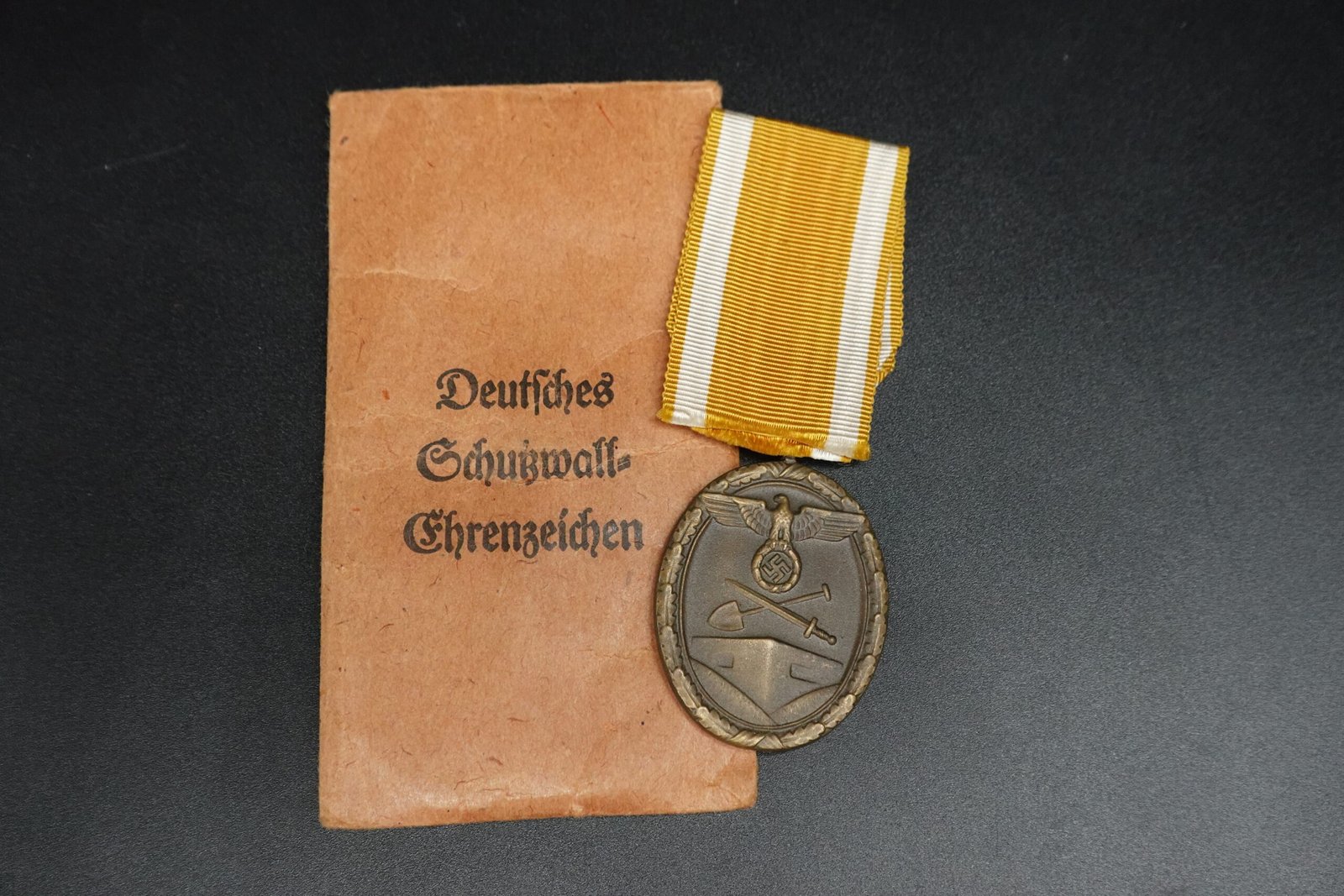
Authentic early example of the Deutsches Schutzwall-Ehrenzeichen (“Westwall Medal”), struck in bronzed buntmetall and preserved in near mint condition. The medal retains a crisp strike with excellent detail across both obverse and reverse. Consistent with all original examples, the medal is unmarked.
Complete with its original and matching issue pouch by Peter Wilhelm Heb, also in outstanding condition with only minimal signs of storage and age.
A highly desirable and complete set, ideal for the advanced collector of German WWII awards.
The Deutsches Schutzwall-Ehrenzeichen (“Westwall Medal”) was instituted on August 2, 1939, to recognize the engineers, laborers, and military personnel involved in the construction and manning of Germany’s western defensive fortifications, commonly known as the Siegfried Line.
The medal was originally struck in bronzed brass (buntmetall) and features an oval design with a bunker, crossed sword and shovel, and a national eagle on the obverse. The reverse bears the inscription “Für Arbeit zum Schutze Deutschlands” (“For work in the defense of Germany”).
Awards were made until January 31, 1941, with approximately 622,064 medals issued.
In 1944, as the western front once again became active following the Allied invasion of France, a second production period was initiated. These later examples were typically produced in bronzed zinc due to material shortages. A clasp bearing the date “1944” was authorized for prior recipients, though it is believed that relatively few were produced and awarded.