Soviet WWII Medal “For Courage” (Silver, Numbered)
Authentic Soviet Medal “For Courage” (also known as “For Valour”, Russian: «ЗА ОТВАГУ»), one of the most respected Soviet decorations awarded for personal bravery and heroism in combat.
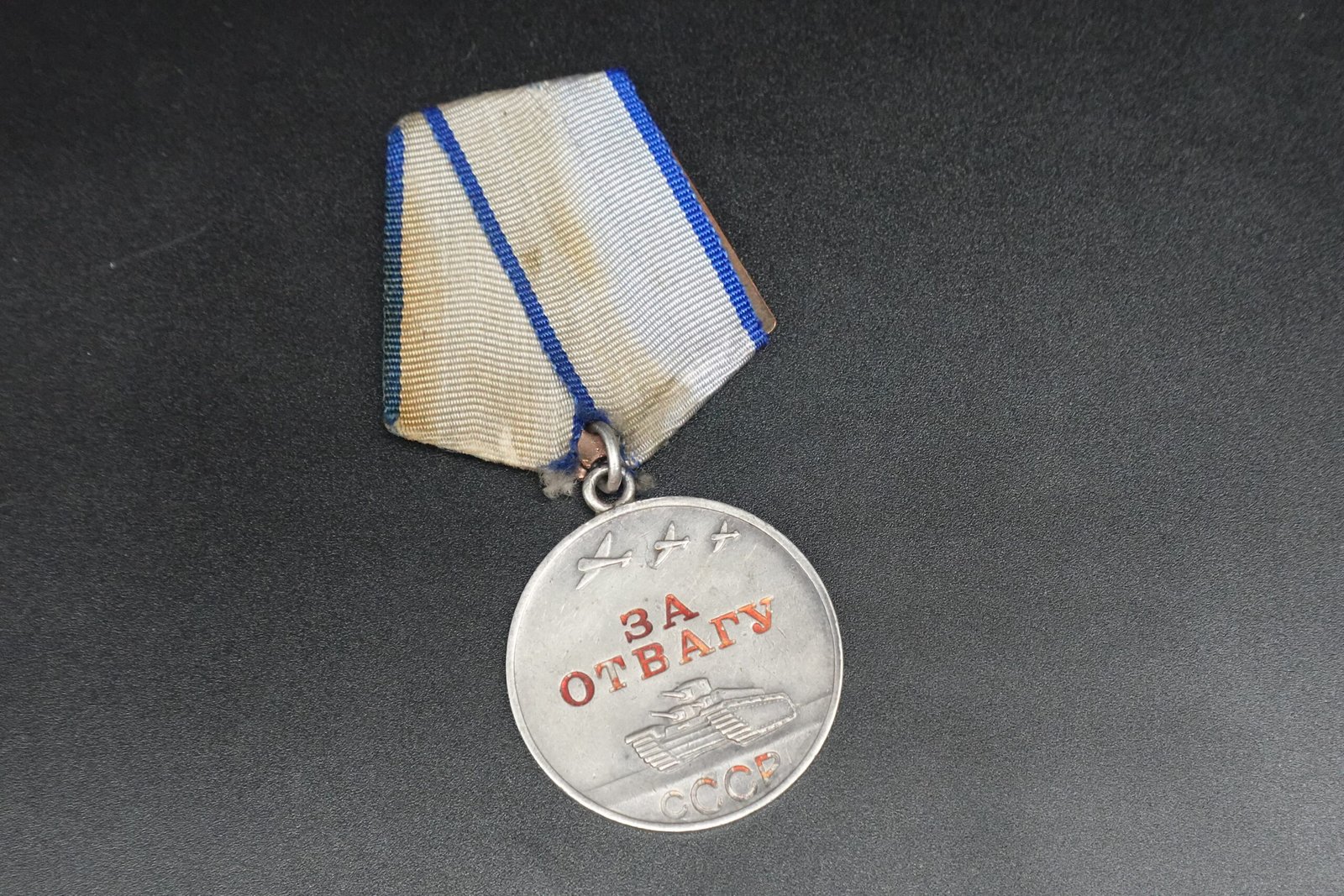
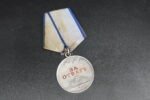
The medal is struck in silver and measures 34 mm in diameter, featuring a raised rim on both sides. The obverse displays three aircraft flying from right to left across the upper field, symbolizing Soviet air power. Beneath them is the bold two-line inscription “FOR COURAGE” («ЗА ОТВАГУ») in red enamel. At the bottom is a detailed depiction of a T-35 tank advancing forward, emphasizing armored strength. On original Soviet-era examples, the inscription “USSR” («СССР») appears below the tank along the lower rim in red enamel, a feature absent on later Russian Federation issues.
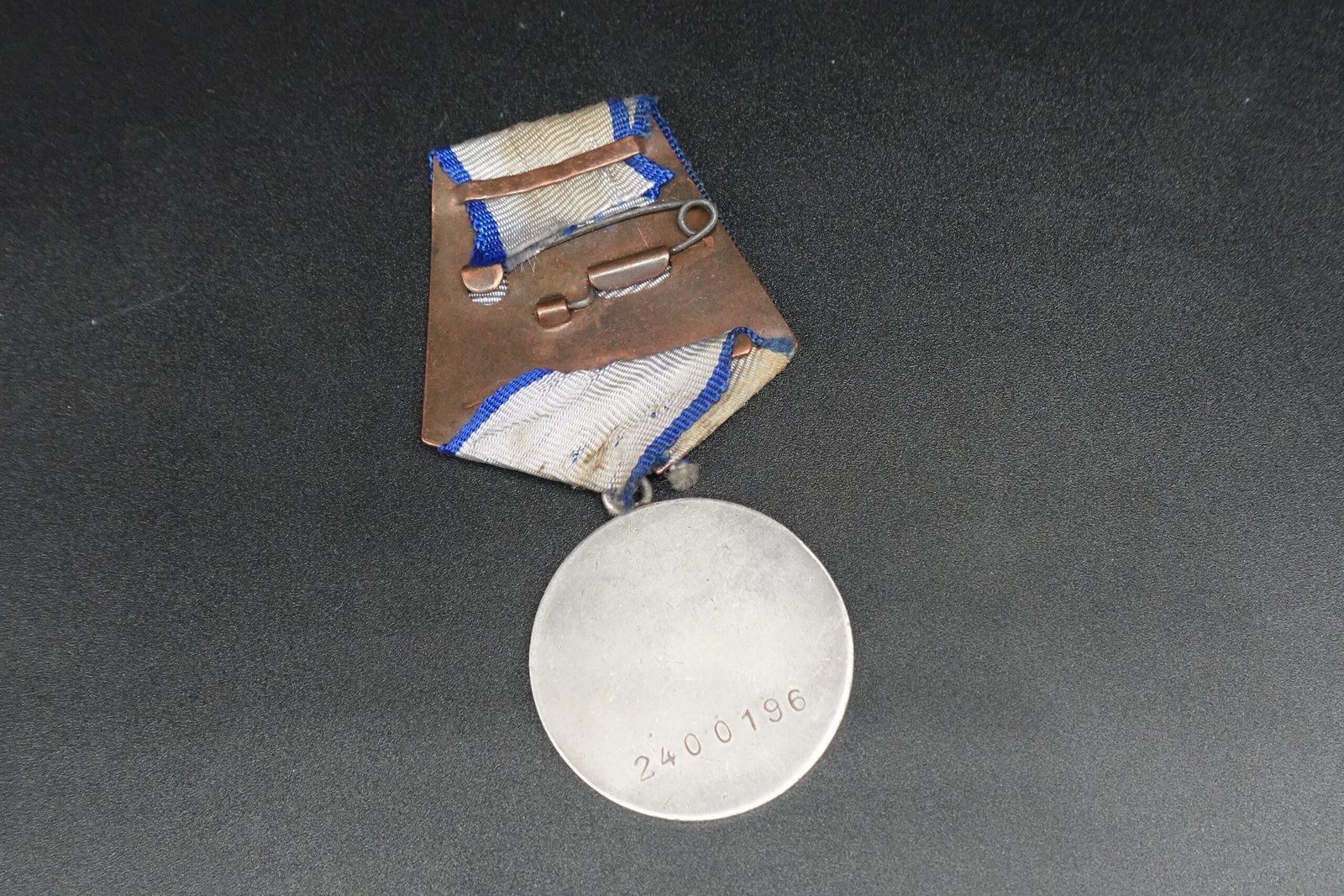
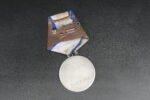
The reverse is plain, bearing a stamped serial number preceded by the letter “N” along the lower half, with a mint mark beneath—indicating official production and individual attribution. This example is serial numbered 2400196, confirming its official issue and collectibility.
The medal is suspended from a standard Soviet pentagonal mount, fitted with a 24 mm silk moiré ribbon in grey with narrow blue edge stripes. Early wartime examples (1938–1943) were issued on a rectangular suspension with a solid red ribbon, later standardized to the pentagonal mount.
The ribbon and suspension may show age-related wear such as light soiling, minor staining, or edge fraying, consistent with period use and storage.
Condition: As shown in photographs.
€110,00
In stock
In stock
Details
| Conflict | World War II |
|---|---|
| Country | Soviet Union |
| Markings | Serial Numbered |
| Classification | Service Medal |
Statement
Wolfgang Historica is a trusted seller with years of experience and consistently positive reviews. We are always interested in purchasing collections or unique objects and also offer a professional consignment service. Buy with confidence.
Historical Description
The Medal “For Courage” (Russian: «Медаль «За отвагу»») was instituted on 17 October 1938 by decree of the Presidium of the Supreme Soviet of the USSR as one of the principal Soviet decorations for personal bravery. It was awarded to members of the Soviet Army, Navy, border guards, and internal troops, as well as to civilians and, in some cases, foreign nationals, for acts of individual courage in combat or in situations involving direct risk to life in the defense of the state.
The first awards were made only days after its creation, during the Battle of Lake Khasan, where Soviet border guards distinguished themselves in clashes with Japanese forces. The medal quickly became one of the most respected and widely recognized awards for frontline bravery.
During the Second World War—known in the Soviet Union as the Great Patriotic War—the medal was awarded on a massive scale, with over 4.2 million recipients recognized for acts of valor. From its establishment in 1938 until the dissolution of the Soviet Union in 1991, a total of approximately 4.57 million medals were issued, many of them awarded posthumously, underscoring the often extreme conditions under which such bravery was displayed.
The medal held a unique place within the Soviet awards system as a decoration specifically recognizing personal courage, rather than command achievement or long service. It was frequently awarded directly to enlisted personnel and junior ranks for immediate acts of heroism on the battlefield.
Following the collapse of the Soviet Union, the decoration was retained by the Russian Federation by Presidential Decree No. 442 of 2 March 1994. The modern version preserves the original design, with the notable removal of the “USSR” («СССР») inscription. Its award criteria were subsequently refined through several presidential decrees in 1999, 2003, and 2010. The first recipients of the post-Soviet medal were members of a special forces unit of the GRU who carried out combat missions in Tajikistan in the early 1990s, marking the continuation of the award’s legacy into the modern era.