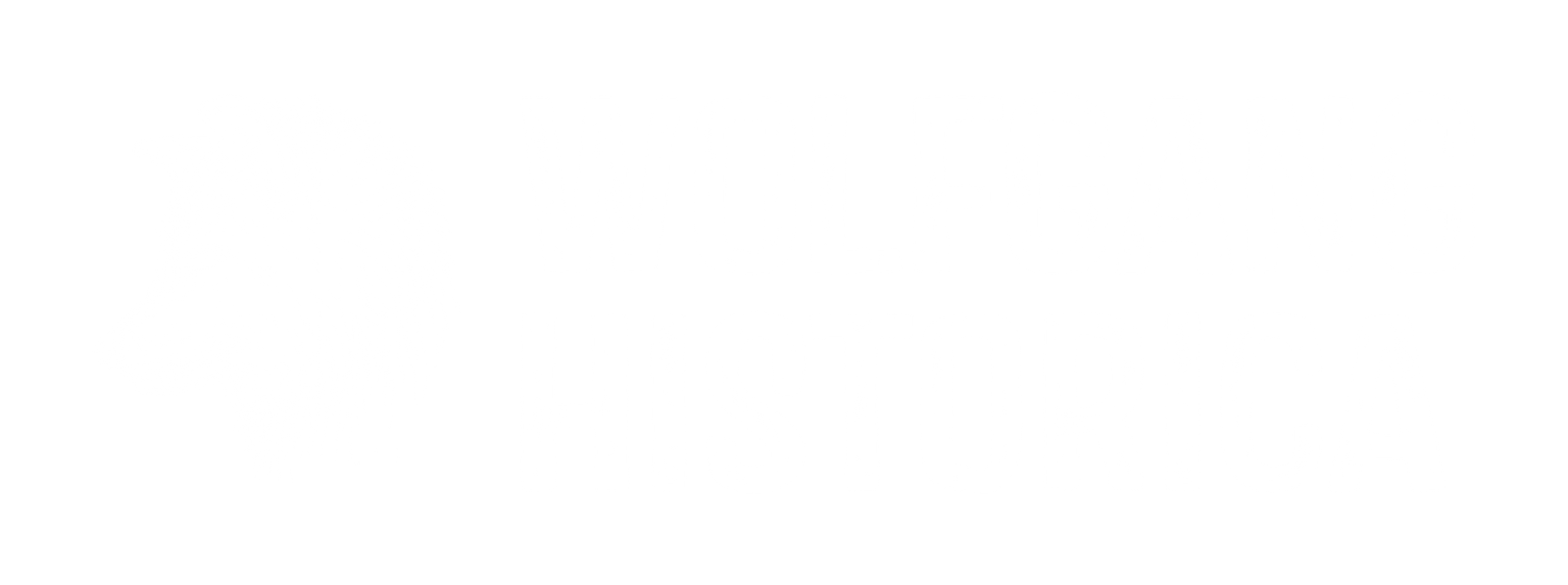


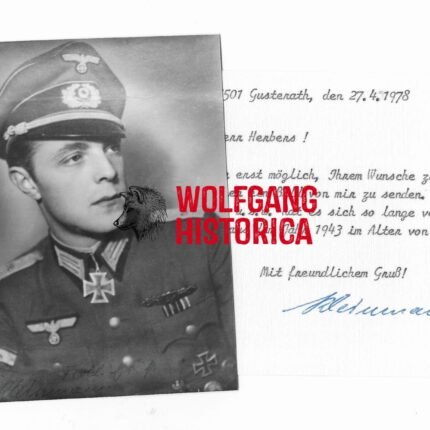
Alfons Kleinmann – Grenadier-Regiment 118 (36. Infanterie-Division)
€35,00Original Postwar Signature on a Postwar Photo plus Card of Alfons Kleinmann. Hauptmann Alfons Kleinmann (10.12.1916 † 12.03.1982) earned the Ritterkreuz des Eisernen Kreuzes on August 14, 1943 as Hauptmann und Führer of the I. Bataillon/ Grenadier-Regiment 118 of the 36. Infanterie-Division.
Provenance: This signature comes from one of the largest postwar signature collection I’ve ever commissioned. This collection was started by a Waffen-SS Veteran, Werner H., in the 1950’s until he passed away.
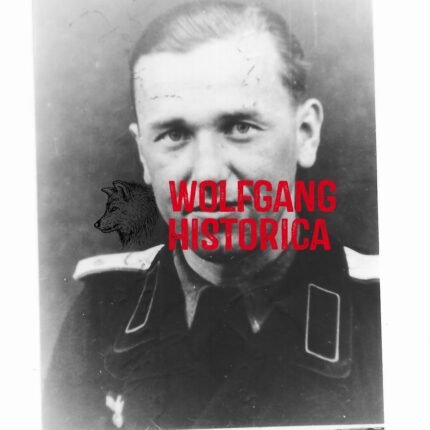
Johannes Dratwa – Sturmgeschütz-Brigade 184
€25,00Original Postwar Signature on a Postwar Photo of Johannes Dratwa. Hauptmann Johannes Dratwa (22.11.1914 † 12.08.2003) earned the Ritterkreuz des Eisernen Kreuzes on March 5, 1945 as Hauptmann und Chef of the 2. Kompanie/ Sturmgeschütz-Brigade 184. Signed on the reverse.
On the 23.01.1945 the Soviet 6th Guards Army began attacking the entire sector of the 121. Infanterie-Division, with their primary objective being the strategically vital Hill 111.4 (near Audari). However the defending Grenadiers, Panzerjäger and Sturmgeschütze of the 2./Sturmgeschütz-Brigade 184 denied the Soviets this prize over the course of bitter combat that lasted for 4 days. The Soviets finally suspended their attack on the evening of the 26.01.1945. Oberleutnant Dratwa was subsequently awarded the Knight’s Cross for the invaluable role that his Batterie played in the defense of this important piece of ground.
Provenance: This signature comes from one of the largest postwar signature collection I’ve ever commissioned. This collection was started by a Waffen-SS Veteran, Werner H., in the 1950’s until he passed away.
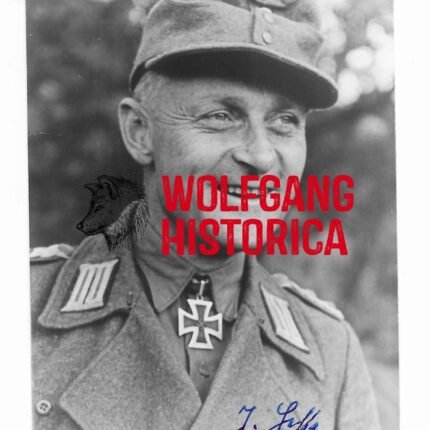
Joachim Hesse – Panzergrenadier-Regiment 64
€25,00Original Postwar Signature on a Postwar Photo of Joachim Hesse. Oberst Joachim Hesse (21.12.1903 † 18.04.1989) earned the Ritterkreuz des Eisernen Kreuzes on April 6, 1944 as Oberst und Kommandeur of the Panzer-Grenadier-Regiment 64 of the 16. Panzer-Division.
Provenance: This signature comes from one of the largest postwar signature collection I’ve ever commissioned. This collection was started by a Waffen-SS Veteran, Werner H., in the 1950’s until he passed away.

Heinrich Trettner – 4. Fallschirmjäger-Division (Eichenlaub)
€0,01Original Postwar Signature on a Postwar Photo of Heinrich Trettner. Generalmajor Heinrich Trettner (08.06.1906 † 30.06.1985) earned the Ritterkreuz des Eisernen Kreuzes on May 24, 1940 as Major im Generalstab und Ia of the 7. Flieger-Division and the Eichenlaub on September 17, 1944 as Generalmajor und Kommandeur of the 4. Fallschirmjäger-Division.
Provenance: This signature comes from one of the largest postwar signature collection I’ve ever commissioned. This collection was started by a Waffen-SS Veteran, Werner H., in the 1950’s until he passed away.
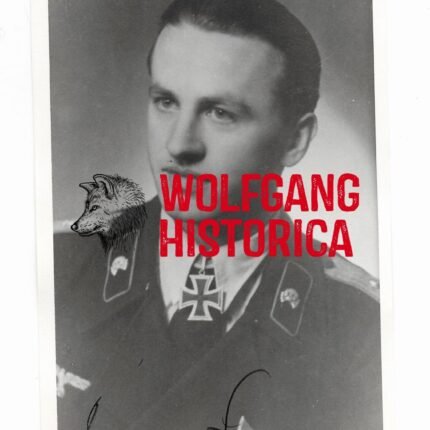
Erwin Strasser – Panzer-Regiment 33 “Prinz Eugen”
€0,01Original Postwar Signature on a Postwar Photo of Erwin Strasser. Oberleutnant Erwin Strasser (15.08.1919 † 23.03.1989) earned the Ritterkreuz des Eisernen Kreuzes on March 5, 1945 as Oberleutnant und Führer of the 5. Kompanie/ Panzer-Regiment 33 “Prinz Eugen” of the 9. Panzer-Division.
Provenance: This signature comes from one of the largest postwar signature collection I’ve ever commissioned. This collection was started by a Waffen-SS Veteran, Werner H., in the 1950’s until he passed away.
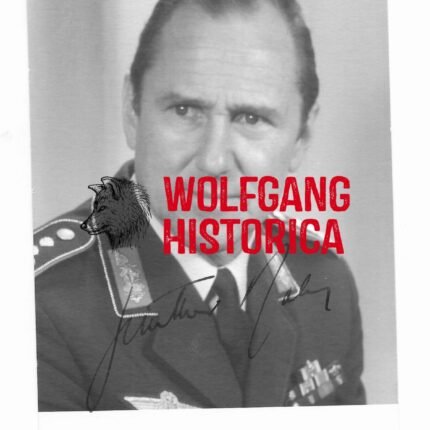
Günther Rall – Jagdgeschwader 52 (Schwertern)
€0,01Original Postwar Signature on a Postwar Photo of Günther Rall. Major Günther Rall (10.03.1918 † 04.10.2009) earned the Deutsches Kreuz in Gold on December 15, 1941 with the 8. Staffel/ Jagdgeschwader 52, the Ritterkreuz on September 4, 1942 as Oberleutnant und Staffelkapitän of the 8. Staffel/ Jagdgeschwader 52 (65 aerial victories), the Eichenlaub on October 26, 1942 as as Oberleutnant und Staffelkapitän of the 8. Staffel/ Jagdgeschwader 52 (65 aerial victories) and the Schwertern on September 12, 1943 as Hauptmann und Gruppekommodore of the III. Gruppe/ Jagdgeschwader 52 (200 aerial victories).
Provenance: This signature comes from one of the largest postwar signature collection I’ve ever commissioned. This collection was started by a Waffen-SS Veteran, Werner H., in the 1950’s until he passed away.
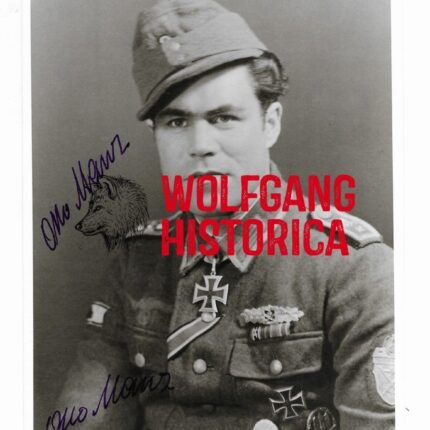
Otto Mauz – Pionier-Bataillon 671
€55,00Original Postwar Signature on a Postwar Photo of Otto Mauz. Oberfeldwebel Otto Mauz (24.04.1915 † 27.04.1980) earned the Ritterkreuz des Eisernen Kreuzes on December 9, 1944 as Oberfeldwebel und Zugführer of 3. Kompanie/ Pionier-Bataillon 671.
In October 1944, in the area SE of Libau, Oberfeldwebel Mauz received the order to form a rearguard with 12 men in order to protect the retreat of the Division. As he was doing so a bridge to his rear was blown up a few hours earlier than planned, resulting in his isolation on the wrong side of the river. Nonetheless Mauz led his troops over the remains of the blasted bridge, eliminated a group of 50 Red Army soldiers in close combat, destroyed 3 vehicles and was able to make his way back to friendly positions under almost hopeless circumstances, and without losing any men at that. Later, near Ginuzi in the area around Vartaja, Oberfeldwebel Mauz heard engine noises that he immediately recognized as belonging to Soviet tanks. As the Division continued its retreat along the road, Mauz snuck towards the source of the noise with 3 men in support. At the section of road where the tanks were, Mauz worked his way up to within a few metres of them. He then destroyed a Soviet heavy tank with a Panzerfaust, which caused the truck immediately behind it to also be knocked out by the blast. With a second and third Panzerfaust he also destroyed two more fully loaded trucks. A Soviet heavy tank right behind these tried to turn around but got bogged down in a swamp; its bailed out crew was eliminated and Mauz blew up the tank with two hand grenades. The following 12 Soviet tanks turned around and fled.
Provenance: This signature comes from one of the largest postwar signature collection I’ve ever commissioned. This collection was started by a Waffen-SS Veteran, Werner H., in the 1950’s until he passed away.
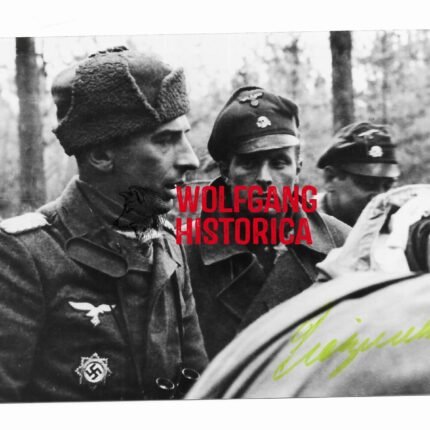
Erich Pietzonka – Fallschirmjäger-Regiment 7 (Eichenlaub)
€80,00Original Postwar Signature on a Postwar Photo of Erich Pietzonka. Oberst Erich Pietzonka (04.10.1906 † 18.12.1989) earned the Ritterkreuz des Eisernen Kreuzes on September 5, 1944 as Oberstleutnant und Kommandeur and the Eichenlaub on September 16, 1944 as Oberst und Kommandeur of Fallschirmjäger-Regiment 7 of the 2. Fallschirmjäger-Division.
Provenance: This signature comes from one of the largest postwar signature collection I’ve ever commissioned. This collection was started by a Waffen-SS Veteran, Werner H., in the 1950’s until he passed away.

Walter Krupinski – Jagdgeschwader 52 (Eichenlaub)
€0,01Original Postwar Signature on a Postwar Photo of Walter Krupinski. Oberleutnant Walter Krupinski (11.11.1920 † 07.10.2000) earned the Deutsches Kreuz in Gold on October 27, 1942 as Leutnant in the 6. Staffel/ Jagdgeschwader 52, the Ritterkreuz on October 29, 1942 as Leutnant in the 6. Staffel/ Jagdgeschwader 52 and the Eichenlaub on March 2, 1944 as Oberleutnant und Staffelkapitän of the 7. Staffel/ Jagdgeschwader 52.
Walter Kupinski achieved 197 victories in over 1100 operational sorties during the Second World War.
Provenance: This signature comes from one of the largest postwar signature collection I’ve ever commissioned. This collection was started by a Waffen-SS Veteran, Werner H., in the 1950’s until he passed away.
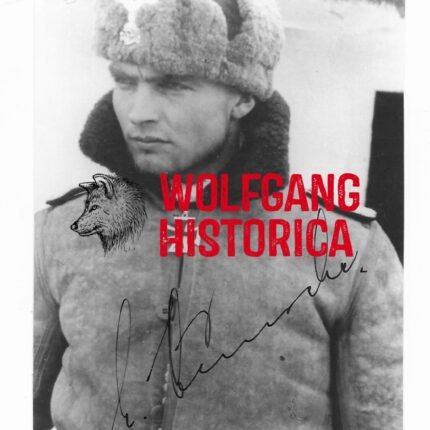
Max Wünsche – SS-Panzer-Regiment 1 “LSSAH” & 12 “Hitlerjugend” (Eichenlaub)
€0,01Original Postwar Signature on a Postwar Photo of Max Wünsche. SS-Standartenführer Max Wünsche (20.04.1914 † 17.04.1995) earned the Ritterkreuz on February 28, 1943 as SS-Obersturmbannführer und Kommandeur of the Stab der I./ SS-Panzer-Regiment 1 of the 1. SS-Panzer-Division “LSSAH” and the Eichenlaub on August 11, 1944 as SS-Obersturmbannführer und Komanndeur of the SS-Panzer-Regiment 12 of the 12. SS-Panzer-Division “Hitlerjugend”.
Max Wünsche was born on 20 April 1914 in Kittlitz. In July 1933 Wünsche joined the SS. In 1935, he graduated from SS-Junkerschule at Bad Tölz and was promoted to Untersturmführer. Wünsche was then posted to the Leibstandarte SS Adolf Hitler (LSSAH) as a platoon leader. In October 1938, Wünsche was assigned as an orderly officer for Hitler. In that role, Wünsche joined the Führerbegleitkommando (the SS bodyguard unit), which provided personal security for Hitler. In January 1940 he was again posted to the LSSAH, as a platoon commander in a motorcycle company under the command of Kurt Meyer, for the invasion of the Netherlands and the Battle of France. In December 1940 he became an adjutant to Sepp Dietrich during the invasion of the Balkans (Operation Marita) and the invasion of the Soviet Union (Operation Barbarossa). In February 1942 Wünsche was given the command of the LSSAH Sturmgeschütz (assault gun) battalion. In 1942 Wünsche completed the General Staff training course at the Staff College in Germany and was promoted to Sturmbannführer. In September 1942 he was posted to the LSSAH and resumed command of the Sturmgeschütz battalion; in October he assumed command of a battalion in a panzer regiment of LSSAH. His battalion’s first action was at Kharkov in 1943. On 25 February 1943 Wünsche’s battalion went into action against a defensive position manned by the Soviet 350th Rifle Division. Supported by artillery and a company of SS grenadiers, Wünsche’s battalion attacked and overran the Soviet front lines. Wünsche’s assault would lead to the destruction of 47 artillery pieces and anti-tank guns.[2] For his actions during the battles for Kharkov, Wünsche was awarded the German Cross in Gold and later the Knight’s Cross, both in February 1943. In June 1943, Wünsche was transferred to a new division forming in France, 12th SS Panzer Division Hitlerjugend, to take command of the 12th SS Panzer Regiment. On 6 June 1944, the Allies landed in Normandy (Operation Overlord) and the division was committed to action on 7 June. The division was later trapped in the Falaise pocket, where on the night of 20 August, Wünsche escaped on foot. He was wounded and taken prisoner by British soldiers. Wünsche spent the rest of the war as a prisoner of war in camp 165 at Caithness, Scotland, a special camp for high-ranking German officers. In 1948 Wünsche was released and returned to Germany. He died in 1995. (Read more on Max Wünsche (Wikipedia))
Provenance: This signature comes from one of the largest postwar signature collection I’ve ever commissioned. This collection was started by a Waffen-SS Veteran, Werner H., in the 1950’s until he passed away.
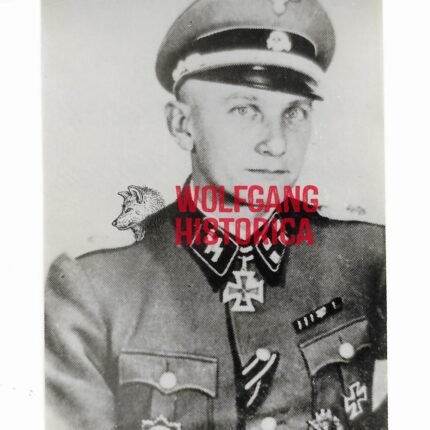
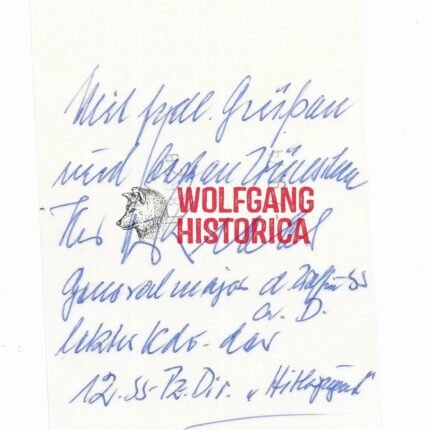
Hugo-Gottfried Kraas – SS-Panzergrenadier-Regiment 2 “LSSAH”
€0,01Original Scarce Postwar Signature on a Postwar Photo of Hugo-Gottfried Kraas. SS-Brigadeführer Hugo-Gottfried Kraas (25.01.1911 † 20.02.1980) earned the Ritterkreuz des Eisernen Kreuzes on March 28, 1943 as SS-Sturmbannführer und Kommandeur of the I. Bataillon/ SS-Panzergrenadier-Regiment 2 “LSSAH” and the Eichenlaub on January 24, 1944 as SS-Obersturmbannführer und Kommandeur of the SS-Panzergrenadier-Regiment 2 “LSSAH” of the 1. SS-Panzer-Division “LSSAH”. Signed on the reverse.
Provenance: This signature comes from one of the largest postwar signature collection I’ve ever commissioned. This collection was started by a Waffen-SS Veteran, Werner H., in the 1950’s until he passed away.

Baldur von Schirach – Reichsjugendführer & Gauleiter
€75,00Original Postwar Signature on a Postwar Card (1953) of Baldur von Schirach. Baldur Benedikt von Schirach (9 May 1907 – 8 August 1974) was a German politician who is best known for his role as the Nazi Party national youth leader and head of the Hitler Youth from 1931 to 1940. He later served as Gauleiter and Reichsstatthalter (“Reich Governor”) of Vienna. After World War II, he was convicted of crimes against humanity during the Nuremberg trials and sentenced to 20 years in prison.
Read more on Baldur von Schirach (Wikipedia) He also took part in the French Campaign (1940) with the Infanterie-Regiment “Großdeutschland” as a Melder.
Provenance: This signature comes from one of the largest postwar signature collection I’ve ever commissioned. This collection was started by a Waffen-SS Veteran, Werner H., in the 1950’s until he passed away.
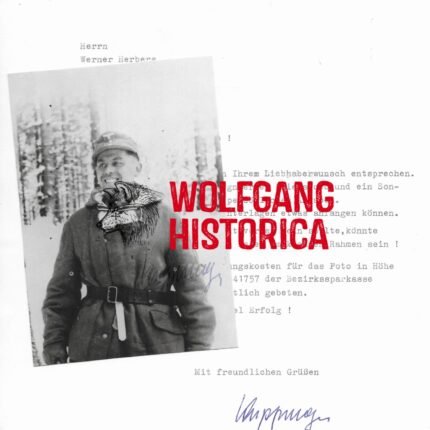
Ernst Kuppinger – 246. Volksgrenadier-Division (Eichenlaub)
€45,00Original Postwar Signature on a Postwar Photo plus Letter of Ernst Kuppinger. Hauptmann Ernst Kuppinger (08.07.1914 † 03.08.1995) earned the Ritterkreuz des Eisernen Kreuzes on December 24, 1944 as Hauptmann und Führer of the II. Bataillon/ Grenadier-Regiment 352 and the Eichenlaub on April 5, 1945 as Hauptmann und Kommandeur of Füsilier-Bataillon 246 of the 246. Volksgrenadier-Division.
Ritterkreuz: Awarded for distinguishing himself with his Bataillon at Setterich (west of Jülich). On the 16.11.1944 the whole Regiment fought well around the village. The next day saw further fierce fighting, with the village changing hands 6 times. However all Allied penetrations were sealed off, and Kuppinger would be recognized for his achievements in this battle.
Provenance: This signature comes from one of the largest postwar signature collection I’ve ever commissioned. This collection was started by a Waffen-SS Veteran, Werner H., in the 1950’s until he passed away.

Kurt Veth – Fallschirmjäger-Regiment 3 (Monte Cassino) (Eichenlaub)
€0,01Original Postwar Signature on a Postwar Paper Photo & Letter of Kurt Veth. Major Kurt Veth (01.06.1907 † 27.12.1994) earned the Ritterkreuz des Eisernen Kreuzes on September 30, 1944 as Hauptmann with the II. Bataillon/ Fallschirmjäger-Regiment 3 and the Eichenlaub on April 30, 1945 as Major with the II. Bataillon/ Fallschirmjäger-Regiment 3 of the 3. Fallschirmjäger-Division.
Ritterkreuz awarded for achievements during the Battle of Monte Cassino
Provenance: This signature comes from one of the largest postwar signature collection I’ve ever commissioned. This collection was started by a Waffen-SS Veteran, Werner H., in the 1950’s until he passed away.
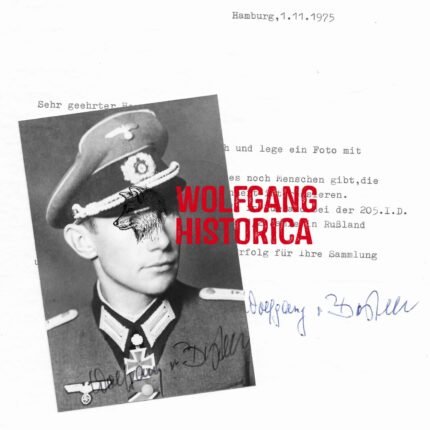
Wolfgang von Bostell – Panzerjäger-Abteilung 1023 & 205 (Eichenlaub)
€35,00Original Postwar Signature on a Postwar Photo plus Letter of Wolfgang von Bostell. Oberleutnant Wolfgang von Bostell (25.02.1917 † 10.05.1991) earned the Ritterkreuz on September 2, 1944 with 2. Kompanie/ Panzerjäger-(Sturmgeschütz-)Abteilung 1023 and the Eichenlaub on April 30, 1945 as Oberleutnant und Führer of the 2. Kompanie/ Panzerjäger-Abteilung 205 of the 205. Infanterie-Division. Good Condition.
Knight’s Cross: “Awarded for destroying 11 enemy tanks and 2 self-propelled guns in the area around Modohn on the 11.-12.08.1944.” Oakleaves: “Awarded for distinguishing himself in the Courland bridgehead southeast of Libau, southwest of Frauenburg and in particularly on the 26.03.1945 while southeast of Schrunden. Here he eliminated numerous enemy resistance nests and spearheaded the effort to eliminate a Soviet penetration. This succeeded, with the result that a Soviet regiment was trapped in a tube-like pocket behind the frontline. A portion of these troops broke out, however the remainder were destroyed on the following day.”
Provenance: This signature comes from one of the largest postwar signature collection I’ve ever commissioned. This collection was started by a Waffen-SS Veteran, Werner H., in the 1950’s until he passed away.
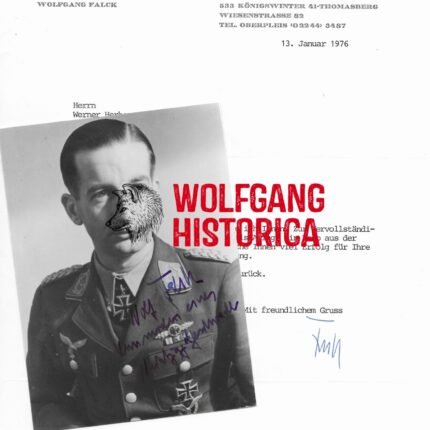
Wolfgang Falck – Nachtjagdgeschwader 1
€0,01Original Postwar Signature on a Postwar Photo of Wolfgang Falck. Oberst Wolfgang Falck (19.08.1910 † 13.03.2007) earned the Ritterkreuz des Eisernen Kreuzes on October 1, 1940 as Major und Kommodore of Nachtjagdgeschwader 1.
Wolfgang Falck was a World War II German Luftwaffe pilot and wing commander and one of the key organisers of the German night fighter defences. As a fighter ace, he claimed eight enemy aircraft shot down in 90 combat missions. Born in Berlin, Falck volunteered for military service in the Reichsheer of the Weimar Republic in 1931. In parallel, he was accepted for flight training with the Deutsche Verkehrsfliegerschule, a covert military-training organization, and at the Lipetsk fighter-pilot school.
Provenance: This signature comes from one of the largest postwar signature collection I’ve ever commissioned. This collection was started by a Waffen-SS Veteran, Werner H., in the 1950’s until he passed away.
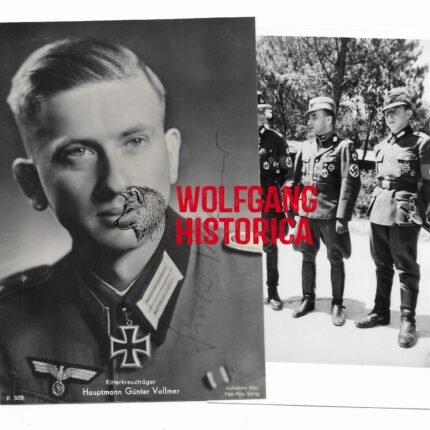
Günter Vollmer – Grenadier-Regiment 411
€0,01Original Postwar Signature on a Wartime Postcard of Günter Vollmer. Hauptmann Günter Vollmer (15.05.1917 † 10.12.2004) earned the Ritterkreuz des Eisernen Kreuzes on April 20, 1943 as Oberleutnant und Führer of the 3. Kompanie/ Grenadier-Regiment 411 of the 122. Infanterie-Division. Edges were cut of the postcard.
Provenance: This signature comes from one of the largest postwar signature collection I’ve ever commissioned. This collection was started by a Waffen-SS Veteran, Werner H., in the 1950’s until he passed away.

Helmut Kinz – Waffen-Gebirgs-Aufklärungs-Abteilung 13 “Handschar”
€0,01Original Scarce Postwar Signature on a Postwar Photo of Helmut Kinz. SS-Sturmbannführer und Major der Schutzpolizei Helmut Kinz (01.12.1915 † 19.10.1985) earned the Ritterkreuz on May 3, 1945 as SS-Sturmbannführer und Kommandeur of the Waffen-Gebirgs-Aufklärungs-Abteilung 13 of the 13. Waffen-Gebirgs-Division der SS “Handschar”. Good condition.
Provenance: This signature comes from one of the largest postwar signature collection I’ve ever commissioned. This collection was started by a Waffen-SS Veteran, Werner H., in the 1950’s until he passed away.
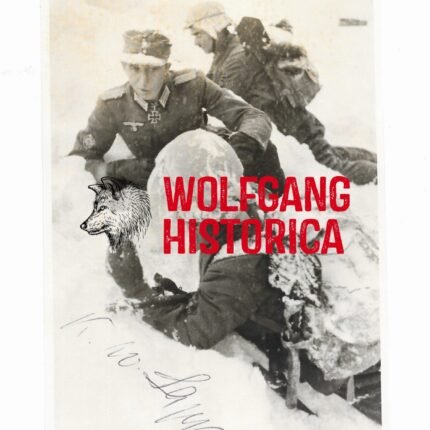
Karl-Walter Lapp – Ski-Bataillon 82
€0,01Original Postwar Signature on a Postwar Photo of Karl-Walter Lapp. Hauptmann Karl-Walter Lapp (02.05.1913 † 19.12.2005) earned the Ritterkreuz des Eisernen Kreuzes on August 14, 1944 as Hauptmann und Kommandeur of Ski-Bataillon 82 of the 1. Gebirgs-Division.
“Major Lapp and his brave Ski-Bataillon, along with his subordinated comrades from the SS-Schützen-Bataillon (mot) 6, were encircled for 12 days by 7 Soviet battalions. In this time the unit fought isolated, while receiving inadequate supply from the air and later also by water, and also under strong enemy artillery and mortar bombardment. Despite all of this they held their positions, an achievement of great importance for the front of the whole Korps. On the 07.07.1944, during an attack by two battalions from the west and another from the east, the Soviets were able to penetrate all the way through to Lapp’s battalion command post. In response he personally ejected the enemy with his staff and resolved the combat situation. Even after being heavily wounded he remained in command of his Bataillon for 5 days until all the other wounded had been taken care of and a new Kampfgruppe commander found.
Provenance: This signature comes from one of the largest postwar signature collection I’ve ever commissioned. This collection was started by a Waffen-SS Veteran, Werner H., in the 1950’s until he passed away.

Friedrich Hengstler – Gebirgsjäger-Regiment 98
€0,01Original Scarce Postwar Signature on a Postwar Photo of Friedrich Hengstler. Oberfeldwebel Friedrich Hengstler (11.07.1913 † 09.02.1998) earned the Ritterkreuz des Eisernen Kreuzes on September 12, 1941 as Oberfeldwebel und Zugführer of 3. Kompanie/ Gebirgsjäger-Regiment 98 of the 1. Gebirgs-Division.
“During the battle of Podwyssokoje on the night of the 06./07.08.1941 the 1. Gebirgs-Division held onto its attained position. The encircled Russians tried desperately to break the encirclement ring around them. One of their main thrusts was launched against the I./Gebirgs-Jäger-Regiment 98. During the defense against the enemy breakthrough attempt on the left wing of this Bataillon, the already heavily wounded Oberfeldwebel Hengstler not only showed exemplary bravery, but also managed to secure a battlefield victory of great importance for the entire Division. After all the officers had fallen he personally took over the command of his Kompanie.”
Provenance: This signature comes from one of the largest postwar signature collection I’ve ever commissioned. This collection was started by a Waffen-SS Veteran, Werner H., in the 1950’s until he passed away.
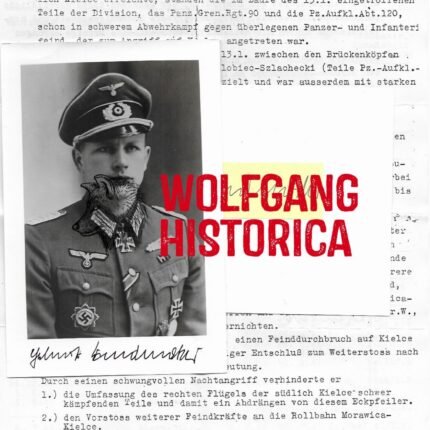
Helmut Wandmaker – Grenadier-Regiment 76 (Nahkampfspange in Gold)
€0,01Original Postwar Signature on a Postwar Photo of Helmut Wandmaker. Major Helmut Wandmaker (09.11.1916 † 19.07.2007) earned the Deutsches Kreuz in Gold on June 1, 1944, the Ritterkreuz on April 5, 1945 as Major und Kommandeur of the II. Bataillon/ Grenadier-Regiment 76 of the 20. Panzer-Grenadier-Division and the Nahkampfspange in Gold on April 7, 1945.
Provenance: This signature comes from one of the largest postwar signature collection I’ve ever commissioned. This collection was started by a Waffen-SS Veteran, Werner H., in the 1950’s until he passed away.
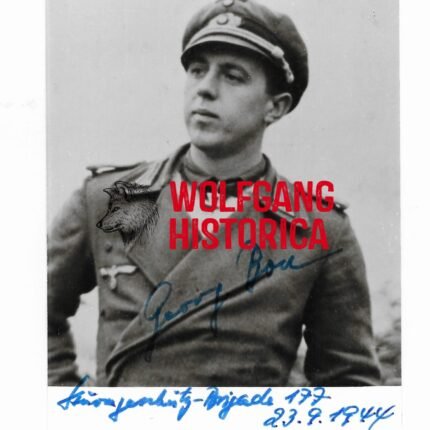
Georg Bose – Sturmgeschütz-Abteilung 177
€0,01Original Postwar Signature on a Postwar Photo of Georg Bose. Leutnant Georg Bose (20.10.1921 † 26.09.2011) earned the Ritterkreuz on September 21, 1944 as Leutnant und Zugführer of 1. Kompanie/ Sturmgeschütz-Abteilung 177.
Provenance: This signature comes from one of the largest postwar signature collection I’ve ever commissioned. This collection was started by a Waffen-SS Veteran, Werner H., in the 1950’s until he passed away.
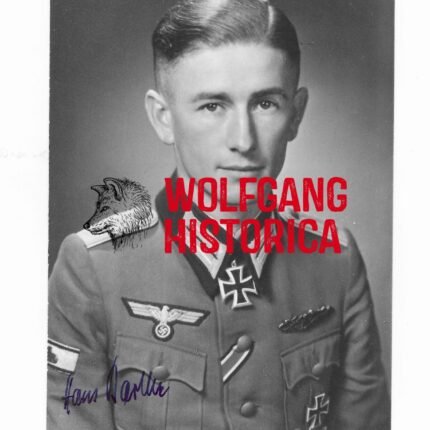
Hans Barthle – Grenadier-Regiment 119
€0,01Original Postwar Signature on a Postwar Photo of Hans Barthle. Oberleutnant Hans Barthle (05.02.1914 † 27.04.1987) earned the Ritterkreuz on December 19, 1943 as Oberleutnant und Chef of the 7. Kompanie/ Grenadier-Regiment 119 of the 25. Panzer-Grenadier-Division.
Provenance: This signature comes from one of the largest postwar signature collection I’ve ever commissioned. This collection was started by a Waffen-SS Veteran, Werner H., in the 1950’s until he passed away.
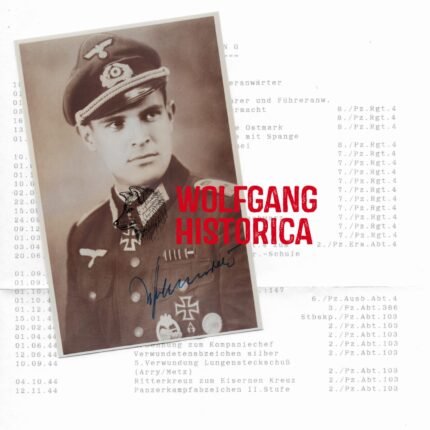
Werner Beschnidt – Panzer-Abteilung 103
€25,00Original Postwar Signature on a Postwar Photo of Werner Beschnidt. Oberleutnant Werner Beschnidt (29.07.1918 † 10.12.1994) earned the Ritterkreuz on October 4, 1944 as Oberleutnant und Führer in the 2. Kompanie/ Panzer-Abteilung 103 of the 3. Panzer-Grenadier-Division.
Provenance: This signature comes from one of the largest postwar signature collection I’ve ever commissioned. This collection was started by a Waffen-SS Veteran, Werner H., in the 1950’s until he passed away.
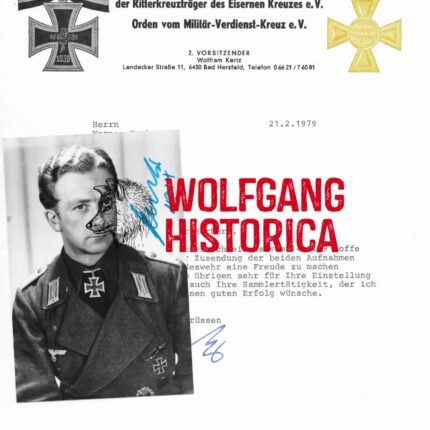
Wolfram Kertz – Kampfgruppe “Bruhn” (Arnhem)
€30,00Original Postwar Signature on a Postwar Photo of Wolfram Kertz. Major Wolfram Kertz (29.07.1916 † 05.05.2009) earned the Ritterkreuz on October 4, 1944 as Oberleutnant und Führer of the 8. Kompanie/ Kampfgruppe “Bruhn” of the II. SS-Panzerkorps. Good condition
During the Ardennes Offensive Wolfram Kertz was assigned as a Kompanieführer to the 9.SS-Panzer-Division “Hohenstaufen”, part of the II. SS-Panzerkorps. After the collapse of the German forces, he was transferred to Regiment Großdeutschland as commander of 309.Batallion.
Provenance: This signature comes from one of the largest postwar signature collection I’ve ever commissioned. This collection was started by a Waffen-SS Veteran, Werner H., in the 1950’s until he passed awa
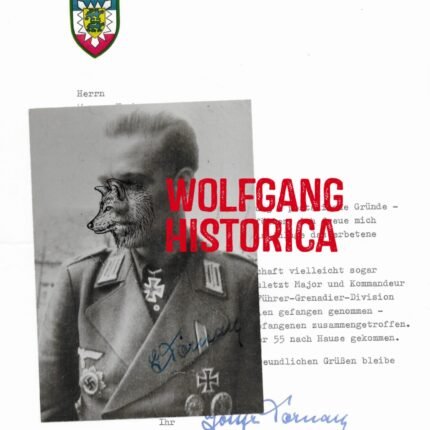
Gottfried Tornau – Sturmartillerie-Brigade “Großdeutschland”
€0,01Original Postwar Signature on a Postwar Photo of Gottfried Tornau. Hauptmann Gottfried Tornau (25.07.1914 † 28.04.1981) earned the Ritterkreuz des Eisernen Kreuzes on March 5, 1945 as Hauptmann und Führer of Sturmartillerie-Brigade of the Führer-Grenadier-Division “Großdeutschland”.
Tornau won his Knight’s Cross for actions at Nantikow (Pomerania), where he led a counterattack against a large Soviet armoured attack. He and his men halted the hostile offensive and thereby allowed thousands of wounded soldiers (as well as civilians) to flee west.
Provenance: This signature comes from one of the largest postwar signature collection I’ve ever commissioned. This collection was started by a Waffen-SS Veteran, Werner H., in the 1950’s until he passed away.
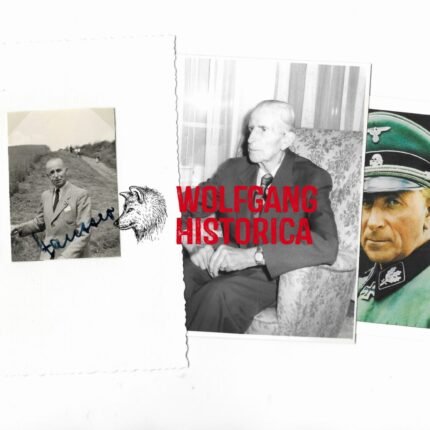
Paul “Papa” Hausser – SS-Oberst-Gruppenführer (Schwertern)
€0,01Original Postwar Signature on a Postwar Photo (Small Photo, two extra unsiged photos) of Paul “Papa” Hausser. SS-Oberst-Gruppenführer und Generaloberst der Waffen-SS Paul Hausser (07.10.1880 † 21.12.1972) earned the Ritterkreuz on August 8, 1943 as SS-Gruppenführer und Kommandeur of the SS-Division “Das Reich”, the Eichenlaub on July 28, 1943 as SS-Obergruppenführer und Kommandierender General of the II. SS-Panzer-Korps of the 2. SS-Panzer-Division “Das Reich” and Schwertern on August 26, 1944 as SS-Oberst-Gruppenführer und Oberbefehlshaber of the 7. Armee for achievements during the Battle of Normandy.
Provenance: This signature comes from one of the largest postwar signature collection I’ve ever commissioned. This collection was started by a Waffen-SS Veteran, Werner H., in the 1950’s until he passed away.
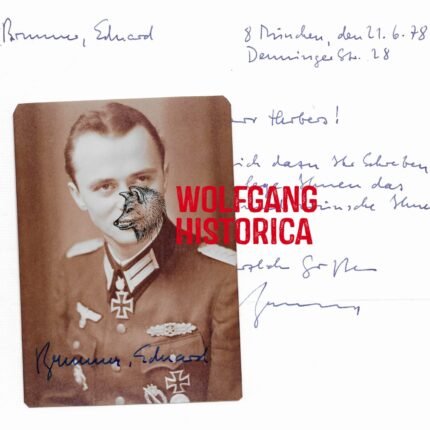
Eduard Brunner – Grenadier-Regiment 62 (Eichenlaub)
€40,00Original Postwar Signature on a Postwar Photo plus Letter of Eduard Brunner. Hauptmann Eduard Brunner (08.12.1918 † 13.05.2006) earned the Deutsches Kreuz in Gold on March 24, 1943 with Grenadier-Regiment 62, the Ritterkreuz on February 27, 1944 as Hauptmann und Führer of the I. Bataillon/ Grenadier-Regiment 62 of the 7. Infanterie-Division and the Eichenlaub on October 28, 1944 as Hauptmann und Kommandeur of I. Bataillon/ Grenadier-Regiment 62 of the 7. Infanterie-Division..
Provenance: This signature comes from one of the largest postwar signature collection I’ve ever commissioned. This collection was started by a Waffen-SS Veteran, Werner H., in the 1950’s until he passed away.

Karl Kreutz – SS-Panzer-Artillerie-Regiment 2 “Das Reich” (Eichenlaub)
€0,01Original Postwar Signature on a Postwar Photo plus Letter of Karl Kreutz. SS-Standartenführer Karl Kreutz (20.09.1909 † 27.07.1997) earned the Ritterkreuz on August 27, 1944 as SS-Standartenführer und Kommandeur of the SS-Panzer-Artillerie-Regiment 2 “Das Reich” and the Eichenlaub on May 6, 1945 as SS-Standartenführer und Kommandeur of the SS-Panzer-Artillerie-Regiment 2 “Das Reich” of the 2. SS-Panzer-Division “Das Reich”.
Eichenlaub: Awarded for further distinguishing himself in the Ardennes, Hungary and around Vienna (the latter in particular). In Vienna his guns took up firing positions at an important crossroads in order to directly fire upon the Soviet breakthrough attempts. During the withdrawal of the Division the Artillerie-Regiment formed the rearguard (a likely unique case). Kreutz would be recognized for the military achievements of his Regiment during these engagements. (Source: Traces of War)
Provenance: This signature comes from one of the largest postwar signature collection I’ve ever commissioned. This collection was started by a Waffen-SS Veteran, Werner H., in the 1950’s until he passed away.
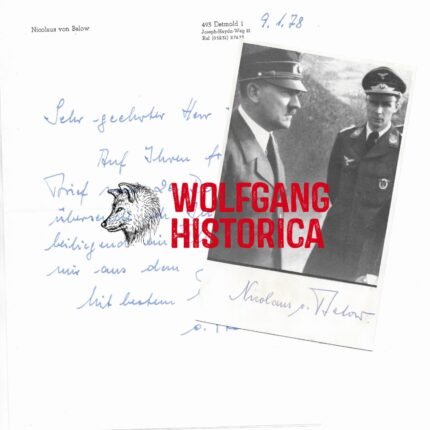
Nicolaus von Below – Adjutant of Adolf Hitler (Führerbunker ’45)
€0,01Original Postwar Signature on a Postwar Photo plus Letter of Nicolaus von Below. Oberst Nicolaus von Below (20.09.1907 † 24.07.1983) was an officer in the Luftwaffe and an Adjutant of Adolf Hitler.
On 29 April, after the wedding of Hitler and Braun, Below was a witness to the last will and testament of Adolf Hitler. He did not sign the Political Testament but added his signature to the Private Testament of the document. Thereafter, Below asked Hitler if he could leave the Führerbunker and attempt to make it out of Berlin to the west. Hitler granted him permission to leave. (Read more on Nicolaus von Below (Wikipedia))
Provenance: This signature comes from one of the largest postwar signature collection I’ve ever commissioned. This collection was started by a Waffen-SS Veteran, Werner H., in the 1950’s until he passed away.
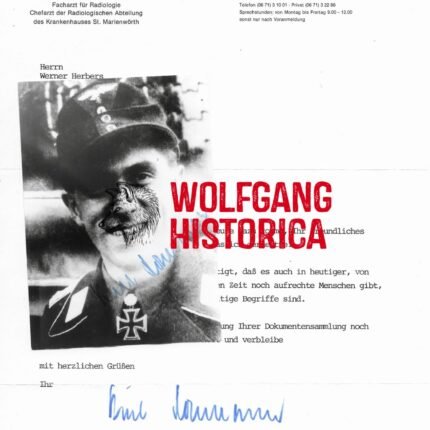
Karl Roßmann – Flak & Panzer-Regiment “Hermann Göring” (Eichenlaub)
€85,00Original Postwar Signature on a Postwar Photo plus Letter of Karl Roßmann. Oberstleutnant Karl Franz Roßmann (23.11.1916 † 01.04.2002) earned the Ritterkreuz on November 12, 1941 as Oberleutnant und Chef of the 16. Kompanie/ Flak-Regiment “General Göring”, the Deutsches Kreuz in Gold on March 20, 1944 with Panzer-Regiment “Hermann Göring” and the Eichenlaub on February 1, 1945 as Major und Kommandeur of Fallschirm-Panzer-Regiment “Hermann Göring”. Good Condition.
Eichenlaub: Awarded for the major role his Panzer-Regiment played in preventing a Soviet breakthrough to East Prussia, and that the enemy could be thrown back over the Rominte river.
Provenance: This signature comes from one of the largest postwar signature collection I’ve ever commissioned. This collection was started by a Waffen-SS Veteran, Werner H., in the 1950’s until he passed away.
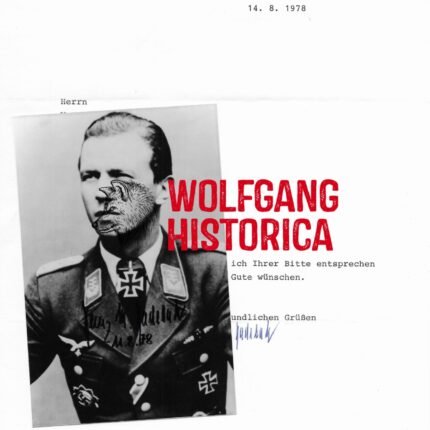
Heinz-Martin Hadeball – Nachtjagdgeschwader 6
€0,01Original Postwar Signature on a Postwar Photo plus Letter of Heinz-Martin Hadeball. Hauptmann Heinz-Martin Hadeball (22.04.1921 † 13.01.1996) earned the Ritterkreuz des Eisernen Kreuzes on July 27, 1944 as Hauptmann und Kommandeur of I. Gruppe/ Nachtjagdgeschwader 6.
33 victories, Night-fighter ace
Provenance: This signature comes from one of the largest postwar signature collection I’ve ever commissioned. This collection was started by a Waffen-SS Veteran, Werner H., in the 1950’s until he passed away.
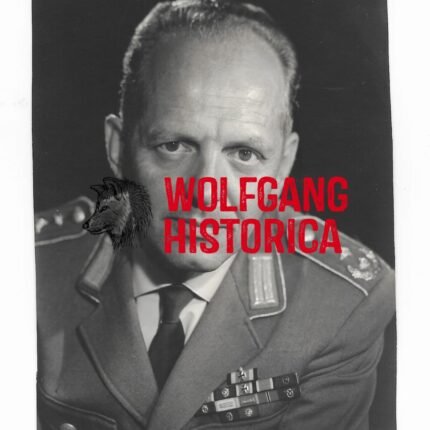
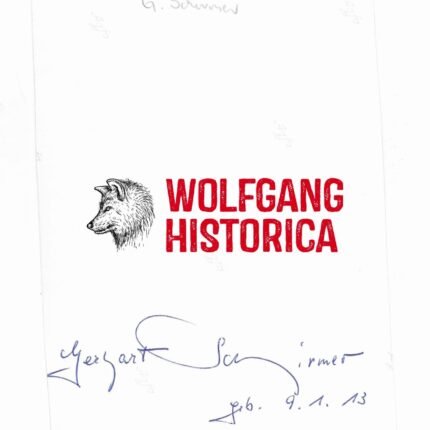
Gerhart Schirmer – Fallschirmjäger-Regiment 2 & 26 (Eichenlaub)
€0,01Original Postwar Signature on a Postwar Photo of Gerhart Schirmer. Oberstleutnant Gerhart Schirmer (09.01.1913 † 05.09.2004) earned the Deutsches Kreuz in Gold on June 25, 1943 with III. Bataillon/ Jäger-Regiment “Hermann Göring”, the Ritterkreuz on June 14, 1941 as Hauptmann und Führer of the II. Bataillon/ Fallschirmjäger-Regiment 2 and the Eichenlaub on November 18, 1944 as Oberstleutnant und Kommandeur of Fallschirmjäger-Regiment 26. Good Condition.
Gerhart Schirmer joined as a Lieutenant in September 1935 the Luftwaffe where he followed the pilot training course. In May 1939 he transferred to the Fallschirmjägers (Paratroopers) and was promoted to Chef der 6. Kompanie des Fallschirmjäger-Regiments 2. With this unit he took part in the invasion of Poland where they secured and hold a bridgehead over the river Weichel. In May 1940 Hauptmann Schirmer jumped during the invasion of the Netherlands in the area of Katwijk to conquer the airfield of Valkenburg. During the battle of the Balkan he jumped on April 26th 1941 near the Greek city of Corinth and after some heavy fighting they conquered the city and they took some 2100 British prisoners. For this action he was later awarded with the Knight’s Cross. Hauptmann Schirmer also fought on Crete, in Russia and Tunisia till he was promoted in May 1943 to Major and took over the command of the 5th Fallschirmjäger-Regiment. With this unit he fought in Italy till he was ordered in January 1944 to form a new Fallschirmjäger-Regiment. This became the 16th Fallschirmjäger-Regiment and as commanding officer of this unit he fought on the West and East front. He was taken prisoner in Berlin at the end of the war and was finally released in January 1956. In December of that same year Gerhart Schirmer joined the Bundeswehr and he retired as a Colonel in April 1971. (Source: Tracesofwar)
Provenance: This signature comes from one of the largest postwar signature collection I’ve ever commissioned. This collection was started by a Waffen-SS Veteran, Werner H., in the 1950’s until he passed away.


Albert Bürger – 4. Flak-Division
€30,00Original Scarce Postwar Signature on a Postwar Photo of Albert Bürger. Oberleutnant Albert Bürger (13.06.1913 † 16.03.1996) earned the Ritterkreuz des Eisernen Kreuzes on April 17, 1945 as Oberleutnant in the 4. Flak-Division.
Provenance: This signature comes from one of the largest postwar signature collection I’ve ever commissioned. This collection was started by a Waffen-SS Veteran, Werner H., in the 1950’s until he passed away.

Franz Graßmel – Fallschirmjäger-Regiment 4
€85,00Original Scarce Postwar Signature on a Postwar Photo plus Letter of Franz Graßmel. Oberstleutnant Franz Graßmel (08.06.1906 † 30.06.1985) earned the Ritterkreuz des Eisernen Kreuzes on April 8, 1944 as Major und Kommandeur of the III. Bataillon/ Fallschirmjäger-Regiment 4 of the 1. Fallschirmjäger-Division and the Eichenlaub on May 8, 1945 as Major und Kommandeur of the Fallschirmjäger-Regiment 20 of the 7. Fallschirmjäger-Division. Eichenlaub may not be official.
Provenance: This signature comes from one of the largest postwar signature collection I’ve ever commissioned. This collection was started by a Waffen-SS Veteran, Werner H., in the 1950’s until he passed away.

Fritz-Rudolf Schultz – Panzer-Regiment 35 (Eichenlaub)
€55,00Original Postwar Signature on a Postwar Photo plus Letter of Fritz-Rudolf Schultz. Major Fritz-Rudolf Schultz (19.02.1917 † 02.03.2002) earned the Deutsches Kreuz in Gold on December 26, 1943 with Panzer-Regiment 35, the Ritterkreuz on April 21, 1944 as Hauptmann und Kommandeur of the I. Abteilung/ Panzer-Regiment 35 of the 4. Panzer-Division and the Eichenlaub on October 28, 1944 as Major und stellv. Führer of Panzer-Regiment 35 Good Condition.
Eichenlaub: Awarded for his actions during the defensive battle at the Venta river on the 09.10.1944. While in command of the armoured Kampfgruppe of the Division he counterattacked and smashed a group of Soviets that had broken into the German lines. In doing so he halted an attack by 2-3 Soviet divisions, and was thereby able to stabilize the southern flank of the 4. Panzer-Division.
Provenance: This signature comes from one of the largest postwar signature collection I’ve ever commissioned. This collection was started by a Waffen-SS Veteran, Werner H., in the 1950’s until he passed away.
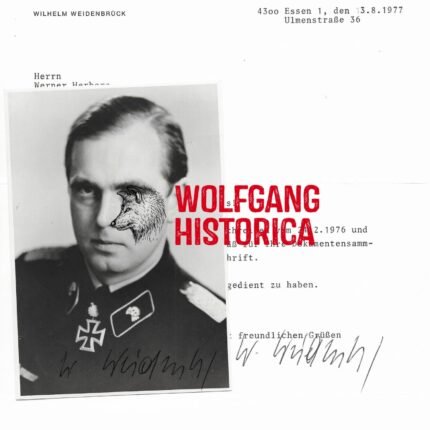
Wilhelm Weidenbrück – Panzer-Regiment 3 & Panzer-Brigade 104 (Eichenlaub)
€55,00Original Postwar Signature on a Postwar Photo plus Letter of Wilhelm Weidenbrück. Major Wilhelm Weidenbrück (05.02.1915 † 28.04.2011) earned the Deutsches Kreuz in Gold on January 2, 1942 with Panzer-Regiment 3, the Ritterkreuz on September 16,1942 as Oberleutnant und Kompaniechef of the 5. Kompanie/ Panzer-Regiment 3 of the 2. Panzer-Division and the Eichenlaub on November 16, 1944 as Major und Kommandeur of Panzer-Brigade 104. Good Condition.
Eichenlaub: Awarded for the successful employment of his brigade in the sector of 5. Jäger-Division on 30.10.1944, fighting at the Narew front at Ostenburg (Pultusk). Following a Soviet breach of the frontline west of the Pelta creek Weidenbrück’s men launched a timely counterattack that restored the old German lines, and 48 Soviet tanks were destroyed/captured in the process.
Provenance: This signature comes from one of the largest postwar signature collection I’ve ever commissioned. This collection was started by a Waffen-SS Veteran, Werner H., in the 1950’s until he passed away.
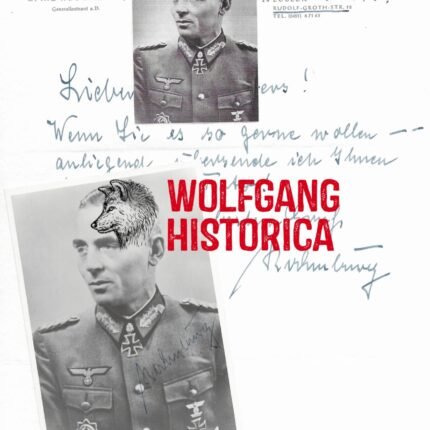
Carl Rodenburg – 76. Infanterie-Division (Stalingrad) (Eichenlaub)
€60,00Original Postwar Signature on a Postwar Photo plus Letter of Carl Rodenburg. Generalmajor Carl Rodenburg (17.05.1894 † 05.11.1992) earned the Deutsches Kreuz in Gold on March 7, 1942 with Infanterie-Regiment 203, the Ritterkreuz on October 8,1942 as Generalmajor und Kommandeur of the 76. Infanterie-Division and the Eichenlaub on January 31, 1943 as Generalmajor und Kommandeur of the 76. Infanterie-Division. Good Condition.
Carl Rodenburg (17 May 1894 – 5 November 1992) was a general in the Wehrmacht of Nazi Germany who commanded the 76th Infantry Division during the Battle of Stalingrad. He was a recipient of the Knight’s Cross of the Iron Cross with Oak Leaves. Rodenburg surrendered to the Soviet forces on 31 January 1943, during the Battle of Stalingrad. He was held until 1955. (Wikipedia)
Provenance: This signature comes from one of the largest postwar signature collection I’ve ever commissioned. This collection was started by a Waffen-SS Veteran, Werner H., in the 1950’s until he passed away.
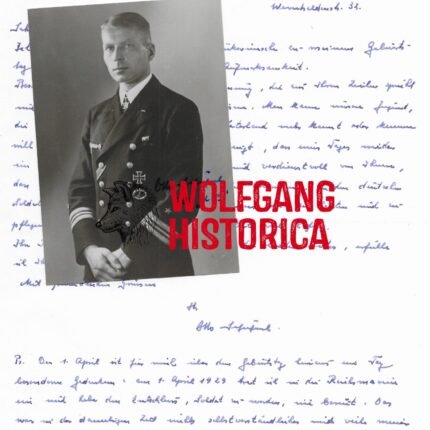
Otto Schuhart – Kommandant of “U-29”
€0,01Original Postwar Signature on a Postwar Photo plus Letter of Otto Schuhart. Korvettenkapitän Otto Schuhart (01.04.1909 † 10.03.1990) earned the Ritterkreuz on May 16, 1940 as Kapitänleutnant und Kommandant of U-29.
Awarded for the sinking of 8 ships (with 56916 GRT) in just three patrols, including the British aircraft carrier HMS Courageous.
Provenance: This signature comes from one of the largest postwar signature collection I’ve ever commissioned. This collection was started by a Waffen-SS Veteran, Werner H., in the 1950’s until he passed away.

Walter Paul Liebing – Fallschirmjäger-Regiment 23
€0,01Original Scarce Postwar Signature on a Postwar Photo of Walter Paul Liebing. Oberstleutnant Walter Paul Liebing (12.08.1912 † 18.10.1998) earned the Ritterkreuz des Eisernen Kreuzes on February 2, 1945 as Major und Kommandeur of the Fallschirmjäger-Regiment 23 of the 2. Fallschirmjäger-Division.
Provenance: This signature comes from one of the largest postwar signature collection I’ve ever commissioned. This collection was started by a Waffen-SS Veteran, Werner H., in the 1950’s until he passed away.
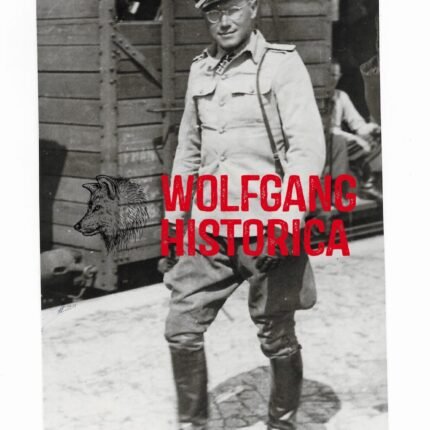
Dr.med. Heinrich Neumann – Luftlande-Sturm-Regiment 1 (Kreta)
€0,01Original Scarce Postwar Signature on a Postwar Photo of Dr.med. Heinrich Neumann. Oberstabsarzt Dr.med. Heinrich Neumann (17.02.1908 † 19.05.2005) earned the Ritterkreuz des Eisernen Kreuzes on August 21, 1941 as Oberstabsarzt und Regimentsarzt of Luftlande-Sturm-Regiment 1.
Awarded for his actions during the Battle of Crete. As all the officers of the I./Fallschirmjäger-Sturm-Regiment 1 had fallen, Neumann took over the leadership of the rest of the Bataillon. Oberleutnant Trebes, commanding the remnants of the Stoßgruppe Braun, also attached himself to Neumann’s group. Acting on his own initiative, Dr. Neumann decided to capture the NW part of Hill 107 and eliminate the Allied AA guns there that commanded the Maleme airfield. In this he was successful, with this action being the turning point of the whole battle. After returning to his nominal duties, he was then ordered by the newly arrived Oberst Ramcke to take over the Bataillon once again. Thus, on the morning of 22.05.1941, Neumann divided the Bataillon into 2 Kompanien. The next day Neumann and his men took the role of Vorausabteilung, and advanced ahead of the left wing of the II. Bataillon towards the east. At 17:00 he reached the village of Modea. The next day, while on the hill south of Platania, the Bataillon halted as the attack had been postponed. Finally, on the 24.05.1941, Oberleutnant Stolz took over the leadership of the Bataillon and Neumann could finally return to looking after the many wounded for good. In this capacity he also distinguished himself outstandingly.
Provenance: This signature comes from one of the largest postwar signature collection I’ve ever commissioned. This collection was started by a Waffen-SS Veteran, Werner H., in the 1950’s until he passed away.
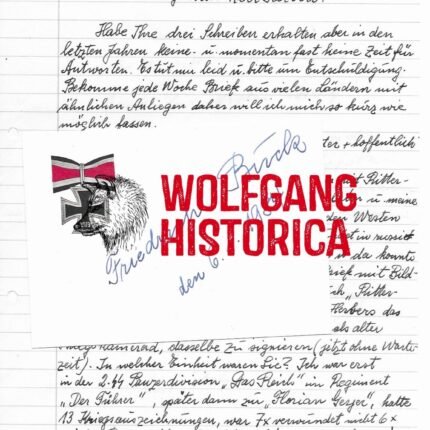
Friedrich Buck – 8. SS-Kavallerie-Division “Florian Geyer” (Nahkampfspange in Gold)
€0,01Original Postwar Signature on a Card plus Letter of Friedrich Buck. SS-Oberscharführer Friedrich Buck (30.01.1922 † 25.09.2015) earned the Nahkampfspange in Gold on January 27, 1945 and the Ritterkreuz on January 27, 1945 as SS-Oberscharführer in 5. Schwadron/ SS-Kavallerie-Regiment 15 of the 8. SS-Kavallerie-Division “Florian Geyer”.


Walter Sander – Fallschirm-Pionier-Bataillon 5 (Battle of the Bulge)
€0,01Original Scarce Postwar Signature on a Postwar Photo of Walter Sander. Oberleutnant Walter Sander (25.07.1914 † 28.04.1981) earned the Ritterkreuz des Eisernen Kreuzes on February 28, 1945 as Leutnant und Führer of 1. Kompanie/ Fallschirm-Pionier-Bataillon 5 of the 5. Fallschirmjäger-Division.
Awarded for his Kompanie’s successes during the initial phases of the Battle of the Bulge. At the start of the attack they moved swiftly through a gap in the US 109th Infantry Regiment (28th US Infantry Division) and reached the crossroads of Fels Kalochette, 20 km in the US rear. Here they captured a US communications battalion with 200 men and 50 vehicles. Later, on the 18.12.1944, Sander’s Kompanie captured the crossroads at Café Schumann (5 km SW of Wiltz), thus completing the encirclement of the town. During a US breakout attempt the Kompanie took a further 280 Americans prisoner. Finally, on the 20.12.1944, the place fell to the Germans with the loss of hundreds of US prisoners and 40 Sherman tanks. Sander was recognized appropriately for his Kompanie’s role in bringing about this outcome.
Provenance: This signature comes from one of the largest postwar signature collection I’ve ever commissioned. This collection was started by a Waffen-SS Veteran, Werner H., in the 1950’s until he passed away.
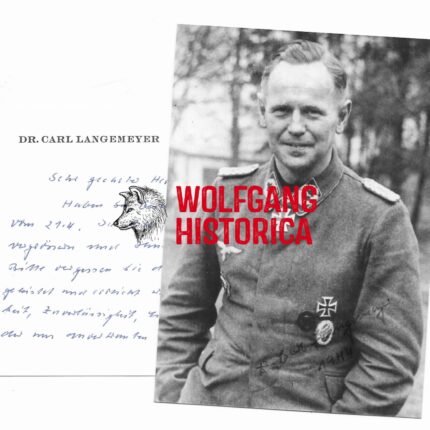
Dr. Carl Neumayer – Fallschirm-Sanitäts-Lehr-Abteilung Nancy
€85,00Original Scarce Postwar Signature on a Postwar Photo plus Card of Dr. Carl Langemayer. Oberstabsarzt Dr. Carl Neumayer (06.08.1907 † 25.07.1982) earned the Ritterkreuz des Eisernen Kreuzes on November 18, 1940 as Stabsarzt und Kommandeur of Fallschirm-Sanitäts-Lehr-Abteilung Nancy.
Provenance: This signature comes from one of the largest postwar signature collection I’ve ever commissioned. This collection was started by a Waffen-SS Veteran, Werner H., in the 1950’s until he passed away.
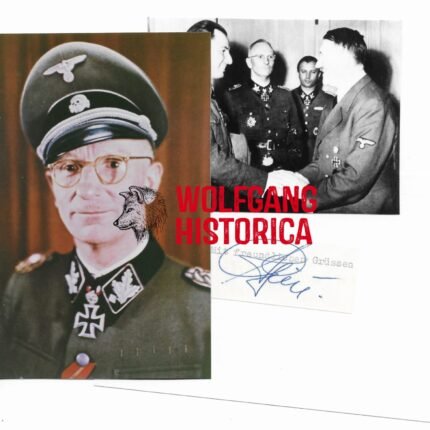
Herbert-Otto Gille – 5. SS-Panzer-Division “Wiking” (Brillanten)
€0,01Original Postwar Signature on a Paper cut-out of Herbert-Otto Gille. SS-Obergruppenführer und General der Waffen-SS Herbert-Otto Gille (08.03.1896 † 26.12.1966) earned the Ritterkreuz on August 15, 1940 as SS-Oberführer und Kommandeur of the SS-Artillerie-Regiment 5, the Eichenlaub on November 1, 1943 as SS-Brigadeführer und Generalmajor der Waffen-SS und Kommandeur of the SS-Panzer-Grenadier-Division “Wiking”, the Schwertern as SS-Gruppenführer und Generalleutnant der Waffen-SS of the SS-Panzer-Grenadier-Division “Wiking” and the Brillanten on April 19, 1944 as SS-Gruppenführer und Generalleutnant der Waffen-SS und Kommandeur of the 5. SS-Panzer-Division “Wiking”. Good condition.
Provenance: This signature comes from one of the largest postwar signature collection I’ve ever commissioned. This collection was started by a Waffen-SS Veteran, Werner H., in the 1950’s until he passed away.


Rudolf Witzig – Sturmgruppe Granit (Eben-Emael) & FJ-Pio.-Rgt. 21 (Eichenlaub)
€65,00Original Postwar Signature on a Postwar Photo plus Letter of Rudolf Witzig. Major Rudolf Witzig (14.08.1916 † 03.10.2001) earned the Ritterkreuz on May 10, 1940 as Oberleutnant with the Sturmgruppe Granat of the Fallschirm-Sturm-Abteilung “Koch” and the Eichenlaub on August 8, 1944 as Major und Kommandeur of the I. Bataillon/ Fallschirm-Pionier-Regiment 21. Good condition.
Oberleutnant Rudolf Witzig, commander of Sturmgruppe Granit. The Sturmgrupe Granit (Granite) was the assault group that famously captured the Belgian Eben-Emael fort on 10 May 1940 led by Oberleutnant Rudolf Witzig. It was 86 men strong and was carried in 11 gliders. Glider 11: Oberleutnant Rudolf Witzig, Oberjäger Fritz Schwarz, Unteroffizier Karl Pilz (Pilot), Otto Braun (WIA), Uwe Johnsen, Hans-Peter Krenz, Fritz Kruck (KIA)
Provenance: This signature comes from one of the largest postwar signature collection I’ve ever commissioned. This collection was started by a Waffen-SS Veteran, Werner H., in the 1950’s until he passed away.
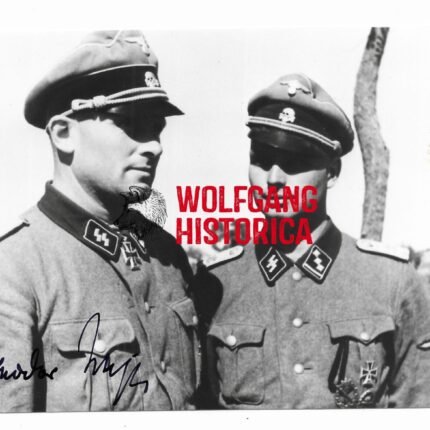
Teddy Wisch – 1. SS-Panzer-Division “LSSAH” (Schwertern)
€0,01Original Postwar Signature on a Postwar Photo of Theodor “Teddy” Wisch. SS-Brigadeführer und Generalmajor der Waffen-SS Theodor “Teddy” Wisch (13.12.1907 † 11.01.1995) earned the Ritterkreuz on September 15, 1941 as SS-Sturmbannführer und Kommandeur of the II. Bataillon/ “LSSAH”, the Eichenlaub on February 12, 1944 as SS-Brigadeführer und Kommandeur of the 1. SS-Panzer-Division “LSSAH” and the Schwertern on August 30, 1944 as SS-Brigadeführer und Generalmajor der Waffen-SS of 1. SS-Panzer-Division “LSSAH”. Good condition.
Provenance: This signature comes from one of the largest postwar signature collection I’ve ever commissioned. This collection was started by a Waffen-SS Veteran, Werner H., in the 1950’s until he passed away.
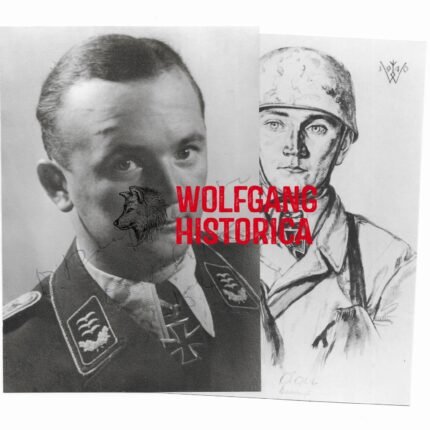
Dr.med. Rolf Jäger – Fallschirm-Sturm-Abteilung “Koch” (Vroenhoven)
€75,00Original Scarce Postwar Signature on a Postwar Photo of Dr.med. Rolf Jäger. Oberstabsarzt Dr.med. Rolf Jäger (01.11.1912 † 06.01.1984) earned the Ritterkreuz des Eisernen Kreuzes on May 15, 1940 as Oberarzt und Truppenarzt of Fallschirm-Sturm-Abteilung Koch.
Provenance: This signature comes from one of the largest postwar signature collection I’ve ever commissioned. This collection was started by a Waffen-SS Veteran, Werner H., in the 1950’s until he passed away.