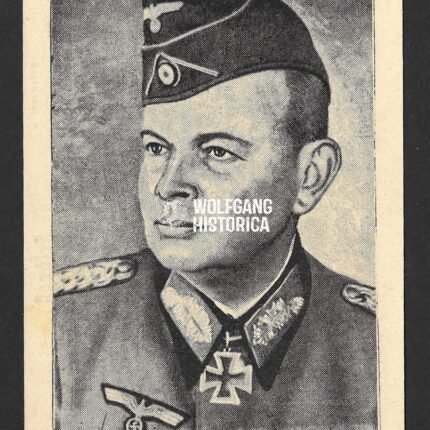

Heinrich Eberbach – Panzer-Regiment 35 & Panzer-Brigade 5 (Eichenlaub)

55,00

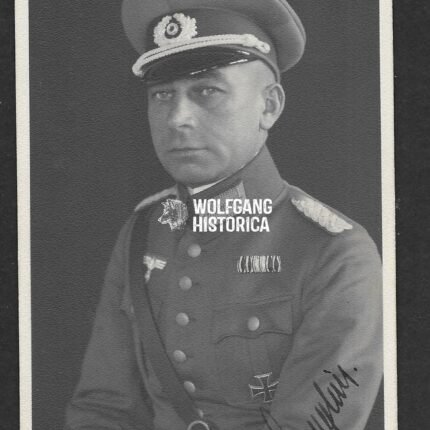
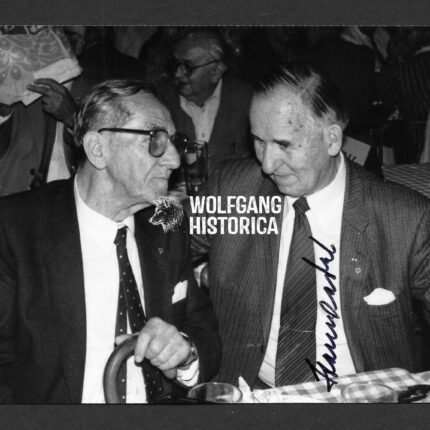
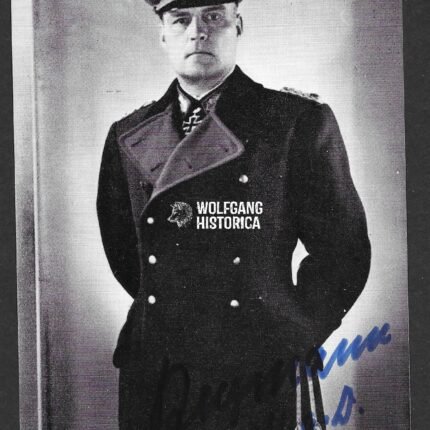
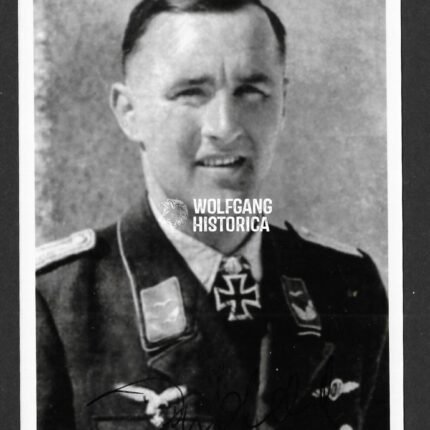
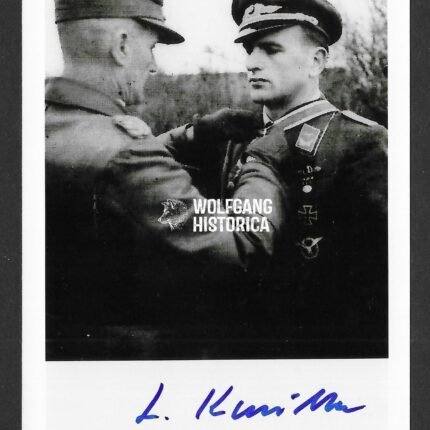
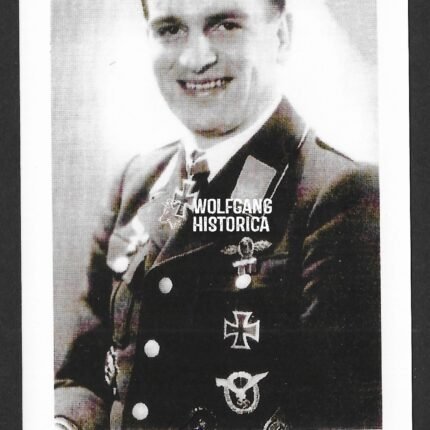
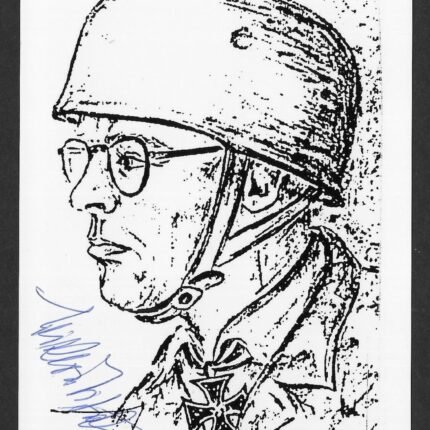
Original Postwar Signature on a Postwar Photo of Heinrich Eberbach. General der Panzertruppen Heinrich Eberbach (24 November 1895, Laufen am Neckar † 13 July 1992, Notzingen) was a career officer in the German Army who rose to the rank of General der Panzertruppen. A highly experienced armored commander, he led formations from regimental to corps level throughout the war, most notably on the Eastern Front and later in Normandy.


Awards and Decorations

  • Knight’s Cross of the Iron Cross (Ritterkreuz des Eisernen Kreuzes) – 4 July 1940, as Oberstleutnant and Kommandeur of Panzer-Regiment 35

  • Oak Leaves to the Knight’s Cross (Eichenlaub) – 31 December 1941, as Oberst and Kommandeur of 5. Panzer-Brigade


Career Highlights

  • World War I Service: Entered the Imperial Army in 1914 and served throughout the First World War.

  • Panzer Commander: Commanded Panzer-Regiment 35 in the 4. Panzer-Division during the campaign in France, earning the Knight’s Cross for his leadership.

  • Eastern Front: As commander of 5. Panzer-Brigade, received the Oak Leaves for his role in early armored battles in Russia in 1941.

  • High Command: Later commanded the 4. Panzer-Division, the XLI Panzer Corps, and in 1944 led Panzergruppe Eberbach during the Battle of Normandy, tasked with countering the Allied breakout.

  • Postwar: Captured by British forces in 1944, held as a prisoner of war until 1948. After his release, lived in Baden-Württemberg until his death in 1992, aged 96.


Item Details

  • Authentic postwar signature of General der Panzertruppen Heinrich Eberbach.

  • Signed on a postwar photograph.

  • Condition: Clear and well-preserved autograph.


Collector’s Note

Heinrich Eberbach was one of the notable Panzer leaders of World War II, active both on the Eastern Front and in the West. His decorations—the Knight’s Cross with Oak Leaves—and his command of Panzergruppe Eberbach during the critical Normandy campaign make his autograph a sought-after item for collectors of armored warfare and high-ranking Wehrmacht commanders.

Hans Speth – LIV. Armeekorps & 28. Jäger-Division

35,00

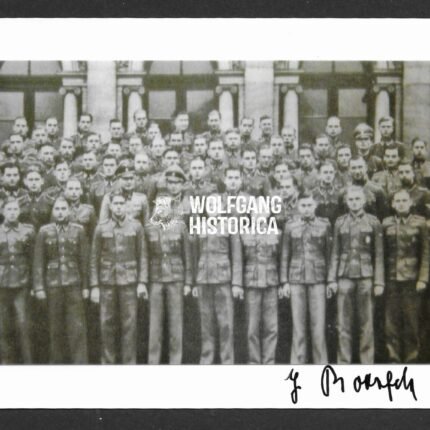
Original Postwar Signature on a Carton with Photo Added to it of Hans-Ludwig Speth. General der Artillerie Hans-Ludwig Speth (7 October 1897, Rockenberg-Friedberg/Hesse † 30 April 1985) was a long-serving officer who fought in both World Wars and rose to the rank of General der Artillerie during the Second World War. He was a highly decorated general staff officer and divisional commander, awarded both the German Cross in Gold and the Knight’s Cross of the Iron Cross for his leadership.

Awards and Decorations:

  • German Cross in Gold (Deutsches Kreuz in Gold)14 April 1942, as Oberst im Generalstab with Stab Generalkommando LIV. Armeekorps.

  • Knight’s Cross of the Iron Cross (Ritterkreuz des Eisernen Kreuzes)23 February 1944, as Generalleutnant and Kommandeur of 28. Jäger-Division.

Career Highlights:

  • Entered service in 1915 with 2. Kurhessisches Feldartillerie-Regiment Nr. 47, serving as an officer in the First World War.

  • Remained in the Reichswehr, advancing through artillery and staff assignments.

  • Prewar instructor at the Kriegsakademie Berlin, later promoted to Oberstleutnant in 1939.

  • Served as Ia of XXVII. Armeekorps during the 1940 Western campaign.

  • Staff service in Romania and Albania in 1940–41 before becoming Chef des Generalstabes LIV. Armeekorps, participating in the Crimea and Leningrad campaigns.

  • Awarded the German Cross in Gold in 1942 for his work as a corps staff officer.

  • From late 1942 until late 1943 served as Chief of Staff, 18. Armee.

  • Appointed Kommandeur of 28. Jäger-Division in December 1943, leading it through difficult Eastern Front fighting and earning the Knight’s Cross in February 1944.

  • Promoted to Generalleutnant in 1944, and by October of the same year to General der Artillerie.

  • Final wartime role as Commandant of the Kriegsakademie in Berlin until May 1945.

  • Survived the war and lived in Hesse until his death in 1985.

Item Details:

  • Authentic postwar signature of General der Artillerie Hans-Ludwig Speth.

  • Condition: Clear and well-preserved autograph.

Collector’s Note:
Speth’s career bridged staff excellence and divisional command, with decorations reflecting both aspects. His awards — the German Cross in Gold as a senior staff officer and the Knight’s Cross as a divisional commander — make his autograph a desirable addition for collectors of Heer generals and decorated leaders of the Eastern Front.

Werner von Bercken – 102. Infanterie-Division

40,00

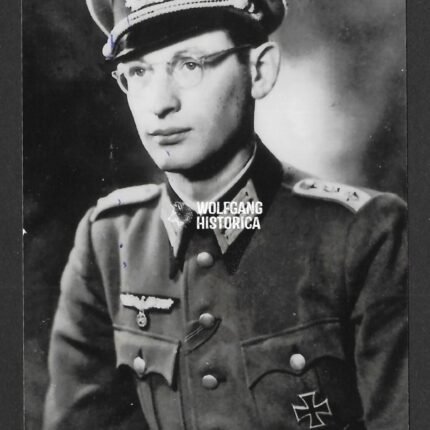
Original Postwar Signature on a Postwar Photo of Werner von Bercken. Generalleutnant Werner von Bercken (8 February 1897, Oppeln/Silesia † 29 Februry 1976, Röttgen/North Rhine-Westphalia) was a German Army officer who rose to the rank of Generalleutnant during the Second World War. He was a decorated front-line divisional commander on the Eastern Front, earning the German Cross in Gold and the Knight’s Cross of the Iron Cross, as well as a citation in the official Wehrmachtbericht.

Awards and Decorations:

  • Wehrmachtbericht Mention10 December 1943.

  • German Cross in Gold (Deutsches Kreuz in Gold)1 June 1944, as Generalmajor and Kommandeur of 102. Infanterie-Division.

  • Knight’s Cross of the Iron Cross (Ritterkreuz des Eisernen Kreuzes)23 October 1944, as Generalleutnant and Kommandeur of 102. Infanterie-Division.

    Awarded for his leadership in the defensive fighting near Novgorod along the Narew river, where his division successfully prevented repeated attempts by the Soviet 47th Army to force a crossing.

Career Highlights:

  • Entered the German Army during the First World War.

  • Continued service in the interwar Reichswehr and Wehrmacht, rising through the ranks.

  • Commanded the 102. Infanterie-Division, where he earned both the German Cross in Gold and the Knight’s Cross for his determined leadership in the heavy defensive battles of 1943–44.

  • Promoted to Generalleutnant in recognition of his service.

  • Captured by the Soviets in April 1945 and held as a prisoner of war until October 1955.

  • Returned to Germany after his release, living in North Rhine-Westphalia until his death in 1976.

Item Details:

  • Authentic postwar signature of Generalleutnant Werner von Bercken.

  • Signed on a postwar photograph. Smaller size.

  • Condition: Clear and well-preserved autograph.

Collector’s Note:
Werner von Bercken’s decorations — the German Cross in Gold, the Knight’s Cross, and a Wehrmachtbericht mention — place him among the recognized divisional commanders of the Eastern Front. His long Soviet captivity (1945–1955) adds historical context, making his autograph a compelling piece for collectors of German Army leadership and Eastern Front memorabilia.

Wilhelm Fahrmbacher – 5. Infanterie-Division & XXV. Armeekorps

50,00

Original Postwar Signature on a Postwar Photo of Wilhelm Fahrmbacher. General der Artillerie Wilhelm Fahrmbacher (19 September 1888, Zweibrücken † 27 April 1970, Garmisch-Partenkirchen) was a career officer who served in both World Wars and rose to the rank of General der Artillerie. A highly decorated divisional and corps commander, he earned the Knight’s Cross of the Iron Cross for his successes during the 1940 French campaign and later led large formations on the Eastern and Western Fronts.

Awards and Decorations:

  • Knight’s Cross of the Iron Cross (Ritterkreuz des Eisernen Kreuzes)24 June 1940, as Generalleutnant and Kommandeur of 5. Infanterie-Division.

    Recognized for his decisive leadership during the breakthrough battles across the Marne on the night of 13/14 June 1940. His division’s bold assault forced an early French retreat and opened the way for a rapid German pursuit over the Aube and Seine rivers. Fahrmbacher’s energy and initiative proved of decisive importance for the success of the campaign.

  • German Cross in Silver (Deutsches Kreuz in Silber)30 October 1943, as General der Artillerie and Kommandierender General of XXV. Armeekorps.

Career Highlights:

  • Commissioned into the Bavarian Army in 1910 and served with distinction during the First World War.

  • In 1938, appointed Kommandeur of 5. Infanterie-Division, leading it with success during the campaign in France in 1940.

  • Promoted to General der Artillerie, later took command of VII. Armeekorps and XXV. Armeekorps, serving on both the Eastern and Western Fronts.

  • Commanded Heeresgruppe Normandie in June 1944 and later acted as Fortress Commander of Lorient in Brittany, holding out until the final German surrender in May 1945.

  • Captured by U.S. forces in 1945, held as a prisoner of war until 1950.

  • After his release, served as a military adviser in Egypt (1951–1958), contributing to the organization of the postwar Egyptian Army.

  • Retired to Bavaria, where he lived until his death in 1970.

Item Details:

  • Authentic postwar signature of General der Artillerie Wilhelm Fahrmbacher.

  • Signed on a postwar photograph. Smaller ID size.

  • Condition: Clear and well-preserved autograph.

Collector’s Note:
Fahrmbacher’s signature is especially desirable due to his decorated service as a Knight’s Cross recipient, his command of both divisions and corps in major campaigns, and his long resistance as Fortress Commander of Lorient until 1945. His unique postwar career as a military adviser in Egypt adds further historical significance, appealing to collectors interested in both WWII and Cold War military history.

Werner Ehrig – 22. Infanterie-Division (LL) & 340. Infanterie-Division

45,00

Original Postwar Signature on a Postwar Photo of Werner Ehrig. Generalleutnant Werner Julius Clement Ehrig (22 April 1897, Eibenstock/Saxony † 31 January 1981, Oldenburg/Lower Saxony) was a career officer who served in both World Wars and rose to the rank of Generalleutnant during the Second World War. A decorated divisional commander, he earned both the Knight’s Cross of the Iron Cross and the German Cross in Gold for his leadership and staff work in key campaigns from the Netherlands to the Eastern Front.

Awards and Decorations:

  • Knight’s Cross of the Iron Cross (Ritterkreuz des Eisernen Kreuzes)26 May 1940, as Oberstleutnant im Generalstab and Ia of 22. Infanterie-Division (LL).

    Recognized for his invaluable contributions to the planning and execution of the operations against the Netherlands. Despite immense difficulties, Ehrig ensured orders reached all subordinate units in time. His initiative and personal bravery played a decisive role in the success of the campaign.

  • German Cross in Gold (Deutsches Kreuz in Gold)14 July 1944, as Generalmajor and Kommandeur of 340. Infanterie-Division.

Career Highlights:

  • Entered the Army in 1914, serving as an officer in the First World War.

  • Remained in the Reichswehr, rising steadily through staff and command posts.

  • Early WWII service included staff roles in XIII. Armeekorps and later as Ia of the 22. Infanterie-Division (LL) during the 1940 Western campaign.

  • Commanded II./Infanterie-Regiment 216 and later served on the staff of LXXXVII. Armeekorps.

  • Appointed Kommandeur of 340. Infanterie-Division in late 1943; his leadership was recognized with the German Cross in Gold during heavy fighting on the Eastern Front in 1944.

  • Later commanded the 544. Grenadier-Division, which was reorganized as the 544. Volksgrenadier-Division, leading it in the Vistula–Oder and West Carpathian operations in 1945.

  • Captured in May 1945 in Bohemia and held by the Soviets until his release.

  • Lived in Oldenburg until his death in 1981.

Item Details:

  • Authentic postwar signature of Generalleutnant Werner Ehrig.

  • Signed on a postwar photograph. Smaller size.

  • Condition: Clear and well-preserved autograph.

Collector’s Note:
Ehrig’s dual decorations — the Knight’s Cross for Holland (1940) and the German Cross in Gold for Eastern Front command (1944) — mark him as a versatile officer recognized both for his staff work and field leadership. His later command of the 544. Volksgrenadier-Division in the final months of the war makes his signature a valuable addition for collectors of Heer divisional commanders and late-war Volksgrenadier formations.

August Wittmann – Gebirgs-Artillerie-Regiment 95 & 3. Gebirgs-Division

55,00

Original Postwar Signature on a Postwar Photo of August Wittmann. Generalleutnant August Wittmann (20 July 1895, Munich † 29 March 1977, Glonn/Bavaria) was a long-serving officer who rose to the rank of Generalleutnant during the Second World War. A veteran of both World Wars, he became one of the most decorated artillery commanders of the Gebirgstruppe, earning the Knight’s Cross of the Iron Cross and the German Cross in Gold, as well as multiple mentions in the official Wehrmachtbericht.

Awards and Decorations:

  • Wehrmachtbericht Mention11 June 1941: Recognized along with fellow Gebirgsdivision commanders for decisive contributions during the operations on Crete.

  • Knight’s Cross of the Iron Cross (Ritterkreuz des Eisernen Kreuzes)21 June 1941, as Oberstleutnant and Kommandeur of Gebirgs-Artillerie-Regiment 95.

    Awarded for his leadership during the Battle of Crete. After repeated attacks on 28–29 May 1941, Wittmann personally led his battalion in a bold advance that cut off the planned British withdrawal from Stylos. On 29 May he forced the surrender of two Australian battalions and several hundred Greek troops near Rethymnon. After a grueling 175 km march from Iraklion, he reached Jerapetra and played a decisive role in the capture of eastern Crete.

  • German Cross in Gold (Deutsches Kreuz in Gold)25 August 1944, as Generalleutnant and Kommandeur of 3. Gebirgs-Division.

Career Highlights:

  • Entered the Bavarian Army in 1914, serving throughout the First World War in Feldartillerie-Regiment 1.

  • Joined the Bavarian Landespolizei in 1920, transferring to the Heer in 1935 with the build-up of the Wehrmacht.

  • Gained command experience in multiple Gebirgs-Artillerie regiments prior to the Second World War.

  • Commanded Gebirgs-Artillerie-Regiment 95, where his performance in the Battle of Crete earned him the Knight’s Cross.

  • Promoted steadily through senior divisional commands, including the 3. Gebirgs-Division, 117. Jäger-Division, and finally the 1. Volks-Gebirgs-Division in 1945.

  • Spent the postwar years in Bavaria, passing away in Glonn in 1977.

Item Details:

  • Authentic postwar signature of Generalleutnant August Wittmann.

  • Signed on a postwar photograph.

  • Condition: Clear and well-preserved autograph.

Collector’s Note:
Wittmann’s reputation as a decorated Gebirgsartillerie commander, his key role in the Battle of Crete, and his leadership of multiple divisions on the Eastern and Balkan fronts make his signature highly desirable. His awards — the Knight’s Cross and German Cross in Gold, combined with his Wehrmachtbericht mention — place him among the prominent leaders of Germany’s elite mountain troops.

Alfred Ritz – Panzergrenadier-Regiment 1 (1. Panzer-Division)

25,00

Original Postwar Signature on a Postwar Photo of Alfred Ritz. Hauptmann Alfred Ritz (10 March 1914, Voerde-Wesel † 12 April 1982, Bonn) was a German Army officer who rose to the rank of Hauptmann during the Second World War. Serving in the elite 1. Panzer-Division, he was awarded the Knight’s Cross of the Iron Cross for his leadership in combat during the final months of the war.

Awards and Decorations:

  • Knight’s Cross of the Iron Cross (Ritterkreuz des Eisernen Kreuzes)11 December 1944, as Hauptmann and Kommandeur of I./Panzergrenadier-Regiment 1, 1. Panzer-Division.

Career Highlights:

  • Entered the Heer and rose through the ranks as a Panzergrenadier officer.

  • Served in the 1. Panzer-Division, one of the Wehrmacht’s most famous armored formations.

  • As commander of I./Panzergrenadier-Regiment 1, he led his battalion in heavy defensive battles on the Eastern Front in late 1944.

  • His determined leadership and personal bravery during these actions earned him the Knight’s Cross.

  • Survived the war and later lived in Bonn until his death in 1982.

Item Details:

  • Authentic postwar signature of Hauptmann Alfred Ritz.

  • Signed on a postwar photograph.

  • Condition: Clear and well-preserved autograph.

Collector’s Note:
As a decorated officer of the 1. Panzer-Division and a Knight’s Cross recipient, Alfred Ritz’s autograph is a significant addition for collectors of Panzer commanders and late-war Eastern Front leadership. His award in December 1944 places him among the division’s noteworthy officers recognized in the final stages of the conflict.

Werner Ranck – X. Armeekorps & 121. Infanterie-Division

45,00

Original Postwar Signature on a Postwar Photo of Werner Ranck. Generalmajor Werner Ranck (25 October 1904, Hamburg † 7 December 1989, Hamburg) was a German Army officer who rose to the rank of Generalmajor during the Second World War. A front-line commander on the Eastern Front, he earned both the German Cross in Gold and the Knight’s Cross of the Iron Cross for his leadership.

Awards and Decorations:

  • German Cross in Gold (Deutsches Kreuz in Gold)10 February 1944, with X. Armeekorps.

  • Knight’s Cross of the Iron Cross (Ritterkreuz des Eisernen Kreuzes)2 March 1945, as Generalmajor and Kommandeur of 121. Infanterie-Division.

Career Highlights:

  • Entered military service in the interwar Reichswehr.

  • Rose steadily through the ranks during the Second World War, serving on the Eastern Front.

  • Distinguished himself as a staff officer and later as a division commander.

  • As commander of the 121. Infanterie-Division, he received the Knight’s Cross for leading his troops in heavy defensive fighting during the final months of the war.

  • Promoted to Generalmajor by 1945.

  • Survived captivity and returned to Hamburg, where he lived until his death in 1989.

Item Details:

  • Authentic postwar signature of Generalmajor Werner Ranck.

  • Signed on a postwar photograph. Smaller ID size.

  • Condition: Clear and well-preserved autograph.

Collector’s Note:
Ranck’s dual decorations — the German Cross in Gold and the Knight’s Cross of the Iron Cross — underline his reputation as a competent and proven commander on the Eastern Front. His autograph is a desirable addition for collectors of late-war Heer division commanders and Knight’s Cross recipients.

Otto Hitzfeld – Infanterie-Regiment 213 & LXVII. Armeekorps (Schwertern)

75,00

Original Postwar Signature on a Postwar Photo of Otto Hitzfeld. General der Infanterie Otto Hitzfeld (7 May 1898 † 6 December 1990) was a highly decorated officer of the German Army during the Second World War, ultimately rising to corps command. Over the course of his career he became one of the few recipients of the Knight’s Cross of the Iron Cross with Oak Leaves and Swords, marking him among the Wehrmacht’s elite leadership.

Awards and Decorations:

  • Knight’s Cross of the Iron Cross (Ritterkreuz des Eisernen Kreuzes) – 30 October 1941, as Oberstleutnant and Kommandeur of Infanterie-Regiment 213, 73. Infanterie-Division.

  • Oak Leaves to the Knight’s Cross (Eichenlaub zum Ritterkreuz) – 17 January 1942, as Oberstleutnant and Kommandeur of Infanterie-Regiment 213, 73. Infanterie-Division.

  • Swords to the Knight’s Cross with Oak Leaves (Schwerter zum Ritterkreuz mit Eichenlaub) – 9 May 1945, as General der Infanterie and Kommandierender General of LXVII. Armeekorps.

Career Highlights:

  • A veteran of the First World War who continued his military career through the interwar years.

  • Distinguished himself on the Eastern Front with the 73. Infanterie-Division, earning both the Knight’s Cross and Oak Leaves for regimental leadership.

  • Rose through senior commands, culminating as General der Infanterie and commander of LXVII. Armeekorps in the final phase of the war.

  • Survived the war and lived until 1990, making him one of the longest-lived Swords recipients.

Item Details:

  • Authentic postwar signature of Otto Hitzfeld.

  • Medium: Postcard-sized format.

  • Condition: Good, with clear autograph and presentation.

Stefan Fröhlich – Kampfgeschwader 76 & Fliegerführer Afrika

65,00

Original Postwar Signature on a Postwar Photo of Stefan Fröhlich. General der Flieger Stefan Fröhlich (7 October 1889, Orsova † 2 October 1978, Graz) was an Austrian-born officer who transferred to the Luftwaffe after the Anschluss and rose to the rank of General der Flieger during the Second World War. Beginning his career as an engineer officer in the Austro-Hungarian Army, he later trained as a pilot and transitioned into air force service, where he became one of the Luftwaffe’s experienced leaders.

Awards and Decorations:

  • Ritterkreuz des Eisernen Kreuzes – 4 July 1940, as Generalmajor und Kommodore of Kampfgeschwader 76.

  • Deutsches Kreuz in Gold – 11 May 1942, as Generalleutnant und Fliegerführer Afrika

Career Highlights:

  • Prewar: Officer of the Austro-Hungarian Army and later the Austrian Bundesheer, rising to Oberst and commanding air training schools before the Anschluss.

  • 1939–1940: Kommodore of Kampfgeschwader 76, leading it in the campaigns in Poland and France, as well as during the early Battle of Britain.

  • 1941: Appointed Fliegerführer Afrika, establishing close cooperation with General Rommel and coordinating Luftwaffe support during the North African campaign.

  • 1942: Commanded 2. Flieger-Division on the Eastern Front; later promoted to General der Flieger and given command of IX. Fliegerkorps.

  • 1943–1945: Commanded Luftgau XVII (Vienna), briefly led Luftwaffenkommando Südost, and finally served as Oberbefehlshaber of Luftflotte 10 in the last weeks of the war.

Item Details:

  • Authentic postwar signature of General der Flieger Stefan Fröhlich.

  • Signed on a postwar photograph.

  • Condition: Excellent, with a strong, legible autograph.

Collector’s Note:
General der Flieger Stefan Fröhlich stands out as one of the few Austrian officers to reach high rank in the Luftwaffe. Decorated with both the Knight’s Cross and the German Cross in Gold, his leadership spanned the Luftwaffe’s major theaters — from the skies over France to the deserts of North Africa and the Eastern Front. His signature is a desirable addition to any collection of Luftwaffe generals or decorated commanders of the air war.

Otto Lasch – Infanterie-Regiment 43 & 349. Infanterie-Division (Festung Königsberg)

40,00

Original Postwar Signature on a Postwar Photo of Otto Lasch. General der Infanterie Otto Lasch (25 June 1893, Pleß † 29 April 1971, Bonn) was a career officer in the German Army who rose to the rank of General der Infanterie during the Second World War. A highly decorated front-line commander, he was awarded the Knight’s Cross of the Iron Cross with Oak Leaves for his leadership of infantry divisions on the Eastern Front.

Awards and Decorations:

  • Knight’s Cross of the Iron Cross (Ritterkreuz des Eisernen Kreuzes)17 July 1941, as Oberst and Kommandeur of Infanterie-Regiment 43, 1. Infanterie-Division.

    During the opening phase of Operation Barbarossa, Lasch commanded advanced detachments tasked with capturing Riga. By driving his men forward with speed and determination, he broke into the city as planned on 1 July 1941, paving the way for German reinforcements to secure the eastern districts. His decisive actions contributed greatly to the success of 18. Armee and earned him the Knight’s Cross.

  • Oak Leaves to the Knight’s Cross (Ritterkreuz mit Eichenlaub, 578th award)10 September 1944, as Generalleutnant and Kommandeur of the 349. Infanterie-Division.

    Recognized for his leadership of the division during the Lemberg–Brody battles of July 1944. After being surrounded with his division and Korpsabteilung C, Lasch led a breakout on 21–22 July, seizing key heights and villages near Jasionowce and Zalesie. When Soviet forces encircled them again the following day, he again organized a breakout, enabling elements of his command to escape despite heavy losses.

  • Wehrmachtbericht Mention12 April 1945.

Career Highlights:

  • Joined the Prussian Army in 1912 and fought in World War I.

  • Rose through the ranks during the interwar years, commanding the Infanterie-Regiment 43 at the start of Operation Barbarossa.

  • Distinguished himself in the capture of Riga (1941) and in the defensive fighting of Lemberg/Brody (1944).

  • Promoted to General der Infanterie.

  • In April 1945, he was appointed Commandant of Königsberg, tasked with defending the city during its final siege.

  • After the city’s capitulation, he was captured by the Soviets and spent years in captivity before being released in 1953.

  • Died in Bonn in 1971.

Item Details:

  • Authentic postwar signature of General der Infanterie Otto Lasch.

  • Signed on a postwar photograph. Smaller size.

  • Condition: Clear, well-preserved autograph.

Collector’s Note:
Otto Lasch is best remembered as the commander of Königsberg’s final defense, but his earlier awards — the Knight’s Cross with Oak Leaves and his Wehrmachtbericht mention — highlight a career of front-line leadership. His autograph is a historically significant addition for collectors of Eastern Front and high-command Heer memorabilia.

Helmut Besch – Kommandant Truppenübungsplatz Heuberg & Galazien

20,00

Original Postwar Signature on a Postwar Photo of Helmut Besch. Generalmajor Helmut Besch (17 April 1892, Strasbourg † 13 October 1974, Tübingen) was a career officer whose service spanned both the Imperial and Wehrmacht eras, culminating in his appointment as Generalmajor in November 1942.

Career & Commands

  • Prewar Service: Commander of the Truppenübungsplatz (Training Area) Heuberg (from 1 December 1935).

  • Commands during WWII:

    • Kommandant Truppenübungsplatz Heuberg (1 September 1939)

    • Kommandant Truppenübungsplatz Harskamp (20 June 1940)

    • Kommandant Truppenübungsplatz Galizien (Janów near Lemberg, 9 March 1942 – 10 April 1944)

    • Returned as Kommandant Truppenübungsplatz Heuberg (20 May 1944).

Promotions

  • Oberst – 1 January 1938

  • Generalmajor – 1 November 1942

Wend von Wietersheim – Panzergrenadier-Regiment 113 & 11. Panzer-Division (Schwertern)

75,00

Original Postwar Signature on a Postwar Photo of Wend von Wietersheim. Generalleutnant Wend von Wietersheim (18 April 1900 † 19 September 1975) was a highly decorated Panzer officer of the Wehrmacht who rose to the rank of Generalleutnant and commanded the famed 11. Panzer-Division. He was one of the relatively few recipients of the Knight’s Cross with Oakleaves and Swords, awarded for his distinguished leadership on both the Eastern and Western Fronts.

Awards & Decorations

  • Deutsches Kreuz in Gold – 24 December 1941 as Oberstleutnant und Kommandeur, Kradschützen-Bataillon 1 / 1. Panzer-Division

  • Ritterkreuz des Eisernen Kreuzes (854th Award) – 10 February 1942 as Oberstleutnant und Kommandeur, Schützen-Regiment 113 / 1. Panzer-Division
    Awarded for his decisive counterattack west of Kalinin (19–20 October 1941), sealing off a Soviet breakthrough and safeguarding the vital Volga railway bridge.

  • Eichenlaub (176th Award) – 12 January 1943 as Oberst und Kommandeur, Panzergrenadier-Regiment 113 / 1. Panzer-Division
    Recognized for his successful counterattack in the Toropez area, late November 1942, which threw back vastly superior Soviet forces.

  • Schwerter (58th Award) – 26 March 1944 as Generalmajor und Kommandeur, 11. Panzer-Division
    Awarded for his outstanding leadership of the 11. Panzer-Division during the southern sector battles of late 1943 and early 1944.

Mentions in the Wehrmachtbericht

  • 24 December 1943 – For the achievements of the 11. Panzer-Division southeast of Kirovograd.

  • 4 September 1944 – For the Division’s distinguished actions covering the retreat through the Rhône Valley.

  • 24 December 1944 – For its role in the Battle of Lorraine and in the fighting around the Western Wall at the Saar.

Career Notes

  • Early war service with the 1. Panzer-Division, rising from battalion to regimental command.

  • Distinguished himself in France (1940), the Soviet campaign (1941–43), and later in the battles across Ukraine and southern Russia.

  • Assumed command of the 11. Panzer-Division, which became known as the “Gespenster-Division” (Ghost Division) during its fast-moving operations on the Western Front in 1944.

  • His leadership in both defensive withdrawals and counteroffensive actions earned him repeated high-level recognition.

Item Details

  • Authentic postwar signature of Generalleutnant Wend von Wietersheim.

  • Signed on a postwar photo.

  • Condition: Excellent.

Collector’s Note:
A superb piece linked to one of the best-known Panzer commanders of the 11. Panzer-Division, decorated with the Knight’s Cross, Oakleaves, and Swords. His career and repeated mentions in the Wehrmachtbericht underline his status as a highly regarded leader in the Panzer arm.

Erich Diestel – 346. Infanterie-Division (Normandy, Flanders)

85,00

Original Scarce Postwar Signature on a Postwar Photo of Erich Diestel. Generalleutnant Erich Diestel (8 November 1892, Deutsch Eylau † 3 August 1973, Bad Wiessee) was a career officer who rose to the rank of Generalleutnant during the Second World War. He held several key commands, most notably leading the 346. Infanterie-Division in heavy fighting on the Western Front and later commanding Korps Diestel and Armeeabteilung Kleffel in the final defense of Holland. Captured in May 1945, he remained in captivity until 1947.

Awards & Decorations:

  • Deutsches Kreuz in Gold – 2 January 1942 as Oberst und Kommandeur of Infanterie-Regiment 188 / 68. Infanterie-Division

  • Wehrmachtbericht Mention – 10 September 1944: “The 346th Infantry Division under the command of Generalleutnant Diestel has fought outstandingly in the battles in Flanders.”

  • Ritterkreuz des Eisernen Kreuzes – 8 October 1944 as Generalleutnant und Kommandeur of the 346. Infanterie-Division, awarded for his division’s performance on the Western Front, particularly during the fighting in Flanders, which also brought him recognition in the Wehrmachtbericht.

Item Details:

  • Authentic postwar signature of Generalleutnant Erich Diestel.

  • Signed on a postwar photograph.

  • Condition: Very good, well-preserved.

Collector’s Note:
As commander of the 346. Infanterie-Division, Diestel played a significant role in the fierce battles in Normandy and Flanders in 1944. His Ritterkreuz award was directly linked to his leadership during this campaign, making his autograph an appealing acquisition for collectors of high-ranking Heer commanders of the Western Front.

Hans Baur – Personal Pilot of Adolf Hitler

75,00

Original Postwar Signature on a Postwar Photo of Hans Baur. SS-Gruppenführer Hans Baur (14 June 1897, Ampfing † 17 February 1993, Herrsching am Ammersee) was a German pilot and senior officer in the SS, best known as the personal pilot of Adolf Hitler. A First World War veteran and one of Germany’s pioneering commercial aviators during the interwar period, Baur became Hitler’s chief pilot in 1932 and later commander of the Government Flight Squadron (Regierungsstaffel).

Career Highlights:

  • Served as a fighter pilot in World War I, credited with six aerial victories.

  • Worked for Deutsche Luft Hansa in the 1920s, becoming one of Germany’s leading civilian pilots.

  • From 1932 onward, appointed as Adolf Hitler’s personal pilot, flying him during election campaigns and later throughout the war.

  • Rose to the rank of SS-Gruppenführer and was closely associated with the inner circle of the Führer’s headquarters.

  • Wounded and captured in Berlin in May 1945, spending ten years in Soviet captivity before release in 1955.

  • Authored postwar memoirs recounting his experiences as Hitler’s pilot.

Item Details:

  • Authentic postwar signature of Hans Baur.

  • Signed on a postwar photograph.

  • Condition: As seen, clear and well-preserved.

Collector’s Note:
As Hitler’s personal pilot, Hans Baur was a central witness to many events at the highest level of the Third Reich. His autograph is considered a significant addition for collectors interested in figures directly tied to Hitler’s inner circle.

Hans Mikosch – Pionier-Btl. 51 (Eben-Emael!) & Pionier-Rgt.-Stab 677 (Stalingrad – Eichenlaub!)

0,01

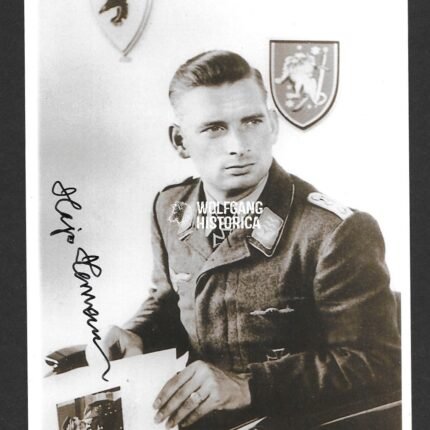
Original Wartime Portrait with Postwar Signature of Hans Mikosch. Generalleutnant Hans Mikosch (7 January 1898, Lissa † 18 January 1993, Mannheim)

Hans Mikosch was one of the most renowned pioneer officers of the Wehrmacht, rising to the rank of Generalleutnant. He distinguished himself as a combat engineer commander in both the Western and Eastern campaigns, earning the Knight’s Cross of the Iron Cross with Oak Leaves for his bold leadership.

Awards and Decorations:

  • Knight’s Cross of the Iron Cross (Ritterkreuz des Eisernen Kreuzes)21 May 1940, as Oberstleutnant and Kommandeur of Pionier-Bataillon 51.

    “Oberstleutnant Mikosch fearlessly led his Bataillon through fortified and toughly defended enemy positions in order to relieve the brave conquerors of Fort Eben-Emael. It was the successful completion of this deed which enabled the Fort to definitively come under our control. Such high recognition of this action is simultaneously tribute to the efforts and outstanding achievements of the entire German Pionierwaffe.”

  • Oak Leaves to the Knight’s Cross (Eichenlaub zum Ritterkreuz des Eisernen Kreuzes, 210th award)6 March 1943, as Oberst and Kommandeur of Pionier-Regimentsstab z.b.V. 677 and Führer of a Kampfgruppe in Stalingrad.

    At Stalingrad, Mikosch commanded a hastily formed Kampfgruppe composed of pioneer elements and mixed infantry. His units were repeatedly called upon for breakthrough and blocking actions in the brutal street fighting. Mikosch personally led from the front, improvising under desperate conditions to hold Soviet assaults at bay. His combat engineers played a vital role in house-to-house fighting, the defense of key strongpoints, and the reinforcement of crumbling sectors. His tireless leadership and personal bravery were instrumental in keeping his formation intact during the catastrophic collapse of the German 6th Army.

Career Highlights:

  • Veteran of the First World War who continued service in the Reichswehr as a career officer.

  • Commanded Pionier-Bataillon 51 during the 1940 Western Campaign, where his actions at Fort Eben-Emael earned him the Knight’s Cross.

  • On the Eastern Front, his Stalingrad command brought him further distinction, leading to the Oak Leaves in 1943.

  • Survived captivity and postwar lived in Mannheim, remaining a respected figure among Germany’s pioneer veterans until his death in 1993.

Item Details:

  • Authentic postwar signature of Generalleutnant Hans Mikosch.

  • Signed on an original wartime portrait.

  • Condition: Clear signature and well-preserved portrait.

Collector’s Note:
This item combines the rarity of a wartime portrait with Mikosch’s postwar autograph, making it especially desirable. His pivotal role in the capture of Fort Eben-Emael and his tenacious leadership of a Kampfgruppe in the inferno of Stalingrad underline his reputation as one of the outstanding leaders of the Pioniertruppe

Werner Ebeling – Grenadier-Regiment 154 & 220 (Eichenlaub)

20,00

Original Postwar Signature on a Postwar Photo of Werner Ebeling. Oberst Werner Ebeling (11 November 1907 † 16 December 2001) was a German Army officer who rose to the rank of Oberst during the Second World War. A highly decorated front-line commander of the 58. Infanterie-Division, he received the Knight’s Cross of the Iron Cross with Oak Leaves for his leadership in some of the fiercest battles on the Eastern Front.

Awards and Decorations:

  • German Cross in Gold (Deutsches Kreuz in Gold)11 March 1943, as Oberleutnant with Grenadier-Regiment 220.

  • Knight’s Cross of the Iron Cross (Ritterkreuz des Eisernen Kreuzes)9 April 1944, as Major and Kommandeur of II./Grenadier-Regiment 220, 58. Infanterie-Division.

  • Oak Leaves to the Knight’s Cross (Ritterkreuz mit Eichenlaub, 799th award)5 March 1945, as Oberstleutnant and Kommandeur of Grenadier-Regiment 154, 58. Infanterie-Division.

Career Highlights:

  • Served throughout the war in infantry leadership roles, primarily with the 58. Infanterie-Division.

  • Earned the German Cross in Gold in 1943 for his distinguished service in combat as a company-grade officer.

  • Awarded the Knight’s Cross in April 1944 for outstanding leadership of his battalion during hard-fought engagements on the Eastern Front.

  • Received the Oak Leaves in March 1945 as a regimental commander, recognized for his division’s stubborn resistance during the late-war battles against overwhelming Soviet forces.

  • Survived the war and lived until 2001, reaching the age of 94.

Item Details:

  • Authentic postwar signature of Oberst Werner Ebeling.

  • Signed on a postwar photograph.

  • Condition: Excellent, with a clear and bold autograph.

Collector’s Note:
Ebeling’s combination of the German Cross in Gold, Knight’s Cross, and Oak Leaves makes his autograph especially attractive for Eastern Front collectors. His long career within the 58. Infanterie-Division gives his grouping of awards and service a strong cohesion and significance.

Martin Unrein – Panzergrenadier-Regiment 4 & 14. Panzer-Division (Eichenlaub)

75,00

Original Postwar Signature on a Postwar Photo of Martin Unrein. General der Panzertruppen Martin Unrein (1 January 1901, Weimar † 22 January 1972, Karlsruhe) was a German Panzer commander who rose to the rank of General der Panzertruppen during the Second World War. A highly decorated officer, he received the Knight’s Cross of the Iron Cross with Oak Leaves for his leadership of armored formations on the Eastern Front in 1943–44.

Awards and Decorations:

  • Knight’s Cross of the Iron Cross (Ritterkreuz des Eisernen Kreuzes, 2099th award)10 September 1943, as Oberst and Kommandeur of Panzergrenadier-Regiment 4, 6. Panzer-Division, XXXXVI. Armeekorps, 8. Armee, Heeresgruppe Süd.

    Awarded for his successful leadership of Panzergrenadier-Regiment 4 during the aftermath of the Battle of Kursk, in particular for the fighting at Alexejevka (19 July 1943) and in the Fourth Battle of Kharkov at Taranovka (23 August 1943). His recommendation also cited his distinguished service during the 1942–43 campaigns, including the successful attack at Sytschevka (5 May 1942).

  • Oak Leaves to the Knight’s Cross (Ritterkreuz mit Eichenlaub zum Eisernen Kreuz, 544th award)26 June 1944, as Generalmajor and Kommandeur of the 14. Panzer-Division, III. Armeekorps, 6. Armee, Heeresgruppe Südukraine.

    Recognized for his distinguished command of the 14. Panzer-Division in a series of critical battles: the defensive actions around Ingulez and Adshamka (15 November 1943 – 4 January 1944), the Battle of Kirovograd (5–22 January 1944), the relief efforts and defensive fighting around Cherkassy (23 January – 4 March 1944), and the retreat into Romania (March–May 1944).

Career Highlights:

  • Career officer who entered the Reichswehr in the 1920s and specialized in mobile warfare.

  • Distinguished himself as a regimental commander in the 6. Panzer-Division, earning the Knight’s Cross in 1943.

  • Promoted to Generalmajor, he led the 14. Panzer-Division through grueling defensive campaigns in Ukraine and Romania, recognized with the Oak Leaves in 1944.

  • Promoted to General der Panzertruppen, later entrusted with command of the III. (Germanisches) SS-Panzer-Korps in the final battles of 1945.

  • Captured at the end of the war and released from captivity before settling in West Germany, where he lived until his death in 1972.

Item Details:

  • Authentic postwar signature of General der Panzertruppen Martin Unrein.

  • Signed on a postwar photograph.

  • Condition: Clear, well-preserved autograph.

Collector’s Note:
As a recipient of the Knight’s Cross with Oak Leaves and a commander of both Panzer-Divisions and the III. SS-Panzer-Korps, Martin Unrein’s autograph is highly desirable. His battlefield leadership in the Ukraine campaigns of 1943–44 and his high-level command in the final year of the war make this a significant and historically rich addition to any advanced Panzer collection.

Gerhard Conrad – Kampfgruppe z.b.V. 2 (7. Flieger-Division – May 1940)

75,00

Original Postwar Signature on a Postwar Photo of Gerhard Conrad. Generalleutnant Dipl.-Ing. Gerhard Conrad (21 April 1895, Pregelmühle/Alsleben, Saxony-Anhalt † 28 May 1982, Ruhpolding, Bavaria) was a Luftwaffe officer and engineer who rose to the rank of Generalleutnant during the Second World War. He was decorated with the Knight’s Cross of the Iron Cross for his leadership of a transport formation during the Western campaign in 1940.

Awards and Decorations:

  • Knight’s Cross of the Iron Cross (Ritterkreuz des Eisernen Kreuzes)24 May 1940, as Oberst and Kommodore of Kampfgruppe zur besonderen Verwendung 2, 7. Flieger-Division, Luftwaffe.

    Awarded for his leadership and personal bravery during the planning and execution of airborne operations in the West. Conrad’s effective command of his transport formation was instrumental in the success of these air-landing missions.

Career Highlights:

  • Entered military service during the First World War, later trained as an engineer.

  • Rejoined the Luftwaffe, where he applied his technical expertise and leadership skills in command positions.

  • As commander of Kampfgruppe zur besonderen Verwendung 2, played a critical role in supporting airborne operations with transport aircraft in 1940.

  • Recognized with the Knight’s Cross for his contributions to the success of the German air-landing missions in the Western campaign.

  • Rose to the rank of Generalleutnant in the Luftwaffe before the end of the war.

  • Captured and later released from captivity, living in Bavaria until his death in 1982.

Item Details:

  • Authentic postwar signature of Generalleutnant Gerhard Conrad.

  • Signed on a postwar photograph.

  • Condition: Clear and well-preserved autograph.

Collector’s Note:
Gerhard Conrad’s award of the Knight’s Cross for his leadership in early Luftwaffe airborne operations highlights his importance in the development of German air-landing tactics. His autograph is a desirable addition for collectors of Luftwaffe generals, paratroop/airborne operations, and Knight’s Cross recipients.

Dietrich Peltz – Sturzkampfgeschwader 77 (Schwertern)

65,00

Original Postwar Signature on a Postwar Photo of Dietrich Peltz. Generalmajor Dietrich Peltz (6 September 1914, Gießen † 10 August 2001, Munich) was one of the Luftwaffe’s most decorated bomber officers, rising to the rank of Generalmajor and earning the Knight’s Cross of the Iron Cross with Oak Leaves and Swords. Recognized for his aggressive leadership in dive-bomber operations and later as a planner of strategic bombing raids, he became one of the youngest generals in the German armed forces.

Awards and Decorations:

  • Knight’s Cross of the Iron Cross (Ritterkreuz des Eisernen Kreuzes)14 October 1940, as Oberleutnant with the Stab of Sturzkampfgeschwader 77.

  • Oak Leaves to the Knight’s Cross (Eichenlaub zum Ritterkreuz des Eisernen Kreuzes, 53rd award)31 December 1941, as Hauptmann and Kommandeur of II./ Sturzkampfgeschwader 77.

  • Swords to the Knight’s Cross with Oak Leaves (Schwerter zum Ritterkreuz des Eisernen Kreuzes, 33rd award)July 1943, as Oberst im Generalstab and Angriffsführer England.

Career Highlights:

  • Distinguished himself as a Stuka pilot and commander in the early campaigns, earning the Knight’s Cross in 1940.

  • As Kommandeur of II./StG 77, led his group in intensive dive-bombing operations on the Eastern Front, where his effectiveness was recognized with the Oak Leaves in 1941.

  • Later transferred to the Luftwaffe General Staff, becoming Angriffsführer England, tasked with planning and executing bomber raids against Britain in 1943, which earned him the Swords.

  • Promoted rapidly due to his ability, he was one of the youngest officers to reach the rank of Generalmajor.

  • Survived the war, later living in Munich until his death in 2001.

Item Details:

  • Authentic postwar signature of Generalmajor Dietrich Peltz.

  • Signed on a postwar photograph.

  • Condition: Clear and well-preserved autograph.

Collector’s Note:
Peltz’s combination of frontline combat command with Stuka units and his later role as a strategic bombing planner make him an especially interesting figure. His awards — the Knight’s Cross with Oak Leaves and Swords — place him among the most highly decorated Luftwaffe officers, making his signed photo a desirable addition for collectors of decorated bomber leaders and high-ranking Luftwaffe personalities.

Dietrich Peltz – Sturzkampfgeschwader 77 (Schwertern) (Wartime Signed)

275,00

Original Wartime Signature on a Postcard of Dietrich Peltz. Generalmajor Dietrich Peltz (6 September 1914, Gießen † 10 August 2001, Munich) was one of the Luftwaffe’s most decorated bomber officers, rising to the rank of Generalmajor and earning the Knight’s Cross of the Iron Cross with Oak Leaves and Swords. Recognized for his aggressive leadership in dive-bomber operations and later as a planner of strategic bombing raids, he became one of the youngest generals in the German armed forces.

Awards and Decorations:

  • Knight’s Cross of the Iron Cross (Ritterkreuz des Eisernen Kreuzes)14 October 1940, as Oberleutnant with the Stab of Sturzkampfgeschwader 77.

  • Oak Leaves to the Knight’s Cross (Eichenlaub zum Ritterkreuz des Eisernen Kreuzes, 53rd award)31 December 1941, as Hauptmann and Kommandeur of II./ Sturzkampfgeschwader 77.

  • Swords to the Knight’s Cross with Oak Leaves (Schwerter zum Ritterkreuz des Eisernen Kreuzes, 33rd award)July 1943, as Oberst im Generalstab and Angriffsführer England.

Career Highlights:

  • Distinguished himself as a Stuka pilot and commander in the early campaigns, earning the Knight’s Cross in 1940.

  • As Kommandeur of II./StG 77, led his group in intensive dive-bombing operations on the Eastern Front, where his effectiveness was recognized with the Oak Leaves in 1941.

  • Later transferred to the Luftwaffe General Staff, becoming Angriffsführer England, tasked with planning and executing bomber raids against Britain in 1943, which earned him the Swords.

  • Promoted rapidly due to his ability, he was one of the youngest officers to reach the rank of Generalmajor.

  • Survived the war, later living in Munich until his death in 2001.

Item Details:

  • Authentic wartime signature of Generalmajor Dietrich Peltz.

  • Signed on a wartime postcard.

  • Condition: Clear and well-preserved autograph. Edges have been cut.

Collector’s Note:
Peltz’s combination of frontline combat command with Stuka units and his later role as a strategic bombing planner make him an especially interesting figure. His awards — the Knight’s Cross with Oak Leaves and Swords — place him among the most highly decorated Luftwaffe officers, making his signed photo a desirable addition for collectors of decorated bomber leaders and high-ranking Luftwaffe personalities.

Martin Bieber – Grenadier-Regiment 184 & Divisionsgruppe 86 (Eichenlaub)

65,00

Original Postwar Signature on a Postwar Photo of Martin Bieber. Generalleutnant Martin Bieber (17 November 1900, Tabarz † 19 October 1974, Bad Reichenhall) was a German Army officer who rose to the rank of Generalleutnant during the Second World War. He distinguished himself as a regimental and divisional commander on the Eastern Front and was decorated with the Knight’s Cross of the Iron Cross with Oak Leaves for his leadership.

Awards and Decorations:

  • Knight’s Cross of the Iron Cross (Ritterkreuz des Eisernen Kreuzes, 1901st award)28 July 1943, as Oberst and Kommandeur of Grenadier-Regiment 184, 86. Infanterie-Division, XXXXI. Panzer-Korps, 9. Armee, Heeresgruppe Mitte.

  • Oak Leaves to the Knight’s Cross (Ritterkreuz mit Eichenlaub, 601st award)2 September 1944, as Oberst and Führer of Divisionsgruppe 86, Korps-Abteilung E, XX. Armeekorps, 2. Armee, Heeresgruppe Mitte.

Career Highlights:

  • Career officer from the Reichswehr era who served with distinction throughout WWII.

  • As commander of Grenadier-Regiment 184, he earned the Knight’s Cross in 1943 during the heavy fighting on the central sector of the Eastern Front.

  • Promoted to divisional leadership, taking over Divisionsgruppe 86, later absorbed into Korps-Abteilung E, where he proved his resilience during the defensive battles of 1944.

  • Awarded the Oak Leaves in September 1944 for his skillful leadership of these ad-hoc formations under extreme pressure during the Soviet summer offensives.

  • Promoted to Generalleutnant before the end of the war, surviving captivity and later settling in Bavaria.

  • Commander of 271. Volksgrenadier-Division.

Item Details:

  • Authentic postwar signature of Generalleutnant Martin Bieber.

  • Signed on a postwar photograph.

  • Condition: Clear and well-preserved autograph.

Siegfried Westphal – Operations Officer under Rommel, Chief of Staff under Kesselring & Rundstedt

90,00

Original Postwar Signature on a Postwar Photo of Siegfried Westphal. General der Kavallerie Siegfried Westphal (18 March 1902, Leipzig † 2 July 1982, Celle) was a German Army officer who rose to the rank of General der Kavallerie during the Second World War. A highly respected staff officer, he served as Chief of Staff to some of Germany’s most famous field commanders, including Erwin Rommel and Albert Kesselring, and later became Chief of Staff of OB West under Field Marshal Gerd von Rundstedt.

Awards and Decorations:

  • German Cross in Gold (Deutsches Kreuz in Gold)29 November 1942, as Oberst i.G. in the General Staff of Panzergruppe Afrika.

  • Knight’s Cross of the Iron Cross (Ritterkreuz des Eisernen Kreuzes)18 May 1943, as Oberst i.G. and Chief of Staff of Panzerarmee Afrika.

Career Highlights:

  • Began his career in the cavalry during the Reichswehr years, later transferring to the General Staff.

  • In North Africa, served as Chief of Staff to Rommel, where his organizational skill and clarity of thought proved indispensable in managing Panzerarmee Afrika.

  • Decorated with the German Cross in Gold and later the Knight’s Cross for his service in the African campaign.

  • After the collapse of Axis forces in Africa, he was reassigned to Italy and later to France.

  • Served as Chief of Staff to OB West during the Normandy campaign of 1944, working under Rundstedt during the Allied landings and subsequent battles in France.

  • Captured in 1945 and later released from captivity.

  • In postwar years, he became a respected military historian, publishing memoirs and works on the war, and later served as a NATO adviser.

  • Died in 1982 in Celle.

Item Details:

  • Authentic postwar signature of General der Kavallerie Siegfried Westphal.

  • Signed on a postwar photograph.

  • Condition: Clear and well-preserved autograph.

Collector’s Note:
Westphal’s combination of frontline General Staff roles — serving directly under Rommel, Kesselring, and Rundstedt — makes him one of the most historically significant German staff officers of the war. His awards, his presence at many of the key campaigns of WWII, and his postwar prominence as an author and NATO figure make his signed material highly desirable.

Bernhard Rogge – Hilfskreuzer “Atlantis” (Eichenlaub)

95,00

Original Postwar Signature on a Postwar Photo of Bernhard Rogge. Vizeadmiral Bernhard Rogge (4 November 1899, Schleswig † 29 June 1982, Reinbek) was one of the most famous commerce raider commanders of the Second World War, rising to the rank of Vizeadmiral in the Kriegsmarine. He became legendary as the commander of the Hilfskreuzer “Atlantis”, conducting one of the most successful raiding cruises of the war.

Awards and Decorations:

  • Knight’s Cross of the Iron Cross (Ritterkreuz des Eisernen Kreuzes)7 December 1940, as Kapitän zur See and Kommandant of Hilfskreuzer “Atlantis”.

  • Oak Leaves to the Knight’s Cross (Eichenlaub zum Ritterkreuz des Eisernen Kreuzes, 51st award)31 December 1941, as Kapitän zur See and Kommandant of Hilfskreuzer “Atlantis”.

  • War Badge for Auxiliary Cruisers with Diamonds (Kriegsabzeichen für Hilfskreuzer mit Brillanten) – one of only a handful of such awards, underlining his exceptional service.

Career Highlights:

  • A professional naval officer who entered the Imperial German Navy during the First World War.

  • Took command of the Hilfskreuzer Atlantis in 1939 and embarked on a legendary commerce-raiding voyage across the Atlantic, Indian, and Pacific Oceans.

  • Between 1940 and 1941, Atlantis sank or captured 22 ships totaling more than 145,000 GRT, the most successful raiding cruise of any German auxiliary cruiser in WWII.

  • Known for his strict adherence to the rules of war and humane treatment of captured crews, earning him respect even among the Allies.

  • Promoted to Vizeadmiral, later serving in shore commands within the Kriegsmarine.

  • After the war, briefly interned before being released; lived quietly in Reinbek until his death in 1982.

Item Details:

  • Authentic postwar signature of Vizeadmiral Bernhard Rogge.

  • Signed on a postwar photograph.

  • Condition: Clear, well-preserved autograph.

Collector’s Note:
Bernhard Rogge is among the most collectible Kriegsmarine figures due to his fame as commander of the “Atlantis”, the most successful German auxiliary cruiser of WWII. His rare combination of the Knight’s Cross with Oak Leaves and the Hilfskreuzer War Badge with Diamonds makes his autograph highly sought after, particularly for collectors of naval warfare and commerce raider history.

Hermann Niehoff – 371. Infanterie-Division (Eichenlaub)

65,00

Original Postwar Signature on a Postwar Photo of Hermann Niehoff. General der Infanterie Hermann Niehoff (3 April 1897, Papenburg † 5 November 1980, Riegsee) was a career officer of the German Army who rose to the rank of General der Infanterie during the Second World War. He distinguished himself as a regimental and divisional commander on the Eastern Front, earning the Knight’s Cross with Oak Leaves. In the final days of the war, he became the last commander of the German fortress of Breslau.

Awards and Decorations:

  • Ehrenblattspange des Heeres und Waffen-SS29 September 1941, as Oberstleutnant and Kommandeur of Infanterie-Regiment 464, 253. Infanterie-Division. (366th award)

  • German Cross in Gold (Deutsches Kreuz in Gold)6 January 1942, as Oberstleutnant and Kommandeur of Infanterie-Regiment 464, 253. Infanterie-Division. (Award 46/11)

  • Knight’s Cross of the Iron Cross (Ritterkreuz des Eisernen Kreuzes, 3143rd award)15 June 1944, as Generalleutnant and Kommandeur of the 371. Infanterie-Division.

    Awarded for his Division’s successful withdrawal actions and subsequent defense along the Bug river in March 1944, where Niehoff’s personal energy and determination were crucial to preventing a Soviet breakthrough.

  • Wehrmachtbericht Mention11 August 1944, as Generalleutnant and Kommandeur of 371. Infanterie-Division, noted for the Division’s performance on the Eastern Front.

  • Oak Leaves to the Knight’s Cross (Ritterkreuz mit Eichenlaub, 808th award)5 March 1945, as Generalleutnant and Kommandeur of the 371. Infanterie-Division, 17. Armee, Heeresgruppe Mitte.

    In February 1945, Niehoff’s division repelled a major Soviet offensive near Ratibor, fighting tenaciously to hold open Reichsstraße 118 despite repeated assaults, some of which were fought off in close combat. His determined leadership earned him the Oak Leaves.

Career Highlights:

  • World War I veteran who rejoined the Reichswehr and steadily advanced during the interwar years.

  • On the Eastern Front, led Infanterie-Regiment 464 and later the 371. Infanterie-Division in some of the hardest fighting of the war.

  • Decorated with the Knight’s Cross and Oak Leaves for outstanding leadership during defensive battles in 1944–45.

  • In April 1945, appointed Kommandant of Breslau, one of the Reich’s last fortress cities, where he commanded until surrendering the city to the Red Army on 6 May 1945.

  • Survived Soviet captivity and was released in 1955. He lived in Bavaria until his death in 1980.

Item Details:

  • Authentic postwar signature of General der Infanterie Hermann Niehoff.

  • Signed on a postwar photograph.

  • Condition: Clear and well-preserved autograph.

Collector’s Note:
Niehoff’s significance lies both in his Knight’s Cross with Oak Leaves for frontline command and his role as the last Fortress Commander of Breslau, one of the most famous German Festungen of WWII. His autograph is highly sought after by collectors of high-ranking Heer generals, Eastern Front commanders, and those focusing on the final battles of 1945.

Gerhard Müller – Panzer-Regiment 5 (21. Panzer-Division – Africa)

35,00

Original Postwar Signature on a Postwar Photo of Gerhard Müller. Generalmajor Gerhard Müller (19 December 1896 † 10 April 1977) was a German Army officer who rose to the rank of Generalmajor during the Second World War. He distinguished himself as a Panzer commander in North Africa, where he earned the Knight’s Cross of the Iron Cross.

Awards and Decorations:

  • Knight’s Cross of the Iron Cross (Ritterkreuz des Eisernen Kreuzes)9 September 1942, as Oberst and Kommandeur of Panzer-Regiment 5, 21. Panzer-Division.

Career Highlights:

  • A veteran of the First World War who continued his career in the Reichswehr and later the Wehrmacht.

  • Took command of Panzer-Regiment 5 in the famed 21. Panzer-Division, serving in the North African theater.

  • His leadership in the desert battles against British forces earned him the Knight’s Cross in September 1942.

  • Promoted to Generalmajor before the war’s end.

  • Survived captivity and lived in Germany until his death in 1977.

Item Details:

  • Authentic postwar signature of Generalmajor Gerhard Müller.

  • Signed on a small-sized postwar photograph.

  • Condition: Clear and well-preserved autograph.

Collector’s Note:
Müller’s signature is desirable for collectors of Afrikakorps memorabilia, as his command of Panzer-Regiment 5 in the 21. Panzer-Division placed him at the heart of Rommel’s desert war. His Knight’s Cross award for leadership in North Africa underscores his importance among Panzer commanders.

Günther Blumentritt – Heeresgruppe D & 25. Armee (Normandy, Netherlands)

95,00

Original Postwar Signature on a Postwar Photo of Günther Blumentritt. General der Infanterie Günther Blumentritt (10 February 1892 † 12 October 1967) was a career officer who rose to the rank of General der Infanterie in the Wehrmacht. Highly regarded as a staff officer and strategist, he played a major role in the planning and execution of Germany’s campaigns in Poland, France, and later the defense of Western Europe.

Awards and Decorations:

  • Knight’s Cross of the Iron Cross (Ritterkreuz des Eisernen Kreuzes)13 September 1944, as General der Infanterie and Chef des Generalstabes of Heeresgruppe D.

  • Oak Leaves to the Knight’s Cross (Eichenlaub zum Ritterkreuz des Eisernen Kreuzes, 772nd award)18 February 1945, as General der Infanterie and Führer of the 25. Armee.

Career Highlights:

  • Served in the First World War and remained in the Reichswehr during the interwar years.

  • As a staff officer, Blumentritt was heavily involved in operational planning. He was instrumental in devising the 1939 invasion of Poland and the 1940 campaign in France.

  • Took part in Operation Barbarossa, the invasion of the Soviet Union, in 1941.

  • Later, as Chief of Staff of Heeresgruppe D, he bore significant responsibility for the planning and organization of the Atlantic Wall and the defense of Normandy.

  • In early 1945, given command of the 25. Armee, for which he was awarded the Oak Leaves to the Knight’s Cross.

  • After the war, he was held in captivity, later released, and lived in West Germany until his death in 1967.

Item Details:

  • Authentic postwar signature of General der Infanterie Günther Blumentritt.

  • Signed on a postwar photograph.

  • Condition: Good, with clear and well-preserved autograph.

Collector’s Note:
Blumentritt is especially collectible due to his dual reputation as both a Knight’s Cross with Oak Leaves holder and one of the Wehrmacht’s key strategic planners. His role in the invasions of Poland and France, as well as in preparing the Atlantic Wall defenses, makes his signed material particularly desirable for collectors focused on the high command of the Western Front.

Friedrich-Carl von Steinkeller -Panzergrenadier-Regiment 7 (Kdr. of Div. “Feldherrnhalle”)

85,00

Original Postwar Signature on a Postwar Photo of Friedrich-Carl von Steinkeller. Generalmajor Friedrich-Carl von Steinkeller (28 March 1896 † 19 October 1981) was a German officer who rose to the rank of Generalmajor during the Second World War. He distinguished himself as a Panzergrenadier commander in one of the Wehrmacht’s most famous armored formations, the 7. Panzer-Division.

Awards and Decorations:

  • Knight’s Cross of the Iron Cross (Ritterkreuz des Eisernen Kreuzes)31 March 1943, as Oberstleutnant and Kommandeur of Panzergrenadier-Regiment 7, 7. Panzer-Division.

Career Highlights:

  • A veteran of the First World War who remained in the Reichswehr between the wars.

  • Took command of Panzergrenadier-Regiment 7 of the 7. Panzer-Division, one of the Wehrmacht’s most elite armored units, during the fighting on the Eastern Front.

  • Awarded the Knight’s Cross for his leadership and bravery in combat operations in 1943.

  • Promoted to Generalmajor before the war’s end.

  • Survived captivity and lived in West Germany until his death in 1981.

Item Details:

  • Authentic postwar signature of Generalmajor Friedrich-Carl von Steinkeller.

  • Signed on a postwar photograph.

  • Condition: Clear, well-preserved autograph.

Collector’s Note:
Von Steinkeller’s connection with the elite 7. Panzer-Division underlines the desirability of his autograph for collectors of armored warfare history. His award of the Knight’s Cross as a regimental commander adds to the appeal, making this an excellent item for a Panzer or Heer collection.

Johannes Steinhoff – Jagdgeschwader 52 & 77 (Schwertern, 176 Victories!)

75,00

Original Postwar Signature on a Postwar Photo of Johannes Steinhoff. Oberstleutnant Johannes Steinhoff (15 September 1913, Bottendorf † 21 February 1994, Wachtberg) was one of Germany’s most famous Luftwaffe fighter aces and later a respected Bundeswehr general. Rising to the rank of Oberstleutnant in the Luftwaffe, he became a triple recipient of the Knight’s Cross of the Iron Cross with Oak Leaves and Swords and ended the war with 176 confirmed aerial victories.

Awards and Decorations:

  • Knight’s Cross of the Iron Cross (Ritterkreuz des Eisernen Kreuzes) – 30 August 1941, as Oberleutnant and Staffelkapitän of 4./Jagdgeschwader 52.

  • Oak Leaves to the Knight’s Cross (Eichenlaub zum Ritterkreuz des Eisernen Kreuzes) – 2 September 1942, as Hauptmann and Kommandeur of II./Jagdgeschwader 52.

  • Swords to the Knight’s Cross with Oak Leaves (Schwerter zum Ritterkreuz mit Eichenlaub) – 28 July 1944, as Oberstleutnant and Kommodore of Jagdgeschwader 77.

Career Highlights:

  • Began his Luftwaffe career before the outbreak of WWII, gaining fame with Jagdgeschwader 52, the Luftwaffe’s most successful fighter wing.

  • Fought on both the Eastern Front and in the West, achieving the majority of his 176 aerial victories against the Soviet Air Force.

  • Severely injured in a crash in April 1945, ending his combat career.

  • After the war, became one of the key architects of the Bundesluftwaffe, serving as Chief of Staff of the Luftwaffe and later as Chairman of NATO’s Military Committee.

  • Widely respected by both former adversaries and allies, he was recognized as one of the great postwar military leaders of West Germany.

Item Details:

  • Authentic postwar signature of Oberstleutnant Johannes Steinhoff.

  • Signed on a postwar photo (postcard size).

  • Condition: As seen, with a clear autograph.

Collector’s Note:
Johannes Steinhoff is one of the best-known Luftwaffe aces, and his autograph is highly sought after by collectors. His combination of wartime success, high decorations, and prominent postwar career in NATO makes his signature especially significant. A desirable piece for any advanced collection of Luftwaffe or Knight’s Cross holders.

Friedrich-Wilhelm Morzik – Kampfgeschwader z.b.V. 1 (Wartime Signed)

120,00

Original Wartime Signature on a Carton Paper with Pasted Article Photo Cut of Friedrich-Wilhelm Morzik. Generalmajor Friedrich-Wilhelm Morzik (10 December 1891 † 17 June 1985) was a Luftwaffe pioneer and transport commander who rose to the rank of Generalmajor during the Second World War. He is best remembered for his role in organizing and leading Luftwaffe air transport operations, most notably the aerial resupply of the Demyansk pocket in early 1942, which became one of the first large-scale airlift operations in military history.

Awards and Decorations:

  • Knight’s Cross of the Iron Cross (Ritterkreuz des Eisernen Kreuzes)16 April 1942, as Oberst and Kommandeur of Kampfgeschwader z.b.V. 1, Lufttransportführer Ost.

    Awarded for his major success in planning and overseeing the German aerial resupply operation to the Demyansk pocket. Despite extreme weather and the unprecedented scale of the task, Morzik’s leadership ensured that trapped German forces received sufficient supplies to continue resisting until their relief in spring 1942. Without his efforts, the troops in the pocket would almost certainly have been overrun.

Career Highlights:

  • Entered military service in World War I and later became an aviation officer in the Luftwaffe.

  • An expert in air transport, Morzik commanded Kampfgeschwader z.b.V. 1, one of the Luftwaffe’s dedicated transport wings.

  • His successful organization of the Demyansk airlift demonstrated the potential of large-scale air supply operations, though later attempts (e.g., Stalingrad) could not replicate the success.

  • Promoted to Generalmajor and continued to serve in Luftwaffe transport and staff roles through the war.

  • Survived captivity and lived in West Germany until his death in 1985.

Item Details:

  • Authentic wartime signature of Generalmajor Friedrich-Wilhelm Morzik.

  • Signed on carton paper with a pasted article photo cut.

  • Condition: Very good, with clear signature and period character.

Collector’s Note:
Morzik’s autograph is especially desirable given his central role in the Demyansk airlift, one of the most significant Luftwaffe operations of the war. The fact that this is a wartime signature (as opposed to postwar) greatly enhances its historical and collector value.

Max Lemke – Aufklärungs-Abteilung 17 (last Kdr. of Fallschirm-Panzer-Division “Hermann Göring”)

55,00

Original Postwar Signature on a Postwar Photo of Max Lemke. Generalmajor Max Lemke (7 April 1895, Schwedt † 29 May 1985, Hannover) was a German officer who rose to the rank of Generalmajor during the Second World War. He was decorated with both the German Cross in Gold and the Knight’s Cross of the Iron Cross for his leadership of reconnaissance and armored formations, and he later became the final commander of the elite Fallschirm-Panzer-Division 1 “Hermann Göring.”

Awards and Decorations:

  • Knight’s Cross of the Iron Cross (Ritterkreuz des Eisernen Kreuzes)18 October 1941, as Oberst and Kommandeur of Aufklärungs-Abteilung 17, 17. Infanterie-Division.

  • German Cross in Gold (Deutsches Kreuz in Gold)23 June 1942.

Career Highlights:

  • A veteran officer of the First World War who continued service in the Reichswehr and Wehrmacht.

  • As commander of Aufklärungs-Abteilung 17 in the 17. Infanterie-Division, he was awarded the Knight’s Cross in October 1941 for his successful leadership in the early phases of the war in the East.

  • Earned the German Cross in Gold in 1942 for further distinction in combat.

  • Rose to command positions within elite formations, becoming the last commander of the Fallschirm-Panzer-Division 1 “Hermann Göring” in the final days of the war.

  • Taken prisoner on 12 May 1945, released a little over a month later on 18 June 1945.

  • After the war, remained active in the Ordensgemeinschaft der Ritterkreuzträger (Association of Knight’s Cross Recipients).

Item Details:

  • Authentic postwar signature of Generalmajor Max Lemke.

  • Signed on a postwar photograph.

  • Condition: Clear and well-preserved autograph.

Collector’s Note:
Lemke’s combination of the German Cross in Gold, Knight’s Cross, and final command of the “Hermann Göring” Division make his autograph a highly desirable piece for collectors of Wehrmacht leadership and elite unit commanders.

Heinz-Günther Guderian – 116. Panzer-Division

55,00

Original Postwar Signature on a Postwar Photo of Heinz-Günther Guderian. Generalmajor Heinz-Günther Guderian (23 August 1914, Goslar † 25 September 2004, Bad Godesberg) was a German officer of the Wehrmacht who rose to the rank of Generalmajor. The son of famed Panzer leader Generaloberst Heinz Guderian (Ritterkreuz mit Eichenlaub), he forged his own distinguished career as a General Staff officer and later in the Bundeswehr. He was awarded the Knight’s Cross of the Iron Cross in 1944 for his leadership in organizing the breakout of the 116. Panzer-Division from the Falaise pocket.

Awards and Decorations:

  • Knight’s Cross of the Iron Cross (Ritterkreuz des Eisernen Kreuzes)5 October 1944, as Major im Generalstab, Ia of 116. Panzer-Division.

    Awarded for his key role in the Falaise pocket breakout (August 1944). With the situation collapsing and no orders to withdraw, Guderian was instrumental in organizing and directing the division’s successful breakout on the night of 20 August 1944, preventing its total destruction.

Career Highlights:

  • Entered service in 1935, steadily advancing through the officer ranks.

  • Served in staff and Panzer-related assignments throughout the war, reaching the General Staff as Major i.G.

  • Distinguished himself in the West in 1944 during the retreat from Normandy, where his actions earned him the Knight’s Cross.

  • Promoted to Oberstleutnant i.G. in November 1944.

  • Postwar, he joined the Bundeswehr, where he continued a long military career: promoted to Oberst (1960), Brigadegeneral (1963), and ultimately Generalmajor (1968), serving as General der Kampftruppen.

  • Survived the war and lived until 2004, reaching the age of 90.

Item Details:

  • Authentic postwar signature of Generalmajor Heinz-Günther Guderian.

  • Signed on a postwar photograph.

  • Condition: Clear and well-preserved autograph.

Collector’s Note:
As the son of the legendary Heinz Guderian, and himself a Knight’s Cross recipient with a distinguished postwar Bundeswehr career, Heinz-Günther Guderian’s signature is of high collector interest. His role in the Falaise pocket breakout highlights his independent achievements, apart from his father’s fame, and makes this a highly desirable piece for Panzer and Normandy campaign collectors.

Friedrich Ruge – Minensuchboote West

35,00

Original Postwar Signature on a Postwar Photo of Friedrich Ruge. Kapitän zur See Friedrich Ruge (24 December 1894 † 3 July 1985) was a career naval officer who served in both World Wars and rose to the rank of Vizeadmiral during the Second World War. He was decorated with the Knight’s Cross of the Iron Cross for his leadership of German naval minesweeping forces in 1940. After the war, he became one of the most important figures in rebuilding the postwar German Navy, serving as the first Inspector of the Bundesmarine.

Awards and Decorations:

  • Knight’s Cross of the Iron Cross (Ritterkreuz des Eisernen Kreuzes)21 October 1940, as Kapitän zur See and Kommodore of Minensuchboote West.

Career Highlights:

  • Entered the Imperial German Navy before World War I and served in various capacities throughout the conflict.

  • Continued his career in the Reichsmarine and Kriegsmarine, specializing in minesweeping and escort operations.

  • As Kommodore of Minensuchboote West, he was awarded the Knight’s Cross in 1940 for his successful leadership in clearing sea lanes and securing German operations during the early campaigns of the war.

  • Rose to the rank of Vizeadmiral by 1944, serving in several senior naval staff and command positions.

  • After 1945, played a central role in the creation of the Bundesmarine (Federal German Navy), becoming its first Inspector (1957–1961).

  • Remembered as both a frontline naval commander and a key figure in the re-establishment of West Germany’s naval forces.

Item Details:

  • Authentic postwar signature of Kapitän zur See Friedrich Ruge.

  • Signed on a postwar photograph.

  • Condition: Clear and well-preserved autograph.

Collector’s Note:
Ruge is notable not only as a Knight’s Cross recipient but also as the first Inspector of the Bundesmarine, bridging the gap between the Kriegsmarine and the modern German Navy. His autograph is therefore of dual interest: to collectors of WWII Kriegsmarine memorabilia and to those focused on the Bundeswehr period.

Wilhelm Meendsen-Bohlken – Befehlshaber der Deutschen Marinekommando Italiens (Admiral)

40,00

Original Postwar Signature on a Postwar Photo of Wilhelm Meendsen-Bohlken. Vizeadmiral Wilhelm Meendsen-Bohlken (5 April 1897 † 13 May 1985) was a career naval officer who served in both World Wars and rose to the rank of Vice Admiral in the Kriegsmarine. He was a recipient of the Knight’s Cross of the Iron Cross for his leadership in Italy.

Award:

  • Knight’s Cross of the Iron Cross – 11 May 1944, as Vizeadmiral and Befehlshaber der Deutschen Marinekommando Italien (Commander of German Naval Command Italy).

Career Highlights:

  • Entered the Imperial Navy as a cadet during World War I and gained early seagoing experience.

  • Continued his naval career in the interwar Reichsmarine, specializing in staff and command positions.

  • During World War II, held senior roles including Commander of German Naval Forces in Italy, directing naval operations and coordinating with Axis forces in the Mediterranean theater.

  • Promoted to Vizeadmiral, one of the Kriegsmarine’s senior flag officer ranks.

  • Survived the war and lived until 1985.

Item Details:

  • Authentic postwar signature of Vizeadmiral Wilhelm Meendsen-Bohlken.

  • Signed on a postwar photograph. 10,5×7,5 cm.

  • Condition: Well-preserved with a clear autograph.

Walter Forstmann – WWI U-Boot Kdt. “U-12” & “U-39” (Pour le Mérite!)

125,00

Original Postwar Signature on a Paper Pasted to a Photo of Walter Forstmann. Kapitän zur See Walter Forstmann (9 March 1883, Essen-Werden † 2 November 1973, Düsseldorf) was one of the most successful U-boat commanders of the First World War, decorated with the Pour le Mérite for his outstanding record at sea. In total, during his command of U-12 and U-39, he sank 148 ships with a combined tonnage of 390,797 GRT, making him the second most successful submarine commander of all time by tonnage sunk, behind only Lothar von Arnauld de la Perière.

Awards and Decorations:

  • Pour le Mérite – 12 August 1916, as Kapitänleutnant of U-39.

  • Knight’s Cross with Swords of the House Order of Hohenzollern.

  • Order of Merit of the Federal Republic of Germany:

    • 1st Class (1952).

    • Grand Cross (3 August 1960).

    • Grand Cross with Star (9 March 1968).

World War I Achievements:

  • Commanded U-12 and later U-39.

  • Became famous for sinking five large steamers in just two days in the Straits of Gibraltar in 1917, disrupting critical Allied coal shipments.

  • His successes led to his award of the Pour le Mérite, the highest German decoration of the war.

World War II Service:

  • Returned to naval duty in 1939, serving in staff positions in Osnabrück and later in Copenhagen as commander of the Wehrwirtschaftsstab Denmark, overseeing German industrial procurement in occupied Denmark.

  • Promoted to Kapitän zur See on 1 July 1942, retiring from the Kriegsmarine in 1945.

Postwar Career:

  • Continued his professional career in housing development and reconstruction, holding leadership and advisory roles in several major German housing cooperatives.

  • Served as vice-president of the German Settler Federation and contributed significantly to postwar settlement and housing projects.

  • Awarded multiple high orders of merit by the Federal Republic of Germany, recognizing his social and civic contributions.

  • Received honorary doctorates from the Accademia Tiberina (1968) and the University of the Mediterranean in Rome (1972).

Item Details:

  • Authentic postwar signature of Kapitän zur See Walter Forstmann.

  • Condition: Excellent, with a clear, well-preserved autograph.

Collector’s Note:
Walter Forstmann is a unique figure bridging both World Wars—celebrated as a legendary U-boat ace of WWI and later active in staff roles during WWII, before becoming a respected civic leader in postwar Germany. His autograph is highly sought after, particularly given his status as one of the few Pour le Mérite U-boat commanders to live into the postwar era.

Wilhelm Bleckwenn – Grenadier-Regiment 487 (Eichenlaub)

65,00

Original Postwar Signature on a Postwar Photo of Wilhelm Bleckwenn. Generalmajor Wilhelm Bleckwenn (21 October 1906 † 10 May 1989) was a German Army officer who rose to the rank of Generalmajor during the Second World War. A front-line regimental commander, he earned both the Knight’s Cross of the Iron Cross and later the Oak Leaves for his leadership of Grenadier-Regiment 487 of the 267. Infanterie-Division.

Awards and Decorations:

  • Knight’s Cross of the Iron Cross (Ritterkreuz des Eisernen Kreuzes)6 April 1944, as Oberst and Kommandeur of Grenadier-Regiment 487, 267. Infanterie-Division.

  • Oak Leaves to the Knight’s Cross (Ritterkreuz mit Eichenlaub, 638th award)18 October 1944, as Oberst and Kommandeur of Grenadier-Regiment 487, 267. Infanterie-Division.

Oak Leaves Citation:
Following the collapse of Heeresgruppe Mitte during Operation Bagration, Oberst Bleckwenn and a small Kampfgruppe under his command managed to break through to East Prussia after 44 days of continuous fighting through the Belorussian forests. In one of the most notable actions of this retreat, on the night of 4/5 August 1944, Bleckwenn led his men across the Memel river south of Druschkiniki, overcoming torrential currents and enemy resistance. For this remarkable achievement of leadership and perseverance, he was awarded the Oak Leaves.

Career Highlights:

  • Career officer who served in both the Reichswehr and Wehrmacht.

  • Commanded Grenadier-Regiment 487 with distinction on the Eastern Front.

  • Decorated with the Knight’s Cross in April 1944 for earlier combat leadership.

  • Survived the war, later attaining the rank of Generalmajor.

  • Lived until 1989, passing away at the age of 82.

Item Details:

  • Authentic postwar signature of Generalmajor Wilhelm Bleckwenn.

  • Signed on a postwar photograph.

  • Condition: Good, with a clear and well-preserved autograph.

Collector’s Note:
Bleckwenn’s Oak Leaves citation highlights one of the most dramatic survival and retreat stories of 1944. His leadership during the collapse of Heeresgruppe Mitte and his regiment’s epic retreat into East Prussia makes his signature a highly desirable piece for Eastern Front collectors.

Hubertus-Maria Ritter von Heigl – Pionier-Bataillon 70

45,00

Original Postwar Signature on a Postwar Photo of Hubertus-Maria Ritter von Heigl. Generalmajor Hubertus-Maria Ritter von Heigl (10 November 1897, Siegenburg † 24 January 1985, München) was a German officer of the Heer who rose to the rank of Generalmajor during the Second World War. A career pioneer officer, he was decorated with the Knight’s Cross of the Iron Cross for his leadership of Pionier-Bataillon 70 during the early stages of the war in the East.

Awards and Decorations:

  • Knight’s Cross of the Iron Cross (Ritterkreuz des Eisernen Kreuzes)13 January 1942, as Oberstleutnant and Kommandeur of Pionier-Bataillon 70.

Career Highlights:

  • World War I veteran who continued his career through the Reichswehr and into the Wehrmacht.

  • Specialized in combat engineering and pioneer operations, serving as commander of Pionier-Bataillon 70.

  • Awarded the Knight’s Cross in early 1942 for his successful leadership of assault and engineering operations on the Eastern Front.

  • Later promoted to Generalmajor, continuing to serve in command and staff functions until the end of the war.

  • Survived captivity and lived in Munich until his death in 1985.

Item Details:

  • Authentic postwar signature of Generalmajor Hubertus-Maria Ritter von Heigl.

  • Signed on a postwar photograph.

  • Condition: Clear, bold autograph.

Collector’s Note:
Ritter von Heigl is among the distinguished pioneer commanders recognized with the Knight’s Cross. His signature is a fine addition for collectors focusing on decorated officers of the Wehrmacht’s specialized branches, particularly combat engineers (Pioniere).

Erwin Jollasse – Schützen-Regiment 52 (18. Panzer-Division)

45,00

Original Postwar Signature on a Postwar Photo of Erwin Jollasse. Generalleutnant Erwin Jollasse (8 December 1892, Hamburg † 14 March 1987, Tutzing) was a German officer who rose to the rank of Generalleutnant during the Second World War. A veteran infantry and Panzergrenadier commander, he was decorated with both the Knight’s Cross of the Iron Cross and the German Cross in Gold for his leadership on the Eastern Front.

Awards and Decorations:

  • Knight’s Cross of the Iron Cross (Ritterkreuz des Eisernen Kreuzes)2 November 1941, as Oberst and Kommandeur of Schützen-Regiment 52, 18. Panzer-Division.

  • German Cross in Gold (Deutsches Kreuz in Gold)6 January 1944.

Career Highlights:

  • World War I veteran who continued his service in the Reichswehr and later the Wehrmacht.

  • Commanded Schützen-Regiment 52 of the 18. Panzer-Division during the opening campaigns in the Soviet Union, where his leadership earned him the Knight’s Cross in late 1941.

  • Later recognized with the German Cross in Gold in 1944 for continued distinguished command achievements.

  • Rose to the rank of Generalleutnant, serving in staff and divisional command roles during the later stages of the war.

  • Survived the war and lived until 1987, passing away in Tutzing at the age of 94.

Item Details:

  • Authentic postwar signature of Generalleutnant Erwin Jollasse.

  • Signed on a postwar photograph.

  • Condition: Excellent, with a clear and well-preserved autograph.

Collector’s Note:
Jollasse’s long service career and his distinction as both a Knight’s Cross and German Cross in Gold recipient make his autograph an attractive addition for collectors of decorated Heer officers, particularly those connected with the 18. Panzer-Division and Eastern Front operations.

Maximilian Sachsenheimer – Jäger-Regiment 75 & 17. Infanterie-Division (Schwertern)

85,00

Original Postwar Signature on a Postwar Photo of Maximilian Heinrich “Max” Sachsenheimer. Generalmajor Max Sachsenheimer (5 December 1909, Mühlbach † 2 June 1973, Merzhausen) was a German officer of the Heer who rose to the rank of Generalmajor in the final year of the Second World War. He was one of the rare recipients of the Knight’s Cross of the Iron Cross with Oak Leaves and Swords, recognized for his determined leadership and bravery on the Eastern Front.

Awards and Decorations:

  • Knight’s Cross of the Iron Cross (Ritterkreuz des Eisernen Kreuzes, 954th award)5 April 1942, as Hauptmann and Kommandeur II./Jäger-Regiment 75, 5. leichte Infanterie-Division.

    Awarded for leading the assault on Point 31 near Jaswy (28 March 1942), securing the Staraya-Russa road, a vital prerequisite for German operations in this sector.

  • German Cross in Gold (Deutsches Kreuz in Gold, award 287/51)3 February 1943, as Major and Kommandeur II./Jäger-Regiment 75, 5. Jäger-Division.

  • Oak Leaves to the Knight’s Cross (Ritterkreuz mit Eichenlaub, 472nd award)14 May 1944, as Major and Führer Jäger-Regiment 75, 5. Jäger-Division.

    Recognized for his regiment’s distinguished actions in the relief of Kovel (March–April 1944), capturing Zyrcze, Piaseczno, and St. Myzowa while repelling repeated Soviet counterattacks.

  • Swords to the Knight’s Cross with Oak Leaves (Ritterkreuz mit Eichenlaub und Schwertern)6 February 1945, as Generalmajor and Kommandeur 17. Infanterie-Division, 9. Armee, Heeresgruppe A.

    Awarded for his division’s stand during the Soviet January 1945 offensive from the Pulawy bridgehead, where his forces destroyed over 100 enemy tanks, and for the counterattack at Dyhernfurth (5 February 1945), where his troops recaptured a critical poison gas factory to prevent it from falling into Soviet hands.

Career Highlights:

  • Began his career in the Reichswehr, serving as a young officer in the 1930s.

  • Gained distinction early in the war as a company and battalion commander in the 5. Infanterie-Division.

  • Repeatedly recognized for bold leadership and front-line presence, especially in the East.

  • Commanded the 17. Infanterie-Division in the final battles of 1945, fighting in Poland and Silesia.

  • Rose to the rank of Generalmajor before the war’s end.

Item Details:

  • Authentic postwar signature of Generalmajor Max Sachsenheimer.

  • Signed on a postwar photograph.

  • Condition: Excellent, with a sharp and well-preserved autograph.

Collector’s Note:
Sachsenheimer stands out as a Swords recipient, one of the most exclusive decorations of the Wehrmacht. His leadership at Kovel and Dyhernfurth, as well as his rare combination of Knight’s Cross, Oak Leaves, and Swords, make his signature highly sought after among collectors of decorated Eastern Front commanders.

Arno Breker – Third Reich’s State Sculptor

50,00

Original Postwar Signature on a Postwar Photo of Arno Breker. Arno Breker (19 July 1900, Elberfeld † 13 February 1991, Düsseldorf) was a renowned German sculptor, widely regarded as one of the most important artists of the 20th century. He achieved international recognition during the 1930s and 1940s as the official state sculptor of the Third Reich, where his monumental works symbolized classical ideals of strength, heroism, and beauty.

Career Highlights:

  • Studied at the Düsseldorf Academy of Arts and later in Paris, where he became acquainted with leading figures of the art world such as Pablo Picasso and Aristide Maillol.

  • Returned to Germany in the mid-1930s, quickly rising to prominence as the favored sculptor of the regime. His colossal statues adorned major buildings and exhibitions, including those designed by Albert Speer.

  • Served as a professor at the Berlin Academy of Arts and was granted the title of “State Sculptor.”

  • After 1945, he continued to work as an artist, focusing on portraiture and smaller-scale sculptures. Despite controversy surrounding his wartime prominence, he maintained a respected career in postwar Germany and abroad.

  • Notable works include “Die Partei” and “Die Wehrmacht” created for the Reich Chancellery, as well as numerous heroic nudes and portraits.

Postwar Recognition:

  • In later decades, Breker worked with and portrayed many famous personalities, including Jean Cocteau, Salvador Dalí, and Anwar Sadat.

  • His artistic legacy remains significant, though deeply intertwined with the politics of his time.

Item Details:

  • Authentic postwar signature of Arno Breker.

  • Signed on a postwar photograph.

  • Condition: Excellent, bold signature with clear presentation.

Collector’s Note:
Breker’s autograph is of special interest not only to collectors of wartime history but also to those in the field of fine arts. As one of the most prominent sculptors of his era, his works—and his signature—bridge the world of politics, art, and history.

Walter Warlimont – Oberkommando der Wehrmacht & Wounded July 20 Plot

95,00

Original Postwar Signature on a Postwar Photo of Walter Warlimont. General der Artillerie Walter Warlimont (3 October 1894, Osnabrück † 9 October 1976, Kreuth am Tegernsee) was a German General der Artillerie and one of the most prominent military strategists in the Oberkommando der Wehrmacht (OKW) during World War II. Commissioned in 1914, he fought in the First World War before serving in several influential staff roles in the interwar years.

He studied U.S. mobilization methods and became Chief of the Industrial Mobilization Section in Germany. During the Spanish Civil War, Warlimont coordinated German aid to Franco and, by 1937, authored a memorandum that influenced Hitler’s creation of the OKW.

In WWII he quickly rose in rank, becoming Deputy Chief of the Armed Forces Operations Staff under General Alfred Jodl. He helped plan the invasions of Poland, France, and Russia, and was involved in strategic oversight throughout the war. On 20 July 1944, he was severely wounded in the assassination attempt against Hitler at the Wolf’s Lair.

Awards and Decorations:

  • Verwundetenabzeichen 20. Juli 1944 in Schwarz – Wounded in the assassination attempt on Hitler, 20 July 1944 (presented 2 September 1944).

  • Ritterkreuz des Kriegsverdienstkreuzes mit Schwertern – 1 February 1945, as General der Artillerie and Chief of the Wehrmachtführungsstabes, OKW.

Postwar:
In 1948, Warlimont was tried in the High Command Trial at Nuremberg for war crimes and sentenced to life imprisonment, though he was released in 1954. He later authored the book Inside Hitler’s Headquarters 1939–1945 and lived quietly in Bavaria until his death in 1976.

Item Details:

  • Authentic postwar signature of General der Artillerie Walter Warlimont.

  • Signed on a postwar photograph.

  • Condition: Very good, with a clear and strong autograph.

Collector’s Note:
Warlimont’s role as Deputy Chief of the OKW Operations Staff makes him one of the key figures of the German high command during WWII. His direct connection to the 20 July 1944 bomb plot and subsequent decorations further elevate the historic significance of his autograph.

Karl Kreutz – SS-Panzer-Artillerie-Regiment 2 “Das Reich” (Eichenlaub)

55,00

Original Postwar Signature on a Postwar Photo of Karl Kreutz. SS-Standartenführer Karl Kreutz (20 September 1909 † 27 July 1997) was a decorated artillery commander of the Waffen-SS who rose to the rank of SS-Standartenführer during the Second World War. He distinguished himself as commander of the SS-Panzer-Artillerie-Regiment 2 “Das Reich”, earning both the Knight’s Cross and later the Oak Leaves for his leadership in some of the war’s final and fiercest battles.

Awards and Decorations:

  • Knight’s Cross of the Iron Cross (Ritterkreuz des Eisernen Kreuzes)27 August 1944, as SS-Standartenführer and Kommandeur of SS-Panzer-Artillerie-Regiment 2, 2. SS-Panzer-Division “Das Reich”.

  • Oak Leaves to the Knight’s Cross (Eichenlaub zum Ritterkreuz des Eisernen Kreuzes, 857th award)6 May 1945, as SS-Standartenführer and Kommandeur of SS-Panzer-Artillerie-Regiment 2, 2. SS-Panzer-Division “Das Reich”.

    Awarded for further distinction during the fighting in the Ardennes, Hungary, and especially in Vienna. In Vienna, Kreutz’s artillery took up direct fire positions at a vital crossroads to halt Soviet breakthrough attempts. During the retreat, his regiment acted as the rearguard of the Division—a rare and exceptional role for an artillery unit—earning him recognition for his outstanding leadership.

Career Highlights:

  • Joined the Waffen-SS and advanced through the artillery branch, eventually taking command of SS-Panzer-Artillerie-Regiment 2 “Das Reich.”

  • His regiment supported the division in numerous battles across the Eastern and Western Fronts.

  • Recognized with the Knight’s Cross in 1944 for his leadership in France during the Normandy and subsequent fighting.

  • Decorated with the Oak Leaves in the final days of the war for his extraordinary handling of the regiment in the Ardennes Offensive, in Hungary, and during the defense of Vienna.

  • Survived the war and lived in Germany until his death in 1997.

Item Details:

  • Authentic postwar signature of SS-Standartenführer Karl Kreutz.

  • Signed on a postwar photograph.

  • Condition: Clear and well-preserved autograph.

Collector’s Note:
Kreutz’s signature is highly desirable for collectors of Waffen-SS and 2. SS-Panzer-Division “Das Reich” history. His rare distinction of earning the Knight’s Cross with Oak Leaves as an artillery commander—especially for his regiment’s rearguard role in Vienna—makes this an exceptional addition to any advanced collection.

Günther Rall – Jagdgeschwader 52 (Schwertern, 275 Victories!)

35,00

Original Postwar Signature on a Postwar Photo of Günther Rall. Major Günther Rall (10 March 1918 † 4 October 2009) was one of the most successful fighter aces in history, serving with Jagdgeschwader 52 on the Eastern Front and rising to the rank of Major during the Second World War. With 275 confirmed aerial victories, he remains the third highest-scoring fighter ace of all time.

Awards and Decorations:

  • German Cross in Gold (Deutsches Kreuz in Gold)15 December 1941, as Oberleutnant with 8./Jagdgeschwader 52.

  • Knight’s Cross of the Iron Cross (Ritterkreuz des Eisernen Kreuzes)4 September 1942, as Oberleutnant and Staffelkapitän of 8./Jagdgeschwader 52, after 65 aerial victories.

  • Oak Leaves to the Knight’s Cross (Eichenlaub zum Ritterkreuz des Eisernen Kreuzes, 122nd award)26 October 1942, as Oberleutnant and Staffelkapitän of 8./Jagdgeschwader 52 (over 100 victories).

  • Swords to the Knight’s Cross with Oak Leaves (Schwerter zum Ritterkreuz mit Eichenlaub, 37th award)12 September 1943, as Hauptmann and Kommodore of III./Jagdgeschwader 52, credited with 200 aerial victories.

Career Highlights:

  • Joined the Luftwaffe in the late 1930s, flying in France and the Battle of Britain before transferring to the Eastern Front.

  • Achieved the bulk of his 275 victories against Soviet aircraft, making him one of the most formidable aces of the Eastern Front.

  • Severely wounded in combat several times, yet returned to flying and command duties after each recovery.

  • By 1943, as Kommodore of III./JG 52, he led some of the Luftwaffe’s top aces.

  • Postwar, Rall joined the Bundesluftwaffe, rising to the rank of General and later serving as NATO’s Chief of the German Air Force Command Staff.

Item Details:

  • Authentic postwar signature of Major Günther Rall.

  • Signed on a postcard-sized postwar photograph.

Collector’s Note:
Günther Rall’s autograph is one of the most sought-after among aviation collectors due to his incredible record of 275 victories and his high decorations up to the Schwerter. His postwar service in the Bundeswehr and NATO further adds to his significance, making this large-format signed photograph an exceptional piece for any serious collection of Luftwaffe or fighter ace memorabilia.

Rudolf Freiherr von Roman – 35. Infanterie-Division & XX. Armeekorps (Eichenlaub)

85,00

Original Postwar Signature on a Postwar Photo of Rudolf Freiherr von Roman. General der Artillerie Rudolf Freiherr von Roman (19 November 1893, Bayreuth † 18 February 1970, Schernau-Dettelbach, Bavaria) was a veteran of both world wars who rose to the rank of General der Artillerie in the Wehrmacht. A highly decorated commander, he earned the Knight’s Cross with Oak Leaves for his leadership of infantry and corps formations on the Eastern Front.

Awards and Decorations:

  • German Cross in Gold (Deutsches Kreuz in Gold, award 33/21)19 December 1941, as Generalmajor and Artillerie-Kommandeur 3

  • Knight’s Cross of the Iron Cross (Ritterkreuz des Eisernen Kreuzes, 877th award)19 February 1942, as Generalmajor and Kommandeur of 35. Infanterie-Division, V. Armeekorps, 4. Panzer-Armee, Heeresgruppe Mitte

    Awarded for his personal leadership during the defense of Gorki on 13 December 1941, where his forces repelled repeated Soviet attacks—including those of 10 tanks—destroyed 5, and enabled the safe withdrawal of German units and artillery. His stand secured the German retreat to new defensive positions.

  • Oak Leaves to the Knight’s Cross (Ritterkreuz mit Eichenlaub, 308th award)28 October 1943, as General der Artillerie and Kommandierender General of XX. Armeekorps, 2. Armee, Heeresgruppe Mitte

    Recognized for his distinguished command of XX. Armeekorps during the heavy defensive battles around Gomel in September 1943.

Career Highlights:

  • Entered the Bavarian Army in 1912 and served in the 6. Feld-Artillerie-Regiment during WWI.

  • Continued service in the Reichswehr and later the Wehrmacht, rising steadily through artillery and staff positions.

  • Commanded Artillerie-Regiment 10 and Artillerie-Regiment 17 before becoming Kommandeur of 35. Infanterie-Division in late 1941.

  • From 1942–45, served as Kommandierender General of XX. Armeekorps, leading it through the brutal retreats and defensive battles on the Eastern Front.

  • Promoted to General der Artillerie in 1942.

  • Captured in 1945, released after the war, and lived in Bavaria until his death in 1970.

Item Details:

  • Authentic postwar signature of General der Artillerie Rudolf Freiherr von Roman.

  • Signed on a postwar photograph.

  • Condition: Clear, well-preserved autograph.

Collector’s Note:
Von Roman’s signature is highly desirable for collectors of Eastern Front commanders and high-ranking artillery officers. His award of the Knight’s Cross with Oak Leaves for actions at Gorki and Gomel highlights his role in some of the most critical defensive battles of the war.

Friedrich Kittel – 62. Volksgrenadier-Division

75,00

Original Postwar Signature on a Postwar Photo of Friedrich Kittel. Generalmajor Friedrich Kittel (19 January 1896, Weida † 11 March 1973, Bad Mergentheim) was a German officer who rose to the rank of Generalmajor during the Second World War. He earned both the German Cross in Gold and the Knight’s Cross of the Iron Cross for his leadership of infantry and Volksgrenadier formations in the bitter fighting on the Eastern and Western Fronts.

Awards and Decorations:

  • German Cross in Gold (Deutsches Kreuz in Gold)1 April 1942, as Oberst and Kommandeur of Infanterie-Regiment 468, 268. Infanterie-Division.

  • Knight’s Cross of the Iron Cross (Ritterkreuz des Eisernen Kreuzes)9 January 1945, as Generalmajor and Kommandeur of 62. Volksgrenadier-Division.

Career Highlights:

  • First World War veteran who stayed in the Reichswehr and rose through the ranks in the interwar years.

  • Distinguished as commander of Infanterie-Regiment 468 in the 268. Infanterie-Division, earning the German Cross in Gold for his regiment’s performance during heavy combat on the Eastern Front in 1942.

  • Delegated with the leadership of the 272. Volksgrenadier-Division (17 September 1944 – 23 September 1944).

  • Hospitalized following an accident (23 September – 1 November 1944).

  • Commander of the 62. Volksgrenadier-Division (1 November 1944 – 1 February 1945). Awarded the Knight’s Cross in January 1945 for his handling of the division during the desperate late-war fighting.

  • Captured in 1945, later released from captivity. Lived in West Germany until his death in 1973.

Item Details:

  • Authentic postwar signature of Generalmajor Friedrich Kittel.

  • Signed on a postwar photograph.

  • Condition: Clear, well-preserved autograph.

Collector’s Note:
Kittel’s short but important divisional commands in the chaotic final months of the war, combined with his dual decorations of German Cross in Gold and Knight’s Cross, make his autograph a significant addition to any advanced Heer collection. His brief leadership of the 272. Volksgrenadier-Division and subsequent command of the 62. Volksgrenadier-Division illustrate the turbulent reality of the Wehrmacht’s final campaigns.

Lothar Berger – Infanterie-Regiment 84 & Brigade z.b.V. 100 (Eichenlaub)

75,00

Original Postwar Signature on a Postwar Photo of Lothar Berger. Generalmajor Lothar Berger (31 December 1900, Halberstadt, Saxony † 5 November 1971, Bad Schwartau, Schleswig-Holstein) was a German Army officer who rose to the rank of Generalmajor during the Second World War. A front-line leader from the campaign in France to the desperate battles of 1945, he was decorated with the Knight’s Cross of the Iron Cross with Oak Leaves as well as Romania’s Order of the Star.

Awards and Decorations:

  • Knight’s Cross of the Iron Cross (Ritterkreuz des Eisernen Kreuzes, 151st award)5 August 1940, as Major and Kommandeur of III./Infanterie-Regiment 84, 4. Infanterie-Division, VIII. Armee-Korps, 7. Armee, Heeresgruppe C.

    Awarded for his exemplary leadership during the French Campaign. On 14 May 1940, Major Berger led his assault companies in the crossing of the Maas near Yvoir under heavy fire. Days later, on 17–18 May, his battalion achieved another decisive success by penetrating the fortified works near Berelles on the French–Belgian border.

  • Oak Leaves to the Knight’s Cross (Ritterkreuz mit Eichenlaub, 806th award)28 March 1945, as Oberst and Kommandeur of Brigade z.b.V. 100, XXXX. Panzer-Korps, 4. Panzer-Armee, Heeresgruppe Mitte.

    Recognized for his distinguished leadership of Brigade z.b.V. 100 during the heavy fighting in early 1945.

Career Highlights:

  • Joined the Reichswehr after the First World War and developed into an experienced infantry officer.

  • Rose to prominence in the 1940 French Campaign, where his battalion’s bold river crossing and breakthrough earned him the Knight’s Cross.

  • Decorated by Germany’s Axis ally Romania in 1942.

  • Commanded Brigade z.b.V. 100 in the last year of the war, for which he was awarded the Oak Leaves in March 1945.

  • Promoted to Generalmajor before the war’s end.

  • Survived captivity and lived in West Germany until his death in 1971.

Item Details:

  • Authentic postwar signature of Generalmajor Lothar Berger. Writting on reverse.

  • Signed on a postwar photograph.

  • Condition: Clear, well-preserved autograph.

Collector’s Note:
Berger’s dual Knight’s Cross with Oak Leaves and his Romanian decoration make his signature particularly sought-after. From the Meuse crossing of 1940 to the last desperate battles of 1945, his career illustrates the trajectory of a combat-proven officer who fought on both the Western and Eastern Fronts.

Franz Griesbach – Grenadier-Regiment 399 (Schwertern)

45,00

Original Postwar Signature on a Postwar Photo of Franz Griesbach. Generalmajor Franz Griesbach (21 December 1892 † 24 September 1984) was a German officer of the Heer who rose to the rank of Generalmajor during the Second World War. A highly decorated front-line commander, he was awarded the Knight’s Cross of the Iron Cross with Oak Leaves and Swords for his leadership of infantry regiments in the bitter fighting on the Eastern Front.

Awards and Decorations:

  • Knight’s Cross of the Iron Cross (Ritterkreuz des Eisernen Kreuzes)14 March 1942, as Major and Kommandeur of I./Infanterie-Regiment 391, 170. Infanterie-Division.

  • Oak Leaves to the Knight’s Cross (Ritterkreuz mit Eichenlaub, 252nd award)17 May 1943, as Oberst and Kommandeur of Grenadier-Regiment 399, 170. Infanterie-Division.

  • Swords to the Knight’s Cross (Ritterkreuz mit Eichenlaub und Schwertern, 65th award)6 March 1944, as Oberst and Kommandeur of Grenadier-Regiment 399, 170. Infanterie-Division.

Career Highlights:

  • World War I veteran who continued his career in the interwar Reichswehr and later the Wehrmacht.

  • Distinguished himself early on the Eastern Front, earning the Knight’s Cross in 1942 for his leadership of I./Infanterie-Regiment 391.

  • As commander of Grenadier-Regiment 399, he led his men through some of the hardest battles of 1943–44, earning both the Oak Leaves and later the Swords to the Knight’s Cross.

  • Promoted to Generalmajor, one of the few officers of his rank to be awarded the Knight’s Cross with Oak Leaves and Swords.

  • Survived the war, captivity, and lived until 1984.

Item Details:

  • Authentic postwar signature of Generalmajor Franz Griesbach.

  • Signed on a postwar photograph.

  • Condition: Clear and well-preserved autograph.

Collector’s Note:
Griesbach’s decorations mark him as one of the rare recipients of the Knight’s Cross with Oak Leaves and Swords, awarded only 159 times during the war. His leadership of regiments in the 170. Infanterie-Division on the Eastern Front makes this signature especially desirable for collectors of high-ranking and highly decorated Heer officers.

Friedrich von Volckamer und Kirchensittenbach – 8. Jäger-Division

45,00

Original Postwar Signature on a Postwar Photo of Friedrich von Volckamer und Kirchensittenbach. Generalleutnant Friedrich von Volckamer und Kirchensittenbach (16 April 1894 † 3 April 1989) was a German Army officer who rose to the rank of Generalleutnant during the Second World War. He was decorated with both the German Cross in Gold and the Knight’s Cross of the Iron Cross for his leadership of the 8. Jäger-Division on the Eastern Front.

Awards and Decorations:

  • German Cross in Gold (Deutsches Kreuz in Gold)3 November 1943, as Generalmajor with 8. Jäger-Division.

  • Knight’s Cross of the Iron Cross (Ritterkreuz des Eisernen Kreuzes)26 March 1944, as Generalleutnant and Kommandeur of 8. Jäger-Division.

Career Highlights:

  • World War I veteran who continued his career into the Reichswehr and later the Wehrmacht.

  • Took command of the 8. Jäger-Division, a formation specialized in combat in difficult terrain and often used in challenging defensive operations on the Eastern Front.

  • Awarded the German Cross in Gold in late 1943 for his division’s performance in heavy combat.

  • Decorated with the Knight’s Cross in March 1944 for his leadership during intense defensive battles against the Red Army.

  • Survived the war and lived until 1989, reaching the age of 94.

Item Details:

  • Authentic postwar signature of Generalleutnant Friedrich von Volckamer und Kirchensittenbach.

  • Signed on a postwar photograph.

  • Condition: Excellent, with a clear and well-preserved autograph.

Collector’s Note:
As a decorated divisional commander and recipient of both the German Cross in Gold and the Knight’s Cross, von Volckamer und Kirchensittenbach’s signature is a desirable addition to any collection of Eastern Front and Heer memorabilia. His leadership of the 8. Jäger-Division represents the specialized and often overlooked role of the Jäger formations within the Wehrmacht.