


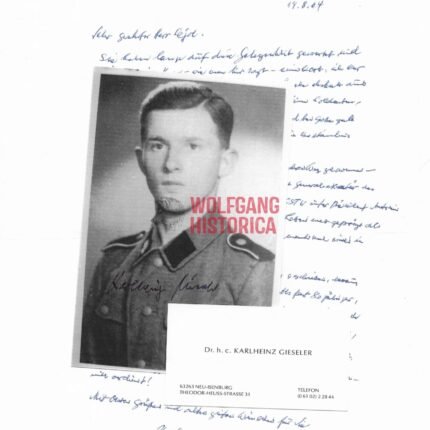
Karl-Heinz Gieseler – 11. SS-Freiwilligen-Panzergrenadier-Division “Nordland”
€0,01Original Postwar Signature on a Postwar Photo of Karl-Heinz Gieseler. SS-Untersturmführer Karl-Heinz Gieseler (30.07.1925 † 17.10.2010) earned (canceled / not official) the Ritterkreuz on April 29, 1945 as SS-Untersturmführer in the 11. SS-Freiwilligen-Panzergrenadier-Division “Nordland”. Good condition. Measuring: Postcardsize. Comes with an extra signed letter and business card.

Erich Zepper – SS-Panzergrenadier-Regiment “Westland”
€0,01Original Postwar Signature on a Postwar Photo & Letter of Erich Zepper. SS-Untersturmführer Erich Zepper (27.11.1915 † 28.07.2005) earned the Ritterkreuz on December 2, 1943 as SS-Hauptscharführer und stellvetretender Führer of the 2. Kompanie/ SS-Panzergrenadier-Regiment “Westland” of the 5. SS-Panzer-Division “Wiking”. Good condition. Measuring: 8,5x14cm.
Zepper’s Knight’s Cross recommendation reads as follows… (via Traces of War): “Following our withdrawal to the Dnieper river, the enemy succeeded in expanding their bridgehead at Kanew during the first days of October 1943. In this time they pushed towards the southeast in the direction of the village of Kreschtschatik, located at the Division’s left boundary. The enemy’s overall objective was to continue attacking in multiple directions in order to enlarge their bridgehead and thereby lay the groundwork for a subsequent operation to roll up the frontline of III. Panzer-Korps.
The Regiment Westland was dispatched to eliminate this enemy bridgehead, and on the 07.10.1943 it occupied its designated assembly area on Triangle Island.
During the attack which followed (which initially had the main effort on the right) the enemy defended bitterly with all available weapons, and ground was gained only with great difficulty in the 300-400 metre wide sand banks between Triangle Island and Foxtail Island. On the right wing the advance got as far as the eastern edge of Foxtail Island, albeit with heavy losses. Here those weak elements of the Regiment that had broken into the enemy positions were ejected by an hostile counterthrust and pushed back to Triangle Island.
On the left wing of the Regiment (which contained the 2./SS-Pz.Gren.Rgt. Westland, commanded by SS-Hauptscharführer Zepper) the enemy reinforced their defense in such a way that the first friendly attack bogged down in fierce defensive fire. SS-Hauptscharführer Zepper and his badly depleted Kompanie found themselves pinned down in a dune position opposite the southeastern tip of Foxtail Island, from which persistent and powerful enemy defensive fire was being unleashed.
During the course of the first attack Zepper realized that the enemy sought to hold their crossing site at the northern edge of Foxtail Island at any cost and under any circumstances. From this he concluded that the Regiment’s attack would only meet success if the enemy was ejected from the southern part of the island.
After friendly forces had regrouped, friendly artillery conducted a powerful barrage in order to prepare the enemy positions for a renewed assault. Recognizing the effectiveness of this preparatory fire, SS-Hauptscharführer Zepper decided not to wait for the ordered attack time but instead commence the assault immediately. Acting on his own initiative, he moved forwards with his men during the friendly artillery barrage and broke into the hostile positions. Only then did he direct the friendly preparatory fire to move on. The enemy was totally surprised by an attack launched while the barrage was still in progress, and their defense was much less effective. SS-Hauptscharführer Zepper skillfully utilized this moment of opportunity, and he pressed his advantage by plunging deep into the enemy trench positions whilst leading at the head of his men. In this fighting the Kompanie eliminated enemy MG, anti-tank and infantry gun crews in close combat while also capturing a considerable quantity of materiel within a relatively small space. This amounted to:
4 anti-tank guns, 4 light field guns, 2 infantry guns, 20 machine-guns, 30 anti-tank rifles.
Moving inexorably forwards, he and his men destroyed bunkers and battle positions. Zepper himself played a major role in the clearing of an enemy regimental command post. The enemy took very high losses, and consequently their defensive power was considerably reduced.
This sally, conducted with extraordinary bravery and decisiveness, created a great deal of confusion among the enemy. This in turn enabled the remaining elements of the Regiment to seize a foothold on the island [Foxtail Island], reenergized the stalled attack and resulted in the destruction/capture of much additional enemy men and materiel.
The decisiveness and exceptional courage that SS-Hauptscharführer Zepper displayed here were the primary factors that led to the shrinkage of the enemy bridgehead to a considerable degree. This, combined with their significant losses, caused the enemy to halt their higher ambitions in this sector for the time being.
SS-Hauptscharführer Zepper is an experienced frontline NCO who has already proven himself as an outstanding Zugführer. He was also awarded the Iron Cross First Class already on the 24.12.1941. As such, I believe Zepper to be someone who is particularly worthy of being awarded the Knight’s Cross to the Iron Cross.”
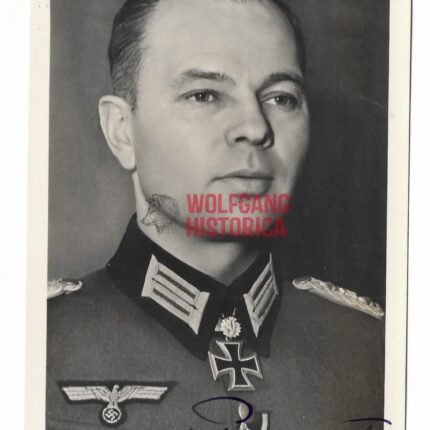
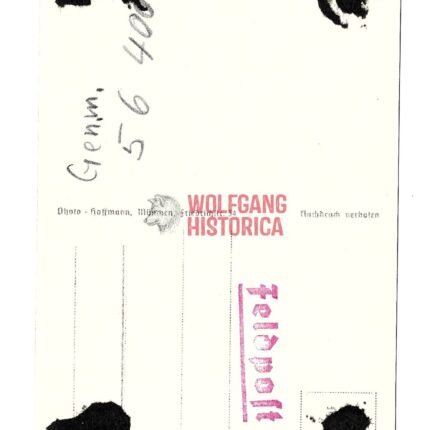
Helmuth von Pannwitz – Reiter-Verband & Kosaken (EL) (Executed! – Wartime Signed)
€0,01Original Wartime Signature on a Postcard of Helmuth von Pannwitz. SS-Obergruppenführer Helmuth von Pannwitz (14.10.1898 † 16.01.1947 (Executed)) earned the Ritterkreuz on September 4, 1941 as Oberstleutnant und Kommandeur of the Aufklärungs-Abteilung 45 of the 45. Infanterie-Division and the Eichenlaub on December 23, 1942 as Oberst und Führer of the Reiter-Verband von Pannwitz subordinated to the 4. Panzer-Armee / Heeresgruppe Don. In 1945, be became the commander of the XV. SS-Kosaken-Kavallerie-Korps. Good condition. Measuring: Postcardsize.
Helmuth von Pannwitz was born in Botzanowitz, Silesia, now part of Olesno. He joined the military at 16 years at the outbreak of the First World War within the Cavalry. Also during the Second World War he distinguished himself as a Cavalry officer. He was involved in setting up the Cossack volunteer forces, the XV. Kosaken-Kavallerie-Korps within the German Wehrmacht. After this he commanded the force in battle. He was so popular that the Cossacks elected him as their Feldataman (the highest rank in the Cossack hierarchy, one that was traditionally reserved to the Tsar alone). Pannwitz surrendered to British forces on 11th May 1945. As a result of special agreement within the Allied froces, the Cossacks were handed over to the Soviet authorities, which is often referred to as “The Betrayal of Cossacks at Lienz”. Most of the Cossack military were to die, be killed, executed or comitted suicide in Soviet imprisonment. As Pannwitz was a German national, he was told by the British that he was not subject to repatriation to the Soiets. Nonetheless, Pannwitz insisted to share the fate of his men and his fellow commanders, giving himself up voluntarily to Soviet prosecution. He was executed om January 16th, 1947 at the Lefortovo prison on the charge of terrorist activities against the Soviet Union. (Source: Traces of War)
Knight’s Cross: Awarded for his actions in the Pripet Marshes during the first month of Operation Barbarossa. On the 04.07.1941 his Vorausabteilung managed to secure the town of Pinsk and its surroundings. On the 08.07.1941 Pannwitz launched a thrust into the area Dawidgrodek-Turow (near Olszany), where he took up the fight against strong Soviet forces. In the battles around Olszay, Oberstleutnant Pannwitz launched a lightning attack that managed to rescue some hard pressed German troops east of the Olszany canal. In the process he also managed to lay the groundwork for the next attack of the Division that resulted in the capture of the territory between Mostwa/Stwiga on one side and Pripet on the other. (Source: Traces of War)
Oakleaves: Awarded for the successes of Kampfgruppe Pannwitz (consisting of Panzer-Abteilung Sauvant, a Romanian cavalry brigade, a battery from the Romanian 47th heavy artillery battalion (mot), various German alarm units as well as Cossacks and Flak) during November 1942. NE of Kotelnikowo, near Scharnutowskij, his Kampfgruppe annihilated the Soviet 61st Cavalry Division, and thereafter the 81st Cavalry Division near Kotelnikowo proper. A Soviet rifle division was also destroyed near Pimen Tscherni/Nebykow. With this the frontline in this sector was stabilized. (Source: Traces of War)

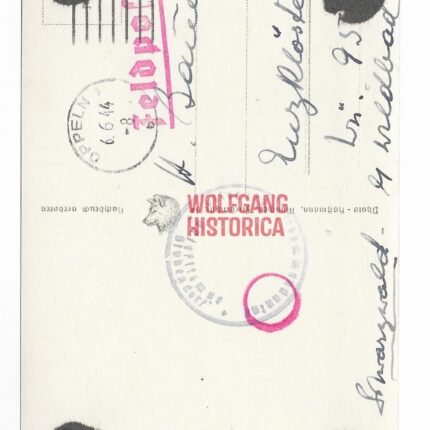
Hyazinth Graf Strachwitz – Panzer-Regiment 2 & Großdeutschland (Diamonds) (Wartime Signed)
€0,01Original Wartime Signature on a Postcard of Hyazinth Graf Strachwitz (also known as Hyazinth Graf Strachwitz von Groß-Zauche und Camminetz). Generalleutnant der Reserve Hyazinth Graf Strachwitz (30.07.1893 † 25.04.1968) earned the Ritterkreuz on August 25, 1941 as Major der Reserve und Kommandeur of the I. Abteilung/ Panzer-Regiment 2 of the 16. Panzer-Division, the Eichenlaub on November 13, 1942 as Oberstleutnant und Kommandeur of the I. Abteilung/ Panzer-Regiment 2 of the 16. Panzer-Division, the Schwertern on March 28, 1943 as Oberst der Reserve und Kommandeur of the Panzer-Regiment “Großdeutschland” of the Infanterie-Division “Großdeutschland” and the Brillanten on April 15, 1944 as Oberst der Reserve und Kommandeur of the Panzer-Kampfgruppe of the Heeresgruppe Nord. Good condition. Measuring: Postcardsize.
Knight’s Cross: While serving as part of the Kampfgruppe of Oberst Wagner, Strachwitz played a decisive role in its success on the 02./03.08.1941. He was able to determine that the easiest way to seize the city of Pervomaisk (a critical road junction for the Soviets) was to strike from the north. The attack was a success and Strachwitz received the Knight’s Cross for his major contribution towards the victorious outcome of this battle. (via Traces of War)
Oakleaves: Awarded for the role his Abteilung played in the Division’s battles near Stalingrad in August of 1942, with following actions in particular being worthy of note…
1) The armoured battles on the 07./08.08.1942, where the Division destroyed 275 Soviet tanks.
2) Reaching the Don river in two places on the 15./17.08.1942.
3) The thrust towards the Volga river north of Stalingrad, beginning on the 23.08.1942. In this advance the Abteilung overran 37 Soviet firing positions.
4) The defensive battle in the same area (especially around Hill 126). In a four day battle the 31 Panzers of the Abteilung destroyed 105 hostile tanks without loss.
Swords: Awarded for the successes of his regiment during the Third Battle of Kharkov, specifically the fighting to recapture Belgorod in the north. In addition to driving the Soviets back, the Regiment also managed to capture or destroy 150 Soviet tanks in a five-day struggle (90+ of which were in the time period 13-15.03.1943).
Diamonds: Awarded for his actions on the Narva front as an ad-hoc Kampfgruppe commander. On the 22.02.1944 he led a mixed Panzer/Sturmgeschütz formation through an unfavourable patch of forested terrain without regard for the adjacent hostile formations. By doing so he was able to succeed in breaking through the Soviet positions located behind the woods and thus contribute significantly to the integrity of the defense on the Narva front. For this action he was awarded the Diamonds to his Knight’s Cross. (via Traces of War)

Hermann Balck – 11. Panzer-Division & 4. Panzer-Armee (Diamonds) (Wartime Signed)
€0,01Original Wartime Signature on a Postcard of Hermann Balck. General der Panzertruppen Hermann Balck (17.12.1893 † 29.11.1982) earned the Ritterkreuz on June 3, 1940 as Oberstleutnant und Kommandeur of the Schützen-Regiment 1 of the 1. Panzer-Division, the Eichenlaub on December 20, 1942 as Generalmajor und Kommandeur of the 11. Panzer-Division, the Schwertern on March 4, 1943 as Generalleutnant und Kommandeur of the 11. Panzer-Division and the Brillanten on August 31, 1944 as General der Panzertruppen und stellvertretender Führer of the 4. Panzer-Armee. Good condition. Measuring: Postcardsize.
Knight’s Cross: “Breakthrough near Martelange. Pursuit towards Bouillon. Capture of Bouillon. Regiment as the first to reach and cross the Maas. Breakthrough of the bunker position. Defense against attacks at Bois de la Marfe. Victorious pursuit battles along the route Chanery—Omont. Several thousand prisoners and about 30 guns captured.” (via Traces of War)
Oakleaves: Awarded for holding the Chir river line with his 11. Panzer-Division during late 1942. In this time his Division smashed all the corps of the Soviet 5th Tank Army one after another.
Swords: Awarded for assisting in the destruction of Mobile Group Popov in the Barwenkowo area during early 1943.
Diamonds: Awarded for achieving the first successful offensively-conducted defensive battle along the Vistula river in 1944.
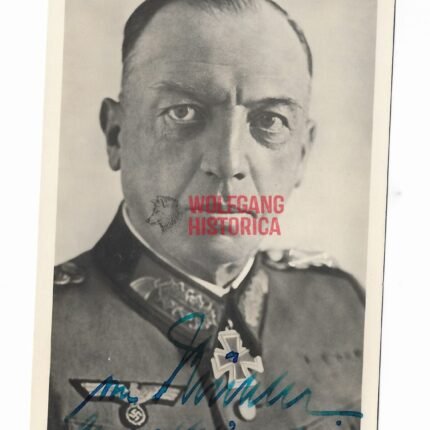
GFM Georg von Küchler – 3. Armee & Heeresgruppe Nord (EL) (Wartime Signed)
€225,00Original Wartime Signature on a Postcard of Georg von Küchler. Generalfeldmarschall Georg von Küchler (30.05.1881 † 25.05.1968) earned the Ritterkreuz on September 30, 1939 as General der Artillerie und Oberbefehlshaber of the 3. Armee, and the Eichenlaub on August 21, 1943 as Generalfeldmarschall und Oberbefehelshaber of the Heeresgruppe Nord. Good condition. Measuring: Postcardsize.
Knight’s Cross: Awarded for his outstanding leadership of the 3. Armee during the Polish campaign. Attacking from East Prussia, it was able to storm the fortress of Graudenz already on the third day of the campaign. With this the path for the 4. Armee, attacking from Pomerania, was cleared. Later the Armee broke through the Mlawa position, crossed the Narew river and encircled Warsaw from the north and east by taking Praga and Modlin.
Oakleaves: Awarded for his achievements during the French campaign as well as those he accumulated during his command of Army Group North. Up until the time he received the Oakleaves he resolved many crisis situations (e.g. at Volkhov, Demyansk, Cholm) and maintained the coherence of his frontline at a time when other German army groups were unable to do the same.
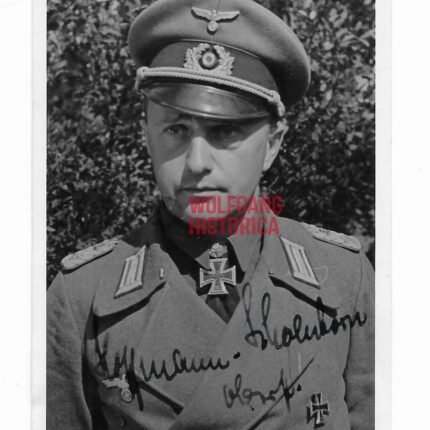
Günther Hoffmann-Schönborn – Sturmgeschütz-Abteilung 191 (EL) (Wartime Signed)
€170,00Original Wartime Signature on a Photo of Günther Hoffmann-Schönborn. Major Günther Hoffmann-Schönborn (01.05.1905 † 04.04.1970) earned the Ritterkreuz on May 14, 1941 and the Eichenlaub on December 31, 1941 as Major und Kommandeur of the Sturmgeschütz-Abteilung 191 “Büffel”. Good condition. Measuring: 10,5×7,5cm.
Knight’s Cross: Awarded for his support of Gruppe Ens during the breakthrough of the Metaxas line. Despite the strong enemy defensive fire and the difficult terrain he managed to bring his Sturmgeschütze into a suitable firing position for covering the attack of Gruppe Ens. This support was invaluable for the Gruppe’s success, enabling it to breakthrough the enemy line and help trigger the collapse of the enemy front. (via Traces of War)
Oakleaves: Awarded for the distinguished leadership of his Abteilung during the advance to the Dnieper river, the crossing of the river and in the subsequent encirclement battle of Kiev. (via Traces of War)


Gordon Gollob – Jagdgeschwader 3 & 77 (Diamonds)
€0,01Original Scarce Postwar Signature on a Postwar Photo of Gordon Gollob. Oberstleutnant Gordon Gollob (16.06.1912 † 07.09.1987) earned the Ritterkreuz on September 18, 1941 as Hauptmann und Kommandeur of the II. Gruppe/ Jagdgeschwader 3 “Udet”, the Eichenlaub on October 26, 1941 as Major und Kommandeur of the II. Gruppe/ Jagdgeschwader 3 “Udet”, the Schwertern on June 23, 1942 as Hauptmann und Führer of the Jagdgeschwader 77 “Herz As” and the Brillanten on August 30, 1942 as Major und Kommodore of Jagdgeschwader 77 “Herz Az”. Good condition. Measuring: Postcardsize.
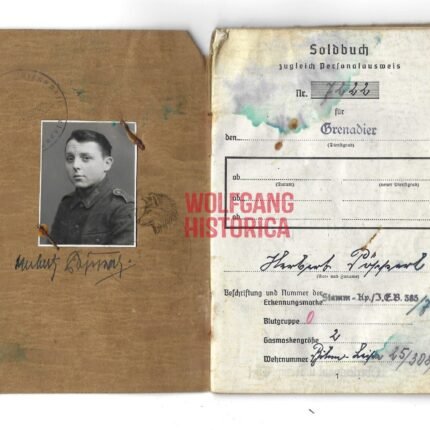
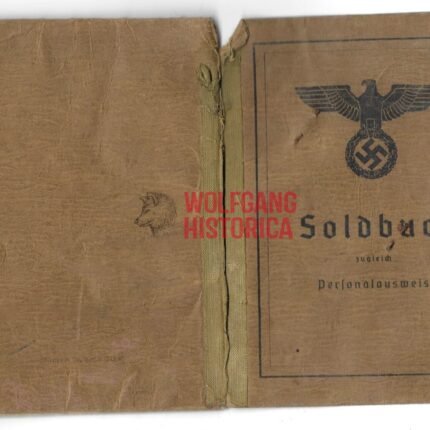
Battle of Normandy KIA Soldbuch – Grenadier-Regiment 984 (275.Inf.Div.)
€0,01Rare Normandy Killed in Action Soldbuch of Grenadier Herbert Pöpperl who served with the 5. Kompanie/ Grenadier-Regiment 984 of the 275. Infanterie-Division. He was Killed in Action on July 10, 1944 on the Cherbourg Peninsula in Normandy (after the U.S. cut of the German forces at St. Mere-Eglise). Interestingly, one of the most known photos from Normandy (see last photo – this is not included within the sale -) was taken on July 8, 1944 and shows KIA soldiers of Grenadier-Regiment 984 (ref. Didier Lodieu) close to Saint-Fromond. Likely he was KIA as well around this area. He was killed only 8 days before his 19th birthday. Good condition. Comes with his Arbeitsbuch (front has white slip pasted on the Swastika) & document related to his death & burial.


Canteen Money 2 Reichsmark – Concentration Camp Buchenwald
€200,00Canteen (Kantine) money for usage in the canteen of the Concentration Camp Buchenwald (Konzentrationslager Buchenwald) for the worth of 1 RM. SS-Standort-Kantine Buchenwald, Außenkommando, WERTMARKE 2 Reichsmark. With “SS-Ko. Rottleberode A 5” Feldpost stamp! Good condition.
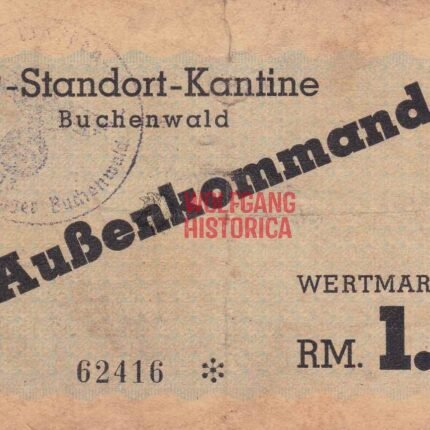

Canteen Money 1 Reichsmark – Concentration Camp Buchenwald
€200,00Canteen (Kantine) money for usage in the canteen of the Concentration Camp Buchenwald (Konzentrationslager Buchenwald) for the worth of 1 RM.
SS-Standort-Kantine Buchenwald, Außenkommando, WERTMARKE 1 Reichsmark. With “Buchenwald” Feldpost stamp! Good condition.
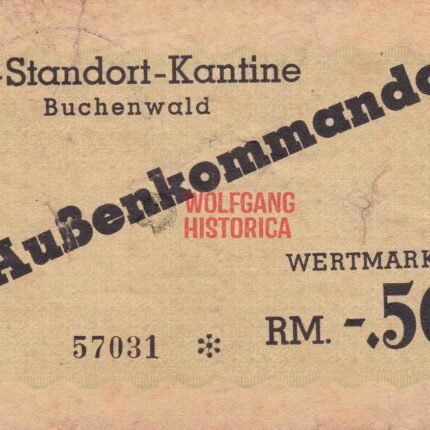

Canteen Money 0.50 Reichsmark – Concentration Camp Buchenwald
€175,00Canteen (Kantine) money for usage in the canteen of the Concentration Camp Buchenwald (Konzentrationslager Buchenwald) for the worth of 0.5 RM.
SS-Standort-Kantine Buchenwald, Außenkommando, WERTMARKE 0.50 Reichsmark. Good condition.
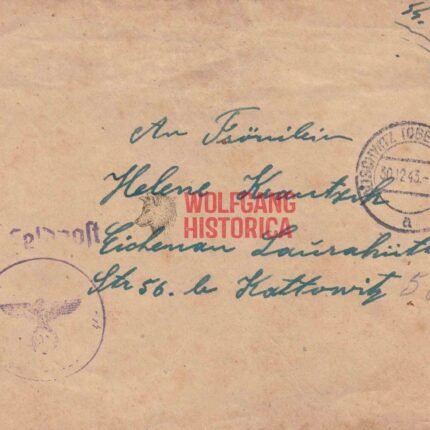

Feldpostenveloppe SS-Stabskompanie – Concentration Camp Auschwitz (!)
€0,01Feldpostenveloppe which was sent from by a member of the SS-Stabskompanie of the Concentration Camp Auschwitz! Possibly written by a SS-Sturmmann Karl Nemeczek? Stamp on the front unreadable but also bears a postal stamp for Auschwitz/Oberschlesien. Used condition. RARE.
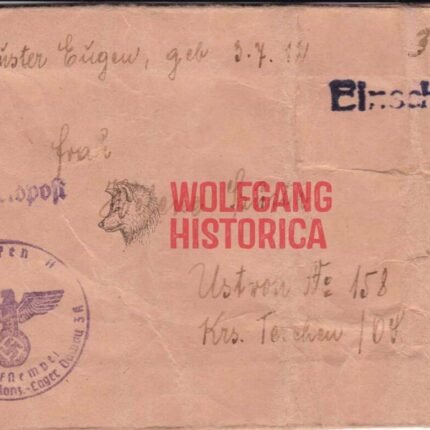
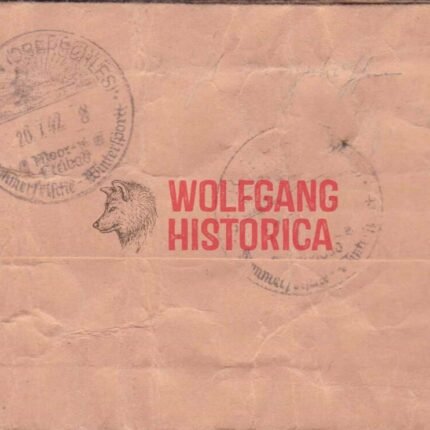
Feldpostenveloppe Kommandantur Concentration Camp Dachau (!)
€0,01Feldpostenveloppe which was sent from the Kommandantur of the Concentration Camp Dachau. Stamped on the front with “SS-Feldpost” “Waffen-SS – Briefstempel – Kommandantur Konz.-Lager Dachau 3“. Used condition.

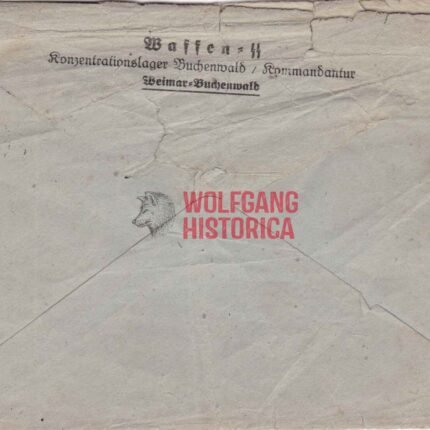
Feldpostenveloppe Kommandatur Concentration Camp Buchenwald (!)
€0,01Feldpostenveloppe which was sent from the Kommandantur of the Concentration Camp Weimar-Buchenwald. Stamped on the front with “SS-Feldpost” “Waffen-SS – Briefstempel – Kommandantur K.L. Buchenwald” and on the reverse with “Waffen-SS / Konzentrationslager Buchenwald / Kommandatur / Weimar-Buchenwald”. Used condition (flap half torn on the back).


Feldpostenveloppe SS-Totenkopf-Infanterie-Rgt. 14 – Concentration Camp Buchenwald
€0,01Feldpostenveloppe and two photographs of an SS-Anwärter who served with the 1. Kompanie/ SS-Totenkopf-Infanterie-Regiment 14, sent from Concentration Camp Weimar-Buchenwald. Stamped with “Weimar-Buchenwald” and “SS-Totenkopf-Infanterie-Regiment 14 – 1. Kompanie”

Feldpostenveloppe adressed to Concentration Camp Lublin
€0,01Feldpostenveloppe adressed to the Landwirtschaft-Abteilung of the Konzentrationslager Lublin (Concentration Camp Lublin) sent by the SS- und Polizeiführer im Generalgouvernement der SS-Wirtschafter Krakau!
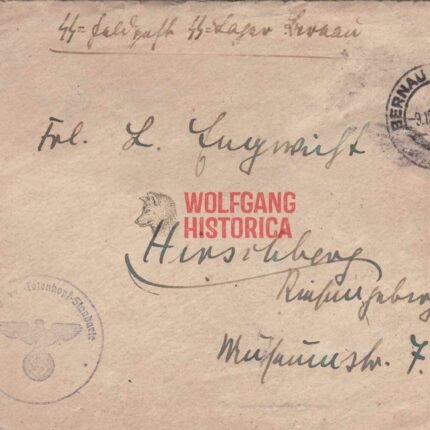
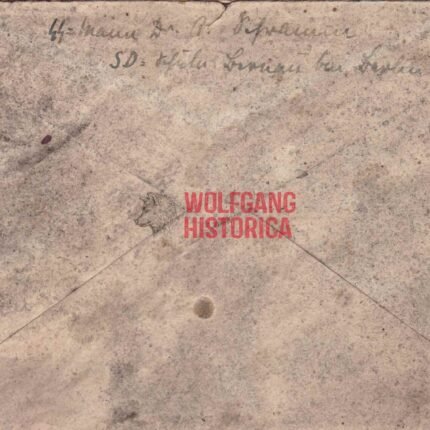
Feldpostletters SS-Lager Dachau / Sicherheitsdienstschule Bernau
€0,011x Feldpostenveloppe & 3x Feldpost letters (2x from December ’40 & 1x 1941) from SS-Lager Dachau (seen on the front of the enveloppe) send by an SS-Mann attending the Sicherheitsdienstschule Bernau near Berlin. On the front of the enveloppe a 12. SS-Totenkopf-Standarte stamp.
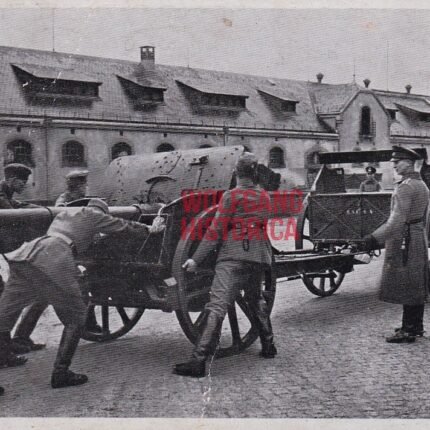

Feldpostkarte – 9. Kompanie/ SS-Totenkopf-Infanterie-Regiment 9
€20,00Feldpostkarte from the 9. Kompanie/ SS-Totenkopf-Infanterie-Regiment 9 from Blomberg.
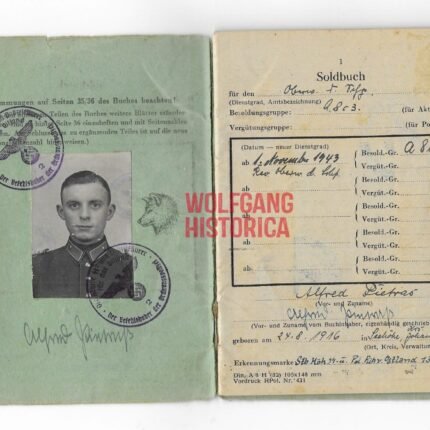
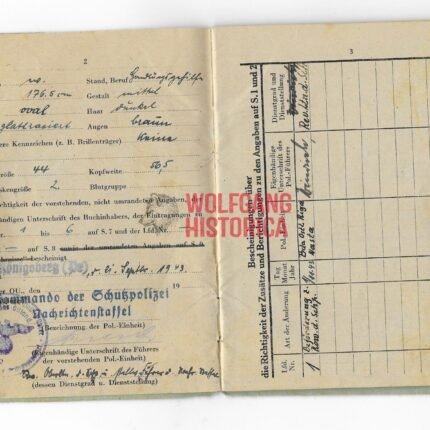
Polizei Soldbuch (Rare Memellandmedaille entry)
€0,01Polizei Soldbuch for Revier-Oberwachtmeister der Schutzpolizei Alfred Pietras, born in Königsberg, who served with the Nachrichtenstaffel/ Kommando der Schutzpolizei and the Stab/ Höhere SS und Polizeiführer Ostland. During his service he earned the Memellandmedaille (!) (Rare), Kriegsverdienstkreuz II. Klasse mit Schwertern, Deutsches Reichssportabzeichen in Bronze, SA-Sportabzeichen in Bronze, Grundschein der D.L.R.G. and Leistungschein der D.L.R.G. Comes with his (small) Besitz-Zeugnis for the SA-Sportabzeichen (Nr. 001133075) and a Portrait. Needs more research. Good condition.
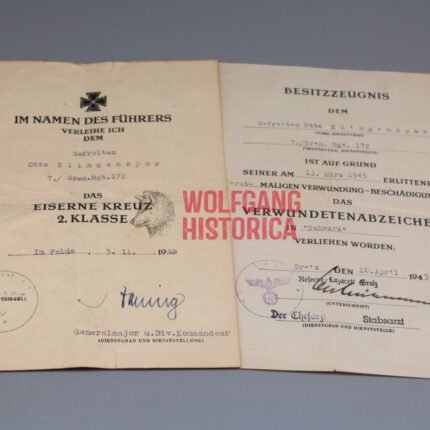
Set Iron Cross 2nd Class & Wound Badge Award Docs (Gren.Rgt.172) (1944-45)
€110,00Set of two Award documents for the Eisernes Kreuz 2. Klasse (Iron Cross 2nd Class) earned on November 5, 1944 & Verwundetenabzeichen in Schwarz (Wound Badge in Black) earned in April 45 for his wound suffered on March 13, 1945 of Gefreiter Otto Klingenspor of the 7. Kompanie/ Grenadier-Regiment 172 of th 75. Infanterie-Division. The Iron Cross 2nd Class document was signed by Generalmajor und Divisionskommandeur karl Arning (RK).

Wehrpass Art.Rgt.248 & Inf.Rgt. 442 (168.Inf.Div.) & Heimat-Pferde-Laz. 108 (3x Awards)
€115,00Wehrpass of Unteroffizier Ernst Müller, who served with Artillerie-Regiment 248 & Infanterie-Regiment 442 of the 168. Infanterie-Division and later with Heimat-Pferde-Lazarett 108! During his service, he earned the Winterschlacht im Osten 1941/42 (30.8.42), Verwundetenabzeichen in Schwarz (15.10.42) & Kriegsverdienstkreuz 2. Klasse mit Schwertern (1.9.44). Good condition.
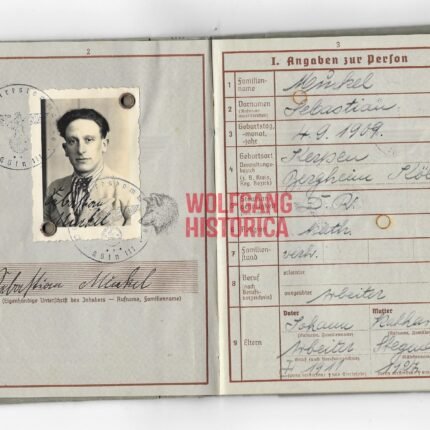

Wehrpass KIA Soldier of Inf.Rgt.336 (161.Inf.Div.)
€65,00Wehrpass of Gefreiter Sebastian Mückl, who served with the Infanterie-Regiment 336 of the 161. Infanterie-Division, when he was Killed in Action on August 17, 1941 by “Artilleriegeschoss Halz“. None awards entered. He lost both of his parents at early age (in 1911 and 1927). Comes with several slips & a letter.

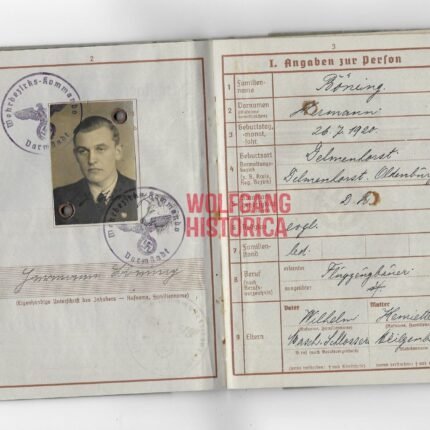
Small Tragic Papergroup (Wehrpass, Flugbuch etc.) of LW Berlin-Adlershof soldier Killed by Accident
€0,01Small tragic paper group of Obergefreiter Hermann Böning, who served with the Ergänzungsabteilung für Soldaten im Ingenieur Dienst der Luftwaffe Berlin-Adlershof when he was killed in an accident “Durch Bergunfall tödlich verüngluckt” on October 17, 1943. Comes with several condoleance cards, Deutsches Luftsport-Verband Flugbuch (continued with the NFSK!) with a ID of him in HJ uniform and two photos of his burial. Good condition.
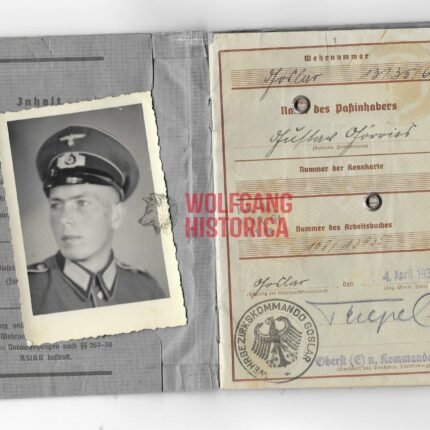
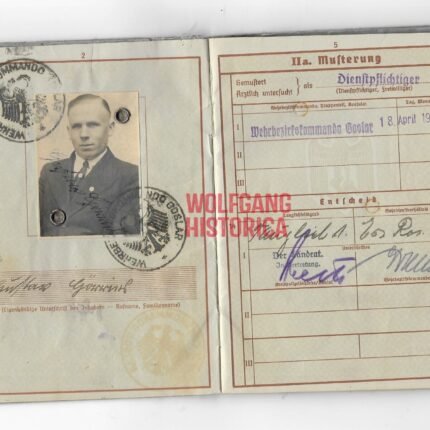
Wehrpass Artillerie-Regiment 171 (71.Inf.Div.) (Cassino, Rimini)
€170,00Interesting Wehrpass of Stabsgefreiter Görries, who served his entire career from 1939 until May 8, 1945 (!) with Artillerie-Regiment 171 of the 71. Infanterie-Division! During his service, he earned the Eisernes Kreuz 2. Klasse (26.7.42), Allgemeines-Sturmabzeichen (10.8.42) and the Verwundetenabzeichen in Schwarz (16.8.42) near Stalingrad (where the Division was destroyed). He was wounded twice: 10.8.42 by a bullet in his left arm and on 10.9.44 due shrapnel in his head. After serving with the regiment in the Soviet-Union, he came in action in Italy, such as at Monte-Cassino and Rimini. Ending his career in South-Hungary & Untersteiermark. Incredible Wehrpass of the Artillerie-Regiment 171. Good condition. Comes with an extra photo.


Soldbuch Luftwaffe Flak schwere Flak-Abt. 246 & 684
€80,00Soldbuch of Unteroffizier Jakok Springer, who served with various Flak training and field units, most notable the schwere Flak-Abteilung 246 and schwere Flak-Abteilung 684 (o) which was active in Steyr. Inserted in a nice ID photo with his (WWI) ribbon bar! Comes with a Passierschein. Good condition.

German Cross in Gold Award doc of Ernst Kröger (Flak)
€0,01Award document for the Deutsches Kreuz in Gold for Wachtmeister Ernst Kröger, who earned it on February 5, 1944 while serving with 1. Batterie/ leichte Flak-Abteilung 76 (mot.).
Good condition, periodically framed (?), full size and no perforations or folds. Facsimile signature of Hermann Göring. Signed by Generaloberst Bruno Loerzer on the bottom right. The frame is able to be hanged.
Shipping costs aren’t final due the size and requested method of shipping (insurance, express or not etc.), if interested, you can contact me prior to gain a better view on shipping costs. Pick-up always possible.
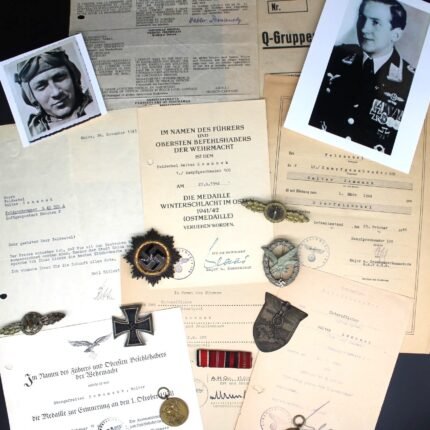
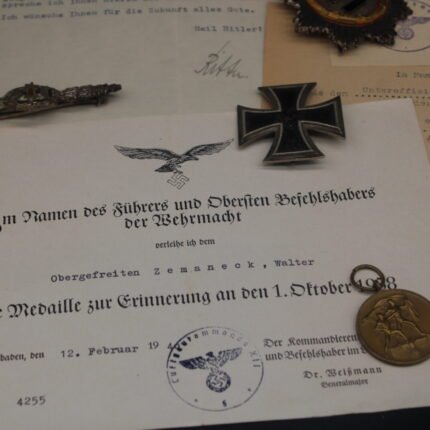
Luftwaffe DKIG Estate of Bordfunker in Kampfgeschwader 100
€0,01Estate of Oberfeldwebel Walter Zemanek, who earned the Ehrenpokal and Deutsches Kreuz in Gold with Kampfgeschwader 100.
- Deutsches Kreuz in Gold marked “1” Deschler & Sohn München. Early, heavy version. Damage on the front emaille in the Swastika, according to the family, this happened in a plane crash.
- Eisernes Kreuz 1. Klasse. “Zemanek” engraved on the back. Unmarked B.H. Mayer Pforzheim?
- Fliegerschützenabzeichen mit Blitzbündel. JMME & Sohn Berlin.
- Frontflugspange in Gold. Unmarked, Tombak Juncker?
- Frontflugspange in Silber. Zinc, RSS (Richard Simm & Sonne).
- Krimschild. No prongs.
- Medaille zur Erinnerung an den 1. Oktober 1938 (no ribbon).
- Rümanische Medaille “Kreuzzug gegen den Kommunismus” (no ribbon).
- Ribbonbar for 4x awards (EK2+WIO+MEDAL38+KREUZZUG).
- Award document for the Winterschlacht im Osten 1941/42
- Award document for the Medaille zur Erinnerung an den 1. Oktober 1938
- Award document for the Krimschild. No prongs.
- Primarily Award document for the Rümanische Medaille “Kreuzzug gegen den Kommunismus”
- Promotion document to Oberfeldwebel.
- Congralutations letters for the DKIG.
- Prisoner of War-document
- Q-Gruppen booklet.
Rare to come by these days, unmessed groupings! Comes from the family!
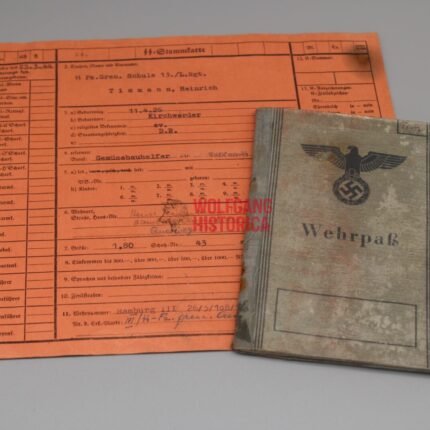

Wehrpass & Stammkarte SS-Regiment “Schill” (famous ‘Halbe Hoard’ find)
€500,00Original Wehrpass & Stammkarte from the famous ‘Halbe hoard’ find from the 1990’s which was a large box found in the ground with ID’s from the 6. Kompanie/ SS-Panzer-Grenadier-Regiment “Schill”. Including this one. Condition as seen due it’s been buried in the ground for several decades. Complete but some pages loose and moist, rust stainings.


7x Award Docs: DKIG-Holder Wilhelm Piepkorn (Inf.Rgt.94 & Gren.-Rgt. 1094) (32. & 548. VGD)
€550,00Interesting 7x (!) Award document set for Hauptmann Wilhelm Piepkorn, who earned the Deutsches Kreuz in Gold on June 23, 1942 with 2. Kompanie/ Infanterie-Regiment 94 of the 32. Infanterie-Division. Later served with the Stab II./ Grenadier-Regiment 1094 of the 548. Volksgrenadier-Division!
The sets consists of:
- Award document for the Nahkampfspange I. Stufe (15 Nahkampftage). Earned on December 22, 1944 with Stab II./ Grenadier-Regiment 1094 of the 548. Volksgrenadier-Division! Signed by Oberstleutnant Walter Kontny (?) (DKIG+EBS).
- Award document for the Eisernes Kreuz 2. Klasse. Earned on October 26, 1939 with Infanterie-Regiment 94 for the Polish Campaign in 1939! Signed by Generalleutnant Franz Böhme (RK). Signed at Kosewo.
- Award document for the Eisernes Kreuz 1. Klasse. Earned on November 13, 1940 with Infanterie-Regiment 94 for the Western Campaign in 1940! Signed by Generalleutnant Wilhelm Bohnstedt (RK).
- Award document for the Infanterie-Sturmabzeichen. Earned on October 4, 1941. Signed by (later) General der Infanterie Wilhelm Wegener (RK+EL+SW, KIA 1944!). Document is torn apart in two.
- Award document for the Verwundetenabzeichen in Schwarz. Earned on May 30, 1940 for a wound suffered on May 17, 1940 during the Western Campaign! Signed by unknown officer.
- Award document for the Verwundetenabzeichen in Silber. Earned on November 6, 1941 for a wound suffered on November 4, 1941 during the Western Campaign! Signed by unknown officer.
- Award document for the Winterschlacht im Osten 1941/42. Signed by unknown officer.
Comes with an extra postwar veteran association document. The Bundesarchiv has a personal file on him, so you can definitely research him (PERS6/57901).

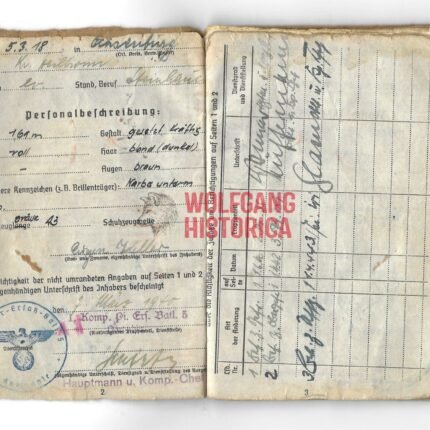
Soldbuch: Pionier-Btl. 35 & 101 (101.Jäg-Div.) (6x Awards incl. Nahkampfspange)
€325,00Interesting Soldbuch of a Unteroffizier Eugen Keller, whom served with Pionier-Bataillon 35 & 101 of the 101. Jäger-Division, with which he earned all of his awards. During his service, he earned the Allgemeines-Sturmabzeichen, Eisernes Kreuz 2. Klasse, Winterschlacht im Osten, Verwundetenabzeichen in Schwarz, Nahkampfspange I. Stufe & Kubanschild. Afterwards he served with the Gebirgs-Pionier-Ausbildungs-Bataillon 833. He received a lot of Gebirgsjäger equipment. Good condition. Photo inside!
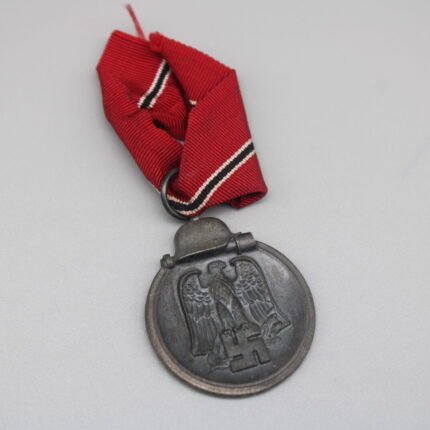
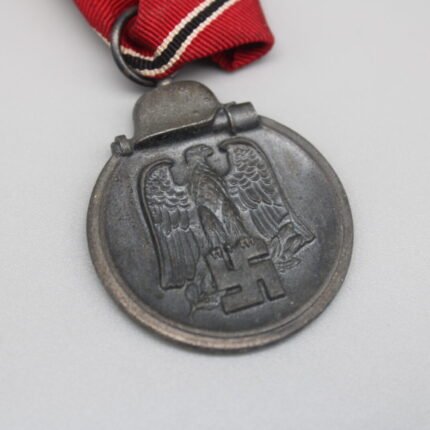
Winterschlacht im Osten 1941/42 (Ostmedaille) “25”
€45,00Winterschlacht im Osten 1941/42 (Winter War Medal) (‘Ostmedaille’). Marked marked with “25” for ‘Arbeitsgemeinschaft der Graveur-, Gold- und Silberschmiedeinnungen’ from ‘Hanau am Main’. Good condition.
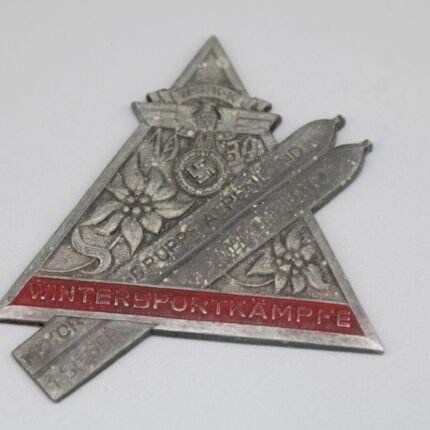
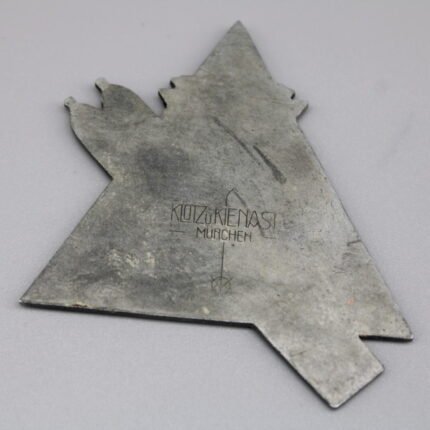
NSKK Motorgruppe Alpenland 1939 Plaque – Alpine Kombination (1st Place Winner)
€220,00NSKK Motorgruppe Alpenland Siegerplakkette (Victory Plaque) for the “Wintersportkämpfe” of 1939 for the 1. Sieger (1st Place) in the “Alpine-Kombination“. Marked Klotz & Kienast, München. Measuring: 8×7,2cm.


Dienstauszeichnung für 4 Jahre – 4 Years of Service Award (Einzelspange)
€75,00Original Wehrmacht Dienstauszeichnung für 4 Jahre (4 Years of Service Award) mounted on a ‘Einzelspange‘. Good condition.
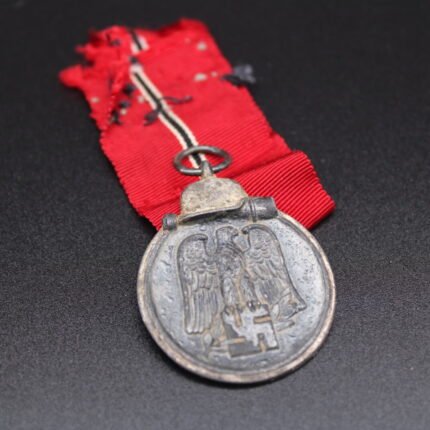
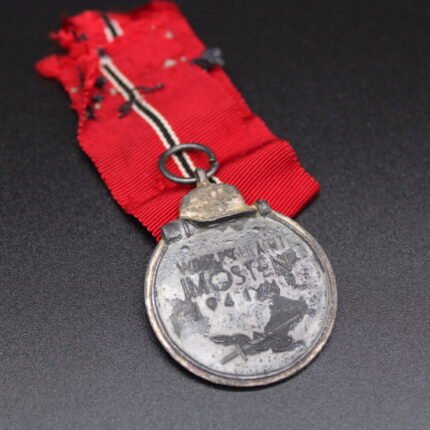
Winterschlacht im Osten 1941/42 (Ostmedaille) “18”
€40,00Winterschlacht im Osten 1941/42 (Winter War Medal) (‘Ostmedaille’). Marked marked with “18” for Karl Wurster KG, Markneukirchen. Condition as seen. Finish gone, nice patina.


Adolf Seitz – Gebirgsjäger-Regiment 99 (Ritterkreuz)
€95,00Original Photograph of Adolf Seitz. Oberst Adolf Seitz (24.02.1891 † 16.11.1945) earned the Ritterkreuz on August 5, 1940 as Major und Kommandeur of the II. Bataillon/ Gebirgsjäger-Regiment 99 of the 1. Gebirgs-Division. Good condition. Postcardsize.


Photographs & Paper of Harald von Hirschfeld – Gebirgsjäger-Regiment 98 (EL)
€0,01Original 5x Photographs & 1x Paper (article on Harald von Hirschfeld) of Harald von Hirschfeld. Major Josef-Georg Mulzer (10.07.1912 † 18.01.1945) earned the Ritterkreuz on November 15, 1941 as Oberleutnant und Chef of the 7. Kompanie/ Gebirgsjäger-Regiment 98 and the Eichenlaub on December 23, 1942 as Hauptmann und Führer of the II. Bataillon/ Gebirgsjäger-Regiment 98 of the 1. Gebirgs-Division. Good condition.


Portrait of unknown Ritterkreuzträger (2x Panzernichtungsabzeichen!)
€0,01Original Portrait of an unknown Ritterkreuzträger. He’s wearing the Ritterkreuz, Deutsches Kreuz in Gold, 2x Panzervernichtungsabzeichen (!) and the Nahkampfspange. Size: 7x10cm. Condition as seen. On the back, perhaps written “Heinz” ?
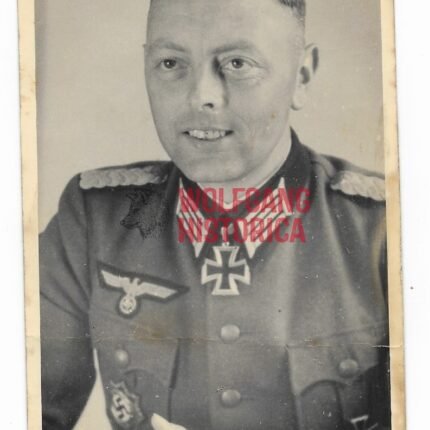
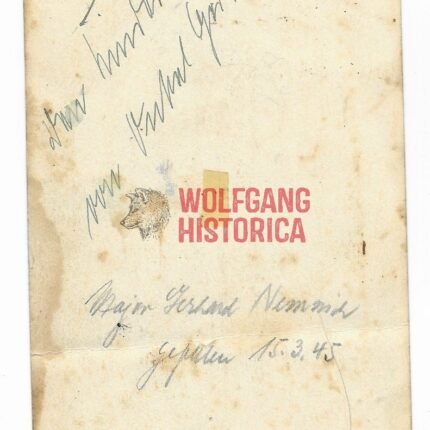
“Gert” Nemnich – Panzer-Pionier-Bataillon 19 (Ritterkreuz) (Wartime Signed)
€105,00Original Portrait with Wartime Signature of Gerhard “Gert” Nemnich. Major Gert Nemnich (10.11.1912 † 15.03.1945) earned the Deutsches Kreuz in Gold on February 28, 1942 and the Ritterkreuz onJuly 15, 1943 as Major und Kommandeur of the Panzer-Pionier-Bataillon 19 of the 19. Panzer-Division. Condition as seen. Postcardsize.
Ritterkreuz: “During the start of the battle of Kursk, along the front of the III. Panzer-Korps, Hauptmann Nemnich attacked across the Donez river with two of his Pionier-Kompanien. With these forces he eliminated 56 Soviet bunkers and their crews after heavy fighting. Following this action (which enabled his Division to cross the Donez here) he beat off a strong Soviet attack into the flank of the follow-up Kampfgruppen and even managed to push this defeated force back. For these actions he would be decorated with the Knight’s Cross.”


Horst Beeger – Lehrgeschwader 1 (Ritterkreuz)
€100,00Original Photograph with Postwar Signature of Horst Beeger. Oberleutnant Horst Beeger (08.06.1913 † 03.03.1998) earned the Ritterkreuz on November 23, 1941 as Oberleutnant und Staffelkapitän of the 3. Staffel/ Lehrgeschwader 1. Good condition. Postcardsize.
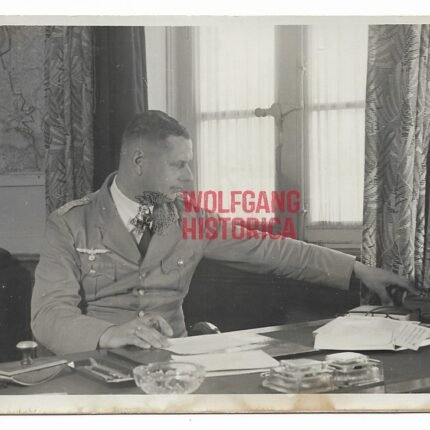
Viktor Schütze – Commander of U-103 (Eichenlaub)
€85,00Original Portrait of Viktor Schütze. Käpitan zur See Viktor Schütze (16.02.1906 † 23.09.1950) earned the Ritterkreuz on December 11, 1940 as Korvettenkapitän und Kapitän of Uboot “U-103” and the Eichenlaub on July 14,1941 as Korvettenkapitän und Kapitän of Uboot “U-103”. Good condition. Postcardsize.
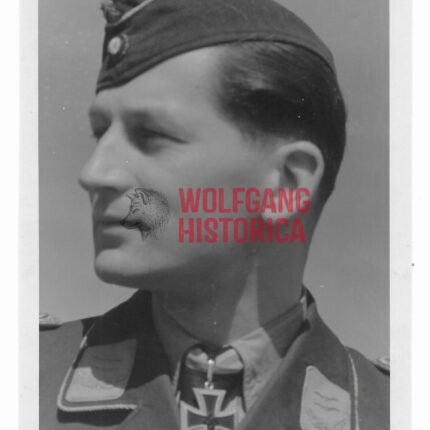
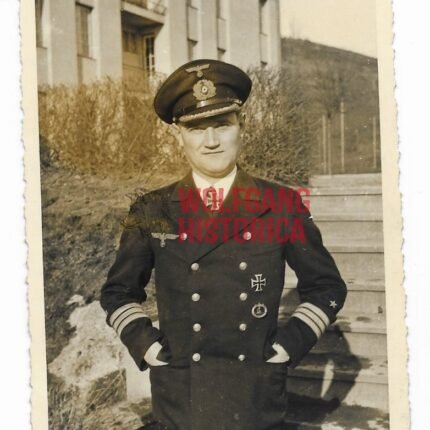
Hans Baasner – Aufklärungsgruppe 121 (Ritterkreuz)
€80,00Original Portrait of Hans Baasner. Oberleutnant Hans Baasner (01.01.1916 † 21.02.1983) earned the Deutsches Kreuz in Gold on April 14, 1942 as Oberleutnant in the 3. Staffel/ Aufklärungsgruppe 121 and the Ritterkreuz on March 11, 1943 as Oberleutnant und Flugzeugführer-Beobachter in the 3. Staffel/ Aufklärungsgruppe 121. Good condition.
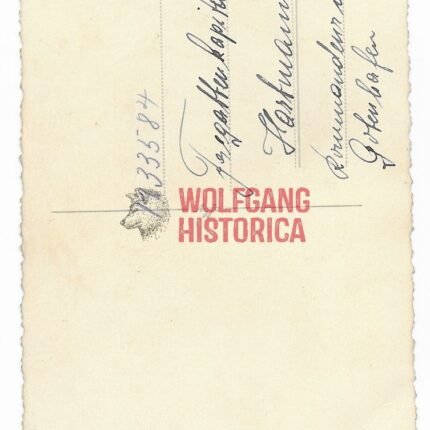
Werner Hartmann – “U-37” & Fdu Mittelmeer (Eichenlaub)
€85,00Original Portrait of Werner Hartmann. Käpitan zur See Werner Hartmann (11.12.1902 † 26.04.1963) earned the Ritterkreuz on May 9, 1940 as Korvettenkapitän und Kapitän of Uboot “U-37” and the Eichenlaub on November 5, 1944 as Kapitän zur See und FdU Mittelmeer . Good condition. Postcardsize.
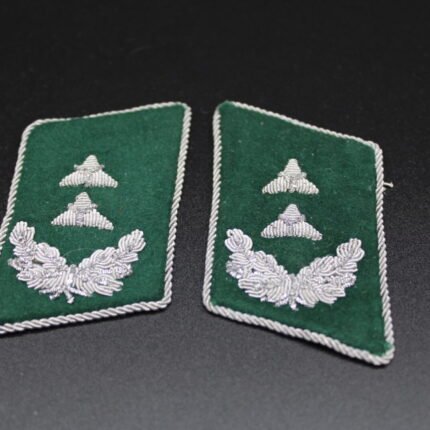

Pair of Luftwaffe Beamte Collar Tabs for a Kriegsoberinspektor
€30,00Pair of dark-green Kragenspiegel (Collar Tabs) for a Beamte des höheren dienstes (Administrative Official of higher ranks) of the Luftwaffe. These ‘Kragenspiegel’ bear the Luftwaffe Rank of ‘Kriegsoberinspektor‘ (equivalent of First Lieutenant). The pair bears embroided oakleaves and two three-pint stars. Pair is almost (fully) matching and in fine condition.
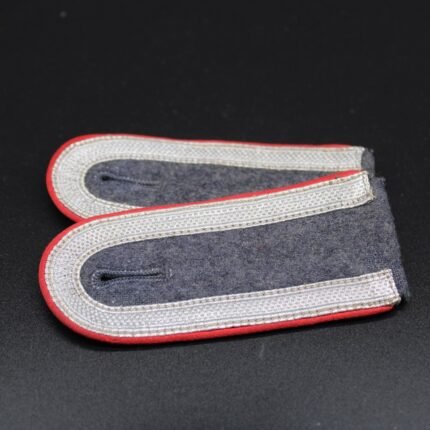

Luftwaffe Flak Unteroffizier (NCO) Shoulder Boards
€0,01Original set of Luftwaffe Flak Unteroffizier (NCO) Shoulder Boards. Very good condition.


2x Award Docs: Iron Cross 2nd Class & WB Silver + Extra Docs (3.Geb.Div.)
€0,012x Award document set of Unteroffizier Albert Gutzeit, who earned all of his awards while serving with the Gebirgs-Artillerie-Regiment 112 of the 3. Gebirgs-Division! Comes with extra documents and papers related to his service and postwar life.
- Eisernes Kreuz 2. Klasse (Iron Cross 2nd Class) for his (prior) service on January 5, 1942 which was signed by General der Gebirgstruppe Hans Kreysing (KC+EL+SW!). Zweitausfertigung.
- Verwundetenabzeichen in Silber (Wound Badge in Silver) for his wound sustained on December 29, 1942, which was signed by an unknown Doctor.
- Various extra ID’s and documents…
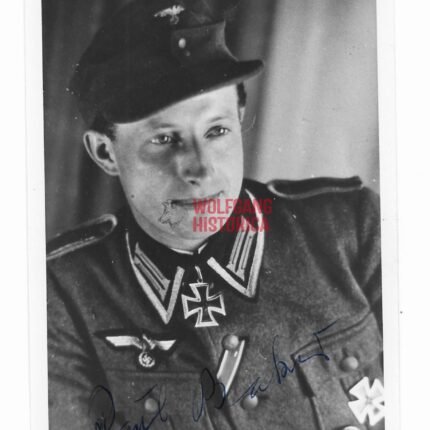
Paul Becker – Artillerie-Regiment 3 (Ritterkreuz, Stalingrad)
€0,01Original Postwar Signature on a Postwar Photocopy of Paul Becker. Unteroffizier Paul Becker (21.03.1918 † 29.11.1992) earned the Ritterkreuz on October 25, 1942 as Obergefreiter und Richtschütze in the 10. Batterie/ Artillerie-Regiment 3 of the 3. Infanterie-Division. Good Condition. Measuring: Postcardsize.
Knight’s Cross: “Obergefreiter Paul Becker had already destroyed 28 enemy tanks during the heavy combat near Kalatsch, and for this he was awarded the Iron Cross First Class. During the battle of Stalingrad he significantly contributed to the successful defense against enemy counterattacks through his personal bravery and decisiveness. The Bolsheviks commenced a furious attack with strong infantry forces that had the support of numerous tanks. Their aim was to break through the German blocking position to the north of the city. Obergefreiter Becker persevered throughout the fierce hostile fire while serving at his gun, and in the heavy fighting he destroyed 13 enemy tanks (most of which were heavy types). He smashed local enemy infantry penetrations with well laid fire. Thus, within a short time, Obergefreiter Becker destroyed a total of 41 Soviet tanks and decisively contributed to the great successes of his Division.”
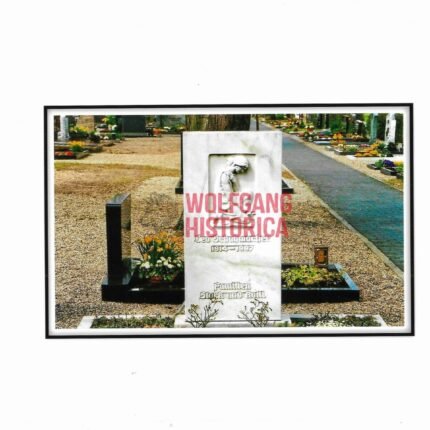
Postwar Photograph of Grave Leo Schuhmacher (Ritterkreuz)
€0,01Postwar grave photograph of Leo Schuhmacher. Leutnant Leo Schuhmacher (13.11.1913 † 13.02.1997) earned the Ritterkreuz on March 1, 1945 as Leutnant und Flugzeugführer in the II. Gruppe/ Jagdgeschwader 1. Good condition.