


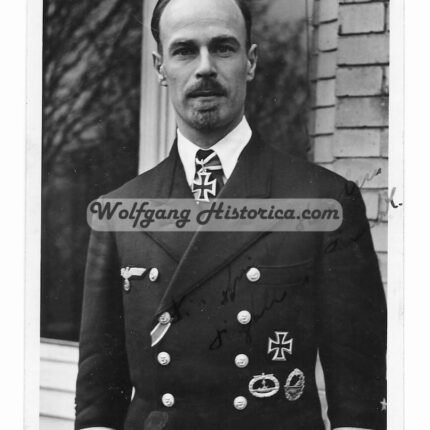
Siegfried Strelow – Commander of U-435 (Sank with All Hands Lost in July 1943)
€250,00Original Photograph with wartime signature of Siegfried Strelow. Siegfried Strelow (15 April 1911 – 15 July 1943) was a German U-boat commander in World War II and recipient of the Knight’s Cross of the Iron Cross (Ritterkreuz des Eisernen Kreuzes), awarded for extreme battlefield bravery or successful military leadership. He and the entire crew of U-435 were killed in action west of Figueira da Foz Municipality, Portugal, in position 39°48′N 14°22′W when their boat was sunk by 4 depth charges from a Royal Air Force (RAF) Vickers Wellington bomber of No. 179 Squadron RAF.
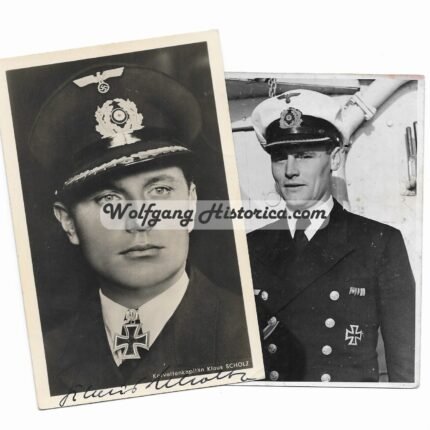
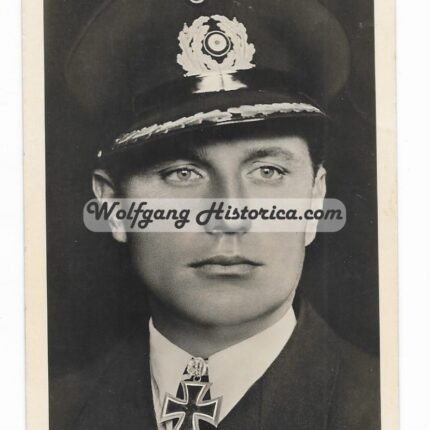
Klaus Scholtz – Commander of U-108 (Credited with sinking 25 ships, Oakleaves)
€275,00Small set of a Wartime Hoffmann Postcard with wartime signature of Klaus Scholtz as well as a wartime photograph of him (not wearing the Knight’s Cross). Scholtz joined the Reichsmarine in 1927 as member of “Crew 1927” (the incoming class of 1927) and served in torpedo boats, before transferring to the U-boat arm (U-bootwaffe) in April 1940. From October 1940 he commanded U-108, sinking 25 ships on 8 patrols, for a total of 128,190 tons of Allied shipping, including the British armed merchant cruiser Rajputana. In October 1942 Scholtz formed and took command of 12th U-boat Flotilla based at Bordeaux, France.
In August 1944 the approach of Allied troops meant that the base had to be evacuated. The last U-boats escaped by sea, and Scholtz attempted to lead the remaining men (about 220) back to Germany on foot. They left Bordeaux on 26 August, but were captured on 11 September by American forces in Loire. Scholtz spent the next 18 months in US captivity. (Source: Wikipedia)
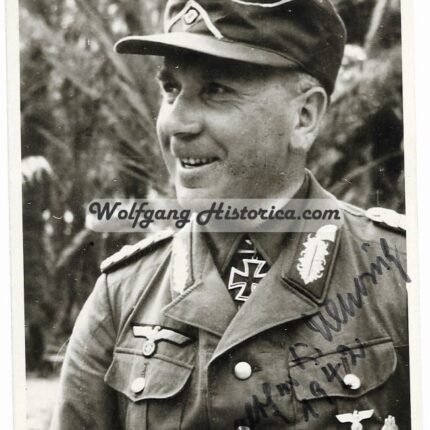
Walther Nehring – Deutsches Afrikakorps & XXIV. Panzerkorps (Swords)
€90,00Original Scarce Postwar Signature on a Postwar Photocopy of Walther Kurt Nehring. General der Panzertruppen Walther Kurt Nehring (15.08.1892 † 20.04.1983) earned the Ritterkreuz on July 24, 1941 as Generalmajor und Kommandeur of the 18. Panzer-Division, the Eichenlaub on February 8, 1944 as General der Panzertruppe und Kommandierender General of the XXIV. Panzerkorps and the Schwertern on January 22, 1945 as General der Panzertruppe und Kommandierender General of the XXIV. Panzerkorps. Good condition. Postcardsize.
Nehring joined the military service on 16 September 1911 in the Infanterie-Regiment 152. He became a commissioned Leutnant on 18 December 1913. On 26 October 1940 he received command of the 18th Panzer Division at Chemnitz, which he commanded during the operations Barbarossa and Typhoon. The division led by Nehring, is accused by numerous current accounts, of war crimes.
Nehring took command of the Afrika Korps in May 1942 and took part in the last major Axis offensive (Operation Brandung) of the Western Desert campaign and the subsequent Battle of Alam Halfa (31 August – 7 September 1942), during which he was wounded in an air raid. Between November and December 1942, he commanded the LXXXX Army Corps, the German contingent in Tunisia.
After North Africa, Nehring was posted to the Eastern Front where he commanded first the XXIV. Panzer Corps, and then from July to August 1944 the Fourth Panzer Army. Nehring then returned to the XXIV in August 1944 and led the Corps until March 1945 when he was made commander of the 1st Panzer Army. During 1944 he was also the commanding officer of the XXXXVIII Panzer Corps. Following the end of the war, Nehring wrote a comprehensive history of the German panzer forces from 1916 to 1945, Die Geschichte der deutschen Panzerwaffe 1916 bis 1945. He also wrote the foreword to Len Deighton’s Blitzkrieg: From the Rise of Hitler to the Fall of Dunkirk.
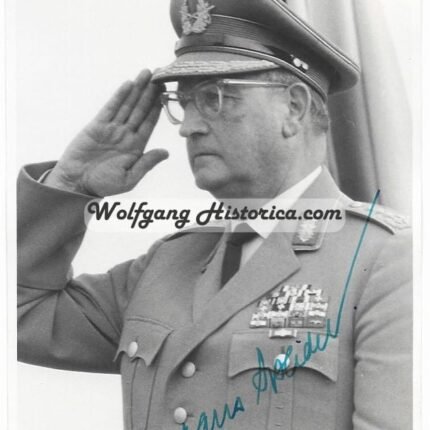
Hans Speidel – Chef des Generalstabes 8. Armee & 20 July Plot
€0,01Postwar Signature of Hans Speidel. Hans Speidel (28 October 1897 – 28 November 1984) was a German general and diplomat, who was one of the major military leaders of West Germany during the early Cold War. The first full General in West Germany, he was a principal founder of the Bundeswehr and a major figure in German rearmament, integration into NATO and international negotiations on European and Western defence cooperation in the 1950s. He served as Commander-in-Chief of the NATO ground forces in Central Europe from 1957 to 1963 and then as President of the German Institute for International and Security Affairs from 1964.
Speidel joined the German Army in 1914, fought in the First World War, and stayed with the Army as a career soldier after the war. He served as chief of staff to Field Marshal Erwin Rommel during the Second World War and was promoted to lieutenant general in 1944. Speidel participated in the 20 July Plot to assassinate Hitler, and he was tasked with recruiting Rommel for the resistance. After the plot failed he was arrested by the Gestapo. At the end of the war, he escaped from Nazi prison and went into hiding. He was the only major member of the 20 July Plot to survive the war.
During the early Cold War, Speidel emerged as one of the major military leaders of West Germany, and played a key role in German rearmament, Western international negotiations on defence cooperation and West German integration into NATO. He is thus regarded as one of the founders of the Bundeswehr.
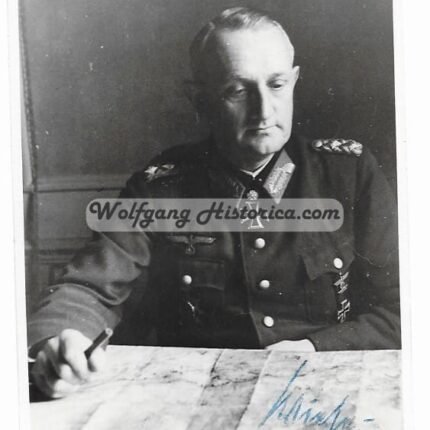
Friedrich Wiese – Infanterie-Regiment 38 & XXXV. Armeekorps (Oakleaves)
€75,00Original Postwar Signature on a Postwar Photo of Friedrich Wiese. General der Infanterie Friedrich Wiese (05.12.1892 † 13.02.1975) earned the Ritterkreuz des Eisernen Kreuzes on February 14, 1942 as Oberst und Kommandeur of Infanterie-Regiment 39 of the 26. Infanterie-Division and the Eichenlaub on January 24, 1944 as General der Infanterie und Kommandeur of the XXXV. Armeekorps. Condition as seen. Postcardsize.
Read more about Friedrich Wiese (Wikipedia).
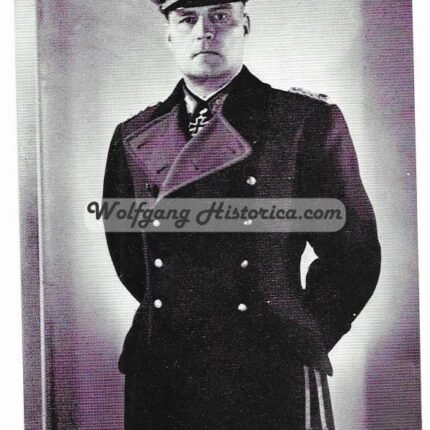
Hellmuth Reymann – 13. Luftwaffe-Feld-Division & 11. Infanterie-Division (Oakleaves)
€35,00Original Postwar Signature on a Postwar Paper Photocopy of Hellmuth Reymann. Generalleutnant Hellmuth Reymann (24.11.1892 † 12.12.1988) earned the Deutsches Kreuz in Gold on November 22, 1941 with Infanterie-Regiment 205, the Ritterkreuz on April 5, 1944 as Generalleutnant und Kommandeur of the 13. Luftwaffe-Feld-Division and the Eichenlaub on November 28, 1944 as Generalleutnant und Kommandeur of the 11. Infanterie-Division. Good Condition. Measuring: Postcardsize.
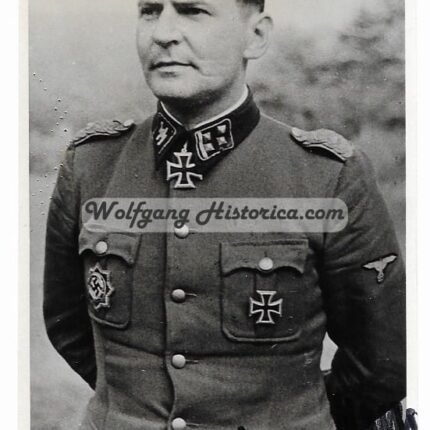
Walter Harzer – 9. SS-Panzer-Division “Hohenstaufen” (Arnhem!)
€0,01Postwar Signature of Knight’s Cross Holder Walter Harzer. Harzer earned the Deutsches Kreuz in Gold (German Cross in Gold) and the Ritterkreuz (Knight’s Cross) as Ia of 9. SS-Panzer-Division “Hohenstaufen”, famous for his role defeating the British at Arnhem!
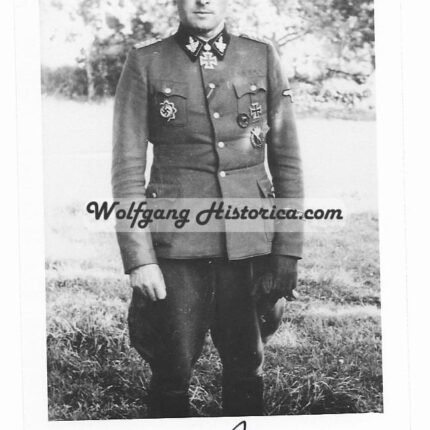
Teddy Wisch – 1. SS-Panzer-Division “Adolf Hitler” (Swords)
€89,99Postwar Signature of Theodor “Teddy Wisch” who earned the Knight’s Cross with Oakleaves and Swords with the 1. SS-Panzer-Division “Adolf Hitler”! There’s a very interesting book on Theodor “Teddy” Wisch by Markus Lippl called: “SS-Brigadefuhrer und Generalmajor der Waffen-SS Theodor “Teddy” Wisch”
- German Cross in Gold on 25 February 1943 as SS-Standartenführer in the SS-Panzergrenadier-Regiment 2, SS-Panzergrenadier-Division “Leibstandarte SS Adolf Hitler”
- Knight’s Cross of the Iron Cross with Oak Leaves and Swords
- Knight’s Cross on 15 September 1941 as SS-Sturmbannführer and commander of the II./LSSAH
- 393rd Oak Leaves on 12 February 1944 as SS-Brigadeführer and commander of the LSSAH
- 94th Swords on 30 August 1944 as SS-Brigadeführer and Generalmajor of the Waffen-SS, and commander of the LSSAH

Max Wünsche – SS-Panzer-Regiment 1 “LAH” & SS-Panzer-Regiment 12 “Hitlerjugend”
€0,01Scarce Postwar Signature of Max Wünsche, who earned the Knight’s Cross with SS-Panzer-Regiment 1 “LAH” and the Oakleaves with SS-Panzer-Regiment 12 “Hitlerjugend”. Postcardsize.
Max Wünsche was born on 20 April 1914 in Kittlitz. In July 1933 Wünsche joined the SS. In 1935, he graduated from SS-Junkerschule at Bad Tölz and was promoted to Untersturmführer. Wünsche was then posted to the Leibstandarte SS Adolf Hitler (LSSAH) as a platoon leader. In October 1938, Wünsche was assigned as an orderly officer for Hitler. In that role, Wünsche joined the Führerbegleitkommando (the SS bodyguard unit), which provided personal security for Hitler.
In January 1940 he was again posted to the LSSAH, as a platoon commander in a motorcycle company under the command of Kurt Meyer, for the invasion of the Netherlands and the Battle of France. In December 1940 he became an adjutant to Sepp Dietrich during the invasion of the Balkans (Operation Marita) and the invasion of the Soviet Union (Operation Barbarossa). In February 1942 Wünsche was given the command of the LSSAH Sturmgeschütz (assault gun) battalion.
In 1942 Wünsche completed the General Staff training course at the Staff College in Germany and was promoted to Sturmbannführer. In September 1942 he was posted to the LSSAH and resumed command of the Sturmgeschütz battalion; in October he assumed command of a battalion in a panzer regiment of LSSAH. His battalion’s first action was at Kharkov in 1943. On 25 February 1943 Wünsche’s battalion went into action against a defensive position manned by the Soviet 350th Rifle Division. Supported by artillery and a company of SS grenadiers, Wünsche’s battalion attacked and overran the Soviet front lines. Wünsche’s assault would lead to the destruction of 47 artillery pieces and anti-tank guns.[2] For his actions during the battles for Kharkov, Wünsche was awarded the German Cross in Gold and later the Knight’s Cross, both in February 1943.
In June 1943, Wünsche was transferred to a new division forming in France, 12th SS Panzer Division Hitlerjugend, to take command of the 12th SS Panzer Regiment. On 6 June 1944, the Allies landed in Normandy (Operation Overlord) and the division was committed to action on 7 June. The division was later trapped in the Falaise pocket, where on the night of 20 August, Wünsche escaped on foot. He was wounded and taken prisoner by British soldiers.
Wünsche spent the rest of the war as a prisoner of war in camp 165 at Caithness, Scotland, a special camp for high-ranking German officers. In 1948 Wünsche was released and returned to Germany. He died in 1995. (Source: Wikipedia)

Sylvester Stadler – “Der Führer” & 9. SS-Panzer-Division “Hohenstaufen”
€55,00Postwar Signature of Sylvester Stadler, earned the Knight’s Cross with Oakleaves and Swords. Earned with SS-Panzer-Grenadier-Regiment 4 “Der Führer” of the 2. SS-Panzer-Division “Das Reich” and Swords (not all sources say official) with the 9. SS-Panzer-Division “Hohenstaufen”. Postcardsize.
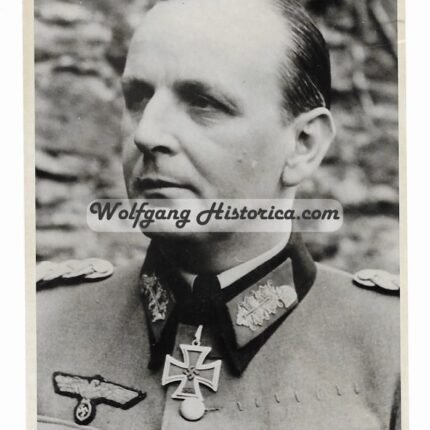
Siegfried Westphal – Operations Officer under Rommel, Chief of Staff under Kesselring & Rundstedt
€0,01Scarce Postwar Signature of Siegfried Westphal. Siegfried Carl Theodor Westphal (18 March 1902 – 2 July 1982) was a German general in the Wehrmacht during World War II. He served as operations officer under Rommel and chief of staff under Kesselring and Rundstedt. He was a recipient of the Knight’s Cross of the Iron Cross.
Westphal surrendered to the American troops in May 1945 and acted as a witness at the Nuremberg Trials. He was released in 1947. He wrote a book The German Army in the West which was published in 1952. He appears in a number of interview segments of The World at War.
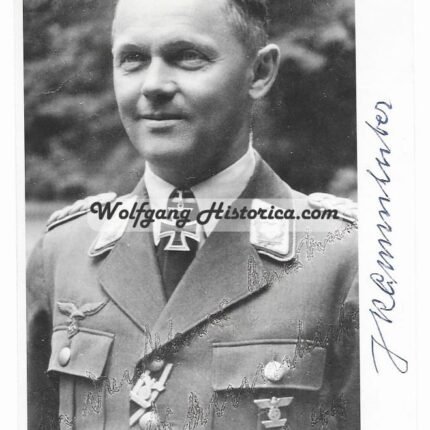
Josef Kammhuber – 1. Nachtjagd-Division & Kammhuber Line
€50,00Postwar Signature of Josef Kammhuber. Josef Kammhuber (August 19, 1896 – January 25, 1986) was a career officer in the Luftwaffe and post-World War II German Air Force. During World War II, he was the first general of night fighters in the Luftwaffe. Kammhuber created the night fighter defense system, the so-called Kammhuber Line, but the detailed knowledge of the system provided to the Royal Air Force by British military intelligence allowed them to render it ineffective. Personal battles between him and Erhard Milch, director of the Reich Air Ministry, led to his dismissal in 1943. After the war, he joined the Bundeswehr, the armed forces of West Germany.
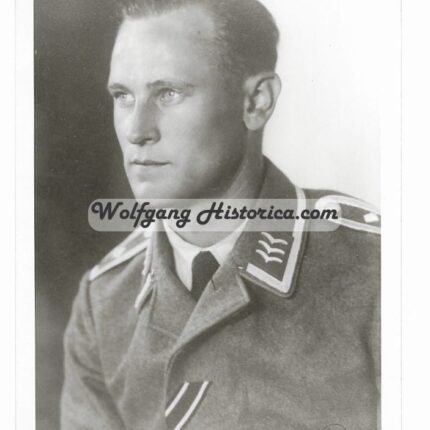

Karl Pilz – Sturmgruppe Granit (Eben Emael, 1940)
€20,00Scarce Postwar Signature of Karl Pilz, Glider Pilot of Trupp 11 of Sturmgruppe Granit. The Sturmgrupe Granit (Granite) was the assault group that famously captured the Belgian Eben-Emael fort on 10 May 1940 led by Oberleutnant Rudolf Witzig. It was 86 men strong and was carried in 11 gliders.
Glider 11
Oberleutnant Rudolf Witzig
Oberjäger Fritz Schwarz
Unteroffizier Karl Pilz (Pilot)
Otto Braun (WIA)
Uwe Johnsen
Hans-Peter Krenz
Fritz Kruck (KIA)
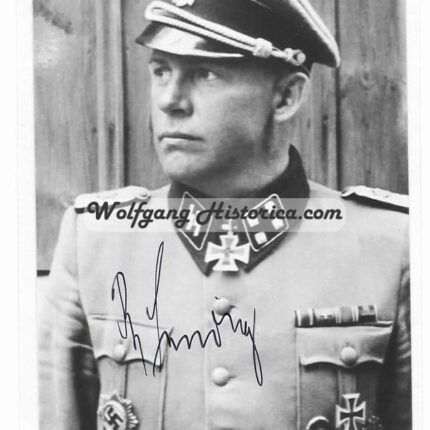
Rudolf Sandig – SS-Panzer-Grenadier-Regiment 2 “LSSAH”
€0,01Postwar Signature of Rudolf Sandig, who earned the Knight’s Cross with SS-Panzer-Grenadier-Regiment 2 “LSSAH” of the 1. SS-Panzer-Division “LSSAH”. Dedicated on the back with text.

Otto Fretter-Pico – 148. Infanterie-Division
€40,00Postwar Signature of Otto Fretter-Pico. Otto Fretter-Pico (2 February 1893 – 30 July 1966) was a general in the Wehrmacht during World War II who commanded several divisions. He was a recipient of the Knight’s Cross of the Iron Cross of Nazi Germany. He surrendered to Brazilian forces in April 1945 and was kept under their custody until 1948 when he retired and went to live in Switzerland. Fretter-Pico died in 1966. Small ID size photo pasted on white paper with signature.
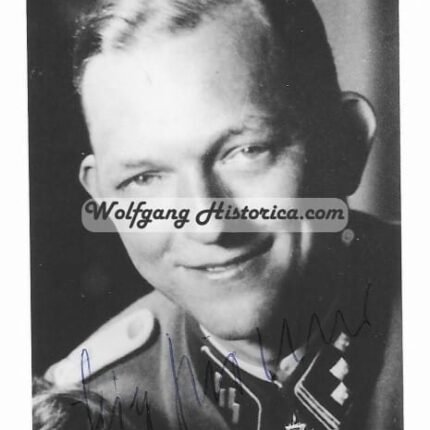
Heinz Jürgens – SS-Polizei-Panzeraufklärungs-Abteilung 4
€35,00Postwar Signature of Heinz Jürgens. Hauptsturmführer Heinz Jürgens earned the Deutsches Kreuz in Gold (German Cross in Gold) and Ritterkreuz (Knight’s Cross) with SS-Polizei-Panzeraufklärungs-Abteilung 4 of the 4. SS-Polizei-Panzergrenadier-Division. Signed on front and back.
During World War II the Polizei Division was formed for active service, Heinz Jürgens served in the Battle of France where he was wounded at Les Islettes and awarded the Wound Badge, the Iron Cross 2nd class and was promoted to Obersturmführer (First Lieutenant) and Oberleutnant of Schutzpolizei.
In 1941 Jürgens participated in Operation Barbarossa the invasion of the Soviet Union. The 4th SS Polizei Division was attached to Army Group North which advanced through the Baltic States towards Leningrad. In January 1942, Jürgens was awarded the Iron cross 1st class and in November 1942, promoted to Hauptsturmführer (Captain) and Hauptmann of Schutzpolizei. After carrying out anti-partisan duties in the Soviet Union the Division was sent to Greece and reformed as a Panzer Grenadier Division, Heinz Jürgens was given command of the 4th SS Panzer Reconnaissance Battalion. From September 1944 to January 1945 they were forced to withdraw into Hungary and Slovakia.
In February 1945 the Division was moved north to Pomerania where Jürgens Battalion acted as a Fire Brigade being sent where they were needed most at short notice. They defended a bridge across the Oder river until the German forces were evacuated across the river in March 1945, for which Jürgens was commended by the commanding General Friedrich August Schack and was promoted to Major of Schutzpolizei in April 1945. Jürgens was awarded the Knight’s Cross in May 1945 for his previous actions, but due to the situation in Germany at the time the order was not signed. (Source: Wikipedia)


Hans von Donath – Eisenbahn-Pionier-Regimentes 3
€25,00Postwar Signature of Hans von Donath. Donath was General and commanded several units during the War, as example Eisenbahn-Pionier-Regimentes 3.
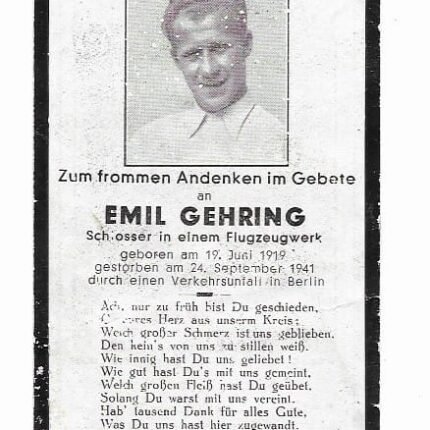
Death Card – Mechanic, Accident in Berlin 1941
€5,00Death Card of Emil Gehring, ‘Schlosser in einem Flugzeugwerk‘, who was killed in a ‘Verkehrsunfall’ (Car accident) in Berlin, September 1941.

Karl Brommann – schwere SS-Panzer-Abteilung 503
€0,01Postwar Signature of Knight’s Cross Holder Karl Brommann. Brommann earned the Ritterkreuz as Fhr. of 1./ schwere SS-Panzer-Abteilung 503.
Karl Brommann was born July 20th, 1920 in Neumünster. After his educatrion he joined the SS in 1937. Following his transfer to the 6. SS G Gebirgs-Division, Brommann served on the eastern front in Finnland and sustained injuries on both legs and his hands on September 15th, 1941. November 6th, 1941, he was injured again after having been shot through his right lung and liver. After a stay in a lazarett he joined the SS-Panzer-Regiment 11 on May 5th, 1943, he transfered to the SS-Panzer-Abteilung 103 – renamed schwere SS-Panzer-Abteilung 503 in September 1944 – in October of 1943. Despite having been wounded several times, Brommann destroyed 66 tanks, 44 anti-tankguns and 15 trucks between February 2nd and March 18th, 1945. During engagements up to March 26th, 1945, he managed again to destroy at least six Josef Stalin tanks. On March 2nd, 1945, Brommann was injured again, sustaining burns on his head and hands and on March 25th, 1945, he was injured once more after having been hit by a shell. On March 26th, the Kriegsmarine took him by way of Hela to Schwinemünde where he was admitted to a lazarett and subsequently was made a POW by the British on May 21st, 1945. He was released in November 1947.
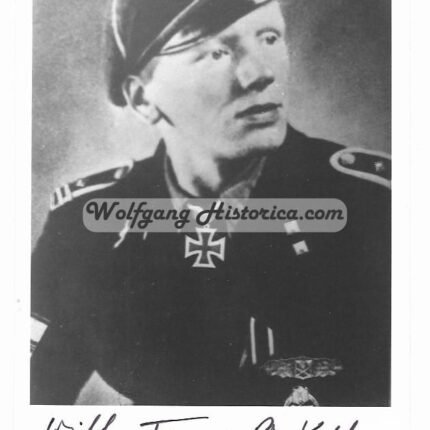
Willi Fey – schwere SS-Panzer-Abteilung 502
€40,00Postwar Signature of Wilhelm “Willi” Fey, Knight’s Cross holder of the schwere SS-Panzer-Abteilung 502
Awarded for destroying 8 Soviet tanks during the fighting for Berlin in the time period 23.-28.04.1945. By this he raised his total of enemy tanks destroyed in close combat to 14. Awarded by SS-Brigadeführer und Generalmajor der Waffen-SS Wilhelm Mohnke. The recommendation was done in the normal way to the Heerespersonalamt. With the Bundesarchiv there is no proof of the actual awarding. The awarding was accepted by the Bundeswehr and a Commission of Honour with the AKCR who both accepted the awarding. Actual awarding is therefore however uncertain.
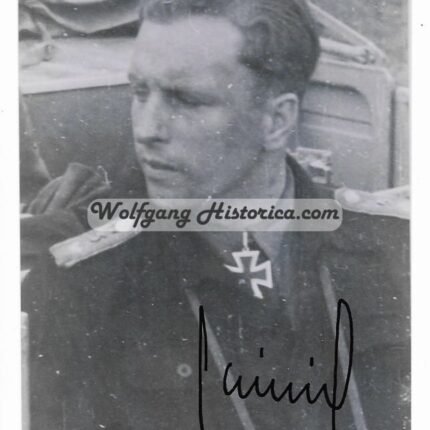
Karl Nicolussi-Leck – SS-Panzer-Regiment 5 “Wiking”
€45,00Postwar Signature of Karl Nicolussi-Leck. Nicolussi-Leck earned both the Deutsches Kreuz in Gold (German Cross in Gold) and Ritterkreuz (Knight’s Cross) with 8. Kompanie/ SS-Panzer-Regiment 5 of the 5.SS-Panzer-Division “Wiking”.
Karl Nicolussi-Leck was the commander of a Panther company in the 5. SS-Panzer-Division “Wiking” during its efforts to relieve the trapped garrison at Kovel in March 1944. On the 27th of that month, with the German relief efforts still in progress, Nicolussi-Leck received an order to halt all offensive actions. By this point he was in radio conduct with the garrison, and felt that its relief was of the utmost importance. He thus told his radio operator to send a reply stating that he (Nicolussi-Leck) could not be found, and with that continued the push to the town. Three days later, following difficult fighting, he was able to reach the trapped garrison with seven tanks on the early morning of the 30th. By doing so he was able to substantially reinforce the garrison’s defences, and he remained with them until Kovel was finally relieved for good. His recommendation also says that he destroyed 17 tanks in the process, although it is possible this number is for the whole company. Either way, Nicolussi-Leck’s actions were judged to be worthy of the Knight’s Cross, and he received this award shortly afterwards. (Source: Traces of War)
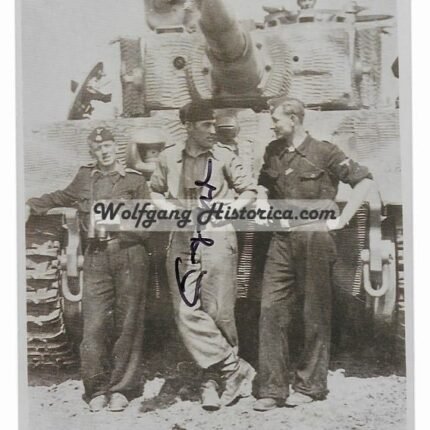
Paul Egger – schwere SS-Panzer-Abteilung 502
€45,00Postwar Signature of Paul Egger, who earned the Ritterkreuz (Knight’s Cross) with schwere SS-Panzer-Abteilung 102/502.
Knight’s Cross awarded for: “On the 14.07.1944 the English took the heavily contested Hill 112 following hours of artillery drumfire and the liberal use of artificial smokescreens. In response SS-Oberscharführer Egger, Zugführer in the 1./s.SS-Panzer-Abteilung 102, immediately initiated a counterthrust through the thick smoke on his own initiative with 4 Panzer VI’s. Despite the thick smoke Egger skillfully led his Zug into the flank of the enemy, and in the combat which followed a total of 14 enemy tanks and 7 heavy anti-tank guns were destroyed. A pursuit thrust after this gave friendly infantry the opportunity to once again attain the old frontline. Through these independently conducted actions SS-Oberscharführer Egger had a decisive share in the immediate recapture of the tactically vital Hill 112. During this action SS-Oberscharführer Egger and his crew personally destroyed 7 enemy tanks, and in doing so raised Egger’s total of tanks destroyed to 68.”

Erich Morgenstern (KC) – Sturzkampfgeschwader 2 & Schlachtgeschwader 5
€80,00Original Wartime Studioportrait of Oberfeldwebel Erich Morgenstern with his postwar signature! Ofw. Morgenstern participated in a total of over 700 sorties as a radio operator, flying mostly with Major Martin Möbus. During this time, he achieved 5 aerial victories as a rear gunner. Morgenstern earned the Deutsches Kreuz in Gold with 4. Staffel/ Sturzkampfgeschwader 2 and the Ritterkreuz des Eisernen Kreuzes (Knight’s Cross) as Bordfunker with I. Gruppe/ Schlachtgeschwader 5.
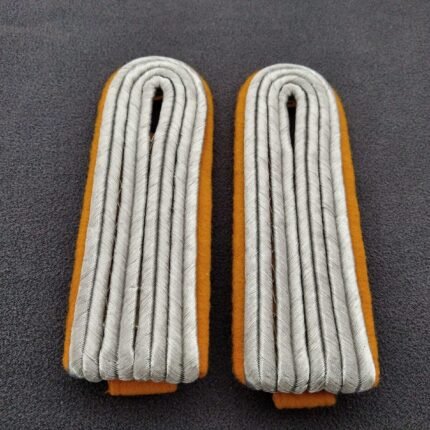
Luftwaffe Fliegertruppe Shoulderboards (Pair) – Leutnant
€0,01Pair of yellow Truppenfarbe (Branch Color) Schulterklappen (Shoulderboards) for a ‘Leutnant‘ (Lieutenant) in the Luftwaffe Flieger / Fallschirmjägertruppen complete with its functional ‘tongue’. Mint condition.
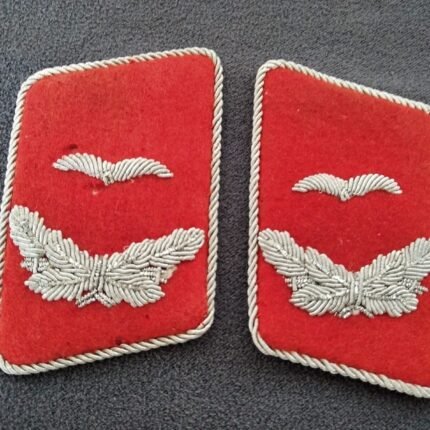
Luftwaffe Flakartillerie Collar Tabs (Pair) for a Leutnant
€0,01Pair of bright-red Kragenspiegel (Collar Tabs) for an Officer of the Flakartillerie. These ‘Kragenspiegel’ bear the Luftwaffe Rank of ‘Leutnant‘ (Lieutenant). The pair bears embroided oakleaves and bird and almos (fully) matching. One collar tab does have some small moth damage thus priced accordingly.
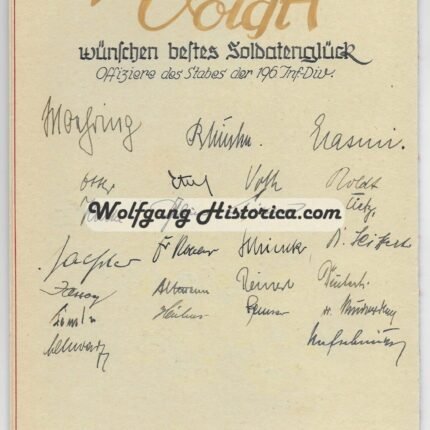
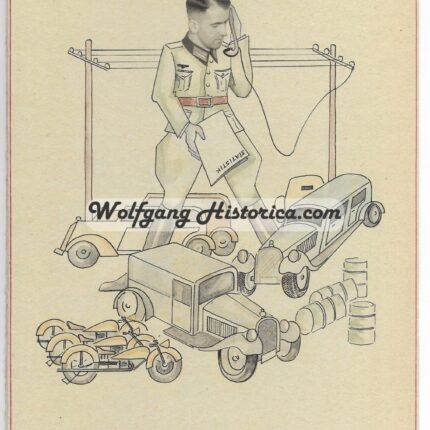
‘Soldatenglück’ Signed by Divisional Staff of 196. Infanterie-Division (Kurt Möhring!)
€0,01Stunning fieldmade and handsigned ‘Soldatenglück’ document (DIN A4, can be opened) with “Dem Scheidenden techn. Inspektor (K) Voigtl wünschen bestes Soldatenglück” (The departing techn. Inspector (K) Voigtl, wishes the best ‘Soldier’s luck’), “Offiziere des Stabes der 196. Infanterie-Division” (Officers of the Divisional Staff of the 196. Infanterie-Division). This document was handsigned by all of the Divisional Staff officers of the Division!
The 196. Infanterie-Division was engaged in the fightings and occupation of Drontheim (Trondheim), Norway. A stunning and researchable document from a Division serving years on the Norwegian front! One of the signatures is from the Divisional Commander Generalleutnant Kurt Möhring (Knight’s Cross and was Killed in Action during the Battle of the Bulge as Commander of the 276. Volks-Grenadier-Division). On December 18, 1944 Major-General Kurt Moehring, was on his way back to his command post when he got killed in his staff car near the village of Beaufort by machinegun fire. Interestingly, his command car was an American jeep and his death is disputed due the American took credit for his death but according to local historians there were no US troops within that area 48 hours after the offensive.
A few identified signatures are that of: Generalleutnant Kurt Moehring (Commander) and Oberstleutnant Klimke (Ia).
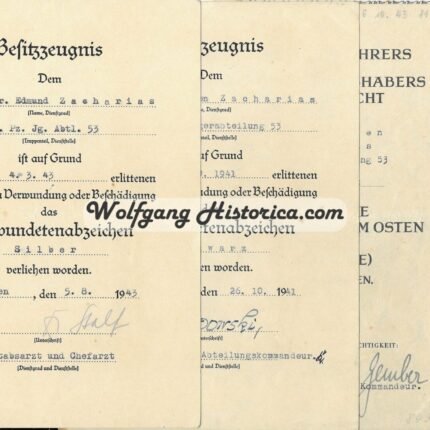
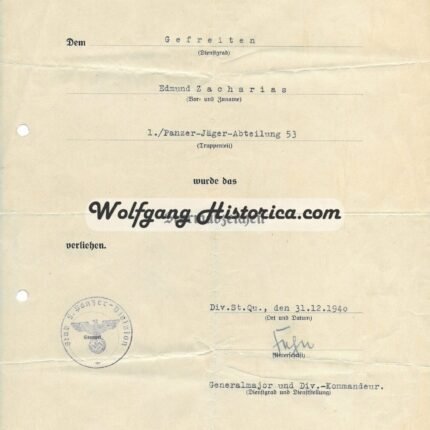
5x Award Documents: Panzerjäger-Abteilung 53 (5. Panzer-Division)
€0,01Interesting (5x!) Award document set of Obergefreiter Edmund Zacharias, who earned all of his awards while serving with the 1. Kompanie/ Panzerjäger-Abteilung 53 of the 5. Panzer-Division! Once the 2. Kompanie was mentioned although that might be an error. From 1939 onwards until (at least) 1943 he was with the same unit.
- Allgemeines Sturmabzeichen (General Assault Badge) for supporting 3 assaults, was awarded on December 31, 1940 for actions during the French Campaign and was signed by Generalmajor u. Divisions-Kommandeur Gustav Fehn (Knight’s Cross), has been folded twice and punched in the past. Document is DIN A4, a nice big early variant!
- Verwundetenabzeichen in Schwarz (Wound Badge in Black) for his first wound sustained on October 12, 1941. Signed by Major u. Abteilungs-Kommandeur Eduard Radowski (Knight’s Cross). Document has been folded once and was punched.
- Verwundetenabzeichen in Silber (Wound Badge in Silver) for his third wound sustained on March 4, 1943. Signed by an unknown Stabsarzt u. Chefarzt of Reserve-Lazarett Wissen. Document has been folded once and was punched.
- Winterschlacht im Osten 1941/42 (Winter War Medal) for his service during the harsh winter of 1941/42 on August 11, 1942, which was signed by Major u. Abteilungs-Kommandeur van Gember (?)
- Medaille zur Erinnerung an den 1. Oktober 1938 (The 1 October 1938 Commemorative Medal) for his participation in the occupation of Sudetenland in October 1938 and Czechoslovakia in March 1939 on August 27, 1939. Signed by an unknown Major u. Abteilungsführer. Document has some staining.
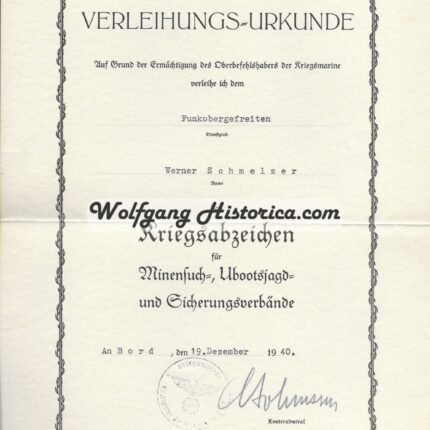
Minesweeper War Badge – Award Document (Funkobergefreiter)
€105,00Award document of Funkobergefreiter Werner Schmelzer (later promoted to Oberfunkmeister), who earned Kriegsabzeichen für Minensuch-, U-Boot-Jagd- und Sicherungsverbände (Minesweeper War Badge or Minesweepers, Sub-Chasers and Escort-Vessel War Badge) for his service on December 19, 1940 (few months after it was established!). Signed by Konteradmiral u. Befehlshaber der Sichering der Ostsee Hans Strohwasser (Knight’s Cross). Document a little bigger as A4 and has been folded once in the past.
Comes with 3 extra paper documents (Oberfunkmeisterzeugnis, Funkmaatenzeugnis and Funkmatenzeugnis).
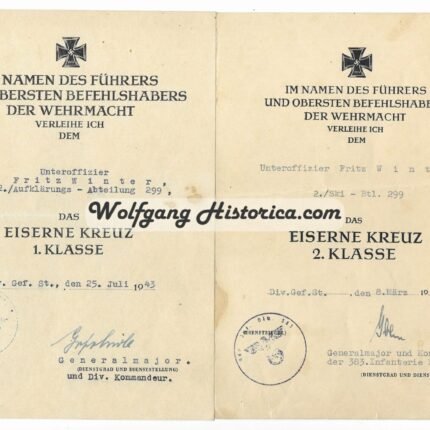
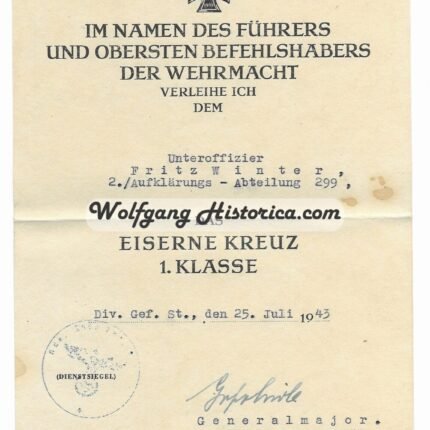
2x Award Documents: Iron Cross 1st & 2nd Class (KIA, 299.Inf.Div.)
€155,00Small but interesting Award document set of Wachtmeister Fritz Winter, who earned all of his awards while serving with the 2. Kompanie/ Aufklärungs-Abteilung 299 and 2. Kompanie/ Ski-Bataillon 299 both of the 299. Infanterie-Division! Wachtmeister (Posthumously) Fritz Winter did not survive the war, he was Killed in Action on July 22, 1943 near or at Höhe 249,8 nordostl. Kakurino (?) due the result of Artillery Shrapnell to his head and chest.
- Eisernes Kreuz 1. Klasse (Iron Cross 1st Class) for his (heroic) service on July 25, 1943 while serving with the 2. Kompanie/ Aufklärungs-Abteilung 299. Document was signed by Generalmajor u. Divisions-Kommandier Ralph Graf von Oriola (Knight’s Cross)
- Eisernes Kreuz 2. Klasse (Iron Cross 2nd Class) for his (heroic) service on March 8, 1943, while serving with the 2. Kompanie/ Ski-Bataillon 299. Document was signed by Generalmajor u. Divisions-Kommandier Friedrich-Wilhelm John (DKIG and Knight’s Cross of the War Merit Cross)
Comes also with a letter and 3 small paper documents.


Heldentod Urkunde – Adjutant in Grenadier-Regiment 556 (330.Inf.Div.)
€0,01Large-size original (DIN A4) “Heldentod Ehrenurkunde” (“Hero’s Death honor document”), which given to family member’s of a soldier who was Killed in Action. This document is honored to Leutnant Max Neumann, who served with the Bataillonsstab II./ Grenadier-Regiment 556 of the 330. Infanterie-Division. Leutnant Neumann succumbed to his wounds (result of a headshot) in the fieldhospital of the Sanitäts-Kompanie 330 on July 23, 1942 near Bojartschina u. Demidow? The document was signed by Oberst Robert Ritter von Doser (later Generalmajor, earned the German Cross in Gold and was KIA in 1943).
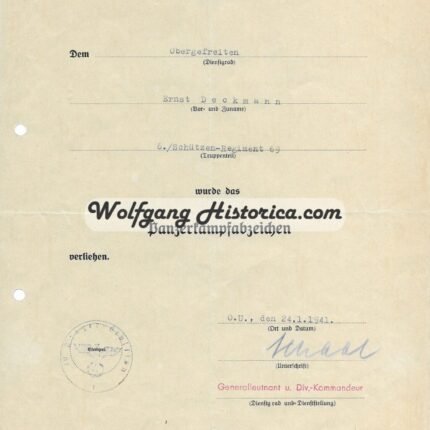
Panzer Assault Badge Award Document – Schützen-Regiment 69 (10.Pz.Div.) (Ferdinand Schaal Signed!)
€180,00Award document of Obergefreiter Ernst Deckmann who earned the Panzerkampfabzeichen (in Bronze) (Panzer Assault Badge in Bronze) for his taking part in three armored assaults in three different days (Bronze was awarded to Personnel of the Schützen- and Panzergrenadier-Regiments, Medical and Armored Reconnaisance Units) on January 24, 1941 while serving with the 6. Kompanie/ Schützen-Regiment 69 of the 10. Panzer-Division (which was later destroyed in Tunis). This will still be for his participation in the French Campaign in 1940! Signed by Generalleutnant Ferdinand Schaal (Knight’s Cross), Schaal was also involved in the unsuccessful 20 July plot against Adolf Hitler; for his participation in the conspiracy, he was imprisoned until the end of the war. Document is DIN A4, has been folded twice and punched in the past.
Comes with a Besitz-Zeugnis for the 1. Fache Schützenabzeichen (Shooting Award) in the 1. Schießklasse.
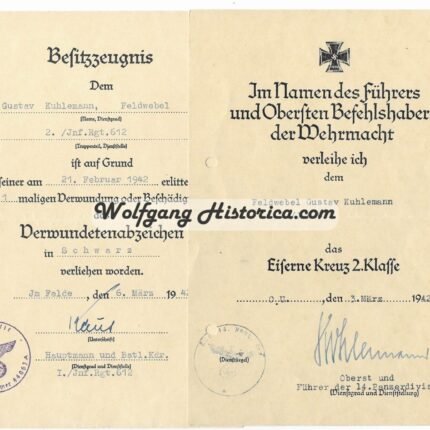
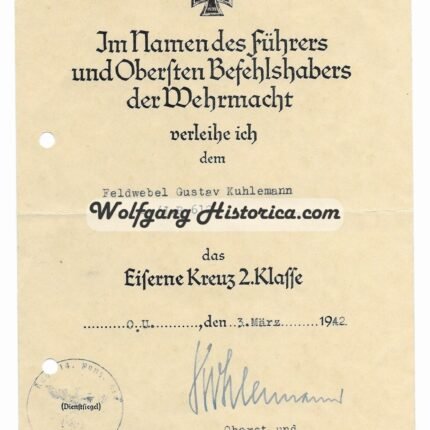
2x Award Documents: Iron Cross 2nd Class & Black Wound Badge (Inf.Rgt.612)
€0,01Small but interesting Award document set which includes a Promotion document of Feldwebel Gustav Kuhlemann, who earned his awards during his fightings on the Eastern Front. He served with the 2. Kompanie/ Infanterie-Regiment 612 (independent unit).
- Eisernes Kreuz 2. Klasse (Iron Cross 2nd Class) for his service (heroic) on March 3, 1942, which was signed by Oberst u. Führer der 14. Panzer-Division Otto Kuhlermann (Knight’s Cross). Document has been folded once and was punched.
- Verwundetenabzeichen in Schwarz (Wound Badge in Black) for his wound sustained on February 21, 1942. Signed by an unknown Hauptmann u. Bataillons-Kommandeur. Document has been folded once and was punched.
- Promotional Document from Unteroffizier to Feldwebel. Document is DIN A4, has been folded twice and was punched.
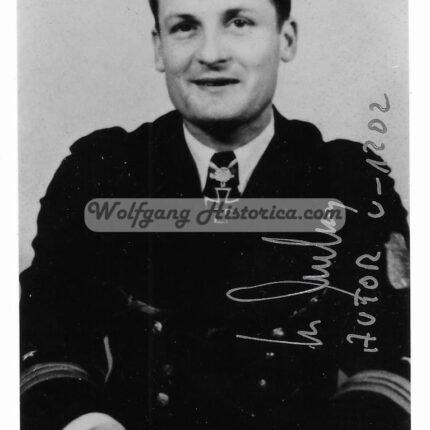
Rolf Thomsen – U-Boat Commander of U-1202
€0,01Postwar Signature of Rolf Thomsen, a U-boat commander in the Kriegsmarine during World War II and later served with the Bundesmarine. He received the Knight’s Cross of the Iron Cross with Oak Leaves for his command of the German submarine U-1202.
Thomsen served as a naval aviator from 1939 until early 1943. He transferred to the U-boat service on 1 January 1944 and on 27 January 1944 commissioned U-1202. During two patrols, Thomsen reported his ship’s attacks on a destroyer, two corvettes, six freighters and an escort carrier, for which he received the Knight’s Cross with Oak Leaves. The loss of one of these ships, Dan Beard, was confirmed by the Allies. Thomsen served in the Bundesmarine of West Germany since 1955, achieving the rank of Flotilla Admiral in 1966. (Source: Wikipedia)

Faithful Service Medal “25 Years” Award Document – Kanzleiobersekretär in Nürnberg
€0,01Award document for the 25 jährige Silberne Treudienst-Ehrenzeichen (25 Years Faithful Service Medal) which was awarded to Kanzleiobersekretär Karl Vetter of Nürnberg. A Kanzleiobersekretär is a mid-level administrative official, either working with the police or judicial department. Document is an A4 Size and bears the facismile signature of Otto Meissner.
War Merit Cross 2nd Class Award Document – Gren.Rgt.162 (61.Inf.Div.)
€30,00Award document of Obergefreiten Erwin Lehmkuhl, who earned the Kriegsverdienstkreuz 2. Klasse mit Schwertern (War Merit Cross 2nd Class with Swords) for his service on April 20, 1943. Signed by a Generalmajor Günther Krappe (Knight’s Cross). The document likely was once (ready to be) framed, hence tape was added on the back to make it stronger.
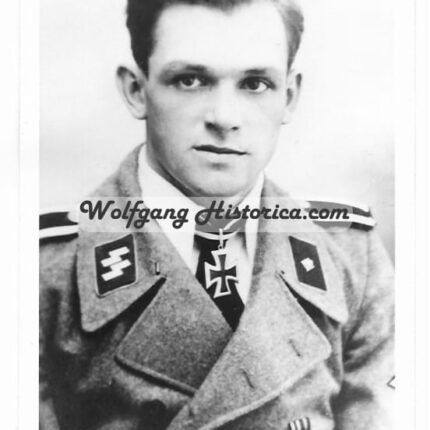
Gerhard Fischer – SS-Panzerjäger-Abteilung 5 “Wiking”
€35,00Postwar Signature of Gerhard Fischer, who earned the Knight’s Cross with 3./ SS-Panzerjäger-Abteilung 5 of the 5. SS-Panzer-Division “Wiking”.
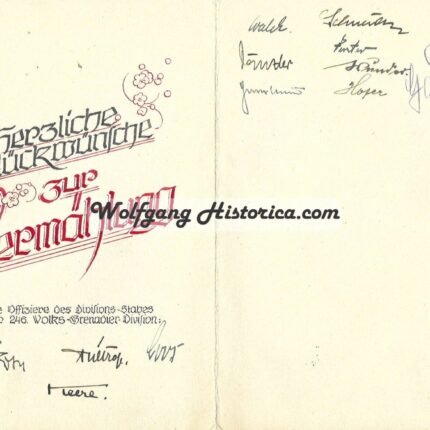

Wedding Congratulations – Signed by Division-Staff (246. VGD, Battle of the Bulge)
€0,01Stunning fieldmade and handsigned wedding congratulations document (A4-size, can be opened) with “Herzlichen Glückwunsche zur Vermählung” (Congratulations to your Wedding), “Die Offiziere des Divsions-Stabes der 246. Volks-Grenadier-Division” (The officers of the Divisional Staff of the 246. Volks-Grenadier-Division). This document was handsigned by all of the officers (except likely the officer to which this was given to) of the 246. Volks-Grenadier-Division. This Division was engaged in the Battle of Aachen, Hürtgenwald, Battle of the Bulge and Frankfurt am Main. A stunning and researchable document from a Division heavily involved in the 1944-45 fightings in the West! One of the signatures is from the Divisional Commander (from Nov. ’44 onward) Generalmajor Peter Körte (Knight’s Cross and he passed away early in 1947).
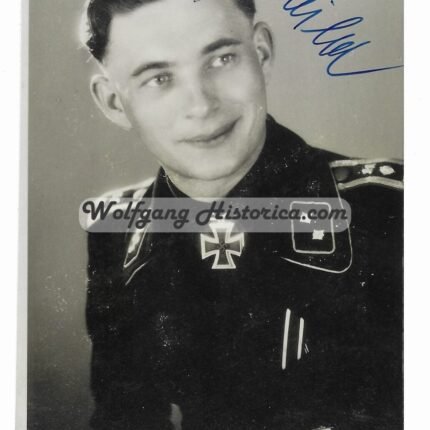
Philipp Wild – SS-Panzer-Abteilung 11 “Hermann von Salza”
€55,00Postwar Signature of Knight’s Cross Holder Philipp Wild. Wild earned the Ritterkreuz (Knight’s Cross) with the 1./ SS-Panzer-Abteilung 11 “Hermann von Salza” of the 11. SS-Freiwilligen-Panzergrenadier-Division “Nordland”
Knight’s Cross awarded for: “Strong enemy air units bombarded the bridgehead and city of Narwa during the nights of 6./7. and 7./8.3. in unremitting attacks, each lasting ten to eleven hours. On 8.3.44 at 07:00 hours, two and half hours of intense artillery fire began, supporting an attack that was followed by the 63rd Guards Rifle Division. That attack was supported by fourteen tanks and conducted on a narrow front against the northeast pillar of the bridgehead. Twelve tanks broke through the main line of resistance and advanced as far as the positions of the heavy infantry weapons of the SS-Freiwilligen-Panzer-Grenadier-Regiment 48 ‘General Seyffardt.’ At that critical rnornent, SS-Oberscharführer Wild (1./SS-Panzer-Abteilung 11) joined the fight with his Panther and in an extremely short time destroyed all of the T-34s that had broken through. As a result of his decisive intervention, he substantially thwarted the enemy’s plans to roll up the Narwa bridgehead. The destruction of the tanks was also important. Because of their loss the ongoing Soviet infantry attacks, supported by isolated tanks, could be repulsed.”
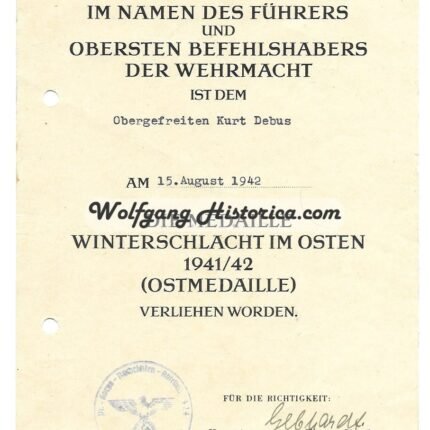
Winter War Medal Award Document – Panzerkorps-Nachrichten-Abteilung 424
€23,00Award document of Obergefreiter Kurt Debus, who earned the Winterschlacht im Osten 1941/42 (Winter War Medal) for his service during the harsh winter on August 15, 1942 while serving with the 3. Kompanie/ Panzer-Korps-Nachrichten-Abteilung 424 of the XXIV. Panzerkorps. Signed by Hauptmann u. Kompaniechef Gebhardt.
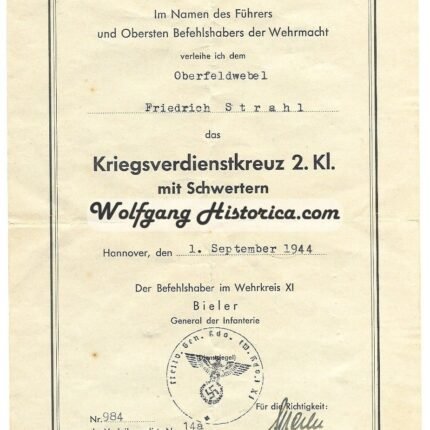
War Merit Cross 2nd Class Award Document – Wehrkreis XI, Hannover
€0,01Award document of Oberfeldwebel Friedrich Strahl, who earned the Kriegsverdienstkreuz 2. Klasse mit Schwertern (War Merit Cross 2nd Class with Swords) for his service on September 1, 1944. Signed by a unknown Major. Has been folded twice in the past. Nice variant for Wehrkreis XI.
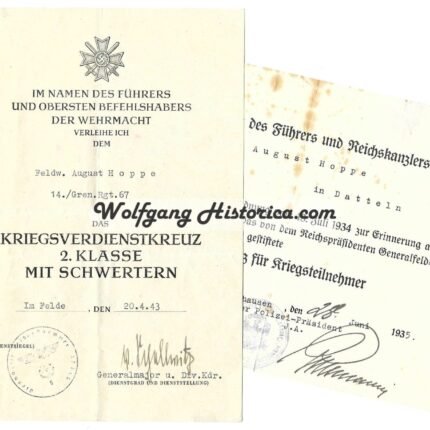
War Merit Cross 2nd Class Award Document – Gren.Rgt.67 (23.Inf.Div.)
€50,00Award document of Feldwebel August Hoppe, who earned the Kriegsverdienstkreuz 2. Klasse mit Schwertern (War Merit Cross 2nd Class with Swords) for his service on April 20, 1943 while serving with the 14. Kompanie/ Grenadier-Regiment 67 of the 23. Infanterie-Division. Signed by an Generalmajor u. Divisions-Kommandeur Friedrich von Schellwitz. Comes also with his award document for the Ehrenkreuz für Frontkämpfer for his service during World War 1.
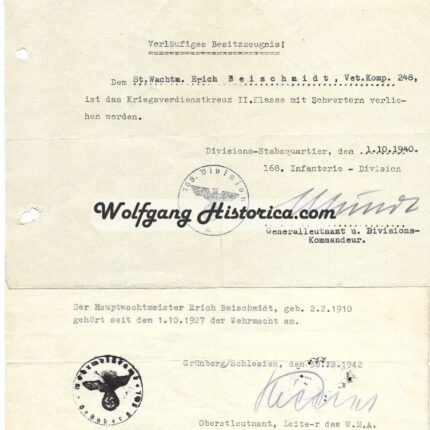
War Merit Cross 2nd Class Award Document – Vet.Komp.248 (161.Inf.Div.)
€25,00Award document (temporary form until the real award document was given) of Wachtmeister Walter Beischmidt, who earned the Kriegsverdienstkreuz 2. Klasse mit Schwertern (War Merit Cross 2nd Class with Swords) for his service on October 1, 1940 while serving with the Veterinär-Kompanie 248 of the 161. Infanterie-Division. Signed by an Generalleutnant u. Divisions-Kommandeur Hans Mundt. Comes also with another document.
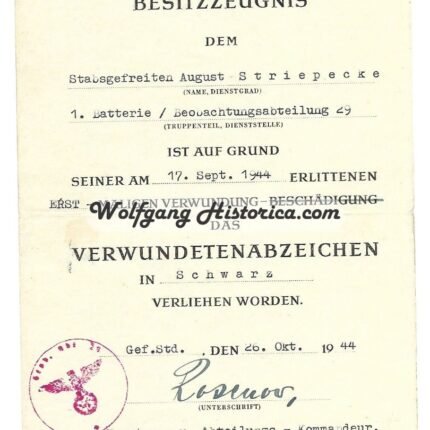
Wound Badge in Black Award Document – Beobachtungs-Abteilung 29
€35,00Award document of Stabsgefreiter August Striepecke, who earned the Verwundetenabzeichen in Schwarz (Wound Badge in Black) for his wound sustained on September 17, 1944 while serving with the 1. Batterie/ Beobachtungs-Abteilung 29. Signed by an Hauptmann u. Abteilungs-Kommandeur Rosenow (could this be Otto Rosenow, DKIG?). Has been folded once in the past.
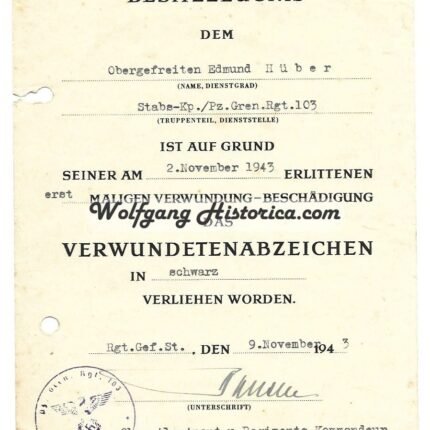
Wound Badge in Black Award Document – Pz.Gren.Rgt.103 (14.Pz.Div.)
€40,00Award document of Obergefreiter Edmund Hüber, who earned the Verwundetenabzeichen in Schwarz (Wound Badge in Black) for his wound sustained on November 2, 1943 while serving with the Stabskompanie/ Panzer-Grenadier-Regiment 103 of the 14. Panzer-Division (which was destroyed in Stalingrad). Signed by Oberstleutnant Ottomar Hansen (DKIG). Small tear near the first punch.
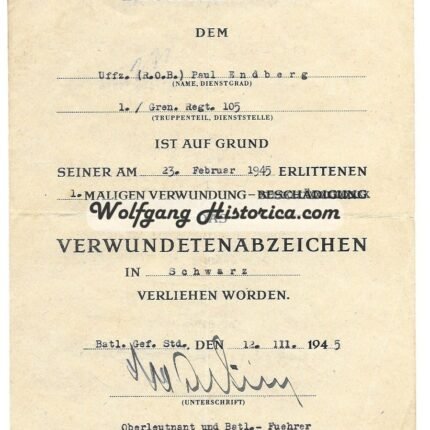
Wound Badge in Black Award Document – Gren.Rgt.105 (February 1945)
€45,00Award document of Unteroffizier (R.O.B. = Reichsoffizierbewerber) Paul Endberg, who earned the Verwundetenabzeichen in Schwarz (Wound Badge in Black) for his wound sustained on February 23, 1945 while serving with the 1. Kompanie/ Grenadier-Regiment 105 of the 72. Infanterie-Division for fightings at the Oder. Signed by an unknown Oberleutnant and Bataillonsführer. Has been folded twice in the past.

Wound Badge in Black Award Document – Inf.Rgt.76 (20.Pz.Gren.Div.)
€40,00Award document of Gefreiter Johann Wendelken, who earned the Verwundetenabzeichen in Schwarz (Wound Badge in Black) for his wound sustained on May 22, 1943 while serving with the 1. Kompanie/ Infanterie-Regiment 36 of the 20. Infanterie-Division (soon after 20. Panzer-Grenadier-Division). Signed by an unknown doctor of Reserve-Lazarett Dinkelsbühl. Has been folded once in the past.


Wound Badge in Black Award Document – Musikkorps Inf.Rgt. 36
€45,00Small set of Herbert Kulter, who earned the Verwundetenabzeichen in Schwarz (Wound Badge in Black) for his wound sustained on May 8, 1943 while serving with the Musikkorps (Music Corps) of the Infanterie-Regiment 36 of the 9. Infanterie-Division. Also comes with a DRK Personalausweis, Verpflichtungsschein, Führerschein (driver’s license) and two postwar veteran’s association documents.
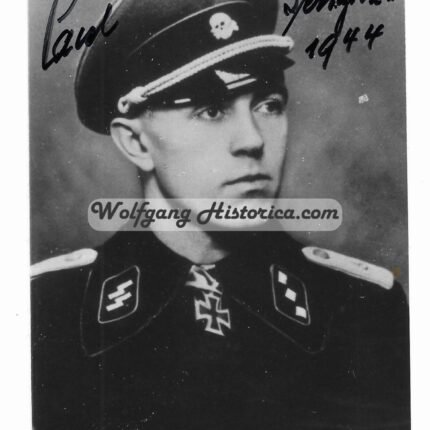
Paul Senghas – SS-Panzer-Regiment 5 “Wiking”
€0,01Postwar Signature of Knight’s Cross Holder Paul Senghas. Senghas earned the Deutsches Kreuz in Gold with 1. Kompanie/ SS-Panzer-Regiment 5 “Wiking” and the Ritterkreuz as Cdr. of I./ SS-Panzer-Regiment 5 “Wiking”.