


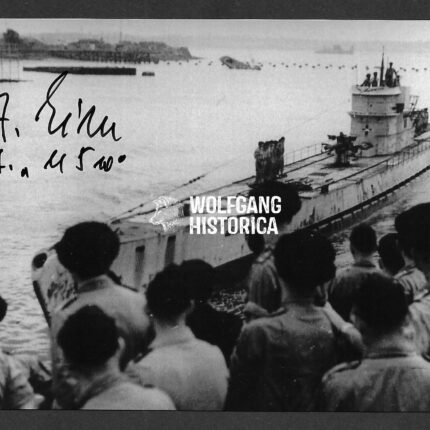
Alfred Eick – Kommandant of “U-510”
€30,00Original Postwar Signature on a Postwar Photo of Alfred Eick. Kapitänleutnant Alfred Eick (9 March 1916 – 12 April 2015) was a decorated U-boat commander in the Kriegsmarine during the Second World War.
-
Ritterkreuz des Eisernen Kreuzes – 31 March 1944, as Oberleutnant zur See und Kommandant of U-510.
Career Highlights:
-
U-Boat Service: Took command of U-510, a Type IXC/40 long-range submarine, in 1943.
-
Successful Patrols: Conducted multiple extended patrols in the Atlantic and Indian Oceans, sinking and damaging a number of Allied merchant vessels.
-
Knight’s Cross: Awarded for his leadership and successes at sea, particularly for his aggressive operations during 1943–44.
-
Postwar Life: Survived the conflict and went on to live until 2015, making him one of the last surviving Ritterkreuz U-boat commanders.
Item Details:
-
Format: Postwar photograph, postcard size.
-
Signature: Clear, authentic postwar autograph of Alfred Eick.
-
Condition: Very good; crisp image with well-preserved signature.
Collector’s Note:
Alfred Eick’s career with U-510 places him among the recognized commanders of Germany’s U-boat arm. Surviving into the 21st century, his signature is both scarce and desirable, especially tied to his Knight’s Cross award as a U-boat commander.
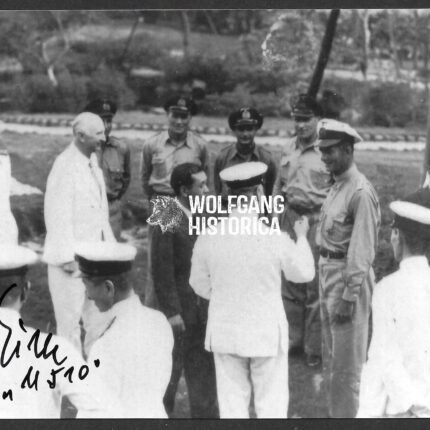
Alfred Eick – Kommandant of “U-510”
€30,00Original Postwar Signature on a Postwar Photo of Alfred Eick. Kapitänleutnant Alfred Eick (9 March 1916 – 12 April 2015) was a decorated U-boat commander in the Kriegsmarine during the Second World War.
-
Ritterkreuz des Eisernen Kreuzes – 31 March 1944, as Oberleutnant zur See und Kommandant of U-510.
Career Highlights:
-
U-Boat Service: Took command of U-510, a Type IXC/40 long-range submarine, in 1943.
-
Successful Patrols: Conducted multiple extended patrols in the Atlantic and Indian Oceans, sinking and damaging a number of Allied merchant vessels.
-
Knight’s Cross: Awarded for his leadership and successes at sea, particularly for his aggressive operations during 1943–44.
-
Postwar Life: Survived the conflict and went on to live until 2015, making him one of the last surviving Ritterkreuz U-boat commanders.
Item Details:
-
Format: Postwar photograph, postcard size.
-
Signature: Clear, authentic postwar autograph of Alfred Eick.
-
Condition: Very good; crisp image with well-preserved signature.
Collector’s Note:
Alfred Eick’s career with U-510 places him among the recognized commanders of Germany’s U-boat arm. Surviving into the 21st century, his signature is both scarce and desirable, especially tied to his Knight’s Cross award as a U-boat commander.
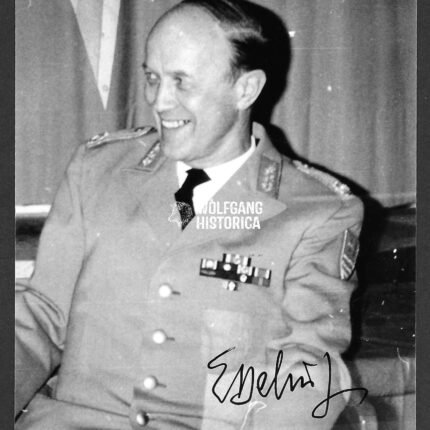
Werner Ebeling – Grenadier-Regiment 154 & 220 (Eichenlaub)
€20,00Original Postwar Signature on a Postwar Photo of Werner Ebeling. Oberst Werner Ebeling (11 November 1907 † 16 December 2001) was a German Army officer who rose to the rank of Oberst during the Second World War. A highly decorated front-line commander of the 58. Infanterie-Division, he received the Knight’s Cross of the Iron Cross with Oak Leaves for his leadership in some of the fiercest battles on the Eastern Front.
Awards and Decorations:
-
German Cross in Gold (Deutsches Kreuz in Gold) – 11 March 1943, as Oberleutnant with Grenadier-Regiment 220.
-
Knight’s Cross of the Iron Cross (Ritterkreuz des Eisernen Kreuzes) – 9 April 1944, as Major and Kommandeur of II./Grenadier-Regiment 220, 58. Infanterie-Division.
-
Oak Leaves to the Knight’s Cross (Ritterkreuz mit Eichenlaub, 799th award) – 5 March 1945, as Oberstleutnant and Kommandeur of Grenadier-Regiment 154, 58. Infanterie-Division.
Career Highlights:
-
Served throughout the war in infantry leadership roles, primarily with the 58. Infanterie-Division.
-
Earned the German Cross in Gold in 1943 for his distinguished service in combat as a company-grade officer.
-
Awarded the Knight’s Cross in April 1944 for outstanding leadership of his battalion during hard-fought engagements on the Eastern Front.
-
Received the Oak Leaves in March 1945 as a regimental commander, recognized for his division’s stubborn resistance during the late-war battles against overwhelming Soviet forces.
-
Survived the war and lived until 2001, reaching the age of 94.
Item Details:
-
Authentic postwar signature of Oberst Werner Ebeling.
-
Signed on a postwar photograph.
-
Condition: Excellent, with a clear and bold autograph.
Collector’s Note:
Ebeling’s combination of the German Cross in Gold, Knight’s Cross, and Oak Leaves makes his autograph especially attractive for Eastern Front collectors. His long career within the 58. Infanterie-Division gives his grouping of awards and service a strong cohesion and significance.
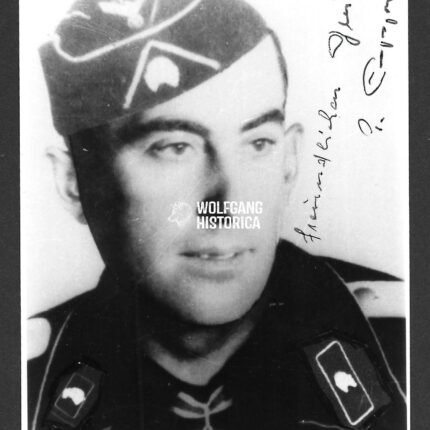
Paul Egger – schwere SS-Panzer-Abteilung 502
€45,00Original Postwar Signature on a Postwar Photo of Paul Egger. SS-Obersturmführer Paul Egger (26 November 1916 – 12 July 2007) was a decorated Waffen-SS panzer officer and late-war tank ace credited with 113 confirmed tank kills.
-
Deutsches Kreuz in Gold – 30 December 1944, as Zugführer in schwere SS-Panzer-Abteilung 502.
-
Ritterkreuz des Eisernen Kreuzes – 28 April 1945, as SS-Obersturmführer und Kompaniechef of 1./schwere SS-Panzer-Abteilung 502.
Career Highlights:
-
Early Service: Joined the Waffen-SS in 1941, assigned to SS-Panzer-Regiment 2 “Das Reich” as a tank commander.
-
Normandy Battles: Fought with schwere SS-Panzer-Abteilung 102 during the Battle of Normandy, where the unit was almost completely destroyed.
-
Eastern Front Actions: Reformed as schwere SS-Panzer-Abteilung 502, Egger took part in the brutal defensive battles around Stettin in 1945.
-
Tank Ace: Credited with 113 destroyed enemy tanks, making him one of the more successful SS panzer commanders of the late war period.
Item Details:
-
Format: Postwar photograph, postcard size.
-
Signature: Authentic postwar autograph of SS-Obersturmführer Paul Egger.
-
Condition: Very good, clean and well-preserved.
Collector’s Note:
Paul Egger’s significance lies in his service with both Das Reich and the schwere SS-Panzer-Abteilungen, two of the most well-known Waffen-SS armored units. His high kill record and late-war Knight’s Cross award make his autograph particularly sought after. This example represents a scarce and desirable set for collectors of panzer aces and Waffen-SS memorabilia.
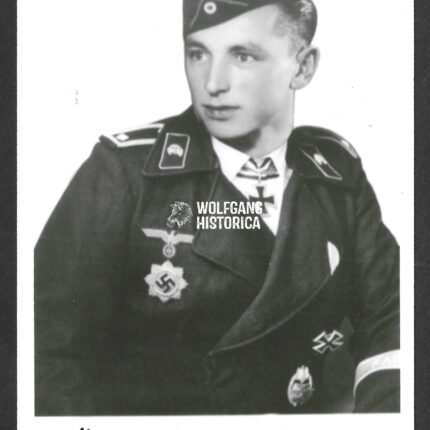
Hermann Eckardt – Panzer-Abteilung 8
€20,00Original Postwar Signature on a Postwar Photo of Hermann Eckardt. Feldwebel Hermann Eckardt (04 October 1920 – 16 September 2010) was a highly decorated German Army NCO who distinguished himself as a front-line panzer and anti-tank commander during the final years of the Second World War.
-
Deutsches Kreuz in Gold – 12 September 1944, as member of 1./Panzer-Abteilung 8.
-
Ritterkreuz des Eisernen Kreuzes – 28 March 1945, as Feldwebel und Zugführer of 1./Panzerjäger-Abteilung 8, 20. Panzergrenadier-Division.
Background:
Eckardt fought throughout the later campaigns on the Eastern Front. His award of the Knight’s Cross came in recognition of his outstanding leadership and personal bravery as Zugführer, where he directed numerous successful anti-tank actions against overwhelming Soviet forces during the desperate defensive battles of early 1945.
Item Details:
-
Format: Postwar photograph, postcard size.
-
Signature: Clear original postwar autograph of Feldwebel Hermann Eckardt.
-
Condition: Very good, well-preserved.
Collector’s Note:
Eckardt belongs to the relatively small group of late-war NCO Knight’s Cross holders from Panzerjäger units, making his signature particularly scarce and desirable for collectors of Panzer and Eastern Front memorabilia.
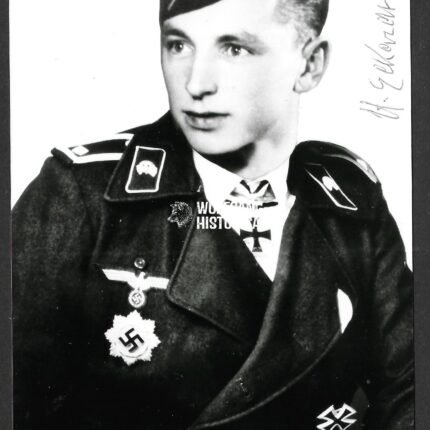
Hermann Eckardt – Panzer-Abteilung 8
€20,00Original Postwar Signature on a Postwar Photo of Hermann Eckardt. Feldwebel Hermann Eckardt (04 October 1920 – 16 September 2010) was a highly decorated German Army NCO who distinguished himself as a front-line panzer and anti-tank commander during the final years of the Second World War.
-
Deutsches Kreuz in Gold – 12 September 1944, as member of 1./Panzer-Abteilung 8.
-
Ritterkreuz des Eisernen Kreuzes – 28 March 1945, as Feldwebel und Zugführer of 1./Panzerjäger-Abteilung 8, 20. Panzergrenadier-Division.
Background:
Eckardt fought throughout the later campaigns on the Eastern Front. His award of the Knight’s Cross came in recognition of his outstanding leadership and personal bravery as Zugführer, where he directed numerous successful anti-tank actions against overwhelming Soviet forces during the desperate defensive battles of early 1945.
Item Details:
-
Format: Postwar photograph, postcard size.
-
Signature: Clear original postwar autograph of Feldwebel Hermann Eckardt.
-
Condition: Very good, well-preserved.
Collector’s Note:
Eckardt belongs to the relatively small group of late-war NCO Knight’s Cross holders from Panzerjäger units, making his signature particularly scarce and desirable for collectors of Panzer and Eastern Front memorabilia.

Soldbuch & Award Doc: Panzer-Regiment 3 (Normandy!)
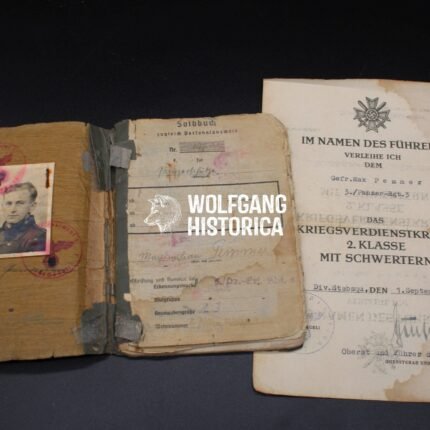
€0,01Original Soldbuch and Award Document – Obergefreiter Max Pemmer (3./Panzer-Regiment 3, 2. Panzer-Division)
A historically significant grouping consisting of the Soldbuch (with photograph, denazified) and the award document for the Kriegsverdienstkreuz 2. Klasse mit Schwertern, issued to Obergefreiter Max Pemmer, who served with the 3. Kompanie / Panzer-Regiment 3 of the elite 2. Panzer-Division during the Battle of Normandy.
-
Award: Kriegsverdienstkreuz 2. Klasse mit Schwertern (War Merit Cross 2nd Class with Swords), awarded 1 September 1944, signed at the divisional level.
-
Unit Service: Panzer-Regiment 3, one of the division’s armored spearheads, equipped with Panther tanks during the Normandy campaign.
-
Historical Note: Pemmer is notably mentioned in the memoirs of a Panther crewmember from 3./Panzer-Regiment 3, who recalls seeing him after the Falaise Pocket in a field hospital, identifying him as the Sprittfahrer (fuel driver).
-
Documents:
– Complete Soldbuch with photograph (denazified).
– Original award document. -
Condition: Both Soldbuch and Urkunde show clear signs of frontline wear, with water damage, creases, and tears, adding to their authenticity and “been there” look.
Background – 2. Panzer-Division in Normandy
The 2. Panzer-Division was deployed to France in 1944 as part of the German armored reserve. It was heavily engaged following the Allied landings in June, taking part in the Mortain counterattack (Operation Lüttich) in August, where German forces attempted to cut off the U.S. advance. After failing to break through, the division became trapped in the Falaise Pocket, where it suffered devastating losses. Survivors like Pemmer managed to escape westward, often through desperate rearguard actions, and regrouped in Germany later in 1944.
Collector’s Note:
A rare and researchable grouping directly tied to the 2. Panzer-Division’s combat in Normandy, including mention in veteran memoirs that confirm Pemmer’s frontline role. Groupings to named soldiers who survived the destruction of the Falaise Pocket are particularly desirable.
Algemene SS-Vlaanderen Membership Pin
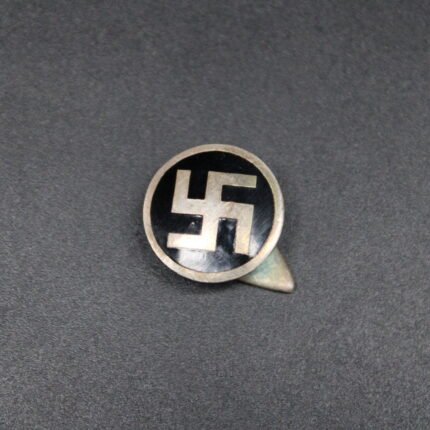
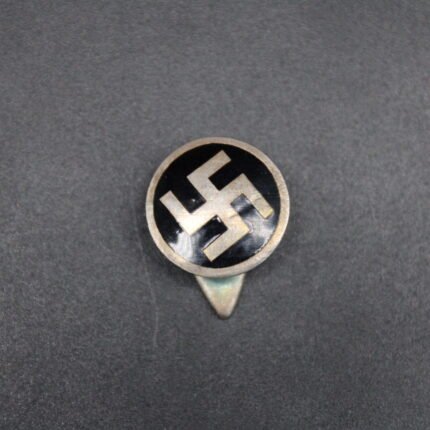
€0,01Original Algemene-SS Vlaanderen membership pin (knoopsgat / buttonhole). This membership pin was worn by Flemish Algemene SS-Vlaanderen members when they were dressed in civil. Produced by and marked “L. Zoll, Antwerpen”. Condition as seen.
Very rare and sought after. Photographs added are for illustration only!
TOP Normandy Award Doc Set – Feldwebel in Panzergrenadier-Regiment 304 (!)
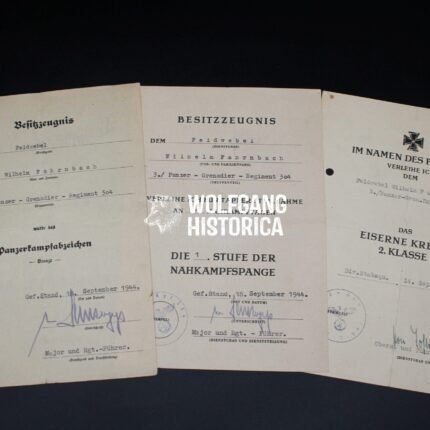
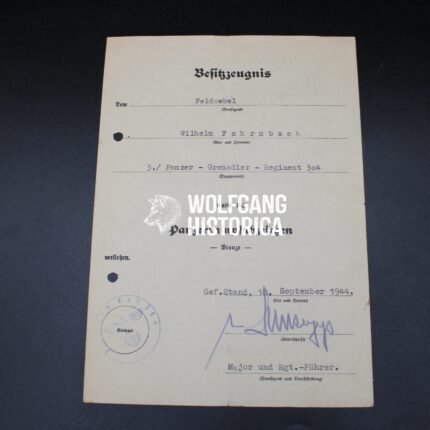
€0,01A rare and complete grouping of frontline award documents to Feldwebel Wilhelm Fahrmann, who served in the 3rd Company of Panzer-Grenadier-Regiment 304 (2. Panzer-Division) during the Normandy campaign, 1944.
Contents:
-
Eisernes Kreuz 2. Klasse (Iron Cross 2nd Class) – Awarded 14 September 1944, signed by Oberst von Nostitz-Wallwitz.
-
Nahkampfspange I. Stufe (Close Combat Clasp in Bronze – 15 days) – Awarded 18 September 1944, signed by Major Bernhard von Schklepp.
-
Panzerkampfabzeichen in Bronze (Panzer Assault Badge in Bronze) – Awarded 18 September 1944, also signed by Major Bernhard von Schklepp.
Historical Context:
The 2. Panzer-Division was heavily engaged in the bitter fighting in Normandy following the Allied landings in June 1944, suffering severe losses during the retreat through France. The dates of these awards — September 1944 — coincide with the desperate defensive battles fought during the withdrawal across France toward the German frontier. The awards were earned for actions during the Normandy fighting period.
Receiving both the Close Combat Clasp (15 days) and the Panzer Assault Badge in such a short timeframe highlights Feldwebel Fahrmann’s direct involvement in some of the most intense fighting, as well as his personal frontline leadership.
Significance:
-
Rare combination of three frontline awards, all documented and awarded within four days.
-
Signed by notable officers, including Oberst von Nostitz-Wallwitz, a divisional commander.
-
Strong Normandy connection,
-
Excellent centerpiece for any 2. Panzer-Division, Normandy campaign, or combat awards collection.

Eduard Dietl – 3.Geb.Div., Gebirgs-Korps Norwegen & 20. Gebirgsarmee (Schwertern) (Wartime Signed)
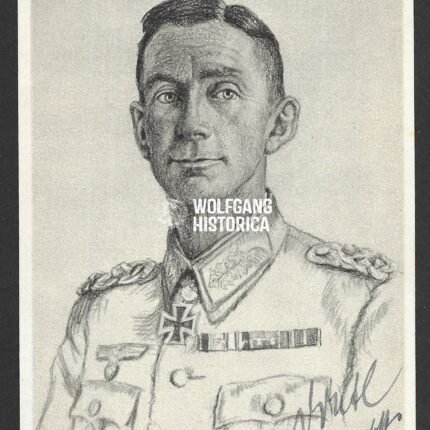
€155,00Original Wartime Signature on a Postcard of Generaloberst Eduard Dietl (21 July 1890 † 23 June 1944) was one of the most renowned commanders of the German mountain troops (Gebirgstruppe) during the Second World War. Rising from Generalleutnant to Generaloberst, he led German forces in Norway and later commanded the 20. Gebirgsarmee in the far north. He was among the earliest recipients of the Ritterkreuz des Eisernen Kreuzes and one of the very few to be awarded the Eichenlaub and Schwertern.
Awards and Decorations
-
Knight’s Cross of the Iron Cross – 9 May 1940, as Generalleutnant und Kommandeur of 3. Gebirgs-Division.
-
Oak Leaves (Eichenlaub) – 19 July 1940, as Generalleutnant und Kommandierender General of Gebirgs-Korps Norwegen.
-
Swords (Schwertern) – 1 July 1944, as Generaloberst und Oberbefehlshaber of 20. Gebirgsarmee.
-
Additional awards: Iron Cross (1914) 1st and 2nd Class, Clasp to the Iron Cross (1939), and numerous foreign and campaign decorations.
Item Details
-
Original wartime signature of Generaloberst Eduard Dietl.
-
Signed on a wartime postcard.
-
Condition: As seen – period ink signature, postcard stock consistent with the era.
Death
On 23 June 1944, the Ju 52 transport aircraft carrying Dietl crashed near Rettenegg, Styria, killing him along with General der Infanterie Thomas-Emil von Wickede, General der Gebirgstruppe Karl Eglseer, Generalleutnant Franz Rossi, and three others. There were no survivors.
Collector’s Note
Eduard Dietl remains one of the most iconic figures of the Gebirgstruppe and among the most decorated German commanders of WWII. His status as a Ritterkreuz mit Eichenlaub und Schwertern recipient, combined with his high command role and tragic death in 1944, makes his original wartime autograph a highly desirable and rare collectible.
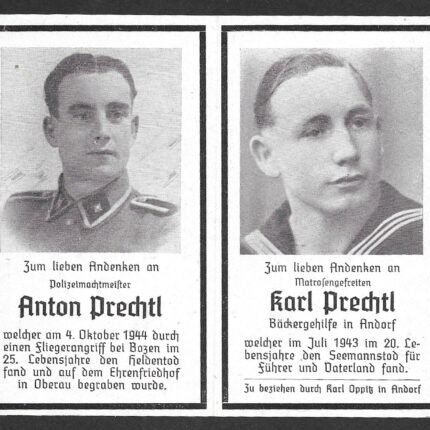
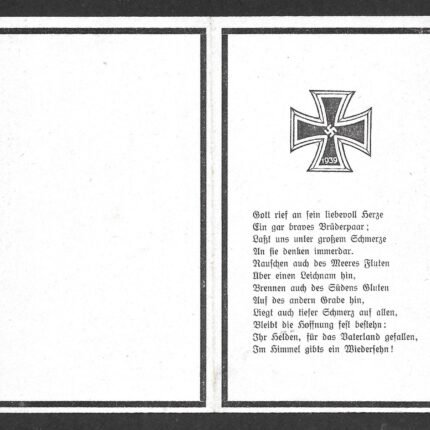
Original Double Death Card – U-boot “U-613” & Waffen-SS Brother
€75,00A very rare double death card commemorating two brothers who both lost their lives in WWII – one at sea as a U-boat sailor, the other as a Waffen-SS soldier.
Matrosengefreiter Karl Prechtl
-
Service: Crew member of U-613, a Type VIIC submarine of the Kriegsmarine.
-
Fate: On 23 July 1943, U-613 was sunk in the mid-Atlantic, south of the Azores, by depth charges from the American destroyer USS George E. Badger (DD-196). The attack occurred near Convoy UGS-12, with the destroyer operating as part of the escort group for the escort carrier USS Bogue (CVE-9).
-
Loss: All 48 crew members were killed. Wreckage and bodies were observed on the surface after the attack.
His Brother Anton Prechtl
-
Service: Member of the Waffen-SS.
-
Fate: Killed in Action on 4 October 1944 near Bozen (Bolzano), South Tyrol, during the late-war fighting in northern Italy.
Item Details:
-
Rare double Sterbebild, commemorating two brothers lost in different branches of service.
-
Represents both the U-boat war in the Atlantic and the bitter ground fighting in Italy.
-
Condition: As seen, with period wear appropriate for age.
Historical Context – U-613:
-
Commissioned in 1941 as part of the Type VIIC class, U-613 conducted patrols in the Atlantic during the height of the Battle of the Atlantic.
-
Her sinking in July 1943 reflects the increasing dominance of Allied anti-submarine tactics, with combined destroyer and escort carrier groups effectively sealing off the Atlantic.
Collector’s Note:
Double death cards are already scarce; examples combining a U-boat crewman and a Waffen-SS casualty are particularly striking. This piece highlights the fate of two brothers, one lost in the vast Atlantic with U-613, the other fallen in the mountains of northern Italy in 1944. A powerful family memorial with strong historical and emotional significance.
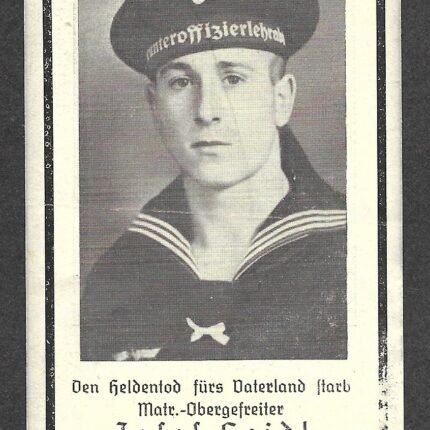
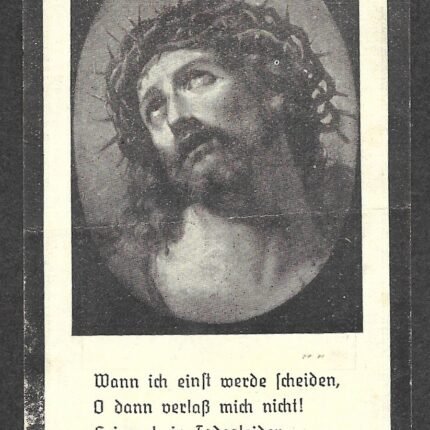
Deathcard of U-Boot Crewmember – U-Boot “U-578” (Unexplained Disappearance))
€55,00Original WWII death card (Sterbebild) for Matrosenobergefreiter Josef Seidl, who served aboard the German submarine U-578.
Service & Fate:
Josef Seidl was a crew member of U-578, a Type VIIC U-boat of the Kriegsmarine. On 6 August 1942, U-578 departed St. Nazaire for operations in the Bay of Biscay and was never heard from again. The submarine was officially declared lost with 49 dead (all hands).
Earlier accounts incorrectly credited her sinking to a Vickers Wellington H of RAF 311 (Czechoslovak) Squadron on 10 August 1942, but modern research has disproven this claim. The true cause of U-578’s disappearance remains unknown.
Item Details:
-
Original wartime Sterbebild of Josef Seidl.
-
Memorial for a sailor lost in one of the war’s unexplained U-boat disappearances.
-
Condition: As seen, with expected age-related wear.
Historical Context – U-578:
-
Type: Type VIIC submarine, backbone of the German U-boat fleet.
-
Patrols: Took part in Atlantic convoy hunting operations during the height of the Battle of the Atlantic.
-
Loss: Her disappearance highlights the dangers of minefields, technical failures, or unrecorded Allied attacks, which remain part of the mystery surrounding U-boat warfare.
Collector’s Note:
Death cards from mysteriously lost U-boats like U-578 are highly sought after. This example, dedicated to Josef Seidl, connects directly to one of the Kriegsmarine’s unsolved wartime losses. A poignant and historically significant addition to any collection of U-boat and naval memorabilia.
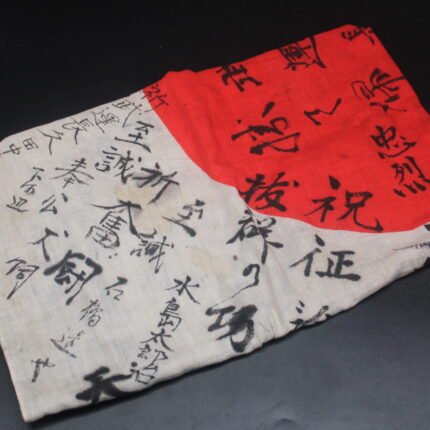
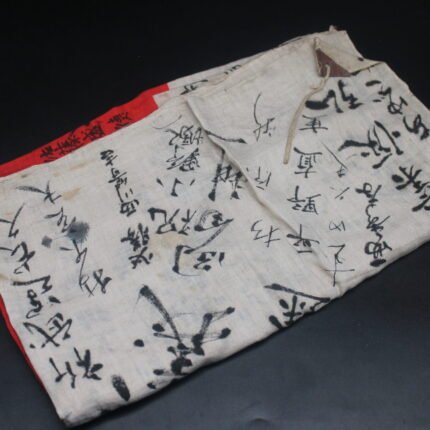
WWII Japanese Yosegaki Hinomaru “Good Luck Flag”
€0,01Original Yosegaki Hinomaru “Good Luck Flag” – Named to Mr. Tadao Hasimoto
An authentic Yosegaki Hinomaru flag which is filled with numerous signatures and good-luck messages written by family, friends, neighbors, and co-workers, radiating outward from the iconic red sun disc.
-
Condition: Strong “been there” combat look, with visible staining, wear, and tears, attesting to genuine field use.
-
Cultural significance: For a Japanese serviceman, such a flag carried immense symbolic and emotional weight, embodying the collective hopes, prayers, and exhortations of those left behind.
Center (inside the red sun)
-
武運長久 (Buun Chōkyū) → “Eternal good fortune in battle.” (dominant central motto)
-
Several vertical name signatures surround this phrase, though brushwork makes them hard to fully identify.
⬆️ Top section (above the red sun)
-
Multiple vertical signatures of individuals.
-
A few common good luck phrases:
-
必勝 (Hisshō) → “Certain victory.”
-
祈武運 (Inoru Buun) → “Prayers for good fortune in war.”
-
➡️ Right section (to the right of the red sun)
-
祈必勝 (Inoru Hisshō) → “Prayers for certain victory.”
-
大日本帝国万歳 (Dai Nippon Teikoku Banzai) → “Long live the Empire of Japan.”
-
Many personal names, often in two-character combinations (typical Japanese surnames):
-
Some examples I can parse: 田中 (Tanaka), 佐藤 (Satō), 山本 (Yamamoto).
-
Several brushstrokes are stylized, but these common surnames appear repeatedly on flags.
-
⬇️ Bottom section (below the red sun)
-
Another cluster of names.
-
Repeated “必勝” (Certain victory) inscriptions.
-
Possible name strings like 高橋 (Takahashi) and 松本 (Matsumoto) appear.
⬅️ Left section (to the left of the red sun)
-
Vertical columns of signatures, most likely from work colleagues or villagers.
-
A clear “必勝” again.
-
Some likely surnames visible: 加藤 (Katō), 林 (Hayashi), 近藤 (Kondō).
✨ Summary of Main Content:
-
Central motto: 武運長久 (“Eternal good fortune in battle”).
-
Supporting slogans: 必勝 (“Certain victory”), 祈必勝 (“Prayers for victory”), 大日本帝国万歳 (“Long live the Empire of Japan”).
-
Surrounding text: Mostly signatures of friends, family, neighbors, or coworkers — names like Tanaka, Satō, Yamamoto, Takahashi, Katō, etc.
Historical Context
The Hinomaru Yosegaki was a deeply personal and traditional gift given to departing Japanese soldiers during WWII. Every name and message inscribed was meant to lend spiritual strength, encourage bravery, and remind the soldier of his duty. It was believed that the combined power of these blessings would protect the owner in combat.
For men far from home, unfolding the flag meant reconnecting with loved ones. In many cases, servicemen left behind locks of hair or fingernail clippings with their families, symbolic tokens in case they did not return.
Collector’s Note
The powerful dedication to national service, is a highly evocative artifact of Imperial Japan’s wartime culture. With its heavy wear and visible age, it represents a genuine battlefield souvenir and a piece of history that once accompanied a soldier into service.
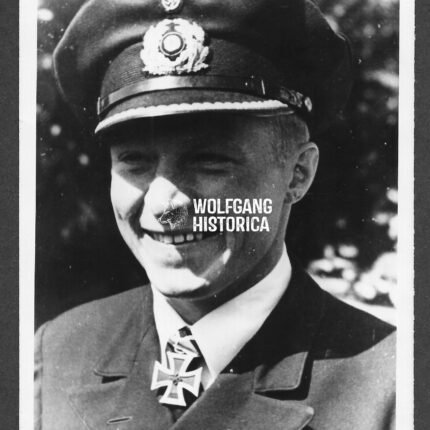

Propaganda Photograph – RKT Schnellboot Kommandant Kurt Fimmen
€0,01Original Propaganda Photograph – Knight’s Cross Schnellboot Commander Oberleutnant zur See Kurt Fimmen
-
Subject: Oberleutnant zur See Kurt Fimmen (1911–2001), commander of Schnellboot S-26, holder of the Ritterkreuz des Eisernen Kreuzes (Knight’s Cross of the Iron Cross).
-
Depicted as the Knight’s Cross–decorated commander of a Schnellboot formation, highlighted in propaganda under the caption „Schnellboote voran“.
-
-
Unit: 1. Schnellbootsflottille
-
Award: Knight’s Cross on 14 August 1940, for leadership and successes with Schnellboot S-26.
-
Caption Reference: No. 5614/6
-
Date/Reporter: Blitz-Attl., 12 September 1940 / Kriegsberichter Ortling
-
Agency Stamp: Franz A. Schostal (Vienna) verso
-
Size: approx. 18 × 13 cm
-
Condition: As seen (handling traces and age wear, agency stamp on reverse)
Historical Note:
Kurt Fimmen, born 4 May 1911 in Wittenberge, Brandenburg, was a distinguished Schnellboot commander during WWII. He received the Knight’s Cross in August 1940 for his aggressive and successful leadership of S 26 in the English Channel. Postwar, he was held as a POW from May to August 1945, later living in Nordhorn, Lower Saxony, where he died in 2001. Propaganda photographs like this underlined the daring image of Schnellboot crews and their commanders, who were often celebrated as naval heroes.
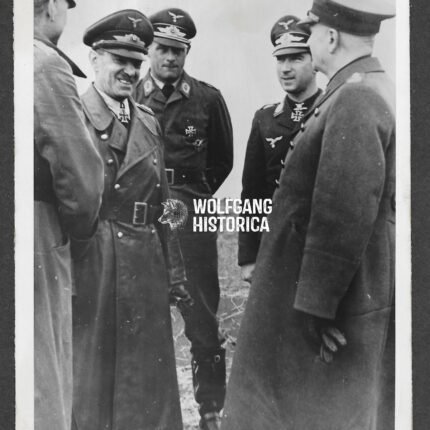
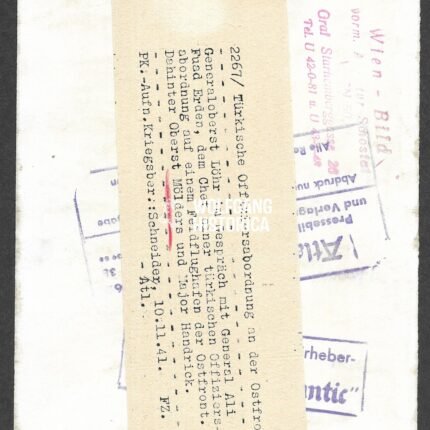
Propaganda Photograph – Turkish Officers Visit the Eastern Front (Löhr, Hendrick & Mölders!)
€0,01Original Propaganda Photograph – Turkish Officers Visit the Eastern Front
-
Subject: Visit of a Turkish officer delegation to the Eastern Front.
-
Generaloberst Löhr in conversation with General Ali Fuat Erden, head of the Turkish officers’ mission.
-
Meeting takes place at a field airfield on the Eastern Front.
-
Also pictured: Generalmajor Hendrick and, in the background, Oberst Werner Mölders (noted Luftwaffe ace and later General der Jagdflieger).
-
-
Caption Reference: No. 2267
-
Date/Reporter: Schneider, 10 November 1941 (PK-Aufn. Kriegsber.)
-
Source: Wien-Bild agency stamps on reverse
-
Size: approx. 18 × 13 cm
-
Condition: As seen (light handling, age traces, with agency and censor markings verso)
Historical Note:
This image documents a diplomatic-military visit of Turkish officers during Germany’s campaign in the East, November 1941. Such visits were used for propaganda purposes to highlight Axis ties and international military cooperation. The presence of high-ranking Luftwaffe figures, including Mölders, adds significant historical importance to the photograph.

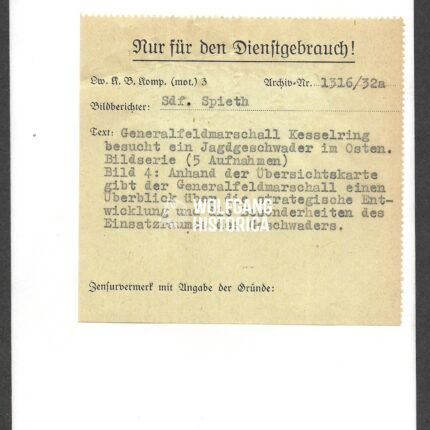
Propaganda Photograph – Generalfeldmarschall Kesselring Visits a Fighter Wing in the East
€0,01Original Propaganda Photograph – Generalfeldmarschall Kesselring Visits a Fighter Wing in the East
-
Subject: Generalfeldmarschall Albert Kesselring visiting a Jagdgeschwader (fighter wing) on the Eastern Front.
-
Content: Part of a photo series (5 images). This particular image (No. 4) shows Kesselring using a large overview map to explain the strategic situation, giving an overview of developments and the operational details of the Geschwader’s area of operations.
-
Photographer/Reporter: Sdf. Spieth
-
Archive Reference: Nr. 1316/32a
-
Unit: Lw. K.B. Komp. (mot.) 3
-
Date/Period: Second World War, Eastern Front
-
Size: approx. 18 × 13 cm
-
Condition: As seen (minor handling and age traces)
Historical Note:
General Albert Kesselring (1885–1960) was one of the Wehrmacht’s most prominent field marshals, active both in the East and later as commander-in-chief in the Mediterranean theater. Propaganda photographs such as this were intended to highlight senior leadership involvement at the front and emphasize the Luftwaffe’s strategic role.
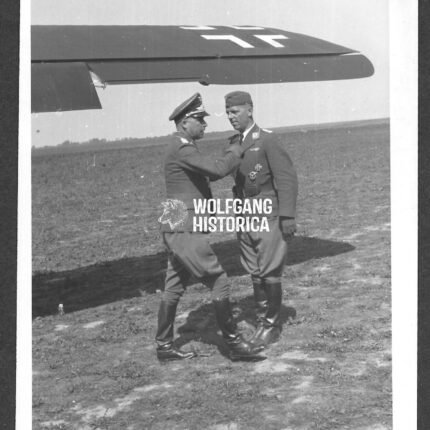
Propaganda Photograph – Oberst Junck & Ritterkreuzträger Oberstleutnant Walter Grabmann
€0,01Original Propaganda Photograph – Oberst Junck & Ritterkreuzträger Oberstleutnant Walter Grabmann
-
Subject:
-
Oberst Werner Junck – Luftwaffe officer, later Generalmajor, noted for commanding Fliegerführer Irak in 1941.
-
Oberstleutnant Walter Grabmann – Knight’s Cross recipient, Kommodore of Zerstörergeschwader 76 (ZG 76), a heavy fighter wing operating Messerschmitt Bf 110s.
-
-
Type: Original German propaganda press photograph
-
Date: [Period image, early WWII, likely 1940–41]
-
Size: 18×13 cm.
-
Condition: As seen
Historical Note:
Walter Grabmann (1905–1992) was awarded the Ritterkreuz des Eisernen Kreuzes (Knight’s Cross of the Iron Cross) on 21 July 1940 as Kommodore of ZG 76 for his leadership during the early aerial campaigns. He had previously served with the Condor Legion in Spain and rose to higher Luftwaffe staff roles later in the war. His appearance alongside Oberst Junck — another prominent Luftwaffe officer — reflects the prominence of German propaganda imagery in highlighting decorated commanders and their units during the height of Luftwaffe operations.
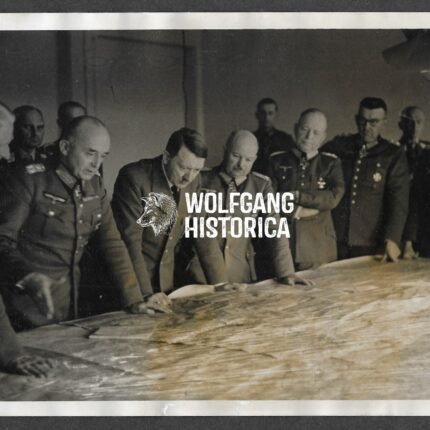
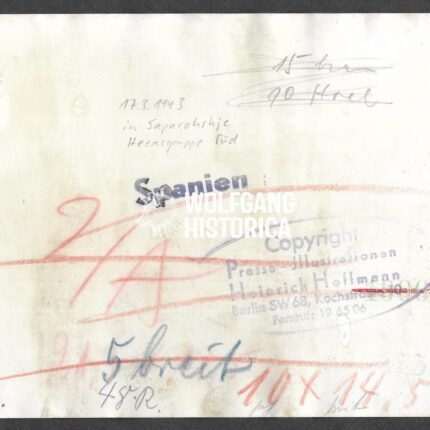
Propaganda Photograph – Adolf Hitler with Senior Officers, March 1943
€0,01Original Propaganda Photo of Adolf Hitler in conference with senior Wehrmacht officers, gathered over a large campaign map.
-
Identified figures (from left, above the map):
-
Generalfeldmarschall Erich von Manstein
-
Generaloberst Richard Ruoff
-
Adolf Hitler
-
Generaloberst Kurt Zeitzler (Chief of the General Staff of the Army)
-
Generalfeldmarschall Ewald von Kleist
-
-
Date: March 1943
-
Type: Original German propaganda press photo
-
Size: approx. 18 × 13 cm
-
Condition: As seen (minor handling marks consistent with age)
Historical Context:
This photograph was taken during a pivotal period following the defeat at Stalingrad (February 1943) and the subsequent German attempts to stabilize the Eastern Front. The presence of both Manstein and Kleist — key commanders in Army Group South — underscores the strategic importance of this meeting. Zeitzler, as Chief of the General Staff, was one of Hitler’s closest military advisors during this stage of the war.

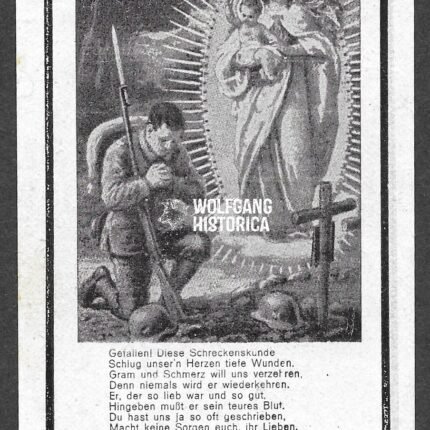
Death Card: Waffen-SS Soldier Eastern Front – July 1944
€45,00Original Death Card (“Sterbebild”) of a SS-Panzer-Obergrenadier Eduard Egger, who was Killed in Action on the Eastern Front. Condition as seen.


Death Card: Waffen-SS Soldier Eastern Front – October 1944
€45,00Original Death Card (“Sterbebild”) of a SS-Rottenführer Josef Holzinger, who was Killed in Action on the Eastern Front. Decorated with the Kriegsverdienstkreuz 2. Klasse, Ostmedaille and other awards. Condition as seen.
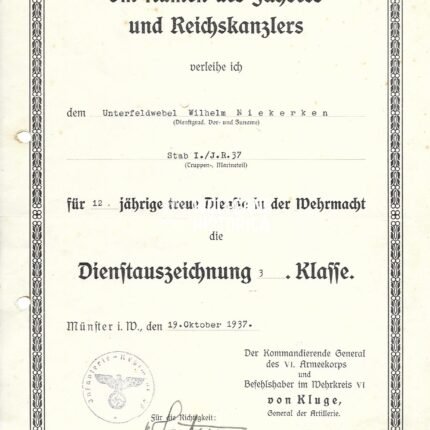
WH 12 Years Loyal Service Award Doc – Infanterie-Rgt. 37 (Signed by von Hartmann – KIA Stalingrad!)
€150,00An original award document for the Wehrmacht Dienstauszeichnung 3. Klasse (Long Service Award, 3rd Class) for 12 years of loyal service, presented to Unterfeldwebel Wilhelm Niekerken of Stab I./ Infanterie-Regiment 37.
The document bears the authentic signature of Alexander von Hartmann, later a highly decorated general and commander of the 71. Infanterie-Division.
Alexander von Hartmann – Notable Signatory
-
Born: 11 December 1890
-
Killed: 26 January 1943, Stalingrad
Von Hartmann rose through the ranks of the German Army from World War I service to command of the 71. Infanterie-Division during the bitter Battle of Stalingrad. He was awarded the Knight’s Cross of the Iron Cross on 8 October 1942 as a Generalleutnant in recognition of his leadership on the Eastern Front.
Facing encirclement at Stalingrad, von Hartmann rejected the idea of captivity, declaring:
“I intend to go to my infantry in the front line… I will seek death among their ranks. Captivity for a general is dishonourable.”
He was killed shortly after, shot in the head while firing his rifle alongside his infantry on 26 January 1943. Posthumously, he was promoted to General of the Infantry.
Collector’s Note
Award documents signed by Alexander von Hartmann are scarce and historically significant, as his dramatic end at Stalingrad and high decoration make him one of the more renowned Wehrmacht generals of WWII.
This example, issued for a long-service award to a non-commissioned officer, provides a fascinating contrast: a routine peacetime recognition, yet tied by signature to a commander remembered for his front-line sacrifice in one of history’s most brutal battles.

VWA Schwarz Award Doc – Panzer-Aufklärungs-Lehr-Abt. (1940 – Signed by Hans Cramer!)
€85,00Original Verwundetenabzeichen in Schwarz (Wound Badge in Black) award document, issued to Leutnant Heinz von Rohdn, who was wounded in action on 8 June 1940 during the Western Campaign. At the time, he was serving with the 4. Kompanie / Panzer-Aufklärungs-Lehr-Abteilung, one of the Wehrmacht’s elite armored reconnaissance training formations.
The document is personally signed by Oberstleutnant Hans Cramer, later a highly decorated Panzer commander and recipient of both the Knight’s Cross of the Iron Cross and the German Cross in Gold.
Hans Cramer – Notable Signatory
Hans Cramer (1896–1968) rose to prominence as one of Germany’s skilled armored leaders during WWII.
-
Knight’s Cross of the Iron Cross – 27 June 1941, as Oberstleutnant and Kommandeur of Panzer-Regiment 8, 15. Panzer-Division.
-
German Cross in Gold – 5 March 1942, as Oberst and commander of Panzer-Regiment 8.
Ritterkreuz Award Action (27 June 1941):
“Oberstleutnant Cramer, commander of Panzer-Regiment 8, led his Regiment in a march from Tripoli to its operations area (a distance of over 1600 km) without any friendly fallouts, and the result was that it was immediately available for operations in an excellent state. After a risky night march he captured Sidi Azeiz and Capuzzo in the morning hours of 16.05.1941. On that same day he led his Regiment in an attack against heavy English tanks, and at the end of that month he significantly contributed to the capture of the Halfaya Pass. By doing this latter act he decisively contributed to the favourable development of the situation for all elements of Kampfgruppe von Herff and for the relief of the strain of our forces at Tobruk.”
(Recommendation submitted 17 June 1941; preliminary document issued 2 July 1941 to Afrikakorps.)
Cramer later rose to the rank of General der Panzertruppen and served as commander of Afrikakorps in 1942–43, before being captured in Tunisia and briefly held as a POW in England.
Unit History – Panzer-Aufklärungs-Lehr-Abteilung
The Panzer-Aufklärungs-Lehr-Abteilung was the German Army’s specialized armored reconnaissance demonstration and training unit, stationed at Krampnitz before the war. Formed from hand-picked instructors and students of the Panzertruppenschule, it represented the cutting edge of reconnaissance tactics.
During the 1940 Western Campaign, the Lehr-Abteilung was thrown into frontline service, testing new equipment and doctrines under combat conditions. Operating fast armored cars, motorcycles, and light tanks, they were tasked with deep penetration reconnaissance, probing enemy defenses, and securing bridges and key terrain. Their aggressive actions often brought them into sharp combat with Allied rearguards, where officers like Leutnant Heinz von Rohdn were exposed to heavy fire.
By combining a training role with active combat deployment, the unit produced many future reconnaissance leaders for Panzer divisions throughout the war.
Collector’s Note
This award document is not only a direct record of Heinz von Rohdn’s wounding in the French campaign of 1940, but also carries the rare wartime signature of Hans Cramer during his time as an Oberstleutnant. Cramer’s later career in North Africa and his Ritterkreuz and Deutsches Kreuz awards make this an especially desirable signed document.
The connection to the Panzer-Aufklärungs-Lehr-Abteilung, an elite and experimental armored recon unit, further enhances its historical significance, linking one soldier’s wound to the frontline testing ground of Germany’s armored warfare doctrine.

KVK2X Award Doc – 20. Waffen-Grenadier-Division der SS (Signed by Augsberger!)
€0,01An authentic wartime award document issued to SS-Unterscharführer Wilhelm Barenscheer, who served with Waffen-Grenadier-Regiment 46 of the 20. Waffen-Grenadier-Division der SS (1. Estnische). The document is dated 30 January 1945 and bears the bold signature of SS-Brigadeführer und Generalmajor der Waffen-SS Franz Augsberger, commander of the division.
Franz Augsberger – Division Commander
Franz Xaver Josef Maria Augsberger (10 October 1905 – 19 March 1945) was an Austrian-born SS officer who rose rapidly through the ranks of the Waffen-SS. Beginning his career in the early 1930s with the SA and NSDAP, he transferred to the SS in 1932 and underwent officer training at the SS-Führerschule Braunschweig.
-
Early career as platoon leader and instructor with SS-Standarte “Der Führer.”
-
Command appointments in the 6. SS-Gebirgs-Division “Nord,” earning the German Cross in Gold (30 May 1942).
-
In 1943, appointed commander of the 3. Estonian SS Volunteer Brigade, which in 1944 expanded into the 20. Waffen-Grenadier-Division der SS (Estnische Nr. 1).
-
On 8 March 1945, awarded the Knight’s Cross of the Iron Cross, personally presented by Generalfeldmarschall Ferdinand Schörner.
-
Killed in action on 19 March 1945 during a bombing raid at Neustadt in Upper Silesia, only days after receiving the Knight’s Cross.
Significance
The 20. Waffen-Grenadier-Division der SS (Estnische Nr. 1) was primarily formed of Estonian volunteers and conscripts. Under Augsberger’s command, the division fought in brutal rearguard and defensive actions on the Eastern Front, often against overwhelming Soviet forces. Documents signed by Augsberger are scarce due to his short tenure as a divisional commander and his death before the end of the war.
Collector’s Note
This document is a desirable piece of Waffen-SS history, connecting directly to the short-lived but historically significant Estonian SS division and its commander, Franz Augsberger. The combination of its late-war date (January 1945), division context, and signature of a Knight’s Cross holder killed in action just weeks later makes this a particularly compelling artifact for collectors of Waffen-SS or foreign volunteer divisions.
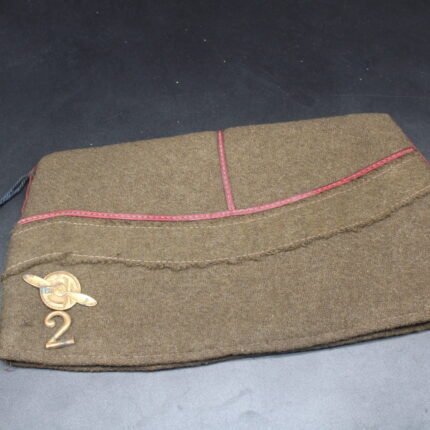
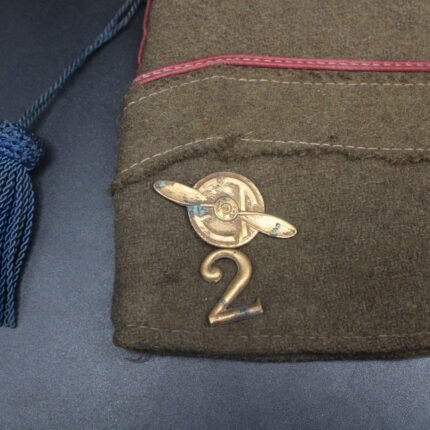
Luchtvaartregiment 2 (Niet-Varend Personeel) Kwartiermuts
€150,00Original Belgian Army Overseas Cap “Kwartiermuts” – 2e Luchtvaartregiment (Niet-Varend Personeel) (c. 1930s)
A very nice and original interwar Belgian Army overseas cap, known as a “Kwartiermuts”, privately tailored for a soldier of the 2e Luchtvaartregiment (non-flying personnel).
Private Purchase Example: A tailor-made cap, purchased at a local shop rather than issued, as was common for Belgian soldiers in the 1930s.
Unit Identification: The piping and insignia mark this example as belonging to the 2e Luchtvaartregiment, specifically for niet-varend personeel (ground staff/technical personnel). The letters “ET” on the badge are often interpreted as École Technique, though generally accepted today as denoting non-flying personnel within the regiment.
Complete Condition: Rare in this form, the cap still retains its original tassel, a feature often missing on surviving examples.
Condition: Well-preserved, with light age wear but no major damage.
Historical Context
The Belgian Luchtvaartregiment was created in the interwar years as the air arm of the Belgian Army. Within this structure, the 2e Luchtvaartregiment formed one of its core units, with the non-flying personnel (mechanics, armorers, technical specialists) providing essential support for operations.
During the 1940 campaign in Belgium, ground staff of the Luchtvaartregiment were crucial in maintaining and servicing aircraft under severe combat pressure. Despite the rapid German advance, these units ensured the operational readiness of Belgian aircraft until the final days of fighting.
Collector’s Note
A scarce Belgian interwar Kwartiermuts from the 2e Luchtvaartregiment (Niet-Varend Personeel). Complete with its tassel and correct insignia featuring the “ET” cypher, this cap is a desirable piece for collectors of Belgian militaria, particularly those focused on the aviation troops and the 1940 campaign.
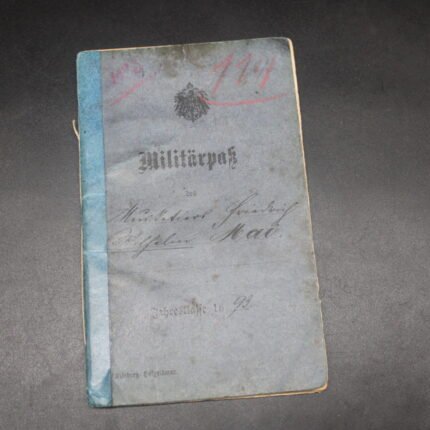
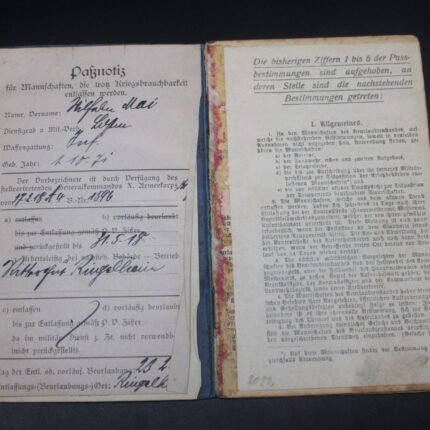
German WW1 Militärpass – Infanterie-Regiment von Voigts-Rhetz Nr. 79 (Bilzen, Achel, Pripjet)
€35,00Original Imperial German Militärpass – Landwehrmann Wilhelm Mai
(Infanterie-Regiment von Voigts-Rhetz [3. Hannoversches] Nr. 79 – later 2. Kompanie / Landsturm-Infanterie-Bataillon II, Hannover X.8)
An authentic First World War Militärpass to Landwehrmann Wilhelm Mai (b. 1 October 1871). His service spanned both active duty in the line infantry and later Landsturm formations, taking him to the Western and Eastern Fronts during some of the earliest and most grueling campaigns of the war.
Service Units:
-
Infanterie-Regiment von Voigts-Rhetz (3. Hannoversches) Nr. 79 – a regiment with traditions dating back to the Kingdom of Hanover, incorporated into the Prussian Army in 1866.
-
2. Kompanie / Landsturm-Infanterie-Bataillon II (Hannover X.8) – part of the territorial reserve forces mobilized for front-line service during WWI.
Combat Service:
-
Überfall bei Bilzen (25 September 1914): Early Western Front action during the opening months of the war, linked to the fighting around the Belgian-Dutch border.
-
Battle near Achel (17 October 1914): Further operations in Belgium during the mobile phase of the campaign.
-
Pripjet Marshes (25 July – 9 August 1916): Prolonged trench and positional fighting in the inhospitable swamp terrain of the Eastern Front, where German and Austro-Hungarian units struggled against Russian forces under extremely harsh conditions.
Unit History – Infanterie-Regiment Nr. 79
Raised in Hanover, the regiment traced its lineage to the mid-19th century and fought with distinction in the Franco-Prussian War of 1870–71. In WWI, IR 79 and its associated Landsturm formations were deployed in both Western and Eastern campaigns, often in difficult secondary operations that nonetheless played a vital role in securing rear areas and holding contested ground.
Collector’s Note
This original Militärpass documents the wartime career of Wilhelm Mai, a Landwehr soldier born in 1871 who saw action in Belgium during the 1914 campaigns and later endured the hardships of positional warfare in the Pripjet Marshes. His service reflects the contribution of older reservists and Landsturm troops, often overlooked compared to front-line regiments but vital to the German war effort.
A scarce example of a named and documented Landsturm soldier with confirmed combat service in both Belgium (1914) and on the Eastern Front (1916).
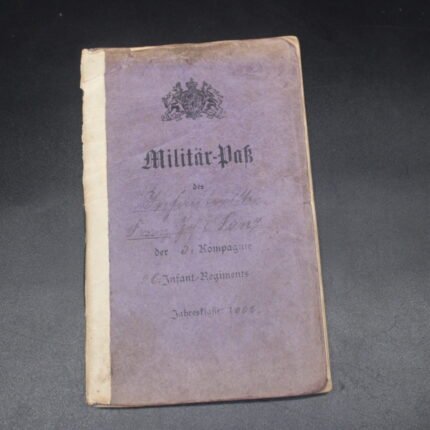

Imperial German WWI Militärpaß – Bayerisches-Reserve-Infanterie-Rgt. 17 (WIA 1918 in France, Earned Prussian EK2)
€45,00Offered is an original Imperial German Militärpaß issued to Franz Josef Lang, a Bavarian infantryman with long pre-war service, extensive frontline combat on the Western Front, and a confirmed Iron Cross 2nd Class award.
Franz Josef Lang was born on 1 May 1881 in Ranzberg and entered the Imperial German Army on 24 October 1902, initially serving with the 5. Kompanie, Infanterie-Regiment Nr. 20. His early enlistment places him among the experienced pre-war soldiers who formed the backbone of the German Army at the outbreak of the First World War.
With the mobilization of 1914, Lang was recalled to active service and assigned to the Bayerisches Infanterie-Regiment Nr. 4. His wartime career continued through multiple frontline infantry formations, including Infanterie-Regiment Nr. 3 and later the Bayerisches Reserve-Infanterie-Regiment Nr. 17. With Reserve Infantry Regiment 17, Lang saw heavy combat service in Flanders and France, placing him squarely in some of the most contested sectors of the Western Front.
On 27 November 1917, Lang was awarded the Preußisches Eisernes Kreuz 2. Klasse, a significant and desirable decoration for a Bavarian soldier, reflecting distinguished service under fire outside his home kingdom.
His Militärpaß further records that on 3 March 1918, Lang was wounded by artillery fire at Mesnil-St-Sevoye, a clear indication of direct exposure to frontline combat during the final, intense phase of the war.
Highlights:
-
Pre-war professional soldier (enlisted 1902)
-
Service in multiple Bavarian frontline infantry regiments
-
Western Front combat in Flanders and France
-
Iron Cross 2nd Class (Prussian award to a Bavarian soldier)
-
Documented combat wound from artillery fire in 1918
A strong, historically rich Militärpaß combining long service, frontline infantry combat, an Iron Cross award, and a recorded wartime wound—an excellent example for collectors of Bavarian units, Western Front veterans, or Iron Cross recipient documents.
1ste Genie Bataljon Kwartiermuts
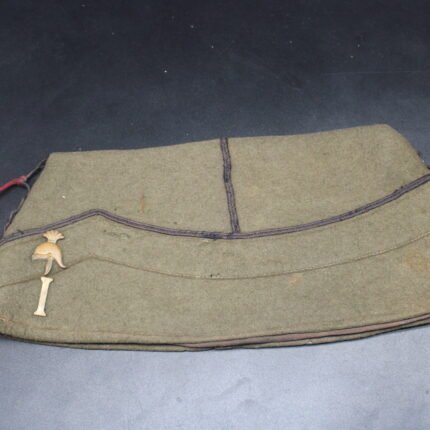
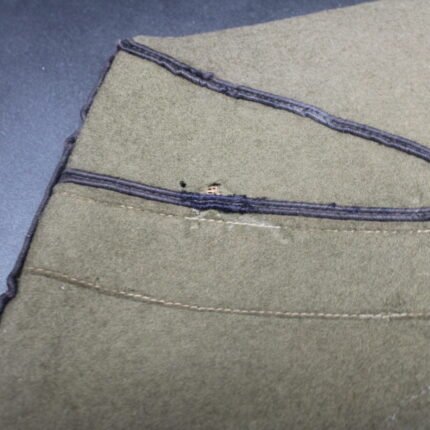
€150,00Original 1930s period Belgian Army overseas cap, known as a “Kwartiermuts”, privately tailored for a soldier of the 1st Genie Bataljon (Engineers).
-
Private Purchase Example: A tailor-made cap, purchased at a local shop rather than issued, as was common for Belgian soldiers in the interwar years.
-
Unit Identification: The piping and cyphers indicate service with the 1st Genie Bataljon, one of the Belgian Army’s specialist engineer formations.
-
Complete Condition: Scarce in this form, the cap still retains its original tassel, a feature often lost over time.
-
Condition: Well-preserved, with light age wear but no major damage.
Historical Context
May 1940 Campaign
-
Night of 9–10 May: Lieutenant Weverbergh’s detachments prepared demolition charges on bridges of the Bilzen–Winterslag railway and over the Hasselt–Genk road and rail line. At 02:30, alarms sounded. Demolition teams were dispatched to bridges over the Demer and Herk, tasked with preparing and holding them until ordered destroyed. By dawn, all charges were in place. Enemy aircraft dropped dummy parachutists, causing confusion.
-
10 May (morning–afternoon): After blowing the assigned bridges, Lt. Weverbergh rejoined the battalion. At noon, orders came to prepare for movement. That evening, 1Gn left Sint-Lambrechts-Herk for Ransberg, while demolition parties remained. Losing radio contact and without orders from the infantry, these teams eventually destroyed the bridges on their own initiative before rejoining the battalion—without losses.
-
11–13 May: From Ransberg, patrols checked the effectiveness of demolitions (e.g. the bridge at Halen). The battalion later moved to Londerzeel.
-
Mid-May: 1Gn was tasked with placing demolition charges along the Willebroek Canal, including at Kapelle-op-den-Bos and Buda. When the British Expeditionary Force (BEF) took over the defense south of Vilvoorde, the battalion handed over charges and moved to Puurs-Kalfort, later preparing further demolitions at Ruisbroek-Windham.
-
15–17 May: After short stays in Puurs, the battalion crossed the Temse bridge with the 1Div and reached Sint-Niklaas, then moved on to the Ghent bridgehead, halting at Drongen. Here, 1Gn took over prepared demolitions on bridges across the Grote Coupure in western Ghent, built a raft on the Ghent–Terneuzen Canal at Meulestede, and was ordered to reorganize “as far as possible” into a cyclist battalion. Tensions arose with local authorities and police over blocking the harbor docks with barges.
-
Late May: The division shifted to the River Lys (Leie) line. 1Gn was trucked to Rollegem-Kapelle. One company built a raft across the Lys to ferry gendarmerie elements. Under artillery fire, the battalion withdrew to Oekene, later to Langemark, where it worked on anti-tank obstacles using railway wagons on the Roeselare–Ypres line, then moved to Hooglede.
-
Final days: As Belgian lines weakened west of Roeselare, 1Gn infantry companies were used as reinforcements:
-
1st Company deployed east of Poelkapelle,
-
2nd Company east of Westrozebeke.
-
On 28 May 1940, while holding these positions, the battalion received word of Belgium’s capitulation. That same day, the men returned to their quarters at Hooglede.
Collector’s Note
A scarce interwar Belgian Army Kwartiermuts from the 1st Genie Bataljon, complete with its tassel and correct unit cyphers. These engineer-marked caps are much harder to encounter than infantry-marked examples, making this a particularly desirable piece for collectors of Belgian militaria from the interwar and 1940 campaign period.
German WW1 Set – Inf.-Rgt. 94 “Großherzog von Sachsen” (Verdun, Somme, Flandern!)
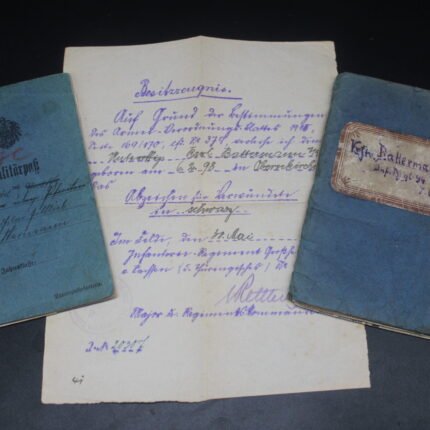
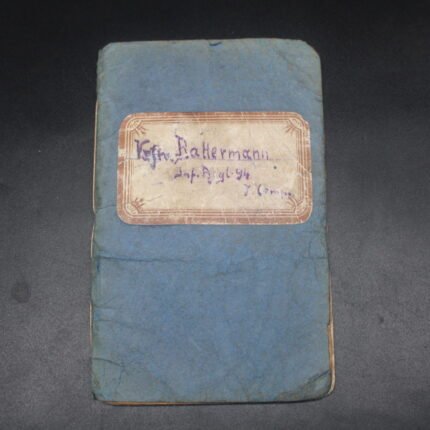
€115,00Original First World War Soldbuch, Militärpass and award document grouping belonging to Vizefeldwebel Battermann (b. 6 February 1898, Oberkirchen). Battermann served with the 7. Kompanie, Infanterie-Regiment 94 “Großherzog von Sachsen”, a regiment with a long tradition in the Imperial Army.
Entered Service: 25 September 1914, joining as a teenager during the early campaigns of WWI.
Promotion for Bravery: Elevated in 1916 “für Tapferkeit vor dem Feinde” (for bravery before the enemy).
Wounded in Action: His combat service culminated with injuries in 1918.
Award Document: Includes his original Urkunde for the Wound Badge in Black (VWA in Schwarz), dated 30 May 1918.
Unit History – Infanterie-Regiment Nr. 94
The Infanterie-Regiment Nr. 94 “Großherzog von Sachsen” was raised in 1809 and during the First World War was part of the XI. Armeekorps. The regiment fought almost exclusively on the Western Front, where it saw some of the fiercest combat of the war:
1914 – Initial Campaigns in Belgium and France: Fighting around Namur, then the early trench systems along the Aisne.
1915 – Champagne & Artois: Engaged in the bitter positional warfare.
1916 – Verdun and the Somme: The regiment was heavily engaged in two of the war’s bloodiest battles, sustaining severe casualties.
1917 – Aisne & Flanders: Defensive fighting during French offensives and later British operations in Flanders.
1918 – German Spring Offensives and Allied Counterattacks: The regiment took part in Operation Michael (March 1918) and subsequent defensive actions, where many veterans like Battermann were wounded.
Battermann’s wounding and award in May 1918 likely coincided with the aftermath of the Spring Offensive battles in Picardy, where IR 94 faced heavy losses.
Collector’s Note
This grouping is particularly desirable as it combines a complete Soldbuch and Militärpass with the original award document for the Wound Badge, directly tying a named soldier’s service and sacrifice to a frontline regiment with a storied history.
With Battermann’s early enlistment, promotion for bravery, combat wounding, and award, this set provides a tangible connection to the harrowing service of the Imperial German infantry on the Western Front.


KIA Soldbuch Grenadier-Regiment 103 – Düren (Buried in Lommel!)
€450,00Original wartime Soldbuch issued to Friedrich Gewald, who later attained the rank of Obergefreiter.
-
Initial Service: Standortbataillon Breslau.
-
Later Service: Transferred to Grenadier-Regiment 103, part of the 47. Volksgrenadier-Division.
-
Operational History: This division was heavily engaged in the desperate defensive fighting along the Western Front in late 1944, including the battle for the Düren bridgehead against advancing U.S. forces.
Fate of the Soldier
Friedrich Gewald is recorded as fallen in action on 14 December 1944 during these engagements. He now rests at the German military cemetery in Lommel, a lasting reminder of the heavy losses sustained in the final months of the war.
Historical Context
The 47. Volksgrenadier-Division, reconstituted in the autumn of 1944, was composed of battle-hardened veterans mixed with new conscripts and Luftwaffe personnel. Thrown into action against overwhelming Allied forces in the Rhineland, it bore the brunt of intense fighting as the Wehrmacht attempted to delay the U.S. advance across the Roer River.
Collector’s Note
This Soldbuch offers a poignant glimpse into the service of an ordinary German infantryman during the final phase of WWII. With a clear service record culminating in the bitter Düren battles, the document is not only a personal artifact but also a piece of frontline history tied to one of the last-ditch defensive struggles of the Reich.
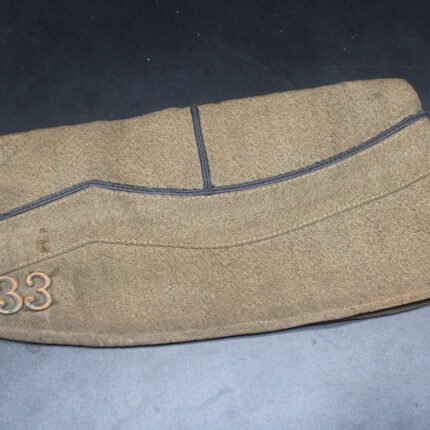
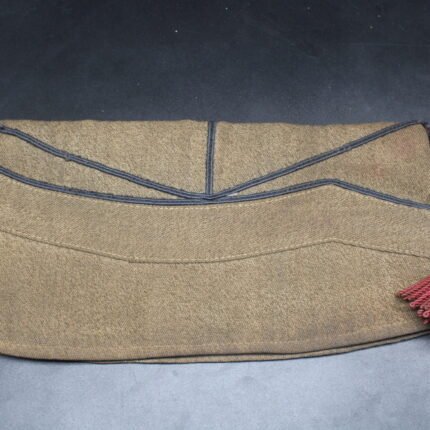
33ste Linieregiment Kwartiermuts
€150,00Original Belgian Army Overseas Cap “Kwartiermuts” – 33rd Line Regiment (c. 1930s)
A very nice and original 1930s period Belgian Army overseas cap, known as a “Kwartiermuts”, privately tailored for a soldier of the 33rd Line Regiment.
-
Private Purchase Example: Unlike standard issue, this is a tailor-made cap, bought at a local uniform shop – a common practice among soldiers of the interwar Belgian Army.
-
Unit Identification: The piping and regimental cyphers clearly denote service with the 33rd Linieregiment.
-
Complete Condition: Particularly desirable as this cap retains its original tassel, a feature which is often missing on surviving examples.
-
Condition: Light wear consistent with age, but overall beautifully preserved, with strong color and shape.
Historical Context
The 33rd Line Regiment (33Li)—whose branch piping and numerals this cap bears—played a notable role in Belgium’s defense during the German invasion of May 1940. Raised in October 1939 at Aalst as a duplicate of the 3rd Line Regiment, it formed part of the 13th Infantry Division, a second-reserve formation. Its ranks were largely older conscripts (classes 1928–1931) and, unlike active units, they often had outdated equipment such as the Belgian Mauser 1889 rifle and French Chauchat light machine guns.
On 10 May 1940, the day the invasion began, the regiment held positions in the Fortified Position of Antwerp (VPA) around Brasschaat, manning trenches behind the new anti-tank ditch linking the old forts. The III Battalion occupied the front line, guarding key approaches like the Bredabaan, with artillery support and additional machine-gun posts at the Schans van Drijhoek.
33Li was tasked with securing demolition points on the northern access roads and fought alongside French elements of the 7th Army moving through Brasschaat toward the Netherlands. In the days that followed, the regiment endured heavy air and artillery attacks; from 16 May German pressure mounted around the Brasschaat camp.
Despite determined resistance, the regiment—together with the division—was ordered to withdraw behind the River Scheldt and then to the Ghent–Terneuzen Canal, where it was merged into a combined formation (33/34Li). After severe bombardments and artillery fire, the line unraveled and the troops fell back westward.
On 28 May 1940, the 33Li, along with the rest of the Belgian Army, laid down arms at the general capitulation.
Collector’s Note
A fine and scarce interwar Belgian Army headdress, complete with tassel and unit insignia. These caps are much harder to find in complete condition compared to wartime German sidecaps, making this an excellent addition to any interwar or 1940 campaign collection.
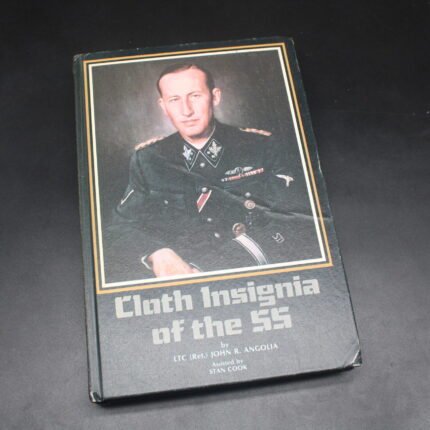

Cloth Insignia of the SS – John R. Angolia (Signed & Numbered 12/500!)
€250,00Cloth Insignia of the SS by John R. Angolia (R. James Bender Publishing, 1983) is a detailed 480-page hardcover reference on the uniforms and cloth insignia of the SS. It covers collar tabs, cuff titles, sleeve shields, rank and specialty insignia, with hundreds of black-and-white photos and descriptions showing wartime variations.
This particular copy is Signed & Numbered 12/500, making it especially scarce and highly desirable for collectors.
Long considered one of the most authoritative works on the subject, it remains an essential tool for collectors and historians to authenticate and study SS insignia. Out of print and sought after, well-preserved copies are highly collectible.

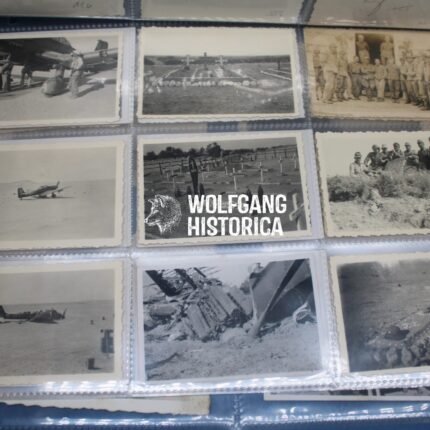
Deutsches Afrikakorps (DAK) Photolot
€0,01Original lot of 45 period photographs from the Deutsches Afrikakorps (DAK), taken during service in North Africa. The lot contains a variety of field scenes including Krad, vehicles, Pak, Stuka, and more.
A substantial and well-rounded group for collectors of WWII photography and North African campaign history. Condition as seen.
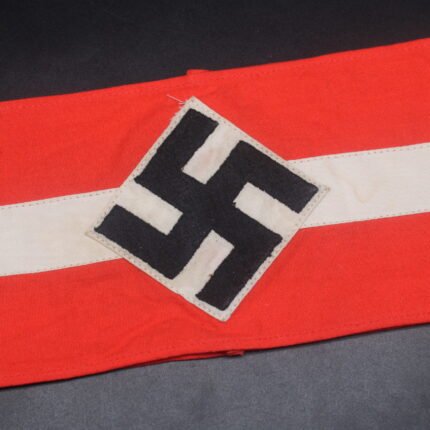

Hitlerjugend Armband
€0,01Original Hitlerjugend Armband in overall good – near mint condition. Three-piece construction. No tag. Condition as seen.

SA/NSDAP Party Sleeve Armband
€0,01Original SA/NSDAP party sleeve armband in overall good – near mint condition. Three-piece construction. No tag. Condition as seen.


Waffen-SS Edelweiss Cloth Cap Badge
€125,00Original embroidered Edelweiss cap badge for the Waffen-SS Gebirgsjäger (mountain troopers), as issued for wear on the mountain and field caps. This example remains in good condition with clear detail to the embroidery.
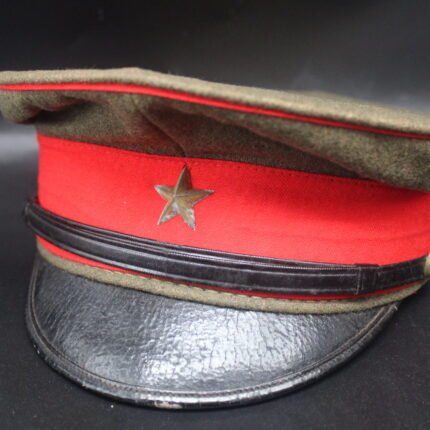
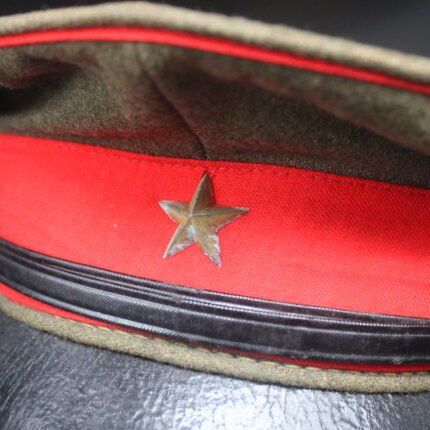
WWII Imperial Japanese Army Visor Cap
€250,00A tailor-made officer’s visor cap crafted from high-quality khaki-colored wool, typical of the pre–WWII uniform style. This design, known as the Type 45 cap, carries the traditional features established in 1913, including the red wool piping and headband along with the low-peaked profile. These elements became standard for officer’s dress and remained in use through the end of the Second World War.
This particular example displays only slight wear and has been beautifully preserved, free from handling damage and without any moth damage. The visor does show age-related cracking, though stable with no risk of further deterioration. Inside, the cap retains its purple silk lining and ersatz leather sweatband, both fully intact.
Collector’s Note
This is a striking and well-preserved example of a Type 45 officer’s visor cap, representing the transitional pre-war and wartime styles. The quality tailoring, intact interior, and large display size make it not only a fine historical artifact but also a centerpiece for any advanced collection of WWII headgear. Among the most beautiful examples we have ever handled.
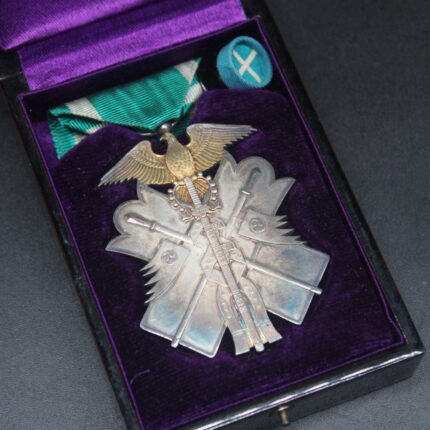
WWII Order of the Golden Kite 7th Class
€145,00Original Order of the Golden Kite, 7th Class – In Case of Issue (1937–1945)
A fine and original example of the Order of the Golden Kite 7th Class, complete with its period presentation case featuring silvered Japanese lettering to the lid.
Award Background:
The Order of the Golden Kite (金鵄勲章, Kinshi Kunshō) was a Japanese military order established in 1890 by Emperor Meiji, awarded exclusively for bravery, leadership, or command in battle. It was conferred upon both officers and enlisted men who distinguished themselves in service to the Empire. The decoration ranked just below the Order of the Rising Sun but carried enormous prestige as a purely military award.
The 7th Class was the lowest grade, typically awarded to enlisted soldiers and non-commissioned officers for acts of valor in combat. Even so, it symbolized personal courage and devotion to duty in the field, often during the campaigns of the Second Sino-Japanese War (1937–45) and the Pacific War.
Award Details:
-
Type: Order of the Golden Kite, 7th Class
-
Period: Shōwa Era, 1937–1945
-
Material: Silvered and gilded construction with fine enamel work (stylized golden kite motif with crossed swords and rays).
-
Case: Original issue case with silvered kanji inscription to the lid.
-
Condition: As seen – light signs of handling and age, case intact.
Historical Context:
The Order of the Golden Kite was abolished in 1947 by the Allied occupation authorities, making surviving wartime-issued examples particularly sought after. Awards from the late 1930s to 1945 are strongly associated with the campaigns in China, Manchuria, and the Pacific theater.
Collector’s Note:
A desirable original and cased example of Japan’s prestigious wartime combat decoration, representing the valor of enlisted soldiers in the Imperial Japanese Army. The presence of the case with silvered characters enhances its value and display appeal.

Leon Degrelle – 28. SS-Freiwilligen-Panzer-Grenadier-Division “Wallonië”
€0,01SS-Standartenführer Leon Degrelle (15 June 1906, Bouillon † 31 March 1994, Málaga) was the Belgian leader of the Rexist Movement and one of the most famous foreign volunteers to serve in the Waffen-SS during the Second World War. He rose from enlisted service to command the Walloon volunteers on the Eastern Front, eventually leading the 28. SS-Freiwilligen-Grenadier-Division “Wallonien.”
Degrelle distinguished himself in heavy fighting against Soviet forces, receiving some of the highest decorations awarded to non-German volunteers. He survived the war, escaping to Spain where he lived in exile until his death in 1994.
Awards and Decorations
-
Knight’s Cross of the Iron Cross (Ritterkreuz des Eisernen Kreuzes) – 20 February 1944, as SS-Hauptsturmführer and Führer of 5. SS-Freiwilligen-Sturmbrigade “Wallonien.”
-
Oak Leaves to the Knight’s Cross (Eichenlaub) – 27 August 1944, as SS-Sturmbannführer and Kommandeur of 28. SS-Freiwilligen-Grenadier-Division “Wallonien.”
-
Close Combat Clasp in Gold (Nahkampfspange in Gold) – 14 September 1944.
-
Additional decorations included the Iron Cross 1st and 2nd Class and Infantry Assault Badge.
Item Details
-
Authentic scarce postwar signature of Leon Degrelle.
-
Signed on a large format postwar photo
-
Condition: As seen – scarce and collectible.
Collector’s Note
Leon Degrelle remains one of the most controversial and well-known foreign volunteers of the Waffen-SS. His rise from volunteer soldier to divisional commander, along with his postwar exile and continued notoriety, makes his autograph especially rare and sought-after. This large-format signed photo is an exceptional piece for advanced collectors of Waffen-SS history, foreign volunteer units, and Knight’s Cross recipients.
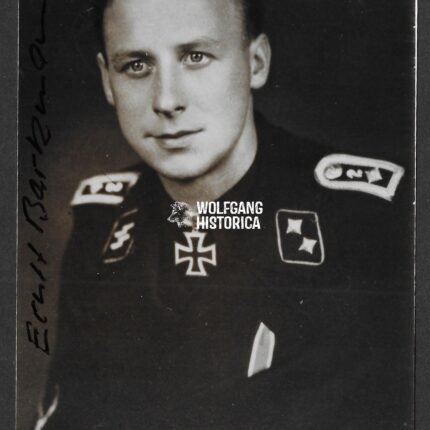
Ernst Barkmann – SS-Panzer-Regiment 2 “Das Reich” (Normandy)
€60,00SS-Oberscharführer Ernst Barkmann (25 August 1919, Kisdorf † 27 June 2009, Kisdorf) was a Waffen-SS NCO and tank commander in the 2. SS-Panzer-Division “Das Reich.” He became one of the division’s most famous Panzer aces and was decorated for his actions in Normandy during the summer of 1944.
Barkmann received the Knight’s Cross of the Iron Cross (Ritterkreuz des Eisernen Kreuzes) on 27 August 1944 as SS-Unterscharführer und Panzerkommandant in the 4./SS-Panzer-Regiment 2. His most renowned action, often referred to as “Barkmann’s Corner,” took place near Le Lorey, where his Panther tank reportedly destroyed numerous Allied vehicles in a single engagement, halting an American advance.
Awards and Decorations
-
Knight’s Cross of the Iron Cross (Ritterkreuz des Eisernen Kreuzes) – 27 August 1944, as SS-Unterscharführer und Panzerkommandant, 4./SS-Panzer-Regiment 2, 2. SS-Panzer-Division “Das Reich.”
-
Other wartime decorations included the Iron Cross 1st and 2nd Class, Panzer Badge in Silver, and the Wound Badge.
Item Details
-
Authentic postwar signature of SS-Oberscharführer Ernst Barkmann.
-
Signed on a postwar photograph.
-
Size: Postcard format.
-
Condition: As seen, well-preserved autograph.
Collector’s Note
Ernst Barkmann’s reputation as a Panzer ace of the Waffen-SS, particularly tied to the legendary events at “Barkmann’s Corner,” makes his signature highly sought after among collectors of armored warfare memorabilia and Knight’s Cross recipients. Postwar signed photographs of Barkmann are increasingly scarce and represent an important piece of history from the Normandy campaign and the Das Reich Division.
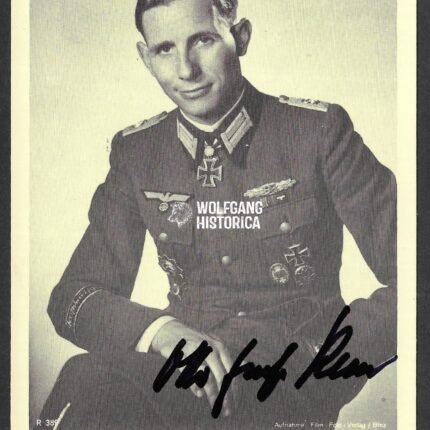
Otto Ernst Remer – Grenadier-Regiment “Grossdeutschland” (Eichenlaub) (Key Figure Stopping 20 July Plot)
€75,00Generalmajor Otto Ernst Remer (18 August 1912, Neubrandenburg † 4 October 1997, Marbella, Spain) was a highly decorated officer of the German Army (Heer) during the Second World War and later a controversial political figure in postwar Germany.
Remer earned the Knight’s Cross of the Iron Cross on 18 May 1943 as Major und Kommandeur of I./Grenadier-Regiment “Grossdeutschland” for his leadership in the heavy fighting on the Eastern Front. He received the Oak Leaves to the Knight’s Cross on 12 November 1943, again as Major and battalion commander in the elite Division “Grossdeutschland.”
Remer is perhaps most widely remembered for his decisive role during the 20 July 1944 plot against Adolf Hitler. As commander of the Wachbataillon Großdeutschland in Berlin, his actions and loyalty to Hitler directly led to the suppression of the coup attempt led by Claus von Stauffenberg.
Awards and Decorations
-
Knight’s Cross of the Iron Cross (Ritterkreuz des Eisernen Kreuzes) – 18 May 1943, as Major und Kommandeur I./Grenadier-Regiment “Grossdeutschland.”
-
Oak Leaves to the Knight’s Cross (Eichenlaub zum Ritterkreuz des Eisernen Kreuzes, Nr. 327) – 12 November 1943, as Major und Kommandeur I./Grenadier-Regiment “Grossdeutschland.”
Item Details
-
Authentic postwar signature of Generalmajor Otto Ernst Remer.
-
Signed on a postwar photograph.
-
Size: Postcard format.
-
Condition: Clear and well-preserved autograph.
Collector’s Note
Otto Ernst Remer’s signature is significant both for his role as a decorated frontline officer of the elite Grossdeutschland Division, and for his historical involvement in the 20 July Plot of 1944, where he played a key role in the outcome. This autograph represents not only the combat history of one of Germany’s most elite formations, but also one of the pivotal political moments within the Third Reich.
A compelling piece for collectors of Knight’s Cross recipients, Grossdeutschland memorabilia, and figures tied to the events of July 20, 1944.
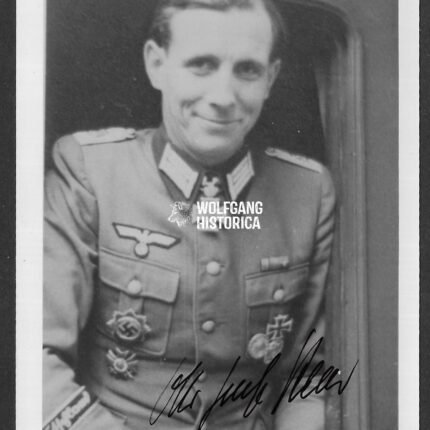
Otto Ernst Remer – Grenadier-Regiment “Grossdeutschland” (Eichenlaub) (Key Figure Stopping 20 July Plot)
€75,00Generalmajor Otto Ernst Remer (18 August 1912, Neubrandenburg † 4 October 1997, Marbella, Spain) was a highly decorated officer of the German Army (Heer) during the Second World War and later a controversial political figure in postwar Germany.
Remer earned the Knight’s Cross of the Iron Cross on 18 May 1943 as Major und Kommandeur of I./Grenadier-Regiment “Grossdeutschland” for his leadership in the heavy fighting on the Eastern Front. He received the Oak Leaves to the Knight’s Cross on 12 November 1943, again as Major and battalion commander in the elite Division “Grossdeutschland.”
Remer is perhaps most widely remembered for his decisive role during the 20 July 1944 plot against Adolf Hitler. As commander of the Wachbataillon Großdeutschland in Berlin, his actions and loyalty to Hitler directly led to the suppression of the coup attempt led by Claus von Stauffenberg.
Awards and Decorations
-
Knight’s Cross of the Iron Cross (Ritterkreuz des Eisernen Kreuzes) – 18 May 1943, as Major und Kommandeur I./Grenadier-Regiment “Grossdeutschland.”
-
Oak Leaves to the Knight’s Cross (Eichenlaub zum Ritterkreuz des Eisernen Kreuzes, Nr. 327) – 12 November 1943, as Major und Kommandeur I./Grenadier-Regiment “Grossdeutschland.”
Item Details
-
Authentic postwar signature of Generalmajor Otto Ernst Remer.
-
Signed on a postwar photograph.
-
Size: Postcard format.
-
Condition: Clear and well-preserved autograph.
Collector’s Note
Otto Ernst Remer’s signature is significant both for his role as a decorated frontline officer of the elite Grossdeutschland Division, and for his historical involvement in the 20 July Plot of 1944, where he played a key role in the outcome. This autograph represents not only the combat history of one of Germany’s most elite formations, but also one of the pivotal political moments within the Third Reich.
A compelling piece for collectors of Knight’s Cross recipients, Grossdeutschland memorabilia, and figures tied to the events of July 20, 1944.
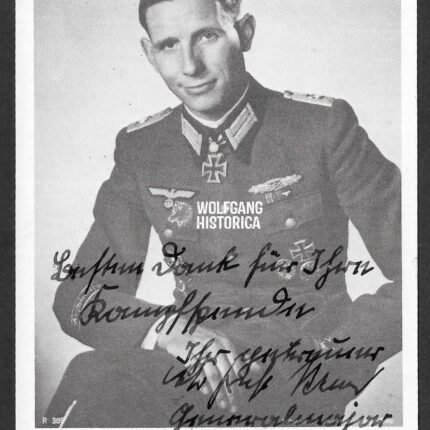
Otto Ernst Remer – Grenadier-Regiment “Grossdeutschland” (Eichenlaub) (Key Figure Stopping 20 July Plot)
€75,00Generalmajor Otto Ernst Remer (18 August 1912, Neubrandenburg † 4 October 1997, Marbella, Spain) was a highly decorated officer of the German Army (Heer) during the Second World War and later a controversial political figure in postwar Germany.
Remer earned the Knight’s Cross of the Iron Cross on 18 May 1943 as Major und Kommandeur of I./Grenadier-Regiment “Grossdeutschland” for his leadership in the heavy fighting on the Eastern Front. He received the Oak Leaves to the Knight’s Cross on 12 November 1943, again as Major and battalion commander in the elite Division “Grossdeutschland.”
Remer is perhaps most widely remembered for his decisive role during the 20 July 1944 plot against Adolf Hitler. As commander of the Wachbataillon Großdeutschland in Berlin, his actions and loyalty to Hitler directly led to the suppression of the coup attempt led by Claus von Stauffenberg.
Awards and Decorations
-
Knight’s Cross of the Iron Cross (Ritterkreuz des Eisernen Kreuzes) – 18 May 1943, as Major und Kommandeur I./Grenadier-Regiment “Grossdeutschland.”
-
Oak Leaves to the Knight’s Cross (Eichenlaub zum Ritterkreuz des Eisernen Kreuzes, Nr. 327) – 12 November 1943, as Major und Kommandeur I./Grenadier-Regiment “Grossdeutschland.”
Item Details
-
Authentic postwar signature of Generalmajor Otto Ernst Remer.
-
Signed on a postwar photograph.
-
Size: Postcard format.
-
Condition: Clear and well-preserved autograph.
Collector’s Note
Otto Ernst Remer’s signature is significant both for his role as a decorated frontline officer of the elite Grossdeutschland Division, and for his historical involvement in the 20 July Plot of 1944, where he played a key role in the outcome. This autograph represents not only the combat history of one of Germany’s most elite formations, but also one of the pivotal political moments within the Third Reich.
A compelling piece for collectors of Knight’s Cross recipients, Grossdeutschland memorabilia, and figures tied to the events of July 20, 1944.
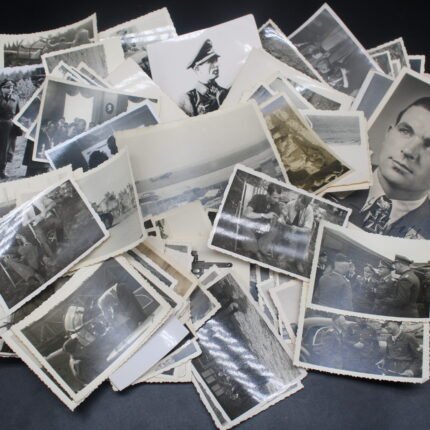
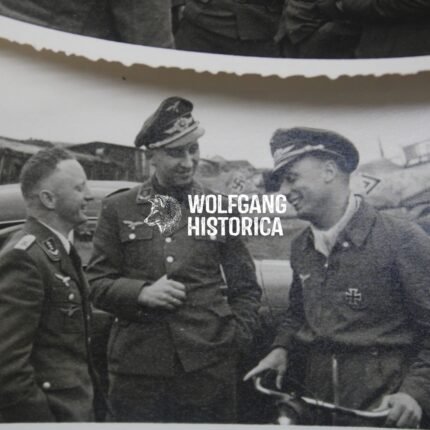
Large TOP Photo Grouping of Major Herbert Ihlefeld (Schwertern)
€0,01Extensive original photo grouping from the estate of Major Herbert Ihlefeld, highly decorated Luftwaffe ace and recipient of the Knight’s Cross with Oak Leaves and Swords. The grouping consists of 104 photographs in total.
The grouping includes:
- Two (1 wartime, 1 postwar) signed photos/postcards of Herbert Ihlefeld. Also one stamped card.
-
Numerous photos of downed or operational aircraft, both RAF and Luftwaffe.
-
Rare images of other Knight’s Cross holders, including:
-
Heinz “Pritzl” Bär (1913–1957) – fighter ace with 220 confirmed aerial victories, recipient of the Knight’s Cross with Oak Leaves and Swords.
-
Adolf Galland (1912–1996) – legendary fighter ace with 104 victories, Inspector of Fighters, and one of the most famous Luftwaffe leaders, decorated with the Knight’s Cross with Oak Leaves, Swords, and Diamonds.
-
Werner Mölders (1913–1941) – pioneer of modern fighter tactics, first pilot in history to achieve over 100 aerial victories, commander of Jagdgeschwader 51 “Mölders”, and recipient of the Knight’s Cross with Oak Leaves, Swords, and Diamonds.
-
-
Scenes from Africa and Greece, frontline airfields, and operational settings.
-
Only a handful of sightseeing or casual photos – the focus is clearly on combat operations and decorated personnel.
Historical Background
Herbert Ihlefeld (1914–1995) achieved 122 aerial victories, making him one of the Luftwaffe’s leading fighter aces. He was awarded the Knight’s Cross in 1940, the Oak Leaves in 1941, and the Swords in 1942 for his exceptional record as both pilot and leader. Ihlefeld later commanded several fighter units, including jet formations, and rose to the rank of Oberst.
The inclusion of other highly decorated Luftwaffe aces like Galland, Bär, and Mölders enhances the grouping’s significance, connecting it to some of the most prominent and influential personalities of the German fighter arm.
Collector’s Note
This is an exceptionally large and historically rich grouping, notable for its signed Ihlefeld photographs, extensive combat-related imagery, and photos of multiple Ritterkreuzträger. The combination of operational aircraft, downed planes, and high-ranking Luftwaffe personalities makes this an outstanding research and display set.
Groupings of this size and quality, especially with autographs and appearances of major Luftwaffe aces such as Ihlefeld, Galland, Bär, and Mölders, are very scarce and highly sought after by collectors of WWII aviation history, Knight’s Cross recipients, and Luftwaffe memorabilia.


Schutzstaffel der NSDAP – SS-Ausweis (Nachrichten-Abt. of SS-Totenkopf-Standarte)
€475,00Original Schutzstaffel der NSDAP – SS-Ausweis (Nr. 379 931) authorized to SS-Staffelmann Erich Oberdörfer, born on December 19, 1921. Serving with the SS-Nachrichten-Ersatz-Abteilung of the SS-Totenkopf-Standarte. Issued on November 1, 1940. On the reverse, the Heinrich Himmler signature is a (rubber) stamp and not handsigned. Complete with photo, his signature, stamp(s) and blind-embossed seal (Blindprägestempel). These SS-Ausweis were issued to SS personnel before the Soldbuch.


Schutzstaffel der NSDAP – SS-Ausweis (Nachrichten-Abt. of SS-Totenkopf-Standarte)
€475,00Original Schutzstaffel der NSDAP – SS-Ausweis (Nr. 379 917) authorized to SS-Staffelmann Karl Ris, born on November 27, 1919. Serving with the SS-Nachrichten-Ersatz-Abteilung of the SS-Totenkopf-Standarte. Issued on November 1, 1940. On the reverse, the Heinrich Himmler signature is a (rubber) stamp and not handsigned. Complete with photo and blind-embossed seal (Blindprägestempel). Typical un-issued SS-Ausweis that was kept in a file of the particular soldier. These SS-Ausweis were issued to SS personnel before the Soldbuch.


Schutzstaffel der NSDAP – SS-Ausweis (Signature of Walter Gerlach!)
€550,00Original Schutzstaffel der NSDAP – SS-Ausweis (Nr. 45 078) authorized to SS-Mann Kurt Schulze, born on May 19, 1913 in Ponnsdorf. Issued on December 12, 1932 in München – very early example! Serving with the 4. Sturm/ I. Sturmbann/ 27. SS-Standarte. On the reverse, the ID bears a handsignature of Walter Gerlach. The Heinrich Himmler signature is a (rubber) stamp and not handsigned. Complete with photo, stamp(s) and blind-embossed seal (Blindprägestempel).
Walter Gerlach (1896–1964)
Walter Gerlach (born 25 August 1896 in Gusow; died 19 April 1964 in Haiger) was a German SS officer and concentration camp functionary during the Nazi period.
After serving as a soldier in the First World War, Gerlach worked in his family’s wood products business, which went bankrupt in 1930. That same year he joined the NSDAP (membership no. 307,120) and in 1931 entered the SS (no. 14,567). He rose quickly, becoming an SS leader in the 27th SS-Standarte in 1932.
From August to November 1934, Gerlach directed the Columbiahaus prison in Berlin, which later became one of the first concentration camps. He then served briefly as camp commandant of KZ Sachsenburg (December 1934 – April 1935) before moving to an adjutant role in Dachau under commandant Heinrich Deubel.
Despite being convicted in 1935 for involvement in a brawl, Gerlach remained in the SS, later leading SS-Abschnitt VII in Königsberg and working from 1942 in positions tied to the Reich Commissioner for the Strengthening of Germandom. In 1944 he became chief of staff to the Higher SS and Police Leader Günther Pancke in occupied Denmark.
After Germany’s defeat, Gerlach was arrested in May 1945 and interned until 1948. In November 1947 he was called as a witness in the Nuremberg Trials. He lived in West Germany after the war and died in 1964.
YouTube video on Walter Gerlach: https://www.youtube.com/watch?v=AR7AGhG-Nus
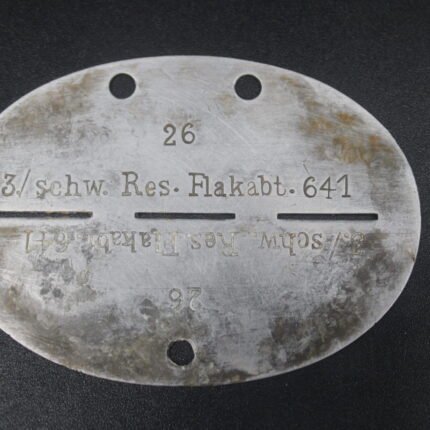
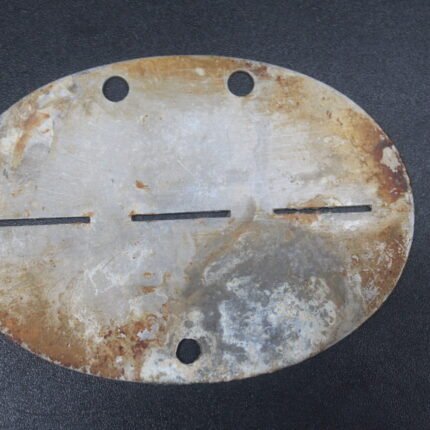
Erkennungsmarke: Reserve-Flak-Abteilung 641 (Norway)
€0,01Original German Erkennungsmarke (dog tag), marked: “-26- 3./schw.Res.Flakabt.641”
-
The number 26 is the soldier’s Stammnummer (personal roll number).
-
Unit: 3. Batterie / schwere Reserve-Flak-Abteilung 641.
Unit History:
-
Formed 26 August 1939 in Düsseldorf from parts of I./Flak-Regiment 64 with three heavy and two light batteries.
-
September 1940: transferred to Bergen, forming Flakgruppe Bergen.
-
June 1941: moved to Finland.
-
July 1942: redesignated gemischte Flak-Abteilung 641 (v). The unit underwent several reorganizations between heavy and mixed configurations, with batteries dissolved, reformed, and exchanged with other Abteilungen.
-
February 1944: transferred to Stavanger, subordinated to Flak-Regiment 92 / 11. Flak-Brigade.
-
August 1944: redeployed to Luftgau I, under Flak-Regiment 125 / 18. Flak-Division, and saw service in Königsberg and Pillau.
-
Condition: As seen (please refer to photos)
A historically significant identification tag from a Flak unit with an active wartime service history spanning Germany, Norway, Finland, and East Prussia. An excellent piece for collectors of Luftwaffe or Flak-related militaria.
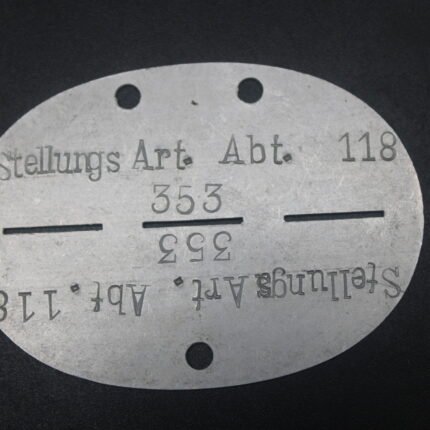
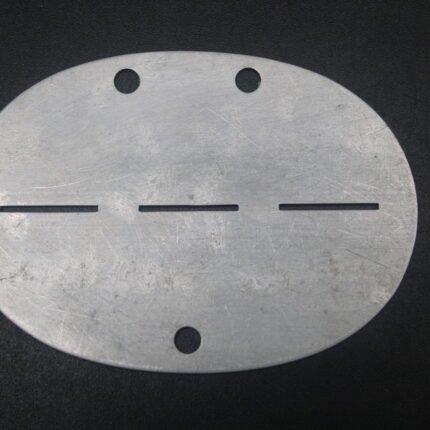
Erkennungsmarke: (Gebirgs) Stellungs-Artillerie-Abteilung 118
€0,01Original German Erkennungsmarke (dog tag), marked: “-353- Stellungs Art.Abt.118”
-
The number 353 is the soldier’s Stammnummer (personal roll number).
-
Unit: Stellungs-Artillerie-Abteilung 118, a (mountain) fixed-position artillery formation of the Wehrmacht.
Unit History:
-
Formed on 20 November 1939 near Salzburg with three batteries as a Heerestruppe unit.
-
Initially deployed along the Western Front.
-
On 29 April 1940, the 1st Battery was transferred to II./Gebirgs-Artillerie-Regiment 113, and the 3rd Battery became the new 1st Battery.
-
On 6 June 1940, the Abteilung was redesignated as I./Gebirgs-Artillerie-Regiment 118.
-
Condition: As seen (please refer to photos)
A fine and historically documented identification tag from a short-lived artillery unit that was later absorbed into a Gebirgs-Artillerie Regiment. A desirable piece for collectors of artillery or mountain troop-related Wehrmacht militaria.