


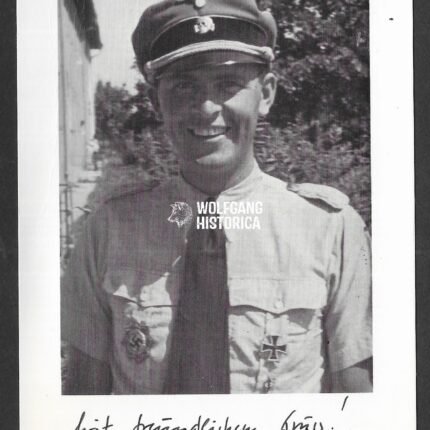
Richard Schulze-Kossens – “LSSAH”, Personal Adjutant of Adolf Hitler, “Hitlerjugend” & “Nibelungen”
€0,01Original Scarce Postwar Signature on a Postwar Photo of Richard Schulze-Kossens. SS-Obersturmbannführer Richard Schulze-Kossens (2 October 1914, Schwedt/Oder † 3 July 1988, Bad Nauheim) was a senior Waffen-SS officer who rose to the rank of SS-Obersturmbannführer during the Second World War. A decorated front-line commander and staff officer, he was awarded the German Cross in Gold and served in several high-profile positions, including as Personal Adjutant to Adolf Hitler.
Awards and Decorations:
-
German Cross in Gold (Deutsches Kreuz in Gold) – 26 December 1941, as SS-Hauptsturmführer and commander of 2. Kompanie, Leibstandarte-SS “Adolf Hitler”.
Career Highlights:
-
Early member of the Leibstandarte-SS Adolf Hitler (LSSAH), where he distinguished himself in combat on the Eastern Front.
-
Decorated with the German Cross in Gold for bravery and leadership during the bitter fighting of 1941.
-
Served as Personal Adjutant to Adolf Hitler, a position of high trust and prestige within the regime’s inner circle.
-
Later returned to front-line duty, serving as regimental commander of the SS-Panzergrenadier-Regiment 25 of the 12. SS-Panzer-Division “Hitlerjugend”.
-
In 1945, appointed Kommandeur of the 38. SS-Grenadier-Division “Nibelungen”, one of the last Waffen-SS formations raised in the final months of the war.
-
Survived the conflict and imprisonment, later living in West Germany until his death in 1988.
Item Details:
-
Authentic scarce postwar signature of SS-Obersturmbannführer Richard Schulze-Kossens.
-
Signed on a postwar photograph and accompanying letter.
-
Condition: Clear, well-preserved examples of autograph material.
Collector’s Note:
Richard Schulze-Kossens’s combination of roles — as a decorated Waffen-SS combat officer, adjutant to Adolf Hitler, and commander of both elite and late-war formations — makes his signed material particularly desirable. The inclusion of both a photograph and letter with his original postwar signature makes this offering especially rare and significant for advanced collectors of Waffen-SS history and Third Reich leadership memorabilia.

Max-Josef Pemsel – 6. Gebirgs-Division
€60,00Original Postwar Signature on a Postwar Photo of Max-Josef Pemsel. Generalleutnant Max-Josef Pemsel (15 January 1897, Regensburg † 30 June 1985, Munich) was a German Army officer who rose to the rank of Generalleutnant during the Second World War. A veteran of both World Wars, he distinguished himself as commander of the 6. Gebirgs-Division in northern Finland, where he was awarded the Knight’s Cross of the Iron Cross and cited in the Wehrmachtbericht. After the war, Pemsel became a senior officer in the Bundeswehr, serving as NATO commander in Schleswig-Holstein.
Awards and Decorations:
-
Knight’s Cross of the Iron Cross (Ritterkreuz des Eisernen Kreuzes) – 9 December 1944, as Generalmajor and Kommandeur of 6. Gebirgs-Division.
Awarded for his leadership during the rearguard battles of early October 1944, when German forces retreated from northern Finland. Pemsel played a decisive role in enabling major elements of the 20. Gebirgsarmee to escape. Under his command, the Petsamo–Kirkenes road was reopened after heavy fighting, preventing a Soviet encirclement of the 6. Gebirgs-Division and frustrating a pincer attack against XIX. Gebirgs-Armeekorps. His actions earned him not only the Knight’s Cross, but also a commendation in the Wehrmachtbericht of 3 November 1944.
Career Highlights:
-
Served as an officer in World War I, later continuing his career in the Reichswehr.
-
Developed as a skilled staff officer during the interwar years.
-
Commanded the 6. Gebirgs-Division, where he distinguished himself in the demanding Arctic and Finnish theaters.
-
Later served as Chief of Staff of the 7. Armee in 1944, overseeing defenses in Normandy during the D-Day invasion.
-
Captured in 1945 and released from captivity in 1948.
-
Entered the Bundeswehr in 1956, rising to Generalleutnant and serving as NATO’s commander in Schleswig-Holstein until his retirement.
-
Lived in Munich until his death in 1985.
Item Details:
-
Authentic postwar signature of Generalleutnant Max-Josef Pemsel.
-
Signed on a postwar photograph.
-
Condition: Clear and well-preserved autograph.
Collector’s Note:
Pemsel’s recognition as commander of the 6. Gebirgs-Division in Finland — including both the Knight’s Cross and a Wehrmachtbericht mention — marks him as one of the notable late-war Gebirgsjäger leaders. His long postwar service as a Bundeswehr and NATO general adds further interest, making his autograph especially appealing to collectors of both WWII mountain troops and Cold War German leadership.

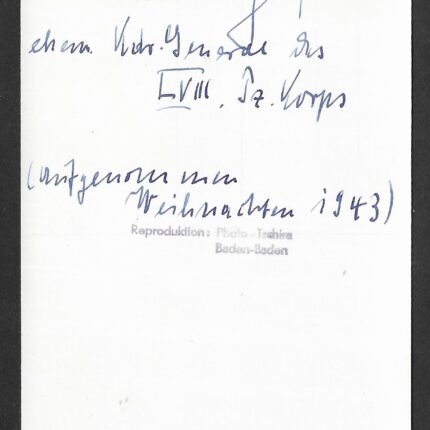
Walter Krüger – 1. Panzer-Division (Eichenlaub)
€80,00Original Postwar Signature on a Postwar Photo of Walter Krüger. General der Panzertruppe Walter Krüger (23 March 1892, Zeitz † 22 October 1973, Baden-Baden) was a highly decorated German Panzer commander who rose to the rank of General der Panzertruppe during the Second World War. Known for his leadership of the 1. Panzer-Division, he was a recipient of the Knight’s Cross of the Iron Cross with Oak Leaves, the German Cross in Gold, and several other awards for battlefield distinction.
Awards and Decorations:
-
Knight’s Cross of the Iron Cross (Ritterkreuz des Eisernen Kreuzes, 350th award) – 15 July 1941, as Generalmajor and Kommandeur of 1. Schützen-Brigade, 1. Panzer-Division (mot), XXXXI. Armeekorps, Panzergruppe 4, Heeresgruppe Nord.
Awarded for his brigade’s role in the opening weeks of Operation Barbarossa, particularly the tank battle of Rossieni–Vosiliskis (23–25 June 1941), the capture of Jakobstadt (28 June 1941), and Ostrow (4 July 1941).
-
German Cross in Gold (Deutsches Kreuz in Gold, award 170/3) – 27 August 1942, as Generalmajor and Kommandeur of 1. Panzer-Division.
-
Wehrmachtbericht Mention – 14 December 1943, as Generalleutnant and Kommandeur of 1. Panzer-Division.
The division, alongside the 68. Infanterie-Division, was officially commended for its performance in combat operations.
-
Oak Leaves to the Knight’s Cross (Ritterkreuz mit Eichenlaub, 377th award) – 24 January 1944, as Generalleutnant and Kommandeur of 1. Panzer-Division, XXXXVIII. Panzerkorps, 4. Panzer-Armee, Heeresgruppe Süd.
Awarded for distinguished leadership during the fighting around Zhitomir in late 1943, and especially for the clearing of the western bank of the Teterew River northeast of the city.
Career Highlights:
-
Veteran of the First World War, continuing his career in the Reichswehr and then the Panzerwaffe.
-
Took command of 1. Schützen-Brigade, leading from the front in the 1941 campaign in the Soviet Union.
-
Elevated to divisional command of the 1. Panzer-Division, guiding it through numerous critical operations on the Eastern Front from 1942–44.
-
Decorated with both the Knight’s Cross and Oak Leaves, recognized as one of Germany’s most capable armored division commanders.
-
Promoted to General der Panzertruppe before the end of the war.
-
Captured in 1945 and later released, living quietly in Baden-Baden until his death in 1973.
Item Details:
-
Authentic postwar signature of General der Panzertruppe Walter Krüger.
-
Signed on a postwar photograph.
-
Condition: Clear and well-preserved autograph.
Collector’s Note:
Walter Krüger’s reputation as commander of the famous 1. Panzer-Division, combined with his dual awards of the Knight’s Cross with Oak Leaves and the German Cross in Gold, make his autograph highly sought after. His leadership in some of the most significant armored battles of the Eastern Front makes this a cornerstone piece for Panzer collectors.
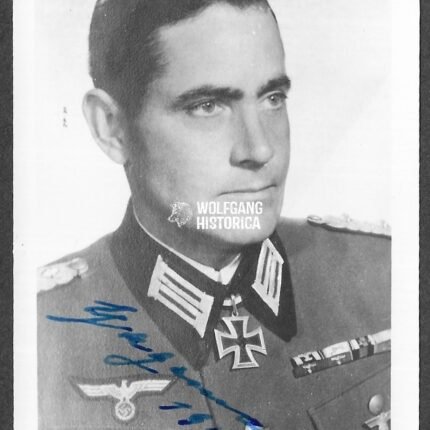
Wolf Hagemann – Gebirgsjäger-Regiment 139 & 336. Infanterie-Division (Narvik, Eichenlaub)
€45,00Original Postwar Signature on a Postwar Photo of Wolf Hagemann. Generalleutnant Wolf Hagemann (23 March 1898, Metz † 15 October 1983, Göttingen) was a German Army officer who rose to the rank of Generalleutnant during the Second World War. He was twice decorated for distinguished leadership in battle, earning the Knight’s Cross of the Iron Cross with Oak Leaves.
Awards and Decorations:
-
Knight’s Cross of the Iron Cross (Ritterkreuz des Eisernen Kreuzes, Nr. 211) – 4 September 1940, as Oberstleutnant and Kommandeur of III./Gebirgsjäger-Regiment 139, 3. Gebirgs-Division.
Awarded for his leadership and bravery in the Battle of Narvik (Norway, 1940), where his battalion played a decisive role in the successful mountain warfare operations against Allied forces.
-
Oak Leaves to the Knight’s Cross (Ritterkreuz mit Eichenlaub, 484th award) – 4 June 1944, as Generalmajor and Kommandeur of 336. Infanterie-Division, 17. Armee, Heeresgruppe Südukraine.
Recognized for his division’s stubborn defensive performance on the Crimean front. On 8 April 1944, his troops repulsed a major Soviet attack against the Siwasch straits. Later, during 5–12 May 1944, he successfully delayed a Soviet breakthrough until the evening of 6 May, a feat of vital importance for the survival of the 17. Armee. The Oak Leaves were personally presented to him by Adolf Hitler on 22 June 1944.
Career Highlights:
-
Served as a young officer in World War I, remaining in the Reichswehr after the war.
-
Distinguished himself early in World War II with the 3. Gebirgs-Division in Norway, where his leadership at Narvik earned him the Knight’s Cross.
-
Later promoted to divisional command, leading the 336. Infanterie-Division in the desperate defensive battles in the Crimea, earning the Oak Leaves for his leadership.
-
Promoted to Generalleutnant, continuing to command until the final phases of the war.
-
Captured in 1945 and held in captivity before returning to civilian life in West Germany. He lived until 1983.
Item Details:
-
Authentic postwar signature of Generalleutnant Wolf Hagemann.
-
Signed on a postwar photograph. Size: 7,3×10,5cm.
-
Condition: Clear and well-preserved autograph.
Collector’s Note:
Wolf Hagemann’s dual decorations — the Knight’s Cross for Narvik and the Oak Leaves for his stand in the Crimea — mark him as one of the more notable divisional commanders of the Heer. His autograph is especially desirable for collectors focusing on the Gebirgsjäger and the Eastern Front’s late-war battles.
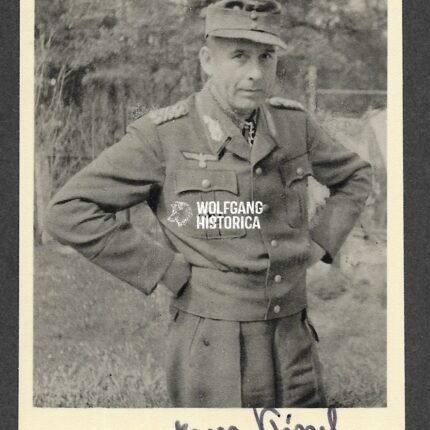
Hans Kissel – Grenadier-Regiment 683 & Chief of Staff of the Volkssturm
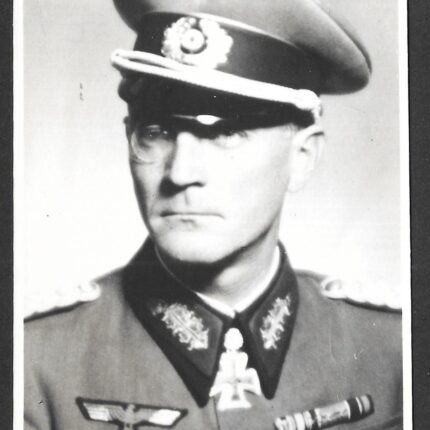
€0,01Original Postwar Signature on an Wartime Photograph of Hans Kissel. Generalmajor Hans Kissel (19 February 1911, Passau † 19 November 1984, Aichach) was a German Army officer who rose to the rank of Generalmajor during the Second World War. He distinguished himself as a regimental commander on the Eastern Front, earning both the German Cross in Gold and the Knight’s Cross of the Iron Cross for his leadership in heavy fighting.
Awards and Decorations:
-
German Cross in Gold (Deutsches Kreuz in Gold) – 18 June 1942, as Oberstleutnant and Führer of III./Jäger-Regiment 228, 101. Jäger-Division, Heer.
-
Knight’s Cross of the Iron Cross (Ritterkreuz des Eisernen Kreuzes) – 17 March 1944, as Oberst and Kommandeur of Grenadier-Regiment 683, 335. Infanterie-Division, Heer.
Career Highlights:
-
Entered the Reichswehr as a young officer and advanced steadily through the interwar years.
-
Distinguished himself in 1942 as battalion commander in the 101. Jäger-Division, earning the German Cross in Gold.
-
Later commanded Grenadier-Regiment 683 of the 335. Infanterie-Division, where his skillful leadership during defensive battles on the Eastern Front brought him the Knight’s Cross in 1944.
-
Promoted to Generalmajor before the end of the war.
-
In 1945, served as Chief of Staff of the Volkssturm, directing Germany’s last-ditch defensive organization.
-
Captured by Allied forces and held in captivity before returning to civilian life in postwar Germany. He died in 1984.
Item Details:
-
Authentic postwar signature of Generalmajor Hans Kissel.
-
Signed on an original photograph (size 7.6 × 10.7 cm).
-
Condition: Clear, well-preserved autograph and photo.
Collector’s Note:
Hans Kissel’s decorations — the Knight’s Cross and German Cross in Gold — together with his unique role as Chief of Staff of the Volkssturm, make his signed photo a particularly notable item. The fact that the signature appears on an original wartime-era photograph (with dimensions 7.6 × 10.7 cm) adds further desirability for advanced collectors of Heer commanders and late-war leadership memorabilia.
Georg Graf von Rittberg – 88. Infanterie-Division (Eichenlaub)
€75,00Original Postwar Signature on a Postwar Photo of Georg Graf von Rittberg. Generalleutnant Georg Graf von Rittberg (30 May 1898, Weidenau † 6 June 1973, Wiesbaden) was a German Army officer who rose to the rank of Generalleutnant during the Second World War. A highly regarded divisional commander, he distinguished himself leading the 88. Infanterie-Division on the Eastern Front and was decorated with the Knight’s Cross of the Iron Cross with Oak Leaves. He was also twice honored in the official Wehrmachtbericht communiqués for the fighting spirit and toughness of his division.
Awards and Decorations:
-
German Cross in Gold (Deutsches Kreuz in Gold, 66/8) – 29 January 1942, as Oberstleutnant and Kommandeur of Artillerie-Regiment 131.
-
Knight’s Cross of the Iron Cross (Ritterkreuz des Eisernen Kreuzes, 2743rd award) – 21 February 1944, as Generalmajor and Kommandeur of 88. Infanterie-Division, 8. Armee, Heeresgruppe Süd.
Awarded for his role during the breakout from the Cherkassy pocket, where he commanded part of the rearguard that shielded the flanks and rear of retreating German divisions. Following heavy fighting, he led his own men out by spearheading an energetic attack along the Dshurshenzy–Potschapinzy line.
-
Oak Leaves to the Knight’s Cross (Ritterkreuz mit Eichenlaub zum Eisernen Kreuz, 624th award) – 10 October 1944, as Generalmajor and Kommandeur of 88. Infanterie-Division, XXXXII. Armeekorps, 4. Panzer-Armee, Heeresgruppe Nordukraine.
Recognized for his command of the 88. Infanterie-Division during the summer fighting of 1944, particularly in the great Vistula bend. Under his leadership, the division counterattacked south of Opatów and held defensive positions on the northern flank of the Baranów bridgehead against repeated Soviet attacks.
-
Wehrmachtbericht Mentions –
18 July 1944: Commended for toughness in combat on the northern Eastern Front.
19 August 1944: Cited for unshakeable courage and reckless determination during the defensive battles in the great bend of the Vistula.
Career Highlights:
-
Served in World War I, remaining in the Reichswehr throughout the interwar years as an artillery officer.
-
Commanded Artillerie-Regiment 131, where his leadership brought him the German Cross in Gold in 1942.
-
Promoted to command the 88. Infanterie-Division, gaining the Knight’s Cross at Cherkassy in 1944 and later the Oak Leaves during the Vistula battles.
-
Promoted to Generalleutnant, continuing to lead in the final year of the war.
-
Survived captivity and lived in Wiesbaden until his death in 1973.
Item Details:
-
Authentic postwar signature of Generalleutnant Georg Graf von Rittberg.
-
Signed on a postwar photograph.
-
Condition: Clear and well-preserved autograph.
Collector’s Note:
Georg Graf von Rittberg’s reputation as a tough divisional commander, his two Wehrmachtbericht mentions, and his award of the Knight’s Cross with Oak Leaves make his signature especially desirable. A scarce and historically significant piece for collectors of Knight’s Cross recipients and Eastern Front commanders.

Erich Dethleffsen – 330. Infanterie-Division & XXXIX. Panzerkorps
€55,00Original Postwar Signature on a Postwar Photo of Erich Dethleffsen. Generalleutnant Erich Dethleffsen (2 August 1904, Kiel † 4 July 1980, Kiel) was a German Army officer who rose to the rank of Generalleutnant during the Second World War. A career General Staff officer, he was decorated with both the German Cross in Gold and the Knight’s Cross of the Iron Cross for his service in senior staff positions on the Eastern Front. He was also the son-in-law of Generaloberst Nikolaus von Falkenhorst, the architect of the invasions of Norway and Denmark.
Awards and Decorations:
-
German Cross in Gold (Deutsches Kreuz in Gold) – 1 May 1942, as Oberstleutnant im Generalstab with 330. Infanterie-Division, Heer.
-
Knight’s Cross of the Iron Cross (Ritterkreuz des Eisernen Kreuzes) – 23 December 1943, as Oberst im Generalstab and Chef des Generalstabes of XXXIX. Panzerkorps, Heer.
Submitted on 24 November 1943; preliminary document and decoration issued on 31 December 1943 at AOK 4.
Career Highlights:
-
Entered the Reichswehr as a young officer and advanced through the interwar years into the General Staff.
-
Served with 330. Infanterie-Division, where his planning and organizational skills during Eastern Front operations earned him the German Cross in Gold in 1942.
-
Promoted to Oberst im Generalstab, serving as Chief of Staff of XXXIX. Panzerkorps, where his contributions to operational command led to the award of the Knight’s Cross in late 1943.
-
Advanced to Generalleutnant by the end of the war.
-
Captured by Allied forces in 1945 and released after captivity.
-
After the war, he published works on German military history and strategy, contributing to the Bundeswehr’s postwar intellectual framework.
-
Lived in Kiel until his death in 1980.
Item Details:
-
Authentic postwar signature of Generalleutnant Erich Dethleffsen.
-
Signed on a postwar photograph.
-
Condition: Clear and well-preserved autograph.
Helmut Kinz – Waffen-Gebirgs-Aufklärungs-Abteilung 13 “Handschar”
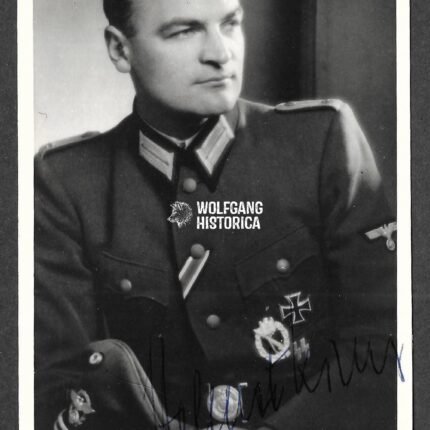
€75,00Original Scarce Postwar Signature on a Postwar Photo of Helmut Kinz. SS-Sturmbannführer und Major der Schutzpolizei Helmut Kinz (1 December 1915, Nagykanizsa † 19 October 1985, Klagenfurt) was a Waffen-SS and police officer who rose to the rank of SS-Sturmbannführer and Major of the Schutzpolizei during the Second World War. He is best remembered as the last commander of the Waffen-Gebirgs-Aufklärungs-Abteilung 13, the reconnaissance battalion of the 13. Waffen-Gebirgs-Division der SS “Handschar” (kroatische Nr. 1). For his leadership in the final days of the war, he was awarded the Knight’s Cross of the Iron Cross.
Award:
-
Knight’s Cross of the Iron Cross (Ritterkreuz des Eisernen Kreuzes) – 3 May 1945, as SS-Sturmbannführer and Kommandeur of Waffen-Gebirgs-Aufklärungs-Abteilung 13, 13. Waffen-Gebirgs-Division der SS “Handschar”.
Career Highlights:
-
Joined the police and later transferred to the Waffen-SS, advancing steadily through both organizations.
-
Appointed commander of the Waffen-Gebirgs-Aufklärungs-Abteilung 13, responsible for reconnaissance and mobile operations within the “Handschar” Division.
-
Led his unit during the final chaotic months of the war in the Balkans, where his command performance earned him the Knight’s Cross in May 1945—among the last decorations of its kind awarded.
-
Captured at the end of the war and later released.
-
Lived in postwar Austria until his death in 1985.
Item Details:
-
Authentic scarce postwar signature of SS-Sturmbannführer Helmut Kinz.
-
Signed on a postwar photograph.
-
Condition: Good, with a clear and well-preserved autograph.

Rudolf Jordan – Gauleiter of Halle-Merseburg & Magdeburg-Anhalt
€55,00Original Postwar Signature on a Carton (surrounding an original postwar photo) of Rudolf Jordan. Rudolf Jordan (21 June 1902, Großenlüder † 27 October 1988, Munich) was a leading NSDAP Party official who served as Gauleiter of Halle-Merseburg and Magdeburg-Anhalt during the Third Reich. As Gauleiter, he held supreme political authority in his regions and was directly responsible to Adolf Hitler.
Career Highlights:
-
Joined the NSDAP in the early years of the movement and rose quickly through the ranks.
-
Served as Gauleiter of Halle-Merseburg from 1931, later appointed Gauleiter of Magdeburg-Anhalt in 1937, positions he held throughout the war.
-
As Gauleiter, oversaw the Nazi Party’s political, administrative, and propaganda apparatus in central Germany, wielding near-total authority at the regional level.
-
Known for his loyalty to Hitler and for being one of the youngest Gauleiters in the regime.
Postwar Fate:
-
Captured by Soviet forces in 1945.
-
Sentenced to 25 years in a Soviet labor camp, where he remained imprisoned for a decade.
-
Released in October 1955, returning to West Germany.
-
Lived in Munich until his death in 1988.
Item Details:
-
Authentic postwar signature of Rudolf Jordan.
-
Signed on a postwar photograph.
-
Condition: Clear, well-preserved autograph.
Hermann Balck – 11. Panzer-Division & 4. Panzer-Armee (Brillanten)
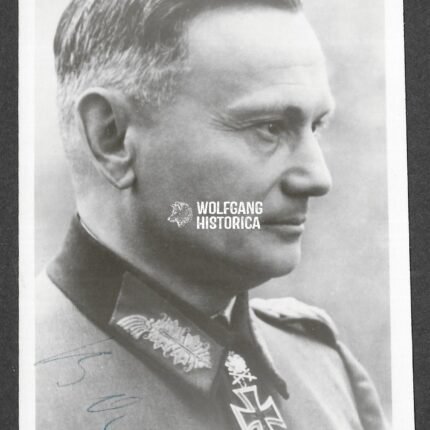
€120,00Original Postwar Signature on a Postwar Photo of Hermann Balck. General der Panzertruppen Hermann Balck (17 December 1893, Danzig-Langfuhr † 29 November 1982, Eberbach) was one of Germany’s most outstanding Panzer commanders of the Second World War. Renowned for his tactical brilliance, he rose to the rank of General der Panzertruppen and became one of only 27 recipients of the Knight’s Cross of the Iron Cross with Oak Leaves, Swords, and Diamonds.
Awards and Decorations:
-
Knight’s Cross of the Iron Cross (Ritterkreuz des Eisernen Kreuzes) – 3 June 1940, as Oberstleutnant and Kommandeur of Schützen-Regiment 1, 1. Panzer-Division.
-
Oak Leaves to the Knight’s Cross (Eichenlaub zum Ritterkreuz des Eisernen Kreuzes) – 20 December 1942, as Generalmajor and Kommandeur of 11. Panzer-Division.
-
Swords to the Knight’s Cross with Oak Leaves (Schwerter zum Ritterkreuz mit Eichenlaub) – 4 March 1943, as Generalleutnant and Kommandeur of 11. Panzer-Division.
-
Diamonds to the Knight’s Cross with Oak Leaves and Swords (Brillanten zum Ritterkreuz mit Eichenlaub und Schwertern) – 31 August 1944, as General der Panzertruppen and Deputy Commander of 4. Panzer-Armee.
Career Highlights:
-
Distinguished himself in the 1940 French campaign, where his Schützen-Regiment spearheaded Panzer thrusts, earning him the Knight’s Cross.
-
Commanded the 11. Panzer-Division on the Eastern Front, where his bold maneuvers and rapid counterattacks earned him the Oak Leaves and Swords.
-
Promoted to General der Panzertruppen, he was entrusted with higher-level commands, including corps and army responsibilities.
-
Awarded the Diamonds in 1944, recognizing his leadership as one of the Wehrmacht’s most skilled operational commanders.
-
After the war, Balck was tried by Allied authorities and later lived quietly in West Germany until his death in 1982.
Item Details:
-
Authentic postwar signature of General der Panzertruppen Hermann Balck.
-
Signed on a postwar photograph. Postcardsize.
-
Condition: Clear and well-preserved autograph.
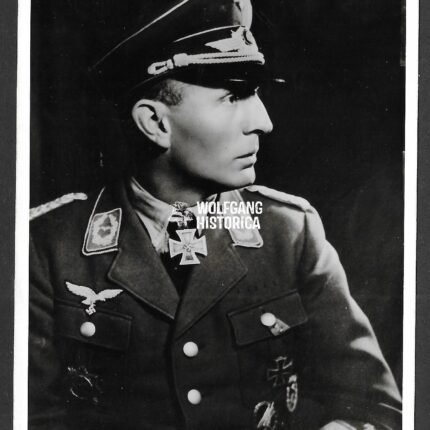
Friedrich August Freiherr von der Heydte – Carentan & Operation Stösser
€0,01Original Postwar Signature on a Postwar Photo of Friedrich August Freiherr von der Heydte. Oberst Friedrich August Freiherr von der Heydte (30 March 1907, München † 7 July 1994, Aham) was a German paratroop officer of the Luftwaffe during the Second World War, rising to the rank of Oberst. He earned the Knight’s Cross of the Iron Cross with Oak Leaves for his leadership of Fallschirmjäger units in some of the most famous airborne and defensive operations of the war.
Awards and Decorations:
-
Knight’s Cross of the Iron Cross (Ritterkreuz des Eisernen Kreuzes) – 21 August 1940, as Hauptmann and Kommandeur of IV./Fallschirmjäger-Regiment 1.
-
Oak Leaves to the Knight’s Cross (Eichenlaub zum Ritterkreuz des Eisernen Kreuzes) – 8 February 1945, as Oberst and Kommandeur of Fallschirmjäger-Regiment 6.
Career Highlights:
-
Entered military service before the outbreak of WWII, joining the elite Fallschirmjäger arm of the Luftwaffe.
-
Commanded IV./Fallschirmjäger-Regiment 1 during the early airborne operations of 1940, where his leadership earned him the Knight’s Cross.
-
Fought in multiple theaters including Crete, Italy, and Normandy, gaining a reputation as one of the most experienced paratroop commanders.
-
In December 1944, during the Battle of the Bulge, he led Operation Stösser, the last major German airborne operation of the war.
-
Awarded the Oak Leaves in 1945 for his leadership of Fallschirmjäger-Regiment 6 during these late-war battles.
-
After the war, became a respected law professor, politician (CSU), and author, writing extensively on military, political, and legal issues.
-
Lived until 1994, making him one of the longest-lived Oak Leaves recipients.
Item Details:
-
Authentic postwar signature of Oberst Friedrich August Freiherr von der Heydte.
-
Signed on a postwar photograph.
-
Condition: Clear and well-preserved autograph.
Collector’s Note:
Von der Heydte is among the most recognized Fallschirmjäger leaders of the Second World War. His association with Operation Stösser and his long, active postwar career as an academic and politician make his autograph especially significant. Highly desirable for collectors of elite airborne units, Knight’s Cross with Oak Leaves recipients, and Luftwaffe ground commanders.
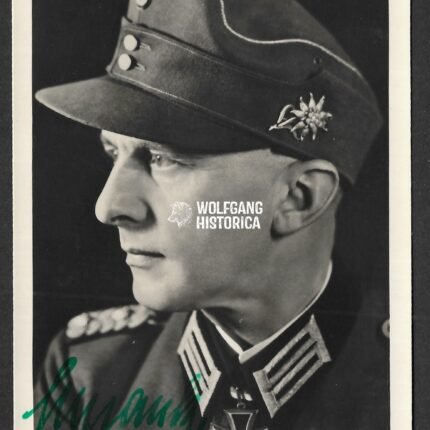
Max-Günther Schrank – Gebirgsjäger-Regiment 100 (Wartime Signed)
€175,00Original Wartime Signature on a Postcard of Max-Günther Schrank. Generalleutnant Max-Günther Schrank (19 November 1898 † 22 September 1960) was a decorated officer of the Wehrmacht, best remembered for his service in the elite Gebirgstruppe during the Second World War. Rising through the ranks, he ultimately commanded the 5. Gebirgs-Division.
Award:
-
Knight’s Cross of the Iron Cross (Ritterkreuz des Eisernen Kreuzes) – 17 July 1941, as Oberst and Kommandeur of I./Gebirgsjäger-Regiment 100, 5. Gebirgs-Division.
Oberstleutnant Schrank has especially distinguished himself by his personal bravery and decisiveness. Through the encirclement and capture of the elusive enemy forces in the south of Crete on 1 June 1941, the operations on the island could be brought to a successful conclusion. Schrank has secured a decisive share in the total victory over the English troops.
Career Highlights:
-
A career officer who entered service during the First World War.
-
Served extensively with the 5. Gebirgs-Division, one of the Wehrmacht’s most respected mountain units.
-
Took part in campaigns across the Balkans, Crete, and the Eastern Front.
-
Later rose to the rank of Generalleutnant, commanding a full division in combat.
Item Details:
-
Authentic wartime signature of Max-Günther Schrank.
-
Signed on a postcard-sized medium.
-
Condition: Good, preserved with clear autograph.
-
Measurements: Standard postcard format.
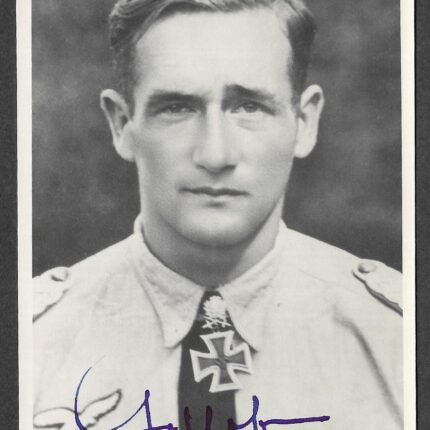
Gordon Gollob – Jagdgeschwader 3 “Udet” & 77 “Herz As” (Brillanten)
€85,00Original Postwar Signature on a Postwar Photo of Gordon Mac Gollob. Generalmajor Gordon Mac Gollob (16 June 1912, Vienna † 7 September 1987, Sullingen) was one of the Luftwaffe’s most renowned fighter aces of the Second World War, ultimately rising to the rank of Generalmajor der Luftwaffe. Over the course of his career he achieved 150 aerial victories, becoming one of the elite recipients of the Knight’s Cross with Oak Leaves, Swords and Diamonds.
Awards and Decorations:
-
Knight’s Cross of the Iron Cross (Ritterkreuz des Eisernen Kreuzes) – 18 September 1941, as Hauptmann and Kommandeur of II./Jagdgeschwader 3 “Udet” (JG 3), after 42 confirmed aerial victories.
-
Oak Leaves to the Knight’s Cross (Eichenlaub zum Ritterkreuz) – 26 October 1941, as Hauptmann and Kommandeur of II./JG 3 “Udet”, for reaching 85 aerial victories.
-
Swords to the Knight’s Cross with Oak Leaves (Schwerter zum Ritterkreuz mit Eichenlaub) – 23 June 1942, as Hauptmann and Führer of Jagdgeschwader 77 (JG 77), for surpassing 107 aerial victories.
-
Diamonds to the Knight’s Cross with Oak Leaves and Swords (Brillanten zum Ritterkreuz mit Eichenlaub und Schwertern) – 30 August 1942, as Major and Kommodore of Jagdgeschwader 77 “Herz As”, after achieving 150 aerial victories.
-
Additionally, he received the Combined Pilot-Observer Badge with Diamonds (Gemeinsames Flugzeugführer- und Beobachterabzeichen mit Brillanten), one of the Luftwaffe’s rarest distinctions.
Career Highlights:
-
Entered the Luftwaffe before WWII and quickly rose as a skilled pilot.
-
Built his reputation as one of the Luftwaffe’s premier Experten (fighter aces) during the Eastern Front campaigns.
-
Commanded both JG 3 “Udet” and JG 77 “Herz As”, leading his Gruppen and Geschwader with distinction.
-
Later in the war, promoted to higher command responsibilities, including positions as an inspector within the fighter arm.
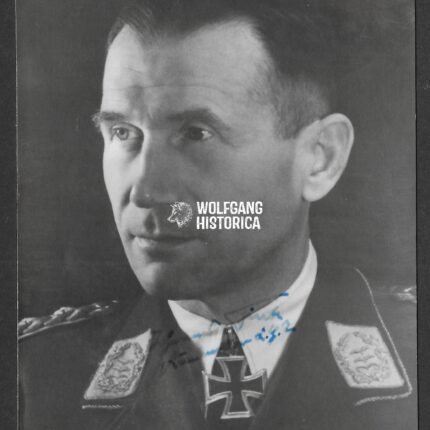
Johannes Fink – Kampfgeschwader 2
€35,00Original Postwar Signature on a Postwar Photo of Johannes Fink. Generalleutnant Johannes Fink (28 March 1895, Pfullingen † 1 June 1981, Pfullingen) was a highly decorated Luftwaffe officer during World War II, ultimately rising to the rank of Generalleutnant. A veteran of both World Wars, Fink began his service in the German Army during WWI and transferred to the Luftwaffe in the interwar period. He became best known for his command of bomber formations during the campaigns of 1940, and later for his leadership at divisional level.
Awards and Decorations:
-
Knight’s Cross of the Iron Cross (Ritterkreuz des Eisernen Kreuzes) – 20 June 1940, as Oberst and Geschwaderkommodore of Kampfgeschwader 2 “Holzhammer” (KG 2).
Oberst Johannes Fink distinguished himself with his Geschwader on the Western Front over the course of numerous successful sorties. He had an outstanding share in the crushing of the opposing Air Force, the breakthrough over the Maas and the subsequent covering of the southern flank of the friendly advance. Coordinated attacks by his Geschwader against enemy airports and troop assemblies met with particularly spectacular results. Oberst Fink also led his Geschwader with distinction through both difficult weather conditions and nocturnal operations. All the missions assigned to his unit were fulfilled with a minimum of losses.
-
German Cross in Gold (Deutsches Kreuz in Gold) – 1 October 1944, as Generalmajor and Kommandeur of the 2. Flieger-Division.
Career Highlights:
-
Served as a frontline officer in World War I before transitioning into aviation service in the Luftwaffe.
-
As Kommodore of KG 2, directed major bombing operations during the Western campaign of 1940, earning the Knight’s Cross.
-
Later commanded the 2. Flieger-Division, overseeing larger-scale operational deployments during the later years of the war.
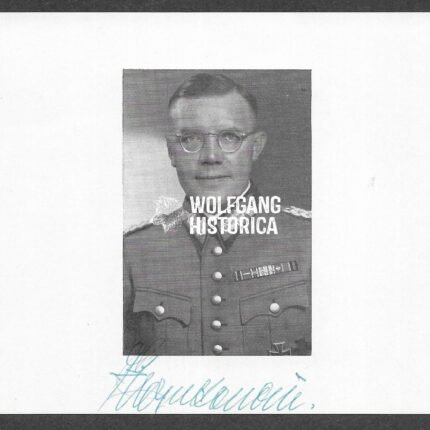
Heinrich Lankenau – Generalleutnant der Ordnungspolizei and SS-Gruppenführer in “Den Haag”
€35,00Original Postwar Signature on a Postwar Paper Photo of Heinrich Lankenau. Generalleutnant der Ordnungspolizei u. SS-Gruppenführer Heinrich Bernhard Lankenau (11 October 1891, Hatten † 16 April 1983, Bad Salzuflen) was a senior German officer of the Ordnungspolizei and SS during the Second World War, holding some of the highest positions in regional police leadership. He attained the rank of Generalleutnant der Ordnungspolizei and SS-Gruppenführer.
Career Service Record:
-
15 June 1939 – Appointed Inspekteur der Ordnungspolizei Münster.
-
September 1939 – March 1940 – Befehlshaber der Ordnungspolizei im Wehrkreis VI.
-
20 April 1940 – Promoted with the Charakter als Generalmajor der Ordnungspolizei.
-
30 October 1940 – Promoted to Generalmajor der Polizei (effective 1 August 1940, seniority 6 October 1940).
-
9 November 1942 – Bestowed the Charakter als Generalleutnant der Polizei.
-
1 December 1942 (Abordnung) / 1 February 1943 (Versetzung) – Posted as Befehlshaber der Ordnungspolizei beim Höheren SS- und Polizeiführer Nord-West in Den Haag, serving until 6 January 1944.
-
20 April 1943 – Promoted to Generalleutnant der Polizei.
-
1 February 1944 – Retired from active service at his own request following conflicts with HSSPF Nord-West Hanns Albin Rauter.
-
1 July 1944 – Formally placed in retirement.
-
1 September 1944 – Temporarily tasked with administration of the Landratsamt Beckum.

Wilhelm Thomas – Infanterie-Regiment 71 (29. Infanterie-Division)
€25,00Original Postwar Signature on a Postwar Paper of Wilhelm Thomas. Generalleutnant Wilhelm Thomas (8 October 1892 † 24 August 1976) was a career officer in the German Army who rose to divisional command during the Second World War. He earned the Knight’s Cross of the Iron Cross for his leadership on the Eastern Front.
Award:
-
Knight’s Cross of the Iron Cross (Ritterkreuz des Eisernen Kreuzes) – 13 October 1941, as Oberst and Kommandeur of Infanterie-Regiment 71, 29. Infanterie-Division (mot.).
Career Highlights:
-
Served as a young officer in the First World War and continued his career in the interwar Reichswehr.
-
Distinguished himself during the invasion of the Soviet Union as commander of Infanterie-Regiment 71, part of the 29. Infanterie-Division (mot.), earning the Knight’s Cross in October 1941.
-
Later promoted to Generalleutnant, commanding multiple infantry divisions on the Eastern Front during the later stages of the war.
-
Captured in 1945 and held in Allied captivity before returning to Germany.
-
Lived in postwar Germany until his death in 1976.
Item Details:
-
Authentic postwar signature of Generalleutnant Wilhelm Thomas.
-
Signed on a postwar photograph.
-
Condition: Clear autograph, well-preserved.
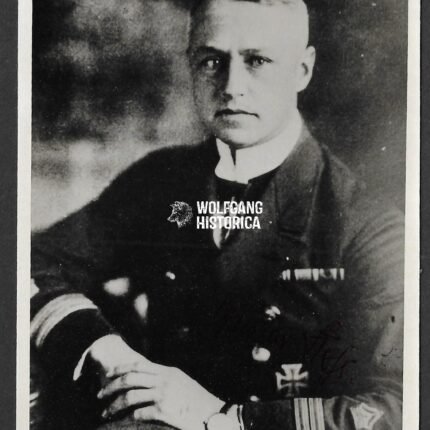
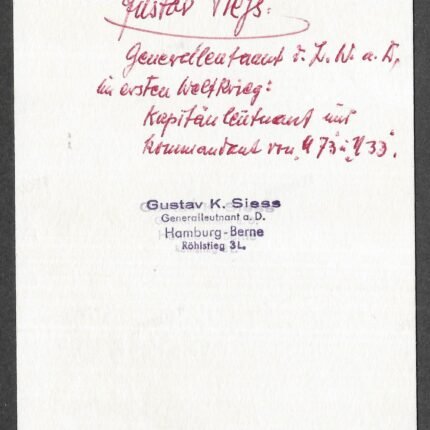
Gustav Sieß – U-Boot Ace World War I (Pour le Mérite!)
€150,00Original Rare Postwar Signature on a Postwar Photograph of Gustav Sieß. Generalleutnant Gustav Sieß (11 December 1883, Hamburg † 14 October 1970, Hamburg) distinguished himself as one of Germany’s foremost U-boat aces during World War I and later served as a high-ranking officer in the Luftwaffe during World War II.
Career Highlights & Decorations:
-
As Kapitänleutnant and U‑boat commander, Sieß achieved remarkable wartime success. He sank 56 ships, totaling approximately 188,900 GRT, including the British battleship HMS Russell, the Russian battleship Peresvet, and the hospital ship Britannic, sister of the Titanic, making him one of the top submarine commanders of WWI.
-
For these exploits, he was awarded the prestigious Pour le Mérite on 24 April 1918. He had previously received both classes of the Iron Cross and the Royal House Order of Hohenzollern with Swords on 27 February 1917.
Interwar & WWII Service:
-
After the war, Sieß entered the commercial sector, founding a trading firm, Siess, von Loë & Co.
-
In 1935, at the age of 53, he returned to military service in the Luftwaffe as a Major, serving as head of logistics at the Air Ministry in Berlin. Due to illness, he retired with the rank of Generalleutnant in 1944.
-
Following the war, he was detained by Soviet authorities and sentenced to 25 years, but was released in 1955. He returned to Hamburg and lived there until his passing in 1970.
Signed on the front and back.

Wilhelm Meendsen-Bohlken – Befehlshaber der Deutschen Marinekommando Italiens (Admiral)
€40,00Original Postwar Signature on a Postwar Photo of Wilhelm Meendsen-Bohlken. Vizeadmiral Wilhelm Meendsen-Bohlken (5 April 1897 † 13 May 1985) was a career naval officer who served in both World Wars and rose to the rank of Vice Admiral in the Kriegsmarine. He was a recipient of the Knight’s Cross of the Iron Cross for his leadership in Italy.
Award:
-
Knight’s Cross of the Iron Cross – 11 May 1944, as Vizeadmiral and Befehlshaber der Deutschen Marinekommando Italien (Commander of German Naval Command Italy).
Career Highlights:
-
Entered the Imperial Navy as a cadet during World War I and gained early seagoing experience.
-
Continued his naval career in the interwar Reichsmarine, specializing in staff and command positions.
-
During World War II, held senior roles including Commander of German Naval Forces in Italy, directing naval operations and coordinating with Axis forces in the Mediterranean theater.
-
Promoted to Vizeadmiral, one of the Kriegsmarine’s senior flag officer ranks.
-
Survived the war and lived until 1985.
Item Details:
-
Authentic postwar signature of Vizeadmiral Wilhelm Meendsen-Bohlken.
-
Signed on a postwar photograph.
-
Condition: Well-preserved with a clear autograph.

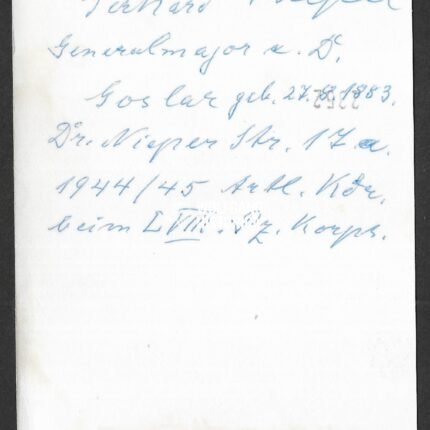
Gerhard Triepel genannt Schulze – Artillerie-Kommandeur 485 (LXXXV. Armeekorps)
€45,00Original Postwar Signature on a Postwar Photo of Gerhard Triepel genannt Schulze. Generalmajor Gerhard Triepel genannt Schulze (12 May 1899 † 28 May 1980) was a German Army officer during the Second World War who rose to the rank of Generalmajor. He distinguished himself as an artillery commander on the Western Front in 1944, earning the German Cross in Gold.
Award:
-
German Cross in Gold (Deutsches Kreuz in Gold) – 16 October 1944, as Oberst and Kommandeur of Artillerie-Kommandeur 485, LXXXV. Armeekorps (Heer).
Career Highlights:
-
Entered military service after the First World War and remained a career officer in the interwar Reichswehr.
-
During World War II, commanded artillery formations and later senior staff positions.
-
Earned the German Cross in Gold for his leadership of Artillerie-Kommandeur 485 under the LXXXV. Armeekorps, during the bitter defensive battles of late 1944.
-
Promoted to Generalmajor, holding divisional-level responsibilities before the war’s end.
-
Survived captivity and lived in postwar Germany until his death in 1980.

Gert Gustav Paul Jeschonnek – Kriegsmarine & Inspekteur der Marine (BW) (Admiral)
€35,00Original Postwar Signature on a Postwar Photo of Gert Gustav Paul Jeschonnek. Vizeadmiral Gert Gustav Paul Jeschonnek (30 October 1912 † 18 April 1999) was a German naval officer whose career bridged both the Kriegsmarine of the Second World War and the postwar Bundesmarine of the Federal Republic of Germany. He is best remembered as Inspector of the Navy (Inspekteur der Marine), the highest-ranking officer of the postwar German Navy.
Career Highlights:
-
Entered the Kriegsmarine before World War II, serving in various naval capacities during the conflict.
-
Survived the collapse of the Third Reich and continued his career in uniform after the founding of the Bundeswehr in 1955.
-
Rose rapidly in the Bundesmarine, holding senior staff and command positions.
-
In 1967, appointed Inspector of the Navy (Inspekteur der Marine), becoming the professional head of the West German Navy and shaping its Cold War development within NATO.
-
Promoted to Vizeadmiral, one of the highest flag ranks in the Bundesmarine.
-
Retired in 1971 after a distinguished career spanning two eras of German naval history.
Item Details:
-
Authentic postwar signature of Vizeadmiral Gert Gustav Paul Jeschonnek.
-
Signed on a postwar photograph.
-
Condition: Clear autograph, well-preserved.
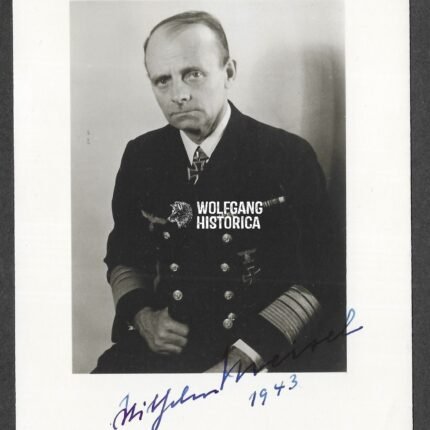
Wilhelm Meisel – Panzerschiff “Admiral Hipper” (Admiral)
€75,00Original Postwar Signature on a Postwar Photo of Wilhelm Meisel. Admiral Wilhelm Meisel (4 November 1891 † 7 September 1974) was a career naval officer whose service spanned both World Wars. Rising from midshipman in 1913 to Admiral in the Kriegsmarine, he commanded surface combatants in key operations and was awarded the Knight’s Cross of the Iron Cross for his leadership of the heavy cruiser Admiral Hipper.
Awards and Decorations:
-
Knight’s Cross of the Iron Cross – 26 February 1941, as Kapitän zur See and commander of the heavy cruiser “Admiral Hipper”.
-
Spanish Cross in Silver (6 June 1939).
Career Highlights:
-
Served in World War I aboard SMS Moltke, SMS Stralsund, and the commerce raider SMS Möwe.
-
Survived the scuttling of the High Seas Fleet at Scapa Flow and returned from British captivity in 1921.
-
During the interwar period, commanded a torpedo boat flotilla, held staff positions, and captained the cruiser Karlsruhe in 1929.
-
In World War II, led a destroyer flotilla during the Polish campaign (1939).
-
As commander of the heavy cruiser Admiral Hipper, directed operations in the Atlantic, for which he received the Knight’s Cross in 1941.
-
Later appointed Chief of Staff of Naval Group West (1943) and subsequently Chief of Naval Staff.
-
Promoted to Admiral, one of the senior flag officers of the Kriegsmarine.
Item Details:
-
Authentic postwar signature of Admiral Wilhelm Meisel.
-
Signed on a postwar photograph. Postcardsize.
-
Condition: Excellent preserved example, with clear autograph.
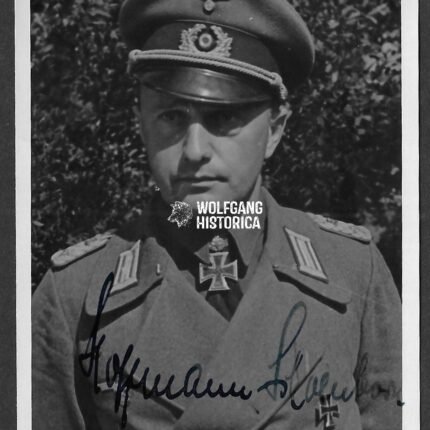
Günther Hoffmann-Schönborn – Sturmgeschütz-Abteilung 191 (Eichenlaub) (Wartime Signed)
€165,00Original Wartime Signature on a Photo of Günther Hoffmann-Schönborn. Major Günther Hoffmann-Schönborn (1 May 1905 † 4 April 1970) was a decorated assault gun commander of the Wehrmacht and one of the early notable leaders of the Sturmgeschütz units. He rose to prominence as Kommandeur of Sturmgeschütz-Abteilung 191 “Büffel”, earning both the Knight’s Cross and Oak Leaves for his battlefield leadership.
Awards and Decorations:
-
Knight’s Cross of the Iron Cross (Ritterkreuz des Eisernen Kreuzes) – 14 May 1941, as Major and Kommandeur of Sturmgeschütz-Abteilung 191 “Büffel”.
Awarded for his support of Gruppe Ens during the breakthrough of the Metaxas Line. Despite strong defensive fire and extremely difficult terrain, Hoffmann-Schönborn successfully brought his Sturmgeschütze into position to cover the attack of Gruppe Ens. This support proved invaluable, enabling the breakthrough of the enemy line and triggering the collapse of the front.
-
Oak Leaves to the Knight’s Cross (Eichenlaub zum Ritterkreuz) – 31 December 1941, as Major and Kommandeur of Sturmgeschütz-Abteilung 191 “Büffel”.
Awarded for the distinguished leadership of his Abteilung during the advance to the Dnieper River, the river crossing, and the subsequent encirclement battle of Kiev.
Career Highlights:
-
Served in the artillery branch before being transferred to the early assault gun formations.
-
As commander of Sturmgeschütz-Abteilung 191, he played a decisive role in both the Balkan campaign and on the Eastern Front.
-
His unit became well known for its aggressive use of assault guns in support of infantry and combined-arms operations.
Item Details:
-
Authentic wartime signature of Günther Hoffmann-Schönborn.
-
Size: 7.5 × 10.5 cm photograph.
-
Condition: Good, with clear autograph.

Nicolaus von Below – Adjutant of Adolf Hitler (Führerbunker ’45)
€120,00Original Postwar Signature on a Postwar Photo of Nicolaus von Below. Oberst Nicolaus von Below (20 September 1907 † 24 July 1983) was a Luftwaffe officer best remembered for his role as Adjutant to Adolf Hitler. His unique position placed him at the very heart of the Reich’s leadership throughout the Second World War, giving him a front-row perspective on critical events and decisions.
Historical Significance:
-
Served as Hitler’s Luftwaffe adjutant from 1937 until the final days of the Third Reich.
-
Present in the Führerbunker during the final battle for Berlin in April 1945.
-
On 29 April 1945, after Hitler’s marriage to Eva Braun, von Below was a witness to Hitler’s Last Will and Testament.
-
He did not sign the Political Testament but added his name to the Private Testament.
-
-
With Hitler’s permission, von Below left the bunker before the final collapse of Berlin and was later taken into Allied custody.
Postwar Life:
-
Survived captivity and later published his memoirs, providing firsthand testimony of his time as Hitler’s adjutant.
-
Lived in postwar Germany until his death in 1983.
Item Details:
-
Authentic postwar signature of Nicolaus von Below. Little bit smaller than Postcardsize.
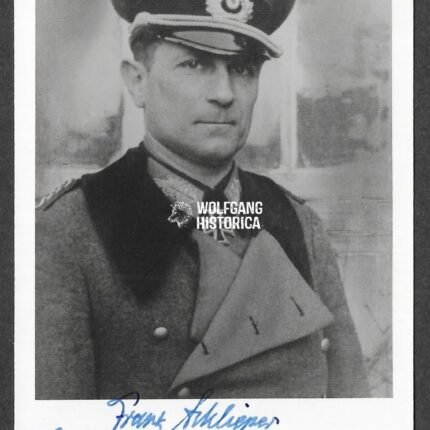
Franz Schlieper – Grenadier-Regiment 94 & Grenadier-Regiment 1132
€65,00Original Postwar Signature on a Postwar Photo of Franz Schlieper. Generalmajor Franz Schlieper (22 August 1905 † 4 April 1974) was a career officer in the German Army during the Second World War who rose to divisional command. He was decorated with both the German Cross in Gold and the Knight’s Cross of the Iron Cross for his battlefield leadership.
Awards and Decorations:
-
German Cross in Gold (Deutsches Kreuz in Gold) – 10 January 1944, as Oberst and Kommandeur of Grenadier-Regiment 94, 32. Infanterie-Division (Heer).
-
Knight’s Cross of the Iron Cross (Ritterkreuz des Eisernen Kreuzes) – 21 September 1944, as Oberst and Kommandeur of Grenadier-Brigade 1132, Führer of the 73. Infanterie-Division (Heer).
Career Highlights:
-
Entered the Reichswehr as a young officer and advanced steadily through the interwar years.
-
Distinguished himself as regimental commander with the 32. Infanterie-Division, earning the German Cross in Gold during the heavy fighting on the Eastern Front.
-
Promoted to brigade and divisional command, he received the Knight’s Cross in late 1944 for his leadership of Grenadier-Brigade 1132 and acting command of the 73. Infanterie-Division.
-
Captured by Soviet forces in May 1945 and held in captivity until 1955.
-
Returned to Germany after release and lived there until his death in 1974.
Item Details:
-
Authentic postwar signature of Franz Schlieper.
-
Signed on a postwar photograph.
-
Condition: Excellent preserved example, with clear autograph.
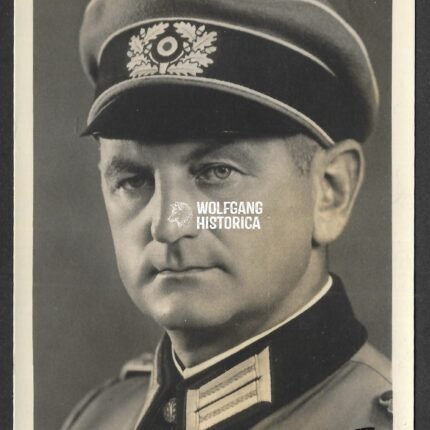
Otto Hitzfeld – Infanterie-Regiment 213 & LXVII. Armeekorps (Schwertern) (Wartime Signed)
€125,00Original Wartime Signature on a Postcard of Otto Hitzfeld. General der Infanterie Otto Hitzfeld (7 May 1898 † 6 December 1990) was a highly decorated officer of the German Army during the Second World War, ultimately rising to corps command. Over the course of his career he became one of the few recipients of the Knight’s Cross of the Iron Cross with Oak Leaves and Swords, marking him among the Wehrmacht’s elite leadership.
Awards and Decorations:
-
Knight’s Cross of the Iron Cross (Ritterkreuz des Eisernen Kreuzes) – 30 October 1941, as Oberstleutnant and Kommandeur of Infanterie-Regiment 213, 73. Infanterie-Division.
-
Oak Leaves to the Knight’s Cross (Eichenlaub zum Ritterkreuz) – 17 January 1942, as Oberstleutnant and Kommandeur of Infanterie-Regiment 213, 73. Infanterie-Division.
-
Swords to the Knight’s Cross with Oak Leaves (Schwerter zum Ritterkreuz mit Eichenlaub) – 9 May 1945, as General der Infanterie and Kommandierender General of LXVII. Armeekorps.
Career Highlights:
-
A veteran of the First World War who continued his military career through the interwar years.
-
Distinguished himself on the Eastern Front with the 73. Infanterie-Division, earning both the Knight’s Cross and Oak Leaves for regimental leadership.
-
Rose through senior commands, culminating as General der Infanterie and commander of LXVII. Armeekorps in the final phase of the war.
-
Survived the war and lived until 1990, making him one of the longest-lived Swords recipients.
Item Details:
-
Authentic wartime signature of Otto Hitzfeld.
-
Medium: Postcard-sized format.
-
Condition: Good, with clear autograph and presentation.

Dr. Konrad Stangl – Luftwaffe & 1. Luftwaffendivision (BW)
€25,00Original Postwar Signature on a Postwar Photo of Dr. Konrad Stangl. Generalleutnant Dr. Konrad Stangl (18 September 1913, Heidenheim – October 1993) was a distinguished German officer who served in the Luftwaffe and later rose to Generalleutnant in the Bundeswehr. He held key leadership roles in the postwar German Air Force during its formative years, making this signature historically significant for both Reichswehr and Bundeswehr collectors.
Career Highlights:
-
Entered the Reichswehr in 1934 as an officer candidate, transitioning to the newly founded Luftwaffe in 1935 and qualified as a pilot by late 1936
-
Following World War II, Stangl continued his career in the Bundeswehr. He served as Commander of the Officer Candidate School of the Luftwaffe in Neubiberg from 21 June 1961 to 30 September 1963.
-
Later appointed Commander of the 1st Luftwaffendivision, serving from 1 October 1963 to 31 March 1968, overseeing operational readiness of air force units during the Cold War.
-
Eventually achieved the rank of Generalleutnant, one of the senior-most positions in the Bundesluftwaffe.
Item Details:
-
Authentic postwar signature of Generalleutnant Dr. Konrad Stangl.
-
Signed on a postwar photograph.
-
Condition: Clear and well-preserved autograph.
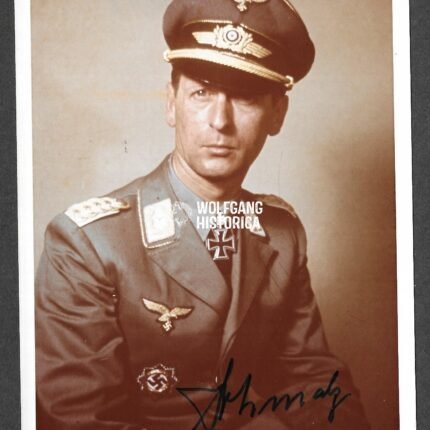
Wilhelm Schmalz – Schützen-Regiment 11 & Panzer-Division “Hermann Göring” (Eichenlaub)
€55,00Original Postwar Signature on a Postwar Photo of Wilhelm Schmalz. Generalleutnant Wilhelm Schmalz (1 March 1901, Zittau † 14 March 1983, Bad Godesberg) was a German officer of the Heer and later of the Luftwaffe’s elite Panzer formations, rising to the rank of Generalleutnant. He earned both the Knight’s Cross of the Iron Cross with Oak Leaves and the German Cross in Gold for his battlefield leadership, most notably with the Panzer-Division “Hermann Göring”.
Awards and Decorations:
-
Knight’s Cross of the Iron Cross (Ritterkreuz des Eisernen Kreuzes) – 28 November 1940, as Major and Kommandeur of I./Kavallerie-Schützen-Regiment 11, 11. Schützen-Brigade, 11. Panzer-Division.
-
German Cross in Gold (Deutsches Kreuz in Gold) – 8 February 1942, as Oberstleutnant and Kommandeur of Kradschützen-Bataillon 59.
-
Oak Leaves to the Knight’s Cross (Eichenlaub zum Ritterkreuz des Eisernen Kreuzes) – 23 December 1943, as Oberst and Kommandeur of Panzer-Division “Hermann Göring”.
Career Highlights:
-
Entered service in the Reichswehr and advanced through the mobile arm of the German Army.
-
Distinguished himself early in the war with Kavallerie-Schützen-Regiment 11 and Kradschützen-Bataillon 59, earning the Knight’s Cross and German Cross.
-
Transferred to the elite Panzer-Division “Hermann Göring”, which he led with distinction in Italy and on the Eastern Front.
-
Promoted to Generalleutnant, commanding the division during the heavy defensive battles of 1943–44.
-
Captured at the end of the war and later released from Allied captivity.
-
Lived in postwar Germany until his death in 1983.
Item Details:
-
Authentic postwar signature of Generalleutnant Wilhelm Schmalz.
-
Signed on a postwar photograph.
-
Condition: Clear, well-preserved autograph.
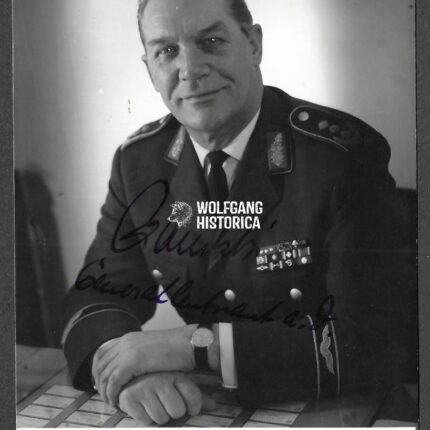
Werner Panitzki – Luftwaffe Personalamt – Inspekteur der Luftwaffe (BW) (DKIS)
€30,00Original Postwar Signature on a Postwar Photo of Werner Panitzki. Generalleutnant der Luftwaffe Werner Panitzki (27 May 1911, Berthelsdorf † 6 April 2001, Bonn) was a German officer whose career spanned both the Luftwaffe of the Second World War and the Bundeswehr of postwar West Germany. He rose to the rank of Generalleutnant and served as the Inspector of the Air Force (Inspekteur der Luftwaffe), making him the highest-ranking officer in the Bundeswehr’s Luftwaffe during the early Cold War.
Award:
-
German Cross in Silver (Deutsches Kreuz in Silber) – 10 May 1945, as Oberstleutnant i.G., X. Abteilung, Luftwaffen-Personalamt
Career Highlights:
-
Entered the Luftwaffe before the outbreak of the Second World War, serving as an officer during the conflict.
-
After the founding of the Bundeswehr in 1955, he resumed his career in uniform and quickly rose through the new West German Air Force’s command structure.
-
In 1962, appointed Inspector of the Luftwaffe (Inspekteur der Luftwaffe), responsible for rebuilding, modernizing, and integrating the new German Air Force within NATO.
-
Promoted to Generalleutnant, serving as one of the Bundeswehr’s senior-most officers.
-
Retired from service in 1966.
-
Passed away in Bonn in 2001.
Item Details:
-
Authentic postwar signature of Generalleutnant Werner Panitzki.
-
Signed on a postwar photograph.
-
Condition: Clear and well-preserved autograph.
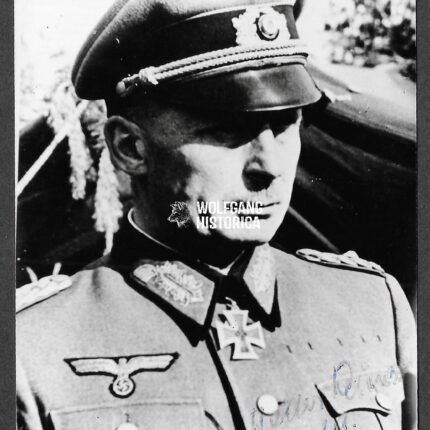
Walter Keiner – 62. Infanterie-Division
€35,00Original Postwar Signature on a Postwar Photo of Walter Keiner. General der Artillerie Walter Keiner (30 December 1890, Benshausen † 23 January 1978, Gelnhausen) was a career artillery officer who rose to the rank of General der Artillerie in the German Army during the Second World War. He was decorated with the Knight’s Cross of the Iron Cross for his leadership on the Eastern Front.
Award:
-
Knight’s Cross of the Iron Cross (Ritterkreuz des Eisernen Kreuzes) – 17 July 1941, as Generalmajor and Kommandeur of the 62. Infanterie-Division, for his role in the early stages of Operation Barbarossa.
Career Highlights:
-
Entered service before the First World War, serving as an artillery officer and continuing through the Reichswehr.
-
By 1941, commanded the 62. Infanterie-Division in the opening phases of the invasion of the Soviet Union, earning the Knight’s Cross for his successful leadership in combat.
-
Promoted through the senior ranks of the Wehrmacht, ultimately reaching General der Artillerie.
-
Lived in postwar Germany until his death in 1978.
Item Details:
-
Authentic postwar signature of General der Artillerie Walter Keiner.
-
Signed on a postwar photograph.
-
Condition as seen.
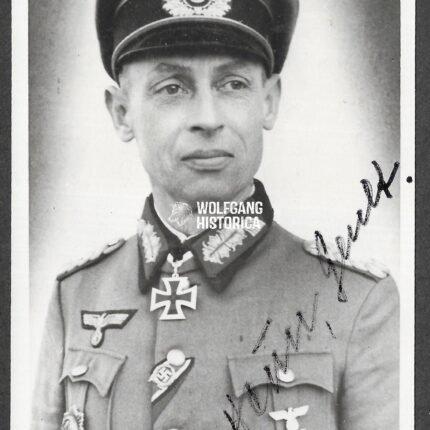
Wilhelm Heun – 83. Infanterie-Division
€35,00Original Postwar Signature on a Postwar Photo of Wilhelm Heun. Generalleutnant Wilhelm Heun (23 May 1895, Herborn † 21 September 1986, Göttingen) was a career officer in the German Army who rose to the rank of Generalleutnant during the Second World War. He received both the German Cross in Gold and the Knight’s Cross of the Iron Cross for his leadership on the Eastern Front.
Awards and Decorations:
-
German Cross in Gold (Deutsches Kreuz in Gold) – 23 October 1942, as Oberst and senior commander on the Eastern Front.
-
Knight’s Cross of the Iron Cross (Ritterkreuz des Eisernen Kreuzes) – 9 December 1944, as Generalmajor and Kommandeur of the 83. Infanterie-Division.
Career Highlights:
-
Served as an infantry officer in the First World War, remaining in the Reichswehr during the interwar period.
-
Fought on the Eastern Front from 1941 onward, where his leadership earned him the German Cross in Gold in 1942.
-
Promoted to Generalmajor, and later Generalleutnant, taking command of the 83. Infanterie-Division.
-
Awarded the Knight’s Cross in December 1944 for his divisional command during heavy fighting in the final year of the war.
-
Captured in 1945 and held as a prisoner of war until his release.
-
Lived in postwar Germany until his death in 1986.
Item Details:
-
Authentic postwar signature of Generalleutnant Wilhelm Heun.
-
Signed on a postwar photograph.
-
Condition: Clear, well-preserved autograph.
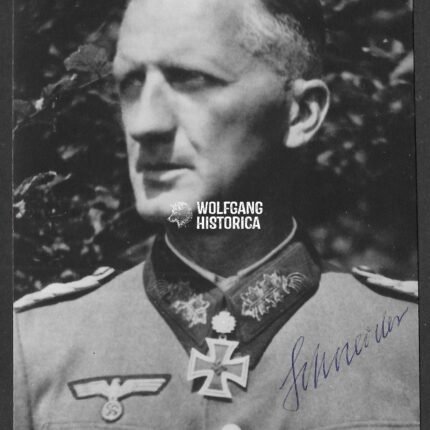
Erich Schneider – 4. Panzer-Division & 14. Infanterie-Division (Eichenlaub)
€55,00Original Postwar Signature on a Postwar Photo of Erich Schneider. Generalleutnant Erich Schneider (12 August 1894, Schwäbisch Gmünd † 3 August 1980, Crailsheim) was a German Army officer who rose to the rank of Generalleutnant during the Second World War. A veteran of the First World War, he commanded both armored and infantry divisions and was decorated with the Knight’s Cross of the Iron Cross with Oak Leaves for his battlefield leadership.
Awards and Decorations:
-
Knight’s Cross of the Iron Cross (Ritterkreuz des Eisernen Kreuzes) – 5 May 1943, as Generalmajor and Kommandeur of the 4. Panzer-Division.
-
Oak Leaves to the Knight’s Cross (Eichenlaub zum Ritterkreuz des Eisernen Kreuzes) – 6 March 1945, as Generalleutnant and Kommandeur of the 14. Infanterie-Division.
Awarded for his successful command of the 14. Infanterie-Division during the five-day battle west, northwest, and northeast of Ostrolenka. Repeated Soviet onslaughts were repelled, preventing a breakthrough. Schneider’s presence at the front in every difficult moment—despite heavy Soviet fire—allowed him to make sound tactical decisions and set a personal example that inspired his men.
Career Highlights:
-
Entered the Army during the First World War and remained in the Reichswehr through the interwar period.
-
Commanded the 4. Panzer-Division in 1943, where he earned the Knight’s Cross for his leadership on the Eastern Front.
-
Promoted to Generalleutnant, taking command of the 14. Infanterie-Division, where he distinguished himself in defensive battles in 1945.
-
His award of the Oak Leaves recognized his leadership in the grueling fighting around Ostrolenka.
-
Survived the war, captivity, and lived in postwar Germany until his death in 1980.
Item Details:
-
Authentic postwar signature of Generalleutnant Erich Schneider.
-
Signed on a postwar photograph, accompanied by a letter, enhancing provenance.
-
Condition: Good, with a clear autograph.
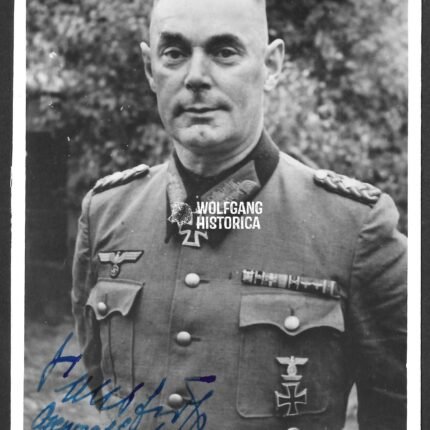
Franz Sensfuß – 212. Volksgrenadier-Division (Eichenlaub)
€55,00Original Postwar Signature on a Postwar Photo of Franz Sensfuß. Generalleutnant Franz Sensfuß (15 June 1891, Diedenhofen † 11 January 1976, Bonn) was a German Army officer who rose to the rank of Generalleutnant and commanded the 212. Infanterie-Division during the Second World War. He was a recipient of the Knight’s Cross of the Iron Cross with Oak Leaves, recognized for his determined leadership against Soviet forces in 1944–45.
Awards and Decorations:
-
Knight’s Cross of the Iron Cross (Ritterkreuz des Eisernen Kreuzes) – 22 August 1944, as Generalleutnant and Kommandeur of the 212. Infanterie-Division (Heer), for repelling numerous Soviet attacks near Szpij, northwest of Lake Narach, in mid-1944.
-
Oak Leaves to the Knight’s Cross (Ritterkreuz mit Eichenlaub zum Eisernen Kreuz, 858th award) – 9 May 1945, as Generalleutnant and Kommandeur of the 212. Infanterie-Division (Heer).
Career Highlights:
-
Entered service before the First World War and served throughout that conflict.
-
Advanced through the Reichswehr in the interwar years and took on key command responsibilities during WWII.
-
Distinguished himself in mid-1944 while leading the 212. Infanterie-Division, successfully repelling repeated Soviet attacks near Lake Narach and stabilizing his sector under extreme pressure.
-
Remained in command through the collapse of the Eastern Front, receiving the Oak Leaves in the final days of the war.
-
Survived captivity and later lived in West Germany until his death in 1976.
Item Details:
-
Authentic postwar signature of Generalleutnant Franz Sensfuß.
-
Signed on a postwar photograph.
-
Condition: Clear, well-preserved autograph.
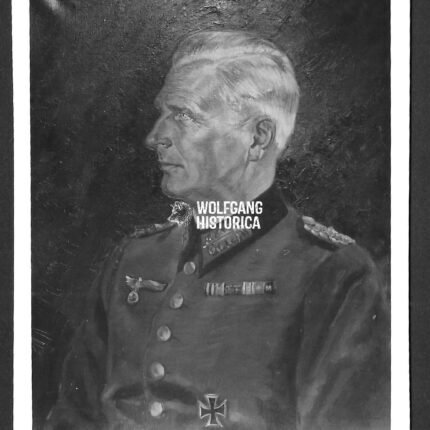
Enno von Rintelen – German Military Attaché in Italy (DKIS)
€45,00Original Postwar Signature on a Postwar Photo of Enno Emil von Rintelen. General der Infanterie Enno von Rintelen (6 November 1891, Stettin † 7 August 1971, Heidelberg) was a German officer whose military career spanned both World Wars. Rising to the rank of General der Infanterie, he is best remembered as the German Military Attaché in Italy and later as the Wehrmacht’s official representative at the Italian Supreme Command, where he played a central role in coordinating military relations between Germany and Italy.
Awards and Decorations:
-
German Cross in Silver (Deutsches Kreuz in Silber) – for his distinguished diplomatic and organizational service as German Military Attaché in Rome and representative to the Italian High Command.
-
Both classes of the Iron Cross (1914), awarded during his service in the First World War.
Career Highlights:
-
Entered the Prussian Army in 1910 and served throughout the First World War.
-
Remained in the Reichswehr during the interwar period, holding a variety of staff and command roles.
-
From 1936 to 1943, served as Military Attaché in Rome, later as German General at Comando Supremo, where he acted as liaison between the Wehrmacht and the Italian armed forces.
-
Promoted through the general officer ranks, ultimately reaching General der Infanterie in 1942.
-
Retired from active service in late 1944.
-
After the war, authored memoirs detailing his time as attaché in Italy, offering a rare perspective on the German-Italian alliance.
-
Lived in postwar Germany until his death in 1971.
Item Details:
-
Authentic postwar signature of General der Infanterie Enno von Rintelen.
-
Signed on a postwar photograph.
-
Condition: Clear, well-preserved autograph.
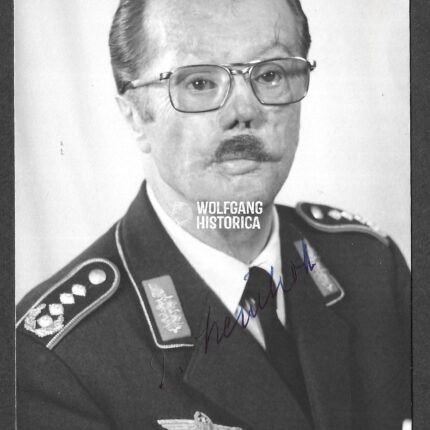
Johannes Steinhoff – Jagdgeschwader 52 & 77 (Schwertern, 176 Victories!)
€75,00Original Postwar Signature on a Postwar Photo of Johannes Steinhoff. Oberstleutnant Johannes Steinhoff (15 September 1913, Bottendorf † 21 February 1994, Wachtberg) was one of Germany’s most famous Luftwaffe fighter aces and later a respected Bundeswehr general. Rising to the rank of Oberstleutnant in the Luftwaffe, he became a triple recipient of the Knight’s Cross of the Iron Cross with Oak Leaves and Swords and ended the war with 176 confirmed aerial victories.
Awards and Decorations:
-
Knight’s Cross of the Iron Cross (Ritterkreuz des Eisernen Kreuzes) – 30 August 1941, as Oberleutnant and Staffelkapitän of 4./Jagdgeschwader 52.
-
Oak Leaves to the Knight’s Cross (Eichenlaub zum Ritterkreuz des Eisernen Kreuzes) – 2 September 1942, as Hauptmann and Kommandeur of II./Jagdgeschwader 52.
-
Swords to the Knight’s Cross with Oak Leaves (Schwerter zum Ritterkreuz mit Eichenlaub) – 28 July 1944, as Oberstleutnant and Kommodore of Jagdgeschwader 77.
Career Highlights:
-
Began his Luftwaffe career before the outbreak of WWII, gaining fame with Jagdgeschwader 52, the Luftwaffe’s most successful fighter wing.
-
Fought on both the Eastern Front and in the West, achieving the majority of his 176 aerial victories against the Soviet Air Force.
-
Severely injured in a crash in April 1945, ending his combat career.
-
After the war, became one of the key architects of the Bundesluftwaffe, serving as Chief of Staff of the Luftwaffe and later as Chairman of NATO’s Military Committee.
-
Widely respected by both former adversaries and allies, he was recognized as one of the great postwar military leaders of West Germany.
Item Details:
-
Authentic postwar signature of Oberstleutnant Johannes Steinhoff.
-
Signed on a postwar photo (postcard size).
-
Condition: As seen, with a clear autograph.
Collector’s Note:
Johannes Steinhoff is one of the best-known Luftwaffe aces, and his autograph is highly sought after by collectors. His combination of wartime success, high decorations, and prominent postwar career in NATO makes his signature especially significant. A desirable piece for any advanced collection of Luftwaffe or Knight’s Cross holders.

Martin Harlinghausen – X. Fliegerkorps & Fliegerführer Atlantik (Eichenlaub)
€45,00Original Postwar Signature on a Postwar Photo of Martin Harlinghausen. Generalmajor Martin Harlinghausen (17 January 1902, Rheda † 22 May 1986, Düsseldorf) was a Luftwaffe officer who rose to the rank of Generalmajor and became one of the key figures in German maritime and anti-shipping air operations during the Second World War. He was decorated with the Knight’s Cross of the Iron Cross with Oak Leaves for his service as Chief of Staff of X. Fliegerkorps, which directed Luftwaffe operations against Allied naval forces.
Awards and Decorations:
-
Knight’s Cross of the Iron Cross (Ritterkreuz des Eisernen Kreuzes) – 4 May 1940, as Major im Generalstab and Chef des Stabes of X. Fliegerkorps, Luftwaffe.
-
Wehrmachtbericht Mention – 3 November 1940, cited in the official Wehrmacht communique.
-
Oak Leaves to the Knight’s Cross (Eichenlaub zum Ritterkreuz des Eisernen Kreuzes, 8th award) – 30 January 1941, as Oberstleutnant im Generalstab and Chef des Stabes of X. Fliegerkorps, Luftwaffe.
Career Highlights:
-
Entered the Luftwaffe in the 1930s, specializing in planning and operational staff roles.
-
As Chief of Staff of X. Fliegerkorps, was heavily involved in the planning and execution of Luftwaffe operations against Allied naval targets in the North Sea, Norway, and the Atlantic approaches.
-
Worked closely with Luftwaffe long-range bomber units and naval command to coordinate strikes against convoys and shipping.
-
Promoted to Generalmajor, later serving in higher staff and command positions in Luftwaffe maritime operations.
-
Captured at the end of the war and released from captivity in the late 1940s.
-
Lived in West Germany until his death in 1986.
Item Details:
-
Authentic postwar signature of Generalmajor Martin Harlinghausen.
-
Signed on a postwar photograph.
-
Condition: Clear, well-preserved autograph.
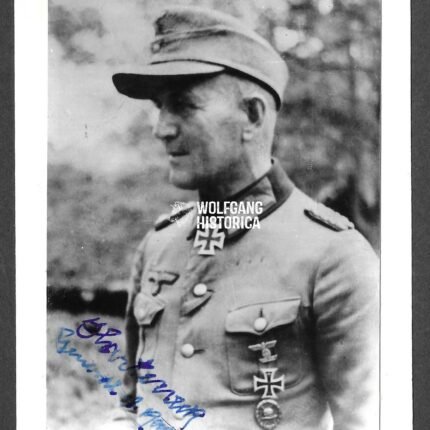
Gustav Harteneck – I. Kavallerie-Korps
€35,00Original Postwar Signature on a Postwar Photo of Gustav Harteneck. General der Kavallerie Gustav Harteneck (27 July 1892, Landau † 13 January 1984, München) was a German cavalry officer who rose to the rank of General der Kavallerie during the Second World War. A career soldier, he commanded the I. Kavallerie-Korps on the Eastern Front and was decorated with both the German Cross in Gold and the Knight’s Cross of the Iron Cross for his leadership.
Awards and Decorations:
-
German Cross in Gold (Deutsches Kreuz in Gold) – 20 March 1942, as Generalmajor in Armeeoberkommando 2.
-
Knight’s Cross of the Iron Cross (Ritterkreuz des Eisernen Kreuzes) – 21 September 1944, as General der Kavallerie and Kommandeur of I. Kavallerie-Korps.
Career Highlights:
-
Entered the Army before the First World War, serving in cavalry units.
-
Continued his career in the interwar Reichswehr, advancing steadily through the officer ranks.
-
During World War II, held senior staff and command posts before taking command of the I. Kavallerie-Korps, where he led his corps in defensive operations on the Eastern Front.
-
Recognized for his leadership with the Knight’s Cross in 1944.
-
Promoted to General der Kavallerie, one of the few to hold this historic cavalry rank in the later war years.
-
Survived the conflict and captivity, later living in Munich until his death in 1984.
Item Details:
-
Authentic postwar signature of General der Kavallerie Gustav Harteneck.
-
Signed on a postwar photograph.
-
Condition: Clear and well-preserved autograph.
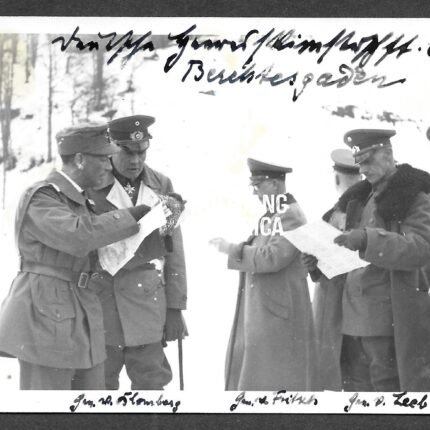
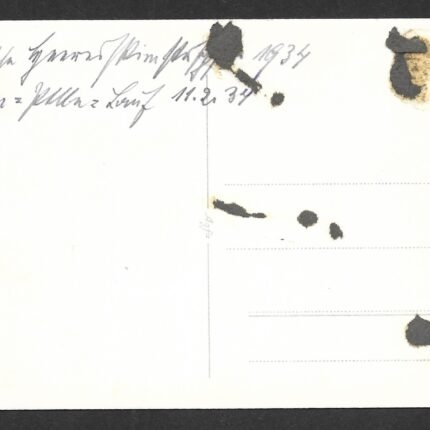
Photo – Generals von Leeb, von Blomberg & von Fritsch in Berchtesgaden, February 1934
€0,01On offer is an original postcard-size photograph taken in February 1934 at Berchtesgaden, showing three of Germany’s most prominent senior officers of the period:
-
General Wilhelm Ritter von Leeb – later Field Marshal in WWII
-
General Werner von Blomberg – then Reichswehr Minister of War and Commander-in-Chief of the Wehrmacht
-
General Werner von Fritsch – later Commander-in-Chief of the German Army (Heer)
This rare early photograph captures the three generals together at a key moment in the re-emerging German military hierarchy, only months after Hitler’s rise to power. Their presence in Berchtesgaden underscores the close ties between the military leadership and the new regime in 1934.
-
Format: Postcard-size photograph
-
Date/Location: February 1934, Berchtesgaden
-
Subjects: Generals von Leeb, von Blomberg, von Fritsch
-
Condition: As seen (please refer to photos)
An excellent and historically important early Third Reich photograph, featuring three men who would play central roles in the development of the Wehrmacht, with two (Blomberg and Fritsch) later brought down during the famous Blomberg–Fritsch Affair of 1938. A highly collectible piece for those interested in pre-war German military history.

Heinrich Baron von Behr – Panzergrenadier-Regiment 200 (90. Panzergrenadier-Div.) (Eichenlaub)
€75,00Original Postwar Signature on a Postwar Photo of Heinrich Baron von Behr. Generalmajor Heinrich Baron von Behr (26 June 1902, Roennen † 14 August 1983, Bonn) was a decorated German Army officer during the Second World War. Rising to the rank of Generalmajor, he was a two-time recipient of the Knight’s Cross of the Iron Cross with Oak Leaves for his battlefield leadership in North Africa and Italy.
Awards and Decorations:
-
Knight’s Cross of the Iron Cross (Ritterkreuz des Eisernen Kreuzes) – 23 February 1944, as Oberst and Kommandeur of Grenadier-Regiment 200, 90. Panzergrenadier-Division.
-
Oak Leaves to the Knight’s Cross (Eichenlaub zum Ritterkreuz des Eisernen Kreuzes) – 9 January 1945, as Oberst and Kommandeur of Panzergrenadier-Regiment 200, 90. Panzergrenadier-Division.
Career Highlights:
-
Career officer who rose steadily through the ranks in the interwar Reichswehr.
-
Commanded Grenadier-Regiment 200 and later Panzergrenadier-Regiment 200, both of the renowned 90. Panzergrenadier-Division, fighting in the Mediterranean and Italian campaigns.
-
His leadership during the tough defensive battles in Italy earned him both the Knight’s Cross and later the Oak Leaves, marking him as one of the division’s most distinguished commanders.
-
Promoted to Generalmajor before the end of the war.
-
Survived captivity and lived in postwar Germany until his death in 1983.
Item Details:
-
Authentic postwar signature of Generalmajor Heinrich Baron von Behr.
-
Signed on a postwar photograph. Postcardsize.
-
Condition: Clear and well-preserved autograph.
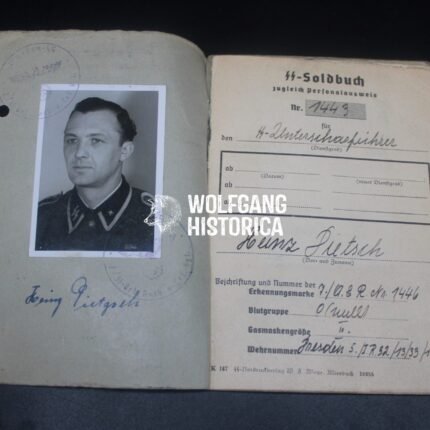
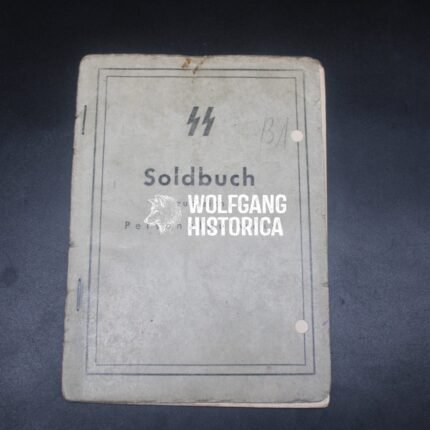
SS Soldbuch – SS-Unterscharführer 9. SS-Panzer-Division “Hohenstaufen” (KIA 1944, Operation Market Garden)
€1.895,00Original Soldbuch of SS-Unterscharführer Heinz Pietsch, a non-commissioned officer who served with the 8. Batterie / SS-Panzer-Artillerie-Regiment 9, which was part of the renowned 9. SS-Panzer-Division “Hohenstaufen.”
-
Born: 6 March 1913 in Dresden
-
Civil profession: Sattler (saddler), Polster (upholsterer), Lackierer (painter/varnisher)
-
Prior to his SS service, Pietsch appears to have served with the Polizei, reflected in his early police long-service award.
-
His Soldbuch was opened on 26 January 1943 by 7./SS-Artillerie-Ersatz-Regiment, marking his official entry into Waffen-SS artillery training.
-
He was later transferred to the 8. Batterie / SS-Panzer-Artillerie-Regiment 9, “Hohenstaufen.”
In September 1944, the division was thrown into the thick of Operation “Market Garden,” the Allied attempt to break into Germany via the Netherlands. The Hohenstaufen, alongside its sister division “Frundsberg,” played a decisive role in halting the British airborne forces at Arnhem, a dramatic battle that has since become one of the most famous engagements of the war.
During this fighting, Pietsch was severely wounded. On 29 September 1944 he was admitted to the Reserve-Lazarett Herborn (Dillkreis), but succumbed to his injuries only days later on 1 October 1944.
His Soldbuch lists the following awards:
-
Medaille zur Erinnerung an den 13. März 1938
-
Medaille zur Erinnerung an den 1. Oktober 1938
-
Spange zum Medaille zur Erinnerung an den 1. Oktober 1938
-
Polizei-Dienstauszeichnung III. Klasse
A tragic and historically important Soldbuch, directly tied to one of the pivotal battles of 1944 and to a soldier who did not survive the campaign. With clear connections to both the Polizei and the Hohenstaufen Division, this is a research-worthy and highly collectible piece for serious students of Waffen-SS and Market Garden history.
- Condition: As seen (please refer to photos)
- Complete with (top) photo – very well filled out.
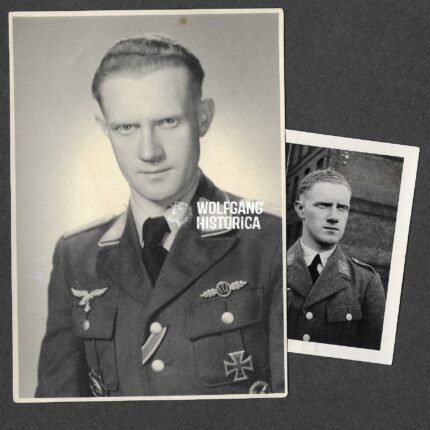
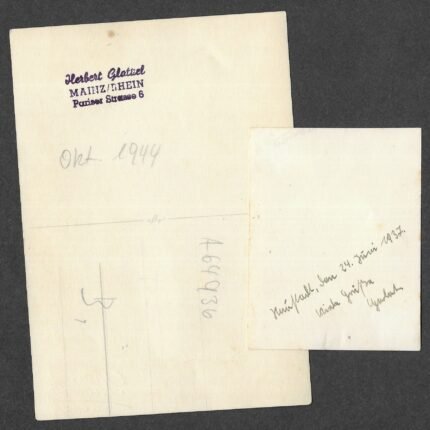
Studioportrait Luftwaffe Officer – Deutsches Kreuz in Gold
€0,01Original studio portrait of a Luftwaffe officer proudly wearing the Deutsches Kreuz in Gold. The set includes both a postcard-size photograph and a matching smaller ID-size photo, making this a fine pair for display or collection.
The officer is pictured in full uniform, with the impressive Deutsches Kreuz in Gold clearly visible on the right breast – a highly prestigious decoration awarded for repeated acts of bravery or leadership in combat.
-
Format: One postcard-size studio portrait & one smaller ID-format photo
-
Subject: Luftwaffe officer with Deutsches Kreuz in Gold and several other awards
-
Condition: As seen (please refer to photos for details)
A desirable and authentic portrait set, ideal for collectors of Luftwaffe memorabilia or award-related photography.
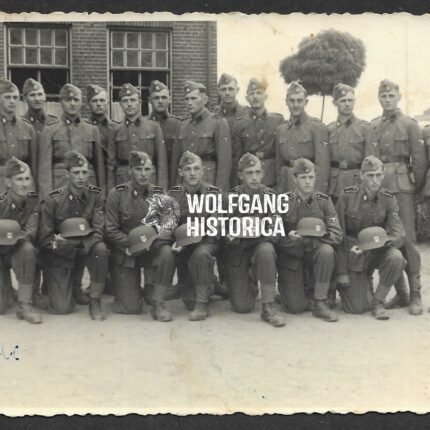
Waffen-SS Groupphoto of soldiers holding their SS Helmet!
€0,01Original Groupphoto of Waffen-SS soldiers holding their SS Helmets in a full row! TOP! Postcardsize. Condition as seen.
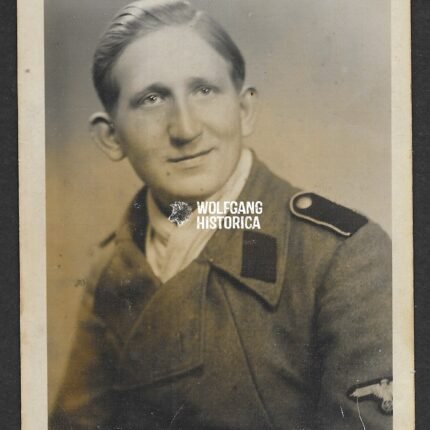
Studioportrait of a Waffen-SS soldier in StuG Uniform
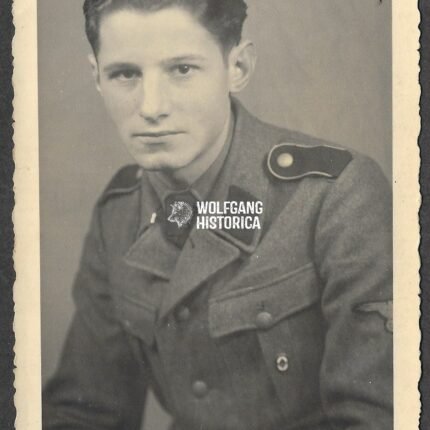
€0,01Original Studioportrait of a Waffen-SS soldier. Postcardsize. Condition as seen.
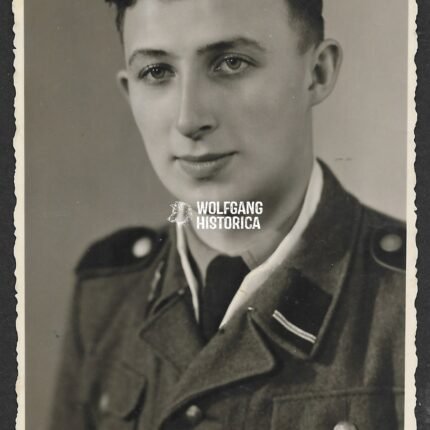
Studioportrait of a Waffen-SS soldier
€0,01Original Studioportrait of a Waffen-SS soldier. Postcardsize. Condition as seen.
Studioportrait of a Waffen-SS soldier wearing a tinnie
€0,01Original Studioportrait of a Waffen-SS soldier wearing a tinnie. Postcardsize. Condition as seen.
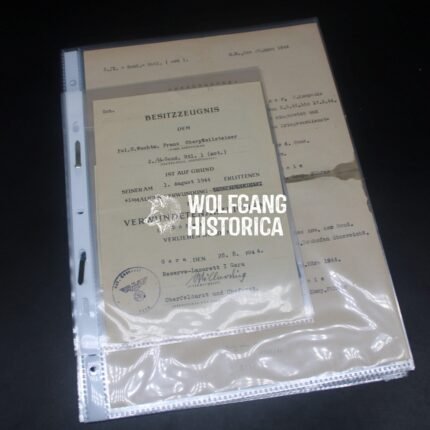
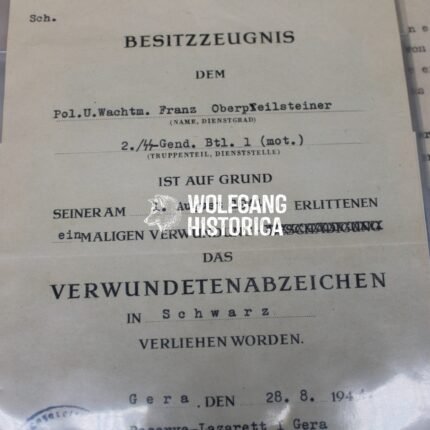
Grouping — Polizei-Unterwachtmeister in SS-Gendarmerie-Bataillon 1 (mot.) — Eastern Front Service
€350,00Recipient: Polizei-Unterwachtmeister Oberpeilsteiner
Unit: SS-Gendarmerie-Bataillon 1 (mot.) — a rarely encountered formation that saw service on the Eastern Front.
Contents
-
Award Document for the Verwundetenabzeichen in Schwarz (Wound Badge in Black), issued for his wound suffered on 1 August 1944
-
Polizei-Dienstausweis (ID booklet, photo removed)
-
Photographs (period originals)
-
Letters & Personal Papers
-
Various documents, including a paper mentioning his award of the Kriegsverdienstkreuz 2. Klasse mit Schwertern (War Merit Cross 2nd Class with Swords)
Collector’s Notes
-
Rarely encountered unit: SS-Gendarmerie-Bataillon 1 (mot.) was part of the Ordnungspolizei and Waffen-SS structure, deployed in the East for security and combat operations.
-
Grouping provides a valuable research opportunity with award papers, ID, letters, and period photographs.
-
Solid centerpiece for a specialized Polizei, SS, or Eastern Front collection.
Condition
-
As seen in photos: documents and papers show normal age-related wear; Wound Badge document well-preserved; Dienstausweis missing photo but otherwise intact.
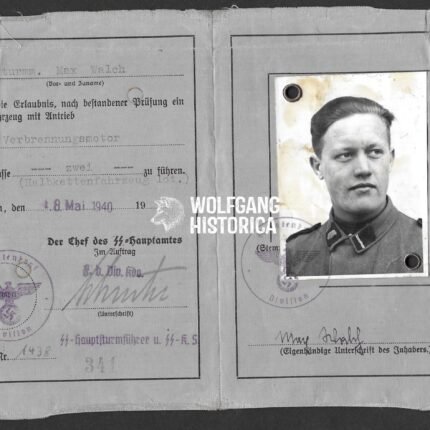
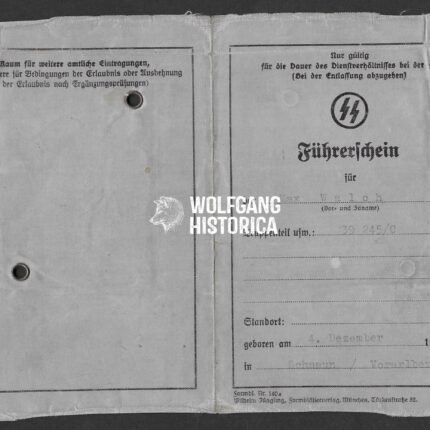
Waffen-SS Führerschein – SS-Totenkopf-Artillerie-Regiment (KIA)
€350,00Original Waffen-SS Führerschein (Waffen-SS Driver’s License) of SS-Sturmmann Max Walch serving with 2. Batterie/ SS-Totenkopf-Artillerie-Regiment of the SS-Division “Totenkopf”. Complete with a photo.
Max Walch was Killed in Action in August of 1941. See death registration card (illustation only).

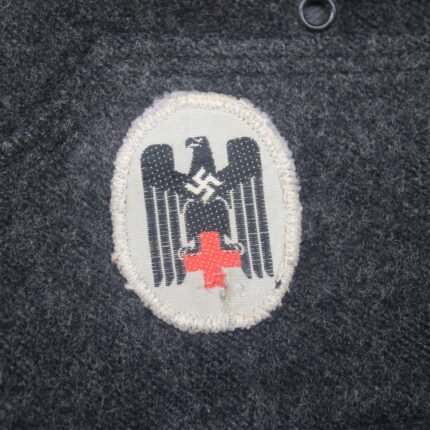
DRK (Deutsches Rotes Kreuz) 2nd Model Schiffchen — Overseas Cap
€0,01Original 2nd Model DRK overseas cap (Schiffchen), complete with its national insignia correctly applied on the side. Maker marked “3”, no size stamp present. Shows only light period wear and remains in overall very good condition — fabric strong, insignia intact.


Waffen-SS Wehrpass & Stammkarte — SS-Panzer-Artillerie-Regiment 1 “LAH” — KIA Falaise Pocket 1944
€1.450,00Recipient: SS-Sturmmann Karl Baldischwieler
Unit: 5. Batterie / SS-Panzer-Artillerie-Regiment 1 “Leibstandarte Adolf Hitler”
Division: 1. SS-Panzer-Division “LAH”
Contents
-
Original SS-Wehrpass — well-documented, includes photo
-
SS-Stammkarte
Service History
-
Training: SS-Artillerie-Ersatz-Regiment
-
Transfer: To 5./SS-Panzer-Artillerie-Regiment 1 (LAH) in June 1943
-
Campaigns:
-
Italy (1943)
-
Eastern Front (late 1943–early 1944)
-
France, Battle of Normandy (summer 1944)
-
-
Promotion: Advanced to SS-Sturmmann during combat, 21 June 1944
-
Fate: Killed in Action on 20 August 1944 near Saint-Lambert-sur-Dives during the closing stages of the Falaise Pocket
Historical Context: The Falaise Pocket
The Battle of the Falaise Pocket (August 12–21, 1944) marked the decisive end of the German presence in Normandy. Surrounded by Allied forces, elements of the 7. Armee and 5. Panzerarmee—including divisions of the Waffen-SS—were encircled near Falaise, Trun, and Chambois.
-
Over 50,000 German troops were trapped, with thousands killed and vast amounts of equipment destroyed.
-
Saint-Lambert-sur-Dives, where Baldischwieler fell, became one of the last escape corridors and saw fierce, desperate fighting as units of the LAH, Hitlerjugend, and other formations tried to break out.
-
Baldischwieler’s death on 20 August 1944 places him among those who perished in the final collapse of the German front in Normandy.
Condition
-
As seen in photos: Wehrpass complete, with photo and wartime entries.
-
Stammkarte included, further strengthening provenance.
Collector’s Notes
-
A poignant and historically significant KIA Normandy grouping tied to the elite Leibstandarte Division.
-
Direct connection to the dramatic fighting and destruction of German forces in the Falaise Pocket, one of the key turning points of the Western Front in 1944.
-
Rare opportunity to acquire an SS-Wehrpass with Normandy and Falaise attribution.