



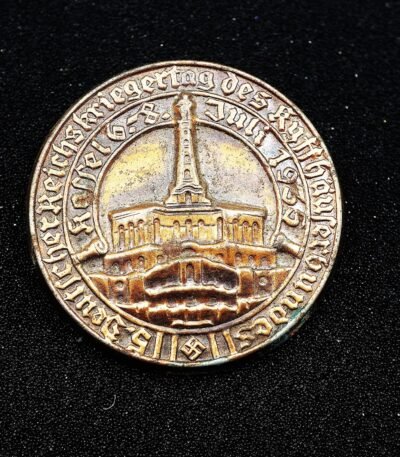
Commemorative Badge – 5th Reichskriegertag, Kassel 1935
€25,00Original commemorative badge for the 5. Deutscher Reichskriegertag des Kyffhäuserbundes, held in Kassel, Germany, from 6–8 July 1935.
The circular badge features a detailed memorial design surrounded by Gothic lettering. The reverse retains its original horizontal pin attachment.
An interesting piece of German historical event memorabilia from the 1930s, suitable for collectors of period badges and veterans’ association material.
Condition: Shows age-related wear and surface discolouration.
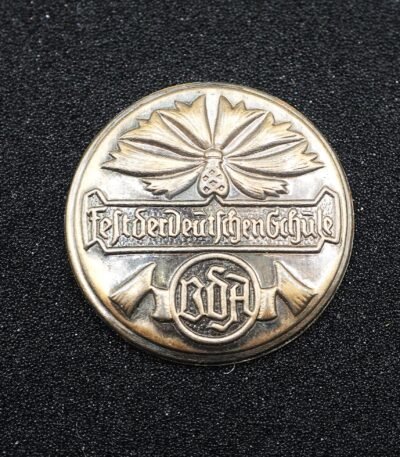
VDA – “Fest der Deutschen Schule” – German Commemorative Badge
€20,00Original German VDA (Volksbund für das Deutschtum im Ausland) “Fest der Deutschen Schule” commemorative badge from the Third Reich period.
The circular badge features a stylised flower motif above a decorative banner bearing the inscription “Fest der deutschen Schule”. The lower section displays the VDA emblem within a circular border.
The badge is made of stamped metal and retains its original horizontal pin attachment on the reverse.
Condition: Good overall appearance, with age-related wear, surface marks and some oxidation around the edges and reverse. The pin attachment is present. Please examine the photographs carefully for the exact condition.
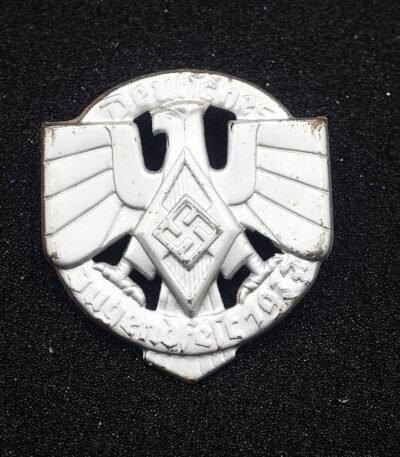
HJ Deutsches Jugendfest 1937 – Silver-Plated Event Badge
€15,00Original German Deutsches Jugendfest 1937 commemorative badge from the Third Reich period.
The badge features a prominent eagle with outstretched wings above the Hitlerjugend diamond emblem, with the inscription “Deutsches Jugendfest 1937” around the lower edge. Manufactured from stamped metal with a silver-coloured finish, it was worn as an event badge.
The reverse retains its horizontal pin attachment.
Condition: Visible oxidation, age-related wear and areas of loss to the original silver-coloured finish, particularly on the reverse. The pin is present. Please examine the photographs carefully for the exact condition.
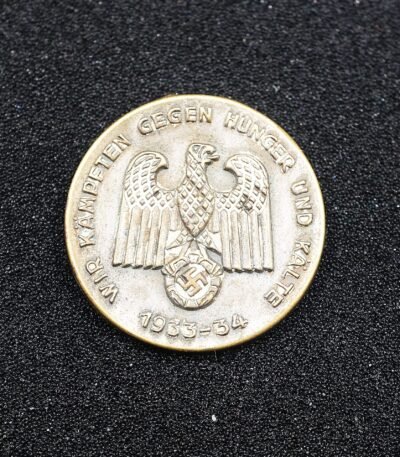
WHW Badge – „Wir kämpfen gegen Hunger und Kälte”, 1933–1934
€12,50Original Winterhilfswerk (WHW) commemorative donation badge from the first Winter Relief campaign of 1933–1934. The badge was distributed during the Reich-wide street collections (Reichsstraßensammlung) on 24–25 March 1934.
The circular, silver-toned badge features a detailed German eagle with outstretched wings and a swastika emblem. The surrounding inscription reads „Wir kämpfen gegen Hunger und Kälte“, with „1933–34“ at the bottom.
The reverse retains its original horizontal pin attachment.
An early WHW donation badge from the inaugural 1933–1934 campaign, representing an interesting addition to a collection of Third Reich-era fundraising and commemorative badges.
Condition: Visible age-related wear, surface marks and areas of discolouration.
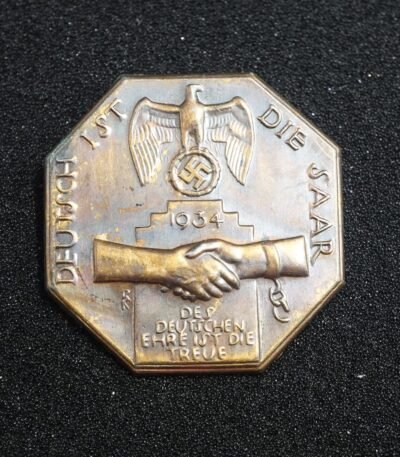
“Deutsch ist die Saar” 1934 – Saar Plebiscite Commemorative Badge
€20,00Original German commemorative badge from 1934, associated with the campaign surrounding the Saar plebiscite of 13 January 1935.
The octagonal, bronze-coloured badge features an eagle above a swastika, with two hands clasping beneath it. One wrist is shown with a broken chain, symbolising the campaign for the Saar territory to return to Germany.
The badge bears the inscriptions:
- “Deutsch ist die Saar” — The Saar is German
- “1934”
- “Des Deutschen Ehre ist die Treue” — The German’s honour is loyalty
The design is attributed to medal artist Richard Klein and features his initials, RK. The badge is made of metal and retains its original horizontal pin fastening on the reverse. The design and inscriptions are documented in the collection of the Paris Museums.
Condition: Shows age-related wear, surface scratches, oxidation and areas of finish loss. The pin fastening is present.
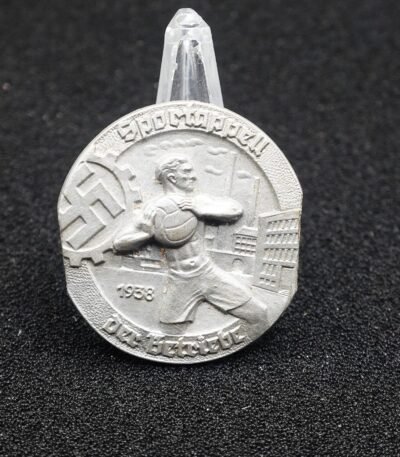
DAF Sportappell der Betriebe 1938 – German Factory Sports Badge – RZM M9/25
€20,00Original German Deutsche Arbeitsfront (DAF) “Sportappell der Betriebe 1938” commemorative badge, issued in connection with workplace sporting activities during the Third Reich period.
The circular badge depicts an athletic man holding a ball in front of an industrial factory complex. To the left is the DAF emblem, featuring a swastika within a cogwheel. The date 1938 appears below the emblem.
The reverse is marked “Richard Sieper & Söhne, Lüdenscheid” and “RZM M9/25”, identifying the manufacturer. The badge is made of period plastic and retains its original vertical pin attachment.
Condition: Shows age-related wear, surface marks and some discolouration. The reverse retains its maker’s markings and pin attachment. Please examine the photographs carefully for the exact condition. Sides seem to have received a cut.
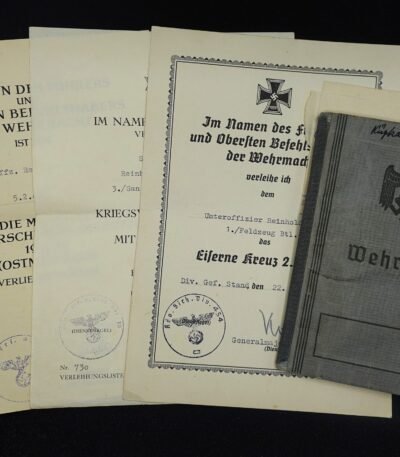
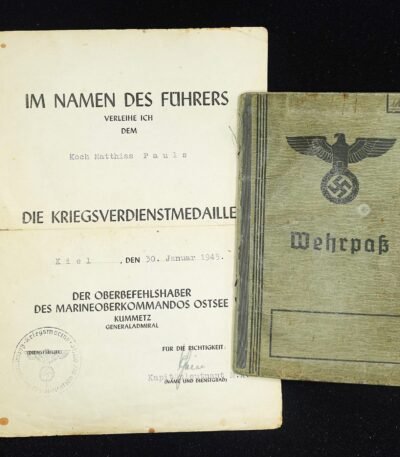
Wehrpass & Award Doc Grouping (Nice Variants!) – Sanitäts-Feldwebel – Feldzeug-Bataillon 16
€295,00A very interesting original Wehrmacht Wehrpass and award grouping belonging to Sanitäts-Feldwebel Reinhold Kupka, born 25 February 1913 in Kiel, with an extensive wartime service record, Eastern Front combat entries and several original award documents.
The Wehrpass contains an original mounted portrait photograph and Kupka’s handwritten signature, together with extensive entries documenting his military career from the pre-war period through the Second World War. His recorded civilian occupation was Kaufmann / Verkäufer.
The service entries include:
- Sanitäts-Ersatz-Abteilung 10, Neumünster
- 1. Kompanie/ Feldzeug-Bataillon 16
- Ortslazarett Neumünster (June 1945!)
The Feldzeug-Bataillon 16 was a Heerestruppe unit responsible for the maintenance, repair and distribution of military equipment. It was formed in Hamburg in October 1940 and served on the Eastern Front from 1941, including operations in southern Russia.
Eastern Front service
The Wehrpass contains particularly valuable combat entries.
- Abwehrkämpfe im Donetzbecken
- Durchbruch und Verfolgung im Donezbecken und gegen den unteren Don
- Schlacht um Rostow und Bataisk
- Verfolgung über den unteren Don und Einnahme von Krasnodar
- Durchbruchskämpfe im westlichen Kaukasus und Eroberung von Noworossijsk
- Stellungen vor Winterstellung bei Noworossijsk
These entries place Kupka’s service firmly within the major 1942 Southern Front campaign, including the advance through the Don basin and into the Caucasus region. The 16. Infanterie-Division (mot.) was operating in the southern sector during this period, advancing through Voronezh and subsequently toward the Caucasus.
Award documents
Eisernes Kreuz 2. Klasse
Awarded to Unteroffizier Reinhold Kupka, serving with 1./Feldzeug-Bataillon 16, on 22 April 1942 at the Divisional Command Post. The certificate is signed by the divisional commander and bears the original divisional seal. The document represents Kupka’s first-class combat decoration from his service on the Eastern Front.
Medaille Winterschlacht im Osten 1941/42
This original certificate records the award of the Medaille Winterschlacht im Osten 1941/42 (Ostmedaille) to Sanitäts-Unteroffizier Reinhold Kupka, dated 5 February 1943. The certificate carries the original period unit stamp and certification signature, and documents Kupka’s participation in the 1941/42 winter campaign on the Eastern Front.
Kriegsverdienstkreuz 2. Klasse mit Schwertern
Awarded to Sanitäts-Feldwebel Reinhold Kupka of 3./Sanitäts-Ersatz- und Ausbildungs-Abteilung 10, this certificate is dated Hamburg, 30 January 1945. It was issued under the authority of the Stellvertretenden Kommandierenden General des X. Armeekorps und Befehlshaber im Wehrkreis X, General der Infanterie Wilhelm Wetzel, and carries the original certification of the responsible medical officer. This late-war award adds an interesting second phase to Kupka’s military career, following his earlier Eastern Front service.
Condition: Original period condition with age toning, handling wear, staining and some wear to the Wehrpass cover and individual documents. The Wehrpass remains very well populated, with the original photograph, handwritten entries, stamps and signatures retained. The award certificates show normal age-related toning and minor handling/storage wear.
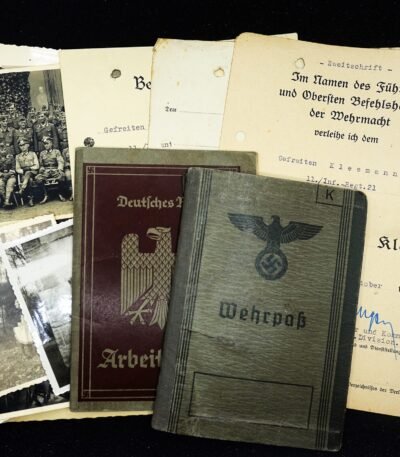
Wehrpass, 3x Award Docs & Photos – Infanterie-Regiment 21 (17. Infanterie-Division)
€250,00Offered is an original grouping belonging to Gefreiter Georg Kleemann, born 21 September 1920 in Neuenberg, Kreis Hochstadt, including his original Wehrpass with mounted portrait photograph and handwritten signature, original award documents, Arbeitsbuch, several original period photographs, and additional service paperwork. The Wehrpass provides a detailed record of his service with 11. Kompanie/ Infanterie-Regiment 21, and his participation in the opening campaign on the Eastern Front in 1941.
His combat record is particularly interesting, documenting the 7. Feldzug gegen Russland from 22 June 1941, including the fighting in the Bialystok–Slonim area, the advance through the Bialowiezer Forest, the Battle of Smolensk, fighting west of Dorogobusch, the defensive battles at Jelnja and Smolensk, and the subsequent advance toward the Desna and Ugra. The detailed typed combat insert provides an excellent contemporary record of his movements and operations with the regiment. Infanterie-Regiment 21 was part of the 17. Infanterie-Division, which entered the Eastern Front with XIII. Armeekorps and 4. Armee in June 1941.
The Wehrpass also records a wound sustained on 12 August 1941, during the fighting in the East, for which he was subsequently awarded the Verwundetenabzeichen in Schwarz. His award record further documents the Infanterie-Sturmabzeichen, Eisernes Kreuz 2. Klasse and later the Verwundetenabzeichen in Schwarz, making this a very well-documented combat record from the 1941 campaign.
Eisernes Kreuz 2. Klasse
An original Zweitschrift (second issue) of the certificate for Gefreiter Georg Kleemann, 11./Infanterie-Regiment 21, dated im Felde, den 21. Oktober 1941. The document awards the Iron Cross 2nd Class (Eisernes Kreuz II. Klasse) and bears the original divisional stamp. The certificate is signed by Generalmajor Gustav-Adolf von Zangen, Kommandeur der 17. Infanterie-Division. As this is explicitly a Zweitschrift, the later signature of von Zangen is historically consistent and should not be confused with the commander of the division at the original date of award.
Infanterie-Sturmabzeichen in Silber
The original Infanterie-Sturmabzeichen in Silber certificate was awarded to Gefreiter Georg Kleemann of 11./Infanterie-Regiment 21, dated 20 September 1941 in the field. The certificate carries the original regimental stamp and is signed by Oberstleutnant und Regimentskommandeur Theodor Preu (DKIG+RK!). The award fits directly into the documented sequence of Kleemann’s intensive frontline service during the 1941 Eastern Front campaign, shortly after the battles around Smolensk and Jelnja.
Verwundetenabzeichen in Schwarz
The original Besitzzeugnis für das Verwundetenabzeichen in Schwarz records that Gefreiter Georg Kleemann, serving with 11./Infanterie-Regiment 21, received the black grade of the Verwundetenabzeichen on the basis of a single wound sustained on 12 August 1941. The certificate was issued on 11 October 1941 and is signed by the Major und Kommandeur III./Infanterie-Regiment 21. This document is particularly interesting when paired with the Wehrpass, where the wound and subsequent award are also recorded.
Wehrpass
The original Wehrpass is the centrepiece of the grouping and retains Kleemann’s original portrait photograph and handwritten signature. It contains his personal details, service history, promotions, decorations and a highly interesting contemporary record of his 1941 combat experience. Particularly valuable is the inserted/typed combat chronology covering the 22 June 1941 invasion of the Soviet Union, the Bialystok–Slonim battles, Bialowiezer Forest, Smolensk, Jelnja, and subsequent operations toward the Desna and Ugra. The combination of the Wehrpass with the matching original award certificates makes the grouping highly researchable and gives a clear chronological picture of Kleemann’s frontline service. He was discharged as being unfit.
Additional Material
The grouping is further enhanced by an original Arbeitsbuch and a selection of period photographs, including a larger group photograph showing Kleemann and fellow servicemen, together with additional wartime photographs. These personal items provide an unusually human element to the otherwise formal military documentation and make the grouping substantially more interesting than a standalone Wehrpass or award certificate.
A very attractive named Eastern Front grouping, combining an original photographic Wehrpass, three original award documents, Arbeitsbuch and period photographs, with the 1941 combat record of 11./Infanterie-Regiment 21 documented in considerable detail.
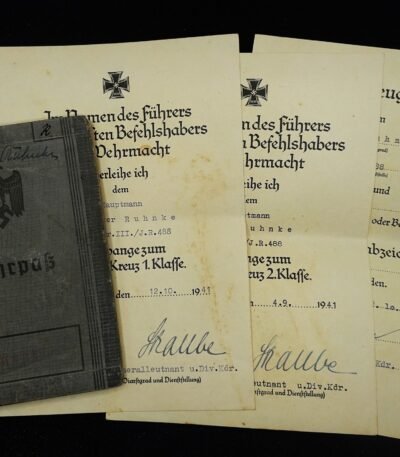
Wehrpass & Award Document Group – Hauptmann d.R. Walter Ruhnke, Infanterie-Regiment 488
€550,00A highly interesting original Wehrmacht officer grouping belonging to Hauptmann der Reserve Walter Ruhnke, commander of III./ Infanterie-Regiment 488, with his original Wehrpass & 3 award documents, including the Spangen zum Eisernen Kreuz 1. und 2. Klasse and a Verwundetenabzeichen in Schwarz for second wound!
The Wehrpass
The original Wehrpass contains a wealth of personal and military information on Hauptmann d.R. Walter Ruhnke. The pass includes an original mounted portrait photograph, his handwritten signature and extensive service entries. Of particular interest are the entries concerning his service with Infanterie-Regiment 488, part of the 268. Infanterie-Division. The regiment was formed in August 1939 and served throughout the war with the 268. Infanterie-Division. In 1941 the division took part in the opening of Operation Barbarossa, advancing through the Białystok–Minsk area, Smolensk, the Jelnya area and the fighting around Vyazma before continuing toward the Tula sector.
The Wehrpass contains numerous period entries for:
- Military service and unit assignments
- Promotions and appointments
- Training
- Decorations and awards
- Combat participation
- Transfer and reserve entries
- His eventual wartime service with III./ Infanterie-Regiment 488
The pages concerning promotions and appointments are particularly useful for reconstructing Ruhnke’s career as an officer.
Accompanying the Wehrpass is the original award certificate for Spange zum Eisernen Kreuz 2. Klasse. Hauptmann Walter Ruhnke, Stab III./J.R. 488 awarded the Spange zum Eisernen Kreuz 2. Klasse on 4 September 1941.
The certificate is signed by Generalleutnant und Divisionskommandeur Erich Straube, commander of the 268. Infanterie-Division at this time. Straube commanded the division from its formation until January 1942 and had been promoted to Generalleutnant on 1 June 1941.
Importantly, this is the Spange (1939 Wiederholungsspange) to the 1914 Iron Cross, indicating that Ruhnke was a veteran of the First World War and had already possessed the corresponding 1914 Iron Cross.
Also included is the corresponding original certificate for the Spange zum Eisernen Kreuz 1. Klasse earned on 12 October 1941. Again signed by Generalleutnant Erich Straube, as commander of the 268. Infanterie-Division.
This makes the pair especially attractive: Ruhnke received both the EK II Spange and EK I Spange during the 1941 Eastern Front campaign.
A further original Besitzzeugnis records that Hauptmann d.R. Walter Ruhnke, III./J.R. 488 was awarded the Verwundetenabzeichen in Schwarz on the basis of second wound sustained on 12 September 1941. The award was issued at Div.-Gef.-Stand, 2 October 1941 and is signed by an Oberst und Regimentskommandeur.
Eastern Front service
The dates of the decorations are particularly significant. Ruhnke’s Spange zum EK II on 4 September 1941, his two wounds on 12 September 1941, and his Spange zum EK I on 12 October 1941 all fall during the 268. Infanterie-Division’s intense fighting on the Eastern Front.
The division fought through Białystok-Minsk, Smolensk and the Jelnya area, subsequently participating in the fighting around Vyazma and advancing toward the Tula sector.
This gives the grouping a very strong combat-history connection, rather than merely representing routine administrative documents.
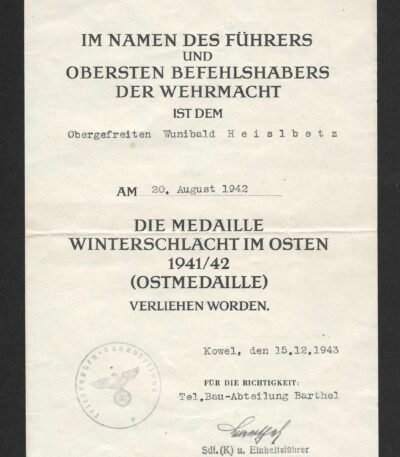
Ostmedaille 1941/42 Award Doc –Tel.-Bau-Abteilung Barthel – Kowel, 1943
€55,00Original wartime award certificate for the Ostmedaille “Winterschlacht im Osten 1941/42”, awarded to Obergefreiter Wunibald Heislbetz. The certificate records that Heislbetz was awarded the Medaille Winterschlacht im Osten 1941/42 (Ostmedaille) on 20 August 1942.
Of particular interest is the unit information: the certificate was confirmed by Tel.-Bau-Abteilung Barthel, with the document dated Kowel, 15 December 1943. The unit designation and location give this otherwise standard campaign-medal certificate a specific wartime connection to the German military communications/construction organization operating in the occupied Eastern territories.
The certificate is signed under “Für die Richtigkeit” by the unit’s Sdf. (K) und Einheitsführer, with the original unit stamp of Tel.-Bau-Abteilung Barthel. The combination of the named recipient, original unit stamp, handwritten signature and precise wartime location of Kowel makes this an interesting piece of original Eastern Front documentation.
It is also notable that although the award is recorded as having been made on 20 August 1942, the certificate itself was issued considerably later, on 15 December 1943 at Kowel. This provides an interesting example of the continued administrative processing and documentation of Ostmedaille awards well after the original award date.
Condition: Original wartime condition with a horizontal fold, light age toning, minor foxing/discoloration and general handling/storage wear. The original stamp and handwritten signature remain clearly visible, and the document is fully legible.
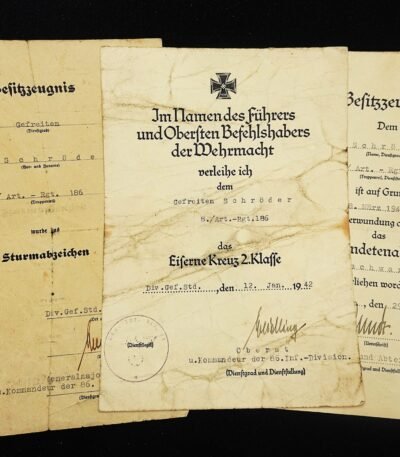
3x Award Docs – Artillerie-Regiment 186 – 86. Infanterie-Division
€135,00Excellent original award grouping belonging to Gefreiter Johann Schröder of the 8. Batterie/ Artillerie-Regiment 186 of the 86. Infanterie-Division. The grouping contains three important wartime award documents, documenting his Eisernes Kreuz 2. Klasse, Infanterie-Sturmabzeichen and Verwundetenabzeichen in Schwarz, all awarded during the 1941/42 Eastern Front campaign.
The Eisernes Kreuz 2. Klasse was awarded to Gefreiter Johann Schröder, 8./ Artillerie-Regiment 186, on 12 January 1942. The certificate bears the official divisional stamp and the original signature of Generalmajor Helmuth Weidling, Kommandeur der 86. Infanterie-Division. Weidling had assumed command of the 86. Infanterie-Division on 1 January 1942, making this an early and particularly interesting example of his signed divisional award documentation. Artillerie-Regiment 186 was the divisional artillery regiment of the 86. Infanterie-Division.
The Infanterie-Sturmabzeichen certificate was subsequently issued to Schröder of 8./ Artillerie-Regiment 186, dated 30 March 1942. It again bears the divisional stamp and the signature of Generalmajor Helmuth Weidling, as commander of the 86. Infanterie-Division. The document provides an excellent second award connection to the same soldier and regiment, making the grouping considerably more desirable than a single isolated award certificate.
The third document is the Besitzzeugnis for the Verwundetenabzeichen in Schwarz, awarded to Gefreiter Johann Schröder, 8./Artillerie-Regiment 186, following a single wound suffered on 18 March 1942. The award was issued on 29 March 1942, only eleven days after the recorded wound. The certificate is signed by a Hauptmann und Abteilungskommandeur and bears the relevant unit stamp, providing direct contemporary documentation of Schröder’s injury and subsequent wound decoration.
The unit connection is particularly interesting. Artillerie-Regiment 186 formed part of the 86. Infanterie-Division, which fought on the Eastern Front from 1941 until the division’s dissolution in November 1943. During 1941/42 the division saw heavy fighting in the central sector, including the Rzhev area. The regiment itself remained with the division throughout this period.
The three documents therefore provide a coherent chronological record of Schröder’s service: EK II in January 1942 → wound in March 1942 → Verwundetenabzeichen in Schwarz shortly afterwards → Infanterie-Sturmabzeichen in March 1942. The repeated appearance of 8./Artillerie-Regiment 186, the 86. Infanterie-Division’s official stamp and the signature of divisional commander Helmuth Weidling gives the group excellent internal consistency.
Condition: The documents are in genuine wartime condition, showing folds, creasing, age toning, foxing/discoloration and general handling/storage wear. The EK II and wound-badge certificates remain clearly legible, while the Sturmabzeichen certificate shows more pronounced creasing and age-related wear. The original stamps and signatures remain present.
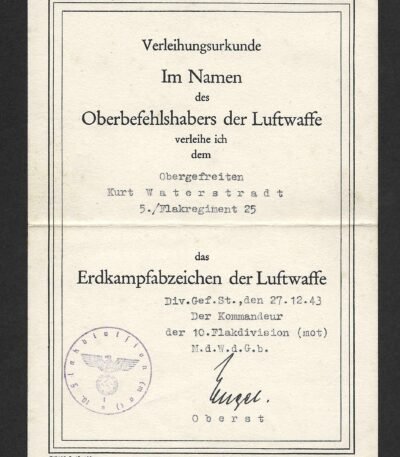
Luftwaffe Erdkampfabzeichen Award Certificate – Flak-Regiment 25 (10. Flak-Division)
€120,00Original German Verleihungsurkunde for the Erdkampfabzeichen der Luftwaffe (Luftwaffe Ground Combat Badge), awarded to Obergefreiter Kurt Vaterstradt, serving with 5. Batterie/ Flak-Regiment 25. The certificate is dated 27 December 1943 and was issued at the Divisions-Gefechtsstand of the 10. Flak-Division (mot.). It bears the original period divisional Dienstsiegel and the handwritten signature of Oberst Engel, who signed as m.d.W.d.G.b. (mit der Wahrnehmung der Geschäfte beauftragt – entrusted with the conduct of the commander’s duties).
The award is particularly interesting because the Erdkampfabzeichen der Luftwaffe was specifically intended to recognize Luftwaffe personnel who had distinguished themselves through combat employment against ground targets. It was introduced in January 1942 and could be awarded to Luftwaffe personnel who had participated in qualifying ground combat operations. This certificate therefore provides direct evidence of Gefreiter Vaterstradt’s participation in ground combat rather than purely anti-aircraft duties.
Flak-Regiment 25 was a long-serving Luftwaffe Flak formation with a distinguished combat history. Its personnel repeatedly saw their anti-aircraft artillery employed in the ground-combat role, and members of the regiment received the Erdkampfabzeichen alongside other combat decorations. Contemporary award listings, for example, document multiple members of Flak-Regiment 25 receiving the Erdkampfabzeichen in addition to their Flak and Iron Cross awards.
The 10. Flak-Division had been formed in September 1941 and fought extensively on the Eastern Front. By late 1943 its formations were involved in the defensive battles and retreats in the Ukraine, including the fighting around Kiev, Zhytomyr and Cherkasy. The division was commanded by Generalmajor Franz Engel from June 1943 onward; the certificate’s signature by Oberst Engel, m.d.W.d.G.b., is consistent with the command being exercised on behalf of the divisional commander at the time.
Condition
Original wartime certificate with a horizontal fold, light age-related toning and minor handling/storage wear. The printed text remains crisp and easily legible, while the original 10. Flak-Division Dienstsiegel and handwritten signature of Oberst Engel are clearly preserved.
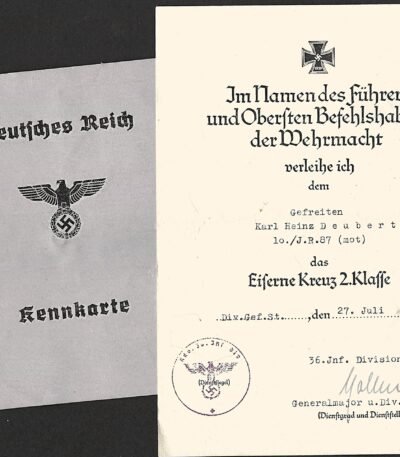
Eisernes Kreuz 2. Klasse Award Doc & Kennkarte – Infanterie-Regiment 87 – 36. Infanterie-Division (mot.)
€95,00Original wartime award document and personal identification document belonging to Gefreiter Karl Heinz Deubert, 10./ Infanterie-Regiment 87 (motorisiert), 36. Infanterie-Division (motorisiert). The Eisernes Kreuz 2. Klasse was awarded to Deubert on 27 July 1942, during the division’s prolonged fighting on the Eastern Front.
The award certificate is headed “Im Namen des Führers und Obersten Befehlshabers der Wehrmacht” and names Gefreiten Karl Heinz Deubert, 10./J.R. 87 (mot.) as the recipient. It is dated 27. Juli 1942 and bears the official divisional stamp of the 36. Infanterie-Division (mot.) together with the original handwritten signature of Generalleutnant Hans Gollnick, the division’s commander at the time. Gollnick had commanded the 36. Infanterie-Division (mot.) since October 1941 and remained its commander during the 1942 Eastern Front campaign.
Infanterie-Regiment 87 (motorisiert) was one of the principal infantry regiments of the 36. Infanterie-Division (mot.). At the time of this award, the division was fighting in the Rzhev–Bor sector under Heeresgruppe Mitte, having already taken part in the advance into the Soviet Union in 1941 and the subsequent extremely heavy defensive fighting of the winter of 1941/42. The division remained in the Rzhev area through the summer of 1942.
Accompanying the award certificate is an original German military identification document (Kennkarte) belonging to Karl Heinz Deubert, complete with his original portrait photograph, fingerprints, personal details, handwritten entries, official stamps and endorsements. This provides an unusually useful personal document to accompany the EK II certificate and firmly connects the award to an identifiable individual rather than an isolated piece of award paperwork.
Condition: The EK II certificate shows age toning, light staining and handling/storage wear, with folds and minor creasing. The accompanying Kennkarte is likewise in original used condition, with period wear, handwritten entries and official stamps. The portrait photograph and important personal information remain clearly visible.
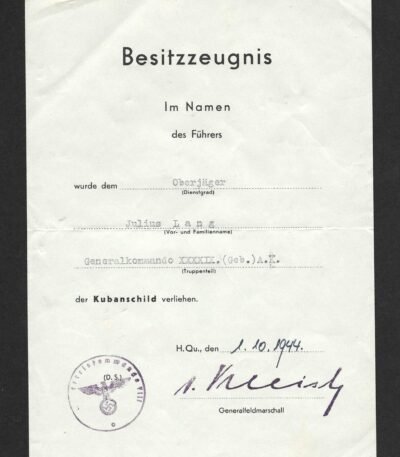
Kubanschild Award Doc – Oberjäger – XXXXIX. (Geb.) A.K. – 1 October 1944
€125,00Original German Besitzzeugnis (certificate of possession/award) for the Kubanschild (Kuban Shield), awarded to Oberjäger Julius Lang, serving with the General Command XXXXIX. (Geb.) A.K. (XXXXIX. Gebirgs-Armeekorps).
The certificate is dated 1 October 1944 and was issued “Im Namen des Führers”. It bears an original period Generalfeldmarschall signature, together with the appropriate official stamped seal.
The Kubanschild was instituted in 1943 for personnel who had taken part in the fighting around the Kuban bridgehead in southern Russia, making original award documentation particularly interesting to collectors of Ostfront, Gebirgsjäger and German award documents.
The certificate is in used original condition, with visible folds, handling marks, light staining/discoloration and age-related paper wear. The original writing, stamp and signature remain clearly visible.
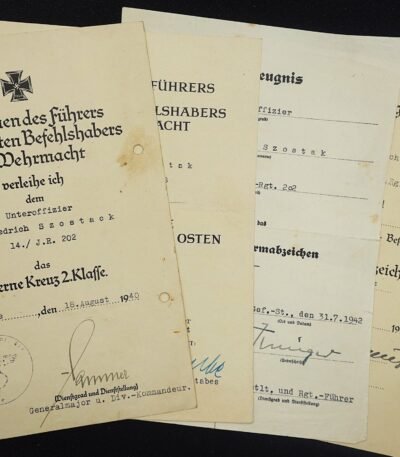
4x Award Docs – Unteroffizier – Infanterie-Regiment 202 & Grenadier-Regiment 48
€195,00Excellent original group of four wartime award documents belonging to Unteroffizier Friedrich Szostak, documenting his service and decorations from 1940–1942. The grouping includes the Eisernes Kreuz 2. Klasse, Ostmedaille 1941/42, Infanterie-Sturmabzeichen in Silber and Verwundetenabzeichen in Schwarz, providing a particularly good record of his wartime service.
The Eisernes Kreuz 2. Klasse was awarded to Unteroffizier Friedrich Szostak, 14./ Infanterie-Regiment 202, on 18 August 1940, “Im Felde.” The certificate carries the contemporary divisional stamp and the original handwritten signature of the Generalmajor und Divisions-Kommandeur Ernst Hammer. Infanterie-Regiment 202 was one of the infantry regiments of the 75. Infanterie-Division, and the division fought in the 1940 Western Campaign, including the assault against the Maginot Line, before moving east later that year.
The Ostmedaille, officially the Medaille Winterschlacht im Osten 1941/42, was awarded to Szostak on 28 July 1942. At this point the document identifies him as Unteroffizier Szostak, Stab II./Grenadier-Regiment 48. The certificate is stamped and signed by Leutnant u. Führer d. Stabes, with the handwritten notation “gez. Schroeder, Oberst”. Infanterie-Regiment 48 was redesignated Grenadier-Regiment 48 on 15 October 1942 and was part of the 12. Infanterie-Division, having fought on the Eastern Front since 1941.
The Infanterie-Sturmabzeichen in Silber was awarded to Fritz Szostak, Unteroffizier, 14./Infanterie-Regiment 202, on 31 July 1942. The certificate is signed by an Oberstleutnant und Regiments-Führer and carries the original unit stamp. Particularly interesting is the close chronology: the Sturmabzeichen was awarded only three days after the Ostmedaille certificate, while the document retains the earlier 14./Infanterie-Regiment 202 designation.
The Verwundetenabzeichen in Schwarz certificate records that Szostak suffered a single wound on 13 July 1942. The award was issued at Rothenburg/Tbr. on 16 September 1942 and is signed by an Oberstabsarzt und Chefarzt. This provides a precise date for his wound and adds an important combat element to the grouping. The document identifies him as Unteroffizier Szostak, 14. Pz. Abw. Kp. Inf.-Rgt. 202, showing his connection with the regiment’s anti-tank company at the time of the wound award.
The grouping is particularly attractive because the documents cover several stages of Szostak’s wartime service and contain multiple original signatures, unit stamps and precise dates. The combination of the EK II from 1940, the 1942 Ostmedaille, silver Infanterie-Sturmabzeichen and black wound badge provides a concise but unusually coherent record of his military career.
Condition: Original wartime condition with folds, creasing, age toning, foxing/discoloration and storage/handling wear. Several documents retain original punched filing holes, while the award certificates remain clearly legible with their original stamps and handwritten signatures preserved.
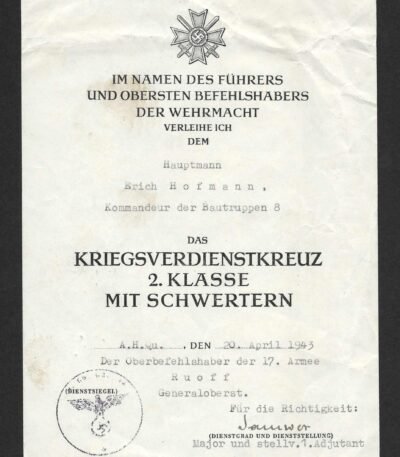
KVK2X Award Doc – Hauptmann Hofmann – Kommandeur der Bautruppen 8 (17. Armee)
€75,00Original German award certificate (Urkunde) for the Kriegsverdienstkreuz 2. Klasse mit Schwertern (War Merit Cross 2nd Class with Swords), awarded to Hauptmann Erich Hofmann, Kommandeur der Bautruppen 8. The certificate is dated A.H.Qu., 20 April 1943 and was issued in the name of the Führer and Supreme Commander of the Wehrmacht. It bears the official 17. Armee Dienstsiegel and the printed name of Generaloberst Richard Ruoff, then Oberbefehlshaber der 17. Armee, with an original certification signature by a Major und stellvertretender 1. Adjutant. Richard Ruoff commanded the 17. Armee from June 1942 until June 1943, making his appearance on this certificate fully consistent with the date.
Of particular interest is the recipient’s position as Kommandeur der Bautruppen 8. This was a Heer construction-troop command, originally designated Abschnittsbaustab 8 and redesignated Kommandeur der Bautruppen 8 in January 1940. The unit served on various fronts during the war and was employed on the Eastern Front, including under the 17. Armee during the opening stages of the campaign. By March 1943, Kommandeur der Bautruppen 8 was listed among the forces operating under the V. Armeekorps within the 17. Armee’s area of operations.
The award date is particularly interesting because Bautruppen were still a distinct Wehrmacht arm at this time. In August 1943, only a few months after this certificate was issued, the Bautruppen were transferred into the Pionierwaffe, with Kommandeur der Bautruppen 8 subsequently becoming Pionier-Regimentsstab z.b.V. 8. This places the document firmly in the final period of the Bautruppen’s independent existence and makes it an interesting piece of documentation for the German military construction organization on the Eastern Front.
Condition
Original wartime document with horizontal folding, light age-related toning, minor staining/discoloration and general handling/storage wear. The printed text remains clear, with the 17. Armee Dienstsiegel, printed Ruoff endorsement and original handwritten certification signature all clearly visible.
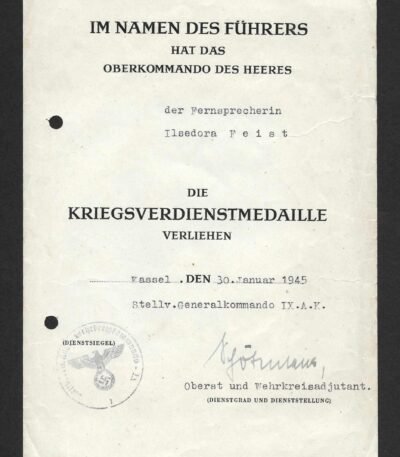
Kriegsvierdienstmedaille Award Doc – Female – Stellv. Generalkommando IX. A.K. – Kassel, 1945
€100,00Original German Verleihungsurkunde zur Kriegsverdienstmedaille, awarded to Fernsprecherin Ilsedora Feist by the Oberkommando des Heeres.
The certificate is dated Kassel, 30 January 1945 and was issued through the Stellvertretendes Generalkommando IX. A.K., making this an interesting late-war Heer document.
The Kriegsverdienstmedaille was awarded for meritorious service during the war, particularly to civilians and personnel who rendered service to the German war effort without qualifying for the military Kriegsverdienstkreuz.
Of particular interest is the recipient’s designation as Fernsprecherin (telephone operator), showing the role of women in wartime communications and support services. The certificate was issued on 30 January 1945, only a few months before the end of the war, making it a genuinely late-war award document.
Condition
Original wartime certificate with folding, creasing, light age toning and general handling/storage wear. There are two punched filing holes along the left margin. The original typed recipient information, date, official Dienstsiegel and signature remain clearly visible.
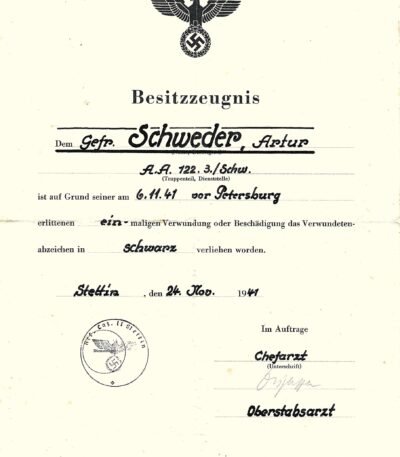
VWA Schwarz Award Doc – Aufklärungs-Abteilung 122 – WIA “vor Petersburg”
€85,00Original A4-size German Wehrmacht Besitzzeugnis for the Verwundetenabzeichen in Schwarz (Wound Badge in Black), awarded to Gefreiter Arthur Schweder, serving with 3. Schwadron/ Aufklärungs-Abteilung 122 of the 122. Infanterie-Division. The certificate records that Schweder suffered a single wound or injury on 6 November 1941 near Petersburg, and was subsequently awarded the Verwundetenabzeichen in Schwarz. The certificate was issued at Stettin on 24 November 1941 and bears the original period medical-service stamp, together with the signatures of the Chefarzt and Oberstabsarzt acting on behalf of the issuing authority.
The unit association is particularly interesting. Aufklärungs-Abteilung 122 was the divisional reconnaissance battalion of the 122. Infanterie-Division, formed in October 1940 with three squadrons. The unit went into the East with the division in June 1941 and was employed as a mobile reconnaissance formation during the advance into the Soviet Union. Contemporary unit histories record its early-war operations with the 122. Infanterie-Division, including its formation of a divisional Vorausabteilung during the opening of the campaign. The 122. Infanterie-Division itself was formed at Groß Born in Pomerania, making the later issuance of this wound certificate in Stettin especially appropriate to the division’s regional replacement and administrative connection.
Particularly notable is the precise combat notation “am 6.11.41 vor Petersburg” — placing Schweder’s wounding during the fighting in the Leningrad/Petersburg area in November 1941. As a member of a divisional reconnaissance squadron, this represents a very interesting individual document from the early phase of the 122. Infanterie-Division’s Eastern Front service.
Condition
Original large-format A4 wartime document with expected age-related toning, light foxing/discoloration, handling wear and a horizontal fold. The printed text remains very clear, while the handwritten entries, original medical-service stamp and signatures are well preserved. The large format and attractive period typography make this an especially desirable presentation piece.
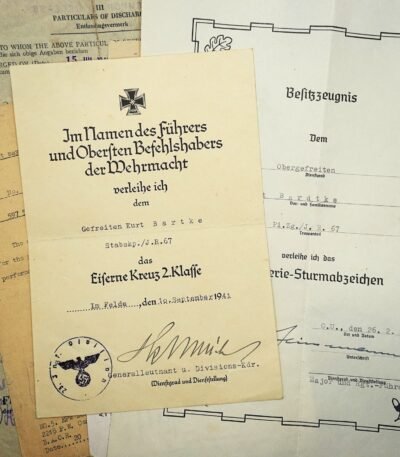
2x Award Certificates & UK POW Docs – Infanterie-Regiment 67 (23. Infanterie-Division)
€160,00Offered here is an interesting original Wehrmacht grouping belonging to Kurt Bartke, including original award certificates for the Eisernes Kreuz 2. Klasse and Infanterie-Sturmabzeichen, together with a substantial selection of original wartime and post-war documentation relating to his captivity as a German prisoner of war. The grouping provides an unusually good combination of military service, decorations and subsequent POW documentation.
The Eisernes Kreuz 2. Klasse was awarded to Gefreiter Kurt Bartke, Stabskp./J.R. 67, im Felde on 10 September 1941. The certificate is signed by the Generalleutnant und Divisions-Kdr., Heinz Hellmich, commander of the 23. Infanterie-Division at the time. Infanterie-Regiment 67 formed part of the 23. Infanterie-Division, which participated in the 1939 Polish Campaign and 1940 Western Campaign before being committed to the Eastern Front in 1941. Hellmich commanded the division from June 1940 until January 1942.
The grouping also contains the Besitzzeugnis for the Infanterie-Sturmabzeichen, awarded to Obergefreiten Kurt Bartke, Pi.Zg./J.R. 67, dated 26 February 1942. The document carries the original unit stamp and signature of a Major und Rgt.-Führer. The reference to a Pi.Zg. indicates Bartke’s association with the Pioneer Platoon of Infanterie-Regiment 67, adding a useful specialist element to his military service history.
Particularly interesting is the continuation of the grouping into the post-war period. The collection includes British/Commonwealth prisoner-of-war documentation, including a Prisoner of War Post / Kriegsgefangenenpost card addressed to his family in Berlin N 65, Amsterdammer Str. 8, as well as British POW administrative papers and discharge documentation. One of the documents records his release on 15 July 1946, demonstrating that Bartke remained in captivity well after the end of the European war.
The POW material gives this grouping considerably more personal and historical depth than a simple pair of award certificates. Together, the documents illustrate Bartke’s progression from Gefreiter to Obergefreiter, his service with Infanterie-Regiment 67, receipt of two important combat-related decorations, and ultimately his experience as a German prisoner of war and subsequent release in 1946.
Infanterie-Regiment 67 was a component of the 23. Infanterie-Division and saw extensive combat on the Eastern Front during 1941–42. The regiment later became Panzer-Grenadier-Regiment 67 in September 1942.
The documents remain in original period condition, with the expected folds, age toning, foxing, handling wear and signs of storage. Several of the later POW papers show additional British administrative stamps and annotations, while the award certificates retain their original period stamps and signatures.
A very appealing and genuinely researchable Wehrmacht grouping, combining original EK II and Infanterie-Sturmabzeichen documentation with rare and highly relevant British POW and post-war release papers. The combination of military awards and captivity documentation makes this a particularly interesting grouping for collectors of Infanterie-Regiment 67, 23. Infanterie-Division, Eastern Front material, Wehrmacht award documents and German POW history.
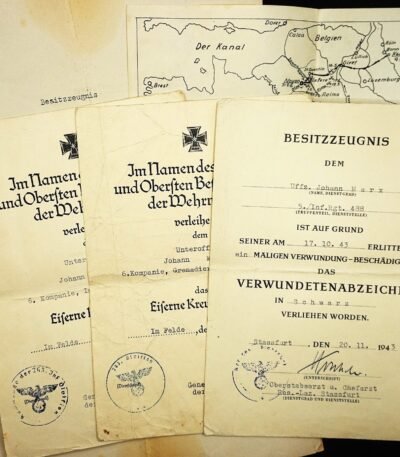
Award Document Grouping – Infanterie-Regiment 485 – 263. Infanterie-Division
€250,00Outstanding original Wehrmacht document grouping belonging to Unteroffizier Johann Marx, 6. Kompanie/ Infanterie-Regiment 485 of the 263. Infanterie-Division. The grouping follows Marx’s wartime service through his decorations, a serious combat wound, correspondence with his wife, and even includes an original campaign map showing the advance and fighting of the 263. Infanterie-Division during the 1940 Western Campaign.
The earliest award document in the group is the Besitzzeugnis for the Eisernes Kreuz 2. Klasse, awarded to Unteroffizier Johann Marx, 6./Infanterie-Regiment 485, dated 30 November 1941, “Im Felde.” The certificate bears the official divisional stamp of the 263. Infanterie-Division and the signature of Generalmajor Ernst Häckel. The 263. Infanterie-Division was already fighting on the Eastern Front in 1941, advancing through the central sector toward the Moscow area.
Also included is an original letter dated 9 December 1941, addressed to Frau Susanne Marx, informing her that the company was forwarding her husband’s newly awarded Eisernes Kreuz 2. Klasse, together with the accompanying award certificate. The letter is signed by a Hauptfeldwebel and provides an excellent personal connection to the grouping, documenting the communication between Marx’s frontline unit and his wife at home.
A further Besitzzeugnis for the Infanterie-Sturmabzeichen records the award to Unteroffizier Johann Marx, 6./J.R. 485. The certificate is signed by an Oberstleutnant und Regimentskommandeur, with the divisional stamp, and represents another important combat decoration from Marx’s service with the regiment.
Particularly significant is the Eisernes Kreuz 1. Klasse, awarded to Unteroffizier Johann Marx, 6. Kompanie, Infanterie-Regiment 485, “Im Felde,” 15 October 1943. The certificate is signed by Generalleutnant Werner Richter, Kommandeur der 263. Infanterie-Division. Richter commanded the 263. Infanterie-Division from April 1943 until he was severely wounded in May 1944, making this an especially interesting original, hand-signed divisional award document.
The grouping also contains the Besitzzeugnis for the Verwundetenabzeichen in Schwarz, awarded following a wound suffered on 17 October 1943. The document is dated 20 November 1943 and records the injury as a malige Verwundung-Beschädigung. It was issued at Stassfurt and signed by an Oberstabsarzt und Chefarzt, providing direct documentation of Marx’s combat wounding shortly after his October 1943 EK I award.
Of exceptional personal interest is the accompanying original wartime letter to Frau Susanne Marx, dated 18 May 1942, informing her that her husband had been awarded the Infanterie-Sturmabzeichen and that the accompanying award document was being forwarded to her. This adds another layer of provenance to the grouping and demonstrates that the documents were retained by Marx’s family rather than being subsequently assembled from unrelated sources.
The grouping is further enhanced by an original “Vormarsch u. Kämpfe unserer Division” map, illustrating the movements and fighting of the 263. Infanterie-Division during the 1940 Western Campaign. The map traces the division’s advance through Belgium and France, with locations including Givet, St. Quentin, Laon, Reims, Paris, Orléans, Tours and the Loire, and includes dated movement markings. The 263. Infanterie-Division took part in the Western Campaign in 1940 before remaining in France as an occupation formation until its transfer east in 1941.
Finally, the group contains a post-war medical certificate dated 24 November 1949, issued by Dr. med. Holler in Koblenz-Horchheim. This document records that Johann Marx had been under treatment from December 1943 until August 1944 in the Reserve-Lazarett Saaffig, including treatment for serious injuries sustained during his military service. Together with the wartime Verwundetenabzeichen document, it provides an unusually complete documentary trail concerning the consequences of his 1943 wounding.
Condition: The documents are in original, well-used wartime condition, showing folds, creasing, age toning, foxing, staining and handling/storage wear. Some documents have more pronounced edge wear and tears, consistent with their wartime use and subsequent preservation. The map likewise shows folds and age-related wear. The majority of the important text, stamps and signatures remain clearly legible.
A superb and highly coherent Wehrmacht document grouping, combining multiple original award certificates, frontline correspondence, a documented combat wound, an original 1940 campaign map and post-war medical documentation. The connection to the 263. Infanterie-Division and Infanterie-Regiment 485 makes this a particularly attractive grouping for collectors of named Eastern Front material and divisional documentation.
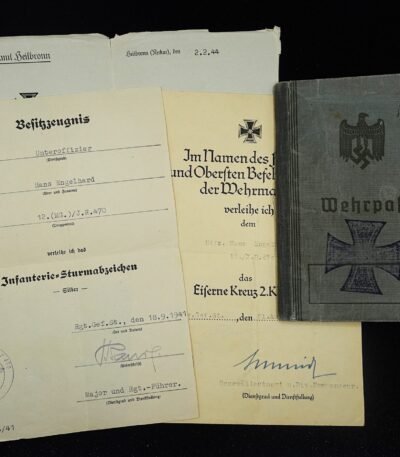
KIA Wehrpass & Award Docs – Infanterie-Regiment 470 & Werfer-Batterie/ Artillerie-Regiment 9
€265,00Offered is an exceptional original grouping belonging to Wachtmeister Hans Engelhardt, born 4 July 1912 in Heilbronn am Neckar. The centerpiece is his original Wehrpass with mounted portrait photograph and handwritten signature, accompanied by original award documents and a period Wehrmeldeamt memorial document.
His Wehrpass provides an unusually detailed record of his military career, including service with Infanterie-Regiment 470 and later 8./Artillerie-Regiment 9. Particularly interesting is his specialist training and qualification as a Werferführer, Zugführer and Batterie-Offizier, documenting his experience and responsibilities within the German Werfer arm.
His service record covers the Polish Campaign of 1939, the Western Campaign of 1940, and extensive combat service on the Eastern Front. The combat entries include the breakthrough on the Aisne Front, the advance through Luxembourg, Belgium and northern France, and later operations in southern Russia, including the advance toward Rostov and Bataisk, the pursuit across the lower Don and Kuban, the advance through the western Caucasus and fighting around the Kuban bridgehead.
Of particular interest is his later service with 8./Artillerie-Regiment 9. Following the regiment’s reorganisation on 19 May 1942, two Werfer batteries from Werfer-Ersatz-Abteilung 11 in Münster were incorporated into Artillerie-Regiment 9 as its new 7. and 8. Batteries. Engelhardt subsequently served with 8./Artillerie-Regiment 9, while his Wehrpass records specialist qualifications as Werferführer, Zugführer and Batterie-Offizier. This gives the grouping an especially interesting connection to the German Werfer/Nebelwerfer arm, combined with documented frontline service.
The Wehrpass further records a notable series of decorations, including the Eisernes Kreuz 2. Klasse, Infanterie-Sturmabzeichen in Silber, Eisernes Kreuz 1. Klasse, Verwundetenabzeichen in Schwarz and Verwundetenabzeichen in Silber. The combination of these awards, his specialist Werfer qualifications and his extensive combat history makes the Wehrpass particularly rewarding to study.
Tragically, Engelhardt was ultimately killed in action, with the Wehrpass recording Granatsplitter in der Brust – a shrapnel fragment wound to the chest. The accompanying “Zum bleibenden Andenken” document issued by the Wehrmeldeamt Heilbronn in February 1944 provides a directly connected contemporary memorial document and adds a particularly personal dimension to the grouping.
Award documents
Eisernes Kreuz 2. Klasse
The original Eisernes Kreuz 2. Klasse certificate was awarded to Unteroffizier Hans Engelhardt of 12./J.R. 470, dated 21 August 1941 at the Divisional Command Post. The certificate bears the original period divisional stamp and the signature of the divisional commander. This award corresponds directly with the Wehrpass entry and documents Engelhardt’s service during the opening phase of the German campaign in the East.
Infanterie-Sturmabzeichen in Silber
The original Infanterie-Sturmabzeichen in Silber certificate was awarded to Unteroffizier Hans Engelhardt of 12./J.R. 470 at the Regiments-Gefechtsstand on 18 September 1941. It bears the original regimental stamp and is signed by the Major und Regimentsführer. Together with the EK II certificate and the detailed combat entries in the Wehrpass, this document provides strong evidence of Engelhardt’s active frontline service during the 1941 campaign.
Wehrmeldeamt Memorial Document
Also included is the original “Zum bleibenden Andenken” memorial document issued by the Wehrmeldeamt Heilbronn, dated 2 February 1944, commemorating Wachtmeister Hans Engelhardt, geboren am 4.7.12. The document states that Engelhardt had died in the fulfilment of his duties and was sent to Herrn Johann Engelhardt, Heilbronn a.N. It carries the original Wehrmeldeamt Heilbronn stamp and the signature of a Hauptmann. As a contemporary official memorial document directly connected to the named Wehrpass, it adds a very personal and historically significant element to the grouping.
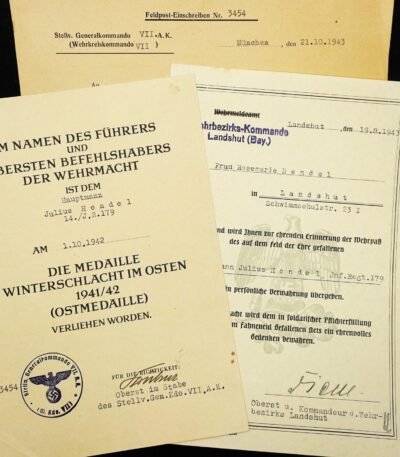
Posthumous Ostmedaille Award Doc – Hauptmann – Infanterie-Regiment 179, KIA 1942
€85,00Offered here is a very interesting original group of posthumous Wehrmacht documents belonging to Hauptmann Julius Hendel of 14./ Infanterie-Regiment 179, who was killed in action on 14 February 1942. The grouping contains the original Ostmedaille award certificate, a period official letter forwarding the medal and certificate to his widow, and a Wehrmeldeamt memorial document concerning the transfer of his Wehrpass to his family.
The Ostmedaille, officially the Medaille Winterschlacht im Osten 1941/42, was awarded posthumously to Hauptmann Julius Hendel, 14./J.R. 179, with the certificate dated 1 October 1942. The document is explicitly issued in the name of the Führer and Supreme Commander of the Wehrmacht and records that Hendel was awarded the medal after his death. The certificate bears the original official stamp and certification of the Stellvertretendes Generalkommando VII. Armeekorps / Wehrkreiskommando VII.
Particularly poignant is the accompanying official Feldpost-Einschreiben Nr. 3454, dated Munich, 21 October 1943, addressed to Frau Rosemarie Hendel, Landshut/B. The letter states that the posthumously awarded Ostmedaille together with its certificate is being sent to her „zum stolzen Gedenken“ to her fallen husband. It explicitly notes that the decoration is intended as a souvenir of remembrance and is not to be worn by relatives. The document is signed “Im Auftrage” on behalf of the Stellvertretendes Generalkommando VII. A.K.
Also included is an original Wehrbezirks-Kommando Landshut memorial document dated 19 August 1943, addressed to Frau Rosemarie Hendel at Schwimmschulstr. 23 I, Landshut. It states that the Wehrpass of the fallen Hauptmann Julius Hendel, Inf.-Regt. 179, is being forwarded to her for personal safekeeping. The document carries the official Wehrbezirks-Kommando stamp and the signature of the Oberst und Kommandeur des Wehrbezirks Landshut.
The military context is particularly interesting. Infanterie-Regiment 179 was originally part of the 57. Infanterie-Division and fought on the Eastern Front from June 1941. During the winter of 1941/42 the division was engaged in heavy defensive fighting in the Belgorod–Kharkov sector; in February 1942, the regiment was detached and exchanged with Infanterie-Regiment 164 of the 62. Infanterie-Division. This places Hendel’s death firmly within the severe winter fighting on the Eastern Front.
The grouping is preserved in original period condition, showing the expected folds, age toning, foxing, discoloration and handling/storage wear. The documents retain their original stamps, signatures and official formatting.
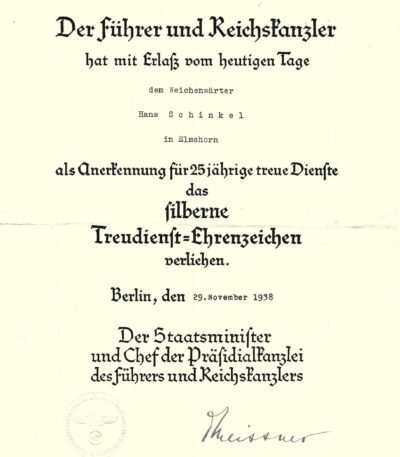
Silbernes Treudienst-Ehrenzeichen Award Doc – 25 Years Faithful Service – Elmshorn, 1938
€45,00Offered here is an original 1938 award certificate for the Silberne Treudienst-Ehrenzeichen, awarded in recognition of 25 years of faithful service to Weichenwärter Hans Schinkel in Elmshorn. The certificate is dated Berlin, 29 November 1938 and records that, by an official decree of the Führer and Reich Chancellor, Schinkel was awarded the Silver Faithful Service Decoration.
Hans Schinkel is identified by his occupation as a Weichenwärter (railway pointsman/switchman), making this an interesting piece of German railway and Reichsbahn-related social history. The award was specifically intended to recognize long and faithful service, and the 25-year qualification demonstrates a substantial period of employment before the certificate was issued in 1938.
The beautifully printed certificate bears the formal heading “Der Führer und Reichskanzler” and features the large Gothic lettering characteristic of official Third Reich award documents. At the bottom is the designation of the Staatsminister und Chef der Präsidialkanzlei des Führers und Reichskanzlers, with the facsimile signature of Dr. Otto Meissner, together with the official embossed seal.
The 29 November 1938 date places the document firmly in the pre-war period, making it particularly appealing to collectors interested in German civil service, railway history, long-service decorations and Third Reich-era award documentation.
The certificate remains in original period condition, with a horizontal fold across the centre, light age toning and minor handling/discoloration consistent with its age. The embossed seal and printed details remain clearly visible.
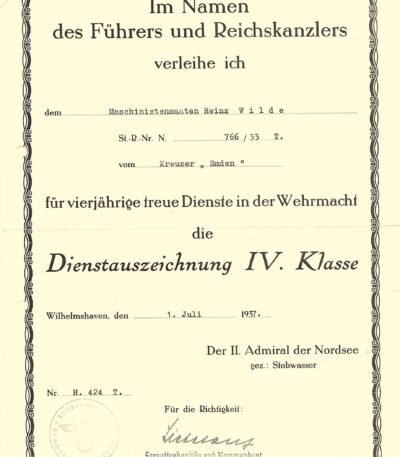
WH Dienstauszeichnung IV. Klasse – Kriegsmarine – Kreuzer „Emden“ – 1937
€75,00Original German award certificate for the Dienstauzeichnung IV. Klasse, issued to Maschinistenmaat Heinz Wilde, who served aboard the light cruiser „Emden“ of the Kriegsmarine. Signed by the Fregattenkapitän und Kommandant Kreuzer „Emden“ Bernhard Liebetanz.
The certificate was awarded “für vierjährige treue Dienste in der Wehrmacht” — for four years of faithful service in the Wehrmacht.
The certificate is particularly interesting because it is directly associated with the light cruiser Emden, one of the most famous ships of the interwar German Kriegsmarine. The recipient, Heinz Wilde, is specifically identified as a Maschinistenmaat, giving the document a nice personnel connection to the ship’s engineering/technical branch.
The award was issued in Wilhelmshaven on 1 July 1937, during the pre-war period of the Kriegsmarine, making this a pre-WWII document and an excellent example of the formal award documentation used by the German Navy before the outbreak of the war.
Condition
Original period document with horizontal folding, light age-related discoloration and handling/storage wear. The original printed text, typed recipient details, signatures and Kriegsmarine Dienstsiegel remain present.
A very attractive original Kriegsmarine document with a named connection to the cruiser „Emden“, suitable for collectors of Kriegsmarine, naval documents, pre-war German military awards and „Emden“ memorabilia.
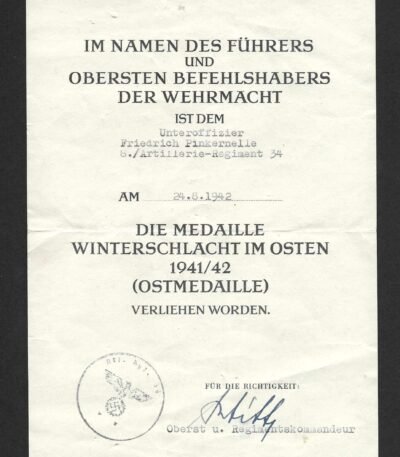
Ostmedaille 1941/42 Award Doc – Unteroffizier – Artillerie-Regiment 34
€45,00Original wartime Besitzzeugnis for the Ostmedaille “Winterschlacht im Osten 1941/42”, awarded to Unteroffizier Friedrich Pinkenelle of the 6. Batterie, Artillerie-Regiment 34. The certificate records that the medal was awarded on 24 August 1942, for participation in the severe winter campaign on the Eastern Front during 1941/42.
Artillerie-Regiment 34 was the divisional artillery regiment of the 34. Infanterie-Division, which fought on the Eastern Front during the 1941/42 winter campaign, including the difficult defensive fighting in the Moscow/Juchnow sector.
The certificate bears the official divisional/unit stamp together with an original handwritten signature “Für die Richtigkeit” by an Oberst und Regimentskommandeur. This gives the document additional interest as a regimental-level award certificate, rather than simply a generic post-war confirmation.
The Ostmedaille, officially titled the Medaille Winterschlacht im Osten 1941/42, was introduced to recognize personnel who had served in the campaign during the exceptionally difficult winter conditions on the Eastern Front. This example was awarded in August 1942 and therefore represents contemporary documentation from the period when the decoration was being actively issued to veterans of the 1941/42 winter campaign.
Condition: Original wartime condition with a horizontal fold, additional light creasing, age toning and minor handling/storage wear. The certificate remains clean and fully legible, with the original unit stamp and handwritten signature clearly preserved.
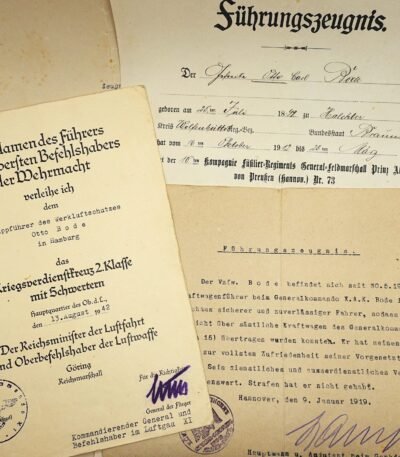
KVK2X Award Doc – Truppführer Werkluftschutz & WWI Docs – Hamburg
€70,00A particularly attractive documentary grouping relating to Otto Carl Bode, showing his military and wartime service from the Imperial German Army in 1914 through his service in the Werkluftschutz during the Second World War.
The grouping consists of three original documents:
1. Führungszeugnis – 1914
An original Führungszeugnis (Certificate of Conduct) for: Gefreiter Otto Carl Bode born 25 July 1892 at Halchter, Kreis Wolfenbüttel, Braunschweig. The document records his service with the: 10. Kompanie, Füsilier-Regiment „General-Feldmarschall Prinz Albrecht von Preußen“ (Hannoversches) Nr. 73
Bode served from 16 October 1912 until 25 March 1914 and is described as having conducted himself well during his period of service.
The certificate is dated: Hannover, 7 July 1914 and is particularly interesting because it was issued by the Generalkommando X. Armeekorps, with the document signed by Oberst Freiherr von der Wenge Graf von Lambsdorff, then Chief of the General Staff of X. Armeekorps. Contemporary records confirm Lambsdorff held this position from 1912 and was the corps’ Chief of Staff at the outbreak of the First World War.
The document also carries the impressive original Generalkommando X. Armeekorps seal.
2. Führungszeugnis – 1919
A second original Führungszeugnis, dated: Hannover, 9 January 1919
This document concerns Vizefeldwebel Bode, who had been employed as a Kraftwagenführer (motor vehicle driver) with the Generalkommando X. A.K. The certificate describes Bode as a safe, reliable and dependable driver, entrusted with supervision of approximately 15 motor vehicles belonging to the General Command. It further states that his service was performed to the complete satisfaction of his superiors and that his conduct both on and off duty was commendable, with no disciplinary punishments recorded.
This is an excellent document for demonstrating the progression of Bode’s career from enlisted infantryman before WWI to Vizefeldwebel and motor transport specialist by the end of the war.
3. Kriegsverdienstkreuz 2. Klasse mit Schwertern – 1942
The third document takes the story forward almost three decades. An original award certificate for: Truppführer des Werkluftschutzes Otto Bode, Hamburg awarding him the: Kriegsverdienstkreuz 2. Klasse mit Schwertern. Dated: Hauptquartier des Ob.d.L., 13 August 1942. The certificate bears the printed/facsimile signature of Hermann Göring, Reichsmarschall, and the document was certified “Für die Richtigkeit” by the General der Flieger, Kommandierender General und Befehlshaber im Luftgau XI.
At this time the Luftgau XI command was held by General der Flieger Ludwig Wolff, who commanded Luftgau XI from 1939 until 1945. Contemporary documentation also confirms Wolff’s role as Kommandierender General und Befehlshaber im Luftgau XI.
A superb career grouping
What makes this group particularly desirable is the continuity of the individual:
1912–1914 – Gefreiter, Füsilier-Regiment Nr. 73
↓
1914 – Führungszeugnis immediately before the First World War
↓
1919 – Vizefeldwebel and Kraftwagenführer with Generalkommando X. A.K.
↓
1942 – Truppführer des Werkluftschutzes in Hamburg
↓
1942 – Awarded the Kriegsverdienstkreuz 2. Klasse mit Schwertern
The documents therefore provide a remarkably personal record of Otto Carl Bode’s military career across Imperial Germany, the First World War and the Second World War, rather than being unrelated individual certificates.
The combination of an original Imperial German 1914 service document signed by Lambsdorff, the 1919 post-WWI Führungszeugnis, and a 1942 KVK II with swords connected to Luftgau XI and Ludwig Wolff makes this a particularly attractive documentary grouping for the specialist collector.
Condition:
All documents show age-related toning, foxing/spotting and folds consistent with their age. The documents remain fully legible, with the important signatures, stamps and official seals clearly present. The 1914 document has particularly attractive period folding and ageing.
A genuinely interesting multi-period German military document group with strong personnel continuity and excellent research potential.
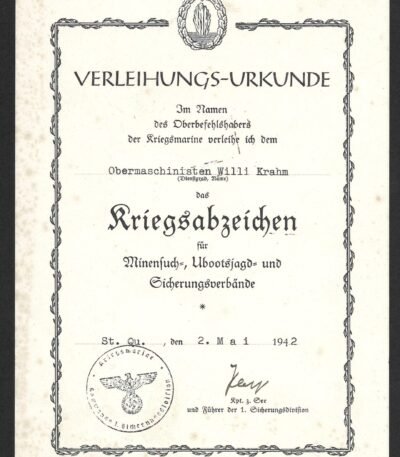
Kriegsmarine Minesweeper War Badge Certificate – 1942 – 1. Sicherungs-Division (Netherlands)
€120,00Original WWII Kriegsmarine award certificate (Verleihungs-Urkunde) for Obermaschinist Willi Krahm, awarding him the War Badge for Mine-Sweeping, U-Boat Hunting and Security Forces (Kriegsabzeichen für Minensuch-, U-Boots-Jagd- und Sicherungsverbände).
The certificate is dated St. Qu. (Stab/Station Quarter), 2 May 1942 and was issued in the name of the Commander-in-Chief of the Kriegsmarine.
The document bears the original Kriegsmarine stamp and a period signature of Kpt. z. See and Führer der 1. Sicherungsdivision Joachim Plath.
A very attractive and historically interesting Kriegsmarine award document, particularly suitable for collectors of German naval awards, Minesweeping and Security Forces, or named WWII military documents.
Condition: Good original wartime condition, with light age toning, handling/storage wear and minor marks. The document remains fully legible, with the original printing, stamp and signature intact. A5 size.
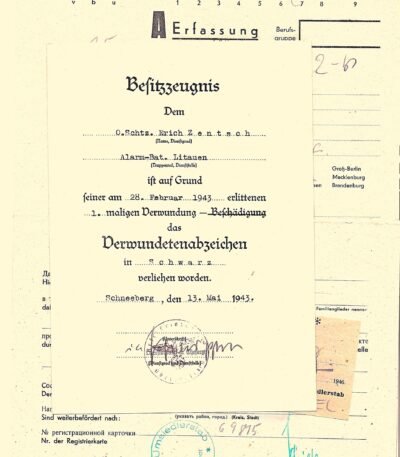
VWA in Schwarz Award Doc – Alarm-Bataillon Litauen – 1943
€55,00Original WWII German Besitzzeugnis for the Verwundetenabzeichen in Schwarz, awarded to Oberschütze Erich Zentsch, serving with Alarm-Bataillon Litauen.
The certificate states that Erich Zentsch was awarded the Verwundetenabzeichen in Schwarz on the basis of a single wound/injury sustained on 28 February 1943.
The document is especially interesting due to the Alarm-Bataillon Litauen connection. Such certificates are an excellent way of documenting the individual service and wartime history of a particular recipient, while the specific unit designation gives the piece additional research potential.
The certificate comes together with soem more original administrative/registration documents, which contains later post-war entries and stamps. This provides an interesting additional provenance element and shows that the document remained with the recipient’s personal paperwork after the war.
Condition: Original period condition with age toning, folds and handling/storage wear. The original ink signature and official stamp remain clearly visible. No restoration or cleaning has been undertaken.
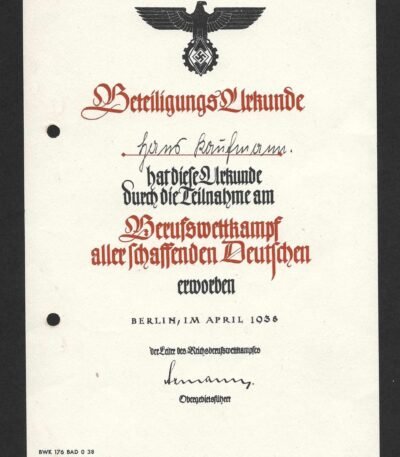
1938 Beteiligungs-Urkunde – Reichsberufswettkampf aller schaffenden Deutschen
€30,00Original Beteiligungs-Urkunde for participation in the Reichsberufswettkampf aller schaffenden Deutschen (National Vocational Competition of all Working Germans), issued in Berlin in April 1938. The certificate is beautifully printed in the characteristic period Gothic style and records that the named recipient had earned the document through participation in the Reichsberufswettkampf aller schaffenden Deutschen.
The document is print signed by Obergebietsführer Artur Axmann, who served as Leiter des Reichsberufswettkampfes. Contemporary sources identify Axmann as the head of the Reichsberufswettkampf in 1938, and contemporary reporting confirms that the 1938 competition was expanded beyond the earlier youth competitions to encompass the wider working population.
The Reichsberufswettkampf was a large-scale vocational competition organized jointly through the Deutsche Arbeitsfront (DAF) and Hitlerjugend (HJ) structures. It was intended to test and promote vocational skills and performance, with competitions progressing through local, Gau and Reich levels. By 1938 the event had developed into a major nationwide competition involving workers from numerous professions.
Particularly interesting is the April 1938 date, placing the certificate at the height of the Reichsberufswettkampf’s development under Axmann. The 1938 Reich competition culminated in Hamburg, where the winners were announced and the specially produced certificates and winner badges were presented. Contemporary reports specifically identify Obergebietsführer Axmann as Leiter des Reichsberufswettkampfes.
Condition
Original period document with two filing holes along the left edge, light age-related toning and minor handling/storage wear. The attractive printed design remains very well preserved, with the original handwritten recipient entry and Axmann signature clearly visible.
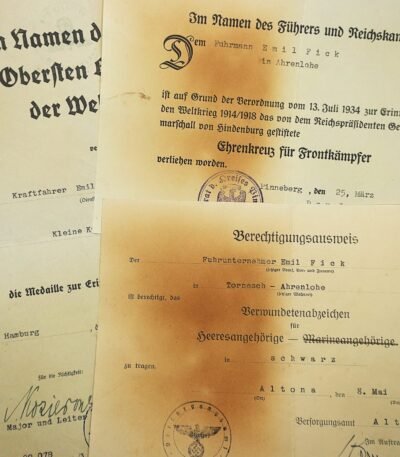
3x Award Docs – Kraftfahrer (Kleine Kw. Kol. 5/30) – Sudetenland & WWI – Ahrenlohe
€65,00Offered here is an interesting group of original German award and service documents belonging to Kraftfahrer Emil Fick of Ahrenlohe, documenting his military-related service and awards from the mid-1930s through the pre-war period. The grouping includes the Ehrenkreuz für Frontkämpfer, a Berechtigungsausweis for the Verwundetenabzeichen in Schwarz, and a 1940 award certificate for the Medaille zur Erinnerung an den 1. Oktober 1938, providing a useful chronological record of Fick’s service.
The earliest document is an original Ehrenkreuz für Frontkämpfer award certificate dated Pinneberg, 25 March 1935, issued to Kraftfahrer Emil Fick in Ahrenlohe. The certificate states that, on the basis of the decree of 13 July 1934, he was awarded the Ehrenkreuz für Frontkämpfer, the commemorative decoration established by Reich President and Generalfeldmarschall Paul von Hindenburg in remembrance of German participation in the First World War. This establishes Fick as a documented WWI front-line veteran.
Also present is an original Berechtigungsausweis dated Altona, 8 May 1936, granting Fuhrunternehmer Emil Fick of Tornesch-Ahrenlohe the right to wear the Verwundetenabzeichen für Heeresangehörige / Marineangehörige in Schwarz. Issued by the Versorgungsamt Altona, this is an important piece of supporting documentation showing that Fick was officially entitled to wear the black grade of the German Wound Badge. Together with his 1935 Frontkämpfer Cross, it provides further evidence of his First World War service and veteran status.
The final and particularly interesting document is an original 1940 award certificate for the Medaille zur Erinnerung an den 1. Oktober 1938, commonly known as the Sudetenland Medal. The certificate records Kraftfahrer Emil Fick, serving with Kleine Kw. Kol. 5/30, and is dated Hamburg, 5 April 1940. The award commemorated German participation in the occupation of the Sudeten territories following the Munich Agreement and subsequent events of October 1938. The certificate was issued through the Wehrkreis X command structure and bears the original official stamp and issue of Generalleutnant Lücke.
The reference to Kleine Kw. Kol. 5/30 (Kleine Kraftwagen-Kolonne) is particularly interesting, as it places Fick in a specifically identified motor transport unit rather than simply recording him as a generic civilian or veteran. His occupation as Kraftfahrer also fits naturally with this motor-transport assignment, giving the group a useful connection between his civilian occupation and his military service.
The documents remain in original period condition, with folds, age toning, foxing/discoloration and general handling wear consistent with their age. The original official stamps and signatures remain clearly visible, and the documents retain their attractive period typography and presentation.
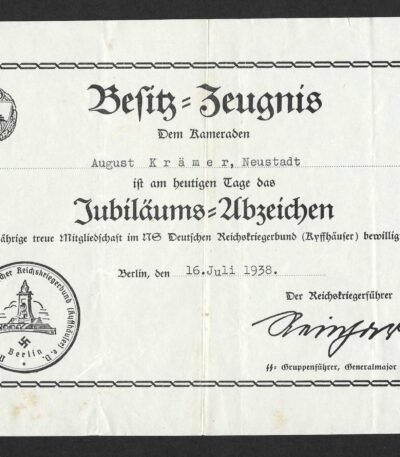
1938 Jubiläums-Abzeichen Certificate – 25 Years’ Membership, NS Deutscher Reichskriegerbund (Kyffhäuser)
€25,00Original German Besitz-Zeugnis / award certificate for the Jubiläums-Abzeichen für 25-jährige treue Mitgliedschaft im NS Deutschen Reichskriegerbund (Kyffhäuser), awarded to August Krämer, Neustadt. The certificate is dated Berlin, 16 July 1938 and formally records that Krämer had been granted the Jubiläums-Abzeichen for 25 years of faithful membership in the NS Deutscher Reichskriegerbund (Kyffhäuser).
The document is particularly interesting because 25 years of continuous membership places the beginning of Krämer’s membership at approximately 1913, meaning his association with the Kyffhäuser veteran organization predates the First World War. The certificate therefore represents not simply a Third Reich-era membership award, but a document reflecting a veteran’s long-standing pre-1914 connection with the German veterans’ movement.
The certificate bears the official Kyffhäuserbund Berlin seal and the impressive signature of SS-Gruppenführer and Generalmajor a.D. Wilhelm Reinhard, identified here as Der Reichskriegerführer. Reinhard served as Reichskriegerführer of the NS Deutscher Reichskriegerbund (Kyffhäuser), making his signature particularly appropriate and desirable on this type of certificate.
The NS Deutscher Reichskriegerbund (Kyffhäuser) was the National Socialist-era successor organization of the long-established German veterans’ association movement. By 1938 it represented a very large membership of former German servicemen and veterans and incorporated the traditions of the older Kyffhäuserbund into the National Socialist state. The Jubiläums-Abzeichen recognized long periods of continuous membership, making 25-year examples especially interesting because they necessarily document membership originating during the Kaiserreich era.
Condition
Original large-format certificate with central vertical folding, additional horizontal folding, light age-related toning, foxing/discoloration and general handling/storage wear. The elaborate printed border and typography remain attractive, while the original Kyffhäuserbund seal and Reinhard signature are clearly visible.
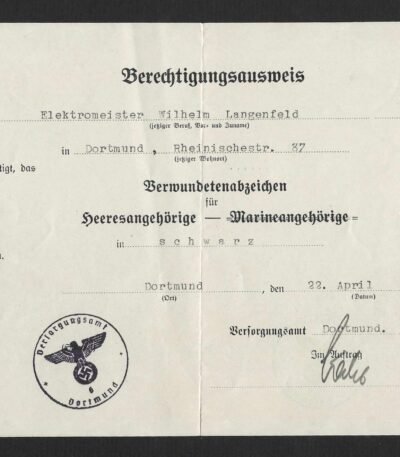
WWI Veteran’s Verwundetenabzeichen Berechtigungsausweis 1937 – Dortmund
€25,00Original German Berechtigungsausweis authorizing Elektromeister Wilhelm Langenfeld, residing at Rheinische Str. 87, Dortmund, to wear the Verwundetenabzeichen in Schwarz (Wound Badge in Black). The document was issued by the Versorgungsamt Dortmund on 22 April 1937 and bears the original official Versorgungsamt Dortmund Dienstsiegel and handwritten authorization signature.
Importantly, this is not a 1937 wartime award. The Verwundetenabzeichen had originally been instituted on 3 March 1918 during the First World War, and this 1937 document represents a later official recognition of the recipient’s entitlement to wear the WWI wound badge. Following the introduction of new regulations in 1936, German Versorgungsämter were authorized to issue such Berechtigungsausweise to WWI veterans who could establish their entitlement, including through military documentation.
The document therefore most likely represents Wilhelm Langenfeld’s WWI veteran status and wartime wounding, with the 1937 certificate serving as the official authorization to wear the black grade of the Imperial German Verwundetenabzeichen. The wording “für Heeresangehörige – Marineangehörige” is printed on the form, while the actual entitlement is specifically entered as “in schwarz.”
This type of document is an interesting example of how the German authorities dealt with First World War veterans nearly two decades after the end of the conflict. The 1936 regulations specifically provided for the issuance of Berechtigungsausweise where an original possession certificate or appropriate military record was unavailable, and such documents are therefore an important part of the post-WWI administrative history of the Verwundetenabzeichen.
Condition
Original 1937 document with a central vertical fold, additional light folding, age-related toning and minor handling/storage wear. The original Dortmund Versorgungsamt stamp and handwritten signature remain clearly visible.
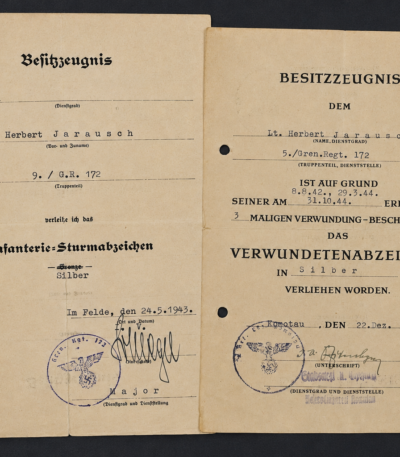
Infanterie-Sturmabzeichen & VWA Silber Award Doc – Leutnant – Grenadier-Regiment 172 (75. Infanterie-Division)
€115,00Original WWII German award document grouping belonging to Leutnant Herbert Jarausch of 5. Kompanie/ Grenadier-Regiment 172 of the 75. Infanterie-Division, consisting of two original award certificates documenting frontline combat service and multiple wounds sustained in action.
The group includes award certificates of the:
Infanterie-Sturmabzeichen in Silber (Infantry Assault Badge in Silver) issued to: Gefreiter Herbert Jarausch of the 9./Grenadier-Regiment 172 on 24 May 1943. The Infantry Assault Badge in Silver was awarded to infantry soldiers who participated in numerous infantry assaults and close-combat operations while serving on the front line.
Verwundetenabzeichen in Silber (Wound Badge in Silver) issued to: Leutnant Herbert Jarausch
of the 5./ Grenadier-Regiment 172 on 22 December 1944 in Komotau
The document records that the recipient had suffered wounds on:
- 8 August 1942
- 29 March 1944
- 31 October 1944
A total of three combat wounds, qualifying him for the Wound Badge in Silver.
Both documents bear original signatures and official unit stamps.
Good original condition with expected wartime folds, filing holes, age toning, and handling wear. Both documents remain fully legible and display well.
A desirable combat award grouping documenting both frontline assault service and multiple battle wounds sustained by a soldier who rose from enlisted rank to officer during the war.
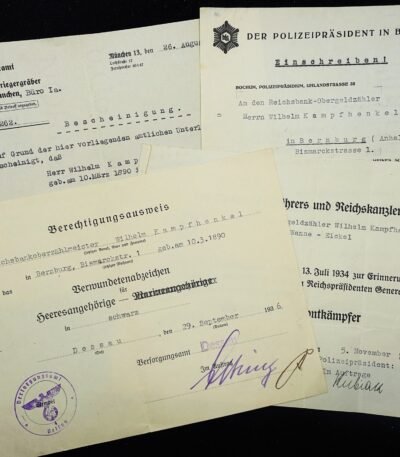
WWI Veteran Award Document Set – 1. Bayerisches Jäger-Bataillon – Wanne-Eickel
€50,00Offered here is a very interesting original document grouping belonging to Wilhelm Kampfenkel, born 10 March 1890 in Wittenberg, Prussia, documenting his service as a Sergant (Hornist) with the 4. Kompanie of the 1. Bayerischen Jäger-Bataillons during the First World War, together with his later recognition as a decorated and wounded WWI veteran.
The earliest and particularly interesting document is an original 1934 Ehrenkreuz für Frontkämpfer award certificate, issued by the Polizeipräsident in Bochum on 5 November 1934. The certificate identifies Kampfenkel, by then a Reichsbank-Obergeldzähler, as a former front-line combatant and records the award of the Ehrenkreuz für Frontkämpfer, established by the decree of 13 July 1934 in remembrance of the German veterans of the First World War. The original Bochum police stamp and period signature remain present.
Also included is an original Berechtigungsausweis for the Verwundetenabzeichen in Schwarz, issued at Dessau on 29 September 1936 by the Versorgungsamt Dessau. The document identifies Kampfenkel as a Reichsbankoberzähler, born 10 March 1890, and officially grants him the right to wear the black grade of the Verwundetenabzeichen. This is an important supporting document confirming that Kampfenkel had been wounded during his earlier military service.
The grouping is further supported by an official Bescheinigung of the Zentralnachweisamt für Kriegerverluste und Kriegergräber, Zweigstelle München, dated 26 August 1936. This document records Kampfenkel’s wartime decorations as Eisernes Kreuz 2. Klasse, dated 6 August 1918, and Verwundetenabzeichen in Schwarz. Importantly, it identifies his wartime rank and appointment as Sergant (Hornist), 4. Kompanie, 1. Bayerisches Jäger-Bataillon, providing a direct contemporary record connecting him with this Bavarian Jäger formation.
The 1. Bayerische Jäger-Bataillon “König” was a long-established Bavarian Jäger formation based at Freising. During the First World War it became part of the Jäger-Regiment 1, serving with the German forces on several fronts, including the Western Front and later as part of the Alpenkorps. The 1st Bavarian Jäger Battalion was ultimately disbanded after the war in December 1918.
The documents also provide an interesting glimpse into Kampfenkel’s post-war civilian career. By the 1930s he is repeatedly identified as a Reichsbank employee, including as Reichsbank-Oberzähler/Obergeldzähler, with addresses in Bernburg and Wanne-Eickel appearing in the accompanying correspondence. Thus, the grouping documents not only his WWI military service, but also his subsequent civilian career and veteran status during the 1930s.
The documents remain in original period condition, showing the expected folds, age toning, foxing/discoloration and handling/storage wear. The original official stamps, signatures and typed details remain clearly visible throughout.
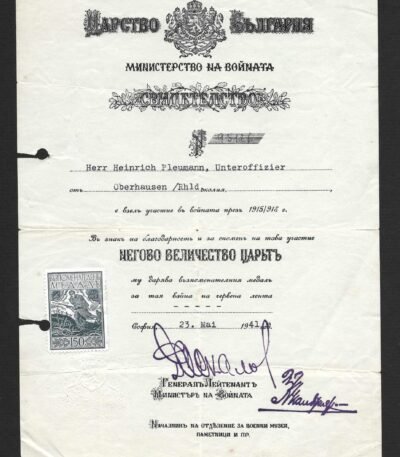
Bulgarian Commemorative Medal for Participation in the First World War – Unteroffizier from Oberhausen (Rhld.)
€30,00Original Bulgarian award certificate (Свидетелство) issued by the Kingdom of Bulgaria, Ministry of War, documenting the award of the Medal for Participation in the War of 1915–1918 to Unteroffizier Heinrich Pleumann, of Oberhausen/Rheinland, Germany. The certificate is dated Sofia, 23 May 1941 and records that Pleumann participated in the Bulgarian campaign of 1915–1918. In recognition and remembrance of his participation, His Majesty the King of Bulgaria awarded him the commemorative medal worn on a red ribbon.
This is a particularly interesting document because Pleumann was a German veteran, rather than a Bulgarian serviceman. The Bulgarian Medal for Participation in the War 1915–1918 was instituted on 9 December 1933 as a commemorative award for participants in the First World War. The red ribbon specifically denoted front-line veterans, while variants with additional central stripes were used for indirect participants and next-of-kin.
The award was also distributed to veterans of the former allied armies, including German, Austrian and Hungarian participants. Sources record that approximately 200,000 medals were sent abroad for presentation to former personnel of these allied armies. This makes a certificate actually issued to a German WWI veteran living in Germany particularly appropriate and collectible.
An especially attractive feature is the original Bulgarian 150-lev revenue/postage stamp affixed to the certificate, together with the embossed official seal of the Bulgarian Ministry of War. The funds raised through these special stamps were used for the planned construction of a new building for the National Military History Museum in Sofia, giving the stamp a direct connection to Bulgarian military heritage.
The certificate is signed by the Lieutenant General and Minister of War, with an additional signature from the official identified as Head of the Department for the Military Museum, Monuments, etc. The combination of the Bulgarian royal heading, Ministry of War documentation, original seal, revenue stamp and German recipient makes this an unusually attractive piece of international WWI veteran documentation.
The date of 23 May 1941 is also noteworthy. By this point Bulgaria was already closely aligned with the Axis powers and had joined the Tripartite Pact in March 1941. Only weeks earlier, Bulgarian forces had entered territories in the Balkans following the German-led campaigns of April 1941. This certificate therefore represents a fascinating intersection of Bulgarian WWI commemorative policy, German-Bulgarian military relations and the continued recognition of veterans more than two decades after the First World War.
Condition
Original large-format certificate with horizontal and vertical folds, age-related toning, light foxing/discoloration and general handling/storage wear. There is some edge wear and a small loss around the left perforation/filing hole, but the elaborate Bulgarian printing remains very attractive. The original 150-lev stamp, Ministry of War seal and signatures are all present.
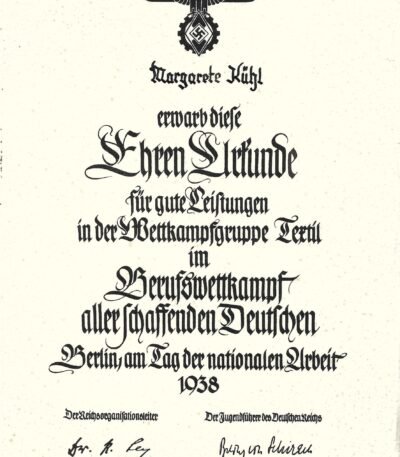
Ehrenurkunde – Reichsberufswettkampf 1938 – Wettkampfgruppe Textil
€30,00Offered here is an original 1938 Ehrenurkunde awarded to Margarete Kühl for her good achievements in the “Wettkampfgruppe Textil” during the Berufswettkampf aller schaffenden Deutschen (Vocational Competition of all Working Germans). The certificate was issued in Berlin on the Day of National Labour, 1 May 1938, making it a very attractive pre-war example of official Reichsberufswettkampf documentation.
The document specifically records Kühl’s achievement within the Textile competition group, providing an interesting connection to the vocational and occupational competitions organised during the Third Reich. The Reichsberufswettkampf was a large-scale competition intended to test and recognise professional skills among German workers and young people across numerous occupational categories. The Textil category makes this particularly interesting for collectors of women’s vocational history, textile occupations and social-history material.
The impressive certificate features the large Reichsberufswettkampf emblem at the top and is beautifully printed in the characteristic Gothic typeface of the period. At the bottom are the signatures of Dr. Robert Ley, Reichsorganisationsleiter, and Baldur von Schirach, Jugendführer des Deutschen Reiches, giving the document considerable official presentation and historical interest.
The certificate remains in original period condition, showing age-related toning, foxing and scattered discoloration throughout, together with some light handling wear. The printed text, decorative design and both signatures remain clearly legible.
A very attractive and fully named original 1938 Reichsberufswettkampf certificate, combining a female recipient, the Textile competition group, an early pre-war date and the signatures of Robert Ley and Baldur von Schirach. An excellent piece of original documentation for collectors of Reichsberufswettkampf material, German occupational history, women’s history and Third Reich-era certificates.
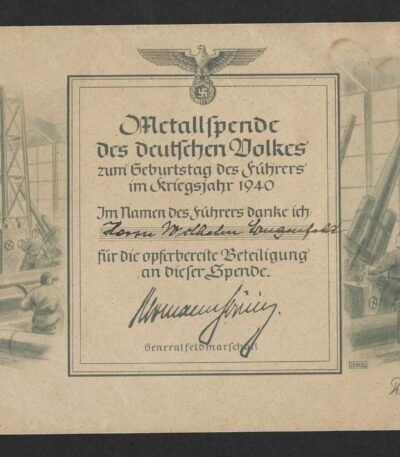
Metallspende des Deutschen Volkes – Dankurkunde 1940 – Hermann Göring
€10,00Original “Metallspende des deutschen Volkes zum Geburtstag des Führers im Kriegsjahr 1940” Dankurkunde, issued in connection with the nationwide German metal collection campaign of 1940. The attractive DIN A5 landscape-format certificate features a large Reich eagle and an illustrated industrial/armaments scene showing workers handling artillery barrels and ammunition. The central text reads “Im Namen des Führers danke ich … für die opferbereite Beteiligung an dieser Spende”, thanking the recipient for their participation in the metal donation campaign. The recipient’s name has been entered on the certificate, although the handwritten entry has subsequently been heavily crossed through/overwritten and is therefore not completely legible.
The certificate is signed in facsimile by Reichsmarschall Hermann Göring, who launched the 1940 Metallspende appeal. On 27 March 1940, Göring called upon the German population to donate surplus metal—including copper, brass, bronze, tin, lead and nickel—for the German war effort. The campaign was promoted as a collective “birthday gift” for Hitler, whose birthday was 20 April. Donors received certificates such as the present example in recognition of their contribution. Contemporary museum and archival material confirms the use of this standardized certificate and Göring’s signature.
Condition: Overall good original condition, with light age toning, scattered foxing and discoloration, minor edge wear and handling/storage marks. The certificate remains complete, with the printed artwork and text well preserved.
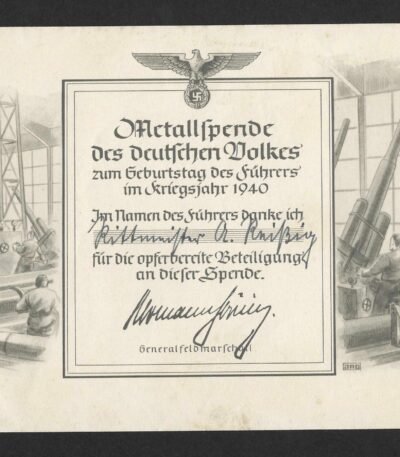
Metallspende des Deutschen Volkes – Dankurkunde 1940 – Hermann Göring
€10,00Original “Metallspende des deutschen Volkes zum Geburtstag des Führers im Kriegsjahr 1940” Dankurkunde, issued in connection with the nationwide German metal collection campaign of 1940. The attractive DIN A5 landscape-format certificate features a large Reich eagle and an illustrated industrial/armaments scene showing workers handling artillery barrels and ammunition. The central text reads “Im Namen des Führers danke ich … für die opferbereite Beteiligung an dieser Spende”, thanking the recipient for their participation in the metal donation campaign. The recipient’s name has been entered on the certificate, although the handwritten entry has subsequently been heavily crossed through/overwritten and is therefore not completely legible.
The certificate is signed in facsimile by Reichsmarschall Hermann Göring, who launched the 1940 Metallspende appeal. On 27 March 1940, Göring called upon the German population to donate surplus metal—including copper, brass, bronze, tin, lead and nickel—for the German war effort. The campaign was promoted as a collective “birthday gift” for Hitler, whose birthday was 20 April. Donors received certificates such as the present example in recognition of their contribution. Contemporary museum and archival material confirms the use of this standardized certificate and Göring’s signature.
Condition: Overall good original condition, with light age toning, scattered foxing and discoloration, minor edge wear and handling/storage marks. The certificate remains complete, with the printed artwork and text well preserved.
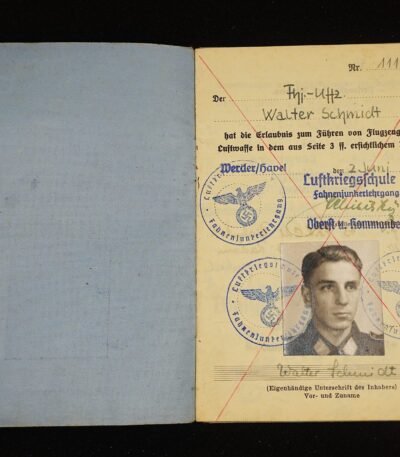
Luftwaffe Flugzeugführerschein – Ju 88 & He 111 Training – MIA 26 Dec 1944 over Liege (BE) – Lehrgeschwader 1
€150,00Original WWII Luftwaffen-Flugzeugführerschein, document no. 111/43, issued to Walter Schmidt, born 19 July 1924 in Bernburg.
Issued on 2 June 1943 by Luftkriegsschule 3, Werder/Havel, during the Fahnenjunkerlehrgang. The licence retains its original portrait photograph, numerous Luftwaffe stamps, signatures and detailed training entries.
Of particular interest are the aircraft qualifications and training entries, including He 72, Bü 131, Bü 181, Kl 35, Go 145, W 33, W 34 and C 445, followed by further training at Flugzeugführerschule (C) 21 in Białystok. Importantly, Schmidt was also listed for the Ju 88 and He 111, both aircraft types associated with the multi-engine/bomber training conducted at FFS C 21. On December 26, 1944, Schmidt took off from Varel and was lost south of Lüttich to anti aircraft. Ju-88S-3 L1+GH. Schmidt is listed as MIA but rest of the crew was taken prisoner.
The document further contains entries for Blindflugschein II, later training at Flugzeugführerschule B 37, promotions during 1943, and numerous original wartime stamps and signatures.
A particularly attractive and extensively completed Luftwaffe pilot’s licence, with excellent documentation of the holder’s progression from basic flying training toward multi-engine aircraft.
Page 14 bears the signature of:
- Major Joachim Jödicke (Deutsches Kreuz in Gold + Ritterkreuz!)
Condition: Period wear, staining, creasing and handling marks, with red cancellation lines to the cover and identification page. Please see photographs.
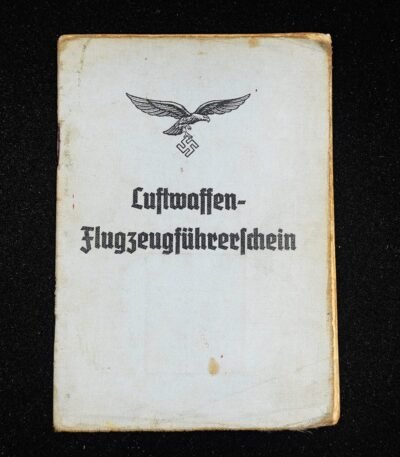
Luftwaffe Flugzeugführerschein – Flieger-Ausbildungs-Regiment 41, Frankfurt/Oder
€100,00Original WWII Luftwaffe Flugzeugführerschein issued to Gefreiter Siegfried Bornemeier, document no. 326/41, at Schule/Flieger-Ausbildungs-Regiment 41, Frankfurt/Oder, dated 31 January 1941.
The licence retains the original portrait photograph, Luftwaffe stamps, signatures and personal details, with a later entry recording his promotion to Unteroffizier on 1 August 1941.
Condition: Period wear, staining and creasing consistent with age. Please see photographs.
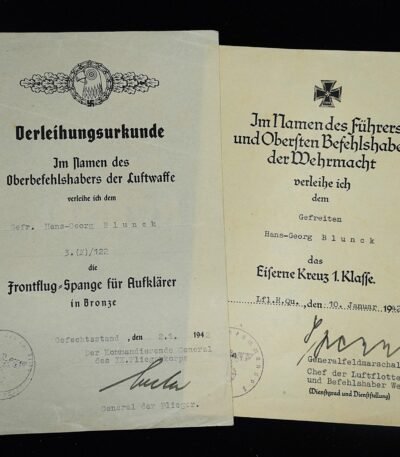
Luftwaffe Award Doc Set – 3.(F)/122 – Ju 88 Loss January 1942 – MIA/KIA England
€300,00Original WWII Luftwaffe award document grouping belonging to Gefreiter Hans-Georg Blunck of 3.(F)/122, including his Eisernes Kreuz 1. Klasse and Frontflugspange für Aufklärer in Bronze.
The grouping includes:
- Eisernes Kreuz 1. Klasse, awarded 10 January 1942, issued by the Chef der Luftflotte 3 und Befehlshaber West.
- Frontflugspange für Aufklärer in Bronze, awarded 2 January 1942, to Gefr. Hans-Georg Blunck, 3.(F)/122, at the Gefechtsstand of the IX. Fliegerkorps.
- Additional original Luftwaffe award documentation for the same recipient.
Of particular interest is the documented wartime fate of Blunck. He served as wireless operator aboard Ju 88A-5 Werknummer 0440, coded F6+PL, of 3.(F)/122. The aircraft failed to return from a mission on 19 January 1942 and was subsequently reported missing.
According to the available loss account, the aircraft was attacked by a Spitfire of RAF No. 145 Squadron, flown by Squadron Leader Tony Lovell, DFC. Following repeated attacks, the Ju 88 reportedly suffered a starboard engine fire, turned to starboard and dived into the sea, crashing approximately 20 miles east of Whitby. The entire crew was lost:
- Fw. Gerhard Drassdo – Observer
- Gefr. Hans Blunck – Wireless Operator
- Gefr. Johann Bauer – Gunner
This gives the award documents a particularly interesting connection to a specific operational Ju 88 loss, rather than merely documenting an unidentified Luftwaffe serviceman.
A highly interesting Luftwaffe reconnaissance document grouping with identified unit, aircraft, crew position and documented operational loss.
Condition: Period condition with folds, age-related staining and handling marks. Please see photographs for details.
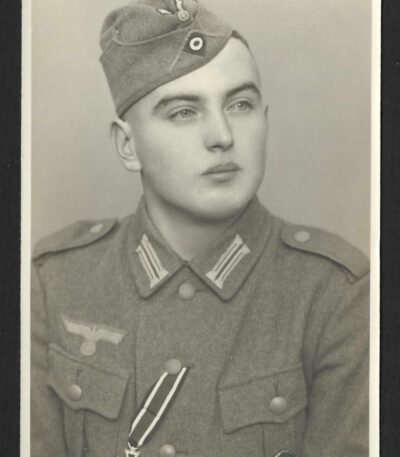
Wehrmacht Studioportrait – Eisernes Kreuz 2. Klasse
€25,00Original Wehrmacht Studio Portrait of a Soldier wearing the Eisernes Kreuz 2. Klasse as on award day. Postcardsize.
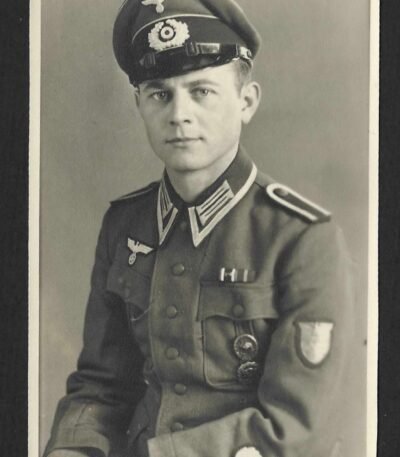
Wehrmacht Studioportrait – Kraftfahrbewährungsabzeichen & Krimschild
€45,00Original studio portrait of a Wehrmacht soldier, postcard size. He wears the Kraftfahrbewährungsabzeichen, the Krimschild, the Verwundetenabzeichen and the DRL Sportabzeichen. Postcardsize.
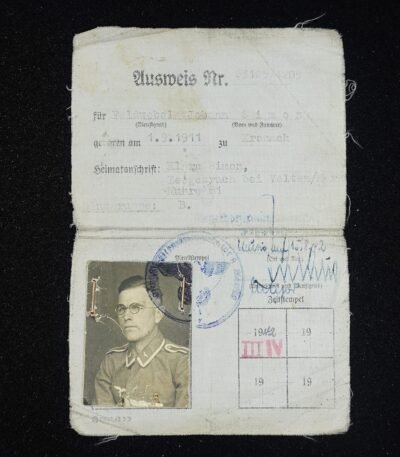
Luftwaffe Ausweis – Velten – Flugzeugführschule
€45,00Original Luftwaffe Ausweis for a Feldwebel, living in Velten, issued by a Flugzeugführer. Condition as seen.
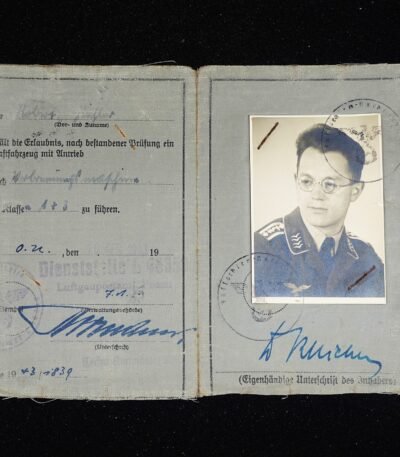
Wehrmacht Führerschein – Luftwaffe- with (Aeskulap) Photo
€40,00Original WWII Wehrmacht-Führerschein belonging to a member of the Luftwaffe, complete with original period photograph.
The licence grants the holder permission, following examination, to operate a Kraftfahrzeug in the specified licence class. The document retains the original photograph of the holder in Luftwaffe uniform.
The licence contains period official stamps, signatures and handwritten entries, including the issuing/administrative authority and licence details. The photograph is particularly attractive and gives a very nice personal aspect to the document.
Condition: Heavy period wear, creasing, staining and handling, with tears/fraying to the edges and some damage to the paper. The photograph remains present. Please study the photographs carefully.
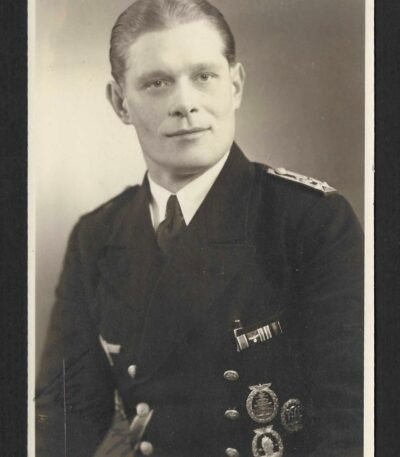
Kriegsmarine Studioportrait – Flottenkriegsabzeichen & Minensucherabzeichen
€55,00Original Kriegsmarine studio portrait of a NCO wearing the Flottenkriegsabzeichen (High Seas Fleet Badge), Minensucher-Abzeichen (Minesweeper’s Badge) and more. Postcardsize.
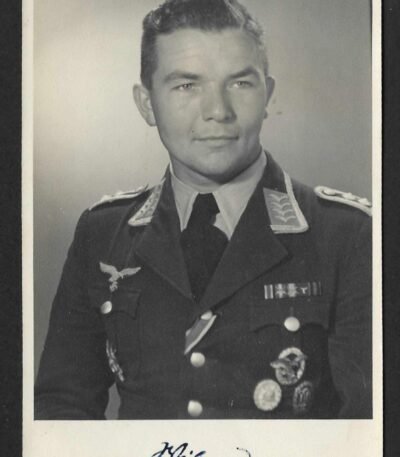
Luftwaffe Studio Portrait – Pilot with Spanienkreuz & Multiple Awards – Postcard Size
€45,00Original period Luftwaffe studio portrait photograph showing a Luftwaffe pilot in uniform wearing several decorations and badges, including the Spanienkreuz, Verwundetenabzeichen, DRL-Sportabzeichen and Beobachterabzeichen. Postcardsize.