
Customers facing issues ordering, contact me via: wolfganghistorica@gmail.com
Follow our WhatsApp Channel | Instagram | YouTube
Out of stock
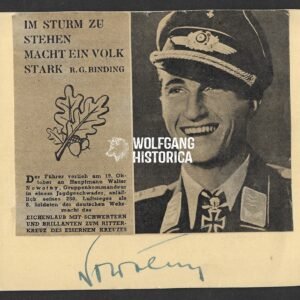
Walter Nowotny – Jagdgeschwader 54 (Diamanten!) (Wartime Signed!)
€300,00Walter Nowotny (7 December 1920 † 8 November 1944) was one of the most celebrated Luftwaffe fighter aces of the Second World War, credited with 258 aerial victories in over 440 combat missions. Serving mainly on the Eastern Front, he became one of the Luftwaffe’s top-scoring aces and later a pioneer of jet fighter operations with Jagdgeschwader 7 “Nowotny”.
Awards and Decorations
-
Knight’s Cross of the Iron Cross (Ritterkreuz des Eisernen Kreuzes) – 4 September 1942, as Leutnant and Staffelkapitän of 9./Jagdgeschwader 54 “Grünherz.”
-
Oak Leaves (Eichenlaub) – 14 September 1943, as Oberleutnant and Staffelkapitän of 1./Jagdgeschwader 54.
-
Swords (Schwerter) – 22 September 1943, as Oberleutnant and Staffelkapitän of 1./Jagdgeschwader 54.
-
Diamonds (Brillanten) – 19 October 1943, as Hauptmann and Gruppenkommandeur of I./Jagdgeschwader 54.
-
Iron Cross (1939) 1st and 2nd Class, Front Flying Clasp in Gold, and other Luftwaffe awards.
Item Details
-
Original wartime signature of Major Walter Nowotny.
-
Provenance: From the large personal collection of HJ boy Ernst Fritzsche, who collected wartime autographs and correspondence during the period.
-
Condition: Very good; light age-related wear and handling marks. Signature remains bold and clearly legible.
Collector’s Note
Major Walter Nowotny remains one of the most renowned Luftwaffe aces of the war and an early jet pilot pioneer. His Knight’s Cross with Oak Leaves, Swords, and Diamonds marks him among the most highly decorated fighter pilots in history. Authentic wartime-signed postcards are exceptionally scarce and highly prized by collectors, especially with documented provenance.
Out of stock
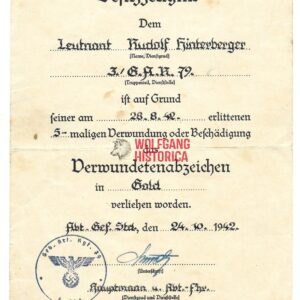
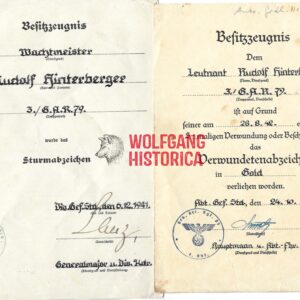
ASA & VWA Gold Award Docs: Gebirgs-Artillerie-Regiment 79 (1. Gebirgs-Division)
€300,00- Allgemeines-Sturmabzeichen (General Assault Badge), awarded on December 6, 1941 for 3 separate assault days during his service! Document was signed by Hubert Lanz (RK+EL).
- Verwundetenabzeichen in Gold (Wound Badge in Gold), awarded on October 10, 1942 for his 5th wound! Document was signed by an unknown officer.
Out of stock

Georg Vilzmann – Ardennes (Accredited with 53 Nahkampftage)
€300,00- One wartime photograph (signed on the back)
- One postwar reproduction with postwar signature
- One postwar reproduction photo (his marriage?)
- One postwar photograph that was signed and dedicated to him by Sylvester Stadler!
Out of stock


Fallschirmschützenschein (Signed by RKT Hans Teusen)
€300,00Out of stock
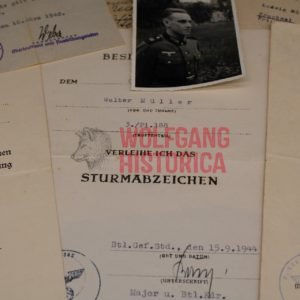

3x Award Docs: Brücken-Bau-Btl. 21 & Pionier-Btl. 188 (Signed by Hermann Hoth, RK+EL+SW!)
€300,00- Award document for the Eisernes Kreuz 2. Klasse. Earned on December 22, 1942 with Brücken-Bau-Bataillon 21! Signed by Generaloberst Hermann Hoth (RK+El+SW).
- Award document for the Allgemeines-Sturmabzeichen. Earned on September 15, 1944 with Pionier-Bataillon 188. Signed by an unknown officer.
- Award document for the Verwundetenabzeichen in Schwarz. Earned on December 18, 1942 for a wound suffered on November 29, 1942 during the Western Campaign! Signed by an unknown doctor.
- 2x Lebenslauf
- 1x Photograph
- 1x Small document
- 1x Document related to his EK2
- 2x documents for civilian occupation
In stock
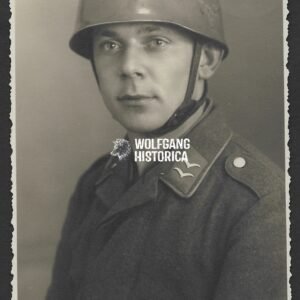
Studioportrait of Fallschirmjäger – “Südfront” FJ Helmet
€295,00Original private wartime photograph depicting a German soldier wearing a Fallschirmjäger steel helmet, photographed during the Second World War. The helmet displays a distinctive goldish-brown / tan finish, strongly indicative of Southern Front (Südfront) service, where such tones were commonly the result of repainting, dust exposure, and climatic conditions encountered in the Mediterranean and Balkan theaters.
The photograph is postcard size and printed on period photographic paper with scalloped (deckle) edges, a format widely used for privately commissioned wartime portraits intended for family correspondence.
Condition:
Very good wartime condition. The image remains sharp with clear facial detail and good contrast. Light, even age toning consistent with period photographs. No major creases or damage.
Collector’s Note:
Authentic wartime Fallschirmjäger portraits are highly sought after, particularly examples showing helmets with Southern Front characteristics. The distinctive helmet coloration adds strong contextual value, making this photograph especially appealing to collectors focused on Fallschirmjäger, Luftwaffe ground forces, or Mediterranean / Balkan theater operations.
A genuine, evocative wartime private photograph offering strong visual and historical appeal.
In stock


Panzerkampfabzeichen in Bronze (Meybauer – “Seven Wheeler”)
€295,00Out of stock


Soldbuch, Award Document & Papers of Ober-Signal-Meister! (Memel, Stralsund, Oslo, Narvik..)
€295,00In stock


Flemish Waffen-SS & DRK Recruitment Postcard – Ersatzkommando Flandern
€295,00Out of stock

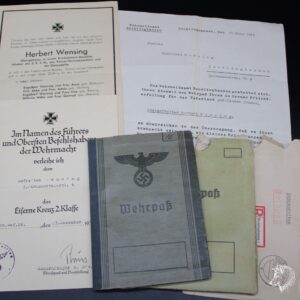
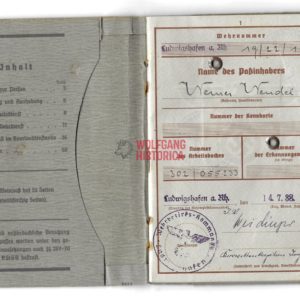
Wehrpass & Award Doc Set of Panzer-Aufklärungs-Abt. 57 & Kradschützen-Btl. 6
€295,00Out of stock


Frontflugspange für Kampfflieger in Bronze (C.E. Juncker, Berlin)
€295,00Out of stock
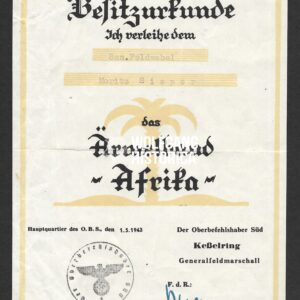
“Afrika” Cufftitle Award Certificate
€295,00Out of stock
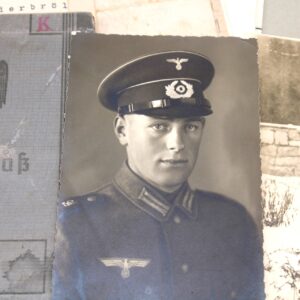
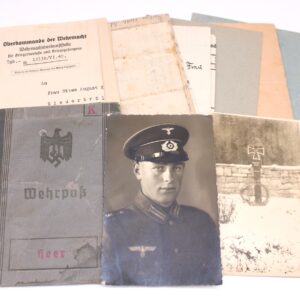
KIA Wehrpass Belgium 1940 – 253.Inf.Div. (Buried Lommel)
€295,00Out of stock

Yosegaki Hinomaru Flag (“Good Luck Flag”) (Named)
€295,00Out of stock


TOP 3X SIGNED PHOTO! Otto Günsche, Hubert Meyer & Hans Siegel
€285,00- Otto Günsche (24.09.1917 † 02.10.2003) earned the Verwundetenabzeichen “20. Juli 1944” in Schwarz and was a member of the Leibstandarte-SS Adolf Hitler before he became Adolf Hitler’s personal adjutant. Served with the 12. SS-Panzer-Division "Hitlerjugend"
- Hans Siegel (25.07.1918 † 18.04.2002) earned the Ritterkreuz des Eisernen Kreuzes on August 23, 1944 as SS-Hauptsturmführer und Chef of the 8. Kompanie/ SS-Panzer-Regiment 12 of the 12. SS-Panzer-Division “Hitlerjugend”.
- Hubert Meyer (05.12.1913 in Berlin † 16.11.2012 in Leverkusen) earned the Deutsches Kreuz in Gold on May 6, 1943 as SS-Hauptsturmführer with the SS-Panzergrenadier-Regiment 1 “LSSAH” of the 1. SS-Panzer-Division “LAH”. Later served with the 12. SS-Panzer-Division “Hitlerjugend”.
Out of stock
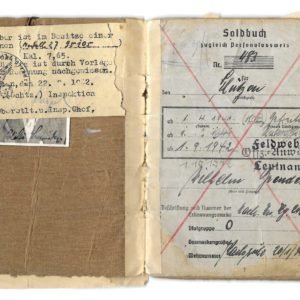
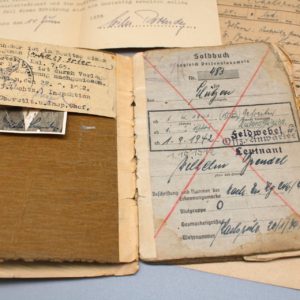
KIA Soldbuch of a Leutnant – Grenadier-Rgt. 105 (72.Inf.Div.)
€280,00Out of stock
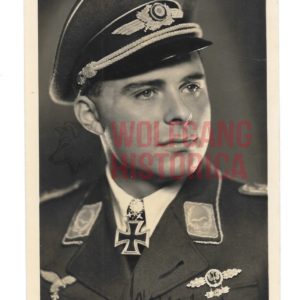
Alfred Druschel – Schlachtgeschwader 1 (Swords) (Wartime Signed)
€280,00Out of stock
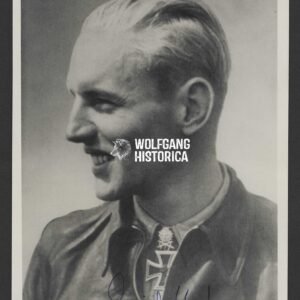
Erich “Bubi” Hartmann – Jagdgeschwader 52 (Brillianten) (352 Aerial Victories!)
€275,00Original Postwar Signature on a Postwar Photo of Erich “Bubi” Hartmann. Major Erich Alfred “Bubi” Hartmann (19 April 1922, Weissach, Württemberg – 20 September 1993, Weil im Schönbuch, Germany) was the most successful fighter ace in aviation history, credited with an unparalleled 352 confirmed aerial victories on the Eastern Front. Known as “The Blond Knight of Germany”, Hartmann flew with Jagdgeschwader 52 (JG 52) and became one of the most decorated Luftwaffe fighter pilots of the Second World War. His skill, discipline, and survival across more than 1,400 combat missions earned him legendary status among pilots of all nations.
Awards and Decorations
-
German Cross in Gold (Deutsches Kreuz in Gold) – 17 October 1943
-
Knight’s Cross of the Iron Cross (Ritterkreuz des Eisernen Kreuzes) – 29 October 1943, as Leutnant and Flugzeugführer, 9./JG 52 (148 victories)
-
Oak Leaves (Eichenlaub) – 2 March 1944, as Leutnant and Staffelkapitän, 9./JG 52 (200 victories)
-
Swords (Schwerter) – 2 July 1944, as Oberleutnant and Staffelkapitän, 9./JG 52 (239 victories)
-
Diamonds (Brillanten) – 25 August 1944, as Oberleutnant and Staffelkapitän, 9./JG 52 (301 victories)
-
Pilot-Observer Badge in Gold with Diamonds (Gemeinsames Flugzeugführer- und Beobachterabzeichen mit Brillanten) – special presentation award
-
Numerous additional decorations including the Iron Cross 1st and 2nd Class
Career Highlights
-
Eastern Front Ace: Flew over 1,400 combat missions, engaging in aerial combat in nearly 825 of them.
-
Unmatched Record: Credited with 352 confirmed kills, all against Soviet aircraft.
-
Survival Tactics: Known for his strict discipline and patience in combat, avoiding unnecessary risks and striking with precision.
-
Last Victory: Achieved his 352nd and final victory on 8 May 1945, just hours before Germany’s surrender.
-
Postwar Captivity: Spent 10 years in Soviet captivity (1945–1955) before returning to West Germany.
-
Postwar Career: Joined the newly formed Bundesluftwaffe (West German Air Force), where he commanded a fighter wing but later resigned due to political disputes over NATO standardization.
-
Legacy: His name remains synonymous with aerial mastery, and he is celebrated as the most successful fighter ace in recorded history.
Item Details
-
Authentic postwar signature of Major Erich “Bubi” Hartmann.
-
Signed on a postwar photograph.
-
Condition: Good, clear autograph.
Collector’s Note
Hartmann’s autograph is among the most coveted in WWII aviation collecting. His record of 352 aerial victories is unmatched and will never likely be equaled. Decorated with the Ritterkreuz mit Eichenlaub, Schwertern und Brillanten and the rare Pilot-Observer Badge with Diamonds, his signature represents the pinnacle of Luftwaffe fighter history. An essential piece for any serious collection of WWII aviation memorabilia.
Out of stock


Rare KIA Wehrpass – “Brandenburg” Special Operations Soldier
€275,00A highly desirable and seldom-encountered Wehrpass to Sebastian Strobel, born 26.11.1925 in München, who served in the elite and clandestine Division “Brandenburg” — the Abwehr’s special-operations and sabotage formation. This Wehrpass traces Strobel’s full path through Brandenburger training, frontline Einsatz, and ultimately his death in action on the Eastern Front.
Documented Service Timeline (as recorded in the Wehrpass)
✔ 12.12.1943 – 14.01.1944
14. Jäger-Lehrkompanie / Lehr-Regiment, Division “Brandenburg”
Strobel begins his specialized instruction here — a training unit for reconnaissance, sabotage, irregular warfare, and small-unit tactics.
✔ 15.01.1944 – 21.10.1944
2. Kompanie / Regiment 3 “Brandenburg”
Full operational assignment into one of the most active Brandenburg regiments. These troops conducted deep reconnaissance, demolition missions, and security warfare across multiple fronts.
✔ 22.10.1944 – 31.01.1945
Unbenannt 3. (gepanzerten) / Jäger-Regiment 1 “Brandenburg”
Late-war restructuring places Strobel into the armored (gepanzert) Jäger battalion of the newly organized Brandenburg Division. These units were thrown into brutal defensive battles on the Eastern Front as Soviet forces advanced in 1944–45.
Combat & Deployment
His Wehrpass lists participation in:
-
Eastern Front operations
-
Küstenland / Adriatic region
-
Front-line infantry and reconnaissance fighting
-
Security and anti-partisan actions
These match known Brandenburg deployments after their 1944 transformation into a front-line Panzergrenadier/Jäger formation.
Killed in Action – 31.01.1945
The final entry records:
-
Killed in action (gefallen) on 31 January 1945
-
Location: Leidedorf b. Ritzen
-
Cause: “Kopf I.G.” – infantry gun head wound (a fatal artillery/infantry gun shot to the head)
-
Fully stamped and signed by the regimental authority.
KIA entries for Brandenburg troops are extremely scarce, as the unit was heavily committed and suffered devastating losses during the final months of the war.
Additional Notes
-
Includes full ID photo, armorial stamps, and complete personal data.
-
All entries are clear, consistent, and fully legible.
-
Contains the promotion to Gefreiter (1.5.1944), signed by Brandenburg officers.
-
Provides a rare full progression from Lehrkompanie → active field regiment → armored Jäger regiment, perfectly illustrating the late-war evolution of the “Brandenburg” units.
A Standout Brandenburger Wehrpass
Wehrpässe to members of the Division / Regiment “Brandenburg” are highly sought after — even more so when:
-
Training, assignments, and units are clearly spelled out
-
Frontline Eastern Front deployments are recorded
-
And the soldier is confirmed KIA, with exact date, location, and cause
This example ticks all of those boxes, making it a premium historical document from Germany’s most secretive special-operations formation.
In stock

Wartime Signature on a Thank-You Card of Ministerialdirektor Leopold Gutterer
€275,00Leopold Gutterer (25 April 1902 – 28 April 1991) was a senior official (Ministerialdirektor) in the Reich Ministry for Public Enlightenment and Propaganda (Reichsministerium für Volksaufklärung und Propaganda), serving directly under Joseph Goebbels. A long-time civil servant and National Socialist administrator, Gutterer held influential posts related to press, film, and cultural coordination during the war years.
This original wartime thank-you card, personally signed by Gutterer, was issued on the occasion of his promotion within the Ministry. The printed text expresses gratitude for the attention shown upon his advancement, ending with his handwritten signature in black ink.
Awards and Decorations
-
Golden Party Badge of the NSDAP.
-
War Merit Cross (Kriegsverdienstkreuz) 2nd Class.
-
Various civil service awards for long-term political and administrative service.
Item Details
-
Original wartime signature of Ministerialdirektor Leopold Gutterer.
-
Issued on a printed official thank-you card marking his promotion.
-
Institution: Reich Ministry for Public Enlightenment and Propaganda, Berlin.
-
Medium: Heavy stock card with deckle edges, period typeface, and ink signature.
-
Size: Approx. 10 × 15 cm (postcard format).
-
Condition: Very good; light age-related toning and minimal edge wear. Signature remains clear and well preserved.
Collector’s Note
Authentic signed material from senior officials of the Propaganda Ministry is scarce, especially from Ministerialdirektor Leopold Gutterer. This example illustrates the formal bureaucratic correspondence and ceremonial culture within the Reich’s propaganda administration.
A historically valuable document for collectors of Third Reich political and administrative ephemera.
Out of stock
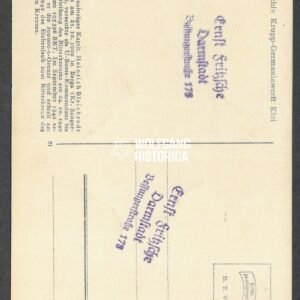
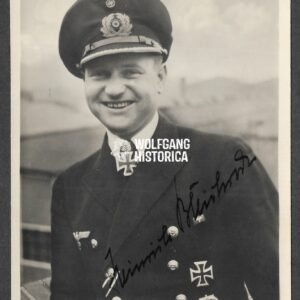
Heinrich Bleichrodt – “U-48” & “U-109” (Eichenlaub) (Wartime Signed)
€275,00Heinrich Bleichrodt (21 October 1909 † 9 January 1977) was a decorated German U-boat commander of the Second World War, serving with distinction during the Battle of the Atlantic. As commander of U-48 and later U-109, Bleichrodt achieved major successes against Allied shipping and became one of the Kriegsmarine’s leading U-boat aces.
Awards and Decorations
-
Knight’s Cross of the Iron Cross (Ritterkreuz des Eisernen Kreuzes) – 24 October 1940, as Kapitänleutnant and Kommandant of U-48.
-
Oak Leaves (Eichenlaub) – 23 September 1942, as Kapitänleutnant and Kommandant of U-109.
-
U-boat War Badge (U-Boots-Kriegsabzeichen).
-
Iron Cross (1939) 1st and 2nd Class.
Item Details
-
Original wartime signature of Kapitänleutnant Heinrich Bleichrodt.
-
Signed on a wartime postcard.
-
Provenance: From the large personal collection of HJ boy Ernst Fritzsche, who collected wartime autographs and correspondence during the period.
-
Condition: Good; postcard shows light age wear and trimmed edges from period handling. Signature remains bold and well-preserved.
Collector’s Note
Heinrich Bleichrodt ranks among the most successful U-boat commanders of the Kriegsmarine, credited with over 200,000 GRT of enemy shipping sunk. His autograph on wartime material is scarce and highly desirable, especially with traceable period provenance.
Out of stock
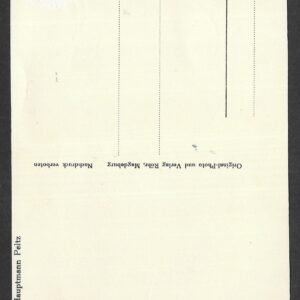
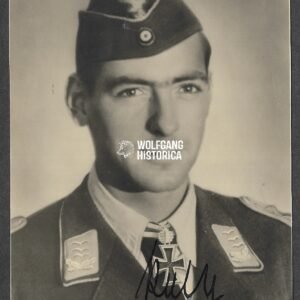
Dietrich Peltz – Sturzkampfgeschwader 77 (Schwertern) (Wartime Signed)
€275,00Original Wartime Signature on a Postcard of Dietrich Peltz. Generalmajor Dietrich Peltz (6 September 1914, Gießen † 10 August 2001, Munich) was one of the Luftwaffe’s most decorated bomber officers, rising to the rank of Generalmajor and earning the Knight’s Cross of the Iron Cross with Oak Leaves and Swords. Recognized for his aggressive leadership in dive-bomber operations and later as a planner of strategic bombing raids, he became one of the youngest generals in the German armed forces.
Awards and Decorations:
-
Knight’s Cross of the Iron Cross (Ritterkreuz des Eisernen Kreuzes) – 14 October 1940, as Oberleutnant with the Stab of Sturzkampfgeschwader 77.
-
Oak Leaves to the Knight’s Cross (Eichenlaub zum Ritterkreuz des Eisernen Kreuzes, 53rd award) – 31 December 1941, as Hauptmann and Kommandeur of II./ Sturzkampfgeschwader 77.
-
Swords to the Knight’s Cross with Oak Leaves (Schwerter zum Ritterkreuz des Eisernen Kreuzes, 33rd award) – July 1943, as Oberst im Generalstab and Angriffsführer England.
Career Highlights:
-
Distinguished himself as a Stuka pilot and commander in the early campaigns, earning the Knight’s Cross in 1940.
-
As Kommandeur of II./StG 77, led his group in intensive dive-bombing operations on the Eastern Front, where his effectiveness was recognized with the Oak Leaves in 1941.
-
Later transferred to the Luftwaffe General Staff, becoming Angriffsführer England, tasked with planning and executing bomber raids against Britain in 1943, which earned him the Swords.
-
Promoted rapidly due to his ability, he was one of the youngest officers to reach the rank of Generalmajor.
-
Survived the war, later living in Munich until his death in 2001.
Item Details:
-
Authentic wartime signature of Generalmajor Dietrich Peltz.
-
Signed on a wartime postcard.
-
Condition: Clear and well-preserved autograph. Edges have been cut.
Collector’s Note:
Peltz’s combination of frontline combat command with Stuka units and his later role as a strategic bombing planner make him an especially interesting figure. His awards — the Knight’s Cross with Oak Leaves and Swords — place him among the most highly decorated Luftwaffe officers, making his signed photo a desirable addition for collectors of decorated bomber leaders and high-ranking Luftwaffe personalities.
Out of stock
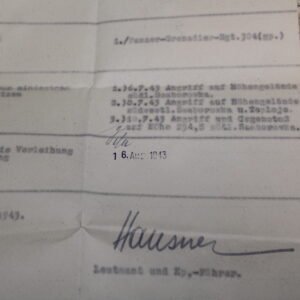
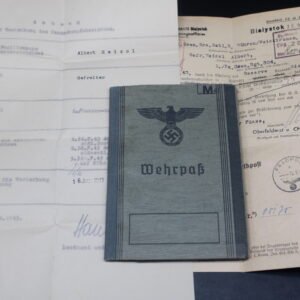
Wehrpass & PKA Award Recommendation Doc —Panzergrenadier-Regiment 304 (gep.)
€275,00Recipient: Gefreiter Meissl
Unit: 1. Kompanie / Panzergrenadier-Regiment 304 (gep.), 2. Panzer-Division
Grouping Includes
-
Wehrpass (complete with original photo)
-
“Antrag für die Verleihung des Panzerkampfabzeichens in Bronze”
(Application for the Award of the Panzer Assault Badge in Bronze) — a rare surviving document connected directly to his decoration.
Service & Decorations
-
Panzerkampfabzeichen in Bronze (Panzer Assault Badge in Bronze)
-
Verwundetenabzeichen in Schwarz (Wound Badge in Black)
-
Wounded September 1943 by shrapnel in the feet and face — likely ending his frontline combat service.
-
Collector’s Notes
-
The Wehrpass is complete, photo intact, and well-documented.
-
The award application (Antrag) for the Panzer Assault Badge is particularly scarce — these documents were normally discarded after processing, making this an excellent addition for paper collectors.
-
Strong divisional link to the 2. Panzer-Division and its Panzergrenadiers.
Condition
-
As seen in photos: original wartime documents, period wear but fully legible and intact.
Out of stock
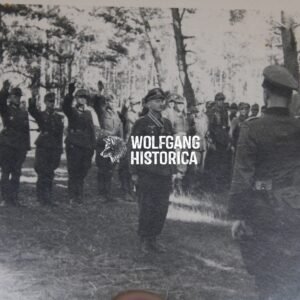
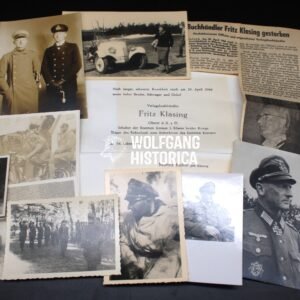
Death Letter & Photographs – Eichenlaubträger Fritz Klasing
€275,00A rare and historically significant set comprising the death notification letter and a selection of original photographs of Fritz Klasing, a distinguished recipient of the Knight’s Cross with Oak Leaves.
Accompanying the death letter (postwar) are several period photographs showcasing Klasing in uniform and civil, including several wearing his Knight’s Cross. These photographs are believed to be unpublished and offer collectors a rare glimpse into Klasing’s military service and personality.
A must-have for any serious collector of WWII militaria or Knight’s Cross documentation.
Out of stock
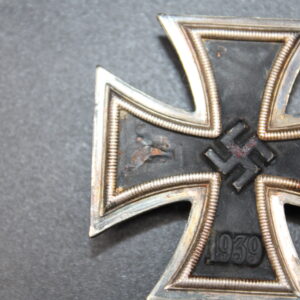
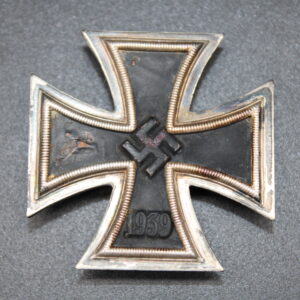
Eisernes Kreuz 1. Klasse – “L/13” (Paul Meybauer, Berlin)
€275,00Out of stock


Wehrmacht (Heer) Krim Shield
€275,00In stock


2x Award Docs: Festung Kreta (Signed by Bruno Bräuer (Executed!))
Out of stock


Soldbuch Pi.Btl.21, 121 & 22 (EK2 in ’40!) (4x Awards, TOP PHOTO)
€275,00Out of stock
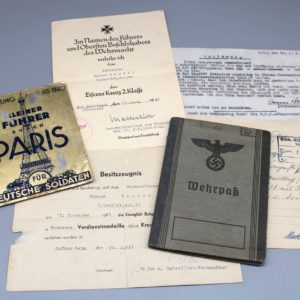
Wehrpass & 2x Award Docs of KIA 72.Inf.Div. soldier
€275,00- Wehrpass
- Award document for the Eisernes Kreuz 2. Klasse (Iron Cross 2nd Class), signed by Generalleutnant u. Kommandeur Franz Mattenklott. Interestingly it notes the place for the award: "Vor Melitopol (Ukraine)!"
- Award document for the Königlich Bulgarische Bronzene Veridenstmedaille ohne Krone am Kriegsband, signed by an unknown officer. Interestingly, also noted that is was awarded "Auf der Krim"!
- 2x Papers
- 1x Kleiner Führer durch Paris für Deutsche Soldaten
Out of stock
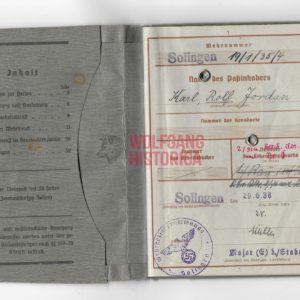

Wehrpass – Panzer-Artillerie-Regiment 76 & Sturmgeschütz-Abteilung 288 (3x Awards)
€275,00Out of stock

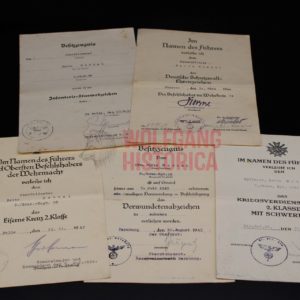
5x Award Docs: Gren.Rgt.58 (6.Inf.Div.) & Gren.Rgt.1062 (84.Inf.Div.) (KVK in ’45)
€275,00- Award document for the Kriegsverdienstkreuz 2. Klasse mit Schwertern. Earned on January 30, 1945! Earned with Grenadier-Regiment 1062 of the 84. Infanterie-Division. Signed by Generalmajor Heinz Fiebig (Ritterkreuz).
- Award document for the Eisernes Kreuz 2. Klasse. Earned on November 23, 1942 with Grenadier-Regiment 58 of the 6. Infanterie-Division! Signed by Generalmajor Horst Großmann (Ritterkreuz mit Eichenlaub).
- Award document for the Infanterie-Sturmabzeichen. Earned on August 19, 1943. Signed by Oberstleutnant Georg von Issendorff (DKIG).
- Award document for the Verwundetenabzeichen in Schwarz. Earned on August 10, 1943 for a wound suffered on July 7, 1943. Signed by unknown officer.
- Award document for the Deutsche Schutzwall-Ehrenzeichen. Earned on March 30, 1940. Signed by unknown officer.
Out of stock

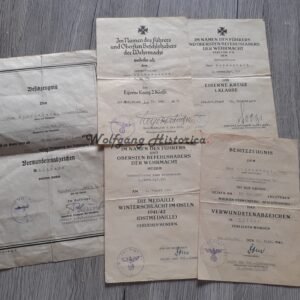
5x Award Documents: Grenadier-Regiment 321 (197.Inf.Div.) (DKIG-Holder!)
€275,00- Eisernes Kreuz 2. Klasse (Iron Cross 2nd Class) for his service (heroic) on August 12, 1941, which was signed by Generalmajor und Divisionskommandeur Hermann Meyer-Rabingen (Knight’s Cross). Document has been folded once.
- Eisernes Kreuz 1. Klasse (Iron Cross 1st Class) for his service (heroic) on October 12, 1943, which was signed by Generalleutnant und Divisionskommandeur Ehrenfried Böge (Knight's Cross with Oakleaves). Document has been folded once.
- Verwundetenabzeichen in Schwarz (Wound Badge in Black) for his wound sustained on September 14, 1943. Signed by an unknown Regimental Commander. A4 Document has been folded twice. Wear & tear.
- Verwundetenabzeichen in Silber (Wound Badge in Silver) for his third wound sustained on November 18, 1943. Signed by unknown Bataillon Commander. Document has been folded once.
- Winterschlacht im Osten 1941/42 (Winter War Medal) for his service during the harsh winter on August 1, 1942. Signed by unknown Bataillon Commander.
Out of stock

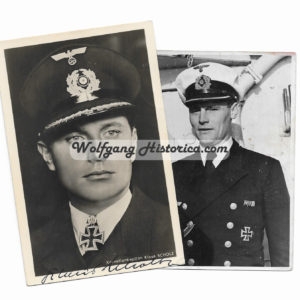
Klaus Scholtz – Commander of U-108 (Credited with sinking 25 ships, Oakleaves)
€275,00Out of stock
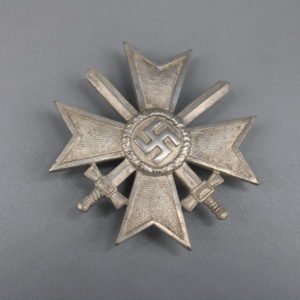

Kriegsverdienstkreuz 1. Klasse with Case (Unmarked)
€260,00Out of stock
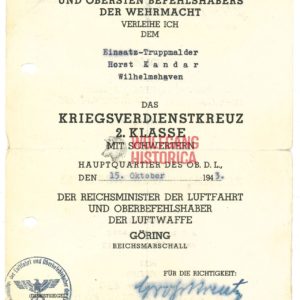
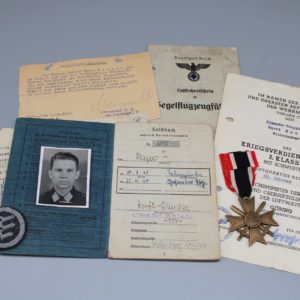
Interesting Late War Grouping of a Marine-Helfer & Luftwaffe Ground Fighter
€255,00- Soldbuch with photo! (denazified)
- Award document for the Kriegsverdienstkreuz 2. Klasse mit Schwertern
- Cloth NSFK Segelflieger-Abzeichen Stufe "C" (Glider Pilot Badge Grade "C")
- Kriegsverdienstkreuz 2. Klasse mit Schwertern
- Luftfahrerschein für Segelflugzeugführer (page with his I.D. deleted - not complete and denazified!)
- 2x Paper slips
Out of stock
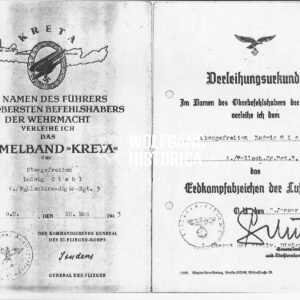

Erdkampfabzeichen Award Doc Fallschirmjäger-Regiment 3 – Italy, January 1944 (Signed by Schulz!)
€250,00Original Erdkampfabzeichen der Luftwaffe award document issued to Obergefreiter Ludwig Giehl, serving with 4. Kompanie / Fallschirmjäger-Regiment 3. The award was conferred in January 1944, during a period of sustained and intense ground combat by German Fallschirmjäger formations on the Italian front.
The document is an original wartime Verleihungsurkunde, printed in the correct format with the Luftwaffe eagle at the head and the formal wording „Im Namen des Oberbefehlshabers der Luftwaffe“. The recipient’s name, rank, and unit are neatly typewritten, fully consistent with period practice. It bears the original Luftwaffe stamp and a clear handwritten signature.
Signature
The document is signed by Oberst Karl-Lothar Schulz, at the time acting in a senior divisional command capacity. Schulz is a highly distinguished Fallschirmjäger officer and later Generalmajor der Luftwaffe, awarded the:
-
Ritterkreuz des Eisernen Kreuzes (24 May 1940)
-
Eichenlaub (20 April 1944)
-
Schwerter (18 November 1944)
Schulz was a veteran of the Norway campaign, the Western campaign, Crete, the Eastern Front, and later commanded Fallschirmjäger forces in Italy. Award documents bearing his signature are particularly sought after due to his status as a Knight’s Cross holder with Eichenlaub and Swords.
Recipient & Combat History
Obergefreiter Ludwig Eichl served with Fallschirmjäger-Regiment 3, a regiment of the 2. Fallschirmjäger-Division. According to an accompanying copied document included with this piece, Eichl also served on Crete, directly linking him to one of the most famous airborne operations of the war (Unternehmen Merkur, May 1941).
By January 1944, Fallschirmjäger-Regiment 3 was engaged in heavy ground combat in Italy, including defensive fighting in advance of and during the Anzio campaign. The award of the Erdkampfabzeichen der Luftwaffe reflects direct participation in sustained infantry combat, a distinction not lightly granted and especially meaningful among Fallschirmjäger personnel.
Condition
Very good original condition. One horizontal fold as issued. Light age toning and minor handling wear consistent with wartime documents. Stamp and signature remain strong and legible. Also has two punch holes.
Collector’s Note
This is a high-quality Fallschirmjäger combat award document with multiple desirable attributes:
-
Frontline Fallschirmjäger unit attribution
-
Italian Front, January 1944
-
Additional provenance linking the recipient to Crete
-
Signed by Karl-Lothar Schulz, Ritterkreuz mit Eichenlaub und Schwertern
An excellent and historically significant piece for the advanced Fallschirmjäger or Luftwaffe awards collector, combining combat history, elite unit service, and a top-tier signature.
Out of stock
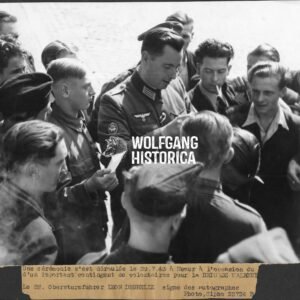
WWII Press Photograph – Léon Degrelle Signing Autographs, Namur, 29 July 1943
€250,00Original large-format wartime press photograph documenting SS-Obersturmbannführer Léon Degrelle, commander of the Walloon Legion, signing autographs for volunteers during a public ceremony in Namur on 29 July 1943. This well-known image captures Degrelle surrounded by members of the Brigade Wallonie, providing a vivid and historically significant snapshot of Waffen-SS propaganda and morale activity in occupied Belgium.
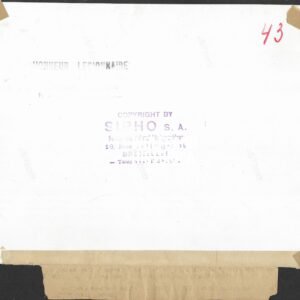
The photograph retains its original press caption in French, affixed to the lower margin, clearly identifying the event, date, location, and subject. The reverse bears the original SIPHO S.A. (Service International Photographique, Brussels) copyright stamp, confirming its authenticity as a contemporary press-issued photograph. Additional period handling marks, tape remnants, and editorial annotations are present, all consistent with genuine newsroom use.
Condition:
Good overall vintage condition. Typical press handling wear, including edge wear, tape remnants, and minor surface marks. Image remains sharp with strong contrast and excellent clarity for its age. No significant damage affecting display or historical value.
Historical Significance:
Léon Degrelle was one of the most prominent non-German Waffen-SS figures and a key collaborator leader in occupied Belgium. Original press photographs depicting him during wartime events are increasingly scarce, particularly large-format examples with intact captions and agency markings. This image offers strong documentary and research value, illustrating recruitment, propaganda, and the cult of personality surrounding Degrelle and the Walloon volunteers.
Collector’s Note:
A highly desirable and authentic WWII press photograph, ideal for advanced collections focused on Waffen-SS history, collaborationist movements, or original wartime photojournalism. The combination of large format, clear identification, period caption, and press agency stamp makes this an excellent display and reference piece.
Out of stock
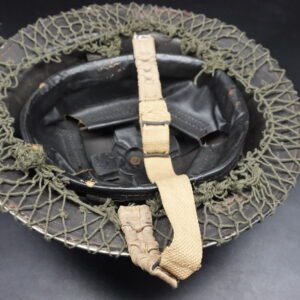

WWII British Mk II Combat Helmet (BMB 1943) with Net
€250,00A solid and untouched British Mk II steel combat helmet, wartime-manufactured by Briggs Motor Bodies (BMB) and dated 1943, retaining its original textured finish and paired with a helmet net.
Helmet Shell
-
Stamped “BMB 1943” with size 7¼ marking
-
Original factory rough-textured paint, showing expected service wear
-
No postwar repaint—100% wartime finish
Liner
-
Complete wartime liner marked 1943, with the correct N (neutral) date code
-
Original rubber buffer still present
-
Liner shows typical dryness and small tears from age, but remains structurally solid
-
Retains the full original interior bolt and nut
Chinstrap
-
Equipped with a desirable elasticated chinstrap, the correct British airborne and infantry style introduced late-war
-
Strap remains supple with light service wear
Net
-
Period? Period attached? I cannot say this but was bought as such but cannot confirm myself, so I mention it here..
Collector’s Note
This is a very appealing, battlefield-ready configuration Mk II—complete, unmessed-with, and featuring all the sought-after components: original wartime paint, correct dated liner, elastic chinstrap, and combat net. Helmets like this increasingly disappear into advanced collections.
Condition
Good, untouched wartime condition throughout. Honest wear, no restoration, no modern parts.
Out of stock


OdR Commemorative Porcelain Plate – Dedicated to RKT Ernst Lüdke by Walter Zurmöhle
€250,00A rare and highly desirable postwar commemorative porcelain plate issued by the Ordensgemeinschaft der Ritterkreuzträger (OdR)—the official association of Knight’s Cross recipients founded after World War II. Produced by Arzberg Porcelain (Germany), this elegant plate displays the classic OdR design, featuring the Knight’s Cross of the Iron Cross (1939) suspended from its ribbon, surrounded by the title of the organization in stylized script.
What elevates this example far above standard OdR plates is its personal dedication on the reverse:
“Ernst Lüdke – zum 70. Lebensjahr von den Kameraden der OdR Hannover – 11.5.1987”,
Signed by Dipl.-Ing. Walter Zurmöhle (Ritterkreuzträger)
Recipient: Oberleutnant der Reserve Ernst Lüdke (11 May 1917 – 9 November 1988)
A decorated Knight’s Cross recipient, Lüdke distinguished himself as:
-
Oberleutnant der Reserve, Führer 2./gem.FlakAbt 241
-
Awarded the Ritterkreuz des Eisernen Kreuzes on 5 September 1944
-
Recognized for his decisive leadership during the Allied breakout attempt from the Anzio bridgehead
-
His innovative and aggressive employment of light Flak earned his positions the legendary nickname: “The Ghost Guns of Anzio”
-
Also holder of the Iron Cross 1st Class, Iron Cross 2nd Class, and Flakkampfabzeichen der Luftwaffe
This commemorative plate was presented to him by his comrades of the OdR Hannover on his 70th birthday—just one year before his death. Items directly connected to known Ritterkreuz recipients are extremely sought after, especially when tied to documented wartime achievements.
Signed by Ritterkreuzträger Dipl.-Ing. Walter Zurmöhle
-
Born 13 May 1916 – Died 7 February 2008
-
Awarded the Knight’s Cross on 5 April 1944 as Oberleutnant and company commander, 1./Pionier-Bataillon 6 (L), 6. Feld-Division (L)
-
His signature adds significant provenance and collector value
Condition
-
Excellent overall condition with full, bright glaze
-
Arzberg maker’s mark attested on reverse
-
Original typed dedication label securely attached and signed
-
Ready for display, with hanging wire intact
Collector’s Note
OdR pieces are scarce, but named, dedicated examples connected to two Knight’s Cross holders—with one signature—are exceptionally rare. This plate offers a unique bridge between wartime history and the postwar fraternity of Ritterkreuz recipients. A standout item for any collection specializing in German awards, Knight’s Cross research, or OdR memorabilia.
Two photos added of Ernst Lüdke and Walter Zurmöhle as example! NOT INCLUDED.
Out of stock


Walther von Seydlitz-Kurzbach – 12. Infanterie-Division (Battle for Stalingrad!) (Collaborated with Soviets, “Anti-Nazi Force” Plan) (Eichenlaub)
€250,00Out of stock
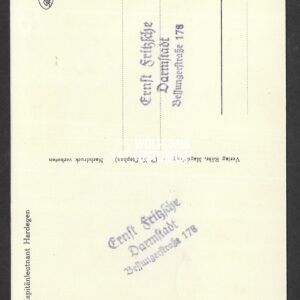
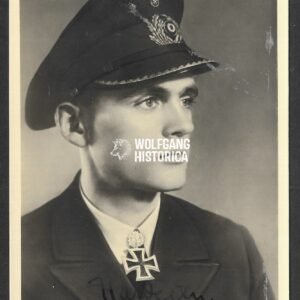
Reinhard Hardegen – Commander of U-123 (Eichenlaub) (Wartime Signed!)
€250,00Reinhard Hardegen (18 March 1913 – 9 June 2018) was a decorated German U-boat commander during the Second World War. As commander of U-123, he became the 24th-most-successful German submarine commander of the war, credited with sinking 22 ships totaling 115,656 GRT. Hardegen was a leading figure during Operation Paukenschlag (Drumbeat), the early 1942 U-boat offensive along the U.S. East Coast.
After the war, he spent time as a British prisoner-of-war before returning to civilian life, where he founded a successful oil trading company and later served for over three decades as a member of Bremen’s city council (Bürgerschaft).
Awards and Decorations
-
Knight’s Cross of the Iron Cross (Ritterkreuz des Eisernen Kreuzes) – 23 January 1942, as Kapitänleutnant and Kommandant of U-123.
-
Oak Leaves (Eichenlaub) – 23 April 1942, as Kapitänleutnant and Kommandant of U-123.
-
U-boat War Badge with Diamonds (U-Boots-Kriegsabzeichen mit Brillanten).
-
Iron Cross (1939) 1st and 2nd Class and Front Clasp in Bronze.
Item Details
-
Original wartime signature of Korvettenkapitän Reinhard Hardegen.
-
Signed on a wartime postcard featuring his portrait.
-
Provenance: From the large personal collection of HJ boy Ernst Fritzsche, who collected wartime autographs and correspondence during the period.
-
Condition: Very good; postcard shows minor age-related wear, with a crisp and clear signature.
Collector’s Note
Reinhard Hardegen was among the Kriegsmarine’s most renowned U-boat commanders and one of the few to live into the 21st century. His wartime signature on an original postcard is scarce and highly collectible, particularly with known period provenance.
Out of stock


Cloth Insignia of the SS – John R. Angolia (Signed & Numbered 12/500!)
€250,00Cloth Insignia of the SS by John R. Angolia (R. James Bender Publishing, 1983) is a detailed 480-page hardcover reference on the uniforms and cloth insignia of the SS. It covers collar tabs, cuff titles, sleeve shields, rank and specialty insignia, with hundreds of black-and-white photos and descriptions showing wartime variations.
This particular copy is Signed & Numbered 12/500, making it especially scarce and highly desirable for collectors.
Long considered one of the most authoritative works on the subject, it remains an essential tool for collectors and historians to authenticate and study SS insignia. Out of print and sought after, well-preserved copies are highly collectible.
Out of stock
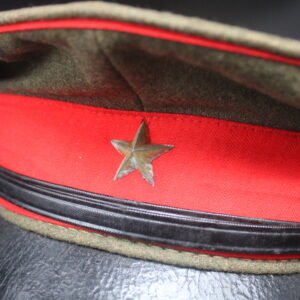

WWII Imperial Japanese Army Visor Cap
€250,00A tailor-made officer’s visor cap crafted from high-quality khaki-colored wool, typical of the pre–WWII uniform style. This design, known as the Type 45 cap, carries the traditional features established in 1913, including the red wool piping and headband along with the low-peaked profile. These elements became standard for officer’s dress and remained in use through the end of the Second World War.
This particular example displays only slight wear and has been beautifully preserved, free from handling damage and without any moth damage. The visor does show age-related cracking, though stable with no risk of further deterioration. Inside, the cap retains its purple silk lining and ersatz leather sweatband, both fully intact.
Collector’s Note
This is a striking and well-preserved example of a Type 45 officer’s visor cap, representing the transitional pre-war and wartime styles. The quality tailoring, intact interior, and large display size make it not only a fine historical artifact but also a centerpiece for any advanced collection of WWII headgear. Among the most beautiful examples we have ever handled.
Out of stock

Signed Letter of Baldur von Schirach
€250,00Original Signed Letter featuring the official title header and blind-embossed seal (Blindprägestempel) of Baldur von Schirach. The letter is hand-signed in ink by Schirach himself, making it a striking and authentic historical document in 1939.
Condition: Well-preserved, with clear signature and intact official embossing. An impressive display piece.
Historical Background
Baldur Benedikt von Schirach
(9 May 1907, Berlin – 8 August 1974, Kröv, Germany)
-
Leading Nazi politician, best known as Reichsjugendführer (Reich Youth Leader) of the Hitlerjugend (Hitler Youth) from 1931 to 1940.
-
Later appointed Gauleiter and Reichsstatthalter of Vienna (1940–1945), where he oversaw both cultural affairs and the deportation of Viennese Jews.
-
Close confidant of Adolf Hitler during the Third Reich and part of the inner Nazi leadership.
-
Tried at the Nuremberg Trials, where he was convicted of crimes against humanity for his role in the deportations and sentenced to 20 years imprisonment.
-
Released in 1966 from Spandau Prison, lived quietly until his death in 1974.
Collector’s Note
This signed letter, complete with the official blind-embossed stamp, represents a tangible connection to one of the most infamous figures of the Nazi regime. Baldur von Schirach’s autograph is historically significant due to his central role in the indoctrination of German youth and his later conviction at Nuremberg.
Such signed documents are sought after by collectors of Third Reich history, Nuremberg Trial figures, and political autographs, both for their rarity and their stark historical weight.
Out of stock
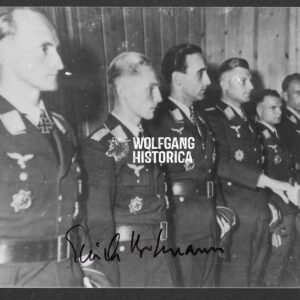
Erich “Bubi” Hartmann – Jagdgeschwader 52 (Brillianten) (352 Aerial Victories!)
€250,00Original Postwar Signature on a Postwar Photo of Erich “Bubi” Hartmann. Major Erich Alfred “Bubi” Hartmann (19 April 1922, Weissach, Württemberg – 20 September 1993, Weil im Schönbuch, Germany) was the most successful fighter ace in aviation history, credited with an unparalleled 352 confirmed aerial victories on the Eastern Front. Known as “The Blond Knight of Germany”, Hartmann flew with Jagdgeschwader 52 (JG 52) and became one of the most decorated Luftwaffe fighter pilots of the Second World War. His skill, discipline, and survival across more than 1,400 combat missions earned him legendary status among pilots of all nations.
Awards and Decorations
-
German Cross in Gold (Deutsches Kreuz in Gold) – 17 October 1943
-
Knight’s Cross of the Iron Cross (Ritterkreuz des Eisernen Kreuzes) – 29 October 1943, as Leutnant and Flugzeugführer, 9./JG 52 (148 victories)
-
Oak Leaves (Eichenlaub) – 2 March 1944, as Leutnant and Staffelkapitän, 9./JG 52 (200 victories)
-
Swords (Schwerter) – 2 July 1944, as Oberleutnant and Staffelkapitän, 9./JG 52 (239 victories)
-
Diamonds (Brillanten) – 25 August 1944, as Oberleutnant and Staffelkapitän, 9./JG 52 (301 victories)
-
Pilot-Observer Badge in Gold with Diamonds (Gemeinsames Flugzeugführer- und Beobachterabzeichen mit Brillanten) – special presentation award
-
Numerous additional decorations including the Iron Cross 1st and 2nd Class
Career Highlights
-
Eastern Front Ace: Flew over 1,400 combat missions, engaging in aerial combat in nearly 825 of them.
-
Unmatched Record: Credited with 352 confirmed kills, all against Soviet aircraft.
-
Survival Tactics: Known for his strict discipline and patience in combat, avoiding unnecessary risks and striking with precision.
-
Last Victory: Achieved his 352nd and final victory on 8 May 1945, just hours before Germany’s surrender.
-
Postwar Captivity: Spent 10 years in Soviet captivity (1945–1955) before returning to West Germany.
-
Postwar Career: Joined the newly formed Bundesluftwaffe (West German Air Force), where he commanded a fighter wing but later resigned due to political disputes over NATO standardization.
-
Legacy: His name remains synonymous with aerial mastery, and he is celebrated as the most successful fighter ace in recorded history.
Item Details
-
Authentic postwar signature of Major Erich “Bubi” Hartmann.
-
Signed on a postwar photograph.
-
Condition: Good, clear autograph.
Collector’s Note
Hartmann’s autograph is among the most coveted in WWII aviation collecting. His record of 352 aerial victories is unmatched and will never likely be equaled. Decorated with the Ritterkreuz mit Eichenlaub, Schwertern und Brillanten and the rare Pilot-Observer Badge with Diamonds, his signature represents the pinnacle of Luftwaffe fighter history. An essential piece for any serious collection of WWII aviation memorabilia.
Out of stock
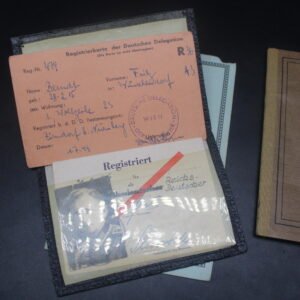
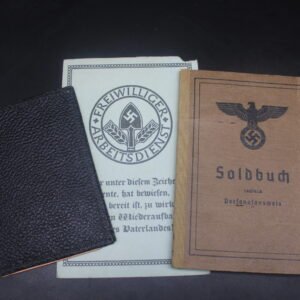
Soldbuch, RAD Pass — “Spieß” in Panzer-Regiment 3 (5x Awards)
€250,00Recipient: Hauptfeldwebel Berndt
Role: “Spieß” (company first sergeant) of the Stabskompanie / Panzer-Regiment 3, 2. Panzer-Division
Grouping Includes
-
Soldbuch
-
Complete with original photograph
-
Very well filled in with entries and awards
-
-
Arbeitsdienst Pass (RAD)
-
Wehrmacht ID Card
Service History
-
Served through the Invasion of Poland (1939)
-
Took part in the Western Campaign, 1940–41 with the 2. Panzer-Division
-
Senior NCO as company “Spieß” in the regimental staff company
Decorations Recorded
-
Dienstauszeichnung IV. Klasse (Long Service Award)
-
Erinnerungsmedaille an den 13.3.1938 (Annexation of Austria Medal)
-
Erinnerungsmedaille an den 1.10.1938 (Sudetenland Medal)
-
Schützenabzeichen 3. Klasse (Marksman’s Badge)
-
Kriegsverdienstkreuz 2. Klasse mit Schwertern (War Merit Cross 2nd Class with Swords)
Collector’s Notes
-
Excellent complete set with strong documentation trail.
-
The Soldbuch is especially desirable: photo included, thorough entries, showing service from the earliest campaigns of the war.
-
Attractive set tied to a senior NCO in the famed 2. Panzer-Division.
Condition
-
As seen in photos: period wear but well-preserved; Soldbuch intact with photo, legible entries throughout.
Out of stock
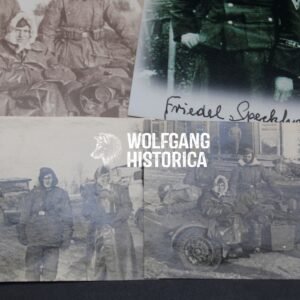
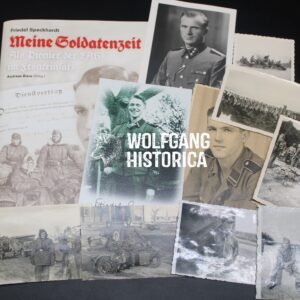
Book of “LSSAH” Veteran Friedel Speckhardt with some original photos!
€250,00Friedel Speckhardt was one of the men who experienced the dedicated and grueling service of the 2nd Pioneer Company of the 1st SS Panzer Division Leibstandarte SS Adolf Hitler (LAH) firsthand. His accounts of operations across various combat zones offer a rare glimpse into the harsh daily life of the pioneers. Although this booklet is not intended as an official chronicle of the 2nd Pioneer Company of the Leibstandarte, Speckhardt’s writings allow readers to trace the unit’s path through the war. His memories are thus preserved for future generations.
Out of stock
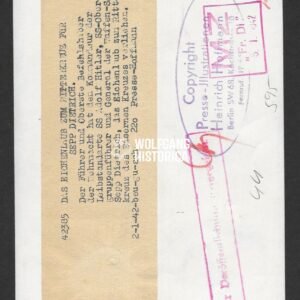
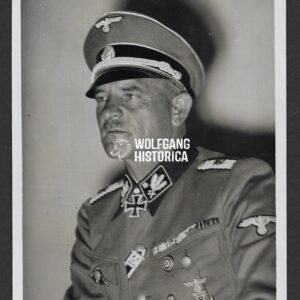
German Press Photo: SS-Gruppenführer Sepp Dietrich
€250,00Out of stock


NSDAP Parteibuch – Ortsgruppe Burtehude (1933)
€250,00Out of stock


Panzerkampfabzeichen in Bronze – Rudolf Souval, Wien
€250,00In stock
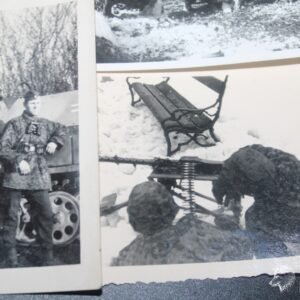

Small Waffen-SS Photolot with Camo being worn!
€250,00Out of stock
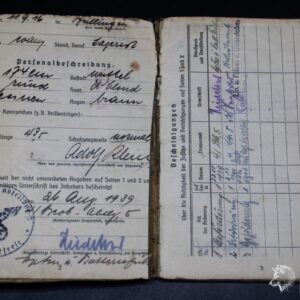
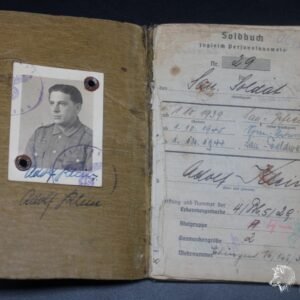
Soldbuch Jäger-Rgt. 229, Festung-Artillerie-Abt. 1509, 1524 (4x Awards incl. Demjanskschild!)
€250,00Out of stock


Document Group of Egon von Ploetz – Werner Freiherr von Fritsch Signature!
€250,00An impressive and historically significant document group belonging to Oberleutnant Egon von Ploetz, who in 1937 served with Reiter-Regiment 4 and is believed to have later attained the rank of Rittmeister (Hauptmann).
The highlight of the set is a large promotion document personally signed by Reichskriegsminister Thomas Ludwig Werner Freiherr von Fritsch. The group further includes:
-
Three official documents bearing the signature of von Fritsch
-
A large formal portrait (with printed signature)
-
A period press photograph
About von Fritsch:
Thomas Ludwig Werner Freiherr von Fritsch (4 August 1880 – 22 September 1939) was a German Generaloberst (full general) and Commander-in-Chief of the German Army from February 1934 to February 1938. His career came to a dramatic halt during the Blomberg–Fritsch Affair, when he was falsely accused of homosexuality and forced to resign—an event that played a key role in Adolf Hitler tightening control over the armed forces.
Shortly before the outbreak of WWII, von Fritsch was reinstated as Colonel-in-Chief of the 12th Artillery Regiment. He was killed in action in Poland on 22 September 1939, becoming only the second German general to die in the conflict.
This grouping represents not only a rare set of documents tied to an officer of the prestigious Reiter-Regiment 4, but also carries the historically important autograph of one of Germany’s most prominent pre-war military leaders.
Out of stock

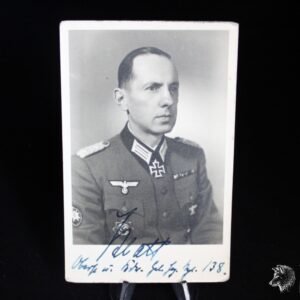
Signed Studioportrait of Paul Klatt – 3. Gebirgs-Division (Eichenlaub) (Wartime)
€250,00Out of stock
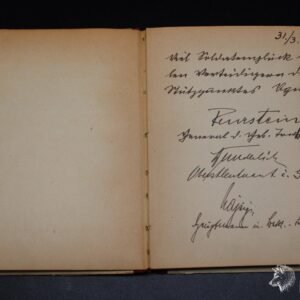

Guestbook of “Stutzpünkt Ogna” in Norway – Grenadier-Regiment 367
€250,00In stock
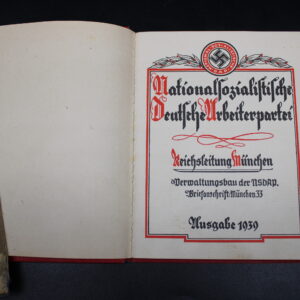
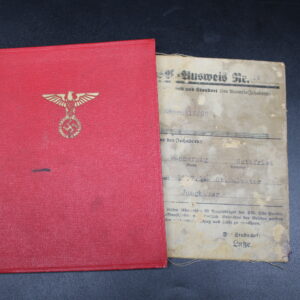
NSDAP Parteibuch & SA-Ausweis (St. Salvator)
€250,00Product Status
All Categories
- Collaboration
- Combat Awards
- Documents
- Dutch Collaboration
- Erkennungsmarke
- Finnish Militaria
- Flemish Collaboration
- General Awards
- Japanese Militaria
- Other Nations
- Photos
- Porcelain & Cutlery
- Portraits
- Storing & Archiving
- Wartime Signed
- Archive (Sold)
- Awards & Decorations
- Uniforms & Insignia
- Papers & Documents
- Award Documents
- Death Cards
- Military & Civil ID's
- Postcards & Feldpost
- Literatur
- Photos & Postcards
- Signatures
- Kriegsmarine
- Luftwaffe & FJ
- Panzer
- Waffen-SS
- Wehrmacht
Brands
- Adolf Baumeister (Lüdenscheid)(1)
- Arbeitsgemeinschaft der Graveur-, Gold- und Silberschemiedeinnungen (Hanau)(1)
- Arbeitsgemeinschaft Metall und Kunststoff (Gablonz an der Neiße)(1)
- Arno Wallpach (Salzburg)(2)
- Berg & Nolte (Lüdenscheid)(3)
- Biedermann & Co (Oberkassel)(1)
- C.E. Juncker (Berlin)(5)
- Carl Poellath (Schrobenhausen)(1)
- Carl Wild (München)(2)
- Deschler & Sohn (München)(1)
- Ernst L. Müller (Pforzheim)(1)
- Förster & Barth (Pforzheim)(2)
- Franz Reischauer (Oberstein)(1)
- Friedrich Linden (Lüdenscheid)(2)
- Friedrich Orth (Wien)(1)
- Fritz Zimmermann (Stuttgart)(1)
- Funke & Brünninghaus (Lüdenscheid)(1)
- Grossmann & Co (Wien)(1)
- Hauptmünzamt Wien (Wien)(2)
- Hermann Aurich (Dresden)(1)
- Hermann Wernstein (Jena-Lobstedt)(1)
- Julius Bauer & Söhne (Zella Mehlis)(1)
- Julius Maurer (Oberstein)(2)
- Karl Wurster K.G. (Markneukirchen)(1)
- Katz & Deyhle (Pforzheim)(1)
- Klein & Quenzer (Idar Oberstein)(3)
- L. Christian Lauer, Nürnberg (Nürnberg-Berlin)(1)
- Overhoff & Cie (Lüdenscheid)(1)
- Paul Meybauer (Berlin)(2)
- Richard Sieper & Söhne (Lüdenscheid)(1)
- Rudolf A. Karneth & Söhne (Gablonz a.N.)(1)
- Rudolf Souval(2)
- Rudolf Wächtler & Lange (Mittweida)(4)
- Wächtler & Lange (Mittweida)(1)
- Walter & Henlein (Gablonz)(1)
- Werner Redo (Saarlautern)(1)
- Wernstein (Jena)(3)
- Wilhelm Deumer (Lüdenscheid)(6)
- Wilhelm Hobacher (Wien)(1)