



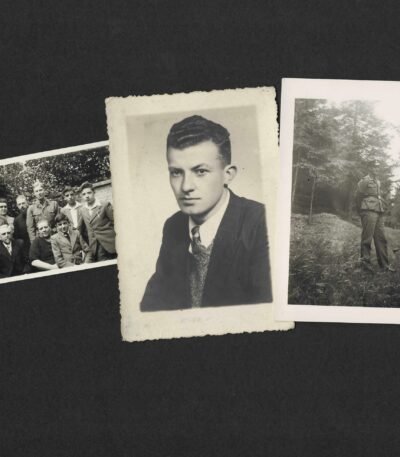
3x Photos of Flemish Waffen-SS Volunteers
€100,00Original 3x Photos of Flemish Waffen-SS Volunteers. Ca 6,5 x 9,5 and smaller.
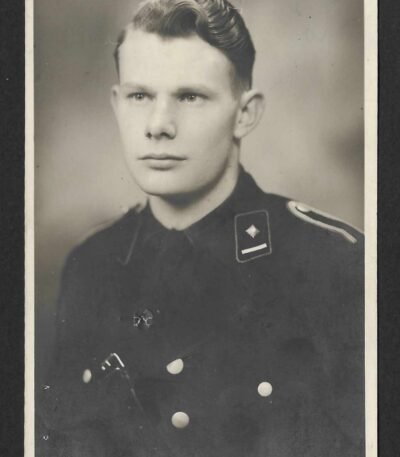
Studio Portrait Vlaamse Wachtbrigade
€150,00Original Studio Portrait of a Flemish member of the Vlaamse Wachtbrigade. Postcardsize.
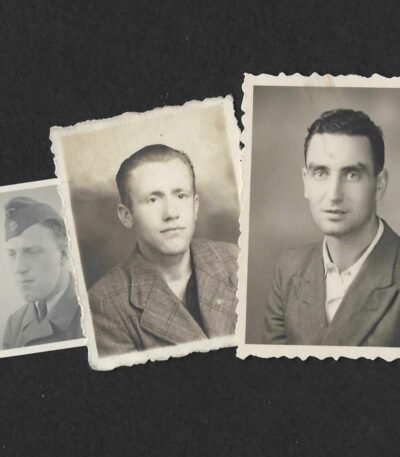
3x Flemish Waffen-SS Volunteers (Small ID Sizes)
€100,003x Small ID photo of Flemish Waffen-SS Volunteers. Small ID Size!
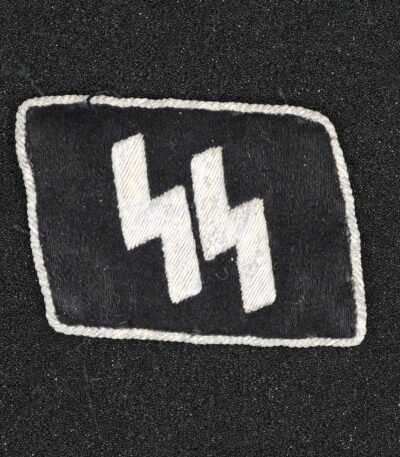
Waffen-SS Officer’s Collar Tab – SS Runes – Uniform Removed
€1.095,00Original WWII Waffen-SS officer’s collar tab featuring the embroidered SS runes. Removed from its original uniform and showing a very attractive, naturally worn appearance.
The insignia displays clear white/silver bullion-style SS runes on black wool, with the original embroidered border. The reverse shows clear evidence of having been removed from a uniform, including remaining stitching and wear.
Condition: Used/worn condition with age-related wear, loose threads and some losses, exactly as shown. No attempt has been made to repair or restore it.
A genuine, well-worn piece of WWII Waffen-SS uniform insignia with excellent period character.
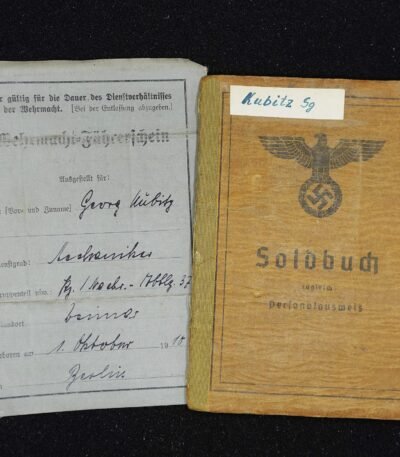
Panzer Soldbuch & Führerschein – Panzer-Abteilung 7 – MP40 – Photo in Panzer Uniform
€295,00Interesting original WWII document grouping belonging to Georg Kubitz, comprising his original Wehrmacht Soldbuch and Wehrmacht-Führerschein, with documentation of service in several armoured formations and training establishments.
Kubitz’s early military career is particularly well documented. His Wehrmacht-Führerschein was issued in 1938 while serving with Panzer-Nachrichten-Abteilung 37, and retains his original photograph, signature and official stamps.
His Soldbuch subsequently records service with:
- Panzer-Nachrichten-Abteilung 37
- Lehrtruppe Panzer-Truppenschule Bergen
- Panzer-Abteilung 7
- Later service with additional formations recorded in the Soldbuch
- Promotion to Unteroffizier
Particularly interesting is the recorded issue of an MP40, documented in the weapon/equipment section of the Soldbuch.
Kubitz was also awarded the Medaille zur Erinnerung an den 1. Oktober 1938, the commemorative medal for the German occupation of the Sudetenland, adding an interesting pre-war element to the grouping.
Highlights
- Original Wehrmacht Soldbuch
- Original Wehrmacht-Führerschein, 1938
- Early service with Panzer-Nachrichten-Abteilung 37
- Lehrtruppe Panzer-Truppenschule Bergen
- Panzer-Abteilung 7
- Documented MP40 issue
- Medaille zur Erinnerung an den 1. Oktober 1938
- Later promoted to Unteroffizier
- Photograph in Panzer uniform
A very interesting and well-documented personal grouping, particularly attractive for collectors of early Wehrmacht, Panzer and communications units. The combination of a 1938 Wehrmacht driver’s licence, pre-war service, Panzer-Truppenschule documentation, Panzer-Abteilung 7 service and a recorded MP40 issue makes this a particularly characterful Soldbuch grouping.
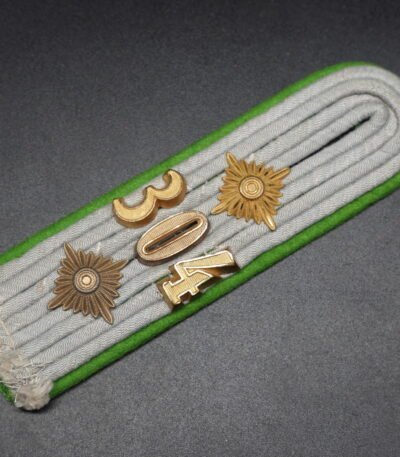
Panzergrenadier-Regiment 304 Hauptmann Shoulder Board
€100,00Original single (to sew in) Hauptmann shoulder board for the Panzergrenadier-Regiment 304 of the 2. Panzer-Division. Condition as seen.
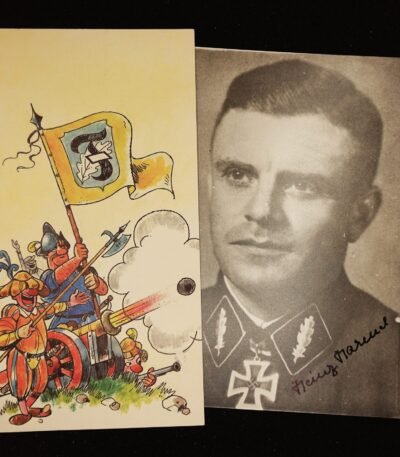
Heinz Harmel – “Deutschland” & “Frundsberg” (Schwertern) (Normandy, Nijmegen) (Larger Size!)
€155,00Original Postwar Signature on a Postwar Photo of Heinz Harmel. SS-Brigadeführer und Generalmajor der Waffen-SS Heinz Harmel (29 June 1906, Metz, Alsace-Lorraine † 2 September 2000, Krefeld) was a Waffen-SS officer who rose to the rank of SS-Brigadeführer und Generalmajor der Waffen-SS. Best known for his front-line leadership, Harmel commanded SS-Panzergrenadier-Regiment 3 “Deutschland” and later the 10. SS-Panzer-Division “Frundsberg”, earning the Ritterkreuz des Eisernen Kreuzes with Oak Leaves and Swords. Comes with a beautiful Frundsberg card!
Awards and Decorations
-
Knight’s Cross of the Iron Cross (Ritterkreuz des Eisernen Kreuzes) – 31 March 1943, as SS-Obersturmbannführer and Kommandeur SS-Panzergrenadier-Regiment 3 “Deutschland”
-
Oak Leaves (Eichenlaub, 296th Award) – 7 September 1943, as SS-Standartenführer and Kommandeur SS-Panzergrenadier-Regiment 3 “Deutschland”, 2. SS-Panzer-Division “Das Reich”
-
Swords (Schwerter, 127th Award) – 15 December 1944, as SS-Brigadeführer und Generalmajor der Waffen-SS and Kommandeur 10. SS-Panzer-Division “Frundsberg”
Career Highlights
-
Early service: Joined the Waffen-SS and quickly rose through the ranks, noted for his competence and ability to inspire troops in combat.
-
Eastern Front: Gained distinction as Kommandeur of SS-Panzergrenadier-Regiment 3 “Deutschland”, earning both the Knight’s Cross and the Oak Leaves for his leadership in heavy fighting.
-
Western Front 1944: As commander of the 10. SS-Panzer-Division “Frundsberg”, Harmel led his division in the Normandy battles, the defense of Arnhem during Operation Market Garden, and the Alsace and Ardennes campaigns.
-
End of the war: In 1945, his division fought in Saxony and Czechoslovakia. Harmel surrendered to Allied forces in May 1945 and was held as a POW.
-
Postwar life: Released after the war, Harmel lived a quiet life in Krefeld until his death in 2000 at the age of 94.
Item Details
-
Authentic postwar signature of Heinz Harmel, SS-Brigadeführer und Generalmajor der Waffen-SS.
-
Signed on a large postwar photograph. Almost A5 size.
-
Condition: Very good, clear autograph and well-preserved photo.
Collector’s Note
Heinz Harmel’s career spans some of the most decisive campaigns of WWII, from the Eastern Front to Normandy and Arnhem. His receipt of the Knight’s Cross with Oak Leaves and Swords, combined with his leadership of the 10. SS-Panzer-Division “Frundsberg”, places him among the notable Waffen-SS divisional commanders. His long postwar life and willingness to sign autographs make his signature obtainable, but pieces on large-format photos such as this are scarcer and highly desirable for collectors.
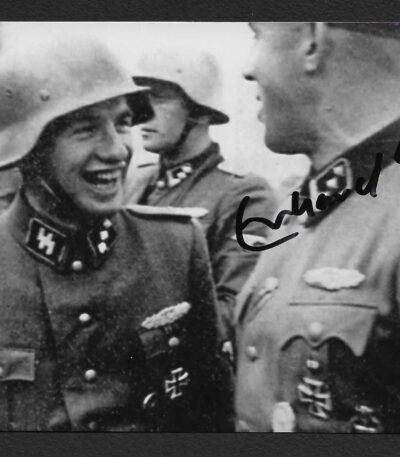
Erhard Gührs – 1. SS-Panzer-Division “LSSAH” (Normandy)
€37,50Original Postwar Signature on a Postwar Photo of Erhard Gührs. SS-Obersturmführer Erhard Gührs served with the SS-Panzer-Grenadier-Regiment 2 of the 1. SS-Panzer-Division “LSSAH”. Severely wounded in August 1944 on the Invasionsfront as Bataillonsadjutant of the SS-Panzer-Grenadier-Regiment 2. Postcardsize. Condition as seen. Postcardsize.
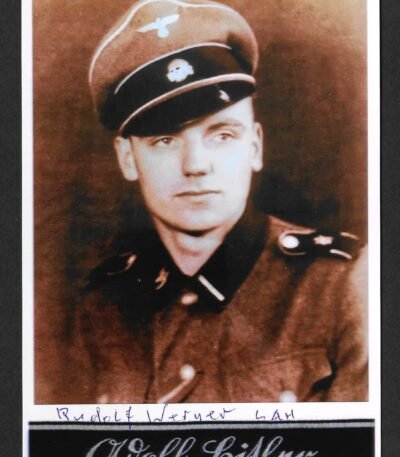
Rudolf Werner – 1. SS-Panzer-Division “LSSAH” & Wach-Bataillon “LSSAH”
€30,00Original Postwar Signature on a Postwar Photo of Rudolf Werner. SS-Sturmmann Rudolf Werner (17.07.1922-) served with the SS-Wach-Bataillon 1 & 1. SS-Panzer-Division “LSSAH” as Feldkoch than fought in the Kessel von Halbe. Good condition. Postcardsize.
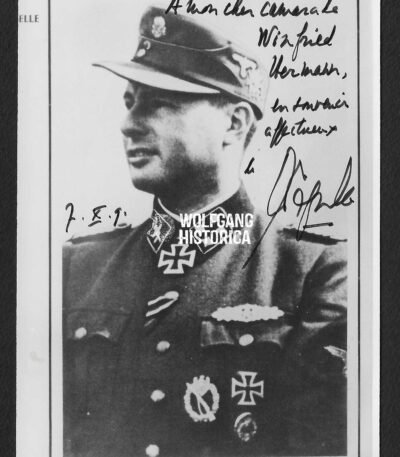
Leon Degrelle – 28. SS-Freiwilligen-Panzer-Grenadier-Division “Wallonië”
€250,00SS-Standartenführer Leon Degrelle (15 June 1906, Bouillon † 31 March 1994, Málaga) was the Belgian leader of the Rexist Movement and one of the most famous foreign volunteers to serve in the Waffen-SS during the Second World War. He rose from enlisted service to command the Walloon volunteers on the Eastern Front, eventually leading the 28. SS-Freiwilligen-Grenadier-Division “Wallonien.”
Degrelle distinguished himself in heavy fighting against Soviet forces, receiving some of the highest decorations awarded to non-German volunteers. He survived the war, escaping to Spain where he lived in exile until his death in 1994.
Awards and Decorations
-
Knight’s Cross of the Iron Cross (Ritterkreuz des Eisernen Kreuzes) – 20 February 1944, as SS-Hauptsturmführer and Führer of 5. SS-Freiwilligen-Sturmbrigade “Wallonien.”
-
Oak Leaves to the Knight’s Cross (Eichenlaub) – 27 August 1944, as SS-Sturmbannführer and Kommandeur of 28. SS-Freiwilligen-Grenadier-Division “Wallonien.”
-
Close Combat Clasp in Gold (Nahkampfspange in Gold) – 14 September 1944.
-
Additional decorations included the Iron Cross 1st and 2nd Class and Infantry Assault Badge.
Collector’s Note
Leon Degrelle remains one of the most controversial and well-known foreign volunteers of the Waffen-SS. His rise from volunteer soldier to divisional commander, along with his postwar exile and continued notoriety, makes his autograph especially rare and sought-after. This large-format signed photo is an exceptional piece for advanced collectors of Waffen-SS history, foreign volunteer units, and Knight’s Cross recipients.
Postcardsize. Sold on commission.
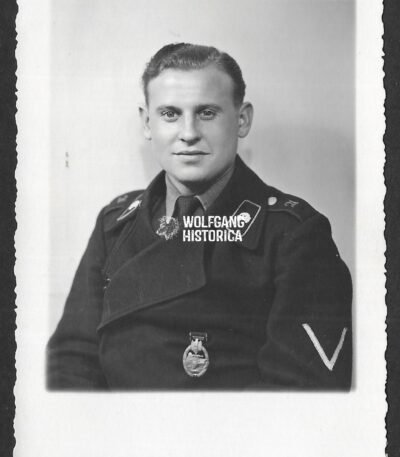
Studioportrait of Panzer soldier wearing Panzerkampfabzeichen in Silber & Shoulderboards “A”
€45,00Original Wehrmacht (Heer) Studioportrait of a Panzer soldier wearing the Panzerkampfabzeichen in Silber (highly detailed) and shoulderboards with “A” for Aufklärung (Recon). Postcardsize. Condition as seen.
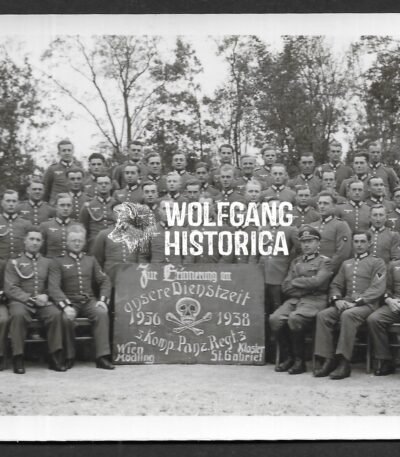
Photograph of Panzer-Regiment 3
€65,00Original photograph of the 3. Kompanie/ Panzer-Regiment 3 in memory of their service from 1936-1938 in Wien. Postcardsize.
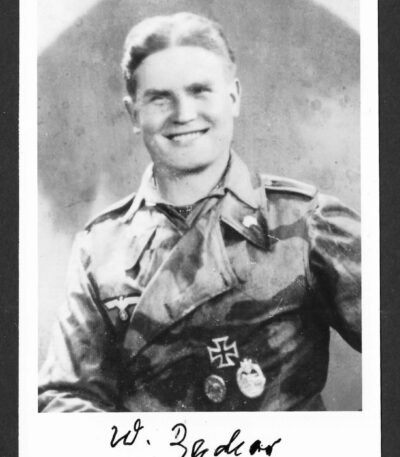
Wilhem Bachor – Panzer-Regiment 24 (24. Panzer-Division)
€45,00Original Postwar Signature on a Postwar Photo of Wilhelm “Willy” Bachor. Oberwachtmeister Wilhelm Bachor (04.05.1921 in Kelbassen † 20.03.2008 in Apolda) earned the Deutsches Kreuz in Gold on June 28, 1944 with Panzer-Regiment 24 and the Ritterkreuz des Eisernen Kreuzes on May 8 – 11, 1945 as Oberwachtmeister in the 12. Kompanie/ Panzer-Regiment 24 of the 24. Panzer-Division. He also earned the Panzerkampfabzeichen III. Stufe “50”. Condition as seen. Postcardsize.
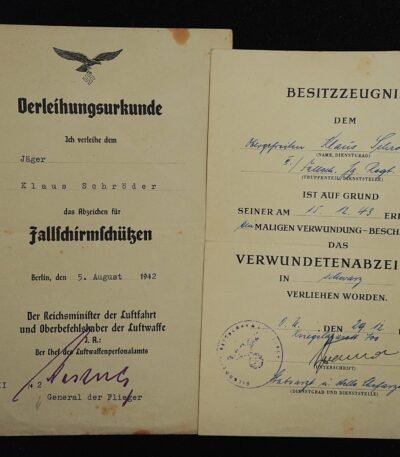
Award Documents – Fallschirmschützenabzeichen & Verwundetenabzeichen – Fallschirmjäger-Regiment 1 (Italy)
€295,00Excellent original WWII award document pair to Klaus Schröder, serving with II./Fallschirmjäger-Regiment 1.
- Fallschirmschützenabzeichen – awarded 5 August 1942, Berlin.
- Verwundetenabzeichen – awarded following a wounding sustained on 15 December 1943.
- Unit clearly identified as II./Fallschirmjäger-Regiment 1.
- The documents retain their original period handwriting, signatures and stamps.
The December 1943 wound places Schröder with FJR 1 during the fighting in the Orsogna–Ortona sector of the Italian Front. II./FJR 1 had been fighting around Melone and Orsogna in early December and was deployed into the Ortona/Orsogna battle area during the Allied offensive in mid-December. Contemporary campaign sources specifically document II./FJR 1 fighting around Melone and the Orsogna sector.
A very desirable Fallschirmjäger document grouping, particularly because both awards are named to the same individual and the unit is explicitly identified.
Condition: Original with age-related staining and handling marks, as shown.
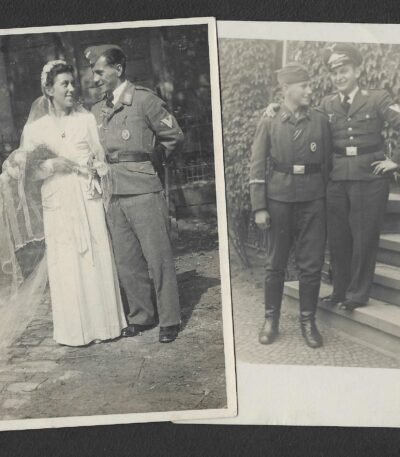
2x Fallschirmjäger Portrait – Paratrooper Badge
€60,00Original 2x WWII Fallschirmjäger portrait photographs, showing a German paratrooper in uniform (in one of them) wearing the Fallschirmschützenabzeichen (Paratrooper Badge). One seems to be wearing a cuff title (Fallschirmjäger-Regiment ..?)
Condition: Good original condition with some age-related wear and light surface marks.
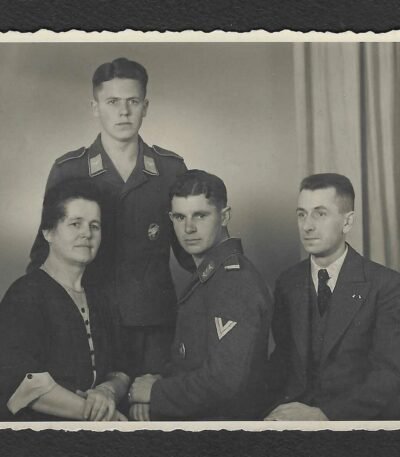
Fallschirmjäger Portrait – Paratrooper Badge
€35,00Original WWII Fallschirmjäger portrait photograph, showing a German paratrooper in uniform with his family wearing the Fallschirmschützenabzeichen (Paratrooper Badge).
Condition: Good original condition with some age-related wear and light surface marks.
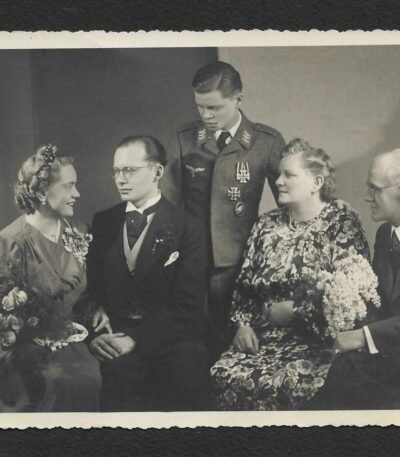
Fallschirmjäger Portrait – Paratrooper Badge, EK1 & EK2 (Single Bar)
€35,00Original WWII Fallschirmjäger portrait photograph, showing a German paratrooper in uniform with his family wearing the Fallschirmschützenabzeichen (Paratrooper Badge) and other awards.
Condition: Good original condition with some age-related wear and light surface marks.
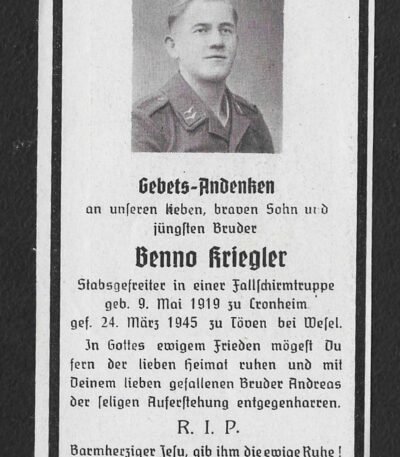
Death Card – Fallschirmjäger – March 1945 at Töven bei Wesel
€75,00Original German WWII death card / Gebets-Andenken for Benno Kriegler, a Stabsgefreiter in einer Fallschirmtruppe.
- Name: Benno Kriegler
- Born: 9 May 1919, Cronheim
- Rank: Stabsgefreiter
- Unit: Fallschirmtruppe (Fallschirmjäger)
- Killed: 24 March 1945 at Töven bei Wesel
- Includes a portrait photograph in uniform
- Death card commemorates him as a beloved son and youngest brother and mentions his brother Andreas, who had also fallen.
A very nice and desirable Fallschirmjäger-related original death card, combining a period portrait with personal biographical information and his documented death during the final fighting in the Wesel area.
Condition: Good overall period condition with normal age-related wear.
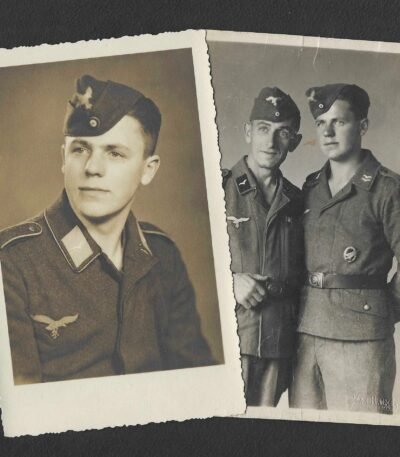
2x Fallschirmjäger Portrait – Paratrooper Badge
€60,00Original 2x WWII Fallschirmjäger portrait photographs, showing a German paratrooper in uniform wearing the Fallschirmschützenabzeichen (Paratrooper Badge). Came together, stay together.
Condition: Good original condition with some age-related wear and light surface marks.
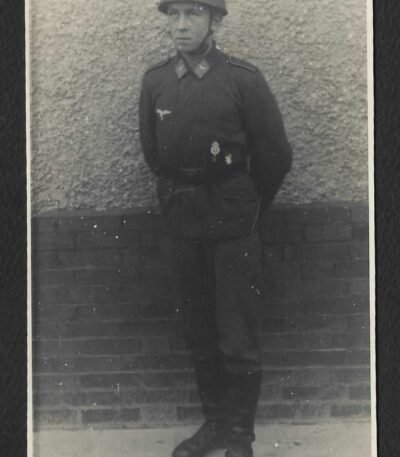
Fallschirmjäger Portrait – FJ Helmet & HJ Badge
€75,00Original WWII German Fallschirmjäger portrait photograph, showing a paratrooper in field-grey uniform and the distinctive Fallschirmjäger Stahlhelm.
The soldier is wearing the characteristic Luftwaffe/Wehrmacht breast eagle, with additional insignia visible on the uniform. The Fallschirmjäger helmet is particularly notable, making this a desirable period Fallschirmjäger portrait.
Condition: Original used condition with various age-related surface marks and wear, as visible.
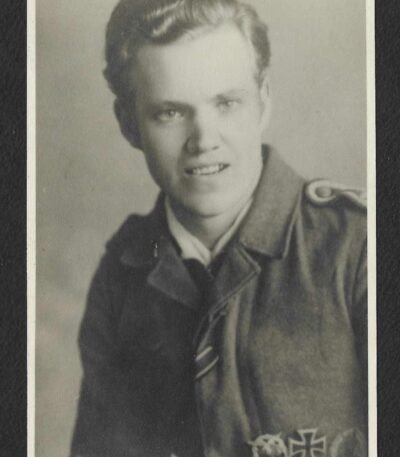
Fallschirmjäger Portrait – Paratrooper Badge, EK1, Wound Badge & Ground Combat Badge
€50,00Original WWII Fallschirmjäger portrait photograph, showing a German paratrooper in uniform wearing the Fallschirmschützenabzeichen (Paratrooper Badge), Verwundetenabzeichen in Schwarz (Black Wound Badge), Eisernes Kreuz 1. Klasse (Iron Cross 1st Class) and Erdkampfabzeichen (Ground Combat Badge) on his tunic.
Condition: Good original condition with some age-related wear and light surface marks. Relative unsharp, priced fairly.
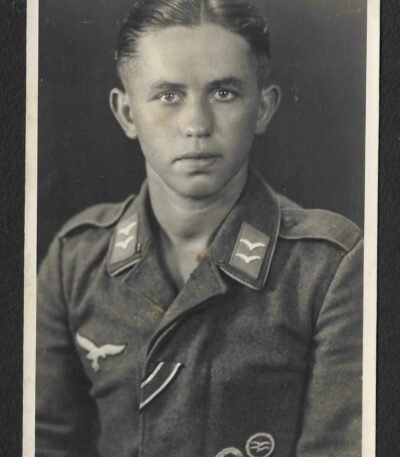
Fallschirmjäger Portrait – Paratrooper Badge in Cloth & Glider Badge in Cloth
€75,00Original WWII Fallschirmjäger portrait photograph, showing a German paratrooper in uniform wearing the Fallschirmschützenabzeichen (Paratrooper Badge) in cloth and Segelflieger-Abzeichen (Glider Badge) in cloth on his tunic.
Condition: Good original condition with some age-related wear and light surface marks.
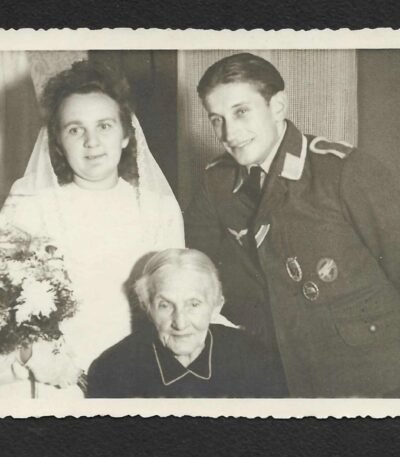
Fallschirmjäger Portrait – Wound Badge, Ground Combat Badge & Paratrooper Badge
€45,00Original WWII Fallschirmjäger portrait photograph, showing a German paratrooper in uniform together with his family wearing the Fallschirmschützenabzeichen (Paratrooper Badge), Wound Badge (Verwundetenabzeichen) and Ground Combat Badge (Erdkampfabzeichen) on his tunic.
Condition: Good original condition with some age-related wear and light surface marks.

Luftwaffe Flak Soldbuch – Luftsperrflakabteilung 207 (Paris, France) – Flak-Abt. 997
€155,00Offered is the original Soldbuch of Karl Spatz, born 16 March 1903, a farmer by profession. The document contains an original period photograph of Spatz and provides a detailed record of his service in the Luftwaffe, primarily with Flak (anti-aircraft artillery) units.
Spatz entered Luftwaffe service in January 1941, initially serving with the Überwachungskommando Fliegerhorst Dortmund. From July 1941 onwards he appears in several Flak formations, including Reserve-Flak-Abteilung 112, followed by service with leichte Flak-Abteilungen 718 and 752. The later entries document further service with Flak-Abteilung 207 and Luftsperr-Flak-Abteilung 207, followed by leichte Flak-Abteilung 997.
Luftsperr-Flak-Abteilung 207 was active in France incl. in Lorient, Saint-Nazaire, Paris, Brest etc.
His training record is particularly interesting and shows training on the Karabiner 98k, 3.7 cm Flak and 2 cm Flak, confirming his practical background in Flak service. The Soldbuch also contains an original weapons issue page, recording a Karabiner 98k and Seitengewehr with their respective issue details.
His rank progression visible in the book includes promotion to Gefreiter on 1 December 1944, followed by Obergefreiter on 1 February 1945.
The Soldbuch is in clearly well-used wartime condition, with considerable age, staining, wear and handwritten annotations throughout. Despite the condition, a substantial amount of information remains legible, making this an interesting original document for collectors of Luftwaffe and Flak militaria. Denazified.
A later 1987 funeral notice for Frau Barbara Haubner, wife of Karl Spatz, came with the soldbuch.

Award Doc, ID’s (Incl. Steuermannschein!) & Photo Group – Landungs-Pionier-Bataillon 772 – Rare KVK II with Swords Doc Variant
€195,00A very interesting and unusually complete original WWII German Wehrmacht grouping to Oberschirrmeister Walter Novoczin, featuring several original documents, photographs and an award certificate connected with his service.
The centerpiece of the grouping is an original Verleihungsurkunde (award certificate) for the Kriegsverdienstkreuz 2. Klasse mit Schwertern, awarded to: Oberschirrmeister Walter Novoczin of Stab/ Landungs-Pionier-Bataillon 772.
The certificate (rare variant) is dated 1 September 1944 and was issued in the name of the Führer by the Oberbefehlshaber der 18. Armee, signed (stamped) in his capacity as General der Infanterie. The original period Dienstsiegel is also present.
Particularly interesting is the identification of Novoczin as an Oberschirrmeister and his connection to Landungs-Pionier-Bataillon 772, a specialist Wehrmacht landing-pioneer formation. Contemporary documentation places elements of Pi.Ldgs.Btl. 772 in the Baltic theatre during 1944, including operations around Estonia and the Baltic islands.
The grouping also contains an original Wehrmacht driver’s qualification/document, issued in Hamburg in September 1938, authorising Novoczin for training/driving Wehrmacht motor vehicles with internal-combustion engines. This provides an interesting pre-war/early-war aspect to the grouping and helps document his technical qualifications.
Also included is an original rare Steuermannschein für heereseigene Motor-Wasserfahrzeuge, bearing Novoczin’s photograph and personal signature. This is particularly appropriate to his later association with a Landungs-Pionier formation and gives the group an interesting specialist maritime/landing-pioneer connection.
The grouping is further accompanied by multiple original period photographs and a small single ribbonbar for the KVK2.
Condition
The documents show strong original period wear, including staining, foxing, fading, creasing, tears, edge wear and handling marks. The cloth-covered documents are particularly well-used and fragile, but retain their original character and remain fully worthy of preservation and display. The photographs likewise show age-related wear consistent with genuine wartime material.
A very attractive and researchable single-soldier grouping, with an identifiable name, rank, specialist qualifications, award documentation and a substantial photographic component. The combination of a Steuermann qualification + motor-vehicle qualification + Landungs-Pionier-Btl. 772 service + KVK II with Swords makes this a particularly interesting grouping for collectors of Wehrmacht specialist personnel and German military documents.

German Female Worker Document Grouping – Eisenwerke Oberdonau – 1942–1946
€175,00The grouping provides an interesting glimpse into the life of a young German civilian woman during the Second World War and in the immediate post-war period.
Included are:
- Wartime Ausweis Nr. G 14 291 issued by Eisenwerke Oberdonau, Linz/Donau, dated 3 March 1942.
- Name: Liesel Mondry
- Born: 23.6.1926
- Occupation: Büroanfängerin
- Company: Eisenwerke Oberdonau, Linz/Donau
- Department indicated as MB Hauptlager
- The original metal ID-card holder, retaining the original photograph and identification details.
- Postspaarbuch Nr. 9.018.253 of the Deutsche Reichspost, complete with its matching Ausweiskarte.
- Post-war Kennkarte / Identitätskarte, issued at Lebenstedt on 4 June 1946 by the Stadtverwaltung Watenstedt-Salzgitter.
The group is particularly appealing because it follows one individual across the wartime and immediate post-war period, with her original photograph and several matching documents preserved together.
The wartime ID is especially interesting because it documents her employment at Eisenwerke Oberdonau in Linz, an important wartime industrial complex, while the 1946 Kennkarte demonstrates her identification and circumstances shortly after the collapse of the Third Reich.
Original condition throughout, with expected age-related wear, folds, handling marks and patina. The documents retain their original photographs, stamps, signatures and other period details.
A very nice named and photographed female civilian grouping, suitable for collectors of WWII German documents, female workers, Reichspost material, industrial history and personal-history groupings.

Kriegsmarine Soldbuch – Marine-Festungs-Pionier-Bataillon 360 – 1945 (2x Awards)
€150,00Original WWII Kriegsmarine Soldbuch belonging to Peter Habrich, born in Elsdorf, with his photograph still present in the document.
Key details documented in the Soldbuch
- Name: August …
- Born: Elsdorf
- Marine-Stammrollen-Nr.: N 17956 M.K.
- Entered: 3/1945, Marine-Festungs-Pionier-Bataillon 360
- Award: Ehrenkreuz für Kriegsteilnehmer, 28.2.1935
- Award: Kriegsverdienstkreuz 2. Klasse mit Schwertern, 12.12.1944
A particularly interesting late-war entry is dated 11 May 1945, shortly after the German capitulation:
„Überführt in das Rgt. Helgoland 2. Btl. – 3. Kompanie Freiburg-Halbe“
This is an unusual and interesting final-war entry, documenting his transfer into Regiment Helgoland, 2nd Battalion, 3rd Company, Freiburg-Halbe.
The Soldbuch also retains numerous original wartime stamps, handwritten entries and official annotations, making it a very interesting late-war Kriegsmarine document with a clearly identifiable owner and documented unit history.
Condition
Original used condition with the expected age, handling and storage wear. The document shows genuine wartime use, with some fading, staining and wear to the covers and pages. The original photograph remains present. Denazified.
A very interesting personal Kriegsmarine Soldbuch, particularly notable for the documented March 1945 service with Marine-Festungs-Pionier-Bataillon 360 and the unusual 11 May 1945 transfer entry.

RAD Dienstausweis – Oberfeldmeister – 3x Awards – Combat Service with Wehrmacht & Luftwaffe
€175,00Original wartime German RAD Ausweis belonging to Oberfeldmeister Prigge, documenting an extensive career in the Reichsarbeitsdienst (RAD) together with later wartime deployments.
The document contains numerous original handwritten entries, official stamps, signatures and service annotations, providing a fascinating record of the holder’s wartime service.
Service History
- Rank: Oberfeldmeister
- Promoted to Oberfeldmeister: January 1940
- RAD-Abteilung 2/172
- RAD-Abteilung 3/328 (XXXII Metz)
- Kommandiert to Der Reichsarbeitsführer: 08/1943 – 11/1944
- 12/1944 – 01/1945: Reichsarbeitsdienst-Abteilung 6/171
- 01/1942 – 02/1945: B.S. 5 Burgkatz (?)
- From 03/1945: RAD-Abteilung 10/175
Wartime Deployments
Particularly interesting are the entries documenting service in the context of the Wehrmacht and Luftwaffe:
- 08/1943 – 11/1944:
Einsatz im Rahmen der Wehrmacht im Heimatskriegsgebiet
— deployment within the framework of the Wehrmacht in the home war area. - 12/1944 – 01/1945:
Einsatz im Rahmen der Luftwaffe
— deployment within the framework of the Luftwaffe.
Awards & Decorations
The Ausweis records the following awards:
- Dienstauszeichnung für 4-jährige Dienstzeit — RAD 4 Years Service Medal
- Westwall-Ehrenzeichen
- Kriegsverdienstkreuz 2. Klasse mit Schwertern — War Merit Cross, 2nd Class with Swords, awarded 03/1944
Condition
Original period document with expected age-related toning, handling wear, creasing and fading, but retaining a very substantial amount of its original handwritten and stamped documentation.
A highly interesting RAD personnel document belonging to Oberfeldmeister Prigge, with an unusually well-documented wartime service history and documented employment with both the Wehrmacht and Luftwaffe.

Organisation Todt Dienstbuch + Arbeitsbuch (Düren) – Westwall Medal
€100,00Original WWII Organisation Todt (OT) Dienstbuch together with the accompanying Arbeitsbuch of Peter Habrich, born in Elsdorf, documenting his employment with the Organisation Todt and his wartime construction service in Belgium and France.
Peter Habrich
- Name: Peter Habrich
- Born: Elsdorf
- Organisation: Organisation Todt
- Service: Frontarbeiter
- Oberbauleitung: Düren
- Areas of service: Belgium and France
Habrich was active with the Oberbauleitung Düren, with the Dienstbuch documenting his employment and wartime activities in the Organisation Todt system.
Of particular interest is the entry concerning his activity under enemy action, recording his deployment in Belgium and France during the fighting.
Schutzwall-Ehrenzeichen
One of the most notable entries in the Dienstbuch is the award of the:
Schutzwall-Ehrenzeichen – awarded January 1940
This decoration was awarded to personnel who had participated in the construction of the Westwall, making the award an important indication of Habrich’s involvement in the German defensive construction programme.
Employment history
The accompanying Arbeitsbuch provides an excellent additional record of Habrich’s employment and construction work.
The book contains numerous original entries, stamps and signatures from different construction companies and worksites, including:
- Carl Brandt Bauunternehmung – Düren
- E. Korte Bauunternehmung – Bochum, Baustelle Udenbreth
- Wilhelm Keufer Bauunternehmung – Duisburg
- Jacob Eikeln Eisenbetonbau – Dülmen
- Adam Hochkirchen – Pflaster-, Tief- und Straßenbau, Frechen b. Köln
- P. Kouzen – Spezial-Abt. Flammschutzimprägnierung, Köln
The entries continue into 1945, giving a very useful picture of his employment during the war.
Condition
Both books show age-related wear, staining, creasing and handling, consistent with genuine wartime documents. The original covers, printed pages, handwritten entries, stamps and signatures remain. The photograph has been removed from the designated photograph area of the Dienstbuch.
A very interesting original OT document grouping belonging to Peter Habrich, particularly notable for his documented connection to the Oberbauleitung Düren, Westwall construction service and subsequent wartime activity in Belgium and France.

RAD BeVo-Woven Cap Badge – EM/NCO Type
€50,00riginal Reichsarbeitsdienst (RAD) Mützenabzeichen for the Schiffchen / Einheitsfeldmütze, in the BeVo-woven EM/NCO (Mannschaften/Unterführer) type.
The badge is executed in the characteristic woven construction, featuring the RAD emblem with the stylised spade, wheat ears and central swastika. The reverse shows the characteristic folded and woven construction, with the original fabric still present. BeVo-woven RAD cap badges of this type were intended for wear on the RAD field and side caps.
A nice original example for the RAD collector, particularly suitable for completing a period RAD uniform or insignia display. The piece shows age-related wear and some handling/storage damage, as visible in the photographs, but remains an interesting original period textile insignia.

SS “Alte Kämpfer” Honour Chevron – Ehrenwinkel
€225,00Original WWII SS Ehrenwinkel für Alte Kämpfer (Old Fighters Honour Chevron).
The insignia features a black wool triangular backing with silver/white metallic woven tresse, with the characteristic black detailing. The reverse shows the original stitching and construction.
The Alte Kämpfer chevron was introduced in 1934 and was awarded to SS members who had joined the SS, NSDAP or an affiliated organisation before 30 January 1933.
A desirable piece of original pre-war SS uniform insignia, showing natural age and storage wear.

Waffen-SS Tropical Sturmmann Rank Chevron
€50,00Original WWII Waffen-SS Sturmmann tropical rank chevron (Dienstgradwinkel).
Constructed with a black wool triangular backing and the characteristic golden-yellow/tan woven tresse, including fine black detailing. The tropical version was intended for wear on tropical/southern-front uniforms.
The chevron shows age-related wear and patina, with the original construction and materials clearly visible. A nice and desirable piece of original Waffen-SS tropical cloth insignia.

Heer Afrikakorps Tropical Oberschütze Rank Star
€30,00Original WWII German Heer tropical Oberschütze rank star
A nice original example with light grey/white machine embroidery on sand-coloured tropical cloth, intended for wear on the tropical uniform in North Africa.
The insignia shows age-related wear and some fraying to the edges, but retains its original wartime construction and attractive used appearance.

Wehrmacht Studioportrait – Iron Cross 2nd Class (Worn as on Award Day)
€25,00Original Studioportrait of a Wehrmacht (Heer) soldier wearing clearly visible the Iron Cross 2nd Class ribbon on the tunic.
The reverse carries a period handwritten dedication in German, together with a dated inscription of 25. Nov. 1941 and a printed photographer/studio marking referring to Stettin. The personal dedication adds an interesting provenance element to the photograph. Postcardsize.

Waffen-SS Tropical Sturmmann Rank Chevron
€50,00Original WWII Waffen-SS Sturmmann tropical rank chevron (Dienstgradwinkel).
Constructed with a black wool triangular backing and the characteristic golden-yellow/tan woven tresse, including fine black detailing. The tropical version was intended for wear on tropical/southern-front uniforms.
The chevron shows age-related wear and patina, with the original construction and materials clearly visible. A nice and desirable piece of original Waffen-SS tropical cloth insignia.

SS “Alte Kämpfer” Honour Chevron – Ehrenwinkel
€225,00Original WWII SS Ehrenwinkel für Alte Kämpfer (Old Fighters Honour Chevron).
The insignia features a black wool triangular backing with silver/white metallic woven tresse, with the characteristic black detailing. The reverse shows the original stitching and construction.
The Alte Kämpfer chevron was introduced in 1934 and was awarded to SS members who had joined the SS, NSDAP or an affiliated organisation before 30 January 1933.
A desirable piece of original pre-war SS uniform insignia, showing natural age and storage wear.
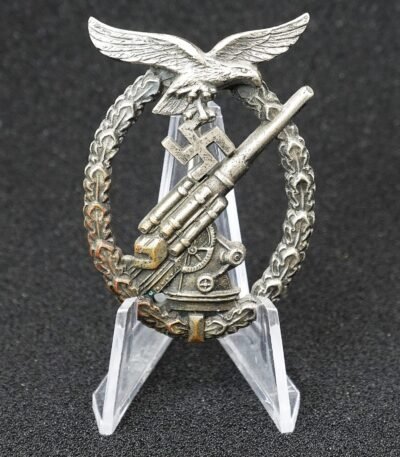
Flakkampfabzeichen – Maker Marked – CE Juncker
€600,00Original WWII German Luftwaffe Flakkampfabzeichen (Flak Combat Badge), maker marked “JUNCKER”.
A very attractive original badge featuring the characteristic Luftwaffe eagle above the anti-aircraft gun and oak-leaf wreath. The reverse retains the original hinge, pin and catch, with the maker mark “JUNCKER” visible on the reverse.
The badge shows genuine period wear and patina consistent with an original piece that has seen use. The surface has an aged, untouched appearance with remaining traces of the original finish.
Details:
- Original WWII German Luftwaffe Flakkampfabzeichen
- Maker marked: C.E. Juncker, Berlin
- Distinctive Juncker construction and detailing
- Original reverse hardware
- Original period patina and wear
- Excellent addition to a Luftwaffe or Flak collection
A desirable original Juncker-marked Luftwaffe Flak Combat Badge.
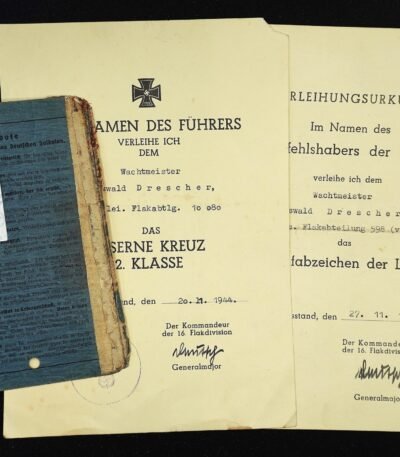
Top Luftwaffe Flak Set – EK II & Erdkampfabzeichen – Belgium & Holland 1944
€285,00A highly desirable and completely original named Luftwaffe Flak grouping belonging to Wachtmeister Oswald Drescher, comprising two wartime award documents together with his original period photograph.
The grouping contains:
- Eisernes Kreuz 2. Klasse (EK II) award document, dated 20 November 1944, issued to Wachtmeister Oswald Drescher, 4./Lei. Flakabtlg. 10080.
- Erdkampfabzeichen der Luftwaffe award document, dated 27 November 1944, issued to Wachtmeister Oswald Drescher, 5./gem. Flakabteilung 598 (v)(RAD).
- Original wartime photograph of Oswald Drescher wearing his Luftwaffe uniform.
Both award documents bear the signature of Generalmajor Friedrich Deutsch (DKiG), commander of the 16. Flak-Division.
The grouping is particularly interesting for its connection to the Western Front and the fighting in Holland and Belgium during the final months of 1944. Flak-Abteilung 598 was under the command of Hauptmann Kansky, Flakführer of Eindhoven, with personnel including members of RAD-Gruppen 200 and 224.
The two awards were issued only seven days apart, on 20 and 27 November 1944, providing an excellent documented snapshot of Drescher’s service during the intense fighting on the Western Front.
The combination of two named original award documents, the original recipient photograph, period unit details, and the connection to the 16. Flak-Division and Flak-Abteilung 598 makes this a particularly attractive grouping for the Luftwaffe and Flak collector.
A very nice original named grouping with strong Western Front provenance and excellent potential for further research into Oswald Drescher and Flak-Abteilung 598.
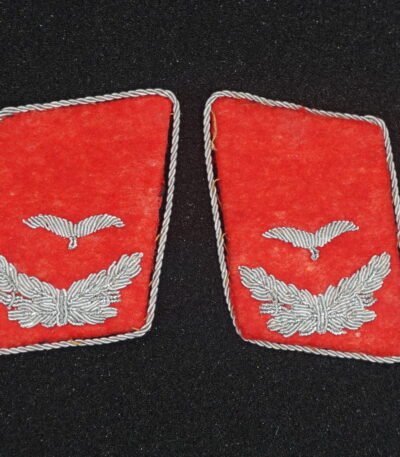
WWII Luftwaffe Flak Leutnant Officer Kragenspiegel – Uniform Removed
€60,00Original WWII German Wehrmacht Heer officer’s Kragenspiegel (collar tabs) for a Leutnant, presented as a matching pair.
The tabs are constructed in the typical officer-quality embroidered style, with silver/aluminium-coloured bullion embroidery on a red Waffenfarbe backing. The distinctive officer pattern and rank style make these an excellent addition to a Heer uniform or insignia collection. Heer officers wore embroidered collar patches, with the branch colour incorporated into the collar insignia.
These are original period pieces, removed from a uniform, rather than reproductions or newly manufactured insignia.
Both tabs retain their original construction, with visible age, wear and some loose threads consistent with their having been removed from a wartime uniform. The red wool backing remains particularly strong in colour.
Condition: Used/worn, with some loose threads and signs of service use as shown.
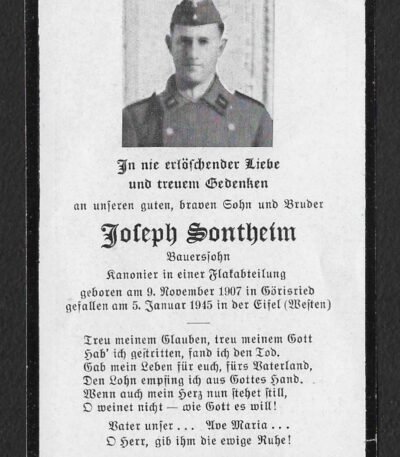
WWII German Death Card – Joseph Sontheim – Flak KIA – Eifel, January 1945
€15,00The card features an original portrait photograph of Sontheim in uniform and gives the following personal and service details:
Joseph Sontheim
Bauernsohn
Kanonier in einer Flakabteilung
Born 9 November 1907 in Görisried
Fallen 5 January 1945 in the Eifel (Westen)
The card is printed with a memorial text dedicated to him as a “guten, braven Sohn und Bruder”, followed by a religious poem and a request for eternal rest.
The photograph shows Sontheim wearing his military uniform and headgear, providing a particularly nice personal connection to the document.
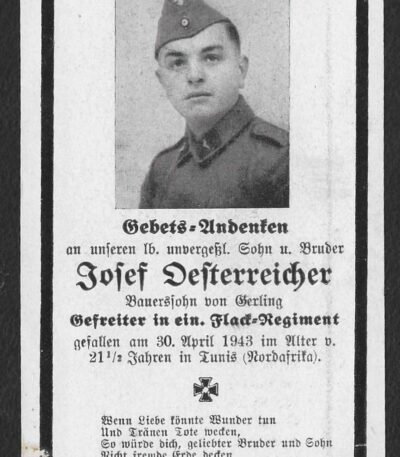
WWII German Death Card – Josef Deterreicher – Flak Regiment – KIA Tunis, Africa
€15,00Original WWII German death card (Sterbebild) for Josef Deterreicher, a Gefreiter in a Flak Regiment.
The card identifies him as:
Josef Deterreicher
Bauerssohn von Gerling
Gefreiter in einem Flak-Regiment
He was killed on 30 April 1943 in Tunis, North Africa, at the age of 21½ years.
The card is headed “Gebets-Andenken” and is dedicated to the soldier as a beloved son and brother. It features his original portrait photograph in uniform, together with a memorial prayer and poem.
Historical significance
A particularly interesting Flak casualty Sterbebild from the Tunisian campaign. The explicit identification as a Gefreiter in a Flak-Regiment, combined with his death in Tunis on 30 April 1943, places the card firmly within the final phase of the Axis campaign in North Africa.
The portrait is also particularly attractive, showing Deterreicher wearing his wartime uniform and side cap.
The card retains its original printed format and portrait photograph. There is some age-related staining, handling wear and minor damage, particularly around the edges, but the main text and photograph remain clearly visible.
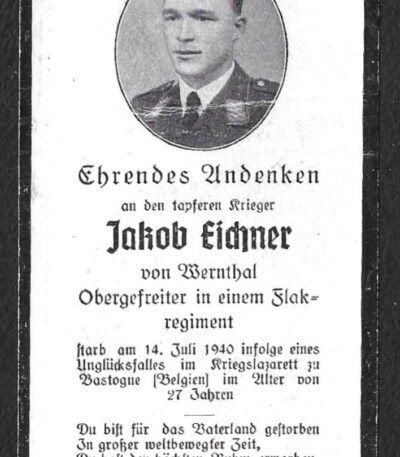
Death Card – Obergefreiter Flak Regiment – Bastogne, Belgium
€15,00Original German WWII death card / memorial card (Sterbebild) for Obergefreiter Jakob Eichner von Wernthal, a member of a German Flak regiment.
The card commemorates Jakob Eichner von Wernthal, who died on 14 July 1940 as the result of an accident while in the Kriegslazarett in Bastogne, Belgium, at the age of 27.
The front features a photographic portrait of Eichner in uniform, accompanied by the following printed information:
Ehrendes Andenken
an den tapferen Krieger
Jakob Eichner
von Wernthal
Obergefreiter in einem Flak-regiment
starb am 14. Juli 1940 infolge eines Unglücksfalles im Kriegslazarett zu Bastogne (Belgien) im Alter von 27 Jahren.
The reverse contains the customary memorial text:
Du bist für das Vaterland gestorben
In großer weltbewegter Zeit,
Du hast den höchsten Ruhm erworben,
Die Palme der Unsterblichkeit!
Printed by Druck Udart, Pfaffenhofen.
Size: approx. 9.2 × 5.4 cm
An interesting and very early-war Flak-related casualty memorial, with a documented connection to Bastogne, Belgium, making this particularly appealing for collectors interested in the German occupation of Belgium, early WWII Flak history, and personal military documents.
Condition: Good original condition for its age, with the expected signs of handling and age. Please study the photographs carefully for the exact condition.
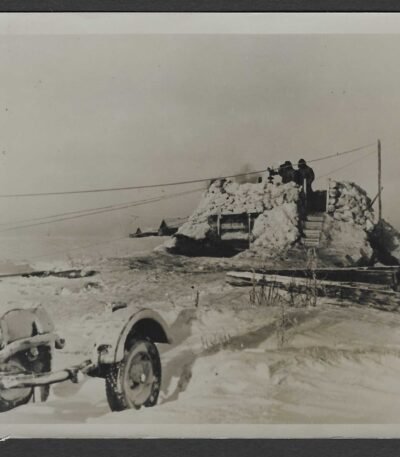
German Press Photo: Flakstellung in einem Stützpunkt
€25,00Original German Press Photo of a “Flakstellung in einem Stützpunkt”. Size: 13x18cm. Condition as seen.
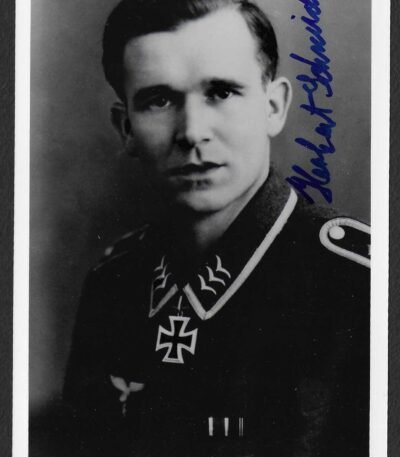
Herbert Schneider – Flak-Regiment 49
€20,00Original Postwar Signature on a Postwar Photo of Herbert Schneider. Oberwachtmeister Herbert Schneider (31.07.1915 † 01.12.2011) earned the Ritterkreuz on February 5, 1944 as Wachtmeister und Flakkampftruppführer of the 6. Batterie/ Flak-Regiment 49. Good condition. Measuring: Postcardsize.
Knight’s Cross: “During the defensive battles near Bolchow-Orel, in the summer of 1943, Wachtmeister Scheider succeeded in destroyed 25 Soviet tanks with his Flak gun. Later on during this fighting he would be heavily wounded by artillery fire on the 21.07.1943. In recognition of his achievements and devotion to duty during this time, he would receive the Knight’s Cross.”
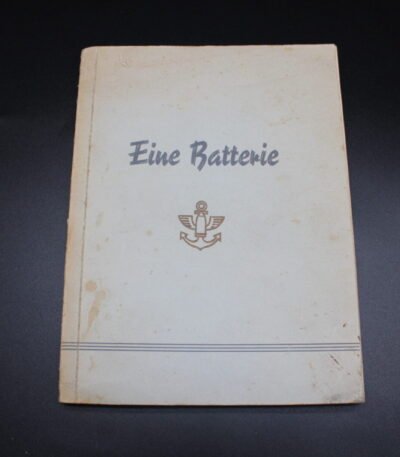
WWII Chronicle “Eine Batterie” – Batterie Krummendeich, Marine-Flak-Abteilung 294
€45,00Original WWII chronicle (Chronik) titled “Eine Batterie”, documenting Batterie Krummendeich of Marine-Flak-Abteilung 294.
Complete example. Condition is as shown in the photographs, with typical age-related wear consistent with wartime paper items.
This chronicle provides a detailed period account of a single battery within a German naval anti-aircraft unit, likely including narrative content, unit-specific information, and possibly photographs or illustrations relating to personnel and service.
A scarce and desirable piece of Kriegsmarine-related documentation, of particular interest to collectors of Flak units, coastal defense, and unit histories.
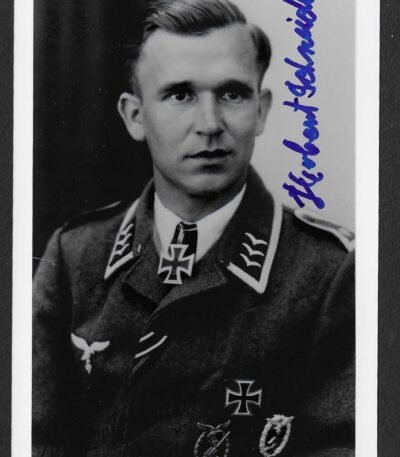
Herbert Schneider – Flak-Regiment 49
€20,00Original Postwar Signature on a Postwar Photo of Herbert Schneider. Oberwachtmeister Herbert Schneider (31.07.1915 † 01.12.2011) earned the Ritterkreuz on February 5, 1944 as Wachtmeister und Flakkampftruppführer of the 6. Batterie/ Flak-Regiment 49. Good condition. Measuring: Postcardsize.
Knight’s Cross: “During the defensive battles near Bolchow-Orel, in the summer of 1943, Wachtmeister Scheider succeeded in destroyed 25 Soviet tanks with his Flak gun. Later on during this fighting he would be heavily wounded by artillery fire on the 21.07.1943. In recognition of his achievements and devotion to duty during this time, he would receive the Knight’s Cross.”
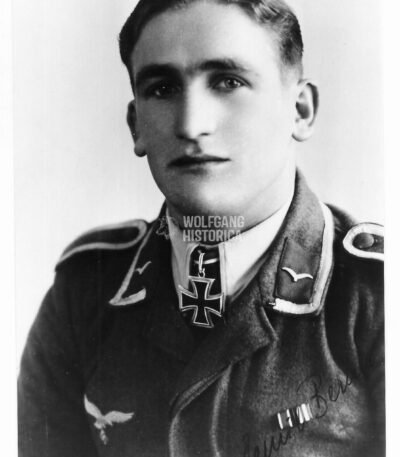
Emil Berner – Flak-Regiment 18 (Afrikakorps)
€25,00Original Postwar Signature on a Postwar Photo of Emil Berner. Unteroffizier Emil Berner (04.12.1921 † 13.06.2008) earned the Ritterkreuz des Eiseren Kreuzes on November 3, 1942 as Gefreiter der Reserve und Richtkanonier in the 3. Batterie/ Flak-Regiment 18 in North Africa.
Awarded for distinguishing himself as a Flak gunner throughout the North African campaign. During the battles of Sidi Rezeg and Bir el Hacheim (1941) he destroyed 16 enemy tanks. During the advances in the time period May-June 1942 (Tobruk—Marsa Matruk—El Alamein) he destroyed another 19 enemy tanks. He also destroyed about 200 vehicles as well as anti-tank gun batteries and MG nests. During the combat along the El Alamein front he prevented an armoured breakthrough, destroying 7 tanks at a range of 30-50 metres and shielding about 1000 prisoners from the Allies long enough for them to be taken away by German troops. He had destroyed 42 tanks altogether by the time he received the Knight’s Cross.
Provenance: This signature comes from one of the largest postwar signature collection I’ve ever commissioned. This collection was started by a Waffen-SS Veteran, Werner H., in the 1950’s until he passed away.
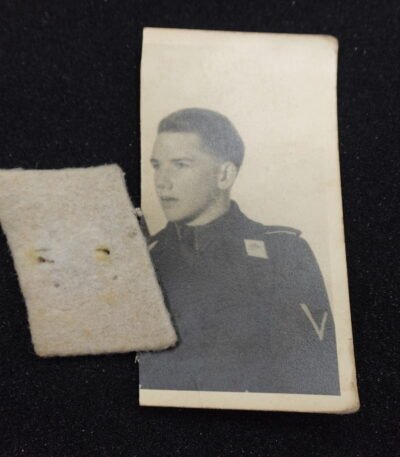
Worn “Hermann Göring” Collar Tab (Missing Skull)
€90,00Original worn “Hermann Göring” collar tab which is missing a Skull, as this was once worn by a Panzer soldier of the unit. Condition as seen.