


Erwin Kreßmann – schwere Panzerjäger-Abteilung 519
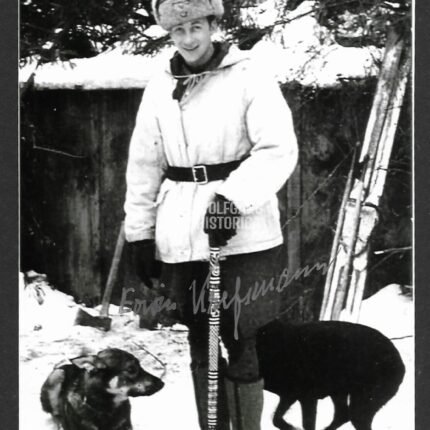
€0,01Original Postwar Signature on a Postwar Photo of Erwin Kreßmann. Hauptmann Erwin Kreßmann (02.06.1918 † 19.03.2017) earned the Deutsches Kreuz in Gold on January 16, 1944 as Oberleutnant with schwere Panzerjäger-Abteilung 519 and the Ritterkreuz des Eisernen Kreuzes on December 9, 1944 as Hauptmann with the 1. Kompanie/ schwere Panzerjäger-Abteilung 519. He also earned 2 Panzervernichtungsabzeichen. Postcardsize. Condition as seen.
Erwin Kreßmann – schwere Panzerjäger-Abteilung 519
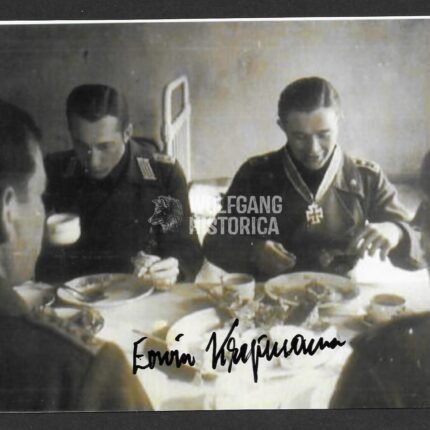
€0,01Original Postwar Signature on a Postwar Photo of Erwin Kreßmann. Hauptmann Erwin Kreßmann (02.06.1918 † 19.03.2017) earned the Deutsches Kreuz in Gold on January 16, 1944 as Oberleutnant with schwere Panzerjäger-Abteilung 519 and the Ritterkreuz des Eisernen Kreuzes on December 9, 1944 as Hauptmann with the 1. Kompanie/ schwere Panzerjäger-Abteilung 519. He also earned 2 Panzervernichtungsabzeichen. Postcardsize. Condition as seen.
Erwin Kreßmann – schwere Panzerjäger-Abteilung 519
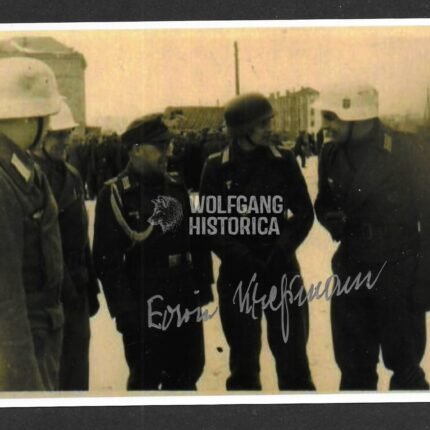
€30,00Original Postwar Signature on a Postwar Photo of Erwin Kreßmann. Hauptmann Erwin Kreßmann (02.06.1918 † 19.03.2017) earned the Deutsches Kreuz in Gold on January 16, 1944 as Oberleutnant with schwere Panzerjäger-Abteilung 519 and the Ritterkreuz des Eisernen Kreuzes on December 9, 1944 as Hauptmann with the 1. Kompanie/ schwere Panzerjäger-Abteilung 519. He also earned 2 Panzervernichtungsabzeichen. Postcardsize. Condition as seen.
Erwin Kreßmann – schwere Panzerjäger-Abteilung 519
€30,00Original Postwar Signature on a Postwar Photo of Erwin Kreßmann. Hauptmann Erwin Kreßmann (02.06.1918 † 19.03.2017) earned the Deutsches Kreuz in Gold on January 16, 1944 as Oberleutnant with schwere Panzerjäger-Abteilung 519 and the Ritterkreuz des Eisernen Kreuzes on December 9, 1944 as Hauptmann with the 1. Kompanie/ schwere Panzerjäger-Abteilung 519. He also earned 2 Panzervernichtungsabzeichen. Postcardsize. Condition as seen.
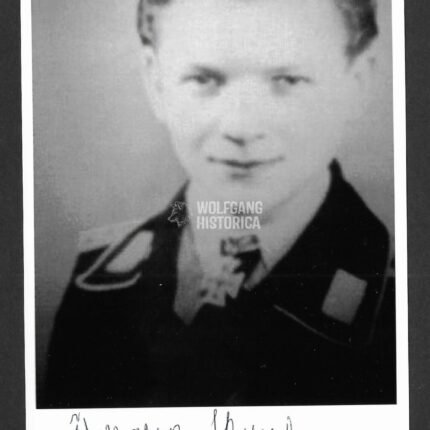
Wolfgang Hartelt – Fallschirm-Panzer-Regiment “Hermann Göring”
€45,00Original Postwar Signature on a Postwar Photo of Wolfgang Hartelt. Oberfähnrich Wolfgang Hartelt (28.11.1924 † 28.01.2009) earned the Ritterkreuz des Eisernen Kreuzes on February 23, 1945 as Oberfähnrich und Zugführer of the 2. Kompanie/ Fallschirm-Panzer-Regiment “Hermann Göring” of the Fallschirm-Panzer-Division 1 “Hermann Göring”. Condition as seen. Postcardsize.
Knight’s Cross: “After the wounding of his Kompanie commander, Wolfgang Hartelt stepped in as commander of the unit and in this capacity has distinguished himself several times as a particularly brave and ruthless soldier. On the 25.01.1945 he led the rearguard of the Division with 5 Panthers when it was attacked by 25 T-34s while on the march. On his own initiative the Oberfähnrich attacked the fivefold superior enemy and eliminated all enemy tanks while at the head of his Kompanie. With this he raised the total of tanks destroyed by Panzers under his command to 59, of which he was personally responsible for 17. This took place on the 26.01.1945 near Benice (8 km from Krotoschin).”

Georg Diers – schwere SS-Panzer-Abteilung 503 (Battle of Berlin, King Tiger!)
€0,01Original Postwar Signature on a Postwar Photo of Georg Diers. SS-Unterscharführer Georg Diers served with the schwere SS-Panzer-Abteilung 503 during the Battle of Berlin as commander of a Königstiger (King Tiger). Good condition. Postcardsize.
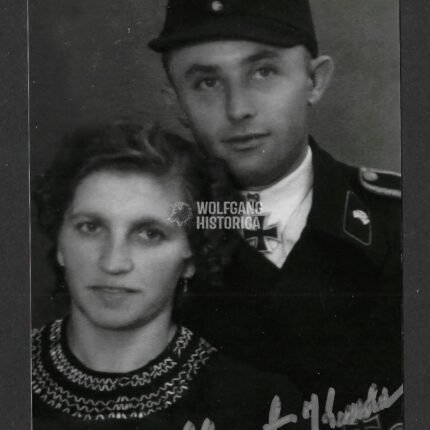
Albert Kerscher – schwere Panzer-Abteilung 502 (Tiger, Wingman of Otto Carius!)
€0,01Original Postwar Signature on a Postwar Photo of Albert Kerscher. Feldwebel Albert Kerscher (29.03.1916 † 12.06.2011) earned the Ritterkreuz des Eisernen Kreuzes on October 23, 1944 as Feldwebel in the 2. Kompanie/ schwere Panzer-Abteilung 502 (Tigers). He also earned the Panzerkampfabzeichen IV. Stufe (Einsatzahl “75”). Awarded for his successes in tank combat as the wingman of Otto Carius. Postcardsize. Condition as seen.
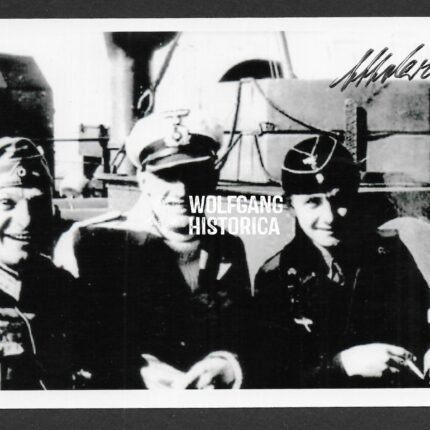
Otto Carius – schwere Panzer-Abteilung 502 (Eichenlaub, Tiger!)
€45,00Original Postwar Signature on a Postwar Photo of Otto Carius. Oberleutnant Otto Carius (27.05.1922 † 24.01.2015) earned the Ritterkreuz des Eisernen Kreuzes on May 4, 1944 as Leutnant and Chef of the 2. Kompanie/ schwere Panzer-Abteilung 502 (Tigers) and the Eichenlaub on July 27, 1944 as Leutnant and Chef of the 2. Kompanie/ schwere Panzer-Abteilung 502 (Tigers). He also earned the Panzerkampfabzeichen IV. Stufe (Einsatzahl “75”) with 2. / schwere Panzerjäger-Abteilung 512 on April 21, 1945. Postcardsize.
Knight’s Cross awarded for: During the time period 17.-22.03.1944 Leutnant Carius led 3 Tiger tanks in a series of engagements with Soviet armour near the village of Lembitu (west of Narva). Within 3 days he and his 3 Tigers destroyed 28 tanks, 4 assault guns and 17 artillery pieces. He would be subsequently awarded the Knight’s Cross for the local successes he achieved in this capacity.
Oakleaves awarded for: On the 22.07.1944 Leutnant Carius led a bold attack into the village of Malinava (northeast of Dünaburg) with only himself and his wingman Albert Kerscher. He and his two Tigers charged in Malinava and engaged the force of 17 Soviet tanks positioned there. Of these Carius destroyed 10, Kerscher 4 and a nearby force of Sturmgeschütze 3. Among this tally of destroyed armour were several IS-2 heavy tanks. By executing this bold operation, accomplished with no friendly losses, Leutnant Carius prevented the continuation of the Soviet breakthrough towards Dünaburg and therefore enabled a friendly defensive front to be built. He would be awarded the Oakleaves in recognition of this feat. (Source: Traces of War)
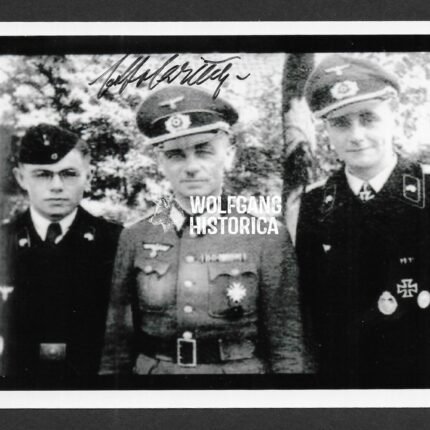
Otto Carius – schwere Panzer-Abteilung 502 (Eichenlaub, Tiger!)
€0,01Original Postwar Signature on a Postwar Photo of Otto Carius. Oberleutnant Otto Carius (27.05.1922 † 24.01.2015) earned the Ritterkreuz des Eisernen Kreuzes on May 4, 1944 as Leutnant and Chef of the 2. Kompanie/ schwere Panzer-Abteilung 502 (Tigers) and the Eichenlaub on July 27, 1944 as Leutnant and Chef of the 2. Kompanie/ schwere Panzer-Abteilung 502 (Tigers). He also earned the Panzerkampfabzeichen IV. Stufe (Einsatzahl “75”) with 2. / schwere Panzerjäger-Abteilung 512 on April 21, 1945. Postcardsize.
Knight’s Cross awarded for: During the time period 17.-22.03.1944 Leutnant Carius led 3 Tiger tanks in a series of engagements with Soviet armour near the village of Lembitu (west of Narva). Within 3 days he and his 3 Tigers destroyed 28 tanks, 4 assault guns and 17 artillery pieces. He would be subsequently awarded the Knight’s Cross for the local successes he achieved in this capacity.
Oakleaves awarded for: On the 22.07.1944 Leutnant Carius led a bold attack into the village of Malinava (northeast of Dünaburg) with only himself and his wingman Albert Kerscher. He and his two Tigers charged in Malinava and engaged the force of 17 Soviet tanks positioned there. Of these Carius destroyed 10, Kerscher 4 and a nearby force of Sturmgeschütze 3. Among this tally of destroyed armour were several IS-2 heavy tanks. By executing this bold operation, accomplished with no friendly losses, Leutnant Carius prevented the continuation of the Soviet breakthrough towards Dünaburg and therefore enabled a friendly defensive front to be built. He would be awarded the Oakleaves in recognition of this feat. (Source: Traces of War)
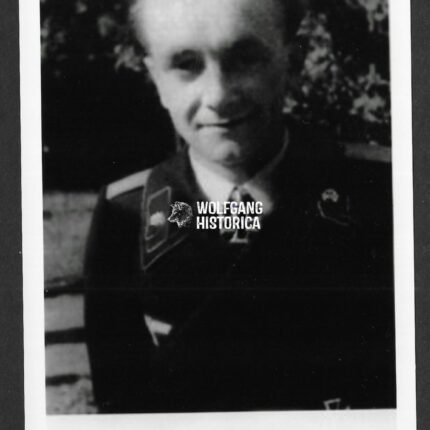
Otto Carius – schwere Panzer-Abteilung 502 (Eichenlaub, Tiger!)
€45,00Original Postwar Signature on a Postwar Photo of Otto Carius. Oberleutnant Otto Carius (27.05.1922 † 24.01.2015) earned the Ritterkreuz des Eisernen Kreuzes on May 4, 1944 as Leutnant and Chef of the 2. Kompanie/ schwere Panzer-Abteilung 502 (Tigers) and the Eichenlaub on July 27, 1944 as Leutnant and Chef of the 2. Kompanie/ schwere Panzer-Abteilung 502 (Tigers). He also earned the Panzerkampfabzeichen IV. Stufe (Einsatzahl “75”) with 2. / schwere Panzerjäger-Abteilung 512 on April 21, 1945. Postcardsize.
Knight’s Cross awarded for: During the time period 17.-22.03.1944 Leutnant Carius led 3 Tiger tanks in a series of engagements with Soviet armour near the village of Lembitu (west of Narva). Within 3 days he and his 3 Tigers destroyed 28 tanks, 4 assault guns and 17 artillery pieces. He would be subsequently awarded the Knight’s Cross for the local successes he achieved in this capacity.
Oakleaves awarded for: On the 22.07.1944 Leutnant Carius led a bold attack into the village of Malinava (northeast of Dünaburg) with only himself and his wingman Albert Kerscher. He and his two Tigers charged in Malinava and engaged the force of 17 Soviet tanks positioned there. Of these Carius destroyed 10, Kerscher 4 and a nearby force of Sturmgeschütze 3. Among this tally of destroyed armour were several IS-2 heavy tanks. By executing this bold operation, accomplished with no friendly losses, Leutnant Carius prevented the continuation of the Soviet breakthrough towards Dünaburg and therefore enabled a friendly defensive front to be built. He would be awarded the Oakleaves in recognition of this feat. (Source: Traces of War)
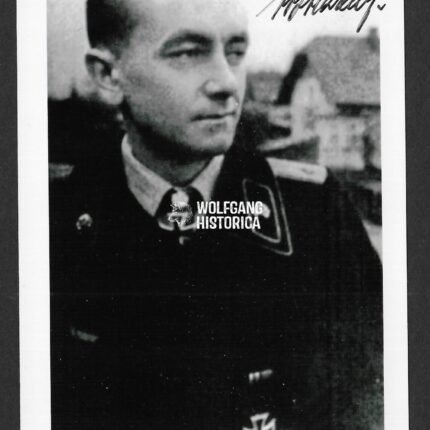
Otto Carius – schwere Panzer-Abteilung 502 (Eichenlaub, Tiger!)
€0,01Original Postwar Signature on a Postwar Photo of Otto Carius. Oberleutnant Otto Carius (27.05.1922 † 24.01.2015) earned the Ritterkreuz des Eisernen Kreuzes on May 4, 1944 as Leutnant and Chef of the 2. Kompanie/ schwere Panzer-Abteilung 502 (Tigers) and the Eichenlaub on July 27, 1944 as Leutnant and Chef of the 2. Kompanie/ schwere Panzer-Abteilung 502 (Tigers). He also earned the Panzerkampfabzeichen IV. Stufe (Einsatzahl “75”) with 2. / schwere Panzerjäger-Abteilung 512 on April 21, 1945. Postcardsize.
Knight’s Cross awarded for: During the time period 17.-22.03.1944 Leutnant Carius led 3 Tiger tanks in a series of engagements with Soviet armour near the village of Lembitu (west of Narva). Within 3 days he and his 3 Tigers destroyed 28 tanks, 4 assault guns and 17 artillery pieces. He would be subsequently awarded the Knight’s Cross for the local successes he achieved in this capacity.
Oakleaves awarded for: On the 22.07.1944 Leutnant Carius led a bold attack into the village of Malinava (northeast of Dünaburg) with only himself and his wingman Albert Kerscher. He and his two Tigers charged in Malinava and engaged the force of 17 Soviet tanks positioned there. Of these Carius destroyed 10, Kerscher 4 and a nearby force of Sturmgeschütze 3. Among this tally of destroyed armour were several IS-2 heavy tanks. By executing this bold operation, accomplished with no friendly losses, Leutnant Carius prevented the continuation of the Soviet breakthrough towards Dünaburg and therefore enabled a friendly defensive front to be built. He would be awarded the Oakleaves in recognition of this feat. (Source: Traces of War)
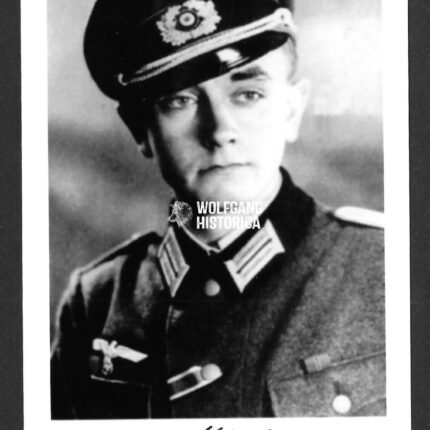
Otto Carius – schwere Panzer-Abteilung 502 (Eichenlaub, Tiger!)
€0,01Original Postwar Signature on a Postwar Photo of Otto Carius. Oberleutnant Otto Carius (27.05.1922 † 24.01.2015) earned the Ritterkreuz des Eisernen Kreuzes on May 4, 1944 as Leutnant and Chef of the 2. Kompanie/ schwere Panzer-Abteilung 502 (Tigers) and the Eichenlaub on July 27, 1944 as Leutnant and Chef of the 2. Kompanie/ schwere Panzer-Abteilung 502 (Tigers). He also earned the Panzerkampfabzeichen IV. Stufe (Einsatzahl “75”) with 2. / schwere Panzerjäger-Abteilung 512 on April 21, 1945. Postcardsize.
Knight’s Cross awarded for: During the time period 17.-22.03.1944 Leutnant Carius led 3 Tiger tanks in a series of engagements with Soviet armour near the village of Lembitu (west of Narva). Within 3 days he and his 3 Tigers destroyed 28 tanks, 4 assault guns and 17 artillery pieces. He would be subsequently awarded the Knight’s Cross for the local successes he achieved in this capacity.
Oakleaves awarded for: On the 22.07.1944 Leutnant Carius led a bold attack into the village of Malinava (northeast of Dünaburg) with only himself and his wingman Albert Kerscher. He and his two Tigers charged in Malinava and engaged the force of 17 Soviet tanks positioned there. Of these Carius destroyed 10, Kerscher 4 and a nearby force of Sturmgeschütze 3. Among this tally of destroyed armour were several IS-2 heavy tanks. By executing this bold operation, accomplished with no friendly losses, Leutnant Carius prevented the continuation of the Soviet breakthrough towards Dünaburg and therefore enabled a friendly defensive front to be built. He would be awarded the Oakleaves in recognition of this feat. (Source: Traces of War)
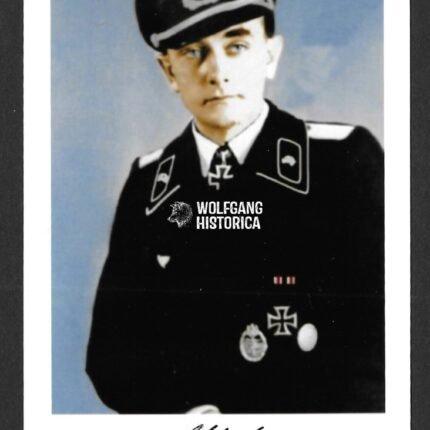
Otto Carius – schwere Panzer-Abteilung 502 (Eichenlaub, Tiger!)
€0,01Original Postwar Signature on a Postwar Photo of Otto Carius. Oberleutnant Otto Carius (27.05.1922 † 24.01.2015) earned the Ritterkreuz des Eisernen Kreuzes on May 4, 1944 as Leutnant and Chef of the 2. Kompanie/ schwere Panzer-Abteilung 502 (Tigers) and the Eichenlaub on July 27, 1944 as Leutnant and Chef of the 2. Kompanie/ schwere Panzer-Abteilung 502 (Tigers). He also earned the Panzerkampfabzeichen IV. Stufe (Einsatzahl “75”) with 2. / schwere Panzerjäger-Abteilung 512 on April 21, 1945. Postcardsize.
Knight’s Cross awarded for: During the time period 17.-22.03.1944 Leutnant Carius led 3 Tiger tanks in a series of engagements with Soviet armour near the village of Lembitu (west of Narva). Within 3 days he and his 3 Tigers destroyed 28 tanks, 4 assault guns and 17 artillery pieces. He would be subsequently awarded the Knight’s Cross for the local successes he achieved in this capacity.
Oakleaves awarded for: On the 22.07.1944 Leutnant Carius led a bold attack into the village of Malinava (northeast of Dünaburg) with only himself and his wingman Albert Kerscher. He and his two Tigers charged in Malinava and engaged the force of 17 Soviet tanks positioned there. Of these Carius destroyed 10, Kerscher 4 and a nearby force of Sturmgeschütze 3. Among this tally of destroyed armour were several IS-2 heavy tanks. By executing this bold operation, accomplished with no friendly losses, Leutnant Carius prevented the continuation of the Soviet breakthrough towards Dünaburg and therefore enabled a friendly defensive front to be built. He would be awarded the Oakleaves in recognition of this feat. (Source: Traces of War)
Otto Carius – schwere Panzer-Abteilung 502 (Eichenlaub, Tiger!)
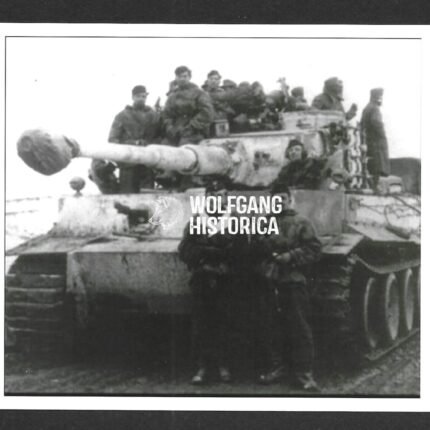
€0,01Original Postwar Signature on a Postwar Photo of Otto Carius. Oberleutnant Otto Carius (27.05.1922 † 24.01.2015) earned the Ritterkreuz des Eisernen Kreuzes on May 4, 1944 as Leutnant and Chef of the 2. Kompanie/ schwere Panzer-Abteilung 502 (Tigers) and the Eichenlaub on July 27, 1944 as Leutnant and Chef of the 2. Kompanie/ schwere Panzer-Abteilung 502 (Tigers). He also earned the Panzerkampfabzeichen IV. Stufe (Einsatzahl “75”) with 2. / schwere Panzerjäger-Abteilung 512 on April 21, 1945. Postcardsize.
Knight’s Cross awarded for: During the time period 17.-22.03.1944 Leutnant Carius led 3 Tiger tanks in a series of engagements with Soviet armour near the village of Lembitu (west of Narva). Within 3 days he and his 3 Tigers destroyed 28 tanks, 4 assault guns and 17 artillery pieces. He would be subsequently awarded the Knight’s Cross for the local successes he achieved in this capacity.
Oakleaves awarded for: On the 22.07.1944 Leutnant Carius led a bold attack into the village of Malinava (northeast of Dünaburg) with only himself and his wingman Albert Kerscher. He and his two Tigers charged in Malinava and engaged the force of 17 Soviet tanks positioned there. Of these Carius destroyed 10, Kerscher 4 and a nearby force of Sturmgeschütze 3. Among this tally of destroyed armour were several IS-2 heavy tanks. By executing this bold operation, accomplished with no friendly losses, Leutnant Carius prevented the continuation of the Soviet breakthrough towards Dünaburg and therefore enabled a friendly defensive front to be built. He would be awarded the Oakleaves in recognition of this feat. (Source: Traces of War)
Otto Carius – schwere Panzer-Abteilung 502 (Eichenlaub, Tiger!)
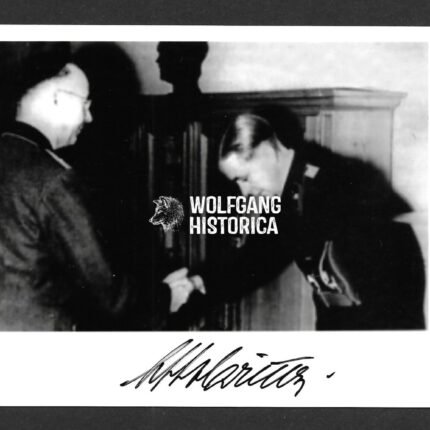
€0,01Original Postwar Signature on a Postwar Photo of Otto Carius. Oberleutnant Otto Carius (27.05.1922 † 24.01.2015) earned the Ritterkreuz des Eisernen Kreuzes on May 4, 1944 as Leutnant and Chef of the 2. Kompanie/ schwere Panzer-Abteilung 502 (Tigers) and the Eichenlaub on July 27, 1944 as Leutnant and Chef of the 2. Kompanie/ schwere Panzer-Abteilung 502 (Tigers). He also earned the Panzerkampfabzeichen IV. Stufe (Einsatzahl “75”) with 2. / schwere Panzerjäger-Abteilung 512 on April 21, 1945. Postcardsize.
Knight’s Cross awarded for: During the time period 17.-22.03.1944 Leutnant Carius led 3 Tiger tanks in a series of engagements with Soviet armour near the village of Lembitu (west of Narva). Within 3 days he and his 3 Tigers destroyed 28 tanks, 4 assault guns and 17 artillery pieces. He would be subsequently awarded the Knight’s Cross for the local successes he achieved in this capacity.
Oakleaves awarded for: On the 22.07.1944 Leutnant Carius led a bold attack into the village of Malinava (northeast of Dünaburg) with only himself and his wingman Albert Kerscher. He and his two Tigers charged in Malinava and engaged the force of 17 Soviet tanks positioned there. Of these Carius destroyed 10, Kerscher 4 and a nearby force of Sturmgeschütze 3. Among this tally of destroyed armour were several IS-2 heavy tanks. By executing this bold operation, accomplished with no friendly losses, Leutnant Carius prevented the continuation of the Soviet breakthrough towards Dünaburg and therefore enabled a friendly defensive front to be built. He would be awarded the Oakleaves in recognition of this feat. (Source: Traces of War)
Otto Carius – schwere Panzer-Abteilung 502 (Eichenlaub, Tiger!)
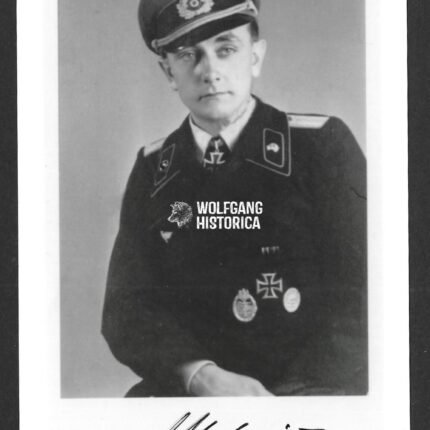
€45,00Original Postwar Signature on a Postwar Photo of Otto Carius. Oberleutnant Otto Carius (27.05.1922 † 24.01.2015) earned the Ritterkreuz des Eisernen Kreuzes on May 4, 1944 as Leutnant and Chef of the 2. Kompanie/ schwere Panzer-Abteilung 502 (Tigers) and the Eichenlaub on July 27, 1944 as Leutnant and Chef of the 2. Kompanie/ schwere Panzer-Abteilung 502 (Tigers). He also earned the Panzerkampfabzeichen IV. Stufe (Einsatzahl “75”) with 2. / schwere Panzerjäger-Abteilung 512 on April 21, 1945. Postcardsize.
Knight’s Cross awarded for: During the time period 17.-22.03.1944 Leutnant Carius led 3 Tiger tanks in a series of engagements with Soviet armour near the village of Lembitu (west of Narva). Within 3 days he and his 3 Tigers destroyed 28 tanks, 4 assault guns and 17 artillery pieces. He would be subsequently awarded the Knight’s Cross for the local successes he achieved in this capacity.
Oakleaves awarded for: On the 22.07.1944 Leutnant Carius led a bold attack into the village of Malinava (northeast of Dünaburg) with only himself and his wingman Albert Kerscher. He and his two Tigers charged in Malinava and engaged the force of 17 Soviet tanks positioned there. Of these Carius destroyed 10, Kerscher 4 and a nearby force of Sturmgeschütze 3. Among this tally of destroyed armour were several IS-2 heavy tanks. By executing this bold operation, accomplished with no friendly losses, Leutnant Carius prevented the continuation of the Soviet breakthrough towards Dünaburg and therefore enabled a friendly defensive front to be built. He would be awarded the Oakleaves in recognition of this feat. (Source: Traces of War)
Otto Carius – schwere Panzer-Abteilung 502 (Eichenlaub, Tiger!)
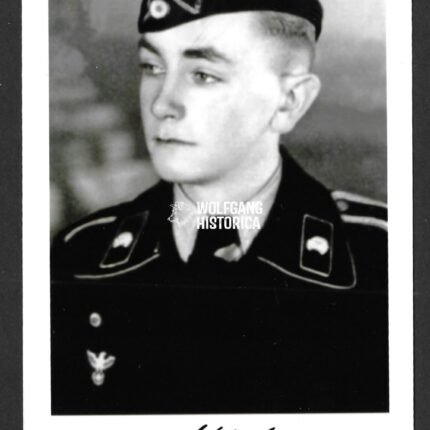
€45,00Original Postwar Signature on a Postwar Photo of Otto Carius. Oberleutnant Otto Carius (27.05.1922 † 24.01.2015) earned the Ritterkreuz des Eisernen Kreuzes on May 4, 1944 as Leutnant and Chef of the 2. Kompanie/ schwere Panzer-Abteilung 502 (Tigers) and the Eichenlaub on July 27, 1944 as Leutnant and Chef of the 2. Kompanie/ schwere Panzer-Abteilung 502 (Tigers). He also earned the Panzerkampfabzeichen IV. Stufe (Einsatzahl “75”) with 2. / schwere Panzerjäger-Abteilung 512 on April 21, 1945. Postcardsize.
Knight’s Cross awarded for: During the time period 17.-22.03.1944 Leutnant Carius led 3 Tiger tanks in a series of engagements with Soviet armour near the village of Lembitu (west of Narva). Within 3 days he and his 3 Tigers destroyed 28 tanks, 4 assault guns and 17 artillery pieces. He would be subsequently awarded the Knight’s Cross for the local successes he achieved in this capacity.
Oakleaves awarded for: On the 22.07.1944 Leutnant Carius led a bold attack into the village of Malinava (northeast of Dünaburg) with only himself and his wingman Albert Kerscher. He and his two Tigers charged in Malinava and engaged the force of 17 Soviet tanks positioned there. Of these Carius destroyed 10, Kerscher 4 and a nearby force of Sturmgeschütze 3. Among this tally of destroyed armour were several IS-2 heavy tanks. By executing this bold operation, accomplished with no friendly losses, Leutnant Carius prevented the continuation of the Soviet breakthrough towards Dünaburg and therefore enabled a friendly defensive front to be built. He would be awarded the Oakleaves in recognition of this feat. (Source: Traces of War)
Otto Carius – schwere Panzer-Abteilung 502 (Eichenlaub, Tiger!)
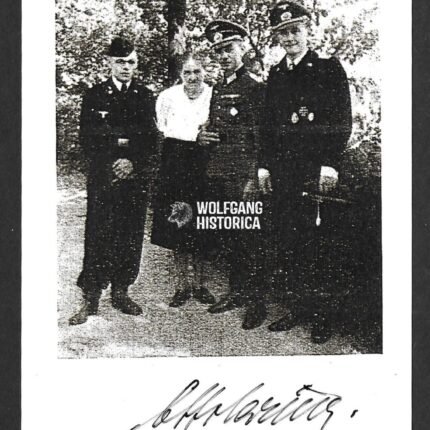
€45,00Original Postwar Signature on a Postwar Photo of Otto Carius. Oberleutnant Otto Carius (27.05.1922 † 24.01.2015) earned the Ritterkreuz des Eisernen Kreuzes on May 4, 1944 as Leutnant and Chef of the 2. Kompanie/ schwere Panzer-Abteilung 502 (Tigers) and the Eichenlaub on July 27, 1944 as Leutnant and Chef of the 2. Kompanie/ schwere Panzer-Abteilung 502 (Tigers). He also earned the Panzerkampfabzeichen IV. Stufe (Einsatzahl “75”) with 2. / schwere Panzerjäger-Abteilung 512 on April 21, 1945. Postcardsize.
Knight’s Cross awarded for: During the time period 17.-22.03.1944 Leutnant Carius led 3 Tiger tanks in a series of engagements with Soviet armour near the village of Lembitu (west of Narva). Within 3 days he and his 3 Tigers destroyed 28 tanks, 4 assault guns and 17 artillery pieces. He would be subsequently awarded the Knight’s Cross for the local successes he achieved in this capacity.
Oakleaves awarded for: On the 22.07.1944 Leutnant Carius led a bold attack into the village of Malinava (northeast of Dünaburg) with only himself and his wingman Albert Kerscher. He and his two Tigers charged in Malinava and engaged the force of 17 Soviet tanks positioned there. Of these Carius destroyed 10, Kerscher 4 and a nearby force of Sturmgeschütze 3. Among this tally of destroyed armour were several IS-2 heavy tanks. By executing this bold operation, accomplished with no friendly losses, Leutnant Carius prevented the continuation of the Soviet breakthrough towards Dünaburg and therefore enabled a friendly defensive front to be built. He would be awarded the Oakleaves in recognition of this feat. (Source: Traces of War)
Otto Carius – schwere Panzer-Abteilung 502 (Eichenlaub, Tiger!)
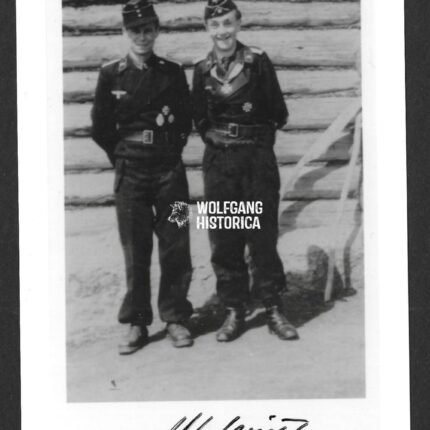
€45,00Original Postwar Signature on a Postwar Photo of Otto Carius. Oberleutnant Otto Carius (27.05.1922 † 24.01.2015) earned the Ritterkreuz des Eisernen Kreuzes on May 4, 1944 as Leutnant and Chef of the 2. Kompanie/ schwere Panzer-Abteilung 502 (Tigers) and the Eichenlaub on July 27, 1944 as Leutnant and Chef of the 2. Kompanie/ schwere Panzer-Abteilung 502 (Tigers). He also earned the Panzerkampfabzeichen IV. Stufe (Einsatzahl “75”) with 2. / schwere Panzerjäger-Abteilung 512 on April 21, 1945. Postcardsize.
Knight’s Cross awarded for: During the time period 17.-22.03.1944 Leutnant Carius led 3 Tiger tanks in a series of engagements with Soviet armour near the village of Lembitu (west of Narva). Within 3 days he and his 3 Tigers destroyed 28 tanks, 4 assault guns and 17 artillery pieces. He would be subsequently awarded the Knight’s Cross for the local successes he achieved in this capacity.
Oakleaves awarded for: On the 22.07.1944 Leutnant Carius led a bold attack into the village of Malinava (northeast of Dünaburg) with only himself and his wingman Albert Kerscher. He and his two Tigers charged in Malinava and engaged the force of 17 Soviet tanks positioned there. Of these Carius destroyed 10, Kerscher 4 and a nearby force of Sturmgeschütze 3. Among this tally of destroyed armour were several IS-2 heavy tanks. By executing this bold operation, accomplished with no friendly losses, Leutnant Carius prevented the continuation of the Soviet breakthrough towards Dünaburg and therefore enabled a friendly defensive front to be built. He would be awarded the Oakleaves in recognition of this feat. (Source: Traces of War)
Otto Carius – schwere Panzer-Abteilung 502 (Eichenlaub, Tiger!)
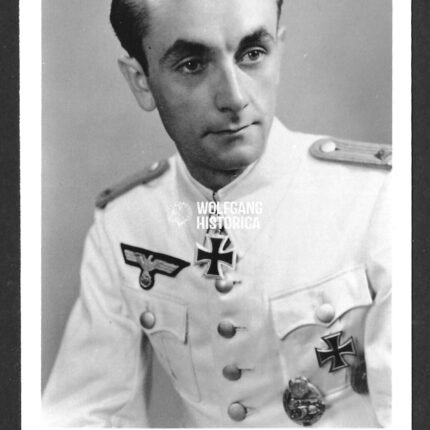
€0,01Original Postwar Signature on a Postwar Photo of Otto Carius. Oberleutnant Otto Carius (27.05.1922 † 24.01.2015) earned the Ritterkreuz des Eisernen Kreuzes on May 4, 1944 as Leutnant and Chef of the 2. Kompanie/ schwere Panzer-Abteilung 502 (Tigers) and the Eichenlaub on July 27, 1944 as Leutnant and Chef of the 2. Kompanie/ schwere Panzer-Abteilung 502 (Tigers). He also earned the Panzerkampfabzeichen IV. Stufe (Einsatzahl “75”) with 2. / schwere Panzerjäger-Abteilung 512 on April 21, 1945. Postcardsize.
Knight’s Cross awarded for: During the time period 17.-22.03.1944 Leutnant Carius led 3 Tiger tanks in a series of engagements with Soviet armour near the village of Lembitu (west of Narva). Within 3 days he and his 3 Tigers destroyed 28 tanks, 4 assault guns and 17 artillery pieces. He would be subsequently awarded the Knight’s Cross for the local successes he achieved in this capacity.
Oakleaves awarded for: On the 22.07.1944 Leutnant Carius led a bold attack into the village of Malinava (northeast of Dünaburg) with only himself and his wingman Albert Kerscher. He and his two Tigers charged in Malinava and engaged the force of 17 Soviet tanks positioned there. Of these Carius destroyed 10, Kerscher 4 and a nearby force of Sturmgeschütze 3. Among this tally of destroyed armour were several IS-2 heavy tanks. By executing this bold operation, accomplished with no friendly losses, Leutnant Carius prevented the continuation of the Soviet breakthrough towards Dünaburg and therefore enabled a friendly defensive front to be built. He would be awarded the Oakleaves in recognition of this feat. (Source: Traces of War)
Otto Carius – schwere Panzer-Abteilung 502 (Eichenlaub, Tiger!)
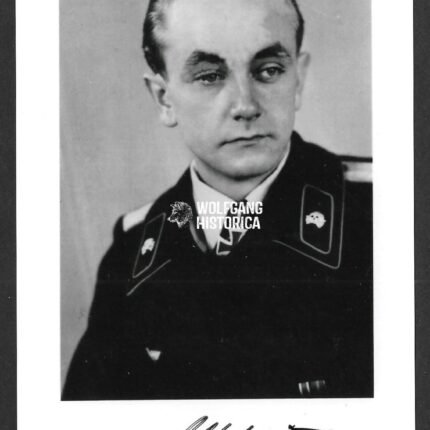
€45,00Original Postwar Signature on a Postwar Photo of Otto Carius. Oberleutnant Otto Carius (27.05.1922 † 24.01.2015) earned the Ritterkreuz des Eisernen Kreuzes on May 4, 1944 as Leutnant and Chef of the 2. Kompanie/ schwere Panzer-Abteilung 502 (Tigers) and the Eichenlaub on July 27, 1944 as Leutnant and Chef of the 2. Kompanie/ schwere Panzer-Abteilung 502 (Tigers). He also earned the Panzerkampfabzeichen IV. Stufe (Einsatzahl “75”) with 2. / schwere Panzerjäger-Abteilung 512 on April 21, 1945. Postcardsize.
Knight’s Cross awarded for: During the time period 17.-22.03.1944 Leutnant Carius led 3 Tiger tanks in a series of engagements with Soviet armour near the village of Lembitu (west of Narva). Within 3 days he and his 3 Tigers destroyed 28 tanks, 4 assault guns and 17 artillery pieces. He would be subsequently awarded the Knight’s Cross for the local successes he achieved in this capacity.
Oakleaves awarded for: On the 22.07.1944 Leutnant Carius led a bold attack into the village of Malinava (northeast of Dünaburg) with only himself and his wingman Albert Kerscher. He and his two Tigers charged in Malinava and engaged the force of 17 Soviet tanks positioned there. Of these Carius destroyed 10, Kerscher 4 and a nearby force of Sturmgeschütze 3. Among this tally of destroyed armour were several IS-2 heavy tanks. By executing this bold operation, accomplished with no friendly losses, Leutnant Carius prevented the continuation of the Soviet breakthrough towards Dünaburg and therefore enabled a friendly defensive front to be built. He would be awarded the Oakleaves in recognition of this feat. (Source: Traces of War)
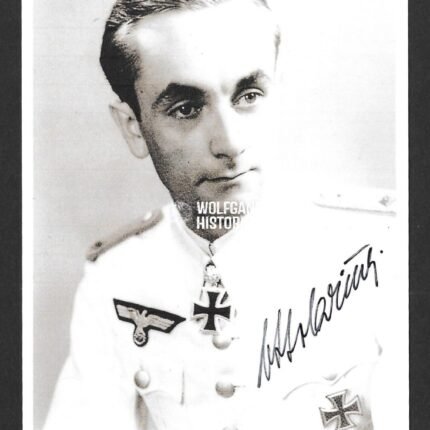
Otto Carius – schwere Panzer-Abteilung 502 (Eichenlaub, Tiger!)
€0,01Original Postwar Signature on a Postwar Photo of Otto Carius. Oberleutnant Otto Carius (27.05.1922 † 24.01.2015) earned the Ritterkreuz des Eisernen Kreuzes on May 4, 1944 as Leutnant and Chef of the 2. Kompanie/ schwere Panzer-Abteilung 502 (Tigers) and the Eichenlaub on July 27, 1944 as Leutnant and Chef of the 2. Kompanie/ schwere Panzer-Abteilung 502 (Tigers). He also earned the Panzerkampfabzeichen IV. Stufe (Einsatzahl “75”) with 2. / schwere Panzerjäger-Abteilung 512 on April 21, 1945. Postcardsize.
Knight’s Cross awarded for: During the time period 17.-22.03.1944 Leutnant Carius led 3 Tiger tanks in a series of engagements with Soviet armour near the village of Lembitu (west of Narva). Within 3 days he and his 3 Tigers destroyed 28 tanks, 4 assault guns and 17 artillery pieces. He would be subsequently awarded the Knight’s Cross for the local successes he achieved in this capacity.
Oakleaves awarded for: On the 22.07.1944 Leutnant Carius led a bold attack into the village of Malinava (northeast of Dünaburg) with only himself and his wingman Albert Kerscher. He and his two Tigers charged in Malinava and engaged the force of 17 Soviet tanks positioned there. Of these Carius destroyed 10, Kerscher 4 and a nearby force of Sturmgeschütze 3. Among this tally of destroyed armour were several IS-2 heavy tanks. By executing this bold operation, accomplished with no friendly losses, Leutnant Carius prevented the continuation of the Soviet breakthrough towards Dünaburg and therefore enabled a friendly defensive front to be built. He would be awarded the Oakleaves in recognition of this feat. (Source: Traces of War)
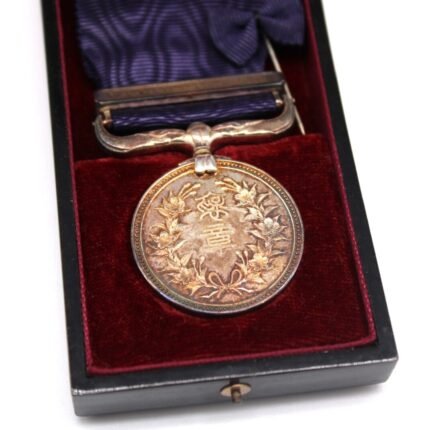
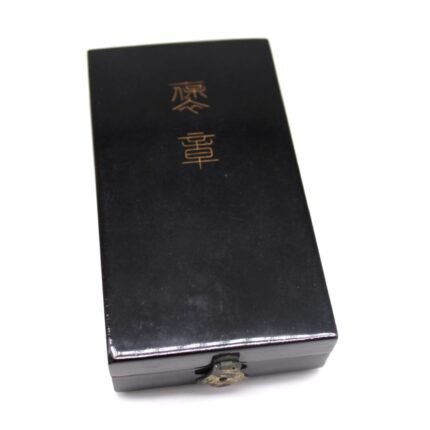
Japanese Medal of Honor – Dark Blue Ribbon (Cased)
€0,01Medals of Honor (褒章, hōshō) are medals awarded by the Emperor of Japan. They are awarded to individuals who have done meritorious deeds and also to those who have achieved excellence in their field of work.[1] The Medals of Honor were established on December 7, 1881, and were first awarded the following year. Several expansions and amendments have been made since then. The medal design for all six types is the same, bearing the stylized characters 褒章 on a gilt central disc surrounded by a silver ring of cherry blossoms on the obverse; only the colors of the ribbon differ. If for some reason an individual were to receive a second medal of the same ribbon colour, then a second medal is not issued but rather a new bar is added to their current medal. The Medals of Honor are awarded twice each year, on April 29 (the birthday of the Shōwa Emperor) and November 3 (the birthday of the Meiji Emperor).
The Medals of Honor with Dark Blue Ribbon were first awarded in 1919 to individuals who have made exceptionally generous financial contributions for the well-being of the public.
Complete in its box of issue and stickpin. Condition as seen.
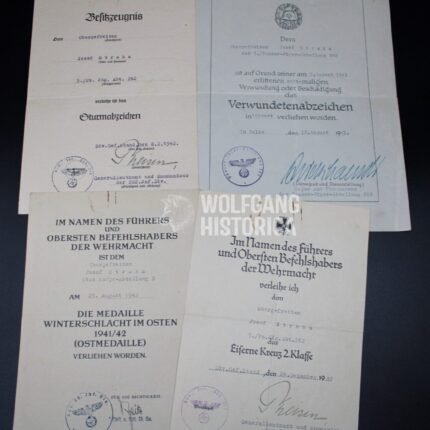
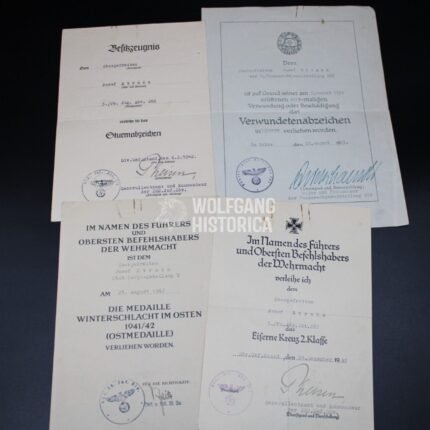
4x Award Docs: Panzerjäger-Abteilung 262 (262. Infanterie-Division) (Beautiful A4 VWA Doc!)
€0,01Original award document group of Obergefreiter Straka who served with the Panzerjäger-Abteilung 262 and Korps-Abteilung D.
- Allgemeines-Sturmabzeichen (General Assault Badge) on February 8, 1942, for 3 separate assault days during his service. Signed by Generalleutnant Edgar Theissen (DKIG).
- Beautiful award doc of the Verwundetenabzeichen in Schwarz (Wound Badge in Black) for his wound sustained on August 5, 1941.
- Eisernes Kreuz 2. Klasse (Iron Cross 2nd Class) for his courageous service on December 24, 1941. Signed by Generalleutnant Edgar Theissen (DKIG).
- Winterschlacht im Osten 1941/42 (Winter War Medal) for his service during the harsh winter of 1942/42 on August 25, 1942
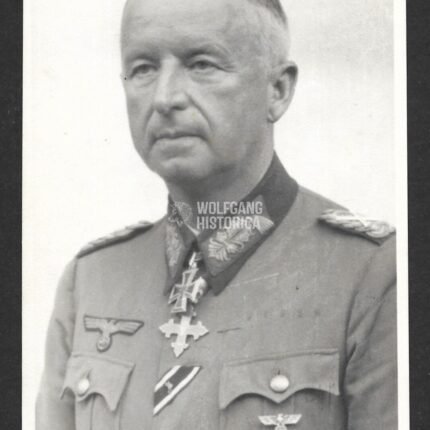
Erich von Manstein – Generalfeldmarschall & Oberbefehlshaber Heeresgruppe Süd (Wartime Signed)
€0,01Original Wartime Signature on a Wartime Photo of Erich von Manstein. Generalfeldmarschall Erich von Manstein (24.11.1887 in Berlin † 10.06.1973 in Irschenhausen) earned the Ritterkreuz des Eisernen Kreuzes on July 19, 1940 as General der Infanterie und Kommandierender General of the XXXVIII. Armeekorps, the Eichenlaub on March 14, 1943 as Generalfeldmarschall und Oberbefehlshaber of the Heeresgruppe Süd and the Schwertern on March 30, 1944 as Generalfeldmarschall und Oberbefehlshaber of the Heeresgruppe Süd. Condition as seen. Postcardsize.
Read more about Erich von Manstein (Wikipedia).
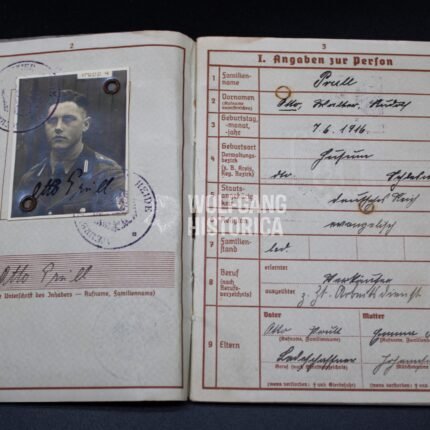
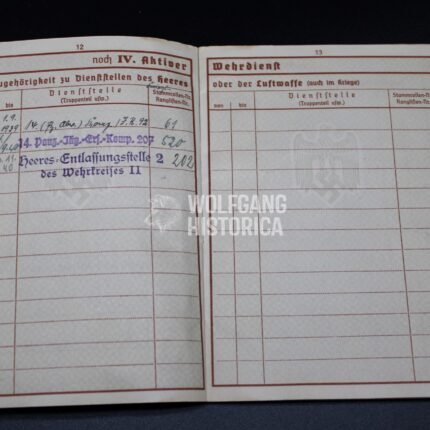
Wehrpass Infanterie-Regiment 92 – EK2 & VWA Silber for September 1, 1939 during Invasion of Poland!
€0,01Original Wehrpass of a soldier who was severely wounded on the first day of the Polish Invasion on September 1, 1939 while serving with 14. Kompanie/ Infanterie-Regiment 92 and was decorated with the Eisernes Kreuz 2. Klasse and Verwundetenabzeichen in Silber for this action! One of the first soldiers of the war to be decorated with the Iron Cross 2nd Class. Condition as seen.
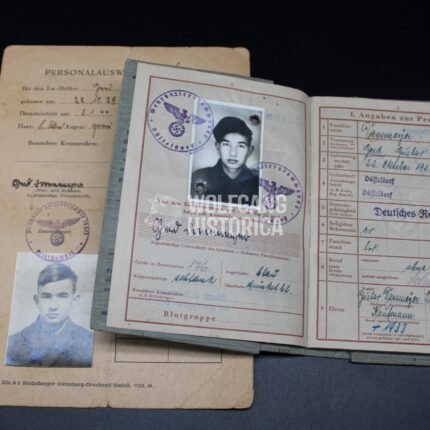
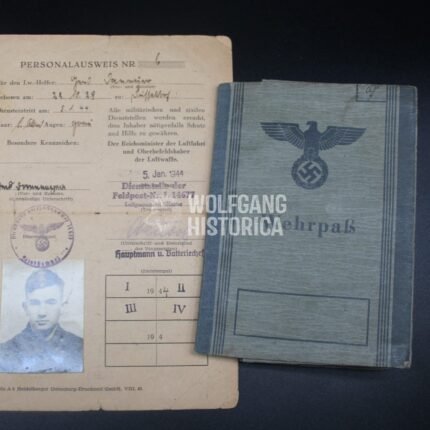
Personalausweis & Wehrpass of a Luftwaffe-Flakhelfer in Düsseldorf
€0,01Original Personalausweis & Wehrpass of a Luftwaffe-Flakhelfer in Düsseldorf, born in 1928! Condition as seen.
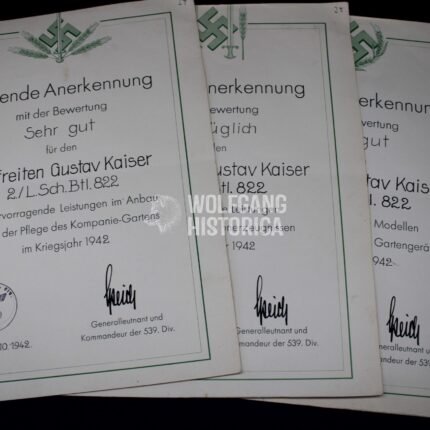
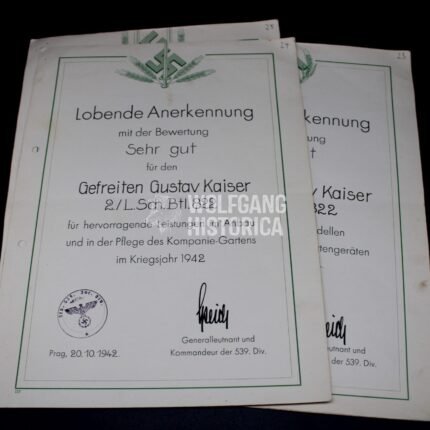
3x Beautiful Honorary Certificates: Landesschützen-Bataillon 822 (539. Division)
€70,003x Anerkennung (recognition, appreciation) set for Gefreiter of the Landesschützen-Bataillon 822 of the 539. Division. Signed by Generalleutnant Richard Speich (DKiS). Beautiful A4 documents! Good condition.
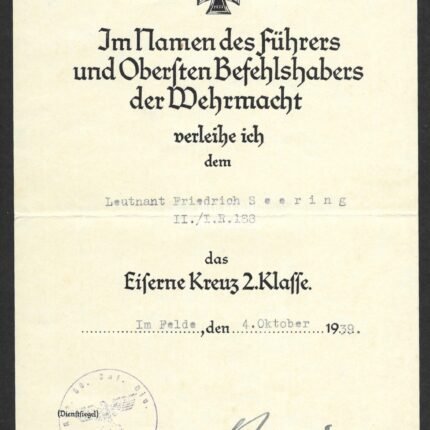
EK2 Award Doc: Infanterie-Regiment 188 (68. Infanterie-Division) (Invasion of Poland 1939!)
€0,01Original award document of Oberleutnant Seering for the Eisernes Kreuz 2. Klasse (Iron Cross 2nd Class), awarded for courageous service during the Invasion of Poland on October 4, 1939, while serving with the Infanterie-Regiment 188 of the 68. Infanterie-Division. Document was signed by Georg Braun (KIA 1941). Condition as seen, has been folded in the past.
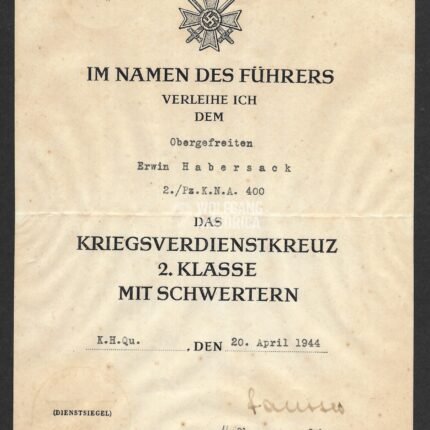
KVK2 Award Doc: Panzerkorps-N.A. 400 (II. SS-Panzerkorps, Signed by SS-Obergruppenführer Paul Hausser!)
€0,01Original award document of Obergefreiter Habersack for the Kriegsverdienstkreuz 2. Klasse mit Schwertern (War Merit Cross 2nd Class with Swords), awarded for meritious service during on April 20, 1944, while serving with the 2. Kompanie/ Panzerkorps-Nachrichten-Abteilung 400 of the II. SS-Panzerkorps. Document was signed by SS-Obergruppenführer und General der Waffen-SS Paul Hausser. Condition as seen, has been folded in the past.
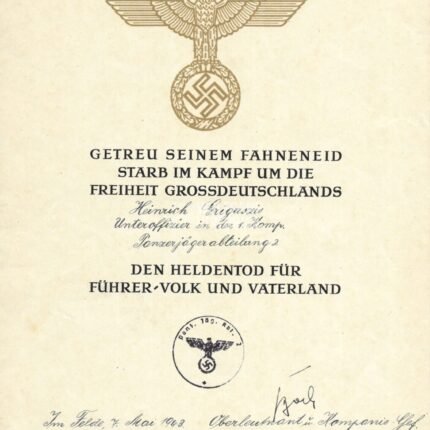
Heldentod Urkunde: Panzerjäger-Abteilung 2 (12. Panzer-Division)
€0,01Original “Heldentod Ehrenurkunde” / “Gedenkblatt” (“Hero’s Death honor document”), which given to family member’s of a soldier who was Killed in Action. This document is honored to Unteroffizier Heinrich Griguszis, who served with the 1. Kompanie/ Panzerjäger-Abteilung 2 of the 12. Panzer-Division. Condition as seen. A4 size.
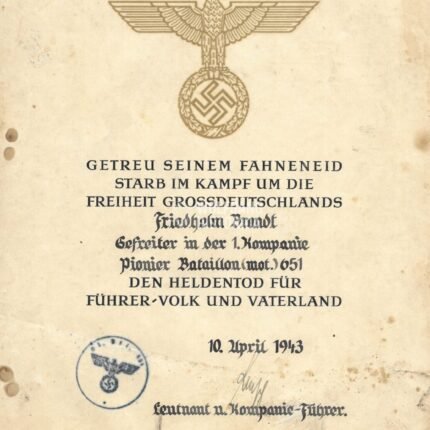
Heldentod Urkunde: Pionier-Bataillon 651
€0,01Original “Heldentod Ehrenurkunde” / “Gedenkblatt” (“Hero’s Death honor document”), which given to family member’s of a soldier who was Killed in Action. This document is honored to Gefreiter Friedhelm Brandt, who served with the 1. Kompanie/ Pionier-Bataillon 651 of the 15. Infanterie-Division. Condition as seen. A4 size.
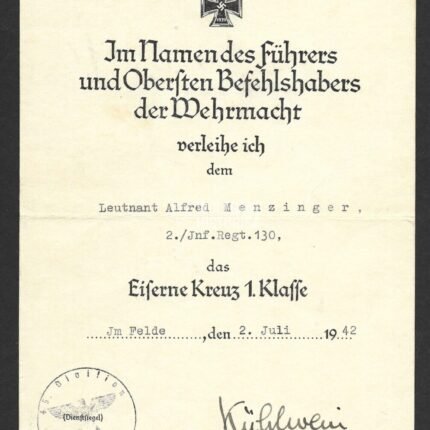
EK1 Award Doc: Infanterie-Regiment 130 (45. Infanterie-Division)
€0,01Original award document of Leutnant Alfred Menzinger, who served with the 2. Kompanie/ Infanterie-Regiment 130 of the 45. Infanterie-Division, for the Eisernes Kreuz 1. Klasse (Iron Cross 1st Class) for his service on July 2, 1942, which was signed by Generalmajor Fritz Kühlwein (DKIG). Condition as seen, has been folded in the past.
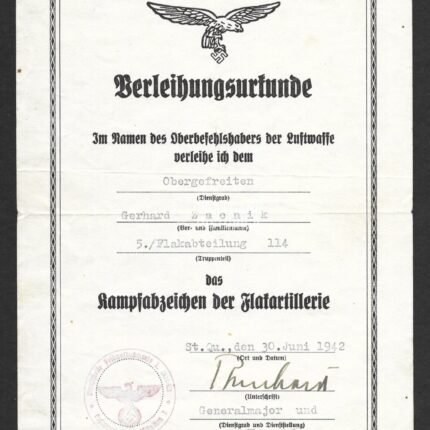
Flakkampfabzeichen Award Document: Flak-Abteilung 114 (Afrika!)
€0,01Original award document for the Kampfabzeichen der Flakartillerie for Obergefreiter Gerhard Zacnik who served with the 5. Batterie/ Flak-Abteilung 114 on June 30, 1942 awarded during fighting in Africa! Signed by Generalmajor Heinrich Burchard (RK, Comitted suicide in April 45!). Condition as seen, has been folded in the past.
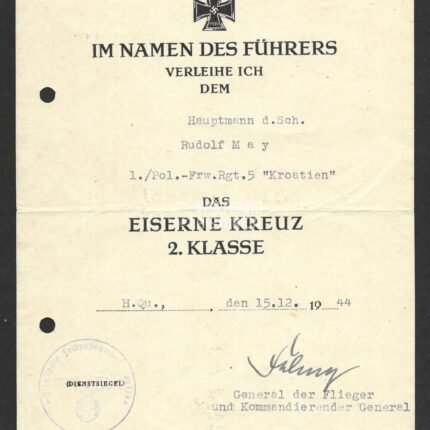
EK2 Award Doc: Hauptmann of Polizei-Freiwilligen-Regiment 5 “Kroatien”!
€0,01Original award document of Hauptmann der Schutzpolizei Rudolf May, who served with the 1. Kompanie/ Polizei-Freiwilligen-Regiment 5 “Kroatien”, for the Eisernes Kreuz 2. Klasse (Iron Cross 2nd Class) for his service on December 15, 1944, which was signed by General der Flieger Hellmuth Felmy (RK). Condition as seen, has been folded in the past.
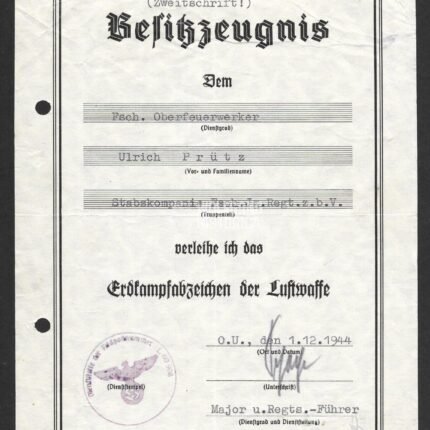
Luftwaffe Erdkampfabzeichen Award Doc – Fallschirmjäger-Regiment zbV (Signed by Gerhard Schacht!)
€0,01Original award document of Fallschirm-Oberfeuerwerker Prütz for the Erdkampfabzeichen der Luftwaffe (Luftwaffe Ground Assault Badge), who served with the Stabskompanie/ Fallschirmjäger-Regiment zbV. He earned the Erdkampfabeichen on December 1, 1944. Signed by Major Gerhard Schacht who earned the Ritterkreuz for Eben-Emael ! Condition as seen.
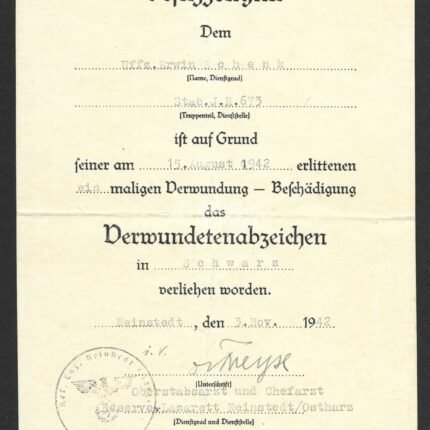
Wound Badge in Black Award Doc: Infanterie-Regiment 673 – Wounded during the Battle of Stalingrad!
€0,01Original Award document of Unteroffizier Schenk, who earned the Verwundetenabzeichen in Schwarz (Wound Badge in Black) for his wound sustained on August 15, 1942 during the Battle of Stalingrad, while serving with the Stab/ Infanterie-Regiment 673 of the 376. Infanterie-Division. This division was destroyed in Stalingrad! Condition as seen, has been folded in the past.
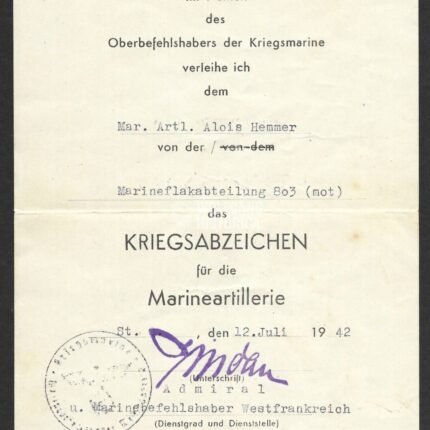
Coastal Artillery Badge Award Doc – Marineflakabteilung 803 (mot)
€0,01Original Kriegsabzeichen für die Marineartillerie award document for Marine-Artillerist Hemmer, who earned the badge on 12. July 1942 while serving with Marineflakabteilung 803 (mot). Condition as seen.
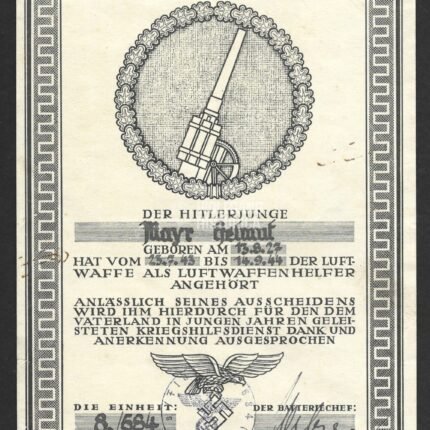
Honorary Certificate for a Luftwaffenhelfer – Flak-Abteilung 684
€0,01Original Certificate of Honorary Service for a Luftwaffenhelfer for his service from 23.7.43 until 14.9.44 with the 8. Batterie/ Flak-Abteilung 684 (o). Condition as seen.
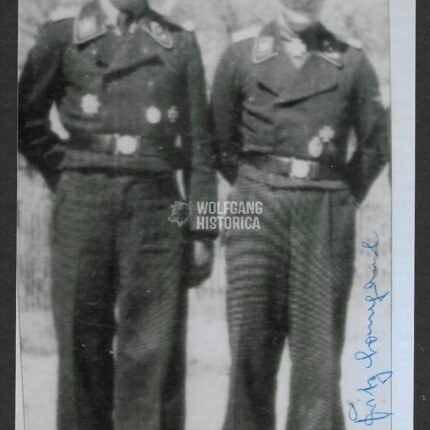
Fritz Langanke – SS-Panzer-Regiment 2 “Das Reich” (Normandy)
€55,00Original Postwar Signature on a Postwar Photo of Fritz Langanke. SS-Obersturmführer Fritz Langanke (15.07.1919 † 10.07.2012) earned the Ritterkreuz des Eisernen Kreuzes on August 27, 1944 as SS-Standarten-Oberjunker und Zugführer of the 2. Kompanie/ SS-Panzer-Regiment 2 of the 2. SS-Panzer-Division “Das Reich“. Postcardsize. Condition as seen.
Knight’s Cross: “SS-Standartenoberjunker Langanke, Zugführer in the II./SS-Pz.Rgt. 2, was separated from his Abteilung along with 3 Panthers on the 28.07.1944. In this time he made the independent decision to rally 300 Heer Grenadiers and launch a breakout attempt on the night of the 29./30.07.1944. Advancing via St. Denis he personally destroyed 13 tanks, 4 anti-tank guns, 8 halftracks and 10 trucks over a series of hard yet successful engagements. Ultimately he managed to make it back to friendly lines while also clearing open the way to freedom for many other units including a self-propelled Flak-Batterie (with five 3.7 cm guns), 2 Grille SPGs, 3 Sturmgeschützen and 29 trucks.”
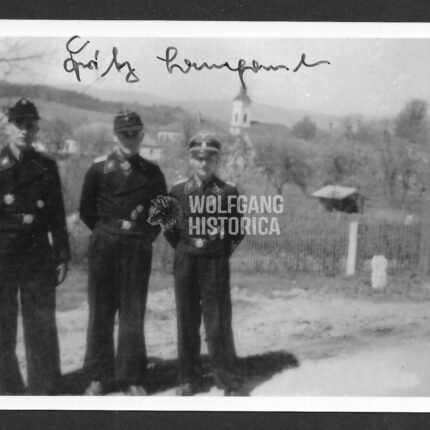
Fritz Langanke – SS-Panzer-Regiment 2 “Das Reich” (Normandy)
€55,00Original Postwar Signature on a Postwar Photo of Fritz Langanke. SS-Obersturmführer Fritz Langanke (15.07.1919 † 10.07.2012) earned the Ritterkreuz des Eisernen Kreuzes on August 27, 1944 as SS-Standarten-Oberjunker und Zugführer of the 2. Kompanie/ SS-Panzer-Regiment 2 of the 2. SS-Panzer-Division “Das Reich“. Postcardsize. Condition as seen.
Knight’s Cross: “SS-Standartenoberjunker Langanke, Zugführer in the II./SS-Pz.Rgt. 2, was separated from his Abteilung along with 3 Panthers on the 28.07.1944. In this time he made the independent decision to rally 300 Heer Grenadiers and launch a breakout attempt on the night of the 29./30.07.1944. Advancing via St. Denis he personally destroyed 13 tanks, 4 anti-tank guns, 8 halftracks and 10 trucks over a series of hard yet successful engagements. Ultimately he managed to make it back to friendly lines while also clearing open the way to freedom for many other units including a self-propelled Flak-Batterie (with five 3.7 cm guns), 2 Grille SPGs, 3 Sturmgeschützen and 29 trucks.”
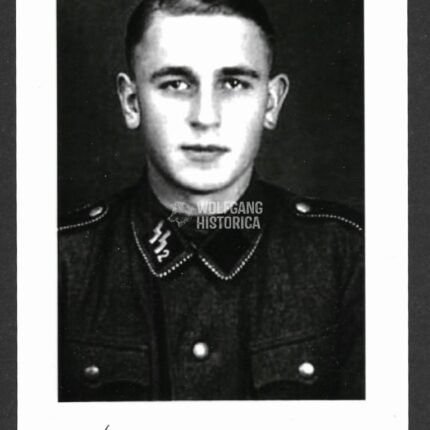
Fritz Langanke – SS-Panzer-Regiment 2 “Das Reich” (Normandy)
€0,01Original Postwar Signature on a Postwar Photo of Fritz Langanke. SS-Obersturmführer Fritz Langanke (15.07.1919 † 10.07.2012) earned the Ritterkreuz des Eisernen Kreuzes on August 27, 1944 as SS-Standarten-Oberjunker und Zugführer of the 2. Kompanie/ SS-Panzer-Regiment 2 of the 2. SS-Panzer-Division “Das Reich“. Postcardsize. Condition as seen.
Knight’s Cross: “SS-Standartenoberjunker Langanke, Zugführer in the II./SS-Pz.Rgt. 2, was separated from his Abteilung along with 3 Panthers on the 28.07.1944. In this time he made the independent decision to rally 300 Heer Grenadiers and launch a breakout attempt on the night of the 29./30.07.1944. Advancing via St. Denis he personally destroyed 13 tanks, 4 anti-tank guns, 8 halftracks and 10 trucks over a series of hard yet successful engagements. Ultimately he managed to make it back to friendly lines while also clearing open the way to freedom for many other units including a self-propelled Flak-Batterie (with five 3.7 cm guns), 2 Grille SPGs, 3 Sturmgeschützen and 29 trucks.”

Günter Wanhöfer – SS-Pionier-Bataillon 54 “Nederland”
€45,00Original Postwar Signature on a Postwar Photo of Günter Wanhöfer. SS-Sturmbannführer Günter Wanhöfer (18.11.1916 † 07.08.2015) earned the Ritterkreuz on August 27, 1944 as SS-Hauptsturmführer und Kommandeur of the SS-Pionier-Bataillon 54 of the 23. SS-Freiwilligen-Panzer-Grenadier-Division “Nederland”. Postcardsize. Condition as seen.

Günter Wanhöfer – SS-Pionier-Bataillon 54 “Nederland”
€45,00Original Postwar Signature on a Postwar Photo of Günter Wanhöfer. SS-Sturmbannführer Günter Wanhöfer (18.11.1916 † 07.08.2015) earned the Ritterkreuz on August 27, 1944 as SS-Hauptsturmführer und Kommandeur of the SS-Pionier-Bataillon 54 of the 23. SS-Freiwilligen-Panzer-Grenadier-Division “Nederland”. Postcardsize. Condition as seen.
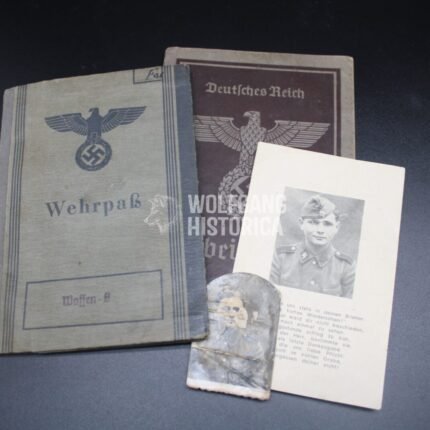
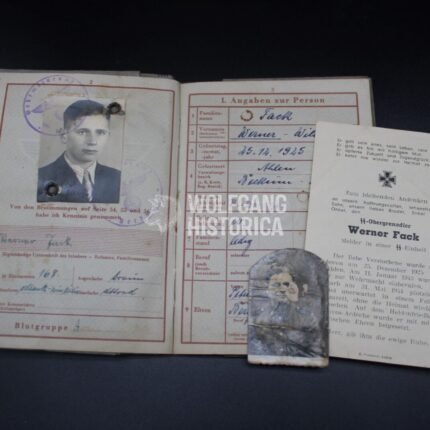
SS-Panzer-Aufklärungs-Abteilung 17 “Götz von Berlichingen” Wehrpass (Died May 31, 1944!)
€0,01Original Waffen-SS Wehrpass for a soldier serving with the SS-Panzer-Aufklärungs-Abteilung 17 of the 17. SS-Panzergrenadier-Division “Götz von Berlichingen”! He died just a week before the Invasion of Normandy on May 31, 1944! Comes with his arbeitsbuch, death card and a photo. Condition as seen.
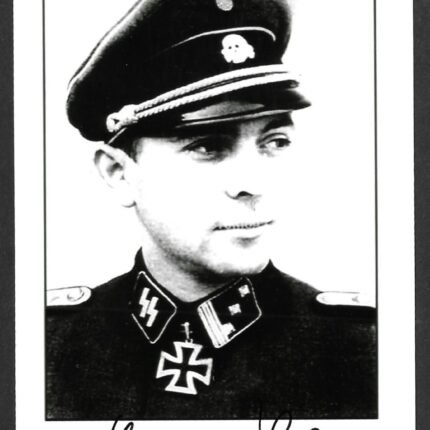
Eberhard Heder – SS-Panzer-Pionier-Bataillon 5 “Wiking”
€50,00Original Postwar Signature on a Postwar Photo of Eberhard Heder. SS-Sturmbannführer Eberhard Heder (30.06.1918 † 18.11.2017) earned the Deutsches Kreuz in Gold on March 11, 1943 as SS-Obersturmführer with the 3. Kompanie/ SS-Pionier-Bataillon 5 “Wiking” and the Ritterkreuz on November 18, 1944 as SS-Hauptsturmführer und Führer of the SS-Panzer-Pionier-Bataillon 5 of the 5. SS-Panzer-Division “Wiking”. Postcardsize. Condition as seen.
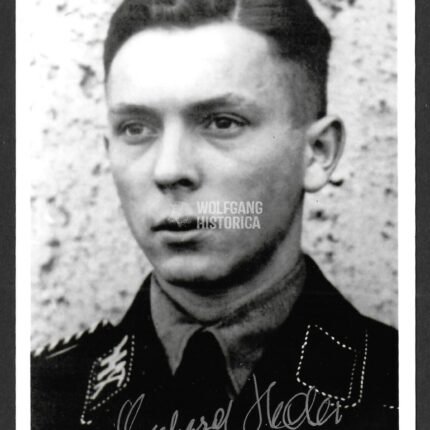
Eberhard Heder – SS-Panzer-Pionier-Bataillon 5 “Wiking”
€50,00Original Postwar Signature on a Postwar Photo of Eberhard Heder. SS-Sturmbannführer Eberhard Heder (30.06.1918 † 18.11.2017) earned the Deutsches Kreuz in Gold on March 11, 1943 as SS-Obersturmführer with the 3. Kompanie/ SS-Pionier-Bataillon 5 “Wiking” and the Ritterkreuz on November 18, 1944 as SS-Hauptsturmführer und Führer of the SS-Panzer-Pionier-Bataillon 5 of the 5. SS-Panzer-Division “Wiking”. Postcardsize. Condition as seen.
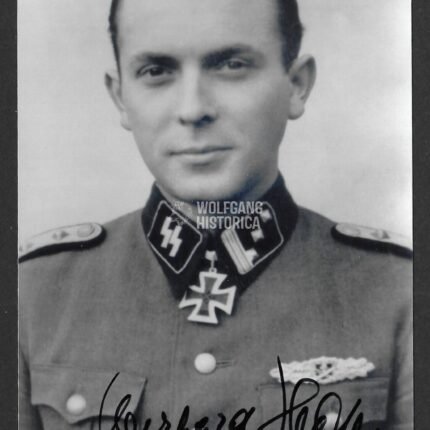
Eberhard Heder – SS-Panzer-Pionier-Bataillon 5 “Wiking”
€0,01Original Postwar Signature on a Postwar Photo of Eberhard Heder. SS-Sturmbannführer Eberhard Heder (30.06.1918 † 18.11.2017) earned the Deutsches Kreuz in Gold on March 11, 1943 as SS-Obersturmführer with the 3. Kompanie/ SS-Pionier-Bataillon 5 “Wiking” and the Ritterkreuz on November 18, 1944 as SS-Hauptsturmführer und Führer of the SS-Panzer-Pionier-Bataillon 5 of the 5. SS-Panzer-Division “Wiking”. Postcardsize. Condition as seen.