Archive of Sold Items

Sturmabzeichen Award Doc: Pionier-Kompanie 714 (714. Infanterie-Division)

75,00

An authentic wartime award document issued to Gefreiter Karcher, who served with Pionierkompanie 714 of the 714. Infanterie-Division (later re-designated as the 114. Jäger-Division).

  • Award: Allgemeines Sturmabzeichen (General Assault Badge)

  • Reason: For active participation in 3 infantry assaults

  • Signed by: Generalmajor Friedrich Stahl (Divisional Commander)

  • Condition: Document was folded in the past; overall condition as seen

Historical Context

The 714. Infanterie-Division was formed in 1941 and deployed primarily in the Balkans, where it took part in anti-partisan operations. In 1943, it was reorganized and renamed the 114. Jäger-Division, continuing service in Italy.

The Allgemeines Sturmabzeichen was instituted in 1940 and awarded to soldiers who participated in three or more infantry assaults, counter-attacks, or close combat actions, often highlighting the courage and frontline involvement of support troops such as pioneers.

Collector’s Note

A desirable and well-documented award paper, featuring the scarce divisional connection to both the Balkans campaign and the later Italian front. The signature of Generalmajor Friedrich Stahl further enhances the historical and collector’s value.

Archivalia 1940-1945 – Vlamingen aan het Oostfront, Vlamingen op het thuisfront

0,01

Book “Archivalia 1940-1945” – Vlamingen aan het Oostfront, Vlamingen op het thuisfront. Very good book!

Photo of SS-Freiwilligen-Leg. “Flandern” – Officer & Spiess Kunz

0,01

Original photo of the 3. Kompanie/ SS-Freiwilligen-Legion “Flandern”, wearing the Frw.Leg.Flandern cufftitles and even some the Langemarck collar tab. Officer and Spiess Kunz visibile. Size: 11×6,8cm. Condition as seen.

Photo of Bunker were Raimond Tollenaere was KIA

50,00

Original photo of the bunker were Flemish SS-Untersturmführer Raimond Tollenare was Killed in Action. Size: 5,8×5,8cm. Condition as seen.

Tony van Dyck – Legion “Flandern”, “Langemarck” & Algemeene-SS Vlaanderen

0,01

Original Death Card & Death Letter of Tony van Dyck! SS-Obersturmührer Tony van Dyck (27.03.1922 Berchem † 19.12.2009 Boechout) served with the 1. Kompanie/ SS-Freiwilligen-Legion “Flandern”, became the Leader of the Algemeene-SS Vlaanderen (1. Standaard van de Germaansche SS) and eventually served with the 27. SS-Freiwilligen-Grenadier-Division “Langemarck”.

He’s highly sought after! Watch the documentary of Tony van Dyck:

HISTORIES – Tony Van Dyck, Alleen De Almachtige Zal Oordelen

Otto Günsche – Adolf Hitler’s Personal Adjutant (WIA 20 July Plot, Führerbunker)

0,01

Original Postwar Signature on a Postwar Photo of Otto Günsche. SS-Sturmbannführer Otto Günsche (24.09.1917 † 02.10.2003) earned the Verwundetenabzeichen “20. Juli 1944” in Schwarz and was a member of the Leibstandarte-SS Adolf Hitler before he became Adolf Hitler’s personal adjutant. Condition as seen. Postcardsize.

With the end of Nazi Germany imminent, Günsche was tasked by Hitler on 30 April 1945 with ensuring the cremation of his body after his death. That afternoon, he stood guard outside the room in the Führerbunker where Hitler and Eva Braun committed suicide. After waiting a short time, Hitler’s valet, Heinz Linge, opened the study door with Martin Bormann at his side. The two men entered the study with Günsche right behind them. Günsche then left the study and announced that Hitler was dead to a group in the briefing room, which included Joseph Goebbels, General Hans Krebs, and General Wilhelm Burgdorf. Günsche had the table and chairs in the study moved out of the way and blankets were laid out on the floor. Hitler and Braun’s lifeless bodies were then wrapped in blankets. In accordance with Hitler’s prior written and verbal instructions, his and Braun’s bodies were carried up the stairs and through the bunker’s emergency exit to the garden behind the Reich Chancellery to be burned. Having ensured that the corpses were burnt using petrol supplied by Hitler’s chauffeur Erich Kempka, Günsche later left the Führerbunker after midnight on 1 May. On 2 May 1945, Günsche was taken prisoner by Soviet Red Army troops that were encircling the city and flown to Moscow for sharp interrogation by the NKVD.

TOP Studioportrait Vlaamse Fabriekswacht – Vlaamse Wachtbrigade

0,01

Original Flemish Collaboration Studioportrait of a member of the Vlaamse Fabriekswacht – Vlaamse Wachtbrigade. Size: 9x12cm. TOP Portrait!

Photo of two Flemish brothers (Waffen-SS & Algemene-SS)

0,01

Original photograph of two Flemish brothers, one serving with the Waffen-SS with the “Langemarck”, other here in uniform of the Flemish Algemene-SS. Size: 6x9cm.

Photo Flemish W-SS Volunteer Emiel de Laet – Sturmbrigade “Langemarck” (MIA)

0,01

Original ID photo with signature of Flemish Waffen-SS Volunteer Emiel de Laet, who went Missing in Action on 5 March 1944, while serving with the 4. Kompanie/ 6. SS-Freiwilligen-Sturmbrigade “Langemarck”. Size: 6,5x5cm.

Bidprentjesalbum van Vlaamse Oostfronters & andere Vlaamse Formaties (Part 1 & 2!)

0,01

Bidprentjesalbum van Vlaamse Oostfronters & andere Vlaamse Formaties (Part 1 & 2!). Condition as seen. From ex-Easternfrontvolunteer.

“Leiderdienst” Dietse Blauwvoetvendels – Knapen (1944/7-8a)

0,01

Original “Leiderdienst” booklet from the Dietse Blauwvoetvendels, for the Knapen. Issue: 1944/7-8a. Condition as seen.

Rudolf Lehmann – 1. SS-Panzer-Division “LSSAH”

0,01

Original Scarce Postwar Signature on a Postwar Photo of Rudolf Lehmann. SS-Obersturmbannführer Rudolf Lehmann (30.01.1914 Heidelberg † 17.09.1983 Ettlingen) earned the Ritterkreuz des Eisernen Kreuzes on February 23, 1944 as SS-Obersturmbannführer und Ia of the 1. SS-Panzer-Division “Leibstandarte-SS Adolf Hitler”. There’s sources mentioning him earning the Eichenlaub on May 6, 1945 but no evidence found. Postcardsize.

Henri Fenet – 33. SS-Freiwilligen-Grenadier-Division “Charlemagne”

0,01

Original Postwar Signature on a Postwar Photo of Henri Fenet. SS-Hauptsturmführer Henri Fenet (11.07.1919 † 14.09.2002) earned the Ritterkreuz on April 29, 1945 as SS-Hauptsturmführer und Führer of the Sturm-Bataillon der 33. SS-Freiwillige-Grenadier-Division “Charlemagne”. Henri Fenet was the sole French Waffen-SS Volunteer to be decorated with the Knight’s Cross. 

Knight’s Cross awarded for the outstanding leadership of his French volunteers during the final fighting for Berlin. Decoration presented by SS-Brigadeführer Mohnke in the Reichs Kanzlerei between 20th and 30th April 1945. Awarding has been established through research by the Ordensgemeinschaft der Ritterkreuzträger. Of the awarding is no evidence in the Bundesarchiv. (Source: Traces of War)

Flemish Collaboration Death Card – Commander of the “Fabriekwacht” Murdered – Jozef Podevyn

0,01

Original Flemish collaboration Death card of Jozef-Domien Podevyn, who was murdered on 25 october 1942. Commander of the Fabriekswacht. Condition as seen.

Feldpost (Cover + 2 letters) of SS-Regiment “Westland”

40,00

Original Feldpost cover + 2 letters inside of SS-Staffelmann Nielsen of the 12. / SS-Regiment “Westland”. The back and front of the cover are loose. Condition as seen.

Benachrichtigung SS-Rottenführer – SS-Flak-Ausbildungs und Ersatz-Regiment, München

25,00

Original Benachrichtigung of SS-Rottenführer Hohner, from the SS-Flak-Ausbildungs und Ersatz-Regiment, München. Condition as seen.

Feldpost cover of the SS-Fürsorgeführer Main

10,00

Original Feldpost cover of the SS-Fürsorgeführer Main to the Mayor of Coburg. Empty. Nothing on the back. Condition as seen.

German Press Photo: Kapitän zur See Hellmuth von Rückteschell (Hilfskreuzer, Oakleaves!)

100,00

Original German Press Photo of Kapitän zur See Hellmuth von Rückteschell (Kommandant Hilfskreuzers HSK 3 „Widder“, Kommandant, HSK 9 „Michel“, Kriegsmarine! Earned the Oakleaves!). Size: 13x18cm. Condition as seen.

Press Photo: Hitlerjugend-Vlaanderen & BDM-Vlaanderen in Gent

0,01

Original Flemish collaboration press photo of the Hitlerjugend-Vlaanderen & BDM-Vlaanderen in Gent. Condition as seen. Size: 18x24cm.

Press Photo: HJ Spokesperson of the Hitlerjugend-Vlaanderen

0,01

Original Flemish collaboration press photo of the spokesperson of the Hitlerjugend-Vlaanderen. Condition as seen. Size: 18x24cm.

Set of 5x Flemish VNVV “Vrouw en Volk” Magazines (1943)

0,01

Original group of issues of Vrouw en Volk (1943), a scarce publication of the VNVV, the women’s branch of the Flemish VNV. Condition as illustrated. All issues are complete, though they exhibit typical wear; one cover has paper adhered to it (see second image).

Included in this lot: 1943 nos. 5, 6, 9, 11, and 12.

French Commemorative War Medal 1914–1918 (Médaille commémorative de la guerre 1914–1918)

15,00

Original French Commemorative War Medal 1914–1918 (Médaille commémorative de la guerre 1914–1918). The Commemorative War Medal 1914–1918 is an official French decoration established by law on 23 June 1920, awarded to military personnel and qualifying civilians who served during the First World War.

It recognizes participation in the conflict between 2 August 1914 and 11 November 1918, regardless of length of mobilization.


Design & Characteristics

  • Material: Bronze

  • Diameter: approx. 33 mm

  • Designer: Pierre-Alexandre Morlon (selected from 73 proposals)

Obverse:

  • Profile of Minerva, symbolizing France

  • Wearing a 1915-style helmet

  • Crowned with laurel leaves and holding a sword

  • Surrounded by oak and bay leaves at the suspension

Reverse:

  • Inscription:
    “GRANDE GUERRE 1914–1918”

  • Encircled by:
    “RÉPUBLIQUE FRANÇAISE”

Condition: As seen in the images.

A classic and widely collected First World War medal, representing the full spectrum of service in wartime France, from front-line soldiers to civilian contributors.

Croix de Guerre 1914–1918 + Bronze Star

20,00

Original French Croix de Guerre 1914–1918 + Bronze Star on the ribbon. The Croix de Guerre 1914–1918 is one of France’s most iconic military decorations, established on 2 April 1915 to recognize acts of bravery and citations in dispatches during the First World War.

Created in response to the need for a formal award beyond written citations, it became a widely awarded decoration to French and Allied soldiers, as well as civilians and even entire units and towns.


Historical Background

At the outbreak of World War I, recognition for bravery was limited to written citations or high-level awards such as the Légion d’Honneur and Médaille Militaire. Due to the scale of the conflict, a new decoration was required.

Driven by figures such as General Boëlle, Maurice Barrès, and Georges Bonnefous, the Croix de Guerre was officially adopted in 1915 and became a central symbol of wartime valor.


Award Criteria

The Croix de Guerre 1914–1918 was awarded to:

  • French and Allied soldiers cited for acts of bravery

  • Civilians recognized for courage under enemy action

  • Recipients of the Légion d’Honneur or Médaille Militaire for wartime valor

  • Military units, ships, and squadrons (collective awards)

  • Cities and villages destroyed or heavily affected by war

The medal is awarded once, with additional acts of bravery indicated by devices on the ribbon.


Design & Characteristics

  • Material: Bronze (Florentine bronze)

  • Size: approx. 37 mm

  • Designer: Paul-Albert Bartholomé

Obverse:

  • Cross pattée with crossed swords

  • Central medallion: Marianne (symbol of the French Republic) wearing a Phrygian cap

  • Inscription: “RÉPUBLIQUE FRANÇAISE”

Reverse:

  • Central dates indicating the war period (most commonly 1914–1918)


Ribbon & Devices

  • Ribbon: Green with seven vertical red stripes and red edges

Citation Devices (very important for collectors):

  • Bronze Star – Regiment / Brigade level

  • Silver Star – Division level

  • Silver-Gilt Star (Vermeil) – Corps level

  • 🌿 Bronze Palm – Army level

  • 🌿 Silver Palm – Represents five bronze palms

The number of devices is unlimited, making each medal unique to the recipient’s service record.

Condition: As seen in the images.

An essential and highly collectible First World War decoration, prized for its historical significance and individualized citation system.

Set of Medal & Award Doc: Belgian Victory Medal 1914–1918 (2e Regiment Grenadiers – Antwerp, Ypres, Passendaele)

30,00

Set of an original Belgian Victory Medal 1914–1918 (“Overwinningsmedaille”) (Inter-Allied Victory Medal / “War for Civilization” Medal) + Oorkonde belonging to Soldier Francois of the 2e Regiment de Grenadiers which fought during the Siege of Antwerp, Battle of Ypres, Passendaele etc.

The Belgian Victory Medal 1914–1918, also known as the Inter-Allied Medal 1914–1918 or, after the reverse inscription, the “War for Civilization” Medal, is Belgium’s official Inter-Allied decoration awarded following the Allied victory in the First World War.

Established on 15 July 1919 by King Albert I of the Belgians, this prestigious medal was granted to all members of the mobilized Belgian Army who served between 1 August 1914 and 11 November 1918. Approximately 300,000 to 350,000 veterans received this decoration.

Subsequent decrees extended eligibility to participants in the African campaigns against German colonial forces, as well as civilians who contributed to the war effort, including members of the merchant navy and fishermen.

The medal was worn after the Yser Medal or the Yser Cross in the official order of precedence. In civilian dress, a small ribbon rosette in the medal’s colors was worn in the buttonhole. For formal evening wear, a miniature version of the medal was suspended from a small ribbon or chain. On military uniforms, recipients wore the ribbon bar (baton).

A highly desirable addition for collectors of World War I decorations, Belgian military history, or Inter-Allied commemorative medals.

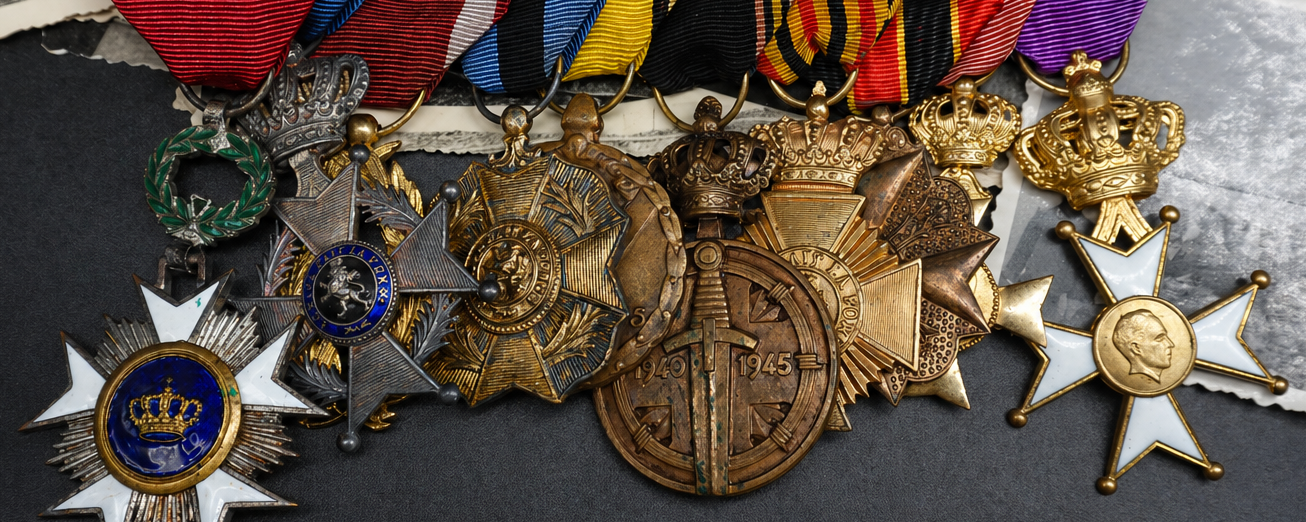
Set of Medal & Award Doc: Order of Leopold II (Rank of Knight)

40,00

Original Order of Leopold II (Rank of Knight) (Order van Leopold II (Ridder)) + Oorkonde voor Sergent Henri Delvenne (authorised 15 november 1951 n. 279 for nomination on 21 july 1942).

The Order of Leopold II is a Belgian civil order of chivalry, originally established in 1900 by King Leopold II in the Congo Free State, then his personal possession. The order’s motto, “L’Union fait la force” / “Eendracht maakt macht” (“Unity makes strength”), reflects the Belgian national ideal.

Initially awarded for services rendered to Congo and to the sovereign, the order was incorporated into the Belgian honors system after Congo became a Belgian colony in 1908. Following Congo’s independence, the Order of Leopold II remained part of the Belgian national system of honors. Today, it is one of Belgium’s three national orders, alongside the Order of the Crown and the Order of Leopold.

The Order of Leopold II is awarded to civilians and military personnel for distinguished service to the King and as a mark of his personal esteem.


Version Offered: Knight (Ridder)

  • Pre-1952 without “Eendracht maakt Macht”

  • Includes Crossed Swords!

The Knight wears the insignia on a 37 mm wide ribbon on the left breast.

Distinctive characteristics of the Knight class:

  • Cross in silvered metal (not gilded)

  • Crown suspension in silver

  • Blue ribbon with a central black stripe

  • Worn as a breast decoration

A refined and historically significant decoration, ideal for collectors of Belgian orders and colonial-era honors.

Condition: Please, see the damage to the enamel in the middle!

Panzer-Lehr-Rgt. Soldier Grouping – Photos, Feldpost & Aluminum Memorial Card (Rare!)

0,01

Exceptional and rarely encountered original grouping belonging to a soldier of the Panzer-Lehr-Regiment (later associated with Panzerjäger-Abteilung 16, as indicated by the shoulder boards visible in one of the portraits).

This lot includes:

  • 7 original period photographs (including uniform portraits)

  • 2 original Feldpost letters

  • 1 aluminum (Alu) remembrance/memorial card

Such complete personal groupings from Panzer-Lehr personnel are scarce on the market, making this a highly desirable set for advanced collectors of German WWII militaria.

Condition: All items are in original, untouched condition as shown in the photos.

Offered on consignment.

Heinz Macher – SS-Panzer-Grenadier-Regiment “Deutschland” (EL+NKIG)

0,01

Original Postwar Signature on a Postwar Photo of Heinz Macher. SS-Sturmbannführer Heinz Macher (31.12.1919 † 21.12.2001) earned the Ritterkreuz on April 3, 1943 as SS-Untersturmführer und Kompanieführer of the 16. Kompanie/ SS-Panzer-Grenadier-Regiment 3 “Deutschland” and the Eichenlaub on August 19, 1944 as SS-Obersturmführer und Kompaniechef of the 16. Kompanie/ SS-Panzer-Grenadier-Regiment 3 “Deutschland” of the 2. SS-Panzer-Division “Das Reich”. Macher also earned the Nahkampfspange in Gold on October 18, 1944. Postcardsize. Condition as seen.

Paul Senghas – SS-Panzer-Regiment 5 “Wiking”

0,01

Original Postwar Signature on a Postwar Photo of Paul Senghas. SS-Hauptsturmführer Paul Senghas (31.01.1916 † 06.11.1996) earned the Ritterkreuz des Eisernen Kreuzes on December 11, 1944 as SS-Obersturmführer und Führer of the I. Abteilung/ SS-Panzer-Regiment 5 of the 5. SS-Panzer-Division “Wiking”. Condition as seen. Postcardsize.

“On the 18.08.1944 the enemy advanced towards the Warsaw-Radzymin-Wyszkow road with massive forces and strong air support. At the time the 5. SS-Panzer-Division ‘Wiking’ was located along the general line Roszcep-Trojany-Debynki. At the time SS-Obersturmführer Senghas stood as the leader of the Stabskompanie along with the supply units of the I./SS-Panzer-Regiment 5 in Zazdroso (1.5 km east of Niegow).

At 11:00 he received a message which reported the Russians as having broken through in battalion strength to a point 1 km east of the railway embankment. A wide gap existed towards the left neighbour, and there was the danger that the Russians would block the main road and thrust into the left flank of the Division. Recognizing this danger, Senghas made the decision to engage the enemy with the handful of men in the supply units at hand (despite their lack of heavy infantry weapons) and bring the Russians to a halt.

Going into position at the railway embankment, he let the Russians approach to within very close range and then smashed their attack. Reinforcements could not be brought up, and so Senghas defended with his handful of men for the remainder of that day and also the two following days, fighting off strong enemy attacks with only rifles, sub-machine guns and close combat weapons. During this time 2 Panzer IVs, which had been in the repair shop and were only conditionally operational, were brought into the fight. 2 Sherman tanks and 1 T-34 were destroyed immediately after they appeared. The Russians took heavy losses in men and ceased their attacks.

By his own initiative and personal devotion to duty, Senghas thus brought the 3 days of close combat to a conclusion. An enemy breakthrough was prevented and the danger to the left flank of the Division removed. Senghas is one of the oldest Eastern front combat veterans, who has mastered many critical situations through swift decisiveness and bold action while ruthlessly demanding the utmost of himself.”

Belgian Deportees’ Cross 1914–1918 (Weggevoerdenkruis) (Price Per Piece)

25,00

Original Belgian Deportees’ Cross 1914–1918 (Weggevoerdenkruis). The Deportees’ Cross 1914–1918 is a Belgian war decoration established by Royal Decree on 27 November 1922. It was awarded to Belgian civilians who were deported to Germany for forced labour during the First World War, recognizing their suffering and endurance under occupation.

Deportees who died during deportation were not eligible for this cross. Instead, they were posthumously honored with the Order of Leopold II, distinguished by a ribbon bearing a central longitudinal gold stripe.


Award Description

The decoration is a 38 mm wide bronze cross pattée, with identical obverse and reverse designs.

  • The horizontal arms feature the raised inscriptions:

    • “1914” on the right arm

    • “1918” on the left arm

  • The cross is suspended from a ring passing through a suspension loop at the top.

  • It is worn on a 37 mm ribbon (typically in green tones with contrasting stripes), symbolizing hope and the hardships endured during deportation.

A rare and meaningful piece of First World War history, especially valued by collectors focusing on civilian experiences and occupation-era memorabilia.

Note: Price Per Piece!

Belgian Volunteer Combatant’s Medal 1914–1918 (Medaille van de Vrijwillige Strijder)

35,00

Original Volunteer Combatant’s Medal 1914–1918 (Medaille van de Vrijwillige Strijder). The Volunteer Combatant’s Medal 1914–1918 is a Belgian wartime service decoration established by Royal Decree on 17 June 1930. It was awarded to Belgian citizens and foreign nationals who voluntarily enlisted in the Belgian Armed Forces during the First World War.

This medal honors those who chose to serve of their own free will, often under extremely dangerous front-line conditions.


Award Criteria

The medal was granted to individuals who:

  • Voluntarily enlisted and served in a combat unit in a danger zone for at least 6 months

Eligibility was later extended to include:

  • Volunteers over 40 years old with at least 3 months of front-line service

  • Volunteers over 50 years old with at least 1 month of front-line service

  • Medical personnel with at least 2 years of service in non-occupied Belgium

  • Young volunteers who fled occupied territory to enlist

  • Wounded personnel

  • Posthumous awards


Design & Characteristics

  • Material: Bronze

  • Shape: Circular medal (36 mm) with a distinctive crescent-shaped upper section, giving a total height of approx. 50 mm

Obverse:

  • Foreground: head of a WWI Belgian soldier wearing a helmet, facing left

  • Background: head of an 1830 Belgian revolutionary volunteer, symbolizing continuity of national struggle

  • Upper crescent: Belgian crown above laurel branches

Reverse:

  • Latin inscription along the edge:
    “VOLUNTARIIS PATRIA MEMOR”
    (“The homeland remembers its volunteers”)

  • Center: the dates 1914–1918


Ribbon

  • Color: Royal blue moiré silk

  • Simple and elegant, emphasizing the honor of voluntary service

Condition: As seen in the images.

A historically rich and symbolic Belgian decoration, highly desirable for collectors of First World War and volunteer service medals.

Order of Leopold II (Rank of Officer)

55,00

Original Order of Leopold II (Rank of Officer). The Order of Leopold II (French: Ordre de Léopold II) is a Belgian civil order of chivalry, originally established in 1900 by King Leopold II in the Congo Free State, then his personal possession. The order’s motto, “L’Union fait la force” / “Eendracht maakt macht” (“Unity makes strength”), reflects the Belgian national ideal.

Initially awarded for services rendered to Congo and to the sovereign, the order was incorporated into the Belgian honors system after Congo became a Belgian colony in 1908. Following Congo’s independence, the Order of Leopold II remained part of the Belgian national system of honors. Today, it is one of Belgium’s three national orders, alongside the Order of the Crown and the Order of Leopold.

The Order of Leopold II is awarded to civilians and military personnel for distinguished service to the King and as a mark of his personal esteem.


Version Offered: Officer (Officier)

The Officer rank represents a higher class within the Order.

The insignia is worn on the left breast, suspended from a ribbon featuring a rosette, distinguishing it from the Knight class.

Distinctive Characteristics of the Officer Class:

  • Cross of the Order in a superior class grade

  • Suspended from the standard blue ribbon with central black stripe

  • Ribbon fitted with a rosette, indicating Officer rank

  • Worn as a breast decoration

A refined and historically significant decoration, ideal for collectors of Belgian orders and colonial-era honors.

Order of Leopold II (Rank of Knight)

30,00

Original Order of Leopold II (Rank of Knight). The Order of Leopold II (French: Ordre de Léopold II) is a Belgian civil order of chivalry, originally established in 1900 by King Leopold II in the Congo Free State, then his personal possession. The order’s motto, “L’Union fait la force” / “Eendracht maakt macht” (“Unity makes strength”), reflects the Belgian national ideal.

Initially awarded for services rendered to Congo and to the sovereign, the order was incorporated into the Belgian honors system after Congo became a Belgian colony in 1908. Following Congo’s independence, the Order of Leopold II remained part of the Belgian national system of honors. Today, it is one of Belgium’s three national orders, alongside the Order of the Crown and the Order of Leopold.

The Order of Leopold II is awarded to civilians and military personnel for distinguished service to the King and as a mark of his personal esteem.


Version Offered: Knight (Ridder)

The Knight wears the insignia on a 37 mm wide ribbon on the left breast.

Distinctive characteristics of the Knight class:

  • Cross in silvered metal (not gilded)

  • Crown suspension in silver

  • Blue ribbon with a central black stripe

  • Worn as a breast decoration

A refined and historically significant decoration, ideal for collectors of Belgian orders and colonial-era honors.

Belgian War Cross 1914–1918 (Oorlogskruis)

20,00

Original Belgian War Cross 1914–1918 (Oorlogskruis). The Belgian War Cross 1914–1918 (Oorlogskruis) is one of Belgium’s most prestigious First World War decorations. It was instituted by Royal Decree on 25 October 1915, inspired by the French Croix de Guerre established earlier that same year.

Awarded exclusively to individual members of the Belgian Army, Navy, and Air Force — and in exceptional cases to foreign Allied servicemen — the War Cross recognized acts of bravery in the face of the enemy.

Beyond gallantry, the decoration was also granted for:

  • Three years of front-line service (five front stripes)

  • Volunteers over 40 or under 16 years of age with at least 18 months of service

  • Escaped prisoners of war who rejoined their unit within three months

  • Soldiers unable to resume combat due to wounds sustained in action

The War Cross could be awarded posthumously. In such cases, the ribbon bears a black enamel bar. Non-commissioned officers and enlisted men who died from wounds received in combat were additionally appointed Knights of the Order of Leopold II with palm and also received the War Cross.

Citation Devices (Ribbon Distinctions)

Recipients mentioned in official dispatches could wear the following devices on the ribbon:

  • Bronze Lion – Mention in Regimental Orders

  • Silver Lion – Mention in Brigade Orders

  • Gold Lion – Mention in Divisional Orders

  • Bronze Palm – Mention in Army Orders

  • Five bronze palms replaced by one silver palm

  • Five silver palms replaced by one gold palm

These devices significantly enhance both the historical and collector value of the decoration.

An essential and highly sought-after piece for collectors of Belgian militaria and First World War decorations.

Otto Günsche – Adolf Hitler’s Personal Adjutant (WIA 20 July Plot, Führerbunker)

220,00

Original Postwar Signature on a Postwar Photo of Otto Günsche. SS-Sturmbannführer Otto Günsche (24.09.1917 † 02.10.2003) earned the Verwundetenabzeichen “20. Juli 1944” in Schwarz and was a member of the Leibstandarte-SS Adolf Hitler before he became Adolf Hitler’s personal adjutant. Condition as seen. Postcardsize.

With the end of Nazi Germany imminent, Günsche was tasked by Hitler on 30 April 1945 with ensuring the cremation of his body after his death. That afternoon, he stood guard outside the room in the Führerbunker where Hitler and Eva Braun committed suicide. After waiting a short time, Hitler’s valet, Heinz Linge, opened the study door with Martin Bormann at his side. The two men entered the study with Günsche right behind them. Günsche then left the study and announced that Hitler was dead to a group in the briefing room, which included Joseph Goebbels, General Hans Krebs, and General Wilhelm Burgdorf. Günsche had the table and chairs in the study moved out of the way and blankets were laid out on the floor. Hitler and Braun’s lifeless bodies were then wrapped in blankets. In accordance with Hitler’s prior written and verbal instructions, his and Braun’s bodies were carried up the stairs and through the bunker’s emergency exit to the garden behind the Reich Chancellery to be burned. Having ensured that the corpses were burnt using petrol supplied by Hitler’s chauffeur Erich Kempka, Günsche later left the Führerbunker after midnight on 1 May. On 2 May 1945, Günsche was taken prisoner by Soviet Red Army troops that were encircling the city and flown to Moscow for sharp interrogation by the NKVD.

Fritz Langanke – SS-Panzer-Regiment 2 “Das Reich”

0,01

Original Postwar Signature on a Postwar Photo of Fritz Langanke. SS-Obersturmführer Fritz Langanke (15.07.1919 † 10.07.2012) earned the Ritterkreuz des Eisernen Kreuzes on August 27, 1944 as SS-Standarten-Oberjunker und Zugführer of the 2. Kompanie/ SS-Panzer-Regiment 2 of the 2. SS-Panzer-Division “Das Reich“. Condition as seen. Postcardsize.

Knight’s Cross: “SS-Standartenoberjunker Langanke, Zugführer in the II./SS-Pz.Rgt. 2, was separated from his Abteilung along with 3 Panthers on the 28.07.1944. In this time he made the independent decision to rally 300 Heer Grenadiers and launch a breakout attempt on the night of the 29./30.07.1944. Advancing via St. Denis he personally destroyed 13 tanks, 4 anti-tank guns, 8 halftracks and 10 trucks over a series of hard yet successful engagements. Ultimately he managed to make it back to friendly lines while also clearing open the way to freedom for many other units including a self-propelled Flak-Batterie (with five 3.7 cm guns), 2 Grille SPGs, 3 Sturmgeschützen and 29 trucks.”

“De Arbeidsman” – VAVV Montly Issue – Oktober 1941

0,01

Original “De Arbeidsman” – VAVV Montly Issue – Oktober 1941. Complete. Condition as seen.

De Dr. Reimond Tollenaere Marsch te Brussel – Folder

0,01

Original “De Dr. Reimond Tollenaere Marsch te Brussel – 12 Juli 1942” Folder. Complete with all pictures but the sides in worn, partial loose condition.

Liederbuch Reichsarbeitsdienst – Singend wollen wir marschieren

10,00

Original Liederbuch (Songbook) of the Reichsarbeidsdienst “Singend wollen wir marschieren”. Complete but in used condition. Condition as seen.

Sint-Maartenfonds (SMF) Pennant

0,01

Original Flemish SMF (Sint-Maartenfonds) Pennant. Condition as seen.

Flemish Vlaamsch Nationaal Verbond (VNV) Liederboek (Songbook)

0,01

Original Flemish Collaboration Vlaamsch Nationaal Verbond (VNV) Liederboek (Songbook), 1942. Condition as seen.

Studioportrait of Juul Geurts – First Flemish W-SS Volunteer to earn EK1

0,01

Original Studioportrait of Waffen-SS Flemish Volunteer “Juul” Geurts, who was the first Flemish Waffen-SS Volunteer to earn the Eisernes Kreuz 1. Klasse. Size: 7×11,2cm. Condition as seen.

Photograph of Flemish Volunteers of the SS-Freiwilligen-Legion “Flandern”

0,01

Original Photograph of Flemish Volunteers of the SS-Freiwilligen-Legion “Flandern”. Size: 6x9cm. Condition as seen.

Press Photo: Hitlerjugend-Vlaanderen Gathering

0,01

Original Flemish collaboration press photo of the Hitlerjugend-Vlaanderen. Condition as seen. Size: 13x18cm.

Press Photo: German General checking the Vlaamse Wacht in Begijnenstraat, Antwerpen

0,01

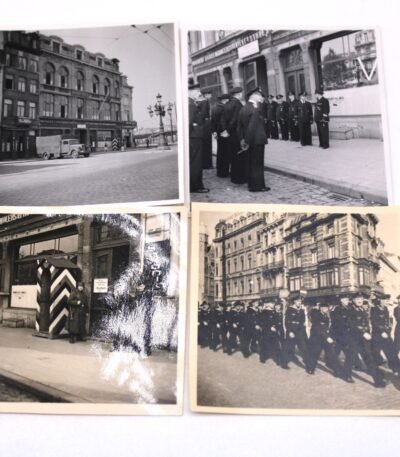
Original Flemish collaboration press photo of the Vlaamse Wacht, taken in the Begijnenstraat, Antwerpen. Condition as seen. Size: 13x18cm.

Hugo Broch – Jagdgeschwader 54 (A5 Size!)

20,00

Original Postwar Signature on a Postwar Photo of Hugo Broch. Feldwebel Hugo Broch (06.01.1922 †) earned the Deutsches Kreuz in Gold on October 17, 1943 and the Ritterkreuz des Eisernen Kreuzes on March 12, 1945 as Feldwebel in the 8. Staffel/ Jagdgeschwader 54. Condition as seen. Large Size (A5!).

Josef Wiechoczek – Jäger-Regiment 28 (8. Jäger-Division)

20,00

Original Postwar Signature on a Postwar Photo of Josef Wiechoczek. Leutnant Josef Wiechoczek (18.11.1915 in Oberschlesien † 05.01.1999 in Bad Säckingen) earned the Ritterkreuz des Eisernen kreuzes on December 9, 1944 as Leutnant und Führer in the 5. Kompanie/ Jäger-Regiment 28 of the 8. Jäger-Division. Size: 9,1x13cm. Condition as seen.

Friedrich Weber – Infanterie-Regiment 481 (256. Infanterie-Division)

60,00

Original Postwar Signature on a Postwar Photo of Friedrich Weber. Generalleutnant Friedrich Weber (31.03.1892 in Chateau-Salins, Lorraine † 02.09.1972 in Deggendorf) earned the Ritterkreuz des Eisernen Kreuzes on June 8, 1940 as Oberstleutnant und Kommandeur of Infanterie-Regiment 481 of the 256. Infanterie-Division. Postcardsize.

He fought in Africa and in the Eastern Front. He was the commander of the fortress division defending Warsaw in January 1945.

Walter Böhm – Panzer-Aufklärungs-Abteilung 8 (8. Panzer-Division)

25,00

Original Postwar Signature on Postwar Photo of Walter Böhm. Oberfeldwebel Walter Böhm (16.12.1918 † 23.09.2011) earned the Ritterkreuz des Eisernen Kreuzes on March 17, 1945 as Oberfeldwebel und Panzerspähtruppführer in the 1. Kompanie/ Panzer-Aufklärungs-Abteilung 8 of the 8. Panzer-Division. Postcardsize. Condition as seen. Comes with a signed letter.