Wound Badge in Black Document & Combat-Day Records – Grenadier-Regiment 225 – Vosges, France 1944

Interesting late-war Wehrmacht document grouping belonging to Gefreiter Paul Schmidt, serving with 4./Grenadier-Regiment 225.

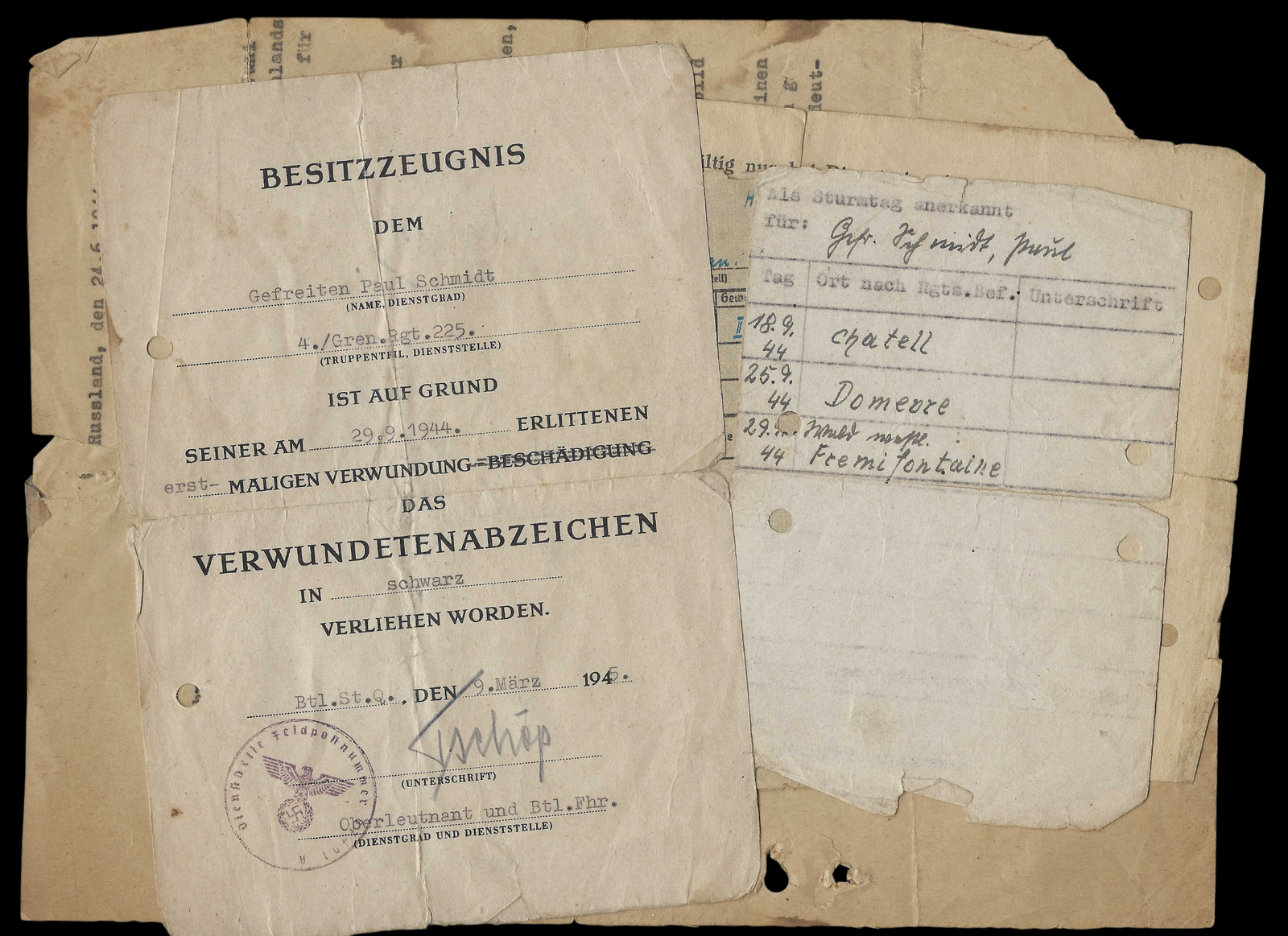
The grouping consists of several wartime documents and service-related papers, most notably a Besitzzeugnis for the Verwundetenabzeichen in Schwarz (Wound Badge in Black), awarded for a first combat wound sustained on 29 September 1944. The award document is dated 9 March 1945, making this a desirable combat-related late-war grouping.

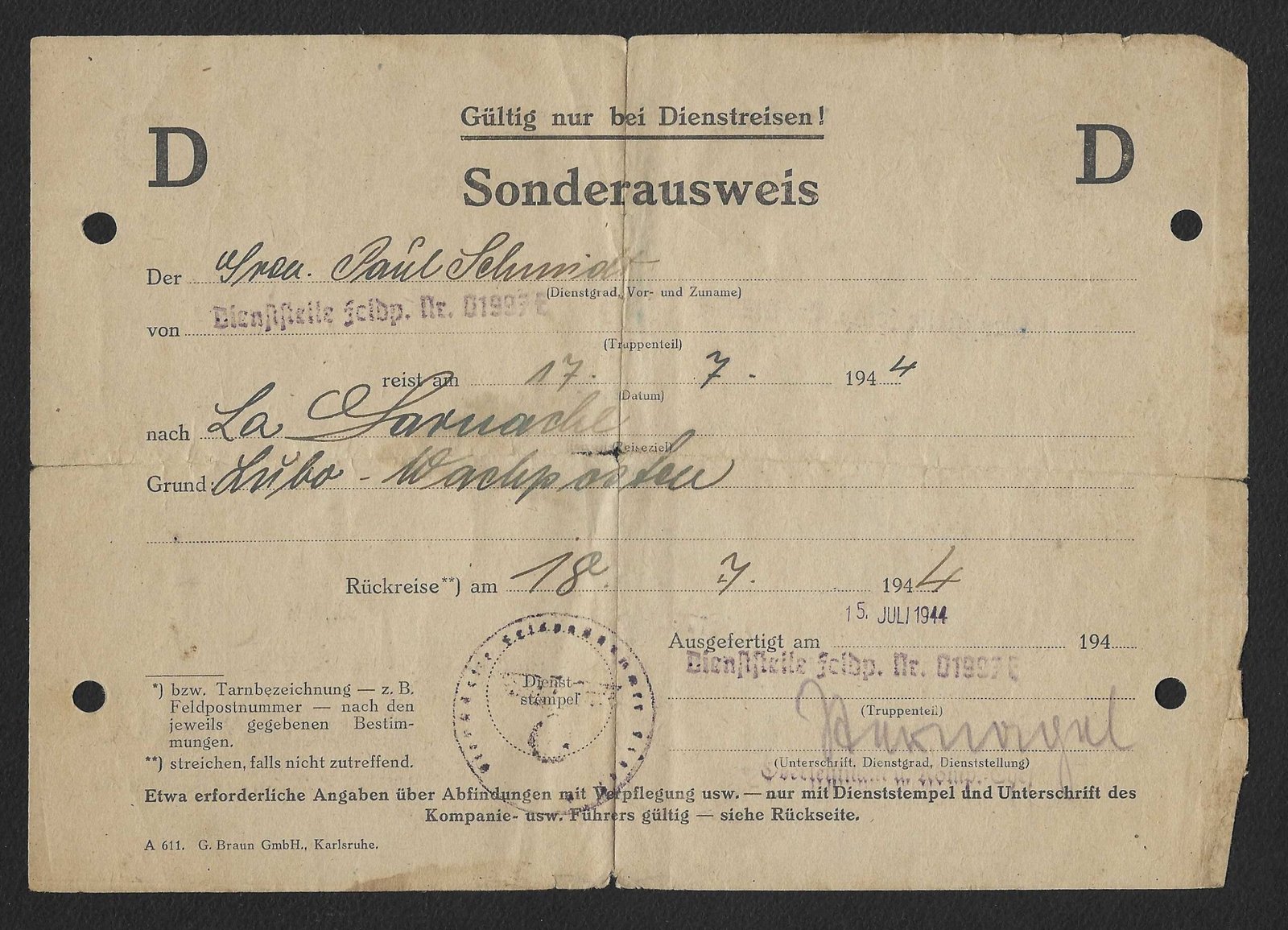
Also included is a Sonderausweis (special travel pass) issued in July 1944, together with several additional wartime slips and papers. Particularly interesting is a handwritten list documenting Sturmtage (combat days) from September 1944, mentioning locations such as Chatel, Domevre and Fremifontaine. These entries provide a direct connection to frontline combat operations during the heavy fighting in France.

Grenadier-Regiment 225 has an interesting and short-lived late-war history. The regiment was initially formed on 4 August 1944 in Western France for the 16. Infanterie-Division, though the rapid collapse and evacuation of German forces in France prevented its full establishment. The regiment was later re-formed on 9 October 1944 under Heeresgruppe G in the Vosges, using personnel from Kampfgruppe Roever and I./Flieger-Regiment 91. This places the grouping directly within the chaotic late-war fighting and restructuring of German Heer formations during the collapse of the Western Front.

A very desirable combat-related Heer document grouping with clear unit attribution, wound badge document, and documented combat-day entries from the Western Front. Groupings with this level of context and research potential are increasingly difficult to find.

Overall in used wartime condition with folds, wear, tears and staining as shown. A solid and historical late-war Wehrmacht grouping with excellent display and research value.

75,00

In stock

In stock

Product total
Options total
Grand total
SKU: 2062613A

Details

Statement

Wolfgang Historica is a trusted seller with years of experience and consistently positive reviews. We are always interested in purchasing collections or unique objects and also offer a professional consignment service. Buy with confidence.

Historical Description

Interesting late-war Wehrmacht document grouping belonging to Gefreiter Paul Schmidt, serving with 4./Grenadier-Regiment 225.

The grouping consists of several wartime documents and service-related papers, most notably a Besitzzeugnis for the Verwundetenabzeichen in Schwarz (Wound Badge in Black), awarded for a first combat wound sustained on 29 September 1944. The award document is dated 9 March 1945, making this a desirable combat-related late-war grouping.

Also included is a Sonderausweis (special travel pass) issued in July 1944, together with several additional wartime slips and papers. Particularly interesting is a handwritten list documenting Sturmtage (combat days) from September 1944, mentioning locations such as Chatel, Domevre and Fremifontaine. These entries provide a direct connection to frontline combat operations during the heavy fighting in France.

Grenadier-Regiment 225 has an interesting and short-lived late-war history. The regiment was initially formed on 4 August 1944 in Western France for the 16. Infanterie-Division, though the rapid collapse and evacuation of German forces in France prevented its full establishment. The regiment was later re-formed on 9 October 1944 under Heeresgruppe G in the Vosges, using personnel from Kampfgruppe Roever and I./Flieger-Regiment 91. This places the grouping directly within the chaotic late-war fighting and restructuring of German Heer formations during the collapse of the Western Front.

A very desirable combat-related Heer document grouping with clear unit attribution, wound badge document, and documented combat-day entries from the Western Front. Groupings with this level of context and research potential are increasingly difficult to find.

Overall in used wartime condition with folds, wear, tears and staining as shown. A solid and historical late-war Wehrmacht grouping with excellent display and research value.