


Johann Fiedler – SS-Panzer-Grenadier-Regiment 6 “Theodor Eicke”
€0,01Original Postwar Signature on a Postwar Paper of Johann Fiedler. SS-Oberscharführer Johann Fiedler (28.04.1922 † 23.09.1999) earned the Ritterkreuz on June 16, 1944 as SS-Unterscharführer und Zugführer in the 5. Kompanie/ SS-Panzer-Grenadier-Regiment 6 “Theodor Eicke” of the 3. SS-Panzer-Division “Totenkopf”. Good condition. Measuring: Postcardsize.
Knight’s Cross: “On the 26.04.1944 the SS-Panzergrenadier-Regiment 6 ‘Theodor Eicke’ attacked towards Pascani with the intent of improving its own lines. After overwhelming the first hostile trenches an enemy flanking position containing numerous bunkers that had not previously been identified made itself very uncomfortably felt. Under fire from the flanking bunkers and field positions, the friendly attack initially bogged down.
In this situation SS-Unterscharführer Fiedler led his squad into an attack against the enemy trench on his own initiative and rolled it up in bitter close combat. He eliminated the bunkers that formed part of the enemy’s defensive network with great prudence and exemplary bravado.
Through this independently conducted action Fiedler took out the enemy flanking threat, and in doing so he enabled the attack of the two forwardly deployed Bataillone to proceed. He personally captured the following:
35 prisoners, 1 anti-tank gun, 2 heavy machine-guns, 5 light machine-guns, 39 machine-pistols.
Over 40 enemy dead lay amongst the trenches and bunkers he had cleared. Through this achievement Unterscharführer Fiedler has achieved a decisive success far out of proportion to his battlefield importance.
I ask that SS-Unterscharführer Fiedler (who has already been wounded in the East a total of 9 times) be awarded the Knight’s Cross of the Iron Cross for his heroic deed and its associated success.”
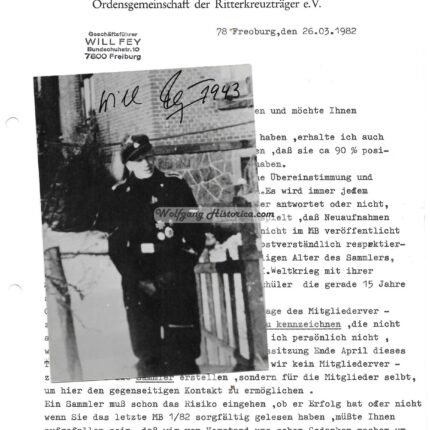
Willi Fey – schwere SS-Panzer-Abteilung 502
€75,00Original Postwar Signature on a Postwar Photocopy of Willi Fey. SS-Oberscharführer Willi Fey (25.09.1918 † 29.04.2002) earned the Ritterkreuz on April 29, 1945 as SS-Oberscharführer und Panzerkommandant in the schwere Panzer-Abteilung 502. Good condition. Measuring: Postcardsize. Comes with an extra signed letter.
Knight’s Cross: Awarded for destroying 8 Soviet tanks during the fighting for Berlin in the time period 23.-28.04.1945. By this he raised his total of enemy tanks destroyed in close combat to 14.
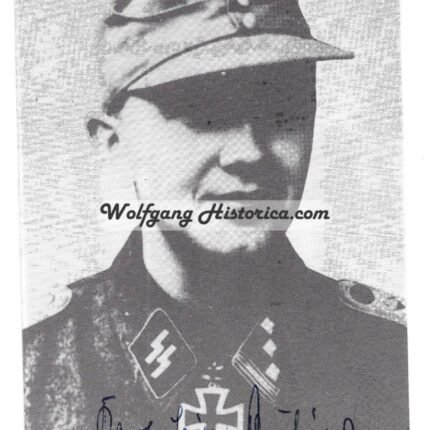
Karl-Heinz Euling – SS-Panzer-Grenadier-Regiment 21 (Arnhem, Nijmegen)
€55,00Original Postwar Signature on a Postwar Photocopy of Karl-Heinz Euling. SS-Hauptsturmführer Karl-Heinz Euling (16.08.1919 † 14.04.2014) earned the Ritterkreuz on October 15, 1944 as SS-Hauptsturmführer und Kommandeur of the I. Bataillon/ SS-Panzer-Grenadier-Regiment 21 of the 10. SS-Panzer-Division “Frundsberg”. Good condition. Measuring: Postcardsize.
Knight’s Cross: “SS-Hauptsturmführer Euling has outstandingly distinguished himself through his unwavering will to fight and personal actions during the fighting against the air-landed enemy forces at Arnhem and Nijmegen (18.-22.09.1944) as well as in the offensive and defensive battles northeast of Nijmegen (01.-04.10.1944).
1.) On the 19.09.1944 SS-Hauptsturmführer Euling and his Bataillon succeeded in reaching the Rhine bridge [no typo] at Nijmegen from the direction of Arnhem (a city where heavy urban combat had already erupted). He crossed the bridge with his lead elements and in doing so laid the foundation for the creation of a bridgehead here. When he was later ordered to evacuate the bridgehead due to the strong enemy attacks, Euling held the bridge long enough for the withdrawal to be completed.
His boldness and fearlessness prevented the hotly pursuing enemy from occupying the bridge, which would have cut off the fleeing friendly formations. He reformed retreating friendly security elements through his energetic, personal intervention and encouraged them to hold their ground. Along with the remnants of his Kampfgruppe, he was the last to remain in contact with the enemy and so became encircled. He set up a defense in the citadel of Nijmegen. His calm and level-headedness influenced his men to hold out to the last man. In the process the enemy lost a Sherman tank and 30 dead/wounded. Euling decided to break out to friendly lines only after all ammunition had been expended and the citadel had caught on fire. Through skillful and prudent leadership he managed to bring his Kampfgruppe through the enemy lines along with all their weapons.
2.) During a friendly attack on the 02.10.1944 SS-Hauptsturmführer Euling once again proved himself through exceptional attacking spirit. He significantly contributed to pushing forward the frontline successfully.
Over the course of strong enemy counterattacks on the 04.10.1944 (which were conducted with overwhelming artillery support), it was once again SS-Hauptsturmführer Euling who gathered up the fleeing friendly elements, reformed them and sent them back into the hard defensive battle. In this way he prevented a rip in the frontline, one which would have inevitably led to a crisis. The location of the battle lines remained unchanged.
He has already excelled as a soldier during the fighting in the East and West as a member of the 9. SS-Pz.Div. ‘Hohenstaufen’.”

Paul Egger – schwere SS-Panzer-Abteilung 502
€45,00Original Postwar Signature on a Postwar Photocopy of Paul Egger. SS-Obersturmführer Paul Egger (26.11.1916 † 12.07.2007) earned the Deutsches Kreuz in Gold on December 30, 1944 and the Ritterkreuz on April 28, 1945 with 1./ schwere SS-Panzer-Abteilung 502. In 1941, he joined the Waffen-SS and became a tank commander in SS-Panzer-Regiment 2 “Das Reich” before transferring to the schwere Panzer-Abteilung 102, with which he took part in the Battle of Normandy. After its destruction, the unit was renamed to schwere SS-Panzer-Abteilung 502 and transferred to the Eastern Front, fighting around Stettin. Paul Egger recorded 113 tank kills. Good condition. Measuring: Postcardsize.
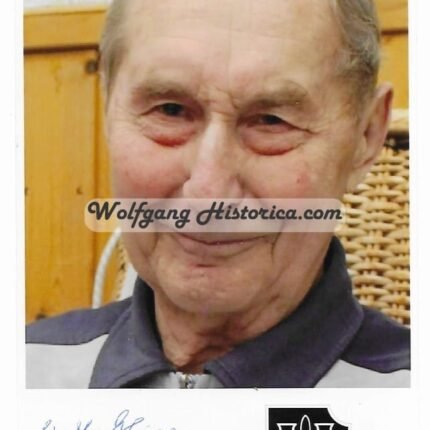
Karl-Heinz Henschel – SS-Artillerie-Regiment 9 “Hohenstaufen”
€15,00Original Postwar Signature on a Postwar Photocopy of Karl-Heinz Henschel. SS-Sturmmann Karl-Heinz Henschel (16.04.1926 † ) served with the Regimentsstabsbatterie/ SS-Artillerie-Regiment 9 of the 9. SS-Panzer-Division “Hohenstaufen”. He fought in Normandy and Arnhem. Measuring: Postcardsize.
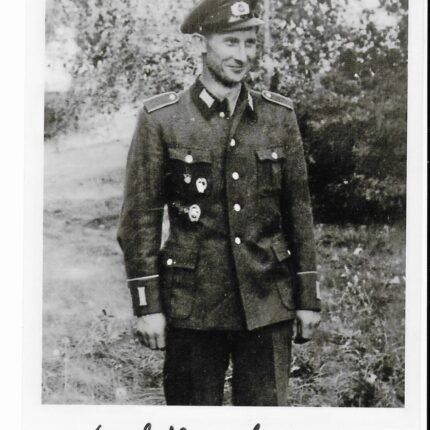
Karl-Heinz Henschel – SS-Artillerie-Regiment 9 “Hohenstaufen”
€15,00Original Postwar Signature on a Postwar Photocopy of Karl-Heinz Henschel. SS-Sturmmann Karl-Heinz Henschel (16.04.1926 † ) served with the Regimentsstabsbatterie/ SS-Artillerie-Regiment 9 of the 9. SS-Panzer-Division “Hohenstaufen”. He fought in Normandy and Arnhem. Measuring: Postcardsize.

Karl-Heinz Henschel – SS-Artillerie-Regiment 9 “Hohenstaufen”
€15,00Original Postwar Signature on a Postwar Photocopy of Karl-Heinz Henschel. SS-Sturmmann Karl-Heinz Henschel (16.04.1926 † ) served with the Regimentsstabsbatterie/ SS-Artillerie-Regiment 9 of the 9. SS-Panzer-Division “Hohenstaufen”. He fought in Normandy and Arnhem. Measuring: Postcardsize.
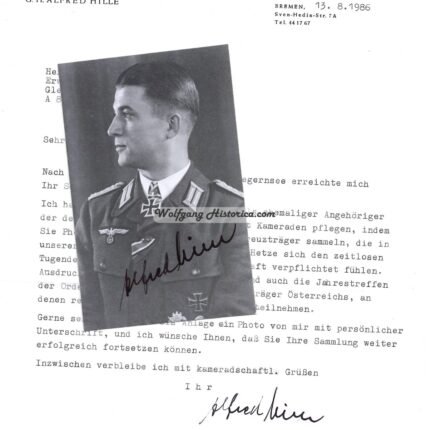
Alfred Hille – Fahnenjunker-Grenadier-Regiment 1237
€55,00Original Postwar Signature on a Postwar Photocopy of Alfred Hille. Hauptmann Alfred Hille (22.11.1908 † 11.09.1996) earned the Ritterkreuz on April 21, 1945 as Hauptmann der Reserve und Führer of a Kampfgruppe in the V. SS-Gebirgskorps (Kommandeur I. / Fahnenjunker-Grenadier-Regiment 1237). Good condition. Measuring: 8×12,5cm. Comes with an extra letter.
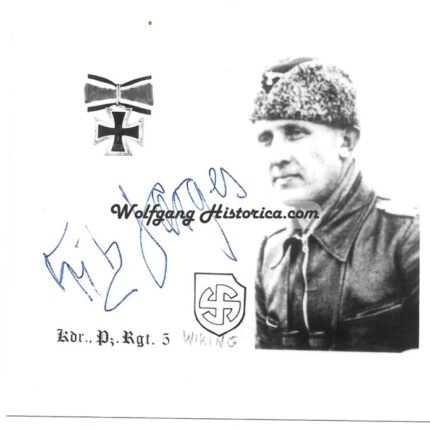
Fritz Darges – SS-Panzer-Regiment 5 “Wiking” and Personal Adjutant of Adolf Hitler
€45,00Original Postwar Signature on a Postwar Photocopy of Fritz Darges. SS-Obersturmbannführer Fritz Darges (08.02.1913 † 25.10.2009) earned the Ritterkreuz on April 5, 1945 as SS-Obersturmbannführer und Führer of the SS-Panzer-Regiment 5 of the 5. SS-Panzer-Division “Wiking”. He served as an Adjutant to Martin Bormann and later was a personal Adjutant to Adolf Hitler. He remained loyal to Adolf Hitler until his death. After his death a manuscript with his memoirs was published. Good condition. Measuring: 11,8×10,4cm.
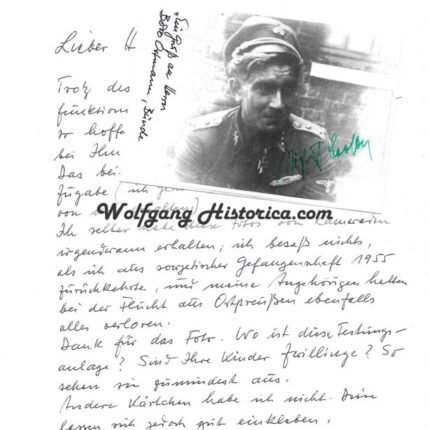
Siegfried Brosow – SS-Pionier-Bataillon 2 “Das Reich”
€0,01Original Postwar Signature on a Postwar Photo of Siegfried Brosow. SS-Hauptsturmführer Siegfried Brosow (10.12.1918 † 18.11.2008) earned the Ritterkreuz on November 13, 1943 as SS-Hauptsturmführer und Chef of the 1. Kompanie/ SS-Pionier-Bataillon 2 of the 2. SS-Panzer-Division “Das Reich”. Good Condition. Comes with an extra letter.
Friedrich Blond – SS-Panzergrenadier-Ausbildungs- und Ersatz-Bataillon 1 “LSSAH”
€40,00Original Postwar Signature on a Postwar Photo of Friedrich Blond. SS-Untersturmführer Friedrich Blond (29.04.1920 † 24.05.2009) earned the Ritterkreuz on April 28, 1945 as SS-Untersturmführer with the 12. Kompanie/ SS-Panzergrenadier-Ausbildungs- und Ersatz-Bataillon 1 “LSSAH”. Good condition.
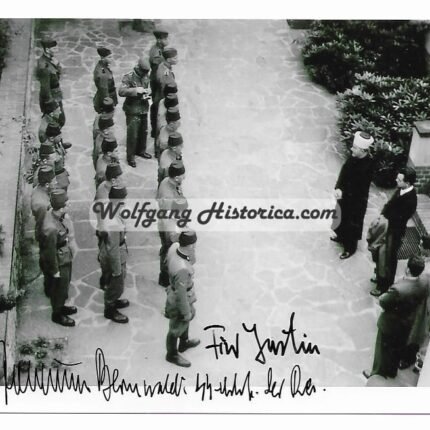
Zvonimir Bernwald – 13. Waffen-Gebirgs-Division der SS “Handschar”
€15,00Original Postwar Signature on a Postwar Photocopy Zvonimir Bernwald. SS-Sturmmann Zvonimir Bernwald (08.08.1924 † 11.09.2019) served with the 13. Waffen-Gebirgs-Division der SS “Handschar”. Zvonimir is also the author of “Muslime in der Waffen-SS – Die 13. Waffen-Gebirgs
Zvonimir Bernwald – 13. Waffen-Gebirgs-Division der SS “Handschar”
€15,00Original Postwar Signature on a Postwar Photocopy Zvonimir Bernwald. SS-Sturmmann Zvonimir Bernwald (08.08.1924 † 11.09.2019) served with the 13. Waffen-Gebirgs-Division der SS “Handschar”. Zvonimir is also the author of “Muslime in der Waffen-SS – Die 13. Waffen-Gebirgs
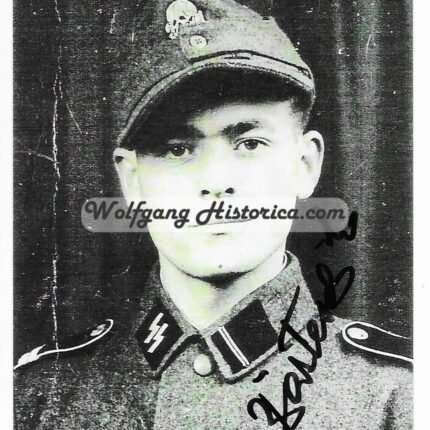
Wilhelm Bartels – 5. SS-Panzer-Division “Wiking”
€15,00Original Postwar Signature on a Postwar Photocopy of Wilhelm Bartels. SS-Sturmmann Wilhelm Bartels served with the 5. SS-Panzer-Division “Wiking”. Good condition. Measuring: Postcardsize.
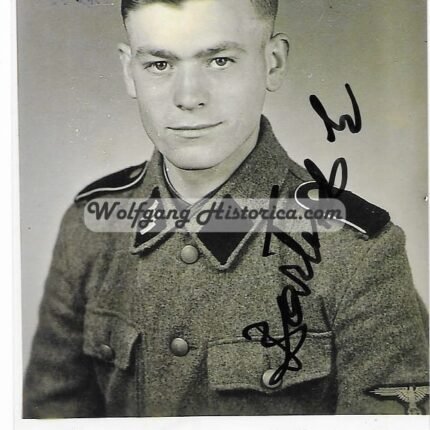
Wilhelm Bartels – 5. SS-Panzer-Division “Wiking”
€15,00Original Postwar Signature on a Postwar Photocopy of Wilhelm Bartels. SS-Sturmmann Wilhelm Bartels served with the 5. SS-Panzer-Division “Wiking”. Good condition. Measuring: Postcardsize.
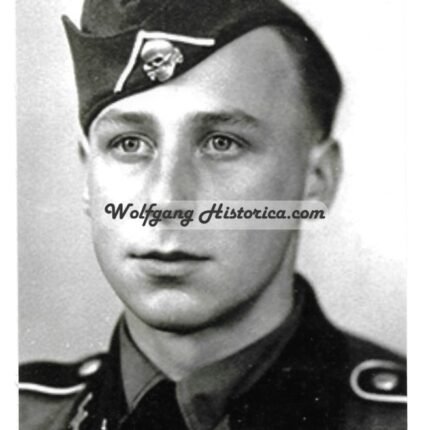
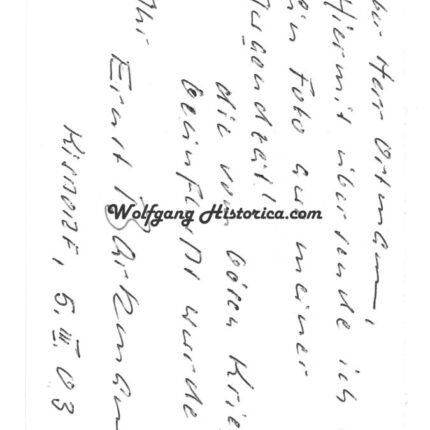
Ernst Barkmann – SS-Panzer-Regiment 2 “Das Reich”
€0,01Original Postwar Signature on a Postwar (Hard Carton) Photocopy of Ernst Barkmann. SS-Oberscharführer Ernst Barkmann (25.08.1919 † 27.06.2009) earned the Ritterkreuz on August 27, 1944 as SS-Unterscharführer und Panzerkommandant in the 4. Kompanie/ SS-Panzer-Regiment 2 of the 2. SS-Panzer-Division “Das Reich”. Good condition. Measuring: Postcardsize. Signed on the reverse, likely it is a paper pasted on the back but very well done, you don’t see or feel a difference.
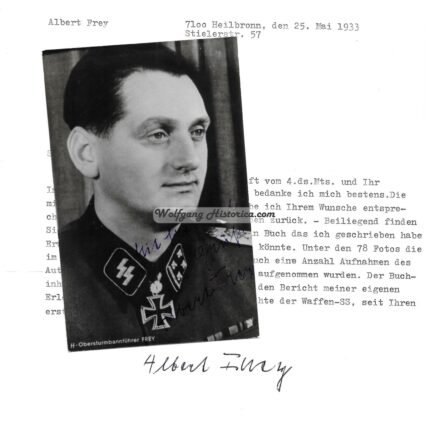
Albert Frey – SS-Panzer-Grenadier-Regiment 1 “LSSAH” (Oakleaves)
€0,01Original Postwar Signature on a Postwar Photocopy of Albert Frey. SS-Standartenführer Albert Frey (16.02.1913 † 01.09.2003) earned the Deutsches Kreuz in Gold on November 17, 1941 with SS-Infanterie-Regiment “Leibstandarte-SS Adolf Hitler”, the Ritterkreuz on March 3, 1943 as SS-Sturmbannführer und Kommandeur of the I. Bataillon/ SS-Panzer-Grenadier-Regiment 1 “LSSAH” and the Eichenlaub on December 29, 1943 as SS-Obersturmbannführer und Kommandeur of the SS-Panzer-Grenadier-Regiment 1 of the 1. SS-Panzer-Division “LSSAH“. Good condition. Measuring: Postcardsize. Comes with an extra letter.

Albert Stenwedel – 13. Waffen-Gebirgs-Division der SS „Handschar“
€40,00Original Postwar Signature on a Postwar Photocopy of Albert Stenwedel. SS-Sturmbannführer Albert Stenwedel (10.09.1908 † 29.07.1997) was an early volunteer for the SS (SS service number 28 762). During World War II he became the Commander of the II. Bataillon/ 27. Waffen-Gebirgsjäger-Regiment of the 13. Waffen-Gebirgs-Division der SS „Handschar“ (1st Croatian) and was awarded the Knight’s Cross near the end of the war in May 1945.

Albert Stenwedel – 13. Waffen-Gebirgs-Division der SS „Handschar“
€40,00Original Postwar Signature on a Postwar Photocopy of Albert Stenwedel. SS-Sturmbannführer Albert Stenwedel (10.09.1908 † 29.07.1997) was an early volunteer for the SS (SS service number 28 762). During World War II he became the Commander of the II. Bataillon/ 27. Waffen-Gebirgsjäger-Regiment of the 13. Waffen-Gebirgs-Division der SS „Handschar“ (1st Croatian) and was awarded the Knight’s Cross near the end of the war in May 1945.

Teddy Wisch – 1. SS-Panzer-Division “Adolf Hitler” (Swords)
€95,00Original Postwar Signature on a Postwar Photocopy of Theodor “Teddy” Wisch. SS-Brigadeführer und Generalmajor der Waffen-SS Theodor “Teddy” Wisch (13.12.1907 † 11.01.1995) earned the Ritterkreuz on September 15, 1941 as SS-Sturmbannführer und Kommandeur of the II. Bataillon/ “LSSAH”, the Eichenlaub on February 12, 1944 as SS-Brigadeführer und Kommandeur of the 1. SS-Panzer-Division “LSSAH” and the Schwertern on August 30, 1944 as SS-Brigadeführer und Generalmajor der Waffen-SS of 1. SS-Panzer-Division “LSSAH”. Good condition. Measuring: Postcardsize.
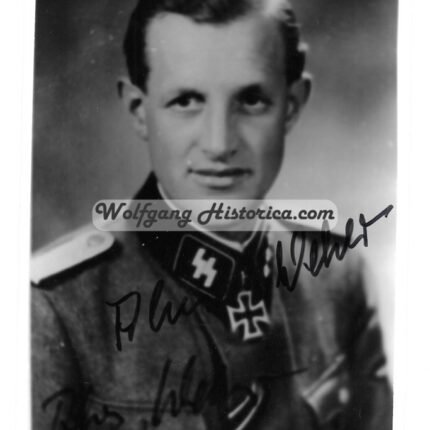
Alois Weber – SS-Panzer-Grenadier-Regiment “Deutschland”
€50,00Original Postwar Signature on a Postwar Photocopy of Alois Weber. SS-Untersturmführer Alois Weber (30.11.1915 † 19.01.2003) earned the Ritterkreuz on July 30, 1943 as SS-Hauptscharführer und Zugführer in the 16. Kompanie/ SS-Panzer-Grenadier-Regiment “Deutschland” of the 2. SS-Panzer-Grenadier-Division “Das Reich”. Good condition. Measuring: Postcardsize.
“During the attack on the 5.7.1943 the II./SS-Pz.Gren.Rgt. “Deutschland” had the order to break open the deep fortified enemy lines near Beresoff. After they had annihilated the enemy combat outposts, they were to take the village itself, then storm the heavily defended high ground to the NE behind Beresoff and take possession of it.
To support this attack of the Battalion a Tiger-Kompanie was attached, as well as a Pioneer-Zug of the 16./SS-Pz.Gren.Rgt. “Deutschland” under the leadership of SS-Hauptscharführer Weber. After elimination of the combat outpost, the Pioneerstosstrupp got the order to penetrate the tank-ditch before Beresoff together with the 6./SS-Pz.Gren.Rgt. “Deutschland”, and then to knock-out the bunkers lying behind (which where in controlling positions).
After they penetrated into the tank-ditch they came under enemy fire. Out of camouflaged positions came the II./SS-Pz.Gren.Rgt. “Deutschland”, who then gained a foothold in this tank-ditch. Further movement was prevented through well-aimed and non-stop enemy artillery, mortar and sniper fire. A further attack appeared impossible and high bloody losses began to mount; mine damage was also caused to the supporting Tiger-Kompanie, who as a result could not give further support.
Within this Battalion, to which the enemy artillery fire was causing higher losses hour after hour (shown through our dead and wounded), the leader of the Pioneerstosstrupp, SS-Hauptscharführer Weber, took the bold decision to take full control of the tank-ditch. Without Tiger support he alone took his Zug and stormed towards the bunker line in order to provide relief for the II./SS-Pz.Gren.Rgt. “Deutschland”. In the strongest enemy fire, he explored any attack possibility. He took his Zug through the running trenches and moved through the violent enemy barrage. Moving through this tank-ditch his men threw the enemy out of one position after another and reached the Soviet bunker system that controlled it.
They exploited this success further and Weber stormed on with his Pioneers. Avoiding the enemy in Beresoff, he quickly took the calm decision to move through the village and onto the controlling high ground. In bitter close combat with his group, they attacked the bunker field there (around 15 bunkers) and forced the Soviets out of each position. This also forced the enemy to abandon the north and southern parts of Beresoff, who retreated in a wild flight over the high ground and moved northwards. Through this it was possible for the II./SS-Pz.Gren.Rgt. “Deutschland” to begin their advance out of the tank-ditch and push the enemy northwards, also gaining access to the main road to Kursk.
Through the go-getting advance, outstanding courage and superior leadership of SS-Hauptscharführer Weber (his attack group had only six casualties), as well the bold decision done on his own initiative, his Pioneerstosstrupp made the attack possible. They had a decisive share of the 20km breakthrough by the SS-Pz.Gren. Div “Das Reich” of the fortified Soviet field positions on both sides of Beresoff.”
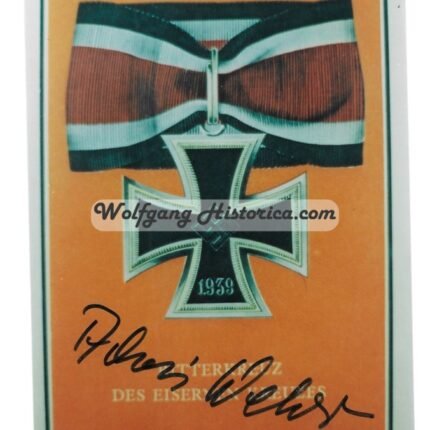
Alois Weber – SS-Panzer-Grenadier-Regiment “Deutschland”
€40,00Original Postwar Signature on a Postwar Photocopy of Alois Weber. SS-Untersturmführer Alois Weber (30.11.1915 † 19.01.2003) earned the Ritterkreuz on July 30, 1943 as SS-Hauptscharführer und Zugführer in the 16. Kompanie/ SS-Panzer-Grenadier-Regiment “Deutschland” of the 2. SS-Panzer-Grenadier-Division “Das Reich”. Good condition. Measuring: Postcardsize.
“During the attack on the 5.7.1943 the II./SS-Pz.Gren.Rgt. “Deutschland” had the order to break open the deep fortified enemy lines near Beresoff. After they had annihilated the enemy combat outposts, they were to take the village itself, then storm the heavily defended high ground to the NE behind Beresoff and take possession of it.
To support this attack of the Battalion a Tiger-Kompanie was attached, as well as a Pioneer-Zug of the 16./SS-Pz.Gren.Rgt. “Deutschland” under the leadership of SS-Hauptscharführer Weber. After elimination of the combat outpost, the Pioneerstosstrupp got the order to penetrate the tank-ditch before Beresoff together with the 6./SS-Pz.Gren.Rgt. “Deutschland”, and then to knock-out the bunkers lying behind (which where in controlling positions).
After they penetrated into the tank-ditch they came under enemy fire. Out of camouflaged positions came the II./SS-Pz.Gren.Rgt. “Deutschland”, who then gained a foothold in this tank-ditch. Further movement was prevented through well-aimed and non-stop enemy artillery, mortar and sniper fire. A further attack appeared impossible and high bloody losses began to mount; mine damage was also caused to the supporting Tiger-Kompanie, who as a result could not give further support.
Within this Battalion, to which the enemy artillery fire was causing higher losses hour after hour (shown through our dead and wounded), the leader of the Pioneerstosstrupp, SS-Hauptscharführer Weber, took the bold decision to take full control of the tank-ditch. Without Tiger support he alone took his Zug and stormed towards the bunker line in order to provide relief for the II./SS-Pz.Gren.Rgt. “Deutschland”. In the strongest enemy fire, he explored any attack possibility. He took his Zug through the running trenches and moved through the violent enemy barrage. Moving through this tank-ditch his men threw the enemy out of one position after another and reached the Soviet bunker system that controlled it.
They exploited this success further and Weber stormed on with his Pioneers. Avoiding the enemy in Beresoff, he quickly took the calm decision to move through the village and onto the controlling high ground. In bitter close combat with his group, they attacked the bunker field there (around 15 bunkers) and forced the Soviets out of each position. This also forced the enemy to abandon the north and southern parts of Beresoff, who retreated in a wild flight over the high ground and moved northwards. Through this it was possible for the II./SS-Pz.Gren.Rgt. “Deutschland” to begin their advance out of the tank-ditch and push the enemy northwards, also gaining access to the main road to Kursk.
Through the go-getting advance, outstanding courage and superior leadership of SS-Hauptscharführer Weber (his attack group had only six casualties), as well the bold decision done on his own initiative, his Pioneerstosstrupp made the attack possible. They had a decisive share of the 20km breakthrough by the SS-Pz.Gren. Div “Das Reich” of the fortified Soviet field positions on both sides of Beresoff.”

Eberhard Heder – SS-Panzer-Pionier-Bataillon 5 “Wiking”
€50,00Original Postwar Signature on a Postwar Photocopy of Eberhard Heder. SS-Sturmbannführer Eberhard Heder (30.06.1918 † 18.11.2017) earned the Deutsches Kreuz in Gold on March 11, 1943 as SS-Obersturmführer with the 3. Kompanie/ SS-Pionier-Bataillon 5 “Wiking” and the Ritterkreuz on November 18, 1944 as SS-Hauptsturmführer und Führer of the SS-Panzer-Pionier-Bataillon 5 of the 5. SS-Panzer-Division “Wiking”. Good condition. Small size with extra photo.
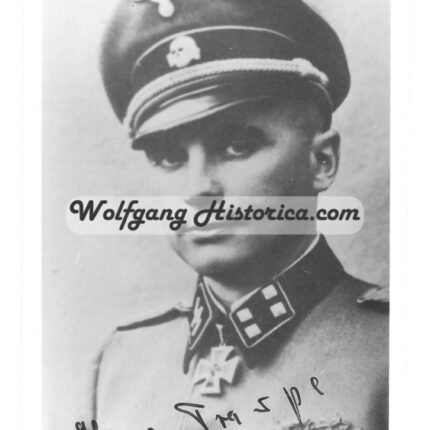
Hans Traupe – SS-Polizei-Grenadier-Regiment 3
€50,00Original Postwar Signature on a Postwar Photocopy of Hans Traupe. SS-Obersturmbannführer Hans Traupe (04.05.1913 † 23.06.2004) earned the Ritterkreuz on February 23, 1944 as SS-Sturmbannführer und Kommandeur of the I. Bataillon/ SS-Polizei-Grenadier-Regiment 3 of the 4. SS-Polizei-Panzergrenadier-Division. Good condition.


Henri Fenet – 33. SS-Freiwilligen-Grenadier-Division “Charlemagne”
€75,00Original Postwar Signature on a Postwar Photocopy of Henri Fenet. SS-Hauptsturmführer Henri Fenet (11.07.1919 † 14.09.2002) earned the Ritterkreuz on April 29, 1945 as SS-Hauptsturmführer und Führer of the Sturm-Bataillon der 33. SS-Freiwillige-Grenadier-Division “Charlemagne”. Henri Fenet was the sole French Waffen-SS Volunteer to be decorated with the Knight’s Cross. Good condition. Signed on the reverse, front is a print.
Knight’s Cross awarded for the outstanding leadership of his French volunteers during the final fighting for Berlin. Decoration presented by SS-Brigadeführer Mohnke in the Reichs Kanzlerei between 20th and 30th April 1945. Awarding has been established through research by the Ordensgemeinschaft der Ritterkreuzträger. Of the awarding is no evidence in the Bundesarchiv. (Source: Traces of War)
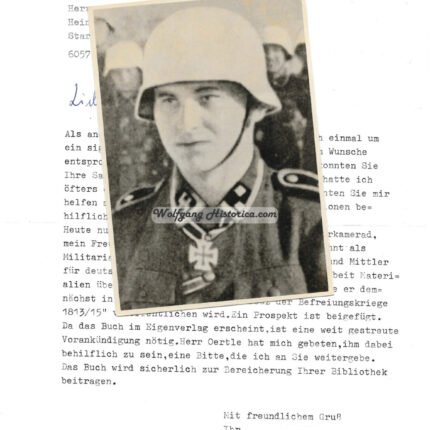
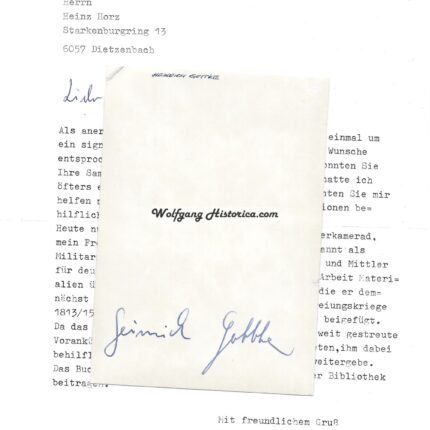
Heinrich Gottke – SS-Flak-Abteilung 17 “Götz von Berlichingen”
€55,00Original Postwar Signature on a Postwar Photocopy of Heinrich Gottke. SS-Oberscharführer Heinrich Gottke (07.07.1921 † 12.08.1998), earned the Ritterkreuz as Vorausbeobachter of the 3. Batterie/ SS-Flak-Abteilung 17 of the 17. SS-Panzergrenadier-Division “Götz von Berlichingen” on December 17, 1944. Good Condition. Comes with an extra letter.
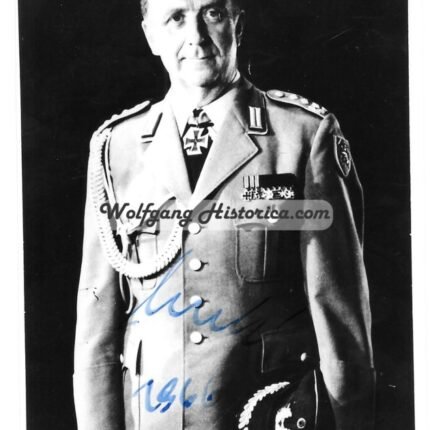
Wolfram Kertz – Kampfgruppe “Bruhn” (Arnhem)
€25,00Original Postwar Signature on a Postwar Photocopy of Wolfram Kertz. Major Wolfram Kertz (29.07.1916 † 05.05.2009) earned the Ritterkreuz on October 4, 1944 as Oberleutnant und Führer of the 8. Kompanie/ Kampfgruppe “Bruhn” of the II. SS. Panzerkorps. Good condition.
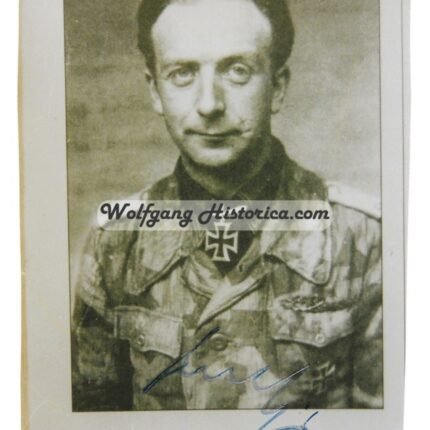
Wolfram Kertz – Kampfgruppe “Bruhn” (Arnhem)
€25,00Original Postwar Signature on a Postwar Photocopy of Wolfram Kertz. Major Wolfram Kertz (29.07.1916 † 05.05.2009) earned the Ritterkreuz on October 4, 1944 as Oberleutnant und Führer of the 8. Kompanie/ Kampfgruppe “Bruhn” of the II. SS. Panzerkorps. Good condition.
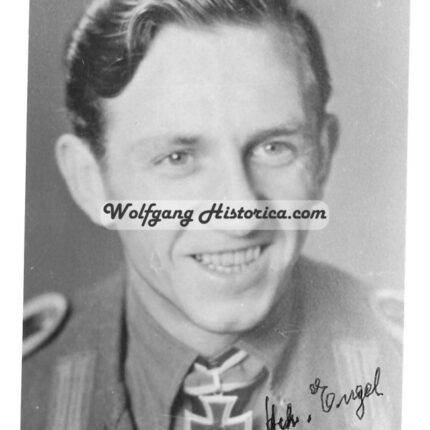
Heinrich Engel – Sturmgeschütz-Abteilung 259
€20,00Original Postwar Signature on a Postwar Photo of Heinrich Engel. Unteroffizier Heinrich Engel (29.05.1914 † 16.12.2004) earned the Ritterkreuz on November 2, 1943 as Unteroffizier und Geschützführer in the 2. Batterie/ Sturmgeschütz-Abteilung 259. Good condition.
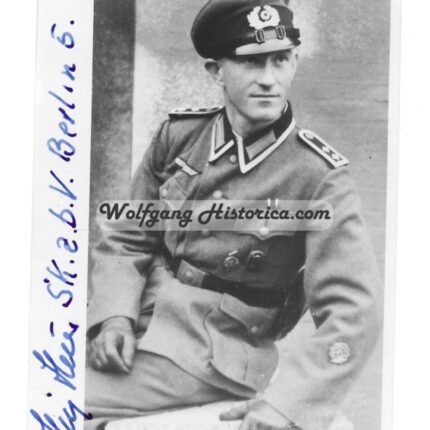
Heinz Heuer – Kampfgruppe zur besonderen Verwendung Berlin 5
€0,01Original Postwar Signature on a Postwar Photocopy of Heinz Heuer. Oberleutnant Heinz Heuer (02.03.1918 † 06.01.2002) earned the Ritterkreuz on April 22, 1945 as Oberfeldwebel with Kampfgruppe zur besonderen Verwendung Berlin 5. Good condition.
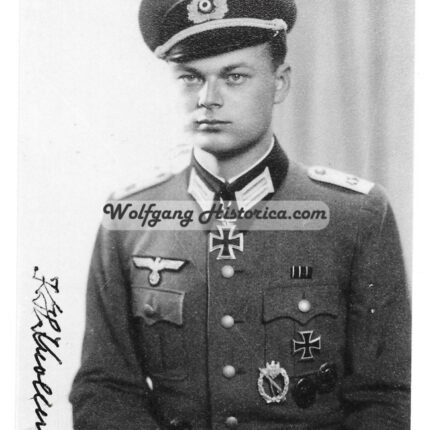
Karl-Heinz Knollmann – Grenadier-Regiment 45
€20,00Original Postwar Signature on a Postwar Photocopy of Karl-Heinz Knollmann. Oberleutnant der Reserve Karl-Heinz Knollmann (28.05.1918 † 02.02.2010) earned the Ritterkreuz on March 21, 1944 as Leutnant der Reserve with Grenadier-Regiment 45 of the 21. Infanterie-Division. Good condition. Postcardsize.
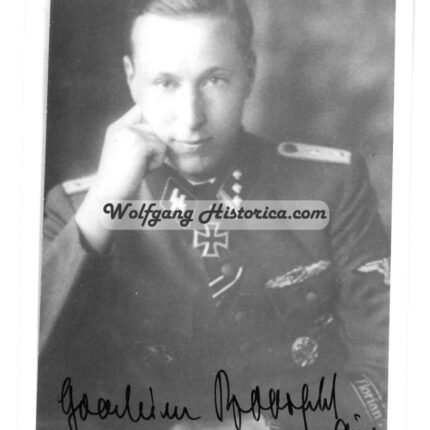
Joachim Boosfeld – 8. SS-Kavallerie-Division “Florian Geyer” (KC + NKIG)
€50,00Original Postwar Signature on a Postwar Photocopy of Joachim Boosfeld. SS-Hauptsturmführer Joachim Boosfeld (01.06.1922 † 19.06.2015) earned the Deutsches Kreuz in Gold on December 30, 1944, the Nahkampfspange in Gold on February 21, 1945 and the Ritterkreuz on February 21, 1945 as SS-Obersturmführer und Chef of 4. Schwadron/ SS-Kavallerie-Regiment 16 of the 8. SS-Kavallerie-Division “Florian Geyer”. Good condition. Measuring: Postcardsize.
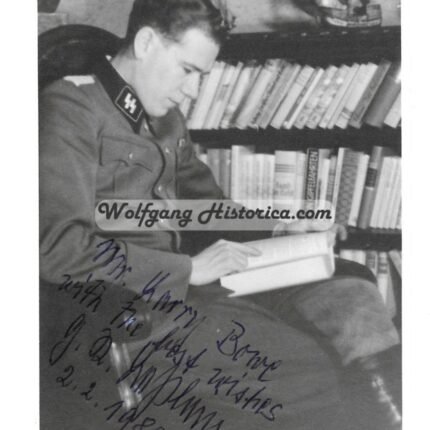
Georg Robert Besslein – SS-Festungs-Grenadier-Regiment “Besslein”
€45,00Original Postwar Signature on a Postwar Photocopy of Georg Robert Besslein. SS-Obersturmbannführer Georg Robert Besslein (14.12.1911 † 27.04.1993) earned the Ritterkreuz on April 30, 1945 as SS-Obersturmbannführer und Kommandeur of SS-Festungs-Grenadier-Regiment “Besslein” i.d. Festung Breslau. Good condition.
Awarded for distinguishing himself while commanding his ad-hoc Regiment during the siege of Breslau. He and his unit particularly distinguished themselves during near Peiskerwitz, the Gandau airport then the Augusta road.
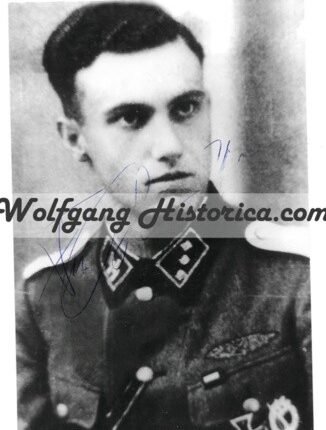
Friedrich Blond – SS-Panzergrenadier-Ausbildungs- und Ersatz-Bataillon 1 “LSSAH”
€40,00Original Postwar Signature on a Postwar Photo of Friedrich Blond. SS-Untersturmführer Friedrich Blond (29.04.1920 † 24.05.2009) earned the Ritterkreuz on April 28, 1945 as SS-Untersturmführer with the 12. Kompanie/ SS-Panzergrenadier-Ausbildungs- und Ersatz-Bataillon 1 “LSSAH”. Good condition.
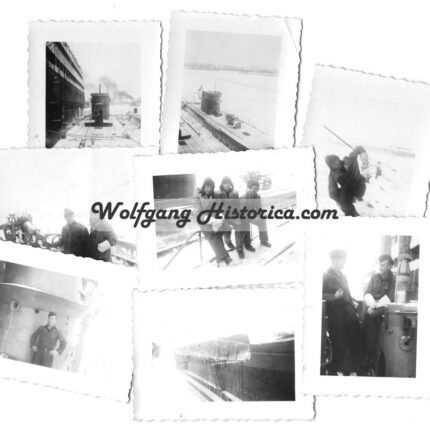
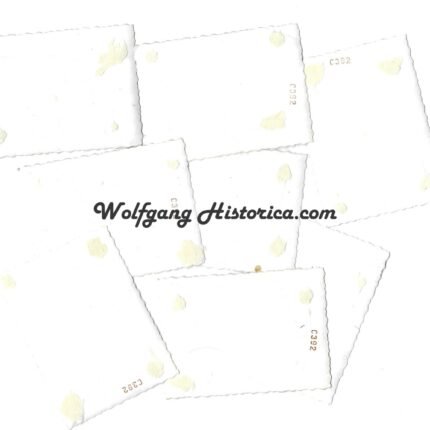
8x Photographs of U-Boot “U-111” (Commander Wilhelm Kleinschmidt) (Sunk in 1941)
€100,00Authentic Set of 8x Photographs from Kriegsmarine U-Boot “U-111”. U-111 was commanded by Kapitänleutnant Wilhelm Kleinschmidt! Throughout it’s short service, U-111 managed to sink 4 ships and damage one more, however she was sunk by depth charges and gunfire from British anti-submarine trawler HMS Lady Shirley on October 4, 1941 near Tenerife, Canary Islands. Commander Wilhelm Kleinschmidt and 7 others did not survive. Good condition. Measuring: 6x9cm.
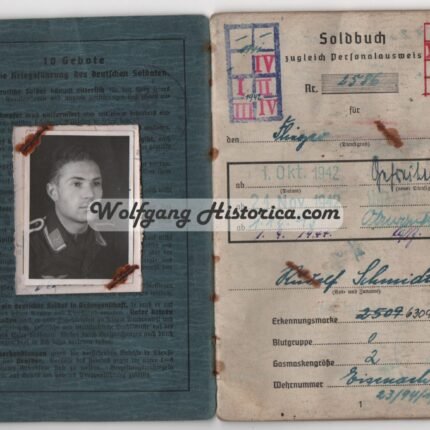
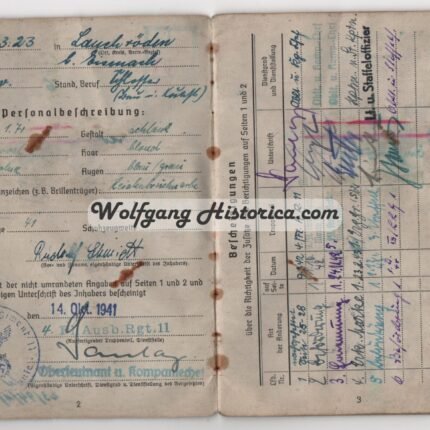
Soldbuch LW Glider Pilot – Ergänzungsgruppe (S) 2 (Segelflugzeugführerabzeichen (!))
€400,00Authentic Interesting, Scarce Soldbuch of Luftwaffe Glider Pilot (Lastensegler) Unteroffizier Rudolf Schmidt. The Soldbuch was opened on October 14, 1941 at his training unit Flieger-Ausbildungs-Regiment 11 and served with various training units until in 1942 he went to the Flugzeugführerschule A/B 116, few months later he was transferred to the Ergänzungsgruppe (S) 2 which flew the gliders DFS 230 and Gotha Go 242 (and at the start also the Messerschmitt Me 321 Gigant). During the time with this unit, he was also awarded the rare Segelflugzeugführerabzeichen (!) (here named the Flugzeugführerabzeichen (L)) together with his Flugzeugführerschein (L) (L for Lastensegler). In July 1944, he was transferred to the Luftlandegeschwader 1 and in December 1944, he was at the Flugzeugführer-Doppelschule A9 and eventually in February 1945, he served with the LS-Führer-Kompanie/ Schleppgruppe 1. Rudolf Schmidt was promoted several times throughout the war reaching the rank of Unteroffizier in 1944. Apparently, in the years before other material of Rudolf Schmidt (such as his Segelflugzeugführerschein, Flugbuch etc.) was sold.
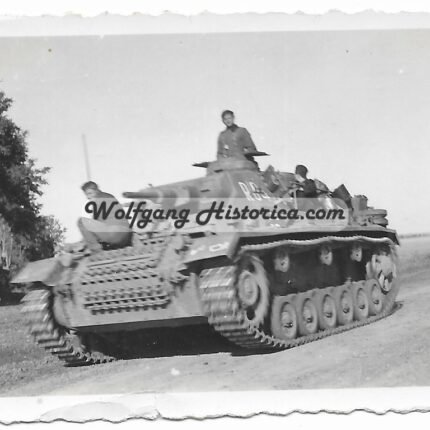
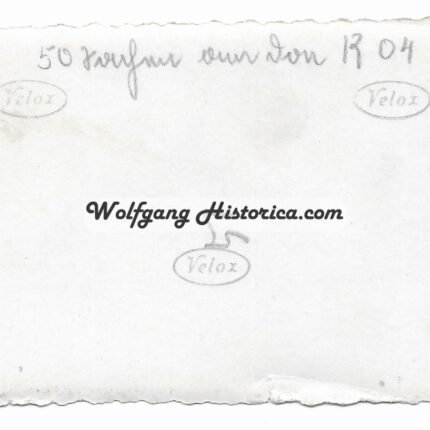
Panzer III – Regimental Staff (R04)
€0,01Authentic Wartime Photograph of a Panzer III (Regimental Staff). Writing on the reverse. Good condition. Measuring: 6x9cm.

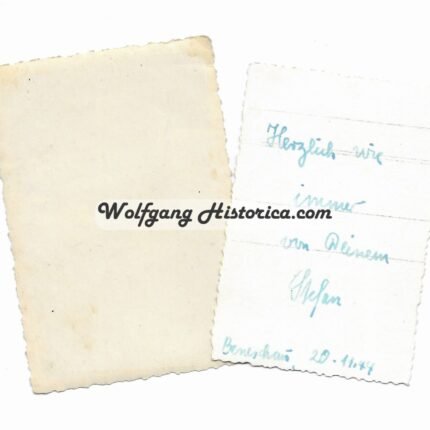
2x Photographs of the Waffen-SS (one wearing a “AH” Cufftitle)
€25,002x Original Wartime Photographs from (a) soldier(s) of the Waffen-SS. One photograph shows a SS-Sturmmann wearing a “Adolf Hitler” cufftitle and another ID photograph shows a SS-Hauptscharführer wearing a officer’s peaked cap, the photo was taken in Beneschau in 1944. Small photographs in overall good condition. One has writing on the reverse.
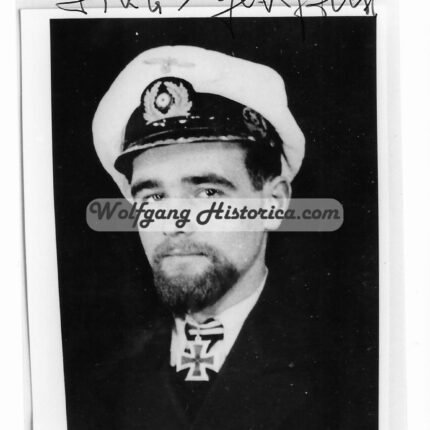
Hans-Georg Hess – U-Boot “U-995”
€0,01Original Postwar Signature on a Postwar Photocopy of Hans-Georg Hess. Oberleutnant zur See Hans-Georg Hess (06.05.1923 † 29.03.2008) earned the Ritterkreuz on February 11, 1945 as Oberleutnant zur See und Kommandant of U-Boot “U-995”. Good condition. Measuring 9×13cm.
As a U-boat commander of U-995 Hans-Georg Hess is credited with the sinking of 3 merchant ships for a total of 1,560 gross register tons (GRT), an auxiliary warships of 633 GRT, a warship of 105 GRT and severely damaging a ship which was later declared a total loss of 7,176 GRT.
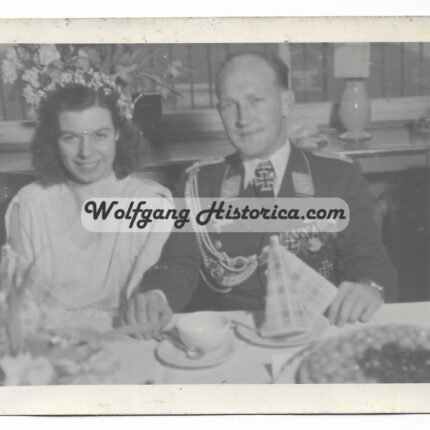
Werner Schroer – Jagdgeschwader 27 (Swords) (114 Aerial Victories!)
€0,01Original Wartime Photograph of Oberleutnant Werner Schroer (17.09.1920 † 03.01.2009), who earned the Deutsches Kreuz in Gold as September 9, 1942 with Jagdgeschwader 27, the Ritterkreuz on October 20, 1942 as Leutnant und Staffelkapitän of the 8. Staffel/ Jagdgeschwader 27 after 49 aerial victories, the Eichenlaub on August 2, 1943 as Hauptmann und Kommandeur of the II. Gruppe/ Jagdgeschwader 27 after 84 aerial victories and the Schwertern on April 19, 1945 as Major und Kommodore of Jagdgeschwader 27 after 110 aerial victories. Overall Good condition except with album residue on the reverse. Motive is also unsharp but still a rare photograph from a Luftwaffe Ace with 114 Victories! Measuring: Postcardsize.
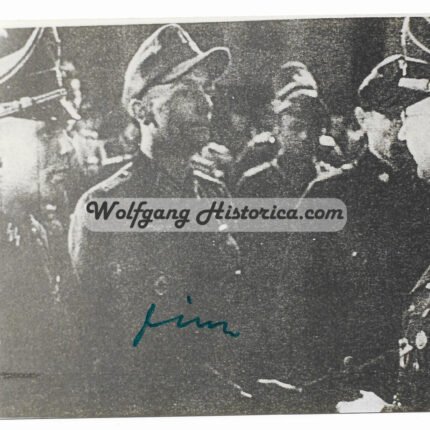
Otto Dinse – SS-Panzer-Grenadier-Regiment 1 “LSSAH” (NKIG)
€35,00Original Scarce Postwar Signature on a Postwar Photocopy of Otto Dinse. SS-Hauptsturmführer Otto Dinse (24.10.1912 † ) earned the Nahkampfspange in Gold on June 2, 1944 as SS-Hauptsturmführer und Chef of the 12. Kompanie/ SS-Panzer-Grenadier-Regiment 1 of the 1. SS-Panzer-Division “LSSAH”. Good condition. Postcardsize.
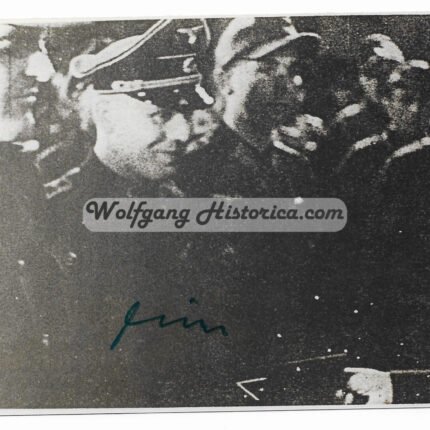
Otto Dinse – SS-Panzer-Grenadier-Regiment 1 “LSSAH” (NKIG)
€35,00Original Scarce Postwar Signature on a Postwar Photocopy of Otto Dinse. SS-Hauptsturmführer Otto Dinse (24.10.1912 † ) earned the Nahkampfspange in Gold on June 2, 1944 as SS-Hauptsturmführer und Chef of the 12. Kompanie/ SS-Panzer-Grenadier-Regiment 1 of the 1. SS-Panzer-Division “LSSAH”. Good condition. Postcardsize.
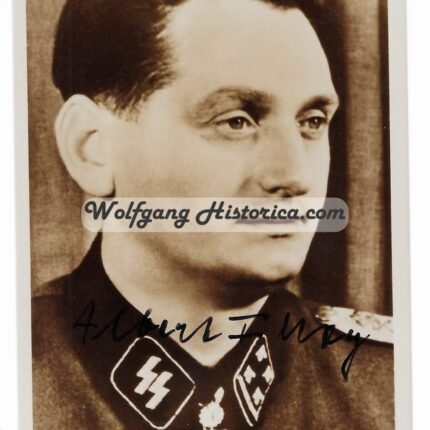
Albert Frey – SS-Panzer-Grenadier-Regiment 1 “LSSAH” (Oakleaves)
€0,01Original Postwar Signature on a Postwar Photo of Albert Frey. SS-Standartenführer Albert Frey (16.02.1913 † 01.09.2003) earned the Deutsches Kreuz in Gold on November 17, 1941 with SS-Infanterie-Regiment “Leibstandarte-SS Adolf Hitler”, the Ritterkreuz on March 3, 1943 as SS-Sturmbannführer und Kommandeur of the I. Bataillon/ SS-Panzer-Grenadier-Regiment 1 “LSSAH” and the Eichenlaub on December 29, 1943 as SS-Obersturmbannführer und Kommandeur of the SS-Panzer-Grenadier-Regiment 1 of the 1. SS-Panzer-Division “LSSAH“. Good condition. Measuring: Postcardsize.

Alois Schnaubelt – SS-Flak-Abteilung 5 “Wiking”
€40,00Original Postwar Signature on a Postwar Photocopy of Alois Schnaubelt. SS-Oberscharführer Alois Schnaubelt (16.01.1921-11.12.2012) earned the Ritterkreuz on November 16, 1944, as SS-Unterscharführer und Geschutzführer of a Flak 88 in the 3. Batterie/ SS-Flak-Abteilung 5 “Wiking” of the 5. SS-Panzer-Division “Wiking”. Credited with the destruction of 9 T-34 tanks within 25 minutes. Good condition. Measuring: 8,9×13,5cm.
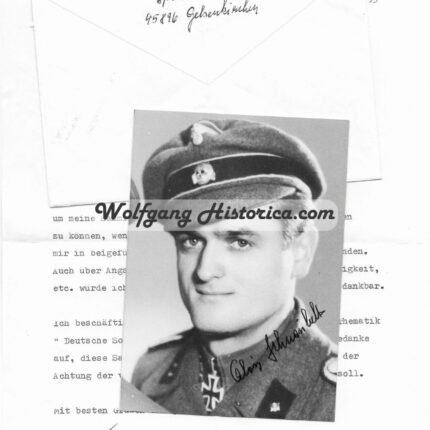
Alois Schnaubelt – SS-Flak-Abteilung 5 “Wiking”
€50,00Original Postwar Signature on a Postwar Photocopy of Alois Schnaubelt. SS-Oberscharführer Alois Schnaubelt (16.01.1921-11.12.2012) earned the Ritterkreuz on November 16, 1944, as SS-Unterscharführer und Geschutzführer of a Flak 88 in the 3. Batterie/ SS-Flak-Abteilung 5 “Wiking” of the 5. SS-Panzer-Division “Wiking”. Credited with the destruction of 9 T-34 tanks within 25 minutes. Good condition. Measuring: 10,5×14,5 cm. Comes with an extra signed etter and enveloppe.
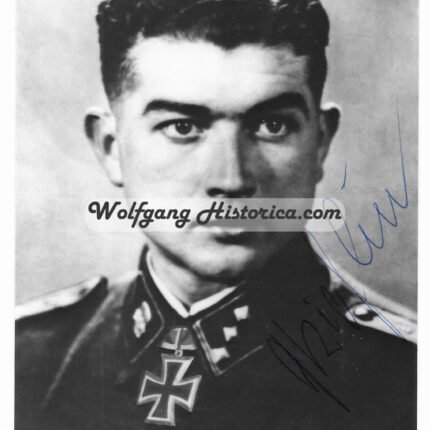
Fritz Rieflin – SS-Panzer-Pionier-Bataillon 2 “Das Reich”
€40,00Original Postwar Signature on a Postwar Photocopy of Fritz Rieflin. SS-Obersturmführer Fritz Rieflin (05.02.1920 † 01.02.1996) earned the Ritterkreuz on May 6, 1945 as SS-Obersturmführer und Chef of the 2. Kompanie/ SS-Panzer-Pionier-Bataillon 2 of the 2. SS-Panzer-Division “Das Reich”. Good condition. Measuring: Postcardsize.
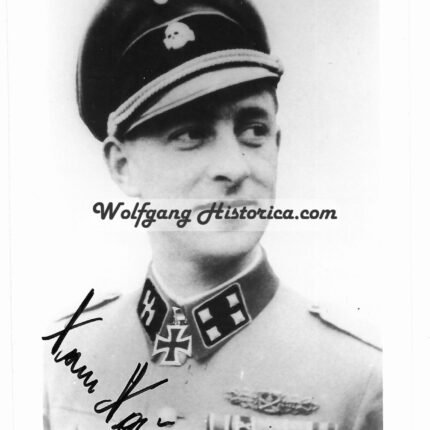
Hans Hauser – SS-Panzer-Grenadier-Regiment 4 “Der Führer”
€0,01Original Postwar Signature on a Postwar Photocopy of Hans Hauser. SS-Sturmbannführer Hans Hauser (31.01.1916 † 21.11.2001) earned the Ritterkreuz on May 6, 1945 as SS-Sturmbannführer und Kommandeur of the I. Bataillon/ SS-Panzer-Grenadier-Regiment 4 “Der Führer” of the 2. SS-Panzer-Division “Das Reich”. Good condition. Measuring: 10,1x14cm.
Knight’s Cross: “In March 1945, near the Austrian capital city of Vienna, Sturmbannführer der Waffen-SS Hans Hauser led a small but highly experienced Kampfgruppe into defensive positions in the village of Münchedorf. Their mission was to defend the German homeland and slow the advancing Soviets moving west. Unaware of Hauser’s defenses, 3 unsupported Soviet T-34 tanks approached the German positions. At the foot of the bridge that led into the village, the lead tank was destroyed and made the bridge impassable. The two remaining tanks withdrew under a deluge of small arms fire.
After strengthening their positions, the Kampfgruppe was attacked a second time shortly before midnight. Artillery barrages and Katyusha rockets pulverized the village and defensive positions that killed Hauser’s adjutant and orderly officer. The Soviets launched their second attack, in which another T-34 was destroyed. News came that Hauser’s Kampfgruppe was holding a gap that separated the two SS Regiments Der Führer and Deutschland, both belonging to the 2. SS-Panzer-Division Das Reich. Hauser’s Kampfgruppe was ordered to hold the gap for 3-4 days to prevent a Soviet penetration and allow the Division to regroup.
Knowing the Soviets would attempt to exploit the gap, the defensive positions were reinforced and a third Soviet attack by T-34 tanks successfully thwarted. After repeated but futile Soviet attacks that drained the strength of the German defenders, the Soviets finally managed to gain a foothold on the village of Münchedorf. Completely outnumbered, Hauser’s Kampfgruppe had lost half the village by the fourth day. Having provided the division the time needed to regroup, Hauser was ordered to disengage and withdraw to friendly lines. Reporting to the Der Führer regimental commander, Obersturmbannführer der Waffen-SS Otto Weidinger, Hauser was placed in command of I. Bataillon after his predecessor had been killed in action. Weidinger would subsequently Hauser for the Knight’s Cross in recognition for his gallant stand at Münchedorf.”
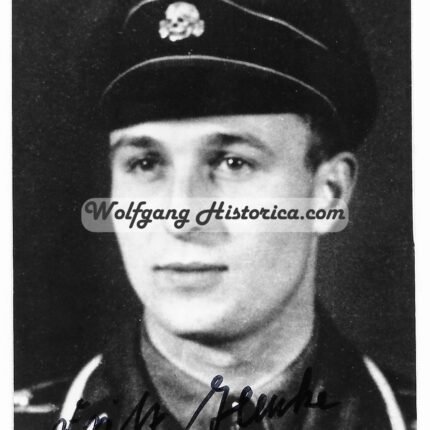
Friedrich “Fritz” Henke – SS-Sturmgeschütz-Abteilung 1 “LSSAH”
€45,00Original Postwar Signature on a Postwar Photocopy of Friedrich “Fritz” Henke. SS-Hauptscharführer Friedrich “Fritz” Henke (06.01.1921 † 15.11.1999) earned the Ritterkreuz on February 12, 1944 as SS-Oberscharführer und Zugführer in the 3. Batterie/ SS-Sturmgeschütz-Abteilung 1 “LSSAH”. Good condition. Measuring: 8,2×12,3cm.
Fritz Henke was a platoon leader in the StuG battalion of the LSSAH in late 1943. Near the end of that year, on the 29.12.1943, Henke was helping protect a group of friendly infantry when a small tank attack was launched. He destroyed 2 tanks, but this initial incursion was soon followed up by a much heavier assault. Thus followed a fierce battle that lasted the whole day. On one occasion, he knocked out a Soviet command tank from which the enemy commander escaped, only to be hit by a pistol shot by Henke. By the end of the day he had destroyed a total of 21 tanks and 11 AT guns. For his notable success, without much friendly support at that, he was later presented with the Knight’s Cross. He had destroyed 38 tanks in total by this time.