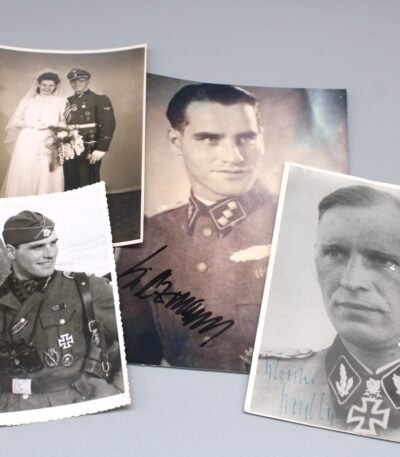

Georg Großjohann – Grenadier-Regiment 308

45,00

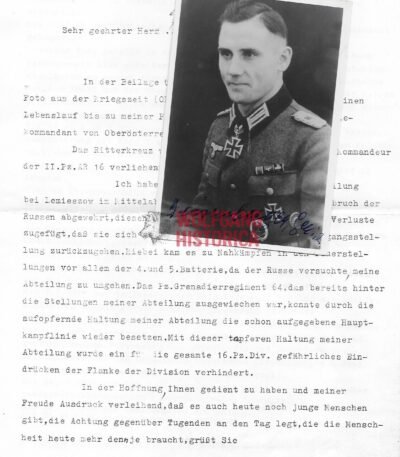
Original Postwar Signature on a Postwar Photocopy of Georg Großjohann. Major Georg Großjohann (26.04.1911 † 28.06.1992) earned the Deutsches Kreuz in Gold on October 4, 1944 with II. Battalion/ Grenadier-Regiment 308 and the Ritterkreuz on December 12, 1944 as Major und Führer of the Grenadier-Regiment 308 of the 198. Infanterie-Division. Good Condition. Measuring: Postcardsize. Comes with an extra letter.

Johannes Erasmus – XXXXVIII. Panzerkorps

35,00

Original Postwar Signature on a Postwar Photocopy of Dr.jur. Johannes Erasmus. Oberstleutnant i.G. Johannes Erasmus (24.10.1913 † 01.08.1993) earned the Ritterkreuz on April 13, 1944 as Major im Generalstab und Ia of the XXXXVIII. Panzerkorps. Good Condition. Measuring: Postcardsize. Comes with an extra signed letter.

Knight’s Cross: “Major Erasmus received the Knight’s Cross to the Iron Cross for his leadership and personal actions during the cleanup of the enemy penetration at Tarnopol on the 11.03.1944.”

Oskar Cipa – Grenadier-Regiment 305

0,00

Original Postwar Signature on a Postwar Photocopy of Oskar Cipa. Oberleutnant Oskar Cipa (07.02.1912 † 13.01.1987) earned the Ritterkreuz on November 13, 1942 as Unteroffizier und Gruppenführer in the 1. Kompanie/ Grenadier-Regiment 305 of the 198. Infanterie-Division. Good Condition. Measuring: 7,2×10,5cm. Comes with an enveloppe.

Knight’s Cross: “At the end of September 1942 Unteroffizier Cipa and his Grenadiers stormed a heavily fortified and defended hilltop located amongst the mountainous terrain north of Tuapse. In the process they knocked out 17 bunkers in addition to numerous Soviet field positions, and by achieving this victory they secured the decisive precondition for seizing the remaining hill positions that were of decisive importance for the local situation. Unteroffizier Cipa would later be awarded the Knight’s Cross for this action.”

Ulrich-Maria Freiherr von Canstein – Grenadier-Regiment 220

35,00

Original Postwar Signature on a Postwar Photocopy of Ulrich-Maria Freiherr von Canstein. Oberstleutnant Ulrich-Maria Freiherr von Canstein (16.06.1906 † 10.08.1991) earned the Ritterkreuz on February 10, 1944 as Oberstleutnant und Kommandeur of the Grenadier-Regiment 220 of the 58. Infanterie-Division. Good Condition. Measuring: Postcardsize. Comes with an extra signed letter.

Knight’s Cross: “Awarded the Knight’s Cross for repulsing the attacks of three Soviet Guards divisions with his Grenadier-Regiment in the area northwest of Newel. During this attack two Soviet battalions thrust through to his command post over the icy Sswiblo lake. In response Oberstleutnant Canstein threw back the enemy back while fighting at the head of a handful of messengers, clerks and signals troops.”

Rolf Bering – Fähnrichs-Regiment 1

30,00

Original Postwar Signature on a Postwar Photocopy of Rolf Bering. Oberstleutnant Rolf Bering (20.06.1912 † 02.08.1993) earned the Deutsches Kreuz in Gold on December 29, 1941 with 2. Batterie/ Artillerie-Regiment 76 and the Ritterkreuz on March 11, 1945 as Major und Führer of the Fähnrichs-Regiment 1 of the Division “Märkisch Friedland”. Good Condition. Measuring: Postcardsize. Comes with an extra signed letter and enveloppe.
Knight’s Cross: “Awarded for his actions in early 1945. Rolf Bering (who had set up his regimental command post in Wittkow) came under attack from the rear while positioned at the western approaches to Schneidemühl. However thanks to the skillful employment of his subordinated Alarm-Bataillon 94 (located in Köslin) it was possible to halt the Russian advance on the 29.01.1945.”

Paul Becker – Artillerie-Regiment 3

0,01

Original Postwar Signature on a Postwar Photocopy of Paul Becker. Unteroffizier Paul Becker (21.03.1918 † 29.11.1992) earned the Ritterkreuz on October 25, 1942 as Obergefreiter und Richtschütze in the 10. Batterie/ Artillerie-Regiment 3 of the 3. Infanterie-Division. Good Condition. Measuring: Postcardsize. Comes with an extra signed letter.

Knight’s Cross: “Obergefreiter Paul Becker had already destroyed 28 enemy tanks during the heavy combat near Kalatsch, and for this he was awarded the Iron Cross First Class. During the battle of Stalingrad he significantly contributed to the successful defense against enemy counterattacks through his personal bravery and decisiveness. The Bolsheviks commenced a furious attack with strong infantry forces that had the support of numerous tanks. Their aim was to break through the German blocking position to the north of the city. Obergefreiter Becker persevered throughout the fierce hostile fire while serving at his gun, and in the heavy fighting he destroyed 13 enemy tanks (most of which were heavy types). He smashed local enemy infantry penetrations with well laid fire. Thus, within a short time, Obergefreiter Becker destroyed a total of 41 Soviet tanks and decisively contributed to the great successes of his Division.”

Günter Chrzonsz – Sturmgeschütz-Abteilung 277

30,00

Original Postwar Signature on a Postwar Photo of Günter Chrzonsz. Leutnant Günter Chrzonsz (later Günter Carsten) (15.10.1914 † 31.10.2003) earned the Ritterkreuz on November 12, 1943 as Oberwachtmeister und Zugführer in the 2. Batterie/ Sturmgeschütz-Abteilung 277. Good Condition. Measuring: 7,5×10,5. Comes with an extra signed letter.

Georg Bose – Sturmgeschütz-Abteilung 177

30,00

Original Postwar Signature on a Postwar Photocopy of Georg Bose. Leutnant Georg Bose (20.10.1921 † 26.09.2011) earned the Ritterkreuz on September 21, 1944 as Leutnant und Zugführer of 1. Kompanie/ Sturmgeschütz-Abteilung 177. Good Condition. Measuring: Postcardsize. Comes with an extra signed letter.

Knight’s Cross: “On the 23.07.1944 the remnants of the 292. Infanterie-Division became encircled near the village of Radziwillowka (about 50 km northwest of Brest-Litovsk), and it requested relief from the Korps. The 3. Kavallerie-Brigade was assigned for this task, however since it was itself involved in heavy defensive combat it was only able to dispatch a small Kampfgruppe that included 3 Sturmgeschützen commanded by Leutnant Bose. During the march to the area one Sturmgeschütz threw a track, and so only 2 were left to support the cavalrymen in their relief effort. Radziwillowka was captured in a short yet fierce battle on the 28.07.1944, and in the process 11 T-34/85 tanks were destroyed (including 4 by Bose himself). With this the 292. Infanterie-Division was relieved, and it was thereafter possible to create a new defensive front. Bose had shown great tactical initiative during this battle, going against the planning of the 292. Infanterie-Division’s Ia in order to achieve success. This deed was also of great importance for the whole 2. Armee as it prevented a breakthrough by strong enemy forces into its flank. For this, as well as reaching a personal total of 19 enemy tanks destroyed, Bose was awarded the Knight’s Cross.”

Rolf Düe – Panzerjäger-Abteilung 19

30,00

Original Postwar Signature on a Postwar Photocopy of Rolf Düe. Hauptmann Rolf Düe (28.01.1915 † 14.04.2005) earned the Ritterkreuz on March 23, 1945 as Hauptmann und Chef of 1. Kompanie/ Panzerjäger-Abteilung 19 of the 19. Panzer-Division. Good Condition. Measuring: 9,4×13,5cm. Comes with an extra signed letter.

Knight’s Cross: “On February 16th, 1945, Düe and his Panzerjäger Kompanie took up defensive positions in the village of Wernersdorf (Lower Silesia). On the following night the enemy probed the defenses with 2 T-34s, but these were destroyed. An Soviet attack launched on the morning of the next day met a similar fate despite being preceded by an artillery barrage, with this attack losing 6 T-34s. Enemy infantry then commenced further attempts throughout the day but all these were repulsed with heavy losses, including 16 T-34 tanks. Düe’s Kompanie ultimately held the village until the morning of the February 18th, 1944, and in doing so prevented a Soviet breakthrough towards Schweidnitz. Such a breakthrough would have led to a catastrophe for the XVII. Armeekorps.”

Hermann Eckardt – Panzer-Abteilung 8

27,50

Original Postwar Signature on a Postwar Photocopy of Hermann Eckardt. Feldwebel Hermann Eckardt (04.10.1920 † 16.09.2010) earned the Deutsches Kreuz in Gold on September 12, 1944 with 1. Kompanie/ Panzer-Abteilung 8 and the Ritterkreuz on March 28, 1945 as Feldwebel und Zugführer of 1. Kompanie/ Panzerjäger-Abteilung 8 of the 20. Panzer-Grenadier-Division. Good Condition. Measuring: Postcardsize. Comes with an extra signed letter.

Max Kurze – Panzerjäger-Abteilung 187

30,00

Original Postwar Signature on a Postwar Photocopy of Max Kurze. Major Max Kurze (22.06.1911 † 25.11.1997) earned the Deutsches Kreuz in Gold on December 1, 1943 with Panzerjäger-Kompanie 187 and the Ritterkreuz on September 20, 1944 as Major und Kommandeur of Panzerjäger-Abteilung 187 of the 87. Infanterie-Division. Good Condition. Measuring: 8,5×12,6cm. Comes with an extra signed letter.

Norbert Kujacinski – Panzer-Regiment 23

35,00

Original Postwar Signature of Norbert Kujacinski. Hauptmann Norbert Kujacinski (11.07.1920 † 02.05.2009) earned the Deutsches Kreuz in Gold and the Ritterkreuz on November 18, 1944 with Panzer-Regiment 23 of the 23. Panzer-Division. He also earned the Panzerkampfabzeichen IV. Stufe (Einsatzahl “75”). Postcardsize.

Knight’s Cross recommandation: On the morning of the 03.10.1944 Hauptmann Kujacinski and his company of Panthers were advancing when they encountered a large group of Soviet medium tanks and assault guns. In the ensuing battle the Germans destroyed 16 tanks and 3 AT guns without loss. Of these, 5 were knocked out by Kujacinski and his crew, bringing his total of destroyed Russian armour to 51. For the destruction of the Russian armoured group, and for personally destroying over 50 Russian tanks over the course of his career, Kujacinski was awarded the Knight’s Cross.

Heinrich Köhler – Heeres-Sturmgeschütz-Brigade 210

0,01

Original Postwar Signature on a Postwar Photocopy of Heinrich Köhler. Leutnant Heinrich Köhler (03.07.1922 † 25.06.2009) earned the Ritterkreuz on April 20, 1945 as Leutnant und Zugführer in the 3. Batterie/ Heeres-Sturmgeschütz-Brigade 210. Good condition. Measuring 9×13,5cm. Comes with an extra signed letter.

Knight’s Cross: In March 1945 the Sturmgeschütz-Brigade 210 was deployed in support of the 1. Marine-Division. On the 16.03.1945 Leutnant Köhler and his Sturmgeschütz Zug were deployed on Hill 42, located at the seam between the 1. Marine-Division and the Panzer-Division Schlesien. On this day the Soviets attacked the hill with about 20 Sherman tanks. Despite three attempts to do so, they were unable to take the hill and lost 15 tanks in the process. 6 of these were knocked out personally by Leutnant Köhler.

Through the steadfastness of Köhler and the whole Sturmgeschütz-Brigade the Soviet attempt to break through to the road bridge over the Oder was stymied. This allowed the refugee columns from East Prussia and Pomerania, which were still crossing, to pass over unhindered. After this the German fighting units in turn followed them, and the bridge was blown at dawn on the 17.03.1945. For his role in ensuring this successful outcome, while also raising his total of destroyed tanks to 21, Köhler would be decorated with the Knight’s Cross. (Source: Traces of War)

Hans Kochanowski – Sturmgeschütz-Abteilung 201

30,00

Original Postwar Signature on a Postwar Photocopy of Hans Kochanowski. Leutnant Hans Kochanowski (09.05.1910 † 10.04.1993) earned the Ritterkreuz on October 15, 1942 as Oberwachtmeister und Zugführer in the 2. Kompanie/ Sturmgeschütz-Abteilung 201. Good Condition. Measuring: 8,6×12,6cm. Comes with an extra signed letter.

Knight’s Cross: “On the morning of the 14.08.1942 a Kampfgruppe of the 75. Infanterie-Division, supported by assault guns of the Sturmgeschütz-Abteilung 201, began an attack with the aim of retaking the village of Podkletnoje and the small forest nearby. However it soon bogged down. Kochanowski, a StuG commander, noticed a group of about 20 enemy tanks at the forest edge and in the thickets just in front of it. In a bold decision he decided to take on this enemy group alone. After destroying the second enemy vehicle, the gun jammed. Kochanowski exited the vehicle and was able to make the gun operational again despite having to endure heavy enemy small arms fire. He then continued the fight and destroyed a total of 12 enemy tanks in this area. By eliminating this major flank threat, Kochanowski made an invaluable contribution to the eventual success of the German counterattack. For this, as well as raising his total of destroyed enemy armour to 31, he was decorated with the Knight’s Cross.”

Gerhard Lange – Panzer-Regiment 35

30,00

Original Postwar Signature on a Postwar Photo of Gerhard Lange. Hauptmann Gerhard Lange (14.07.1916 † 10.04.1996) earned the Deutsches Kreuz in Gold on March 28, 1945 and the Ritterkreuz on April 28, 1945 as Hauptman und Führer of the II. Abteilung/ Panzer-Regiment 35 of the 4. Panzer-Division. Good Condition. Measuring: Postcardsize. Comes with an extra signed letter.

Fritz Kercher – Panzerjäger-Abteilung 5 (Sturmgeschütz)

35,00

Original Postwar Signature on a Postwar Photocopy of Fritz Kercher. Leutnant Fritz Kercher (11.09.1919 † 12.11.2007) earned the Ritterkreuz on March 6, 1944 as Leutnant und Zugführer of the 1. Kompanie/ Panzerjäger-Abteilung 5 of the 5. Jäger-Division. Good Condition. Measuring: 8,3×12,5cm. Comes with an extra signed letter.

Gerhard Fischer – Panzer-Regiment 23 (PKA100)

30,00

Original Postwar Signature of Gerhard Fischer. Major Gerhard Fischer (04.12.1915 † 09.08.2014) earned the Ritterkreuz on December 28, 1943 as Oberleutnant und Chef of the 8. Kompanie/ Panzer-Regiment 23 of the 23. Panzer-Division. He also earned the Panzerkampfabzeichen V. Stufe (Einsatzahl “100”). Good Condition. Measuring: Postcardsize. Comes with an extra signed letter.

Hans Ender – Grenadier-Regiment 545 (389. Infanterie-Division)

27,50

Original Postwar Signature on a Postwar Photocopy of Hans Ender. Hauptmann Hans Ender (06.08.1910 † 11.01.1993) earned the Ritterkreuz on April 5, 1945 as Hauptmann und Kommandeur of the II. Bataillon/ Grenadier-Regiment 545 of the 389. Infanterie-Division. Good condition. Measuring: 8,8×12,5cm. Comes with extra documents.

Knight’s Cross: “During the 389. Infanterie-Division’s fierce defensive battles in the Tucheler Moor the enemy launched attacks with the ultimate aim of taking Danzig, an act which would cut off the German resupply and prevent the evacuation of the German civilian population. In this context Hauptmann Ender and his II./Grenadier-Regiment 545 were ordered to defend the Frankenhagen sector (10 km NW of Tuchel), one of the hotspots of the fighting. On the 10.02.1945, following a one hour artillery barrage, the enemy attacked the Bataillon’s flank with strong infantry forces and 18 tanks. Their goal was to tear a hole in our defensive positions and roll them up. This created a dangerous situation for the entire divisional sector. In response the Bataillon commander placed himself at the head of the last reserve forces and succeeded in separating the enemy infantry from their tanks. He and his men were able to destroy 15 tanks, 4 anti-tank guns (7.62 cm) and 5 assault guns in close combat via Panzerfausts. The position was ultimately held by its hard-pressed garrison. Over the course of this 10 hour long defensive battle our own artillery only played a minor support role, meaning that the actual combat was almost exclusively at close range.”

Volkhard Eitner – Grenadier-Regiment 212

25,00

Original Postwar Signature on a Postwar Photocopy of Volkhard Eitner. Oberstleutnant Volkhard Eitner (02.01.1914 † 05.11.1996) earned the Deutsches Kreuz in Gold on October 9, 1942 and the Ritterkreuz on June 10, 1943 as Hauptmann und Kommandeur of the I. Bataillon/ Grenadier-Regiment 212 of the 79. Infanterie-Division. Good condition. Measuring: Postcardsize. Comes with an extra signed letter.

Knight’s Cross: “During the middle of February 1943 the Soviet 4th Guards Mechanized Corps attacked the Mius position (at the time still under construction) and penetrated through the not-yet complete German lines. In the process a Rhine Infanterie-Bataillon made up of soldiers on leave under the command of Hauptmann Volkhard Eitner was pushed back after a heroic fight. Contact with the Regiment was broken, and in this extremely precarious situation the Bataillon found itself on its own. Under strong enemy fire, as well as the constant threat from broken-through Soviet tanks, Hauptmann Eitner reorganized his Bataillon and created a continuous blocking position facing the kilometres-wide enemy penetration. Then the Bataillon commander gave the order in counterattack so as to retake the old frontline.

A completion of this operation appeared impossible. The Grenadiers had been utterly exhausted by the constant fighting and marching of the previous days under very unfavourable weather conditions. The handful of armour piercing weapons had been knocked out, and the Soviets held a major numerical advantage. Despite this Hauptmann Eitner and his men were somehow able to push back the enemy in a bitter nocturnal engagement. In the early morning they succeeded in reoccupying the old frontline, which they proceeded to hold against all further enemy attacks while inflicting bloody losses as they did so. As a result the hole the enemy had torn in the Mius front was significantly narrowed, and the conditions were created to destroy the Soviet 4th Mechanized Corps via concentrated attacks while it was still behind the German position.”

Reinhold Böhmke – Grenadier-Regiment 162 (61. Infanterie-Division)

25,00

Original Postwar Signature on a Postwar Photocopy of Reinhold Böhmke. Oberfeldwebel Reinhold Böhmke (25.09.1911 † 12.11.2001) earned the Ritterkreuz on April 6, 1944 as Oberfeldwebel und Zugführer in the 13. Kompanie/ Grenadier-Regiment 162 of the 61. Infanterie-Division. Good condition. Measuring: 8,8×12,5cm. Comes with extra documents.

Knight’s Cross: “On the 15.01.1944 Böhmke mastered a critical situation through his own initiative during a Soviet combined arms attack south of Oranienbaum. The Soviets managed to occupy the hill in the rear of I./Grenadier-Regiment 162. At this time Oberfeldwebel Böhmke was serving as the forward observer of an infantry gun Zug, and in the absence of the Bataillon commander (who was fighting at the frontline) he decided to attack the much larger enemy force with a handful of men. He managed to capture the hill in close combat while eliminating several MG nests. In the end an entire Soviet battalion was shattered during the battle.”

Rudolf Fleischer – Heeres-Flak-Abteilung 314

25,00

Original Postwar Signature on a Postwar Photocopy of Rudolf Fleischer. Major Rudolf Fleischer (21.07.1915 † 13.12.1991) earned the Deutsches Kreuz in Gold on March 9, 1945 as Major und Kommandeur of the Heeres-Flak-Abteilung 314 and the Ritterkreuz on May 9, 1945 as Major und Kommandeur of the Heeres-Flak-Abteilung 314 of the 18. Panzer-Grenadier-Division. Good condition. Measuring: 7,6×11,2cm. Comes with an extra signed letter.

Knight’s Cross: ““In the evening hours of the 27.03.1945 the enemy penetrated into Nyirad with strong infantry and tank forces. To prevent a further advance of the enemy towards the south, which would lead them into the flank of the divisions of the IV. SS-Panzer-Korps and the Kavallerie-Korps, friendly infantry were dispatched to the southern edge of the woods south of Nyirad. Major Fleischer and his weak Heeres-Flak-Art. Abt. 314 had the mission of guarding against broken-through enemy tanks coming in from the north from their own positions along both sides of the road at Ujderogs. They were to later pull back alongside the friendly infantry. But following the retreat of the friendly infantry Major Fleischer decided to continue to hold his positions on his own initiative, despite the lack of infantry support and the toughly prosecuted enemy attacks. Through his outstanding personal bravery he inspired his men to hold on time and again. His unit ultimately destroyed 3 enemy tanks and 2 enemy battalions. By this he enabled the divisions of the IV. SS-Panzer-Korps and the Kavallerie-Korps to withdraw. I recommend Major Fleischer for the award of the Knight’s Cross to the Iron Cross.”

Albert Langer – Grenadier-Regiment 51

20,00

Original Postwar Signature on a Postwar Photocopy of Albert Langer. Gefreiter Albert Langer (05.09.1924 † 24.05.1993) earned the Ritterkreuz on April 7, 1944 as Gefreiter und Gruppenführer in the 1. Kompanie/ Grenadier-Regiment 51 of the 18. Panzer-Grenadier-Division. Good condition. Measuring: Postcardsize.

Knight’s Cross: “At the end of March 1944 the Soviets instigated a fierce battle between the Dnieper and Tschaussy rivers, in which the I./Grenadier-Regiment 51 (mot) was heavily involved. The Germans had by this time suffered heavy losses and after the 2. Kompanie of the Bataillon was no longer combat capable, it came down to 1. Kompanie and its handful of Grenadiers to carry on the fight. Among these was the machine-gunner Gefreiter Langer.

When a Soviet battalion, soon followed by another, commenced an attack on the German Kompanie, Langer was forced to take over control of his squad after its commanding Unteroffizier had fallen out due to a nervous breakdown. Throughout that day and the following night however the squad was able to hold its ground despite the heavy odds. Their situation vastly improved when they finally received an ammunition resupply during the night.

In the end Langer and his squad managed to fend off all strong Soviet attacks for four days during battles that raged both in daylight and darkness. This success was largely on account of Langer’s bravery and decisiveness, and it contributed significantly to the overall defensive triumph of the Bataillon. Thus on the third night of the battle already (26.03.1944) Langer was awarded the Iron Cross First Class and his comrades the Iron Cross Second Class. Afterwards Langer would be recommended for and receive the Knight’s Cross.” (Source: Traces of War)

Hans Lex – Panzer-Regiment “Großdeutschland”

35,00

Original Postwar Signature on a Postwar Photocopy of Hans Lex. Hauptmann Hans Lex (21.01.1916 † 11.08.1994) earned the Deutsches Kreuz in Gold on December 8, 1942 with 7. Kompanie/ Panzer-Regiment 203 and the Ritterkreuz on September 10, 1943 as Oberleutnant und Chef of the 7. Kompanie/ Panzer-Regiment “Großdeutschland” of the Panzergrenadier Division “Großdeutschland”. Good condition. Measuring: Postcardsize.

Knight’s Cross: “During the German Operation Citadel Oberleutnant Lex commanded a Kompanie of Panzer IV tanks. On the 15.07.1943 he and his Panzers were deployed as security to the west. Near Nowenskoje Lex recognized a Soviet tank assembly area, and without hesitating decided to catch the enemy armour there in a surprise attack. The Soviets were unable to offer effective resistance and soon lost 16 tanks while failing to knock out a single German tank. By his independent action Lex had thus eliminated a potential flank threat to the German forces in this area at minimal cost. He would be decorated with the Knight’s Cross in recognition.”

Karl Bieg – Grenadier-Regiment 868

25,00

Original Postwar Signature on a Postwar Photocopy of Karl Bieg. Major Karl Bieg (13.09.1909 † 12.10.1993) earned the Ritterkreuz on September 17, 1943 as Hauptmann und Führer of the II. Bataillon/ Grenadier-Regiment 868 of the 355. Infanterie-Division. Good condition. Measuring: 7,8×11,5cm. Comes with an extra signed letter.

Knight’s Cross: “During the heavy fighting south of Kharkov Hauptmann Bieg managed to repulse the attacks by overwhelmingly vast enemy forces over the course of 15 consecutive major battle days. Despite being painfully wounded he remained with his Grenadiers and stood steadfast alongside them even though they were all being threatened by the Bolsheviks from the sides and rear. In the following days he and his brave unit fought their way through the enemy encirclement ring and occupied new blocking positions to the rear, once again holding these successfully against all the enemy’s furious attacks.”

Johannes “Hanns” Lutter – Schnellkampfgeschwader 210

25,00

Original Postwar Signature on a Postwar Photocopy of Johannes “Hanns” Lutter. Hauptmann Johannes “Hanns” Lutter (17.12.1912 † 13.03.2004) earned the Deutsches Kreuz in Gold on August 21, 1942 as Leutnant in the 4. Staffel/ Zerstörergeschwader 1 and the Ritterkreuz on October 5, 1941 as Oberfeldwebel und Flugzeugführer of in the II. Gruppe/ Schnellkampfgeschwader 210 . Good condition. Measuring: 7,1×10,4cm. Comes with an extra signed card.

Jürgen Gauss – 12. Panzer-Division

0,01

Original Postwar Signature on a Postwar Photocopy of Jürgen Gauß. Hauptmann Jürgen Gauß (18.03.1918 † 04.09.1996) earned the Deutsches Kreuz in Gold on January 27, 1945 as Oberleutnant of the I. Bataillon/ Panzer-Grenadier-Regiment 25 and the Ritterkreuz on March 28, 1945 as Hauptmann und Führer of a Kampfgruppe of the 12. Panzer-Division. Good condition. Measuring: 8,9×12,4cm. Comes with an extra signed letter.

Knight’s Cross: “The Führer has awarded the Knight’s Cross of the Iron Cross to Hauptmann Jürgen Gauss, born in Stettin, leader of an armoured Kampfgruppe in a Pomeranian Panzer-Division: During the last days of the Fifth Battle of Courland the Russians achieved a deep penetration near Frauenburg with strong tank/infantry forces, and threatened an important railway line. Two motorized enemy battalions pushed forward into a patch of forest with about 15 AFVs, and another 30-40 enemy tanks occupied a different forest. Thus Hauptmann Gauss commenced a counterattack with his numerically inferior Kampfgruppe. He smashed the foremost enemy armoured spearheads, destroyed the bulk of the escorting infantry, drove far beyond the ordered objective and cleared a second Soviet position in a swift attack, meaning that a village captured by the enemy as well as the edge of a forest was retaken. During this bold strike the Russians sustained bloody losses, which included 17 tanks, 4 anti-tank guns and numerous light infantry weapons destroyed. This was achieved with minimal friendly armour losses. These heavy losses forced the enemy to suspend their breakthrough attempts here.”

Erich Eichler – Artillerie-Regiment 20 (20. Panzer-Grenadier-Division)

25,00

Original Postwar Signature on a Postwar Photocopy of Erich Eichler. Hauptmann Erich Eichler (19.08.1914 † 08.03.2003) earned the Ritterkreuz on September 21, 1944 as Hauptmann with the II. Abteilung/ Artillerie-Regiment 20 of the 20. Panzer-Grenadier-Division. Good condition. Measuring: Postcardsize. Comes with an extra signed letter.

Gerhard Beier – Panzerjäger-Kompanie 1193

25,00

Original Postwar Signature on a Postwar Photo of Gerhard Beier. Leutnant Gerhard Beier (11.12.1919 † 17.11.2005) earned the Ritterkreuz on March 17, 1945 as Leutnant und Führer of the Panzerjäger-Kompanie 1193 of the 93. Infanterie-Division. Good condition. Measuring: 7×10,2cm. Comes with an extra signed letter.

Erwin Cohrs – Panzer-Grenadier-Regiment 67 (26. Panzer-Division)

0,01

Original Postwar Signature on a Postwar Photocopy of Erwin Cohrs. Major Erwin Cohrs (19.02.1916 † 27.02.1994) earned the Deutsches Kreuz in Gold on December 8, 1943 with 6. Kompanie/ Panzer-Grenadier-Regiment 67 and the Ritterkreuz on December 9, 1944 as Major und Kommandeur of the II. Bataillon/ Panzer-Grenadier-Regiment 67 of the 26. Panzer-Division. Good condition. Measuring: 8,5×12,7cm. Comes with an extra signed letter.

Knight’s Cross: “During the last days of October 1944 Allied forces made an advance near C. Condoli with strong forces. In response Major Cohrs launched a counterattack with his Grenadiers that threw the Allied troops back across the Savio river with heavy losses. By doing so he removed the impending danger of an Allied breakthrough, which would have had severe consequences for the Division’s entire frontline. Major Cohrs would thus subsequently be awarded the Knight’s Cross.”

Fritz Burkhardt – Grenadier-Regiment 417

25,00

Original Postwar Signature on a Postwar Photocopy of Fritz Burkhardt. Oberleutnant Fritz Burkhardt (22.03.1920 † 26.12.2002) earned the Deutsches Kreuz in Gold on September 17, 1944 with Stab/ Grenadier-Regiment 417 and the Ritterkreuz on April 17, 1945 as Oberleutnant und Chef of the 8. Kompanie/ Grenadier-Regiment 417 of the 168. Panzer-Division. Good Condition. Measuring: Postcardsize. Comes with an extra signed letter.

Hans Bujak – Grenadier-Regiment 7

30,00

Original Postwar Signature on a Postwar Photo of Hans Bujak. Oberfeldwebel Hans Bujak (05.02.1914 † 20.03.1990) earned the Ritterkreuz on August 27, 1944 as Feldwebel und Zugführer of the 10. Kompanie/ Grenadier-Regiment 7 of the 252. Infanterie-Division. Good condition. Measuring: Postcardsize. Comes with an extra signed letter.

Knight’s Cross: “On the 15.07.1944 the Russians succeeded in breaking into the frontline of the 252. Infanterie-Division in a forest north of Lake Luksias. An immediate counterthrust to seal off this penetration failed, and in the process the commander of the III./Grenadier-Regiment 7 (Hauptmann Gräbsch) fell in battle. During this time Bujak’s Zug (consisting of 21 men) had the mission of holding a hill and a defile between lakes. In the late afternoon of this day the Soviets penetrated between Bujak’s Zug and the lake, and they went on to firmly establish themselves in a forest along the Division’s retreat route. Nonetheless Bujak and his men held their important position. During the evening of the same day a renewed German counterattack with Sturmgeschütz support managed to throw the enemy out of the forest. As the enemy was falling back Bujak struck their flank with a part of his Zug, and by doing so he significantly contributed to the ability of the German forces in this area to definitively resolve this dangerous situation and recapture the old frontline northeast of Lake Luksias.”

Knight’s Cross: “On the 15.07.1944 the Russians succeeded in breaking into the frontline of the 252. Infanterie-Division in a forest north of Lake Luksias. An immediate counterthrust to seal off this penetration failed, and in the process the commander of the III./Grenadier-Regiment 7 (Hauptmann Gräbsch) fell in battle. During this time Bujak’s Zug (consisting of 21 men) had the mission of holding a hill and a defile between lakes. In the late afternoon of this day the Soviets penetrated between Bujak’s Zug and the lake, and they went on to firmly establish themselves in a forest along the Division’s retreat route. Nonetheless Bujak and his men held their important position. During the evening of the same day a renewed German counterattack with Sturmgeschütz support managed to throw the enemy out of the forest. As the enemy was falling back Bujak struck their flank with a part of his Zug, and by doing so he significantly contributed to the ability of the German forces in this area to definitively resolve this dangerous situation and recapture the old frontline northeast of Lake Luksias.”

Wolfgang von Bostell – Panzerjäger-Abteilung 1023 & 205 (Eichenlaub)

35,00

Original Postwar Signature on a Postwar Photocopy of Wolfgang von Bostell. Oberleutnant Wolfgang von Bostell (25.02.1917 † 10.05.1991) earned the Ritterkreuz on September 2, 1944 with 2. Kompanie/ Panzerjäger-(Sturmgeschütz-)Abteilung 1023 and the Eichenlaub on April 30, 1945 as Oberleutnant und Führer of the 2. Kompanie/ Panzerjäger-Abteilung 205 of the 205. Panzer-Division. Good Condition. Measuring: Postcardsize. Comes with an extra signed letter.

Knight’s Cross: “Awarded for destroying 11 enemy tanks and 2 self-propelled guns in the area around Modohn on the 11.-12.08.1944.” Oakleaves: “Awarded for distinguishing himself in the Courland bridgehead southeast of Libau, southwest of Frauenburg and in particularly on the 26.03.1945 while southeast of Schrunden. Here he eliminated numerous enemy resistance nests and spearheaded the effort to eliminate a Soviet penetration. This succeeded, with the result that a Soviet regiment was trapped in a tube-like pocket behind the frontline. A portion of these troops broke out, however the remainder were destroyed on the following day.”

Gustav-Adolf Blancbois – Panzer-Grenadier-Regiment 25

25,00

Original Postwar Signature on a Postwar Photocopy of Gustav-Adolf Blancbois. Major Gustav-Adolf Blancbois (13.09.1917 † 15.01.1993) earned the Deutsches Kreuz in Gold on March 11, 1943 with 4. Kompanie/ Panzer-Grenadier-Regiment 25 and the Ritterkreuz on July 20, 1944 as Hauptmann und Kommandeur of the I. Bataillon/ Panzer-Grenadier-Regiment 25 of the 12. Panzer-Division. Good Condition. Measuring: Postcardsize. Comes with an extra signed letter.

Knight’s Cross: “At 02:10 on the 01.07.1944 the reinforced I./Panzergrenadier-Regiment 25 under its distinguished commander, Hauptmann Blancbois, set out for a relief attack through Pogoreloye in the direction of Svisloch. The objective was to create a corridor for the German soldiers escaping from Bobruisk. The Bataillon became pinned down by overwhelming Soviet forces on three sides just before the village of Svisloch, and it was thrown back a few kilometres. However during this combat a total of at least 15000 men were able to get behind the Bataillon and retreat over the Svisloch river towards Marina Gorka. By this action Hauptmann Blancbois had a decisive share in the rescue of Bobruisk’s former garrison.”

Dr. Günther Bergerhoff – Grenadier-Regiment 162

0,01

Original Postwar Signature on a Postwar Photocopy of Dr. Günther Bergerhoff. Oberleutnant Dr. Günther Bergerhoff (12.12.1912 † 06.05.1991) earned the Ritterkreuz on April 15, 1944 as Oberleutnant und Adjutant of the I. Bataillon/ Grenadier-Regiment 162 of the 61. Infanterie-Division. Good condition. Measuring: 8,9x13cm. Comes with an extra signed letter.

Knight’s Cross: “On the night of the 15./16.02.1944 the Grenadier-Regiment 162 attacked the Soviet bridgehead over the Narew river north of Kriwasoo. After achieving a penetration with a small assault unit, Oberleutnant Bergerhoff found himself at the head of his Bataillon after its commander and all other officers had become casualties. He nonetheless succeeded in making contact with the left neighbour, and he led his Bataillon into the small penetration area he had previously made. His bravery and decisiveness on this night meant that the attack finally came to fruition as dawn broke. A Soviet regimental command post was captured, two enemy battalions were smashed and numerous infantry guns and heavy mortars were captured.”

Wolfram Kertz – Kampfgruppe “Bruhn”

0,01

Original Postwar Signature on a Postwar Photocopy of Wolfram Kertz. Major Wolfram Kertz (29.07.1916 † 05.05.2009) earned the Ritterkreuz on October 4, 1944 as Oberleutnant und Führer of the 8. Kompanie/ Kampfgruppe “Bruhn” of the II. SS. Panzerkorps. Good condition. Measuring: Postcardsize.

Wolfram Kertz – Kampfgruppe “Bruhn”

30,00

Original Postwar Signature on a Postwar Photocopy of Wolfram Kertz. Major Wolfram Kertz (29.07.1916 † 05.05.2009) earned the Ritterkreuz on October 4, 1944 as Oberleutnant und Führer of the 8. Kompanie/ Kampfgruppe “Bruhn” of the II. SS. Panzerkorps. Good condition. Measuring: Postcardsize. Comes with an extra signed letter.

Karl Kurz – Gebirgsjäger-Artillerie-Regiment 95

0,01

Original Postwar Signature on a Postwar Photocopy of Karl Kurz. Oberleutnant Karl Kurz (16.03.1920 † 02.08.2006) earned the Ritterkreuz on March 5, 1945 as Oberleutnant und Chef of the 9. Batterie/ Gebirgsjäger-Artillerie-Regiment 95 of the 5. Gebirgs-Division. Good condition. Measuring: 8,5×13,5cm. Signed on the reverse.

Walter Böhm – Panzer-Aufklärungs-Abteilung 8

0,01

Original Postwar Signature on a Postwar Photocopy of Walter Böhm. Oberfeldwebel Walter Böhm (16.12.1918 † 23.09.2011) earned the Ritterkreuz on March 17, 1945 as Oberfeldwebel und Panzerspähtruppführer in the 1. Kompanie/ Panzer-Aufklärungs-Abteilung 8 of the 8. Panzer-Division. Good condition. Postcardsize. Comes with an extra signed letter.

Knight’s Cross: Awarded for his actions during an attack against a Soviet-held village in the Gran bridgehead. Here Böhm managed to eliminate a hostile assembly area and capture 30 assorted artillery pieces with just 3 armoured cars.

Franz Griesbach – Grenadier-Regiment 399 (Swords)

0,01

Original Postwar Signature on a Postwar Photocopy of Franz Griesbach. Generalmajor Franz Griesbach (21.12.1892 † 24.09.1984) earned the Ritterkreuz on March 14, 1942 as Major und Kommandeur of the I. Bataillon/ Infanterie-Regiment 391, the Eichenlaub on May 17, 1943 as Oberst und Kommandeur of Grenadier-Regiment 399 and the Schwertern on March 6, 1944 as Oberst und Kommandeur of Grenadier-Regiment 399 of the 170. Infanterie-Division. Good condition. Postcardsize. Signed on the front (mostly faded but visible) and back.

Friedrich Buchenau – Fähnrich-Regiment 4 (Division Bärwalde)

32,50

Original Postwar Signature on a Postwar Photocopy of Friedrich Buchenau. Major Friedrich Buchenau (04.06.1914 † 08.02.1991) earned the Ritterkreuz on March 28, 1945 as Major und Kommandeur of the Fähnrich-Regiment 4 of the Division Bärwalde. Good condition. Measuring: 8,8×11,4cm. Comes with an extra signed letter.

“During their thrust from southern Pomerania towards the Stettin Lagoon the enemy reached the Baltic Sea south of Bad Bievenow, and by doing so they encircled a group of German troops. However this group fought their way through to the Baltic Sea coast and created a bridgehead in the Horst area. The Bolsheviks immediately started an attack against this group in order to crush it once and for all. At the same time our Kampfgruppe launched its own attack in order to force a breakthrough towards the west.

Within this context the Fahnenjunker-Regiment of the Artillerieschule 2 under the command of Major Buchenau had the mission of breaking through the enemy encirclement ring. The officer candidates had neither artillery nor heavy weapons available, but they fought fiercely even so. They fought through the enemy blocking fire, overpowered the enemy infantry and smashed a strong anti-tank gun blocking position. The young soldiers then chose to not take the time to reorder their units, instead they thrust further towards the west. They captured a village and also seized an enemy battery consisting of six 12.2 cm artillery pieces. On the next morning they captured another village, and by doing so they reached the ordered attack objective.

The exemplary fighting spirit of these officer candidates enabled the Kampfgruppe to break through to our Stettin bridgehead while taking along all wounded soldiers and attached civilians. During this fighting they captured or destroyed 3 tanks, 4 armoured cars, 40 anti-tank guns, 6 artillery pieces, 15 super-heavy mortars, numerous anti-tank rifles, uncounted numbers of machine-guns and small arms as well as a large quantity of trucks and motorcycles.”

Herbert Bartels – Reserve-Flak-Abteilung 293

30,00

Original Postwar Signature on a Postwar Photocopy of Herbert Bartels. Hauptmann Herbert Bartels (15.08.1917 † 01.07.2009) earned the Ritterkreuz on November 22, 1943 as Leutnant und Batteriechef of the 3. Batterie/ Reserve-Flak-Abteilung 293 / Flak-Regiment 42 and the Deutsches Kreuz in Gold on March 20, 1945 as Hauptmann with the 3. Batterie/ Reserve-Flak-Abteilung 293. Good condition. Measuring: 8,9×12,6. Comes with an extra signed letter and ID sized photo.

Knight’s Cross: Awarded for distinguishing himself with his Batterie during the combat on the northern Crimean front as the Germans fought to repel Soviet attacks here in the months of October-November 1943. He and his 8.8 cm Flak guns were always requested by the German infantry wherever large Soviet armour concentrations appeared.

Eitel Barth – Kampfgeschwader 55 “Greif”

0,01

Original Postwar Signature on a Postwar Photocopy of Eitel Barth. Hauptmann Eitel Barth (07.12.1915 † 04.05.2004) earned the Deutsches Kreuz in Gold on July 10, 1942 as Leutnant in the 6. Staffel/ Kampfgeschwader 55 “Greif” and the Ritterkreuz on March 24, 1943 as Oberleutnant und Staffelführer of the 4. Staffel/ Kampfgeschwader 55 “Greif”. Good condition. Measuring: 9×12,4cm. Comes with an extra signed letter. Signed on the back.

Willi Braun – Kampfgeschwader 55 “Greif”

30,00

Original Postwar Signature on a Postwar Photocopy of Willi Braun. Fahnenjunker-Feldwebel Willi Braun (21.07.1920 † 16.02.1994) earned the Deutsches Kreuz in Gold on May 17, 1943 as Unteroffizier in the 4. Staffel/ Kampfgeschwader 55 “Greif” and the Ritterkreuz on June 9, 1944 as Fahnenjunker-Feldwebel und Beobachter in the 4. Staffel/ Kampfgeschwader 55 “Greif”. Good condition. Measuring: Postcardsize. Comes with an extra signed letter.

Knight’s Cross: “Awarded after participating in over 400 bombing sorties. By this time he had assisted in the destruction of 11 tanks, 236 trucks, 8 transport, 5 fuel and 2 ammunition trains, several ammunition/fuel depots and a number of smaller merchant vessels.”

Herbert Geisler – Kampfgeschwader 4 “General Wever”

0,01

Original Postwar Signature on a Postwar Photocopy of Herbert Geisler. Stabsfeldwebel Herbert Geisler (26.10.1912 † 12.04.1995) earned the Deutsches Kreuz in Gold on May 11, 1942 as Oberfeldwebel in the 2. Staffel/ Kampfgeschwader 55 “Greif” and the Ritterkreuz on October 24, 1944 as Oberfeldwebel und Flugzeugführer in the Stab/ Kampfgeschwader 4 “General Weber”. Good condition. Measuring: 7,3×10cm.

Erwin Prössl – Aufklärungsgruppe 31

20,00

Original Postwar Signature on a Postwar Photo of Erwin Prössl. Oberleutnant Erwin Prössl (04.04.1915 † 01.03.2015) earned the Deutsches Kreuz in Gold on November 7, 1942 as Feldwebel in the 4. Staffel/ Aufklärungsgruppe 31 and the Ritterkreuz on February 29, 1944 as Leutnant und Flugzeugführer in the 4. Staffel/ Aufklärungsgruppe 31. Good condition. Measuring: Postcardsize. Comes with an extra signed letter.

Otto Edler von Ballasko – Kampfgeschwader 1 “Hindenburg”

25,00

Original Postwar Signature on a Postwar Photocopy of Otto Edler von Ballasko. Hauptmann im Generalstab Otto Edler von Ballasko (29.04.1919 † 05.02.2005) earned the Deutsches Kreuz in Gold on Janaury 19, 1942 as Leutnant in the 9. Staffel/ Kampfgeschwader 1 “Hindenburg” and the Ritterkreuz on August 13, 1942 as Oberleutnant und Staffelkapitän of the 9. Staffel/ Kampfgeschwader 1 “Hindenburg”. Good condition. Measuring: Postcardsize.

Hellmut Hauser – Kampfgeschwader 51 “Edelweiss”

25,00

Original Postwar Signature on a Postwar Photocopy of Hellmut Hauser. Major Hellmuth Hauser (24.02.1916 † 05.09.2004) earned the Deutsches Kreuz in Gold on September 9, 1942 as Hauptmann of the 5. Staffel/ Kampfgeschwader 51 “Edelweiss” and the Ritterkreuz on December 23, 1942 as Hauptmann und Staffelkapitän of the I. Gruppe/ Kampfgeschwader 51 “Edelweiss”. Good condition. Measuring: 8,9×12,7cm.

Johann Pichler – Jagdgeschwader 77

0,01

Original Scarce Postwar Signature on a Postwar Photocopy of Johann Pichler. Leutnant Johann Pichler (15.12.1912 † 16.02.1995) earned the Deutsches Kreuz in Gold on March 18, 1943 as Oberfeldwebel in the 7. Staffel/ Jagdgeschwader 77 and the Ritterkreuz on August 19, 1944 as Fahnenjunker-Oberfeldwebel und Flugzeugführer in the 7. Staffel/ Jagdgeschwader 77. Good condition. Measuring: 8,5×12,6cm. Comes with an extra letter.

Knight’s Cross: Awarded in recognition of his 75 aerial victories, achieved over about 700 sorties. These included 29 in the East and 16 four-engined bombers. He also sunk several ships near Crete.