
Günther Frenzel – Kampfgeschwader zur besonderen Verwendung 1

25,00

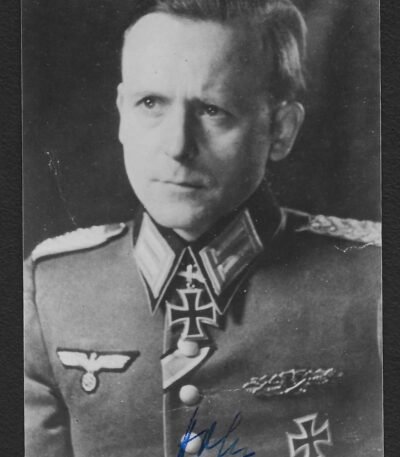
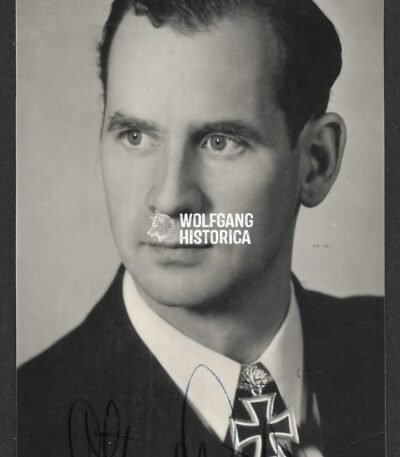
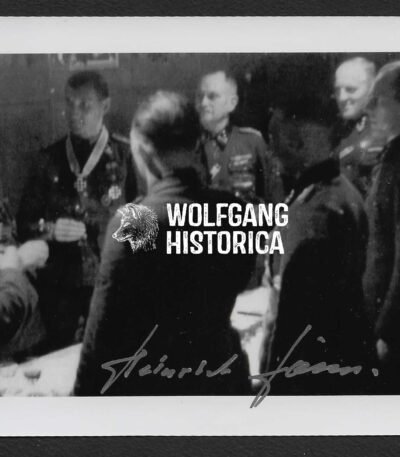
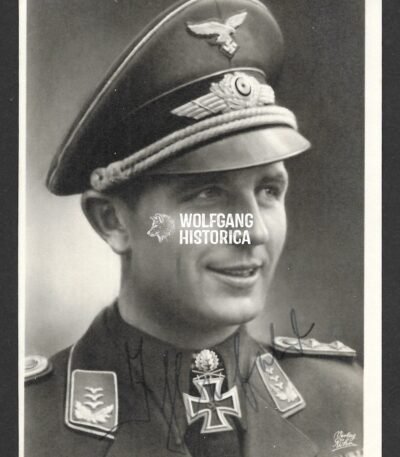
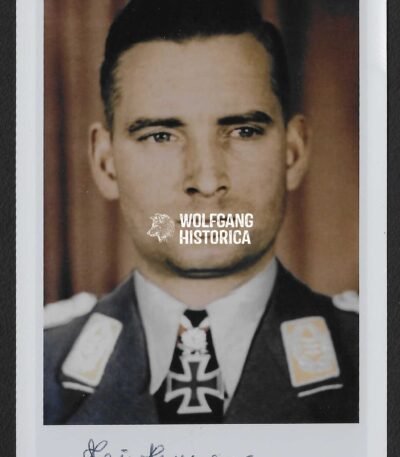
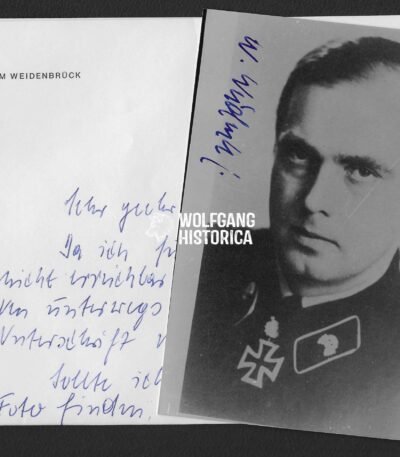
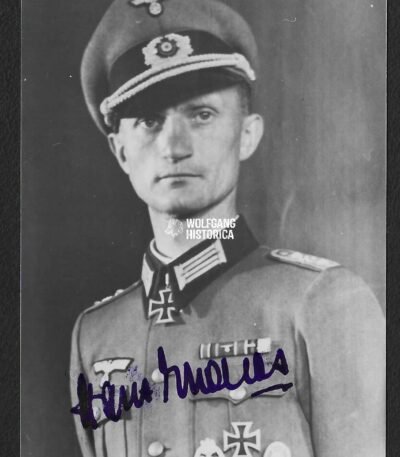
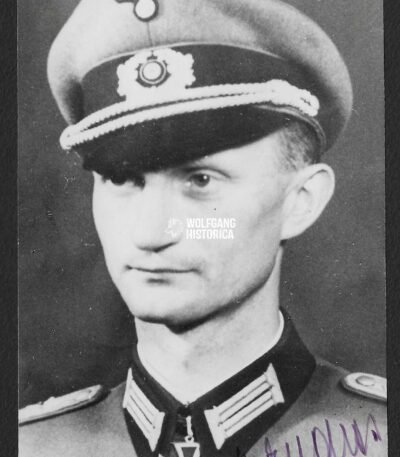
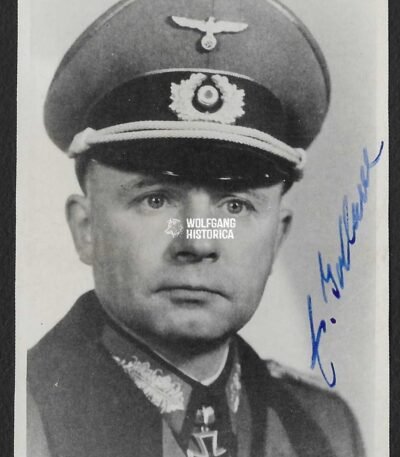
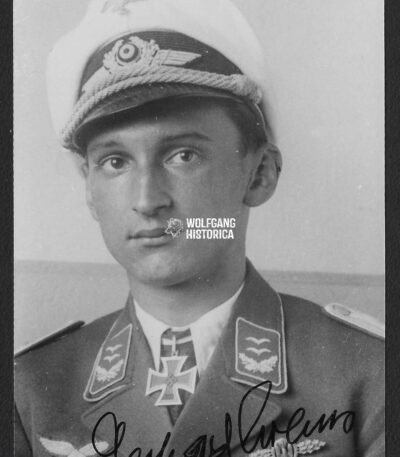
Original Postwar Signature on a Postwar Photo of Günther Frenzel

Leutnant Günther Frenzel (19 March 1919 – 12 March 2011) was a highly decorated Luftwaffe transport and special mission pilot of Kampfgeschwader zur besonderen Verwendung 1 (KG z.b.V. 1). He earned the Ritterkreuz des Eisernen Kreuzes on 23 December 1942 as Feldwebel und Staffelführer of 11. Staffel / KG z.b.V. 1, in recognition of his daring missions and exceptional skill as a transport pilot under the most dangerous conditions.

Awards and Decorations

  • Ritterkreuz des Eisernen Kreuzes – 23 December 1942 as Feldwebel und Staffelführer, 11./KG z.b.V. 1

  • Various campaign and service awards (not detailed here)

Career Highlights

  • ~200 Operational Flights: Frenzel accumulated around 200 combat missions, primarily in the Ju-52, often under heavy enemy fire.

  • Stellar Navigation: Volunteered to locate a downed bomber crew deep in enemy territory, successfully navigating by the stars to rescue them.

  • Captured Aircraft Operation: Took part in special operations flying captured Vickers Wellington bombers against Allied fuel depots in the Congo. On one such mission, he even landed at a Belgian-Congo airfield, refueled, and then bombed the same base.

  • Escape from Captivity: Captured during Operation Crusader at Derna airfield, he escaped the same day with his flight mechanic by seizing their Ju-52 under British fire, taking off during a German air attack.

  • Survivor of a Mass Shoot-Down: While flying across the Mediterranean, Frenzel’s transport was the only survivor out of 13 Ju-52s ambushed by British fighters. Despite being badly wounded and his aircraft heavily damaged, he kept it airborne for 45 minutes before crash-landing near the coast, saving all aboard. Field Marshal Albert Kesselring personally visited him in hospital to commend his bravery.

Item Details

  • Type: Postwar signed photograph

  • Size: Postcardsize

  • Condition: Good, with clear signature

Collector’s Note

Frenzel’s service stands out for the audacity and uniqueness of his missions: captured Allied bombers, daring escapes, and survival against overwhelming odds. His signature is a scarce and desirable addition to any collection focusing on Ritterkreuzträger, Luftwaffe transport units, or extraordinary air operations of WWII.

Günther Frenzel – Kampfgeschwader zur besonderen Verwendung 1

25,00

Original Postwar Signature on a Postwar Photo of Günther Frenzel

Leutnant Günther Frenzel (19 March 1919 – 12 March 2011) was a highly decorated Luftwaffe transport and special mission pilot of Kampfgeschwader zur besonderen Verwendung 1 (KG z.b.V. 1). He earned the Ritterkreuz des Eisernen Kreuzes on 23 December 1942 as Feldwebel und Staffelführer of 11. Staffel / KG z.b.V. 1, in recognition of his daring missions and exceptional skill as a transport pilot under the most dangerous conditions.

Awards and Decorations

  • Ritterkreuz des Eisernen Kreuzes – 23 December 1942 as Feldwebel und Staffelführer, 11./KG z.b.V. 1

  • Various campaign and service awards (not detailed here)

Career Highlights

  • ~200 Operational Flights: Frenzel accumulated around 200 combat missions, primarily in the Ju-52, often under heavy enemy fire.

  • Stellar Navigation: Volunteered to locate a downed bomber crew deep in enemy territory, successfully navigating by the stars to rescue them.

  • Captured Aircraft Operation: Took part in special operations flying captured Vickers Wellington bombers against Allied fuel depots in the Congo. On one such mission, he even landed at a Belgian-Congo airfield, refueled, and then bombed the same base.

  • Escape from Captivity: Captured during Operation Crusader at Derna airfield, he escaped the same day with his flight mechanic by seizing their Ju-52 under British fire, taking off during a German air attack.

  • Survivor of a Mass Shoot-Down: While flying across the Mediterranean, Frenzel’s transport was the only survivor out of 13 Ju-52s ambushed by British fighters. Despite being badly wounded and his aircraft heavily damaged, he kept it airborne for 45 minutes before crash-landing near the coast, saving all aboard. Field Marshal Albert Kesselring personally visited him in hospital to commend his bravery.

Item Details

  • Type: Postwar signed photograph

  • Size: Postcardsize

  • Condition: Good, with clear signature

Collector’s Note

Frenzel’s service stands out for the audacity and uniqueness of his missions: captured Allied bombers, daring escapes, and survival against overwhelming odds. His signature is a scarce and desirable addition to any collection focusing on Ritterkreuzträger, Luftwaffe transport units, or extraordinary air operations of WWII.

Günther Frenzel – Kampfgeschwader zur besonderen Verwendung 1

25,00

Original Postwar Signature on a Postwar Photo of Günther Frenzel

Leutnant Günther Frenzel (19 March 1919 – 12 March 2011) was a highly decorated Luftwaffe transport and special mission pilot of Kampfgeschwader zur besonderen Verwendung 1 (KG z.b.V. 1). He earned the Ritterkreuz des Eisernen Kreuzes on 23 December 1942 as Feldwebel und Staffelführer of 11. Staffel / KG z.b.V. 1, in recognition of his daring missions and exceptional skill as a transport pilot under the most dangerous conditions.

Awards and Decorations

  • Ritterkreuz des Eisernen Kreuzes – 23 December 1942 as Feldwebel und Staffelführer, 11./KG z.b.V. 1

  • Various campaign and service awards (not detailed here)

Career Highlights

  • ~200 Operational Flights: Frenzel accumulated around 200 combat missions, primarily in the Ju-52, often under heavy enemy fire.

  • Stellar Navigation: Volunteered to locate a downed bomber crew deep in enemy territory, successfully navigating by the stars to rescue them.

  • Captured Aircraft Operation: Took part in special operations flying captured Vickers Wellington bombers against Allied fuel depots in the Congo. On one such mission, he even landed at a Belgian-Congo airfield, refueled, and then bombed the same base.

  • Escape from Captivity: Captured during Operation Crusader at Derna airfield, he escaped the same day with his flight mechanic by seizing their Ju-52 under British fire, taking off during a German air attack.

  • Survivor of a Mass Shoot-Down: While flying across the Mediterranean, Frenzel’s transport was the only survivor out of 13 Ju-52s ambushed by British fighters. Despite being badly wounded and his aircraft heavily damaged, he kept it airborne for 45 minutes before crash-landing near the coast, saving all aboard. Field Marshal Albert Kesselring personally visited him in hospital to commend his bravery.

Item Details

  • Type: Postwar signed photograph

  • Size: Postcardsize

  • Condition: Good, with clear signature

Collector’s Note

Frenzel’s service stands out for the audacity and uniqueness of his missions: captured Allied bombers, daring escapes, and survival against overwhelming odds. His signature is a scarce and desirable addition to any collection focusing on Ritterkreuzträger, Luftwaffe transport units, or extraordinary air operations of WWII.

Günther Frenzel – Kampfgeschwader zur besonderen Verwendung 1

25,00

Original Postwar Signature on a Postwar Photo of Günther Frenzel

Leutnant Günther Frenzel (19 March 1919 – 12 March 2011) was a highly decorated Luftwaffe transport and special mission pilot of Kampfgeschwader zur besonderen Verwendung 1 (KG z.b.V. 1). He earned the Ritterkreuz des Eisernen Kreuzes on 23 December 1942 as Feldwebel und Staffelführer of 11. Staffel / KG z.b.V. 1, in recognition of his daring missions and exceptional skill as a transport pilot under the most dangerous conditions.

Awards and Decorations

  • Ritterkreuz des Eisernen Kreuzes – 23 December 1942 as Feldwebel und Staffelführer, 11./KG z.b.V. 1

  • Various campaign and service awards (not detailed here)

Career Highlights

  • ~200 Operational Flights: Frenzel accumulated around 200 combat missions, primarily in the Ju-52, often under heavy enemy fire.

  • Stellar Navigation: Volunteered to locate a downed bomber crew deep in enemy territory, successfully navigating by the stars to rescue them.

  • Captured Aircraft Operation: Took part in special operations flying captured Vickers Wellington bombers against Allied fuel depots in the Congo. On one such mission, he even landed at a Belgian-Congo airfield, refueled, and then bombed the same base.

  • Escape from Captivity: Captured during Operation Crusader at Derna airfield, he escaped the same day with his flight mechanic by seizing their Ju-52 under British fire, taking off during a German air attack.

  • Survivor of a Mass Shoot-Down: While flying across the Mediterranean, Frenzel’s transport was the only survivor out of 13 Ju-52s ambushed by British fighters. Despite being badly wounded and his aircraft heavily damaged, he kept it airborne for 45 minutes before crash-landing near the coast, saving all aboard. Field Marshal Albert Kesselring personally visited him in hospital to commend his bravery.

Item Details

  • Type: Postwar signed photograph

  • Size: Postcardsize

  • Condition: Good, with clear signature

Collector’s Note

Frenzel’s service stands out for the audacity and uniqueness of his missions: captured Allied bombers, daring escapes, and survival against overwhelming odds. His signature is a scarce and desirable addition to any collection focusing on Ritterkreuzträger, Luftwaffe transport units, or extraordinary air operations of WWII.

Günther Frenzel – Kampfgeschwader zur besonderen Verwendung 1

25,00

Original Postwar Signature on a Postwar Photo of Günther Frenzel

Leutnant Günther Frenzel (19 March 1919 – 12 March 2011) was a highly decorated Luftwaffe transport and special mission pilot of Kampfgeschwader zur besonderen Verwendung 1 (KG z.b.V. 1). He earned the Ritterkreuz des Eisernen Kreuzes on 23 December 1942 as Feldwebel und Staffelführer of 11. Staffel / KG z.b.V. 1, in recognition of his daring missions and exceptional skill as a transport pilot under the most dangerous conditions.

Awards and Decorations

  • Ritterkreuz des Eisernen Kreuzes – 23 December 1942 as Feldwebel und Staffelführer, 11./KG z.b.V. 1

  • Various campaign and service awards (not detailed here)

Career Highlights

  • ~200 Operational Flights: Frenzel accumulated around 200 combat missions, primarily in the Ju-52, often under heavy enemy fire.

  • Stellar Navigation: Volunteered to locate a downed bomber crew deep in enemy territory, successfully navigating by the stars to rescue them.

  • Captured Aircraft Operation: Took part in special operations flying captured Vickers Wellington bombers against Allied fuel depots in the Congo. On one such mission, he even landed at a Belgian-Congo airfield, refueled, and then bombed the same base.

  • Escape from Captivity: Captured during Operation Crusader at Derna airfield, he escaped the same day with his flight mechanic by seizing their Ju-52 under British fire, taking off during a German air attack.

  • Survivor of a Mass Shoot-Down: While flying across the Mediterranean, Frenzel’s transport was the only survivor out of 13 Ju-52s ambushed by British fighters. Despite being badly wounded and his aircraft heavily damaged, he kept it airborne for 45 minutes before crash-landing near the coast, saving all aboard. Field Marshal Albert Kesselring personally visited him in hospital to commend his bravery.

Item Details

  • Type: Postwar signed photograph

  • Size: Postcardsize

  • Condition: Good, with clear signature

Collector’s Note

Frenzel’s service stands out for the audacity and uniqueness of his missions: captured Allied bombers, daring escapes, and survival against overwhelming odds. His signature is a scarce and desirable addition to any collection focusing on Ritterkreuzträger, Luftwaffe transport units, or extraordinary air operations of WWII.

Günther Frenzel – Kampfgeschwader zur besonderen Verwendung 1

25,00

Original Postwar Signature on a Postwar Photo of Günther Frenzel

Leutnant Günther Frenzel (19 March 1919 – 12 March 2011) was a highly decorated Luftwaffe transport and special mission pilot of Kampfgeschwader zur besonderen Verwendung 1 (KG z.b.V. 1). He earned the Ritterkreuz des Eisernen Kreuzes on 23 December 1942 as Feldwebel und Staffelführer of 11. Staffel / KG z.b.V. 1, in recognition of his daring missions and exceptional skill as a transport pilot under the most dangerous conditions.

Awards and Decorations

  • Ritterkreuz des Eisernen Kreuzes – 23 December 1942 as Feldwebel und Staffelführer, 11./KG z.b.V. 1

  • Various campaign and service awards (not detailed here)

Career Highlights

  • ~200 Operational Flights: Frenzel accumulated around 200 combat missions, primarily in the Ju-52, often under heavy enemy fire.

  • Stellar Navigation: Volunteered to locate a downed bomber crew deep in enemy territory, successfully navigating by the stars to rescue them.

  • Captured Aircraft Operation: Took part in special operations flying captured Vickers Wellington bombers against Allied fuel depots in the Congo. On one such mission, he even landed at a Belgian-Congo airfield, refueled, and then bombed the same base.

  • Escape from Captivity: Captured during Operation Crusader at Derna airfield, he escaped the same day with his flight mechanic by seizing their Ju-52 under British fire, taking off during a German air attack.

  • Survivor of a Mass Shoot-Down: While flying across the Mediterranean, Frenzel’s transport was the only survivor out of 13 Ju-52s ambushed by British fighters. Despite being badly wounded and his aircraft heavily damaged, he kept it airborne for 45 minutes before crash-landing near the coast, saving all aboard. Field Marshal Albert Kesselring personally visited him in hospital to commend his bravery.

Item Details

  • Type: Postwar signed photograph

  • Size: Postcardsize

  • Condition: Good, with clear signature

Collector’s Note

Frenzel’s service stands out for the audacity and uniqueness of his missions: captured Allied bombers, daring escapes, and survival against overwhelming odds. His signature is a scarce and desirable addition to any collection focusing on Ritterkreuzträger, Luftwaffe transport units, or extraordinary air operations of WWII.

Gerhard Fischer – Panzer-Regiment 23 (23. Panzer-Division)

25,00

Original Postwar Signature on a Postwar Photo of Gerhard Fischer. Major Gerhard Fischer (4 December 1915 – 9 August 2014) was a decorated German Panzer officer of the 23. Panzer-Division during the Second World War. A front-line tank commander, he rose through the ranks to company command and earned high recognition for his leadership and combat achievements on the Eastern Front.

Awards and Decorations

  • Ritterkreuz des Eisernen Kreuzes (Knight’s Cross of the Iron Cross) – 28 December 1943 as Oberleutnant and Chef of 8. Kompanie / Panzer-Regiment 23, 23. Panzer-Division.

  • Panzerkampfabzeichen V. Stufe (Tank Battle Badge, 100 engagements) – Awarded for exceptional front-line service and endurance as a Panzer officer.

Career Highlights

  • Eastern Front Service: Fought in the hard defensive battles of the 23. Panzer-Division, particularly during the retreat phases of 1943.

  • Company Commander: As chief of 8. Kompanie, Fischer distinguished himself by leading his unit with determination in heavy Panzer actions.

  • Ritterkreuz Recognition: Awarded for personal bravery and outstanding leadership in armored combat, making him one of the division’s most noted Panzer officers.

  • Longevity: Survived the war and lived to the age of 98, one of the longest-lived Knight’s Cross holders of the Panzertruppe.

Item Details

  • Type: Postwar signed photograph.

  • Size: Postcardsize.

  • Condition: Good, with a clear and well-preserved autograph.

Collector’s Note

Gerhard Fischer represents the seasoned Panzer officers who endured years of hard fighting on the Eastern Front. His combination of the Ritterkreuz and the rare Panzerkampfabzeichen 100 underlines both his personal courage and his extensive frontline service. A scarce and desirable signature for collectors of Panzer and Ritterkreuz memorabilia.

Gerhard Fischer – Panzer-Regiment 23 (23. Panzer-Division)

25,00

Original Postwar Signature on a Postwar Photo of Gerhard Fischer. Major Gerhard Fischer (4 December 1915 – 9 August 2014) was a decorated German Panzer officer of the 23. Panzer-Division during the Second World War. A front-line tank commander, he rose through the ranks to company command and earned high recognition for his leadership and combat achievements on the Eastern Front.

Awards and Decorations

  • Ritterkreuz des Eisernen Kreuzes (Knight’s Cross of the Iron Cross) – 28 December 1943 as Oberleutnant and Chef of 8. Kompanie / Panzer-Regiment 23, 23. Panzer-Division.

  • Panzerkampfabzeichen V. Stufe (Tank Battle Badge, 100 engagements) – Awarded for exceptional front-line service and endurance as a Panzer officer.

Career Highlights

  • Eastern Front Service: Fought in the hard defensive battles of the 23. Panzer-Division, particularly during the retreat phases of 1943.

  • Company Commander: As chief of 8. Kompanie, Fischer distinguished himself by leading his unit with determination in heavy Panzer actions.

  • Ritterkreuz Recognition: Awarded for personal bravery and outstanding leadership in armored combat, making him one of the division’s most noted Panzer officers.

  • Longevity: Survived the war and lived to the age of 98, one of the longest-lived Knight’s Cross holders of the Panzertruppe.

Item Details

  • Type: Postwar signed photograph.

  • Size: Postcardsize.

  • Condition: Good, with a clear and well-preserved autograph.

Collector’s Note

Gerhard Fischer represents the seasoned Panzer officers who endured years of hard fighting on the Eastern Front. His combination of the Ritterkreuz and the rare Panzerkampfabzeichen 100 underlines both his personal courage and his extensive frontline service. A scarce and desirable signature for collectors of Panzer and Ritterkreuz memorabilia.

Gerhard Fischer – Panzer-Regiment 23 (23. Panzer-Division)

25,00

Original Postwar Signature on a Postwar Photo of Gerhard Fischer. Major Gerhard Fischer (4 December 1915 – 9 August 2014) was a decorated German Panzer officer of the 23. Panzer-Division during the Second World War. A front-line tank commander, he rose through the ranks to company command and earned high recognition for his leadership and combat achievements on the Eastern Front.

Awards and Decorations

  • Ritterkreuz des Eisernen Kreuzes (Knight’s Cross of the Iron Cross) – 28 December 1943 as Oberleutnant and Chef of 8. Kompanie / Panzer-Regiment 23, 23. Panzer-Division.

  • Panzerkampfabzeichen V. Stufe (Tank Battle Badge, 100 engagements) – Awarded for exceptional front-line service and endurance as a Panzer officer.

Career Highlights

  • Eastern Front Service: Fought in the hard defensive battles of the 23. Panzer-Division, particularly during the retreat phases of 1943.

  • Company Commander: As chief of 8. Kompanie, Fischer distinguished himself by leading his unit with determination in heavy Panzer actions.

  • Ritterkreuz Recognition: Awarded for personal bravery and outstanding leadership in armored combat, making him one of the division’s most noted Panzer officers.

  • Longevity: Survived the war and lived to the age of 98, one of the longest-lived Knight’s Cross holders of the Panzertruppe.

Item Details

  • Type: Postwar signed photograph.

  • Size: Postcardsize.

  • Condition: Good, with a clear and well-preserved autograph.

Collector’s Note

Gerhard Fischer represents the seasoned Panzer officers who endured years of hard fighting on the Eastern Front. His combination of the Ritterkreuz and the rare Panzerkampfabzeichen 100 underlines both his personal courage and his extensive frontline service. A scarce and desirable signature for collectors of Panzer and Ritterkreuz memorabilia.

Gerhard Fischer – Panzer-Regiment 23 (23. Panzer-Division)

25,00

Original Postwar Signature on a Postwar Photo of Gerhard Fischer. Major Gerhard Fischer (4 December 1915 – 9 August 2014) was a decorated German Panzer officer of the 23. Panzer-Division during the Second World War. A front-line tank commander, he rose through the ranks to company command and earned high recognition for his leadership and combat achievements on the Eastern Front.

Awards and Decorations

  • Ritterkreuz des Eisernen Kreuzes (Knight’s Cross of the Iron Cross) – 28 December 1943 as Oberleutnant and Chef of 8. Kompanie / Panzer-Regiment 23, 23. Panzer-Division.

  • Panzerkampfabzeichen V. Stufe (Tank Battle Badge, 100 engagements) – Awarded for exceptional front-line service and endurance as a Panzer officer.

Career Highlights

  • Eastern Front Service: Fought in the hard defensive battles of the 23. Panzer-Division, particularly during the retreat phases of 1943.

  • Company Commander: As chief of 8. Kompanie, Fischer distinguished himself by leading his unit with determination in heavy Panzer actions.

  • Ritterkreuz Recognition: Awarded for personal bravery and outstanding leadership in armored combat, making him one of the division’s most noted Panzer officers.

  • Longevity: Survived the war and lived to the age of 98, one of the longest-lived Knight’s Cross holders of the Panzertruppe.

Item Details

  • Type: Postwar signed photograph.

  • Size: A5-size.

  • Condition: Good, with a clear and well-preserved autograph.

Collector’s Note

Gerhard Fischer represents the seasoned Panzer officers who endured years of hard fighting on the Eastern Front. His combination of the Ritterkreuz and the rare Panzerkampfabzeichen 100 underlines both his personal courage and his extensive frontline service. A scarce and desirable signature for collectors of Panzer and Ritterkreuz memorabilia.

Gerhard Fischer – Panzer-Regiment 23 (23. Panzer-Division)

25,00

Original Postwar Signature on a Postwar Photo of Gerhard Fischer. Major Gerhard Fischer (4 December 1915 – 9 August 2014) was a decorated German Panzer officer of the 23. Panzer-Division during the Second World War. A front-line tank commander, he rose through the ranks to company command and earned high recognition for his leadership and combat achievements on the Eastern Front.

Awards and Decorations

  • Ritterkreuz des Eisernen Kreuzes (Knight’s Cross of the Iron Cross) – 28 December 1943 as Oberleutnant and Chef of 8. Kompanie / Panzer-Regiment 23, 23. Panzer-Division.

  • Panzerkampfabzeichen V. Stufe (Tank Battle Badge, 100 engagements) – Awarded for exceptional front-line service and endurance as a Panzer officer.

Career Highlights

  • Eastern Front Service: Fought in the hard defensive battles of the 23. Panzer-Division, particularly during the retreat phases of 1943.

  • Company Commander: As chief of 8. Kompanie, Fischer distinguished himself by leading his unit with determination in heavy Panzer actions.

  • Ritterkreuz Recognition: Awarded for personal bravery and outstanding leadership in armored combat, making him one of the division’s most noted Panzer officers.

  • Longevity: Survived the war and lived to the age of 98, one of the longest-lived Knight’s Cross holders of the Panzertruppe.

Item Details

  • Type: Postwar signed photograph.

  • Size: A5-size.

  • Condition: Good, with a clear and well-preserved autograph.

Collector’s Note

Gerhard Fischer represents the seasoned Panzer officers who endured years of hard fighting on the Eastern Front. His combination of the Ritterkreuz and the rare Panzerkampfabzeichen 100 underlines both his personal courage and his extensive frontline service. A scarce and desirable signature for collectors of Panzer and Ritterkreuz memorabilia.

Klaus Feldt – Schnellboot “S-30” & 2. Schnellbootflottille (Eichenlaub)

25,00

Original Postwar Signature on a Postwar Photo of Klaus Feldt. Korvettenkapitän Klaus Feldt (14 April 1912 – 7 September 2010) was a highly decorated Kriegsmarine Schnellboot commander during the Second World War. He earned distinction for his aggressive leadership in fast attack craft operations, particularly in the English Channel and North Sea, commanding both individual boats and flotillas.

Awards and Decorations

  • Ritterkreuz des Eisernen Kreuzes (Knight’s Cross of the Iron Cross) – 13 June 1942 as Oberleutnant zur See and Kommandant of Schnellboot S-30.

  • Eichenlaub (Oak Leaves to the Knight’s Cross) – 1 January 1944 as Korvettenkapitän and Chef of the 2. Schnellbootflottille, in recognition of his continued successes in offensive operations.

Career Highlights

  • Fast Attack Craft Commander: Rose from boat commander (S-30) to flotilla leader, gaining a reputation for bold night attacks against Allied shipping and convoy routes.

  • Channel & North Sea Operations: His leadership in high-risk torpedo boat missions contributed significantly to the Kriegsmarine’s ability to disrupt Allied supply lines.

  • Highly Decorated: One of the few Schnellboot officers to be awarded both the Knight’s Cross and Oak Leaves, a testament to his sustained operational impact.

  • Longevity: Survived the war and lived to the age of 98, making him one of the longest-lived Oak Leaves recipients of the Kriegsmarine.

Item Details

  • Type: Postwar signed photograph.

  • Size: Postcardsize.

  • Condition: Good, clear autograph and preserved photo.

Collector’s Note

Klaus Feldt’s career represents the elite echelon of Schnellboot commanders, men whose daring raids earned them top decorations. His combination of the Ritterkreuz and Eichenlaub places him among the Kriegsmarine’s most successful fast-attack leaders. Signed items from Schnellboot officers are notably scarcer than those of U-boat commanders, making this a particularly desirable piece.

Klaus Feldt – Schnellboot “S-30” & 2. Schnellbootflottille (Eichenlaub)

25,00

Original Postwar Signature on a Postwar Photo of Klaus Feldt. Korvettenkapitän Klaus Feldt (14 April 1912 – 7 September 2010) was a highly decorated Kriegsmarine Schnellboot commander during the Second World War. He earned distinction for his aggressive leadership in fast attack craft operations, particularly in the English Channel and North Sea, commanding both individual boats and flotillas.

Awards and Decorations

  • Ritterkreuz des Eisernen Kreuzes (Knight’s Cross of the Iron Cross) – 13 June 1942 as Oberleutnant zur See and Kommandant of Schnellboot S-30.

  • Eichenlaub (Oak Leaves to the Knight’s Cross) – 1 January 1944 as Korvettenkapitän and Chef of the 2. Schnellbootflottille, in recognition of his continued successes in offensive operations.

Career Highlights

  • Fast Attack Craft Commander: Rose from boat commander (S-30) to flotilla leader, gaining a reputation for bold night attacks against Allied shipping and convoy routes.

  • Channel & North Sea Operations: His leadership in high-risk torpedo boat missions contributed significantly to the Kriegsmarine’s ability to disrupt Allied supply lines.

  • Highly Decorated: One of the few Schnellboot officers to be awarded both the Knight’s Cross and Oak Leaves, a testament to his sustained operational impact.

  • Longevity: Survived the war and lived to the age of 98, making him one of the longest-lived Oak Leaves recipients of the Kriegsmarine.

Item Details

  • Type: Postwar signed photograph.

  • Size: Postcardsize.

  • Condition: Good, clear autograph and preserved photo.

Collector’s Note

Klaus Feldt’s career represents the elite echelon of Schnellboot commanders, men whose daring raids earned them top decorations. His combination of the Ritterkreuz and Eichenlaub places him among the Kriegsmarine’s most successful fast-attack leaders. Signed items from Schnellboot officers are notably scarcer than those of U-boat commanders, making this a particularly desirable piece.

Klaus Feldt – Schnellboot “S-30” & 2. Schnellbootflottille (Eichenlaub)

25,00

Original Postwar Signature on a Postwar Photo of Klaus Feldt. Korvettenkapitän Klaus Feldt (14 April 1912 – 7 September 2010) was a highly decorated Kriegsmarine Schnellboot commander during the Second World War. He earned distinction for his aggressive leadership in fast attack craft operations, particularly in the English Channel and North Sea, commanding both individual boats and flotillas.

Awards and Decorations

  • Ritterkreuz des Eisernen Kreuzes (Knight’s Cross of the Iron Cross) – 13 June 1942 as Oberleutnant zur See and Kommandant of Schnellboot S-30.

  • Eichenlaub (Oak Leaves to the Knight’s Cross) – 1 January 1944 as Korvettenkapitän and Chef of the 2. Schnellbootflottille, in recognition of his continued successes in offensive operations.

Career Highlights

  • Fast Attack Craft Commander: Rose from boat commander (S-30) to flotilla leader, gaining a reputation for bold night attacks against Allied shipping and convoy routes.

  • Channel & North Sea Operations: His leadership in high-risk torpedo boat missions contributed significantly to the Kriegsmarine’s ability to disrupt Allied supply lines.

  • Highly Decorated: One of the few Schnellboot officers to be awarded both the Knight’s Cross and Oak Leaves, a testament to his sustained operational impact.

  • Longevity: Survived the war and lived to the age of 98, making him one of the longest-lived Oak Leaves recipients of the Kriegsmarine.

Item Details

  • Type: Postwar signed photograph.

  • Size: Postcardsize.

  • Condition: Good, clear autograph and preserved photo.

Collector’s Note

Klaus Feldt’s career represents the elite echelon of Schnellboot commanders, men whose daring raids earned them top decorations. His combination of the Ritterkreuz and Eichenlaub places him among the Kriegsmarine’s most successful fast-attack leaders. Signed items from Schnellboot officers are notably scarcer than those of U-boat commanders, making this a particularly desirable piece.

Klaus Feldt – Schnellboot “S-30” & 2. Schnellbootflottille (Eichenlaub)

25,00

Original Postwar Signature on a Postwar Photo of Klaus Feldt. Korvettenkapitän Klaus Feldt (14 April 1912 – 7 September 2010) was a highly decorated Kriegsmarine Schnellboot commander during the Second World War. He earned distinction for his aggressive leadership in fast attack craft operations, particularly in the English Channel and North Sea, commanding both individual boats and flotillas.

Awards and Decorations

  • Ritterkreuz des Eisernen Kreuzes (Knight’s Cross of the Iron Cross) – 13 June 1942 as Oberleutnant zur See and Kommandant of Schnellboot S-30.

  • Eichenlaub (Oak Leaves to the Knight’s Cross) – 1 January 1944 as Korvettenkapitän and Chef of the 2. Schnellbootflottille, in recognition of his continued successes in offensive operations.

Career Highlights

  • Fast Attack Craft Commander: Rose from boat commander (S-30) to flotilla leader, gaining a reputation for bold night attacks against Allied shipping and convoy routes.

  • Channel & North Sea Operations: His leadership in high-risk torpedo boat missions contributed significantly to the Kriegsmarine’s ability to disrupt Allied supply lines.

  • Highly Decorated: One of the few Schnellboot officers to be awarded both the Knight’s Cross and Oak Leaves, a testament to his sustained operational impact.

  • Longevity: Survived the war and lived to the age of 98, making him one of the longest-lived Oak Leaves recipients of the Kriegsmarine.

Item Details

  • Type: Postwar signed photograph.

  • Size: Postcardsize.

  • Condition: Good, clear autograph and preserved photo.

Collector’s Note

Klaus Feldt’s career represents the elite echelon of Schnellboot commanders, men whose daring raids earned them top decorations. His combination of the Ritterkreuz and Eichenlaub places him among the Kriegsmarine’s most successful fast-attack leaders. Signed items from Schnellboot officers are notably scarcer than those of U-boat commanders, making this a particularly desirable piece.

Klaus Feldt – Schnellboot “S-30” & 2. Schnellbootflottille (Eichenlaub)

25,00

Original Postwar Signature on a Postwar Photo of Klaus Feldt. Korvettenkapitän Klaus Feldt (14 April 1912 – 7 September 2010) was a highly decorated Kriegsmarine Schnellboot commander during the Second World War. He earned distinction for his aggressive leadership in fast attack craft operations, particularly in the English Channel and North Sea, commanding both individual boats and flotillas.

Awards and Decorations

  • Ritterkreuz des Eisernen Kreuzes (Knight’s Cross of the Iron Cross) – 13 June 1942 as Oberleutnant zur See and Kommandant of Schnellboot S-30.

  • Eichenlaub (Oak Leaves to the Knight’s Cross) – 1 January 1944 as Korvettenkapitän and Chef of the 2. Schnellbootflottille, in recognition of his continued successes in offensive operations.

Career Highlights

  • Fast Attack Craft Commander: Rose from boat commander (S-30) to flotilla leader, gaining a reputation for bold night attacks against Allied shipping and convoy routes.

  • Channel & North Sea Operations: His leadership in high-risk torpedo boat missions contributed significantly to the Kriegsmarine’s ability to disrupt Allied supply lines.

  • Highly Decorated: One of the few Schnellboot officers to be awarded both the Knight’s Cross and Oak Leaves, a testament to his sustained operational impact.

  • Longevity: Survived the war and lived to the age of 98, making him one of the longest-lived Oak Leaves recipients of the Kriegsmarine.

Item Details

  • Type: Postwar signed photograph.

  • Size: Postcardsize.

  • Condition: Good, clear autograph and preserved photo.

Collector’s Note

Klaus Feldt’s career represents the elite echelon of Schnellboot commanders, men whose daring raids earned them top decorations. His combination of the Ritterkreuz and Eichenlaub places him among the Kriegsmarine’s most successful fast-attack leaders. Signed items from Schnellboot officers are notably scarcer than those of U-boat commanders, making this a particularly desirable piece.

Klaus Feldt – Schnellboot “S-30” & 2. Schnellbootflottille (Eichenlaub)

25,00

Original Postwar Signature on a Postwar Photo of Klaus Feldt. Korvettenkapitän Klaus Feldt (14 April 1912 – 7 September 2010) was a highly decorated Kriegsmarine Schnellboot commander during the Second World War. He earned distinction for his aggressive leadership in fast attack craft operations, particularly in the English Channel and North Sea, commanding both individual boats and flotillas.

Awards and Decorations

  • Ritterkreuz des Eisernen Kreuzes (Knight’s Cross of the Iron Cross) – 13 June 1942 as Oberleutnant zur See and Kommandant of Schnellboot S-30.

  • Eichenlaub (Oak Leaves to the Knight’s Cross) – 1 January 1944 as Korvettenkapitän and Chef of the 2. Schnellbootflottille, in recognition of his continued successes in offensive operations.

Career Highlights

  • Fast Attack Craft Commander: Rose from boat commander (S-30) to flotilla leader, gaining a reputation for bold night attacks against Allied shipping and convoy routes.

  • Channel & North Sea Operations: His leadership in high-risk torpedo boat missions contributed significantly to the Kriegsmarine’s ability to disrupt Allied supply lines.

  • Highly Decorated: One of the few Schnellboot officers to be awarded both the Knight’s Cross and Oak Leaves, a testament to his sustained operational impact.

  • Longevity: Survived the war and lived to the age of 98, making him one of the longest-lived Oak Leaves recipients of the Kriegsmarine.

Item Details

  • Type: Postwar signed photograph.

  • Size: Postcardsize.

  • Condition: Good, clear autograph and preserved photo.

Collector’s Note

Klaus Feldt’s career represents the elite echelon of Schnellboot commanders, men whose daring raids earned them top decorations. His combination of the Ritterkreuz and Eichenlaub places him among the Kriegsmarine’s most successful fast-attack leaders. Signed items from Schnellboot officers are notably scarcer than those of U-boat commanders, making this a particularly desirable piece.

Klaus Feldt – Schnellboot “S-30” & 2. Schnellbootflottille (Eichenlaub)

25,00

Original Postwar Signature on a Postwar Photo of Klaus Feldt. Korvettenkapitän Klaus Feldt (14 April 1912 – 7 September 2010) was a highly decorated Kriegsmarine Schnellboot commander during the Second World War. He earned distinction for his aggressive leadership in fast attack craft operations, particularly in the English Channel and North Sea, commanding both individual boats and flotillas.

Awards and Decorations

  • Ritterkreuz des Eisernen Kreuzes (Knight’s Cross of the Iron Cross) – 13 June 1942 as Oberleutnant zur See and Kommandant of Schnellboot S-30.

  • Eichenlaub (Oak Leaves to the Knight’s Cross) – 1 January 1944 as Korvettenkapitän and Chef of the 2. Schnellbootflottille, in recognition of his continued successes in offensive operations.

Career Highlights

  • Fast Attack Craft Commander: Rose from boat commander (S-30) to flotilla leader, gaining a reputation for bold night attacks against Allied shipping and convoy routes.

  • Channel & North Sea Operations: His leadership in high-risk torpedo boat missions contributed significantly to the Kriegsmarine’s ability to disrupt Allied supply lines.

  • Highly Decorated: One of the few Schnellboot officers to be awarded both the Knight’s Cross and Oak Leaves, a testament to his sustained operational impact.

  • Longevity: Survived the war and lived to the age of 98, making him one of the longest-lived Oak Leaves recipients of the Kriegsmarine.

Item Details

  • Type: Postwar signed photograph.

  • Size: Postcardsize.

  • Condition: Good, clear autograph and preserved photo.

Collector’s Note

Klaus Feldt’s career represents the elite echelon of Schnellboot commanders, men whose daring raids earned them top decorations. His combination of the Ritterkreuz and Eichenlaub places him among the Kriegsmarine’s most successful fast-attack leaders. Signed items from Schnellboot officers are notably scarcer than those of U-boat commanders, making this a particularly desirable piece.

Klaus Feldt – Schnellboot “S-30” & 2. Schnellbootflottille (Eichenlaub)

25,00

Original Postwar Signature on a Postwar Photo of Klaus Feldt. Korvettenkapitän Klaus Feldt (14 April 1912 – 7 September 2010) was a highly decorated Kriegsmarine Schnellboot commander during the Second World War. He earned distinction for his aggressive leadership in fast attack craft operations, particularly in the English Channel and North Sea, commanding both individual boats and flotillas.

Awards and Decorations

  • Ritterkreuz des Eisernen Kreuzes (Knight’s Cross of the Iron Cross) – 13 June 1942 as Oberleutnant zur See and Kommandant of Schnellboot S-30.

  • Eichenlaub (Oak Leaves to the Knight’s Cross) – 1 January 1944 as Korvettenkapitän and Chef of the 2. Schnellbootflottille, in recognition of his continued successes in offensive operations.

Career Highlights

  • Fast Attack Craft Commander: Rose from boat commander (S-30) to flotilla leader, gaining a reputation for bold night attacks against Allied shipping and convoy routes.

  • Channel & North Sea Operations: His leadership in high-risk torpedo boat missions contributed significantly to the Kriegsmarine’s ability to disrupt Allied supply lines.

  • Highly Decorated: One of the few Schnellboot officers to be awarded both the Knight’s Cross and Oak Leaves, a testament to his sustained operational impact.

  • Longevity: Survived the war and lived to the age of 98, making him one of the longest-lived Oak Leaves recipients of the Kriegsmarine.

Item Details

  • Type: Postwar signed photograph.

  • Size: Postcardsize.

  • Condition: Good, clear autograph and preserved photo.

Collector’s Note

Klaus Feldt’s career represents the elite echelon of Schnellboot commanders, men whose daring raids earned them top decorations. His combination of the Ritterkreuz and Eichenlaub places him among the Kriegsmarine’s most successful fast-attack leaders. Signed items from Schnellboot officers are notably scarcer than those of U-boat commanders, making this a particularly desirable piece.

Paul Feiertag – Divisions-Füsilier-Bataillon 96

25,00

Unteroffizier Paul Feiertag (20 August 1916 – 30 November 1999) was a decorated squad leader in the Wehrmacht during the Second World War. He earned the Ritterkreuz des Eisernen Kreuzes on 30 September 1944 as Unteroffizier und Gruppenführer in the 3. Kompanie / Divisions-Füsilier-Bataillon 96 of the 96. Infanterie-Division.

Ritterkreuz Citation:

“… During the heavy fighting along the southern sector of the Eastern Front at the start of this year his Kompanie was halted by heavy enemy fire while in an unclear situation. Unteroffizier Feiertag went to try and make contact with the enemy along with a soldier from his squad. In the process he came into the vicinity of an enemy artillery piece and was able to get to within grenade-throwing distance unnoticed. He threw two hand grenades and utilized the ensuing chaos by eliminating the Soviet gun crew with his machine-pistol. He destroyed the gun itself with a hand grenade. The confusion amongst the enemy gave the Kompanie the chance to storm the enemy positions with a loud ‘Hurra’.

In the ensuing village battle Feiertag once again stood at the spearhead of his Kompanie despite having been shot through the hand and forearm, and he remained in this capacity until the day’s objective had been reached. By knocking out the enemy gun with a machine-pistol and hand grenades he secured his Kompanie’s victory thanks to his ruthless devotion and initiative. After his wound had healed Unteroffizier Feiertag returned to his unit in May of this year, and was once again wounded in July.”

Item Details:

  • Format: Postwar photograph with original signature.

  • Size: Postcard size.

  • Signature: Clear postwar autograph of Ritterkreuzträger Paul Feiertag.

  • Condition: Good; well-preserved example.

Collector’s Note:

Paul Feiertag’s Knight’s Cross exemplifies the frontline heroism of junior leaders in the German Army. His daring destruction of a Soviet artillery gun under fire, even after being wounded, highlights the kind of individual initiative often recognized with the Ritterkreuz. Signed items of NCO-level Knight’s Cross holders are considerably rarer than those of higher-ranking officers, making this piece a desirable addition for serious collectors of Eastern Front memorabilia.

Walter Fasel – Füsilier-Regiment 26 (30. Infanterie-Division)

15,00

Original Postwar Signature on a Postwar Photo of Walter Fasel. Feldwebel Walter Fasel (7 June 1919 – 13 August 2013) was a decorated non-commissioned officer of the Wehrmacht during the Second World War. He earned the Ritterkreuz des Eisernen Kreuzes on 31 August 1943 as Feldwebel und Zugführer of the 14. Kompanie / Füsilier-Regiment 26, part of the 30. Infanterie-Division.

Career Highlights:

  • Served on the Eastern Front with the 30. Infanterie-Division, which fought in some of the toughest defensive battles of the war.

  • As a platoon leader, Fasel distinguished himself during the fighting in 1943, showing exceptional leadership and bravery under extreme conditions.

  • His award of the Knight’s Cross recognized his decisive role in holding critical positions against Soviet attacks.

  • Survived the war and lived to the age of 94, passing away in 2013.

Item Details:

  • Format: Postwar photograph with original signature.

  • Size: Postcard size.

  • Signature: Clear postwar autograph of Ritterkreuzträger Walter Fasel.

  • Condition: Good; well-preserved signature and image.

Collector’s Note:

Walter Fasel represents the decorated frontline NCOs whose leadership often proved decisive in small-unit combat on the Eastern Front. His Knight’s Cross award as a platoon leader reflects both the ferocity of the fighting in 1943 and the importance of junior leaders in the Wehrmacht’s defensive operations. Autographs of such decorated Feldwebel-rank soldiers remain particularly attractive to collectors.

Walter Fasel – Füsilier-Regiment 26 (30. Infanterie-Division)

15,00

Original Postwar Signature on a Postwar Photo of Walter Fasel. Feldwebel Walter Fasel (7 June 1919 – 13 August 2013) was a decorated non-commissioned officer of the Wehrmacht during the Second World War. He earned the Ritterkreuz des Eisernen Kreuzes on 31 August 1943 as Feldwebel und Zugführer of the 14. Kompanie / Füsilier-Regiment 26, part of the 30. Infanterie-Division.

Career Highlights:

  • Served on the Eastern Front with the 30. Infanterie-Division, which fought in some of the toughest defensive battles of the war.

  • As a platoon leader, Fasel distinguished himself during the fighting in 1943, showing exceptional leadership and bravery under extreme conditions.

  • His award of the Knight’s Cross recognized his decisive role in holding critical positions against Soviet attacks.

  • Survived the war and lived to the age of 94, passing away in 2013.

Item Details:

  • Format: Postwar photograph with original signature.

  • Size: Postcard size.

  • Signature: Clear postwar autograph of Ritterkreuzträger Walter Fasel.

  • Condition: Good; well-preserved signature and image.

Collector’s Note:

Walter Fasel represents the decorated frontline NCOs whose leadership often proved decisive in small-unit combat on the Eastern Front. His Knight’s Cross award as a platoon leader reflects both the ferocity of the fighting in 1943 and the importance of junior leaders in the Wehrmacht’s defensive operations. Autographs of such decorated Feldwebel-rank soldiers remain particularly attractive to collectors.

Walter Fasel – Füsilier-Regiment 26 (30. Infanterie-Division)

15,00

Original Postwar Signature on a Postwar Photo of Walter Fasel. Feldwebel Walter Fasel (7 June 1919 – 13 August 2013) was a decorated non-commissioned officer of the Wehrmacht during the Second World War. He earned the Ritterkreuz des Eisernen Kreuzes on 31 August 1943 as Feldwebel und Zugführer of the 14. Kompanie / Füsilier-Regiment 26, part of the 30. Infanterie-Division.

Career Highlights:

  • Served on the Eastern Front with the 30. Infanterie-Division, which fought in some of the toughest defensive battles of the war.

  • As a platoon leader, Fasel distinguished himself during the fighting in 1943, showing exceptional leadership and bravery under extreme conditions.

  • His award of the Knight’s Cross recognized his decisive role in holding critical positions against Soviet attacks.

  • Survived the war and lived to the age of 94, passing away in 2013.

Item Details:

  • Format: Postwar photograph with original signature.

  • Size: Postcard size.

  • Signature: Clear postwar autograph of Ritterkreuzträger Walter Fasel.

  • Condition: Good; well-preserved signature and image.

Collector’s Note:

Walter Fasel represents the decorated frontline NCOs whose leadership often proved decisive in small-unit combat on the Eastern Front. His Knight’s Cross award as a platoon leader reflects both the ferocity of the fighting in 1943 and the importance of junior leaders in the Wehrmacht’s defensive operations. Autographs of such decorated Feldwebel-rank soldiers remain particularly attractive to collectors.

Walter Fasel – Füsilier-Regiment 26 (30. Infanterie-Division)

15,00

Original Postwar Signature on a Postwar Photo of Walter Fasel. Feldwebel Walter Fasel (7 June 1919 – 13 August 2013) was a decorated non-commissioned officer of the Wehrmacht during the Second World War. He earned the Ritterkreuz des Eisernen Kreuzes on 31 August 1943 as Feldwebel und Zugführer of the 14. Kompanie / Füsilier-Regiment 26, part of the 30. Infanterie-Division.

Career Highlights:

  • Served on the Eastern Front with the 30. Infanterie-Division, which fought in some of the toughest defensive battles of the war.

  • As a platoon leader, Fasel distinguished himself during the fighting in 1943, showing exceptional leadership and bravery under extreme conditions.

  • His award of the Knight’s Cross recognized his decisive role in holding critical positions against Soviet attacks.

  • Survived the war and lived to the age of 94, passing away in 2013.

Item Details:

  • Format: Postwar photograph with original signature.

  • Size: Postcard size.

  • Signature: Clear postwar autograph of Ritterkreuzträger Walter Fasel.

  • Condition: Good; well-preserved signature and image.

Collector’s Note:

Walter Fasel represents the decorated frontline NCOs whose leadership often proved decisive in small-unit combat on the Eastern Front. His Knight’s Cross award as a platoon leader reflects both the ferocity of the fighting in 1943 and the importance of junior leaders in the Wehrmacht’s defensive operations. Autographs of such decorated Feldwebel-rank soldiers remain particularly attractive to collectors.

Walter Fasel – Füsilier-Regiment 26 (30. Infanterie-Division)

15,00

Original Postwar Signature on a Postwar Photo of Walter Fasel. Feldwebel Walter Fasel (7 June 1919 – 13 August 2013) was a decorated non-commissioned officer of the Wehrmacht during the Second World War. He earned the Ritterkreuz des Eisernen Kreuzes on 31 August 1943 as Feldwebel und Zugführer of the 14. Kompanie / Füsilier-Regiment 26, part of the 30. Infanterie-Division.

Career Highlights:

  • Served on the Eastern Front with the 30. Infanterie-Division, which fought in some of the toughest defensive battles of the war.

  • As a platoon leader, Fasel distinguished himself during the fighting in 1943, showing exceptional leadership and bravery under extreme conditions.

  • His award of the Knight’s Cross recognized his decisive role in holding critical positions against Soviet attacks.

  • Survived the war and lived to the age of 94, passing away in 2013.

Item Details:

  • Format: Postwar photograph with original signature.

  • Size: Postcard size.

  • Signature: Clear postwar autograph of Ritterkreuzträger Walter Fasel.

  • Condition: Good; well-preserved signature and image.

Collector’s Note:

Walter Fasel represents the decorated frontline NCOs whose leadership often proved decisive in small-unit combat on the Eastern Front. His Knight’s Cross award as a platoon leader reflects both the ferocity of the fighting in 1943 and the importance of junior leaders in the Wehrmacht’s defensive operations. Autographs of such decorated Feldwebel-rank soldiers remain particularly attractive to collectors.

Walter Fasel – Füsilier-Regiment 26 (30. Infanterie-Division)

15,00

Original Postwar Signature on a Postwar Photo of Walter Fasel. Feldwebel Walter Fasel (7 June 1919 – 13 August 2013) was a decorated non-commissioned officer of the Wehrmacht during the Second World War. He earned the Ritterkreuz des Eisernen Kreuzes on 31 August 1943 as Feldwebel und Zugführer of the 14. Kompanie / Füsilier-Regiment 26, part of the 30. Infanterie-Division.

Career Highlights:

  • Served on the Eastern Front with the 30. Infanterie-Division, which fought in some of the toughest defensive battles of the war.

  • As a platoon leader, Fasel distinguished himself during the fighting in 1943, showing exceptional leadership and bravery under extreme conditions.

  • His award of the Knight’s Cross recognized his decisive role in holding critical positions against Soviet attacks.

  • Survived the war and lived to the age of 94, passing away in 2013.

Item Details:

  • Format: Postwar photograph with original signature.

  • Size: Postcard size.

  • Signature: Clear postwar autograph of Ritterkreuzträger Walter Fasel.

  • Condition: Good; well-preserved signature and image.

Collector’s Note:

Walter Fasel represents the decorated frontline NCOs whose leadership often proved decisive in small-unit combat on the Eastern Front. His Knight’s Cross award as a platoon leader reflects both the ferocity of the fighting in 1943 and the importance of junior leaders in the Wehrmacht’s defensive operations. Autographs of such decorated Feldwebel-rank soldiers remain particularly attractive to collectors.

Walter Fasel – Füsilier-Regiment 26 (30. Infanterie-Division)

15,00

Original Postwar Signature on a Postwar Photo of Walter Fasel. Feldwebel Walter Fasel (7 June 1919 – 13 August 2013) was a decorated non-commissioned officer of the Wehrmacht during the Second World War. He earned the Ritterkreuz des Eisernen Kreuzes on 31 August 1943 as Feldwebel und Zugführer of the 14. Kompanie / Füsilier-Regiment 26, part of the 30. Infanterie-Division.

Career Highlights:

  • Served on the Eastern Front with the 30. Infanterie-Division, which fought in some of the toughest defensive battles of the war.

  • As a platoon leader, Fasel distinguished himself during the fighting in 1943, showing exceptional leadership and bravery under extreme conditions.

  • His award of the Knight’s Cross recognized his decisive role in holding critical positions against Soviet attacks.

  • Survived the war and lived to the age of 94, passing away in 2013.

Item Details:

  • Format: Postwar photograph with original signature.

  • Size: Postcard size.

  • Signature: Clear postwar autograph of Ritterkreuzträger Walter Fasel.

  • Condition: Good; well-preserved signature and image.

Collector’s Note:

Walter Fasel represents the decorated frontline NCOs whose leadership often proved decisive in small-unit combat on the Eastern Front. His Knight’s Cross award as a platoon leader reflects both the ferocity of the fighting in 1943 and the importance of junior leaders in the Wehrmacht’s defensive operations. Autographs of such decorated Feldwebel-rank soldiers remain particularly attractive to collectors.

Johannes Eikmeier – Reiter-Regiment 32 (3. Kavallerie-Brigade)

15,00

Original Postwar Signature on a Postwar Photo of Johannes “Hans” Eikmeier. Major Johannes “Hans” Eikmeier (3 December 1918 – 5 September 2012) was a decorated officer of the Wehrmacht during the Second World War who rose to the rank of Major.

  • Deutsches Kreuz in Gold – 25 January 1943, as Oberleutnant in Aufklärungs-Abteilung 120.

  • Ritterkreuz des Eisernen Kreuzes – 30 September 1944, as Rittmeister und Führer of II./ Reiter-Regiment 32, 3. Kavallerie-Brigade.

Career Highlights:

  • Served as a reconnaissance officer and later cavalry commander during the Eastern Front campaigns.

  • Distinguished himself in reconnaissance and combat operations with Aufklärungs-Abteilung 120, earning the German Cross in Gold in early 1943.

  • Awarded the Knight’s Cross in late 1944 for his leadership and bravery commanding II./ Reiter-Regiment 32 during the heavy fighting on the Eastern Front.

  • Survived the war and lived a long postwar life, passing away in 2012 at the age of 93.

Item Details:

  • Format: Postwar photocopy with original signature.

  • Size: Postcard size.

  • Signature: Authentic postwar autograph of Johannes “Hans” Eikmeier.

  • Condition: Good; clear and well-preserved signature on photocopy photo.

Collector’s Note:
Although signed on a photocopy rather than an original wartime photograph, this piece remains a desirable signature of a Ritterkreuzträger who served in both reconnaissance and cavalry formations. Eikmeier’s long life makes his autograph obtainable, yet his dual awards — Deutsches Kreuz in Gold and Ritterkreuz — ensure continued collector interest.

Alfred Eick – Kommandant of “U-510”

30,00

Original Postwar Signature on a Postwar Photo of Alfred Eick. Kapitänleutnant Alfred Eick (9 March 1916 – 12 April 2015) was a decorated U-boat commander in the Kriegsmarine during the Second World War.

  • Ritterkreuz des Eisernen Kreuzes – 31 March 1944, as Oberleutnant zur See und Kommandant of U-510.

Career Highlights:

  • U-Boat Service: Took command of U-510, a Type IXC/40 long-range submarine, in 1943.

  • Successful Patrols: Conducted multiple extended patrols in the Atlantic and Indian Oceans, sinking and damaging a number of Allied merchant vessels.

  • Knight’s Cross: Awarded for his leadership and successes at sea, particularly for his aggressive operations during 1943–44.

  • Postwar Life: Survived the conflict and went on to live until 2015, making him one of the last surviving Ritterkreuz U-boat commanders.

Item Details:

  • Format: Postwar photograph, postcard size.

  • Signature: Clear, authentic postwar autograph of Alfred Eick.

  • Condition: Very good; crisp image with well-preserved signature.

Collector’s Note:
Alfred Eick’s career with U-510 places him among the recognized commanders of Germany’s U-boat arm. Surviving into the 21st century, his signature is both scarce and desirable, especially tied to his Knight’s Cross award as a U-boat commander.

Alfred Eick – Kommandant of “U-510”

30,00

Original Postwar Signature on a Postwar Photo of Alfred Eick. Kapitänleutnant Alfred Eick (9 March 1916 – 12 April 2015) was a decorated U-boat commander in the Kriegsmarine during the Second World War.

  • Ritterkreuz des Eisernen Kreuzes – 31 March 1944, as Oberleutnant zur See und Kommandant of U-510.

Career Highlights:

  • U-Boat Service: Took command of U-510, a Type IXC/40 long-range submarine, in 1943.

  • Successful Patrols: Conducted multiple extended patrols in the Atlantic and Indian Oceans, sinking and damaging a number of Allied merchant vessels.

  • Knight’s Cross: Awarded for his leadership and successes at sea, particularly for his aggressive operations during 1943–44.

  • Postwar Life: Survived the conflict and went on to live until 2015, making him one of the last surviving Ritterkreuz U-boat commanders.

Item Details:

  • Format: Postwar photograph, postcard size.

  • Signature: Clear, authentic postwar autograph of Alfred Eick.

  • Condition: Very good; crisp image with well-preserved signature.

Collector’s Note:
Alfred Eick’s career with U-510 places him among the recognized commanders of Germany’s U-boat arm. Surviving into the 21st century, his signature is both scarce and desirable, especially tied to his Knight’s Cross award as a U-boat commander.

Alfred Eick – Kommandant of “U-510”

30,00

Original Postwar Signature on a Postwar Photo of Alfred Eick. Kapitänleutnant Alfred Eick (9 March 1916 – 12 April 2015) was a decorated U-boat commander in the Kriegsmarine during the Second World War.

  • Ritterkreuz des Eisernen Kreuzes – 31 March 1944, as Oberleutnant zur See und Kommandant of U-510.

Career Highlights:

  • U-Boat Service: Took command of U-510, a Type IXC/40 long-range submarine, in 1943.

  • Successful Patrols: Conducted multiple extended patrols in the Atlantic and Indian Oceans, sinking and damaging a number of Allied merchant vessels.

  • Knight’s Cross: Awarded for his leadership and successes at sea, particularly for his aggressive operations during 1943–44.

  • Postwar Life: Survived the conflict and went on to live until 2015, making him one of the last surviving Ritterkreuz U-boat commanders.

Item Details:

  • Format: Postwar photograph, postcard size.

  • Signature: Clear, authentic postwar autograph of Alfred Eick.

  • Condition: Very good; crisp image with well-preserved signature.

Collector’s Note:
Alfred Eick’s career with U-510 places him among the recognized commanders of Germany’s U-boat arm. Surviving into the 21st century, his signature is both scarce and desirable, especially tied to his Knight’s Cross award as a U-boat commander.

Alfred Eick – Kommandant of “U-510”

30,00

Original Postwar Signature on a Postwar Photo of Alfred Eick. Kapitänleutnant Alfred Eick (9 March 1916 – 12 April 2015) was a decorated U-boat commander in the Kriegsmarine during the Second World War.

  • Ritterkreuz des Eisernen Kreuzes – 31 March 1944, as Oberleutnant zur See und Kommandant of U-510.

Career Highlights:

  • U-Boat Service: Took command of U-510, a Type IXC/40 long-range submarine, in 1943.

  • Successful Patrols: Conducted multiple extended patrols in the Atlantic and Indian Oceans, sinking and damaging a number of Allied merchant vessels.

  • Knight’s Cross: Awarded for his leadership and successes at sea, particularly for his aggressive operations during 1943–44.

  • Postwar Life: Survived the conflict and went on to live until 2015, making him one of the last surviving Ritterkreuz U-boat commanders.

Item Details:

  • Format: Postwar photograph, postcard size.

  • Signature: Clear, authentic postwar autograph of Alfred Eick.

  • Condition: Very good; crisp image with well-preserved signature.

Collector’s Note:
Alfred Eick’s career with U-510 places him among the recognized commanders of Germany’s U-boat arm. Surviving into the 21st century, his signature is both scarce and desirable, especially tied to his Knight’s Cross award as a U-boat commander.

Alfred Eick – Kommandant of “U-510”

30,00

Original Postwar Signature on a Postwar Photo of Alfred Eick. Kapitänleutnant Alfred Eick (9 March 1916 – 12 April 2015) was a decorated U-boat commander in the Kriegsmarine during the Second World War.

  • Ritterkreuz des Eisernen Kreuzes – 31 March 1944, as Oberleutnant zur See und Kommandant of U-510.

Career Highlights:

  • U-Boat Service: Took command of U-510, a Type IXC/40 long-range submarine, in 1943.

  • Successful Patrols: Conducted multiple extended patrols in the Atlantic and Indian Oceans, sinking and damaging a number of Allied merchant vessels.

  • Knight’s Cross: Awarded for his leadership and successes at sea, particularly for his aggressive operations during 1943–44.

  • Postwar Life: Survived the conflict and went on to live until 2015, making him one of the last surviving Ritterkreuz U-boat commanders.

Item Details:

  • Format: Postwar photograph, postcard size.

  • Signature: Clear, authentic postwar autograph of Alfred Eick.

  • Condition: Very good; crisp image with well-preserved signature.

Collector’s Note:
Alfred Eick’s career with U-510 places him among the recognized commanders of Germany’s U-boat arm. Surviving into the 21st century, his signature is both scarce and desirable, especially tied to his Knight’s Cross award as a U-boat commander.

Alfred Eick – Kommandant of “U-510”

30,00

Original Postwar Signature on a Postwar Photo of Alfred Eick. Kapitänleutnant Alfred Eick (9 March 1916 – 12 April 2015) was a decorated U-boat commander in the Kriegsmarine during the Second World War.

  • Ritterkreuz des Eisernen Kreuzes – 31 March 1944, as Oberleutnant zur See und Kommandant of U-510.

Career Highlights:

  • U-Boat Service: Took command of U-510, a Type IXC/40 long-range submarine, in 1943.

  • Successful Patrols: Conducted multiple extended patrols in the Atlantic and Indian Oceans, sinking and damaging a number of Allied merchant vessels.

  • Knight’s Cross: Awarded for his leadership and successes at sea, particularly for his aggressive operations during 1943–44.

  • Postwar Life: Survived the conflict and went on to live until 2015, making him one of the last surviving Ritterkreuz U-boat commanders.

Item Details:

  • Format: Postwar photograph, postcard size.

  • Signature: Clear, authentic postwar autograph of Alfred Eick.

  • Condition: Very good; crisp image with well-preserved signature.

Collector’s Note:
Alfred Eick’s career with U-510 places him among the recognized commanders of Germany’s U-boat arm. Surviving into the 21st century, his signature is both scarce and desirable, especially tied to his Knight’s Cross award as a U-boat commander.

Alfred Eick – Kommandant of “U-510”

30,00

Original Postwar Signature on a Postwar Photo of Alfred Eick. Kapitänleutnant Alfred Eick (9 March 1916 – 12 April 2015) was a decorated U-boat commander in the Kriegsmarine during the Second World War.

  • Ritterkreuz des Eisernen Kreuzes – 31 March 1944, as Oberleutnant zur See und Kommandant of U-510.

Career Highlights:

  • U-Boat Service: Took command of U-510, a Type IXC/40 long-range submarine, in 1943.

  • Successful Patrols: Conducted multiple extended patrols in the Atlantic and Indian Oceans, sinking and damaging a number of Allied merchant vessels.

  • Knight’s Cross: Awarded for his leadership and successes at sea, particularly for his aggressive operations during 1943–44.

  • Postwar Life: Survived the conflict and went on to live until 2015, making him one of the last surviving Ritterkreuz U-boat commanders.

Item Details:

  • Format: Postwar photograph, postcard size.

  • Signature: Clear, authentic postwar autograph of Alfred Eick.

  • Condition: Very good; crisp image with well-preserved signature.

Collector’s Note:
Alfred Eick’s career with U-510 places him among the recognized commanders of Germany’s U-boat arm. Surviving into the 21st century, his signature is both scarce and desirable, especially tied to his Knight’s Cross award as a U-boat commander.

Alfred Eick – Kommandant of “U-510”

30,00

Original Postwar Signature on a Postwar Photo of Alfred Eick. Kapitänleutnant Alfred Eick (9 March 1916 – 12 April 2015) was a decorated U-boat commander in the Kriegsmarine during the Second World War.

  • Ritterkreuz des Eisernen Kreuzes – 31 March 1944, as Oberleutnant zur See und Kommandant of U-510.

Career Highlights:

  • U-Boat Service: Took command of U-510, a Type IXC/40 long-range submarine, in 1943.

  • Successful Patrols: Conducted multiple extended patrols in the Atlantic and Indian Oceans, sinking and damaging a number of Allied merchant vessels.

  • Knight’s Cross: Awarded for his leadership and successes at sea, particularly for his aggressive operations during 1943–44.

  • Postwar Life: Survived the conflict and went on to live until 2015, making him one of the last surviving Ritterkreuz U-boat commanders.

Item Details:

  • Format: Postwar photograph, postcard size.

  • Signature: Clear, authentic postwar autograph of Alfred Eick.

  • Condition: Very good; crisp image with well-preserved signature.

Collector’s Note:
Alfred Eick’s career with U-510 places him among the recognized commanders of Germany’s U-boat arm. Surviving into the 21st century, his signature is both scarce and desirable, especially tied to his Knight’s Cross award as a U-boat commander.

Paul Egger – schwere SS-Panzer-Abteilung 502

45,00

Original Postwar Signature on a Postwar Photo of Paul Egger. SS-Obersturmführer Paul Egger (26 November 1916 – 12 July 2007) was a decorated Waffen-SS panzer officer and late-war tank ace credited with 113 confirmed tank kills.

  • Deutsches Kreuz in Gold – 30 December 1944, as Zugführer in schwere SS-Panzer-Abteilung 502.

  • Ritterkreuz des Eisernen Kreuzes – 28 April 1945, as SS-Obersturmführer und Kompaniechef of 1./schwere SS-Panzer-Abteilung 502.

Career Highlights:

  • Early Service: Joined the Waffen-SS in 1941, assigned to SS-Panzer-Regiment 2 “Das Reich” as a tank commander.

  • Normandy Battles: Fought with schwere SS-Panzer-Abteilung 102 during the Battle of Normandy, where the unit was almost completely destroyed.

  • Eastern Front Actions: Reformed as schwere SS-Panzer-Abteilung 502, Egger took part in the brutal defensive battles around Stettin in 1945.

  • Tank Ace: Credited with 113 destroyed enemy tanks, making him one of the more successful SS panzer commanders of the late war period.

Item Details:

  • Format: Postwar photograph, postcard size.

  • Signature: Authentic postwar autograph of SS-Obersturmführer Paul Egger.

  • Condition: Very good, clean and well-preserved.

Collector’s Note:
Paul Egger’s significance lies in his service with both Das Reich and the schwere SS-Panzer-Abteilungen, two of the most well-known Waffen-SS armored units. His high kill record and late-war Knight’s Cross award make his autograph particularly sought after. This example represents a scarce and desirable set for collectors of panzer aces and Waffen-SS memorabilia.

Hermann Eckardt – Panzer-Abteilung 8

20,00

Original Postwar Signature on a Postwar Photo of Hermann Eckardt. Feldwebel Hermann Eckardt (04 October 1920 – 16 September 2010) was a highly decorated German Army NCO who distinguished himself as a front-line panzer and anti-tank commander during the final years of the Second World War.

  • Deutsches Kreuz in Gold – 12 September 1944, as member of 1./Panzer-Abteilung 8.

  • Ritterkreuz des Eisernen Kreuzes – 28 March 1945, as Feldwebel und Zugführer of 1./Panzerjäger-Abteilung 8, 20. Panzergrenadier-Division.

Background:
Eckardt fought throughout the later campaigns on the Eastern Front. His award of the Knight’s Cross came in recognition of his outstanding leadership and personal bravery as Zugführer, where he directed numerous successful anti-tank actions against overwhelming Soviet forces during the desperate defensive battles of early 1945.

Item Details:

  • Format: Postwar photograph, postcard size.

  • Signature: Clear original postwar autograph of Feldwebel Hermann Eckardt.

  • Condition: Very good, well-preserved.

Collector’s Note:
Eckardt belongs to the relatively small group of late-war NCO Knight’s Cross holders from Panzerjäger units, making his signature particularly scarce and desirable for collectors of Panzer and Eastern Front memorabilia.

Eduard Dietl – 3.Geb.Div., Gebirgs-Korps Norwegen & 20. Gebirgsarmee (Schwertern) (Wartime Signed)

155,00

Original Wartime Signature on a Postcard of Generaloberst Eduard Dietl (21 July 1890 † 23 June 1944) was one of the most renowned commanders of the German mountain troops (Gebirgstruppe) during the Second World War. Rising from Generalleutnant to Generaloberst, he led German forces in Norway and later commanded the 20. Gebirgsarmee in the far north. He was among the earliest recipients of the Ritterkreuz des Eisernen Kreuzes and one of the very few to be awarded the Eichenlaub and Schwertern.


Awards and Decorations

  • Knight’s Cross of the Iron Cross – 9 May 1940, as Generalleutnant und Kommandeur of 3. Gebirgs-Division.

  • Oak Leaves (Eichenlaub) – 19 July 1940, as Generalleutnant und Kommandierender General of Gebirgs-Korps Norwegen.

  • Swords (Schwertern) – 1 July 1944, as Generaloberst und Oberbefehlshaber of 20. Gebirgsarmee.

  • Additional awards: Iron Cross (1914) 1st and 2nd Class, Clasp to the Iron Cross (1939), and numerous foreign and campaign decorations.


Item Details

  • Original wartime signature of Generaloberst Eduard Dietl.

  • Signed on a wartime postcard.

  • Condition: As seen – period ink signature, postcard stock consistent with the era.


Death

On 23 June 1944, the Ju 52 transport aircraft carrying Dietl crashed near Rettenegg, Styria, killing him along with General der Infanterie Thomas-Emil von Wickede, General der Gebirgstruppe Karl Eglseer, Generalleutnant Franz Rossi, and three others. There were no survivors.


Collector’s Note

Eduard Dietl remains one of the most iconic figures of the Gebirgstruppe and among the most decorated German commanders of WWII. His status as a Ritterkreuz mit Eichenlaub und Schwertern recipient, combined with his high command role and tragic death in 1944, makes his original wartime autograph a highly desirable and rare collectible.

Deathcard of U-Boot Crewmember – U-Boot “U-254” (Sunk due Collission with U-221!)

55,00

Original WWII death card (Sterbebild) honoring Heinrich Jerzenbeck, a crew member of the German submarine U-254.

Service & Fate:
Jerzenbeck served aboard U-254, a Type VIIC U-boat of the Kriegsmarine. On 8 December 1942, while operating in the North Atlantic south-east of Cape Farewell, Greenland, U-254 collided with U-221 at position 58.45N, 33.02W. The submarine was lost with 41 men killed, while only 4 survived.

Item Details:

  • Original WWII Sterbebild memorial card.

  • Commemorates a fallen U-boat crewman from the Atlantic campaign.

  • Condition: As seen, with age wear consistent with period authenticity.

Historical Context – U-254:

  • Type: VIIC U-boat, the standard class of Germany’s U-Bootwaffe.

  • Patrols: Prior to its loss, U-254 had operated against Allied shipping during the critical mid-war period.

  • Fate: The loss highlights the extreme dangers of U-boat service—not only from enemy action but also from accidents at sea.

  • Casualties: 41 dead, 4 survivors, making this one of the rare instances of U-boat losses caused by a collision with another German submarine.

Collector’s Note:
A poignant and scarce Kriegsmarine death card, tied to the tragic story of U-254. Items related to submarines lost through non-combat accidents are particularly notable, offering a unique perspective on the dangers faced by U-boat crews. A meaningful addition to any U-boat or Kriegsmarine collection.

Deathcard of U-Boot Crewmember – U-Boot “U-332” (Sunk by British Liberator)

55,00

Original WWII death card (Sterbebild) commemorating Josef Schneider, a crew member of the German submarine U-332.

Service & Fate:
Schneider served aboard U-332, a Type VIIC U-boat of the Kriegsmarine. On 29 April 1943, U-332 was sunk in the Bay of Biscay north of Cape Finisterre, Spain, at position 45.08N, 09.33W. The submarine was destroyed by depth charges from a British Liberator aircraft of No. 224 Squadron RAF (D). All 45 men on board were lost, with no survivors.

Item Details:

  • Original WWII Sterbebild memorial card.

  • Honors a fallen U-boat crewman from the Battle of the Atlantic.

  • Condition: As seen, with period age wear.

Historical Context – U-332:

  • Type: Type VIIC U-boat, the backbone of Germany’s submarine fleet.

  • Patrols: Before her loss, U-332 completed several war patrols and successfully attacked Allied shipping.

  • Loss: By spring 1943, Allied anti-submarine measures, including long-range patrol aircraft like the Liberator, were turning the tide of the Atlantic war. U-332’s destruction was part of this intensified campaign.

  • Crew: 45 dead (all hands lost) highlights the extreme risks and fatal outcomes common among U-boat crews.

Collector’s Note:
This memorial card for Josef Schneider of U-332 represents not only the sacrifice of one man but also the fate of an entire U-boat crew during the turning point of the Battle of the Atlantic. A poignant and historically significant addition for any Kriegsmarine or U-boat collection.

Deathcard of U-Boot Crewmember – U-Boot “U-222” (Collided with “U-626”)

55,00

Original WWII death card (Sterbebild) commemorating Richard Donhauser, a crew member of the German submarine U-222.

Service & Fate:
Donhauser served aboard U-222, a Type VIIC U-boat of the Kriegsmarine. On 2 September 1942, during training operations in the Baltic Sea west of Pillau, U-222 collided with U-626 and sank at position 54.25N, 19.30E. Of the crew, 42 men perished and only 3 survived.

Item Details:

  • Original wartime Sterbebild memorial card.

  • Honors a submariner lost in a rare training accident rather than combat.

  • Condition: Good, with light age wear.

Historical Context – U-222:

  • Type: Type VIIC U-boat, backbone of the German U-boat fleet.

  • Role: Training and preparation for operational deployment.

  • Loss: Unlike many U-boats sunk in the North Atlantic by Allied forces, U-222’s loss came through a collision during exercises, highlighting the inherent dangers of submarine service even far from enemy action.

Collector’s Note:
This death card for Richard Donhauser represents the sacrifices of U-boat crews not only in combat but also in training. With only 3 survivors out of 45 men, the loss of U-222 stands as a stark reminder of the constant risks faced by the Kriegsmarine’s submarine arm. A poignant and historically significant piece for collectors of U-boat and Kriegsmarine memorabilia.

Deathcard of U-Boot Crewmember (Narvikschild!) – U-Boot “U-567” (Sunk by British Sloop HMS Deptford)

55,00

Original WWII death card (Sterbebild) for Otto Lehr, a crew member of the German submarine U-567.

Service & Fate:
Lehr served aboard U-567, a Type VIIC U-boat of the Kriegsmarine. On 21 December 1941, the submarine was sunk in the North Atlantic north-east of the Azores, at position 44.02N, 20.10W, after being attacked with depth charges from the British sloop HMS Deptford. The boat was lost with all 47 crew members.

Item Details:

  • Original wartime Sterbebild memorial card.

  • Commemorates a sailor lost at sea with his boat during the height of the Battle of the Atlantic.

  • Condition: As seen, with light age wear consistent with period pieces.

Historical Context – U-567:

  • Type: Type VIIC U-boat, the workhorse of the German submarine fleet.

  • Role: Assigned to the 1st U-boat Flotilla, U-567 operated in the North Atlantic.

  • Commander: At the time of her loss, U-567 was under Kapitänleutnant Engelbert Endrass, a Knight’s Cross with Oak Leaves holder and one of Germany’s notable U-boat aces.

  • Loss: The sinking marked the end of Endrass’s career and deprived the Kriegsmarine of one of its most promising young commanders.

Collector’s Note:
This death card is not only a memorial to Otto Lehr but also directly connected to Kapitänleutnant Endrass, one of the most famous U-boat commanders. With all 47 hands lost, U-567’s sinking reflects the extreme risks of submarine warfare. An evocative and historically significant piece for collectors of Kriegsmarine and U-boat memorabilia.

Deathcard of U-Boot Crewmember – U-Boot “U-520” (Sunk by Canadian Digby aircraft)

55,00

Original WWII death card (Sterbebild) for Josef Schillinger, a crew member of the German submarine U-520.

Service & Fate:
Schillinger served aboard U-520, a Type IXC U-boat of the Kriegsmarine. On 30 October 1942, the submarine was sunk in the North Atlantic east of Newfoundland, at position 47.47N, 49.50W, by depth charges from a Canadian Digby aircraft (No. 10 Squadron RCAF/Z). The entire crew of 53 men perished — all hands lost.

Item Details:

  • Original wartime Sterbebild memorial card.

  • Commemorates a sailor lost with his boat during the Battle of the Atlantic.

  • Condition: As seen, with period patina and age wear.

Historical Context – U-520:

  • Type: Type IXC U-boat, designed for long-range patrols in distant waters.

  • Patrols: Operated in the Atlantic during 1942, a period of high U-boat activity against Allied shipping.

  • Loss: The sinking by Canadian forces highlights the growing effectiveness of Allied anti-submarine warfare in the Northwest Atlantic by late 1942.

  • Casualties: All 53 crew members lost, making this Sterbebild a poignant remembrance of the human cost of submarine warfare.

Collector’s Note:
Death cards from U-boat crew members are especially collectible when connected to boats that suffered the fate of total loss at sea. This Sterbebild for Josef Schillinger of U-520 preserves the personal memory of one of the 53 sailors who perished, making it a rare and historically significant piece for collectors of Kriegsmarine and Battle of the Atlantic memorabilia.

Deathcard of U-Boot Crewmember – U-Boot “U-226” (Sunk East of Newfoundland, UK)

50,00

Original WWII death card (Sterbebild) for Sepp Grundl, a crew member of the German submarine U-226.

Service & Fate:
Grundl served aboard U-226, a Type VIIC U-boat of the Kriegsmarine. On 6 November 1943, the submarine was sunk in the North Atlantic east of Newfoundland, at position 44.49N, 41.13W, by depth charges from the British sloops HMS Starling, HMS Woodcock, and HMS Kite. The entire crew of 51 men perished — all hands lost.

Item Details:

  • Original wartime Sterbebild memorial card.

  • Dedicated to a fallen U-boat sailor.

  • Condition: As seen, with period patina and light age wear.

Historical Context – U-226:

  • Type: Type VIIC U-boat, the most common German submarine class of WWII.

  • Operations: Conducted Atlantic patrols during the height of the Battle of the Atlantic.

  • Loss: Destroyed in November 1943 during heavy Allied anti-submarine operations by escort groups.

  • Significance: U-226’s destruction underlines the increasing effectiveness of Allied convoy escorts and hunter-killer groups from 1943 onward.

Collector’s Note:
Death cards from U-boat crewmen are highly collectible, especially when tied to boats where all hands were lost. This example for Sepp Grundl of U-226 offers a personal and poignant remembrance of the immense risks faced by U-boat sailors during the later, deadly phase of the Battle of the Atlantic.

Deathcard of U-Boot Crewmember – U-Boot “U-375” (Sunk by British Destroyers)

55,00

Original WII death card (Sterbebild) for Rudolf Braun, a crew member of the German submarine U-74.

Service & Fate:
Rudolf Braun served aboard U-74, a Type VIIB U-boat of the Kriegsmarine. On 2 May 1942, the submarine was sunk in the Mediterranean east-southeast of Cartagena, Spain, at position 37.12N, 00.01E, by depth charges from the British destroyers HMS Wishart and HMS Wrestler. The entire crew of 47 men perished — no survivors.

Item Details:

  • Original wartime Sterbebild memorial card.

  • Commemorates the ultimate sacrifice of a U-boat crewman.

  • Condition: As seen, with period patina and age-related wear.

Historical Context – U-74:

  • Type: Type VIIB U-boat, an early but effective design.

  • Operations: Served in the Atlantic and later the Mediterranean, supporting Axis naval operations.

  • Loss: Destroyed in May 1942 during the intensified Allied anti-submarine campaign in the Mediterranean.

  • Significance: U-74’s sinking highlighted the increasing dangers U-boats faced in contested waters, particularly from coordinated destroyer patrols.

Collector’s Note:
Death cards from U-boat crews represent both personal remembrance and a stark reminder of the heavy toll of the Battle of the Atlantic and Mediterranean. With all hands lost, this piece offers a direct and human connection to the men who served — and died — in the Kriegsmarine’s submarine arm.

Deathcard of U-Boot Crewmember – U-Boot “U-384” (Sunk by British Fortress!)

55,00

Original WWII death card (Sterbebild) for Karl Huf, a crew member of the German submarine U-384.

Service & Fate:
Karl Huf served aboard U-384, a Type VIIC U-boat of the Kriegsmarine. On 19 March 1943, at 1745 hrs, the submarine was sunk in the North Atlantic west of Ireland, at position 54.18N, 26.15W. The sinking was caused by depth charges dropped by a British Fortress aircraft (206 Sqn RAF/B). All 47 crew members were lost — no survivors.

Item Details:

  • Original wartime Sterbebild commemorating Karl Huf.

  • A poignant relic tied to the Battle of the Atlantic.

  • Condition: As seen, with natural age-related wear.

Historical Context – U-384:

  • Type: Type VIIC, the workhorse of the German U-Bootwaffe.

  • Patrols: Conducted only two patrols.

  • Loss: Destroyed during the height of the 1943 “air gap” battles, when Allied aircraft extended their coverage deep into the Atlantic.

  • Legacy: The destruction of U-384 illustrates the increasing vulnerability of German U-boats during the critical turning point of the Battle of the Atlantic.

Collector’s Note:
This death card serves as both a personal memorial and a tangible link to the brutal campaign waged beneath the Atlantic waves. Pieces connected to U-boat crews lost with all hands are particularly valued, reflecting the tragic sacrifices of the U-Bootwaffe.

Deathcard of U-Boot Crewmember – U-Boot “U-194” (Sunk by US Catalina Aircraft)

55,00

Original WWII death card (Sterbebild) for Heinrich Lutz, a crew member of German submarine U-194.

Service & Fate:
Heinrich Lutz served aboard U-194, a Type IXC/40 long-range U-boat of the Kriegsmarine. On 24 June 1943, during its maiden patrol, U-194 was sunk in the North Atlantic south-west of Iceland at position 59.00N, 26.18W. The submarine was destroyed by a newly introduced Fido homing torpedo launched from a U.S. Navy Catalina aircraft (VP-84 USN/G). All 54 crew members perished — there were no survivors.

Item Details:

  • Original wartime Sterbebild (death card) of Heinrich Lutz.

  • A solemn memorial from one of the U-boat arm’s darkest periods.

  • Condition: As seen, with expected age wear.

Historical Context – U-194:

  • Type: Type IXC/40, a larger and longer-ranged variant of the Type IX U-boat.

  • Commissioned: 1942 under Korvettenkapitän Hermann Hess.

  • Patrols: Only one, beginning in June 1943.

  • Significance: U-194 was among the first U-boats destroyed by the revolutionary Fido (Mk 24 “Mine”) acoustic homing torpedo, marking a turning point in Allied anti-submarine warfare.

  • Legacy: Its loss exemplified the increasing danger faced by U-boat crews in 1943, the “black year” of the U-boat arm.

Collector’s Note:
This death card represents not just a single fallen sailor, but also a key moment in U-boat history — the devastating effectiveness of Allied technological advances against the once-feared “grey wolves” of the Atlantic. With U-194 lost on her very first patrol, such pieces are scarce and highly desirable for collectors of Kriegsmarine and U-Bootwaffe history.