


Shop
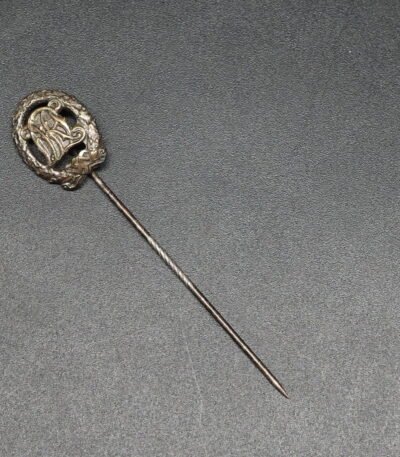
DRL Sportsbadge in Bronze Stickpin
€25,00Original DRL Sportsbadge in Bronze Stickpin. Condition as seen.
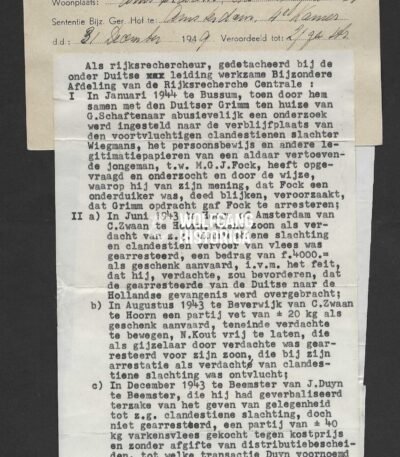
Post-War Dutch Judicial Index Card – Rijksrechercheur (born in Opsterland)
€90,00Original post-war Dutch judicial registration card (justitiële / vonnissenkaart), accompanied by a typed judicial case summary, issued by the Dutch Special Court of Justice / Amsterdam Court of Appeal, dated 31 December 1949, sentencing a national police investigator to 2 years imprisonment for collaboration-era abuses.
This historically significant artifact documents misconduct by a Rijksrechercheur (national police investigator) who was operating while seconded to a Central National Police Investigation Special Department under German command during WWII.
A rare and powerful piece of Dutch WWII judicial and policing history with clear relevance to occupation-era abuse of authority and post-war accountability.
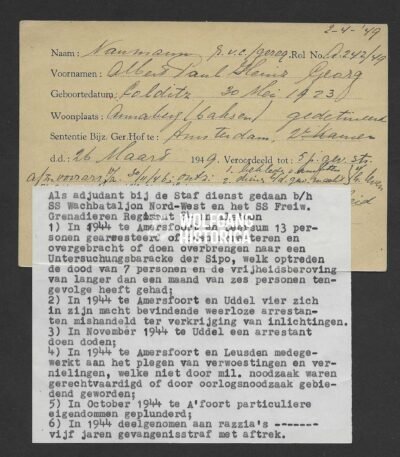
Post-War Dutch Judicial Index Card – Wachbataillon “Nordwest” & SS-Freiwilligen-Grenadier-Rgt. 84
€90,00Original post-war Dutch judicial registration card (justitiële / vonnissenkaart), accompanied by a typed judicial case summary, relating to a German War Criminal, the notorious Landwacht commander of Winschoten.
These documents originate from the Dutch Bijzondere Rechtspleging (Special Courts), established after WWII to prosecute collaboration and war crimes.
Translated judicial content (summary)
“Served as adjutant with the HQ at the SS-Wachbataillon Nordwest and the SS-Freiwilligen-Grenadier-Regiment 84 and at the time:”
In 1944 in Amersfoort and Leersum, arrested or had arrested 13 people and transferred or had them transferred to an investigation barracks of the Security Police (Sipo), which action resulted in the death of 7 people and the deprivation of liberty for more than one month of 6 people;
In 1944 in Amersfoort and Uddel, mistreated 4 defenseless detainees who were under his authority in order to obtain information;
In November 1944 in Uddel, killed one detainee;
In 1944 in Amersfoort and Leusden, assisted in committing acts of destruction and sabotage, which were not justified by military necessity or wartime emergency;
In October 1944 in Amersfoort, looted private property;
In 1944, participated in raids (round-ups of civilians);
Sentenced to five years imprisonment, with deduction (of time already served).
Condition
Original documents in used archival condition. Handwritten, typed, and stamped entries present. Wear consistent with age and official use.
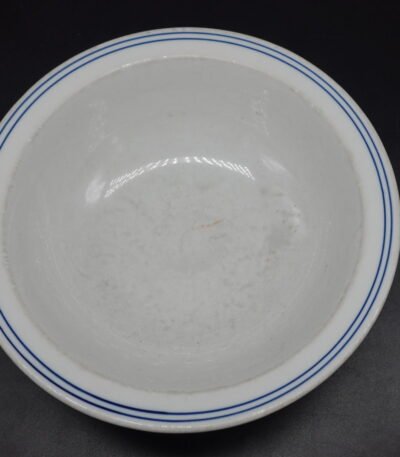
DAF Potato/Salad Bowl (Echt Unterglasur, KPM)
€40,00Original DAF Potato/Salad Bowl (Echt Unterglasur, KPM). Condition as seen.
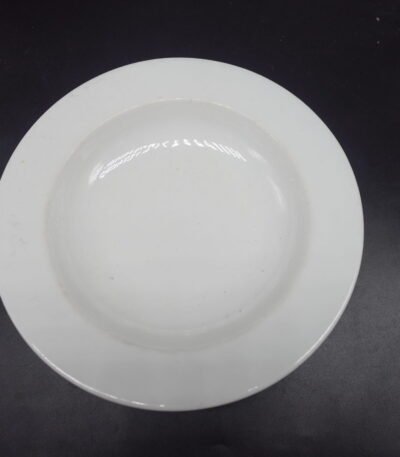
DAF Porcelain Soup Plate (Hutschenreuther Selb, LHS Bavaria)
€30,00Original DAF Porcelain Soup Plate (Hutschenreuther, Bavaria). Modell des Amtes – Schönheit der Arbeit. Condition as seen.
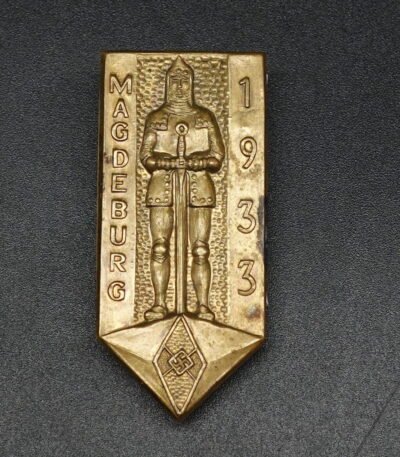
Hitlerjugend “Magdeburg 1933” Badge
€95,00Original Hitlerjugend Magdeburg 1933 Badge. Condition as seen.
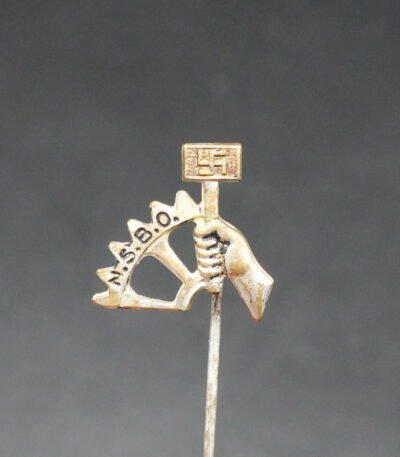
NSBO Membership Stickpin
€20,00Original NSBO (Nationalsozialistische Betriebszellenorganisation) Membership Stickpin. Condition as seen.
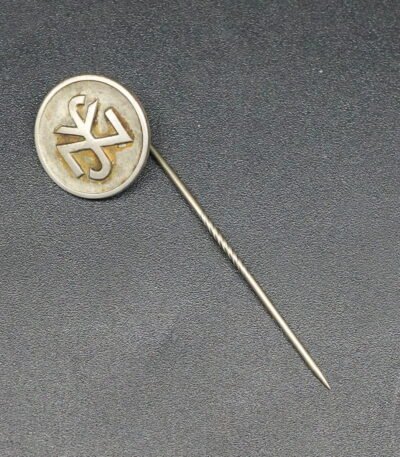
Nationalsozialistische Volkswohlfahrt (NSV) Membership Pin
€15,00Original Nationalsozialistische Volkswohlfahrt (NSV) Membership Pin. Condition as seen.
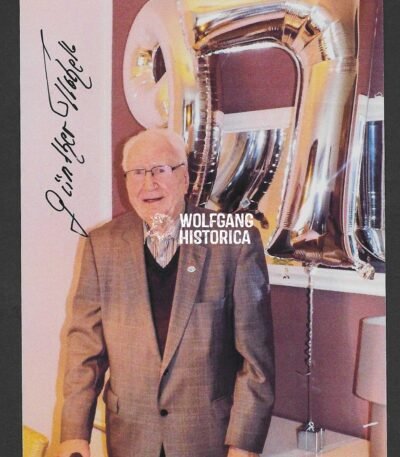
Günther Tlotzek – 11. Infanterie-Division
€15,00Original Postwar Signature on a Postwar Photo of Günther Tlotzek, who served with the 11. Infanterie-Division and also wrote a book. He sadly recently passed away. Postcardsize.
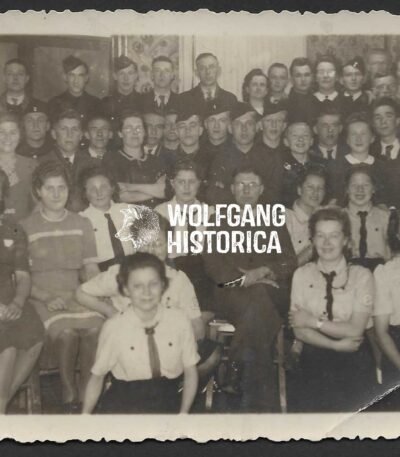
Photograph – NSKK, Zwarte Brigade, NSJ & DMS (Christmas Event)
€95,00Original 1941 Collaboration Photograph – NSKK, Zwarte Brigade, NSJ & Dietse Jeugd (Named Christmas Event)
Original World War II collaboration photograph documenting Flemish and Dutch nationalist organizations during a joint Christmas celebration in 1941.
The image shows members of:
-
NSKK (Nationalsozialistisches Kraftfahrkorps)
-
Zwarte Brigade / Zwarte Brigades (ZB), the paramilitary wing of the Flemish National Union (VNV)
-
Jeugdstorm, the youth movement of the Dutch NSB
-
Dietse Meisjesscharen (DMS), the girls’ section of the VNV youth organization
-
NSJ (Nationaal-Socialistische Jeugd in Vlaanderen), Flemish nationalist youth
-
Likely Jeugdstorm formations, reflecting the cooperation between Dutch and Flemish collaboration groups
The reverse bears the original handwritten notation:
“Gezamenlijk kerstfeest NSKK, ZB, NSJ 1941” (“Joint Christmas celebration NSKK, Zwarte Brigade, NSJ 1941”), confirming the event, organizations involved, and year.
Details:
-
Authentic wartime photograph (1941)
-
Subject: Flemish & Dutch collaboration organizations
-
Joint Christmas event, outdoor/group celebration setting
-
Period-written description on reverse
-
Size: standard period photograph format (as shown)
Condition:
Original, with expected age and handling wear. Image and reverse text remain clear and legible. No modern reproduction.
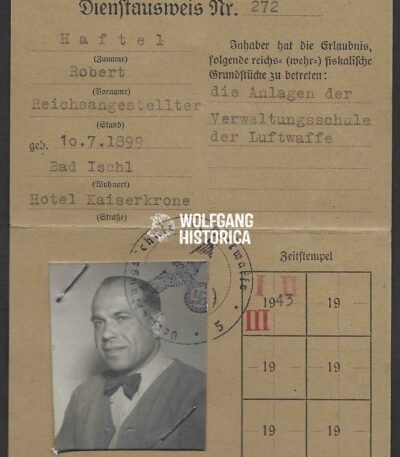
Dienstausweis – Verwaltungsschule der Luftwaffe
Original price was: €65,00.€55,00Current price is: €55,00.Original Dienstausweis (Service ID) for a Civilian Employee at the Verwaltungsschule der Luftwaffe. ID issued by the Verwaltungsschule der Luftwaffe. Condition as seen.
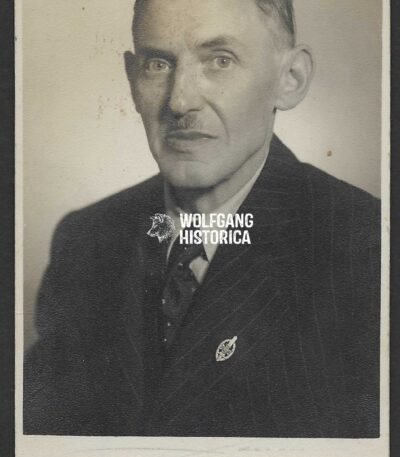
Rare Studioportrait Civilian wearing NSKOV Pin (!)
€10,00Original and rare Studioportrait of a civilian wearing the NSKOV Pin (!). Postcardsize. Condition as seen.
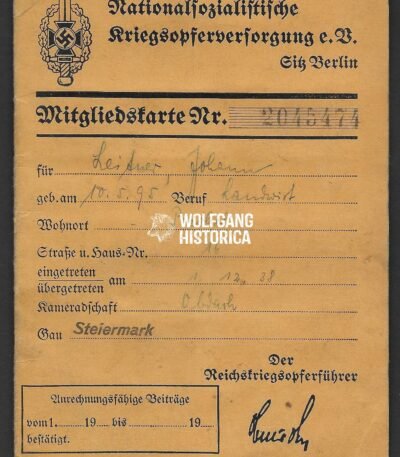
NSKOV Kriegsopferversorgung Mitgliedskarte (Steiermark)
€30,00Original Mitgliedskarte (Membership card) of the NSKOV (Nationalsozialistische Kriegsopferversorgung) (National Socialist War Victim’s Care). Gau Steiermark. Complete with stamps. Condition as seen.
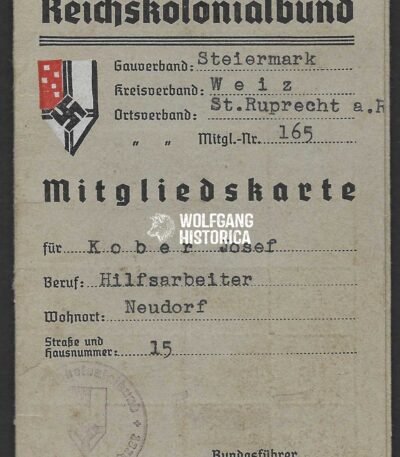
Reichskolonialbund Mitgliedskarte
€30,00Original Reichskolonialbund Mitgliedskarte. Condition as seen. Complete with stamps.
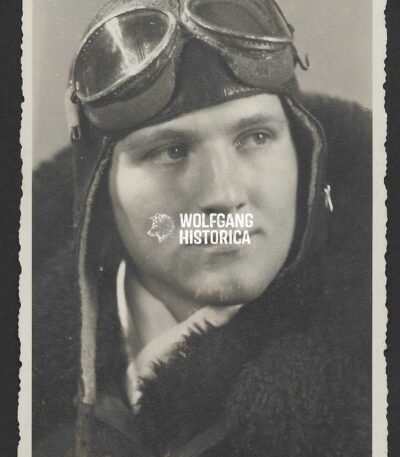
Luftwaffe Pilot Studioportrait in Winter Flying Gear
€10,00Original Luftwaffe Pilot Studioportrait in Winter Flying Gear. Postcardsize.
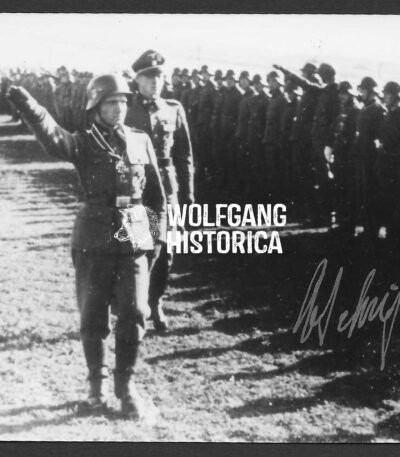
Remi Schrijnen – 6. SS-Freiwilligen-Sturmbrigade “Langemarck”
€35,00Original Postwar Signature on a Postwar Photo of Remi Schrijnen. SS-Unterscharführer Remi Schrijnen (24.12.1921 † 27.07.2006) earned the Ritterkreuz on September 21, 1944 as SS-Sturmmann und Richtschütze in the 6. Kompanie/ 6. SS-Freiwilligen-Sturmbrigade “Langemarck”. Condition as seen. Smaller than postcardsize.
Knight’s Cross: “On 29.07.1944 Schrijnen was serving as the crew of a Pak 40 in the middle of a major Soviet tank/infantry attack. His position was hit by a heavy artillery barrage, with several rounds impacting just 10 metres behind the gun. Schrijnen was hit by several shell splinters, but the four other crewman all became casualties. Under the weight of the Soviet attack the order was given to withdraw. Schrijnen however disobeyed the order and remained behind to cover his comrades. Despite being wounded, exhausted and vastly outnumbered he was still able to knock out 4 T-34s and 3 IS-2s before his gun was destroyed. Later, counterattacking German forces found Schrijnen unconscious on the battlefield. He would receive the Knight’s Cross for his actions this day as well as for prior successes as an anti-tank gunner.”
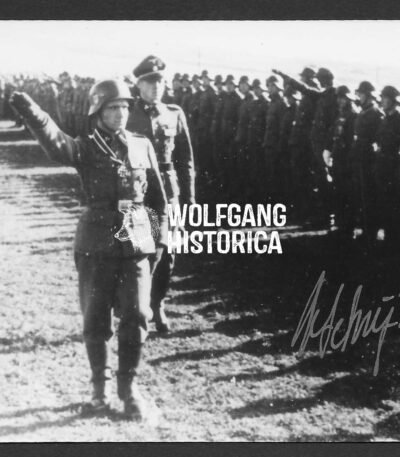
Remi Schrijnen – 6. SS-Freiwilligen-Sturmbrigade “Langemarck”
€35,00Original Postwar Signature on a Postwar Photo of Remi Schrijnen. SS-Unterscharführer Remi Schrijnen (24.12.1921 † 27.07.2006) earned the Ritterkreuz on September 21, 1944 as SS-Sturmmann und Richtschütze in the 6. Kompanie/ 6. SS-Freiwilligen-Sturmbrigade “Langemarck”. Condition as seen. Smaller than postcardsize.
Knight’s Cross: “On 29.07.1944 Schrijnen was serving as the crew of a Pak 40 in the middle of a major Soviet tank/infantry attack. His position was hit by a heavy artillery barrage, with several rounds impacting just 10 metres behind the gun. Schrijnen was hit by several shell splinters, but the four other crewman all became casualties. Under the weight of the Soviet attack the order was given to withdraw. Schrijnen however disobeyed the order and remained behind to cover his comrades. Despite being wounded, exhausted and vastly outnumbered he was still able to knock out 4 T-34s and 3 IS-2s before his gun was destroyed. Later, counterattacking German forces found Schrijnen unconscious on the battlefield. He would receive the Knight’s Cross for his actions this day as well as for prior successes as an anti-tank gunner.”
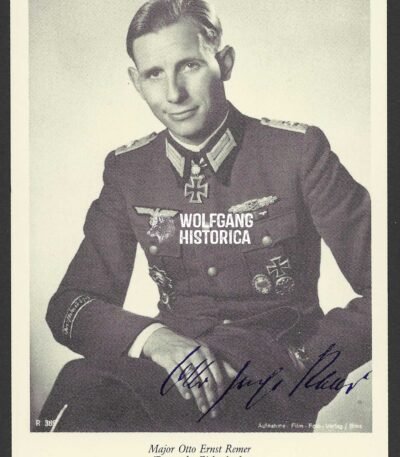
Otto Ernst Remer – Grenadier-Regiment “Grossdeutschland” (Eichenlaub) (Key Figure Stopping 20 July Plot)
€75,00Original Postwar Signature on a Postwar Photo of Otto Ernst Remer. Generalmajor Otto Ernst Remer (18.08.1912 † 04.10.1997) earned the Ritterkreuz on May 18, 1943 as Major und Kommandeur of I. Bataillon/ Grenadier-Regiment “Grossdeutschland” and the Eichenlaub on November 12, 1943 as Major und Kommandeur of I. Bataillon/ Grenadier-Regiment “Grossdeutschland”. He played a major role in stopping the 20 July plot in 1944 against Adolf Hitler. Postcardsize.
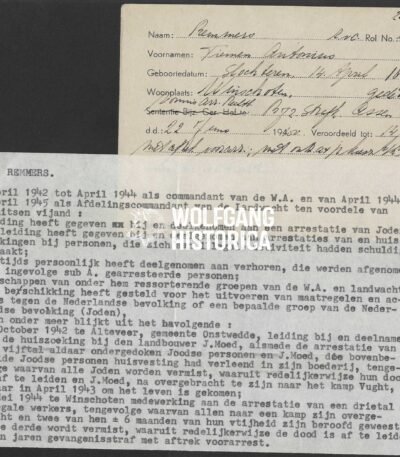
Post-War Dutch Judicial Index Card – Landwacht Commander (Winschoten)
€90,00Original post-war Dutch judicial registration card (justitiële / vonnissenkaart), accompanied by a typed judicial case summary, relating to Tiemen Antonius Remmers, the notorious Landwacht commander of Winschoten.
These documents originate from the Dutch Bijzondere Rechtspleging (Special Courts), established after WWII to prosecute collaboration and war crimes.
Original documents in used archival condition. Handwritten, typed, and stamped entries present. Wear consistent with age and official use.
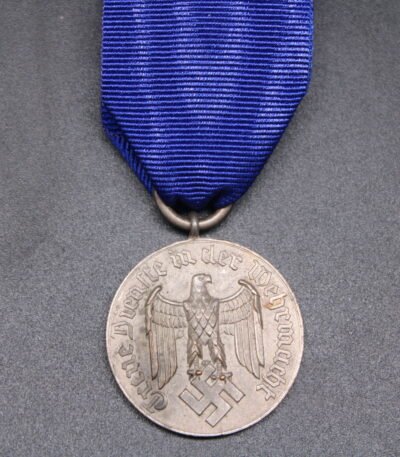
Wehrmacht Dienstauszeichnung für 4 Jahre
€80,00Original Wehrmacht Dienstauszeichnung für 4 Jahre (4 Years of Service Award). Medal complete with ribbon. Condition as seen.
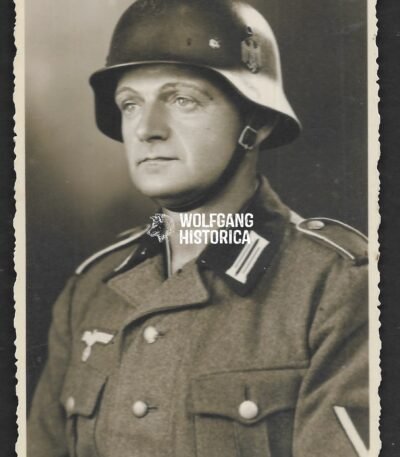
Studioportrait Wehrmacht Soldier wearing helmet (with decal)
€25,00Original Wehrmacht (Heer) studioportrait of a soldier wearing a helmet with decal. Postcardsize. Condition as seen.
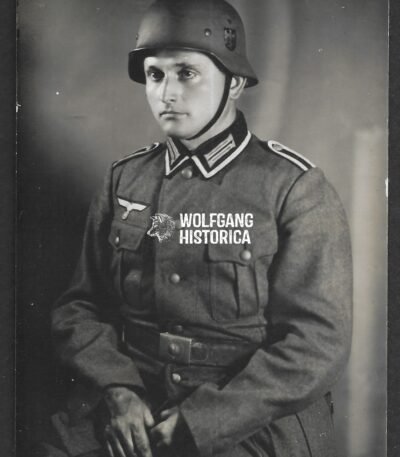
Studioportrait Wehrmacht Soldier wearing helmet (with decal)
€15,00Original Wehrmacht (Heer) studioportrait of a soldier wearing a helmet with decal. Postcardsize. Condition as seen.
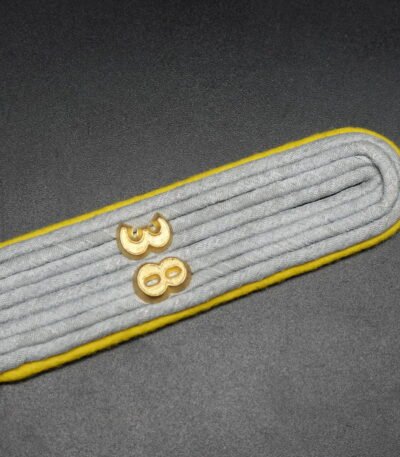
Nachrichten-Abteilung 38 Leutnant Shoulder Board
€75,00Original single (to sew in) Leutnant (Lieutenant) shoulder board for the Nachrichten-Abteilung 38 of the 2. Panzer-Division. Condition as seen.
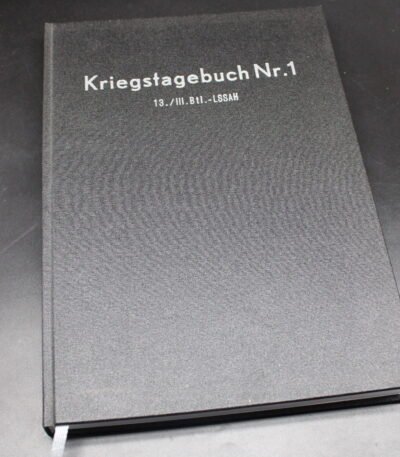
Gerhard Schulze – Kriegstagebuch Nr. 1 – 13. / III. Btl. – LSSAH
€95,00Original book of Schulze, Gerhard: Kriegstagebuch Nr. 1 – 18./IV. [Wach-] Btl.- LSSAH umbenannt in 13. / III. Btl. – LSSAH. – begonnen 13. 11. 1939 und beendet 03. 07. 1942. A4 size.
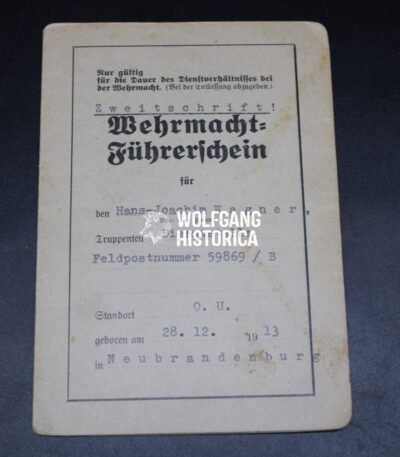
Rare Wehrmacht-Führerschein – Issued to Ritterkreuzträger Hans-Joachim Wagner
€350,00Original Wehrmacht-Führerschein (Zweitschrift) to later Ritterkreuzträger Hans-Joachim Wagner – at the time serving with Feldpostnummer 59869 B (1. Batterie / Sturmgeschütz-Abteilung 261).
-
Name: Hans-Joachim Wagner
-
Born: 28 December 1913, Neubrandenburg
-
Died: 9 June 1985, Kiel
-
Rank at issue: Soldat of a Sturmgeschütz unit (later Hauptmann d.R.)
-
Document: Wehrmacht driver’s license, Zweitschrift (duplicate), valid only in connection with the Soldbuch
-
Dated: 18.08.1944
-
Authorisation: Permits him to drive motor vehicles with internal-combustion engines of classes 1–3
-
Unit notation: Feldpostnummer 59869/B = 1. Batterie / Sturmgeschütz-Abteilung 261
-
Signature: Signed by Major und Kommandeur Fritz Konopka (NOT Gerhard Konopka), as “Hauptmann u. Führer der Brigade”, with clear unit stamp
Wagner later became a decorated assault-gun commander:
-
Decoration: Ritterkreuz des Eisernen Kreuzes, 25.01.1945
-
Rank / unit at award: Hauptmann der Reserve, Sturmgeschütz-Brigade 286
-
Reason for award (summary): On 5 December 1944, near Pásztó in Hungary, Wagner’s Sturmgeschütze helped stop a Soviet breakthrough to the northwest. His guns knocked out several enemy tanks, forced the remaining tanks and accompanying infantry to break off the attack, and he then rallied fleeing Flak gunners from 18. SS-Panzergrenadier-Division “Horst Wessel”, bringing them back into their positions. With these Flak guns and his assault guns he created a blocking line that held for several days without reinforcement – an action that earned him the Knight’s Cross.
Note: Sold on Commission
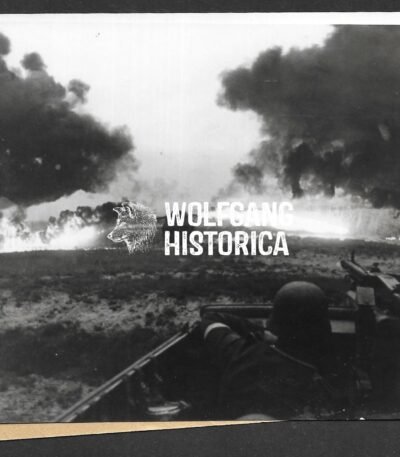
German Press Photo – Panzergrenadiers in Training, July 1944 (“Brennende Erde”)
€100,00Original wartime German press photograph showing Panzergrenadiers (armored infantry) during frontline training. The detailed typed caption explains the vital combat role of the Panzergrenadier, fighting in close cooperation with armored vehicles and assault guns, often in burning or contested areas — the literal “Brennende Erde” (“Burning Earth”) of the front.
Reverse caption reads:
“Panzergrenadiere in kriegsnaher Ausbildung. Auf allen Kriegsschauplätzen ist der Panzergrenadier an entscheidender Stelle dabei: er bildet heute den Rückhalt der Fronten immer da, wo ein Brennpunkt ist. Im Schutze des Schützenpanzerwagens geht er zum Angriff auf die feindlichen Linien vor… Schützenpanzer mit Flammenwerfern fahren mit aufgesessenen Panzergrenadieren in den Feind.”
(Panzergrenadiers in combat training. On every front, the Panzergrenadier plays a decisive role, providing the backbone of the lines wherever the fighting is fiercest. Under the protection of armored vehicles, they advance to attack enemy positions; assault vehicles with flamethrowers move forward with mounted Panzergrenadiers into the fight.)
-
Caption Title: “Brennende Erde” (“Burning Earth”)
-
Date: 20 July 1944
-
Photographer / PK Unit: Kriegsberichter Hellfritzsch (G/M)
-
Caption Code: L 2334 Wb EM
-
Agency Stamp: Weltbild Presseservice, Frankfurt am Main (on reverse)
-
Size: approx. 18 × 13 cm
-
Condition: Very good – complete typed caption slip, period pencil annotations, minor edge wear consistent with age.
Historical Context
Taken during the summer of 1944, this photo captures the intense training and battlefield readiness of Panzergrenadier units at a time when German armored forces were engaged in desperate fighting on both Eastern and Western Fronts. The use of the title “Brennende Erde” reflects the scorched landscapes of the Eastern Front and the fierce mechanized warfare characteristic of late-war operations.
Collector’s Note
An excellent and atmospheric Weltbild press photograph illustrating the frontline role of Panzergrenadiers in 1944. Photos from this period with strong thematic titles and complete typed wartime captions are highly collectible, especially when tied to armored and mechanized units. A strong addition for collectors of Wehrmacht, Panzertruppe, and propaganda photography.
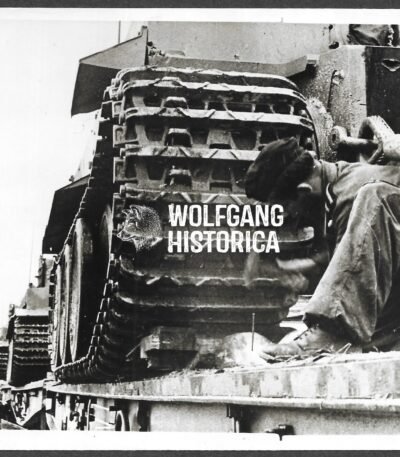
German Press Photo – Transport of Tiger Tanks, July 1944
€125,00Original wartime German press photograph showing Tiger tanks being secured for transport using strong steel cables (Stahltrossen) and wooden chocks placed under their wide caterpillar tracks. The detailed caption explains how the heavy tanks were fastened and stabilized during movement to prevent shifting on railway or transport vehicles.
The reverse caption reads:
“Mit starken Stahltrossen werden die Tigerpanzer festgezurrt, unter die breiten Raupenketten werden hölzerne Hemmschuhe getrieben. Sie sind so gegen Schlingern der fahrenden Wagen gesichert.”
(With strong steel cables, the Tiger tanks are lashed down; wooden chocks are driven under their wide tracks to secure them against swaying during transport.)
-
Date: 10 July 1944
-
Photographer / PK Unit: Kriegsberichter Knirsch (/vb)
-
Agency Stamp: Weltbild Presseservice, Frankfurt am Main (stamped on reverse)
-
Caption Code: L 2129 Wb EM
-
Size: approx. 18 × 13 cm
-
Condition: Excellent for age – sharp image, full typed caption label intact on reverse, light handling consistent with period use.
Historical Context
Photographed in July 1944, this image dates from the height of the fighting in Normandy, when Tiger I heavy tanks were urgently moved between fronts to counter the Allied invasion. The photo highlights the logistical challenge of transporting these massive armored vehicles safely — an essential part of Wehrmacht operations.
Collector’s Note
Original Weltbild press photos featuring Tiger tanks are highly desirable among collectors due to their rarity and direct connection to armored warfare on the Western Front. This example, complete with a detailed original typed caption slip and agency stamp, offers both visual impact and historical depth — a fine addition to any WWII armor or propaganda photo collection.
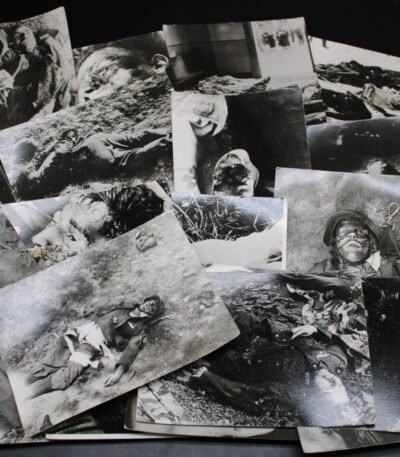
Gruesome Photolot (Postwar Copies) of Murdered/Dead German Soldiers
€200,0020x Gruesome Photolot (Postwar Copies) of Murdered/Dead German Soldiers (of which 1 or 2 with civilians)
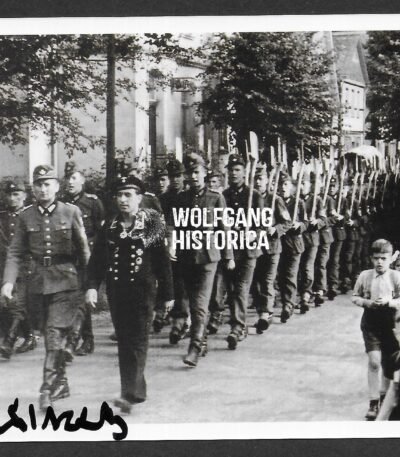
Othmar Hermes – Grenadier-Regiment 464 (253. Infanterie-Division)
€15,00Original Postwar Signature on a Postwar Photo of Othmar Hermes
Leutnant Othmar Hermes (25 November 1925 – 12 January 2014) was a decorated front-line soldier of the Wehrmacht who distinguished himself during the heavy fighting on the Eastern Front.
Awards and Decorations
-
Iron Cross 2nd Class (Eisernes Kreuz II. Klasse)
-
Iron Cross 1st Class (Eisernes Kreuz I. Klasse)
-
Infantry Assault Badge (Infanterie-Sturmabzeichen)
-
Wound Badge (Verwundetenabzeichen)
-
Knight’s Cross of the Iron Cross (Ritterkreuz des Eisernen Kreuzes) – 11 June 1944 as Gefreiter und Kompaniemelder, 6. Kompanie / Grenadier-Regiment 464, 253. Infanterie-Division
Career Highlights
-
Eastern Front Service: Fought with Grenadier-Regiment 464 during the bitter defensive battles against the advancing Red Army.
-
Knight’s Cross Action: Recognized for his extraordinary bravery as a company runner (Kompaniemelder). Despite being only a Gefreiter, Hermes showed decisive courage under fire, contributing directly to the survival and fighting capacity of his unit.
-
Postwar Career: Rose to the rank of Leutnant der Reserve and lived a long postwar life, passing away in 2014.
Item Details
-
Type: Original postwar signed photograph
-
Size: Postcard format
-
Condition: As seen – good condition, clear autograph
Collector’s Note
Hermes stands out as one of the youngest Knight’s Cross recipients of the Wehrmacht, having earned the high award as just a Gefreiter at age 18. His autograph is sought after for its rarity and for the remarkable circumstances of his Ritterkreuz award.
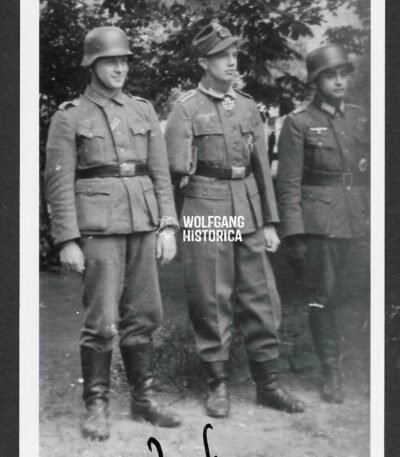
Othmar Hermes – Grenadier-Regiment 464 (253. Infanterie-Division)
€15,00Original Postwar Signature on a Postwar Photo of Othmar Hermes
Leutnant Othmar Hermes (25 November 1925 – 12 January 2014) was a decorated front-line soldier of the Wehrmacht who distinguished himself during the heavy fighting on the Eastern Front.
Awards and Decorations
-
Iron Cross 2nd Class (Eisernes Kreuz II. Klasse)
-
Iron Cross 1st Class (Eisernes Kreuz I. Klasse)
-
Infantry Assault Badge (Infanterie-Sturmabzeichen)
-
Wound Badge (Verwundetenabzeichen)
-
Knight’s Cross of the Iron Cross (Ritterkreuz des Eisernen Kreuzes) – 11 June 1944 as Gefreiter und Kompaniemelder, 6. Kompanie / Grenadier-Regiment 464, 253. Infanterie-Division
Career Highlights
-
Eastern Front Service: Fought with Grenadier-Regiment 464 during the bitter defensive battles against the advancing Red Army.
-
Knight’s Cross Action: Recognized for his extraordinary bravery as a company runner (Kompaniemelder). Despite being only a Gefreiter, Hermes showed decisive courage under fire, contributing directly to the survival and fighting capacity of his unit.
-
Postwar Career: Rose to the rank of Leutnant der Reserve and lived a long postwar life, passing away in 2014.
Item Details
-
Type: Original postwar signed photograph
-
Size: Postcard format
-
Condition: As seen – good condition, clear autograph
Collector’s Note
Hermes stands out as one of the youngest Knight’s Cross recipients of the Wehrmacht, having earned the high award as just a Gefreiter at age 18. His autograph is sought after for its rarity and for the remarkable circumstances of his Ritterkreuz award.
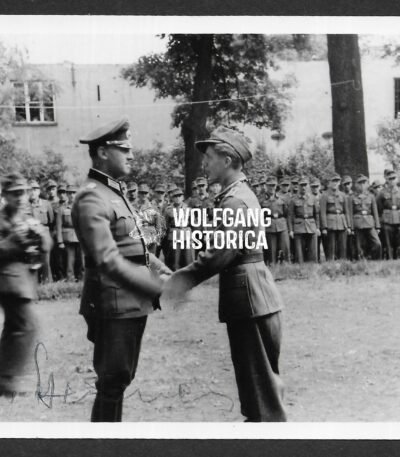
Othmar Hermes – Grenadier-Regiment 464 (253. Infanterie-Division)
€15,00Original Postwar Signature on a Postwar Photo of Othmar Hermes
Leutnant Othmar Hermes (25 November 1925 – 12 January 2014) was a decorated front-line soldier of the Wehrmacht who distinguished himself during the heavy fighting on the Eastern Front.
Awards and Decorations
-
Iron Cross 2nd Class (Eisernes Kreuz II. Klasse)
-
Iron Cross 1st Class (Eisernes Kreuz I. Klasse)
-
Infantry Assault Badge (Infanterie-Sturmabzeichen)
-
Wound Badge (Verwundetenabzeichen)
-
Knight’s Cross of the Iron Cross (Ritterkreuz des Eisernen Kreuzes) – 11 June 1944 as Gefreiter und Kompaniemelder, 6. Kompanie / Grenadier-Regiment 464, 253. Infanterie-Division
Career Highlights
-
Eastern Front Service: Fought with Grenadier-Regiment 464 during the bitter defensive battles against the advancing Red Army.
-
Knight’s Cross Action: Recognized for his extraordinary bravery as a company runner (Kompaniemelder). Despite being only a Gefreiter, Hermes showed decisive courage under fire, contributing directly to the survival and fighting capacity of his unit.
-
Postwar Career: Rose to the rank of Leutnant der Reserve and lived a long postwar life, passing away in 2014.
Item Details
-
Type: Original postwar signed photograph
-
Size: Postcard format
-
Condition: As seen – good condition, clear autograph
Collector’s Note
Hermes stands out as one of the youngest Knight’s Cross recipients of the Wehrmacht, having earned the high award as just a Gefreiter at age 18. His autograph is sought after for its rarity and for the remarkable circumstances of his Ritterkreuz award.
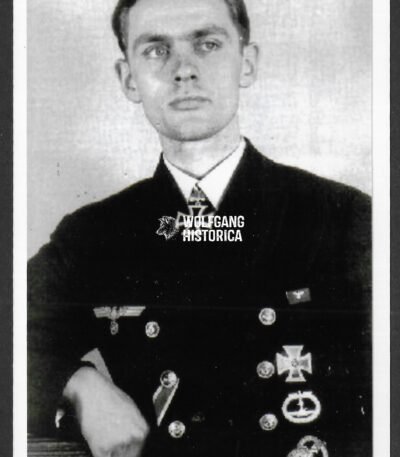
Reinhard Hardegen – Kommandant of “U-123” (Eichenlaub)
€45,00Original Postwar Signature on a Postwar Photo of Reinhard Hardegen
Korvettenkapitän Reinhard Hardegen (18 March 1913 – 9 June 2018) was one of the most well-known U-boat commanders of the Second World War. As commander of U-123, he led highly successful patrols during Operation Drumbeat (Paukenschlag) off the American East Coast, becoming a prominent figure in the Battle of the Atlantic.
Awards and Decorations
-
Iron Cross 2nd Class (Eisernes Kreuz II. Klasse)
-
Iron Cross 1st Class (Eisernes Kreuz I. Klasse)
-
U-boat War Badge (U-Boots-Kriegsabzeichen)
-
Knight’s Cross of the Iron Cross (Ritterkreuz des Eisernen Kreuzes) – 23 January 1942 as Kapitänleutnant und Kommandant of U-123
-
Oak Leaves to the Knight’s Cross (Eichenlaub) – 23 April 1942 as Kapitänleutnant und Kommandant of U-123
Career Highlights
-
U-boat Commander: Commanded U-123 during the early successes of the Atlantic campaign.
-
Operation Drumbeat: Led patrols along the American coast in 1942, sinking numerous merchant vessels and bringing the war directly to US waters.
-
Confirmed Successes: Credited with sinking 25 ships, a total tonnage exceeding 136,000 GRT.
-
Postwar Life: Survived captivity, later becoming a businessman and politician in Bremen. He lived to the remarkable age of 105, making him one of the last surviving U-boat aces.
Item Details
-
Type: Original postwar signed photograph
-
Size: Postcard format
-
Condition: As seen – clear, bold signature
Collector’s Note
Reinhard Hardegen is one of the best-documented and longest-living Ritterkreuzträger of the U-Bootwaffe. His postwar reflections on the morality and tragedy of the U-boat war, combined with his unique longevity, make his autograph especially desirable. This piece offers both a tangible connection to the Atlantic U-boat campaign and to one of its most famous commanders.
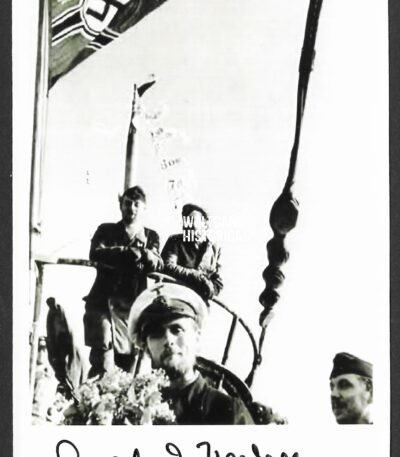
Reinhard Hardegen – Kommandant of “U-123” (Eichenlaub)
€45,00Original Postwar Signature on a Postwar Photo of Reinhard Hardegen
Korvettenkapitän Reinhard Hardegen (18 March 1913 – 9 June 2018) was one of the most well-known U-boat commanders of the Second World War. As commander of U-123, he led highly successful patrols during Operation Drumbeat (Paukenschlag) off the American East Coast, becoming a prominent figure in the Battle of the Atlantic.
Awards and Decorations
-
Iron Cross 2nd Class (Eisernes Kreuz II. Klasse)
-
Iron Cross 1st Class (Eisernes Kreuz I. Klasse)
-
U-boat War Badge (U-Boots-Kriegsabzeichen)
-
Knight’s Cross of the Iron Cross (Ritterkreuz des Eisernen Kreuzes) – 23 January 1942 as Kapitänleutnant und Kommandant of U-123
-
Oak Leaves to the Knight’s Cross (Eichenlaub) – 23 April 1942 as Kapitänleutnant und Kommandant of U-123
Career Highlights
-
U-boat Commander: Commanded U-123 during the early successes of the Atlantic campaign.
-
Operation Drumbeat: Led patrols along the American coast in 1942, sinking numerous merchant vessels and bringing the war directly to US waters.
-
Confirmed Successes: Credited with sinking 25 ships, a total tonnage exceeding 136,000 GRT.
-
Postwar Life: Survived captivity, later becoming a businessman and politician in Bremen. He lived to the remarkable age of 105, making him one of the last surviving U-boat aces.
Item Details
-
Type: Original postwar signed photograph
-
Size: Postcard format
-
Condition: As seen – clear, bold signature
Collector’s Note
Reinhard Hardegen is one of the best-documented and longest-living Ritterkreuzträger of the U-Bootwaffe. His postwar reflections on the morality and tragedy of the U-boat war, combined with his unique longevity, make his autograph especially desirable. This piece offers both a tangible connection to the Atlantic U-boat campaign and to one of its most famous commanders.
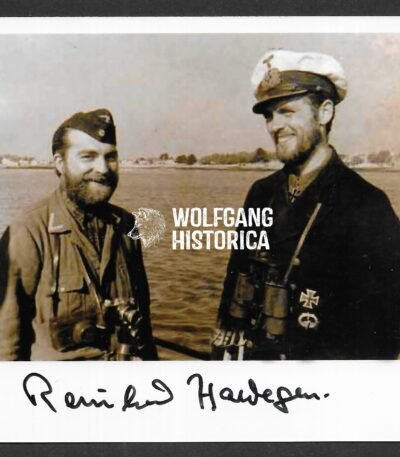
Reinhard Hardegen – Kommandant of “U-123” (Eichenlaub)
€45,00Original Postwar Signature on a Postwar Photo of Reinhard Hardegen
Korvettenkapitän Reinhard Hardegen (18 March 1913 – 9 June 2018) was one of the most well-known U-boat commanders of the Second World War. As commander of U-123, he led highly successful patrols during Operation Drumbeat (Paukenschlag) off the American East Coast, becoming a prominent figure in the Battle of the Atlantic.
Awards and Decorations
-
Iron Cross 2nd Class (Eisernes Kreuz II. Klasse)
-
Iron Cross 1st Class (Eisernes Kreuz I. Klasse)
-
U-boat War Badge (U-Boots-Kriegsabzeichen)
-
Knight’s Cross of the Iron Cross (Ritterkreuz des Eisernen Kreuzes) – 23 January 1942 as Kapitänleutnant und Kommandant of U-123
-
Oak Leaves to the Knight’s Cross (Eichenlaub) – 23 April 1942 as Kapitänleutnant und Kommandant of U-123
Career Highlights
-
U-boat Commander: Commanded U-123 during the early successes of the Atlantic campaign.
-
Operation Drumbeat: Led patrols along the American coast in 1942, sinking numerous merchant vessels and bringing the war directly to US waters.
-
Confirmed Successes: Credited with sinking 25 ships, a total tonnage exceeding 136,000 GRT.
-
Postwar Life: Survived captivity, later becoming a businessman and politician in Bremen. He lived to the remarkable age of 105, making him one of the last surviving U-boat aces.
Item Details
-
Type: Original postwar signed photograph
-
Size: Postcard format
-
Condition: As seen – clear, bold signature
Collector’s Note
Reinhard Hardegen is one of the best-documented and longest-living Ritterkreuzträger of the U-Bootwaffe. His postwar reflections on the morality and tragedy of the U-boat war, combined with his unique longevity, make his autograph especially desirable. This piece offers both a tangible connection to the Atlantic U-boat campaign and to one of its most famous commanders.
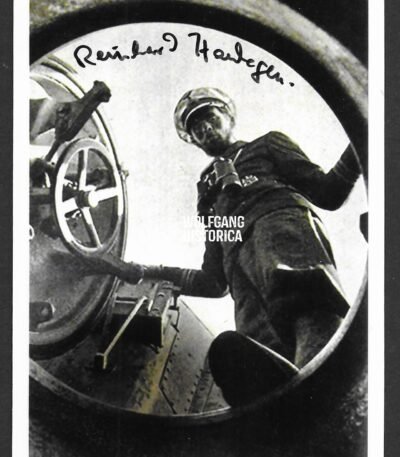
Reinhard Hardegen – Kommandant of “U-123” (Eichenlaub)
€45,00Original Postwar Signature on a Postwar Photo of Reinhard Hardegen
Korvettenkapitän Reinhard Hardegen (18 March 1913 – 9 June 2018) was one of the most well-known U-boat commanders of the Second World War. As commander of U-123, he led highly successful patrols during Operation Drumbeat (Paukenschlag) off the American East Coast, becoming a prominent figure in the Battle of the Atlantic.
Awards and Decorations
-
Iron Cross 2nd Class (Eisernes Kreuz II. Klasse)
-
Iron Cross 1st Class (Eisernes Kreuz I. Klasse)
-
U-boat War Badge (U-Boots-Kriegsabzeichen)
-
Knight’s Cross of the Iron Cross (Ritterkreuz des Eisernen Kreuzes) – 23 January 1942 as Kapitänleutnant und Kommandant of U-123
-
Oak Leaves to the Knight’s Cross (Eichenlaub) – 23 April 1942 as Kapitänleutnant und Kommandant of U-123
Career Highlights
-
U-boat Commander: Commanded U-123 during the early successes of the Atlantic campaign.
-
Operation Drumbeat: Led patrols along the American coast in 1942, sinking numerous merchant vessels and bringing the war directly to US waters.
-
Confirmed Successes: Credited with sinking 25 ships, a total tonnage exceeding 136,000 GRT.
-
Postwar Life: Survived captivity, later becoming a businessman and politician in Bremen. He lived to the remarkable age of 105, making him one of the last surviving U-boat aces.
Item Details
-
Type: Original postwar signed photograph
-
Size: Postcard format
-
Condition: As seen – clear, bold signature
Collector’s Note
Reinhard Hardegen is one of the best-documented and longest-living Ritterkreuzträger of the U-Bootwaffe. His postwar reflections on the morality and tragedy of the U-boat war, combined with his unique longevity, make his autograph especially desirable. This piece offers both a tangible connection to the Atlantic U-boat campaign and to one of its most famous commanders.
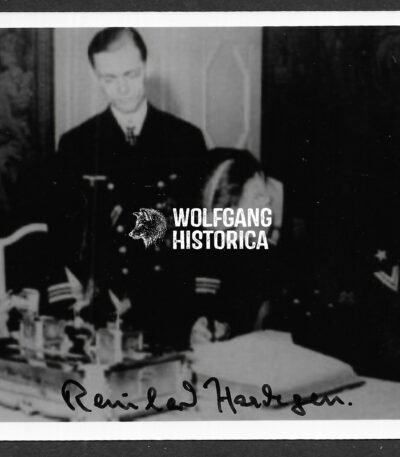
Reinhard Hardegen – Kommandant of “U-123” (Eichenlaub)
€45,00Original Postwar Signature on a Postwar Photo of Reinhard Hardegen
Korvettenkapitän Reinhard Hardegen (18 March 1913 – 9 June 2018) was one of the most well-known U-boat commanders of the Second World War. As commander of U-123, he led highly successful patrols during Operation Drumbeat (Paukenschlag) off the American East Coast, becoming a prominent figure in the Battle of the Atlantic.
Awards and Decorations
-
Iron Cross 2nd Class (Eisernes Kreuz II. Klasse)
-
Iron Cross 1st Class (Eisernes Kreuz I. Klasse)
-
U-boat War Badge (U-Boots-Kriegsabzeichen)
-
Knight’s Cross of the Iron Cross (Ritterkreuz des Eisernen Kreuzes) – 23 January 1942 as Kapitänleutnant und Kommandant of U-123
-
Oak Leaves to the Knight’s Cross (Eichenlaub) – 23 April 1942 as Kapitänleutnant und Kommandant of U-123
Career Highlights
-
U-boat Commander: Commanded U-123 during the early successes of the Atlantic campaign.
-
Operation Drumbeat: Led patrols along the American coast in 1942, sinking numerous merchant vessels and bringing the war directly to US waters.
-
Confirmed Successes: Credited with sinking 25 ships, a total tonnage exceeding 136,000 GRT.
-
Postwar Life: Survived captivity, later becoming a businessman and politician in Bremen. He lived to the remarkable age of 105, making him one of the last surviving U-boat aces.
Item Details
-
Type: Original postwar signed photograph
-
Size: Postcard format
-
Condition: As seen – clear, bold signature
Collector’s Note
Reinhard Hardegen is one of the best-documented and longest-living Ritterkreuzträger of the U-Bootwaffe. His postwar reflections on the morality and tragedy of the U-boat war, combined with his unique longevity, make his autograph especially desirable. This piece offers both a tangible connection to the Atlantic U-boat campaign and to one of its most famous commanders.
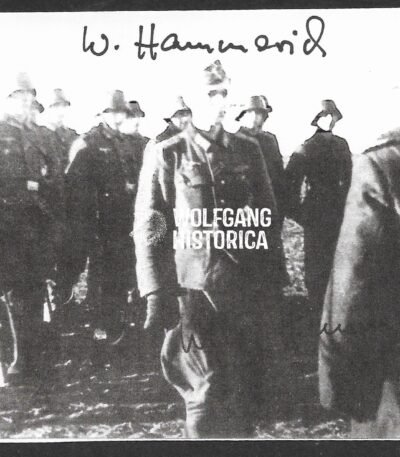
Willi Hammerich – Grenadier-Regiment 956
€15,00Original Postwar Signature on a Postwar Photo of Willi Hammerich
Oberleutnant Willi Hammerich (17 December 1921, Fleckeby – 21 November 2010, Schulensee) served as an infantry officer on the Western Front and distinguished himself in late 1944 during the defensive battles in Alsace. He was awarded the Knight’s Cross of the Iron Cross for his leadership and bravery as a company commander.
Awards and Decorations
- Knight’s Cross of the Iron Cross (Ritterkreuz des Eisernen Kreuzes) – 9 December 1944 as Oberleutnant und Chef 4./ Grenadier-Regiment 956, 362. Infanterie-Division
Career Highlights
-
Company Commander on the Western Front: Led 4./Grenadier-Regiment 956 in bitter defensive fighting in Alsace in late 1944.
-
Knight’s Cross Award: Recognized for exceptional leadership and courage under fire, contributing significantly to halting enemy attacks during this critical phase of the war.
-
Postwar Life: Survived the war and lived a long life in northern Germany, passing away in 2010 at the age of 88.
Item Details
-
Type: Original postwar signed photograph
-
Size: Postcard format
-
Condition: As seen – well preserved with clear signature
Collector’s Note
Willi Hammerich’s signature is sought after as he was a late-war Ritterkreuzträger whose award reflects the desperate fighting on the Western Front in the winter of 1944. A fine addition for collectors focused on company-level commanders and Knight’s Cross recipients of the infantry divisions deployed in Alsace.
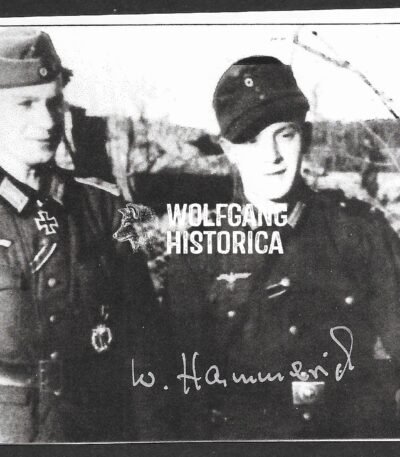
Willi Hammerich – Grenadier-Regiment 956
€15,00Original Postwar Signature on a Postwar Photo of Willi Hammerich
Oberleutnant Willi Hammerich (17 December 1921, Fleckeby – 21 November 2010, Schulensee) served as an infantry officer on the Western Front and distinguished himself in late 1944 during the defensive battles in Alsace. He was awarded the Knight’s Cross of the Iron Cross for his leadership and bravery as a company commander.
Awards and Decorations
- Knight’s Cross of the Iron Cross (Ritterkreuz des Eisernen Kreuzes) – 9 December 1944 as Oberleutnant und Chef 4./ Grenadier-Regiment 956, 362. Infanterie-Division
Career Highlights
-
Company Commander on the Western Front: Led 4./Grenadier-Regiment 956 in bitter defensive fighting in Alsace in late 1944.
-
Knight’s Cross Award: Recognized for exceptional leadership and courage under fire, contributing significantly to halting enemy attacks during this critical phase of the war.
-
Postwar Life: Survived the war and lived a long life in northern Germany, passing away in 2010 at the age of 88.
Item Details
-
Type: Original postwar signed photograph
-
Size: Postcard format
-
Condition: As seen – well preserved with clear signature
Collector’s Note
Willi Hammerich’s signature is sought after as he was a late-war Ritterkreuzträger whose award reflects the desperate fighting on the Western Front in the winter of 1944. A fine addition for collectors focused on company-level commanders and Knight’s Cross recipients of the infantry divisions deployed in Alsace.
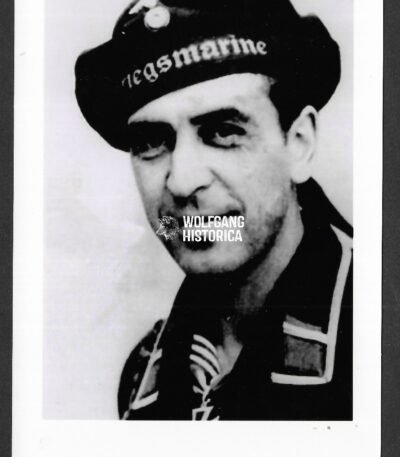
Walter Gerhold – Kleinkampf-Flottille 361 (Normandy!)
€40,00Original Postwar Signature on a Postwar Photo of Walther Gerhold
Schreiber-Obergefreiter Walther Gerhold (8 June 1921 – 2 March 2013) was a Kriegsmarine sailor and recipient of the Ritterkreuz des Eisernen Kreuzes for his daring action as a one-man torpedo operator with the Kleinkampfverbände.
Award and Citation
-
Ritterkreuz des Eisernen Kreuzes – 6 July 1944, as Schreiber-Obergefreiter und Einmanntorpedofahrer with Kleinkampf-Flottille 361.
-
Citation:
“The 23-year-old Schreiberobergefreiter Walter Gerhold, from Sauerland, is the first lone fighter from the Kriegsmarine to be awarded the Knight’s Cross for sinking a British cruiser of the Aurora-class under the most difficult conditions. Commanding his human torpedo, Gerhold passed six British destroyers at close range, broke through their security ring, and attacked a cruiser lying behind it with a skillful and calculated approach. The ship sank following a major boiler explosion. For his bravery before the enemy, Gerhold was also promoted to Schreibermaat.”
Item Details
-
Type: Original postwar signed photograph
-
Size: Postcard format
-
Condition: Very good, clear autograph
Collector’s Note
Walther Gerhold holds a special place in Kriegsmarine history as the first one-man torpedo operator to be decorated with the Knight’s Cross. His bold solo mission against a heavily defended Royal Navy formation showcases the extreme risks undertaken by the Kleinkampfverbände (small battle units). Autographs from Gerhold are scarce, making this postcard an excellent addition for collectors of Kriegsmarine and naval special forces memorabilia.
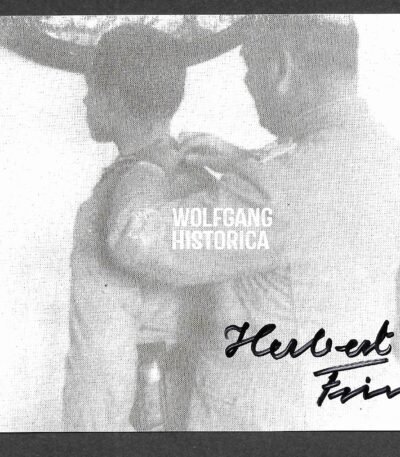
Herbert Fries – Fallschirm-Panzerjäger-Abteilung 1 (Pantherturm!)
€25,00Original Postwar Signature on a Postwar Photo of Herbert Fries
Leutnant Herbert Fries (1 March 1925, Waldmühlen – 6 January 2014, Rennerod-Emmerichenhain) was a Fallschirmjäger and one of the youngest recipients of the Ritterkreuz des Eisernen Kreuzes during the Second World War. Serving as a gunner in the 2./Fallschirm-Panzerjäger-Abteilung 1, 1. Fallschirmjäger-Division, he earned the Knight’s Cross for extraordinary anti-tank actions in Italy.
Award and Citation
-
Ritterkreuz des Eisernen Kreuzes – 5 September 1944, as Gefreiter und Geschützführer in the 2./Fallschirm-Panzerjäger-Abteilung 1
-
Citation: Recognized for his outstanding performance manning a Pantherturm defensive position on the Via Casilina near Piedimonte during the battles of May 1944.
-
21.05.1944 – Destroyed 7 Allied tanks
-
22.05.1944 – Destroyed 6 additional tanks
-
24.05.1944 – Destroyed another 7 tanks
-
Total: 20 enemy tanks destroyed in just three days, decisively slowing Allied advances.
-
-
After exhausting their position, Fries and his crew destroyed their turret (“Schlafmütze” / sleepyhead) and withdrew with the retreating German forces.
Item Details
-
Type: Original postwar signed photograph
-
Size: Postcardsize
-
Condition: As seen, well-preserved signature
Collector’s Note
Herbert Fries is remembered as one of the notable anti-tank fighters of the Luftwaffe’s ground formations. His signature is scarce compared to other Ritterkreuzträger, particularly on large-format photos such as this example. An impressive and historically rich autograph, highly desirable for collectors of Fallschirmjäger and anti-tank warfare memorabilia.
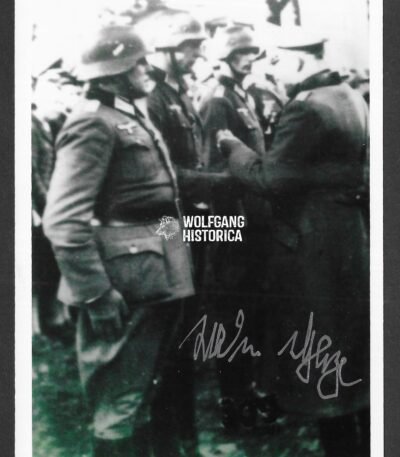
Waldemar von Gaza – Panzergrenadier-Regiment 66 (Schwertern)
€30,00Original Postwar Signature on a Postwar Photo of Waldemar von Gaza
Major Waldemar von Gaza (6 December 1917 – 13 January 2014) was a highly decorated officer of the 13. Panzer-Division, rising to command-level positions in armored infantry units on the Eastern Front. Over the course of the war, he received the Ritterkreuz des Eisernen Kreuzes with Eichenlaub and Schwertern, placing him among the most distinguished recipients of Germany’s highest battlefield awards.
Awards and Decorations
-
Ritterkreuz des Eisernen Kreuzes – 18 September 1942, as Oberleutnant und Chef 2./Panzergrenadier-Regiment 666, 13. Panzer-Division
-
Eichenlaub (Nr. 158) – 18 January 1943, as Hauptmann und Führer of a Kampfgruppe, 13. Panzer-Division
-
Schwerter (Nr. 324) – 3 October 1943, as Major und Führer of Panzergrenadier-Regiment 66, 13. Panzer-Division
-
Other awards included both classes of the Iron Cross and campaign distinctions
Service Highlights
-
Fought throughout the Eastern Front campaigns, earning distinction in combined-arms actions with armored infantry.
-
His leadership of Kampfgruppen during some of the most intense battles of 1942–43 earned him rapid recognition.
-
By 1943, he had risen to regimental command level, where he was awarded the Swords to the Knight’s Cross for continued outstanding leadership in combat.
Item Details
-
Type: Original postwar signed photograph
-
Size: Postcardsize
-
Condition: Good, as seen
Collector’s Note
Waldemar von Gaza’s decorations—Ritterkreuz, Eichenlaub, and Schwerter—mark him as one of the relatively few officers to attain this level of distinction. His signature is sought-after by collectors of panzer and Eastern Front memorabilia, with his long postwar life making his autograph available but still scarce in comparison to other triple recipients.
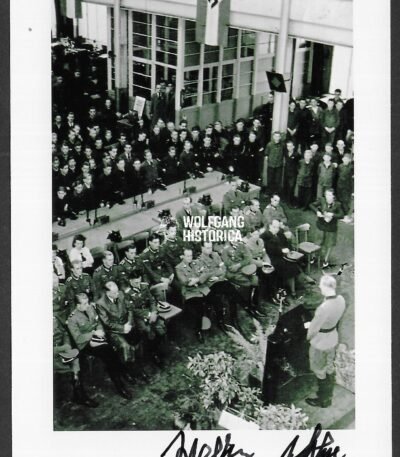
Waldemar von Gaza – Panzergrenadier-Regiment 66 (Schwertern)
€30,00Original Postwar Signature on a Postwar Photo of Waldemar von Gaza
Major Waldemar von Gaza (6 December 1917 – 13 January 2014) was a highly decorated officer of the 13. Panzer-Division, rising to command-level positions in armored infantry units on the Eastern Front. Over the course of the war, he received the Ritterkreuz des Eisernen Kreuzes with Eichenlaub and Schwertern, placing him among the most distinguished recipients of Germany’s highest battlefield awards.
Awards and Decorations
-
Ritterkreuz des Eisernen Kreuzes – 18 September 1942, as Oberleutnant und Chef 2./Panzergrenadier-Regiment 666, 13. Panzer-Division
-
Eichenlaub (Nr. 158) – 18 January 1943, as Hauptmann und Führer of a Kampfgruppe, 13. Panzer-Division
-
Schwerter (Nr. 324) – 3 October 1943, as Major und Führer of Panzergrenadier-Regiment 66, 13. Panzer-Division
-
Other awards included both classes of the Iron Cross and campaign distinctions
Service Highlights
-
Fought throughout the Eastern Front campaigns, earning distinction in combined-arms actions with armored infantry.
-
His leadership of Kampfgruppen during some of the most intense battles of 1942–43 earned him rapid recognition.
-
By 1943, he had risen to regimental command level, where he was awarded the Swords to the Knight’s Cross for continued outstanding leadership in combat.
Item Details
-
Type: Original postwar signed photograph
-
Size: Postcardsize
-
Condition: Good, as seen
Collector’s Note
Waldemar von Gaza’s decorations—Ritterkreuz, Eichenlaub, and Schwerter—mark him as one of the relatively few officers to attain this level of distinction. His signature is sought-after by collectors of panzer and Eastern Front memorabilia, with his long postwar life making his autograph available but still scarce in comparison to other triple recipients.
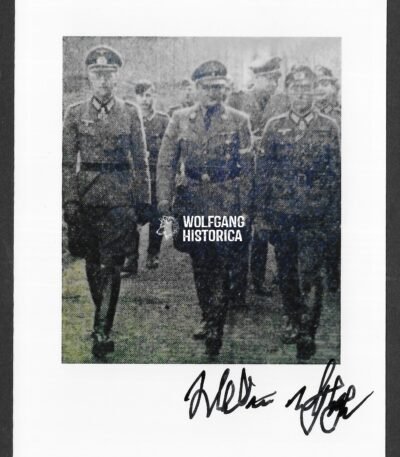
Waldemar von Gaza – Panzergrenadier-Regiment 66 (Schwertern)
€30,00Original Postwar Signature on a Postwar Photo of Waldemar von Gaza
Major Waldemar von Gaza (6 December 1917 – 13 January 2014) was a highly decorated officer of the 13. Panzer-Division, rising to command-level positions in armored infantry units on the Eastern Front. Over the course of the war, he received the Ritterkreuz des Eisernen Kreuzes with Eichenlaub and Schwertern, placing him among the most distinguished recipients of Germany’s highest battlefield awards.
Awards and Decorations
-
Ritterkreuz des Eisernen Kreuzes – 18 September 1942, as Oberleutnant und Chef 2./Panzergrenadier-Regiment 666, 13. Panzer-Division
-
Eichenlaub (Nr. 158) – 18 January 1943, as Hauptmann und Führer of a Kampfgruppe, 13. Panzer-Division
-
Schwerter (Nr. 324) – 3 October 1943, as Major und Führer of Panzergrenadier-Regiment 66, 13. Panzer-Division
-
Other awards included both classes of the Iron Cross and campaign distinctions
Service Highlights
-
Fought throughout the Eastern Front campaigns, earning distinction in combined-arms actions with armored infantry.
-
His leadership of Kampfgruppen during some of the most intense battles of 1942–43 earned him rapid recognition.
-
By 1943, he had risen to regimental command level, where he was awarded the Swords to the Knight’s Cross for continued outstanding leadership in combat.
Item Details
-
Type: Original postwar signed photograph
-
Size: Postcardsize
-
Condition: Good, as seen
Collector’s Note
Waldemar von Gaza’s decorations—Ritterkreuz, Eichenlaub, and Schwerter—mark him as one of the relatively few officers to attain this level of distinction. His signature is sought-after by collectors of panzer and Eastern Front memorabilia, with his long postwar life making his autograph available but still scarce in comparison to other triple recipients.
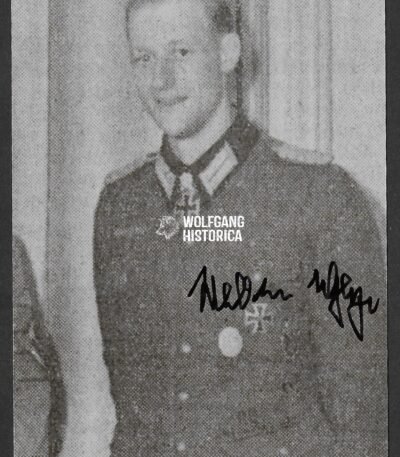
Waldemar von Gaza – Panzergrenadier-Regiment 66 (Schwertern)
€30,00Original Postwar Signature on a Postwar Photo of Waldemar von Gaza
Major Waldemar von Gaza (6 December 1917 – 13 January 2014) was a highly decorated officer of the 13. Panzer-Division, rising to command-level positions in armored infantry units on the Eastern Front. Over the course of the war, he received the Ritterkreuz des Eisernen Kreuzes with Eichenlaub and Schwertern, placing him among the most distinguished recipients of Germany’s highest battlefield awards.
Awards and Decorations
-
Ritterkreuz des Eisernen Kreuzes – 18 September 1942, as Oberleutnant und Chef 2./Panzergrenadier-Regiment 666, 13. Panzer-Division
-
Eichenlaub (Nr. 158) – 18 January 1943, as Hauptmann und Führer of a Kampfgruppe, 13. Panzer-Division
-
Schwerter (Nr. 324) – 3 October 1943, as Major und Führer of Panzergrenadier-Regiment 66, 13. Panzer-Division
-
Other awards included both classes of the Iron Cross and campaign distinctions
Service Highlights
-
Fought throughout the Eastern Front campaigns, earning distinction in combined-arms actions with armored infantry.
-
His leadership of Kampfgruppen during some of the most intense battles of 1942–43 earned him rapid recognition.
-
By 1943, he had risen to regimental command level, where he was awarded the Swords to the Knight’s Cross for continued outstanding leadership in combat.
Item Details
-
Type: Original postwar signed photograph
-
Size: Postcardsize
-
Condition: Good, as seen
Collector’s Note
Waldemar von Gaza’s decorations—Ritterkreuz, Eichenlaub, and Schwerter—mark him as one of the relatively few officers to attain this level of distinction. His signature is sought-after by collectors of panzer and Eastern Front memorabilia, with his long postwar life making his autograph available but still scarce in comparison to other triple recipients.
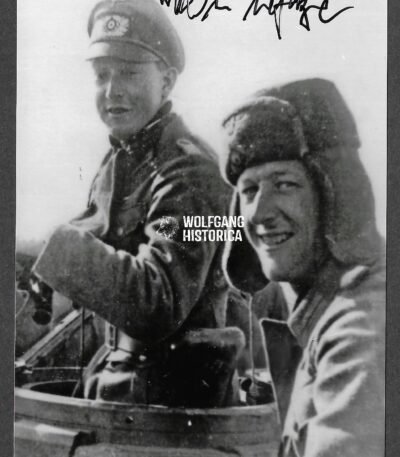
Waldemar von Gaza – Panzergrenadier-Regiment 66 (Schwertern)
€30,00Original Postwar Signature on a Postwar Photo of Waldemar von Gaza
Major Waldemar von Gaza (6 December 1917 – 13 January 2014) was a highly decorated officer of the 13. Panzer-Division, rising to command-level positions in armored infantry units on the Eastern Front. Over the course of the war, he received the Ritterkreuz des Eisernen Kreuzes with Eichenlaub and Schwertern, placing him among the most distinguished recipients of Germany’s highest battlefield awards.
Awards and Decorations
-
Ritterkreuz des Eisernen Kreuzes – 18 September 1942, as Oberleutnant und Chef 2./Panzergrenadier-Regiment 666, 13. Panzer-Division
-
Eichenlaub (Nr. 158) – 18 January 1943, as Hauptmann und Führer of a Kampfgruppe, 13. Panzer-Division
-
Schwerter (Nr. 324) – 3 October 1943, as Major und Führer of Panzergrenadier-Regiment 66, 13. Panzer-Division
-
Other awards included both classes of the Iron Cross and campaign distinctions
Service Highlights
-
Fought throughout the Eastern Front campaigns, earning distinction in combined-arms actions with armored infantry.
-
His leadership of Kampfgruppen during some of the most intense battles of 1942–43 earned him rapid recognition.
-
By 1943, he had risen to regimental command level, where he was awarded the Swords to the Knight’s Cross for continued outstanding leadership in combat.
Item Details
-
Type: Original postwar signed photograph
-
Size: Postcardsize
-
Condition: Good, as seen
Collector’s Note
Waldemar von Gaza’s decorations—Ritterkreuz, Eichenlaub, and Schwerter—mark him as one of the relatively few officers to attain this level of distinction. His signature is sought-after by collectors of panzer and Eastern Front memorabilia, with his long postwar life making his autograph available but still scarce in comparison to other triple recipients.
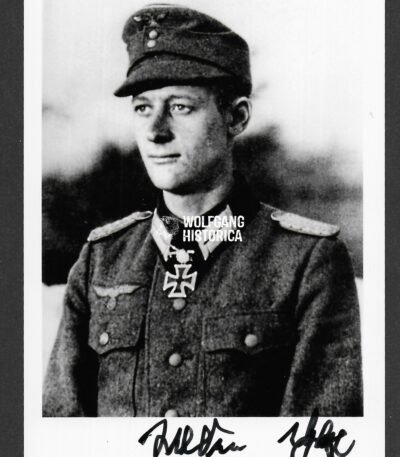
Waldemar von Gaza – Panzergrenadier-Regiment 66 (Schwertern)
€30,00Original Postwar Signature on a Postwar Photo of Waldemar von Gaza
Major Waldemar von Gaza (6 December 1917 – 13 January 2014) was a highly decorated officer of the 13. Panzer-Division, rising to command-level positions in armored infantry units on the Eastern Front. Over the course of the war, he received the Ritterkreuz des Eisernen Kreuzes with Eichenlaub and Schwertern, placing him among the most distinguished recipients of Germany’s highest battlefield awards.
Awards and Decorations
-
Ritterkreuz des Eisernen Kreuzes – 18 September 1942, as Oberleutnant und Chef 2./Panzergrenadier-Regiment 666, 13. Panzer-Division
-
Eichenlaub (Nr. 158) – 18 January 1943, as Hauptmann und Führer of a Kampfgruppe, 13. Panzer-Division
-
Schwerter (Nr. 324) – 3 October 1943, as Major und Führer of Panzergrenadier-Regiment 66, 13. Panzer-Division
-
Other awards included both classes of the Iron Cross and campaign distinctions
Service Highlights
-
Fought throughout the Eastern Front campaigns, earning distinction in combined-arms actions with armored infantry.
-
His leadership of Kampfgruppen during some of the most intense battles of 1942–43 earned him rapid recognition.
-
By 1943, he had risen to regimental command level, where he was awarded the Swords to the Knight’s Cross for continued outstanding leadership in combat.
Item Details
-
Type: Original postwar signed photograph
-
Size: Postcardsize
-
Condition: Good, as seen
Collector’s Note
Waldemar von Gaza’s decorations—Ritterkreuz, Eichenlaub, and Schwerter—mark him as one of the relatively few officers to attain this level of distinction. His signature is sought-after by collectors of panzer and Eastern Front memorabilia, with his long postwar life making his autograph available but still scarce in comparison to other triple recipients.
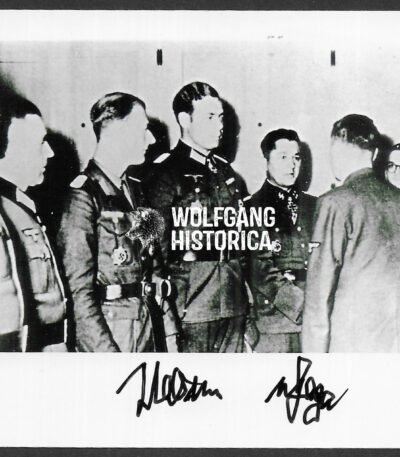
Waldemar von Gaza – Panzergrenadier-Regiment 66 (Schwertern)
€30,00Original Postwar Signature on a Postwar Photo of Waldemar von Gaza
Major Waldemar von Gaza (6 December 1917 – 13 January 2014) was a highly decorated officer of the 13. Panzer-Division, rising to command-level positions in armored infantry units on the Eastern Front. Over the course of the war, he received the Ritterkreuz des Eisernen Kreuzes with Eichenlaub and Schwertern, placing him among the most distinguished recipients of Germany’s highest battlefield awards.
Awards and Decorations
-
Ritterkreuz des Eisernen Kreuzes – 18 September 1942, as Oberleutnant und Chef 2./Panzergrenadier-Regiment 666, 13. Panzer-Division
-
Eichenlaub (Nr. 158) – 18 January 1943, as Hauptmann und Führer of a Kampfgruppe, 13. Panzer-Division
-
Schwerter (Nr. 324) – 3 October 1943, as Major und Führer of Panzergrenadier-Regiment 66, 13. Panzer-Division
-
Other awards included both classes of the Iron Cross and campaign distinctions
Service Highlights
-
Fought throughout the Eastern Front campaigns, earning distinction in combined-arms actions with armored infantry.
-
His leadership of Kampfgruppen during some of the most intense battles of 1942–43 earned him rapid recognition.
-
By 1943, he had risen to regimental command level, where he was awarded the Swords to the Knight’s Cross for continued outstanding leadership in combat.
Item Details
-
Type: Original postwar signed photograph
-
Size: Postcardsize
-
Condition: Good, as seen
Collector’s Note
Waldemar von Gaza’s decorations—Ritterkreuz, Eichenlaub, and Schwerter—mark him as one of the relatively few officers to attain this level of distinction. His signature is sought-after by collectors of panzer and Eastern Front memorabilia, with his long postwar life making his autograph available but still scarce in comparison to other triple recipients.
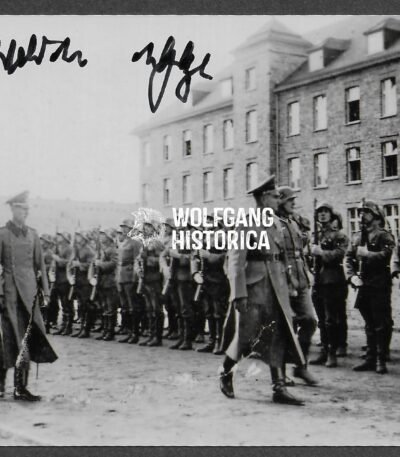
Waldemar von Gaza – Panzergrenadier-Regiment 66 (Schwertern)
€30,00Original Postwar Signature on a Postwar Photo of Waldemar von Gaza
Major Waldemar von Gaza (6 December 1917 – 13 January 2014) was a highly decorated officer of the 13. Panzer-Division, rising to command-level positions in armored infantry units on the Eastern Front. Over the course of the war, he received the Ritterkreuz des Eisernen Kreuzes with Eichenlaub and Schwertern, placing him among the most distinguished recipients of Germany’s highest battlefield awards.
Awards and Decorations
-
Ritterkreuz des Eisernen Kreuzes – 18 September 1942, as Oberleutnant und Chef 2./Panzergrenadier-Regiment 666, 13. Panzer-Division
-
Eichenlaub (Nr. 158) – 18 January 1943, as Hauptmann und Führer of a Kampfgruppe, 13. Panzer-Division
-
Schwerter (Nr. 324) – 3 October 1943, as Major und Führer of Panzergrenadier-Regiment 66, 13. Panzer-Division
-
Other awards included both classes of the Iron Cross and campaign distinctions
Service Highlights
-
Fought throughout the Eastern Front campaigns, earning distinction in combined-arms actions with armored infantry.
-
His leadership of Kampfgruppen during some of the most intense battles of 1942–43 earned him rapid recognition.
-
By 1943, he had risen to regimental command level, where he was awarded the Swords to the Knight’s Cross for continued outstanding leadership in combat.
Item Details
-
Type: Original postwar signed photograph
-
Size: Postcardsize
-
Condition: Good, as seen
Collector’s Note
Waldemar von Gaza’s decorations—Ritterkreuz, Eichenlaub, and Schwerter—mark him as one of the relatively few officers to attain this level of distinction. His signature is sought-after by collectors of panzer and Eastern Front memorabilia, with his long postwar life making his autograph available but still scarce in comparison to other triple recipients.