Karl Strecker – 79. Infanterie-Division & XI. Armeekorps (Stalingrad!)

85,00

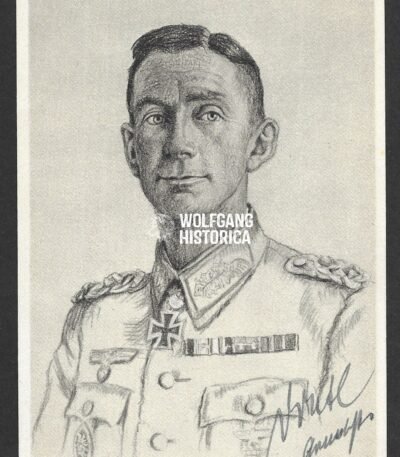
Original Postwar Signature on a Postwar Photo of Karl Strecker. Generaloberst Karl Strecker (20 September 1884, Radmannsdorf/West Prussia – 10 April 1973, Riezlern/Austria) was a career German officer who rose to the rank of Generaloberst in the Wehrmacht. A veteran of the First World War and interwar police service, he later commanded the 79. Infanterie-Division during the invasions of Poland, France, and Russia, before leading XI. Armeekorps into the battle of Stalingrad. Promoted to Generaloberst on 31 January 1943, he was one of the senior commanders forced to surrender in the northern pocket of Stalingrad on 2 February 1943. He spent over twelve years in Soviet captivity before being released in October 1955.


Awards and Decorations

  • Knight’s Cross of the Iron Cross (Ritterkreuz des Eisernen Kreuzes) – 26 October 1941, as Generalleutnant and Kommandeur of 79. Infanterie-Division

  • German Cross in Gold (Deutsches Kreuz in Gold) – 25 January 1943, as General der Infanterie and Kommandierender General of XI. Armeekorps

  • Order of Michael the Brave, 3rd Class (Ordinul Mihai Viteazul Clasa III, Romania) – 6 November 1942, as General der Infanterie and Kommandierender General of XI. Armeekorps


Career Highlights

  • Early Career: Entered the Imperial Army in 1905 with Infanterie-Regiment 152. Served as adjutant, company and battalion commander during WWI.

  • Police Service: After leaving the Reichswehr in 1920, continued as a police officer, eventually commanding the Police School Münster and rising to Generalmajor der Polizei (1934).

  • Command of 79. Infanterie-Division: Led the division from the invasion of Poland (1939) through France (1940) and into Operation Barbarossa (1941). Awarded the Knight’s Cross for distinguished leadership in Russia.

  • Higher Command: Promoted to General der Infanterie in 1942, commanded XVII. Armeekorps and then XI. Armeekorps during the drive into southern Russia.

  • Stalingrad: Promoted to Generaloberst on 31 January 1943, just one day before the surrender of the northern pocket at Stalingrad. His corps was among the last formations to capitulate on 2 February 1943.

  • Soviet Captivity: Held in the USSR from 1943–1955, one of the longest periods of imprisonment among German generals, only freed after Adenauer’s negotiations.

  • Postwar: Retired in Austria, passing away in 1973.


Item Details

  • Authentic postwar signature of Generaloberst Karl Strecker.

  • Signed on a postwar photograph.

  • Condition: Well-preserved, clear autograph.


Collector’s Note

Karl Strecker’s role as one of the highest-ranking generals captured at Stalingrad, coupled with his promotion to Generaloberst during the final days of the battle, make his autograph highly significant for collectors. His twelve-year Soviet captivity and eventual release in 1955 place him among the most notable survivors of the Stalingrad disaster. Items bearing his signature offer direct historical connection to one of the most decisive battles of the Second World War.

Karl-Maria Demelhuber – Befehlshaber der Waffen-SS in den Niederlanden

0,01

Original Scarce Postwar Signature on a Postwar Photo of Karl-Maria Demelhuber. SS-Obergruppenführer und General der Waffen-SS Karl-Maria Demelhuber
(27 May 1896, Freising – 18 March 1988, Seeshaupt, Bavaria) was a senior Waffen-SS officer who rose to the rank of SS-Obergruppenführer und General der Waffen-SS during the Second World War. A career officer, he held a series of high-level commands including the SS-Standarte “Germania”, the 6. SS-Gebirgs-Division “Nord”, and later the XII. and XVI. SS-Korps. His wartime service placed him among the key organizational leaders of Waffen-SS formations, particularly in the Netherlands and on secondary fronts.


Awards and Decorations

  • German Cross in Silver (Deutsches Kreuz in Silber) – 9 November 1943, as SS-Gruppenführer und Generalleutnant der Waffen-SS, Befehlshaber der Waffen-SS in den Niederlanden

  • Other decorations included the Iron Cross (WWI & WWII) and long-service awards of the SS and Wehrmacht


Career Highlights

  • Early SS Leadership: Commanded the SS-Standarte “Germania”, one of the formative regiments of the Waffen-SS.

  • Mountain Division Command: Led the 6. SS-Gebirgs-Division “Nord”, a unit that saw action in Finland and northern theaters.

  • Higher SS Corps Commands: Later commanded the XII. SS-Korps and the XVI. SS-Korps, overseeing Waffen-SS formations in the later stages of the war.

  • Occupation Duties: Served as Befehlshaber der Waffen-SS in the Netherlands, where he was awarded the German Cross in Silver for his role.

  • Postwar: Captured and interned after 1945, Demelhuber lived quietly in Bavaria until his death in 1988.


Item Details

  • Authentic scarce postwar signature of Karl-Maria Demelhuber.

  • Postcard size format.

  • Condition: Good, clear and well-preserved autograph.


Collector’s Note

Demelhuber’s signature is regarded as scarce, given his relatively low postwar profile and limited correspondence compared to other high-ranking SS generals. His career—spanning from regimental leadership with “Germania” to corps command in the final stages of the war—makes his autograph a significant addition for collectors focused on the leadership structure of the Waffen-SS and the history of its major divisional commanders.

Pierre-Henri Clostermann – French RAF Fighter Ace

125,00

Original Postwar Signature on a Postwar Photo of Pierre-Henri Clostermann DSO, DFC & Bar. Pierre-Henri Clostermann (28 February 1921, Curitiba, Brazil – 22 March 2006, Montesquieu-des-Albères, France) was a French fighter ace of the Second World War, credited with between 15–33 aerial victories, depending on the source. Flying with the RAF’s Spitfire and Tempest squadrons, he became one of the most recognized Allied fighter pilots of the war, famously known as “France’s First Fighter” by Charles de Gaulle. His wartime memoir, Le Grand Cirque (The Big Show), remains one of the most celebrated aviation books of the conflict.


Awards and Decorations

  • Grand Croix de la Légion d’Honneur (France)

  • Compagnon de l’Ordre de la Libération – 21 January 1946

  • Médaille Militaire

  • Croix de Guerre 1939–45 with 27 citations (17 palms, 2 stars)

  • Croix de la Valeur Militaire with 2 citations

  • Médaille de la Résistance with rosette

  • Médaille de l’Aéronautique

  • Distinguished Service Order (DSO) – United Kingdom

  • Distinguished Flying Cross & Bar (DFC & Bar) – United Kingdom

  • Distinguished Service Cross (US Army) – United States

  • Croix de Guerre (Belgium)

  • Numerous foreign decorations from Morocco, Tunisia, Brazil, Denmark, and the Vatican


Career Highlights

  • Early Aviation Training: Learned to fly in Brazil at 16, and later studied aeronautics in San Diego, USA, graduating as an aeronautical engineer and licensed pilot before joining the Free French in 1942.

  • RAF Service: Served in No. 341 (Alsace) Squadron and later No. 602 Squadron RAF, flying Spitfires on offensive sweeps, bomber escorts, and Normandy landings air cover.

  • First Victories: Scored his first aerial victories on 27 July 1943, destroying two Fw 190s over France.

  • Tempest Ace: In December 1944 joined No. 274 Squadron RAF, later commanding A Flight, No. 3 Squadron RAF in the Hawker Tempest V “Le Grand Charles”, where he flew “rat scramble” missions against Me 262 jet fighters and led devastating ground-attack sorties.

  • Combat Record: Flew 432 sorties, claiming 15–33 aerial victories, 225 motor vehicles, 72 locomotives, 5 tanks, and 2 E-boats destroyed.

  • Author: Published Le Grand Cirque (The Big Show) in 1951, which became one of the most successful aviation memoirs of all time, praised by William Faulkner as “the finest aviation book to come out of World War II.”

  • Postwar Career: Engineer at Renault and Reims Aviation, later elected youngest Member of the French Parliament (Assemblée Nationale). Re-enlisted briefly during the Algerian War (1956–57) as a ground-attack pilot.

  • Later Controversy: In 1982, praised Argentine pilots’ bravery during the Falklands War, which drew criticism in Britain. In France, he was a noted critic of the 1991 Gulf War.


Item Details

  • Authentic postwar signature of Pierre Clostermann.

  • Signed on a postwar photograph.

  • Condition: Well-preserved and clear autograph.


Collector’s Note

Pierre-Henri Clostermann remains a legendary figure in aviation history: a Free French ace with RAF Tempests and Spitfires, bestselling author, engineer, and politician. His signature is especially sought-after by collectors of WWII aviation memorabilia, linking directly to one of the most iconic fighter pilots of the Allied cause.

Erich “Bubi” Hartmann – Jagdgeschwader 52 (Brillianten) (352 Aerial Victories!)

250,00

Original Postwar Signature on a Postwar Photo of Erich “Bubi” Hartmann. Major Erich Alfred “Bubi” Hartmann (19 April 1922, Weissach, Württemberg – 20 September 1993, Weil im Schönbuch, Germany) was the most successful fighter ace in aviation history, credited with an unparalleled 352 confirmed aerial victories on the Eastern Front. Known as “The Blond Knight of Germany”, Hartmann flew with Jagdgeschwader 52 (JG 52) and became one of the most decorated Luftwaffe fighter pilots of the Second World War. His skill, discipline, and survival across more than 1,400 combat missions earned him legendary status among pilots of all nations.


Awards and Decorations

  • German Cross in Gold (Deutsches Kreuz in Gold) – 17 October 1943

  • Knight’s Cross of the Iron Cross (Ritterkreuz des Eisernen Kreuzes) – 29 October 1943, as Leutnant and Flugzeugführer, 9./JG 52 (148 victories)

  • Oak Leaves (Eichenlaub) – 2 March 1944, as Leutnant and Staffelkapitän, 9./JG 52 (200 victories)

  • Swords (Schwerter) – 2 July 1944, as Oberleutnant and Staffelkapitän, 9./JG 52 (239 victories)

  • Diamonds (Brillanten) – 25 August 1944, as Oberleutnant and Staffelkapitän, 9./JG 52 (301 victories)

  • Pilot-Observer Badge in Gold with Diamonds (Gemeinsames Flugzeugführer- und Beobachterabzeichen mit Brillanten) – special presentation award

  • Numerous additional decorations including the Iron Cross 1st and 2nd Class


Career Highlights

  • Eastern Front Ace: Flew over 1,400 combat missions, engaging in aerial combat in nearly 825 of them.

  • Unmatched Record: Credited with 352 confirmed kills, all against Soviet aircraft.

  • Survival Tactics: Known for his strict discipline and patience in combat, avoiding unnecessary risks and striking with precision.

  • Last Victory: Achieved his 352nd and final victory on 8 May 1945, just hours before Germany’s surrender.

  • Postwar Captivity: Spent 10 years in Soviet captivity (1945–1955) before returning to West Germany.

  • Postwar Career: Joined the newly formed Bundesluftwaffe (West German Air Force), where he commanded a fighter wing but later resigned due to political disputes over NATO standardization.

  • Legacy: His name remains synonymous with aerial mastery, and he is celebrated as the most successful fighter ace in recorded history.


Item Details

  • Authentic postwar signature of Major Erich “Bubi” Hartmann.

  • Signed on a postwar photograph.

  • Condition: Good, clear autograph.


Collector’s Note

Hartmann’s autograph is among the most coveted in WWII aviation collecting. His record of 352 aerial victories is unmatched and will never likely be equaled. Decorated with the Ritterkreuz mit Eichenlaub, Schwertern und Brillanten and the rare Pilot-Observer Badge with Diamonds, his signature represents the pinnacle of Luftwaffe fighter history. An essential piece for any serious collection of WWII aviation memorabilia.

Hugo Primozic – Sturmgeschütz-Abteilung 667 (Eichenlaub) (Wartime Signature)

100,00

Original Wartime Signature on a Wartime Postcard of Hugo Primozic. Oberleutnant Hugo Primozic (16 February 1914 – 18 March 1996) was one of the most successful Sturmgeschütz (assault gun) commanders of the Second World War. Serving with Sturmgeschütz-Abteilung 667, he achieved remarkable success against Soviet armor, earning both the Knight’s Cross of the Iron Cross and the Oak Leaves within a span of just a few months in late 1942 and early 1943. His extraordinary tally of destroyed enemy tanks made him one of the legendary figures of the German assault gun arm.


Awards and Decorations

  • Knight’s Cross of the Iron Cross (Ritterkreuz des Eisernen Kreuzes) – 19 September 1942, as Wachtmeister and Zugführer, 2./Sturmgeschütz-Abteilung 667.

    • Awarded for destroying 45 enemy tanks during fighting in the central sector of the Eastern Front. Of these, Primozic destroyed 24 in one day (15 September 1942), halting a major Soviet breakthrough.

  • Oak Leaves to the Knight’s Cross (Ritterkreuz mit Eichenlaub) – 25 January 1943, as Oberwachtmeister and Zugführer, 2./Sturmgeschütz-Abteilung 667.

    • Awarded for raising his total of destroyed tanks to 60. On 11 December 1942 alone, he destroyed 7 Soviet tanks during a counterattack.


Career Highlights

  • Zugführer (platoon leader) in 2./Sturmgeschütz-Abteilung 667, operating on the Eastern Front.

  • September 1942: Destroyed 24 tanks in a single day, preventing a Soviet breakthrough – a feat that earned him the Ritterkreuz.

  • December 1942: In another display of skill and tenacity, destroyed 7 tanks in one day, bringing his tally to 60 and earning him the Eichenlaub.

  • Rose to the rank of Oberleutnant before the war’s end.

  • Survived the conflict and lived until 1996.


Item Details

  • Authentic wartime signature of Hugo Primozic.

  • Signed on a wartime postcard.

  • Condition: Good, clear and well-preserved.


Collector’s Note

Hugo Primozic stands among the most celebrated Sturmgeschütz aces of the German Army. His tank-destroying record – especially the extraordinary achievement of 24 tanks in a single day – has become legendary. His autograph, particularly on a wartime postcard, is a prized piece for collectors of Panzerjäger history, Ritterkreuz recipients, and Eastern Front memorabilia.

Franz Ketterl – Infanterie-Regiment 438 (132. Infanterie-Division) (Wartime Signed)

70,00

Original Wartime Signature on a Postcard of Franz Ketterl. Oberleutnant Franz Ketterl
(21 March 1898 – 27 July 1979) was a German Army officer who served on the Eastern Front during the Second World War. As company commander of 1./Infanterie-Regiment 438, 132. Infanterie-Division, he distinguished himself in heavy winter fighting and received the Knight’s Cross of the Iron Cross on 12 January 1942 for his leadership and bravery.


Awards and Decorations

  • Knight’s Cross of the Iron Cross (Ritterkreuz des Eisernen Kreuzes) – 12 January 1942, as Oberleutnant and Chef of 1./Infanterie-Regiment 438, 132. Infanterie-Division.

Career Highlights

  • Served in the 132. Infanterie-Division, which fought extensively on the Eastern Front from 1941 onward.

  • As company commander of 1./Infanterie-Regiment 438, Ketterl played a key role in the division’s bitter engagements during the early stages of the Soviet campaign.

  • Awarded the Ritterkreuz for his personal bravery and leadership in combat during the severe winter fighting of 1941/42.

  • Survived the war and lived until 1979.


Item Details

  • Authentic wartime signature of Oberleutnant Franz Ketterl.

  • Signed on a wartime postcard.

  • Condition: Largely faded, as seen.


Collector’s Note

Franz Ketterl represents the many front-line company commanders who bore the brunt of the brutal Eastern Front battles. His award of the Knight’s Cross in early 1942, during the desperate winter fighting, reflects the importance of small-unit leadership at a critical time in the German campaign. A rare and historically significant autograph for collectors of Ritterkreuz recipients and Eastern Front memorabilia.

Karl-Friedrich Merten – Watch Officer “U-38” & Kommandant “U-68” (Eichenlaub)

150,00

Original Wartime Signature on a Postcard of Karl-Friedrich Merten. Kapitän zur See Karl-Friedrich Merten (15 August 1905, Posen – 2 May 1993, Waldshut-Tiengen) was one of the Kriegsmarine’s most successful U-boat commanders of the Second World War. Commanding U-68, he conducted five war patrols in the Atlantic, Caribbean, and Indian Oceans, sinking 27 ships for a total of 170,151 GRT. His bold leadership and outstanding combat record earned him the Knight’s Cross of the Iron Cross with Oak Leaves, as well as mention in the official Wehrmachtbericht.


Awards and Decorations

  • Wehrmachtbericht Mention – 8 April 1942, for his successes with U-68.

  • Knight’s Cross of the Iron Cross (Ritterkreuz des Eisernen Kreuzes) – 13 June 1942, as Korvettenkapitän and Kommandant of U-68.
    Awarded for his first three patrols, during which U-68 sank 11 ships totaling 63,047 GRT, and for his role in rescuing the crews of the “Python” and “Atlantis” in late 1941.

  • Oak Leaves to the Knight’s Cross (Ritterkreuz mit Eichenlaub) – 16 November 1942, as Korvettenkapitän and Kommandant of U-68.
    Awarded after two more patrols in which U-68 sank 16 ships with 107,128 GRT.

  • U-Boat War Badge with Diamonds (U-Boot-Kriegsabzeichen mit Brillanten) – 30 January 1943, as commander of the 26. U-Boat Flotilla.


Career Highlights

  • Joined the Reichsmarine in 1926, serving aboard the light cruisers Karlsruhe and Leipzig during Spanish Civil War patrols.

  • At the outbreak of WWII, served aboard the battleship Schleswig-Holstein, taking part in the Battle of Westerplatte and the Battle of Hel.

  • Transferred to the U-Bootwaffe in 1940; first served as watch officer on U-38.

  • Commander of U-68 (1941–42):

    • 1st Patrol (June–August 1941) – broke into the Atlantic.

    • 2nd Patrol (Sept–Dec 1941) – 106 days at sea, involved in the rescue of crews of the Atlantis and Python.

    • 3rd Patrol (Feb–April 1942) – continued successes in the Atlantic.

    • 4th Patrol (May–July 1942) – heavy successes in Caribbean waters.

    • 5th Patrol (Aug–Dec 1942) – Indian Ocean operations, culminating in Oak Leaves award.

  • Credited with 27 ships sunk (170,151 GRT).

  • Commanded the 26th U-Boat Flotilla (Jan 1943) and later the 24th U-Boat Flotilla (March 1943).

  • Posted to the Führer Headquarters in February 1945.

  • Captured by US forces in May 1945 and released in June 1945.

  • Postwar: worked in ship salvage on the Rhine, later entered the shipbuilding industry, and authored memoirs on U-boat warfare.


Item Details

  • Original wartime signature of Karl-Friedrich Merten.

  • Signed in blue ink on a wartime postcard.

  • Condition: Condition as seen, bit faded.


Collector’s Note

Karl-Friedrich Merten ranks among the elite U-boat commanders of WWII, with over 170,000 GRT sunk and the Ritterkreuz mit Eichenlaub to his credit. His leadership during the long-range patrols of U-68 in the Atlantic, Caribbean, and Indian Oceans, combined with his postwar authorship on U-boat warfare, makes his signature a highly sought-after piece for collectors of Kriegsmarine memorabilia.

Alfred Haase – Pionier-Lehr-Bataillon 2 (Wartime Signed)

125,00

Original Wartime Signature on a Wartime Postcard of Alfred Haase. Oberst Alfred Haase
(9 September 1898 † 24 February 2000) was a German Army officer who rose to the rank of Oberst and was a decorated front-line pioneer commander. He received the Knight’s Cross of the Iron Cross in April 1942 for his leadership of Kampfgruppe Haase during the harsh winter battles of 1941/42. His distinguished combat leadership also earned him a mention in the Wehrmachtbericht.


Awards and Decorations

  • Knight’s Cross of the Iron Cross (Ritterkreuz des Eisernen Kreuzes) – 1 April 1942, as Major and leader of Kampfgruppe Haase / Kommandeur of Pionier-Lehr-Bataillon 2.

    • Awarded for the outstanding defense of the Ugra train station and bridgehead from February 14, 1942. Despite encirclement from 24 February, Haase’s Kampfgruppe repelled 12 strong Soviet attacks (day and night), often in bitter close combat. He personally directed bold counterthrusts, captured prisoners who provided valuable intelligence, and held a key point that prevented the linking of two enemy forces. His steadfast leadership was deemed vital to the success of 4. Armee.

  • Wehrmachtbericht Mention – 13 April 1942

    • “Major Haase, commander of a pioneer battalion, has distinguished himself with his subordinates battle group during weeks of successful defense of a hard fought over strong point.”


Career Highlights

  • Leader of Kampfgruppe Haase, which held the critical Ugra sector during the Soviet winter offensive of 1941/42.

  • Known for his resolute defensive leadership under encirclement and vastly superior enemy numbers.

  • Promoted to Oberst, continuing his service as a respected pioneer commander.

  • Lived to the remarkable age of 101, passing away in 2000, making him one of the last surviving Knight’s Cross holders of his generation.


Item Details

  • Original wartime signature of Oberst Alfred Haase.

  • Signed on a wartime postcard.

  • Condition: Clear, well-preserved period autograph.


Collector’s Note

Alfred Haase’s Knight’s Cross citation is a striking example of a small Kampfgruppe holding firm under overwhelming pressure, a feat celebrated by the Wehrmachtbericht. His centenarian lifespan and status as one of the last surviving decorated officers add unique historical value. This wartime-signed postcard offers a rare piece of history connected to the pioneer arm of the Heer and the bitter defensive battles of the Eastern Front.

Wilhelm Nagel – Grenadier-Regiment 353 & 131

40,00

Original Postwar Signature on a Postwar Photo of Wilhelm Nagel. Oberst Wilhelm Nagel (12 June 1898, Tübingen/Württemberg † 23 April 1980, Zell im Wiesental/Baden-Württemberg) was a career officer in the German Army who rose to the rank of Oberst during the Second World War. He was decorated with both the German Cross in Gold and the Knight’s Cross of the Iron Cross for his leadership of front-line infantry regiments on the Eastern Front.

Awards and Decorations:

  • German Cross in Gold (Deutsches Kreuz in Gold)29 January 1943, as Oberst with Grenadier-Regiment 353.

  • Knight’s Cross of the Iron Cross (Ritterkreuz des Eisernen Kreuzes)12 June 1944, as Oberst and Kommandeur of Grenadier-Regiment 131.

Career Highlights:

  • Served as an officer of the infantry during the Second World War.

  • Commanded Grenadier-Regiment 353, where his leadership in the heavy battles of 1942–43 earned him the German Cross in Gold.

  • Later took command of Grenadier-Regiment 131, leading it in combat during the difficult fighting of 1944. His ability to hold together his regiment under extreme conditions brought him the award of the Knight’s Cross on his 46th birthday.

  • Continued to serve until the end of the war.

  • Survived captivity and lived in Baden-Württemberg until his death in 1980.

Item Details:

  • Authentic postwar signature of Oberst Wilhelm Nagel.

  • Signed on a postwar photograph.

  • Condition: Clear and well-preserved autograph.

Collector’s Note:
Nagel’s decorations — the German Cross in Gold and the Knight’s Cross of the Iron Cross — reflect his reputation as a capable and battle-proven regimental commander. His signed photograph is a desirable addition for collectors focusing on Eastern Front infantry leadership and decorated Knight’s Cross recipients.

Helwig Luz – Schützen-Regiment 110 (Son KIA in Stalingrad)

65,00

Original Postwar Signature on a Postwar Card with Photo of Helwig Luz. Generalleutnant Helwig Luz (28 June 1892 † 28 April 1980) was a German Army officer who rose to the rank of Generalleutnant during the Second World War. A highly experienced Panzer leader, he was decorated with the Knight’s Cross of the Iron Cross for his achievements with the 11. Panzer-Division.

Awards and Decorations:

  • Knight’s Cross of the Iron Cross (Ritterkreuz des Eisernen Kreuzes)15 November 1941, as Oberst and Kommandeur of Schützen-Regiment 110, 11. Panzer-Division.

Career Highlights:

  • Entered military service before the First World War, serving with distinction in both world wars.

  • Commanded Schützen-Regiment 110 of the renowned 11. Panzer-Division, where he earned the Knight’s Cross for his leadership on the Eastern Front in 1941.

  • In September 1942, his son Helwig Luz Jr., serving as a Leutnant with Panzer-Regiment 24, was killed in action at Stalingrad.

  • Shortly afterward, Luz was recalled to Germany and placed in the Führerreserve, before being assigned in February 1943 to lead the Settlement Office of the 6th Army (Abwicklungsstelle 6. Armee), responsible for administrative and personnel matters following the destruction of the army at Stalingrad.

  • Continued to serve in various posts until the end of the war, reaching the rank of Generalleutnant.

  • Survived the war and lived in Bavaria until his death in 1980.

Item Details:

  • Authentic postwar signature of Generalleutnant Helwig Luz.

  • Signed on a postwar photograph.

  • Condition: Good, clear autograph.

Collector’s Note:
Luz’s role as a decorated Panzer commander and later as head of the 6th Army’s settlement office after Stalingrad makes him a figure of historical importance. Combined with the personal tragedy of his son’s death at Stalingrad, his story reflects both the military and human dimensions of the war. His signed photo is a highly collectible piece for those interested in Panzer leaders and Knight’s Cross recipients of the Wehrmacht.

Herbert Ihlefeld – Jagdgeschwader 77 “Herz As” (Schwertern) (Wartime Signed)

150,00

Original Wartime Signature on a Postcard of Herbert Ihlefeld. Oberst Herbert Ihlefeld
(1 June 1914 † 8 August 1995) was one of the Luftwaffe’s most successful fighter aces and a highly decorated officer. Serving with Jagdgeschwader 77 “Herz As”, he quickly distinguished himself as a front-line pilot and commander. Over the course of his wartime career, he achieved at least 122 confirmed aerial victories, making him one of the leading Experten of the Luftwaffe.


Awards and Decorations

  • Knight’s Cross of the Iron Cross (Ritterkreuz des Eisernen Kreuzes) – 13 September 1940, as Oberleutnant and Flugzeugführer, 1./JG 77 “Herz As”.

  • Oak Leaves to the Knight’s Cross (Eichenlaub) – 27 June 1941, as Hauptmann and Kommandeur of I./JG 77 “Herz As”.

  • German Cross in Gold (Deutsches Kreuz in Gold) – 9 April 1942.

  • Swords to the Knight’s Cross (Schwerter) – 24 April 1942, as Hauptmann and Kommandeur of I./JG 77 “Herz As”.


Career Highlights

  • Began his career as a fighter pilot with Jagdgeschwader 77, quickly rising to become a Gruppenkommandeur.

  • Distinguished himself during the Battle of Britain and in the Balkans and Eastern Front campaigns.

  • By 1942, he had been awarded the Knight’s Cross with Oak Leaves and Swords, marking him as one of the Luftwaffe’s elite aces.

  • Credited with at least 122 aerial victories across multiple theaters of war.

  • Rose to the rank of Oberst, later holding senior command positions in the Luftwaffe.


Item Details

  • Original wartime signature of Oberst Herbert Ihlefeld.

  • Signed on a wartime postcard.

  • Condition: Excellent, clear period autograph.


Collector’s Note

Herbert Ihlefeld stands among the great names of Luftwaffe fighter history, his career spanning the early victories of 1940 through the brutal campaigns of the East. With over 120 aerial victories and the Ritterkreuz mit Eichenlaub und Schwertern, his autograph remains a highly desirable piece for collectors of Luftwaffe aces and decorated fighter leaders.

Gerhard Hein – Infanterie-Regiment 209 (Eichenlaub) (12. SS-Panzer-Division “Hitlerjugend”)

0,01

Original Wartime Signature on a Postcard of Gerhard “Gerd” Hein. SS-Sturmbannführer & Oberstleutnant der Reserve Gerhard Hein (9 July 1916, Klein Paniow-Rybnik † 6 June 2008, Harrislee) was a German officer who served with distinction on the Eastern Front and later with the Waffen-SS. He was a Knight’s Cross with Oak Leaves recipient and rose to command the SS-Panzergrenadier-Regiment 26 of the 12. SS-Panzer-Division “Hitlerjugend.”


Awards and Decorations

  • Knight’s Cross of the Iron Cross (Ritterkreuz des Eisernen Kreuzes) – 3 September 1940, as Unteroffizier and platoon leader, 10./Infanterie-Regiment 209, 58. Infanterie-Division.

  • Oak Leaves to the Knight’s Cross (Eichenlaub zum Ritterkreuz) – 6 September 1942, as Leutnant and company commander, 5./Infanterie-Regiment 209, 58. Infanterie-Division.


Career Highlights

  • Distinguished himself early in the war, earning the Knight’s Cross as a platoon leader in 1940.

  • Awarded the Oak Leaves for continued leadership and bravery in 1942 on the Eastern Front.

  • Later transferred to the Waffen-SS, where he became commander of SS-Panzergrenadier-Regiment 26 of the elite 12. SS-Panzer-Division “Hitlerjugend.”

  • Rose to the rank of SS-Sturmbannführer in the Waffen-SS and Oberstleutnant der Reserve in the Heer.

  • Survived the war and lived until 2008, passing away in Harrislee.


Item Details

  • Original Wartime signature of Gerhard Hein.

  • Signed on a Wartime Postcard.

  • Condition: Clear and well-preserved autograph.


Collector’s Note

Hein’s dual career in both the Heer and Waffen-SS, combined with his Knight’s Cross with Oak Leaves, makes him a particularly interesting figure. His command of the Hitlerjugend Division’s SS-Panzergrenadier-Regiment 26 places him among the most notable regimental leaders of the Waffen-SS. His long postwar life and rarity of signed material enhance the value of his autograph for collectors of Knight’s Cross holders and Waffen-SS memorabilia.

Gustav Hoffmann – SS-Flak-Abteilung 12 “Hitlerjugend”

35,00

Original Postwar Signature on a Postwar Photo of Gustav Hoffmann. SS-Sturmmann Gustav Hoffmann (16 January 1926, Vienna † 24 October 2024) served as an SS-Sturmmann in the 4. Batterie/SS-Flak-Abteilung 12 of the 12. SS-Panzer-Division “Hitlerjugend.” Born the son of deaf parents and raised in modest conditions, he completed school and training as an office clerk before volunteering in 1943 for service with the Waffen-SS.

He began his duty on 22 August 1943 at the SS-Flak-Ausbildungs- und Ersatz-Regiment in München and was later transferred to the 4. Batterie/SS-Flak-Abteilung 12. There, Hoffmann served as a driver for the Sd.Kfz. 7/2 halftrack with its mounted 3.7 cm Flak gun. He took part in the bitter fighting in Normandy, the Ardennes, and Hungary. At war’s end, he was captured by American forces in Austria and spent time in U.S. captivity.

In the postwar years, Hoffmann preserved and collected accounts, diaries, and reports from his comrades of the 4. Batterie, culminating in the publication of the detailed unit chronicle “In Erdkampf und Luftabwehr,” which appeared in 2020.

Awards & Service Notes:

  • Rank: SS-Sturmmann

  • Unit: 4. Batterie/SS-Flak-Abteilung 12, 12. SS-Panzer-Division “Hitlerjugend”

  • Role: Driver of Sd.Kfz. 7/2 halftrack with 3.7 cm Flak gun

  • Campaigns: Normandy, Ardennes, Hungary

Item Details:

  • Authentic postwar signature of Gustav Hoffmann.

  • Signed on a postwar photograph (postcard size).

  • Condition: Very good, crisp autograph.

Collector’s Note:
Hoffmann lived to the age of 98, passing away in October 2024. As one of the last veterans of the 12. SS-Panzer-Division “Hitlerjugend,” his personal recollections and his chronicle work provide a rare perspective on this infamous Waffen-SS unit. His signed photo represents a scarce opportunity for collectors of Waffen-SS autographs and unit history.

Leo Kreisch – Panzerschiff Lützow & Führer der U-Boote

40,00

Original Postwar Signature on a Postwar Photo of Leo Kreisch. Vizeadmiral Leo Kreisch
(25 June 1895, Xanten † 1977) was a career naval officer who served in both World Wars, rising to the rank of Vizeadmiral in the Kriegsmarine. Beginning his service in the Kaiserliche Marine in 1914, he trained aboard the light cruisers Danzig and Wiesbaden before being commissioned as a Leutnant zur See in July 1916. He went on to serve aboard the Regensburg and later attended U-Boat school.

Integrated into the Reichsmarine after the First World War, Kreisch steadily advanced through the ranks, serving in various posts including Torpedooffizier on the battleship Schleswig-Holstein. During the Second World War, he held several important naval commands:

  • Kommandant of the light cruiser Nürnberg (1940)

  • Commander of the Panzerschiff Lützow (1941–42)

  • Führer der U-Boote Italien/Mittelmeer (1942–44), directing submarine operations in the Mediterranean.

  • Führer der Zerstörer (1944–45), overseeing destroyer forces until the end of the war.

On 1 January 1945, he was promoted to Vizeadmiral. After Germany’s capitulation, Kreisch survived captivity and lived in postwar Germany, including in Berlin-Zehlendorf. He passed away in 1977.


Career Highlights

  • World War I service on cruisers Danzig, Wiesbaden, and Regensburg.

  • Reichsmarine officer in the interwar period, rising to Korvettenkapitän in 1933.

  • World War II commands:

    • Nürnberg (light cruiser)

    • Lützow (pocket battleship)

    • U-Boat operations in Italy/Mediterranean, 1942–44

    • Commander of German destroyers, 1944–45

  • Promoted to Vizeadmiral (1 January 1945).


Item Details

  • Authentic postwar signature of Vizeadmiral Leo Kreisch.

  • Signed on a postwar photograph.

  • Condition: Clear, well-preserved autograph.

Günther Krappe – 61. Infanterie-Division

40,00

Original Postwar Signature on a Postwar Photo of Günther Krappe. Generalleutnant Günther Krappe (13 April 1893, Schilde † 31 December 1981, Altena) was a German Army officer who reached the rank of Generalleutnant during the Second World War. His career included front-line regimental and divisional command as well as high-profile diplomatic roles as military attaché in Hungary and Spain. He is best remembered as commander of the 61. Infanterie-Division on the Eastern Front, where he earned the Knight’s Cross of the Iron Cross for his leadership.


Awards and Decorations

  • Knight’s Cross of the Iron Cross (Ritterkreuz des Eisernen Kreuzes) – 11 April 1944, as Generalleutnant and Kommandeur of the 61. Infanterie-Division.
    Awarded for his skillful leadership of the division in heavy defensive fighting on the Eastern Front, where his command helped stabilize German positions under immense Soviet pressure.


Career Highlights

  • Entered Army service in 1912 as Fahnenjunker with the 34. Fusilier-Regiment.

  • Served in the First World War as platoon and company leader.

  • Interwar service in the Reichswehr as adjutant and company commander.

  • Military Attaché in Budapest (1939–1941) and in Madrid (1941–1942).

  • Attended the Panzer Troop School at Wünsdorf before divisional command.

  • Commanded the 61. Infanterie-Division (1943–1944).

  • Delegated with the leadership of the X. Waffen-SS Corps in February–March 1945.

  • Captured by the Soviets in March 1945; held prisoner until March 1949.

  • Returned to Germany after captivity, living in Altena until his death in 1981.


Item Details

  • Authentic postwar signature of Generalleutnant Günther Krappe.

  • Signed on a postwar photograph. Small size.

  • Condition: Well-preserved, clear autograph.

Collector’s Note

Generalleutnant Günther Krappe’s career combined frontline command with sensitive diplomatic assignments, placing him in key roles both in the field and abroad. His Knight’s Cross reflects his recognized leadership of the 61. Infanterie-Division in 1944, while his later captivity and survival provide additional historical context. His signature remains a desirable addition for collectors of German divisional commanders and Eastern Front memorabilia.

Hans Ritter – General der Luftwaffe beim Oberbefehlshaber der Kriegsmarine

35,00

Original Postwar Signature on a Postwar Photo of Hans Ritter. General der Flieger Hans Ritter (2 March 1893, Harburg an der Elbe † 21 May 1991, Munich) began his military career on 1 April 1912 when he entered the Imperial Navy as a cadet. He trained aboard the Hertha and served on several capital ships before transferring to naval aviation in 1916. As a seaplane pilot, he served in Kurland and Flanders, later becoming Adjutant of the I. Seeflieger-Abteilung. After the war, he remained in the Reichsmarine, where he continued his naval and aviation career, eventually transferring to the Luftwaffe in 1935.

During the Second World War, Ritter rose to General der Flieger. He served as General der Luftwaffe beim Oberbefehlshaber der Kriegsmarine, Inspector of the Naval Air Arm in the Reichsluftfahrtministerium, and Commander of the Marinefliegerverbände. Promoted to Generalmajor in 1939, Generalleutnant in 1940, and General der Flieger in 1942, he held several high-level posts before being placed in the Führerreserve in September 1944 and formally released from service in January 1945.

Captured by Soviet forces in July 1945, Ritter was taken to the USSR, where a Soviet military tribunal sentenced him. He was released in the mid-1950s and lived in Munich until his death in 1991.


Item Details:

  • Original postwar signed photograph of General der Flieger Hans Ritter.

  • Size: small size.

  • Condition: very good.

Friedrich Sixt – 50. Infanterie-Division & 5. Jäger-Division (Eichenlaub)

45,00

Original Postwar Signature on a Postwar Photo of Friedrich Sixt. General der Infanterie Friedrich Sixt (28 October 1895, Munich † 4 August 1976, Icking) was a highly experienced officer of the Bavarian Army, Reichswehr, and later the Wehrmacht. He served in both world wars, being wounded twice in the First World War. A General Staff-trained officer, he held numerous key posts, including Chief of Staff of XXXXIV. Armeekorps and of the 17. Armee. Later, he commanded the 50. Infanterie-Division and the 5. Jäger-Division, leading his units with distinction on the Eastern Front until the end of the war. He rose to the rank of General der Infanterie and was regarded as a tough, capable commander during defensive operations.


Awards and Decorations

  • German Cross in Gold (Deutsches Kreuz in Gold) – 18 May 1942 as Oberst i.G., Chief of the General Staff, XXXXIV. Armeekorps
  • Knight’s Cross of the Iron Cross (Ritterkreuz des Eisernen Kreuzes) – 17 December 1943 as Generalleutnant und Kommandeur, 50. Infanterie-Division, for his successful defensive command of the Perekop Isthmus and the Tatar Wall in the Crimea. (2443rd Award)

  • Oak Leaves to the Knight’s Cross (Eichenlaub zum Ritterkreuz) – 11 March 1945 as Generalleutnant und Kommandeur, 5. Jäger-Division, for his outstanding leadership during the defensive battles on the Bug and Narew rivers and the skillful withdrawal to the Vistula in January 1945.

  • Mentioned in the Wehrmachtbericht – 12 September 1944, for distinction with his 5. Jäger-Division at the Narew


Item Details:

  • Original postwar signed photo of General der Infanterie Friedrich Sixt.

  • Size: Smaller size.

  • Condition: very good.

Otto-Joachim Lüdecke – 56. Infanterie-Division

40,00

Original Postwar Signature on a Postwar Photo of Otto-Joachim Lüdecke. Generalleutnant Otto-Joachim Lüdecke (27 May 1895, Staßfurt † 14 February 1971, Hassel) was a career officer who rose to the rank of Generalleutnant in the Wehrmacht. Beginning his service in 1913 as a Fahnenjunker, he advanced through both world wars, serving in various staff and command functions. During the Second World War, he held key engineering and infantry leadership posts, including as commander of the 56. Infanterie-Division and later of the 264. Infanterie-Division.

Awards and Decorations:

  • Knight’s Cross of the Iron Cross (Ritterkreuz des Eisernen Kreuzes)8 August 1943, as Generalmajor und Kommandeur of the 56. Infanterie-Division, for his leadership and command performance on the Eastern Front.

Item Details:

  • Original postwar signature of Generalleutnant Otto-Joachim Lüdecke.

  • Signed on a postwar photo. Small size.

  • Condition: Very good.

Collector’s Note:
As a decorated division commander, Lüdecke’s Knight’s Cross award and his long career spanning both world wars make his autograph a highly desirable addition for collectors focusing on Wehrmacht leadership and combat operations of the Eastern Front.

Friedrich Schulz – XXXXIII. AK, III. Panzerkorps & 7. Armee (Schwertern)

40,00

Original Postwar Signature on a Card with Photo of Karl Friedrich “Fritz” Wilhelm Schulz. General der Infanterie Karl Friedrich Wilhelm Schulz (15 October 1897, Nettkow/Silesia † 30 November 1976, Freudenstadt/Baden-Württemberg) was a career officer who rose through the ranks from the First World War to become one of the senior German Army commanders in the final stage of the Second World War. He held key staff and frontline leadership roles, including Chef des Generalstabes of XXXXIII. Armeekorps, Heeresgruppe Don, and later as commander of III. Panzer-Korps, XXXXVI. Panzer-Korps, 17. Armee and ultimately Heeresgruppe G. His career culminated with his promotion to General der Infanterie.

Awards and Decorations:

  • Knight’s Cross of the Iron Cross (Ritterkreuz des Eisernen Kreuzes)29 March 1942, as Oberst im Generalstab and Chef des Generalstabes XXXXIII. Armeekorps, awarded for crushing Soviet penetration attempts near Kaluga during the winter battles of 1941/42.

  • Oak Leaves to the Knight’s Cross (Ritterkreuz mit Eichenlaub)20 March 1944, as Generalleutnant and acting commander (m.d.F.b.) of III. Panzer-Korps, for his masterful leadership during the fighting near Cherkassy (28 November 1943 – 1 January 1944). (428th award)

  • Swords to the Knight’s Cross with Oak Leaves (Ritterkreuz mit Eichenlaub und Schwertern)26 February 1945, as General der Infanterie and Oberbefehlshaber of 17. Armee, for his defense of Upper Silesia in February 1945, where his Armee halted Soviet advances and inflicted heavy losses.

Item Details:

  • Original postwar signature of General der Infanterie Karl Friedrich Wilhelm Schulz.

  • Signed on a card with photo added to it. Small size.

  • Condition: Excellent.

Collector’s Note:
Schulz is among the rarer high-ranking commanders to have earned the Knight’s Cross with Oak Leaves and Swords, and his autograph represents a highly desirable piece for collectors focused on senior Wehrmacht leadership and the decisive late-war battles of the Eastern Front.

Georg von Gyldenfeldt – Flak-Regiment 104

30,00

Original Postwar Signature on a Postwar Photo of Georg von Gyldenfeldt. Generalmajor Georg von Gyldenfeldt (1 May 1897, Putz/West Prussia † 23 May 1977, Münster/North Rhine-Westphalia) was a career officer of the Luftwaffe who rose to the rank of Generalmajor during the Second World War. A seasoned artillery and flak officer, he commanded several anti-aircraft formations in the Luftwaffe and distinguished himself as a regimental commander.

Awards and Decorations:

  • German Cross in Gold (Deutsches Kreuz in Gold)14 April 1942, as Oberst and Kommandeur of Flak-Regiment 104, Luftwaffe.

Career Notes:

  • Entered military service during the First World War.

  • Continued through the interwar years, transferring into the Luftwaffe.

  • In the Second World War, he was appointed Kommandeur of Flak-Regiment 104, a formation tasked with both homeland defense and frontline anti-aircraft operations.

  • For his leadership and performance in this capacity, he received the German Cross in Gold in 1942.

  • Later achieved the rank of Generalmajor before the end of the war.

Item Details:

  • Authentic postwar signature of Generalmajor Georg von Gyldenfeldt.

  • Signed on a postwar photograph. Smaller size.

  • Condition: Very good, clear autograph.

Collector’s Note:
Signatures of Luftwaffe flak commanders are far less common than those of fighter or bomber leaders, making Gyldenfeldt’s autograph a desirable addition for collectors of Luftwaffe history, particularly those focused on the anti-aircraft arm.

Siegfried Hass – 170. Infanterie-Division

35,00

Original Postwar Signature on a Postwar Photo of Siegfried Hass. Generalleutnant Siegfried Hass (7 June 1898 † 14 December 1987) was a German Army officer who rose to the rank of Generalleutnant in the Wehrmacht during the Second World War. He served with distinction on the Eastern Front, where his leadership earned him some of Germany’s highest awards for bravery and command ability.

Awards and Decorations:

  • German Cross in Gold (Deutsches Kreuz in Gold)12 September 1942, as Oberstleutnant with Infanterie-Regiment 57.

  • Knight’s Cross of the Iron Cross (Ritterkreuz des Eisernen Kreuzes)18 February 1945, as Generalleutnant and Kommandeur of the 170. Infanterie-Division.

Career Highlights:

  • A veteran of the First World War, Hass continued his military service through the Reichswehr into the Wehrmacht.

  • Distinguished himself early in the Second World War with Infanterie-Regiment 57, where he earned the German Cross in Gold for his leadership in 1942.

  • Later entrusted with divisional command, he was promoted to Generalleutnant and appointed commander of the 170. Infanterie-Division.

  • His leadership of this division during the difficult final phases of the war on the Eastern Front brought him the Knight’s Cross in 1945.

  • Survived captivity after the war and lived until 1987.

Item Details:

  • Authentic postwar signature of Generalleutnant Siegfried Hass.

  • Signed on a postwar photograph.

  • Condition: Very good, clear autograph.

Collector’s Note:
Hass’s combination of the German Cross in Gold and Knight’s Cross of the Iron Cross highlights his career as a proven regimental leader and later divisional commander. His signed photo represents a desirable piece for collectors of Wehrmacht generals and Knight’s Cross recipients.

Franz Reuss – IV. Fliegerkorps & 4. Flieger-Division

45,00

Original Postwar Signature on a Postwar Photo of Franz Reuss. Generalmajor Franz Reuss (17 April 1904, Augsburg † 5 June 1992, Munich) was a Luftwaffe officer who rose to the rank of Generalmajor during the Second World War. Initially serving in the Bavarian Landespolizei, he transferred to the Luftwaffe where he held several key staff and command positions, ultimately leading the 4. Flieger-Division. He distinguished himself in both operational planning and divisional command, earning high decorations including the Knight’s Cross of the Iron Cross.

Awards and Decorations:

  • German Cross in Gold (Deutsches Kreuz in Gold)21 August 1942, as Oberstleutnant im Generalstab, Stab IV. Fliegerkorps.

  • Knight’s Cross of the Iron Cross (Ritterkreuz des Eisernen Kreuzes)18 July 1944, as Generalmajor and Kommandeur of 4. Flieger-Division.

Career Highlights:

  • Began his military career in 1920 with the 1. Bayerisches Schützen-Regiment before joining the Bavarian Landespolizei.

  • Transferred into the Wehrmacht in 1935, serving as a squadron leader with Reiter-Regiment 18.

  • Completed General Staff training at the Heeres-Kriegsakademie in Berlin, later switching to the Luftwaffe.

  • Served as Staffelkapitän in Kampfgeschwader 53 and later as Kommandeur of III./Kampfgeschwader 76 during the early years of the war.

  • Worked extensively in Luftwaffe staff roles, including as Ia with IV. Fliegerkorps and later as Chief of Staff of II. Luftwaffen-Feldkorps.

  • Took command of the 4. Flieger-Division in 1944, where his leadership earned him the Knight’s Cross.

  • Captured by Allied forces in April 1945, remaining in captivity until January 1947.

  • Lived in Munich until his death in 1992.

Item Details:

  • Authentic postwar signature of Generalmajor Franz Reuss.

  • Signed on a postwar photograph.

  • Condition: Very good, clear autograph.

Collector’s Note:
Franz Reuss’s dual career as both a staff officer and divisional commander highlights the adaptability and experience of senior Luftwaffe leadership. His Knight’s Cross award as commander of the 4. Flieger-Division in 1944, combined with his earlier German Cross in Gold, places him among the decorated mid-level Luftwaffe generals of the war. This signed photograph is a fine addition to any collection focusing on Luftwaffe leadership and Knight’s Cross recipients.

Siegfried Westphal – Operations Officer under Rommel, Chief of Staff under Kesselring & Rundstedt

90,00

Original Postwar Signature on a Postwar Photo of Siegfried Westphal. General der Kavallerie Siegfried Westphal (18 March 1902, Leipzig † 2 July 1982, Celle) was a German Army officer who rose to the rank of General der Kavallerie during the Second World War. A highly respected staff officer, he served as Chief of Staff to some of Germany’s most famous field commanders, including Erwin Rommel and Albert Kesselring, and later became Chief of Staff of OB West under Field Marshal Gerd von Rundstedt.

Awards and Decorations:

  • German Cross in Gold (Deutsches Kreuz in Gold) – 29 November 1942, as Oberst i.G. in the General Staff of Panzergruppe Afrika.

  • Knight’s Cross of the Iron Cross (Ritterkreuz des Eisernen Kreuzes) – 18 May 1943, as Oberst i.G. and Chief of Staff of Panzerarmee Afrika.

Career Highlights:

  • Began his career in the cavalry during the Reichswehr years, later transferring to the General Staff.

  • In North Africa, served as Chief of Staff to Rommel, where his organizational skill and clarity of thought proved indispensable in managing Panzerarmee Afrika.

  • Decorated with the German Cross in Gold and later the Knight’s Cross for his service in the African campaign.

  • After the collapse of Axis forces in Africa, he was reassigned to Italy and later to France.

  • Served as Chief of Staff to OB West during the Normandy campaign of 1944, working under Rundstedt during the Allied landings and subsequent battles in France.

  • Captured in 1945 and later released from captivity.

  • In postwar years, he became a respected military historian, publishing memoirs and works on the war, and later served as a NATO adviser.

  • Died in 1982 in Celle.

Item Details:

  • Authentic postwar signature of General der Kavallerie Siegfried Westphal.

  • Signed on a postwar photograph.

  • Condition: Clear and well-preserved autograph.

Collector’s Note:
Westphal’s combination of frontline General Staff roles — serving directly under RommelKesselring, and Rundstedt — makes him one of the most historically significant German staff officers of the war. His awards, his presence at many of the key campaigns of WWII, and his postwar prominence as an author and NATO figure make his signed material highly desirable.

Johannes Frießner – XXIII. Armeekorps & Armeeabt. “Narwa” (Eichenlaub)

75,00

Original Postwar Signature on a Postwar Photo of Johannes Frießner. Generaloberst Johannes Frießner (22 March 1892, Chemnitz † 26 June 1971, Gmain/Bavaria) was a highly decorated German officer who rose to the rank of Generaloberst during the Second World War. He held important commands on the Eastern Front and earned the Knight’s Cross of the Iron Cross with Oak Leaves for his leadership during critical battles in 1943–44.

Awards and Decorations:

  • German Cross in Gold (Deutsches Kreuz in Gold)9 June 1943, as General der Infanterie and Kommandierender General of XXXXI. Panzerkorps.

  • Knight’s Cross of the Iron Cross (Ritterkreuz des Eisernen Kreuzes)23 July 1943, as General der Infanterie and Kommandierender General of XXIII. Armeekorps.

    Awarded for his command during Operation Citadel and its aftermath. On 5–6 July 1943, Frießner’s corps captured the strategically important village of Protassowo despite intense Soviet artillery fire. In the following days, his corps skillfully switched to defensive operations and on 15 July 1943 repelled a large Soviet assault, destroying 61 enemy tanks in the process.

  • Oak Leaves to the Knight’s Cross (Ritterkreuz mit Eichenlaub)9 April 1944, as General der Infanterie and commander of Armeeabteilung “Narwa”.

    Awarded for his role in the withdrawal from the Lake Ilmen salient under extremely difficult circumstances and for the destruction of Soviet bridgeheads across the Narva River (mentioned in the Wehrmachtbericht of 9 March 1944). He was praised for effectively coordinating German troops with Estonian volunteer forces in this critical defensive battle.

Career Highlights:

  • Entered the Army in 1911, serving with distinction in the First World War and continuing his career in the Reichswehr.

  • Rose steadily through staff and command roles, promoted to Generalmajor in 1940, General der Infanterie in 1943, and finally Generaloberst in August 1944.

  • Commanded XXXXI. Panzerkorps and XXIII. Armeekorps during key stages of the Eastern Front fighting in 1943.

  • Took command of Armeeabteilung “Narwa”, where he coordinated German and Estonian forces in the Narva sector, earning the Oak Leaves.

  • Later held army-level commands, including Heeresgruppe Süd and Heeresgruppe Nord, during the final stages of the war.

  • Captured by U.S. forces in 1945 and released in 1947.

Item Details:

  • Authentic postwar signature of Generaloberst Johannes Frießner.

  • Signed on a postwar photograph.

  • Condition: Excellent, clear autograph.

Collector’s Note:
Frießner’s leadership during Kursk, the defense of the Narva front, and his promotion to Generaloberst make him one of the notable German commanders of the Eastern Front. His Knight’s Cross with Oak Leaves underscores his reputation as a capable operational commander, making his signed photo a valuable addition for collectors of high-ranking Wehrmacht generals.

Hermann Hölter – 20. Gebirgs-Armee

35,00

Original Postwar Signature on a Postwar Photo of Hermann Hölter. Generalleutnant Hermann Hölter (31 January 1900, Lemgo/Lippe † 5 May 1989, Bad Boll/Baden-Württemberg) was a German career officer who served in both world wars, rising to the rank of Generalleutnant in the Wehrmacht. He spent much of his career as a general staff officer and is particularly remembered for his service as Chief of Staff of the 20. Gebirgs-Armee in Finland and Norway during the later stages of the Second World War.

Awards and Decorations:

  • German Cross in Gold (Deutsches Kreuz in Gold)17 August 1944, as Generalmajor and Chief of Staff, 20. Gebirgs-Armee

  • Knight’s Cross of the Iron Cross (Ritterkreuz des Eisernen Kreuzes)3 May 1945, as Generalleutnant and Chief of Staff, 20. Gebirgs-Armee (award disputed; documentation incomplete and contested by later researchers).

Career Highlights:

  • Entered military service in 1917 with the 10. Württembergisches Infanterie-Regiment Nr. 180, serving in the final year of the First World War.

  • Remained in the Reichswehr, advancing through staff and command positions during the interwar years.

  • In 1941, appointed Chief of Staff to the German representative at the Finnish High Command, later serving as Chief of Staff of XXXVI. Gebirgs-Armeekorps.

  • From 1944 until the end of the war, served as Chief of Staff of the 20. Gebirgs-Armee, overseeing German operations in Finland and Norway.

  • Captured in May 1945, later released.

  • Lived in Baden-Württemberg until his death in 1989.

The Knight’s Cross Controversy:
The award of the Knight’s Cross to Hölter on 3 May 1945 remains disputed. While he was listed by Walther-Peer Fellgiebel in the 1986 edition of his reference work, archival evidence from the German Federal Archives is lacking. The OdR (Association of Knight’s Cross Recipients) debated his status multiple times between 1976 and 1984, alternately rejecting and recognizing the claim. Some researchers, such as Veit Scherzer, consider the award highly questionable due to the lack of documented combat justification in Norway in 1945 and Hitler’s March 1945 order restricting awards for leadership only.

Item Details:

  • Authentic postwar signature of Generalleutnant Hermann Hölter.

  • Signed on a postwar photograph.

  • Condition: Excellent, well-preserved autograph.

Collector’s Note:
Hölter’s career is significant for his long service in staff positions, his key role in Finland and Norway, and the enduring debate around his Knight’s Cross. This adds an element of rarity and intrigue to his signature, making it a notable acquisition for collectors focusing on German general staff officers and the complex history of late-war decorations.

Emil Vogel – 101. Jäger-Division (Eichenlaub)

40,00

Original Postwar Signature on a Postwar Photo of Emil Vogel. Generalleutnant Emil Vogel (20 July 1894, Zwickau † 1 October 1985, Mülheim) was a veteran officer of both World Wars who rose to the rank of Generalleutnant in the Wehrmacht. He earned the Knight’s Cross of the Iron Cross with Oak Leaves for his outstanding leadership of the 101. Jäger-Division during some of the fiercest battles on the Eastern Front, including the Kuban bridgehead and the Kamenets-Podolsky pocket.

Awards and Decorations:

  • Knight’s Cross of the Iron Cross (Ritterkreuz des Eisernen Kreuzes)7 August 1943, as Generalleutnant and Commander of the 101. Jäger-Division.

    Awarded for his successful leadership during the division’s heavy fighting in the Kuban bridgehead, notably:

    1. The capture of Kurinskij basin on the Tuapse road (03.10.1942).

    2. Personally leading III./Grenadier-Regiment 419 in a counterattack that destroyed Soviet forces at Kulturnyj (09.02.1943).

    3. Crushing the Soviet bridgehead east of Ssakataj (29./30.04.1943).

    4. Eliminating Soviet troops who penetrated the Adagut position at Kesslerovo (01.05.1943).

    5. Retaking and holding Hill 121.4 against tanks and aircraft (26.05.1943).

  • Wehrmachtbericht Mention29 March 1944: Recognition of the 101. Jäger-Division’s outstanding performance during the Kamenets-Podolsky encirclement battle.

  • Knight’s Cross of the Iron Cross with Oak Leaves (Ritterkreuz mit Eichenlaub)14 May 1944, as Generalleutnant and Commander of the 101. Jäger-Division.

    Awarded for the division’s determined defensive and rearguard actions during the breakout from the Kamenets-Podolsky pocket, where Vogel’s troops enabled XLVI. Panzerkorps to avoid destruction.

Career Highlights:

  • Entered military service in 1914, serving in the First World War with distinction.

  • Continued his career in the Reichswehr and later the Wehrmacht, specializing in infantry and light infantry (Jäger) leadership.

  • Commanded the 101. Jäger-Division, one of the elite light infantry divisions of the German Army, in heavy fighting on the Eastern Front.

  • Recognized as a capable and courageous field commander, personally leading troops in battle on multiple occasions.

  • Captured at the end of the war and later released, living in Mülheim until his death in 1985.

Item Details:

  • Authentic postwar signature of Generalleutnant Emil Vogel.

  • Signed on a postwar photograph.

  • Condition: Excellent, clear autograph.

Collector’s Note:
Emil Vogel’s decorations — Knight’s Cross with Oak Leaves and a Wehrmachtbericht mention — place him among the highly respected divisional commanders of the Eastern Front. His leadership in the Kuban bridgehead and at Kamenets-Podolsky highlights his importance in some of the most desperate battles of the war, making his signed photo a rare and desirable addition for collectors of Heer commanders and Knight’s Cross recipients.

Bruno Maaß – Reichsgericht & Flieger-Bodenorganisation

45,00

Original Postwar Signature on a Postwar Photo of Bruno Maass. Generalleutnant Bruno Maass (8 October 1893, Insterburg † 24 January 1973, Munich) was a professional officer who began his career in the Prussian Army before transferring to the air service in the First World War. He later became a senior Luftwaffe general, rising to the rank of Generalleutnant during the Second World War.

Career Highlights:

  • Entered service in 1911 with the 2. Leib-Husaren-Regiment “Königin Viktoria von Preußen” Nr. 2, promoted to Leutnant in 1912.

  • Trained as a pilot in 1915, serving with Flieger-Abteilung 15 and Flieger-Abteilung 31 before becoming Adjutant of the Kommandeur der Flieger with Heeresgruppe “Woyrsch” and later 18. Armee.

  • Postwar, continued his military career in the Reichswehr, serving with Reiter-Regiment 9 of the 2. Kavallerie-Division. Promoted to Rittmeister in 1921.

  • Joined the Luftwaffe in 1933, holding staff and command roles, including Gruppenkommandeur of III./Kampfgeschwader 253.

  • Served as Adjutant and later Chief of Staff, Luftgau-Kommando VII before joining the Luftwaffe General Staff.

  • Appointed to the German Luftwaffe Mission in Romania in 1941; promoted to Generalmajor in August of that year.

  • Later returned to Luftgau-Kommando VII, and from 1942 served as Reichsgericht Judge.

  • In 1943, took over the Abteilung Flieger-Bodenorganisation in the Reichsluftfahrtministerium (later titled General der Fliegerbodenorganisation und des Flugbetriebes).

  • Promoted to Generalleutnant on 1 January 1945, but released due to illness in February 1945.

  • Captured by Allied forces in May 1945.

Postwar Life:

  • Contributed to the German Air Force Monograph Project, producing detailed studies and analyses of the Luftwaffe’s organization and wartime operations, now preserved in the Bundesarchiv-Militärarchiv.

  • Lived in Munich until his death in 1973.

Item Details:

  • Authentic postwar signature of Generalleutnant Bruno Maass.

  • Signed on a postwar photograph.

  • Condition: Clear, well-preserved autograph.

Collector’s Note:
Although not a frontline combat commander, Maass played an important role in Luftwaffe staff, organizational, and training structures. His postwar contributions to the German Air Force Monograph Project make him a figure of enduring historical interest, especially for collectors focusing on Luftwaffe leadership and its postwar legacy.

Ulrich Kessler – Fliegerführer Atlantik & Tokyo

75,00

Original Postwar Signature on a Postwar Photo of Ulrich Kessler. General der Flieger Ulrich Otto Eduard Kessler (3 November 1894, Danzig/West Prussia † 27 March 1983, Bad Urach/Baden-Württemberg) was a career naval and Luftwaffe officer who rose to the rank of General der Flieger. Beginning his career as a naval aviator in the First World War, he later transferred to the Luftwaffe, where he held senior staff and command positions. He was most noted as Fliegerführer Atlantik, directing Luftwaffe air operations over the Atlantic, and was decorated with both the German Cross in Gold and the Knight’s Cross of the Iron Cross.

Awards and Decorations:

  • German Cross in Gold (Deutsches Kreuz in Gold)16 February 1944, as Generalleutnant and Fliegerführer Atlantik.

  • Knight’s Cross of the Iron Cross (Ritterkreuz des Eisernen Kreuzes)8 April 1944, as Generalleutnant and Fliegerführer Atlantik.

Career Highlights:

  • Entered the Imperial Navy in 1914 and transferred to naval aviation in 1917, serving at Seeflieger stations Helgoland, Zeebrugge, and Norderney.

  • Continued in naval service through the 1920s, specializing in observer equipment development and later taking part in clandestine German flight training programs.

  • Transferred to the Luftwaffe in 1933, holding posts in training and staff commands.

  • Commanded Küstenfliegergruppe 106 at Sylt and later served as Kommodore of KG 152 (later KG 1).

  • Served as Chief of Staff, Luftflotte 1 and later X. Fliegerkorps, playing a role in campaigns in Scandinavia and the Soviet Union.

  • From 1942–44 served as Fliegerführer Atlantik, coordinating long-range Luftwaffe operations over the Atlantic against Allied shipping and naval forces.

  • Decorated with the German Cross in Gold and Knight’s Cross in recognition of his leadership in this theater.

  • Appointed Luftwaffe liaison officer in Tokyo in 1944, serving as Luftattaché at the German Embassy in Japan in 1945.

  • Captured by U.S. forces aboard U-234 after its surrender while returning from Japan in May 1945.

  • Held in American captivity until 1947, then released and settled in Metzingen, later residing in Bad Urach until his death in 1983.

Item Details:

  • Authentic postwar signature of General der Flieger Ulrich Kessler.

  • Signed on a postwar photograph.

  • Condition: Clear, sharp signature with good preservation.

Collector’s Note:
Kessler’s long career — from a First World War naval aviator to Luftwaffe General der Flieger — makes his autograph especially appealing. His decorations as Knight’s Cross and German Cross in Gold recipient, combined with his unusual late-war role as German Luftwaffe attaché in Japan and capture aboard U-234, give his story a rare historical significance that makes signed items from him highly desirable.

Gustav Harteneck – I. Kavallerie-Korps

35,00

Original Postwar Signature on a Postwar Photo of Gustav Harteneck. General der Kavallerie Gustav Harteneck (27 July 1892, Landau † 13 January 1984, München) was a German cavalry officer who rose to the rank of General der Kavallerie during the Second World War. A career soldier, he commanded the I. Kavallerie-Korps on the Eastern Front and was decorated with both the German Cross in Gold and the Knight’s Cross of the Iron Cross for his leadership.

Awards and Decorations:

  • German Cross in Gold (Deutsches Kreuz in Gold)20 March 1942, as Generalmajor in Armeeoberkommando 2.

  • Knight’s Cross of the Iron Cross (Ritterkreuz des Eisernen Kreuzes)21 September 1944, as General der Kavallerie and Kommandeur of I. Kavallerie-Korps.

Career Highlights:

  • Entered the Army before the First World War, serving in cavalry units.

  • Continued his career in the interwar Reichswehr, advancing steadily through the officer ranks.

  • During World War II, held senior staff and command posts before taking command of the I. Kavallerie-Korps, where he led his corps in defensive operations on the Eastern Front.

  • Recognized for his leadership with the Knight’s Cross in 1944.

  • Promoted to General der Kavallerie, one of the few to hold this historic cavalry rank in the later war years.

  • Survived the conflict and captivity, later living in Munich until his death in 1984.

Item Details:

  • Authentic postwar signature of General der Kavallerie Gustav Harteneck.

  • Signed on a postwar photograph.

  • Condition: Clear and well-preserved autograph.

Heinrich Eberbach – Panzer-Regiment 35 & Panzer-Brigade 5 (Eichenlaub)

55,00

Original Postwar Signature on a Postwar Photo of Heinrich Eberbach. General der Panzertruppen Heinrich Eberbach (24 November 1895, Laufen am Neckar † 13 July 1992, Notzingen) was a career officer in the German Army who rose to the rank of General der Panzertruppen. A highly experienced armored commander, he led formations from regimental to corps level throughout the war, most notably on the Eastern Front and later in Normandy.


Awards and Decorations

  • Knight’s Cross of the Iron Cross (Ritterkreuz des Eisernen Kreuzes) – 4 July 1940, as Oberstleutnant and Kommandeur of Panzer-Regiment 35

  • Oak Leaves to the Knight’s Cross (Eichenlaub) – 31 December 1941, as Oberst and Kommandeur of 5. Panzer-Brigade


Career Highlights

  • World War I Service: Entered the Imperial Army in 1914 and served throughout the First World War.

  • Panzer Commander: Commanded Panzer-Regiment 35 in the 4. Panzer-Division during the campaign in France, earning the Knight’s Cross for his leadership.

  • Eastern Front: As commander of 5. Panzer-Brigade, received the Oak Leaves for his role in early armored battles in Russia in 1941.

  • High Command: Later commanded the 4. Panzer-Division, the XLI Panzer Corps, and in 1944 led Panzergruppe Eberbach during the Battle of Normandy, tasked with countering the Allied breakout.

  • Postwar: Captured by British forces in 1944, held as a prisoner of war until 1948. After his release, lived in Baden-Württemberg until his death in 1992, aged 96.


Item Details

  • Authentic postwar signature of General der Panzertruppen Heinrich Eberbach.

  • Signed on a postwar photograph.

  • Condition: Clear and well-preserved autograph.


Collector’s Note

Heinrich Eberbach was one of the notable Panzer leaders of World War II, active both on the Eastern Front and in the West. His decorations—the Knight’s Cross with Oak Leaves—and his command of Panzergruppe Eberbach during the critical Normandy campaign make his autograph a sought-after item for collectors of armored warfare and high-ranking Wehrmacht commanders.

Hans Speth – LIV. Armeekorps & 28. Jäger-Division

35,00

Original Postwar Signature on a Carton with Photo Added to it of Hans-Ludwig Speth. General der Artillerie Hans-Ludwig Speth (7 October 1897, Rockenberg-Friedberg/Hesse † 30 April 1985) was a long-serving officer who fought in both World Wars and rose to the rank of General der Artillerie during the Second World War. He was a highly decorated general staff officer and divisional commander, awarded both the German Cross in Gold and the Knight’s Cross of the Iron Cross for his leadership.

Awards and Decorations:

  • German Cross in Gold (Deutsches Kreuz in Gold)14 April 1942, as Oberst im Generalstab with Stab Generalkommando LIV. Armeekorps.

  • Knight’s Cross of the Iron Cross (Ritterkreuz des Eisernen Kreuzes)23 February 1944, as Generalleutnant and Kommandeur of 28. Jäger-Division.

Career Highlights:

  • Entered service in 1915 with 2. Kurhessisches Feldartillerie-Regiment Nr. 47, serving as an officer in the First World War.

  • Remained in the Reichswehr, advancing through artillery and staff assignments.

  • Prewar instructor at the Kriegsakademie Berlin, later promoted to Oberstleutnant in 1939.

  • Served as Ia of XXVII. Armeekorps during the 1940 Western campaign.

  • Staff service in Romania and Albania in 1940–41 before becoming Chef des Generalstabes LIV. Armeekorps, participating in the Crimea and Leningrad campaigns.

  • Awarded the German Cross in Gold in 1942 for his work as a corps staff officer.

  • From late 1942 until late 1943 served as Chief of Staff, 18. Armee.

  • Appointed Kommandeur of 28. Jäger-Division in December 1943, leading it through difficult Eastern Front fighting and earning the Knight’s Cross in February 1944.

  • Promoted to Generalleutnant in 1944, and by October of the same year to General der Artillerie.

  • Final wartime role as Commandant of the Kriegsakademie in Berlin until May 1945.

  • Survived the war and lived in Hesse until his death in 1985.

Item Details:

  • Authentic postwar signature of General der Artillerie Hans-Ludwig Speth.

  • Condition: Clear and well-preserved autograph.

Collector’s Note:
Speth’s career bridged staff excellence and divisional command, with decorations reflecting both aspects. His awards — the German Cross in Gold as a senior staff officer and the Knight’s Cross as a divisional commander — make his autograph a desirable addition for collectors of Heer generals and decorated leaders of the Eastern Front.

Werner von Bercken – 102. Infanterie-Division

40,00

Original Postwar Signature on a Postwar Photo of Werner von Bercken. Generalleutnant Werner von Bercken (8 February 1897, Oppeln/Silesia † 29 Februry 1976, Röttgen/North Rhine-Westphalia) was a German Army officer who rose to the rank of Generalleutnant during the Second World War. He was a decorated front-line divisional commander on the Eastern Front, earning the German Cross in Gold and the Knight’s Cross of the Iron Cross, as well as a citation in the official Wehrmachtbericht.

Awards and Decorations:

  • Wehrmachtbericht Mention10 December 1943.

  • German Cross in Gold (Deutsches Kreuz in Gold)1 June 1944, as Generalmajor and Kommandeur of 102. Infanterie-Division.

  • Knight’s Cross of the Iron Cross (Ritterkreuz des Eisernen Kreuzes)23 October 1944, as Generalleutnant and Kommandeur of 102. Infanterie-Division.

    Awarded for his leadership in the defensive fighting near Novgorod along the Narew river, where his division successfully prevented repeated attempts by the Soviet 47th Army to force a crossing.

Career Highlights:

  • Entered the German Army during the First World War.

  • Continued service in the interwar Reichswehr and Wehrmacht, rising through the ranks.

  • Commanded the 102. Infanterie-Division, where he earned both the German Cross in Gold and the Knight’s Cross for his determined leadership in the heavy defensive battles of 1943–44.

  • Promoted to Generalleutnant in recognition of his service.

  • Captured by the Soviets in April 1945 and held as a prisoner of war until October 1955.

  • Returned to Germany after his release, living in North Rhine-Westphalia until his death in 1976.

Item Details:

  • Authentic postwar signature of Generalleutnant Werner von Bercken.

  • Signed on a postwar photograph. Smaller size.

  • Condition: Clear and well-preserved autograph.

Collector’s Note:
Werner von Bercken’s decorations — the German Cross in Gold, the Knight’s Cross, and a Wehrmachtbericht mention — place him among the recognized divisional commanders of the Eastern Front. His long Soviet captivity (1945–1955) adds historical context, making his autograph a compelling piece for collectors of German Army leadership and Eastern Front memorabilia.

Wilhelm Fahrmbacher – 5. Infanterie-Division & XXV. Armeekorps

50,00

Original Postwar Signature on a Postwar Photo of Wilhelm Fahrmbacher. General der Artillerie Wilhelm Fahrmbacher (19 September 1888, Zweibrücken † 27 April 1970, Garmisch-Partenkirchen) was a career officer who served in both World Wars and rose to the rank of General der Artillerie. A highly decorated divisional and corps commander, he earned the Knight’s Cross of the Iron Cross for his successes during the 1940 French campaign and later led large formations on the Eastern and Western Fronts.

Awards and Decorations:

  • Knight’s Cross of the Iron Cross (Ritterkreuz des Eisernen Kreuzes)24 June 1940, as Generalleutnant and Kommandeur of 5. Infanterie-Division.

    Recognized for his decisive leadership during the breakthrough battles across the Marne on the night of 13/14 June 1940. His division’s bold assault forced an early French retreat and opened the way for a rapid German pursuit over the Aube and Seine rivers. Fahrmbacher’s energy and initiative proved of decisive importance for the success of the campaign.

  • German Cross in Silver (Deutsches Kreuz in Silber)30 October 1943, as General der Artillerie and Kommandierender General of XXV. Armeekorps.

Career Highlights:

  • Commissioned into the Bavarian Army in 1910 and served with distinction during the First World War.

  • In 1938, appointed Kommandeur of 5. Infanterie-Division, leading it with success during the campaign in France in 1940.

  • Promoted to General der Artillerie, later took command of VII. Armeekorps and XXV. Armeekorps, serving on both the Eastern and Western Fronts.

  • Commanded Heeresgruppe Normandie in June 1944 and later acted as Fortress Commander of Lorient in Brittany, holding out until the final German surrender in May 1945.

  • Captured by U.S. forces in 1945, held as a prisoner of war until 1950.

  • After his release, served as a military adviser in Egypt (1951–1958), contributing to the organization of the postwar Egyptian Army.

  • Retired to Bavaria, where he lived until his death in 1970.

Item Details:

  • Authentic postwar signature of General der Artillerie Wilhelm Fahrmbacher.

  • Signed on a postwar photograph. Smaller ID size.

  • Condition: Clear and well-preserved autograph.

Collector’s Note:
Fahrmbacher’s signature is especially desirable due to his decorated service as a Knight’s Cross recipient, his command of both divisions and corps in major campaigns, and his long resistance as Fortress Commander of Lorient until 1945. His unique postwar career as a military adviser in Egypt adds further historical significance, appealing to collectors interested in both WWII and Cold War military history.

Werner Ehrig – 22. Infanterie-Division (LL) & 340. Infanterie-Division

45,00

Original Postwar Signature on a Postwar Photo of Werner Ehrig. Generalleutnant Werner Julius Clement Ehrig (22 April 1897, Eibenstock/Saxony † 31 January 1981, Oldenburg/Lower Saxony) was a career officer who served in both World Wars and rose to the rank of Generalleutnant during the Second World War. A decorated divisional commander, he earned both the Knight’s Cross of the Iron Cross and the German Cross in Gold for his leadership and staff work in key campaigns from the Netherlands to the Eastern Front.

Awards and Decorations:

  • Knight’s Cross of the Iron Cross (Ritterkreuz des Eisernen Kreuzes)26 May 1940, as Oberstleutnant im Generalstab and Ia of 22. Infanterie-Division (LL).

    Recognized for his invaluable contributions to the planning and execution of the operations against the Netherlands. Despite immense difficulties, Ehrig ensured orders reached all subordinate units in time. His initiative and personal bravery played a decisive role in the success of the campaign.

  • German Cross in Gold (Deutsches Kreuz in Gold)14 July 1944, as Generalmajor and Kommandeur of 340. Infanterie-Division.

Career Highlights:

  • Entered the Army in 1914, serving as an officer in the First World War.

  • Remained in the Reichswehr, rising steadily through staff and command posts.

  • Early WWII service included staff roles in XIII. Armeekorps and later as Ia of the 22. Infanterie-Division (LL) during the 1940 Western campaign.

  • Commanded II./Infanterie-Regiment 216 and later served on the staff of LXXXVII. Armeekorps.

  • Appointed Kommandeur of 340. Infanterie-Division in late 1943; his leadership was recognized with the German Cross in Gold during heavy fighting on the Eastern Front in 1944.

  • Later commanded the 544. Grenadier-Division, which was reorganized as the 544. Volksgrenadier-Division, leading it in the Vistula–Oder and West Carpathian operations in 1945.

  • Captured in May 1945 in Bohemia and held by the Soviets until his release.

  • Lived in Oldenburg until his death in 1981.

Item Details:

  • Authentic postwar signature of Generalleutnant Werner Ehrig.

  • Signed on a postwar photograph. Smaller size.

  • Condition: Clear and well-preserved autograph.

Collector’s Note:
Ehrig’s dual decorations — the Knight’s Cross for Holland (1940) and the German Cross in Gold for Eastern Front command (1944) — mark him as a versatile officer recognized both for his staff work and field leadership. His later command of the 544. Volksgrenadier-Division in the final months of the war makes his signature a valuable addition for collectors of Heer divisional commanders and late-war Volksgrenadier formations.

August Wittmann – Gebirgs-Artillerie-Regiment 95 & 3. Gebirgs-Division

55,00

Original Postwar Signature on a Postwar Photo of August Wittmann. Generalleutnant August Wittmann (20 July 1895, Munich † 29 March 1977, Glonn/Bavaria) was a long-serving officer who rose to the rank of Generalleutnant during the Second World War. A veteran of both World Wars, he became one of the most decorated artillery commanders of the Gebirgstruppe, earning the Knight’s Cross of the Iron Cross and the German Cross in Gold, as well as multiple mentions in the official Wehrmachtbericht.

Awards and Decorations:

  • Wehrmachtbericht Mention11 June 1941: Recognized along with fellow Gebirgsdivision commanders for decisive contributions during the operations on Crete.

  • Knight’s Cross of the Iron Cross (Ritterkreuz des Eisernen Kreuzes)21 June 1941, as Oberstleutnant and Kommandeur of Gebirgs-Artillerie-Regiment 95.

    Awarded for his leadership during the Battle of Crete. After repeated attacks on 28–29 May 1941, Wittmann personally led his battalion in a bold advance that cut off the planned British withdrawal from Stylos. On 29 May he forced the surrender of two Australian battalions and several hundred Greek troops near Rethymnon. After a grueling 175 km march from Iraklion, he reached Jerapetra and played a decisive role in the capture of eastern Crete.

  • German Cross in Gold (Deutsches Kreuz in Gold)25 August 1944, as Generalleutnant and Kommandeur of 3. Gebirgs-Division.

Career Highlights:

  • Entered the Bavarian Army in 1914, serving throughout the First World War in Feldartillerie-Regiment 1.

  • Joined the Bavarian Landespolizei in 1920, transferring to the Heer in 1935 with the build-up of the Wehrmacht.

  • Gained command experience in multiple Gebirgs-Artillerie regiments prior to the Second World War.

  • Commanded Gebirgs-Artillerie-Regiment 95, where his performance in the Battle of Crete earned him the Knight’s Cross.

  • Promoted steadily through senior divisional commands, including the 3. Gebirgs-Division, 117. Jäger-Division, and finally the 1. Volks-Gebirgs-Division in 1945.

  • Spent the postwar years in Bavaria, passing away in Glonn in 1977.

Item Details:

  • Authentic postwar signature of Generalleutnant August Wittmann.

  • Signed on a postwar photograph.

  • Condition: Clear and well-preserved autograph.

Collector’s Note:
Wittmann’s reputation as a decorated Gebirgsartillerie commander, his key role in the Battle of Crete, and his leadership of multiple divisions on the Eastern and Balkan fronts make his signature highly desirable. His awards — the Knight’s Cross and German Cross in Gold, combined with his Wehrmachtbericht mention — place him among the prominent leaders of Germany’s elite mountain troops.

Alfred Ritz – Panzergrenadier-Regiment 1 (1. Panzer-Division)

25,00

Original Postwar Signature on a Postwar Photo of Alfred Ritz. Hauptmann Alfred Ritz (10 March 1914, Voerde-Wesel † 12 April 1982, Bonn) was a German Army officer who rose to the rank of Hauptmann during the Second World War. Serving in the elite 1. Panzer-Division, he was awarded the Knight’s Cross of the Iron Cross for his leadership in combat during the final months of the war.

Awards and Decorations:

  • Knight’s Cross of the Iron Cross (Ritterkreuz des Eisernen Kreuzes)11 December 1944, as Hauptmann and Kommandeur of I./Panzergrenadier-Regiment 1, 1. Panzer-Division.

Career Highlights:

  • Entered the Heer and rose through the ranks as a Panzergrenadier officer.

  • Served in the 1. Panzer-Division, one of the Wehrmacht’s most famous armored formations.

  • As commander of I./Panzergrenadier-Regiment 1, he led his battalion in heavy defensive battles on the Eastern Front in late 1944.

  • His determined leadership and personal bravery during these actions earned him the Knight’s Cross.

  • Survived the war and later lived in Bonn until his death in 1982.

Item Details:

  • Authentic postwar signature of Hauptmann Alfred Ritz.

  • Signed on a postwar photograph.

  • Condition: Clear and well-preserved autograph.

Collector’s Note:
As a decorated officer of the 1. Panzer-Division and a Knight’s Cross recipient, Alfred Ritz’s autograph is a significant addition for collectors of Panzer commanders and late-war Eastern Front leadership. His award in December 1944 places him among the division’s noteworthy officers recognized in the final stages of the conflict.

Werner Ranck – X. Armeekorps & 121. Infanterie-Division

45,00

Original Postwar Signature on a Postwar Photo of Werner Ranck. Generalmajor Werner Ranck (25 October 1904, Hamburg † 7 December 1989, Hamburg) was a German Army officer who rose to the rank of Generalmajor during the Second World War. A front-line commander on the Eastern Front, he earned both the German Cross in Gold and the Knight’s Cross of the Iron Cross for his leadership.

Awards and Decorations:

  • German Cross in Gold (Deutsches Kreuz in Gold)10 February 1944, with X. Armeekorps.

  • Knight’s Cross of the Iron Cross (Ritterkreuz des Eisernen Kreuzes)2 March 1945, as Generalmajor and Kommandeur of 121. Infanterie-Division.

Career Highlights:

  • Entered military service in the interwar Reichswehr.

  • Rose steadily through the ranks during the Second World War, serving on the Eastern Front.

  • Distinguished himself as a staff officer and later as a division commander.

  • As commander of the 121. Infanterie-Division, he received the Knight’s Cross for leading his troops in heavy defensive fighting during the final months of the war.

  • Promoted to Generalmajor by 1945.

  • Survived captivity and returned to Hamburg, where he lived until his death in 1989.

Item Details:

  • Authentic postwar signature of Generalmajor Werner Ranck.

  • Signed on a postwar photograph. Smaller ID size.

  • Condition: Clear and well-preserved autograph.

Collector’s Note:
Ranck’s dual decorations — the German Cross in Gold and the Knight’s Cross of the Iron Cross — underline his reputation as a competent and proven commander on the Eastern Front. His autograph is a desirable addition for collectors of late-war Heer division commanders and Knight’s Cross recipients.

Otto Hitzfeld – Infanterie-Regiment 213 & LXVII. Armeekorps (Schwertern)

75,00

Original Postwar Signature on a Postwar Photo of Otto Hitzfeld. General der Infanterie Otto Hitzfeld (7 May 1898 † 6 December 1990) was a highly decorated officer of the German Army during the Second World War, ultimately rising to corps command. Over the course of his career he became one of the few recipients of the Knight’s Cross of the Iron Cross with Oak Leaves and Swords, marking him among the Wehrmacht’s elite leadership.

Awards and Decorations:

  • Knight’s Cross of the Iron Cross (Ritterkreuz des Eisernen Kreuzes) – 30 October 1941, as Oberstleutnant and Kommandeur of Infanterie-Regiment 213, 73. Infanterie-Division.

  • Oak Leaves to the Knight’s Cross (Eichenlaub zum Ritterkreuz) – 17 January 1942, as Oberstleutnant and Kommandeur of Infanterie-Regiment 213, 73. Infanterie-Division.

  • Swords to the Knight’s Cross with Oak Leaves (Schwerter zum Ritterkreuz mit Eichenlaub) – 9 May 1945, as General der Infanterie and Kommandierender General of LXVII. Armeekorps.

Career Highlights:

  • A veteran of the First World War who continued his military career through the interwar years.

  • Distinguished himself on the Eastern Front with the 73. Infanterie-Division, earning both the Knight’s Cross and Oak Leaves for regimental leadership.

  • Rose through senior commands, culminating as General der Infanterie and commander of LXVII. Armeekorps in the final phase of the war.

  • Survived the war and lived until 1990, making him one of the longest-lived Swords recipients.

Item Details:

  • Authentic postwar signature of Otto Hitzfeld.

  • Medium: Postcard-sized format.

  • Condition: Good, with clear autograph and presentation.

Stefan Fröhlich – Kampfgeschwader 76 & Fliegerführer Afrika

65,00

Original Postwar Signature on a Postwar Photo of Stefan Fröhlich. General der Flieger Stefan Fröhlich (7 October 1889, Orsova † 2 October 1978, Graz) was an Austrian-born officer who transferred to the Luftwaffe after the Anschluss and rose to the rank of General der Flieger during the Second World War. Beginning his career as an engineer officer in the Austro-Hungarian Army, he later trained as a pilot and transitioned into air force service, where he became one of the Luftwaffe’s experienced leaders.

Awards and Decorations:

  • Ritterkreuz des Eisernen Kreuzes – 4 July 1940, as Generalmajor und Kommodore of Kampfgeschwader 76.

  • Deutsches Kreuz in Gold – 11 May 1942, as Generalleutnant und Fliegerführer Afrika

Career Highlights:

  • Prewar: Officer of the Austro-Hungarian Army and later the Austrian Bundesheer, rising to Oberst and commanding air training schools before the Anschluss.

  • 1939–1940: Kommodore of Kampfgeschwader 76, leading it in the campaigns in Poland and France, as well as during the early Battle of Britain.

  • 1941: Appointed Fliegerführer Afrika, establishing close cooperation with General Rommel and coordinating Luftwaffe support during the North African campaign.

  • 1942: Commanded 2. Flieger-Division on the Eastern Front; later promoted to General der Flieger and given command of IX. Fliegerkorps.

  • 1943–1945: Commanded Luftgau XVII (Vienna), briefly led Luftwaffenkommando Südost, and finally served as Oberbefehlshaber of Luftflotte 10 in the last weeks of the war.

Item Details:

  • Authentic postwar signature of General der Flieger Stefan Fröhlich.

  • Signed on a postwar photograph.

  • Condition: Excellent, with a strong, legible autograph.

Collector’s Note:
General der Flieger Stefan Fröhlich stands out as one of the few Austrian officers to reach high rank in the Luftwaffe. Decorated with both the Knight’s Cross and the German Cross in Gold, his leadership spanned the Luftwaffe’s major theaters — from the skies over France to the deserts of North Africa and the Eastern Front. His signature is a desirable addition to any collection of Luftwaffe generals or decorated commanders of the air war.

Otto Lasch – Infanterie-Regiment 43 & 349. Infanterie-Division (Festung Königsberg)

40,00

Original Postwar Signature on a Postwar Photo of Otto Lasch. General der Infanterie Otto Lasch (25 June 1893, Pleß † 29 April 1971, Bonn) was a career officer in the German Army who rose to the rank of General der Infanterie during the Second World War. A highly decorated front-line commander, he was awarded the Knight’s Cross of the Iron Cross with Oak Leaves for his leadership of infantry divisions on the Eastern Front.

Awards and Decorations:

  • Knight’s Cross of the Iron Cross (Ritterkreuz des Eisernen Kreuzes)17 July 1941, as Oberst and Kommandeur of Infanterie-Regiment 43, 1. Infanterie-Division.

    During the opening phase of Operation Barbarossa, Lasch commanded advanced detachments tasked with capturing Riga. By driving his men forward with speed and determination, he broke into the city as planned on 1 July 1941, paving the way for German reinforcements to secure the eastern districts. His decisive actions contributed greatly to the success of 18. Armee and earned him the Knight’s Cross.

  • Oak Leaves to the Knight’s Cross (Ritterkreuz mit Eichenlaub, 578th award)10 September 1944, as Generalleutnant and Kommandeur of the 349. Infanterie-Division.

    Recognized for his leadership of the division during the Lemberg–Brody battles of July 1944. After being surrounded with his division and Korpsabteilung C, Lasch led a breakout on 21–22 July, seizing key heights and villages near Jasionowce and Zalesie. When Soviet forces encircled them again the following day, he again organized a breakout, enabling elements of his command to escape despite heavy losses.

  • Wehrmachtbericht Mention12 April 1945.

Career Highlights:

  • Joined the Prussian Army in 1912 and fought in World War I.

  • Rose through the ranks during the interwar years, commanding the Infanterie-Regiment 43 at the start of Operation Barbarossa.

  • Distinguished himself in the capture of Riga (1941) and in the defensive fighting of Lemberg/Brody (1944).

  • Promoted to General der Infanterie.

  • In April 1945, he was appointed Commandant of Königsberg, tasked with defending the city during its final siege.

  • After the city’s capitulation, he was captured by the Soviets and spent years in captivity before being released in 1953.

  • Died in Bonn in 1971.

Item Details:

  • Authentic postwar signature of General der Infanterie Otto Lasch.

  • Signed on a postwar photograph. Smaller size.

  • Condition: Clear, well-preserved autograph.

Collector’s Note:
Otto Lasch is best remembered as the commander of Königsberg’s final defense, but his earlier awards — the Knight’s Cross with Oak Leaves and his Wehrmachtbericht mention — highlight a career of front-line leadership. His autograph is a historically significant addition for collectors of Eastern Front and high-command Heer memorabilia.

Helmut Besch – Kommandant Truppenübungsplatz Heuberg & Galazien

20,00

Original Postwar Signature on a Postwar Photo of Helmut Besch. Generalmajor Helmut Besch (17 April 1892, Strasbourg † 13 October 1974, Tübingen) was a career officer whose service spanned both the Imperial and Wehrmacht eras, culminating in his appointment as Generalmajor in November 1942.

Career & Commands

  • Prewar Service: Commander of the Truppenübungsplatz (Training Area) Heuberg (from 1 December 1935).

  • Commands during WWII:

    • Kommandant Truppenübungsplatz Heuberg (1 September 1939)

    • Kommandant Truppenübungsplatz Harskamp (20 June 1940)

    • Kommandant Truppenübungsplatz Galizien (Janów near Lemberg, 9 March 1942 – 10 April 1944)

    • Returned as Kommandant Truppenübungsplatz Heuberg (20 May 1944).

Promotions

  • Oberst – 1 January 1938

  • Generalmajor – 1 November 1942

Wend von Wietersheim – Panzergrenadier-Regiment 113 & 11. Panzer-Division (Schwertern)

75,00

Original Postwar Signature on a Postwar Photo of Wend von Wietersheim. Generalleutnant Wend von Wietersheim (18 April 1900 † 19 September 1975) was a highly decorated Panzer officer of the Wehrmacht who rose to the rank of Generalleutnant and commanded the famed 11. Panzer-Division. He was one of the relatively few recipients of the Knight’s Cross with Oakleaves and Swords, awarded for his distinguished leadership on both the Eastern and Western Fronts.

Awards & Decorations

  • Deutsches Kreuz in Gold – 24 December 1941 as Oberstleutnant und Kommandeur, Kradschützen-Bataillon 1 / 1. Panzer-Division

  • Ritterkreuz des Eisernen Kreuzes (854th Award) – 10 February 1942 as Oberstleutnant und Kommandeur, Schützen-Regiment 113 / 1. Panzer-Division
    Awarded for his decisive counterattack west of Kalinin (19–20 October 1941), sealing off a Soviet breakthrough and safeguarding the vital Volga railway bridge.

  • Eichenlaub (176th Award) – 12 January 1943 as Oberst und Kommandeur, Panzergrenadier-Regiment 113 / 1. Panzer-Division
    Recognized for his successful counterattack in the Toropez area, late November 1942, which threw back vastly superior Soviet forces.

  • Schwerter (58th Award) – 26 March 1944 as Generalmajor und Kommandeur, 11. Panzer-Division
    Awarded for his outstanding leadership of the 11. Panzer-Division during the southern sector battles of late 1943 and early 1944.

Mentions in the Wehrmachtbericht

  • 24 December 1943 – For the achievements of the 11. Panzer-Division southeast of Kirovograd.

  • 4 September 1944 – For the Division’s distinguished actions covering the retreat through the Rhône Valley.

  • 24 December 1944 – For its role in the Battle of Lorraine and in the fighting around the Western Wall at the Saar.

Career Notes

  • Early war service with the 1. Panzer-Division, rising from battalion to regimental command.

  • Distinguished himself in France (1940), the Soviet campaign (1941–43), and later in the battles across Ukraine and southern Russia.

  • Assumed command of the 11. Panzer-Division, which became known as the “Gespenster-Division” (Ghost Division) during its fast-moving operations on the Western Front in 1944.

  • His leadership in both defensive withdrawals and counteroffensive actions earned him repeated high-level recognition.

Item Details

  • Authentic postwar signature of Generalleutnant Wend von Wietersheim.

  • Signed on a postwar photo.

  • Condition: Excellent.

Collector’s Note:
A superb piece linked to one of the best-known Panzer commanders of the 11. Panzer-Division, decorated with the Knight’s Cross, Oakleaves, and Swords. His career and repeated mentions in the Wehrmachtbericht underline his status as a highly regarded leader in the Panzer arm.

Erich Diestel – 346. Infanterie-Division (Normandy, Flanders)

85,00

Original Scarce Postwar Signature on a Postwar Photo of Erich Diestel. Generalleutnant Erich Diestel (8 November 1892, Deutsch Eylau † 3 August 1973, Bad Wiessee) was a career officer who rose to the rank of Generalleutnant during the Second World War. He held several key commands, most notably leading the 346. Infanterie-Division in heavy fighting on the Western Front and later commanding Korps Diestel and Armeeabteilung Kleffel in the final defense of Holland. Captured in May 1945, he remained in captivity until 1947.

Awards & Decorations:

  • Deutsches Kreuz in Gold – 2 January 1942 as Oberst und Kommandeur of Infanterie-Regiment 188 / 68. Infanterie-Division

  • Wehrmachtbericht Mention – 10 September 1944: “The 346th Infantry Division under the command of Generalleutnant Diestel has fought outstandingly in the battles in Flanders.”

  • Ritterkreuz des Eisernen Kreuzes – 8 October 1944 as Generalleutnant und Kommandeur of the 346. Infanterie-Division, awarded for his division’s performance on the Western Front, particularly during the fighting in Flanders, which also brought him recognition in the Wehrmachtbericht.

Item Details:

  • Authentic postwar signature of Generalleutnant Erich Diestel.

  • Signed on a postwar photograph.

  • Condition: Very good, well-preserved.

Collector’s Note:
As commander of the 346. Infanterie-Division, Diestel played a significant role in the fierce battles in Normandy and Flanders in 1944. His Ritterkreuz award was directly linked to his leadership during this campaign, making his autograph an appealing acquisition for collectors of high-ranking Heer commanders of the Western Front.

Hans Baur – Personal Pilot of Adolf Hitler

75,00

Original Postwar Signature on a Postwar Photo of Hans Baur. SS-Gruppenführer Hans Baur (14 June 1897, Ampfing † 17 February 1993, Herrsching am Ammersee) was a German pilot and senior officer in the SS, best known as the personal pilot of Adolf Hitler. A First World War veteran and one of Germany’s pioneering commercial aviators during the interwar period, Baur became Hitler’s chief pilot in 1932 and later commander of the Government Flight Squadron (Regierungsstaffel).

Career Highlights:

  • Served as a fighter pilot in World War I, credited with six aerial victories.

  • Worked for Deutsche Luft Hansa in the 1920s, becoming one of Germany’s leading civilian pilots.

  • From 1932 onward, appointed as Adolf Hitler’s personal pilot, flying him during election campaigns and later throughout the war.

  • Rose to the rank of SS-Gruppenführer and was closely associated with the inner circle of the Führer’s headquarters.

  • Wounded and captured in Berlin in May 1945, spending ten years in Soviet captivity before release in 1955.

  • Authored postwar memoirs recounting his experiences as Hitler’s pilot.

Item Details:

  • Authentic postwar signature of Hans Baur.

  • Signed on a postwar photograph.

  • Condition: As seen, clear and well-preserved.

Collector’s Note:
As Hitler’s personal pilot, Hans Baur was a central witness to many events at the highest level of the Third Reich. His autograph is considered a significant addition for collectors interested in figures directly tied to Hitler’s inner circle.

Hans Mikosch – Pionier-Btl. 51 (Eben-Emael!) & Pionier-Rgt.-Stab 677 (Stalingrad – Eichenlaub!)

0,01

Original Wartime Portrait with Postwar Signature of Hans Mikosch. Generalleutnant Hans Mikosch (7 January 1898, Lissa † 18 January 1993, Mannheim)

Hans Mikosch was one of the most renowned pioneer officers of the Wehrmacht, rising to the rank of Generalleutnant. He distinguished himself as a combat engineer commander in both the Western and Eastern campaigns, earning the Knight’s Cross of the Iron Cross with Oak Leaves for his bold leadership.

Awards and Decorations:

  • Knight’s Cross of the Iron Cross (Ritterkreuz des Eisernen Kreuzes)21 May 1940, as Oberstleutnant and Kommandeur of Pionier-Bataillon 51.

    “Oberstleutnant Mikosch fearlessly led his Bataillon through fortified and toughly defended enemy positions in order to relieve the brave conquerors of Fort Eben-Emael. It was the successful completion of this deed which enabled the Fort to definitively come under our control. Such high recognition of this action is simultaneously tribute to the efforts and outstanding achievements of the entire German Pionierwaffe.”

  • Oak Leaves to the Knight’s Cross (Eichenlaub zum Ritterkreuz des Eisernen Kreuzes, 210th award)6 March 1943, as Oberst and Kommandeur of Pionier-Regimentsstab z.b.V. 677 and Führer of a Kampfgruppe in Stalingrad.

    At Stalingrad, Mikosch commanded a hastily formed Kampfgruppe composed of pioneer elements and mixed infantry. His units were repeatedly called upon for breakthrough and blocking actions in the brutal street fighting. Mikosch personally led from the front, improvising under desperate conditions to hold Soviet assaults at bay. His combat engineers played a vital role in house-to-house fighting, the defense of key strongpoints, and the reinforcement of crumbling sectors. His tireless leadership and personal bravery were instrumental in keeping his formation intact during the catastrophic collapse of the German 6th Army.

Career Highlights:

  • Veteran of the First World War who continued service in the Reichswehr as a career officer.

  • Commanded Pionier-Bataillon 51 during the 1940 Western Campaign, where his actions at Fort Eben-Emael earned him the Knight’s Cross.

  • On the Eastern Front, his Stalingrad command brought him further distinction, leading to the Oak Leaves in 1943.

  • Survived captivity and postwar lived in Mannheim, remaining a respected figure among Germany’s pioneer veterans until his death in 1993.

Item Details:

  • Authentic postwar signature of Generalleutnant Hans Mikosch.

  • Signed on an original wartime portrait.

  • Condition: Clear signature and well-preserved portrait.

Collector’s Note:
This item combines the rarity of a wartime portrait with Mikosch’s postwar autograph, making it especially desirable. His pivotal role in the capture of Fort Eben-Emael and his tenacious leadership of a Kampfgruppe in the inferno of Stalingrad underline his reputation as one of the outstanding leaders of the Pioniertruppe

Werner Ebeling – Grenadier-Regiment 154 & 220 (Eichenlaub)

20,00

Original Postwar Signature on a Postwar Photo of Werner Ebeling. Oberst Werner Ebeling (11 November 1907 † 16 December 2001) was a German Army officer who rose to the rank of Oberst during the Second World War. A highly decorated front-line commander of the 58. Infanterie-Division, he received the Knight’s Cross of the Iron Cross with Oak Leaves for his leadership in some of the fiercest battles on the Eastern Front.

Awards and Decorations:

  • German Cross in Gold (Deutsches Kreuz in Gold)11 March 1943, as Oberleutnant with Grenadier-Regiment 220.

  • Knight’s Cross of the Iron Cross (Ritterkreuz des Eisernen Kreuzes)9 April 1944, as Major and Kommandeur of II./Grenadier-Regiment 220, 58. Infanterie-Division.

  • Oak Leaves to the Knight’s Cross (Ritterkreuz mit Eichenlaub, 799th award)5 March 1945, as Oberstleutnant and Kommandeur of Grenadier-Regiment 154, 58. Infanterie-Division.

Career Highlights:

  • Served throughout the war in infantry leadership roles, primarily with the 58. Infanterie-Division.

  • Earned the German Cross in Gold in 1943 for his distinguished service in combat as a company-grade officer.

  • Awarded the Knight’s Cross in April 1944 for outstanding leadership of his battalion during hard-fought engagements on the Eastern Front.

  • Received the Oak Leaves in March 1945 as a regimental commander, recognized for his division’s stubborn resistance during the late-war battles against overwhelming Soviet forces.

  • Survived the war and lived until 2001, reaching the age of 94.

Item Details:

  • Authentic postwar signature of Oberst Werner Ebeling.

  • Signed on a postwar photograph.

  • Condition: Excellent, with a clear and bold autograph.

Collector’s Note:
Ebeling’s combination of the German Cross in Gold, Knight’s Cross, and Oak Leaves makes his autograph especially attractive for Eastern Front collectors. His long career within the 58. Infanterie-Division gives his grouping of awards and service a strong cohesion and significance.

Martin Unrein – Panzergrenadier-Regiment 4 & 14. Panzer-Division (Eichenlaub)

75,00

Original Postwar Signature on a Postwar Photo of Martin Unrein. General der Panzertruppen Martin Unrein (1 January 1901, Weimar † 22 January 1972, Karlsruhe) was a German Panzer commander who rose to the rank of General der Panzertruppen during the Second World War. A highly decorated officer, he received the Knight’s Cross of the Iron Cross with Oak Leaves for his leadership of armored formations on the Eastern Front in 1943–44.

Awards and Decorations:

  • Knight’s Cross of the Iron Cross (Ritterkreuz des Eisernen Kreuzes, 2099th award)10 September 1943, as Oberst and Kommandeur of Panzergrenadier-Regiment 4, 6. Panzer-Division, XXXXVI. Armeekorps, 8. Armee, Heeresgruppe Süd.

    Awarded for his successful leadership of Panzergrenadier-Regiment 4 during the aftermath of the Battle of Kursk, in particular for the fighting at Alexejevka (19 July 1943) and in the Fourth Battle of Kharkov at Taranovka (23 August 1943). His recommendation also cited his distinguished service during the 1942–43 campaigns, including the successful attack at Sytschevka (5 May 1942).

  • Oak Leaves to the Knight’s Cross (Ritterkreuz mit Eichenlaub zum Eisernen Kreuz, 544th award)26 June 1944, as Generalmajor and Kommandeur of the 14. Panzer-Division, III. Armeekorps, 6. Armee, Heeresgruppe Südukraine.

    Recognized for his distinguished command of the 14. Panzer-Division in a series of critical battles: the defensive actions around Ingulez and Adshamka (15 November 1943 – 4 January 1944), the Battle of Kirovograd (5–22 January 1944), the relief efforts and defensive fighting around Cherkassy (23 January – 4 March 1944), and the retreat into Romania (March–May 1944).

Career Highlights:

  • Career officer who entered the Reichswehr in the 1920s and specialized in mobile warfare.

  • Distinguished himself as a regimental commander in the 6. Panzer-Division, earning the Knight’s Cross in 1943.

  • Promoted to Generalmajor, he led the 14. Panzer-Division through grueling defensive campaigns in Ukraine and Romania, recognized with the Oak Leaves in 1944.

  • Promoted to General der Panzertruppen, later entrusted with command of the III. (Germanisches) SS-Panzer-Korps in the final battles of 1945.

  • Captured at the end of the war and released from captivity before settling in West Germany, where he lived until his death in 1972.

Item Details:

  • Authentic postwar signature of General der Panzertruppen Martin Unrein.

  • Signed on a postwar photograph.

  • Condition: Clear, well-preserved autograph.

Collector’s Note:
As a recipient of the Knight’s Cross with Oak Leaves and a commander of both Panzer-Divisions and the III. SS-Panzer-Korps, Martin Unrein’s autograph is highly desirable. His battlefield leadership in the Ukraine campaigns of 1943–44 and his high-level command in the final year of the war make this a significant and historically rich addition to any advanced Panzer collection.

Gerhard Conrad – Kampfgruppe z.b.V. 2 (7. Flieger-Division – May 1940)

75,00

Original Postwar Signature on a Postwar Photo of Gerhard Conrad. Generalleutnant Dipl.-Ing. Gerhard Conrad (21 April 1895, Pregelmühle/Alsleben, Saxony-Anhalt † 28 May 1982, Ruhpolding, Bavaria) was a Luftwaffe officer and engineer who rose to the rank of Generalleutnant during the Second World War. He was decorated with the Knight’s Cross of the Iron Cross for his leadership of a transport formation during the Western campaign in 1940.

Awards and Decorations:

  • Knight’s Cross of the Iron Cross (Ritterkreuz des Eisernen Kreuzes)24 May 1940, as Oberst and Kommodore of Kampfgruppe zur besonderen Verwendung 2, 7. Flieger-Division, Luftwaffe.

    Awarded for his leadership and personal bravery during the planning and execution of airborne operations in the West. Conrad’s effective command of his transport formation was instrumental in the success of these air-landing missions.

Career Highlights:

  • Entered military service during the First World War, later trained as an engineer.

  • Rejoined the Luftwaffe, where he applied his technical expertise and leadership skills in command positions.

  • As commander of Kampfgruppe zur besonderen Verwendung 2, played a critical role in supporting airborne operations with transport aircraft in 1940.

  • Recognized with the Knight’s Cross for his contributions to the success of the German air-landing missions in the Western campaign.

  • Rose to the rank of Generalleutnant in the Luftwaffe before the end of the war.

  • Captured and later released from captivity, living in Bavaria until his death in 1982.

Item Details:

  • Authentic postwar signature of Generalleutnant Gerhard Conrad.

  • Signed on a postwar photograph.

  • Condition: Clear and well-preserved autograph.

Collector’s Note:
Gerhard Conrad’s award of the Knight’s Cross for his leadership in early Luftwaffe airborne operations highlights his importance in the development of German air-landing tactics. His autograph is a desirable addition for collectors of Luftwaffe generals, paratroop/airborne operations, and Knight’s Cross recipients.