

An essential and highly sought-after piece for collectors of Belgian militaria and First World War decorations.
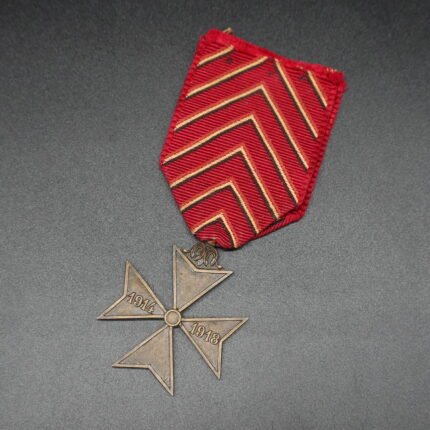
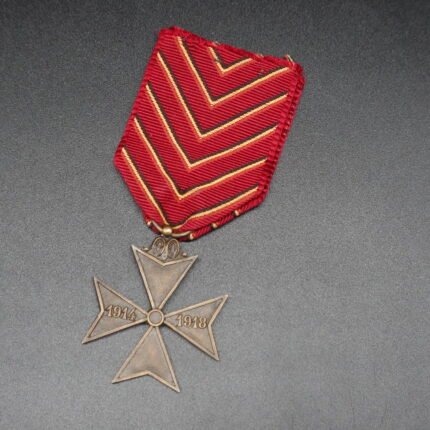
Belgian Deportees’ Cross 1914–1918 (Weggevoerdenkruis)
€25,00Original Belgian Deportees’ Cross 1914–1918 (Weggevoerdenkruis). The Deportees’ Cross 1914–1918 is a Belgian war decoration established by Royal Decree on 27 November 1922. It was awarded to Belgian civilians who were deported to Germany for forced labour during the First World War, recognizing their suffering and endurance under occupation.
Deportees who died during deportation were not eligible for this cross. Instead, they were posthumously honored with the Order of Leopold II, distinguished by a ribbon bearing a central longitudinal gold stripe.
Award Description
The decoration is a 38 mm wide bronze cross pattée, with identical obverse and reverse designs.
-
The horizontal arms feature the raised inscriptions:
-
“1914” on the right arm
-
“1918” on the left arm
-
-
The cross is suspended from a ring passing through a suspension loop at the top.
-
It is worn on a 37 mm ribbon (typically in green tones with contrasting stripes), symbolizing hope and the hardships endured during deportation.
A rare and meaningful piece of First World War history, especially valued by collectors focusing on civilian experiences and occupation-era memorabilia.
Note: Price Per Piece!
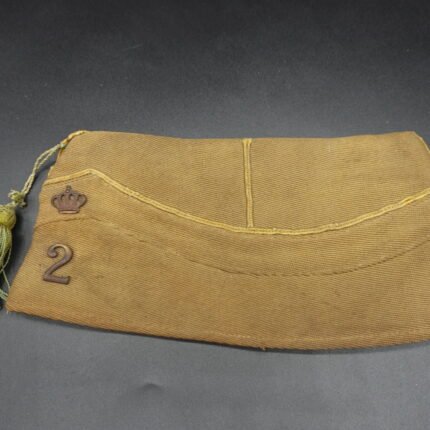
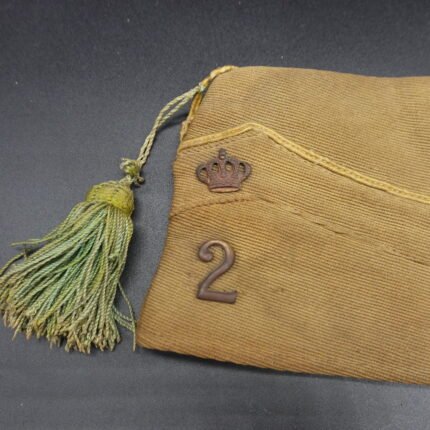
2de Jagers te Voet Kwartiermuts (Bonnet de Police)
€130,00Original 2de Jagers te Voet Kwartiermuts (Bonnet de Police), interesting unit and harder to find! Condition as seen.
Read more of the 2de Jagers te Voet
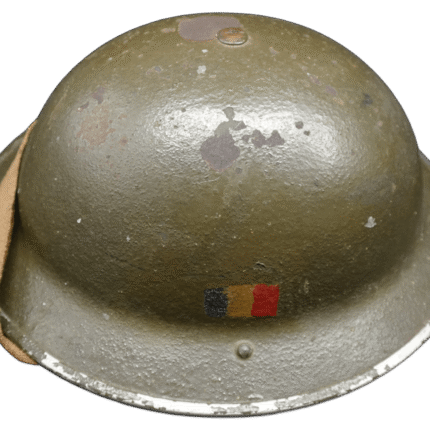
WWII British MKII Steel Helmet for Belgian Volunteer
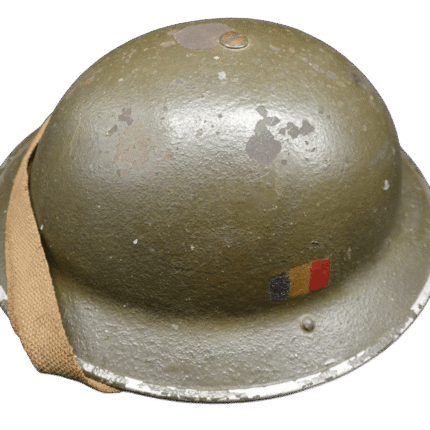
€395,00Original World War II British MK II steel helmet for a Belgian soldier that served with the United Kingdom Forces. Perhaps he belonged to the Belgian First Infantry Brigade “Brigade Piron” (his uniform – largely eaten by moths was sold previously by the seller). Complete with chin strap, inner liner (marked CCL 11 1943) and Belgian flag painted on the left side of the helmet shell. Named inside “Robert Loulou” (but LouLou is typically a nickname, so likely this is his nickname). On the chinstrap you also can read “Coppin”?! Stunning, beautiful helmet. Condition as seen.
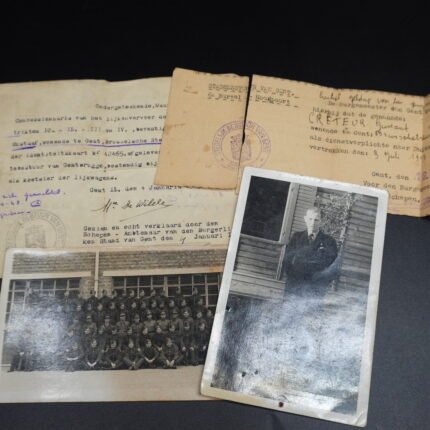
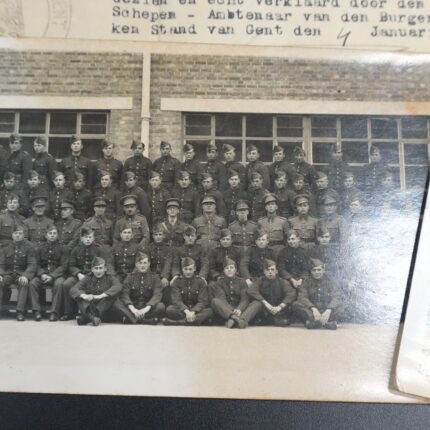
Small Set of 9de Linieregiment (1939!) in Oostende
€20,00Original Small Set of a soldier from the 9e Compagnie/ 9de Linieregiment (1939!) in Oostende. Condition as seen.
Read more about the 9de Linieregiment
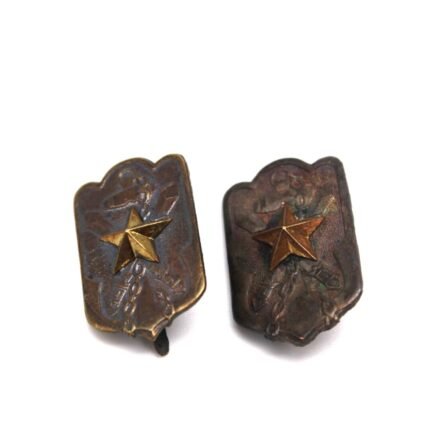
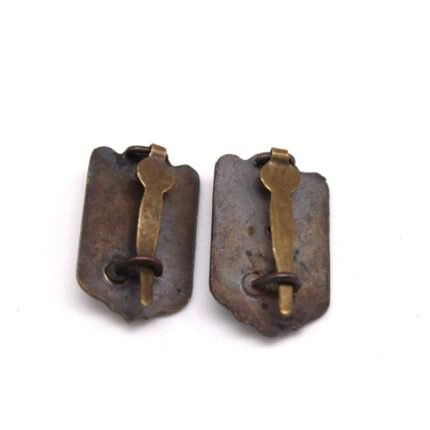
Imperial Japanese Army Military Reservist Badges (Small)
Original price was: €20,00.€10,00Current price is: €10,00.Original Imperial Japanese Army Military Reservist Badges (small variant). Condition as seen.
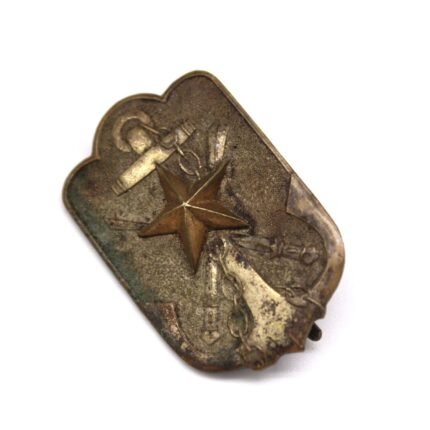
Imperial Japanese Army Military Reservist Badge
Original price was: €20,00.€10,00Current price is: €10,00.Original Imperial Japanese Army Military Reservist Badge (large variant). Condition as seen.
Manchurian Incident Medal (Cased)
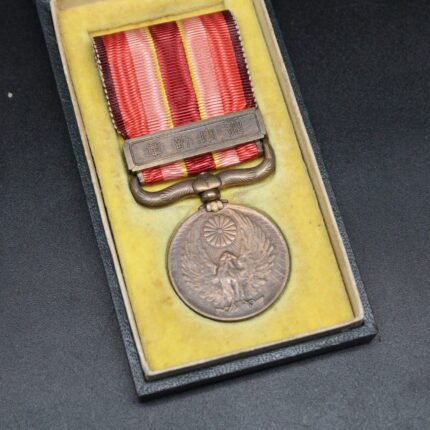
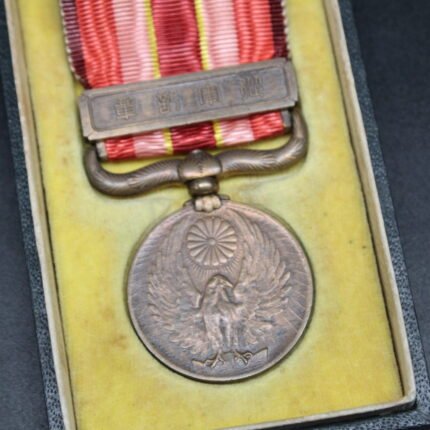
Original price was: €80,00.€60,00Current price is: €60,00.A fine and complete example of the Showa 6–9 War Service Medal (Manchurian Incident Medal), awarded to personnel who served during the early Imperial Japanese military operations of the Manchurian Incident (1931–1934)—a conflict that marked the beginning of Japan’s expansionary campaigns leading into the Second Sino-Japanese War and ultimately the Pacific War.
Instituted in 1934, the medal was issued to members of the Army, Navy, and supporting organizations who took part in combat operations, logistical support, or administrative duties related to the campaign. Its obverse features the Imperial chrysanthemum crest above a spread-winged eagle, symbolizing military strength and the authority of the Emperor. The reverse displays two crossed military helmets and inscriptions denoting the Showa era years Six to Nine. The ribbon—shades of red with yellow and white stripes—represents loyalty and valor.
Condition & Presentation
This example remains in very good condition, showing an attractive, untouched patina consistent with its age. The medal is housed in its original black case, which retains sharp gold kanji lettering on the lid. The interior is lined with the classic yellow felt insert that securely holds the piece in place.
Collector’s Notes
-
Complete and original medal with full ribbon and suspension bar
-
Crisp detail to the eagle, chrysanthemum, and reverse inscriptions
-
Case remains solid, with only minor wear from handling
-
A desirable early-Showa period decoration connected to one of the pivotal turning points in Japanese military history
An excellent addition for collectors of Imperial Japanese medals, early militaria, or those focusing on the Manchurian and pre-WWII military campaigns.
Japanese Victory Medal (Cased)
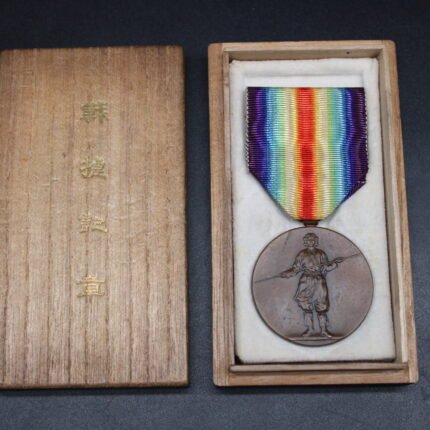
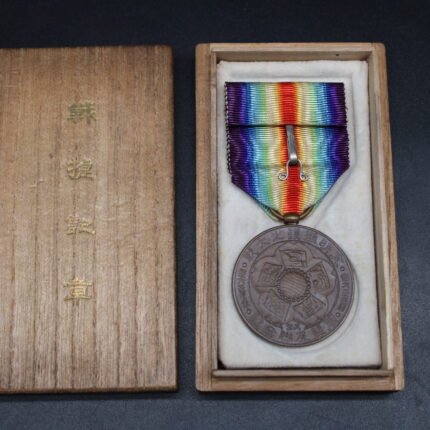
Original price was: €125,00.€100,00Current price is: €100,00.Original Japanese Victory Medal in very good condition with matching wooden case.
The Victory Medal was a commemorative military medal of Japan awarded to mark service during the First World War. Established by Imperial Edict #406 on 17 September 1920, it was one of the series of Victory Medals created and awarded by the victorious allies after the First World War. Fifteen nations in all issued a version of the medal. All shared the rainbow suspension and service ribbon, but the medals’ designs varied by country. Japan’s design was different from all other versions as it did not depict the goddess Victory. This figure from Roman mythology would have no connection to Japanese culture, so a depiction of Takemikazuchi, the war god in Japanese mythology occupies the obverse of the medal. (Source: Wikipedia)
Taishō Enthronement Commemorative Medal (Cased)
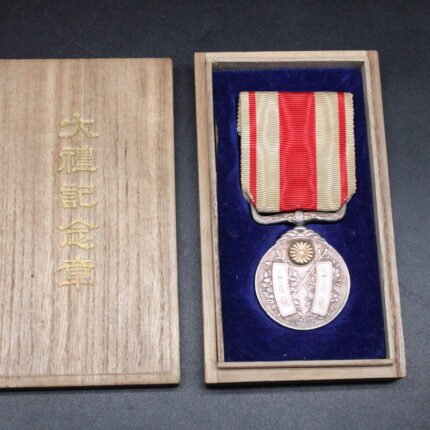
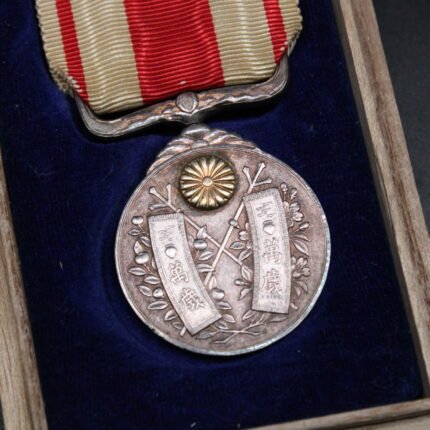
Original price was: €95,00.€65,00Current price is: €65,00.Issued to honor one of Japan’s most important imperial events, the Taishō Enthronement Commemorative Medal celebrates the accession of Emperor Taishō, who assumed the throne in 1912 following the death of Emperor Meiji. Although the succession occurred in 1912, the formal enthronement ceremonies—grand national celebrations steeped in tradition—were held in 1915, and it was during these festivities that the medals were awarded.
Bestowed upon individuals across Japan who took part in or contributed to the ceremonies, the medal exists in both men’s and women’s versions. The obverse features two banners bearing the word “Banzai”—a symbolic cheer of long life and loyalty—encapsulating the national spirit surrounding the new Emperor.
- Housed in its matching wooden presentation case, complete with crisp golden characters on the lid
-
Box and medal both in very good condition, showing only minimal age
-
A fully authentic and desirable Imperial-era piece
Collector’s Note
Artifacts from the Taishō period are increasingly sought after due to their transitional place between the Meiji modernization and the militarization of the Shōwa era. This medal, especially with its original case, is a fine representation of early 20th-century Japanese imperial craftsmanship and ceremony—an elegant addition to any collection of Japanese orders, medals, or imperial memorabilia.
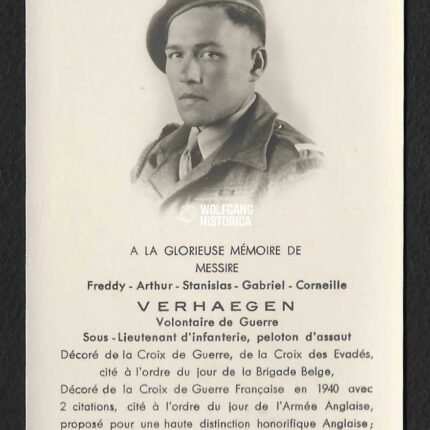
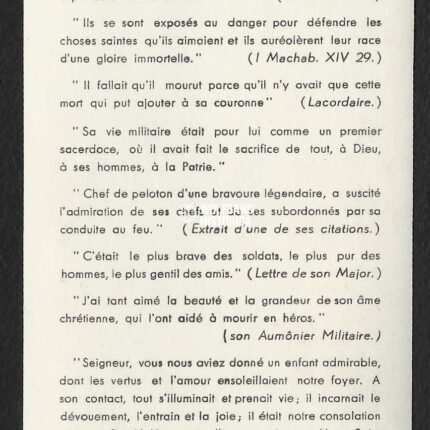
Belgian Death Card – Onderluitenant Verhaegen (KIA September 1944) – Brigade Bevrijding
€35,00Original Belgian WWII death card of Onderluitenant Freddy A. Verhaegen, who was Killed in Action on May 25, 1944 in Thorn (Nederland). Serving with the 2e Gemotoriseerde Eenheid Bde Bevrijding.
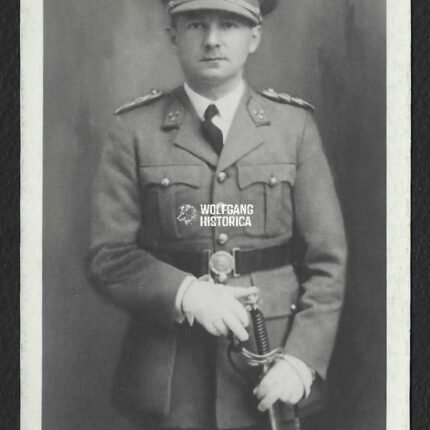
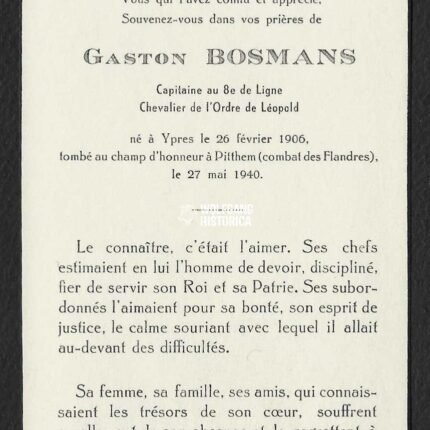
Belgian Death Card – Kapitein Gaston Bosmans (KIA May 27, 1940) – 8e Linieregiment
€25,00Original Belgian WWII death card of Kapitein Gaston Bosmans, who was Killed in Action on May 27, 1940 in Pittem. Commander of the 4th Company, 8e Linieregiment.
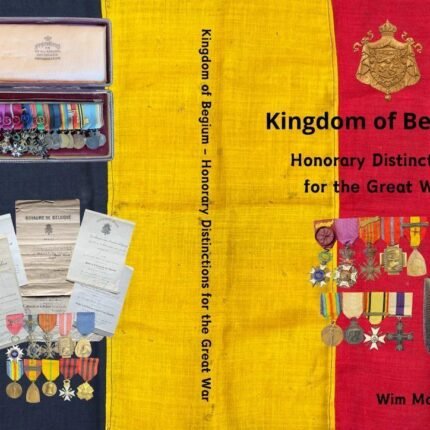
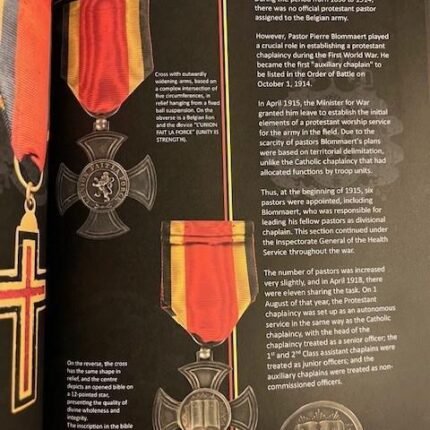
*BACK AVAILABLE / LAST CHANCE* Kingdom of Belgium – Honorary Distinctions for the Great War (Book)
€65,00Kingdom of Belgium – Honorary Distinctions for the Great War
By Wim Martens | Limited Conference Edition | 217 Pages
A highly sought-after reference work dedicated to Belgian First World War honors and decorations. Published to coincide with the XVII European Conference for Phaleristics in Brussels (May–June 2024), this volume provides a comprehensive and meticulously organized overview of official Belgian wartime distinctions.
Arranged chronologically by date of institution, the book presents detailed coverage of orders, medals, and decorations, including recognized variants, accompanying certificates, and period imagery of recipients. In addition, select service insignia and several unofficial yet tolerated distinctions are thoughtfully documented, offering a broader perspective valuable to collectors and historians alike.
Richly illustrated and expertly compiled, this 217-page publication serves as both a scholarly reference and a visually engaging catalog of Belgium’s Great War honors system.
Highlights:
-
Complete overview of Belgian WWI honorary distinctions
-
Chronological structure for ease of reference
-
High-quality photographs of medals, variants, and documents
-
Includes service insignia and rare unofficial distinctions
-
Features historical images of decorated individuals
-
Published for a specialized European phaleristics conference
Condition: New
Availability: Very difficult to find — especially outside specialist circles.
An essential addition to any serious phaleristics library or First World War collection.
Note: Shipping prices might not be final to some countries due weight and size!
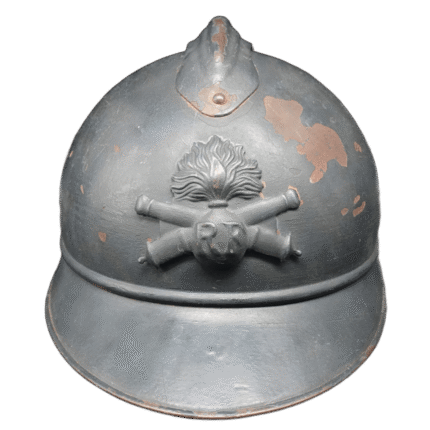
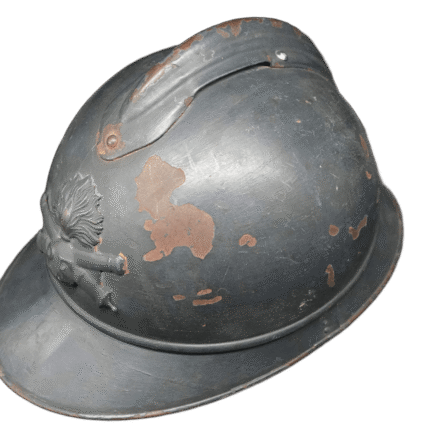
WWI French M15 Adrian Helmet – Artillery
€250,00Original French M15 Adrian World War I helmet for Artillery troops. Helmet is “horizon blue” (bleu horizon), inner helmet made with uniform leftovers! Complete with chin strap. Condition as seen.
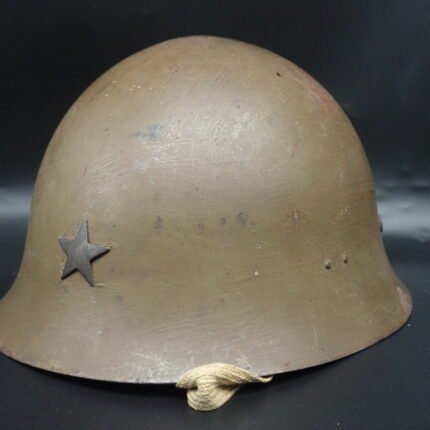
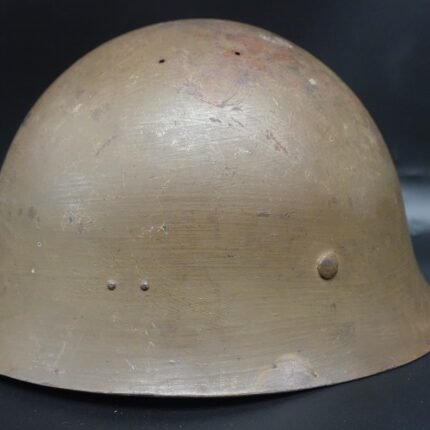
Japanese WWII Type 90 Steel Combat Helmet
€995,00Original WWII Japanese Type 90 combat helmet, which was used from 1930 to 1945 by soldiers of the Imperial Japanese Army. The helmet shell shows some signs of oxidation. In places, the underlayers of bluish paint are visible beneath the brush-applied paint.
The army star is fixed to the front part; it also serves as a rivet. On the rear inner rim of the hull, the kanji 少is stamped into the steel and painted white over it, indicating that it is a small size. Next to it, we can see the Kobe Seiko arsenal logo stamped in the steel (an S in a diamond) as well as a partially visible number.
The kanji indicating the size is also present on the leather band of the headdress. The leather helmet is in good condition. It has canvas compartments containing padding (one of the compartments is now empty) . One of them bears a Japanese army stamp indicating the production date of Showa 15 (1940).
The canvas chin strap is complete
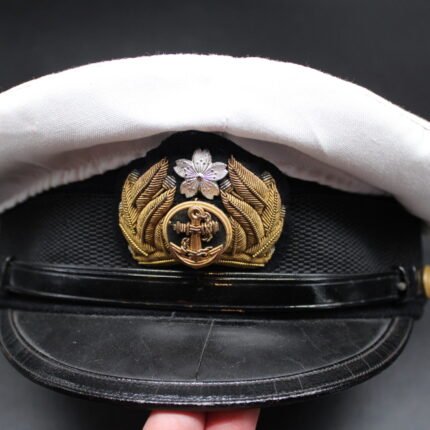
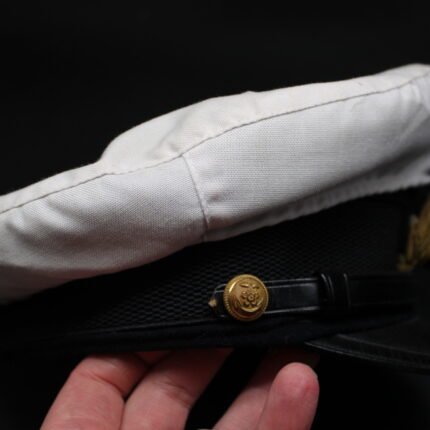
WWII Imperial Japanese Navy (IJN) Officer’s Visor Cap
€395,00A beautifully tailored Imperial Japanese Navy officer’s visor cap from the Second World War, manufactured to the high standards typical of naval uniforms of the era. Navy officer caps differed markedly from their Army counterparts, featuring deep midnight-blue wool, glossy black patent-leather elements, and the distinctive gold bullion anchor-and-cherry-blossom insignia—the long-standing emblem of the Imperial Japanese Navy.
This example is constructed from fine, dark navy wool with excellent form retention and a sharp, elegant naval profile. The front displays a crisp officer-quality bullion cap badge, richly embroidered and remaining bright with only mild toning from age. The black lacquered visor shows expected period age-crazing but is stable and fully intact. The chinstrap, side buttons, and stitching all remain original.
Inside, the cap retains its silk or rayon lining—still clean and richly colored—along with the original leather or ersatz-leather sweatband. The interior shows gentle, honest service wear but no damage, tears, or repairs. Overall, it is a remarkably well-preserved cap that clearly saw use yet was carefully stored for decades afterward.
A notable addition is the original white cotton removable over-cap, used for tropical and summer dress. This piece is often missing and greatly enhances both the completeness and display quality of the set.
Collector’s Note
Authentic Imperial Japanese Navy officer caps from WWII are significantly scarcer than Army examples due to the smaller size of the IJN and its disproportionately high wartime losses. Surviving caps—especially those in complete, undamaged condition with original insignia—are highly sought after by collectors of Axis headgear and naval militaria.
This cap’s fine construction, excellent badge, and appealing overall condition make it a standout display piece and a superb representative example of wartime naval uniform design. An exceptional addition to any advanced WWII collection.
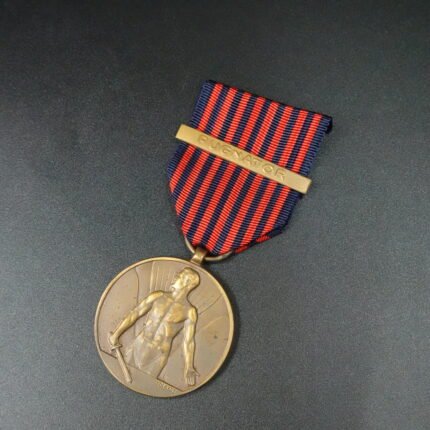
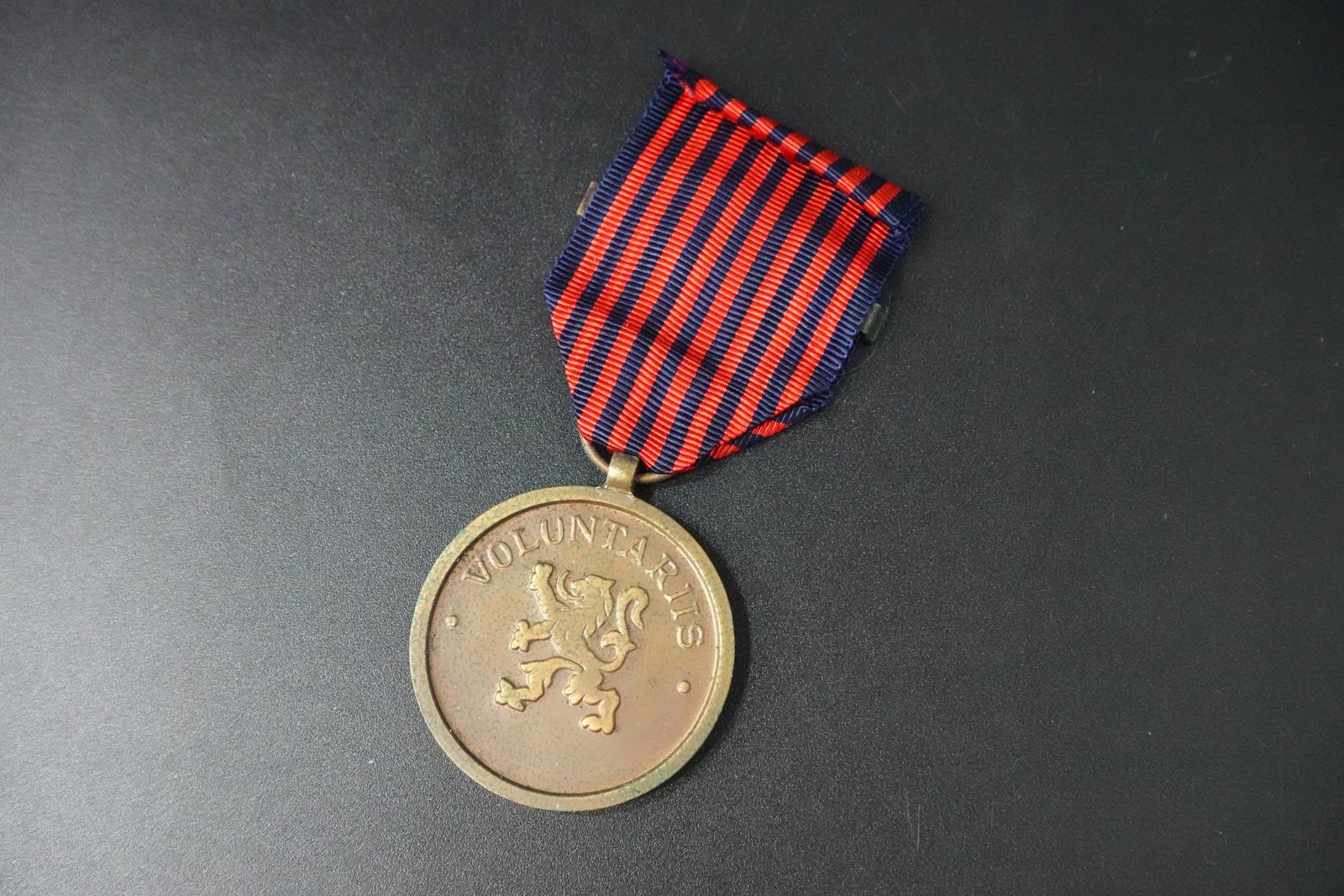
Belgian War Volunteer Combatant Medal 1940–1945 (Medaille v.d. Strijdende Oorlogsvrijwilliger)
€20,00Original Belgian War Volunteer Combatant Medal (Médaille du Volontaire de Guerre Combattant / Medaille van strijdende Oorlogsvrijwilliger) with “Pugnator” Clasp. The War Volunteer Combatant Medal is a Belgian decoration established by Royal Decree on 8 April 1952, awarded to Belgian and foreign nationals who voluntarily enlisted in the Belgian Armed Forces for the duration of the war. This could be awarded to Korean War Volunteers but also retroactively to both 1st and/or the 2nd World War veterans.
The medal could also be awarded posthumously, recognizing those who made the ultimate sacrifice.
Award Criteria
The medal was granted to:
-
Belgian or foreign individuals who voluntarily enlisted
-
Personnel who committed to serve for the duration of the war (Korea, 1914-1918 and 1940–1945)
-
Combatants who actively participated in wartime operations
This version specifically recognizes combatant volunteers, distinguishing it from the general War Volunteer Medal.
Distinction: “Pugnator” Bar
The Combatant version is identical to the standard War Volunteer Medal but includes:
-
A 4 mm bronze and/or silver bar on the ribbon
-
Inscribed with “Pugnator” (Latin for “fighter” or “combatant”)
This device clearly identifies the recipient as a front-line combat volunteer.
Design & Characteristics
-
Material: Patinated bronze
-
Diameter: approx. 37 mm
Obverse:
-
Classical Belgian medal design (typically featuring national symbolism)
Reverse:
-
Central lion rampant
-
Circular Latin inscription: “VOLUNTARIIS” (To the volunteers)
Suspension:
-
Ring passing through a lateral barrel suspension
Ribbon
-
Width: approx. 38 mm
-
Composed of 15 narrow longitudinal stripes alternating:
-
Red and blue
-
-
With wider blue edge stripes (4 mm)
Condition: As seen in the images.
A highly collectible Belgian WWII medal, especially valued for its “Pugnator” combat distinction, making it more desirable among volunteer service decorations.
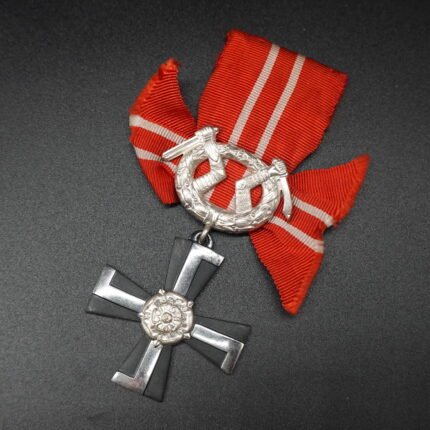
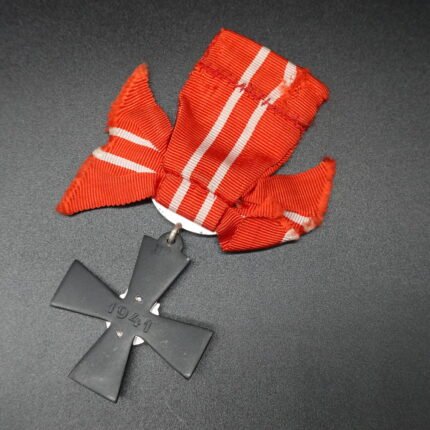
Finnish Order of the Cross of Liberty 4th Class (1941) with Swords
€165,00Original Finnish Order of the Cross of Liberty 4th Class (1941) with Swords. Two piece construction, complete with ribbon. Near Mint. Condition as seen.
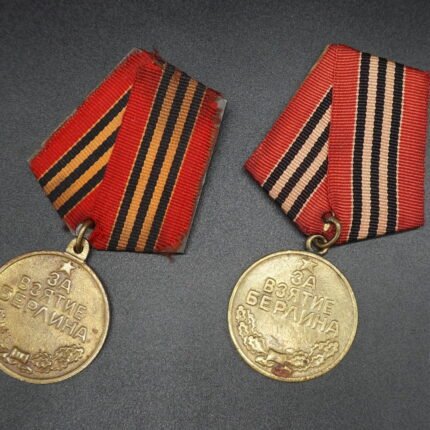
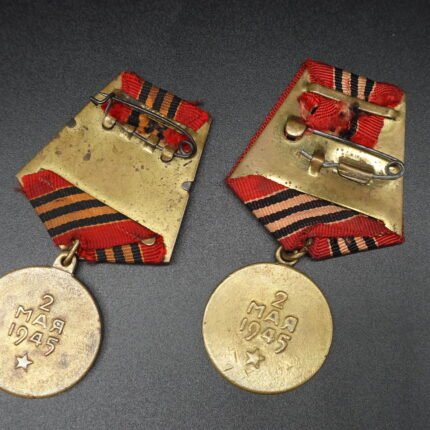
Medal for the Capture of Berlin (Price per Piece)
€55,00Original Soviet World War II, Medal for the Capture of Berlin. Condition as seen.
Price per Piece. You’ll get the best remaining one.
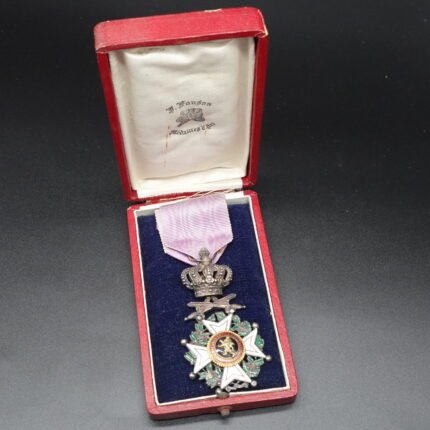
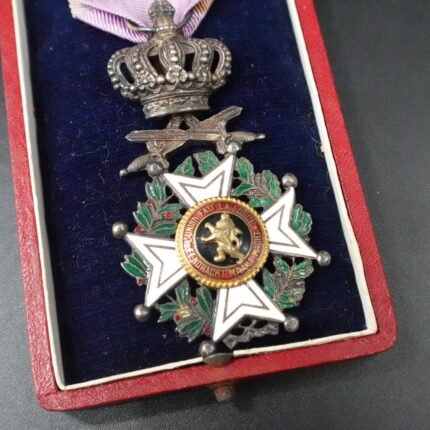
Order of Leopold (Rank of Knight) – Leopoldsorde (Rangorde Ridder) in Etui
€90,00Original Order of Leopold (Leopoldsorde / Ordre de Léopold) (Class of Knight – Rangorde v.d. Ridder) with Etui! This is the post-1952 design with bilungual motto.
The Order of Leopold is the oldest and highest national order of Belgium, established on 11 July 1832 by King Leopold I. It remains one of the three principal Belgian orders of knighthood and is awarded by Royal Decree. It recognizes exceptional service to the Belgian state, whether in military, civil, or maritime contexts.
Overview & Structure
The order is divided into three main divisions:
-
Civil Division – for civilian merit
-
Military Division – for armed forces (with crossed swords)
-
Maritime Division – for merchant navy (with anchors)
It follows a five-class system, inspired by French honors:
-
Grand Cordon
-
Grand Officer
-
Commander
-
Officer
-
Knight
Historical Background
Following Belgian independence in 1830, the newly formed nation required a national honors system. King Leopold I established the order not only for military merit, but for all forms of service to the Kingdom.
The official motto: “L’Union fait la Force / Eendracht maakt Macht” (Unity Makes Strength)
The design was approved shortly after independence and reflects strong European chivalric traditions.
Design & Insignia
Badge:
-
White-enameled Maltese cross
-
Silver (Knight) or gold (higher classes)
-
Green enamel laurel and oak wreath between the arms
-
Central medallion:
-
Obverse: Belgian lion on black enamel
-
Reverse: Monogram “LR” (Leopoldus Rex)
-
-
Red enamel ring with bilingual motto
-
Topped by a royal crown
-
May include crossed swords (military) or anchors (maritime)
Ribbon
-
Standard color: Purple
Special distinctions (rare variants):
-
⚔️ Crossed swords – wartime award
-
⭐ Gold or silver stars – mentioned in dispatches or merit
-
🌿 Palms – military wartime distinction
-
Gold borders or stripes – exceptional acts of valor
Condition: As seen in the images.
A prestigious and historically significant Belgian order, highly sought after by collectors of royal, military, and national honors.
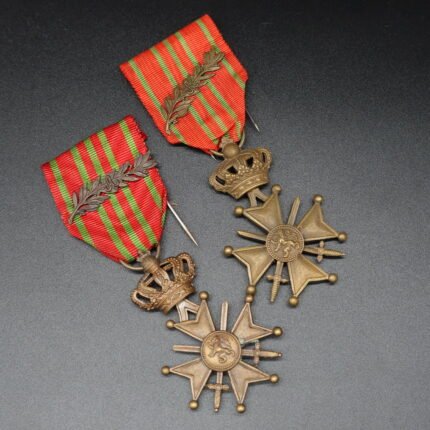
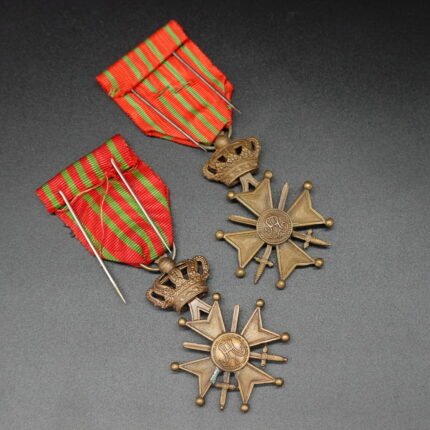
Belgian War Cross 1914–1918 (Oorlogskruis) (Price Per Piece)
€25,00Original Belgian War Cross 1914–1918 (Oorlogskruis) with Palm. The Belgian War Cross 1914–1918 (Oorlogskruis) is one of Belgium’s most prestigious First World War decorations. It was instituted by Royal Decree on 25 October 1915, inspired by the French Croix de Guerre established earlier that same year.
Awarded exclusively to individual members of the Belgian Army, Navy, and Air Force — and in exceptional cases to foreign Allied servicemen — the War Cross recognized acts of bravery in the face of the enemy.
Beyond gallantry, the decoration was also granted for:
-
Three years of front-line service (five front stripes)
-
Volunteers over 40 or under 16 years of age with at least 18 months of service
-
Escaped prisoners of war who rejoined their unit within three months
-
Soldiers unable to resume combat due to wounds sustained in action
The War Cross could be awarded posthumously. In such cases, the ribbon bears a black enamel bar. Non-commissioned officers and enlisted men who died from wounds received in combat were additionally appointed Knights of the Order of Leopold II with palm and also received the War Cross.
Citation Devices (Ribbon Distinctions)
Recipients mentioned in official dispatches could wear the following devices on the ribbon:
-
Bronze Lion – Mention in Regimental Orders
-
Silver Lion – Mention in Brigade Orders
-
Gold Lion – Mention in Divisional Orders
-
Bronze Palm – Mention in Army Orders
-
Five bronze palms replaced by one silver palm
-
Five silver palms replaced by one gold palm
These devices significantly enhance both the historical and collector value of the decoration.
Belgian Civilian Disobedience Medal 1940–1945 (Werkweigeraarsmedaille)
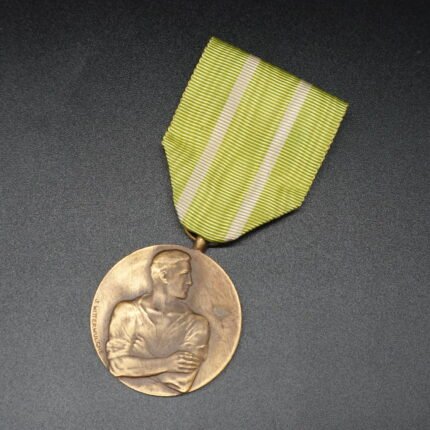
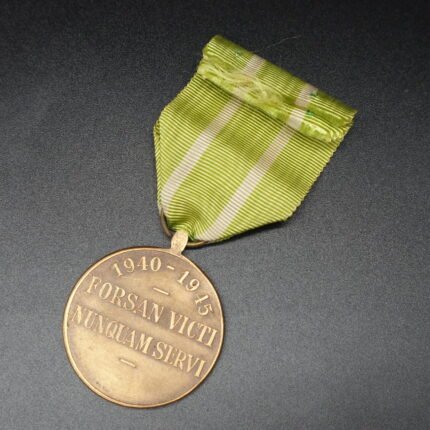
€30,00Original Belgian Civilian Disobedience Medal 1940–1945 (Médaille du Réfractaire / Werkweigeraarsmedaille). This medal with green-white ribbon was awarded to civilians who for refused to work for the German occupiers.
The Civilian Disobedience Medal 1940–1945 is a Belgian war service decoration established by Royal Decree on 12 February 1951. It was awarded to Belgian civilians who refused to support the German war effort during the Second World War. This medal honors acts of civil resistance, defiance, and moral courage carried out under occupation.
Award Criteria
The medal was awarded to Belgian citizens who:
-
Refused to serve in German armed forces
-
Refused to work for the German occupiers
-
Refused to return to Germany after forced labour leave
It recognizes non-violent resistance and personal risk taken in opposition to the occupier.
Design & Characteristics
-
Material: Bronze
-
Diameter: approx. 37 mm
Obverse:
-
Torso of a civilian man with arms crossed
-
Head turned away in defiance, symbolizing resistance
- Designed by J. Witterwulghe (marked on the front of the medal)
Reverse:
-
Latin inscription: “FORSAN VICTI NUNQUAM SERVI” (“Perhaps defeated, but never slaves”)
-
Upper edge: “1940–1945”
Ribbon Variants
-
Base color: Green silk moiré
-
Two longitudinal stripes (3 mm wide), positioned near the edges
Condition: As seen in the images.
A powerful and meaningful Belgian WWII decoration, highly valued for its recognition of civil courage and resistance without weapons.
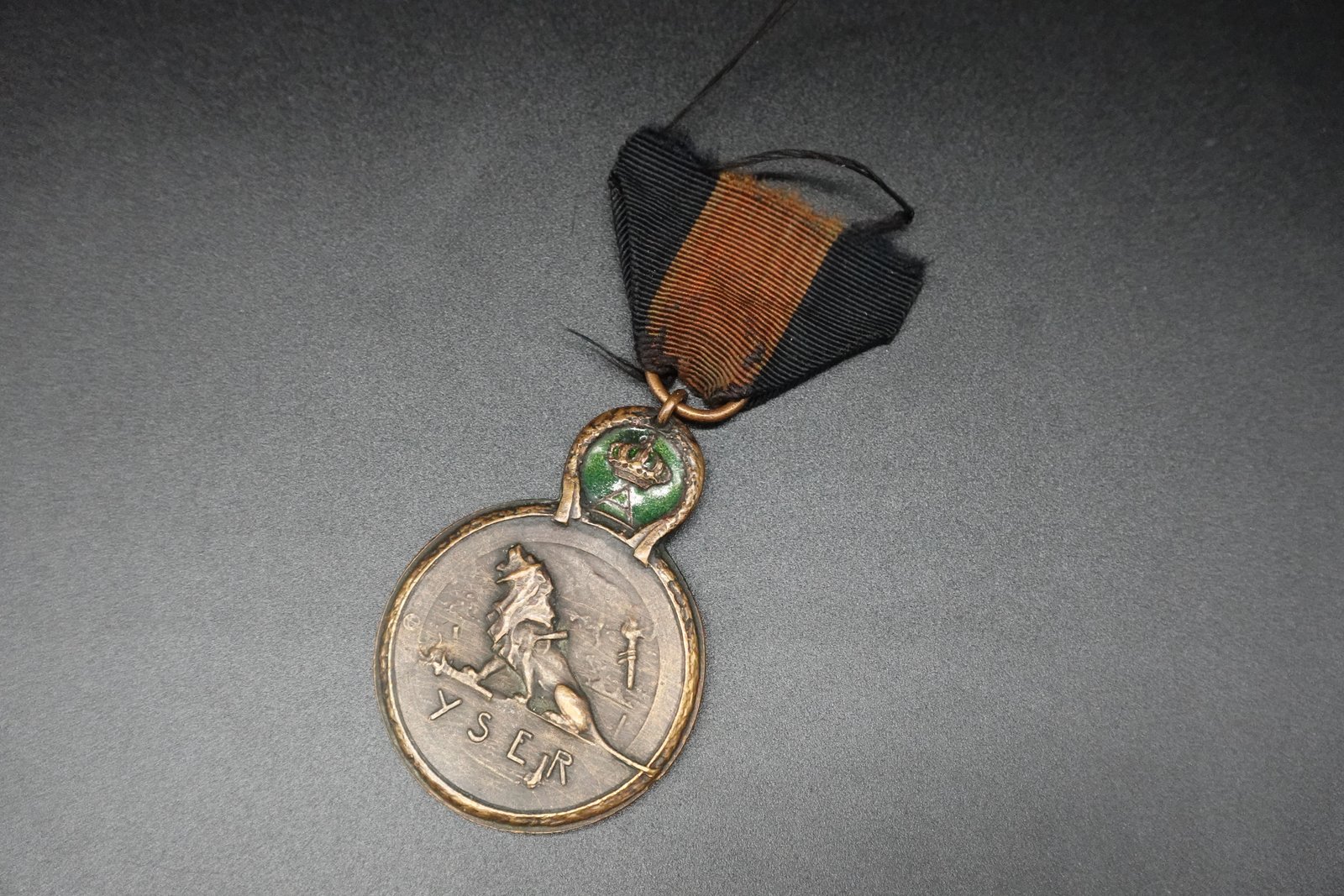
Belgian Yser Medal (Medaille van de IJzer)
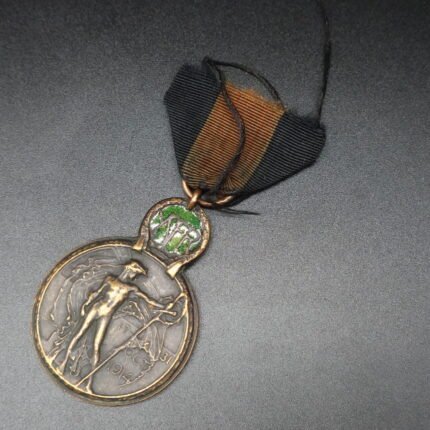
€20,00Original Belgian Yser Medal (Medaille van de IJzer / Médaille de l’Yser). The Yser Medal is a Belgian World War I campaign decoration established on 18 October 1918. It was awarded for distinguished service during the Battle of the Yser (17–31 October 1914), where the Belgian Army successfully halted the German advance during the invasion of Belgium.
Award Criteria
The medal was awarded to:
-
Members of the Belgian Armed Forces who fought along the Yser River
-
Personnel who distinguished themselves during the battle
-
Allied foreign soldiers who participated in the engagement
The decoration could also be awarded posthumously.
In the official order of wear, the medal is placed immediately after the War Cross (Croix de Guerre).
Design & Characteristics
-
Material: Bronze with enamel detail
-
Diameter: approx. 35 mm
Obverse:
-
A helmeted nude figure holding a lance, symbolizing resistance and the halting of the German advance
-
Inscription: “17–31 OCT 1914”
-
Green enameled medallion with the inscription: “YSER”
Reverse:
-
A wounded Belgian lion lying on the bank of the Yser River, pierced by an arrow
-
Below: inscription “YSER”
-
Upper medallion: royal crown above the monogram “A” of King Albert I
Ribbon
-
Color: Red silk moiré
-
Edges: Wide black stripes
Symbolism:
-
Red – Blood shed during battle
-
Black – Mourning and sacrifice
Condition: As seen in the images.
A highly significant and iconic Belgian WWI decoration, representing one of the most defensive actions in Belgian military history.
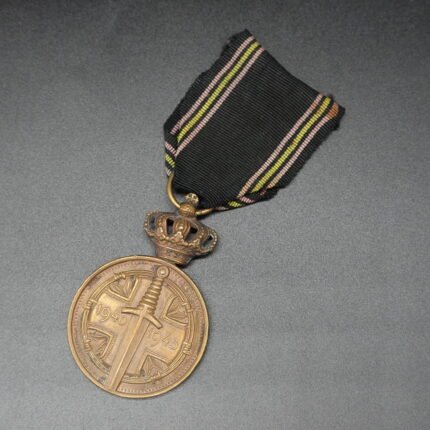
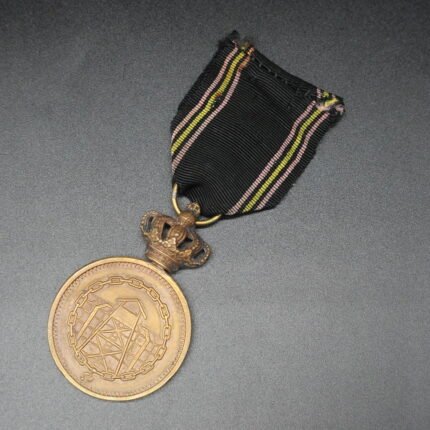
Belgian Prisoner of War Medal 1940–1945 (Krijgsgevangenenmedaille 1940–1945)
€17,50Original Belgian Prisoner of War Medal 1940–1945 (Krijgsgevangenenmedaille 1940–1945). The Prisoner of War Medal 1940–1945 is a Belgian war service decoration established by Royal Decree on 20 October 1947. It was awarded to members of the Belgian Armed Forces who were captured and held prisoner by Axis forces during the Second World War.
This medal honors the hardship, endurance, and sacrifice of those who experienced captivity during the war.
Award Criteria
The medal was awarded to:
-
Members of the Belgian Armed Forces
-
Personnel who were held as prisoners of war by Axis forces during WWII
Additional distinctions:
-
Duration of captivity could be indicated by small metal bars on the ribbon
Design & Characteristics
-
Material: Bronze
-
Diameter: approx. 38 mm
-
Total height (with crown): approx. 64 mm
Obverse:
-
A downward-pointing broadsword over a Greek cross
-
Dates “1940” and “1945” on the cross arms
-
Laurel leaves between the arms
-
Encircled by a ring of barbed wire, symbolizing imprisonment
Reverse:
-
Depiction of a guard tower and prison camp fence
-
Surrounded by a chain border, reinforcing the theme of captivity
Suspension:
-
Topped by a prominent royal crown, attached by a pin
Ribbon
-
Color: Black silk moiré
-
Edge stripes: Narrow stripes in red, black, yellow, black, red
-
Symbolism reflects Belgium and the dark experience of captivity
Condition: As seen in the images.
A powerful and historically significant Belgian WWII decoration, highly valued by collectors of prisoner-of-war and wartime hardship memorabilia.
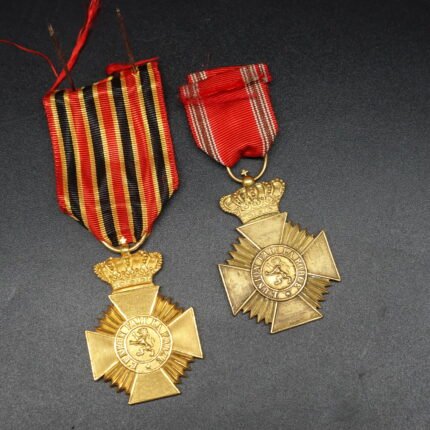
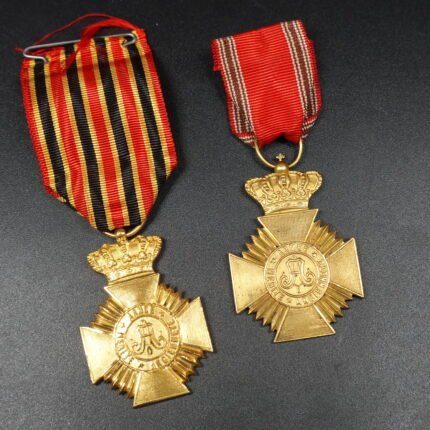
Belgian Military Decoration for Long Service (Militair Ereteken voor Dienstanciënniteit) (Price Per Piece)
€15,00Original Belgian Military Decoration for Long Service (Militair Ereteken voor Dienstanciënniteit / Décoration Militaire). The Military Decoration (Militair Ereteken) is an official Belgian military award established by Royal Decree on 22 December 1873. It is awarded to non-commissioned officers and enlisted personnel and exists in two distinct categories, each recognizing different forms of service.
Informative: Belgian Military Decoration comes in two versions:
1. Long Service (Dienstanciënniteit)
-
Awarded to NCOs and enlisted personnel
-
Second Class: after 10 years of service
-
First Class: after an additional 5 years
-
Not awarded to officers (who instead receive the Military Cross)
2. Exceptional Service / Gallantry (Buitengewone Dienst)
-
Awarded for acts of courage, devotion, or distinguished service
-
Can be granted for a single notable act
-
Also awarded to naval personnel after 20 years of service at sea
-
May exceptionally be awarded in First Class
-
Can be awarded to foreign non-commissioned personnel
All awards are granted by Royal Decree and officially published in the Belgian State Gazette.
Design & Characteristics
The decoration is identical across both categories and classes:
-
Form: Cross pattée with four rays between each arm, surmounted by a royal crown
-
Obverse: Belgian lion with the motto:
-
“L’Union fait la Force” (pre-1952)
-
“L’Union fait la Force – Eendracht maakt macht” (post-1952)
-
-
Reverse:
-
Pre-1952: Royal monogram (Leopold II, Albert I, or Leopold III) with “Armée Mérite Ancienneté”
-
Post-1952: Belgian lion only
-
Ribbon Variants
The two categories are distinguished by their ribbons:
-
Long Service:
17 narrow vertical stripes in Belgian national colors (red, yellow, black), with red on the outer edges -
Exceptional Service / Gallantry:
Red ribbon with Belgian tricolor edges (red outermost)
Additional distinctions:
-
First Class: indicated by a chevron on the ribbon
-
Wartime award (Article 4): may include a silver palm with royal monogram
Order of Precedence & Wear
-
Worn after the decorations of the National Orders
-
Takes precedence over the Military Cross (as it was established earlier)
-
If both categories are awarded, the gallantry version takes precedence
-
NCOs promoted to officer rank may continue to wear the decoration until eligible for the Military Cross
A highly collectible and historically important Belgian decoration, valued for both its longevity and its dual recognition of service and bravery.
Note: Price Per Piece! The one with the wrong ribbon (on the right, will be discounted to 10 EUR instead of 15 EUR – if you want this one, add it in the purchase note)
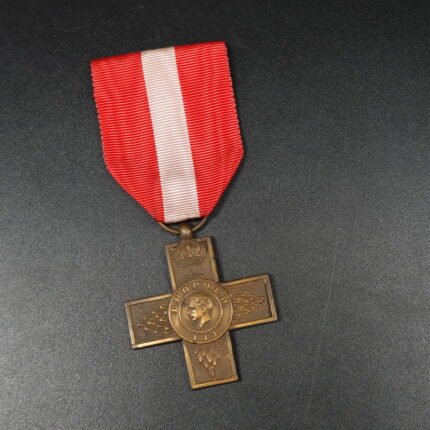
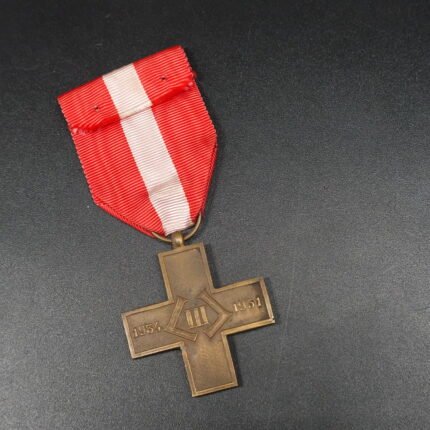
“Leopold III – 1934-1951” Cross Medal
€30,00Original “Leopold III – 1934-1951” Cross Medal. Onofficial award but difficult to find. Condition as seen.
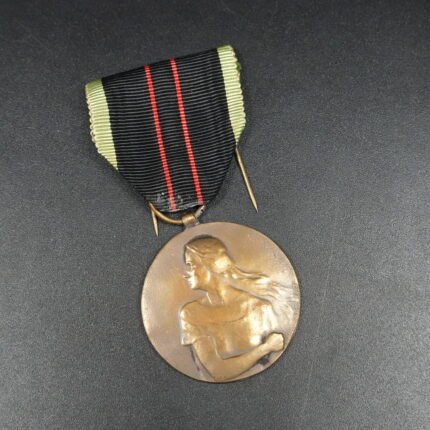
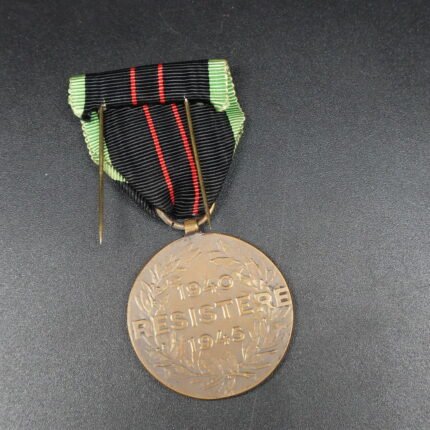
Belgian Armed Resistance Medal 1940–1945 (Medaille van de Gewapende Weerstand)
€30,00Original Belgian Armed Resistance Medal 1940–1945 (“Medaille van de Gewapende Weerstand”) (Médaille de la Résistance Armée 1940–1945). The Armed Resistance Medal 1940–1945 was a Belgian wartime decoration established by decree of the Prince Regent on 16 February 1946. It was awarded to members of the Belgian Resistance and intelligence agents who took part in armed operations in occupied territory during the Second World War.
The medal could be awarded posthumously, honoring those who lost their lives in the struggle against occupation.
Design & Characteristics
The decoration is a 39 mm round bronze medal, rich in symbolic detail.
Obverse:
A raised image of the left-profile torso of a woman, her gaze turned to the right, her right fist clenched — a powerful symbol of defiance against the will of the occupier.
Reverse:
The inscription: “1940” – “RESISTERE” – “1945” arranged in three lines and surrounded by a laurel wreath running along the full rim of the medal. The Latin word Resistere (“to resist”) emphasizes the spirit of armed resistance.
Ribbon & Symbolism
The medal is suspended from a ring passing through a lateral barrel-shaped suspension at the top. The ribbon colors carry strong symbolic meaning:
-
Green – Hope for liberation
-
Red – Blood shed by resistance fighters
-
Black – The dark days of occupation and the clandestine nature of the resistance
A highly significant and historically charged decoration, essential for collectors of Belgian WWII militaria and resistance memorabilia.
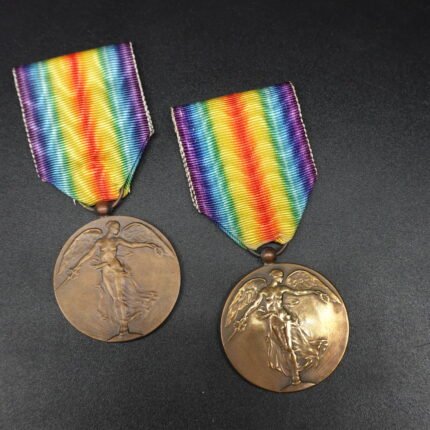
Belgian Victory Medal 1914–1918 (Overwinningsmedaille) (Price Per Piece)
€15,00Original Belgian Victory Medal 1914–1918 (“Overwinningsmedaille”) (Inter-Allied Victory Medal / “War for Civilization” Medal) The Belgian Victory Medal 1914–1918, also known as the Inter-Allied Medal 1914–1918 or, after the reverse inscription, the “War for Civilization” Medal, is Belgium’s official Inter-Allied decoration awarded following the Allied victory in the First World War.
Established on 15 July 1919 by King Albert I of the Belgians, this prestigious medal was granted to all members of the mobilized Belgian Army who served between 1 August 1914 and 11 November 1918. Approximately 300,000 to 350,000 veterans received this decoration.
Subsequent decrees extended eligibility to participants in the African campaigns against German colonial forces, as well as civilians who contributed to the war effort, including members of the merchant navy and fishermen.
The medal was worn after the Yser Medal or the Yser Cross in the official order of precedence. In civilian dress, a small ribbon rosette in the medal’s colors was worn in the buttonhole. For formal evening wear, a miniature version of the medal was suspended from a small ribbon or chain. On military uniforms, recipients wore the ribbon bar (baton).
A highly desirable addition for collectors of World War I decorations, Belgian military history, or Inter-Allied commemorative medals.
Note: Price Per Piece!
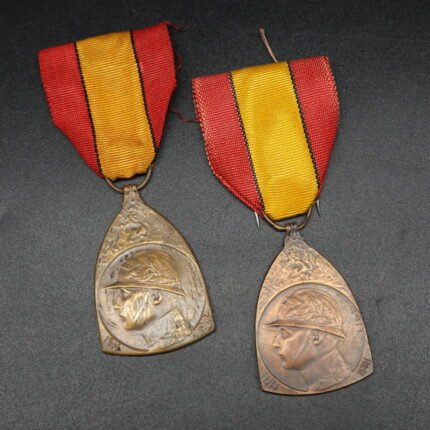
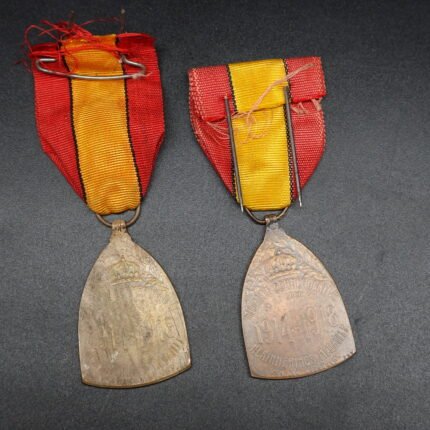
Belgian Commemorative Medal 1914–1918 (Herinneringsmedaille 1914–1918) (Price Per Piece)
€15,00Original Belgian Commemorative Medal 1914–1918 (Herinneringsmedaille 1914–1918). The Herinneringsmedaille 1914–1918 is an official Belgian military decoration awarded to soldiers and civilians who served in the Belgian Armed Forces during the First World War or who rendered distinguished service during the German occupation. This historic decoration honors their courage, sacrifice, and contribution to Belgium’s war effort.
Crafted in bronze-toned metal, the medal features a distinctive triangular design with a rounded lower edge. The obverse displays the profiled portrait of a Belgian soldier wearing the iconic Adrian helmet, surrounded by a wreath of laurel leaves — a classical symbol of honor and victory. The years “1914” and “1918” appear on either side, marking the duration of the Great War.
The full-size medal is suspended from a yellow moiré ribbon with a central black stripe and red borders, reflecting the national colors of Belgium.
An excellent addition to any World War I collection, militaria display, or historical archive.
Note: Price Per Piece!
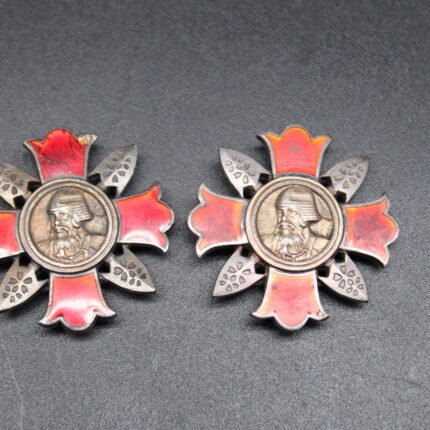
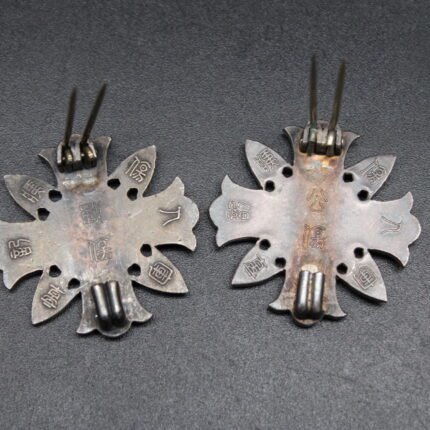
Set of Two Japanese Wound Badges – Combat & Non-Combat Variant (!)
€95,00A desirable matched set of Imperial Japanese wound badges (Combat & Non-Combat Variants – Pair) from the Model 1938 issue, representing both major variants awarded during the late pre-war and WWII periods. These badges were issued by the Imperial Japanese Army to recognize wounds or injuries suffered in service, and complete pairs such as this are increasingly hard to find.
Included in the Set
Type 4.1 – Sensho Wound Badge (Combat Injury)
Awarded to soldiers wounded in direct combat, the Sensho badge carries significant historical weight as it denotes frontline experience and injury suffered in battle.
-
Diameter: 31 mm
-
Distinct in its meaning and traditionally more sought after due to its combat association.
Type 4.2 – Kosho Wound Badge (Non-Combat Service Injury)
The Kosho badge was awarded for non-combat injuries or ailments received in public service, such as illness, poisoning, or accidents occurring while on duty.
-
Diameter: 31 mm
-
Although awarded under different circumstances, it is essential for completing a full wound badge collection.
Condition
Both badges remain in worn, condition, showing scratches, wear, and minor defects consistent with age and actual use—exact details visible in the photos. The honest patina adds character and authenticity, making this a perfect set for collectors who appreciate items as they were found.
Collector’s Note
Securing both the Sensho (combat) and Kosho (non-combat) wound badge variants together is increasingly uncommon. This duo represents a complete study example of the Model 1938 wound award system and is ideal for advanced collections focused on Imperial Japanese militaria or wound award typology.
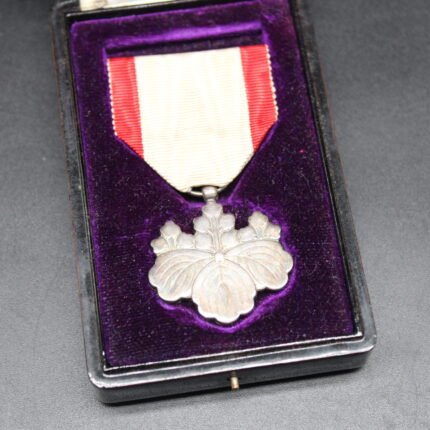
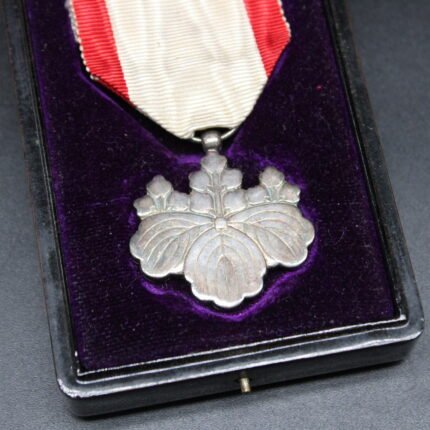
Order of the Rising Sun – 8th Class (Cased)
€45,00The Order of the Rising Sun (旭日章 – Kyokujitsu-shō) was established in 1875 by Emperor Meiji as Japan’s first national order of merit. Designed to reflect the symbolic identity of Japan as the “Land of the Rising Sun,” the order features stylized radiant sunbeams representing vitality, honor, and national service.
The 8th Class (now discontinued) was the most junior grade of the order and was traditionally awarded for loyal public service, military merit, or distinguished civil achievement. Prior to 1945 it was frequently bestowed upon NCOs, soldiers, police, government clerks, and civilians who demonstrated commendable dedication in their respective roles. While modest in rank, the 8th Class remained a respected imperial decoration, representing inclusion in Japan’s oldest system of formal honors.
This example is an original pre-WWII/WWII period medal, complete with its matching presentation box. The medal retains excellent detail, displaying the classic radiant sunburst design suspended from its red-and-white ribbon. The wooden case bears the gilded kanji inscription identifying the order.
Item Details
-
Decoration: Order of the Rising Sun, 8th Class
-
Era: Pre-1945 Imperial Japan
-
Material: Silvered metal with enamel accents
-
Ribbon: Original, lightly aged but strong
-
Case: Original, with gold-stamped kanji on lid
-
Condition: Medal in very good condition with crisp detail; box with minor age wear only
Collector’s Note
The lower classes of the Order of the Rising Sun — especially the 8th Class — are increasingly difficult to find in complete, untouched sets, as many were discarded or separated from their cases over time. This is an appealing and historically significant example of Imperial Japan’s earliest and most iconic award system, ideal for collections focused on Japanese orders, early Meiji-era decoration history, or WWII-era militaria.