

[block id=”422″]
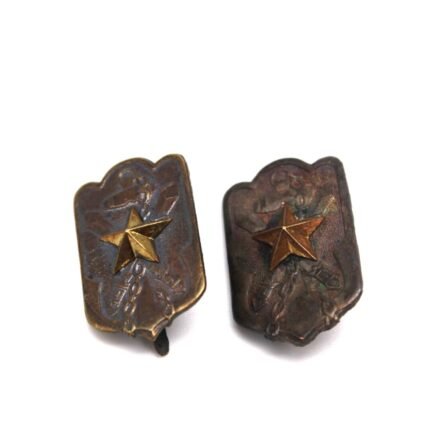
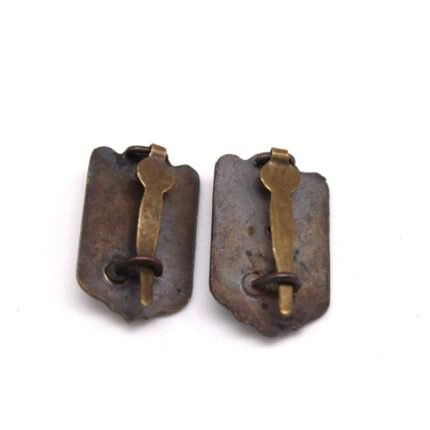
Imperial Japanese Army Military Reservist Badges (Small)
Original price was: €20,00.€10,00Current price is: €10,00.Original Imperial Japanese Army Military Reservist Badges (small variant). Condition as seen.
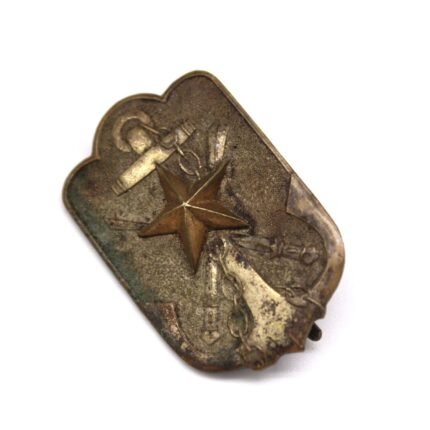
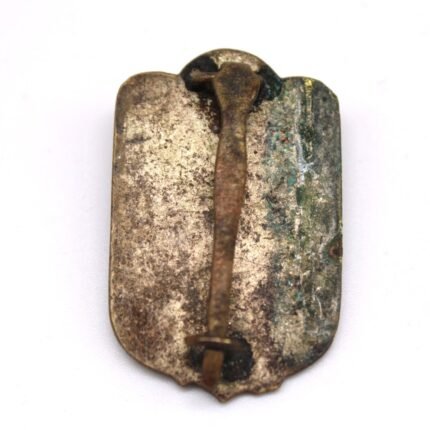
Imperial Japanese Army Military Reservist Badge
Original price was: €20,00.€10,00Current price is: €10,00.Original Imperial Japanese Army Military Reservist Badge (large variant). Condition as seen.
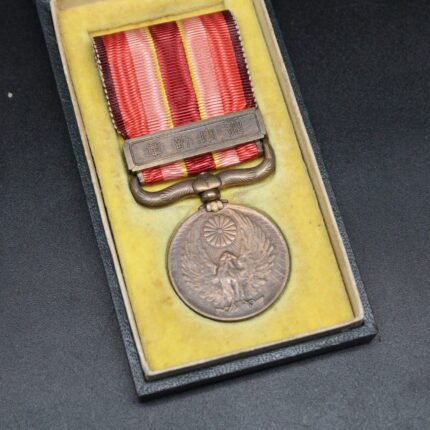
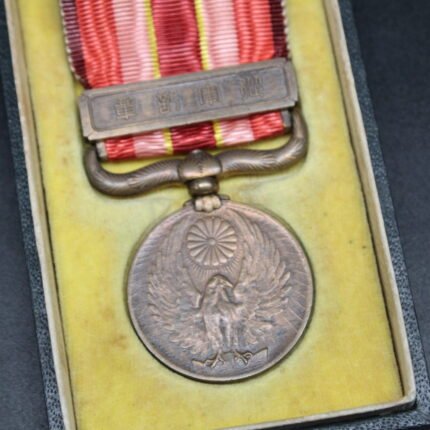
Manchurian Incident Medal (Cased)
Original price was: €80,00.€60,00Current price is: €60,00.A fine and complete example of the Showa 6–9 War Service Medal (Manchurian Incident Medal), awarded to personnel who served during the early Imperial Japanese military operations of the Manchurian Incident (1931–1934)—a conflict that marked the beginning of Japan’s expansionary campaigns leading into the Second Sino-Japanese War and ultimately the Pacific War.
Instituted in 1934, the medal was issued to members of the Army, Navy, and supporting organizations who took part in combat operations, logistical support, or administrative duties related to the campaign. Its obverse features the Imperial chrysanthemum crest above a spread-winged eagle, symbolizing military strength and the authority of the Emperor. The reverse displays two crossed military helmets and inscriptions denoting the Showa era years Six to Nine. The ribbon—shades of red with yellow and white stripes—represents loyalty and valor.
Condition & Presentation
This example remains in very good condition, showing an attractive, untouched patina consistent with its age. The medal is housed in its original black case, which retains sharp gold kanji lettering on the lid. The interior is lined with the classic yellow felt insert that securely holds the piece in place.
Collector’s Notes
-
Complete and original medal with full ribbon and suspension bar
-
Crisp detail to the eagle, chrysanthemum, and reverse inscriptions
-
Case remains solid, with only minor wear from handling
-
A desirable early-Showa period decoration connected to one of the pivotal turning points in Japanese military history
An excellent addition for collectors of Imperial Japanese medals, early militaria, or those focusing on the Manchurian and pre-WWII military campaigns.
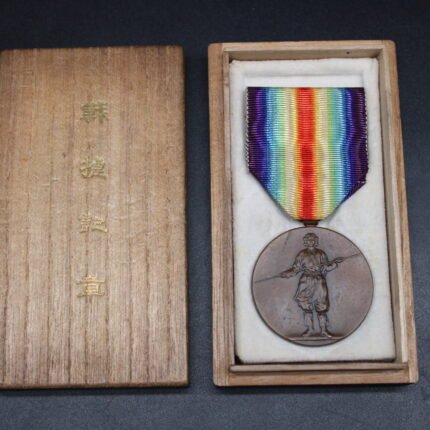
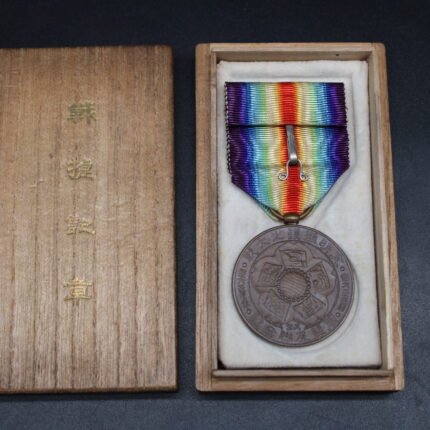
Japanese Victory Medal (Cased)
Original price was: €125,00.€100,00Current price is: €100,00.Original Japanese Victory Medal in very good condition with matching wooden case.
The Victory Medal was a commemorative military medal of Japan awarded to mark service during the First World War. Established by Imperial Edict #406 on 17 September 1920, it was one of the series of Victory Medals created and awarded by the victorious allies after the First World War. Fifteen nations in all issued a version of the medal. All shared the rainbow suspension and service ribbon, but the medals’ designs varied by country. Japan’s design was different from all other versions as it did not depict the goddess Victory. This figure from Roman mythology would have no connection to Japanese culture, so a depiction of Takemikazuchi, the war god in Japanese mythology occupies the obverse of the medal. (Source: Wikipedia)
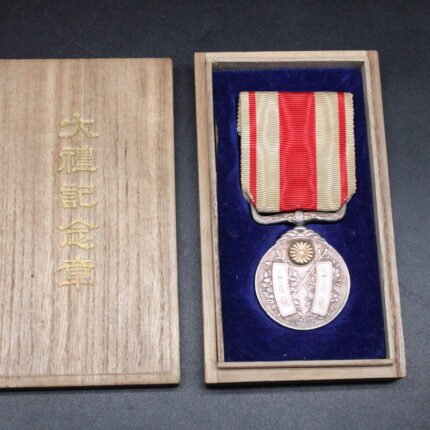
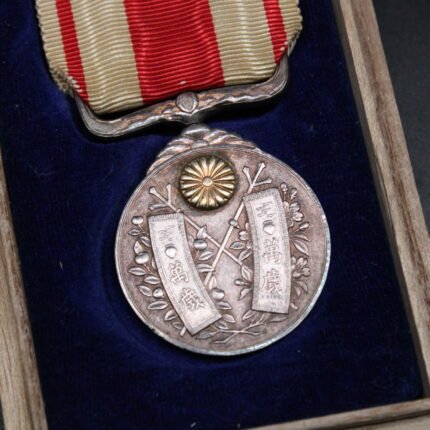
Taishō Enthronement Commemorative Medal (Cased)
Original price was: €95,00.€65,00Current price is: €65,00.Issued to honor one of Japan’s most important imperial events, the Taishō Enthronement Commemorative Medal celebrates the accession of Emperor Taishō, who assumed the throne in 1912 following the death of Emperor Meiji. Although the succession occurred in 1912, the formal enthronement ceremonies—grand national celebrations steeped in tradition—were held in 1915, and it was during these festivities that the medals were awarded.
Bestowed upon individuals across Japan who took part in or contributed to the ceremonies, the medal exists in both men’s and women’s versions. The obverse features two banners bearing the word “Banzai”—a symbolic cheer of long life and loyalty—encapsulating the national spirit surrounding the new Emperor.
- Housed in its matching wooden presentation case, complete with crisp golden characters on the lid
-
Box and medal both in very good condition, showing only minimal age
-
A fully authentic and desirable Imperial-era piece
Collector’s Note
Artifacts from the Taishō period are increasingly sought after due to their transitional place between the Meiji modernization and the militarization of the Shōwa era. This medal, especially with its original case, is a fine representation of early 20th-century Japanese imperial craftsmanship and ceremony—an elegant addition to any collection of Japanese orders, medals, or imperial memorabilia.
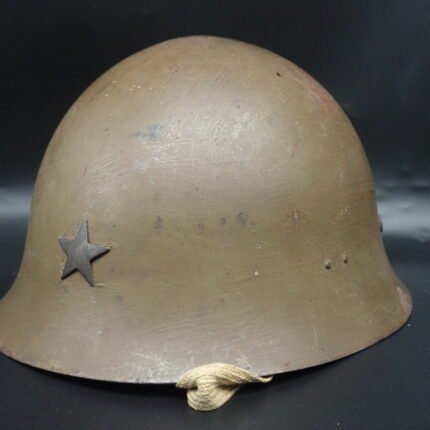
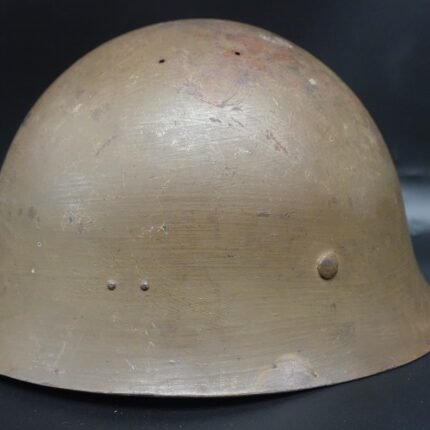
Japanese WWII Type 90 Steel Combat Helmet
€995,00Original WWII Japanese Type 90 combat helmet, which was used from 1930 to 1945 by soldiers of the Imperial Japanese Army. The helmet shell shows some signs of oxidation. In places, the underlayers of bluish paint are visible beneath the brush-applied paint.
The army star is fixed to the front part; it also serves as a rivet. On the rear inner rim of the hull, the kanji 少is stamped into the steel and painted white over it, indicating that it is a small size. Next to it, we can see the Kobe Seiko arsenal logo stamped in the steel (an S in a diamond) as well as a partially visible number.
The kanji indicating the size is also present on the leather band of the headdress. The leather helmet is in good condition. It has canvas compartments containing padding (one of the compartments is now empty) . One of them bears a Japanese army stamp indicating the production date of Showa 15 (1940).
The canvas chin strap is complete
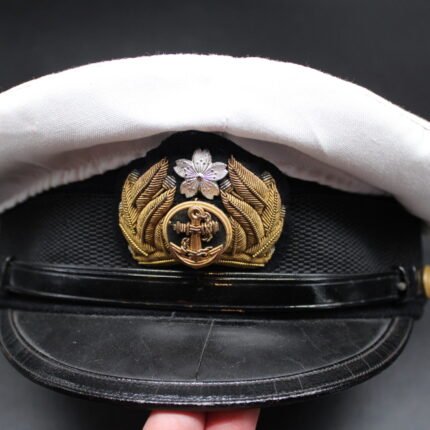
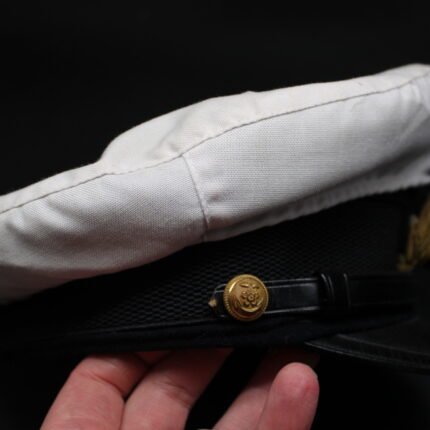
WWII Imperial Japanese Navy (IJN) Officer’s Visor Cap
€395,00A beautifully tailored Imperial Japanese Navy officer’s visor cap from the Second World War, manufactured to the high standards typical of naval uniforms of the era. Navy officer caps differed markedly from their Army counterparts, featuring deep midnight-blue wool, glossy black patent-leather elements, and the distinctive gold bullion anchor-and-cherry-blossom insignia—the long-standing emblem of the Imperial Japanese Navy.
This example is constructed from fine, dark navy wool with excellent form retention and a sharp, elegant naval profile. The front displays a crisp officer-quality bullion cap badge, richly embroidered and remaining bright with only mild toning from age. The black lacquered visor shows expected period age-crazing but is stable and fully intact. The chinstrap, side buttons, and stitching all remain original.
Inside, the cap retains its silk or rayon lining—still clean and richly colored—along with the original leather or ersatz-leather sweatband. The interior shows gentle, honest service wear but no damage, tears, or repairs. Overall, it is a remarkably well-preserved cap that clearly saw use yet was carefully stored for decades afterward.
A notable addition is the original white cotton removable over-cap, used for tropical and summer dress. This piece is often missing and greatly enhances both the completeness and display quality of the set.
Collector’s Note
Authentic Imperial Japanese Navy officer caps from WWII are significantly scarcer than Army examples due to the smaller size of the IJN and its disproportionately high wartime losses. Surviving caps—especially those in complete, undamaged condition with original insignia—are highly sought after by collectors of Axis headgear and naval militaria.
This cap’s fine construction, excellent badge, and appealing overall condition make it a standout display piece and a superb representative example of wartime naval uniform design. An exceptional addition to any advanced WWII collection.
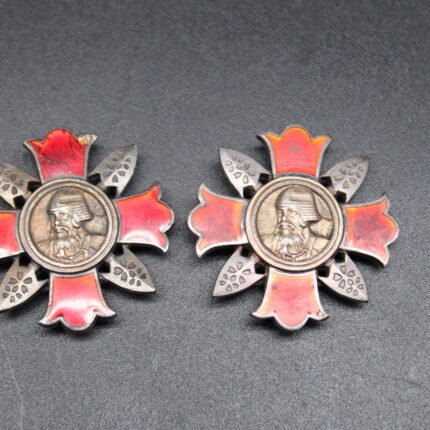
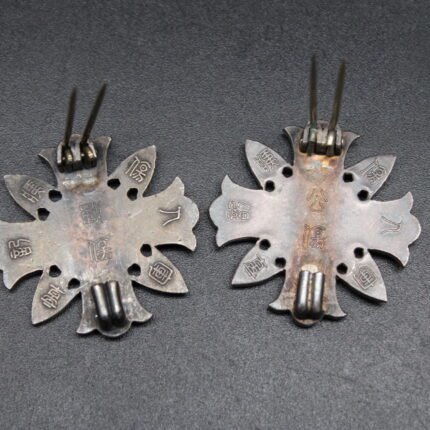
Set of Two Japanese Wound Badges – Combat & Non-Combat Variant (!)
€95,00A desirable matched set of Imperial Japanese wound badges (Combat & Non-Combat Variants – Pair) from the Model 1938 issue, representing both major variants awarded during the late pre-war and WWII periods. These badges were issued by the Imperial Japanese Army to recognize wounds or injuries suffered in service, and complete pairs such as this are increasingly hard to find.
Included in the Set
Type 4.1 – Sensho Wound Badge (Combat Injury)
Awarded to soldiers wounded in direct combat, the Sensho badge carries significant historical weight as it denotes frontline experience and injury suffered in battle.
-
Diameter: 31 mm
-
Distinct in its meaning and traditionally more sought after due to its combat association.
Type 4.2 – Kosho Wound Badge (Non-Combat Service Injury)
The Kosho badge was awarded for non-combat injuries or ailments received in public service, such as illness, poisoning, or accidents occurring while on duty.
-
Diameter: 31 mm
-
Although awarded under different circumstances, it is essential for completing a full wound badge collection.
Condition
Both badges remain in worn, condition, showing scratches, wear, and minor defects consistent with age and actual use—exact details visible in the photos. The honest patina adds character and authenticity, making this a perfect set for collectors who appreciate items as they were found.
Collector’s Note
Securing both the Sensho (combat) and Kosho (non-combat) wound badge variants together is increasingly uncommon. This duo represents a complete study example of the Model 1938 wound award system and is ideal for advanced collections focused on Imperial Japanese militaria or wound award typology.
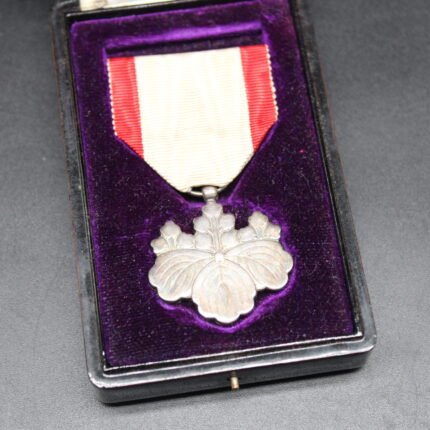
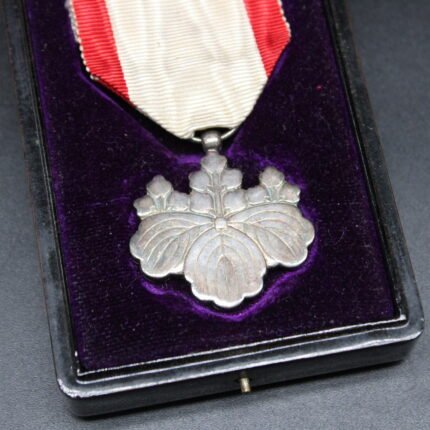
Order of the Rising Sun – 8th Class (Cased)
€45,00The Order of the Rising Sun (旭日章 – Kyokujitsu-shō) was established in 1875 by Emperor Meiji as Japan’s first national order of merit. Designed to reflect the symbolic identity of Japan as the “Land of the Rising Sun,” the order features stylized radiant sunbeams representing vitality, honor, and national service.
The 8th Class (now discontinued) was the most junior grade of the order and was traditionally awarded for loyal public service, military merit, or distinguished civil achievement. Prior to 1945 it was frequently bestowed upon NCOs, soldiers, police, government clerks, and civilians who demonstrated commendable dedication in their respective roles. While modest in rank, the 8th Class remained a respected imperial decoration, representing inclusion in Japan’s oldest system of formal honors.
This example is an original pre-WWII/WWII period medal, complete with its matching presentation box. The medal retains excellent detail, displaying the classic radiant sunburst design suspended from its red-and-white ribbon. The wooden case bears the gilded kanji inscription identifying the order.
Item Details
-
Decoration: Order of the Rising Sun, 8th Class
-
Era: Pre-1945 Imperial Japan
-
Material: Silvered metal with enamel accents
-
Ribbon: Original, lightly aged but strong
-
Case: Original, with gold-stamped kanji on lid
-
Condition: Medal in very good condition with crisp detail; box with minor age wear only
Collector’s Note
The lower classes of the Order of the Rising Sun — especially the 8th Class — are increasingly difficult to find in complete, untouched sets, as many were discarded or separated from their cases over time. This is an appealing and historically significant example of Imperial Japan’s earliest and most iconic award system, ideal for collections focused on Japanese orders, early Meiji-era decoration history, or WWII-era militaria.