


Shop
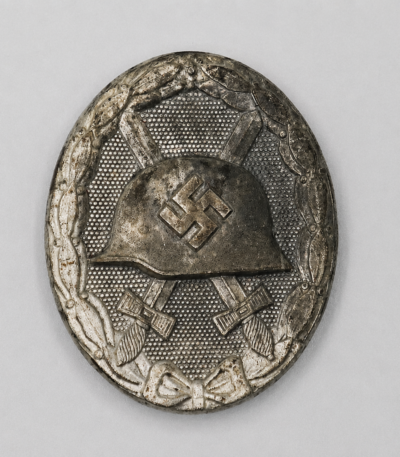
Verwundetenabzeichen in Silber – Wound Badge in Silver – Maker Marked “107” Carl Wild – Zinc Example
€85,00Original WWII German Verwundetenabzeichen in Silber (Wound Badge in Silver), manufactured in zinc and maker marked “107” on the reverse for Carl Wild, Hamburg.
This example retains a very attractive appearance with a pleasing naturally aged patina and a substantial amount of its original silver finish still present, particularly on the helmet, wreath, and crossed swords. The badge shows strong detailing throughout and remains a visually appealing piece.
The reverse setup is fully intact with its original hinge, pin, and catch assembly. The maker mark “107” is clearly visible beneath the hinge.
The Silver Grade Wound Badge was awarded to German servicemen wounded three or four times in combat, or for more severe injuries sustained during active military service.
A solid original wartime example by a desirable maker, featuring excellent overall character and finish retention.
Condition exactly as shown in the photographs.
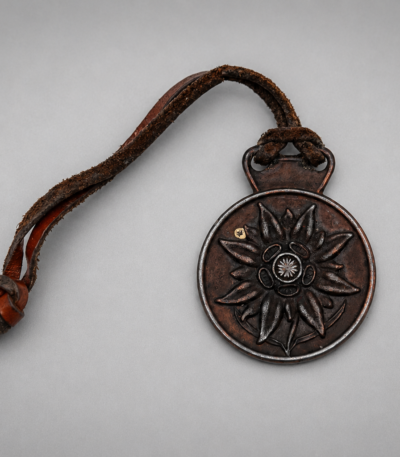
WWII German “Eismeerfront 1942–1943” Commemorative Badge / Tinnie with Leather Hanger
€155,00Original Second World War German commemorative badge / tinnie marked: “Eismeerfront 1942–1943”. A very interesting wartime remembrance piece connected to service on the harsh Arctic Front (Eismeerfront), the northernmost combat theater of the German-Soviet War centered around northern Finland, Lapland, and the Arctic region near Murmansk.
The badge features:
- Front with gothic-style “Eismeerfront 1942–1943” inscription
- Reverse with prominent edelweiss-style design, strongly associated with German mountain and northern troops
- Original leather hanger / suspension strap still attached
- Attractive untouched darkened wartime patina throughout
Constructed in lightweight wartime metal with a suspension loop and period leather attachment, likely intended for wear on personal equipment, a vehicle interior, or as a commemorative keepsake by veterans serving in the Arctic theater.
The Eismeerfront was one of the most brutal operational environments of WWII, with German and Finnish troops facing extreme cold, snow, isolation, and continuous fighting against Soviet forces in the far north.
The piece remains in very good untouched condition showing honest age and wear. The leather hanger displays expected age hardening and surface wear consistent with wartime use and storage. Condition exactly as shown in the photographs.
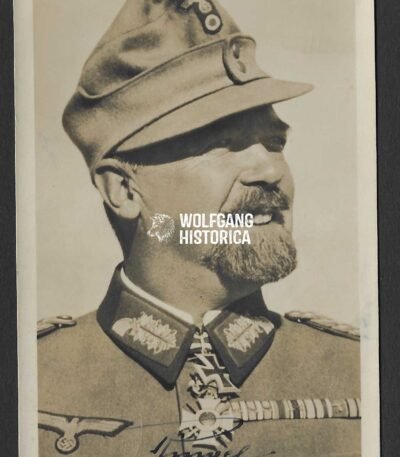
Julius Ringel – 5. Gebirgs-Division (Eichenlaub) (Wartime Signed)
€150,00Original Wartime Signature on a Postcard of Julius Ringel. General der Gebirgstruppe Julius “Papa” Ringel (16.11.1889 † 11.02.1967) was an Austrian general serving in the armed forces of Nazi Germany during the Second World War. He saw service on the Western Front, Eastern Front, and during the Balkan Campaign, and held a number of senior commands, including 3. Gebirgs-Division, 5. Gebirgs-Division, LXIX. Armeekorps, Wehrkreis XI, and Armeekorps Ringel. He earned the Ritterkreuz des Eisernen Kreuzes on June 13, 1941 as Generalmajor und Kommandeur of the 5. Gebirgs-Division, and was later awarded the Eichenlaub on October 25, 1943 as Generalleutnant und Kommandeur of the 5. Gebirgs-Division. Condition as seen. Postcard size.
This is sold on commission!
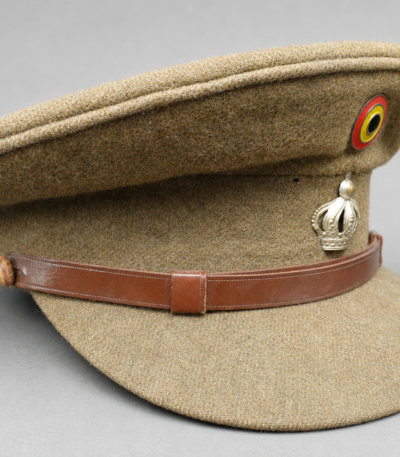
Belgian Army Visor Cap – Post-Liberation / Early Postwar – Royal Crown Badge
€100,00Original Belgian Army visor cap dating to the immediate post-liberation / early post-WWII period, likely manufactured shortly after the liberation of Belgium in 1944–45.
The cap is constructed in classic Belgian khaki wool with a brown leather chinstrap and retains its original Belgian national cockade together with the royal crown insignia to the front. The overall appearance strongly reflects transitional Belgian military headgear used during the rebuilding of the Belgian armed forces following occupation.
The interior retains its original diamond-shaped retailer/manufacturer label from:
“Vêtements Civils et Militaires Van Den Haute-Rabou”
86 Rue de Diest, Louvain (Leuven)
Condition remains very good overall, showing only light age and storage wear. The cap retains an attractive shape and displays very well.
A desirable and increasingly harder-to-find piece of early postwar Belgian military headgear, closely linked to the liberation and reconstruction period of the Belgian Army.
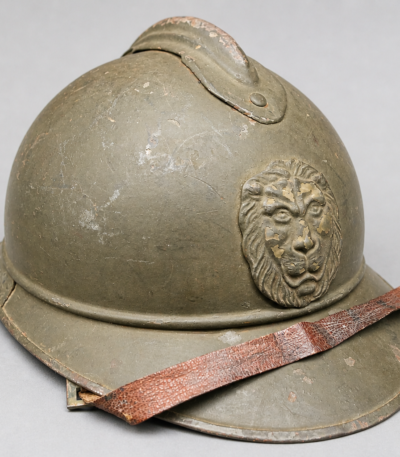
Belgian M15 Adrian Helmet (WWI) – Complete with Chinstrap (Reissued)
€275,00Original Belgian Adrian helmet Model 1915, originally produced during the First World War and later refurbished for continued Belgian military service during the interwar period. Complete with original Belgian lion-head front badge and characteristic comb crest. The helmet retains its period repaint and later upgraded liner/strap configuration, typical of Belgian arsenal refurbishments carried out during the 1920s–1930s.
A genuine and historically interesting example showing both WWI origin and later pre-WWII Belgian military reuse.
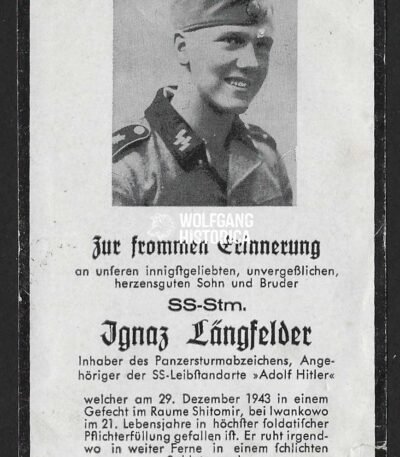
WWII German Waffen-SS Death Card – SS-Sturmmann, LSSAH, KIA Shitomir 1943
€125,00Original WWII German Sterbebild (death card) for Ignaz Längfelder, an SS-Sturmmann of the elite Leibstandarte SS “Adolf Hitler” (LSSAH), killed in action on the Eastern Front in 1943.
Details from the card:
- Name: Ignaz Längfelder
- Rank: SS-Sturmmann
- Unit: Leibstandarte SS “Adolf Hitler” (LSSAH)
- Award: Panzer Assault Badge (Panzersturmabzeichen)
- Killed in action: 29 December 1943
- Location: Shitomir / Iwankowo sector (Ukraine)
- Age: 21
The card notes he fell in combat during heavy fighting in the Shitomir region, part of the winter battles on the Eastern Front.
The reverse features a religious image (after Titian) with devotional text.
Condition:
Good overall condition with typical age wear, slight edge wear, and light handling marks. Fully intact and well preserved.
Additional note:
This individual is the subject of a published family-written book, adding a rare level of personal historical documentation and research potential.
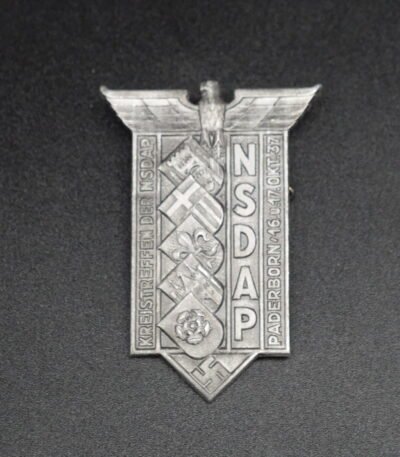
NSDAP Kreistreffen Paderborn 1937 Badge – Steinhauer & Lück, Lüdenscheid (Early Party Tinnie)
€60,00Original NSDAP Kreistreffen badge for the district rally held in Paderborn, 14–16 October 1937.
Die-stamped aluminium construction with a detailed design featuring an eagle above a shield displaying multiple regional coats of arms. Vertical inscription “NSDAP” and side text “Kreistreffen der NSDAP – Paderborn 14–16 Oktober 1937.”
Reverse maker marked Steinhauer & Lück, Lüdenscheid, one of the most well-known and respected producers of Third Reich insignia.
Complete with original pinback.
Condition is very good, with sharp detail, light wear, and a clean, untouched appearance (see images).
A highly attractive and well-designed regional NSDAP event badge, with strong visual appeal and a desirable maker mark.
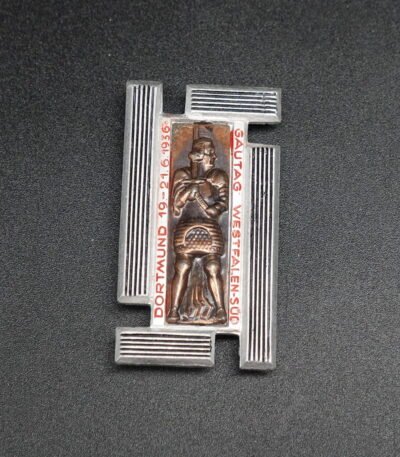
NSDAP Gautag Westfalen-Süd Dortmund 1936 Badge – Steinhauer & Lück, Lüdenscheid (High Quality Design)
€55,00Original NSDAP Gautag badge for Westfalen-Süd, issued for the rally held in Dortmund, 19–21 June 1936.
Die-stamped aluminium construction with an unusually elaborate geometric design, featuring a central medieval armored figure flanked by architectural elements and red-painted vertical inscription:
“Gautag Westfalen-Süd – Dortmund 19–21.6.1936”
Reverse clearly maker marked Steinhauer & Lück, Lüdenscheid, one of the premier badge manufacturers of the period.
Complete with original pinback.
Condition is very good, with strong detail, intact paint, and only light age-related wear. A particularly clean and well-preserved example (see images).
A visually striking and higher-quality Gau rally tinnie, standing out from more typical, simpler designs of the era.
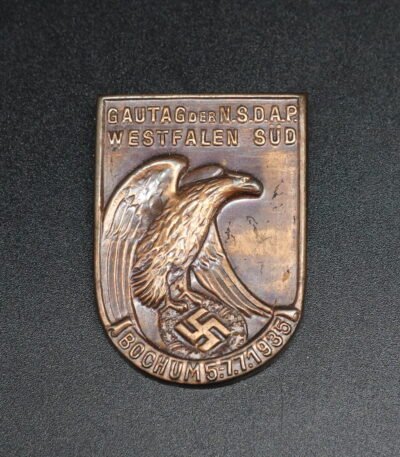
NSDAP Gautag Westfalen-Süd Bochum 1935 Badge – Early Gau Rally Tinnie
€55,00Original NSDAP Gautag badge for Westfalen-Süd, issued for the event held in Bochum, 5–7 July 1935.
Die-stamped construction with bronze-toned finish, featuring a large national eagle clutching a wreath with swastika, surrounded by the inscription:
“Gautag der NSDAP Westfalen Süd – Bochum 5–7.7.1935”
Complete with original pinback.
Condition is good, showing honest age-related wear and patina, with clear detail and legible text (see images).
A classic early-period Gau rally tinnie, representing regional party organization during the consolidation phase of the mid-1930s.
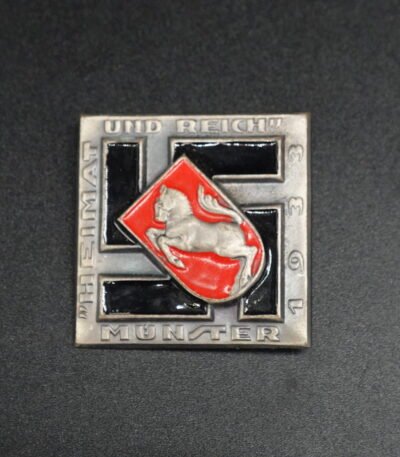
“Heimat und Reich” Münster Tinnie 1933 – Early Third Reich
€65,00Original “Heimat und Reich” tinnie (badge) from Münster, dated 1933.
Die-stamped, silvered metal construction with red and black painted finish, measuring approximately 50 × 50 mm, with vertical pinback to the reverse.
The badge features the inscription “Heimat und Reich 1933 Münster” and incorporates the Westphalian horse within a central shield. The piece retains strong detail and contrast, with typical age-related wear to the painted surfaces (see images).
Large and visually striking example from the early period of the Third Reich. Tinnies of this type were commonly produced for regional events, gatherings, or propaganda-related activities tied to the rapid political consolidation of 1933.
A desirable and collectible early piece, especially with clear regional attribution to Münster.
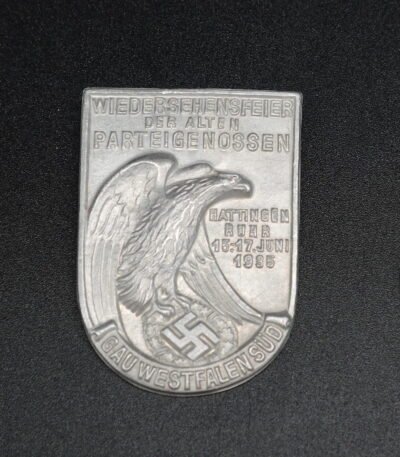
NSDAP “Wiedersehensfeier der Alten Parteigenossen” Hattingen Ruhr 1935 Badge – Sieper & Söhne
€55,00Original NSDAP event badge (tinnie) for the “Wiedersehensfeier der Alten Parteigenossen”, held in Hattingen (Ruhr), 15–17 June 1935, within Gau Westfalen-Süd.
Die-stamped aluminium construction featuring a large national eagle with wreath and swastika, with surrounding inscription. Reverse marked B. Sieper & Söhne, Lüdenscheid, a known and respected maker of Third Reich badges.
Complete with original pinback.
Condition is very good, with sharp detail and light, honest wear consistent with age (see images).
A classic early-period NSDAP Gau event badge, representing regional party organization and early consolidation phase items from 1933–1935.
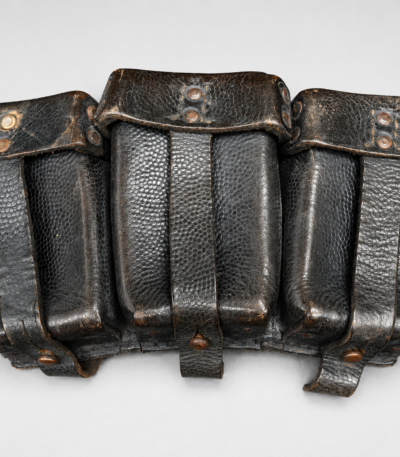
WWII German K98 Ammunition Pouch – RBNr. Numbered, Black Leather (Late War)
€75,00Original WWII German K98 ammunition pouch (Patronentasche), constructed in black pebbled leather and clearly stamped with an RBNr. (Reichsbetriebsnummer) indicating late-war production.
The pouch is (in my opinion, what I can make out!) marked:
RBNr. 0/0570/0033
This code corresponds to:
- Manufacturer: Karl Kühne
- Location: Lüdenscheid, Westfalen
- Industry: Military leather equipment production, including ammunition pouches, straps, and field gear
The RBNr. system was introduced during the war to conceal manufacturer identities, replacing earlier visible maker/date markings. Identified examples like this are especially desirable as they can be traced back to specific firms.
This example features:
- Three-cell K98 configuration (holds 60 rounds total)
- Blackened leather typical of mid-to-late war production
- Original stitching and hardware throughout
- Clear and legible RBNr. stamp
Condition:
Good, honest field-used condition. The leather remains structurally sound with expected wear, light scuffing, and age-related patina. Hardware intact and functional. A well-preserved example of a late-war issued pouch.
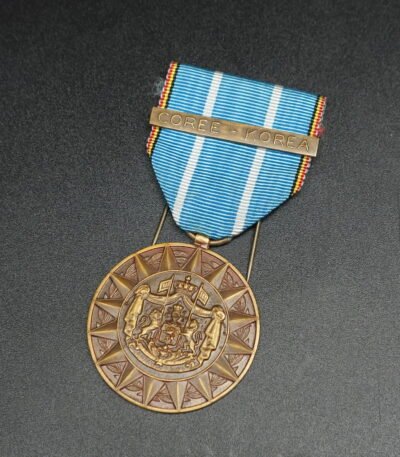
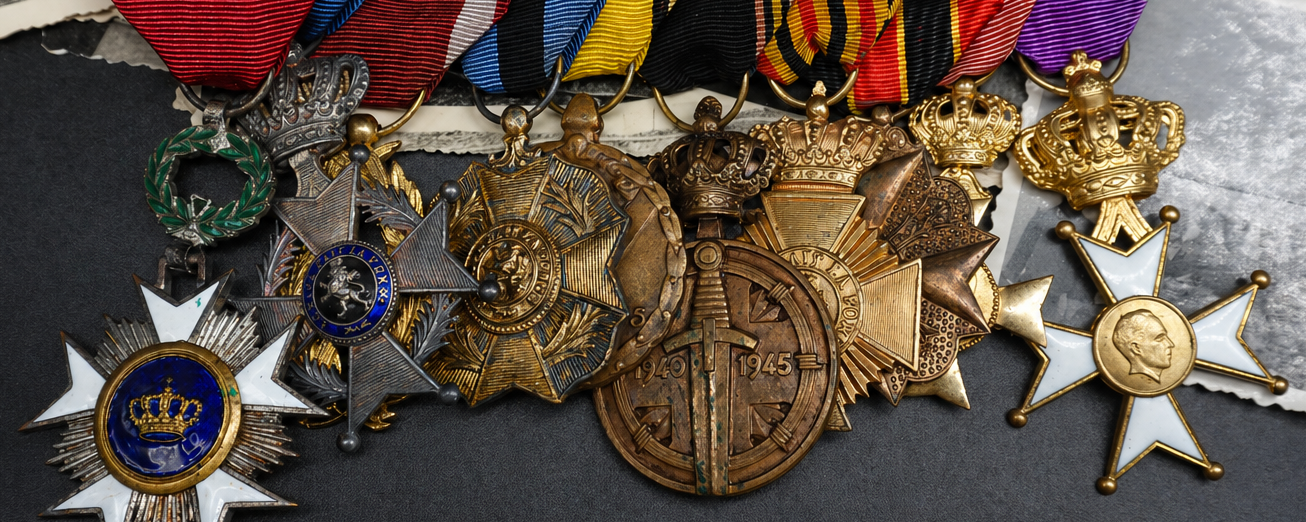
Belgian UN Korea Medal – “Corée–Korea” Clasp (Korean War, 1950–53)
€125,00Original Belgian United Nations Korea Medal, complete with “Corée–Korea” clasp.
Bronze medal featuring the Belgian coat of arms within a radiating star design, suspended from its original ribbon in light blue with white stripes and national edge colors. The medal retains a strong, attractive finish with light, honest wear. The clasp is present and correctly mounted on the ribbon.
Overall condition is very good (see images), with only minor signs of age and use.
A desirable and historically significant decoration awarded to members of the Belgian Armed Forces who served during the Korean War.
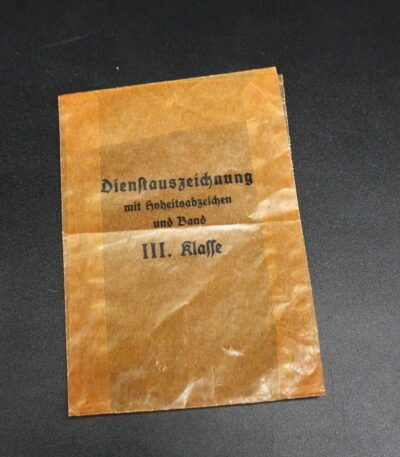
WWII Wehrmacht Dienstauszeichnung Packet – III. Klasse (with Hoheitsabzeichen und Band)
€40,00Original WWII German paper packet for a Dienstauszeichnung (Long Service Award), III. Klasse, marked “mit Hoheitsabzeichen und Band” (with national emblem and ribbon).
This type of packaging was used for Wehrmacht long-service awards, issued to personnel of the Wehrmacht.
Constructed from thin, period waxed paper, typical of wartime award packaging. The packet remains in good, untouched condition, showing expected creasing, handling wear, and age-related discoloration (see images).
Original award packets are often missing, as they were frequently discarded after presentation. As such, surviving examples—especially clearly marked and legible—are increasingly difficult to find.
A desirable accessory piece for completing a Wehrmacht long-service award set or for display alongside period decorations.
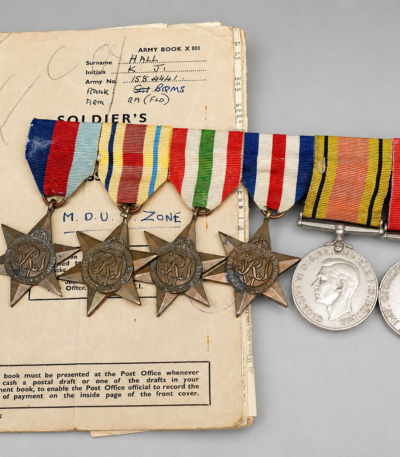
British WWII Mounted Medal Group, 91st Field Royal Artillery (Monte Cassino & Rhine Crossing)
€325,00Authentic British Second World War mounted medal group of six, comprising the 1939–1945 Star, Atlantic Star, Italy Star, France and Germany Star, Defence Medal, and War Medal 1939–1945, mounted as worn on the original bar and accompanied by the Soldier’s Release Book.
The group is attributed to Battery Quartermaster Sergeant Hall, who served with the 91st Field Regiment, Royal Artillery, a Territorial Army unit associated with the 5th Infantry Division. The regiment saw extensive active service throughout the war, providing vital artillery support across multiple major theatres.
The medals include:
- 1939–1945 Star – for early operational service
- Atlantic Star – for service connected to the Battle of the Atlantic
- Italy Star – for service in the Italian Campaign, including the fighting at Battle of Monte Cassino
- France and Germany Star – for service in North-West Europe
- Defence Medal – for non-operational service
- War Medal 1939–1945 – for full-time wartime service
The 91st Field Regiment was mobilised in 1939 and initially deployed to France with the British Expeditionary Force. Following evacuation and reorganisation, it served in the North African campaign before taking part in the Allied advance through Italy, including operations around Monte Cassino. As a field artillery regiment equipped with 25-pounder guns, it played a key role in supporting infantry assaults and engaging enemy positions.
In the later stages of the war, the regiment was deployed to North-West Europe. By March 1945, it was operating under XXX Corps and took part in the Rhine crossing during the final Allied advance into Germany.
The group therefore reflects a highly experienced artillery NCO with confirmed service in:
- North Africa
- Italy (including Monte Cassino)
- North-West Europe (Belgium and Germany)
The medals are mounted as worn on their original bar and display an even, attractive patina. The ribbons show light age-related wear consistent with period use.
Accompanied by the original Soldier’s Release Book, offering strong research potential and clear attribution, significantly enhancing collectibility.
Condition: As shown in photographs.
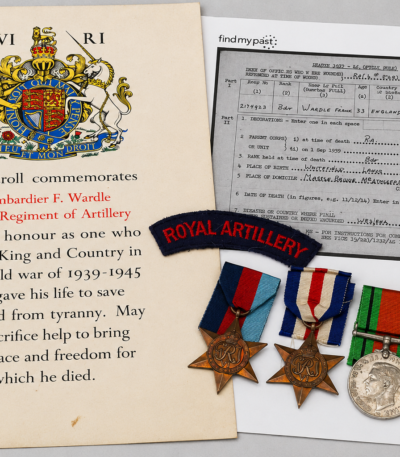
WWII British KIA Medal Group, Royal Horse Artillery, Netherlands 1944 (with Memorial Scroll)
€350,00Authentic British Second World War casualty medal group of four to Bombardier Frank Wardle, 4th Regiment, Royal Horse Artillery, who was killed in action in the Netherlands on 26 October 1944.
The group comprises:
- 1939–1945 Star
- France and Germany Star
- Defence Medal
- War Medal 1939–1945
Together with the original Next of Kin Memorial Scroll, named to Bombardier F. Wardle, Royal Regiment of Artillery, and a period Royal Artillery shoulder title. Also included are supporting research documents confirming service details, unit, and place of burial.
Bombardier Wardle (service number 2127923) served with the 4th Regiment, Royal Horse Artillery, a mobile artillery unit supporting armoured and infantry formations during the Allied campaign in North-West Europe. He was killed in action on 26 October 1944 during the fighting in the Netherlands, a period associated with intense operations following the advance from Normandy and the battles to secure key approaches into Germany.
He is buried at Bergen op Zoom War Cemetery, where many casualties from the autumn 1944 operations in Holland are commemorated.
The medals are original and accompanied by their correct ribbons, showing light age-related wear consistent with period use and storage. The memorial scroll is well preserved and forms a central part of the group, significantly enhancing its historical and commemorative value.
This is a poignant and fully attributable Second World War casualty group to a Royal Horse Artillery soldier, with strong historical context and research potential.
Condition: As shown in photographs.
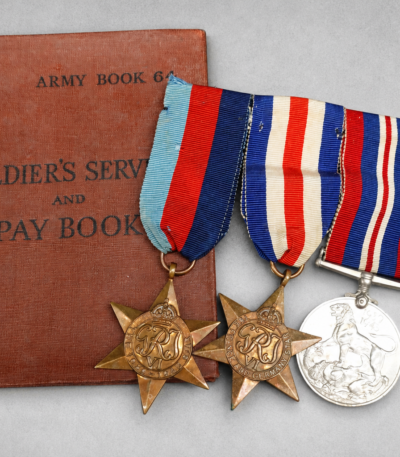
WWII British Medal Group to Royal Engineers Sapper, Normandy 1944, with Service Book (Engine Driver)
€175,00Authentic British Second World War medal group of three, awarded to 14253819 Sapper Walter Clarke, Royal Engineers, comprising the 1939–1945 Star, France and Germany Star, and War Medal 1939–1945, accompanied by his original Army Book 64 (Soldier’s Service and Pay Book).
The group is fully attributable, with the service book confirming Clarke’s personal details, enlistment, trade, and wartime service. He enlisted on 6 August 1942 and was employed as an engine driver, having previously worked as an LMS fireman (locomotive), indicating specialist railway or transport-related skills.
The award of the France and Germany Star confirms operational service in North-West Europe. The service book records his deployment to Normandy on 17 August 1944, placing him in the theatre shortly after the Allied breakout from the Normandy beachhead and during the rapid advance across France.
As a member of the Royal Engineers, Clarke would have been engaged in essential logistical and infrastructure duties, likely including railway operation, transport coordination, and the repair or construction of key supply routes supporting front-line forces. Such roles were critical to maintaining the momentum of Allied operations following the Normandy landings.
The medals are mounted together and display a natural patina, with ribbons showing light age-related wear consistent with period use. The accompanying service book is well preserved and provides valuable insight into the soldier’s background and wartime role.
A solid and fully attributable Royal Engineers group with clear Normandy service and good research potential.
Condition: As shown in photographs.
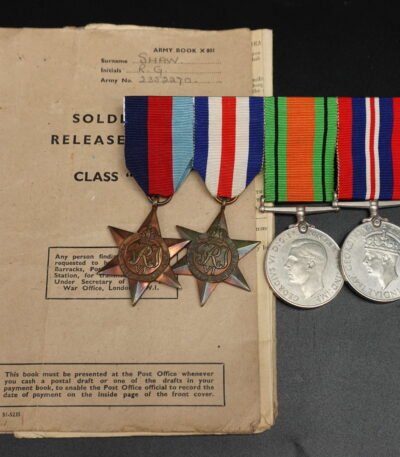
British WWII 4 Medal Mounted Group to Signalman, Royal Signals (France & Germany)
€180,00Authentic British Second World War mounted medal group of four, comprising the 1939–1945 Star, France and Germany Star, Defence Medal, and War Medal 1939–1945, mounted as worn and accompanied by the original Soldier’s Release Book.
The group is attributable to 2352270 Signalman R. G. Shaw, Royal Corps of Signals, with medal entitlement confirmed through service records. Issued to Richard George Shaw, of 93 Cardigan Road, Anlaby, Hull, Yorkshire.
The medals include:
- 1939–1945 Star – for operational service during the war
- France and Germany Star – for service in North-West Europe, likely during the Allied advance following D-Day
- Defence Medal – for non-operational service
- War Medal 1939–1945 – for full-time wartime service
The France and Germany Star confirms operational service in the North-West Europe theatre during 1944–45, a period encompassing the liberation of Western Europe and the final advance into Germany.
Signalman Shaw served in the Royal Signals, responsible for maintaining communications—an essential role in coordinating infantry, artillery, and armoured units during active operations.
The medals are mounted as worn on a period bar and display an even patina. The ribbons show light age-related wear consistent with service.
Condition: As shown in photographs.
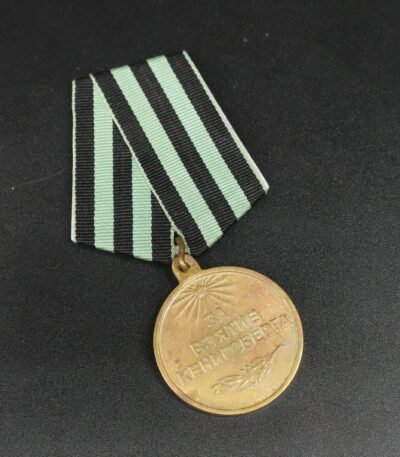
Soviet WWII Campaign Medal “For the Capture of Königsberg”
€55,00Authentic Soviet Medal “For the Capture of Königsberg” (Russian: «ЗА ВЗЯТИЕ КЕНИГСБЕРГА»), awarded to participants of the Battle of Königsberg during the final phase of the Second World War.
The medal is struck in brass and measures 32 mm in diameter, featuring a raised rim. The obverse displays a small five-pointed star with divergent rays at the top. Beneath it is the bold three-line inscription “FOR THE CAPTURE OF KÖNIGSBERG” («ЗА ВЗЯТИЕ КЕНИГСБЕРГА»), with a horizontal laurel branch below symbolizing victory.
The reverse features a plain five-pointed star at the top, with the date “10 APRIL 1945” («10 АПРЕЛЯ 1945») arranged in three lines beneath, marking the fall of Königsberg to Soviet forces.
The medal is suspended from a standard Soviet pentagonal mount, fitted with a 24 mm silk moiré ribbon incorporating narrow green edge stripes and alternating black and green central stripes. The ribbon may show typical age-related wear such as light soiling, minor staining, and edge fraying, consistent with period use and storage.
Condition: As shown in photographs.
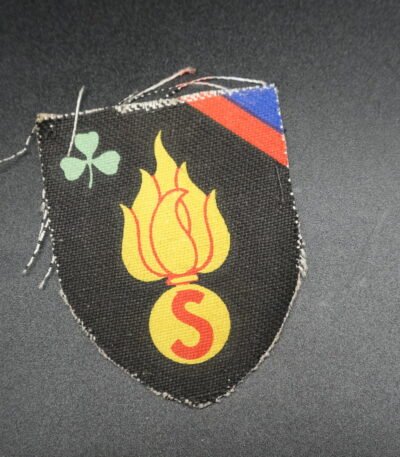
Insignia – 4th Infantry Brigade “Steenstraete” (Belgium, 1945) – First Pattern
€15,00Original printed insignia of the Belgian 4th Infantry Brigade “Steenstraete”, first pattern.
A scarce early example, produced shortly near the end of the Second World War. The insignia remains in overall good condition, showing typical age-related wear (see images for details).
An attractive and historically relevant piece of post-liberation Belgian military material, seldom encountered on the market.
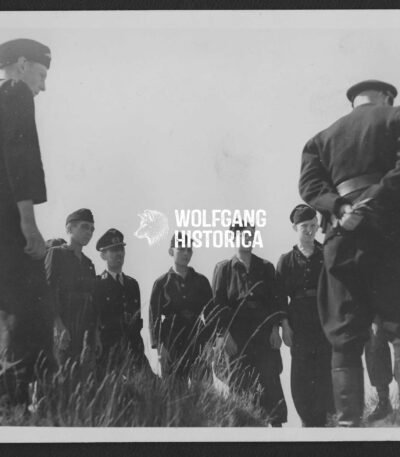
Press Photo Flemish Collaboration: Rare Photo of the Vlaams Jongerenkorps!
€125,00Original Press Photo Flemish Collaboration: Rare Photo of the Vlaams Jongerenkorps! Size: 18x13cm.
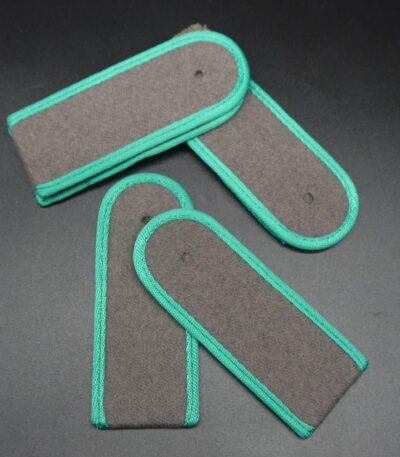
NVA EM Shoulder Boards Green – Grenztruppen (Price Per Pair)
€10,00NVA EM Shoulder Boards Green – Grenztruppen (Border Troops)
Price Per Pair.
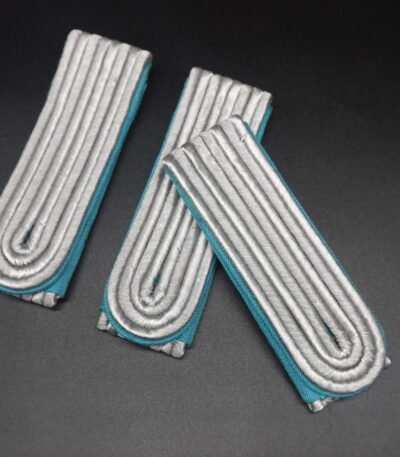
NVA Officer Shoulder Boards Blue – Luftstreitkräfte (Price Per Pair)
€10,00NVA Officer Shoulder Boards Blue – Luftstreitkräfte (Price Per Pair)
Price Per Pair.
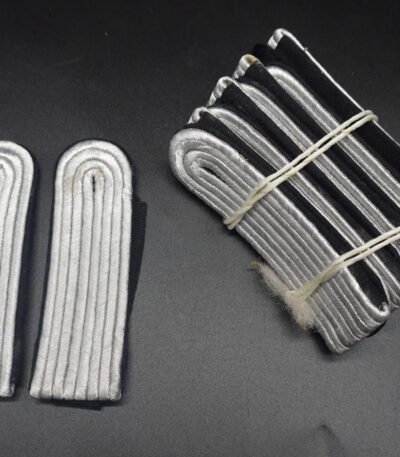
NVA Officer Shoulder Boards Black – Pionier (Price Per Pair)
€10,00Original NVA Officer Shoulder Boards Black (PIONIER).
Price Per Pair
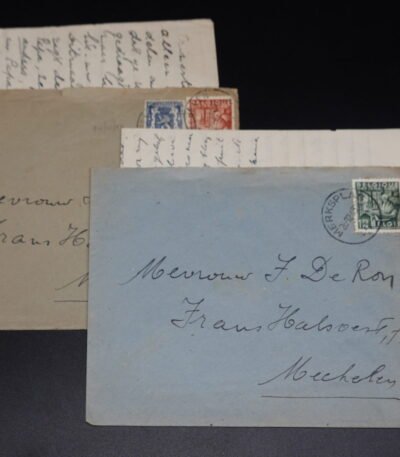
2x Letters Felix de Ron – Vlaamse Wacht (Written while in Jail – POW)
€95,00Original 2x Letters & Covers of Major Felix de Ron, who was a Commander in the Vlaamse Wacht (Flemish Guard), the letters were written in jail as a prisoner.
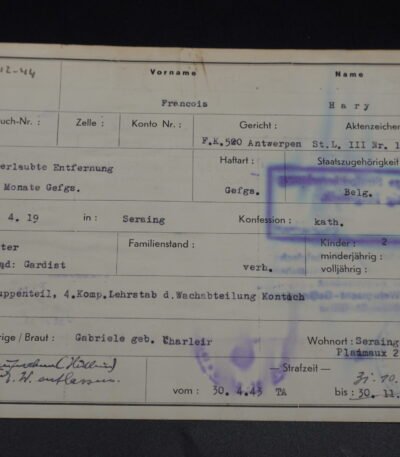
Wehrmacht Arrest Form for Flemish Vlaamse Wacht Soldier
€100,00Original Wehrmacht Arrest Form for a Flemish Vlaamse Wacht Soldier, for not returning to the unit (AWOL). Condition as seen.
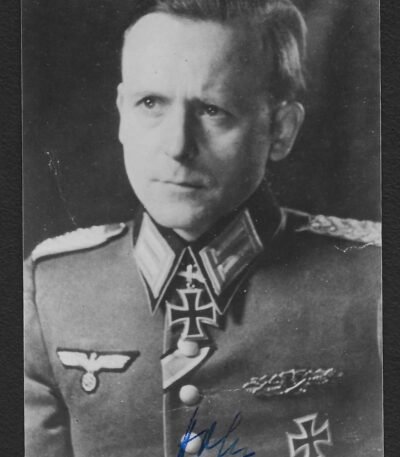
Lothar Hofer – SS-Artillerie-Regiment 54 “Nederland”
€45,00Original Postwar Signature on a Postwar Photo of Lothar Hofer. SS-Sturmbannführer Lothar Hofer (18.09.1914 † 22.01.1999) earned the Ritterkreuz on April 5, 1945 as SS-Sturmbannführer und Major der Schutzpolizei und Kommandeur of the III. Abteilung/ SS-Artillerie-Regiment 54 of the 23. SS-Freiwilligen-Panzer-Grenadier-Division “Nederland”. Good condition. Postcardsize.
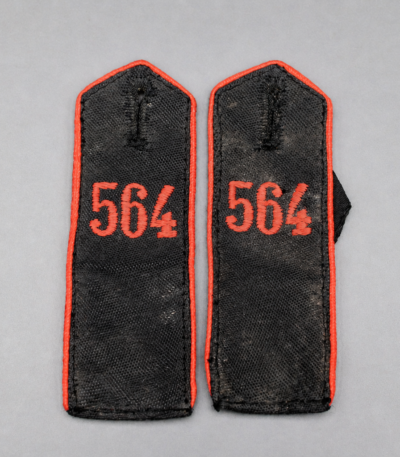
Hitlerjugend Shoulder Boards (Pair) – Bann 564 (Complete with Slip-Ons)
€125,00Original matching pair of Hitlerjugend (HJ) shoulder boards for Bann 564.
Complete with slip-on attachments. The pair remains in overall good condition, showing typical age-related wear consistent with period items (see images for details).
A solid and authentic set of HJ insignia, clearly identifiable to a specific Bann unit, making it a desirable piece for collectors of youth organization material and German WWII uniforms.
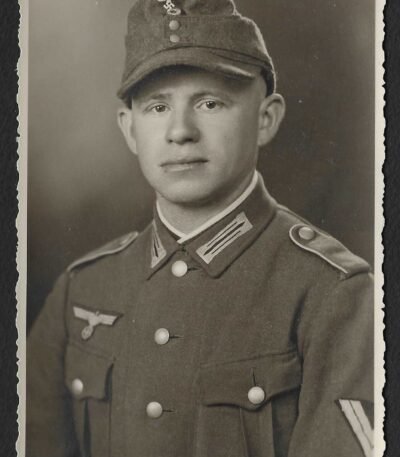
Studioportrait Wehrmacht Soldier wearing Luftwaffe M43 Field Cap
€15,00Original Wehrmacht (Heer) studioportrait of a soldier wearing a Luftwaffe M43 Feldmütze (Field Cap)! Postcardsize. Condition as seen.
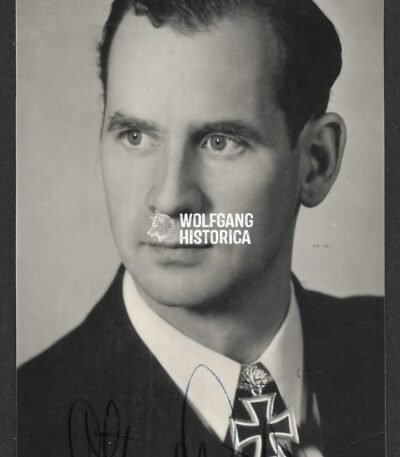
Otto von Bülow – Kommandant of “U-404” (Eichenlaub) (Wartime Signed)
€225,00Original Wartime Signature on a Postcard of Otto von Bülow. Korvettenkäpitan zur See Otto von Bülow (16.10.1911 † 05.01.2006) earned the Ritterkreuz des Eisernen Kreuzes on October 20, 1942 as Kapitänleutnant und Kommandant of U-404 and the Eichenlaub on April 26, 1943 as Kapitänleutnant und Kommandant of U-404. Good condition. Edges have been cut.
Creditted with sinking 15 ships (Read more on Otto von Bülow (Wikipedia))
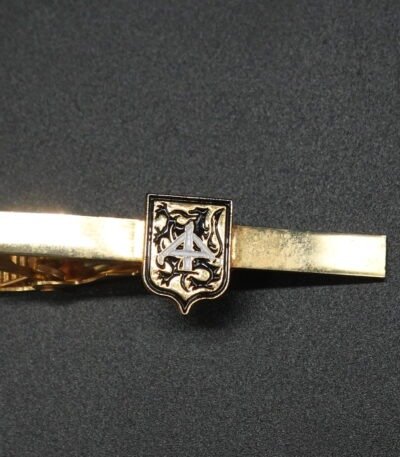
Tie Clasp (Dasspeld) of the Flemish Waffen-SS Veteran Organisation “Sint-Maartenfonds” (SMF)
€50,00Original rare Tie Clasp (Dasspeld) of the Flemish Waffen-SS Veteran Organisation “Sint-Maartenfonds” (SMF)
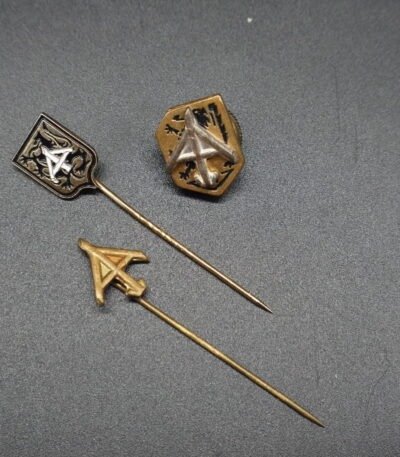
3x Pins of the Flemish Waffen-SS Veteran Organisation “Sint-Maartenfonds” (SMF)
€60,00Original 3x Pins of the Flemish Waffen-SS Veteran Organisation “Sint-Maartenfonds” (SMF).
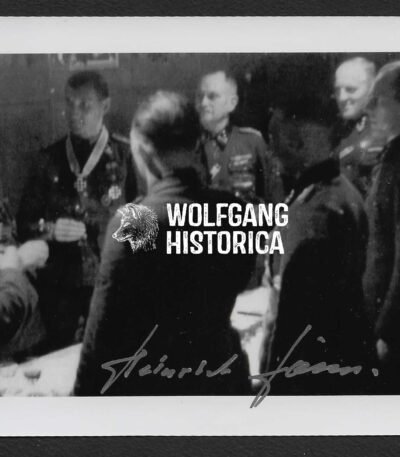
Heinrich Sonne – SS-Infanterie-Brigade 1
€47,50Original Postwar Signature on a Postwar Photo of Heinrich Sonne. SS-Hauptsturmführer Heinrich Sonne (23.02.1917 † 05.09.1984) earned the Ritterkreuz des Eisernen Kreuzes on December 10, 1943 as SS-Obersturmführer und Chef of the Kradschützen-kompanie/ SS-Infanterie-Brigade 1 (mot.). Good condition. Measuring: Postcardsize.
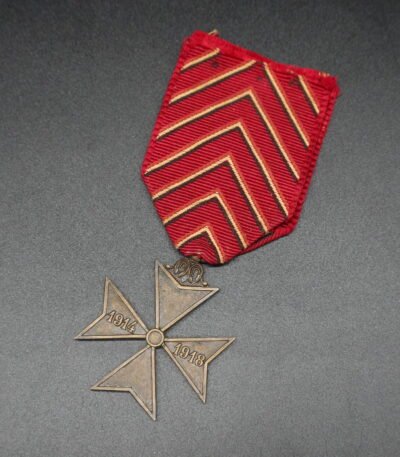
Belgian Deportees’ Cross 1914–1918 (Weggevoerdenkruis)
€25,00Original Belgian Deportees’ Cross 1914–1918 (Weggevoerdenkruis). The Deportees’ Cross 1914–1918 is a Belgian war decoration established by Royal Decree on 27 November 1922. It was awarded to Belgian civilians who were deported to Germany for forced labour during the First World War, recognizing their suffering and endurance under occupation.
Deportees who died during deportation were not eligible for this cross. Instead, they were posthumously honored with the Order of Leopold II, distinguished by a ribbon bearing a central longitudinal gold stripe.
A rare and meaningful piece of First World War history, especially valued by collectors focusing on civilian experiences and occupation-era memorabilia.
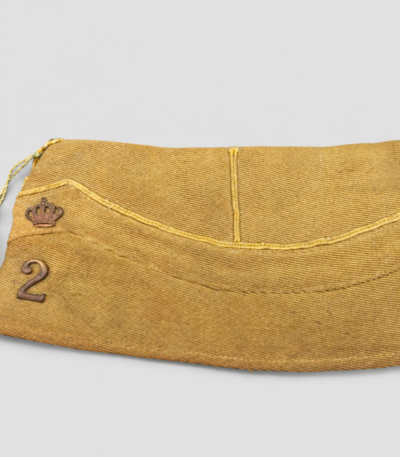
Belgian 2de Jagers te Voet Side Cap – WWII Belgian Army Infantry – Rare Bonnet de Police
€130,00Original Belgian Army Bonnet de Police (side cap) attributed to the 2de Regiment Jagers te Voet (2nd Foot Chasseurs).
A desirable and increasingly hard-to-find piece of Belgian WWII-era infantry headgear. The cap shows honest period wear and age, with all characteristics consistent with wartime or immediate pre-war manufacture. Condition is exactly as shown in the photos.
The Jagers te Voet were elite light infantry units within the Belgian Army, known for their mobility, discipline, and frontline combat role.
Read more of the 2de Jagers te Voet
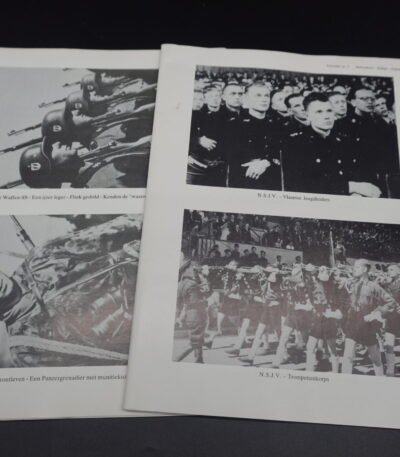
2x Photo Parts of Vlaanderen in Uniform (“Parts to make VIU Part 8”)
€22,50Original 2x Photo Parts of Vlaanderen in Uniform (“Parts to make VIU Part 8”)
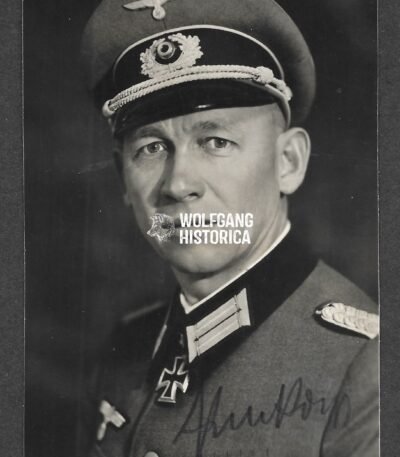
Werner Pankow – Infanterie-Regiment 151 (Wartime Signed)
€95,00Original Wartime Signature on a Postcard of Werner Pankow. Hauptmann Dr. Werner Pankow (02.02.1897 † 06.09.1980) earned the Ritterkreuz des Eisernen Kreuzes on September 20, 1941 as Hauptmann d.R. und Führer of the II. Bataillon/ Infanterie-Regiment 151 of 61. Infanterie-Division. Good condition. Edges have been cut.
Provenance: This signature comes from one of the largest postwar signature collection I’ve ever commissioned. This collection was started by a Waffen-SS Veteran, Werner H., in the 1950’s until he passed away.
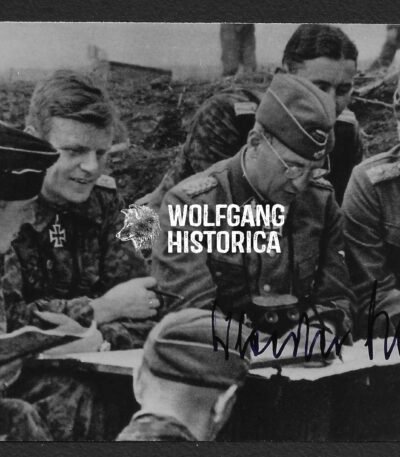
Sylvester Stadler – “Der Führer” & “Hohenstaufen” (Swords + NKIG)
€60,00Original Postwar Signature on a Postwar Photo of Sylvester Stadler. SS-Oberführer Sylvester Stadler (24.04.1911 † 25.05.1995) earned the Ritterkreuz on April 6, 1943 as SS-Sturmbannführer und Kommandeur of the II. Bataillon/ SS-Panzer-Grenadier-Regiment 4 “Der Führer”, the Eichenlaub on September 16, 1943 as SS-Obersturmbannführer und Kommandeur of the SS-Panzer-Grenadier-Regiment 4 “Der Führer” of the 2. SS-Panzer-Division “Das Reich“, the Nahkampfspange in Gold on December 12, 1943 with the SS-Panzer-Grenadier-Regiment 4 “Der Führer” and the Schwertern on May 6, 1945 as SS-Oberführer und Kommandeur of 9. SS-Panzer-Division “Hohenstaufen”.
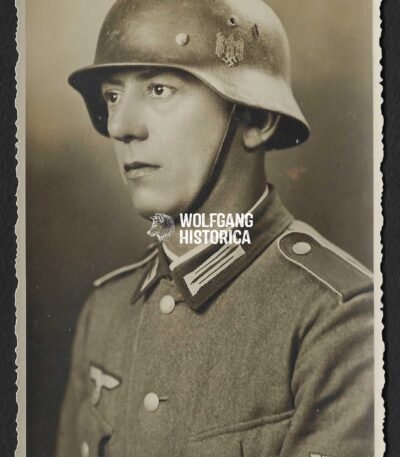
Studioportrait Wehrmacht Soldier wearing helmet (with decal)
€25,00Original Wehrmacht (Heer) studioportrait of a soldier wearing a helmet with decal. Postcardsize. Condition as seen.
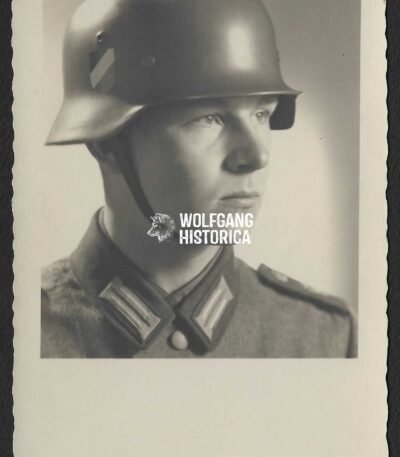
Studioportrait Wehrmacht Soldier wearing helmet (with decal)
€25,00Original Wehrmacht (Heer) studioportrait of a soldier wearing a helmet with decal. Postcardsize. Condition as seen.
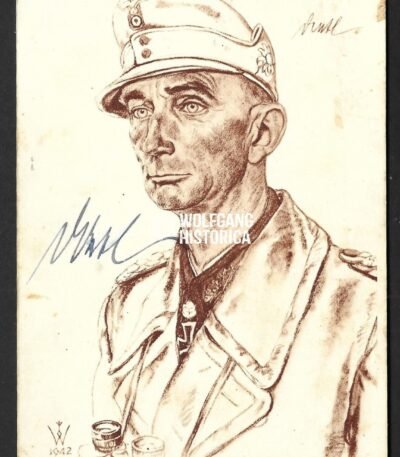
Eduard Dietl – 3.Geb.Div., Gebirgs-Korps Norwegen & 20. Gebirgsarmee (Schwertern) (Wartime Signed)
€145,00Original Wartime Signature on a Postcard of Generaloberst Eduard Dietl (21 July 1890 † 23 June 1944) was one of the most renowned commanders of the German mountain troops (Gebirgstruppe) during the Second World War. Rising from Generalleutnant to Generaloberst, he led German forces in Norway and later commanded the 20. Gebirgsarmee in the far north. He was among the earliest recipients of the Ritterkreuz des Eisernen Kreuzes and one of the very few to be awarded the Eichenlaub and Schwertern.
Item Details
-
Original wartime signature of Generaloberst Eduard Dietl.
-
Signed on a wartime postcard.
-
Condition: As seen – period ink signature, postcard stock consistent with the era.
Death
On 23 June 1944, the Ju 52 transport aircraft carrying Dietl crashed near Rettenegg, Styria, killing him along with General der Infanterie Thomas-Emil von Wickede, General der Gebirgstruppe Karl Eglseer, Generalleutnant Franz Rossi, and three others. There were no survivors.
Collector’s Note
Eduard Dietl remains one of the most iconic figures of the Gebirgstruppe and among the most decorated German commanders of WWII. His status as a Ritterkreuz mit Eichenlaub und Schwertern recipient, combined with his high command role and tragic death in 1944, makes his original wartime autograph a highly desirable and rare collectible.
Death: On 23 June 1944, the Ju 52 aircraft carrying Dietl, General der Infanterie Thomas-Emil von Wickede, General der Gebirgstruppe Karl Eglseer, Generalleutnant der Gebirgstruppe Franz Rossi and three other passengers crashed in the vicinity of the small village of Rettenegg, Styria. There were no survivors.
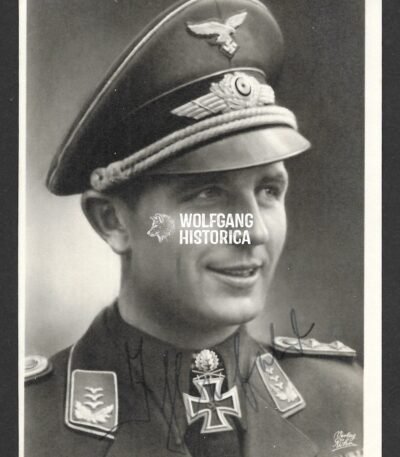
Herbert Ihlefeld – Jagdgeschwader 77 “Herz As” (Schwertern) (Wartime Signed)
€145,00Original Wartime Signature on a Postcard of Herbert Ihlefeld. Oberst Herbert Ihlefeld (1 June 1914 † 8 August 1995) was one of the Luftwaffe’s most successful fighter aces and a highly decorated officer. Serving with Jagdgeschwader 77 “Herz As”, he quickly distinguished himself as a front-line pilot and commander. Over the course of his wartime career, he achieved at least 122 confirmed aerial victories, making him one of the leading Experten of the Luftwaffe.
Awards and Decorations
-
Knight’s Cross of the Iron Cross (Ritterkreuz des Eisernen Kreuzes) – 13 September 1940, as Oberleutnant and Flugzeugführer, 1./JG 77 “Herz As”.
-
Oak Leaves to the Knight’s Cross (Eichenlaub) – 27 June 1941, as Hauptmann and Kommandeur of I./JG 77 “Herz As”.
-
German Cross in Gold (Deutsches Kreuz in Gold) – 9 April 1942.
-
Swords to the Knight’s Cross (Schwerter) – 24 April 1942, as Hauptmann and Kommandeur of I./JG 77 “Herz As”.
Item Details
-
Original wartime signature of Oberst Herbert Ihlefeld.
-
Signed on a wartime postcard.
-
Condition: Excellent, clear period autograph.
Collector’s Note
Herbert Ihlefeld stands among the great names of Luftwaffe fighter history, his career spanning the early victories of 1940 through the brutal campaigns of the East. With over 120 aerial victories and the Ritterkreuz mit Eichenlaub und Schwertern, his autograph remains a highly desirable piece for collectors of Luftwaffe aces and decorated fighter leaders.
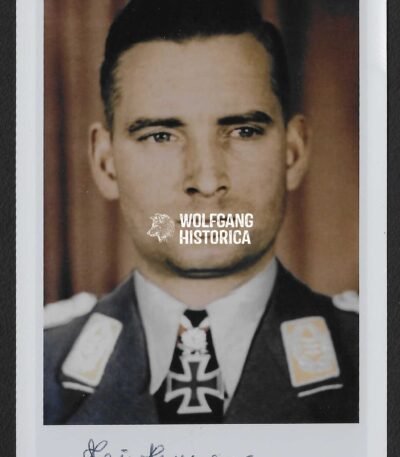
Hajo Herrmann – Kampfgeschwader 4, 30 & Jagdgeschwader 300 (Schwertern)
€25,00Original Postwar Signature on a Postwar Photo of Hans-Joachim “Hajo” Herrmann. Oberst Hajo Hermann (01.08.1913 † 05.11.2010) earned the Ritterkreuz des Eisernen Kreuzes on October 13, 1940 as Oberleutnant und Staffelkapitän of the 7. Staffel/ Kampfgeschwader 4, the Deutsches Kreuz in Gold on June 5, 1942 with Kampfgeschwader 30 “Adler”, the Eichenlaub on August 2, 1943 as Major und Kommodore of Jagdgeschwader 300 and the Schwertern on January 23, 1944 as Oberst und Inspekteur of the Deutschen Luftverteidigung. Condition as seen. Postcardsize.
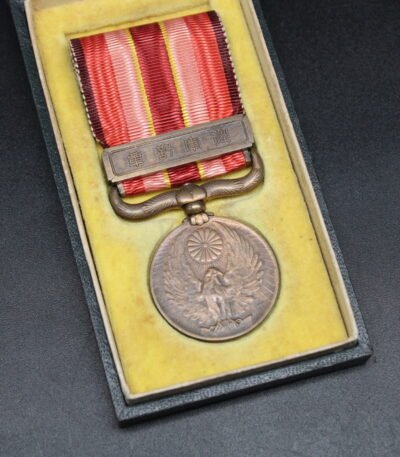
Manchurian Incident Medal (Cased)
Original price was: €80,00.€60,00Current price is: €60,00.A fine and complete example of the Showa 6–9 War Service Medal (Manchurian Incident Medal), awarded to personnel who served during the early Imperial Japanese military operations of the Manchurian Incident (1931–1934)—a conflict that marked the beginning of Japan’s expansionary campaigns leading into the Second Sino-Japanese War and ultimately the Pacific War.
Instituted in 1934, the medal was issued to members of the Army, Navy, and supporting organizations who took part in combat operations, logistical support, or administrative duties related to the campaign. Its obverse features the Imperial chrysanthemum crest above a spread-winged eagle, symbolizing military strength and the authority of the Emperor. The reverse displays two crossed military helmets and inscriptions denoting the Showa era years Six to Nine. The ribbon—shades of red with yellow and white stripes—represents loyalty and valor.
Condition & Presentation
This example remains in very good condition, showing an attractive, untouched patina consistent with its age. The medal is housed in its original black case, which retains sharp gold kanji lettering on the lid. The interior is lined with the classic yellow felt insert that securely holds the piece in place.
Collector’s Notes
-
Complete and original medal with full ribbon and suspension bar
-
Crisp detail to the eagle, chrysanthemum, and reverse inscriptions
-
Case remains solid, with only minor wear from handling
-
A desirable early-Showa period decoration connected to one of the pivotal turning points in Japanese military history
An excellent addition for collectors of Imperial Japanese medals, early militaria, or those focusing on the Manchurian and pre-WWII military campaigns.
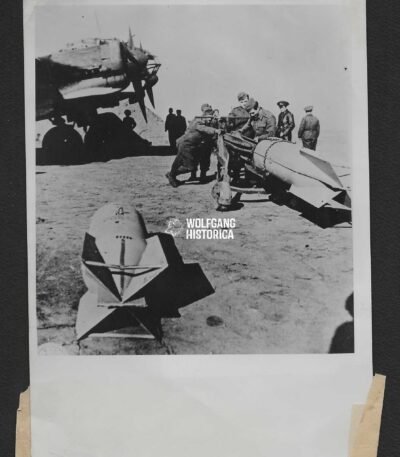
Press Photo: Legion Condor in Spain?
€30,00Original press photo – does it depict the Legion Condor in Spain? Size: 18x13cm.
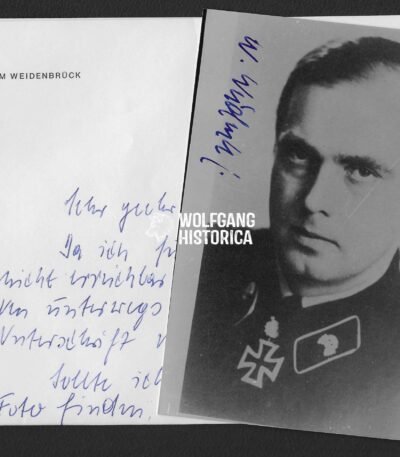
Wilhelm Weidenbrück – Panzer-Regiment 3 & Panzer-Brigade 104 (Eichenlaub)
€55,00Original Postwar Signature on a Postwar Photo plus Letter of Wilhelm Weidenbrück. Major Wilhelm Weidenbrück (05.02.1915 † 28.04.2011) earned the Deutsches Kreuz in Gold on January 2, 1942 with Panzer-Regiment 3, the Ritterkreuz on September 16,1942 as Oberleutnant und Kompaniechef of the 5. Kompanie/ Panzer-Regiment 3 of the 2. Panzer-Division and the Eichenlaub on November 16, 1944 as Major und Kommandeur of Panzer-Brigade 104. Good Condition.
Eichenlaub: Awarded for the successful employment of his brigade in the sector of 5. Jäger-Division on 30.10.1944, fighting at the Narew front at Ostenburg (Pultusk). Following a Soviet breach of the frontline west of the Pelta creek Weidenbrück’s men launched a timely counterattack that restored the old German lines, and 48 Soviet tanks were destroyed/captured in the process.
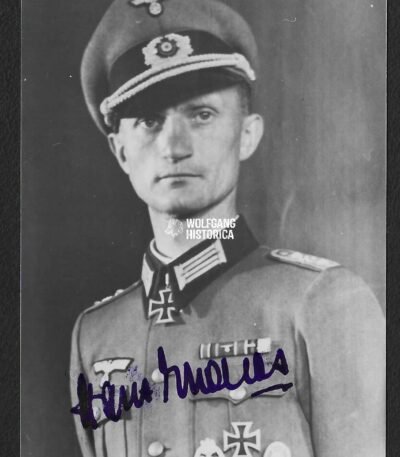
Hans Endres – Panzer-Artillerie-Regiment 74 (2. Panzer-Division)
€17,50Original Postwar Signature on a Postwar Photo of Hans Endres. Major Hans Endres (05.06.1915 † 05.10.2004) earned the Ritterkreuz des Eisernen Kreuzes on August 14, 1943 as Hauptmann und Führer of the Panzer-Artillerie-Regiment 74 of the 2. Panzer-Division.