



Shop
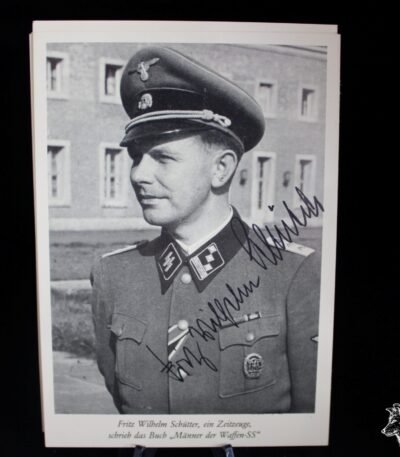
Fritz Wilhelm Schütter – 2. SS-Panzer-Division “Das Reich” & Book Author
€25,00Original Postwar Signature on a Postwar Card of Fritz Wilhelm Schütter. SS-Hauptsturmführer Fritz Wilhelm Schütter (24.09.1912 in Halle † 02.05.1992) served with the 2. SS-Panzer-Division “Das Reich” and was Abteilungsleiter beim Chef des Fernmeldewesens im Reichsinnenministerium. He was the author of Männer der Waffen-SS: Der Weg einer Truppe. Postcardsize. Condition as seen. Several available.
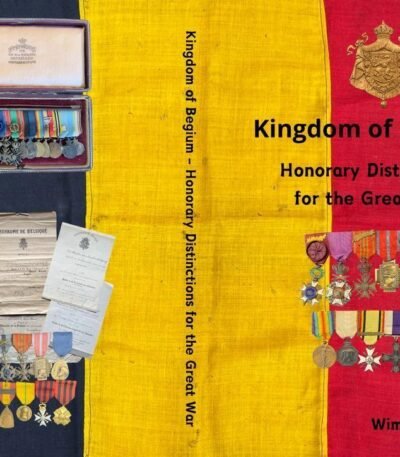
Kingdom of Belgium – Honorary Distinctions for the Great War (Book)
€65,00Kingdom of Belgium – Honorary Distinctions for the Great War
By Wim Martens | Limited Conference Edition | 217 Pages
A highly sought-after reference work dedicated to Belgian First World War honors and decorations. Published to coincide with the XVII European Conference for Phaleristics in Brussels (May–June 2024), this volume provides a comprehensive and meticulously organized overview of official Belgian wartime distinctions.
Arranged chronologically by date of institution, the book presents detailed coverage of orders, medals, and decorations, including recognized variants, accompanying certificates, and period imagery of recipients. In addition, select service insignia and several unofficial yet tolerated distinctions are thoughtfully documented, offering a broader perspective valuable to collectors and historians alike.
Richly illustrated and expertly compiled, this 217-page publication serves as both a scholarly reference and a visually engaging catalog of Belgium’s Great War honors system.
Highlights:
-
Complete overview of Belgian WWI honorary distinctions
-
Chronological structure for ease of reference
-
High-quality photographs of medals, variants, and documents
-
Includes service insignia and rare unofficial distinctions
-
Features historical images of decorated individuals
-
Published for a specialized European phaleristics conference
Condition: New
Availability: Very difficult to find — especially outside specialist circles.
An essential addition to any serious phaleristics library or First World War collection.
Note: Shipping prices might not be final to some countries due weight and size!
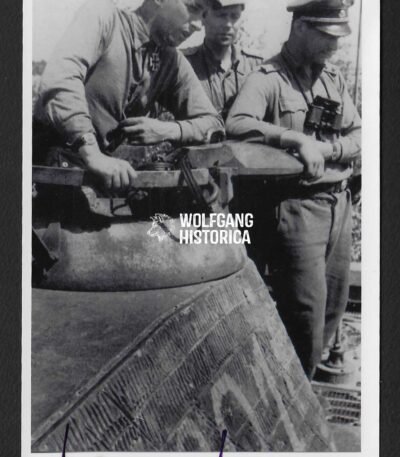
Karl Nicolussi-Leck – SS-Panzer-Regiment 5 “Wiking”
€55,00Original Postwar Signature on a Postwar Photo of Karl Nicolussi-Leck. SS-Hauptsturmführer Karl Nicolussi-Leck earned the Ritterkreuz des Eisernen Kreuzes on April 9, 1944 as SS-Obersturmführer und Chef of the 8. Kompanie/ SS-Panzer-Regiment 5 of the 5. SS-Panzer-Division “Wiking”. Large size: 18,7×18,2cm.
Karl Nicolussi-Leck was the commander of a Panther company in the 5. SS-Panzer-Division “Wiking” during its efforts to relieve the trapped garrison at Kovel in March 1944. On the 27th of that month, with the German relief efforts still in progress, Nicolussi-Leck received an order to halt all offensive actions. By this point he was in radio conduct with the garrison, and felt that its relief was of the utmost importance. He thus told his radio operator to send a reply stating that he (Nicolussi-Leck) could not be found, and with that continued the push to the town. Three days later, following difficult fighting, he was able to reach the trapped garrison with seven tanks on the early morning of the 30th. By doing so he was able to substantially reinforce the garrison’s defences, and he remained with them until Kovel was finally relieved for good. His recommendation also says that he destroyed 17 tanks in the process, although it is possible this number is for the whole company. Either way, Nicolussi-Leck’s actions were judged to be worthy of the Knight’s Cross, and he received this award shortly afterwards. (Source: Traces of War)
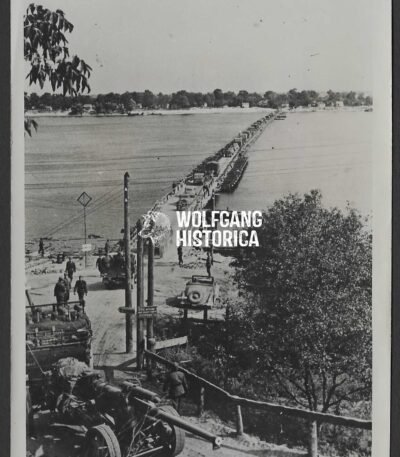
German Press Photo: 720 m ist diese Pionier-Behelfs-Brücke lang
€30,00Original German Press Photo of 720 m ist diese Pionier-Behelfs-Brücke lang. Size: 13x18cm. Condition as seen.
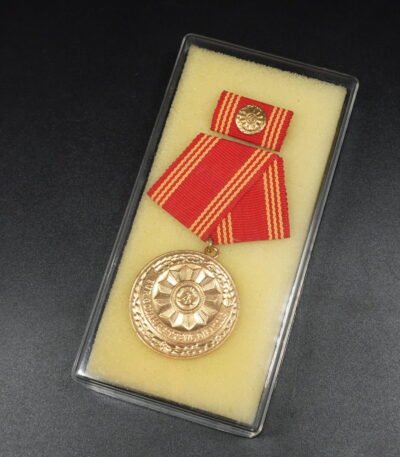
DDR Medal for Faithful Service in the Armed Organs of the Ministry of the Interior (30 Years)
€20,00The Medal for Faithful Service in the Armed Organs of the Ministry of the Interior (MdI) – 30 Years is one of the highest long-service decorations awarded in the German Democratic Republic (DDR).
It was granted to members of the armed organs of the Ministry of the Interior in recognition of an exceptional 30 years of loyal and dedicated service, reflecting a full career within East Germany’s internal security system.
Description
-
Country: German Democratic Republic (East Germany)
-
Institution: Ministry of the Interior (Ministerium des Innern – MdI)
-
Class: 30 Years (XXX)
-
Material: Gold-colored metal
Design:
-
Obverse typically features the national emblem of the DDR
-
Reverse bears inscription for faithful service
-
Commonly includes a “30” clasp or device on the ribbon indicating years of service
Ribbon:
- Often fitted with a numeral device (30)
Historical Context
The armed organs of the MdI included key institutions such as the Volkspolizei and other internal security forces responsible for maintaining order and enforcing state authority during the Cold War.
The 30-year medal represents one of the highest possible service recognitions, awarded only to personnel who completed decades of continuous service, demonstrating exceptional loyalty, discipline, and commitment to the state.
Condition: As seen in the images.
A top-tier DDR decoration, highly desirable for advanced collectors of East German militaria and Ministry of the Interior awards.
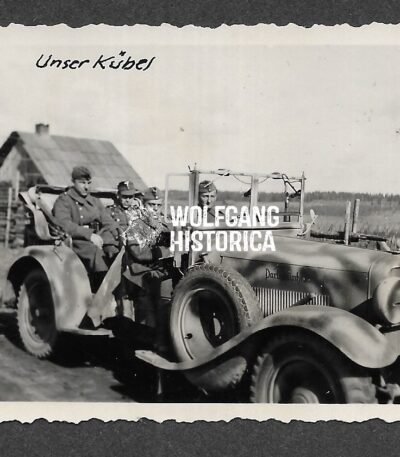
Photograph of Camo Wanderer W23 Kübel (?)
€25,00Original wartime photograph titled “Unser Kübel” (“Our Kübel”), showing a group of German Wehrmacht soldiers seated in a Wanderer W23 Kübelwagen (?) on a rural road, with farm buildings in the background. The vehicle, featuring field camouflage and distinctive front grille design, is characteristic of the early-war period.
Printed on period photo paper with scalloped edges and light silvering typical of 1940s prints. Excellent tonal contrast and clear detail; overall very good condition.
A fine and authentic field image depicting one of the less common pre-standardized Kübelwagen types used by German forces during the early stages of WWII.
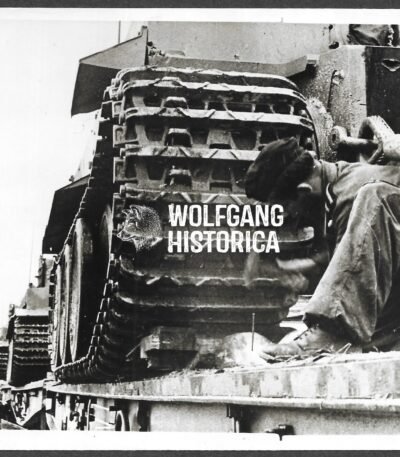
German Press Photo – Transport of Tiger Tanks, July 1944
€125,00Original wartime German press photograph showing Tiger tanks being secured for transport using strong steel cables (Stahltrossen) and wooden chocks placed under their wide caterpillar tracks. The detailed caption explains how the heavy tanks were fastened and stabilized during movement to prevent shifting on railway or transport vehicles.
The reverse caption reads:
“Mit starken Stahltrossen werden die Tigerpanzer festgezurrt, unter die breiten Raupenketten werden hölzerne Hemmschuhe getrieben. Sie sind so gegen Schlingern der fahrenden Wagen gesichert.”
(With strong steel cables, the Tiger tanks are lashed down; wooden chocks are driven under their wide tracks to secure them against swaying during transport.)
-
Date: 10 July 1944
-
Photographer / PK Unit: Kriegsberichter Knirsch (/vb)
-
Agency Stamp: Weltbild Presseservice, Frankfurt am Main (stamped on reverse)
-
Caption Code: L 2129 Wb EM
-
Size: approx. 18 × 13 cm
-
Condition: Excellent for age – sharp image, full typed caption label intact on reverse, light handling consistent with period use.
Historical Context
Photographed in July 1944, this image dates from the height of the fighting in Normandy, when Tiger I heavy tanks were urgently moved between fronts to counter the Allied invasion. The photo highlights the logistical challenge of transporting these massive armored vehicles safely — an essential part of Wehrmacht operations.
Collector’s Note
Original Weltbild press photos featuring Tiger tanks are highly desirable among collectors due to their rarity and direct connection to armored warfare on the Western Front. This example, complete with a detailed original typed caption slip and agency stamp, offers both visual impact and historical depth — a fine addition to any WWII armor or propaganda photo collection.
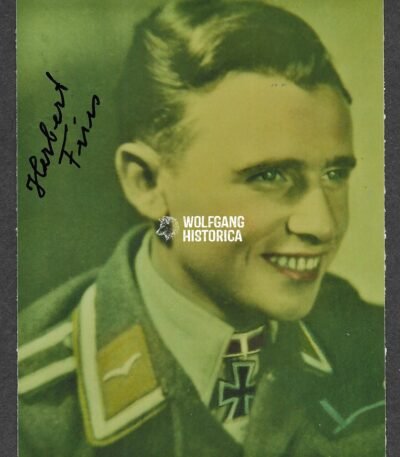
Herbert Fries – Fallschirm-Panzerjäger-Abteilung 1 (Pantherturm!)
€25,00Original Postwar Signature on a Postwar Photo of Herbert Fries. Leutnant Herbert Fries (1 March 1925, Waldmühlen – 6 January 2014, Rennerod-Emmerichenhain) was a Fallschirmjäger and one of the youngest recipients of the Ritterkreuz des Eisernen Kreuzes during the Second World War. Serving as a gunner in the 2./Fallschirm-Panzerjäger-Abteilung 1, 1. Fallschirmjäger-Division, he earned the Knight’s Cross for extraordinary anti-tank actions in Italy.
Award and Citation
-
Ritterkreuz des Eisernen Kreuzes – 5 September 1944, as Gefreiter und Geschützführer in the 2./Fallschirm-Panzerjäger-Abteilung 1
-
Citation: Recognized for his outstanding performance manning a Pantherturm defensive position on the Via Casilina near Piedimonte during the battles of May 1944.
-
21.05.1944 – Destroyed 7 Allied tanks
-
22.05.1944 – Destroyed 6 additional tanks
-
24.05.1944 – Destroyed another 7 tanks
-
Total: 20 enemy tanks destroyed in just three days, decisively slowing Allied advances.
-
-
After exhausting their position, Fries and his crew destroyed their turret (“Schlafmütze” / sleepyhead) and withdrew with the retreating German forces.
Item Details
-
Type: Original postwar signed photograph
-
Size: Little bit smaller than Postcardsize
-
Condition: As seen, well-preserved signature
Collector’s Note
Herbert Fries is remembered as one of the notable anti-tank fighters of the Luftwaffe’s ground formations. His signature is scarce compared to other Ritterkreuzträger, particularly on large-format photos such as this example. An impressive and historically rich autograph, highly desirable for collectors of Fallschirmjäger and anti-tank warfare memorabilia.
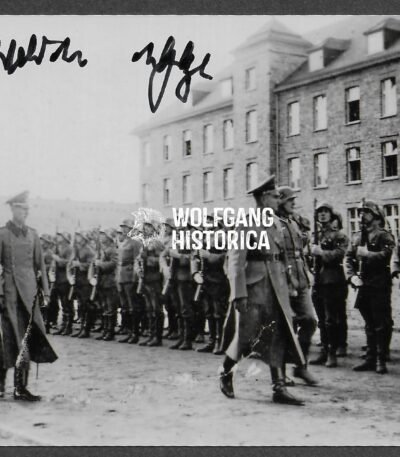
Waldemar von Gaza – Panzergrenadier-Regiment 66 (Schwertern)
€30,00Original Postwar Signature on a Postwar Photo of Waldemar von Gaza
Major Waldemar von Gaza (6 December 1917 – 13 January 2014) was a highly decorated officer of the 13. Panzer-Division, rising to command-level positions in armored infantry units on the Eastern Front. Over the course of the war, he received the Ritterkreuz des Eisernen Kreuzes with Eichenlaub and Schwertern, placing him among the most distinguished recipients of Germany’s highest battlefield awards.
Awards and Decorations
-
Ritterkreuz des Eisernen Kreuzes – 18 September 1942, as Oberleutnant und Chef 2./Panzergrenadier-Regiment 666, 13. Panzer-Division
-
Eichenlaub (Nr. 158) – 18 January 1943, as Hauptmann und Führer of a Kampfgruppe, 13. Panzer-Division
-
Schwerter (Nr. 324) – 3 October 1943, as Major und Führer of Panzergrenadier-Regiment 66, 13. Panzer-Division
-
Other awards included both classes of the Iron Cross and campaign distinctions
Service Highlights
-
Fought throughout the Eastern Front campaigns, earning distinction in combined-arms actions with armored infantry.
-
His leadership of Kampfgruppen during some of the most intense battles of 1942–43 earned him rapid recognition.
-
By 1943, he had risen to regimental command level, where he was awarded the Swords to the Knight’s Cross for continued outstanding leadership in combat.
Item Details
-
Type: Original postwar signed photograph
-
Size: Postcardsize
-
Condition: Good, as seen
Collector’s Note
Waldemar von Gaza’s decorations—Ritterkreuz, Eichenlaub, and Schwerter—mark him as one of the relatively few officers to attain this level of distinction. His signature is sought-after by collectors of panzer and Eastern Front memorabilia, with his long postwar life making his autograph available but still scarce in comparison to other triple recipients.
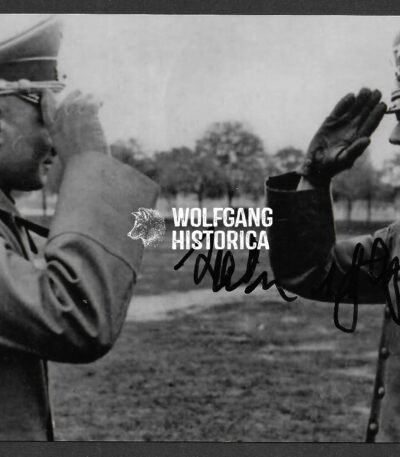
Waldemar von Gaza – Panzergrenadier-Regiment 66 (Schwertern) (A5-Size!)
€30,00Original Postwar Signature on a Postwar Photo of Waldemar von Gaza
Major Waldemar von Gaza (6 December 1917 – 13 January 2014) was a highly decorated officer of the 13. Panzer-Division, rising to command-level positions in armored infantry units on the Eastern Front. Over the course of the war, he received the Ritterkreuz des Eisernen Kreuzes with Eichenlaub and Schwertern, placing him among the most distinguished recipients of Germany’s highest battlefield awards.
Awards and Decorations
-
Ritterkreuz des Eisernen Kreuzes – 18 September 1942, as Oberleutnant und Chef 2./Panzergrenadier-Regiment 666, 13. Panzer-Division
-
Eichenlaub (Nr. 158) – 18 January 1943, as Hauptmann und Führer of a Kampfgruppe, 13. Panzer-Division
-
Schwerter (Nr. 324) – 3 October 1943, as Major und Führer of Panzergrenadier-Regiment 66, 13. Panzer-Division
-
Other awards included both classes of the Iron Cross and campaign distinctions
Service Highlights
-
Fought throughout the Eastern Front campaigns, earning distinction in combined-arms actions with armored infantry.
-
His leadership of Kampfgruppen during some of the most intense battles of 1942–43 earned him rapid recognition.
-
By 1943, he had risen to regimental command level, where he was awarded the Swords to the Knight’s Cross for continued outstanding leadership in combat.
Item Details
-
Type: Original postwar signed photograph
-
Size: Postcardsize
-
Condition: Good, as seen
Collector’s Note
Waldemar von Gaza’s decorations—Ritterkreuz, Eichenlaub, and Schwerter—mark him as one of the relatively few officers to attain this level of distinction. His signature is sought-after by collectors of panzer and Eastern Front memorabilia, with his long postwar life making his autograph available but still scarce in comparison to other triple recipients.
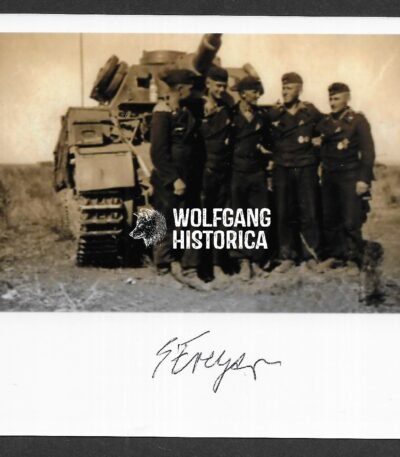
Siegfried Freyer – Panzer-Regiment 24 (24. Panzer-Division)
€25,00Original Postwar Signature on a Postwar Photo of Siegfried Freyer
Wachtmeister Siegfried Freyer (11 February 1917 – 10 May 2014) was a German panzer officer in the 24. Panzer-Division and a recipient of the Ritterkreuz des Eisernen Kreuzes. He earned his Knight’s Cross on 23 July 1942 as Wachtmeister und Zugführer of 4. Kompanie/ Panzer-Regiment 24 for his extraordinary bravery during the heavy urban fighting at Voronezh.
Knight’s Cross Action
On 7 July 1942, during close-quarter fighting in the streets of Voronezh, Soviet armored units attempted to break through the encirclement ring of Freyer’s Kampfgruppe. Acting on his own initiative, Freyer led his platoon in a counterattack and personally destroyed 10 Soviet T-34 tanks in the span of just half an hour. His decisive intervention prevented a breakthrough, stabilized the frontline, and directly enabled the occupation of the city. For this exceptional act of bravery and leadership, he was awarded the Knight’s Cross of the Iron Cross.
Awards and Decorations
-
Ritterkreuz des Eisernen Kreuzes – 23 July 1942 as Wachtmeister und Zugführer, 4./Panzer-Regiment 24, 24. Panzer-Division
-
Iron Cross 2nd Class & 1st Class
-
Other campaign awards
Item Details
-
Type: Original postwar signed photograph
-
Size: Postcardsize
-
Condition: Good, clear autograph
Collector’s Note
Siegfried Freyer’s Knight’s Cross recommendation is one of the most dramatic tank combat citations of the Eastern Front, highlighting his destruction of 10 T-34s in just 30 minutes. His signature is a scarce and desirable addition for collectors of panzer division memorabilia, particularly those focused on the pivotal 1942 campaigns and the battle for Voronezh.
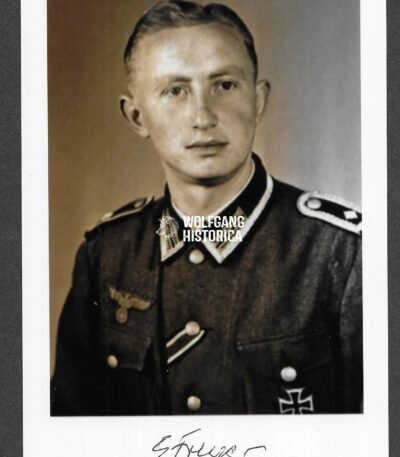
Siegfried Freyer – Panzer-Regiment 24 (24. Panzer-Division)
€25,00Original Postwar Signature on a Postwar Photo of Siegfried Freyer
Wachtmeister Siegfried Freyer (11 February 1917 – 10 May 2014) was a German panzer officer in the 24. Panzer-Division and a recipient of the Ritterkreuz des Eisernen Kreuzes. He earned his Knight’s Cross on 23 July 1942 as Wachtmeister und Zugführer of 4. Kompanie/ Panzer-Regiment 24 for his extraordinary bravery during the heavy urban fighting at Voronezh.
Knight’s Cross Action
On 7 July 1942, during close-quarter fighting in the streets of Voronezh, Soviet armored units attempted to break through the encirclement ring of Freyer’s Kampfgruppe. Acting on his own initiative, Freyer led his platoon in a counterattack and personally destroyed 10 Soviet T-34 tanks in the span of just half an hour. His decisive intervention prevented a breakthrough, stabilized the frontline, and directly enabled the occupation of the city. For this exceptional act of bravery and leadership, he was awarded the Knight’s Cross of the Iron Cross.
Awards and Decorations
-
Ritterkreuz des Eisernen Kreuzes – 23 July 1942 as Wachtmeister und Zugführer, 4./Panzer-Regiment 24, 24. Panzer-Division
-
Iron Cross 2nd Class & 1st Class
-
Other campaign awards
Item Details
-
Type: Original postwar signed photograph
-
Size: Postcardsize
-
Condition: Good, clear autograph
Collector’s Note
Siegfried Freyer’s Knight’s Cross recommendation is one of the most dramatic tank combat citations of the Eastern Front, highlighting his destruction of 10 T-34s in just 30 minutes. His signature is a scarce and desirable addition for collectors of panzer division memorabilia, particularly those focused on the pivotal 1942 campaigns and the battle for Voronezh.
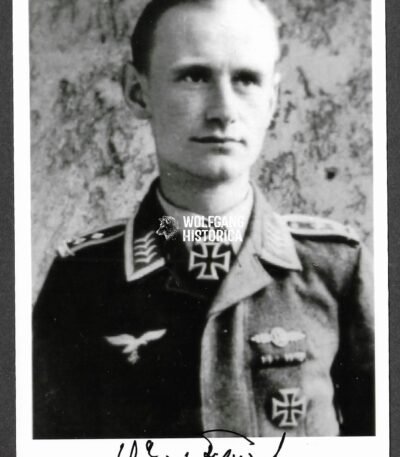
Günther Frenzel – Kampfgeschwader zur besonderen Verwendung 1
€25,00Original Postwar Signature on a Postwar Photo of Günther Frenzel
Leutnant Günther Frenzel (19 March 1919 – 12 March 2011) was a highly decorated Luftwaffe transport and special mission pilot of Kampfgeschwader zur besonderen Verwendung 1 (KG z.b.V. 1). He earned the Ritterkreuz des Eisernen Kreuzes on 23 December 1942 as Feldwebel und Staffelführer of 11. Staffel / KG z.b.V. 1, in recognition of his daring missions and exceptional skill as a transport pilot under the most dangerous conditions.
Awards and Decorations
-
Ritterkreuz des Eisernen Kreuzes – 23 December 1942 as Feldwebel und Staffelführer, 11./KG z.b.V. 1
-
Various campaign and service awards (not detailed here)
Career Highlights
-
~200 Operational Flights: Frenzel accumulated around 200 combat missions, primarily in the Ju-52, often under heavy enemy fire.
-
Stellar Navigation: Volunteered to locate a downed bomber crew deep in enemy territory, successfully navigating by the stars to rescue them.
-
Captured Aircraft Operation: Took part in special operations flying captured Vickers Wellington bombers against Allied fuel depots in the Congo. On one such mission, he even landed at a Belgian-Congo airfield, refueled, and then bombed the same base.
-
Escape from Captivity: Captured during Operation Crusader at Derna airfield, he escaped the same day with his flight mechanic by seizing their Ju-52 under British fire, taking off during a German air attack.
-
Survivor of a Mass Shoot-Down: While flying across the Mediterranean, Frenzel’s transport was the only survivor out of 13 Ju-52s ambushed by British fighters. Despite being badly wounded and his aircraft heavily damaged, he kept it airborne for 45 minutes before crash-landing near the coast, saving all aboard. Field Marshal Albert Kesselring personally visited him in hospital to commend his bravery.
Item Details
-
Type: Postwar signed photograph
-
Size: Postcardsize
-
Condition: Good, with clear signature
Collector’s Note
Frenzel’s service stands out for the audacity and uniqueness of his missions: captured Allied bombers, daring escapes, and survival against overwhelming odds. His signature is a scarce and desirable addition to any collection focusing on Ritterkreuzträger, Luftwaffe transport units, or extraordinary air operations of WWII.
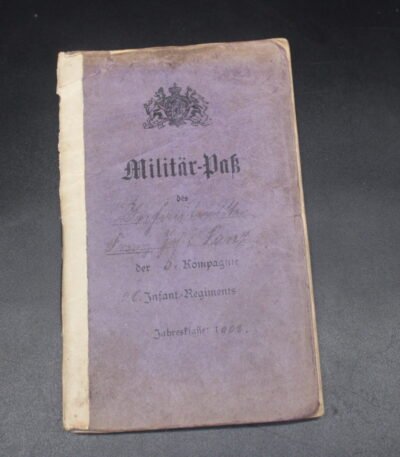
Imperial German WWI Militärpaß – Bayerisches-Reserve-Infanterie-Rgt. 17 (WIA 1918 in France, Earned Prussian EK2)
€45,00Offered is an original Imperial German Militärpaß issued to Franz Josef Lang, a Bavarian infantryman with long pre-war service, extensive frontline combat on the Western Front, and a confirmed Iron Cross 2nd Class award.
A strong, historically rich Militärpaß combining long service, frontline infantry combat, an Iron Cross award, and a recorded wartime wound—an excellent example for collectors of Bavarian units, Western Front veterans, or Iron Cross recipient documents.
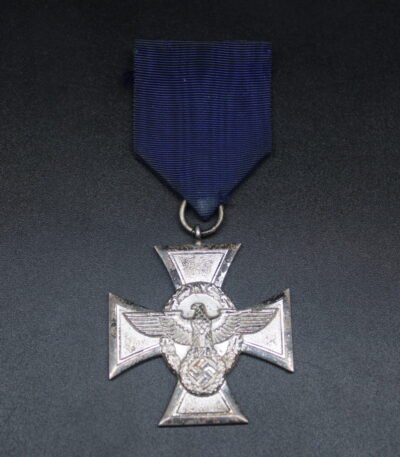
Polizei-Dienstauszeichnung 2. Stufe für 18 Jahre
€130,00Original Polizei-Dienstauszeichnung 2. Stufe für 18 Jahre Treue Dienst (Police Service Award 2nd Class for 18 Years Loyal Service). Ribbon complete with pin! Condition as seen.
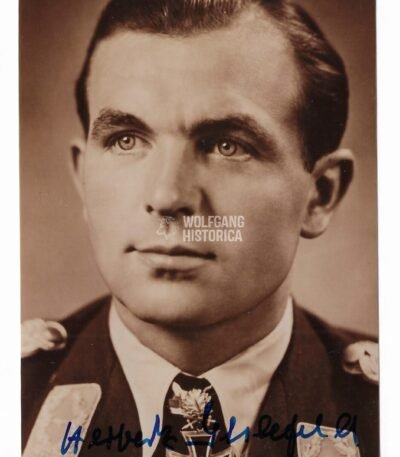
Herbert Ihlefeld – Jagdgeschwader 77 “Herz As” (Schwertern, 122 Victories!)
€35,00Original Postwar Signature on a Postwar Photo of Herbert Ihlefeld. Oberst Herbert Ihlefeld (01.06.1914 † 08.08.1995) earned the Ritterkreuz on September 13, 1940 as Oberleutnant und Flugzeugführer in the 1. Staffel/ Jagdgeschwader 77 “Herz As”, the Eichenlaub on June 27, 1941 as Hauptmann und Kommandeur of the I. Gruppe/ Jagdgeschwader 77 “Herz As”, the Deutsches Kreuz in Gold on April 9, 1942 and the Schwertern on April 24, 1942 as Hauptmann und Kommandeur of the I. Gruppe/ Jagdgeschwader 77 “Herz As”. He’s credited with at least 122 aerial victories!
Provenance: This signature comes from one of the largest postwar signature collection I’ve ever commissioned. This collection was started by a Waffen-SS Veteran, Werner H., in the 1950’s until he passed away.
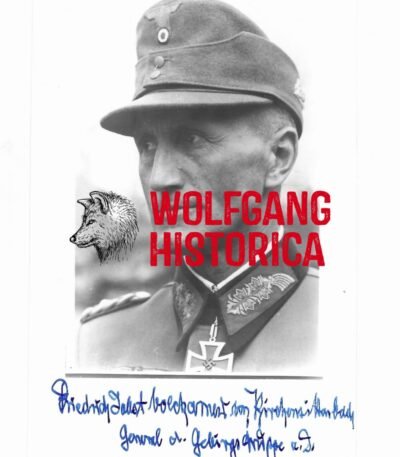
Friedrich von Volckamer und Kirchensittenbach – 8. Jäger-Division
€45,00Original Postwar Signature on a Postwar Photo of Friedrich von Volckamer und Kirchensittenbach. Generalleutnant Friedrich von Volckamer und Kirchensittenbach (16.04.1894 † 03.04.1989) earned the Deutsches Kreuz in Gold on November 3, 1943 with 8. Jäger-Division and the Ritterkreuz on March 26, 1944 as Generalleutnant und Kommandeur of the 8. Jäger-Division.
Provenance: This signature comes from one of the largest postwar signature collection I’ve ever commissioned. This collection was started by a Waffen-SS Veteran, Werner H., in the 1950’s until he passed away.
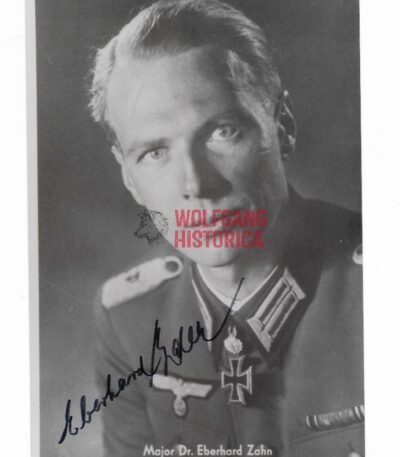
Dr. Eberhard Zahn – Panzerjäger-Abteilung 33 (Eichenlaub)
€25,00Original Postwar Signature on a Postwar Photo of Dr. Eberhard Zahn. Oberstleutnant Dr. Eberhard Zahn (02.01.1910 † 07.02.2010) earned the Ritterkreuz on June 30, 1941 as Leutnant und Zugführer of the 2. Kompanie/ Panzerjäger-Abteilung 33 of the 15. Panzer-Division and the Eichenlaub on March 6, 1943 as Hauptmann und Kompaniechef of the 2. Kompanie/ Panzerjäger-Abteilung 33. Good condition. Postcardsize.
Knight’s Cross: Awarding for his resiliency in battle during the British Operation Battleaxe. With his 5cm Pak he defeated a British armoured attack and destroyed 6 enemy tanks. When his gun was knocked out he continued to fight on as an infantryman, and despite being captured he refused to give up and managed to escape and return to German lines.
Oakleaves: “…At the start of July 1942 the south wing of [Zahn’s] Division was hit by an armoured surprise attack. Since one of the Kompanie commanders became a casualty in the bitter fighting, Hauptmann Zahn (at the time still an Oberleutnant and the Abteilung adjutant) rushed forward, saved his heavily wounded comrade under heavy fire and then took over leadership of the Kompanie. He then brought the attack to a halt with only 3 guns that were available.” (Source: Traces of War)
Hermann Henle – Werfer-Regiment 70
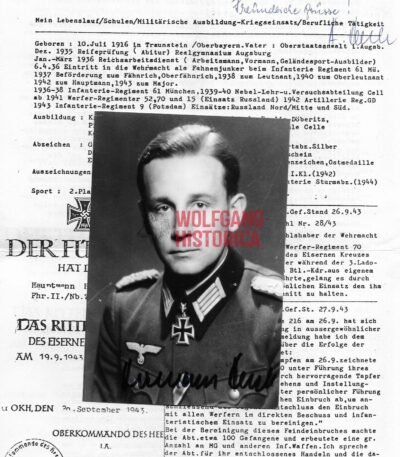
€22,50Original Postwar Signature on a Postwar Photo of Hermann Henle. Major Hermann Henle (10.07.1916 † 16.03.2008) earned the Ritterkreuz on September 19, 1943 as Hauptmann und Führer of the II. Abteilung/ Werfer-Regiment 70. Good condition. Postcardsize.
Ludwig Bauer – Panzer-Regiment 33
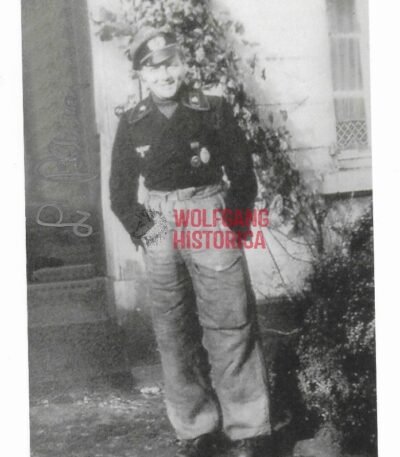
€20,00Original Postwar Signature on a Postwar Photo of Ludwig Bauer. Leutnant Ludwig Bauer (16.02.1923 † 20.05.2020) earned the Ritterkreuz on April 29, 1945 as Leutnant und Führer in the 1. Kompanie/ Panzer-Regiment 33 “Prinz Eugen” of the 9. Panzer-Division. Good condition. Postcardsize.
Heinrich Ruhl – Divisions-Füsilier-Bataillon 122 (122.Inf.Div.)
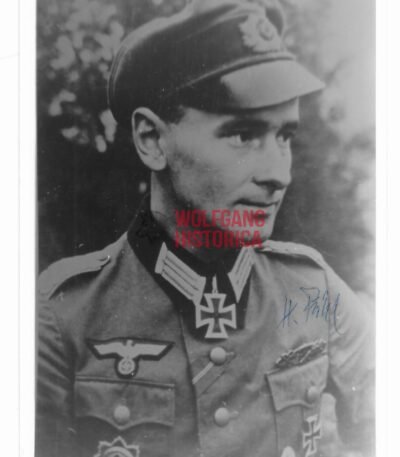
€25,00Original Postwar Signature on a Postwar Photo of Heinrich Ruhl. Major Heinrich Ruhl (31.08.1915 † 01.12.2015) earned the Ritterkreuz on September 21, 1944 as Major und Kommandeur of the Divisions-Füsilier-Bataillon 122 of the 122. Infanterie-Division and the Eichenlaub on March 16, 1945 as Major und Kommandeur of the Divisions-Füsilier-Bataillon 122 of the 122. Infanterie-Division. Good condition. Postcardsize.
Gustav-Peter Reber – “LSSAH” and XI. SS-Panzerkorps
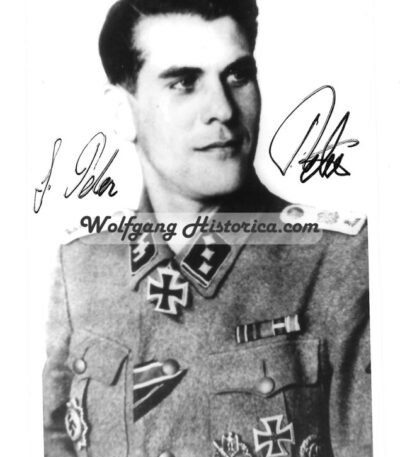
€40,00Original Postwar Signature of Knight’s Cross Holder Gustav-Peter Reber. Reber earned the Deutsches Kreuz in Gold with 1. Kompanie/ SS-Panzer-Grenadier-Regiment 2 “LSSAH” and the Ritterkreuz as Cdr. of Stabsquartier/ XI. SS-Panzerkorps. Good condition. Postcardsize.
Also Führer Kampfgruppe, Kessel von Halbe. Actions in Halbe pocket ; before breakout awarded by Gruppenführer Wagner , approved by Obergruppenführer Kleinheisterkamp, K.G. XI. SS-AK.
No proof possible with existing BArch documents ; according to Krätschmer (letter to von Seemen from 07.08.1980) the award was made together with the OL for Kleinheisterkamp and was announced via radio message from FHQ in Berlin to 9. Armee (Kessel von Halbe) on 28.04.1945 ; the incoming radio messages of AOK 9 from april 45 are not existing anymore ; the wireless radio connections to the Führerbunker in Berlin were interrupted since April 28th, 05.00hours in the morning ; the OdR Ordenskommission decided about this case in 1981 with the result : “RK ja, 28.4.1945” (Source: Traces of War)
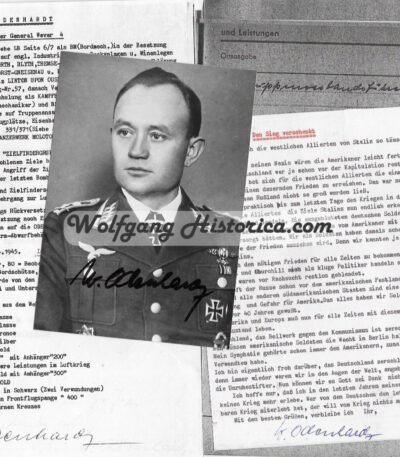
Wilhelm Odenhardt – Kampfgeschwader 4 “General Wever”
€35,00Original Postwar Signature on a Postwar Photocopy of Wilhelm Odenhardt. Oberfeldwebel Wilhelm Odenhardt (26.01.1914 † 12.04.1992) earned the Deutsches Kreuz in Gold on May 17, 1943 with Kampfgeschwader 4 “General Wever” and the Ritterkreuz on October 24, 1944 as Oberfeldwebel und Beobachter in the 4. Staffel/ Kampfgeschwader 4 “General Wever”. Good condition. Measuring: 8,9×12,7cm. Comes with an extra signed letter(s) and enveloppe.
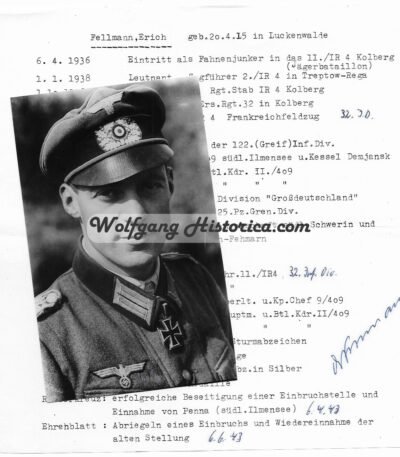
Erich Fellmann – Grenadier-Regiment 409
€30,00Original Postwar Signature on a Postwar Photocopy of Erich Fellmann. Hauptmann Erich Fellmann (20.04.1915 † 14.01.2004) earned the Deutsches Kreuz in Gold on June 18, 1942 with 9. Kompanie/ Infanterie-Regiment 409 and the Ritterkreuz on April 6, 1943 as Hauptmann und Kommandeur of II. Bataillon/ Grenadier-Regiment 409 of the 122. Infanterie-Division. Good Condition. Measuring: Postcardsize. Comes with an extra signed letter and enveloppe.
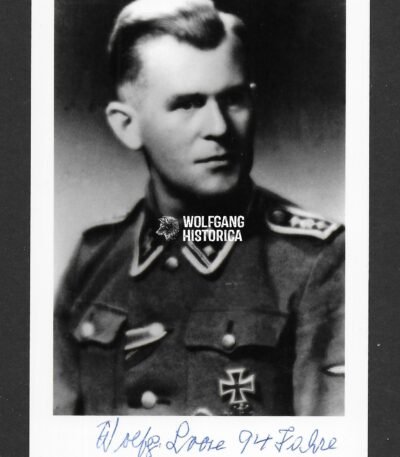
Wolfgang Loose – 2. SS-Panzer-Division “Das Reich” (NKIG)
€30,00Original Postwar Signature on a Postwar Photo of Wolfgang Loose. SS-Untersturmführer Wolfgang Loose (16.02.1916-) earned the Nahkampfspange in Gold on March 18, 1945 with the Bataillonsstab/ SS-Panzer-Grenadier-Regiment 3 “Deutschland” of the 2. SS-Panzer-Division “Das Reich”. Good condition. Postcardsize.
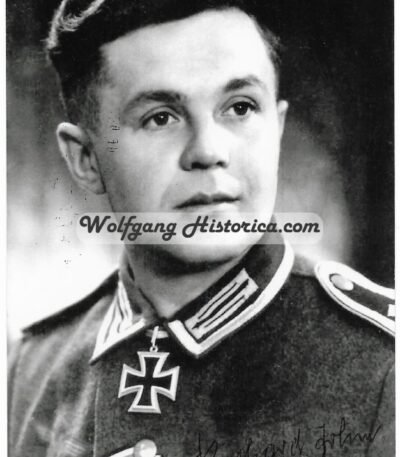
Richard John – Grenadier-Regiment 445 (134.Inf.Div.)
€15,00Original Postwar Signature on a Postwar Photocopy of Richard John. Feldwebel Richard John (14.11.1916 † 21.06.2010) earned the Ritterkreuz on May 4, 1944 as Feldwebel und Kompanie-Truppführer in the 2. Kompanie/ Grenadier-Regiment 445 of the 134. Infanterie-Division. Good condition. Postcardsize.
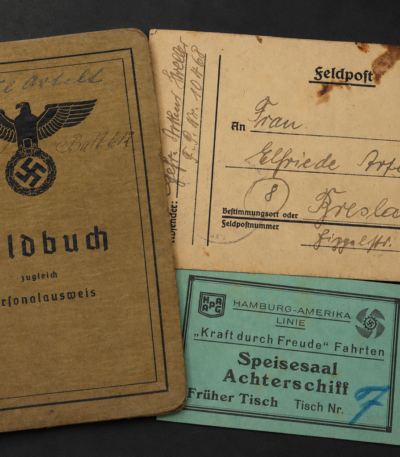
Soldbuch Obergefreiter – Nachschub-Bataillon 612 – Missing at Le Château-Charleville, August 1944 – Ostmedaille & KVK2
€165,00Interesting and historically attractive WW2 German Soldbuch belonging to Obergefreiter Paul Artelt, who served with Nachschub-Bataillon 612 and later went missing in August 1944 during the fighting around Le Château-Charleville.
A very nice mid- to late-war Soldbuch with numerous unit entries, leave stamps, weapon issue entries, accompanying Feldpost envelope and handwritten notification letter regarding his disappearance.
Soldier Details
- Name: Paul Artelt
- Born: 11 October 1905
- Birthplace: Altkessel-Graeberei
- Profession: Kutscher
- Religion: Catholic
- Rank progression:
- Schütze
- Gefreiter
- Obergefreiter (from 1.2.1944)
Units
The Soldbuch shows service with:
- 1. Kompanie / Infanterie-Ersatz-Bataillon 375
- Nachschub-Bataillon 612
The Soldbuch contains:
- multiple leave entries
- weapon issue pages
- hospital/lazarett-related stamps
- Feldpost envelope
- handwritten wartime/postwar correspondence concerning his disappearance
Awards
- 10.8.42 Ostmedaille (Eastern Front Medal / Winterschlacht im Osten)
- 1.6.44 Kriegsverdienstkreuz 2. Klasse (KVK2)
A very desirable combination for a logistics/supply soldier serving under difficult Eastern Front and later Western Front conditions.
Missing in Action – August 1944
The most historically significant aspect of the grouping is the included handwritten correspondence mentioning that Artelt went missing in:
- Le Château-Charleville
- in August 1944
This places him during the chaotic German retreat after the Allied breakout from Normandy and the collapse of the front in France.
Supply and transport battalions such as Nachschub-Bataillon 612 were heavily exposed during this period, often caught in encirclements, strafing attacks and rapidly collapsing retreat routes.
The included handwritten letter gives the grouping strong personal and research potential.
Included in the Grouping
- Original Soldbuch
- Feldpost envelope addressed to his wife
- Period “Kraft durch Freude” ship dining card
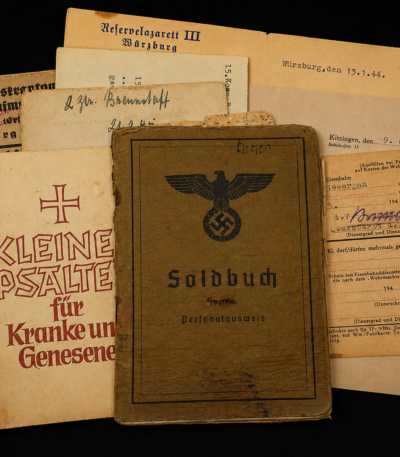
Soldbuch & Document Grouping to Unteroffizier – Grenadier-Regiment 404 (246. Infanterie-Division) – 4 Awards
€225,00Very interesting and extensive WW2 German Soldbuch grouping belonging to Unteroffizier Fritz Ehrler, born 11 February 1913 in Mannheim. A well-filled Soldbuch with numerous entries, stamps, lazarett stays, combat-related hospitalization records, awards, leave entries and accompanying documents.
The Soldbuch was originally issued to Ehrler as a Gefreiter and later updated to Unteroffizier.
Identified Units
- Infanterie-Regiment 404
- Grenadier-Regiment 404 of the 246. Infanterie-Division
- Grenadier-Ersatz-Bataillon 352
- Replacement/training formations connected to Mannheim and Luxembourg
Awards Recorded
- Kriegsverdienstkreuz 2. klasse mit Schwertern (KVK2) – awarded 26.10.1942
- Eisernes Kreuz 2. Klasse (EK2) – awarded 2..5.1943
- Ostmedaille (“Winterschlacht im Osten 1941/42”) – entered 4.8.1942
- Verwundetenabzeichen in Schwarz – entered 8.6.1943
Wounds / Hospitalization
The Soldbuch contains extensive medical and lazarett entries, making this grouping especially interesting for research.
Recorded stays include:
- Reservelazarett Grimma
- Feldlazarett (mot.) 606
- Reserve-Lazarett II Jablonna-Legionowo
- Reservelazarett II Chemnitz – Teillazarett Rabenstein
- Reservelazarett Tauberbischofsheim
- Reservelazarett III Würzburg
- Teillazarett Juliusspital Würzburg
Several medical classifications and transfers are recorded throughout 1942–1945.
Additional Interesting Entries
- Numerous official Wehrmacht and lazarett stamps
- Equipment issue entries
- Leave entries
- Wehrmacht-Marschausweis included
- Additional accompanying wartime and postwar papers/booklets
- Portrait photograph still present inside the Soldbuch
- Waffen and equipment issue pages filled in
- Detailed personal description page complete.
Included
- Original Soldbuch
- Wehrmacht-Marschausweis
- Additional accompanying documents/booklets as shown
A very displayable and researchable original grouping with excellent wartime content, numerous medical/lazarett entries and combat award documentation.
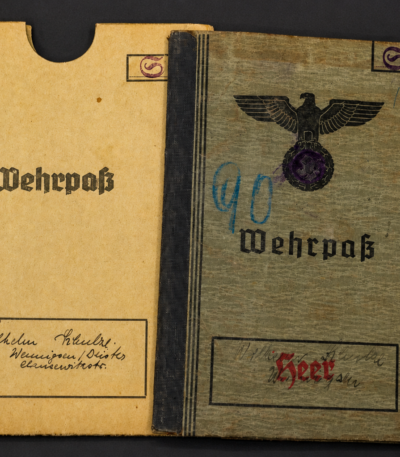
Wehrpass – Unteroffizier in Kraftfahr-Kp. 222 & Sturmgeschütz-Brigade 300 – KBA in Bronze in March 1945!
€195,00Very interesting and well-filled Wehrpass issued to Wilhelm Hermann Friedrich Schulze, born 7 February 1911 in Westerhof/Osterode, documenting continuous Heer service from 1940 through the final days of the war, including service on the Eastern Front and attachment to Sturmgeschütz-Brigade 300.
The Wehrpass retains the original portrait photograph, numerous unit and administrative stamps, handwritten entries, combat/service notes, inserted campaign sheet, promotions, and wartime awards. Several stamps were period/postwar denazified, commonly encountered on original retained Wehrpässe.
Recorded Units Include:
- 4. (MG) Kompanie / Infanterie-Ersatz-Bataillon 191 – Hildesheim
- Infanterie-Regiment 552
- Kraftwagen-Kolonne 222
- Kraftfahr-Kompanie 222
- 1. Kompanie/ Sturmgeschütz-Brigade 300
Notable Entries:
- Awarded the Kriegsverdienstkreuz 2. Klasse mit Schwertern (KVK2 mit Schwertern) on 20.4.1941
- Awarded the Kraftfahrbewährungsabzeichen in Bronze on 19.3.1945
- Promoted to Gefreiter on 1.3.1941
- Promoted to Obergefreiter on 1.4.1943
- Promoted to Unteroffizier on 1.5.1945
- Eastern Front combat/service entries
- Inserted typed campaign sheet detailing 1944 operations in the Ukraine sector
- Original wartime photo present
- Numerous official stamps and signatures throughout
The Wehrpass shows honest wartime wear and age, remaining in very solid and displayable condition overall.
A highly desirable and researchable late-war Heer Wehrpass featuring:
- Assault gun brigade service
- Eastern Front operations
- Combat driver qualification award
- Multiple wartime promotions
- Final-days-of-the-war Unteroffizier promotion
- Strong unit history for collector and research value
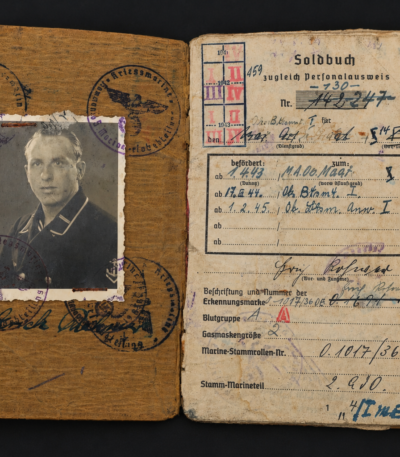
Kriegsmarine Soldbuch – Oberbootsmann – EK2, Wound Badge & Minesweeper Badge – Netzsperrflottille Nord (Norway)
€275,00Original Second World War German Kriegsmarine Soldbuch / Personalausweis belonging to Oberbootsmann Georg Rohwer, a Kriegsmarine serviceman who served in several Marine-Flak units and later with the Netzsperrflottille Nord in occupied Norway.
This is a highly detailed and extensively filled Soldbuch with original portrait photograph, numerous Kriegsmarine unit stamps, wartime entries, transfer records, lazarett entries, leave records and award annotations spanning from 1941 through 1945.
Particularly desirable are the documented combat awards recorded inside the Soldbuch:
- Verwundetenabzeichen in Schwarz (Wound Badge in Black) – September 1944
- Eisernes Kreuz 2. Klasse (EK2) – October 1944
- Minensucher-Abzeichen (Minesweeper War Badge) – November 1944
The Soldbuch shows service with multiple Kriegsmarine Marine-Flak-Abteilungen, including:
- Marine-Flak-Abteilung 211
- Marine-Flak-Abteilung 251
- Marine-Flak-Abteilung 281
His final wartime service appears connected to the Netzsperrgruppe Nord / Netzsperrflottille Nord, the Kriegsmarine naval barrier and coastal defense flotilla operating along the Norwegian coastline.
The booklet contains:
- Original attached wartime portrait photo
- Numerous Kriegsmarine eagle stamps and Feldpost markings
- Extensive administrative and leave entries
- Lazarett / hospital records
- Equipment and clothing issue pages
- Award entries and promotions
- Strong wartime-used character throughout
Condition is original wartime-used condition with age wear, stains, folds and handling marks consistent with active service use. An excellent and highly displayable Kriegsmarine combat-related Soldbuch with researched award and unit history.
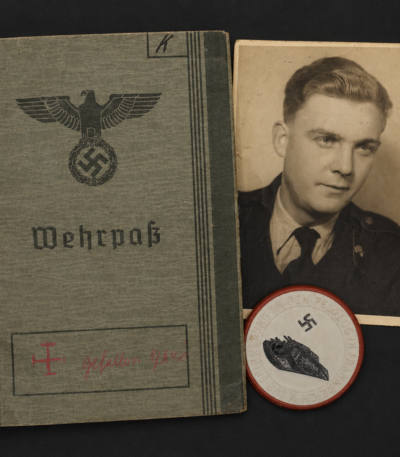
Wehrpass & Porcelain Medaillon – Panzer Regiment 25 – KIA June 1941 during Operation Barbarossa
€250,00Excellent and highly personal original WWII Wehrpass, Photo and Porcelain token belonging to Johann Knauß, a young German Panzer soldier who served in Panzer-Regiment 25 and was killed in action during the opening days of Operation Barbarossa in June 1941.
The grouping consists of his original Wehrpass with portrait photograph, wartime entries detailing his campaigns in France and the Soviet Union, together with period personal photographs and an interesting Paris souvenir medallion likely acquired during occupation service in France.
Particularly desirable is the clear documentation of his death during the rapid armored advance into Soviet territory in June 1941.
Included in the grouping:
- Original Wehrpass with portrait photograph
- Additional wartime portrait photograph
- Paris occupation souvenir porcelain medallion/token: “Zur Erinnering an den Feldzug in Frankreich / Einnahme von Paris 14. Juni 1940“
Documented Units:
- 1./Panzer-Ersatz-Abteilung 25, Erlangen
- 5./ Panzer-Regiment 25
- Later: 7./ Panzer-Regiment 25
Notable Details:
- Entered Wehrmacht service:
- 1 October 1940
- Participated in:
- Occupation service in France
- Fought during:
- Operation Barbarossa
- Wehrpass records combat actions during the opening invasion battles in the Soviet Union
- Killed near:
- Grodno
- 27 June 1941
- Original red handwritten “gefallen 1941” notation on Wehrpass cover
Recorded Weapons Training Includes:
- Gewehr 98
- Pistole 08
- MG34
- MG37(t)
- KwK 38(t)
- KwK 30
- Maschinenpistole
A very personal early-war Panzer soldier grouping connected to the dramatic opening phase of the German invasion of the Soviet Union.
100% original wartime material.
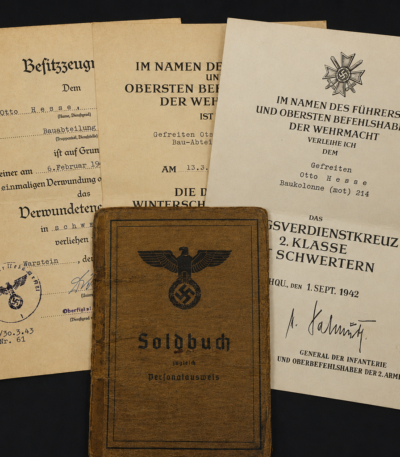
Soldbuch & Award Docs Grouping – Bau-Abteilung & 70. Infanterie-Division Walcheren / Scheldt
€495,00Rare and historically compelling original WWII German Wehrmacht Soldbuch and award document grouping belonging to Otto Hesse, later serving with Pionier-Kompanie 170 of the 70. Infanterie-Division, a unit heavily engaged during the desperate fighting in the Netherlands and the Scheldt estuary in 1944.
The grouping includes Hesse’s original wartime Soldbuch with portrait photograph, together with multiple award documents and extensive service entries documenting his wartime career from early construction and pioneer formations through late-war combat service.
Included in the grouping:
- Original Soldbuch with photo
- Award document for:
- Kriegsverdienstkreuz 2. Klasse mit Schwertern
- Medaille Winterschlacht im Osten 1941/42 (Ostmedaille)
- Verwundetenabzeichen in Schwarz
Documented Units Include:
- Baukompanie 214
- Baukolonne (mot.) 214
- Bauabteilung 214
- Reserve-Pionier-Bataillon 9
- Pionier-Kompanie 170 of the 70. Infanterie-Division
A particularly interesting aspect is the late-war service in the Netherlands during the fighting around Walcheren and the Scheldt estuary. The Soldbuch records a wound entry from late October 1944 with diagnosis code 31a, indicating a bullet wound (Schussverletzung), likely sustained during the fierce combat operations against Allied forces in the Netherlands.
An outstanding and highly researchable late-war Wehrmacht grouping with strong Eastern Front and Western Front historical connections.
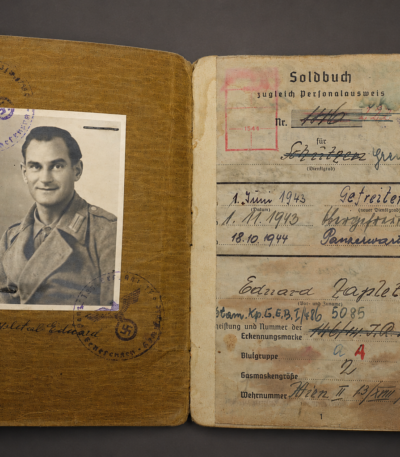
WH Soldbuch to Heeres-Panzerjäger-Abteilung 616 (Jagdpanther Unit) – Ostpreußen 1945
€375,00Original and extensively filled Wehrmacht Soldbuch grouping belonging to Austrian soldier Eduard Zapletal, born 5 October 1913 in Vienna, who ultimately served with the renowned 3. Kompanie/ Heeres-Panzerjäger-Abteilung 616, a late-war heavy tank destroyer battalion equipped with Jagdpanther and Bergepanther vehicles. The 3. Kompanie (detached from the PzJgAbt 616) was the sole company fighting in January 1945 in Ostpreußen with the Jagdpanzer V!
A highly desirable and historically significant late-war Panzerjäger Soldbuch featuring:
- Original portrait photograph in Stug uniform
- Extensive wartime entries, stamps and unit transfers
- Promotion entries up to Panzerwart II
- Multiple interesting weapon issue entries
- Several hospital and recovery entries
- Included Austrian postwar discharge/demobilization document
Documented units include:
- Infanterie-Regiment 462
- Infanterie-Panzerjäger-Ausbildungs-Kompanie 130
- Panzerjäger-Abteilung 46
- Panzerjäger-Kompanie 1192
- schwere Panzerjäger-Abteilung 616 (final combat unit)
The Soldbuch clearly reflects long wartime service from early infantry formations into specialized anti-tank and armored destroyer units during the final phase of the war.
Particularly notable is the final assignment to s.Pz.Jg.Abt. 616, one of the Wehrmacht’s heavy tank destroyer battalions equipped with the formidable Jagdpanther tank destroyer — widely regarded as one of the most effective armored fighting vehicles fielded by Germany during WWII.
The grouping remains in authentic wartime condition with strong field-used character, period wear, staining and extensive handwritten entries throughout. A superb researchable Panzerjäger Soldbuch with excellent display appeal and highly collectible late-war armored-unit associations.
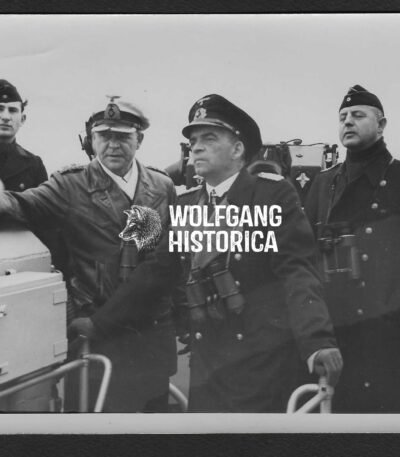
WWII German Kriegsmarine Press Photograph – Generaladmiral Otto Schniewind Inspecting Naval Personnel
€85,00Original German Second World War Kriegsmarine photograph depicting what appears to be Generaladmiral Otto Schniewind, one of the most senior naval commanders of the German Navy during the war.
The image shows Schniewind together with fellow Kriegsmarine officers and naval personnel during an inspection aboard a German naval vessel or coastal command position. Visible are several officers equipped with binoculars and communications gear, emphasizing the operational nature of the scene.
Otto Schniewind was among the most important senior officers of the Kriegsmarine and served as Chief of Staff of the Seekriegsleitung (Naval War Staff) before later becoming Fleet Commander (Flottenchef). Following the loss of Admiral Günther Lütjens during the sinking of the battleship Bismarck, Schniewind assumed a leading role within the operational command structure of the German Navy. He was promoted to Generaladmiral in March 1944 and was a recipient of the Knight’s Cross of the Iron Cross.
Photographs depicting senior Kriegsmarine commanders remain highly desirable among collectors of German naval militaria, particularly when showing operational inspections and command activity.
Condition
- Original wartime photograph.
- No press caption present on reverse.
- Minor age toning and handling wear consistent with age.
- Slight corner wear visible.
- Overall very good historical condition.
- Press Photo Size: 13x8cm
Sold on commission.
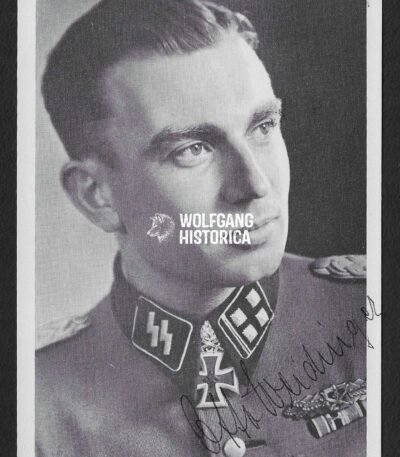
Otto Weidinger – 2. SS-Panzer-Division “Das Reich” (Schwertern)
€150,00Original Postwar Signature on a Card of Otto Weidinger. SS-Obersturmbannführer Otto Weidinger (27.05.1914 † 11.01.1990) earned the Ritterkreuz on April 21, 1944 as SS-Sturmbannführer und Kommandeur of the SS-Panzer-Aufklärungs-Abteilung “Das Reich”, the Eichenlaub on December 27, 1944 as SS-Obersturmbannführer und Kommandeur of the SS-Panzer-Grenadier-Regiment 4 “Der Führer” and Schwertern on May 6, 1945 as SS-Obersturmbannführer und Kommandeur of the SS-Panzer-Grenadier-Regiment 4 “Der Führer” of the 2. SS-Panzer-Division “Das Reich“. Postcardsize.
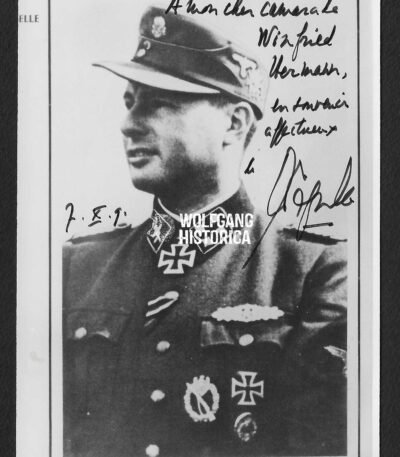
Leon Degrelle – 28. SS-Freiwilligen-Panzer-Grenadier-Division “Wallonië”
€250,00SS-Standartenführer Leon Degrelle (15 June 1906, Bouillon † 31 March 1994, Málaga) was the Belgian leader of the Rexist Movement and one of the most famous foreign volunteers to serve in the Waffen-SS during the Second World War. He rose from enlisted service to command the Walloon volunteers on the Eastern Front, eventually leading the 28. SS-Freiwilligen-Grenadier-Division “Wallonien.”
Degrelle distinguished himself in heavy fighting against Soviet forces, receiving some of the highest decorations awarded to non-German volunteers. He survived the war, escaping to Spain where he lived in exile until his death in 1994.
Awards and Decorations
-
Knight’s Cross of the Iron Cross (Ritterkreuz des Eisernen Kreuzes) – 20 February 1944, as SS-Hauptsturmführer and Führer of 5. SS-Freiwilligen-Sturmbrigade “Wallonien.”
-
Oak Leaves to the Knight’s Cross (Eichenlaub) – 27 August 1944, as SS-Sturmbannführer and Kommandeur of 28. SS-Freiwilligen-Grenadier-Division “Wallonien.”
-
Close Combat Clasp in Gold (Nahkampfspange in Gold) – 14 September 1944.
-
Additional decorations included the Iron Cross 1st and 2nd Class and Infantry Assault Badge.
Collector’s Note
Leon Degrelle remains one of the most controversial and well-known foreign volunteers of the Waffen-SS. His rise from volunteer soldier to divisional commander, along with his postwar exile and continued notoriety, makes his autograph especially rare and sought-after. This large-format signed photo is an exceptional piece for advanced collectors of Waffen-SS history, foreign volunteer units, and Knight’s Cross recipients.
Postcardsize. Sold on commission.
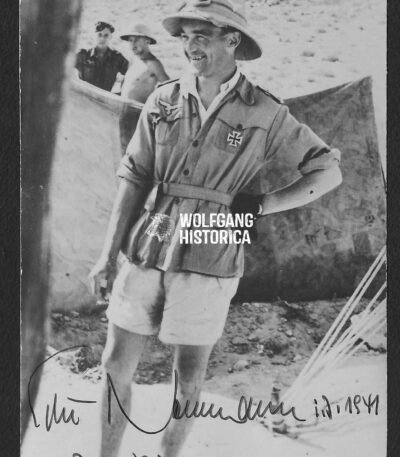
Eduard Neumann – Jagdgeschwader 27 “Afrika”
€35,00Original Postwar Signature on a Postwar Photo of Eduard Neumann. Oberst Eduard “Edu” Neumann (05.06.1911 † 09.08.2004) was a highly respected Luftwaffe fighter ace and commander of Jagdgeschwader 27 “Afrika” during the North African Campaign. He was awarded the Deutsches Kreuz in Gold on 11 May 1942 as Hauptmann and Gruppenkommandeur of I./Jagdgeschwader 27 in recognition of his outstanding leadership and combat achievements during the air war over North Africa. Under his command, I./JG 27 became one of the Luftwaffe’s most successful fighter groups, playing a key role in the desert campaign and producing renowned aces such as Hans-Joachim Marseille. Postcardsize.
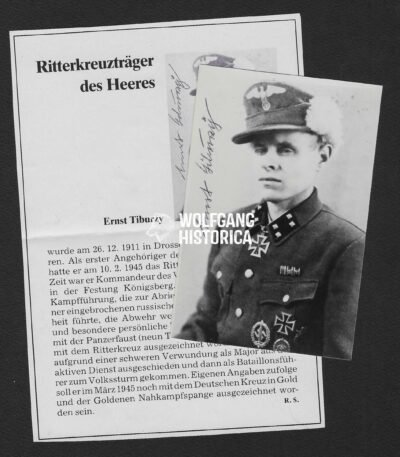
Ernst Tiburzy – Volkssturm-Bataillon 25/82, Festung Königsberg
€35,00Original Postwar Signature on a Postwar Photo of Ernst Tiburzy. Major Ernst Tiburzy (26.12.1911 † 15.01.2004) earned the Ritterkreuz des Eisernen Kreuzes on February 10, 1945 as Volkssturm-Bataillonsführer of Volkssturm-Bataillon 25/82 in the Festung Königsberg. During the heavy defensive fighting in East Prussia, Tiburzy reportedly distinguished himself through determined close-combat leadership and the destruction of several Soviet tanks with the Panzerfaust while organizing the defense against repeated Soviet breakthroughs. For these actions and his personal bravery during the final battles for Königsberg, he was awarded the Ritterkreuz des Eisernen Kreuzes. Size: 12,3×8,2cm.
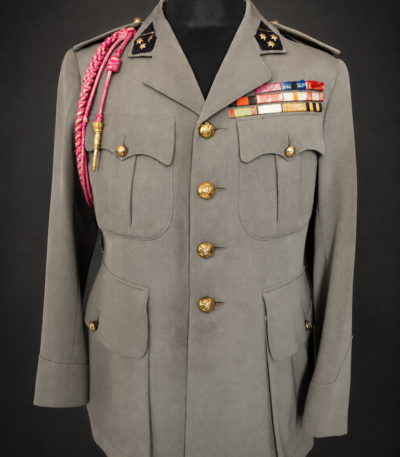
Named Belgian M35 Officer Uniform – Lt. Georges L.L. Saint-Maux – Administration Service
€550,00An exceptional and historically researchable Belgian M35 officer’s uniform set, consisting of the tunic and matching trousers (the trousers are unfortunately not pictured, as they could not be mounted together with the display). The uniform belonged to an officer of the Belgian Army Administration service and pairs perfectly with the administrative kepi previously acquired from the same grouping.
What makes this set especially desirable is the fact that it is fully name-attributed. The interior label bears the name “Lt. St. Maux”, allowing the original owner to be positively identified as Georges L.L. Saint-Maux of Aarlen (Arlon).
Further research revealed Saint-Maux in the well-known “Guldenboek der Vuurkaarten”, where both his full name and portrait photograph are published, giving this uniform a direct and personal historical connection to its wearer. In addition, he also appears on the website of the Fraternelle Chasseur Ardennais, where he is listed among the Chasseurs Ardennais in 1938. During the First World War, Saint-Maux served with the Belgian 10th Line Regiment.
The tunic remains a fine and attractive example of the Belgian M35 officer uniform, showing honest period wear and age. A highly interesting named Belgian officer grouping with documented provenance and excellent research potential.
A rare opportunity to acquire a fully identified Belgian officer uniform belonging to a documented prewar and wartime officer with confirmed military service history.
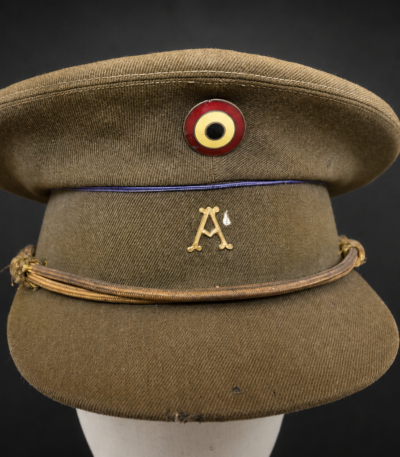
Belgian Pre-WWII / WWII Administration Officer Visor Cap – Named to Lt. Demanet
€100,00Original Belgian prewar / WWII officer visor cap of the Administration branch, named to Lt. Demanet. Khaki wool construction with original Belgian cockade, gilt “A” branch insignia and officer braided chin cord with Belgian buttons.
The cap shows clear period use and wear. Several moth holes are present to the exterior and the interior displays wear, damage and age-related deterioration, as visible in the photographs. Nevertheless, it remains an original untouched period example with strong display appeal.
A scarce and attractive Belgian officer headgear piece from the pre-1940 / WWII era.
Condition: used condition with moth damage, wear and tear, age staining and storage traces. Sold exactly as shown.
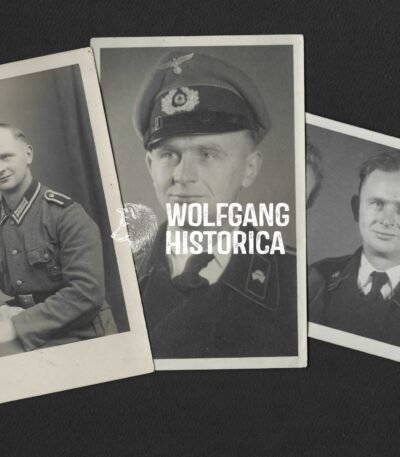
3x Studioportrait of a Panzertruppen soldier
€25,00Original 3x Studioportrait of a Panzertruppen soldier, wearing the Panzerkampfabzeichen (in Bronze). Postcardsize. Condition as seen.
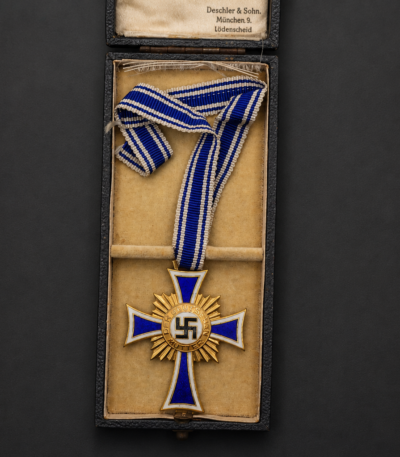
Mutterkreuz in Gold – Mother’s Cross in Gold – Wilhelm Deumer
€105,00Original Mutterkreuz in Gold (Ehrenkreuz der Deutschen Mutter / Mother’s Cross in Gold) complete with its original Wilhelm Deumer case (etui).
A very attractive near mint example with excellent enamel and finish preservation. The cross remains in outstanding condition overall and is accompanied by its original fitted case bearing the national eagle emblem to the lid.
The ribbon has been shortened for display or wear at some point in its history, but remains original to the piece.
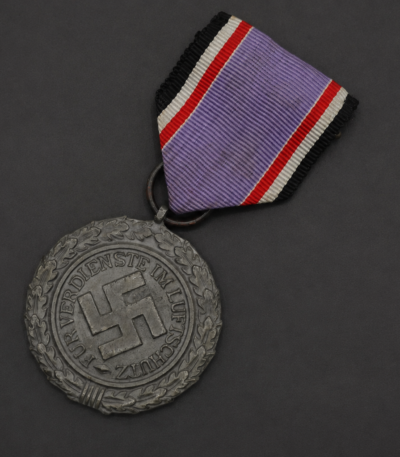
Luftschutz-Ehrenzeichen 2. Klasse – Aluminium Construction – Unmarked Example
€75,00Original Luftschutz-Ehrenzeichen 2. Klasse (Air Raid Protection Honor Decoration 2nd Class), unmarked aluminium example in honest wartime condition.
A lightweight wartime-produced piece showing natural age patina and wear consistent with period use. The medal remains a desirable award connected to Germany’s civilian air raid protection and homeland defense organizations during WWII.
Condition as seen.
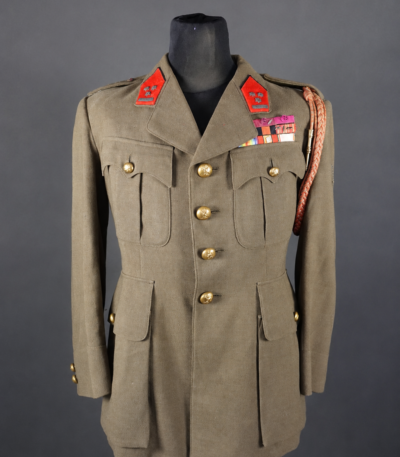
Belgian M1935 Officer’s Tunic – 12e Linieregiment (Infantry)
€450,00Interesting and research-worthy Belgian Model 1935 officer’s tunic, fitted with shoulder boards of the 12th Line Regiment (12e Linieregiment). The tunic displays a remarkable combination of pre-war, wartime, and post-war elements, illustrating the continued use and adaptation of Belgian military uniforms throughout and after the Second World War.
Most striking are the eight gold front stripes on the lower sleeve, indicating four years of frontline service during the First World War. Such a distinction would only have been awarded to a veteran with extensive active front service between 1914–1918.
Inside the tunic is a name label dated 1940, reading — as far as currently decipherable — “Schouveller.” Research in Belgian military annuaries reveals a likely candidate: Schouveller R.V.J., Infantryman, born 15 October 1901.
This immediately creates a historical inconsistency, as an individual born in 1901 could not realistically have accumulated four years of effective frontline service during the First World War, and therefore would not qualify for eight front stripes. Furthermore, Schouveller appears associated with the Chasseurs Ardennais (Ardense Jagers) in period records.
Several plausible explanations exist:
- The tunic may originally have belonged to Schouveller and later reused by an older First World War veteran during or after 1940.
- The uniform could have been privately acquired or reused following mobilization, demobilization, or captivity circumstances.
- The handwritten name may have been misread, requiring further archival comparison with similar surnames.
The tunic is decorated with numerous award ribbons connected to both World Wars, including:
- Leopold Order with Palm
- Fire Cross (Vuurkruis)
- War Cross with Palms
- Victory Medal
- Iron Medal with four stripes
- Belgian Centenary of National Independence Medal 1830–1930
The uniform is additionally fitted with the Fourragère / Vuurkoord, further enhancing its visual and historical appeal.
Rank insignia indicate Captain-Commandant, though these are clearly early post-war additions — entirely consistent with Belgian military practice, as pre-war uniforms were frequently reused and updated after 1945. The shoulder boards themselves also appear to be early post-war manufacture.
An especially interesting aspect is the historical connection between the 12th Line Regiment and the Chasseurs Ardennais, strengthening the possibility that the tunic reflects a transitional or reused service garment rather than a straightforward single-period issue.
Overall, this is a highly attractive and historically layered Belgian officer’s tunic with excellent research potential, illustrating the complex continuity between First World War veterans, the 1940 campaign, and post-war Belgian military service.
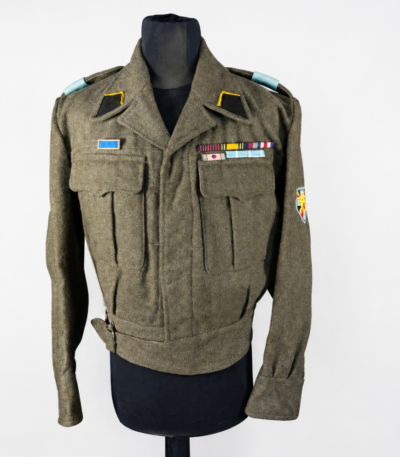
Belgian “Korea” (BUNC) Battledress
€395,00Original Belgian BUNC (Belgian United Nations Command) Korean War battledress blouse. This postwar Belgian Army example is fitted with period-applied Korean War insignia including the “BELGIUM” shoulder title, “KOREA” shoulder tab, lion-head divisional patch and blue-and-white formation insignia.
Interestingly, the 3rd Division patch is sewed on mirrored (lines should face the other way) but I found evidence in a documentary, where this also occured!
The battledress retains multiple ribbon bars (incl. WWII awards and Korea awards), US Unit Citation, and qualification insignia, giving the uniform a strong and attractive veteran appearance. Inside is the original maker/tailor label marked “Et. Maurice Delholle – BUNCOR”, dated 1949.
A very displayable and increasingly uncommon Belgian Korean War uniform with excellent historical character.
Condition is good overall with normal age and service wear. Insignia remain well preserved and the uniform displays very nicely. Exact condition as shown in the photographs.
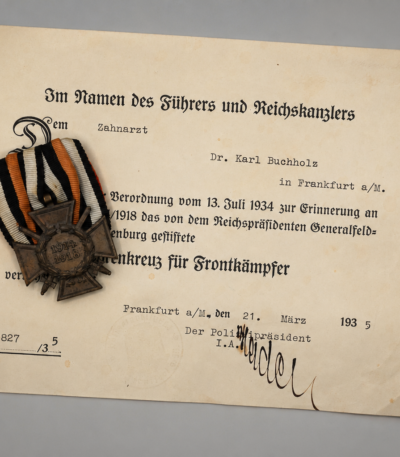
Hindenburg Cross with Award Document to a Dentist – Frankfurt am Main – Marked “R.V. Pforzheim 18”
€50,00Original Ehrenkreuz für Frontkämpfer 1914–1918 (Hindenburg Cross with Swords) complete with its matching award document issued to: Dr. Karl Buchholz, Dentist (Zahnarzt), Frankfurt am Main.
The document is dated: 21 March 1935
The cross remains mounted on its original ribbon and backing cloth. Reverse is maker marked: “R.V. PFORZHEIM 18”
A very attractive and honest untouched set with light age patina and excellent display appeal. The combination of named document and matching decoration makes this a desirable complete wartime-era award grouping.
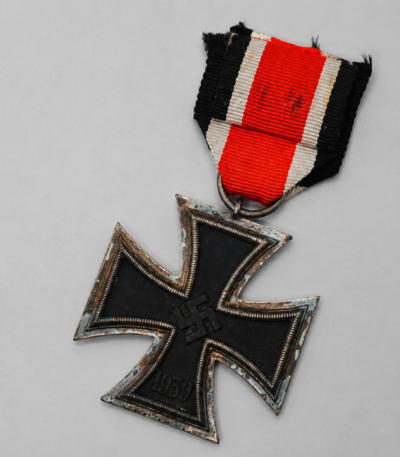
Eisernes Kreuz 2. Klasse (Unmarked)
€110,00Original Eisernes Kreuz 2. Klasse (Iron Cross 2nd Class), unmarked. Three piece construction with magnetic iron core. Interesting with the small ribbon bar attached to the medal’s ribbon. Condition as seen.
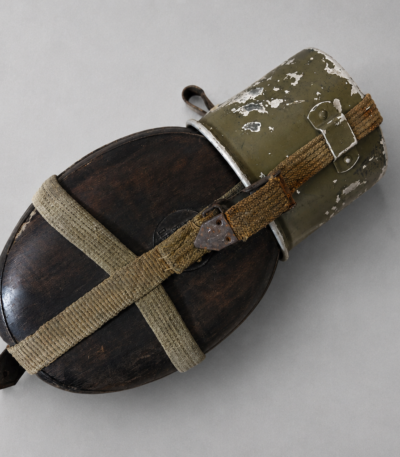
WWII German Coconut Canteen (Kokosnuss Feldflasche) with Cup & Carrier Straps
€150,00Original and attractive WWII German coconut canteen (Kokosnuss Feldflasche) complete with its carrying straps and accompanying metal drinking cup.
The canteen retains its distinctive dark coconut shell body with period webbing harness and black bakelite screw cap. The accompanying cup remains attached and shows characteristic wartime field use and paint wear. A very appealing example with strong display character.
Visible maker markings to the coconut body include:
DRGM HRE42 DRP
The canteen shows honest wartime wear and age throughout, including surface scratches, paint loss to the cup, oxidation to metal components, and field-used patina. The webbing remains present and displays nicely together with the canteen.
These coconut canteens are strongly associated with tropical and southern theatre service and are considerably less common than standard Wehrmacht M31 canteens, making them particularly desirable display pieces today.