


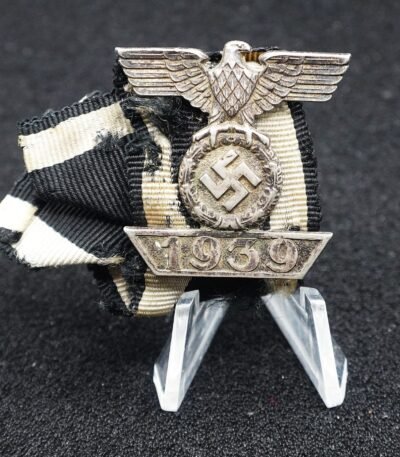
Wiederholungsspange 1939 – Clasp to the Iron Cross, 1939 – L/11 Deumer
€350,00An original-looking German Wiederholungsspange 1939 (Clasp to the Iron Cross, 1939), bearing the maker’s mark L/11, attributed to Wilhelm Deumer of Lüdenscheid.
The clasp features the characteristic German eagle with outstretched wings above the 1939 Iron Cross motif, with a separate 1939 date bar beneath. The reverse bears the L/11 maker’s mark. The clasp is accompanied by a black-and-white ribbon, folded and attached behind the decoration.
This award was intended for personnel who received the Iron Cross during the First World War and subsequently earned the corresponding Iron Cross again during the Second World War. The clasp was worn above the ribbon of the 1914 Iron Cross.
Historical Background
The 1939 Clasp to the Iron Cross 2nd Class was introduced following the reinstatement of the Iron Cross in September 1939. It was awarded to personnel who had received the Iron Cross 2nd Class in 1914 and subsequently qualified for the 1939 award. The clasp allowed the original First World War medal and its ribbon to be retained while recognising the later award.
The L/11 code identifies Wilhelm Deumer, a manufacturer based in Lüdenscheid. The clasp design and maker’s attribution are documented in specialist references.
Condition
The clasp shows heavy age-related wear, with substantial tarnishing, oxidation and discolouration to the metal. The ribbon is worn, frayed and damaged, with loose threads and areas of deterioration. The reverse displays corrosion and surface wear. The original-looking components are present in the photographs, but authenticity cannot be conclusively established from photographs alone.
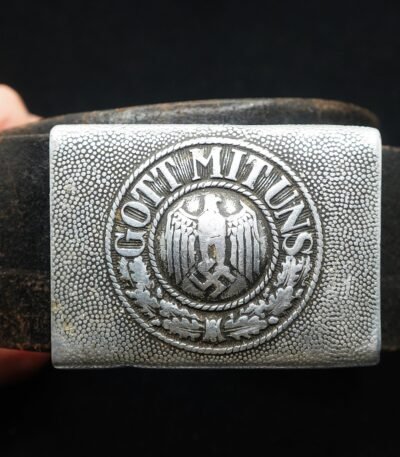
Wehrmacht Heer Belt & Buckle – Gott Mit Uns – Belt Size 86
€250,00An original German Wehrmacht Heer enlisted men’s/NCO’s belt and buckle from the Second World War period.
The rectangular aluminium buckle features the distinctive “GOTT MIT UNS” motto (“God with us”), surrounding the German Army eagle and swastika, framed by an oak-leaf wreath. The design is set against a finely pebbled background, a characteristic feature of the German Army’s dress-pattern belt buckles.
The buckle retains its original silver-coloured finish, with darker patination and wear highlighting the raised details. The reverse retains its fastening hardware.
The accompanying leather belt shows a stamped “86” marking, likely indicating its size. The leather has developed a dark brown appearance through age and wear, with considerable surface wear, cracking and deterioration to the finish. The original buckle and belt remain together as a complete display piece.
Condition: Used condition, with visible age-related wear to both components. The buckle retains good detail, while the leather belt shows substantial wear, surface cracking and finish loss. Please examine all photographs carefully.
An interesting original German Army belt set for collectors of Wehrmacht uniforms, equipment and Second World War militaria.
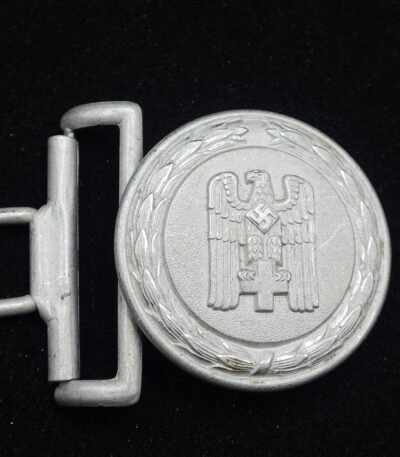
Deutsches Rotes Kreuz (DRK) – Field Belt Buckle – Aluminium – “Ges. Gesch. 2”
€250,00An original German Red Cross (Deutsches Rotes Kreuz – DRK) field belt buckle, dating from the Third Reich period. Manufactured from aluminium, this distinctive buckle features a central circular medallion bearing the German eagle with outstretched wings, a swastika on its breast and a cross held in its talons. The emblem is surrounded by a decorative laurel wreath, with a finely textured background that contrasts with the raised details of the design.
The reverse is stamped “GES. GESCH. 2”, indicating a legally protected design. This marking is associated with a known variant of the DRK field belt buckle. This circular design was intended for the field or dress belt (Feldbindenschloss). The multi-piece aluminium construction, central medallion and rear fastening assembly are characteristic features of this type.
The Deutsches Rotes Kreuz was reorganised under National Socialist rule during the 1930s, and its uniforms and insignia reflected the period’s increasingly militarised organisational structure. DRK personnel served in a range of medical, nursing and support roles. This buckle represents the organisation’s uniform equipment during the period immediately before and during the Second World War.
Condition: Good original condition, with visible age-related wear, light surface oxidation and minor marks consistent with use and storage. The eagle, cross, wreath and reverse marking remain clearly identifiable. The buckle retains its rear fastening components. Please refer to the photographs for a detailed assessment of the condition.
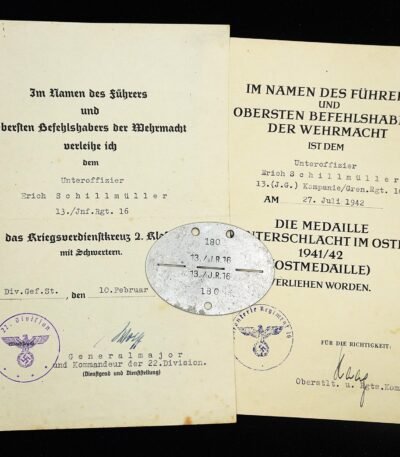
2x Award Docs & Erkennungsmarke – Unteroffizier – Infanterie-Regiment 16
€160,00An interesting three-piece Wehrmacht grouping belonging to Unteroffizier Erich Schillmüller, who served with the 13th Company of Infanterie-Regiment 16, later redesignated Grenadier-Regiment 16. The grouping comprises two original award documents and a matching-style German military identity disc bearing the same company and regimental designation.
The first document awards Schillmüller the War Merit Cross 2nd Class with Swords (Kriegsverdienstkreuz 2. Klasse mit Schwertern). Dated 10 February, the year is obscured by the identity disc in the photographs, but the document is signed by Generalmajor Ludwig Wolff, commander of the 22nd Infantry Division. Wolff commanded the division from October 1941 until August 1942, making February 1942 consistent with his tenure.
The second document confirms the award of the Eastern Front Medal (Medaille für die Winterschlacht im Osten 1941/42, commonly known as the Ostmedaille) on 27 July 1942. The document bears the signature attributed to Werner Haag, who served as Divisionsadjutant of the 22nd Infantry Division until 31 July 1942 and subsequently commanded Infanterie-Regiment 16 from 1 August 1942.
Completing the grouping is an oval German military identity disc (Erkennungsmarke), stamped “13./J.R.16” and numbered 180. The company and regimental designation corresponds to the unit recorded on the award documents, providing an appealing connection between the documents and the personal equipment of a soldier of the regiment.
Infanterie-Regiment 16 formed part of the 22nd Infantry Division, originally raised in Bremen in 1935. The regiment subsequently became Grenadier-Regiment 16 in 1942.
Condition: Both award documents show age-related toning, foxing, and staining. The War Merit Cross document has two punched holes along its left margin. The identity disc shows surface wear, scratches, and discolouration, with its stamped details remaining legible. Please consult the photographs for a complete assessment.
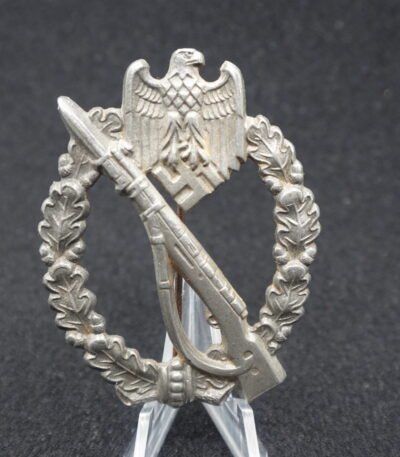
Infantry Assault Badge in Silver – Infanterie-Sturmabzeichen – GWL
€165,00An original-looking German Infantry Assault Badge in Silver (Infanterie-Sturmabzeichen in Silber) from the Second World War, manufactured by Gebrüder Wegerhoff of Lüdenscheid, identified by the distinctive GWL maker’s mark on the reverse.
The badge features the characteristic German eagle with outstretched wings, positioned above a Karabiner 98k rifle with fixed bayonet, enclosed within an oval oak-leaf wreath. The detailed relief and remaining silver-coloured finish make this a recognisable example of the German Army’s infantry combat decoration.
The reverse displays the clearly visible GWL mark within a circular cartouche. The badge has a single-piece zinc construction, with a vertical pin fastening assembly.
Historical Background
The Infantry Assault Badge was instituted on 20 December 1939 by Generaloberst Walther von Brauchitsch. The silver grade recognised qualifying combat participation by infantry and mountain infantry personnel during the Second World War.
The original award criteria included participation in at least three separate infantry assaults on different days. The decoration recognised frontline combat service and the demanding role of infantrymen in ground operations.
Gebrüder Wegerhoff (GWL) was a German manufacturer of military decorations based in Lüdenscheid, a major centre of German badge and insignia production. The maker’s mark on this example provides a specific manufacturer attribution.
Condition
The badge displays age-related wear and surface patina, with areas of discolouration and oxidation. The original silver-coloured finish is worn, although the main design details remain clearly visible. The reverse shows surface wear, and the steel pin exhibits noticeable rust and oxidation. The hinge and catch assembly appear present in the photographs. Please examine all photographs carefully, as they form an integral part of the condition description.
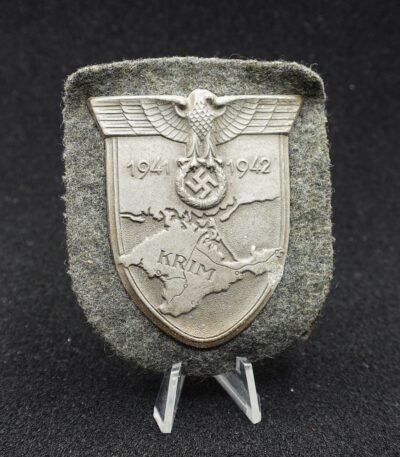
Crimea Shield (Krimschild), 1941–1942 – Zinc with Field-Grey Wool Backing
€180,00An example of the German Crimea Campaign Shield (Krimschild), instituted on 25 July 1942 to recognise participation in the Crimean campaign during the Second World War.
The shield features a German eagle with outstretched wings above the dates 1941–1942, with a map of the Crimean region and the inscription KRIM below. It is constructed from zinc, with a field-grey wool backing intended for attachment to the uniform sleeve.
The shield retains its distinctive design and raised details. The reverse is covered by a shaped paper backing, with the edges of the backing material showing age-related deterioration.
Historical Background
The Crimea Shield was awarded to eligible German and allied military personnel who participated in the campaign in Crimea between 21 September 1941 and 4 July 1942. The campaign included the fighting across the peninsula and the capture of Sevastopol. The shield was normally worn on the left upper sleeve of the uniform, sewn onto its cloth backing. Different backing colours were used for different branches of service.
Condition
The shield displays age-related wear and surface discolouration. The zinc face retains clearly visible relief details, although the original finish appears worn. The field-grey wool backing is present, while the reverse paper covering shows significant cracking, tears and losses around the edges. Please consult all photographs for the exact condition. Priced accordingly!
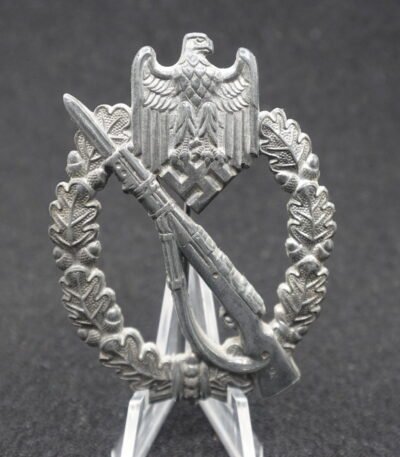
Infantry Assault Badge in Silver – Infanterie-Sturmabzeichen – Unmarked Josef Bergs & Co, Gablonz.
€120,00An interesting German Infantry Assault Badge in Silver (Infanterie-Sturmabzeichen in Silber) from the Second World War, representing one of the principal combat awards issued to German infantry personnel.
The badge features the characteristic German eagle holding a swastika, positioned above a diagonally placed rifle with a fixed bayonet, enclosed within an oval oak-leaf wreath. The detailed relief and silver-coloured finish give the decoration its distinctive appearance. Unmarked but attributed to Josef Bergs & Co, Gablonz.
This example is unmarked, with its construction attributed provisionally to the Gablonz manufacturing area. No specific manufacturer can be confirmed from the available photographs, so the attribution should be treated with caution.
Historical Background
The Infantry Assault Badge was instituted on 20 December 1939 by Generaloberst Walther von Brauchitsch. It recognised qualifying combat participation by infantry personnel during the Second World War.
The silver grade was awarded to eligible infantrymen who participated in qualifying assault actions, with the original criteria including participation in at least three separate infantry assaults on different days. The award reflected the demanding frontline service of infantry soldiers during the conflict.
Condition
The badge displays age-related wear and surface patina, with areas of discolouration and minor oxidation. The silver-coloured finish remains visible across much of the front, and the main design details are clearly distinguishable. The reverse exhibits surface wear and some corrosion, particularly around the fastening components. The hinge, pin and catch appear to be present in the photographs.
Please examine the photographs carefully for a detailed assessment of the item’s condition.
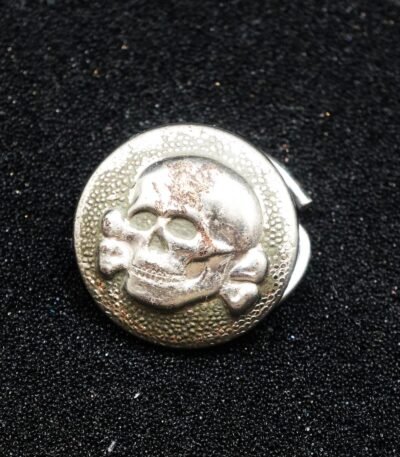
SS-VT Totenkopf Side Cap Button – Martin Winter, München – RZM M5/69
€475,00An early German SS-Verfügungstruppe (SS-VT) side-cap Totenkopf button, manufactured by Martin Winter of München, bearing the RZM manufacturer code M5/69.
The button features a finely detailed, raised skull and crossed bones against a distinctive stippled background, surrounded by a raised circular rim. The silver-coloured finish highlights the skull’s sculpted features, making this an attractive example of early SS-VT uniform insignia.
The reverse features the original central attachment loop and stamped markings. The RZM code M5/69 is associated with M. Winter, München, as documented in specialist collector references.
Condition: Shows age-related wear, surface oxidation and discolouration consistent with its apparent age. The skull retains good detail, and the reverse attachment loop is present. Please examine the photographs carefully for the item’s exact condition.
An interesting piece of early SS-VT uniform insignia, suitable for a specialist collection of German military headgear and insignia from the pre-war period.
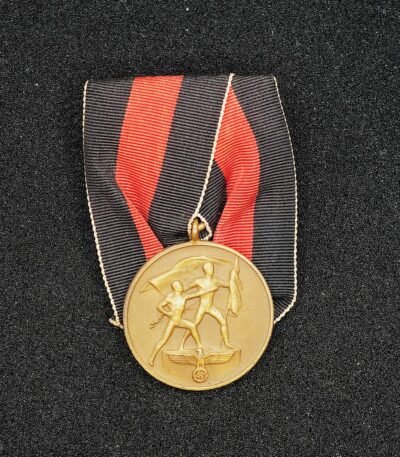
German Anschluss Medal – 13 March 1938 – Mounted for Wear
€75,00An original German Anschluss Commemorative Medal (Medaille zur Erinnerung an den 13. März 1938), instituted on 1 May 1938 to commemorate the annexation of Austria by Nazi Germany.
The medal features two male figures representing the union of Austria with the German Reich. Beneath them is the German national eagle with swastika. The reverse bears the inscription “13. März 1938”, surrounded by the motto “Ein Volk, Ein Reich, Ein Führer” (“One People, One Reich, One Leader”).
The medal retains its distinctive red ribbon with a central white-black-white stripe. It is mounted for wear with a metal pin-back fitting, allowing it to be attached to a uniform. The ribbon’s original colours remain attractive, and the medal displays an aged golden-silver tone.
The Anschluss Medal was one of the German commemorative decorations associated with the territorial expansion of the Third Reich before the Second World War. Approximately 318,689 examples were awarded.
Condition: Shows age-related wear and surface discolouration. The ribbon remains attached, with some visible handling wear and loose threads. The reverse retains its metal mounting and pin assembly. Please examine the photographs for a detailed assessment.
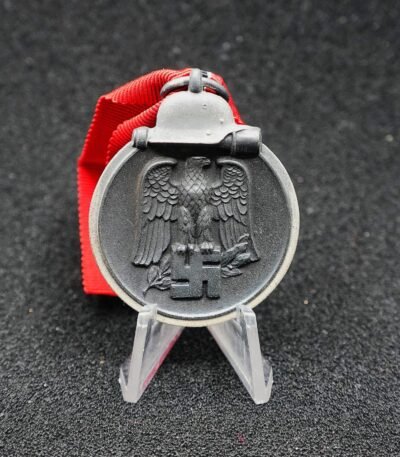
German Ostmedaille – Winter War Medal – Unmarked
€65,00An original German Eastern Front Medal (Ostmedaille), instituted on 26 May 1942 to commemorate participation in the winter campaign on the Eastern Front during 1941–1942.
The obverse features the German national eagle clutching a swastika above a steel helmet and stick grenade, surrounded by a circular raised rim. The reverse bears the inscription “WINTERSCHLACHT IM OSTEN 1941/42”, above a crossed sword and laurel branch.
This example is unmarked on the suspension ring and retains its red ribbon with the characteristic central black stripe bordered by narrow white stripes.
The medal displays a dark grey finish contrasting with the lighter-coloured rim and suspension. Both sides retain clear, well-defined details.
Item Details
- Award: Medaille Winterschlacht im Osten 1941/42 (Ostmedaille)
- Period: Second World War
- Country: Germany
- Manufacturer: Unmarked; maker cannot be identified from the available photographs
- Material: Zinc alloy
- Ribbon: Red with central black stripe bordered by white
- Suspension: Original-style integrated helmet and ribbon loop
Condition
Good used condition, showing age-related wear, surface oxidation and some variation in the finish. The raised details and reverse inscription remain clearly visible. The medal retains its ribbon. Please examine the photographs carefully, as they form part of the description.
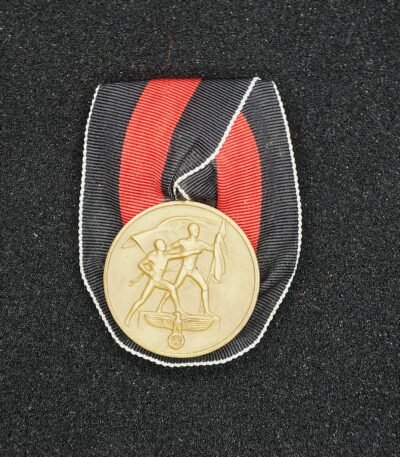
German Anschluss Medal – 13 March 1938 – Mounted for Wear
€75,00An original German Anschluss Commemorative Medal (Medaille zur Erinnerung an den 13. März 1938), instituted on 1 May 1938 to commemorate the annexation of Austria by Nazi Germany.
The medal features two male figures representing the union of Austria with the German Reich. Beneath them is the German national eagle with swastika. The reverse bears the inscription “13. März 1938”, surrounded by the motto “Ein Volk, Ein Reich, Ein Führer” (“One People, One Reich, One Leader”).
The medal retains its distinctive red ribbon with a central white-black-white stripe. It is mounted for wear with a cloth pin-back fitting, allowing it to be attached to a uniform. The ribbon’s original colours remain attractive, and the medal displays an aged golden-silver tone.
The Anschluss Medal was one of the German commemorative decorations associated with the territorial expansion of the Third Reich before the Second World War. Approximately 318,689 examples were awarded.
Condition: Shows age-related wear and surface discolouration. The ribbon remains attached, with some visible handling wear and loose threads. The reverse retains its metal mounting and pin assembly. Please examine the photographs for a detailed assessment.
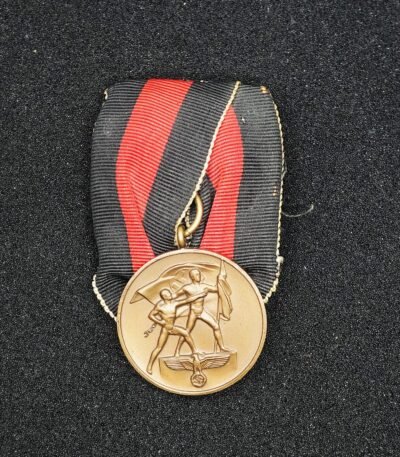
German Anschluss Medal – 13 March 1938 – Mounted for Wear
€75,00An original German Anschluss Commemorative Medal (Medaille zur Erinnerung an den 13. März 1938), instituted on 1 May 1938 to commemorate the annexation of Austria by Nazi Germany.
The medal features two male figures representing the union of Austria with the German Reich. Beneath them is the German national eagle with swastika. The reverse bears the inscription “13. März 1938”, surrounded by the motto “Ein Volk, Ein Reich, Ein Führer” (“One People, One Reich, One Leader”).
The medal retains its distinctive red ribbon with a central white-black-white stripe. It is mounted for wear with a cloth pin-back fitting, allowing it to be attached to a uniform. The ribbon’s original colours remain attractive, and the medal displays an aged golden-silver tone.
The Anschluss Medal was one of the German commemorative decorations associated with the territorial expansion of the Third Reich before the Second World War. Approximately 318,689 examples were awarded.
Condition: Shows age-related wear and surface discolouration. The ribbon remains attached, with some visible handling wear and loose threads. The reverse retains its metal mounting and pin assembly. Please examine the photographs for a detailed assessment.
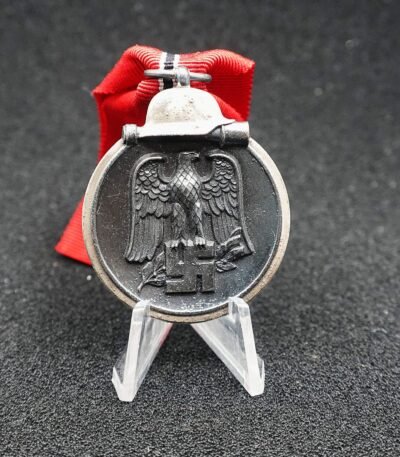
Ostmedaille – Maker Marked 93 – Richard Simm & Söhne, Gablonz – NM
€75,00An original German Eastern Front Medal (Medaille Winterschlacht im Osten 1941/42), commonly known as the Ostmedaille, awarded for service during the winter campaign on the Eastern Front in 1941–1942.
The medal features the German national eagle holding a swastika above a helmet and stick grenade on the obverse. The reverse bears the inscription “WINTERSCHLACHT IM OSTEN 1941/42”, with a crossed sword and branch beneath.
The suspension ring is stamped “93”, identifying the manufacturer as Richard Simm & Söhne, Gablonz. This maker’s code is documented in specialist militaria catalogues and dealer references.
The medal retains its red ribbon with the distinctive central black stripe bordered by white stripes. The dark finish contrasts with the lighter-coloured raised rim and suspension assembly.
Condition: Shows age-related wear and surface oxidation, with some loss of the original finish. The raised details remain clearly visible. The suspension ring and ribbon are present. Please examine the photographs carefully for the item’s precise condition. Near Mint.
An attractive maker-marked example of the Ostmedaille by Richard Simm & Söhne, suitable for a collection of German Second World War medals and decorations.
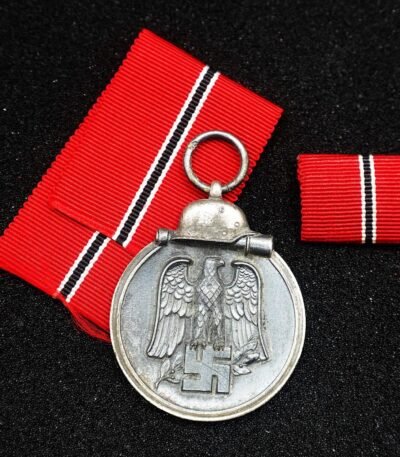
Ostmedaille – Maker Marked 65 (Klein & Quenzer) + Ribbon & Ribbon Bar
€80,00An original German Eastern Front Medal (Medaille für die Winterschlacht im Osten 1941/42), commonly known as the Ostmedaille, awarded for service on the Eastern Front during the winter campaign of 1941–1942. The medal features the German eagle holding a swastika above crossed branches on the obverse. The reverse bears the inscription “WINTERSCHLACHT IM OSTEN 1941/42”, with a crossed sword and branch beneath.
The medal is maker-marked “65” on the suspension ring, identifying the manufacturer as Klein & Quenzer AG, Idar-Oberstein, a recognised producer of German military decorations during the Second World War.
The medal retains its red ribbon with the distinctive central black stripe bordered by white stripes. Included is a matching ribbon bar featuring the same ribbon colours, making this an attractive set for collectors of German WWII medals and decorations.
Condition: The medal shows visible age-related wear, with loss of the original finish, surface oxidation and small areas of discolouration. The suspension ring remains present, and the medal retains its ribbon. The matching ribbon bar is also included. Please examine the photographs carefully for the item’s precise condition.
An appealing maker-marked Ostmedaille by Klein & Quenzer, complete with its ribbon and matching ribbon bar.
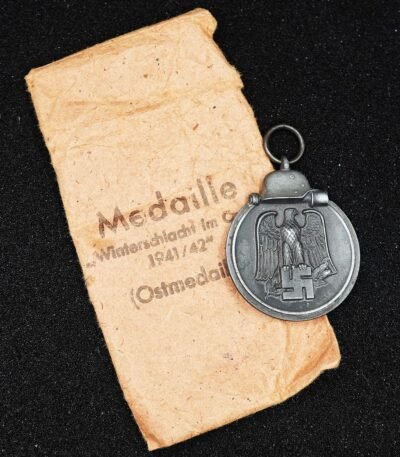
German Ostmedaille – Unmarked + Pouch
€55,00An original German Eastern Front Medal (Ostmedaille), instituted on 26 May 1942 to commemorate participation in the winter campaign on the Eastern Front during 1941–1942. This example comes with its associated paper issue pouch, adding historical interest to the piece.
The medal features the German national eagle clutching a swastika above a steel helmet and stick grenade. The reverse bears the inscription “WINTERSCHLACHT IM OSTEN 1941/42”, above a crossed sword and laurel branch.
The medal is unmarked on the suspension ring. The accompanying paper pouch is printed with the designation “Medaille Winterschlacht im Osten 1941/42 (Ostmedaille)”. A faint additional stamp is visible on the opposite side, although the wording is difficult to establish from the photographs.
The medal displays age-related wear, surface oxidation and variations in its dark finish. The raised details remain well defined, and the reverse inscription is clearly legible. The paper pouch shows considerable age-related deterioration, including heavy creasing, staining, worn edges and areas of damage. The printed designation remains readable. Please study the photographs carefully, particularly the condition of the original paper pouch.
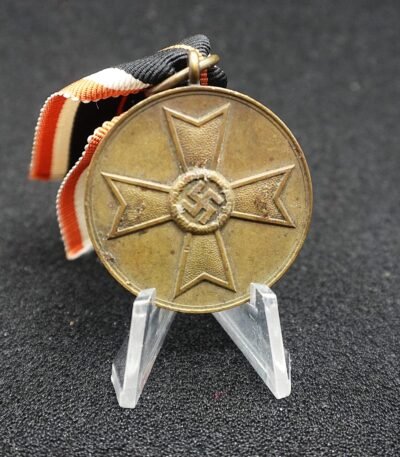
War Merit Medal 1939 – Kriegsverdienstmedaille
€30,00An original German War Merit Medal 1939 (Kriegsverdienstmedaille), instituted on 19 August 1940 to recognise contributions to the German war effort that did not warrant a higher award in the War Merit Cross series.
The obverse features a textured cross with a central circular medallion bearing a swastika, surrounded by a raised border. The reverse displays the Gothic inscription “Für Kriegsverdienst 1939” (“For War Merit 1939”).
The medal retains its suspension ring and its distinctive black ribbon with a narrow red central stripe and red-and-white edging.
Historical Background
The War Merit Medal was the lowest award in the War Merit Cross series. It recognised contributions to the wartime effort, particularly in civilian and industrial contexts, although it could also be awarded to military personnel. Recipients included workers in armaments production and individuals involved in wartime support services. The medal was awarded in large numbers during the Second World War.
Condition
The medal displays an attractive aged bronze-coloured patina, with visible surface wear and minor discolouration. The raised details and inscription remain clearly defined. The ribbon is present and shows signs of age and handling. Please examine the photographs carefully for the precise condition.
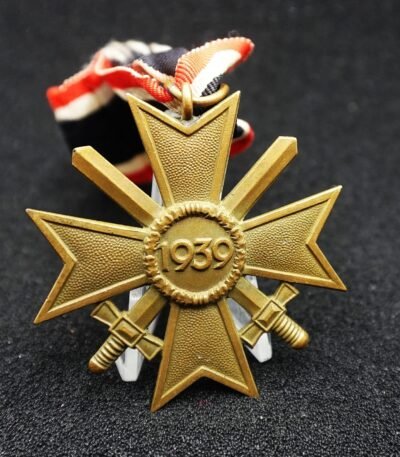
War Merit Cross 2nd Class with Swords – 1939 – Kriegsverdienstkreuz 2. Klasse mit Schwertern
€45,00An original German Kriegsverdienstkreuz 1939, 2. Klasse mit Schwertern (War Merit Cross 2nd Class with Swords), instituted on 18 October 1939.
The cross features a textured, gilt-bronze-coloured finish, with a central circular medallion bearing the date “1939” on the obverse. Crossed swords appear behind the arms of the cross, symbolising its military distinction.
The reverse features a central swastika within a circular border. The decoration retains its red, white and black ribbon, characteristic of the War Merit Cross awards.
Historical Background
The War Merit Cross was introduced to recognise contributions to the German war effort that did not necessarily meet the criteria for the Iron Cross. The version with swords recognised military merit associated with wartime service, while the version without swords was generally awarded for civilian or non-combat contributions.
Condition
The cross displays age-related wear and patina, with some discolouration and loss or variation of the finish. The raised details remain clearly visible. The ribbon is present and shows signs of age and handling. Please examine the photographs carefully for the precise condition.
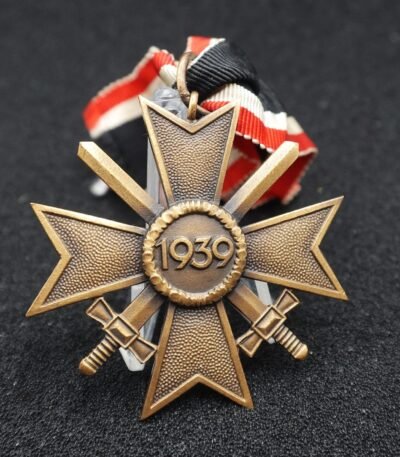
War Merit Cross 2nd Class with Swords – 1939 – Kriegsverdienstkreuz 2. Klasse mit Schwertern
€45,00An original German Kriegsverdienstkreuz 1939, 2. Klasse mit Schwertern (War Merit Cross 2nd Class with Swords), instituted on 18 October 1939.
The cross features a textured, gilt-bronze-coloured finish, with a central circular medallion bearing the date “1939” on the obverse. Crossed swords appear behind the arms of the cross, symbolising its military distinction.
The reverse features a central swastika within a circular border. The decoration retains its red, white and black ribbon, characteristic of the War Merit Cross awards.
Historical Background
The War Merit Cross was introduced to recognise contributions to the German war effort that did not necessarily meet the criteria for the Iron Cross. The version with swords recognised military merit associated with wartime service, while the version without swords was generally awarded for civilian or non-combat contributions.
Condition
The cross displays age-related wear and patina, with some discolouration and loss or variation of the finish. The raised details remain clearly visible. The ribbon is present and shows signs of age and handling. Please examine the photographs carefully for the precise condition.
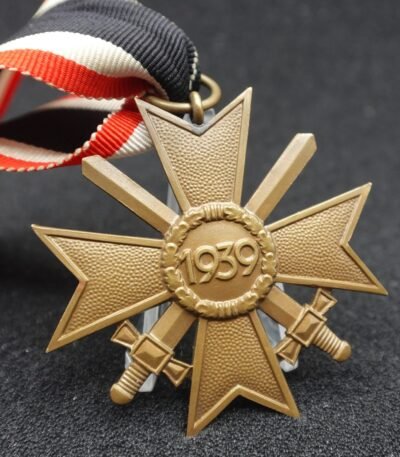
War Merit Cross 2nd Class with Swords – 1939 – Kriegsverdienstkreuz 2. Klasse mit Schwertern
€45,00An original German Kriegsverdienstkreuz 1939, 2. Klasse mit Schwertern (War Merit Cross 2nd Class with Swords), instituted on 18 October 1939.
The cross features a textured, gilt-bronze-coloured finish, with a central circular medallion bearing the date “1939” on the obverse. Crossed swords appear behind the arms of the cross, symbolising its military distinction.
The reverse features a central swastika within a circular border. The decoration retains its red, white and black ribbon, characteristic of the War Merit Cross awards.
Historical Background
The War Merit Cross was introduced to recognise contributions to the German war effort that did not necessarily meet the criteria for the Iron Cross. The version with swords recognised military merit associated with wartime service, while the version without swords was generally awarded for civilian or non-combat contributions.
Condition
The cross displays age-related wear and patina, with some discolouration and loss or variation of the finish. The raised details remain clearly visible. The ribbon is present and shows signs of age and handling. Please examine the photographs carefully for the precise condition.
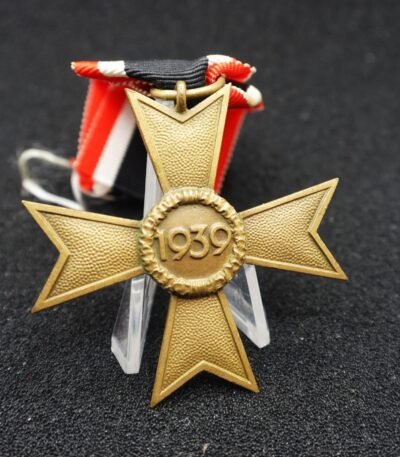
War Merit Cross 2nd Class – 1939 – Kriegsverdienstkreuz 2. Klasse
€30,00An original German War Merit Cross 2nd Class without Swords (Kriegsverdienstkreuz 1939, 2. Klasse ohne Schwerter), instituted on 18 October 1939.
The cross features the characteristic textured arms with raised borders and a central circular medallion bearing a swastika within a decorative wreath. The reverse displays the date “1939” in raised numerals.
Unlike the combat-related version, this example has no crossed swords between the arms of the cross. It retains its suspension ring and black, white and red ribbon.
Historical Background
The War Merit Cross recognised contributions to the German war effort that did not necessarily qualify for the Iron Cross. The version without swords was principally associated with civilian merit and non-combat contributions, including work in industry, administration and wartime support services. The decoration was awarded to both civilians and military personnel for qualifying non-combat service.
Condition
The cross displays an aged bronze-coloured finish with natural patina, minor surface wear and some discolouration. The raised details and date remain clearly defined. The suspension ring and ribbon are present. Please examine the photographs carefully for the precise condition.
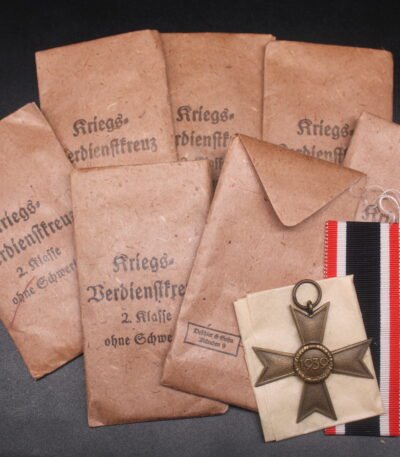
Kriegsverdienstkreuz 2. Klasse ohne Schwertern (Deschler & Sohn)
€45,00Original Kriegsverdienstkreuz 2. Klasse ohne Schwertern from Deschler & Sohn, maker marked “1” with cellophane and pouch! Mint. Condition as seen.
Price per Piece!
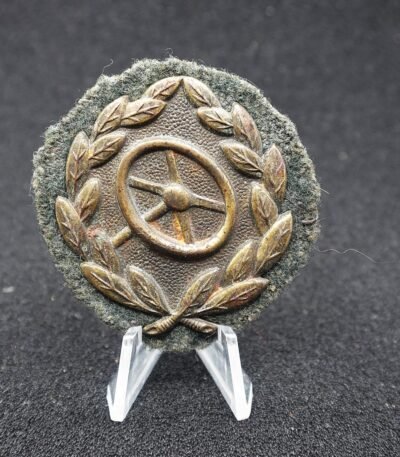
Driver’s Proficiency Badge in Bronze – Kraftfahrbewährungsabzeichen in Bronze
€65,00An original-looking example of the German Driver’s Proficiency Badge in Bronze (Kraftfahrbewährungsabzeichen in Bronze), introduced during the Second World War to recognise qualifying driving service under wartime conditions.
The badge features a central steering wheel surrounded by a laurel wreath, with finely textured detailing to the background. The bronze-coloured finish remains visible across the design, showing attractive age-related patina and areas of discolouration.
The badge is mounted on its original-looking grey-green wool backing, which gives the piece additional character. The reverse features a circular metal backing plate with the remains of the fastening assembly.
Historical Background
The Driver’s Proficiency Badge was instituted on 23 October 1942 to recognise qualifying driving service under wartime conditions. It was awarded in bronze, silver and gold grades, with the award criteria relating to driving service and operational circumstances.
Military drivers played an essential role in transporting troops, ammunition, equipment and supplies. This decoration represents the contribution of motor transport personnel to German military operations during the Second World War.
Condition
The badge displays heavy age-related wear, with extensive oxidation and corrosion to the reverse. Much of the original finish on the rear plate has deteriorated, and the fastening assembly appears damaged or incomplete. The front retains visible detail, with wear and patina consistent with its aged appearance. The grey-green wool backing is heavily worn, with loose fibres and fraying around the edges. Please examine the photographs carefully, as they form an integral part of the condition description.
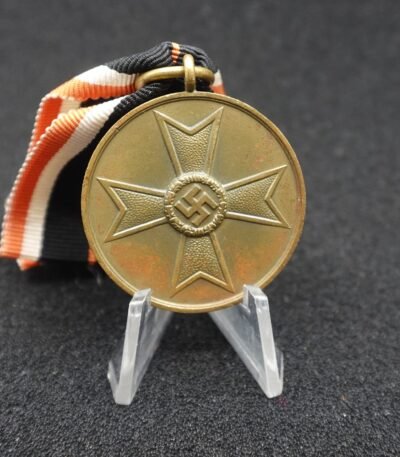
War Merit Medal 1939 – Kriegsverdienstmedaille
€30,00An original German War Merit Medal 1939 (Kriegsverdienstmedaille), instituted on 19 August 1940 to recognise contributions to the German war effort that did not warrant a higher award in the War Merit Cross series.
The obverse features a textured cross with a central circular medallion bearing a swastika, surrounded by a raised border. The reverse displays the Gothic inscription “Für Kriegsverdienst 1939” (“For War Merit 1939”).
The medal retains its suspension ring and its distinctive black ribbon with a narrow red central stripe and red-and-white edging.
Historical Background
The War Merit Medal was the lowest award in the War Merit Cross series. It recognised contributions to the wartime effort, particularly in civilian and industrial contexts, although it could also be awarded to military personnel. Recipients included workers in armaments production and individuals involved in wartime support services. The medal was awarded in large numbers during the Second World War.
Condition
The medal displays an attractive aged bronze-coloured patina, with visible surface wear and minor discolouration. The raised details and inscription remain clearly defined. The ribbon is present and shows signs of age and handling. Please examine the photographs carefully for the precise condition.
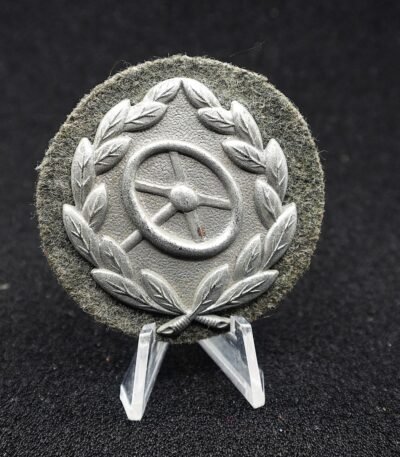
Driver’s Proficiency Badge in Silver – Kraftfahrbewährungsabzeichen in Silber
€85,00An interesting German Driver’s Proficiency Badge in Silver (Kraftfahrbewährungsabzeichen in Silber), awarded during the Second World War to recognise qualifying driving service under wartime conditions.
Instituted on 23 October 1942, the badge was awarded in three grades: bronze, silver and gold. It was associated with military drivers whose duties involved operating vehicles under the demanding conditions of wartime service.
This example features the characteristic steering-wheel design surrounded by a wreath, representing the importance of motor transport to German military operations. The badge is mounted on a grey-green wool backing.
Historical Background
The Driver’s Proficiency Badge was introduced on 23 October 1942 to recognise qualifying service by drivers operating in wartime conditions. It was awarded in bronze, silver and gold grades, with the criteria relating to driving service and operational circumstances. The badge reflects the importance of transport personnel in moving troops, equipment and supplies throughout the various theatres of war.
Condition
The badge displays considerable age-related wear, with extensive oxidation and corrosion visible on the reverse. The original finish shows significant deterioration. The grey-green wool backing is heavily aged, with loose fibres and visible wear. Please examine the photographs carefully for a detailed assessment of the condition.
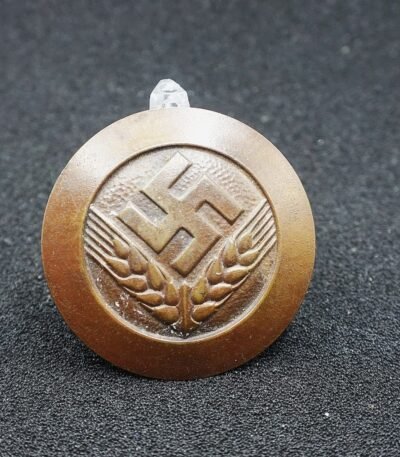
RADwJ Jungführerin Rank Brooch – Bronze
€75,00An example of a Jungführerin rank brooch of the Reichsarbeitsdienst der weiblichen Jugend (RADwJ), the Reich Labour Service for Female Youth, dating from the Second World War.
The obverse features the characteristic mobile swastika, flanked by two wheat sheaves, within a circular central design. The brooch has a smooth, bronze-coloured outer rim, consistent with the insignia worn by a Jungführerin under the RADwJ rank system introduced in October 1939.
The reverse is fitted with a horizontal pin fastening. No maker’s mark is.
Historical Background
The RADwJ was the female branch of the German Reich Labour Service. Its members undertook agricultural, domestic and social support work, while the organisation also served the ideological objectives of the Nazi state. Its rank brooches distinguished leadership levels through their metal colour and rim design. The smooth bronze-coloured rim is consistent with the Jungführerin rank.
Condition
The brooch shows noticeable age-related wear, with surface tarnishing, oxidation and areas of discolouration. The central design remains clearly visible. The reverse pin assembly appears present, with visible wear and oxidation. Please examine the photographs carefully for the full condition.
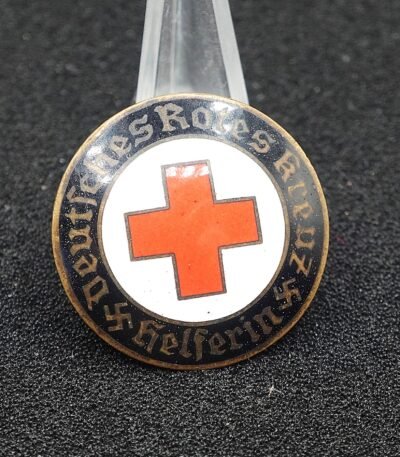
German DRK Helferin Badge – Enamel Membership Badge
€45,00An original German Deutsches Rotes Kreuz (DRK) Helferin badge from the Second World War period, intended for female helpers serving within the German Red Cross organisation.
The circular badge features a central red cross on a white enamel field, surrounded by a black enamel border bearing the Gothic inscription “Deutsches Rotes Kreuz Helferin” (German Red Cross Helper).
The badge is manufactured in a copper-alloy construction with multicoloured enamel detailing. The reverse bears the marking “GES. GESCH.”, an abbreviation of Gesetzlich Geschützt, meaning “legally protected.” No specific manufacturer is identifiable from the visible marking.
The original horizontal pin assembly remains attached to the reverse.
Historical Background
During the Second World War, female DRK helpers contributed to medical assistance, hospital services, patient transport and civilian relief. These badges served as identifying insignia associated with their service within the organisation.
Condition
The badge displays attractive age-related patina and surface discolouration to the reverse. The front retains its distinctive red, white and black enamel colours, with visible wear and fine age-related surface imperfections, particularly to the white field and dark outer border. The pin assembly is present.
Please examine the photographs carefully for the exact condition.
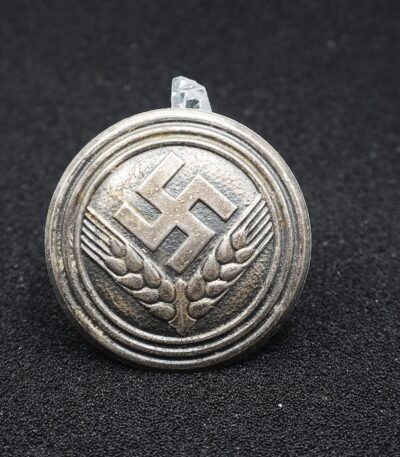
RADwJ Maidenoberführerin Rank Brooch – Silver
€95,00An original-style German WWII Reich Labour Service for Female Youth (RADwJ) Maidenoberführerin rank brooch, featuring the characteristic central swastika above a pair of wheat sheaves, surrounded by a circular, multi-ridged border.
The brooch has a silver-coloured finish, consistent with rank insignia used by the female branch of the Reich Labour Service. The reverse features a horizontal pin fastening. The piece displays visible age-related wear and surface discolouration.
A desirable item for collectors of German WWII insignia, RADwJ rank badges and female service uniforms.
Historical Background
The RADwJ was the female branch of the German Reich Labour Service. Its members undertook agricultural, domestic and other forms of labour service within an organisation shaped by National Socialist ideology.
A revised system of rank insignia was introduced in October 1939, with differences in the brooch border helping to distinguish ranks.
Condition
The brooch shows noticeable age-related wear, including tarnishing, surface discolouration and minor marks. The central design remains clearly visible. The reverse pin is present; its complete functionality should be checked before sale.
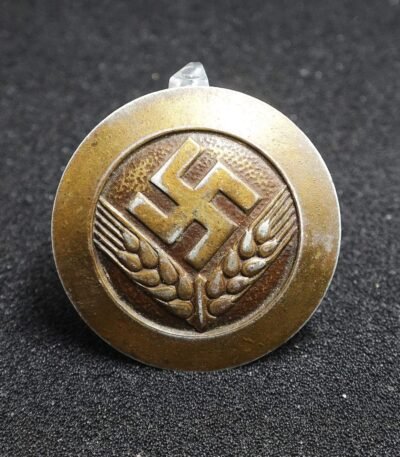
RADwJ Stabsführerin Rank Brooch – Gold-Coloured
€125,00An interesting German WWII Reich Labour Service for Female Youth (RADwJ) Stabsführerin rank brooch, featuring the characteristic mobile swastika above a pair of wheat sheaves, enclosed within a circular border.
The brooch displays a gold-coloured finish with a smooth outer rim, consistent with the Stabsführerin rank insignia. The reverse is fitted with a horizontal pin fastening.
The piece retains its original character, with visible age-related patina and surface wear. The reverse shows the pin assembly, while no maker’s mark is clearly visible in the supplied photographs.
A distinctive item for collectors of Third Reich insignia, RADwJ badges and German WWII female service uniforms.
Historical Background
The RADwJ was the female branch of the German Reich Labour Service. Its members undertook agricultural, domestic and other labour duties within an organisation shaped by National Socialist ideology.
The organisation used distinctive rank insignia to identify leadership positions. This Stabsführerin brooch represents one of the leadership ranks within the female labour service hierarchy.
Condition
The brooch displays visible age-related wear and patina, including surface discolouration and areas of finish variation. The central design remains clearly visible. The pin assembly is present; its functionality should be checked before sale.
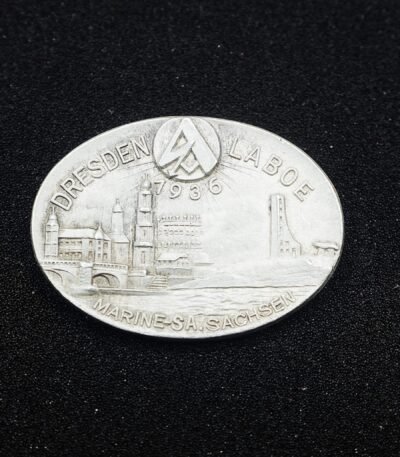
1936 Marine-SA Sachsen Laboe Monument Dedication Badge – Hermann Aurich
€125,00Original rare period German Marine-SA badge commemorating an event or gathering associated with the Marine-SA Sachsen in 1936. The oval badge features a detailed cityscape of Dresden alongside a maritime scene, with the inscription “Dresden–Laboe 1936” and “Marine-SA Sachsen”.
The reverse retains its original horizontal pin attachment and a circular maker’s mark (marked AURICH, DRESDEN.).
An interesting pre-war German event badge for collectors of Marine-SA and regional event memorabilia.
Condition: Shows age-related wear and surface marks. Please examine the photographs carefully.
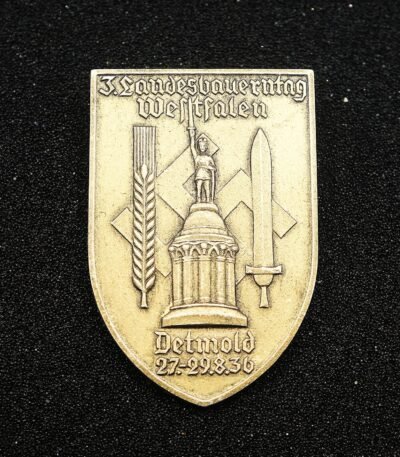
3. Landesbauerntag Westfalen Badge – Detmold, 27–29 August 1936
€45,00Original German commemorative event badge for the 3rd Landesbauerntag Westfalen, held in Detmold from 27–29 August 1936.
The attractive shield-shaped badge features a central monument topped by a figure, flanked by a sheaf of wheat and a sword. The front bears the Gothic inscription “3. Landesbauerntag Westfalen”, with “Detmold 27.–29.8.36” below.
The reverse is stamped Paulmann & Crone, Lüdenscheid, and retains its original horizontal pin attachment.
An interesting pre-war German event badge for collectors of Third Reich-era memorabilia and regional agricultural gathering badges.
Condition: Age-related wear and surface marks; please see photographs.
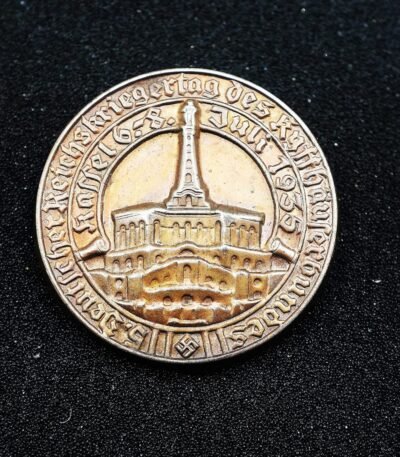
Commemorative Badge – 5th Reichskriegertag des Kyffhäuserbundes, Kassel 1935
€25,00Original commemorative badge for the 5. Deutscher Reichskriegertag des Kyffhäuserbundes, held in Kassel, Germany, from 6–8 July 1935.
The circular badge features a detailed memorial design surrounded by Gothic lettering. The reverse retains its original horizontal pin attachment.
An interesting piece of German historical event memorabilia from the 1930s, suitable for collectors of period badges and veterans’ association material.
Condition: Shows age-related wear and surface discolouration.
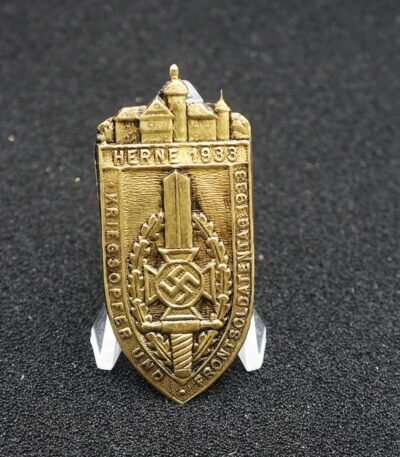
Kriegsopfer- und Frontsoldatentag – Herne 1933 – German Commemorative Badge
€15,00Original German commemorative event badge marked “Herne 1933”, associated with the Kriegsopfer- und Frontsoldatentag (War Victims’ and Front Soldiers’ Day).
The shield-shaped badge features an architectural motif at the top and a central memorial design surrounded by an inscription referring to the event. It is finished in gold-coloured metal and retains its vertical reverse pin attachment.
Condition: Shows considerable age-related wear, oxidation and loss of finish. The reverse has substantial discolouration and residue around the pin area. The pin is present. Please study the photographs carefully for the exact condition.
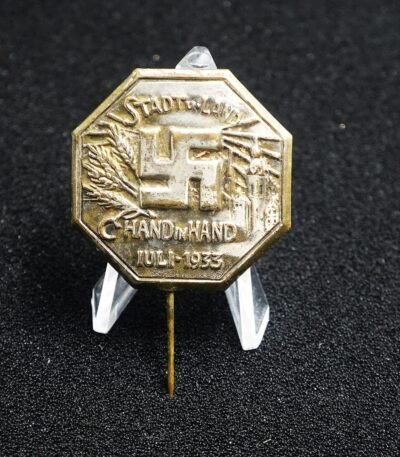
“Stadt und Land Hand in Hand” – German Harvest Festival Badge, July 1933
€25,00Original German commemorative badge issued for the Deutscher Erntetag (German Harvest Day) in July 1933.
The octagonal badge bears the inscription “Stadt und Land – Hand in Hand” (“Town and Countryside – Hand in Hand”), with a central swastika and agricultural imagery representing the relationship between urban and rural communities. The date July 1933 appears at the bottom.
The badge is made of gold-coloured metal and retains its original long, vertical pin fastening on the reverse.
Condition: Shows age-related wear, surface scratches, oxidation and areas of finish loss. The pin is present.
An early Third Reich commemorative badge associated with the agricultural propaganda and public events of 1933. The design and event identification are supported by specialist dealer listings.
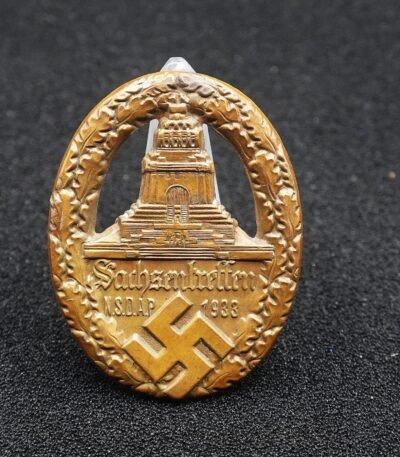
NSDAP Badge – Sachsentreffen 1933
€40,00Original commemorative badge for the NSDAP Sachsentreffen of 1933.
The oval, gold-coloured badge features a detailed depiction of the Völkerschlachtdenkmal in Leipzig, surrounded by a decorative wreath border. The inscription reads „Sachsentreffen – N.S.D.A.P. – 1933“, with a large swastika at the bottom.
Condition: Noticeable age-related wear, oxidation and loss of finish, particularly on the reverse. Pin most likely repaired?
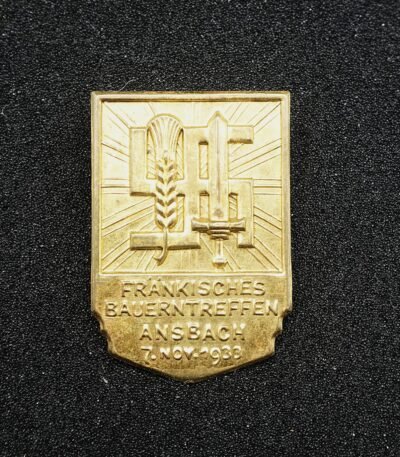
Fränkisches Bauerntreffen Ansbach – 7 November 1933 Event Badge
€45,00Original period German commemorative event badge for the Fränkisches Bauerntreffen (Franconian Farmers’ Meeting) held in Ansbach on 7 November 1933.
The shield-shaped badge features a striking design incorporating a sheaf of wheat, a sword and radiating lines. The reverse retains its original horizontal pin attachment.
An interesting early Third Reich period event badge, suitable for collectors of German historical memorabilia and political event badges of the 1930s. Comparable examples have appeared in established militaria auctions.
Condition: Shows age-related wear and surface marks. Please examine the photographs carefully.
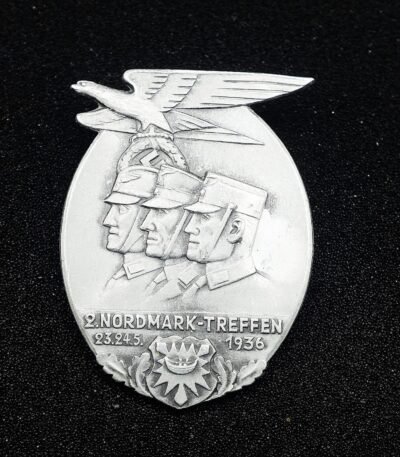
SA Badge – 2. Nordmark-Treffen – 23–24 May 1936 (Paulmann & Crone, Lüdenscheid)
€50,00Original German event badge commemorating the 2nd Nordmark-Treffen, held on 23–24 May 1936.
The badge features a striking design with a flying eagle above three uniformed figures representing different formations, with the event title and dates displayed below. The reverse is maker-marked Paulmann & Crone, Lüdenscheid, and retains its original horizontal pin attachment.
Condition: Shows surface wear and age-related marks. Please examine the photographs carefully.
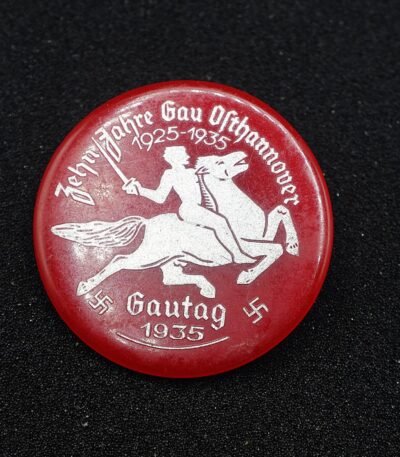
NSDAP Badge – 10 Years Gau Osthannover, 1925–1935
€45,00Original commemorative badge celebrating the 10th anniversary of Gau Osthannover (1925–1935), issued for the Gautag 1935.
The red circular badge features a white depiction of the traditional Hanoverian rearing horse, with a rider holding a sword. The surrounding inscription reads „Zehn Jahre Gau Osthannover 1925–1935“, with „Gautag 1935“ below, flanked by two swastikas.
The reverse retains its original horizontal pin attachment.
Condition: Visible surface wear and scratches consistent with age.
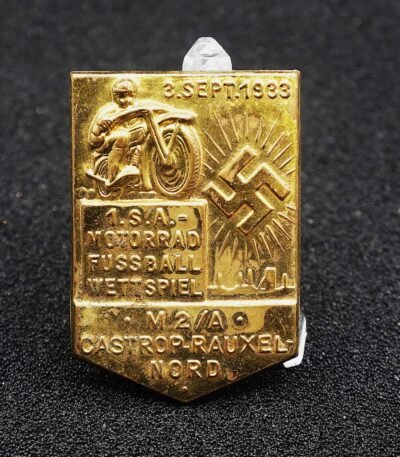
SA Event Badge – 1. SA-Motorrad-Fußball-Wettspiel – Castrop-Rauxel-Nord, 1933
€75,00Original German SA commemorative event badge for the 1st SA Motorcycle Football Competition, held on 3 September 1933 in Castrop-Rauxel-Nord.
The rectangular, shield-shaped badge features a motorcyclist, a football-related event inscription and a swastika design. The reverse bears the event details, including the date and location.
An early 1933 event badge of historical interest to collectors of German political and paramilitary memorabilia.
Condition: Visible age-related wear and surface marks; please see photographs.
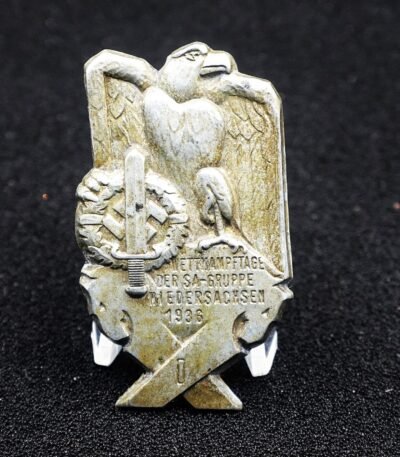
SA Badge – Wettkampftage der SA-Gruppe Niedersachsen, 1936
€30,00Original German event badge issued for the Wettkampftage der SA-Gruppe Niedersachsen, held on 26–27 September 1936 in Braunschweig.
The striking, irregularly shaped badge features a large eagle above a sword and decorative wreath, with the inscription „Wettkampftage der SA-Gruppe Niedersachsen 1936“. The design incorporates the crossed horse heads associated with the coat of arms of Lower Saxony.
The reverse retains its original vertical pin attachment.
Condition: Heavy oxidation, discolouration and surface wear.
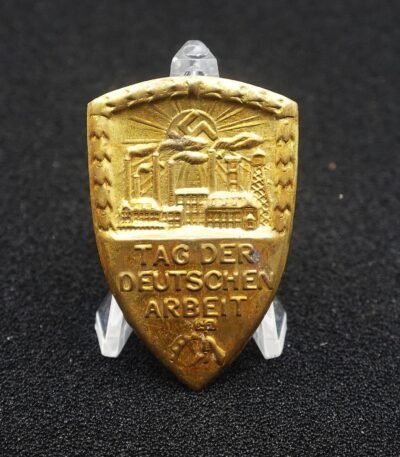
“Tag der Deutschen Arbeit” Badge – Factory Motif – Third Reich Period
€20,00Original German Tag der Deutschen Arbeit commemorative badge from the Third Reich period.
The shield-shaped badge features a detailed industrial scene depicting a factory complex beneath a radiant sun and swastika emblem. The inscription reads “Tag der Deutschen Arbeit”, commemorating the National Socialist regime’s officially designated German Labour Day.
The reverse features a vertically arranged pin attachment and raised design details.
Condition: Shows age-related wear, oxidation, discolouration and areas of wear to the gold-coloured finish. The pin attachment appears to be present. Please examine the photographs carefully for the exact condition.
An interesting period event badge for collectors of German political and labour-related insignia from the 1930s.
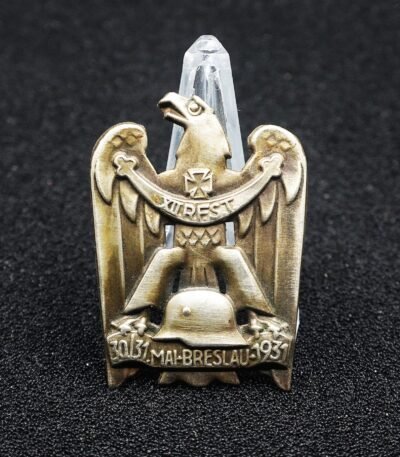
Stahlhelm Badge – XII. Reichsfrontsoldatentag, Breslau, 1931
€35,00Original commemorative badge for the 12th Reichsfrontsoldatentag of the Stahlhelm, Bund der Frontsoldaten, held in Breslau on 30–31 May 1931. The badge also commemorates the 3. Reichsfahrt.
The striking design features a German eagle above a steel helmet, with an Iron Cross and banners bearing the inscriptions „XII. R.F.S.T.“ and „30./31. Mai Breslau 1931“.
An interesting commemorative badge from the Weimar Republic period, associated with one of Germany’s major First World War veterans’ organisations.
Condition: Noticeable oxidation, discolouration and surface wear. The reverse pin is broken.
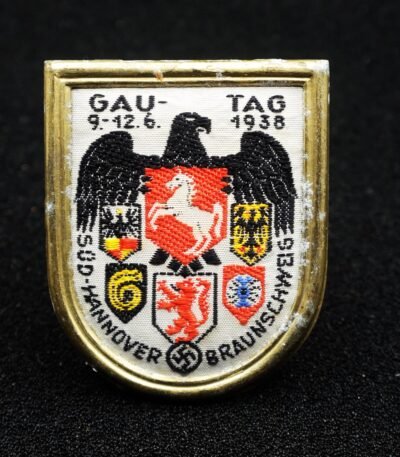
NSDAP Gau-Tag Badge – Süd-Hannover–Braunschweig, 1938
€30,00Original commemorative badge issued for the NSDAP Gau-Tag held in Hannover from 9–12 June 1938.
The shield-shaped badge features a black eagle above six regional coats of arms, with the inscriptions “GAU-TAG 9–12.6.1938” and “SÜD-HANNOVER – BRAUNSCHWEIG”. The design is woven in multiple colours and mounted in a gold-coloured metal frame.
The reverse retains its horizontal pin attachment.
Condition: Visible wear and discolouration to the frame and fabric edges.
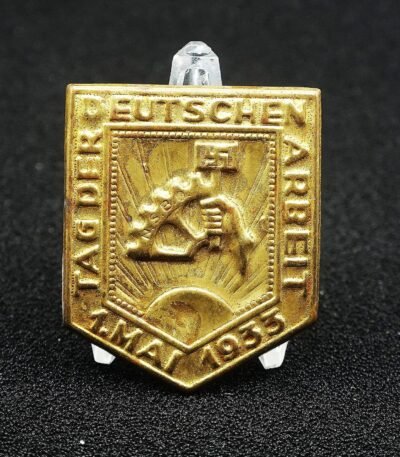
German Labour Day Badge – Deutscher Tag der Arbeit, May 1935 (NSBO)
€30,00Original German commemorative badge for the Tag der Arbeit (Day of Labour), 1 May 1935. NSBO (Nationalsozialistische Betriebszellenorganisation),.
The gold-coloured, shield-shaped badge features a striking design of clasped hands beneath a swastika flag, with radiating sunbeams in the background. The raised inscription reads „Deutschen Tag der Arbeit – Mai 1935“. The reverse retains its vertical pin attachment.
An interesting period badge documenting the Labour Day celebrations organised under the Nazi regime in 1935.
Condition: Visible age-related wear, surface marks and discolouration, particularly on the reverse.
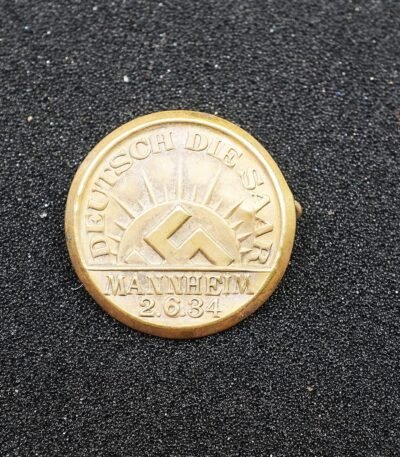
“Deutsch die Saar” Badge – Mannheim, 2 June 1934 – Saar Campaign
€30,00Original German commemorative badge issued in Mannheim on 2 June 1934, associated with the “Deutsch die Saar” campaign advocating the return of the Saar Territory to Germany.
The circular badge features a rising sun with a swastika at its centre. The inscription reads “Deutsch die Saar”, with “Mannheim 2.6.34” below, identifying the location and date of issue.
The badge is made of silver-coloured metal with a raised design and a horizontal pin attachment on the reverse.
Condition: Shows age-related wear, discolouration and areas of finish loss. The reverse pin attachment is present. Please examine the photographs carefully for the exact condition.
An interesting historical event badge documenting the political campaign surrounding the Saar Territory in the period before the January 1935 Saar referendum.
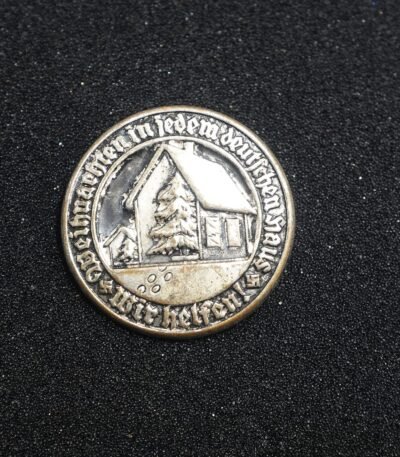
WHW Christmas Donation Badge 1933 – “Weihnachten in jedem deutschen Haus – Wir helfen”
€15,00Original German Winterhilfswerk (WHW) donation badge from the 1933 Christmas collection, bearing the inscription “Weihnachten in jedem deutschen Haus – Wir helfen” (“Christmas in Every German Home – We Help”).
The badge features a house and fir tree within a decorative border bearing the German inscription. It was issued during the early period of the Winterhilfswerk des Deutschen Volkes, the National Socialist winter relief organisation. Examples of this design are documented as part of the December 1933 Reich street collection.
The badge is made of pressed sheet metal and retains its horizontal pin fastening on the reverse. It displays age-related wear and surface imperfections consistent with its age.
Condition: Shows age-related wear, surface scratches, oxidation and areas of finish loss. The pin attachment is present. Please examine the photographs carefully for the exact condition.
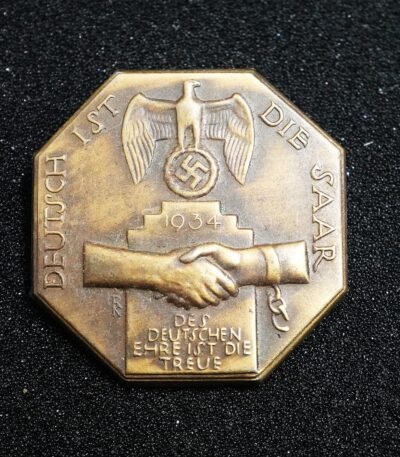
“Deutsch ist die Saar” 1934 – Saar Plebiscite Commemorative Badge
€20,00Original German commemorative badge from 1934, associated with the campaign surrounding the Saar plebiscite of 13 January 1935.
The octagonal, bronze-coloured badge features an eagle above a swastika, with two hands clasping beneath it. One wrist is shown with a broken chain, symbolising the campaign for the Saar territory to return to Germany.
The badge bears the inscriptions:
- “Deutsch ist die Saar” — The Saar is German
- “1934”
- “Des Deutschen Ehre ist die Treue” — The German’s honour is loyalty
The design is attributed to medal artist Richard Klein and features his initials, RK. The badge is made of metal and retains its original horizontal pin fastening on the reverse. The design and inscriptions are documented in the collection of the Paris Museums.
Condition: Shows age-related wear, surface scratches, oxidation and areas of finish loss. The pin fastening is present.
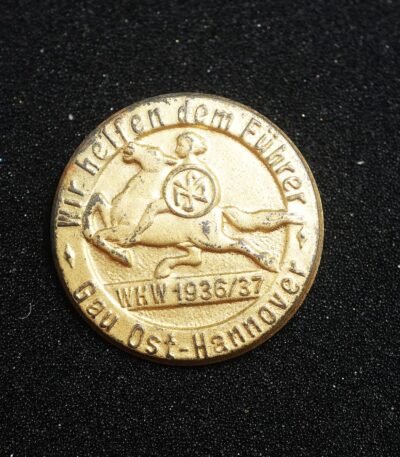
WHW 1936/37 – “Wir helfen dem Führer” – Gau Ost-Hannover – Donation Badge
€10,00Original German Winterhilfswerk (WHW) donation badge from the 1936/37 campaign, issued for Gau Ost-Hannover.
The circular badge depicts a running figure carrying a shield bearing the WHW emblem. The surrounding inscription reads “Wir helfen dem Führer”, with “WHW 1936/37” beneath the central design and “Gau Ost-Hannover” along the lower edge.
The badge is made of metal with a silver-coloured finish and retains its original horizontal pin attachment on the reverse.
Condition: Shows age-related wear, surface scratches, oxidation and areas of finish loss. The pin attachment is present. Please examine the photographs carefully for the exact condition.