



Sold out
Heinrich Gottke – SS-Flak-Abteilung 17 “Götz von Berlichingen”
€45,00Original Postwar Signature on a Postwar Photo of Heinrich Gottke. SS-Oberscharführer Heinrich Gottke (07.07.1921 † 12.08.1998), earned the Ritterkreuz des Eisernen Kreuzes as Vorausbeobachter of the 3. Batterie/ SS-Flak-Abteilung 17 of the 17. SS-Panzergrenadier-Division “Götz von Berlichingen” on December 17, 1944. Size: 8,5×12,5cm.
Sold out
Franz Kühn – 17. SS-Panzergrenadier-Division “Götz von Berlichingen” – Most Succesful Sniper of GvB (!) – Scharfschützenabzeichen in Gold
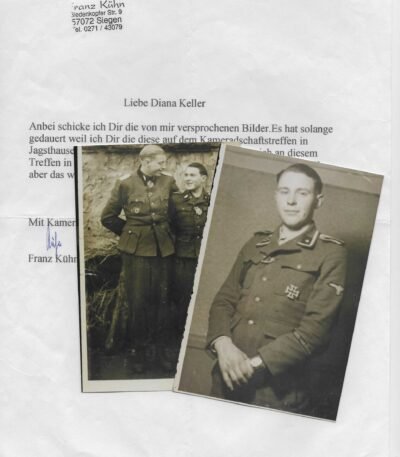
€150,00Interesting postwar veteran grouping belonging to Franz Kühn (born 6 May 1926), a former member of SS-Panzergrenadier-Regiment 38 of the 17. SS-Panzergrenadier-Division “Götz von Berlichingen.” Included are two original postwar photographs bearing his signature, together with an accompanying signed letter dated 06.04.2000 from Siegen, Germany, in which Kühn sends the photographs to a correspondent.
The wartime clipping identifies him as SS-Unterscharführer Kühn, SS-Panzergrenadier-Regiment 38, and describes him as “Der erfolgreichste Scharfschütze der Division” (the division’s most successful sniper). According to the article, Kühn had achieved 20 confirmed sniper kills, making him the leading sniper of the division at that time. The article further notes that his success inspired additional sniper activity throughout the division and that he had recently returned from a period of special leave.
Research published by collectors and historians of the division records Kühn’s service with the 3. Kompanie / SS-Panzergrenadier-Regiment 38, his progression through the ranks to SS-Unterscharführer, and his recognition for sniper actions during the bitter fighting around Bliesbrück in January 1945. Contemporary divisional reports reportedly credited him with at least 20 confirmed sniper kills by February 1945, while later accounts state that he was awarded the Scharfschützenabzeichen in Gold during the final months of the war.
The 17. SS-Panzergrenadier-Division “Götz von Berlichingen” fought exclusively on the Western Front and saw heavy combat in Normandy, the retreat across France, the Metz sector, Operation Nordwind, the Saar-Palatinate fighting, and the final defensive battles in Germany during 1944–45. Kühn’s documented sniper activity occurred during the division’s desperate defensive operations in early 1945 under divisional commander SS-Standartenführer Fritz Klingenberg.
One of the signed photographs shows Kühn in Waffen-SS uniform wearing his Iron Cross 1st Class, while the second signed photograph depicts him together with another decorated veteran. The accompanying signed letter provides excellent provenance and directly links the photographs to Kühn himself. Such veteran-sourced material is highly desirable, especially when it can be connected to a documented and identifiable soldier featured in wartime divisional publications.
A scarce and historically interesting veteran grouping relating to one of the best-known snipers of the 17. SS-Panzergrenadier-Division “Götz von Berlichingen.”
Sold out
Photograph of Flemish Volunteer of the SS-Freiwilligen-Legion “Flandern”
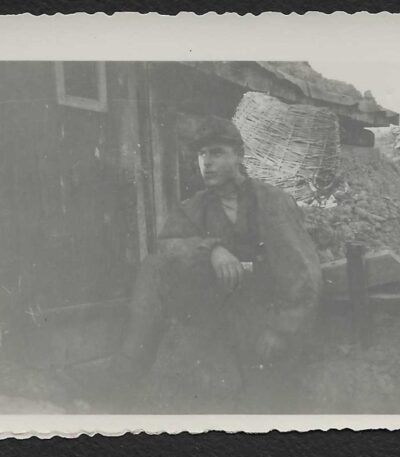
€45,00Original wartime photograph depicting a Flemish volunteer of the 2. Kompanie/ SS-Freiwilligen-Legion “Flandern”. Camo gear being worn! Name known. Somewhere at the front, but the photo has a shade on it making the photo lesser visibile quality.
Format: 6 x 9 cm
Condition: As shown in the photographs / Better quality in real life
Sold out
Photograph of Flemish Volunteer of the SS-Freiwilligen-Legion “Flandern”
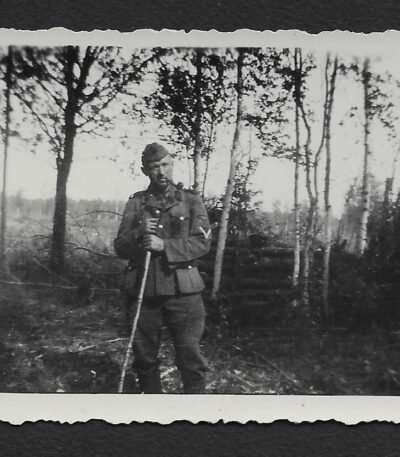
€75,00Original wartime photograph depicting a Flemish volunteer of the 3. Kompanie/ SS-Freiwilligen-Legion “Flandern”, he later with MIA with the Sturmbrigade “Langemarck”. Name known!
Format: 6 x 9 cm
Condition: As shown in the photographs / Better quality in real life

Sold out
Photograph of Flemish Volunteers from the SS-Pionier-Bataillon 27 “Langemarck”
€75,00Original Photograph of Flemish Volunteers from the SS-Pionier-Bataillon 27 “Langemarck” in Pikowitz. Camo!
Format: 6 x 6 cm
Condition: As shown in the photographs / Better quality in real life
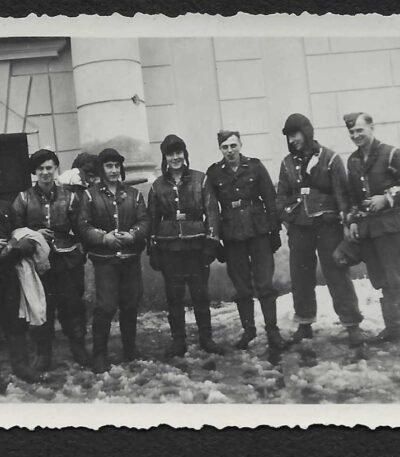
Sold out
Photograph of Flemish Volunteers in winter gear of the SS-Freiwilligen-Legion “Flandern”
€100,00Original wartime photograph depicting Flemish volunteers of the 3. Kompanie/ SS-Freiwilligen-Legion “Flandern”. Most names known.
Format: 6 x 9 cm
Condition: As shown in the photographs / Better quality in real life

Photograph of Flemish Volunteers in Camo of the SS-Freiwilligen-Legion “Flandern”
€100,00Original wartime photograph depicting Flemish volunteers of the 2. Kompanie/ SS-Freiwilligen-Legion “Flandern”, during a meal break. Camo gear being worn!
Format: 6 x 9 cm
Condition: As shown in the photographs / Better quality in real life

Photograph of Flemish Volunteer of the SS-Freiwilligen-Legion “Flandern”
€75,00Original wartime photograph depicting a Flemish volunteer of the SS-Freiwilligen-Legion “Flandern”, wearing the Tollenaere-Trouwkenteken and the Wound Badge in Black. The soldier also appears to wear the “Flandern” cuff title and the distinctive Lion shield on the sleeve (both more difficult to distinguish clearly).
A very interesting period image of a Flemish SS volunteer with visible combat-related insignia.
Format: 6 x 9 cm
Condition: As shown in the photographs

Sold out
WWII Belgian “Geni” NCO Visor Cap
€100,00Original Belgian Army “Geni” NCO visor cap dating from the pre-WWII to early WWII period, featuring the distinctive Belgian national cockade and original engineer (“Genie / Geni”) branch insignia to the front.
The cap retains an attractive original shape, “Scharlakenrood” bies, and displays a pleasing field-used appearance overall. The exterior wool remains in solid condition with honest age and service wear visible throughout. Several small moth holes and minor damages are present, including a more noticeable moth-damaged area to the side/rear section (see photographs for details).
Inside, the cap still retains its original silk lining and sweatband. The interior shows age-related wear, staining and deterioration from prolonged storage and use. The sweatband carries the original “Superfine Quality” marking, still partially visible.
A desirable and increasingly difficult to find example of a Belgian interwar / early WWII NCO visor cap, especially with original insignia still present.

WWII Belgian M31 Adrian Helmet – May 1940 Campaign, Complete with Chinstrap
€295,00Original Belgian M31 Adrian helmet, used during the early stages of World War II, particularly during the May 1940 campaign (“Battle of Belgium”).
A very attractive and honest example retaining a significant amount of its original wartime paint, giving the helmet excellent display appeal. The helmet is complete with its original liner and chinstrap, and shows genuine period wear and age from service use (please refer to the images for condition details).
The liner is clearly marked by the Belgian manufacturer “X. BUISSET” of Vilvoorde and is size 60 — a desirable large size, noticeably bigger than the standard Belgian M31 Adrian helmets commonly encountered.
Overall, this is a desirable and increasingly scarce piece of original Belgian WWII headgear, especially as a complete example with strong untouched character and good original finish.
Sold out
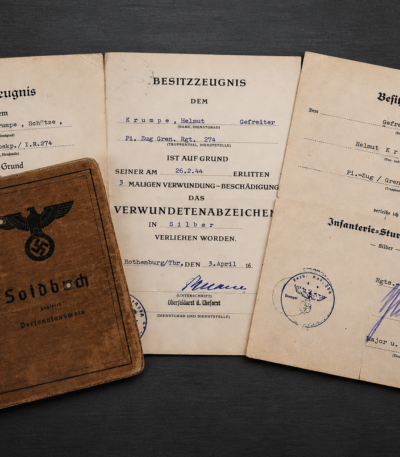
Soldbuch & Award Grouping – Grenadier-Regiment 274 – Stalingrad & Italy Campaign Veteran – Infantry Assault Badge Silver + Wound Badge Black & Silver
€0,01Very attractive and historically rich Wehrmacht Soldbuch grouping belonging to Gefreiter Helmut Krumpe, serving with Pi. Zug / Grenadier-Regiment 274. The set includes his original Soldbuch, portrait photograph and three original award documents, including the Infantry Assault Badge in Silver and both the Wound Badge in Black and Silver.
A highly combat-related grouping showing extensive front-line service, multiple wounds and long hospital stays from both the Eastern Front and later the Italian campaign.
Included in the set
- Original Soldbuch
- Original portrait photograph in uniform
- Award document for the:
- Verwundetenabzeichen in Schwarz – awarded 9.10.1942
- Infanterie-Sturmabzeichen in Silber – awarded 16.9.1943
- Verwundetenabzeichen in Silber – awarded 3.4.1944
Combat History – Stalingrad & Italy
Krumpe initially served through Infanterie-Ersatz-Bataillon 192 and later with Infanterie- / Grenadier-Regiment 274, part of the famous 94. Infanterie-Division.
His first combat wound was suffered on 26.8.1942, during the period when the 94. Infanterie-Division was heavily engaged in the advance toward Stalingrad. The division fought in the Don region and the brutal approach battles west of the city before becoming involved in the Stalingrad fighting itself. The wound date fits perfectly within this phase of the campaign.
After recovery, Krumpe later served with the rebuilt 94. Infanterie-Division, which fought extensively in Italy during 1943–1945. The division participated in combat operations around:
- Minturno
- Formia
- the Gustav Line
- the Cassino sector
- the Gothic Line
- and the retreat battles through northern Italy.
His Infantry Assault Badge in Silver, awarded on 16.9.1943, was very likely earned during the Italian campaign fighting.
Multiple Wounds
The grouping clearly documents repeated combat injuries:
- Wound Badge in Black
- for wounds suffered on 26 August 1942
- awarded on 9 October 1942
- Wound Badge in Silver
- awarded on 3 April 1944
- confirming at least three combat wounds
The Soldbuch contains numerous hospital and reserve lazarett entries, confirming prolonged medical treatment and repeated front-line service.
Lazarett & Recovery Entries
The Soldbuch includes entries for several hospitals and reserve lazaretts, including:
- Reserve-Lazarett Stolp
- Kriegslazarett 4/571
- Reserve-Lazarett Schloß Banz
- Rothenburg/Tbr.
Also present are:
- recovery leave (Genesungsurlaub)
- repeated medical transfers
- continued treatment into late 1944 / early 1945
Condition
The Soldbuch shows genuine wartime wear and field use:
- worn and heavily used cover
- creasing and edge damage
- loose/detached pages in places
- numerous period stamps, signatures and entries throughout
The award documents remain in very good condition overall with clear signatures and unit stamps.
A highly displayable and historically significant combat grouping connected to both the Stalingrad campaign and the later fighting in Italy, with strong award content and extensive wartime entries throughout.

Sold out
Fallschirmjäger EK2 Award Doc & Photo Grouping – 5. Fallschirmjäger-Division – Battle of the Bulge
€350,00Very attractive and historic original WWII German document & photo grouping belonging to Feldwebel Alfred Lederbogen of 3. Kompanie/ Fallschirmjäger-Regiment 14, part of the renowned 5. Fallschirmjäger-Division.
The centerpiece of the set is the original Eisernes Kreuz 2. Klasse (EK2) award document, awarded on 27.1.1945. The grouping is accompanied by several original wartime portrait photographs in uniform, including excellent Fallschirmjäger / Luftwaffe studio portraits.
Fallschirmjäger-Regiment 14 belonged to the 5. Fallschirmjäger-Division, which fought on the Western Front in some of the war’s heaviest combat, including:
- Normandy, France (1944)
- Retreat battles through France and Belgium
- Aachen sector
- Hürtgen Forest
- The Ardennes Offensive / Battle of the Bulge
Historical records show that FJR 14 participated heavily in the Ardennes fighting from December 1944 into January 1945. The regiment crossed the Our River on 16 December 1944 and fought around:
- Putscheid
- Weiler
- Wiltz
- Doncols
- Bastogne sector
- Assenois
- Villers-la-Bonne-Eau
- Harlange
- Bavigne
The regiment suffered extremely heavy losses during the fighting against the advancing American forces, especially during the battles around Bastogne and the later withdrawal actions in January 1945. Given the award date of 27 January 1945, it is very possible Feldwebel Lederbogen received the EK2 for actions connected to the brutal combat of the Battle of the Bulge / Ardennes Offensive and the desperate defensive battles that followed
Included are multiple early Luftsport / aviation-related identity and membership documents dating back to the 1930s, showing Lederbogen’s pre-war aviation involvement. One booklet still retains the original attached portrait photograph and period revenue stamp.
Included in the grouping:
- Original EK2 award document to Feldwebel Alfred Lederbogen
- Named to 3./ Fallsch.Jg.Rgt.14
- Several original wartime portrait photographs
- Early German aviation / Luftsport identity documents
- Original attached photographs and stamps
- Postwar military government document
Condition is overall good used condition with normal age wear, folds, small tears and period handling marks as visible in the photos. Nothing repaired or cleaned.
A very interesting and uncommon named Fallschirmjäger grouping with strong display value, excellent portraits and direct connection to the brutal late-war fighting of the 5. Fallschirmjäger-Division on the Western Front.
Sold on commission.
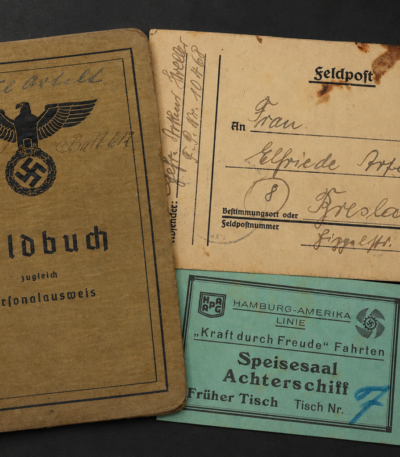
Soldbuch Obergefreiter – Nachschub-Bataillon 612 – Missing at Le Château-Charleville, August 1944 – Ostmedaille & KVK2
€165,00Interesting and historically attractive WW2 German Soldbuch belonging to Obergefreiter Paul Artelt, who served with Nachschub-Bataillon 612 and later went missing in August 1944 during the fighting around Le Château-Charleville.
A very nice mid- to late-war Soldbuch with numerous unit entries, leave stamps, weapon issue entries, accompanying Feldpost envelope and handwritten notification letter regarding his disappearance.
Soldier Details
- Name: Paul Artelt
- Born: 11 October 1905
- Birthplace: Altkessel-Graeberei
- Profession: Kutscher
- Religion: Catholic
- Rank progression:
- Schütze
- Gefreiter
- Obergefreiter (from 1.2.1944)
Units
The Soldbuch shows service with:
- 1. Kompanie / Infanterie-Ersatz-Bataillon 375
- Nachschub-Bataillon 612
The Soldbuch contains:
- multiple leave entries
- weapon issue pages
- hospital/lazarett-related stamps
- Feldpost envelope
- handwritten wartime/postwar correspondence concerning his disappearance
Awards
- 10.8.42 Ostmedaille (Eastern Front Medal / Winterschlacht im Osten)
- 1.6.44 Kriegsverdienstkreuz 2. Klasse (KVK2)
A very desirable combination for a logistics/supply soldier serving under difficult Eastern Front and later Western Front conditions.
Missing in Action – August 1944
The most historically significant aspect of the grouping is the included handwritten correspondence mentioning that Artelt went missing in:
- Le Château-Charleville
- in August 1944
This places him during the chaotic German retreat after the Allied breakout from Normandy and the collapse of the front in France.
Supply and transport battalions such as Nachschub-Bataillon 612 were heavily exposed during this period, often caught in encirclements, strafing attacks and rapidly collapsing retreat routes.
The included handwritten letter gives the grouping strong personal and research potential.
Included in the Grouping
- Original Soldbuch
- Feldpost envelope addressed to his wife
- Period “Kraft durch Freude” ship dining card

Sold out
Soldbuch & Document Grouping – Füsilier-Regiment 27 (12. Volksgrenadier-Division) – Wounded in Hürtgenwald – Close Combat Day at Stolberg!
€450,00Excellent and combat-related WW2 German Soldbuch and document grouping belonging to Oberschütze Ludwig Winter, born 4 January 1907 in Leipzig-Gohlis.
A highly interesting late-war infantry grouping with documented combat service in the Hürtgenwald fighting, a recorded close combat day near Stolberg/Atsch, award documents and numerous lazarett entries.
Winter served with:
- Infanterie-Regiment 484
- 9. Kompanie / Füsilier-Regiment 27 of the 12. Volksgrenadier-Division
The grouping includes the original Soldbuch with portrait photo, award document, combat day slip, civilian/postwar paperwork and various additional documents.
Awards & Decorations
Verwundetenabzeichen in Schwarz
Awarded on:
- 24 January 1945
Award document states:
- wounded on 17.11.1944
- awarded for a 1-time wound
This wound was sustained during the brutal fighting in the Battle of the Hürtgenwald.
Kriegsverdienstkreuz 2. Klasse
Awarded:
- 1 September 1941
Interesting detail:
- awarded while serving as a Regierungsrat (government official/civil servant)
Combat & Frontline Service
A separate combat day card records:
- 17 September 1944
- location: Atsch near Stolberg
This entry confirms a documented Nahkampftag (close combat day) during the fighting around Aachen/Stolberg, part of the heavy battles on the German western frontier in autumn 1944.
The Soldbuch also contains:
- shooting qualification entries
- weapon issue entries
- extensive clothing/equipment issue pages
- multiple official field and lazarett stamps
- His awards are entered on page 14!
Lazarett / Medical History
Numerous late-war hospitalization entries including:
- Reserve-Lazarett Lengerich (Westf.)
- Teillazarett Oberschule Kitzingen
- Reserve-Lazarett V Leipzig
- Reserve-Lazarett Cosel O/S
- Ausweichlazarett Leipzig
- Teillazarett Max Klingerschule
The wound entry from 17.11.1944 strongly ties this Soldbuch to the catastrophic Hürtgenwald campaign.
Included in the Grouping
- Original Soldbuch with portrait photo
- Verwundetenabzeichen award document
- Close combat day card
- KVK2 award document copy
- Additional civilian/postwar paperwork
- Identity/photo card
- Various accompanying documents as shown

Sold out
Soldbuch Obergefreiter – I./ Panzer-Regiment 24 (Panther!) – Normandy Veteran – KVK2 w/ Swords
€550,00Original and well-used WW2 German Heer Soldbuch issued to Heinz Osieka, born 7 July 1923 in Walzen, Kreis Neustadt. A highly attractive combat-used Panzer Soldbuch from an interesting Panther unit active in Normandy with numerous wartime entries, unit stamps, leave entries, issued equipment pages, hospital records, promotions, and original portrait photograph.
The Soldbuch displays heavy wartime use and authentic field wear throughout, giving it excellent untouched character.
Recorded Units Include:
- Panzer-Ersatz-Abteilung 15 – Sagan
- Stabsschwadron II./Panzer-Regiment 24
- Stabsschwadron I./Panzer-Regiment 24
Two combat days recorded:
- 27.5.44
- 23.8.44 (both signed by Lt. Morgenstern!)
Awards:
- Awarded the Kriegsverdienstkreuz 2. Klasse mit Schwertern (KVK2 w/ Swords) on 1.9.1944
Promotions:
- Promoted to Oberschütze on 1.12.1942
- Promoted to Obergefreiter on 1.5.1944
Interesting Entries:
- Multiple leave entries from 1943–1944
- Detailed equipment issue pages including rifle, pistol, and entrenching tool
- Hospital/lazarett entry:
- Reserve-Lazarett I Görlitz
- Admitted 23.7.1943 / Released 7.8.1943
- Numerous wartime Panzer unit stamps and signatures
- Original portrait photo still attached
- Strong connection to I./Panzer-Regiment 24, a Panther-equipped battalion
- Unit associated with combat operations in Normandy following the Allied invasion in 1944
- KVK2 with Swords awarded after the Normandy fighting period
The Soldbuch remains in solid collectible condition despite clear frontline and field use. The worn cover and pages reflect genuine wartime service. The soldbuch has two covers!
A very desirable Panzer-related Soldbuch connected to a Panther tank unit, with Normandy and Eastern Front relevance and excellent research potential.
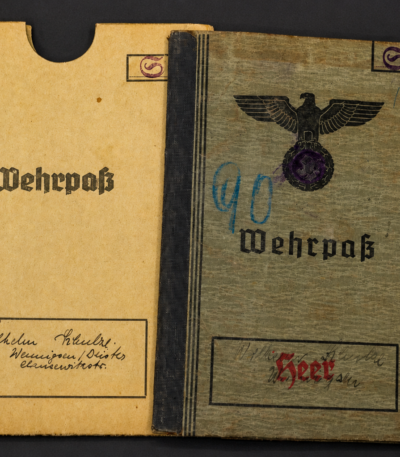
Wehrpass – Unteroffizier in Kraftfahr-Kp. 222 & Sturmgeschütz-Brigade 300 – KBA in Bronze in March 1945!
€195,00Very interesting and well-filled Wehrpass issued to Wilhelm Hermann Friedrich Schulze, born 7 February 1911 in Westerhof/Osterode, documenting continuous Heer service from 1940 through the final days of the war, including service on the Eastern Front and attachment to Sturmgeschütz-Brigade 300.
The Wehrpass retains the original portrait photograph, numerous unit and administrative stamps, handwritten entries, combat/service notes, inserted campaign sheet, promotions, and wartime awards. Several stamps were period/postwar denazified, commonly encountered on original retained Wehrpässe.
Recorded Units Include:
- 4. (MG) Kompanie / Infanterie-Ersatz-Bataillon 191 – Hildesheim
- Infanterie-Regiment 552
- Kraftwagen-Kolonne 222
- Kraftfahr-Kompanie 222
- 1. Kompanie/ Sturmgeschütz-Brigade 300
Notable Entries:
- Awarded the Kriegsverdienstkreuz 2. Klasse mit Schwertern (KVK2 mit Schwertern) on 20.4.1941
- Awarded the Kraftfahrbewährungsabzeichen in Bronze on 19.3.1945
- Promoted to Gefreiter on 1.3.1941
- Promoted to Obergefreiter on 1.4.1943
- Promoted to Unteroffizier on 1.5.1945
- Eastern Front combat/service entries
- Inserted typed campaign sheet detailing 1944 operations in the Ukraine sector
- Original wartime photo present
- Numerous official stamps and signatures throughout
The Wehrpass shows honest wartime wear and age, remaining in very solid and displayable condition overall.
A highly desirable and researchable late-war Heer Wehrpass featuring:
- Assault gun brigade service
- Eastern Front operations
- Combat driver qualification award
- Multiple wartime promotions
- Final-days-of-the-war Unteroffizier promotion
- Strong unit history for collector and research value

Sold out
WWII Soldbuch to Obergefreiter of Pionier-Bataillon 1176 – KVK2 mit Schwertern & Ruhrkessel History
€110,00Interesting and combat-used WWII German Soldbuch issued to Paul Loddenkämper, born 14.12.1911 in Velde. The Soldbuch documents long wartime service within various Pionier replacement and frontline units, ending with service in the late-war Pionier-Bataillon 1176.
The holder was promoted from Gefreiter to Obergefreiter on 1.6.1942 and was awarded the Kriegsverdienstkreuz 2. Klasse mit Schwertern (KVK2 mit Schwertern) on 20.4.1944.
Particularly interesting is the final unit entry for Pionier-Bataillon 1176, a late-war battalion formed on 25 October 1944 on the Lower Rhine (Niederrhein) from Walküre units of Division Nr. 176, including elements of Pionier-Ersatz- und Ausbildungs-Bataillon 6 and 26. The battalion served with the 176. Infanterie-Division and fought defensive battles along the Maas near Maasbracht before being forced back behind the Roer in December 1944.
The unit subsequently participated in severe retreat fighting through: Erkelenz, Waldniel, Viersen, Mönchengladbach, St. Tönis and Krefeld
before retreating into the Duisburg bridgehead and finally behind the Rhine, where the surviving remnants were ultimately trapped in the Ruhr Pocket (Ruhrkessel) and surrendered into American captivity.
The Soldbuch itself shows heavy wartime use and contains numerous entries, unit stamps, signatures, and field-related annotations throughout. Recorded units include:
- Pionier-Bataillon 31 (?)
- Pionier-Ersatz- und Ausbildungs-Bataillon 6, Minden
- Pionier-Bataillon 1176
A documented Kriegslazarett entry records hospitalization for Flecktyphus (Typhus) in 1941.
Condition is heavily worn but original and untouched, showing clear evidence of prolonged wartime field carry. The cover displays age wear, staining, and edge damage, while the interior remains well preserved overall with strong readability and attractive wartime entries throughout. Photo was removed from the Soldbuch.
A very researchable and historically interesting original WWII Pionier Soldbuch tied to the desperate late-war fighting of Pionier-Bataillon 1176 and the final collapse within the Ruhrkessel.

Sold out
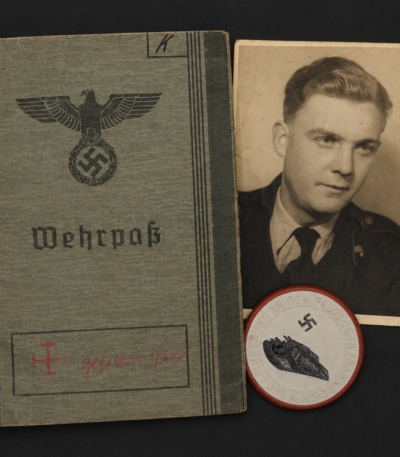
Wehrpass & Porcelain Medaillon – Panzer Regiment 25 – KIA June 1941 during Operation Barbarossa
€230,00Excellent and highly personal original WWII Wehrpass, Photo and Porcelain token belonging to Johann Knauß, a young German Panzer soldier who served in Panzer-Regiment 25 and was killed in action during the opening days of Operation Barbarossa in June 1941.
The grouping consists of his original Wehrpass with portrait photograph, wartime entries detailing his campaigns in France and the Soviet Union, together with period personal photographs and an interesting Paris souvenir medallion likely acquired during occupation service in France.
Particularly desirable is the clear documentation of his death during the rapid armored advance into Soviet territory in June 1941.
Included in the grouping:
- Original Wehrpass with portrait photograph
- Additional wartime portrait photograph
- Paris occupation souvenir porcelain medallion/token: “Zur Erinnering an den Feldzug in Frankreich / Einnahme von Paris 14. Juni 1940“
Documented Units:
- 1./Panzer-Ersatz-Abteilung 25, Erlangen
- 5./ Panzer-Regiment 25
- Later: 7./ Panzer-Regiment 25
Notable Details:
- Entered Wehrmacht service:
- 1 October 1940
- Participated in:
- Occupation service in France
- Fought during:
- Operation Barbarossa
- Wehrpass records combat actions during the opening invasion battles in the Soviet Union
- Killed near:
- Grodno
- 27 June 1941
- Original red handwritten “gefallen 1941” notation on Wehrpass cover
Recorded Weapons Training Includes:
- Gewehr 98
- Pistole 08
- MG34
- MG37(t)
- KwK 38(t)
- KwK 30
- Maschinenpistole
A very personal early-war Panzer soldier grouping connected to the dramatic opening phase of the German invasion of the Soviet Union.
100% original wartime material.
Sold out
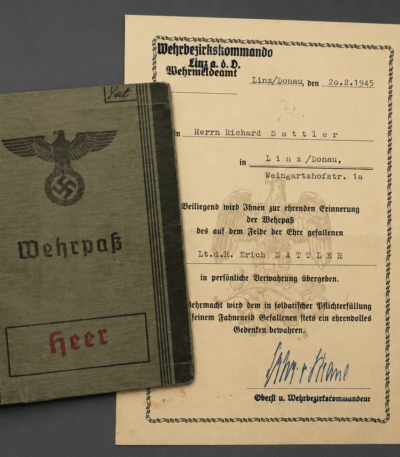
Panzer Officer Wehrpass – Panther & Tiger Trained – Panzer-Regiment 33 & 39 – KIA December 1944
€195,00Outstanding and highly researchable original WWII German Wehrpass grouping belonging to Leutnant der Reserve Erich Sattler, a late-war German Panzer officer trained on the Panzer IV, Panther, and Tiger tanks, and ultimately serving with II./ Panzer-Regiment 39.
This exceptional grouping includes Sattler’s original Wehrpass with portrait photograph together with the official wartime memorial/return letter sent to his family after his death in December 1944.
The Wehrpass documents Sattler’s full wartime military progression from recruit to reserve Panzer officer, including advanced armored warfare training, officer candidate schools, promotions, and service in frontline Panzer formations.
Included in the grouping:
- Original Wehrpass with attached portrait photo
- Official Wehrbezirkskommando return/memorial letter dated
Units & Rank:
- Promotions through multiple ranks up to: Leutnant der Reserve
- Named to: Erich Sattler, born 3 October 1921 in Linz/Donau
- 2./Sanitäts-Ersatz-Abteilung 17
- 2./ Panzer-Ersatz-Abteilung 33
- Marsch-Kompanie Panzer-Ersatz-Abteilung 33
- Panzer-Regiment 33
- Panzer-Ersatz- und Ausbildungs-Abteilung 33
- II./ Panzer-Regiment 39
Particularly Interesting Features:
- Early Panzer training as:
- Ladeschütze (loader) on the Panzer IV in 1942
- Advanced 1944 armored instruction involving:
- Panzerkampfwagen V “Panther”
- Panzerkampfwagen VI “Tiger”
- Officer candidate and Panzer leadership courses
- Promotion sequence from enlisted ranks through officer candidate status to reserve lieutenant
- Included wartime memorial return letter confirming Sattler was killed in action and his Wehrpass returned to the family
- Numerous wartime entries, signatures, and official unit stamps
- Panzer and officer training records
An exceptional late-war Panzer officer grouping with highly desirable Panther/Tiger training references and direct connection to frontline armored combat during the final phase of the war.
100% original wartime material.
Sold out
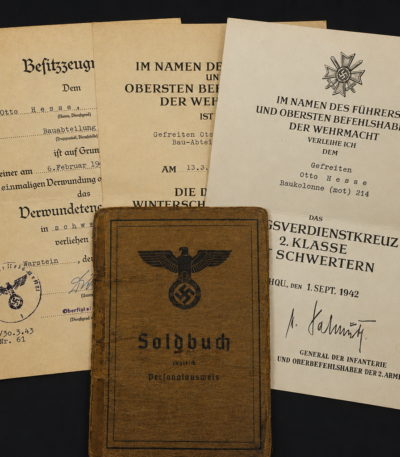
Soldbuch & Award Docs Grouping – Bau-Abteilung & 70. Infanterie-Division Walcheren / Scheldt
€450,00Rare and historically compelling original WWII German Wehrmacht Soldbuch and award document grouping belonging to Otto Hesse, later serving with Pionier-Kompanie 170 of the 70. Infanterie-Division, a unit heavily engaged during the desperate fighting in the Netherlands and the Scheldt estuary in 1944.
The grouping includes Hesse’s original wartime Soldbuch with portrait photograph, together with multiple award documents and extensive service entries documenting his wartime career from early construction and pioneer formations through late-war combat service.
Included in the grouping:
- Original Soldbuch with photo
- Award document for:
- Kriegsverdienstkreuz 2. Klasse mit Schwertern
- Medaille Winterschlacht im Osten 1941/42 (Ostmedaille)
- Verwundetenabzeichen in Schwarz
Documented Units Include:
- Baukompanie 214
- Baukolonne (mot.) 214
- Bauabteilung 214
- Reserve-Pionier-Bataillon 9
- Pionier-Kompanie 170 of the 70. Infanterie-Division
A particularly interesting aspect is the late-war service in the Netherlands during the fighting around Walcheren and the Scheldt estuary. The Soldbuch records a wound entry from late October 1944 with diagnosis code 31a, indicating a bullet wound (Schussverletzung), likely sustained during the fierce combat operations against Allied forces in the Netherlands.
An outstanding and highly researchable late-war Wehrmacht grouping with strong Eastern Front and Western Front historical connections.
Sold out
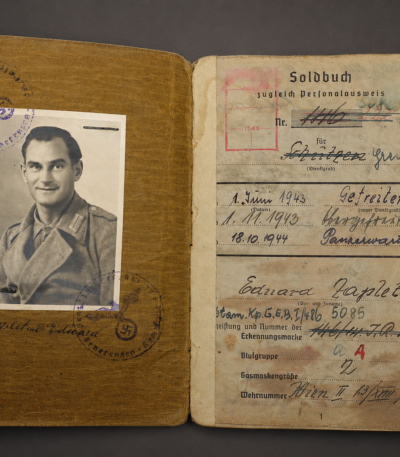
WH Soldbuch to Heeres-Panzerjäger-Abteilung 616 (Jagdpanther Unit) – Ostpreußen 1945
€375,00Original and extensively filled Wehrmacht Soldbuch grouping belonging to Austrian soldier Eduard Zapletal, born 5 October 1913 in Vienna, who ultimately served with the renowned 3. Kompanie/ Heeres-Panzerjäger-Abteilung 616, a late-war heavy tank destroyer battalion equipped with Jagdpanther and Bergepanther vehicles. The 3. Kompanie (detached from the PzJgAbt 616) was the sole company fighting in January 1945 in Ostpreußen with the Jagdpanzer V!
A highly desirable and historically significant late-war Panzerjäger Soldbuch featuring:
- Original portrait photograph in Stug uniform
- Extensive wartime entries, stamps and unit transfers
- Promotion entries up to Panzerwart II
- Multiple interesting weapon issue entries
- Several hospital and recovery entries
- Included Austrian postwar discharge/demobilization document
Documented units include:
- Infanterie-Regiment 462
- Infanterie-Panzerjäger-Ausbildungs-Kompanie 130
- Panzerjäger-Abteilung 46
- Panzerjäger-Kompanie 1192
- schwere Panzerjäger-Abteilung 616 (final combat unit)
The Soldbuch clearly reflects long wartime service from early infantry formations into specialized anti-tank and armored destroyer units during the final phase of the war.
Particularly notable is the final assignment to s.Pz.Jg.Abt. 616, one of the Wehrmacht’s heavy tank destroyer battalions equipped with the formidable Jagdpanther tank destroyer — widely regarded as one of the most effective armored fighting vehicles fielded by Germany during WWII.
The grouping remains in authentic wartime condition with strong field-used character, period wear, staining and extensive handwritten entries throughout. A superb researchable Panzerjäger Soldbuch with excellent display appeal and highly collectible late-war armored-unit associations.

Sold out
Wehrmacht Soldbuch & Führerschein Grouping – Festungs-Pak Verband XXVI / Berlin 1943–1945
€195,00Original and well-filled Wehrmacht Soldbuch and Wehrmacht-Führerschein grouping belonging to Kraftfahrer (later Oberschütze and Gefreiter) Curt Genendsch, born 4 October 1903 in Berlin.
This attractive and researchable grouping follows the military service of a German Army driver from training through late-war fortress anti-tank units and Berlin-area formations.
Highlights include:
- Original Soldbuch with photograph
- Matching Wehrmacht-Führerschein (military driver’s license)
- NSKK qualification for operation of Anthrazit- und Holzgas-Generatorfahrzeuge (wood-gas and anthracite-powered vehicles)
- Wehrmacht-Kommandantur Berlin identification papers
- Detailed service history from 1943 through the final months of the war
- Promotion entries to Oberschütze and later Gefreiter
- Multiple leave, hospital and equipment entries
Documented units include:
- Kraftfahr-Ausbildungs-Abteilung 3 Rathenow
- Standort-Bataillon z.b.V. Berlin
- Festungs-Pak-Ersatz- und Ausbildungs-Abteilung 102
- Festungs-Pak-Kompanie 10
- Festungs-Pak-Verband 6/XXVI
Particularly desirable is the combination of the Soldbuch with the matching military driver’s license and specialized fuel-generator qualification, illustrating the increasingly important role of military transport personnel during Germany’s fuel shortages in the later war years. No awards entered in the Soldbuch.
The documents remain in honest wartime condition with expected wear, handling marks, folds and age toning. The Soldbuch is extensively filled out and offers excellent research potential.
A very interesting late-war Berlin-related Wehrmacht document grouping with strong identification value and clear unit history.

Sold out
Rare Late-War 26. Panzer-Division Document Grouping – Panzer-Artillerie-Regiment 93
€400,00Exceptional and historically rich late-war document grouping belonging to Gefreiter Paul Fromme, serving with 2. Batterie/ Panzer-Artillerie-Regiment 93 of the famed 26. Panzer-Division.
This highly attractive set includes:
- Award document for the Kriegsverdienstkreuz 2. Klasse mit Schwertern dated 30.1.1945
- Official award certificate for wear of the 26. Panzer-Division Traditionsabzeichen dated 24.12.1944 signed by the Abteilungskommandeur
- Document that he is allowed to wear it
- Matching division insignia / sleeve patches
- Accompanying official typed correspondence
- Period handwritten note/card included in the lot
The grouping is especially desirable due to the strong visual appeal of the rare 26. Panzer-Division insignia, featuring the distinctive profile-and-spear emblem associated with the division’s traditions badge. The documents remain in solid original condition with honest age wear, folds, staining, and period handling exactly as expected from authentic wartime paper items.
An excellent research and collector opportunity for advanced German militaria collections focused on armored formations or late-war combat units.

Sold out
WWII German “Kreta” Cuff Title Grouping with EK II Ribbon & Gebirgsjäger Grave Photograph
€750,00Original WWII German “Kreta” campaign cuff title grouping consisting of a veteran-worn Kreta cuff title, an original EK II ribbon, a small ribbon bar with 13. März 1938 Anschluss Medal ribbon and Iron Cross 2nd Class ribbon, together with an original wartime photograph depicting graves of soldiers from Gebirgsjäger-Regiment 100.
The cuff title shows clear period wear and use throughout and has been stitched together, likely during the wartime or immediate postwar period. The piece retains strong character with visible wear, loose threads and age-related traces exactly as expected from an original used example.
The included wartime photograph is especially atmospheric, showing marked field graves of German mountain troops, adding a very personal and historical element to the set.
A highly displayable and authentic Fallschirmjäger / Gebirgsjäger Kreta-related grouping with strong wartime character and undeniable historical appeal.

Sold out
Rare Studio Portrait of Generalfeldmarschall Friedrich Paulus (STALINGRAD!)
€495,00Original scarce original postcard-sized studio portrait of Friedrich Paulus, one of the most significant and controversial German military commanders of the Second World War.
This striking formal portrait depicts Paulus in full German Army uniform, prominently wearing the Knight’s Cross of the Iron Cross at his neck, one of Germany’s highest military decorations. The image captures him at the height of his military career, shortly before his name became forever linked with the dramatic events at Stalingrad.
Friedrich Paulus is best remembered as commander of the German 6th Army during the pivotal Battle of Stalingrad. The battle became one of the largest and bloodiest engagements in military history and marked a decisive turning point on the Eastern Front.
In January 1943, as Soviet forces completed the encirclement of the 6th Army, Adolf Hitler promoted Paulus to the rank of Field Marshal (Generalfeldmarschall). The promotion carried symbolic significance, as no German Field Marshal had ever surrendered in battle. Nevertheless, on 31 January 1943, Paulus surrendered to Soviet forces in Stalingrad, becoming the first German Field Marshal ever taken prisoner by the enemy.
Biography
Born on 23 September 1890 in Breitenau, Germany, Paulus served in the Imperial German Army during the First World War and remained in military service throughout the interwar years. Known as a highly capable staff officer and planner, he rose through the ranks of the Wehrmacht and became one of Germany’s senior commanders during the invasion of the Soviet Union.
Following his capture at Stalingrad, Paulus spent the remainder of the war in Soviet captivity. He later cooperated with anti-Nazi German organizations supported by the Soviet Union and testified at post-war proceedings. He was released in 1953 and died in Dresden in 1957.
Collectors’ Interest
Original period portraits of Friedrich Paulus are highly sought after by collectors of World War II militaria, military photography, German military history, and Eastern Front memorabilia. His direct association with the Battle of Stalingrad—arguably the most famous battle of the Second World War—makes authentic portraits especially desirable historical artifacts.
Sold out
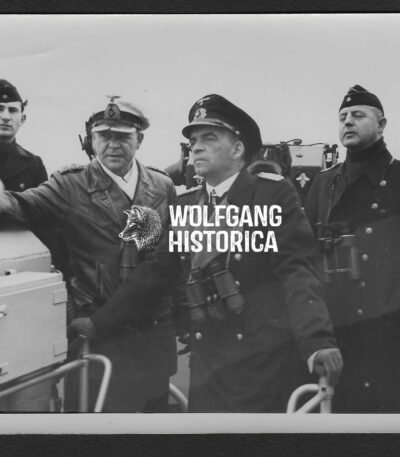
WWII German Kriegsmarine Press Photograph – Generaladmiral Otto Schniewind Inspecting Naval Personnel
€85,00Original German Second World War Kriegsmarine photograph depicting what appears to be Generaladmiral Otto Schniewind, one of the most senior naval commanders of the German Navy during the war.
The image shows Schniewind together with fellow Kriegsmarine officers and naval personnel during an inspection aboard a German naval vessel or coastal command position. Visible are several officers equipped with binoculars and communications gear, emphasizing the operational nature of the scene.
Otto Schniewind was among the most important senior officers of the Kriegsmarine and served as Chief of Staff of the Seekriegsleitung (Naval War Staff) before later becoming Fleet Commander (Flottenchef). Following the loss of Admiral Günther Lütjens during the sinking of the battleship Bismarck, Schniewind assumed a leading role within the operational command structure of the German Navy. He was promoted to Generaladmiral in March 1944 and was a recipient of the Knight’s Cross of the Iron Cross.
Photographs depicting senior Kriegsmarine commanders remain highly desirable among collectors of German naval militaria, particularly when showing operational inspections and command activity.
Condition
- Original wartime photograph.
- No press caption present on reverse.
- Minor age toning and handling wear consistent with age.
- Slight corner wear visible.
- Overall very good historical condition.
- Press Photo Size: 13x8cm
Sold on commission.

Sold out
WWII German Press Photo – Generalfeldmarschall Walter Model and Generaloberst Vitéz Béla Miklós von Lakatos Inspect Hungarian Armored Units near Stanislau
€75,00Original German Second World War press photograph depicting Generalfeldmarschall Walter Model, holder of the Oak Leaves with Swords to the Knight’s Cross of the Iron Cross and commander of a German Army Group on the Eastern Front, together with Generaloberst Vitéz Béla Miklós von Lakatos, commander of a Hungarian field army operating alongside German forces.
The photograph shows the two senior Axis commanders inspecting newly arrived Hungarian armored units deployed in the sector around Stanislau on the Eastern Front. Visible in the foreground is a Hungarian armored fighting vehicle, emphasizing the cooperation between German and Hungarian forces during the later stages of the war in the East.
The reverse retains its original wartime typed press caption, press stampings, and period photographer credit. The caption is dated 21 April 1944 and identifies the image as an official wartime press release.
Original wartime press photographs featuring high-ranking German commanders such as Walter Model are highly collectible, particularly when connected to significant Eastern Front operations and Axis allied military cooperation.
Condition
- Original wartime press photograph.
- Original typed press caption attached to reverse.
- Period press markings and stamps visible.
- Minor age toning and handling wear consistent with age.
- Overall very good historical condition.
- Press Photo Size: 13x18cm
Sold on commission.

Sold out
WWII German Press Photo – Ritterkreuzträger Major d.R. Hans Eichmeier – Kommandeur leichte Flak-Abteilung 854 (v)
€90,00Original German Second World War press photograph depicting Ritterkreuzträger Major der Reserve Hans Eichmeier, commander of leichte Flak-Abteilung 854 (v) of the German Luftwaffe.
The portrait shows Eichmeier wearing the Knight’s Cross of the Iron Cross (Ritterkreuz des Eisernen Kreuzes), Germany’s premier award for battlefield bravery and military leadership. Visible are also the Iron Cross 1st Class and additional wartime decorations. The reverse retains its original wartime typed press caption, period press markings, issue date of 12 July 1944, and original image reference number A 129 636.
According to the original wartime press caption, Eichmeier distinguished himself during the defensive fighting in the Kowel sector on the Eastern Front. For the combat achievements and leadership of his unit, he was awarded the Knight’s Cross of the Iron Cross on 11 June 1944.
The reverse further notes that Eichmeier was born in Munich and was 44 years old at the time of the photograph’s wartime release.
Original press photographs of identified Knight’s Cross recipients remain among the most sought-after fields of German WWII militaria, particularly when accompanied by original wartime captions and identifiable press reference numbers.
Condition
- Original wartime press photograph.
- Original typed press caption attached to reverse.
- Period press markings visible.
- Minor age toning, staining, and handling wear consistent with age.
- Overall good historical condition.
- Press Photo Size: 13x18cm
Sold on commission.

Sold out
WWII German Press Photo – Ritterkreuzträger Hauptmann d.R. Erich Darnedde – Grenadier-Regiment 277
€90,00Original German Second World War press photograph depicting Ritterkreuzträger Hauptmann der Reserve Erich Darnedde, an infantry battalion commander of the German Army (Heer).
The portrait shows Darnedde wearing the Knight’s Cross of the Iron Cross (Ritterkreuz des Eisernen Kreuzes), Germany’s premier award for battlefield bravery and military leadership. The reverse retains its original wartime typed press caption and press markings, including the issue date 26 August 1943 and image reference number 4 122 313.
Darnedde was awarded the Knight’s Cross on 8 February 1943 while serving as commander of the I. Bataillon, Grenadier-Regiment 277, part of the 83. Infanterie-Division on the Eastern Front. His decoration recognized outstanding leadership during the intense defensive battles fought by German infantry formations during the winter campaigns of 1942–1943.
Original press photographs of identified Knight’s Cross recipients remain among the most sought-after categories of German WWII militaria, particularly when the recipient can be positively linked to a specific unit and award.
Condition
- Original wartime press photograph.
- Original typed caption attached to reverse.
- Period press markings visible.
- Minor age toning and handling wear consistent with age.
- Overall very good historical condition.
- Press photo size: 13×18 cm
Sold on commission.

Press Photo: SS-Obergruppenführer Reinhard Heydrich in Prague
€200,00Authentic original wartime German press photograph of Reinhard Heydrich, during the height of WWII. This is a period press photo (not a reproduction), distributed for wartime publication and documentation.
-
Markings: Original press, with period stamps/annotations, consistent with 1940s press distribution.
-
Condition: Very good for age. Minor edge wear and handling marks, typical of original wartime press material. No major tears. Text and imagery remain clear and historically intact.
-
Size: Approx. press photo standard format
-
Provenance: Guaranteed original WWII press issue photograph.
Historical Significance:
This photograph captures a major wartime propaganda and political coordination event focused on Southeastern Europe, attended by senior Reich leadership. The image provides strong collector appeal for:
-
WWII historians and archives
-
Collectors of original Third Reich press material
-
Military memorabilia and wartime photography specialists
-
Museum or research collections requiring primary source imagery

Press Photo: SS-Obergruppenführer Reinhard Heydrich in Prague
€250,00Authentic original wartime German press photograph of Reinhard Heydrich, during the height of WWII. This is a period press photo (not a reproduction), distributed for wartime publication and documentation.
-
Markings: Original press, with period stamps/annotations, consistent with 1940s press distribution.
-
Condition: Very good for age. Minor edge wear and handling marks, typical of original wartime press material. No major tears. Text and imagery remain clear and historically intact.
-
Size: Approx. press photo standard format
-
Provenance: Guaranteed original WWII press issue photograph.
Historical Significance:
This photograph captures a major wartime propaganda and political coordination event focused on Southeastern Europe, attended by senior Reich leadership. The image provides strong collector appeal for:
-
WWII historians and archives
-
Collectors of original Third Reich press material
-
Military memorabilia and wartime photography specialists
-
Museum or research collections requiring primary source imagery

Sold out
SS-Obergruppenführer und General der Waffen-SS Felix Steiner (Schwertern!) – “Wiking” & III. (germanisches) SS-Panzerkorps
€250,00Original Postwar Signature on a Postwar Photo of Felix Steiner. SS-Obergruppenführer und General der Waffen-SS Felix Steiner (23.05.1896 † 12.05.1966) was one of the most well-known senior commanders of the Waffen-SS during the Second World War. He was awarded the Ritterkreuz des Eisernen Kreuzes mit Eichenlaub und Schwertern for his leadership of the SS-Division “Wiking” and later the III. (germanisches) SS-Panzerkorps on the Eastern Front. Steiner gained a reputation for aggressive combat leadership and for commanding multinational Waffen-SS formations composed largely of volunteers from various European countries. Postcardsize.

Sold out
Friedrich Hummel – Secret Operations (!) (Brandenburger, Agent, Frogman …)
€150,00Original Scarce Postwar Signature on a Postwar Photo & Letter of Friedrich Hummel. Hauptmann Friedrich Hummel (08.02.1910 † 10.07.1993) earned the Ritterkreuz des Eisernen Kreuzes on October 19, 1944 as Hauptmann und Kommandeur of Jagdverband Leitstelle West (Frontaufklärungsverband II West).
Friedrich Hummel was a former Brandenburger, Defense II agent, sea fighter, lieutenant captain of the small combat units (K-units) of the Navy and commander of Lehrkommando 700. The intelligence officer was the head of numerous special units and the leading practitioner of ship sabotage in the German Wehrmacht. In the last months of the war, Major Hummel was the operational planner of the SS combat swimmers with the simultaneous rank of SS Hauptsturmfuhrer of the Waffen SS. (Read more on Friedrich Hummel (Metapedia))
Sold out
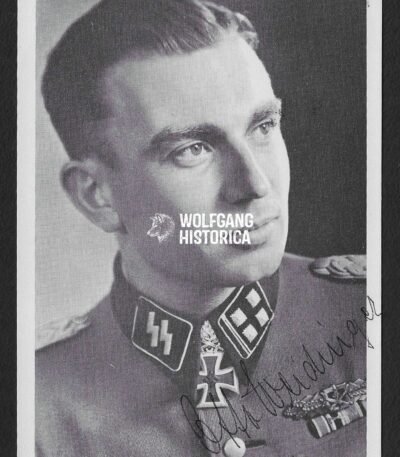
Otto Weidinger – 2. SS-Panzer-Division “Das Reich” (Schwertern)
€150,00Original Postwar Signature on a Card of Otto Weidinger. SS-Obersturmbannführer Otto Weidinger (27.05.1914 † 11.01.1990) earned the Ritterkreuz on April 21, 1944 as SS-Sturmbannführer und Kommandeur of the SS-Panzer-Aufklärungs-Abteilung “Das Reich”, the Eichenlaub on December 27, 1944 as SS-Obersturmbannführer und Kommandeur of the SS-Panzer-Grenadier-Regiment 4 “Der Führer” and Schwertern on May 6, 1945 as SS-Obersturmbannführer und Kommandeur of the SS-Panzer-Grenadier-Regiment 4 “Der Führer” of the 2. SS-Panzer-Division “Das Reich“. Postcardsize.
Sold out
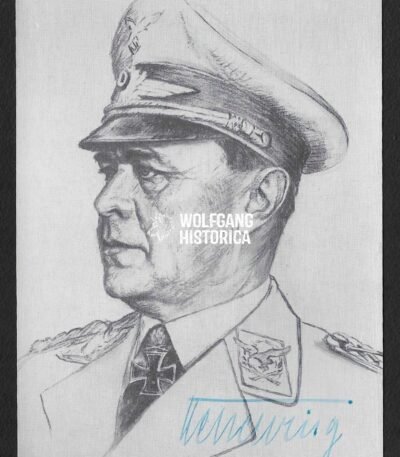
Albert Kesselring – Generalfeldmarschall (Schwertern!)
€65,00Original Postwar Signature on a Postwar Photo of Albert Kesselring. Generalfeldmarschall Albert Kesselring (30.11.1885 † 16.07.1960) was one of the most prominent senior commanders of the Luftwaffe and later the German Armed Forces during the Second World War. He was awarded the Ritterkreuz des Eisernen Kreuzes mit Eichenlaub und Schwertern for his leadership during the campaigns in Poland, France, the Mediterranean, and Italy. As Oberbefehlshaber Süd and later Oberbefehlshaber Südwest, Kesselring became particularly known for organizing the stubborn German defense of Italy against the Allied advance between 1943 and 1945. Postcardsize.
Sold out
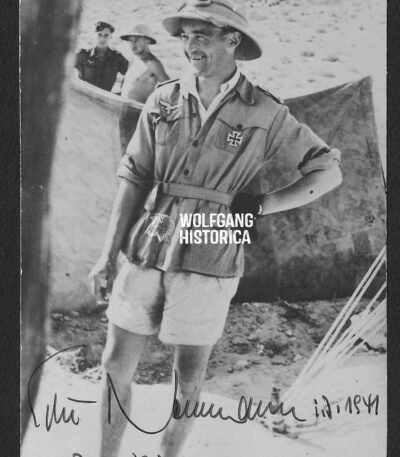
Eduard Neumann – Jagdgeschwader 27 “Afrika”
€35,00Original Postwar Signature on a Postwar Photo of Eduard Neumann. Oberst Eduard “Edu” Neumann (05.06.1911 † 09.08.2004) was a highly respected Luftwaffe fighter ace and commander of Jagdgeschwader 27 “Afrika” during the North African Campaign. He was awarded the Deutsches Kreuz in Gold on 11 May 1942 as Hauptmann and Gruppenkommandeur of I./Jagdgeschwader 27 in recognition of his outstanding leadership and combat achievements during the air war over North Africa. Under his command, I./JG 27 became one of the Luftwaffe’s most successful fighter groups, playing a key role in the desert campaign and producing renowned aces such as Hans-Joachim Marseille. Postcardsize.
Sold out
Ernst Tiburzy – Volkssturm-Bataillon 25/82, Festung Königsberg
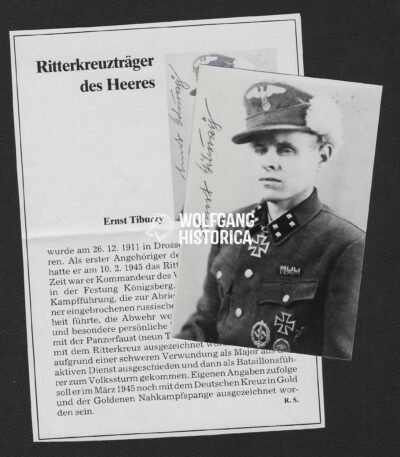
€35,00Original Postwar Signature on a Postwar Photo of Ernst Tiburzy. Major Ernst Tiburzy (26.12.1911 † 15.01.2004) earned the Ritterkreuz des Eisernen Kreuzes on February 10, 1945 as Volkssturm-Bataillonsführer of Volkssturm-Bataillon 25/82 in the Festung Königsberg. During the heavy defensive fighting in East Prussia, Tiburzy reportedly distinguished himself through determined close-combat leadership and the destruction of several Soviet tanks with the Panzerfaust while organizing the defense against repeated Soviet breakthroughs. For these actions and his personal bravery during the final battles for Königsberg, he was awarded the Ritterkreuz des Eisernen Kreuzes. Size: 12,3×8,2cm.

Sold out
Soviet WWII Campaign Medal “For the Defence of Stalingrad”
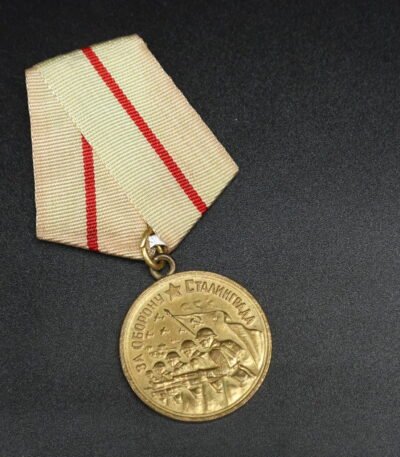
€85,00Authentic Soviet Medal “For the Defence of Stalingrad” (Russian: Медаль «За оборону Сталинграда»), awarded for participation in the defence of the city during the pivotal battle of Stalingrad (1942–1943).
The medal is struck in brass and measures 32 mm in diameter with a raised rim. The obverse depicts a dynamic battle scene of five Soviet infantry soldiers advancing with rifles, supported by tanks and aircraft, with a waving Soviet flag above. At the top is a five-pointed star, flanked by the inscription “FOR THE DEFENCE OF STALINGRAD” («ЗА ОБОРОНУ СТАЛИНГРАДА»).
The reverse features the hammer and sickle emblem above the inscription “FOR OUR SOVIET MOTHERLAND” («ЗА НАШУ СОВЕТСКУЮ РОДИНУ»).
The medal is suspended from a standard Soviet pentagonal mount and worn on a 24 mm olive-green silk moiré ribbon with a central red stripe. The ribbon shows age-related wear with light soiling, minor staining, and fraying to the edges, consistent with period use and storage. Overall remains intact and displays well.
Condition: As shown in photographs.
Sold out
Soviet WWII Campaign Medal “For the Defence of Stalingrad”
€70,00Authentic Soviet Medal “For the Defence of Stalingrad” (Russian: Медаль «За оборону Сталинграда»), awarded for participation in the defence of the city during the pivotal battle of Stalingrad (1942–1943).
The medal is struck in brass and measures 32 mm in diameter with a raised rim. The obverse depicts a dynamic battle scene of five Soviet infantry soldiers advancing with rifles, supported by tanks and aircraft, with a waving Soviet flag above. At the top is a five-pointed star, flanked by the inscription “FOR THE DEFENCE OF STALINGRAD” («ЗА ОБОРОНУ СТАЛИНГРАДА»).
The reverse features the hammer and sickle emblem above the inscription “FOR OUR SOVIET MOTHERLAND” («ЗА НАШУ СОВЕТСКУЮ РОДИНУ»).
The medal is suspended from a standard Soviet pentagonal mount and worn on a 24 mm olive-green silk moiré ribbon with a central red stripe. The ribbon shows age-related wear with light soiling, minor staining, and fraying to the edges, consistent with period use and storage. Overall remains intact and displays well. Ribbon could be replaced.
Condition: As shown in photographs.
Sold out
Belgian “Korea” (BUNC) Battledress
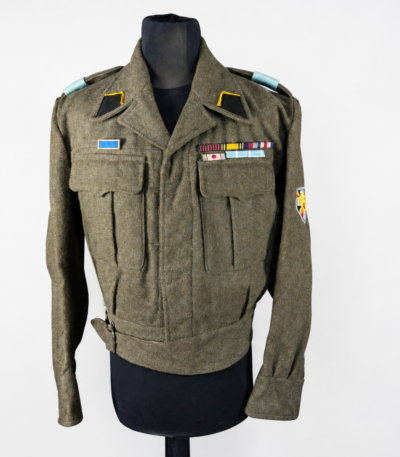
€395,00Original Belgian BUNC (Belgian United Nations Command) Korean War battledress blouse. This postwar Belgian Army example is fitted with period-applied Korean War insignia including the “BELGIUM” shoulder title, “KOREA” shoulder tab, lion-head divisional patch and blue-and-white formation insignia.
Interestingly, the 3rd Division patch is sewed on mirrored (lines should face the other way) but I found evidence in a documentary, where this also occured!
The battledress retains multiple ribbon bars (incl. WWII awards and Korea awards), US Unit Citation, and qualification insignia, giving the uniform a strong and attractive veteran appearance. Inside is the original maker/tailor label marked “Et. Maurice Delholle – BUNCOR”, dated 1949.
A very displayable and increasingly uncommon Belgian Korean War uniform with excellent historical character.
Condition is good overall with normal age and service wear. Insignia remain well preserved and the uniform displays very nicely. Exact condition as shown in the photographs.

Sold out
Hans Traupe – SS-Polizei-Grenadier-Regiment 3
€55,00Original Postwar Signature on a Postwar Photo & Letter of Hans Traupe. SS-Obersturmbannführer Hans Traupe (04.05.1913 † 23.06.2004) earned the Ritterkreuz on February 23, 1944 as SS-Sturmbannführer und Kommandeur of the I. Bataillon/ SS-Polizei-Grenadier-Regiment 3 of the 4. SS-Polizei-Panzergrenadier-Division. Good condition. Measuring: Postcardsize.

Sold out
Alfred Schneidereit – SS-Panzer-Grenadier-Regiment 1 “LSSAH”
€45,00Original Postwar Signature on a Postwar Photo of Alfred Schneidereit. SS-Untersturmführer Alfred Schneidereit (29.10.1919 † 21.02.1999) earned the Ritterkreuz on December 20, 1943 as SS-Unterscharführer in the 8. Kompanie/ SS-Panzer-Grenadier-Regiment 1 “LSSAH” of the 1. SS-Panzer-Division “LSSAH“. Good condition. Size: 7×12 cm.
Sold out
Fritz Darges – SS-Panzer-Regiment 5 “Wiking” & Personal Adjutant of Adolf Hitler
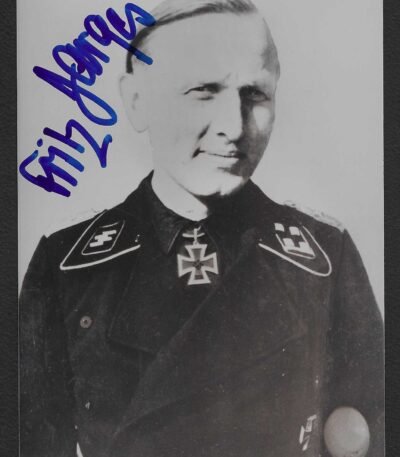
€45,00Original Postwar Signature on a Postwar Paper of Fritz Darges. SS-Obersturmbannführer Fritz Darges (08.02.1913 in Dülseberg † 25.10.2009 in Celle) earned the Ritterkreuz des Eisernen Kreuzes on April 5, 1945 as SS-Obersturmbannführer und Führer of the SS-Panzer-Regiment 5 of the 5. SS-Panzer-Division “Wiking”. Condition as seen. NOTE: The signature is written on a paper on which a photo in pasted!
He served as an Adjutant to Martin Bormann and later was a personal Adjutant to Adolf Hitler. After his death a manuscript with his memoirs was published. Read more on Fritz Darges (Wikipedia)
Sold out
Paul Senghas – SS-Panzer-Regiment 5 “Wiking”
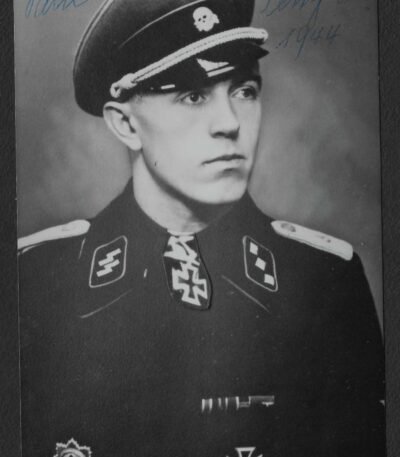
€50,00Original Postwar Signature on a Postwar Photo of Paul Senghas. SS-Hauptsturmführer Paul Senghas (31.01.1916 † 06.11.1996) earned the Ritterkreuz des Eisernen Kreuzes on December 11, 1944 as SS-Obersturmführer und Führer of the I. Abteilung/ SS-Panzer-Regiment 5 of the 5. SS-Panzer-Division “Wiking”. Condition as seen. Postcardsize.
“On the 18.08.1944 the enemy advanced towards the Warsaw-Radzymin-Wyszkow road with massive forces and strong air support. At the time the 5. SS-Panzer-Division ‘Wiking’ was located along the general line Roszcep-Trojany-Debynki. At the time SS-Obersturmführer Senghas stood as the leader of the Stabskompanie along with the supply units of the I./SS-Panzer-Regiment 5 in Zazdroso (1.5 km east of Niegow).
At 11:00 he received a message which reported the Russians as having broken through in battalion strength to a point 1 km east of the railway embankment. A wide gap existed towards the left neighbour, and there was the danger that the Russians would block the main road and thrust into the left flank of the Division. Recognizing this danger, Senghas made the decision to engage the enemy with the handful of men in the supply units at hand (despite their lack of heavy infantry weapons) and bring the Russians to a halt.
Going into position at the railway embankment, he let the Russians approach to within very close range and then smashed their attack. Reinforcements could not be brought up, and so Senghas defended with his handful of men for the remainder of that day and also the two following days, fighting off strong enemy attacks with only rifles, sub-machine guns and close combat weapons. During this time 2 Panzer IVs, which had been in the repair shop and were only conditionally operational, were brought into the fight. 2 Sherman tanks and 1 T-34 were destroyed immediately after they appeared. The Russians took heavy losses in men and ceased their attacks.
By his own initiative and personal devotion to duty, Senghas thus brought the 3 days of close combat to a conclusion. An enemy breakthrough was prevented and the danger to the left flank of the Division removed. Senghas is one of the oldest Eastern front combat veterans, who has mastered many critical situations through swift decisiveness and bold action while ruthlessly demanding the utmost of himself.”
Sold out
Heinrich Springer – “LSSAH” & “Hitlerjugend” Division (Normandy, Arnhem)
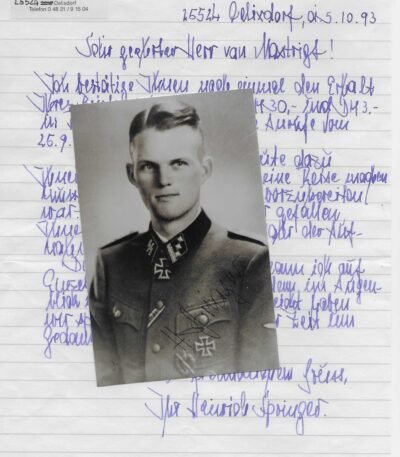
€65,00Set of Heinrich Springer! Including original Postwar Signature on a Postwar Photo of Heinrich Springer. SS-Sturmbannführer Heinrich Springer (03.11.1914 † 27.10.2007) earned the Ritterkreuz des Eisernen Kreuzes on January 12, 1942 as SS-Hauptsturmführer und Führer of the 3. Kompanie/ “Leibstandarte-SS Adolf Hitler”. Postcardsize. Comes with a letter!
Sold out
Franz-Josef Krombholz – SS-Freiwilligen-Gebirgsjäger-Regiment 14 “Skanderbeg”
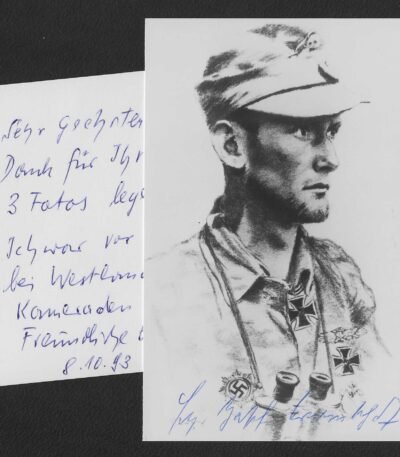
€75,00Original Postwar Signature on a Postwar Photo + Card of Franz-Josef Krombholz. SS-Hauptsturmführer Franz-Josef Krombholz (13.08.1920 † 13.12.2000) earned the Deutsches Kreuz in Gold on April 24, 1944 with the SS-Freiwilligen-Gebirgsjäger-Regiment 14 “Skanderbeg” and the Ritterkreuz on March 28, 1945 as SS-Hauptsturmführer und Kommandeur of the III. Bataillon/ SS-Freiwilligen-Gebirgsjäger-Regiment 14 “Skanderbeg” of the 7. SS-Freiwilligen-Gebirgs-Division “Prinz Eugen“.