



Shop
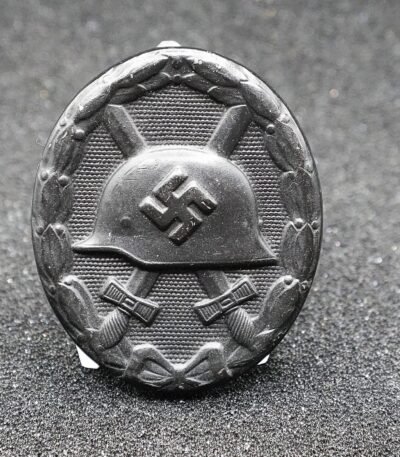
Wound Badge in Black – Unmarked
€45,00Original German Wound Badge in Black (Verwundetenabzeichen in Schwarz), produced in iron (Eisen) and remaining unmarked.
A classic wartime example of the 1939-pattern Wound Badge, featuring the characteristic blackened iron construction and original period pin-back assembly.
The badge is offered in condition as shown, with natural signs of age and wear consistent with an original wartime example.
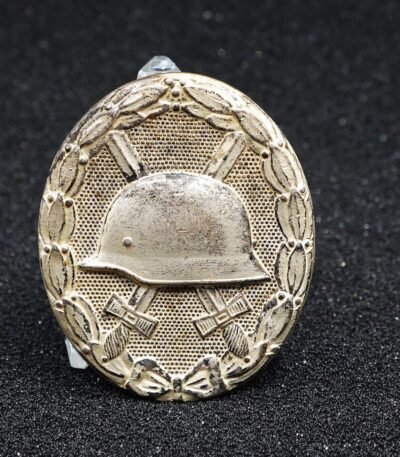
Wound Badge in Silver – 1957 Pattern – Unmarked (Steinhauer & Lück, Lüdenscheid)
€55,00Original post-war Wound Badge in Silver (Verwundetenabzeichen in Silber), produced in the 1957 pattern and attributed to Steinhauer & Lück, Lüdenscheid.
This example is unmarked, with the manufacturer attribution based on its construction and known characteristics associated with Steinhauer & Lück production.
The 1957 version was produced for wear by former recipients while complying with the post-war regulations concerning the removal of prohibited National Socialist symbols. The central swastika was therefore replaced by a neutral oak-leaf motif.
A desirable example for collectors of German awards and post-war reissues, particularly those interested in the continued production and wear of former wartime decorations.
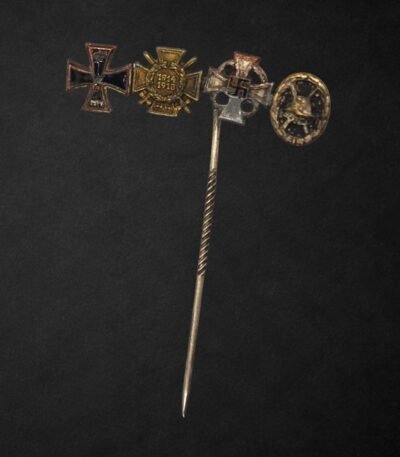
WWII Miniature Medal Bar Stickpin – EK, HC, TD, VWA
€45,00Original German period miniature medal bar stickpin, featuring four finely detailed miniature decorations mounted side by side on a long decorative stickpin.
The miniatures appear to represent:
- Iron Cross 1914
- Honour Cross of the World War 1914/1918 (Hindenburg Cross)
- Loyal Service Medal
- Wound Badge
The reverse shows the individual miniature components attached to the horizontal mounting bar. The long stickpin features a decorative twisted section and remains intact. Attractive age-related patina and wear throughout.
An appealing miniature representation of a veteran’s combination of military decorations and an equestrian award, intended for wear on civilian clothing.
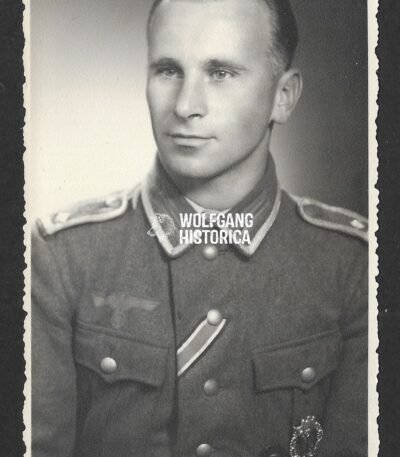
Studioportrait Wehrmacht NCO wearing ISA & VWA
€10,00Original Wehrmacht (Heer) studioportrait of a soldier wearing awards (Verwundetenabzeichen in Schwarz and Infanterie-Sturmabzeichen). Postcardsize. Condition as seen.
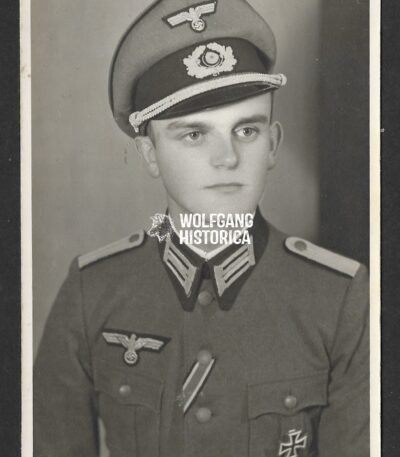
Studioportrait Wehrmacht Officer wearing ASA, VWA & EK1
€15,00Original Wehrmacht (Heer) studioportrait of an officer wearing awards (Allgemeines-Sturmabzeichen, Verwundetenabzeichen in Schwarz and Eisernes Kreuz 1. Klasse). Beautiful embroided wreath and concarde on the visor Postcardsize. Condition as seen.
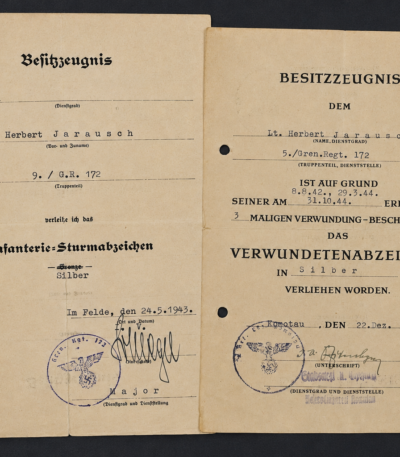
Infantry Assault Badge in Silver & Wound Badge in Silver Document Group – Leutnant in Grenadier-Regiment 172 (75. Infanterie-Division)
€130,00Original WWII German award document grouping belonging to Leutnant Herbert Jarausch of 5. Kompanie/ Grenadier-Regiment 172 of the 75. Infanterie-Division, consisting of two original award certificates documenting frontline combat service and multiple wounds sustained in action.
The group includes award certificates of the:
Infanterie-Sturmabzeichen in Silber (Infantry Assault Badge in Silver) issued to: Gefreiter Herbert Jarausch of the 9./Grenadier-Regiment 172 on 24 May 1943. The Infantry Assault Badge in Silver was awarded to infantry soldiers who participated in numerous infantry assaults and close-combat operations while serving on the front line.
Verwundetenabzeichen in Silber (Wound Badge in Silver) issued to: Leutnant Herbert Jarausch
of the 5./ Grenadier-Regiment 172 on 22 December 1944 in Komotau
The document records that the recipient had suffered wounds on:
- 8 August 1942
- 29 March 1944
- 31 October 1944
A total of three combat wounds, qualifying him for the Wound Badge in Silver.
Both documents bear original signatures and official unit stamps.
Good original condition with expected wartime folds, filing holes, age toning, and handling wear. Both documents remain fully legible and display well.
A desirable combat award grouping documenting both frontline assault service and multiple battle wounds sustained by a soldier who rose from enlisted rank to officer during the war.
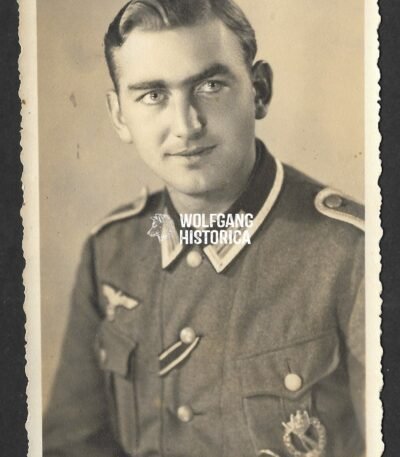
Studioportrait Wehrmacht Soldier wearing ISA & VWA
€10,00Original Wehrmacht (Heer) studioportrait of a soldier wearing awards (Infanterie-Sturmabzeichen and Verwundetenabzeichen in Schwarz). Postcardsize. Condition as seen.
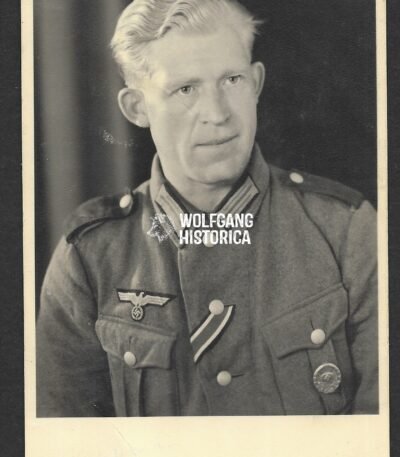
Studioportrait Wehrmacht Soldier wearing VWA (Krummhubel-Bruckenberg)
€10,00Original Wehrmacht (Heer) studioportrait of a soldier wearing awards (Verwundetenabzeichen in Silber/Gold). Shouderboards upside down? Taken in Krummhubel-Bruckenberg. Postcardsize. Condition as seen.
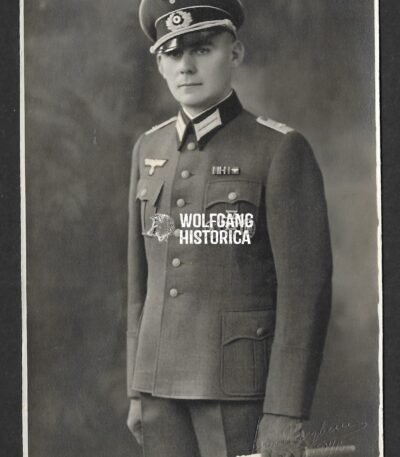
Studioportrait Wehrmacht Officer wearing EK1, DRL & VWA (Stargard, Pommern)
€10,00Original Wehrmacht (Heer) studioportrait of an officer wearing awards (Verwundetenabzeichen in Schwarz, DRL-Sportabzeichen and Eisernes Kreuz 1. Klasse). Taken in Stargard, Pommern. Postcardsize. Condition as seen.
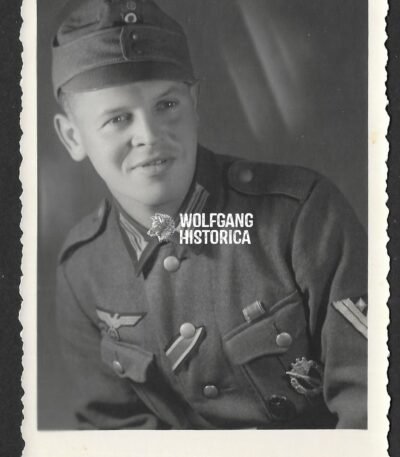
Studioportrait Wehrmacht Soldier wearing ISA & VWA
€10,00Original Wehrmacht (Heer) studioportrait of a soldier wearing awards (Infanterie-Sturmabzeichen & Verwundetenabzeichen in Schwarz also the 13. März 38 ribbon bar) and field cap. Postcardsize. Condition as seen.
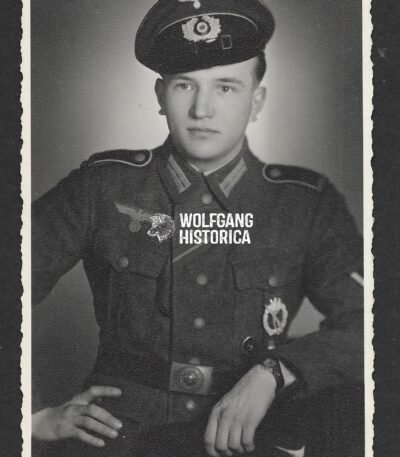
Studioportrait Wehrmacht Soldier wearing ISA & VWA (Wien)
€10,00Original Wehrmacht (Heer) studioportrait of a soldier wearing awards (Infanterie-Sturmabzeichen & Verwundetenabzeichen in Schwarz). Taken in Wien. Postcardsize. Condition as seen.
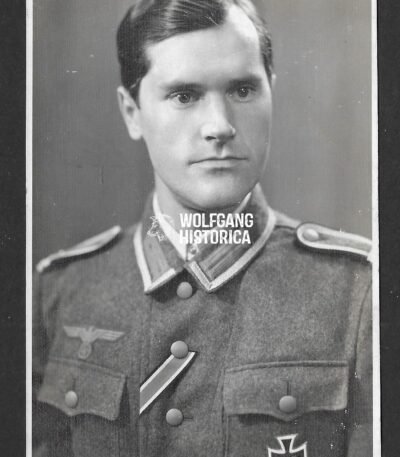
Studioportrait Wehrmacht NCO wearing EK1 & VWA
€15,00Original Wehrmacht (Heer) studioportrait of a NCO wearing awards (Eisernes Kreuz 1. Klasse & Verwundetenabzeichen in Schwarz). Postcardsize. Condition as seen.
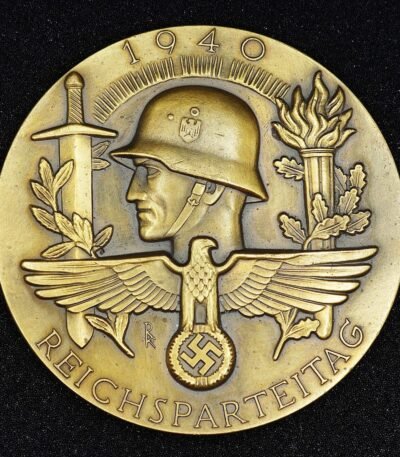
Reichsparteitag 1940 – Large Deschler München Plaque – Richard Klein
€1.000,00Large original German Third Reich Reichsparteitag 1940 commemorative plaque, designed by the renowned German sculptor and medallist Richard Klein and manufactured by Deschler, München. This is a prototype since due the war the Reichsparteitag 1940 never took place!
The obverse features the profile of a German soldier wearing a Stahlhelm, flanked by a sword and a torch surrounded by oak and laurel leaves. Beneath the soldier is the German eagle holding the wreath with swastika, with the inscription: “REICHSPARTEITAG 1940”
The reverse features a large laurel wreath surrounding the inscription: “Nur tapfere Völker haben Geschichte” (“Only brave peoples have history”). The reverse is clearly marked DESCHLER MÜNCHEN. Size: 8,5 cm diameter.
The 1940 Reichsparteitag in Nürnberg was ultimately cancelled and never held, making surviving prototype examples of the associated commemorative pieces interesting historical objects.
This example displays attractive age-related patina and surface toning throughout. The detailed relief remains well defined, with the original finish giving the piece a particularly attractive appearance.
A substantial and impressive Third Reich period commemorative piece, particularly suitable for collectors of German medals, plaques and political memorabilia.
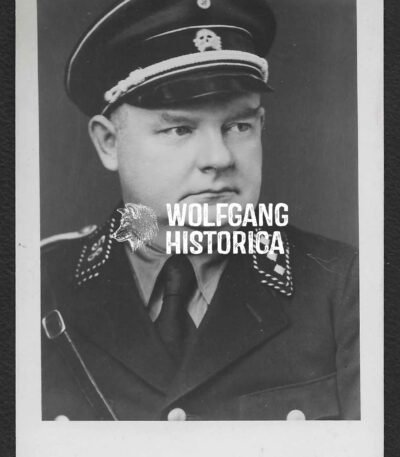
Signed Portrait of (SS-Oberführer) Dr. Heinrich Glasmeier – Reichsrundfunkintendant – Early 1934 (!)
€495,00Original period portrait photograph of Dr. Heinrich Glasmeier (1892–1945), shown wearing an early SS uniform and bearing a personal handwritten dedication and signature on the reverse, dated 1934.
Glasmeier was an important figure in the German broadcasting system during the National Socialist period. In April 1933 he was appointed Intendant of Westdeutsche Rundfunk GmbH in Cologne, a position he held until 1937. He subsequently became Reichsrundfunkintendant and General Director of the Reichs-Rundfunk-Gesellschaft. Glasmeier had also been a member of the SS since 1933.
The photograph shows Glasmeier in an early period SS uniform and is accompanied on the reverse by a contemporary handwritten personal inscription and his signature, dated 1934. The date corresponds perfectly with his position as head of the Westdeutsche Rundfunk at the time.
Glasmeier ultimately attained the rank of SS-Oberführer in 1939, his highest rank within the SS. He remained Reichsrundfunkintendant and General Director of the Reichs-Rundfunk-Gesellschaft until the final months of the war. In May 1945, as U.S. forces approached St. Florian, Glasmeier fled towards the front in the direction of Graz and Wiener Neustadt. He disappeared and was never seen again. He was officially declared dead by the Münster District Court in 1950, although the exact circumstances and date of his death remain uncertain.
The combination of an original period portrait, a personal dedication, and a contemporary signature makes this a particularly interesting piece for collectors of original German political history, autographs, SS-related material, and the history of German broadcasting.
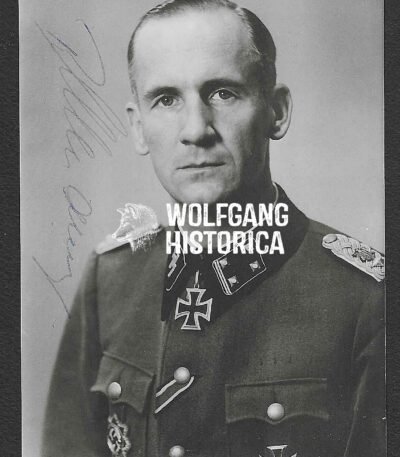
Rudolf Lehmann – 1. SS-Panzer-Division “LSSAH”
€175,00Original Scarce Postwar Signature on a Postwar Photo of Rudolf Lehmann. SS-Obersturmbannführer Rudolf Lehmann (30.01.1914 Heidelberg † 17.09.1983 Ettlingen) earned the Ritterkreuz des Eisernen Kreuzes on February 23, 1944 as SS-Obersturmbannführer und Ia of the 1. SS-Panzer-Division “Leibstandarte-SS Adolf Hitler”. There’s sources mentioning him earning the Eichenlaub on May 6, 1945 but no evidence found. Postcardsize.
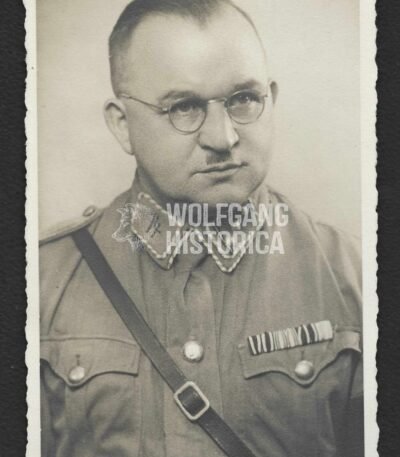
Sturmabteilung (SA) Officer Portrait – Nürnberg
€65,00Original period portrait photograph of an SA officer, photographed by the Nürnberg studio Photo-Noris, Nürnberg, Färberstr. Ecke Breitegasse.
The portrait shows the officer wearing his SA uniform with period collar insignia and a substantial ribbon bar, presenting a particularly clear and well-preserved study of an SA officer’s uniform and decorations.
The reverse retains the original Photo-Noris Nürnberg photographer’s imprint, providing useful period provenance and confirming the professional photographic studio responsible for the portrait.
A very attractive original photograph for collectors of SA militaria, German political organizations, uniforms, decorations and original period photography.
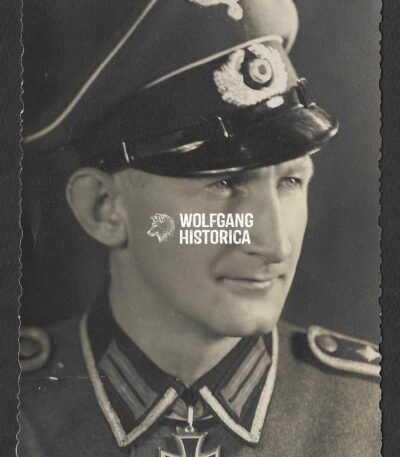
Studioportrait Ritterkreuzträger Anton Bayer – Grenadier-Regiment 19 (7. Infanterie-Division)
€150,00Original wartime studio portrait postcard-size photograph of Oberfeldwebel Anton Bayer (1914–1996), Knight’s Cross holder of Grenadier-Regiment 19 / 7. Infanterie-Division, with his original postwar autograph on the reverse.
A very attractive original portrait of Oberfeldwebel Anton Bayer, a highly decorated German Army anti-tank specialist and recipient of the Ritterkreuz des Eisernen Kreuzes.
The photograph shows Bayer in uniform wearing the Knight’s Cross of the Iron Cross, awarded to him on 5 October 1943 for his actions on the Eastern Front. He served as a Zugführer in 14.(Panzer-Jäger)/Grenadier-Regiment 19, 7. Infanterie-Division. Contemporary and specialist sources document Bayer’s Ritterkreuz award in this capacity.
Bayer had entered military service with the anti-tank company of Infanterie-Regiment 19 in 1936 and served with the regiment during the campaigns in Poland, France and the Soviet Union. Following the reorganisation of the regiment, he continued with 14. Kompanie/Grenadier-Regiment 19, later designated Grenadier-Regiment 19 “List”, of the 7. Infanterie-Division.
His Knight’s Cross was awarded following a particularly notable action on 27 August 1943. During heavy fighting, Soviet T-34 tanks broke through the German defensive positions. Bayer had prepared an anti-tank position on elevated ground, but the attacking armour quickly knocked out the available Pak guns. When the crew of the final operational gun was put out of action, Bayer personally took over the weapon and engaged the Soviet tanks.
According to the Ritterkreuz recommendation, Bayer succeeded in destroying several attacking T-34s before using his remaining ammunition to immobilise additional tanks. He then destroyed the gun to prevent its capture and fought his way back to the German lines armed only with his pistol. His actions helped prevent the Soviet armour from penetrating into the German rear and allowed his regiment to withdraw.
Bayer’s other decorations included the Eisernes Kreuz 2. Klasse, Eisernes Kreuz 1. Klasse, Infanterie-Sturmabzeichen, Ostmedaille, Nahkampfspange in Bronze and Verwundetenabzeichen.
Anton Bayer was born on 30 May 1914 and died on 7 July 1996. At the end of the war he was taken prisoner by Soviet forces on 8 May 1945 and remained in Soviet captivity until 10 April 1948.
The photograph
The item consists of an original wartime studio portrait in postcard format, showing Bayer wearing his Knight’s Cross. The reverse bears a handwritten postwar signature by Anton Bayer, making this a particularly desirable combination of an original wartime portrait and signed Ritterkreuzträger photograph.
The photograph retains its original scalloped photographic edges and shows normal age-related handling/storage wear consistent with an original period photograph.
An excellent portrait for collectors of Ritterkreuzträger, Grenadier-Regiment 19, 7. Infanterie-Division, Panzerjäger personnel and signed Wehrmacht photographs.
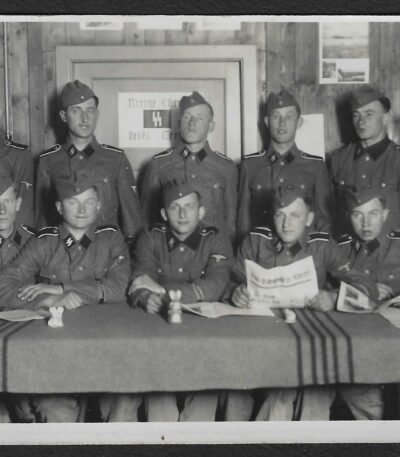
Rare Waffen-SS Group Photograph with “Das Schwarze Korps” Newspaper & “Meine Ehre heißt Treue” Motto
€150,00Original wartime Waffen-SS group photograph depicting ten SS soldiers posed indoors around a table. One of the men is prominently holding an issue of the official SS newspaper “Das Schwarze Korps”. Particularly noteworthy is the wall display behind the group featuring the famous Waffen-SS motto “Meine Ehre heißt Treue”, making this an especially desirable and well-composed period image.
The soldiers wear early Waffen-SS uniforms with shoulder straps and collar tabs, providing an excellent study piece of wartime SS uniforms and barracks life. The combination of the official SS newspaper together with the prominently displayed unit motto creates an uncommon and highly displayable photograph.
A scarce original wartime Waffen-SS photograph in very good condition, ideal for collectors of SS photographs, documents, and historical militaria.
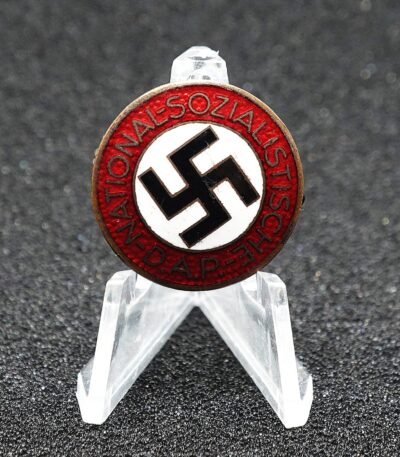
NSDAP Parteiabzeichen – RZM M1/23 – Wilhelm Borgas (Rare Maker!)
€195,00A fine original German Third Reich period NSDAP Parteiabzeichen featuring the classic red, white and black enamel design with the inscription “NATIONAL-SOZIALISTISCHE D.A.P.”
The reverse is clearly marked RZM M1/23, identifying the manufacturer as Wilhelm Borgas, Eutingen. M1/23 is regarded as a relatively scarce manufacturer code among NSDAP Parteiabzeichen collectors.
The badge retains its original pin and catch. The enamel shows some age-related wear and minor imperfections, together with natural patination to the reverse. Overall, an attractive period example with a desirable and less commonly encountered maker marking.
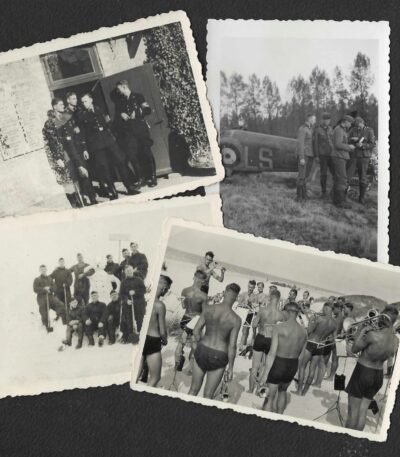
4x (Waffen-)SS Photographs – LAH – SS-VT
€100,00Original 4x 4x (Waffen-)SS Photographs – LAH – SS-VT. 6x9cm.
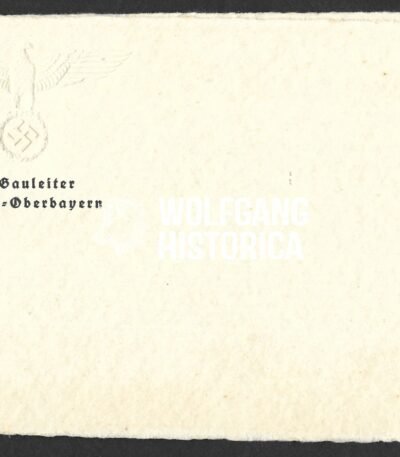
Wartime Signed New Year’s Greeting Card Signed by Gauleiter and Staatsminister Adolf Wagner
€250,00Original folding New Year’s greeting card from Adolf Wagner (1 October 1890 – 12 April 1944), Gauleiter of Munich–Upper Bavaria (München–Oberbayern) and Bavarian State Minister (Staatsminister). Wagner was one of the early members of the NSDAP and a senior political leader in Bavaria, holding the dual posts of Gauleiter and Minister of the Interior until his death in 1944.
The card bears the printed message:
“Zum Jahreswechsel sende ich Ihnen auch im Namen meiner Frau die besten Glückwünsche” (“At the turn of the year, I send you, also in the name of my wife, my best wishes”).
Signed in ink “Adolf Wagner” below the printed title Staatsminister. The cover shows the embossed eagle and swastika emblem above the printed letterhead Der Gauleiter München–Oberbayern.
Item Details
-
Original wartime New Year’s greeting card from Gauleiter and Staatsminister Adolf Wagner.
-
Signed in ink on the interior.
-
Embossed party eagle and printed heading on the front panel.
-
Format: Folding card, approx. 10 × 15 cm when closed.
-
Condition: Excellent; minimal age toning and handling wear. Signature remains bold and well preserved.
Collector’s Note
A fine and authentic example of official correspondence from Adolf Wagner, one of the highest-ranking regional leaders of the NSDAP and a key political figure in Bavaria. Such personally signed seasonal greeting cards were distributed to selected officials and associates, and examples with intact embossing and clear signatures are scarce and historically valuable.
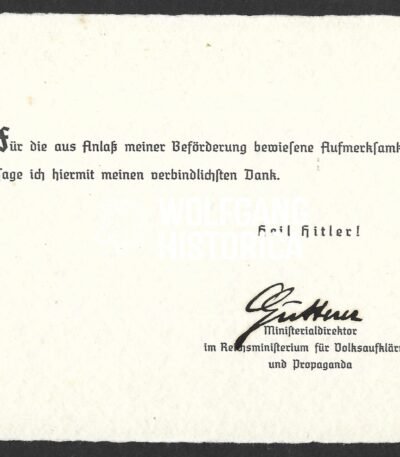
Wartime Signature on a Thank-You Card of Ministerialdirektor Leopold Gutterer
€195,00This original wartime thank-you card, personally signed by Leopold Gutterer , was issued on the occasion of his promotion within the Ministry. The printed text expresses gratitude for the attention shown upon his advancement, ending with his handwritten signature in black ink. Leopold Gutterer (25 April 1902 – 28 April 1991) was a senior official (Ministerialdirektor) in the Reich Ministry for Public Enlightenment and Propaganda (Reichsministerium für Volksaufklärung und Propaganda), serving directly under Joseph Goebbels. A long-time civil servant and National Socialist administrator, Gutterer held influential posts related to press, film, and cultural coordination during the war years.
Item Details
-
Original wartime signature of Ministerialdirektor Leopold Gutterer.
-
Issued on a printed official thank-you card marking his promotion.
-
Institution: Reich Ministry for Public Enlightenment and Propaganda, Berlin.
-
Medium: Heavy stock card with deckle edges, period typeface, and ink signature.
-
Size: Approx. 10 × 15 cm (postcard format).
-
Condition: Very good; light age-related toning and minimal edge wear. Signature remains clear and well preserved.
Collector’s Note
Authentic signed material from senior officials of the Propaganda Ministry is scarce, especially from Ministerialdirektor Leopold Gutterer. This example illustrates the formal bureaucratic correspondence and ceremonial culture within the Reich’s propaganda administration. A historically valuable document for collectors of Third Reich political and administrative ephemera.
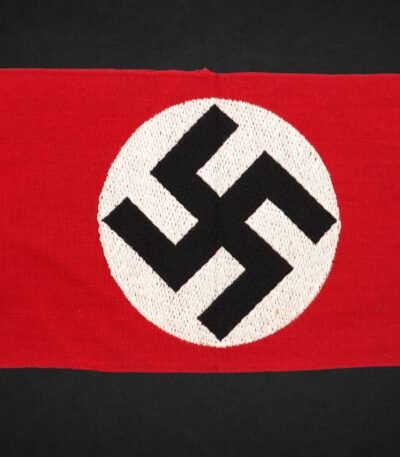
NSDAP Member’s Armband (Armbinde) – BeVo Wuppertal Variant
€250,00Original NSDAP Member’s Armband (Armbinde). This classic NSDAP political armband is manufactured from red cotton with stitched edges and features a finely machine-woven black swastika on a white roundel, woven directly into the red cotton armband. This high-quality construction is commonly associated with BeVo (Bandfabrik Ewald Vorsteher), Wuppertal, one of Germany’s leading manufacturers of woven insignia during the Third Reich period. The reverse displays the characteristic woven construction associated with this desirable variant. A rare and highly collectible original BeVo-type NSDAP member’s armband, preserved in good used condition with honest period wear.
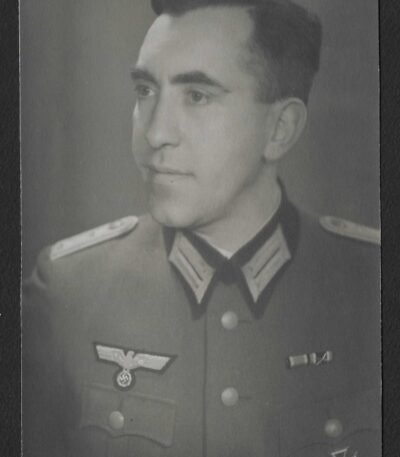
Portrait of Ritterkreuzträger Burkhardt Bollmann – Posthumous Knight’s Cross Recipient – KIA 1944
€75,00Original wartime studio portrait of Ritterkreuzträger Burkhardt Bollmann, a rare and historically interesting signed photo of a Knight’s Cross recipient who received the award posthumously.
The postcard-sized studio portrait shows Bollmann in Wehrmacht uniform wearing an impressive award bar, with the Iron Cross 1st Class clearly visible. A sharp and attractive period portrait with very good contrast and excellent display value.
Particularly interesting is the handwritten text on the reverse, identifying him as:
Burkhardt Bollmann
Born: 18 June 1905, Landshausen, Kr. Ziegenhain
Killed in action: 21 October 1944, during fighting at the Brückenkopf Schelde-Süd (Scheldt bridgehead, south sector)
Bollmann was awarded the Knight’s Cross of the Iron Cross posthumously for his leadership and combat actions during the bitter defensive fighting in late 1944, making this a desirable piece connected to the final hard-fought battles on the Western Front.
The photo remains in very good condition with clear image detail and light age wear consistent with wartime storage. The handwritten identification on the reverse adds strong provenance and historical value.
A scarce and highly collectible original portrait of a posthumous Knight’s Cross holder, ideal for collectors of elite Wehrmacht award recipients and late-war Western Front material.
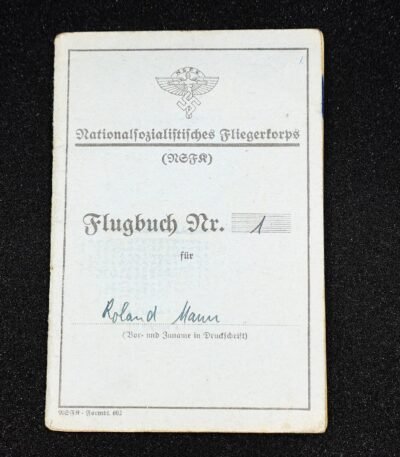
NSFK Flugbuch (Flight Log Book) – Pforzheim HJ Bann 424 Sturm 8/15 – NSFK-Gruppe 3
€75,00A scarce and attractive original Nationalsozialistisches Fliegerkorps (NSFK) Flugbuch belonging to Roland Mann, documenting his glider flight training from the late pre-war period through the Second World War.
The Flugbuch was opened on 9 September 1938 and belonged to Roland Mann, born on 7 June 1923 in Pforzheim, later residing in Hamburg. It retains the original portrait photograph, official NSFK ink stamp, handwritten signature, and numerous instructional entries covering several years of flight training.
Mann began his training on 4 December 1938, successfully passing his:
- A Glider Pilot Examination – 21 August 1940
- B Glider Pilot Examination – 15 May 1941
- C Glider Pilot Examination – 20 June 1941
The flight log contains over one hundred individual flight entries recording aircraft types, launch methods, flight durations, training exercises, and instructor confirmations. Flights were conducted with several well-known German training gliders including the Grunau Baby IIb, Grunau 9, SG-38 Schulgleiter, and DFS Zögling, providing an excellent record of NSFK glider instruction during the war years.
Of particular interest are official stamps from:
- NSFK Sturm 8/15
- NSFK Reichsgruppe Nord – Fliegerhorst Hamburg
- Segelfluggruppe des Fliegerhorstes Flensburg
The Flugbuch remains in very good original condition with normal period wear from use. The photograph, stamps, handwritten entries, examination records, and flight log are all well preserved, making this an excellent research document.
Original NSFK flight log books with photographs and extensive wartime flying records are becoming increasingly difficult to find and are highly desirable pieces documenting Germany’s pre-war and wartime pilot training system. This is an outstanding example suitable for collectors of NSFK, Luftwaffe training material, aviation history, and Third Reich documentation.
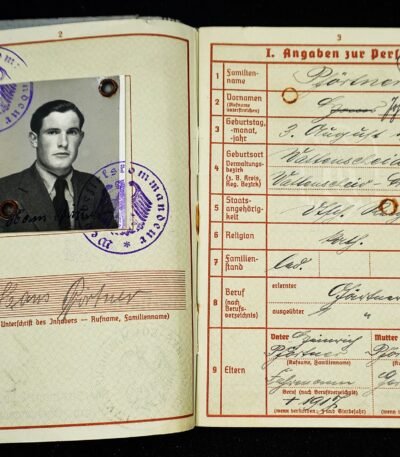
KIA Wehrpass – Artillerie-Regiment 208 (208. Infanterie-Division) (EK2, VWA, WIO)
€130,00An original WWII German Wehrpass issued to Gefreiter Hans Johann Wilhelm Pörtner, born 3 August 1913 in Nauenscheid, Germany.
The Wehrpass was issued by Wehrbezirkskommando Berlin VII on 15 April 1936 and contains the original portrait photograph of the soldier along with numerous official wartime entries documenting his combat service on the Eastern Front.
Before entering military service, Pörtner worked as a glazier (Glaser).
Military Service
The Wehrpass records service with:
- 2. Batterie/ Artillerie-Ersatz-Abteilung 208
- 8. Batterie/ Artillerie-Regiment 208
He served with Artillerie-Regiment 208 of the 208. Infanterie-Division, a unit heavily engaged during the German campaigns on the Eastern Front.
Promotions
Recorded promotions include:
- Gefreiter
- Unteroffizier
Decorations
Officially entered awards include:
- Medaille Winterschlacht im Osten 1941/42 (Ostmedaille) – awarded 7 August 1942
- Verwundetenabzeichen in Schwarz (Black Wounde Badge0 – entered 12 March 1943
- Eisernes Kreuz 2. Klasse (Iron Cross 2nd Class) – awarded 28 July 1943
The award of the Iron Cross 2nd Class indicates bravery in combat and makes this Wehrpass particularly desirable.
Combat Service
The Wehrpass contains an extensive record of operations, including:
- Border security duties on the French frontier
- Occupation service in Northern France
- Winter campaign on the Eastern Front (1941–1942)
- Defensive fighting around Ostrozhsk
- Combat in the Army Group Centre sector
- Numerous artillery engagements throughout 1942
Killed in Action
A final entry records that Hans Pörtner was killed in action on 13 October 1943 near Demidov (Russia)
Condition
The Wehrpass remains in very good original condition with its period portrait photograph intact. It contains numerous official stamps, signatures, promotion entries, campaign records, award entries, and the final killed-in-action notation.
A highly attractive and fully documented Eastern Front combat Wehrpass belonging to a soldier of Artillerie-Regiment 208, awarded the Iron Cross 1st Class, Eastern Front Medal, and West Wall Medal, and ultimately killed in action near Demidov in October 1943. An excellent and researchable original document for collectors of Wehrmacht and Eastern Front history.
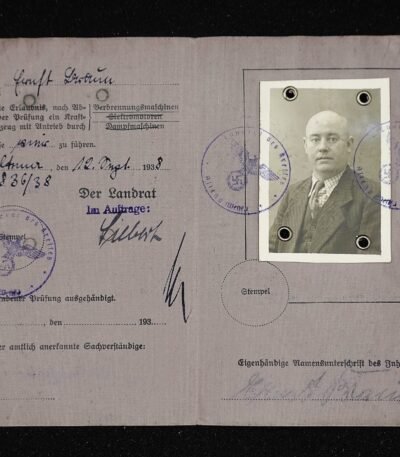
Civil German Führerschein (Civil Driver’s License)
€10,00An original German Führerschein (Driver’s License) issued on 12 August 1938 to Georg Brodin, born 29 August 1900 in Münsterfeld.
The license was issued by the Landrat and includes the original passport photograph secured with official rivets and overlapping governmental ink stamps, together with the owner’s handwritten signature. It authorized the holder to operate motor vehicles with internal combustion engines.
The document retains its official issue stamps, handwritten entries and signatures, while the reverse records the holder’s personal details, address and the payment of the 1 Reichsmark issuance fee.
Pre-war civilian Führerscheine are increasingly sought after as representative documents from everyday life in the Third Reich, especially examples retaining their original photograph and official period stamps.
The document remains in very good condition with honest age-related handling wear, while the photograph, stamps and handwritten entries remain clear and well preserved. A fine original civilian identification document and an attractive addition to any collection of Third Reich documents, civilian paperwork or German historical ephemera.
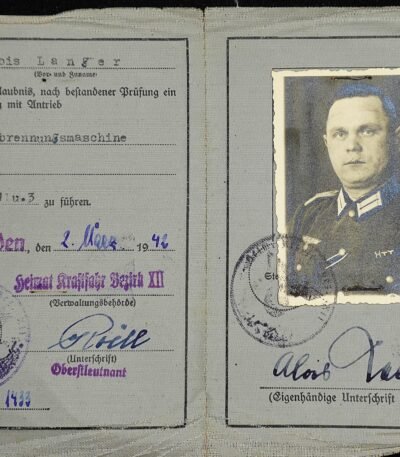
Wehrmacht-Führerschein (Military Driver’s License) – Aufstellungsstab Baumholder / Heimat-Kraftfahr-Bezirk XII
€45,00An original Wehrmacht-Führerschein (Military Driver’s License) issued to Alois Langer, born 25 March 1909 in Deutsch-Neukirch.
The document was issued on 2 March 1942 in Wiesbaden by the Heimat Kraftfahr Bezirk XII and authorized the holder to operate motor vehicles with internal combustion engines in classes 1b and 3. The driver’s license bears its original official ink stamps and signatures, together with an excellent original portrait photograph of Langer.
The document identifies him as serving with an Aufstellungsstab Baumholder based at Baumholder.
Unlike standard civilian driver’s licenses, Wehrmacht driver’s licenses with uniformed portraits are considerably more desirable among collectors, particularly when issued to a clearly identified artillery motor transport soldier. The original cloth-covered construction, official wartime stamps, and attractive portrait make this a very displayable piece of Wehrmacht documentation.
Condition: Good original condition. The document shows honest field wear and fraying to the cloth edges from service use, while remaining complete. The portrait photograph, handwritten entries, official stamps, and signatures are all clear and well preserved.
A desirable original WWII Wehrmacht driver’s license belonging to an artillery motor transport soldier, complete with portrait photograph and wartime issue from Wiesbaden in 1942.
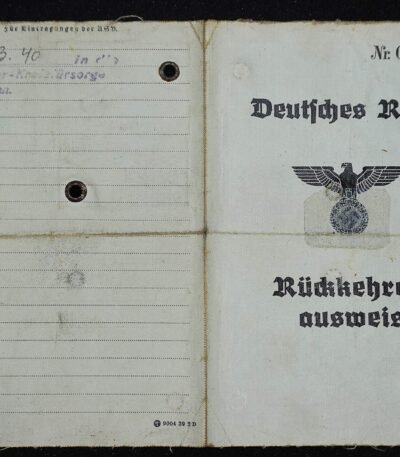
Rare WWII German EWZ Rückkehrerausweis – Riga, Latvia – Posen 1943 – Heim ins Reich
€95,00An original and uncommon German WWII Rückkehrerausweis (Returnee Identity Card), issued to Eugen Priķis, born 21 April 1907 in Riga, Latvia (then recorded as Russia). The document was issued in Posen (Poznań) on 17 March 1943 by the Einwandererzentralstelle (EWZ) – Ausweisstelle Posen, the authority responsible for processing and documenting ethnic Germans and other approved returnees into the German Reich.
The identity card retains its original passport photograph bearing official ink and violet authority stamps. Personal details list Eugen Priķis as a Textilmustermeister (Textile Pattern Master), of Latvian nationality, with his previous residence recorded as Riga. His daughter Irmela, born 4 March 1934 in Riga, is also entered in the document.
The front cover records an entry dated 20 March 1940 relating to the Umsiedler-Hilfsfürsorge (Resettler Welfare Office), adding further period authenticity.
Rückkehrerausweise are considerably less encountered than Wehrpässe or Soldbücher and represent an interesting field of collecting connected to the wartime resettlement of Baltic Germans and other populations into the Third Reich. The combination of a portrait photograph, official stamps, complete personal information, and Latvian origin makes this an attractive historical document.
A genuine and uncommon German WWII identity document in good original condition, showing expected age, handling wear and period folding. A desirable addition for collectors of German WWII documents, Baltic German history, or EWZ-related material.
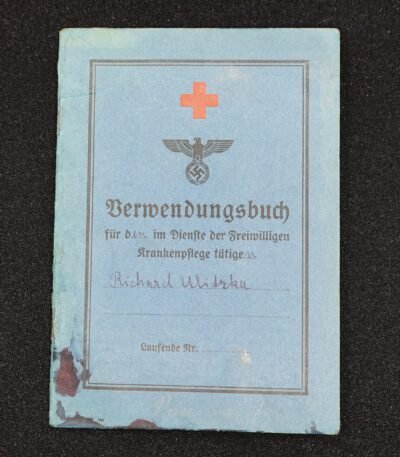
DRK Verwendungsbuch – Hamburg, Wehrkreis X
€45,00A very attractive and complete Deutsches Rotes Kreuz (DRK) Verwendungsbuch issued to Richard Friedrich Midszka, born 2 July 1895 in Wilhelmsburg (Harburg). The booklet retains its original portrait photograph, numerous official DRK and military acceptance stamps, and extensive handwritten service entries.
The holder entered the Freiwillige Krankenpflege on 1 December 1939, and the Verwendungsbuch was officially issued in Hamburg on 18 March 1940 by the Inspector of the Deutsches Rotes Kreuz for Wehrkreis X. The document records his personal details, family information, physical description, dog tag number, military identification details, and official authorization for voluntary medical service.
Unlike many surviving examples that remained largely unused, this Verwendungsbuch contains multiple completed entries and official stamps, making it a considerably more interesting research piece. The original photograph remains firmly attached and the booklet is complete throughout.
A desirable and increasingly difficult-to-find wartime DRK document, representing the service records of a male volunteer attached to the German Red Cross medical organization during the Second World War.
Condition
Very good original condition with honest signs of wartime use and age. Complete with original photograph, handwritten entries, official stamps, and signatures. Minor wear and staining to the blue cover, as shown in the photographs.
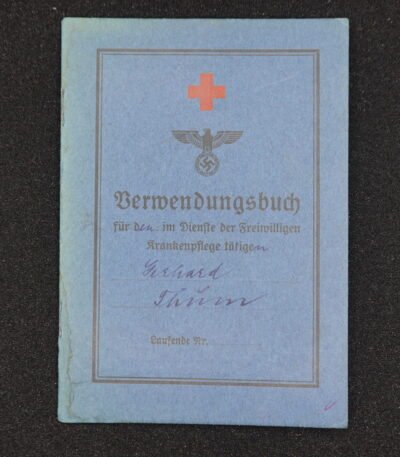
DRK Verwendungsbuch – Frankfurt am Main
€45,00An original Deutsches Rotes Kreuz (DRK) Verwendungsbuch issued to Richard Johann Thum, born 7 December 1886 in Köln, Rhine Province. This official service book served as the personal identification and service record for members of the Freiwillige Krankenpflege (Voluntary Medical Service) during the Second World War.
The booklet retains its original portrait photograph, securely attached and cancelled with multiple official DRK stamps of the Kreisstelle Frankfurt a.M. III. It was officially issued in Hamburg on 25 June 1940 by the Inspector of the Deutsches Roten Kreuz for Wehrkreis X, complete with the original signature and official DRK inspection stamp.
Richard Thum is recorded as a merchant (Kaufmann) by profession and entered the Freiwillige Krankenpflege on 5 February 1940. The booklet contains detailed personal information, including his family details, physical description, identification number, and medical service qualifications as a Krankenpfleger. The document remains largely complete with numerous handwritten entries and official authentication stamps.
Condition
Very good original condition with light handling and storage wear consistent with age. Complete with original photograph, handwritten entries, official DRK stamps, and signatures. The blue cover remains attractive with only minor edge wear.
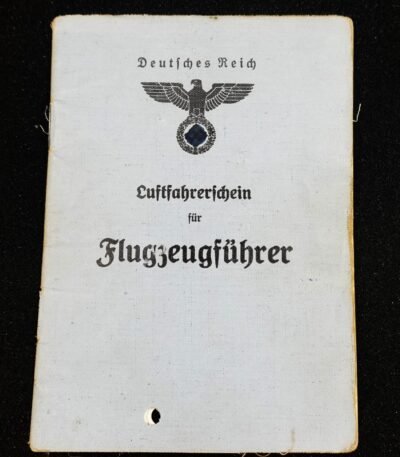
Early Luftfahrerschein für Flugzeugführer (Pilot’s Licence) – Dresden, 1936
€75,00An original and scarce pre-war Luftfahrerschein für Flugzeugführer (Pilot’s Licence) issued during the early years of the Third Reich. These official Luftamt pilot licences are considerably harder to find than standard Wehrmacht identity documents and make attractive additions to any Luftwaffe or aviation collection.
This licence (No. 335) was issued to Ernst Schmidt, born 25 April 1912 in Chemnitz, who was employed as a Kraftwagenführer (motor vehicle driver). The document was issued by the Luftamt Dresden on 19 November 1936, complete with the original official ink stamp, period photograph, and handwritten signature.
The licence authorizes the holder to operate aircraft in the A2 (Land) category. The remaining pages intended for extensions and renewals remain largely unused, preserving the document in its original state.
The document remains in good original condition with normal signs of age and handling. Please study the photographs carefully as they form part of the description. Swastikas have been denazified with inkt. One staple in the document.
A scarce and desirable pre-war German aviation document that is becoming increasingly difficult to obtain.
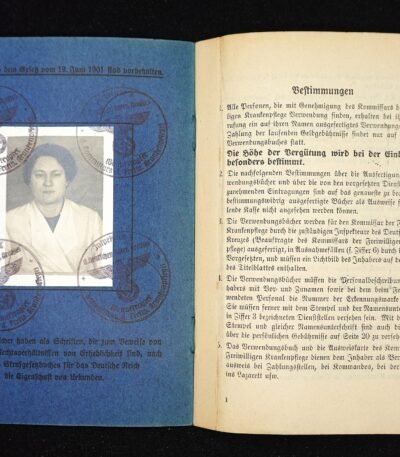
DRK Verwendungsbuch – Hamburg
€75,00An original wartime Deutsches Rotes Kreuz (DRK) Verwendungsbuch issued to Wilma Elisabeth Warmburg, complete with its original attached portrait photograph and official issue stamps.
The booklet was issued in Hamburg on 22 July 1940 and served as the official service record for personnel employed within the DRK voluntary nursing service. It retains the original owner’s photograph, several official inspection stamps and signatures.
Wilma Warmburg was born on 21 November 1905 in Hamburg and is listed as a housewife (Hausfrau). Her husband is recorded as Reinhold Warmburg, residing in Hamburg-Bergedorf, with no children noted.
The booklet records her physical description, identification details and official registration within the DRK nursing organization. Unlike many later wartime examples, this booklet appears largely unused, with few subsequent service entries, making it a well-preserved early-war issue.
A desirable original DRK personnel document with excellent display appeal thanks to its original portrait photograph and early 1940 issue date.
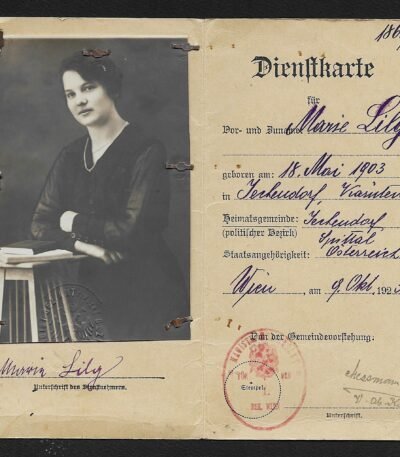
Austrian Hausgehilfin Dienstkarte (Domestic Service Identity Card) – Vienna, 1923
€15,00An original and historically interesting Austrian Hausgehilfin Dienstkarte (Domestic Service Identity Card) issued to Marie Litz, complete with its original photograph, official embossed seal, municipal ink stamp, and handwritten entries.
The document was issued in Vienna on 9 October 1923 under the Austrian Hausgehilfengesetz (Domestic Servants Act) of 26 February 1920, serving as the official identification and employment record for domestic servants working in private households. Such identity cards were required for housemaids and domestic employees and documented their personal details and employment history.
This example is issued to Marie Litz, born 18 May 1903 in Teichendorf, Spital, Austria. It features an attractive original portrait photograph securely attached with its original metal staples, together with the official embossed Austrian eagle seal, municipal stamp, and period signatures. The cover is titled “Dienstkarte” and references the legal basis under the Hausgehilfengesetz.
An increasingly uncommon surviving Weimar-era Austrian identity document that offers an excellent insight into the regulation of domestic employment during the early First Austrian Republic. The original portrait photograph and complete official markings make this an attractive display piece for collectors of Austrian history, identification documents, and social history.
Condition: Very good original condition with expected age-related wear, folds, and light creasing. Complete with original photograph, embossed seal, official stamps, handwritten entries, and signatures.
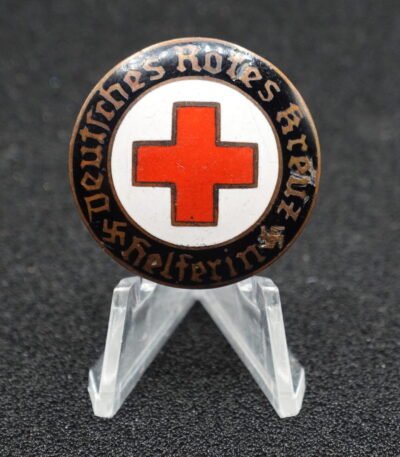
WWII German DRK Helferin Badge – Enamel Membership Badge by Ernst L. Müller, Pforzheim
€45,00Original WWII German Deutsches Rotes Kreuz (DRK) membership / helper badge featuring the classic red cross design surrounded by the inscription: “Deutsches Rotes Kreuz Helferin”
The badge is manufactured in tombak/copper construction with attractive multi-colored enamel finish. Reverse retains its original functional pin setup and is marked: “GES. GESCH.” together with the maker initials: “E.L.M.” identifying the manufacturer as: Ernst L. Müller, Pforzheim
a known wartime producer of political and organizational insignia during the Third Reich period.
The badge displays attractive untouched age patina throughout the reverse, while the enamel front remains highly displayable with honest period wear and fine age-related craquelure to the white enamel field.
Badges of this type were worn by female DRK (Deutsches Rotes Kreuz) auxiliaries and helpers involved in wartime medical support, civilian aid, nursing assistance, transport duties, and hospital service during the Second World War.
Condition exactly as shown in the photographs. Has chip damages.
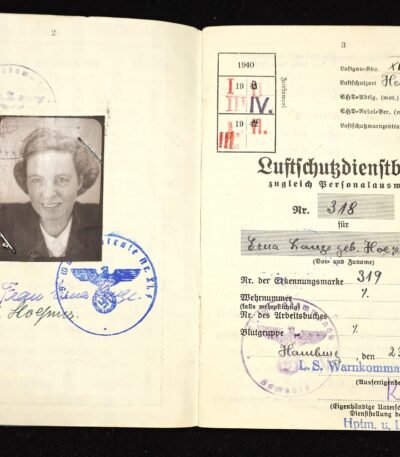
Luftschutz-Dienstbuch to LSW-Helferin – Hamburg / Allenstein – Awarded Kriegsverdienstmedaille (!)
€175,00An original and well-filled Luftschutz-Dienstbuch (Air Raid Protection Service Book), issued to LSW-Helferin Erna Lauge (née Hoepner), documenting her wartime service within the German Luftschutzwarndienst during the Second World War. Uncommon to see one for a female and who was awarded the Kriegsverdienstmedaille!
Personal Details
- Name: Erna Lauge (née Hoepner)
- Born: 26 October 1905
- Birthplace: Garding
- Religion: Evangelical Lutheran
- Issued by LS-Warnkommando Hamburg
- Issued on 23 March 1943
- Original portrait photograph present
Wartime Service
Following her medical examination in April 1943, she entered service as an LSW-Helferin (Luftschutzwarndienst-Helferin).
The Dienstbuch records service with:
- LS-Warnkommando Hamburg
- LS-Warnkommando Allenstein
- Service as Fernsprecherin (Telephone Operator)
Numerous wartime entries, official signatures and unit stamps document her continued service during 1943–1944.
Decorations
- Kriegsverdienstmedaille
Very good original condition with photo, which is relative uncommen as most are without photo. A very attractive and researchable Luftschutz document from one of Germany’s principal air defence organisations.
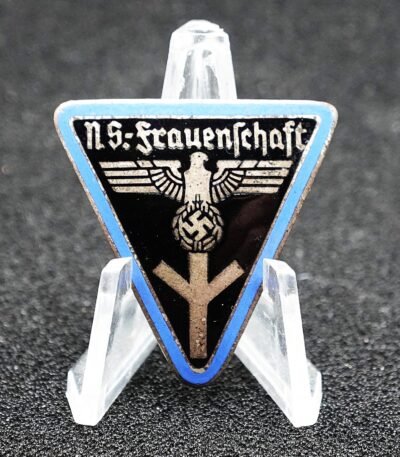
NS-Frauenschaft Membership Badge – RZM M1/42
€80,00Original Third Reich period NS-Frauenschaft membership badge in triangular form, featuring black and blue enamel with the German eagle and swastika. The reverse is RZM marked M1/42 and retains its original pin attachment. Shows age-related wear to the finish and enamel. Size: 31 mm.
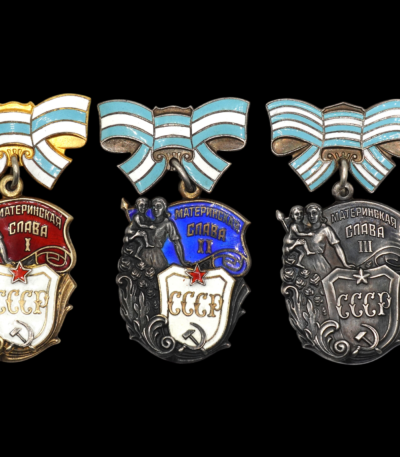
Complete Soviet Order of Maternal Glory Set – 1st, 2nd & 3rd Class – Numbered & Mint Marked USSR Awards
€195,00An attractive original Soviet trio consisting of the Order of Maternal Glory 1st Class, 2nd Class, and 3rd Class, among the most iconic family and social awards instituted by the Soviet Union during the Second World War.
Established on 8 July 1944, these decorations were awarded to mothers who successfully raised large families and made exceptional contributions to the upbringing of Soviet children. The awards formed part of a wider Soviet demographic policy intended to encourage population growth following the enormous losses suffered during the war.
The three classes are distinguished by their finishes:
- 1st Class – gilt and silvered construction with red enamel banner.
- 2nd Class – silvered finish with blue enamel banner.
- 3rd Class – silvered finish without colored banner enamel.
Each award features the image of a mother holding her child, the Soviet state emblem, hammer and sickle, and the inscription “Материнская Слава” (Maternal Glory).
Included Awards
Order of Maternal Glory 1st Class
- Serial number: 707445
- Mint marked: Монетный Двор (Monetny Dvor)
- Gilded and enameled example.
Order of Maternal Glory 2nd Class
- Serial number: 1161759
- Mint marked: Монетный Двор
- Attractive blue enamel.
Order of Maternal Glory 3rd Class
- Serial number: 296189 (?)
- Mint marked: Монетный Двор
- Silvered class example.
All three awards remain in very good original condition with attractive enamel, clear mint marks, and visible serial numbers. Honest age-related wear is present, consistent with period-issued examples. An impressive display set representing all three classes of one of the Soviet Union’s most recognizable civilian decorations.
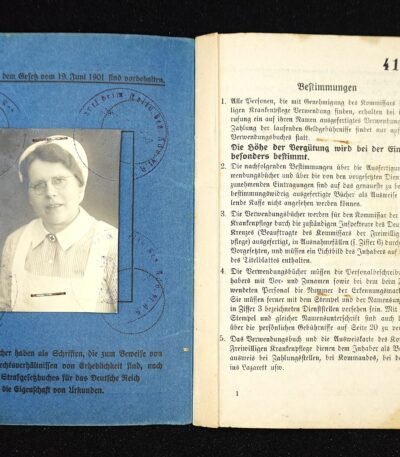
DRK Schwesternhelferin Verwendungsbuch – Reserve-Lazarett München & Jülich
€80,00An original Deutsches Rotes Kreuz (DRK) Verwendungsbuch belonging to Schwesternhelferin Anna Krauthausen, complete with its original attached portrait photograph and extensive wartime service entries.
Issued in Munich on 28 August 1942, the booklet records her qualification in Krankenpflege (Nursing Care) and documents several years of uninterrupted wartime medical service within the German Red Cross.
The service record begins in April 1942, when Krauthausen commenced service as a helper at a military hospital. During the following years she served at various medical facilities, including:
- Reserve hospitals in Munich
- Hospital service in Jülich
- Assignments connected with Reserve-Lazarett München I
- Additional medical postings through 1944 and into March 1945
The Verwendungsbuch contains numerous official DRK, Wehrkreis and military medical stamps together with handwritten entries recording: Hospital assignments
- Leave authorisations
- Medical examinations
- Vaccinations
- Gas mask issue
- Hospital admissions
- Illness records
- Duty transfers
- Final wartime entries from March 1945
An attractive and extensively completed DRK nurse’s service book illustrating the daily administration of wartime German Red Cross medical personnel.
Condition
- Original attached photograph
- Numerous official DRK and military hospital stamps
- Well-filled service record
- Complete throughout
- Expected age toning and handling wear
- Very good historical condition
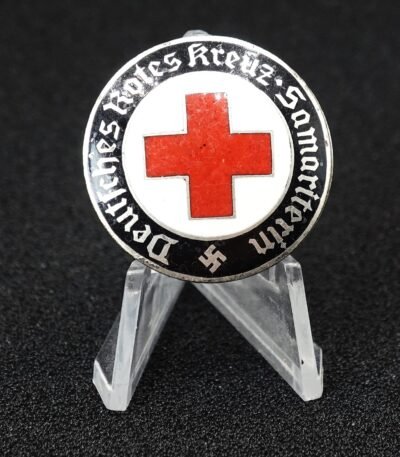
WWII German DRK Samariterin Enamel Badge
€90,00A fine and original early pre-war Deutsches Rotes Kreuz (German Red Cross) Samariterin badge, manufactured in silver-plated tombac with beautifully preserved red and white vitreous enamel.
The obverse features the iconic red cross within a white enamel field, surrounded by the inscription “Deutsches Rotes Kreuz Samariterin” in Gothic lettering. The reverse retains its original Ges. Gesch. marking and early directly soldered pin construction, both characteristics of desirable early production examples.
This example remains in excellent collector condition with vibrant enamel, attractive untouched patina and a fully functional pin assembly. An increasingly difficult badge to locate in such honest, original condition.
A desirable addition to any DRK, medical, or Third Reich organization collection.
Condition
- Original silver-plated tombac construction
- Excellent red and white enamel
- Original untouched finish
- Functional pin and catch
- Reverse marked Ges. Gesch.
- Honest age patina throughout
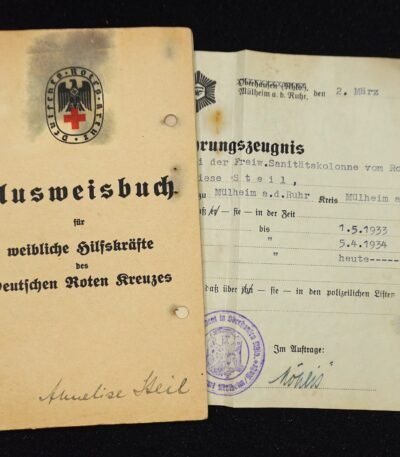
DRK Ausweisbuch für weibliche Hilfskräfte – Mülheim-Ruhr
€65,00An original and highly interesting Deutsches Rotes Kreuz (German Red Cross) Ausweisbuch für weibliche Hilfskräfte issued to Anneliese Steil, complete with portrait photograph, official stamps and an accompanying Führungszeugnis (Certificate of Good Conduct).
This booklet documents several years of DRK training and service prior to the Second World War and records her progression from Samariterin (First Aid Worker) to Helferin (Helper).
The booklet was first issued through the Vaterländischer Frauenverein (Patriotic Women’s Association), Mülheim-Ruhr branch, on 4 June 1936, and includes numerous official DRK and police authentication stamps.
Historical Summary
Unlike later wartime DRK service books, this example documents the structured peacetime training of female Red Cross personnel during the period immediately preceding the Second World War.
The owner, Anneliese Steil, was born on 10 November 1916 in Mülheim an der Ruhr.
She completed several official DRK medical courses:
- Helferin (Helper) Course
- Samariterin Course
Official certification as:
- Samariterin in 1936
- Helferin in 1937
The booklet also records continuing education (“Fortbildung”) during 1937, including medical and first aid refresher courses.
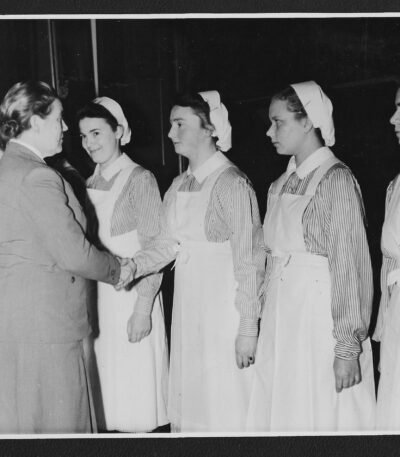
Press Photograph – Flemish Nursing Students – Occupied Belgium – WWII
€100,00An original wartime press photograph depicting a formal presentation involving a group of Flemish nursing students dressed in period nursing uniforms. The image captures an official shaking hands with one of the young women while the remaining trainees stand in formation, illustrating the structured training and organization of medical personnel in occupied Belgium during the Second World War.
The reverse bears the original Belga Press Photo Service (Brussels) stamp and names.
Press photographs relating to wartime nursing education and civilian medical organizations are considerably less common than military subjects and provide valuable documentary insight into everyday life and institutional activities in occupied Belgium.
Condition: Very good original condition with minor age-related handling wear. Reverse retains the original Belga Press Service stamp, handwritten identification, and period archive markings. An attractive and historically interesting original WWII Belgian press photograph.
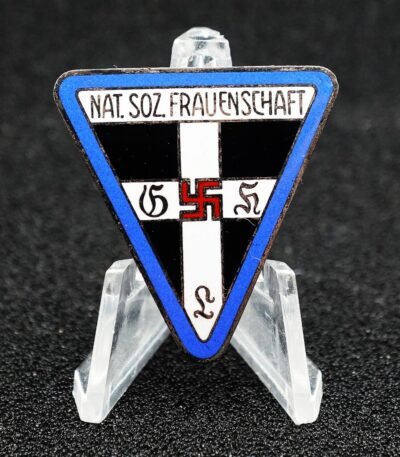
NS-Frauenschaft Membership Badge – RZM M1/102
€55,00Original Third Reich period Nationalsozialistische Frauenschaft (NS-Frauenschaft) membership badge. Attractive triangular enamel design in blue, black, white and red. The reverse is RZM marked M1/102 and complete with its original pin attachment. Nice overall condition with minor age-related wear. Size: 31 mm.
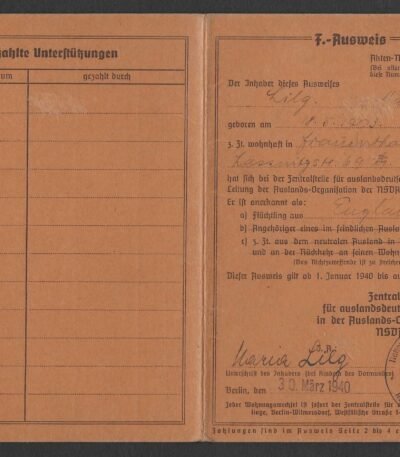
Flüchteling-Ausweis – England
€25,00Original “F.-Ausweis” (Flüchteling-Ausweis) from an Austrian born female, who fled from England back to Austria. Condition as seen.
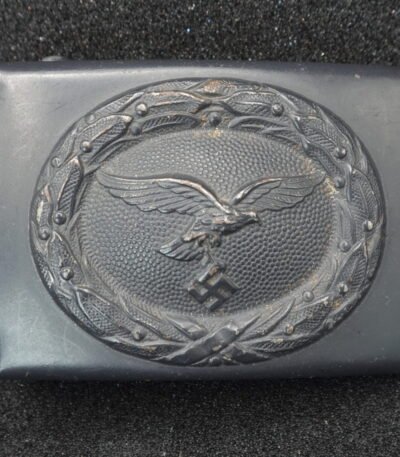
Luftwaffe EM/NCO Belt Buckle with Original Leather Tab – Berg & Nolte A.G., Lüdenscheid – 1941
€375,00An original Luftwaffe enlisted/NCO belt buckle complete with its original leather tab, manufactured by Berg & Nolte A.G., Lüdenscheid, and dated 1941.
The buckle is the standard wartime Luftwaffe pattern, manufactured from blued steel, featuring the Luftwaffe eagle in flight clutching a swastika within an oak leaf wreath. The original dark finish is well preserved, displaying honest age-related wear and light oxidation in the recessed areas, giving the buckle an attractive untouched appearance.
The reverse retains its original leather tab, clearly embossed:
BERG & NOLTE A.G. – LÜDENSCHEID – 1941
Berg & Nolte A.G. was one of the principal wartime manufacturers of German military belt buckles and leather fittings, making this a desirable maker-marked example.
The leather tab also bears a separate purple ink stamp reading: Horst Wenderoth, Langebrück, Sachsen, Hermannstr.
This is believed to be an ownership or identification stamp rather than a manufacturer’s marking, adding an interesting historical element to the piece.
The original leather tab still retains its wool/felt backing and remains firmly attached to the buckle. The buckle is complete with its original catch and prongs and has never been cleaned or restored.
An excellent untouched Luftwaffe buckle with desirable wartime maker markings, date, and an interesting named leather tab. Near Mint Condition with lots of paint left.
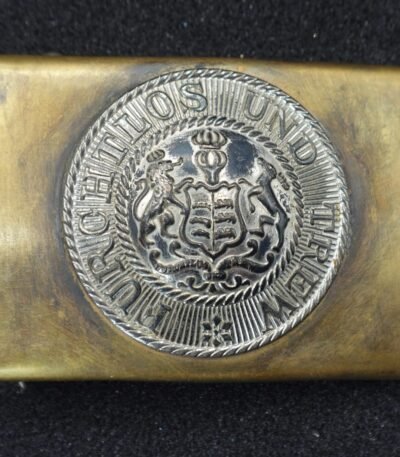
WWI Imperial German Kingdom of Württemberg Enlisted Belt Buckle – M1895 Pattern
€140,00An original Imperial German Army enlisted man’s belt buckle (Koppelschloss) of the Kingdom of Württemberg, featuring the state motto “FURCHTLOS UND TREW” (“Fearless and Loyal”) surrounding the Württemberg coat of arms.
Unlike the more common Prussian “GOTT MIT UNS” buckles, Württemberg buckles were issued exclusively to troops serving under the Kingdom of Württemberg within the Imperial German Army, making them considerably scarcer and more desirable among collectors.
This example is the Model 1895 (M1895) pattern, constructed with a brass body and a silvered applied center roundel. The reverse retains its original attachment hook and steel catch, with no apparent repairs or alterations. It exhibits an attractive untouched patina with honest service wear consistent with age.
A fine and increasingly difficult-to-find Imperial German state buckle, ideal for collectors of WWI German militaria or those specializing in the individual kingdoms of the German Empire.
Condition
- Original Imperial German enlisted buckle
- Kingdom of Württemberg issue
- Brass body with silvered applied roundel
- Original hook and catch
- Attractive untouched patina
- Honest age and service wear
- No visible maker mark
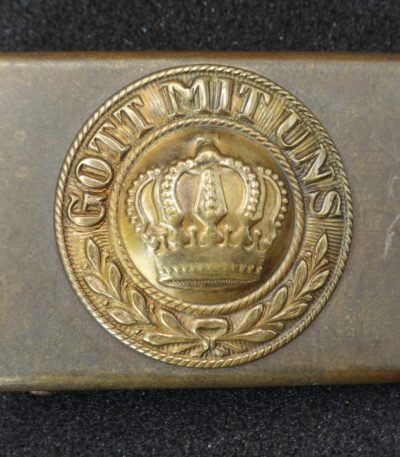
WWI Imperial German (Prussian) “GOTT MIT UNS” Enlisted Belt Buckle – M1895 Pattern
€100,00An original Imperial German Army enlisted man’s belt buckle (Koppelschloss) featuring the famous “GOTT MIT UNS” (“God With Us”) motto surrounding the Imperial Crown within a laurel wreath.
This is the classic Model 1895 (M1895) buckle worn by enlisted soldiers of the Kingdom of Prussia, by far the largest contingent of the Imperial German Army during the First World War. The buckle is constructed from brass with a separately attached roundel, while the reverse retains its original steel catch and attachment bar.
The buckle displays honest field wear and an attractive aged patina consistent with military service. The reverse shows typical oxidation and wear expected from an original period example. No maker’s mark is visible.
A classic and highly collectible Imperial German military item, suitable for any collection focusing on the German Empire, Kaiserreich, or the First World War.
Condition
- Original Imperial German enlisted buckle
- Brass construction with separate applied roundel
- Original steel catch and attachment bar
- Attractive untouched patina
- Honest service wear
- Reverse shows age-related oxidation
- No visible maker markings
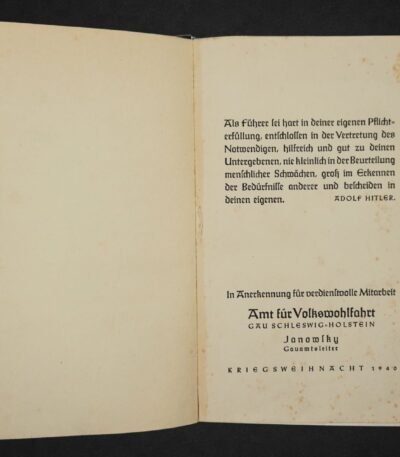
Gau Schleswig-Holstein Presentation Copy of Mein Kampf (1939) – Kriegsweihnacht Award 1940 – Amt für Volkswohlfahrt
€195,00Original wartime presentation copy of Adolf Hitler’s Mein Kampf, published in 1939 by the Zentralverlag der NSDAP, Franz Eher Nachf., München. This example is the 459./461. Auflage (edition) and is complete with its original blue cloth binding featuring the gilt NSDAP eagle and swastika to the front cover.
The book contains a printed presentation dedication awarded by the Amt für Volkswohlfahrt, Gau Schleswig-Holstein in recognition of valuable service:
“In Anerkennung für verdienstvolle Mitarbeit”
Amt für Volkswohlfahrt – Gau Schleswig-Holstein
Janowsky – Gauamtsleiter
Kriegsweihnacht 1940
The dedication was presented during Christmas 1940 (Kriegsweihnacht 1940) to recognize meritorious service within the NSDAP Office for Public Welfare (Volkswohlfahrt) in Gau Schleswig-Holstein. The book also includes a leadership quotation by Adolf Hitler preceding the presentation page.
The volume retains the portrait of Adolf Hitler opposite the title page and remains in solid, complete condition. It displays age-related foxing throughout, consistent with wartime paper, while the binding remains sound and the gilt cover emblem is well preserved.
An excellent and historically interesting presentation edition of Mein Kampf, directly associated with the Amt für Volkswohlfahrt and wartime Christmas recognition within Gau Schleswig-Holstein.
Condition: Good overall condition with age-related foxing, staining on the sides and light handling wear. Please refer to the photographs for details.