


Kriegsverdienstkreuz 2. Klasse mit Schwertern Award Doc – Münster – Luftgau VI, 1944
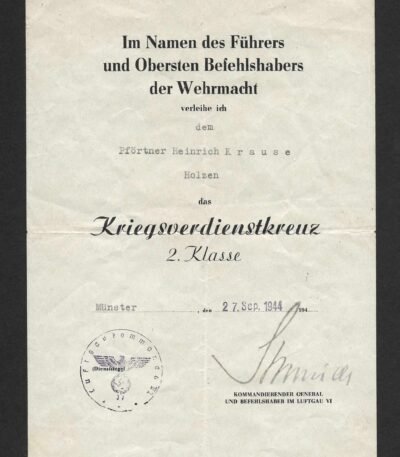
Original WWII German award document (Verleihungsurkunde) for the Kriegsverdienstkreuz 2. Klasse (War Merit Cross 2nd Class), awarded to Heinrich Krause, employed as a Pförtner (gatekeeper or doorman) at Holzen, on 27 September 1944.
Issued in the name of the Führer and Supreme Commander of the Wehrmacht, the document bears a printed signature of August Schmidt above the printed designation Kommandierender General und Befehlshaber im Luftgau VI (Commanding General and Commander of Luftgau VI). The document also retains its circular official service seal.
The War Merit Cross was awarded for meritorious service contributing to the German war effort. Unlike the version with swords, the award without swords was generally associated with distinguished service away from direct combat. Its presentation to a civilian employee is consistent with the award’s use to recognize contributions to the wartime administration and support system.
Condition
Original period paper document showing age-related toning, horizontal folding, creases and general handling wear. The printed text, recipient’s name, date, official stamp and handwritten signature remain visible. Please examine the photographs carefully for the precise condition.
Kriegsverdienstkreuz 2. Klasse mit Schwertern Award Doc – Artillerie-Regiment 195 – Generalleutnant Sixt von Arnim (Stalingrad!)
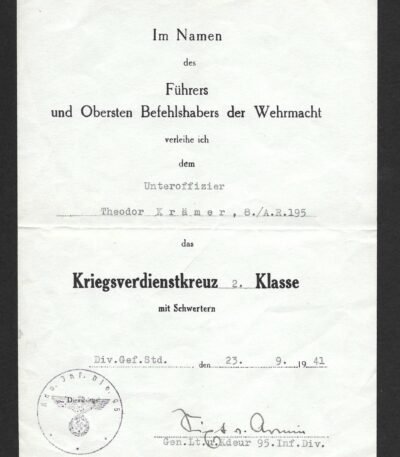
Original WWII German award document (Verleihungsurkunde) for the Kriegsverdienstkreuz 2. Klasse mit Schwertern (War Merit Cross 2nd Class with Swords), awarded to Unteroffizier Theodor Krämer of 8./ Artillerie-Regiment 195 on 23 September 1941.
The document was issued in the name of the Führer and Supreme Commander of the Wehrmacht. The award was authenticated by Generalleutnant Sixt von Arnim, whose signature appears at the bottom of the document in his capacity as commander of the 95th Infantry Division (95. Infanterie-Division).
The War Merit Cross with Swords recognized military merit in connection with actions involving enemy forces. This document is an interesting example of a wartime award issued during the early phase of the German-Soviet War in 1941, with a named recipient, identifiable unit designation, dated award and commanding officer’s signature.
Historical Background – Sixt von Arnim
The signing officer, Sixt von Arnim, later became closely associated with one of the most consequential battles of the Second World War. In early June 1942, he assumed command of the 113th Infantry Division (113. Infanterie-Division), which he subsequently led into the Battle of Stalingrad. On 20 January 1943, he was taken prisoner by Soviet forces. During captivity, he became a close confidant of Field Marshal Friedrich Paulus, the German commander at Stalingrad. Von Arnim remained in Soviet captivity and died in the Soviet Union in 1952.
This later chapter in von Arnim’s career adds an interesting historical dimension to the document, which dates from September 1941, before his command at Stalingrad.
Historical Details
Condition
Original period paper document with age-related toning, visible horizontal folding, creases and handling wear. The printed text remains legible, and the recipient’s name, award details, date, unit information and signature are visible. Please examine the photographs carefully for the precise condition.
Kriegsverdienstkreuz 2. Klasse mit Schwertern Award Doc – Freiherr von Dalwigk zu Lichtenfels – Wehrkreis III, 1943
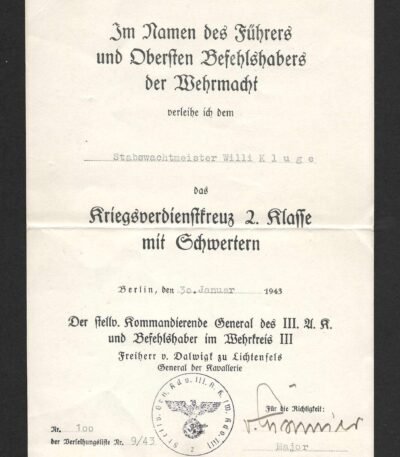
he certificate was issued under the authority of General der Kavallerie Freiherr von Dalwigk zu Lichtenfels, acting as deputy commanding general of the III Army Corps and commander of Wehrkreis III.
The War Merit Cross with Swords recognised military merit associated with service under enemy action or in circumstances involving combat-related duties. This original certificate is dated during the middle period of the Second World War and documents the award to a recipient holding the rank of Stabswachtmeister, a senior non-commissioned rank used in certain German mounted and specialist units.
The document features traditional Gothic lettering, the recipient’s name in typewritten text, the award date and location, an official Wehrkreis III service seal, and a handwritten authentication by an officer identified as a Major. The award-list reference is Nr. 100, Verleihungsliste Nr. 9/43.
Condition: The paper shows age-related toning, a prominent horizontal fold through the centre, light creasing, and some wear to the seal. The handwritten authentication remains visible. Please examine the photographs carefully for the exact condition.
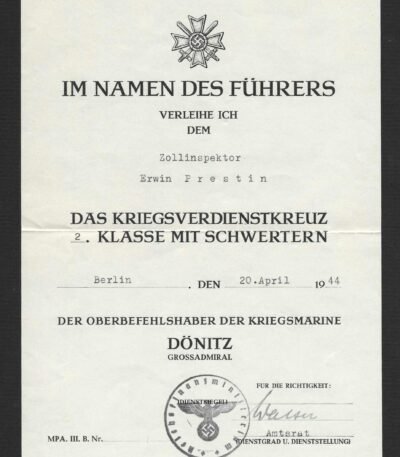
Kriegsverdienstkreuz 2. Klasse mit Schwertern Award Doc – Kriegsmarine – Admiral Karl Dönitz, 1943
Original German Kriegsmarine award document for the Kriegsverdienstkreuz 2. Klasse mit Schwertern (War Merit Cross 2nd Class with Swords), awarded to Zollinspektor Friedrich Jungk in Berlin on 13 August 1943.
The certificate bears the printed signature of Großadmiral Karl Dönitz, identified as Commander-in-Chief of the Kriegsmarine. Dönitz succeeded Erich Raeder in this position in January 1943 and later became Head of State of Germany following Hitler’s death in 1945.
The War Merit Cross with Swords recognised military merit associated with service under enemy action or in circumstances involving combat-related duties. This example is a Kriegsmarine-issued award document, distinguished by its naval command heading and the rank of the officer responsible for certifying the document.
The certificate includes the recipient’s name in typewritten lettering, the date and place of issue, Dönitz’s handwritten signature above the rank designation Großadmiral, an official service seal, and a further handwritten authentication in the section marked Für die Richtigkeit. The document reference is MPA. III. Nr. 10845/43.
Condition: The document appears well preserved, with a horizontal fold across the centre, light age-related toning, and some fading to the official seal. The signatures and printed text remain clearly visible. Please refer to the photographs for a detailed assessment of its condition.
An attractive original WWII naval award document bearing the signature of Karl Dönitz, suitable for collectors of Kriegsmarine history, German military decorations, and signed wartime documents.
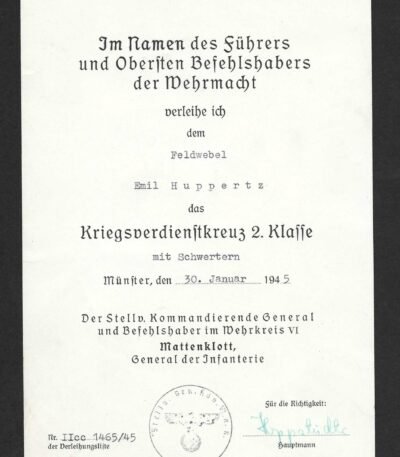
Kriegsverdienstkreuz 2. Klasse mit Schwertern Award Doc – Mattenklott – Münster, 1945
Original German Wehrmacht award document for the Kriegsverdienstkreuz 2. Klasse mit Schwertern (War Merit Cross 2nd Class with Swords), awarded to Feldwebel Emil Huppertz in Münster on 30 January 1945.
The document was issued under the authority of General der Infanterie Franz Mattenklott, acting as deputy commanding general and commander of Wehrkreis VI.
The certificate features its original printed Gothic lettering, typewritten recipient details, an official seal, and a handwritten authentication in turquoise ink, identified on the document as belonging to a Hauptmann. The award-list reference is recorded as IIc. 1465/45.
The War Merit Cross with Swords recognised military merit associated with service under conditions involving enemy action. The second-class award was commonly worn suspended from a ribbon.
Condition: The document shows age-related discoloration, a horizontal fold across the centre, and fading to the official seal. The turquoise handwritten authentication remains visible. Please examine the photographs for the precise condition.
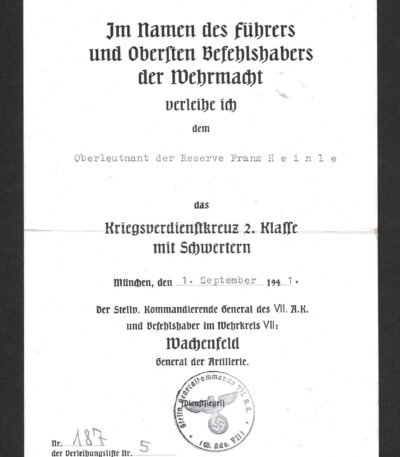
Kriegsverdienstkreuz 2. Klasse mit Schwertern Award Doc – Wachenfeld – München, 1941
Original WWII German award certificate for the Kriegsverdienstkreuz 2. Klasse mit Schwertern (War Merit Cross 2nd Class with Swords), awarded to Oberleutnant der Reserve Franz Heinle on 1 September 1941 in Munich.
The certificate identifies the recipient as Oberleutnant der Reserve Franz Heinle (Reserve First Lieutenant) and records the award of the War Merit Cross 2nd Class with Swords. It is an original example of German wartime award documentation issued during the early period of the Second World War.
The document was issued under the authority of the Stellvertretender Kommandierender General des VII. Armeekorps und Befehlshaber im Wehrkreis VII (Deputy Commanding General of VII Army Corps and Commander of Military District VII). The certificate names General der Artillerie Wachenfeld (General of Artillery Wachenfeld) as the responsible senior commander. His printed name and rank appear prominently beneath the issuing authority. Interesting that it remained unsigned!
The Kriegsverdienstkreuz mit Schwertern (War Merit Cross with Swords) recognised meritorious service connected with the war effort involving enemy action. Dated 1 September 1941, this certificate originates from a period when German forces were engaged in major operations across Europe and the Eastern Front.
Additional details include the circular official Dienstsiegel (service seal) of the Stellvertretendes Generalkommando VII. Armeekorps (Deputy General Command of VII Army Corps), as well as handwritten entries in the award register number field. The combination of a named recipient, specific award date, issuing command and named senior general makes this an interesting historical document for collectors of German military awards and original WWII paperwork.
Condition
The certificate shows age-related toning, a prominent horizontal fold across the centre, minor creasing, scattered small marks and light staining. The printed text and typewritten recipient details remain legible. The official seal is visible, and handwritten entries appear in the lower-left section. Please examine the photographs carefully for the exact condition.
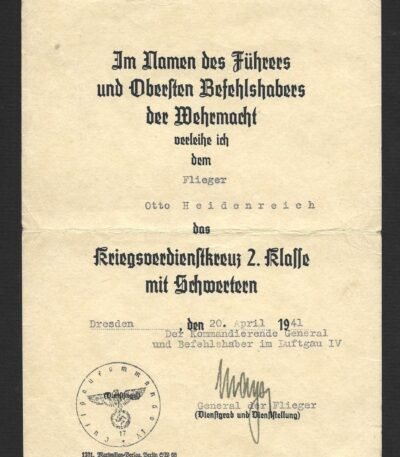
Kriegsverdienstkreuz 2. Klasse mit Schwertern Award Doc – Dresden, 1941
Original WWII German award certificate for the Kriegsverdienstkreuz 2. Klasse mit Schwertern (War Merit Cross 2nd Class with Swords), awarded to Flieger Otto Heidenreich on 20 April 1941 in Dresden.
The certificate bears the heading „Im Namen des Führers und Obersten Befehlshabers der Wehrmacht“ (In the Name of the Führer and Supreme Commander of the Wehrmacht) and formally records the award of the Kriegsverdienstkreuz 2. Klasse mit Schwertern.
The recipient is identified as Flieger Otto Heidenreich, an enlisted member of the Luftwaffe (German Air Force). The award was issued under the authority of the Kommandierender General und Befehlshaber im Luftgau IV (Commanding General and Commander of Air District IV).
The document is signed by Generalmajor Wilhelm Mayer (Major General Wilhelm Mayer), whose signature appears prominently in the lower-right section. The combination of a named recipient, a specific award date, an official Luftgau IV service seal and the identified general’s signature adds considerable historical interest for collectors of Luftwaffe militaria and original award documents.
The Kriegsverdienstkreuz mit Schwertern (War Merit Cross with Swords) recognised meritorious service connected with the war effort involving enemy action. Dated 20 April 1941, this certificate originates from the early period of the Second World War, shortly before the German invasion of the Soviet Union.
The document features a circular official Dienstsiegel (service seal), typewritten recipient details, the award date and place, and a large handwritten signature. The printed publisher’s line at the bottom identifies the firm Militärverlag Maximilian-Verlag, Berlin SW 68.
Condition
The certificate shows noticeable age-related toning, several horizontal fold lines, extensive creasing and wrinkles, and minor scattered marks and stains. The paper remains largely intact, and the printed text, typewritten details, official seal and signature are clearly visible. Please examine the photographs carefully for the exact condition.
An original named Luftwaffe award document dated April 1941, suitable for collectors of German military decorations, Luftwaffe history and original WWII paperwork.
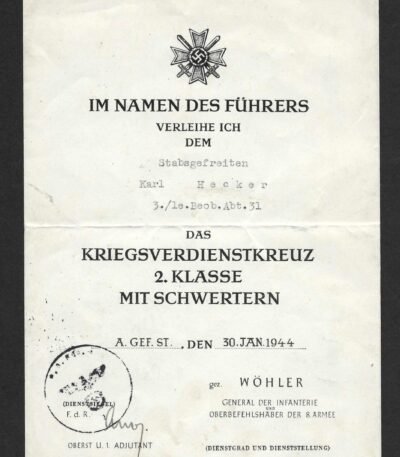
Kriegsverdienstkreuz 2. Klasse mit Schwertern Award Doc – Beobachtungs-Abteilung 31, 1944
Original WWII German award certificate for the Kriegsverdienstkreuz 2. Klasse mit Schwertern (War Merit Cross 2nd Class with Swords), awarded to Stabsgefreiter Karl Hecker of 3./le. Beob. Abt. 31 on 30 January 1944.
The certificate identifies the recipient as Stabsgefreiter Karl Hecker and records his unit as 3./le. Beob. Abt. 31, an abbreviation for the 3rd Battery of leichte Beobachtungs-Abteilung 31 (Light Observation Battalion 31).
The award was issued under the authority of General der Infanterie Friedrich-Wilhelm Wöhler, whose name and rank appear on the document. At the time, Wöhler was identified as Oberbefehlshaber der 8. Armee (Commander-in-Chief of the 8th Army). His printed name and official position make this a particularly interesting document for collectors of German army award certificates and Eastern Front-related militaria.
The Kriegsverdienstkreuz mit Schwertern (War Merit Cross with Swords) recognised meritorious service connected with the war effort involving enemy action. The award date, 30 January 1944, places this document in the middle period of the Second World War, when German forces were engaged in major operations on the Eastern Front.
The certificate features a printed award heading, typewritten recipient and unit details, an official Dienstsiegel (service seal), and the printed name and rank of General der Infanterie Wöhler. A handwritten authentication signature appears in the lower-left area, alongside the designation Oberst u. 1. Adjutant (Colonel and First Adjutant).
Condition
The document shows age-related toning, a prominent horizontal fold across the centre, additional creasing, minor stains and scattered marks. The official seal is partly faded, while the printed text and recipient details remain legible. A handwritten signature is present near the lower-left section. Please examine the photographs carefully for the exact condition.
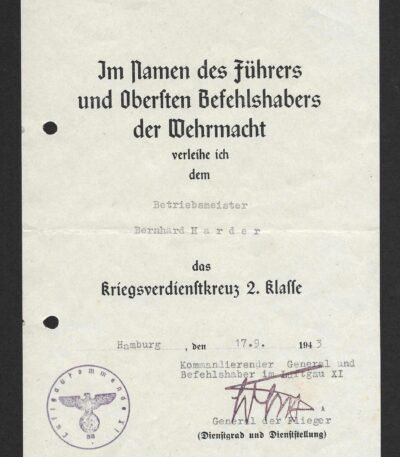
Kriegsverdienstkreuz 2. Klasse – Luftgau XI – Betriebsmeister, Hamburg, 1943
Original WWII German award certificate for the Kriegsverdienstkreuz 2. Klasse (War Merit Cross 2nd Class), awarded to Betriebsmeister Bernhard Harder on 17 September 1943 in Hamburg.
The certificate bears the heading „Im Namen des Führers und Obersten Befehlshabers der Wehrmacht“ (In the Name of the Führer and Supreme Commander of the Wehrmacht) and formally records the award of the War Merit Cross 2nd Class.
The document identifies the recipient as Betriebsmeister Bernhard Harder. The title Betriebsmeister generally refers to a works or plant supervisor, suggesting a position in industrial or technical operations, although his precise employer and duties are not established by the certificate alone.
The award was issued under the authority of the Kommandierender General und Befehlshaber im Luftgau XI (Commanding General and Commander of Luftgau XI). The certificate is stamped by a General der Flieger (General of Aviation).
The Kriegsverdienstkreuz (War Merit Cross) was established to recognise meritorious service contributing to the German war effort. The second-class award without swords was generally associated with war-related service not specifically recognised as service under enemy fire. By September 1943, German industry and the home front were under increasing pressure to sustain military production and wartime operations.
The certificate features a circular official Dienstsiegel (service seal), typewritten recipient details and a prominent handwritten signature. Its named recipient, dated award and Luftwaffe command connection make it an interesting original document for collectors of WWII German awards, Luftwaffe history and wartime industrial history.
Condition
The document shows age-related toning, a horizontal fold across the centre, minor staining and foxing, and two punched holes along the left margin. The printed text remains clearly legible, while the typewritten details and signature are visible. Please examine the photographs carefully for the exact condition.
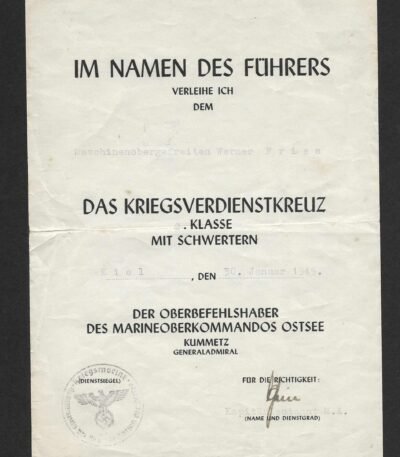
Kriegsverdienstkreuz 2. Klasse mit Schwertern Award Doc – Marineoberkommando Ostsee – Kummetz – Kiel, 1945
Original WWII German Kriegsmarine award document for the Kriegsverdienstkreuz 2. Klasse mit Schwertern (War Merit Cross 2nd Class with Swords), issued to Maschinenobergefreiter Werner Fries on 30 January 1945 in Kiel.
The certificate bears the printed heading “Im Namen des Führers” and records the award of the War Merit Cross 2nd Class with Swords. The document was issued under the authority of Generaladmiral Kummetz, identified on the certificate as Der Oberbefehlshaber des Marineoberkommandos Ostsee (Commander-in-Chief of Naval High Command Baltic Sea). The printed surname refers to Admiral Otto Kummetz, a senior Kriegsmarine commander.
The War Merit Cross with Swords was awarded for meritorious service connected with the war effort involving enemy action. This example dates from the final months of the Second World War, when the German Navy was heavily engaged in operations in the Baltic Sea, including the evacuation of German troops and civilians as Soviet forces advanced.
The certificate features a circular official service seal, printed award text and a handwritten certification signature in the lower-right section. The combination of its named recipient, specific award, date and naval command makes it an interesting historical document for collectors of Kriegsmarine militaria and original WWII German award certificates.
Condition
The document shows age-related toning, creases and fold lines, scattered foxing and staining, and some fading of the typewritten entries and official seal. The paper remains intact overall, with visible handling wear consistent with an original wartime document. Please examine the photographs carefully for the exact condition.
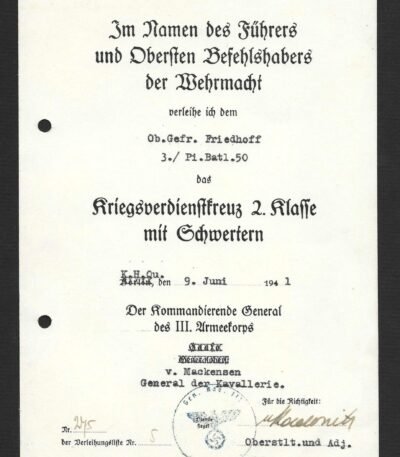
Kriegsverdienstkreuz 2. Klasse mit Schwertern Award Doc – Pionier-Bataillon 50, 1941 – III. Armeekorps
Original WWII German Wehrmacht award document for the Kriegsverdienstkreuz 2. Klasse mit Schwertern (War Merit Cross 2nd Class with Swords), awarded to Obergefreiter Friedhoff of the 3. Kompanie/ Pionier-Bataillon 50.
Dated 9 June 1941, the document was issued under the authority of the commanding general of the III Army Corps, General der Kavallerie Hans von Mackensen. It bears the printed designation of the commanding general, an official service seal, a handwritten signature in the authentication section, and additional handwritten administrative annotations.
The War Merit Cross with Swords recognised military merit in connection with service involving enemy action. The award date is particularly interesting, falling just twelve days before the launch of Operation Barbarossa, the German invasion of the Soviet Union on 22 June 1941.
An interesting original document for collectors of Wehrmacht award certificates, military paperwork, German pioneer troops and WWII award history.
Condition: Shows age-related paper toning, two punched holes along the left margin, handwritten entries and corrections, and a partially faded official seal. The signature and printed details remain visible. Please examine the photographs carefully for the exact condition.
An original historical document, offered as a collectible piece of WWII military history.
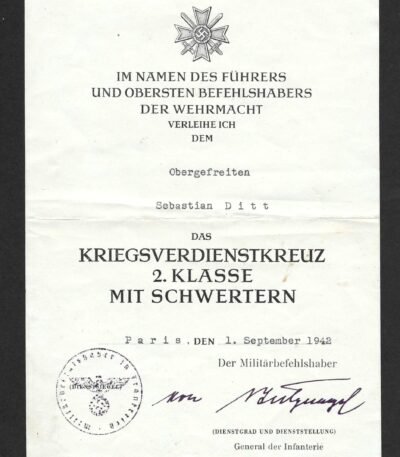
Kriegsverdienstkreuz 2. Klasse mit Schwertern Award Doc – Paris, 1942 – Carl-Heinrich von Stülpnagel
Original WWII German award certificate (Verleihungsurkunde) for the Kriegsverdienstkreuz 2. Klasse mit Schwertern (War Merit Cross 2nd Class with Swords), awarded to Obergefreiter Sebastian Ditt.
The document is dated Paris, 1 September 1942, and was issued by the German Military Commander in France (Der Militärbefehlshaber). It features the printed War Merit Cross with Swords emblem at the top and an official circular military service seal.
The award is accompanied by printed signature, with the signatory’s printed rank given as General der Infanterie. The signature appears to read Carl-Heinrich von Stülpnagel, who served as German Military Commander in France during this period. The attribution should be regarded as provisional unless independently authenticated.
The certificate is an interesting example of a Wehrmacht award document issued in occupied France during 1942.
Condition: Noticeable horizontal fold across the centre, additional creasing and wrinkles, scattered age spots and minor discoloration. The circular seal remains visible, although parts of its impression are faint. The handwritten signature is prominent. Please study the photographs for the full condition.
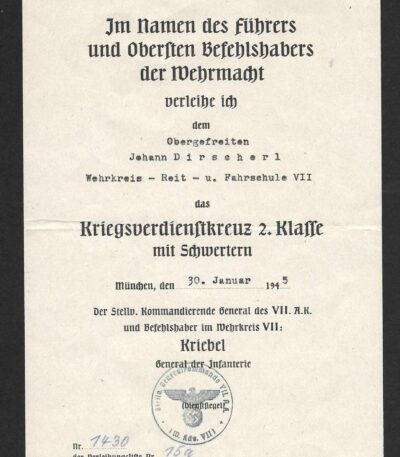
Kriegsverdienstkreuz 2. Klasse mit Schwertern Award Doc – Wehrkreis Reit und Fahrschule VII, München – Kriebel, 1945
Original WWII German award document (Verleihungsurkunde) for the Kriegsverdienstkreuz 2. Klasse mit Schwertern (War Merit Cross 2nd Class with Swords), awarded to Obergefreiter Johann Dirscherl.
The recipient is identified as serving with Wehrkreis-Reit- und Fahrschule VII (Military District VII Riding and Driving School). The document is dated Munich, 30 January 1945, and was issued in the name of the Commander-in-Chief of the Wehrmacht.
The award was authorised by General der Infanterie Kriebel, acting as Deputy Commanding General of the VII Army Corps and Commander of Military District VII. The document features his printed name and rank, together with the official circular military service seal.
The lower section contains handwritten reference numbers for the award and the award list. The original document retains its period typography and paper.
Condition: Shows age-related discoloration, a prominent horizontal fold across the centre, lighter creasing and scattered minor marks. The printed text remains clearly legible, and the official seal is visible. Please examine the photographs carefully for the precise condition.
An authentic historical document from the final months of the Second World War, suitable for a collection of German military award documents or Wehrmacht paper memorabilia.
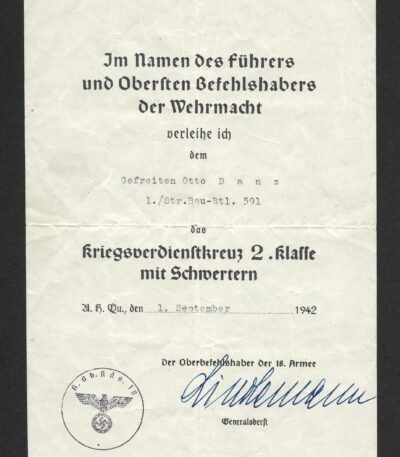
Kriegsverdienstkreuz 2. Klasse mit Schwertern Award Doc – Straßenbau-Bataillon 591 – Generaloberst Georg Lindemann
Original WWII German award certificate (Verleihungsurkunde) for the Kriegsverdienstkreuz 2. Klasse mit Schwertern (War Merit Cross 2nd Class with Swords), awarded to Gefreiter Otto Danz, serving with 1./Straßenbau-Bataillon 591, and dated 1 September 1942, in the field.
The certificate was issued by the Oberbefehlshaber der 18. Armee and features a prominent handwritten signature of Generaloberst Georg Lindemann, commander-in-chief of the 18th Army at the time. The original circular military service seal is also present.
Historical background – Generaloberst Georg Lindemann (1884–1963)
Georg Lindemann was a senior German Army commander during the Second World War. After commanding the 36. Infanterie-Division during the campaigns in Poland and France, he led the L. Armeekorps during the invasion of the Soviet Union. On 16 January 1942, he assumed command of the 18th Army, which fought on the northern sector of the Eastern Front, particularly in the operations surrounding the siege of Leningrad. Promoted to Generaloberst in July 1942, he later received the Oak Leaves to the Knight’s Cross of the Iron Cross in August 1943. In March 1944, he took command of Army Group North. In the final phase of the war, he was appointed commander of German forces in Denmark. He died in 1963.
This certificate dates from Lindemann’s tenure as commander of the 18th Army, providing a direct historical connection to his command during the fighting on the Eastern Front.
Condition: Noticeable folds, creasing and age-related wear
An historically interesting original award certificate combining a named recipient, a specialist military construction unit and the handwritten signature of a senior German army commander.
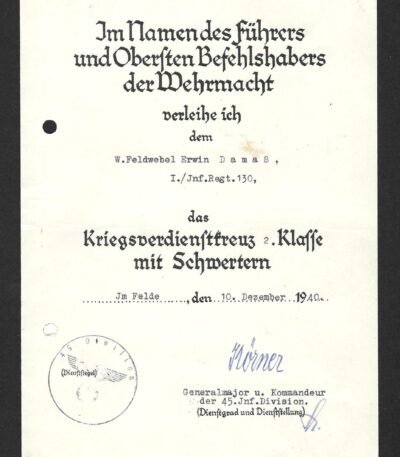
Kriegsverdienstkreuz 2. Klasse mit Schwertern Award Doc – Infanterie-Regiment 130 (45. Infanterie-Division), 1940
Original WWII German award certificate (Verleihungsurkunde) for the Kriegsverdienstkreuz 2. Klasse mit Schwertern (War Merit Cross 2nd Class with Swords), awarded to W. Feldwebel Erwin Damasß, serving with I./ Infanterie-Regiment 130 of the 45. Infanterie-Division and dated 10 December 1940 in the field (Im Felde).
The certificate features the recipient’s typed name and military unit, the original handwritten signature of Generalmajor Gerhard Körner, commander of the 45. Infanterie-Division, and a circular military service seal. Generalmajor Körner was killed in a car accident in 1941!
The War Merit Cross with Swords recognised meritorious service connected with the German war effort under conditions involving military operations. This certificate is an early-war example, dated December 1940, and documents the award to a named non-commissioned officer serving with an infantry regiment.
Condition: Age-related toning, creasing, a horizontal fold, and two holes along the left margin; the seal is partly faint.
An interesting original award document for collectors of WWII German award certificates, infantry history and Wehrmacht militaria.
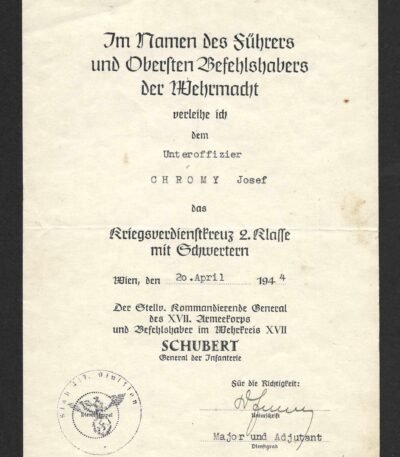
Kriegsverdienstkreuz 2. Klasse mit Schwertern Award Doc – XVII. Armeekorps – Wien 1944
Original WWII German award certificate (Verleihungsurkunde) for the Kriegsverdienstkreuz 2. Klasse mit Schwertern (War Merit Cross 2nd Class with Swords), awarded to Unteroffizier Josef Chromy and dated Vienna, 20 April 1944.
The certificate is printed in traditional Gothic lettering and retains the recipient’s typed name and rank. It bears the printed name of General der Infanterie Schubert, serving as deputy commanding general of the XVII. Armeekorps and commander of Wehrkreis XVII, together with a handwritten confirming signature from the adjutant’s office and an official military seal.
Issued during the final year of the war, this document represents an original example of the German military award system. The War Merit Cross with Swords recognised meritorious service connected with the war effort under conditions involving military operations.
Details:
- Country: Germany
- Period: WWII, dated 20 April 1944
- Recipient: Unteroffizier Josef Chromy
- Award: Kriegsverdienstkreuz 2. Klasse mit Schwertern
- Place of issue: Vienna (Wien)
- Issuing authority: XVII. Armeekorps / Wehrkreis XVII
- Features: Official seal and handwritten adjutant’s confirmation
- Condition: Good overall condition, with age-related toning, folds, creasing and minor staining
An appealing original award document for collectors of WWII German militaria, award certificates and Wehrmacht history.
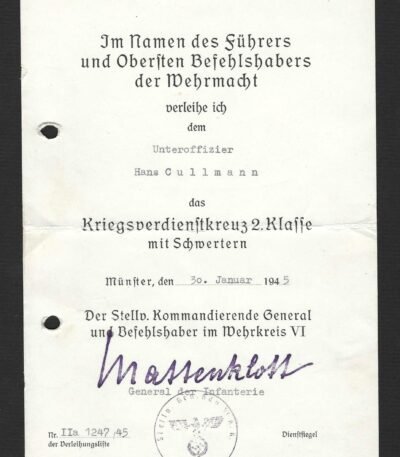
Kriegsverdienstkreuz 2. Klasse mit Schwertern Award Doc – Mattenklott – Münster 1945
Original WWII German award certificate (Verleihungsurkunde) for the Kriegsverdienstkreuz 2. Klasse mit Schwertern (War Merit Cross 2nd Class with Swords), awarded to Unteroffizier Hans Cullmann and dated Münster, 30 January 1945.
The certificate is printed in traditional Gothic lettering and features the recipient’s typed name and rank. It bears the large handwritten signature of General der Infanterie Walter Massenkeil, who served as deputy commanding general and commander of Wehrkreis VI. The official military service seal is also present.
Issued during the final months of the Second World War, this document represents a late-war example of the German military award system. The War Merit Cross with Swords was awarded for meritorious service connected with the war effort involving military operations.
Details:
- Country: Germany
- Period: WWII, dated 30 January 1945
- Recipient: Unteroffizier Hans Cullmann
- Award: Kriegsverdienstkreuz 2. Klasse mit Schwertern
- Place of issue: Münster, Germany
- Issuing authority: Wehrkreis VI
- Features: Large handwritten general’s signature and official service seal
- Condition: Visible age-related wear, horizontal fold, two punched holes along the left margin, and light staining.
An interesting original late-war award document for collectors of WWII German militaria, signed award certificates and Wehrmacht history.
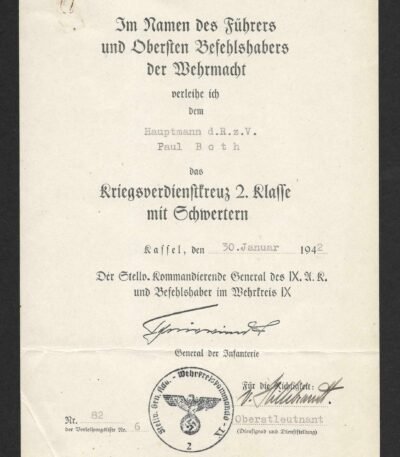
Kriegsverdienstkreuz 2. Klasse mit Schwertern Award Doc – Hauptmann d.R.z.V. – Kassel 1942
Original WWII German award document (Verleihungsurkunde) for the Kriegsverdienstkreuz 2. Klasse mit Schwertern (War Merit Cross 2nd Class with Swords), awarded to Hauptmann d.R.z.V. Paul Both and dated Kassel, 30 January 1942.
The certificate is printed in traditional Gothic lettering and features the recipient’s typed name and rank, the original signature of a General der Infanterie, and the official unit seal of the deputy commanding general of the IX. Armeekorps and commander of Wehrkreis IX.
The award was issued during the second year of the war, a period when the War Merit Cross with Swords was awarded for meritorious service contributing to the German war effort under conditions involving military operations.
An attractive original award certificate for collectors of WWII German military documents, decorations and Wehrmacht history.
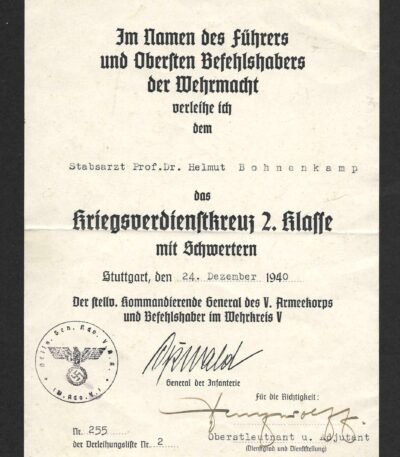
Kriegsverdienstkreuz 2. Klasse mit Schwertern Award Doc – Stabsarzt & Professor – Stuttgart 1940
Original WWII German award document (Verleihungsurkunde) for the Kriegsverdienstkreuz 2. Klasse mit Schwertern (War Merit Cross 2nd Class with Swords), awarded to Stabsarzt Prof. Dr. Helmut Bohnenkamp and dated Stuttgart, 24 December 1940.
The document is printed in the traditional Gothic lettering used on German military award certificates of the period. It bears the signature of a General der Infanterie in his capacity as deputy commanding general of the V. Armeekorps and commander of Wehrkreis V, together with the confirming signature of an Oberstleutnant serving as adjutant. The original unit seal is also present.
The certificate retains its original printed and typed details, with the recipient’s name, award designation, place and date clearly legible. It shows age-related toning, handling marks, creasing and other minor signs of storage consistent with an original document of this period.
An interesting original award document for collectors of WWII German military decorations, award certificates and military medical personnel history.
New On Commission
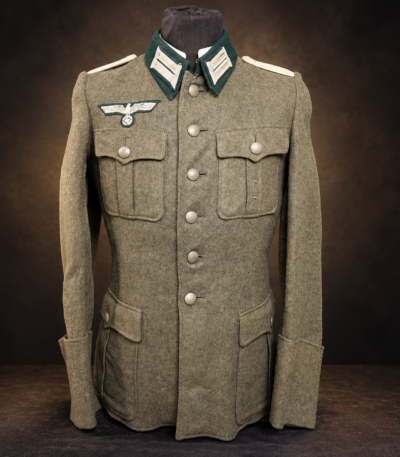
Wehrmacht Heer Infantry Leutnant Officer’s Field Tunic
€1.300,00Original WWII German Wehrmacht Heer field tunic featuring a distinctive dark green collar, white infantry branch-colour piping (Waffenfarbe) and a set of original insignia.
The tunic is constructed from field-grey wool and features six front closure buttons and four flat pockets with pointed flaps. The dark green collar provides an attractive early-style appearance, while the white piping is consistent with Heer infantry branch colour.
The tunic retains its breast eagle, collar tabs and shoulder straps, creating an appealing display piece for collectors of original German military uniforms from the Second World War.
Features:
- German Wehrmacht Heer field tunic (Feldbluse).
- Field-grey wool construction.
- Distinctive dark green collar.
- Six-button front closure.
- Four flat pockets with pointed flaps.
- White infantry branch-colour piping (Waffenfarbe).
- Breast eagle, collar tabs and shoulder straps present.
- Well-worn appearance with visible signs of age and use.
Condition:
The tunic displays considerable wear consistent with age and use. There is visible damage and material loss around the collar, together with general wear to the wool and staining to the interior lining. Please examine all photographs carefully for a detailed assessment of the condition.
The precise model designation and the originality of the individual insignia and their attachment have not been independently established. But it’s most likely a modified M41 with M36 Dark Green Collar.
An interesting addition to a Wehrmacht uniform collection or a suitable historical mannequin display.
Offered on commission by Wolfgang Historica.
New
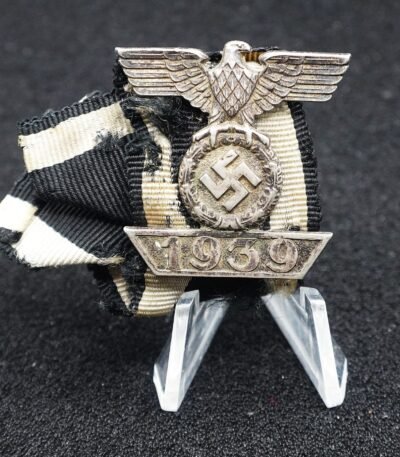
Wiederholungsspange 1939 – Clasp to the Iron Cross, 1939 – L/11 Deumer
€350,00An original-looking German Wiederholungsspange 1939 (Clasp to the Iron Cross, 1939), bearing the maker’s mark L/11, attributed to Wilhelm Deumer of Lüdenscheid.
The clasp features the characteristic German eagle with outstretched wings above the 1939 Iron Cross motif, with a separate 1939 date bar beneath. The reverse bears the L/11 maker’s mark. The clasp is accompanied by a black-and-white ribbon, folded and attached behind the decoration.
This award was intended for personnel who received the Iron Cross during the First World War and subsequently earned the corresponding Iron Cross again during the Second World War. The clasp was worn above the ribbon of the 1914 Iron Cross.
Historical Background
The 1939 Clasp to the Iron Cross 2nd Class was introduced following the reinstatement of the Iron Cross in September 1939. It was awarded to personnel who had received the Iron Cross 2nd Class in 1914 and subsequently qualified for the 1939 award. The clasp allowed the original First World War medal and its ribbon to be retained while recognising the later award.
The L/11 code identifies Wilhelm Deumer, a manufacturer based in Lüdenscheid. The clasp design and maker’s attribution are documented in specialist references.
Condition
The clasp shows heavy age-related wear, with substantial tarnishing, oxidation and discolouration to the metal. The ribbon is worn, frayed and damaged, with loose threads and areas of deterioration. The reverse displays corrosion and surface wear. The original-looking components are present in the photographs, but authenticity cannot be conclusively established from photographs alone.
New
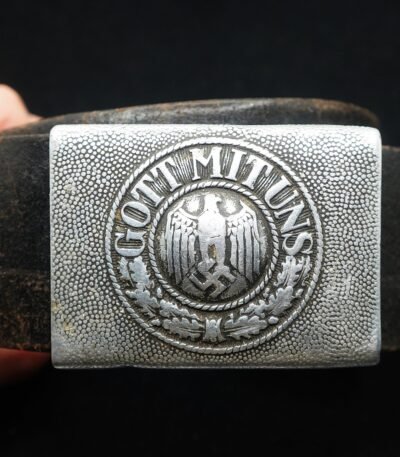
Wehrmacht Heer Belt & Buckle – Gott Mit Uns – Belt Size 86
€250,00An original German Wehrmacht Heer enlisted men’s/NCO’s belt and buckle from the Second World War period.
The rectangular aluminium buckle features the distinctive “GOTT MIT UNS” motto (“God with us”), surrounding the German Army eagle and swastika, framed by an oak-leaf wreath. The design is set against a finely pebbled background, a characteristic feature of the German Army’s dress-pattern belt buckles.
The buckle retains its original silver-coloured finish, with darker patination and wear highlighting the raised details. The reverse retains its fastening hardware.
The accompanying leather belt shows a stamped “86” marking, likely indicating its size. The leather has developed a dark brown appearance through age and wear, with considerable surface wear, cracking and deterioration to the finish. The original buckle and belt remain together as a complete display piece.
Condition: Used condition, with visible age-related wear to both components. The buckle retains good detail, while the leather belt shows substantial wear, surface cracking and finish loss. Please examine all photographs carefully.
An interesting original German Army belt set for collectors of Wehrmacht uniforms, equipment and Second World War militaria.
New
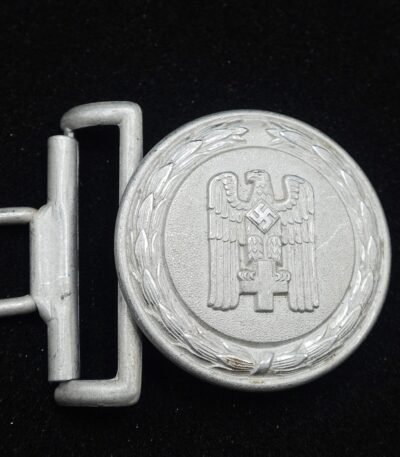
Deutsches Rotes Kreuz (DRK) – Field Belt Buckle – Aluminium – “Ges. Gesch. 2”
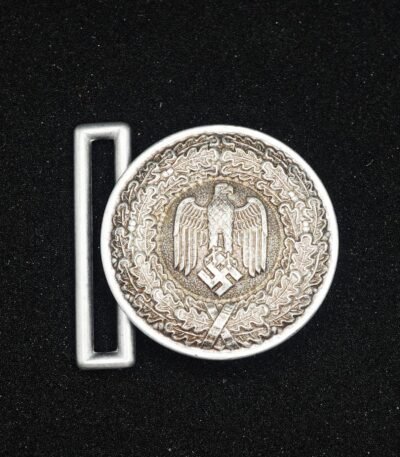
€250,00An original German Red Cross (Deutsches Rotes Kreuz – DRK) field belt buckle, dating from the Third Reich period. Manufactured from aluminium, this distinctive buckle features a central circular medallion bearing the German eagle with outstretched wings, a swastika on its breast and a cross held in its talons. The emblem is surrounded by a decorative laurel wreath, with a finely textured background that contrasts with the raised details of the design.
The reverse is stamped “GES. GESCH. 2”, indicating a legally protected design. This marking is associated with a known variant of the DRK field belt buckle. This circular design was intended for the field or dress belt (Feldbindenschloss). The multi-piece aluminium construction, central medallion and rear fastening assembly are characteristic features of this type.
The Deutsches Rotes Kreuz was reorganised under National Socialist rule during the 1930s, and its uniforms and insignia reflected the period’s increasingly militarised organisational structure. DRK personnel served in a range of medical, nursing and support roles. This buckle represents the organisation’s uniform equipment during the period immediately before and during the Second World War.
Condition: Good original condition, with visible age-related wear, light surface oxidation and minor marks consistent with use and storage. The eagle, cross, wreath and reverse marking remain clearly identifiable. The buckle retains its rear fastening components. Please refer to the photographs for a detailed assessment of the condition.
New
2x Award Docs & Erkennungsmarke – Unteroffizier – Infanterie-Regiment 16
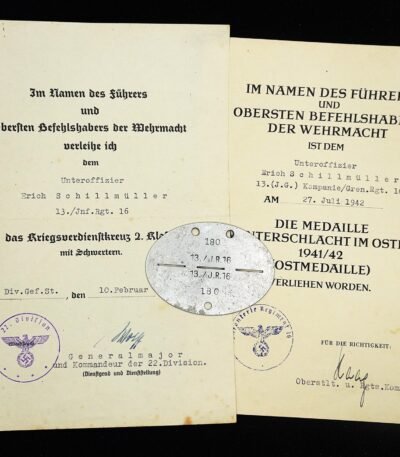
€160,00An interesting three-piece Wehrmacht grouping belonging to Unteroffizier Erich Schillmüller, who served with the 13th Company of Infanterie-Regiment 16, later redesignated Grenadier-Regiment 16. The grouping comprises two original award documents and a matching-style German military identity disc bearing the same company and regimental designation.
The first document awards Schillmüller the War Merit Cross 2nd Class with Swords (Kriegsverdienstkreuz 2. Klasse mit Schwertern). Dated 10 February, the year is obscured by the identity disc in the photographs, but the document is signed by Generalmajor Ludwig Wolff, commander of the 22nd Infantry Division. Wolff commanded the division from October 1941 until August 1942, making February 1942 consistent with his tenure.
The second document confirms the award of the Eastern Front Medal (Medaille für die Winterschlacht im Osten 1941/42, commonly known as the Ostmedaille) on 27 July 1942. The document bears the signature attributed to Werner Haag, who served as Divisionsadjutant of the 22nd Infantry Division until 31 July 1942 and subsequently commanded Infanterie-Regiment 16 from 1 August 1942.
Completing the grouping is an oval German military identity disc (Erkennungsmarke), stamped “13./J.R.16” and numbered 180. The company and regimental designation corresponds to the unit recorded on the award documents, providing an appealing connection between the documents and the personal equipment of a soldier of the regiment.
Infanterie-Regiment 16 formed part of the 22nd Infantry Division, originally raised in Bremen in 1935. The regiment subsequently became Grenadier-Regiment 16 in 1942.
Condition: Both award documents show age-related toning, foxing, and staining. The War Merit Cross document has two punched holes along its left margin. The identity disc shows surface wear, scratches, and discolouration, with its stamped details remaining legible. Please consult the photographs for a complete assessment.
New
Infantry Assault Badge in Silver – Infanterie-Sturmabzeichen – GWL
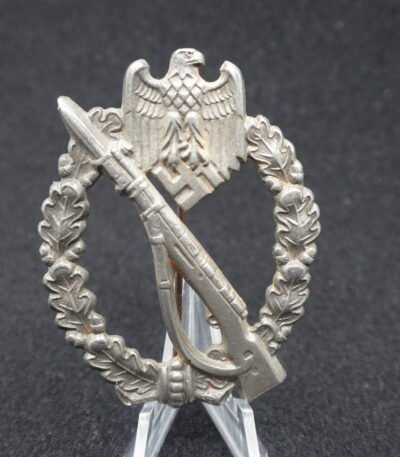
€165,00An original-looking German Infantry Assault Badge in Silver (Infanterie-Sturmabzeichen in Silber) from the Second World War, manufactured by Gebrüder Wegerhoff of Lüdenscheid, identified by the distinctive GWL maker’s mark on the reverse.
The badge features the characteristic German eagle with outstretched wings, positioned above a Karabiner 98k rifle with fixed bayonet, enclosed within an oval oak-leaf wreath. The detailed relief and remaining silver-coloured finish make this a recognisable example of the German Army’s infantry combat decoration.
The reverse displays the clearly visible GWL mark within a circular cartouche. The badge has a single-piece zinc construction, with a vertical pin fastening assembly.
Historical Background
The Infantry Assault Badge was instituted on 20 December 1939 by Generaloberst Walther von Brauchitsch. The silver grade recognised qualifying combat participation by infantry and mountain infantry personnel during the Second World War.
The original award criteria included participation in at least three separate infantry assaults on different days. The decoration recognised frontline combat service and the demanding role of infantrymen in ground operations.
Gebrüder Wegerhoff (GWL) was a German manufacturer of military decorations based in Lüdenscheid, a major centre of German badge and insignia production. The maker’s mark on this example provides a specific manufacturer attribution.
Condition
The badge displays age-related wear and surface patina, with areas of discolouration and oxidation. The original silver-coloured finish is worn, although the main design details remain clearly visible. The reverse shows surface wear, and the steel pin exhibits noticeable rust and oxidation. The hinge and catch assembly appear present in the photographs. Please examine all photographs carefully, as they form an integral part of the condition description.
New
Crimea Shield (Krimschild), 1941–1942 – Zinc with Field-Grey Wool Backing
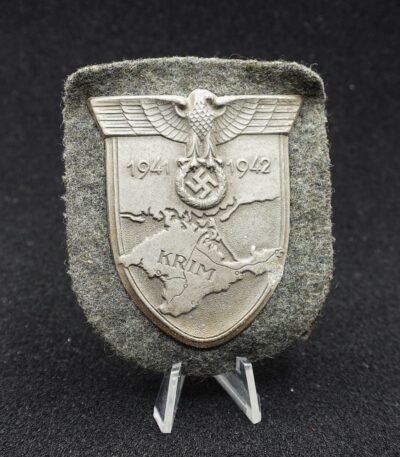
€180,00An example of the German Crimea Campaign Shield (Krimschild), instituted on 25 July 1942 to recognise participation in the Crimean campaign during the Second World War.
The shield features a German eagle with outstretched wings above the dates 1941–1942, with a map of the Crimean region and the inscription KRIM below. It is constructed from zinc, with a field-grey wool backing intended for attachment to the uniform sleeve.
The shield retains its distinctive design and raised details. The reverse is covered by a shaped paper backing, with the edges of the backing material showing age-related deterioration.
Historical Background
The Crimea Shield was awarded to eligible German and allied military personnel who participated in the campaign in Crimea between 21 September 1941 and 4 July 1942. The campaign included the fighting across the peninsula and the capture of Sevastopol. The shield was normally worn on the left upper sleeve of the uniform, sewn onto its cloth backing. Different backing colours were used for different branches of service.
Condition
The shield displays age-related wear and surface discolouration. The zinc face retains clearly visible relief details, although the original finish appears worn. The field-grey wool backing is present, while the reverse paper covering shows significant cracking, tears and losses around the edges. Please consult all photographs for the exact condition. Priced accordingly!
New
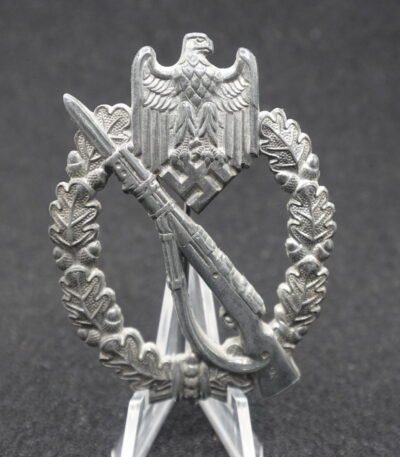
Infantry Assault Badge in Silver – Infanterie-Sturmabzeichen – Unmarked Josef Bergs & Co, Gablonz.
€120,00An interesting German Infantry Assault Badge in Silver (Infanterie-Sturmabzeichen in Silber) from the Second World War, representing one of the principal combat awards issued to German infantry personnel.
The badge features the characteristic German eagle holding a swastika, positioned above a diagonally placed rifle with a fixed bayonet, enclosed within an oval oak-leaf wreath. The detailed relief and silver-coloured finish give the decoration its distinctive appearance. Unmarked but attributed to Josef Bergs & Co, Gablonz.
This example is unmarked, with its construction attributed provisionally to the Gablonz manufacturing area. No specific manufacturer can be confirmed from the available photographs, so the attribution should be treated with caution.
Historical Background
The Infantry Assault Badge was instituted on 20 December 1939 by Generaloberst Walther von Brauchitsch. It recognised qualifying combat participation by infantry personnel during the Second World War.
The silver grade was awarded to eligible infantrymen who participated in qualifying assault actions, with the original criteria including participation in at least three separate infantry assaults on different days. The award reflected the demanding frontline service of infantry soldiers during the conflict.
Condition
The badge displays age-related wear and surface patina, with areas of discolouration and minor oxidation. The silver-coloured finish remains visible across much of the front, and the main design details are clearly distinguishable. The reverse exhibits surface wear and some corrosion, particularly around the fastening components. The hinge, pin and catch appear to be present in the photographs.
Please examine the photographs carefully for a detailed assessment of the item’s condition.
New
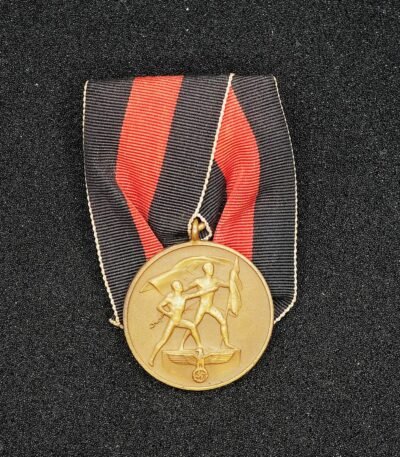
German Anschluss Medal – 13 March 1938 – Mounted for Wear
€75,00An original German Anschluss Commemorative Medal (Medaille zur Erinnerung an den 13. März 1938), instituted on 1 May 1938 to commemorate the annexation of Austria by Nazi Germany.
The medal features two male figures representing the union of Austria with the German Reich. Beneath them is the German national eagle with swastika. The reverse bears the inscription “13. März 1938”, surrounded by the motto “Ein Volk, Ein Reich, Ein Führer” (“One People, One Reich, One Leader”).
The medal retains its distinctive red ribbon with a central white-black-white stripe. It is mounted for wear with a metal pin-back fitting, allowing it to be attached to a uniform. The ribbon’s original colours remain attractive, and the medal displays an aged golden-silver tone.
The Anschluss Medal was one of the German commemorative decorations associated with the territorial expansion of the Third Reich before the Second World War. Approximately 318,689 examples were awarded.
Condition: Shows age-related wear and surface discolouration. The ribbon remains attached, with some visible handling wear and loose threads. The reverse retains its metal mounting and pin assembly. Please examine the photographs for a detailed assessment.
New
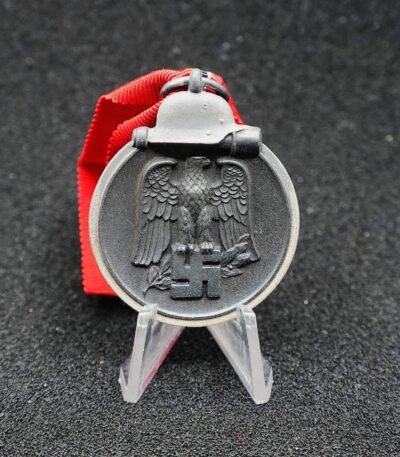
German Ostmedaille – Winter War Medal – Unmarked
€65,00An original German Eastern Front Medal (Ostmedaille), instituted on 26 May 1942 to commemorate participation in the winter campaign on the Eastern Front during 1941–1942.
The obverse features the German national eagle clutching a swastika above a steel helmet and stick grenade, surrounded by a circular raised rim. The reverse bears the inscription “WINTERSCHLACHT IM OSTEN 1941/42”, above a crossed sword and laurel branch.
This example is unmarked on the suspension ring and retains its red ribbon with the characteristic central black stripe bordered by narrow white stripes.
The medal displays a dark grey finish contrasting with the lighter-coloured rim and suspension. Both sides retain clear, well-defined details.
Item Details
- Award: Medaille Winterschlacht im Osten 1941/42 (Ostmedaille)
- Period: Second World War
- Country: Germany
- Manufacturer: Unmarked; maker cannot be identified from the available photographs
- Material: Zinc alloy
- Ribbon: Red with central black stripe bordered by white
- Suspension: Original-style integrated helmet and ribbon loop
Condition
Good used condition, showing age-related wear, surface oxidation and some variation in the finish. The raised details and reverse inscription remain clearly visible. The medal retains its ribbon. Please examine the photographs carefully, as they form part of the description.
New
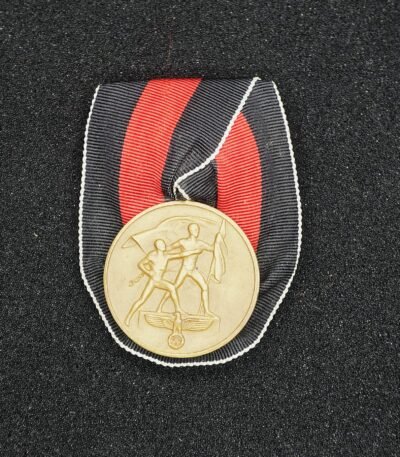
German Anschluss Medal – 13 March 1938 – Mounted for Wear
€75,00An original German Anschluss Commemorative Medal (Medaille zur Erinnerung an den 13. März 1938), instituted on 1 May 1938 to commemorate the annexation of Austria by Nazi Germany.
The medal features two male figures representing the union of Austria with the German Reich. Beneath them is the German national eagle with swastika. The reverse bears the inscription “13. März 1938”, surrounded by the motto “Ein Volk, Ein Reich, Ein Führer” (“One People, One Reich, One Leader”).
The medal retains its distinctive red ribbon with a central white-black-white stripe. It is mounted for wear with a cloth pin-back fitting, allowing it to be attached to a uniform. The ribbon’s original colours remain attractive, and the medal displays an aged golden-silver tone.
The Anschluss Medal was one of the German commemorative decorations associated with the territorial expansion of the Third Reich before the Second World War. Approximately 318,689 examples were awarded.
Condition: Shows age-related wear and surface discolouration. The ribbon remains attached, with some visible handling wear and loose threads. The reverse retains its metal mounting and pin assembly. Please examine the photographs for a detailed assessment.
New
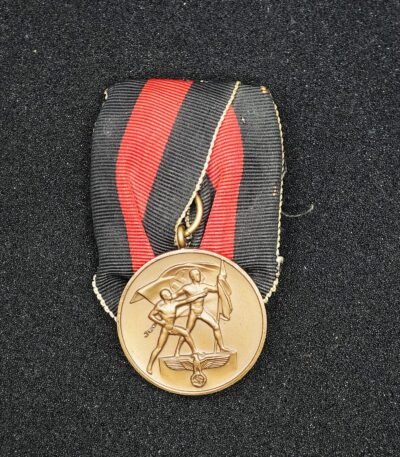
German Anschluss Medal – 13 March 1938 – Mounted for Wear
€75,00An original German Anschluss Commemorative Medal (Medaille zur Erinnerung an den 13. März 1938), instituted on 1 May 1938 to commemorate the annexation of Austria by Nazi Germany.
The medal features two male figures representing the union of Austria with the German Reich. Beneath them is the German national eagle with swastika. The reverse bears the inscription “13. März 1938”, surrounded by the motto “Ein Volk, Ein Reich, Ein Führer” (“One People, One Reich, One Leader”).
The medal retains its distinctive red ribbon with a central white-black-white stripe. It is mounted for wear with a cloth pin-back fitting, allowing it to be attached to a uniform. The ribbon’s original colours remain attractive, and the medal displays an aged golden-silver tone.
The Anschluss Medal was one of the German commemorative decorations associated with the territorial expansion of the Third Reich before the Second World War. Approximately 318,689 examples were awarded.
Condition: Shows age-related wear and surface discolouration. The ribbon remains attached, with some visible handling wear and loose threads. The reverse retains its metal mounting and pin assembly. Please examine the photographs for a detailed assessment.
New
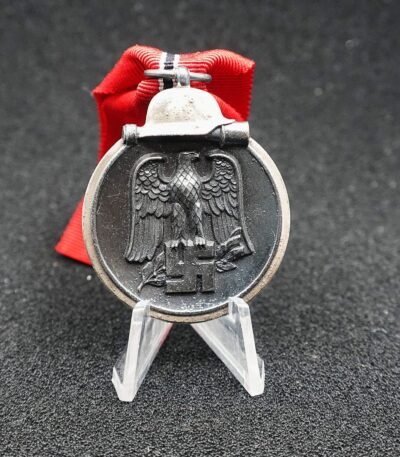
Ostmedaille – Maker Marked 93 – Richard Simm & Söhne, Gablonz – NM
€75,00An original German Eastern Front Medal (Medaille Winterschlacht im Osten 1941/42), commonly known as the Ostmedaille, awarded for service during the winter campaign on the Eastern Front in 1941–1942.
The medal features the German national eagle holding a swastika above a helmet and stick grenade on the obverse. The reverse bears the inscription “WINTERSCHLACHT IM OSTEN 1941/42”, with a crossed sword and branch beneath.
The suspension ring is stamped “93”, identifying the manufacturer as Richard Simm & Söhne, Gablonz. This maker’s code is documented in specialist militaria catalogues and dealer references.
The medal retains its red ribbon with the distinctive central black stripe bordered by white stripes. The dark finish contrasts with the lighter-coloured raised rim and suspension assembly.
Condition: Shows age-related wear and surface oxidation, with some loss of the original finish. The raised details remain clearly visible. The suspension ring and ribbon are present. Please examine the photographs carefully for the item’s precise condition. Near Mint.
An attractive maker-marked example of the Ostmedaille by Richard Simm & Söhne, suitable for a collection of German Second World War medals and decorations.
New
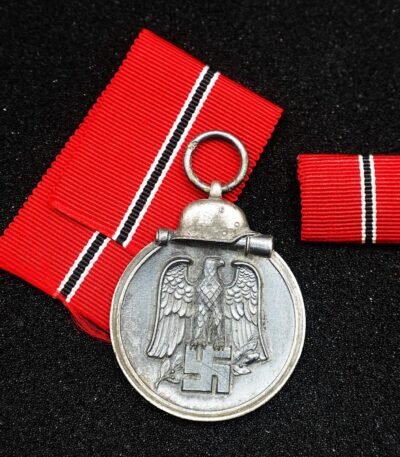
Ostmedaille – Maker Marked 65 (Klein & Quenzer) + Ribbon & Ribbon Bar
€80,00An original German Eastern Front Medal (Medaille für die Winterschlacht im Osten 1941/42), commonly known as the Ostmedaille, awarded for service on the Eastern Front during the winter campaign of 1941–1942. The medal features the German eagle holding a swastika above crossed branches on the obverse. The reverse bears the inscription “WINTERSCHLACHT IM OSTEN 1941/42”, with a crossed sword and branch beneath.
The medal is maker-marked “65” on the suspension ring, identifying the manufacturer as Klein & Quenzer AG, Idar-Oberstein, a recognised producer of German military decorations during the Second World War.
The medal retains its red ribbon with the distinctive central black stripe bordered by white stripes. Included is a matching ribbon bar featuring the same ribbon colours, making this an attractive set for collectors of German WWII medals and decorations.
Condition: The medal shows visible age-related wear, with loss of the original finish, surface oxidation and small areas of discolouration. The suspension ring remains present, and the medal retains its ribbon. The matching ribbon bar is also included. Please examine the photographs carefully for the item’s precise condition.
An appealing maker-marked Ostmedaille by Klein & Quenzer, complete with its ribbon and matching ribbon bar.
New
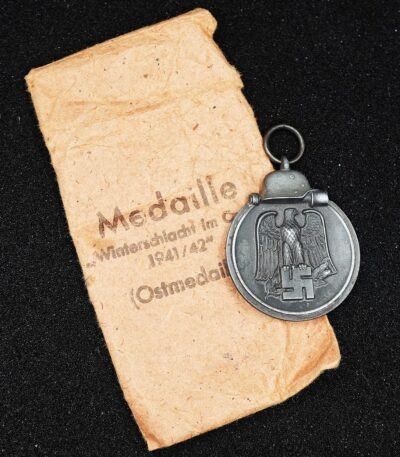
German Ostmedaille – Unmarked + Pouch
€55,00An original German Eastern Front Medal (Ostmedaille), instituted on 26 May 1942 to commemorate participation in the winter campaign on the Eastern Front during 1941–1942. This example comes with its associated paper issue pouch, adding historical interest to the piece.
The medal features the German national eagle clutching a swastika above a steel helmet and stick grenade. The reverse bears the inscription “WINTERSCHLACHT IM OSTEN 1941/42”, above a crossed sword and laurel branch.
The medal is unmarked on the suspension ring. The accompanying paper pouch is printed with the designation “Medaille Winterschlacht im Osten 1941/42 (Ostmedaille)”. A faint additional stamp is visible on the opposite side, although the wording is difficult to establish from the photographs.
The medal displays age-related wear, surface oxidation and variations in its dark finish. The raised details remain well defined, and the reverse inscription is clearly legible. The paper pouch shows considerable age-related deterioration, including heavy creasing, staining, worn edges and areas of damage. The printed designation remains readable. Please study the photographs carefully, particularly the condition of the original paper pouch.
New
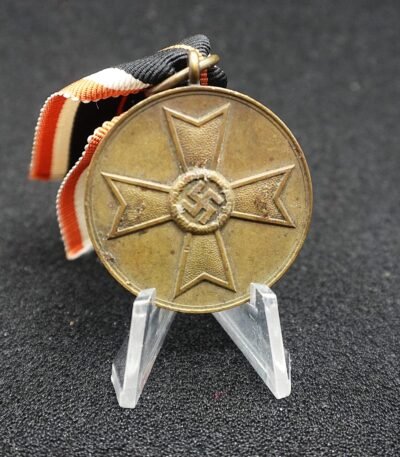
War Merit Medal 1939 – Kriegsverdienstmedaille
€30,00An original German War Merit Medal 1939 (Kriegsverdienstmedaille), instituted on 19 August 1940 to recognise contributions to the German war effort that did not warrant a higher award in the War Merit Cross series.
The obverse features a textured cross with a central circular medallion bearing a swastika, surrounded by a raised border. The reverse displays the Gothic inscription “Für Kriegsverdienst 1939” (“For War Merit 1939”).
The medal retains its suspension ring and its distinctive black ribbon with a narrow red central stripe and red-and-white edging.
Historical Background
The War Merit Medal was the lowest award in the War Merit Cross series. It recognised contributions to the wartime effort, particularly in civilian and industrial contexts, although it could also be awarded to military personnel. Recipients included workers in armaments production and individuals involved in wartime support services. The medal was awarded in large numbers during the Second World War.
Condition
The medal displays an attractive aged bronze-coloured patina, with visible surface wear and minor discolouration. The raised details and inscription remain clearly defined. The ribbon is present and shows signs of age and handling. Please examine the photographs carefully for the precise condition.
New
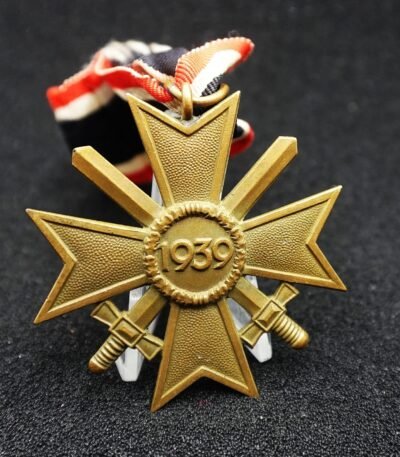
War Merit Cross 2nd Class with Swords – 1939 – Kriegsverdienstkreuz 2. Klasse mit Schwertern
€45,00An original German Kriegsverdienstkreuz 1939, 2. Klasse mit Schwertern (War Merit Cross 2nd Class with Swords), instituted on 18 October 1939.
The cross features a textured, gilt-bronze-coloured finish, with a central circular medallion bearing the date “1939” on the obverse. Crossed swords appear behind the arms of the cross, symbolising its military distinction.
The reverse features a central swastika within a circular border. The decoration retains its red, white and black ribbon, characteristic of the War Merit Cross awards.
Historical Background
The War Merit Cross was introduced to recognise contributions to the German war effort that did not necessarily meet the criteria for the Iron Cross. The version with swords recognised military merit associated with wartime service, while the version without swords was generally awarded for civilian or non-combat contributions.
Condition
The cross displays age-related wear and patina, with some discolouration and loss or variation of the finish. The raised details remain clearly visible. The ribbon is present and shows signs of age and handling. Please examine the photographs carefully for the precise condition.
New
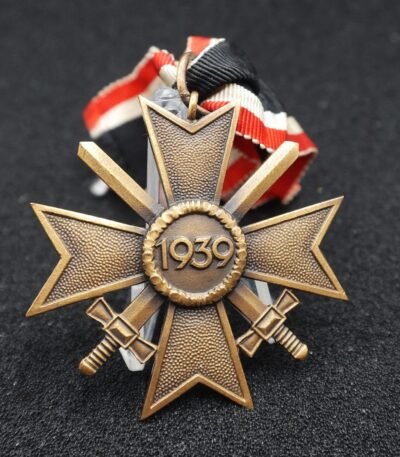
War Merit Cross 2nd Class with Swords – 1939 – Kriegsverdienstkreuz 2. Klasse mit Schwertern
€45,00An original German Kriegsverdienstkreuz 1939, 2. Klasse mit Schwertern (War Merit Cross 2nd Class with Swords), instituted on 18 October 1939.
The cross features a textured, gilt-bronze-coloured finish, with a central circular medallion bearing the date “1939” on the obverse. Crossed swords appear behind the arms of the cross, symbolising its military distinction.
The reverse features a central swastika within a circular border. The decoration retains its red, white and black ribbon, characteristic of the War Merit Cross awards.
Historical Background
The War Merit Cross was introduced to recognise contributions to the German war effort that did not necessarily meet the criteria for the Iron Cross. The version with swords recognised military merit associated with wartime service, while the version without swords was generally awarded for civilian or non-combat contributions.
Condition
The cross displays age-related wear and patina, with some discolouration and loss or variation of the finish. The raised details remain clearly visible. The ribbon is present and shows signs of age and handling. Please examine the photographs carefully for the precise condition.
New
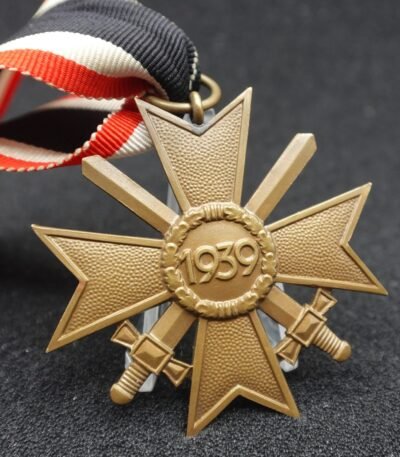
War Merit Cross 2nd Class with Swords – 1939 – Kriegsverdienstkreuz 2. Klasse mit Schwertern
€45,00An original German Kriegsverdienstkreuz 1939, 2. Klasse mit Schwertern (War Merit Cross 2nd Class with Swords), instituted on 18 October 1939.
The cross features a textured, gilt-bronze-coloured finish, with a central circular medallion bearing the date “1939” on the obverse. Crossed swords appear behind the arms of the cross, symbolising its military distinction.
The reverse features a central swastika within a circular border. The decoration retains its red, white and black ribbon, characteristic of the War Merit Cross awards.
Historical Background
The War Merit Cross was introduced to recognise contributions to the German war effort that did not necessarily meet the criteria for the Iron Cross. The version with swords recognised military merit associated with wartime service, while the version without swords was generally awarded for civilian or non-combat contributions.
Condition
The cross displays age-related wear and patina, with some discolouration and loss or variation of the finish. The raised details remain clearly visible. The ribbon is present and shows signs of age and handling. Please examine the photographs carefully for the precise condition.
New
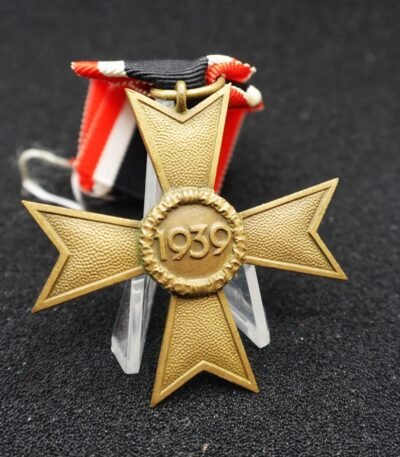
War Merit Cross 2nd Class – 1939 – Kriegsverdienstkreuz 2. Klasse
€30,00An original German War Merit Cross 2nd Class without Swords (Kriegsverdienstkreuz 1939, 2. Klasse ohne Schwerter), instituted on 18 October 1939.
The cross features the characteristic textured arms with raised borders and a central circular medallion bearing a swastika within a decorative wreath. The reverse displays the date “1939” in raised numerals.
Unlike the combat-related version, this example has no crossed swords between the arms of the cross. It retains its suspension ring and black, white and red ribbon.
Historical Background
The War Merit Cross recognised contributions to the German war effort that did not necessarily qualify for the Iron Cross. The version without swords was principally associated with civilian merit and non-combat contributions, including work in industry, administration and wartime support services. The decoration was awarded to both civilians and military personnel for qualifying non-combat service.
Condition
The cross displays an aged bronze-coloured finish with natural patina, minor surface wear and some discolouration. The raised details and date remain clearly defined. The suspension ring and ribbon are present. Please examine the photographs carefully for the precise condition.
New
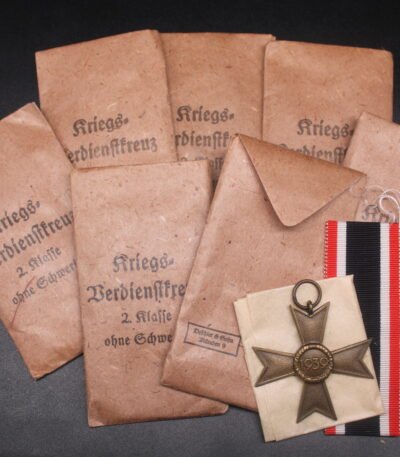
Kriegsverdienstkreuz 2. Klasse ohne Schwertern (Deschler & Sohn)
€45,00Original Kriegsverdienstkreuz 2. Klasse ohne Schwertern from Deschler & Sohn, maker marked “1” with cellophane and pouch! Mint. Condition as seen.
Price per Piece!
New
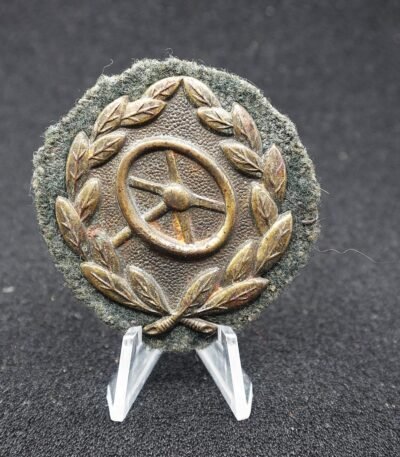
Driver’s Proficiency Badge in Bronze – Kraftfahrbewährungsabzeichen in Bronze
€65,00An original-looking example of the German Driver’s Proficiency Badge in Bronze (Kraftfahrbewährungsabzeichen in Bronze), introduced during the Second World War to recognise qualifying driving service under wartime conditions.
The badge features a central steering wheel surrounded by a laurel wreath, with finely textured detailing to the background. The bronze-coloured finish remains visible across the design, showing attractive age-related patina and areas of discolouration.
The badge is mounted on its original-looking grey-green wool backing, which gives the piece additional character. The reverse features a circular metal backing plate with the remains of the fastening assembly.
Historical Background
The Driver’s Proficiency Badge was instituted on 23 October 1942 to recognise qualifying driving service under wartime conditions. It was awarded in bronze, silver and gold grades, with the award criteria relating to driving service and operational circumstances.
Military drivers played an essential role in transporting troops, ammunition, equipment and supplies. This decoration represents the contribution of motor transport personnel to German military operations during the Second World War.
Condition
The badge displays heavy age-related wear, with extensive oxidation and corrosion to the reverse. Much of the original finish on the rear plate has deteriorated, and the fastening assembly appears damaged or incomplete. The front retains visible detail, with wear and patina consistent with its aged appearance. The grey-green wool backing is heavily worn, with loose fibres and fraying around the edges. Please examine the photographs carefully, as they form an integral part of the condition description.
New
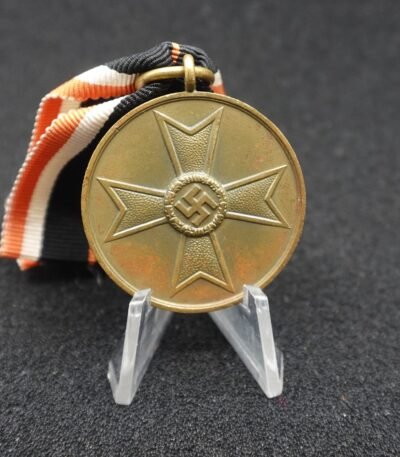
War Merit Medal 1939 – Kriegsverdienstmedaille
€30,00An original German War Merit Medal 1939 (Kriegsverdienstmedaille), instituted on 19 August 1940 to recognise contributions to the German war effort that did not warrant a higher award in the War Merit Cross series.
The obverse features a textured cross with a central circular medallion bearing a swastika, surrounded by a raised border. The reverse displays the Gothic inscription “Für Kriegsverdienst 1939” (“For War Merit 1939”).
The medal retains its suspension ring and its distinctive black ribbon with a narrow red central stripe and red-and-white edging.
Historical Background
The War Merit Medal was the lowest award in the War Merit Cross series. It recognised contributions to the wartime effort, particularly in civilian and industrial contexts, although it could also be awarded to military personnel. Recipients included workers in armaments production and individuals involved in wartime support services. The medal was awarded in large numbers during the Second World War.
Condition
The medal displays an attractive aged bronze-coloured patina, with visible surface wear and minor discolouration. The raised details and inscription remain clearly defined. The ribbon is present and shows signs of age and handling. Please examine the photographs carefully for the precise condition.
New
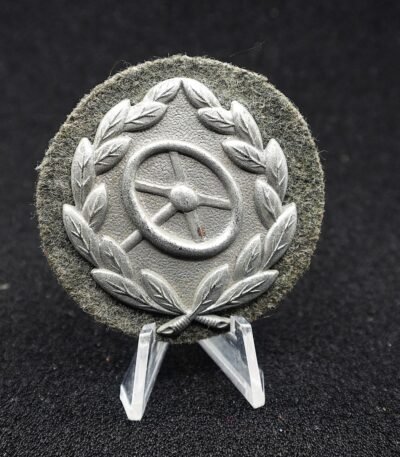
Driver’s Proficiency Badge in Silver – Kraftfahrbewährungsabzeichen in Silber
€85,00An interesting German Driver’s Proficiency Badge in Silver (Kraftfahrbewährungsabzeichen in Silber), awarded during the Second World War to recognise qualifying driving service under wartime conditions.
Instituted on 23 October 1942, the badge was awarded in three grades: bronze, silver and gold. It was associated with military drivers whose duties involved operating vehicles under the demanding conditions of wartime service.
This example features the characteristic steering-wheel design surrounded by a wreath, representing the importance of motor transport to German military operations. The badge is mounted on a grey-green wool backing.
Historical Background
The Driver’s Proficiency Badge was introduced on 23 October 1942 to recognise qualifying service by drivers operating in wartime conditions. It was awarded in bronze, silver and gold grades, with the criteria relating to driving service and operational circumstances. The badge reflects the importance of transport personnel in moving troops, equipment and supplies throughout the various theatres of war.
Condition
The badge displays considerable age-related wear, with extensive oxidation and corrosion visible on the reverse. The original finish shows significant deterioration. The grey-green wool backing is heavily aged, with loose fibres and visible wear. Please examine the photographs carefully for a detailed assessment of the condition.
New
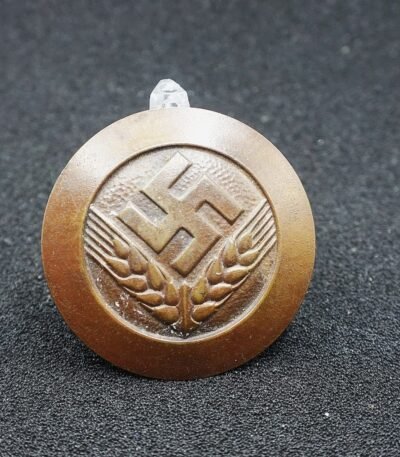
RADwJ Jungführerin Rank Brooch – Bronze
€75,00An example of a Jungführerin rank brooch of the Reichsarbeitsdienst der weiblichen Jugend (RADwJ), the Reich Labour Service for Female Youth, dating from the Second World War.
The obverse features the characteristic mobile swastika, flanked by two wheat sheaves, within a circular central design. The brooch has a smooth, bronze-coloured outer rim, consistent with the insignia worn by a Jungführerin under the RADwJ rank system introduced in October 1939.
The reverse is fitted with a horizontal pin fastening. No maker’s mark is.
Historical Background
The RADwJ was the female branch of the German Reich Labour Service. Its members undertook agricultural, domestic and social support work, while the organisation also served the ideological objectives of the Nazi state. Its rank brooches distinguished leadership levels through their metal colour and rim design. The smooth bronze-coloured rim is consistent with the Jungführerin rank.
Condition
The brooch shows noticeable age-related wear, with surface tarnishing, oxidation and areas of discolouration. The central design remains clearly visible. The reverse pin assembly appears present, with visible wear and oxidation. Please examine the photographs carefully for the full condition.
New
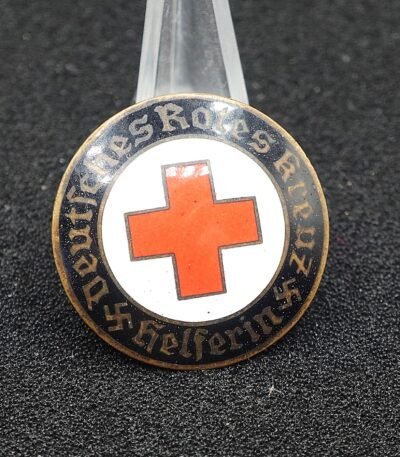
German DRK Helferin Badge – Enamel Membership Badge
€45,00An original German Deutsches Rotes Kreuz (DRK) Helferin badge from the Second World War period, intended for female helpers serving within the German Red Cross organisation.
The circular badge features a central red cross on a white enamel field, surrounded by a black enamel border bearing the Gothic inscription “Deutsches Rotes Kreuz Helferin” (German Red Cross Helper).
The badge is manufactured in a copper-alloy construction with multicoloured enamel detailing. The reverse bears the marking “GES. GESCH.”, an abbreviation of Gesetzlich Geschützt, meaning “legally protected.” No specific manufacturer is identifiable from the visible marking.
The original horizontal pin assembly remains attached to the reverse.
Historical Background
During the Second World War, female DRK helpers contributed to medical assistance, hospital services, patient transport and civilian relief. These badges served as identifying insignia associated with their service within the organisation.
Condition
The badge displays attractive age-related patina and surface discolouration to the reverse. The front retains its distinctive red, white and black enamel colours, with visible wear and fine age-related surface imperfections, particularly to the white field and dark outer border. The pin assembly is present.
Please examine the photographs carefully for the exact condition.
New
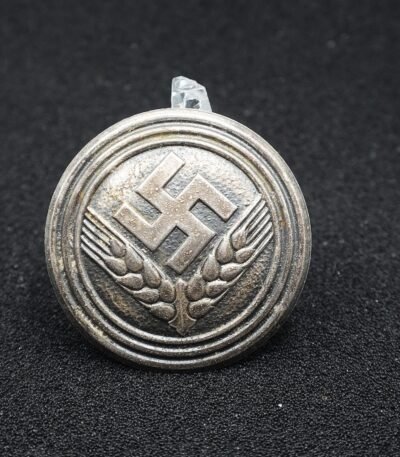
RADwJ Maidenoberführerin Rank Brooch – Silver
€95,00An original-style German WWII Reich Labour Service for Female Youth (RADwJ) Maidenoberführerin rank brooch, featuring the characteristic central swastika above a pair of wheat sheaves, surrounded by a circular, multi-ridged border.
The brooch has a silver-coloured finish, consistent with rank insignia used by the female branch of the Reich Labour Service. The reverse features a horizontal pin fastening. The piece displays visible age-related wear and surface discolouration.
A desirable item for collectors of German WWII insignia, RADwJ rank badges and female service uniforms.
Historical Background
The RADwJ was the female branch of the German Reich Labour Service. Its members undertook agricultural, domestic and other forms of labour service within an organisation shaped by National Socialist ideology.
A revised system of rank insignia was introduced in October 1939, with differences in the brooch border helping to distinguish ranks.
Condition
The brooch shows noticeable age-related wear, including tarnishing, surface discolouration and minor marks. The central design remains clearly visible. The reverse pin is present; its complete functionality should be checked before sale.
New
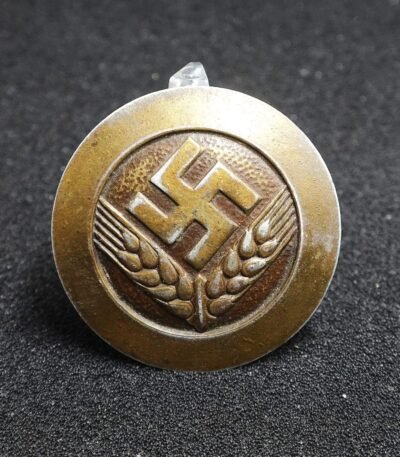
RADwJ Stabsführerin Rank Brooch – Gold-Coloured
€125,00An interesting German WWII Reich Labour Service for Female Youth (RADwJ) Stabsführerin rank brooch, featuring the characteristic mobile swastika above a pair of wheat sheaves, enclosed within a circular border.
The brooch displays a gold-coloured finish with a smooth outer rim, consistent with the Stabsführerin rank insignia. The reverse is fitted with a horizontal pin fastening.
The piece retains its original character, with visible age-related patina and surface wear. The reverse shows the pin assembly, while no maker’s mark is clearly visible in the supplied photographs.
A distinctive item for collectors of Third Reich insignia, RADwJ badges and German WWII female service uniforms.
Historical Background
The RADwJ was the female branch of the German Reich Labour Service. Its members undertook agricultural, domestic and other labour duties within an organisation shaped by National Socialist ideology.
The organisation used distinctive rank insignia to identify leadership positions. This Stabsführerin brooch represents one of the leadership ranks within the female labour service hierarchy.
Condition
The brooch displays visible age-related wear and patina, including surface discolouration and areas of finish variation. The central design remains clearly visible. The pin assembly is present; its functionality should be checked before sale.