


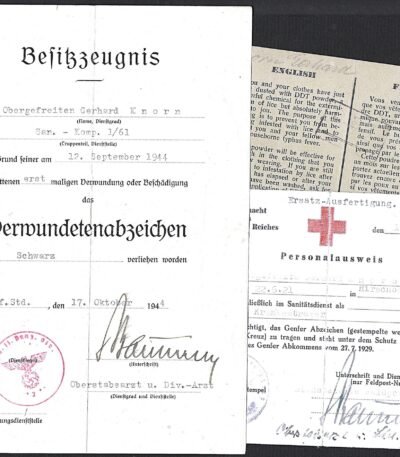
Verwundetenabzeichen in Schwarz Award Doc + Sanitätsdienst Personalausweis – 11. Panzer-Division – Western Front, 1944
Interesting original three-piece document grouping associated with Obergefreiter Gerhard Knorn, who served with Sanitäts-Kompanie 1/61.
The grouping includes:
1. Besitzzeugnis zum Verwundetenabzeichen in Schwarz (Certificate for the Black Wound Badge)
Awarded to Obergefreiter Gerhard Knorn for his first wound, sustained on 12 September 1944. The certificate records his unit as Sanitäts-Kompanie 1/61 of the 11. Panzer-Division and is dated 17 October 1944, issued at a divisional headquarters. It bears an original signature and official medical service stamp.
2. Personalausweis für den Sanitätsdienst (Medical Service Identity Card)
Identity document authorising its holder to serve in the medical service as a Krankenträger (medical stretcher-bearer). It records the date of birth as 22 June 1921 and authorises the wearing of the Geneva Convention medical armband, identifying the bearer as protected medical personnel under Article 9 of the Geneva Convention of 27 July 1929.
3. DDT-Merkblatt (DDT Instruction Leaflet)
Original multilingual instruction leaflet in English and French explaining the use of DDT powder to treat clothing and prevent lice infestation and typhus. An interesting accompanying piece illustrating wartime and immediate post-war military hygiene and delousing procedures.
A particularly appealing grouping combining a named Wehrmacht wound-badge award certificate with medical-service identification and a contemporary hygiene instruction leaflet.
Condition: Documents show typical age-related wear, folds, handling marks and some discoloration. The award certificate retains its original stamp and signature. All three pieces are included.
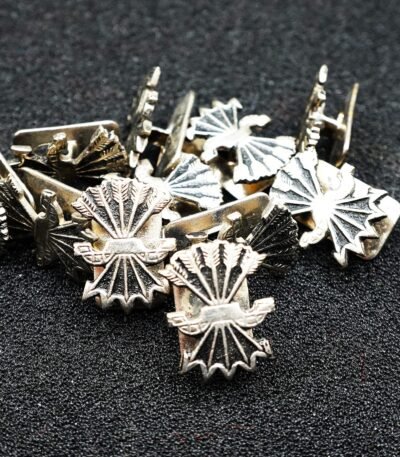
Spanish Falange Española Numbered Membership Lapel Badge (Price per Piece)
Original-style Falange Española lapel badge, featuring the organisation’s distinctive Yugo y Flechas (Yoke and Arrows) emblem. This small metal insignia was designed to be worn through a buttonhole and features a rear attachment fitting.
The reverse is marked with the letter “A” for Adherido, together with an individual serial number. Within the organisation, Adheridos were affiliated members, a category distinguished from Militantes under the organisation’s membership regulations.
- Organisation: Falange Española
- Type: Numbered membership lapel badge
- Markings: Letter “A” and individual serial number
- Size: Approximately 20 × 15 mm
- Attachment: Rear buttonhole fitting
A compact and interesting piece for collectors of Spanish political insignia, Spanish Civil War history and the Falange movement.
Condition: Very good overall, with the reverse markings and attachment fitting visible. Please consult the photographs for the exact number, finish and condition of the individual badge.
Important: Price per Piece!
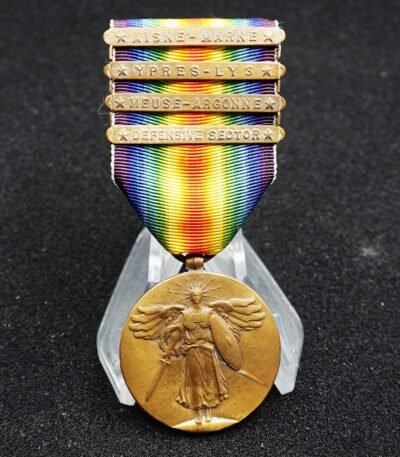
US World War I Victory Medal with Four Battle Clasps – Aisne-Marne, Ypres-Lys, Meuse-Argonne, Defensive Sector
US Victory Medal 1917–1918 mit vier Gefechtsspangen – Aisne-Marne, Ypres-Lys, Meuse-Argonne, Defensive Sector (United States World War I Victory Medal with Four Battle Clasps – Aisne-Marne, Ypres-Lys, Meuse-Argonne, Defensive Sector)
An attractive original United States World War I Victory Medal, complete with its original rainbow-coloured ribbon, four bronze Army battle clasps and wrap-brooch suspension.
The bronze-coloured medal features the winged figure of Victory holding a sword and shield on the obverse. The reverse bears the inscription “THE GREAT WAR FOR CIVILIZATION”, with the United States shield and the names of the Allied and Associated nations.
The ribbon is fitted with four clearly legible bronze battle clasps, each decorated with a star at either end:
- AISNE-MARNE – participation in the Aisne-Marne campaign, 18 July–6 August 1918.
- YPRES-LYS – participation in the Ypres-Lys campaign, 19 August–11 November 1918.
- MEUSE-ARGONNE – participation in the Meuse-Argonne campaign, 26 September–11 November 1918.
- DEFENSIVE SECTOR – qualifying service in a defensive sector not covered by a separately designated campaign clasp.
These clasps represent significant operations of the American Expeditionary Forces on the Western Front during the final year of the First World War. Their combination makes this an appealing example for collectors of American military medals and First World War campaign awards.
Condition: Good overall, with attractive age patina to the medal and clasps. The original ribbon remains present but shows some fraying and loose threads, particularly along the upper edges. The four clasps and wrap-brooch suspension are present. Please refer to the photographs for a detailed assessment of condition.
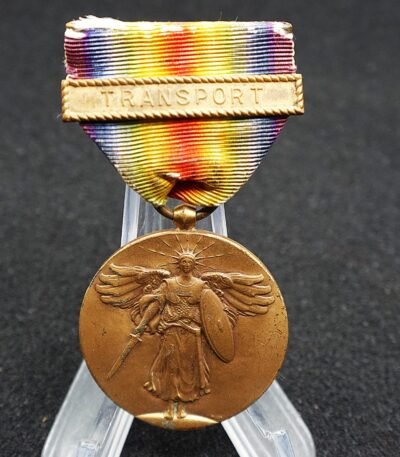
US World War I Victory Medal with Navy “Transport” Clasp
An attractive original United States World War I Victory Medal, complete with the desirable Navy “TRANSPORT” clasp and its original wrap-brooch suspension.
The bronze-coloured medal features the winged figure of Victory on the obverse. The reverse bears the inscription “THE GREAT WAR FOR CIVILIZATION”, with the names of Allied nations surrounding the central design.
The “TRANSPORT” clasp identifies a specific category of U.S. Navy service during the First World War. It was awarded to personnel regularly attached to a transport or cargo vessel for at least one qualifying voyage across the North Atlantic between 6 April 1917 and 11 November 1918.
The medal retains its original multicoloured ribbon and the period wrap-brooch pin assembly, with the TRANSPORT bar mounted across the ribbon. This combination makes it an appealing example for collectors of American First World War medals and naval history.
Condition: Good overall condition, with attractive age patina and some minor surface wear. The original ribbon shows some fraying and loose threads along the upper edge. The clasp and wrap-brooch mechanism are present, with no obvious repairs visible in the photographs.
An interesting original American First World War medal with a clearly identified naval transport service clasp.
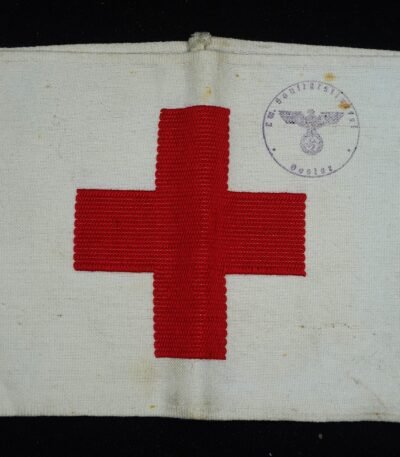
Luftwaffenlazarett Goslar – DRK Medical Armband with Red Cross and Unit Stamp
An interesting original Sanitätsarmbinde (medical armband) featuring a large red cross on white woven textile, with a circular stamp apparently reading „Luftwaffenlazarett Goslar“.
The stamp potentially connects this example to the Luftwaffe military hospital at Goslar, making it particularly interesting for collectors of Luftwaffe medical history and German wartime medical equipment.
The armband features a large red cross applied to the white textile and retains the circular purple stamp beside it.
Condition: Used historical textile with age-related yellowing, scattered brown staining, creasing and fraying around the edges. The red cross remains clearly visible, and the stamp is still present.
An appealing and distinctive medical collectible, especially for collectors interested in Luftwaffe medical services and wartime hospital history.
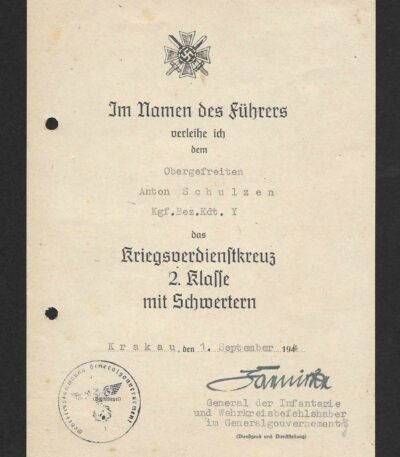
Kriegsverdienstkreuz 2. Klasse mit Schwertern Award Doc – Kriegsgefangenen-Bezirks-Kommandant Y – Krakau 1941
An original German Verleihungsurkunde zum Kriegsverdienstkreuz 2. Klasse mit Schwertern (Award Certificate for the War Merit Cross 2nd Class with Swords), issued to Obergefreiter Anton Schulzen, serving with Kgf. Bez. Kdt. Y (Kriegsgefangenen-Bezirks-Kommandant Y).
The certificate was issued in Krakau on 1. September 1944, during the final months of the unit’s existence. The Kriegsgefangenen-Bezirks-Kommandant Y was established on 1. Juni 1942 by the German Military Commander in the General Government and subordinated to the Commander of Prisoners of War for Special Employment (Kommandeur der Kriegsgefangenen z. b. V. im Generalgouvernement). The unit was disbanded on 15. September 1944.
The document features the printed heading Im Namen des Führers, the award designation Kriegsverdienstkreuz 2. Klasse mit Schwertern, an official service stamp and a large handwritten signature of Siegfried Haenicke above the printed appointment General der Infanterie und Wehrkreisbefehlshaber im Generalgouvernement.
General der Infanterie Siegfried Haenicke (1878–1946), was a veteran career officer of the Prussian and German armies, Haenicke commanded the 61. Infanterie-Division during the campaigns in Poland, Western Europe and the Soviet Union before becoming Wehrkreisbefehlshaber im Generalgouvernement in October 1942. He held senior military command appointments in the occupied General Government until early 1945. His signature provides a direct historical connection to the Wehrmacht’s military administration in occupied Poland.
He earned most significantly:
-
Pour le Mérite — awarded during the First World War on 14 June 1918.
-
Ritterkreuz des Eisernen Kreuzes — awarded on 17 September 1941.
-
Deutsches Kreuz in Gold — awarded on 4 September 1942.
An interesting original award certificate documenting military administration and prisoner-of-war organisation in the German-occupied General Government of Poland during the Second World War.
Condition
Age-related toning and scattered foxing or small stains throughout. The printed text, signature and official stamp remain visible. Two punched holes are present along the left margin. Overall, an original document with typical period wear.
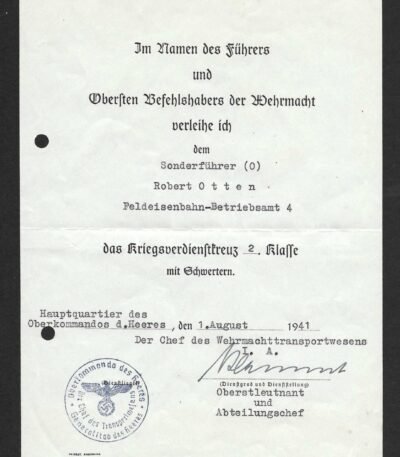
Kriegsverdienstkreuz 2. Klasse mit Schwertern Award Doc – Sonderführer (O) – Feldeisenbahn-Betriebsamt 4, 1941
Original German award certificate (Verleihungsurkunde) for Sonderführer (O) Robert Otten, awarding the Kriegsverdienstkreuz 2. Klasse mit Schwertern (War Merit Cross 2nd Class with Swords), dated 1. August 1941 at the headquarters of the Oberkommando des Heeres (OKH) (German Army High Command).
The recipient is identified as serving with Feldeisenbahn-Betriebsamt 4 (Field Railway Operating Office 4), a specialist military railway organisation responsible for railway operations supporting the German Army.
The certificate was issued by the Chef des Wehrmachttransportwesens (Chief of Wehrmacht Transportation), with the wording I. A. (im Auftrag — on behalf of). It bears the original official service seal (Dienstsiegel) of the transport administration and a handwritten signature from an officer identified by the printed text as Oberstleutnant und Abteilungschef (Lieutenant Colonel and Department Head). The signer’s name cannot be confidently established.
Historical Interest
Dated 1941, this is an early-war award document connected to the German military railway and transport administration. The recipient’s designation as Sonderführer (O) and his assignment to Feldeisenbahn-Betriebsamt 4 make it particularly relevant to collectors specialising in military railway operations, logistical units and Wehrmacht award documents.
The official seal and clearly identified recipient and unit provide useful starting points for further research into Robert Otten’s service.
Condition
The certificate shows light age-related toning, a pronounced horizontal fold across the centre, minor creasing and scattered small marks. Two punched holes are present along the left margin. The printed text, handwritten signature and official seal remain clearly visible.
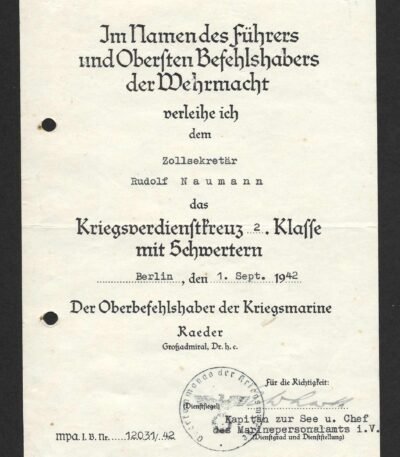
Kriegsverdienstkreuz 2. Klasse mit Schwertern Award Doc – Zollsekretär – Kriegsmarine, Berlin, 1942
Original German award certificate (Verleihungsurkunde) for Zollsekretär Rudolf Naumann, awarding the Kriegsverdienstkreuz 2. Klasse mit Schwertern (War Merit Cross 2nd Class with Swords), dated 1. September 1942 in Berlin.
The certificate was issued under the authority of the Oberbefehlshaber der Kriegsmarine (Commander-in-Chief of the German Navy), Großadmiral Erich Raeder. His name and rank are printed on the document.
The award is officially signed by a Kapitän zur See, identified in the printed text as serving with the Marinepersonalamt (Navy Personnel Office). The document retains its original Kriegsmarine service seal (Dienstsiegel) and the administrative reference MPA I.B. Nr. 12031/42.
An interesting award certificate for collectors of Kriegsmarine militaria, naval administration and German wartime award documents, particularly as it was issued to a named customs official rather than a serving naval rank.
Condition
The document shows age-related toning, a prominent horizontal fold, scattered small stains and handling marks. Two punched holes are present along the left margin. The printed text, certification signature and official seal remain visible.
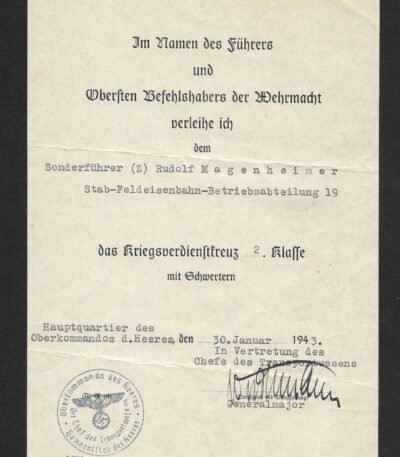
Kriegsverdienstkreuz 2. Klasse mit Schwertern Award Doc – Sonderführer (Z) – Feldeisenbahn-Betriebsabteilung 19, 1943
Original German award certificate (Verleihungsurkunde) for Sonderführer (Z) Rudolf Magenheimer, awarding the Kriegsverdienstkreuz 2. Klasse mit Schwertern (War Merit Cross 2nd Class with Swords), dated 30. Januar 1943 at the headquarters of the Oberkommando des Heeres (OKH) (German Army High Command).
Magenheimer is identified as serving with Stab-Feldeisenbahn-Betriebsabteilung 19 (Staff, Field Railway Operating Battalion 19). This specialist railway unit designation adds interest for collectors of German military railway history and wartime transport operations.
The certificate was issued in Vertretung des Chefs des Transportwesens (on behalf of the Chief of Transportation). It bears the official service seal (Dienstsiegel) of the Army High Command’s transport administration and a handwritten signature above the printed rank Generalmajor. The signature is not confidently identifiable from the photograph alone, so no personal attribution is made here.
Historical Interest
The award documents recognition of a member of the German Army’s field railway operating organisation. Such personnel supported military railway operations and transport logistics, making this certificate relevant to collectors specialising in Feldeisenbahn, military transportation and award documents connected with the OKH.
Condition
The certificate shows age-related toning, a pronounced horizontal fold across the centre, additional creasing and several small stains and handling marks. The official seal, printed text and handwritten signature remain visible. Documents looks to be cut from the left side?
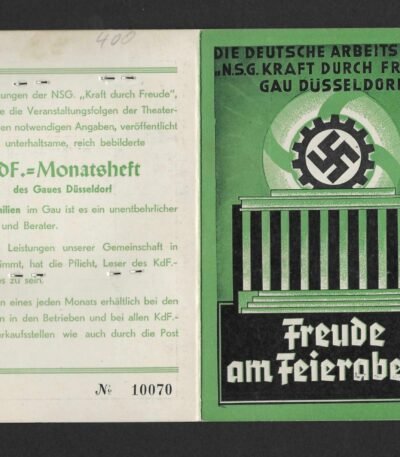
Deutsche Arbeitsfront (DAF) – KdF-Theaterring-Ausweis 1937/38 – Gau Düsseldorf
An attractive original Deutsche Arbeitsfront (DAF) / NS-Gemeinschaft „Kraft durch Freude“ (KdF) theatre pass for the 1937/1938 season, issued to Hans Fürth of the Krefeld area.
The pass features the striking original green „Freude am Feierabend“ cover design, incorporating the distinctive KdF emblem and architectural motif. The inside contains the holder’s handwritten personal details, an original portrait photograph, official period ink stamps and his handwritten signature.
Document details:
- Document: KdF-Theaterring-Ausweis (theatre pass)
- Season: 1937/1938
- Ausweis Nr.: 9532
- Name: Fürth, Hans
- Location: Hüls, Krefeld, Gau Düsseldorf
- Street address: Blumenstraße 19
- Issue date: 29 November 1937
- Official stamp: Deutsche Arbeitsfront, NS-Gemeinschaft „Kraft durch Freude“, Krefeld
- Additional printed material: KdF-Monatsheft advertisement, Gau Düsseldorf
- Printed number on reverse: 10070
The pass retains its original photograph of the holder, with official stamps crossing the photograph and handwritten signature beneath it. The reverse features printed promotional text for the KdF-Monatsheft des Gaues Düsseldorf, describing the cultural and recreational services offered by the organization.
Historical background
The Kraft durch Freude (Strength Through Joy) organization was established under the Deutsche Arbeitsfront to organize leisure activities for German workers, including theatre performances, concerts, excursions, holidays and other cultural events. Theatre passes such as this one formed part of its organized cultural programme during the pre-war period.
This example is particularly appealing as a named and photographed civilian document, complete with its original green cover artwork, handwritten particulars and official local stamps. It provides a tangible example of the administrative and cultural activities organized by the DAF and KdF in the Düsseldorf region during the late 1930s.
Condition
Good original period condition, with expected age-related toning, light staining, minor marks and handling wear. The booklet retains its original portrait photograph, handwritten entries, signature and official stamps. The cover artwork remains attractive and clearly legible. There is a visible vertical crease along the centre fold and some minor wear to the edges.
An interesting and visually attractive original document for collectors of Deutsche Arbeitsfront (DAF), Kraft durch Freude (KdF), Third Reich civilian documents and pre-war German social and cultural history.
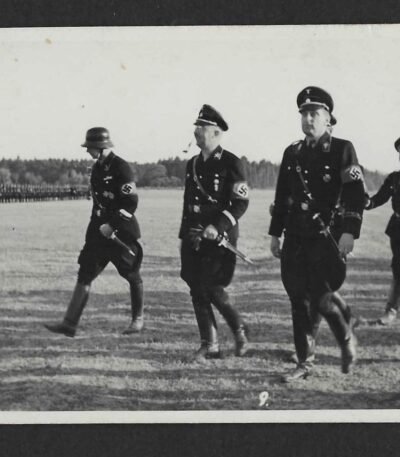
Heinrich Himmler + SS-Führer reviewing Troops – SS-Daggers
An interesting original period photograph depicting Reichsführer-SS Heinrich Himmler accompanied by several senior SS officers, inspecting or reviewing a formation of troops on an open parade ground.
The photograph shows the officers in dark SS service uniforms, wearing peaked caps or headgear, rank insignia, armbands and decorations. Particularly noteworthy are the visible SS dress daggers (SS-Dolche) worn by several of the officers, making this an appealing photograph for collectors interested in SS uniforms, edged weapons and insignia.
A formation of uniformed personnel can be seen standing in the background, suggesting a formal inspection, parade or ceremonial military gathering. The exact occasion, location and date have not been established, and the accompanying officers have not been individually identified.
Photographer’s Marking
The reverse bears a faint period photographer’s stamp reading:
FOTO-KEMPE – Inh. Gerh. Jacobs & Fritz Kempe – Greifswald
This original photographic studio marking provides a useful point of reference for further historical research. The precise circumstances under which the photograph was taken remain unconfirmed.
Condition
Original photograph in used period condition. The image remains clear and displays good detail in the uniforms, headgear, decorations and daggers. The reverse shows the faded photographer’s stamp. There are minor age-related spots, light staining and general wear to the photographic paper, particularly around the edges.
An interesting photographic document for a collection of Third Reich-era photographs, senior SS personalities, uniform studies or German WWII edged weapons.
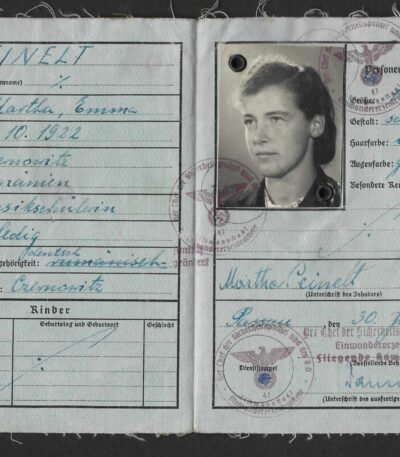
Deutsches Reich – Rückkehrerausweis – Czernowitz – Chef der Sicherheitspolizei un des SD – Einwandererzentralstelle – Fliegende Kommission IX
An interesting original Deutscher Rückkehrerausweis (German Returnee Identity Document) from the Second World War, numbered 324006, issued to Martha Emme Peinelt.
This four-panel document features the original portrait photograph of the holder, handwritten personal particulars, official stamps and signatures. The cover displays the printed Deutsches Reich heading and national emblem, while the interior contains the holder’s personal description and administrative certification.
Personal details recorded in the document:
- Name: Peinelt, Martha Emme
- Date of birth: 9 October 1922
- Place of birth: Czernowitz (today Chernivtsi, Ukraine)
- Occupation: Musiklehrerin (music teacher)
- Marital status: Ledig (single)
- Previous place of residence: Czernowitz (today Chernivtsi, Ukraine)
- Physical description: 1.68 m tall, slim build, brown hair and grey-blue eyes
- Document number: 324006
The document bears multiple period ink stamps, including markings associated with the German security and immigration administration. The handwritten issue date appears to read 30 July 1941 in Passau, stamped by the Der Chef der Sicherheitspolizei un des SD – Einwandererzentralstelle – Fliegende Kommission IX.
Historical background
The Rückkehrerausweis was used in connection with the registration and processing of people classified as returnees or resettlers during the period of National Socialist rule. Such documents are encountered in the context of wartime population movements and the Nazi regime’s resettlement policies, including the administrative processing of ethnic German populations.
The combination of a named individual, portrait photograph, personal particulars and official endorsements makes this an informative primary-source document for collectors interested in German WWII civilian identification papers, wartime population administration and personal documents of the Third Reich period.
Condition
Used original condition, with visible age-related staining, foxing, handling wear, creasing and general discoloration to the paper. The booklet remains identifiable and retains its portrait photograph, handwritten entries and official markings. Please study the photographs carefully for the precise condition.
An interesting named and photographed historical document, suitable for a collection of German WWII identity papers, civilian documents or Third Reich-era administrative material.
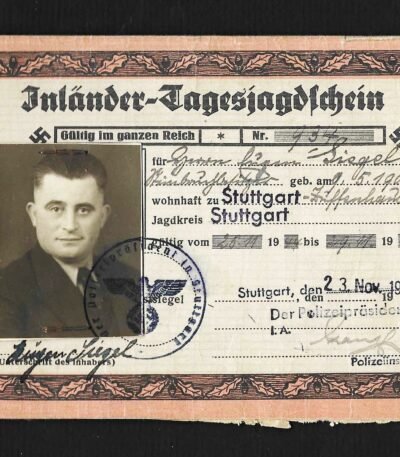
Inländer-Jagdschein Stuttgart-Zuffenhausen – 1944
An original Inländer-Jagdschein (German resident hunting licence), issued in Stuttgart during the final months of the Second World War.
The licence was issued by the Polizeipräsident Stuttgart on 23 November 1944 and bears the official police stamp. It features the original portrait photograph of the licence holder, handwritten personal information, a Stuttgart-Zuffenhausen residential entry and the designation Jagd-Kreis Stuttgart.
The document is marked „Gültig im ganzen Reich“ (valid throughout the German Reich), making it an interesting example of wartime hunting documentation and civilian administration in Germany in 1944.
Details:
- Document: Inländer-Jagdschein (resident hunting licence)
- Place of issue: Stuttgart
- Issuing authority: Polizeipräsident Stuttgart
- Date of issue: 23 November 1944
- Recorded residence: Stuttgart-Zuffenhausen
- Hunting district: Stuttgart
- Photograph: Original portrait photograph attached
- Authentication: Period police stamp and handwritten entries
Condition: Heavily used original document, with age-related discolouration, creasing, edge wear, damaged corners and paper loss, particularly around the edges. The original photograph, handwritten entries and official stamp remain present. Please examine the photographs carefully.
An interesting original document for collectors of German hunting licences, civilian identification documents and administrative history from the Third Reich period.
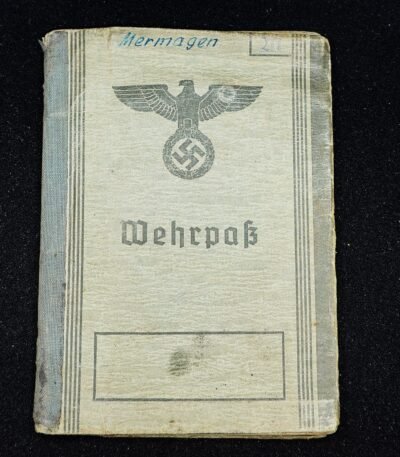
Wehrpass Bau-Bataillon 85 – Afrika-Feldzug, Tobruk & El Alamein – 2x Awards (One RARE!)
Original interesting and extensively completed Wehrpass documenting the service of a soldier who served with army construction units during the Second World War, including service in the North African theatre.
The Wehrpass retains its original portrait photograph and contains numerous handwritten entries, unit assignments, promotions, official stamps and a detailed campaign calendar recording operations across several campaigns.
Notable historical details include:
- Bau-Bataillon 85 and associated construction and replacement units, as recorded in the unit service section.
- North African campaign service, with entries in the campaign calendar relating to fighting around Tobruk and El Alamein, alongside other recorded operations.
- The Italienisch-Deutsche Erinnerungsmedaille für den Feldzug in Afrika (Italo-German Africa Campaign Medal), recorded in the decorations section.
- An unusual entry referring to a certificate from the Oberbefehlshaber der Panzerarmee Afrika “Urkunde Oberbefehlshaber Panzerarmee Afrika für gute Fahrleistung (?) in Afrika“, apparently connected with good driving performance in Africa. This is a particularly interesting detail and warrants further study.
- Numerous further service entries, promotions, stamps and handwritten annotations extending from the early war years into the final period of the conflict.
The campaign calendar is a particularly valuable feature, providing a substantial chronological record of the soldier’s wartime service. Combined with the original photograph, the Africa campaign medal entry and the reference to driving performance in North Africa, it makes this a distinctive document for collectors of Wehrmacht personnel records and the German-Italian campaign in Africa.
Condition: Original, well-used Wehrpass with age-related yellowing, staining, handling marks and wear to the cover and spine. The interior retains extensive handwritten entries, period stamps and the original portrait photograph. Please consult the photographs for the exact condition and recorded details.
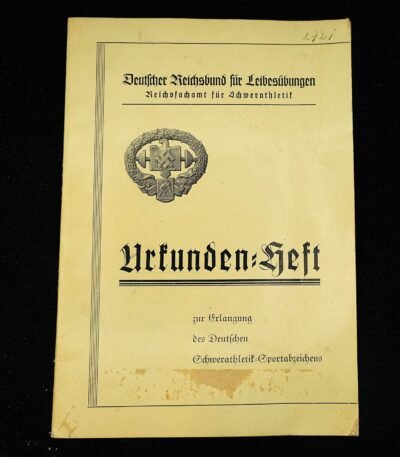
Urkunden-Heft zum Deutschen Schwerathletik-Sportabzeichen in Bronze – German Heavy Athletics Sports Badge Certificate – 1937
An interesting, personally completed Urkunden-Heft zur Erlangung des Deutschen Schwerathletik-Sportabzeichens (certificate booklet for the German Heavy Athletics Sports Badge), issued by the Deutscher Reichsbund für Leibesübungen – Reichsfachamt für Schwerathletik.
The booklet contains a portrait photograph of the recipient in uniform, handwritten personal details, official period stamps, signatures and recorded athletic performances. The award entry on page 28 records the Deutsches Schwerathletik-Sportabzeichen in Bronze, awarded in Berlin on 24 October 1937.
The performance pages contain handwritten entries for individual athletic disciplines, together with dates and attestations. These records provide a personal glimpse into organised German athletics during the 1930s.
Condition: Used historical document with age-related yellowing, staining, marks and wear to the cover and pages. The booklet remains complete-looking in the photographed sections, with the original photograph, handwritten entries and stamps present.
An appealing addition to a collection of German sports badges, Third Reich-era sporting organisations, historical documents or uniform-related photographs.
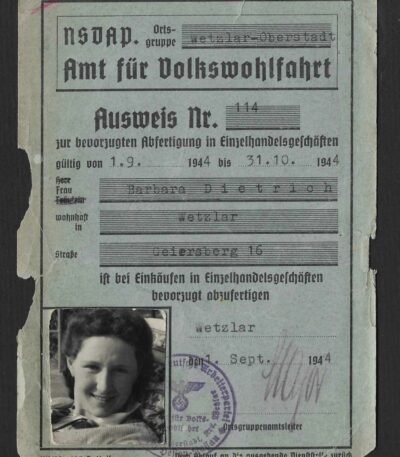
NSDAP-Ausweis – Amt für Volkswohlfahrt, Ortsgruppe Wetzlar
Original NSDAP Amt für Volkswohlfahrt Ausweis (NSDAP Office for People’s Welfare Identification Card) issued to Barbara Dietrich, resident of Wetzlar, Germany, in September 1944.
This interesting late-war document, numbered 114, entitled the holder to preferential service when shopping in retail stores (bevorzugte Abfertigung in Einzelhandelsgeschäften). The card was valid from 1 September to 31 October 1944 and records her address as Geleitsberg 16, Wetzlar.
The card features a period photographic portrait of the holder, handwritten personal details, an official stamp and an authorising signature. The Ortsgruppe designation has been crossed out and amended, adding an interesting administrative detail to the document.
An unusual piece of civilian and party-related ephemera from the final year of the Third Reich, illustrating the local administration of shopping privileges during wartime Germany.
Condition: Heavily worn, with substantial edge damage, tears, creases, paper loss and discolouration. The portrait photograph and most of the printed and handwritten information remain visible. Please examine the photographs carefully.
A distinctive original paper collectible for specialists in NSDAP-related documents, wartime civilian administration and Wetzlar local history.
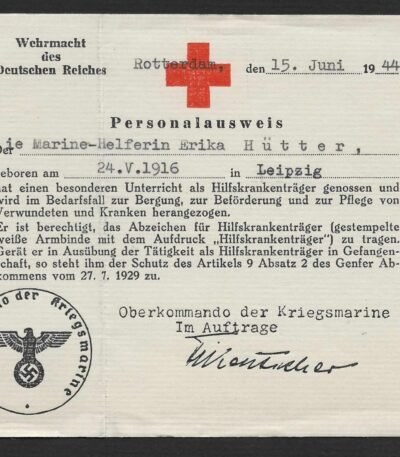
Personalausweis Marine-Helferin – Hilfskrankenträgerin, Rotterdam – 1944
Original Personalausweis für Marine-Helferin Erika Hütter (Identity Document for Navy Auxiliary Woman Erika Hütter), issued in Rotterdam on 15 June 1944 by the Oberkommando der Kriegsmarine.
Born on 24 May 1916 in Leipzig, Erika Hütter had received special instruction as a Hilfskrankenträgerin (auxiliary medical orderly). The document states that, when required, she could be called upon to assist with the recovery, transportation and care of wounded and sick personnel.
The certificate authorises her to wear the designated Hilfskrankenträgerinnen armband (auxiliary medical orderly armband), described in the document as a white armband stamped with the inscription “Hilfskrankenträger.” It also refers to the protection afforded to such personnel under Article 9, paragraph 2, of the Geneva Convention of 27 July 1929, when performing their medical duties in captivity.
The document features a red cross, the official stamp of the Oberkommando der Kriegsmarine (High Command of the German Navy) and a handwritten authorising signature.
An interesting original wartime document illustrating the organisation of auxiliary medical personnel serving under the German Navy in occupied Western Europe during 1944.
Condition: Appears well preserved, with visible age-related discolouration and a central fold. The printed text, handwritten personal details, red cross and official stamp remain clearly visible.
A desirable paper item for collectors of Kriegsmarine militaria, female auxiliary service and wartime medical personnel.
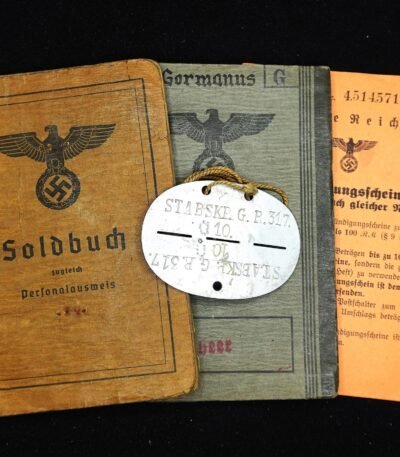
Set WP+SB+EKM – Grenadier-Regiment 317 (211. Infanterie-Division) – 4 Nahkampftage (5x Awards)
Original Soldbuch (German Wehrmacht Pay Book and Identity Document) belonging to Hermann Gormanns, an Oberfähnrich d.R. (Reserve Officer Candidate) who served with Infanterie-Regiment 317 / Grenadier-Regiment 317, part of the 211. Infanterie-Division (211th Infantry Division).
The Soldbuch contains numerous handwritten entries, official stamps and signatures documenting his military service. Particularly interesting is the record of four Nahkampftage (close-combat days), with locations recorded as Punkt 149.7, Klinzy, Debrik and Bakunowitschi. These entries provide a fascinating glimpse into his service on the Eastern Front.
Another noteworthy entry describes him as a “Kämpfer der Infanterie” (Infantry Fighter), an unusual and interesting inscription for collectors of Wehrmacht documents.
Recorded decorations include:
- Infanterie-Sturmabzeichen (Infantry Assault Badge) – 15 October 1942
- Winterschlacht im Osten-Medaille (Eastern Front Medal) – 2 August 1942
- Kriegsverdienstkreuz 2. Klasse mit Schwertern (War Merit Cross 2nd Class with Swords) – 30 November 1942
- Eisernes Kreuz 2. Klasse (Iron Cross 2nd Class) – 19 April 1943
- Kriegsverdienstkreuz 1. Klasse (War Merit Cross 1st Class) – also recorded in the Soldbuch
The booklet also contains entries relating to equipment, leave and military administration, adding further detail to the service history of its original owner.
The 211. Infanterie-Division fought on the Eastern Front, including in the central sector, where its units experienced prolonged and heavy fighting against Soviet forces. The close-combat entries and recorded locations make this Soldbuch particularly interesting for collectors researching German infantry service on the Eastern Front.
Condition: The Soldbuch shows age-related wear, staining and signs of handling. The portrait photograph is missing. Otherwise, it remains in good condition for an original wartime document, with numerous handwritten entries, stamps and signatures.
An appealing and well-documented Soldbuch with multiple recorded decorations, four close-combat days and the unusual “Kämpfer der Infanterie” entry.
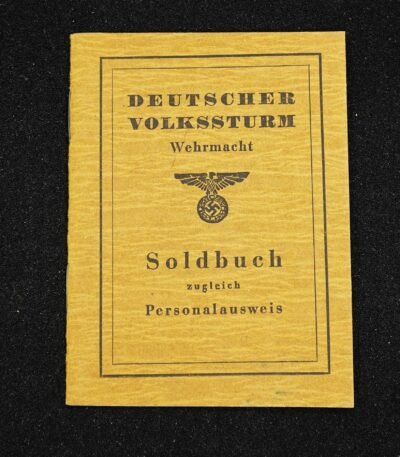
Deutscher Volkssturm Soldbuch – 1928, Gau 42, 1945
Original Deutscher Volkssturm Soldbuch, zugleich Personalausweis (German Volkssturm Pay Book and Identity Document) from the final period of the Second World War.
This interesting late-war document features the distinctive printed cover inscription Deutscher Volkssturm – Wehrmacht and includes a printed portrait of Adolf Hitler. The personal details identify the holder as born on 20 June 1928, meaning he was approximately 16–17 years old during 1945.
The booklet contains handwritten personal information, military registration details and an official stamp associated with the Deutscher Volkssturm, Gau 42. A dated entry appears on page 2, alongside the official stamp and signatures.
An interesting original document illustrating the mobilisation and administration of the Volkssturm during the final phase of the war, when Germany increasingly relied on older men and very young recruits.
Condition: Shows age-related wear and handling, with minor marks and signs of use. The booklet remains intact in the photographed pages. The designated photograph space is empty; the portrait visible on the opposite page is printed in the booklet.
A desirable historical document for collectors of German Volkssturm, late-war militaria and Third Reich paper items.
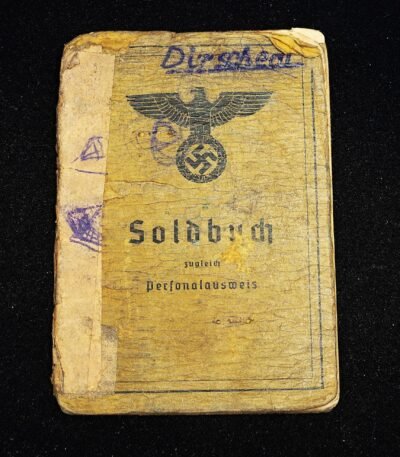
Soldbuch – Grenadier-Regimenter 481 & 476, Granatwerfer-Kompanie 256 – 256. Volksgrenadier-Division (Holland!) – MP 44
An extensively completed Soldbuch (Wehrmacht Military Pay Book) belonging to Feldwebel Dirschedl, documenting his military service, unit transfers, decorations, medical treatment and other personnel details throughout the Second World War.
The book contains entries relating to service with several formations, including Infanterie-Regiment 481, Grenadier-Regiment 481, Grenadier-Regiment 476, Artillerie-Regiment 256, schwere Granatwefer-Kompanie 256 of the 256. Volksgrenadier-Division (!) and Artillerie-Regiment 1316.
The recorded decorations include:
- Eisernes Kreuz 2. Klasse (Iron Cross 2nd Class) – 12 July 1941
- Infanterie-Sturmabzeichen in Silber (Infantry Assault Badge in Silver) – 15 December 1941
- Verwundetenabzeichen in Schwarz (Wound Badge in Black) – 21 January 1942
- Medaille Winterschlacht im Osten 1941/42 (Eastern Front Medal) – entry dated 1 December 1942
A particularly interesting feature is the late-war equipment entry for MP 44, dated January 1945, as noted by the seller. Such weapon entries are of particular interest to collectors researching late-war German small arms and military documentation. Comparable Soldbücher with MP 44 entries have appeared on the collector market.
The Soldbuch also contains numerous unit, leave, medical and administrative entries, providing a detailed record of the soldier’s wartime service. The original portrait photograph has been removed.
Condition: Heavily used original period document, with age-related staining, discolouration, creasing, handwritten amendments, stamps and general wear. Please study all photographs carefully for the precise condition and individual entries.
An interesting and well-documented Wehrmacht Soldbuch with multiple recorded decorations, a varied service history and a notable late-war MP 44 equipment entry.
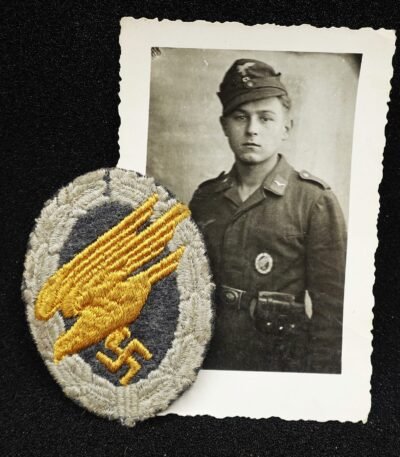
Luftwaffe Paratrooper Badge in Cloth + Portrait Photograph
Original Fallschirmschützenabzeichen der Luftwaffe in Stoff (Luftwaffe Paratrooper Badge in Cloth), featuring the characteristic embroidered diving eagle and swastika on a dark backing, surrounded by an oval wreath.
A nice patina which displays extensive wear and age-related deterioration. The wreath is heavily discoloured and worn, with visible losses to the embroidery and backing. The eagle retains portions of its original gold-coloured and light-coloured stitching.
The badge is offered together with a period black-and-white portrait photograph (Porträtfoto) of a Fallschirmjäger with one in wear.
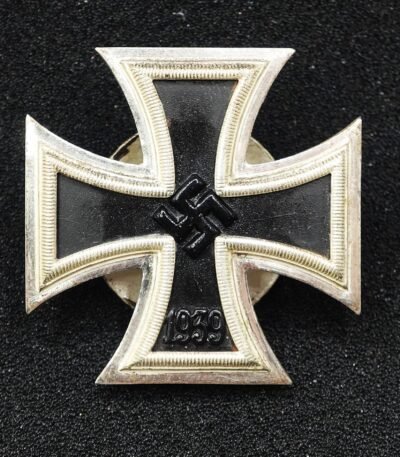
Iron Cross 1st Class 1939 – “L/56” Funcke & Brüninghaus, Lüdenscheid – Screwback Disc (NM)
Original Eisernes Kreuz 1. Klasse 1939 (Iron Cross 1st Class) manufactured by Funcke & Brüninghaus, Lüdenscheid, with the maker’s code L/56 stamped on the reverse screwback disc.
This example features a blackened iron core and a silver-coloured frame with the characteristic ribbed inner border. The obverse retains a very attractive appearance, with strong detail and much of the original finish remaining. The reverse is fitted with its original-style screwback disc, bearing the L/56 maker’s mark.
The Schraubscheiben-Ausführung (screwback version) is an alternative to the more commonly encountered pin-back configuration and is sought after by collectors of German military decorations.
Condition: Near Mint. The front displays well, while the reverse screwback disc shows noticeable oxidation, staining and areas of finish loss. Please examine the photographs carefully for the exact condition.
An attractive maker-marked Iron Cross 1st Class (L/56) for a collection of German military decorations from the Second World War.
Please study all photographs carefully, as they form an integral part of the description.
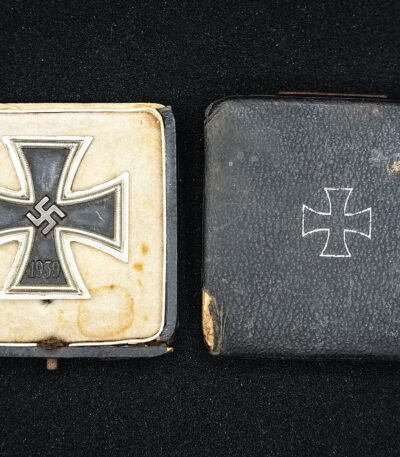
Iron Cross 1st Class 1939 – Unmarked, Engraving “Fw. Maak” – Damaged Case
Original 1939 Eisernes Kreuz 1. Klasse (Iron Cross 1st Class) in unmarked construction, featuring a blackened iron core and a silver-coloured frame with the characteristic ribbed border.
The cross displays an attractive, naturally aged appearance, with pleasing patina and signs of genuine period wear. The reverse bears a personal inscription reading “Fw. Maak”, accompanied by a date. This individual marking adds historical interest, although the identity of the recipient and the exact date have not been independently verified.
The award comes with an accompanying original presentation case (Etui) bearing the Iron Cross emblem on the lid. The case is damaged and broken, with deterioration to the edges and noticeable age staining to the interior lining. The reverse of the cross also shows surface wear, scratches and darkened areas consistent with its age and use.
An interesting named example of the 1939 Iron Cross 1st Class, offered together with its damaged case.
Please study all photographs carefully, as they form an integral part of the description.
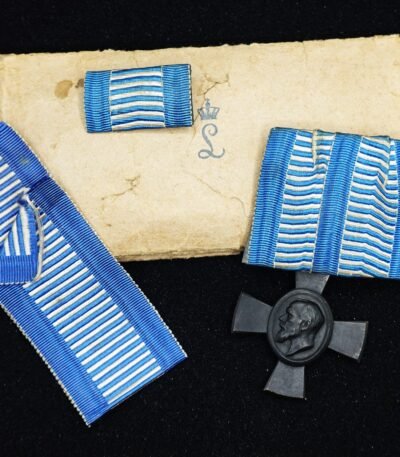
König-Ludwig-Kreuz 1916 + Ribbon Bar + Ribbon + Original Award Wrapper
Original König-Ludwig-Kreuz 1916 (King Ludwig Cross 1916), instituted by King Ludwig III of Bavaria on 7 January 1916 to recognise meritorious voluntary service on the home front during the First World War.
The cross features a darkened finish and a central medallion bearing the profile of King Ludwig III on the obverse. The reverse displays the Bavarian lozenge pattern with the founding date “7.1.1916”.
This example is accompanied by blue-and-white original-style award ribbon material (Ordensband), additional ribbon bar and a paper wrapper bearing the crowned “L” monogram associated with King Ludwig III. The cross has an attractive aged appearance, while the ribbon material shows creasing, staining and fraying. The paper wrapper is fragile, with extensive age-related cracking, staining and edge wear.
An appealing First World War Bavarian award group, with its associated ribbon material and paper wrapper. A nice addition to a collection of Imperial German or Bavarian decorations.
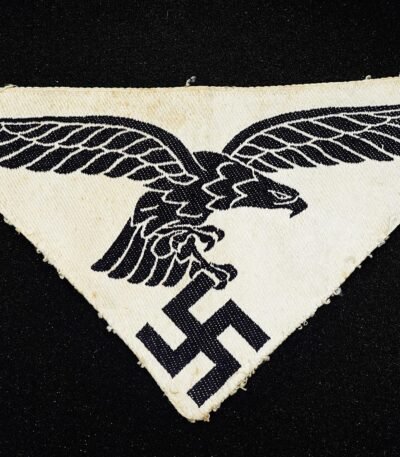
Luftwaffe-Sporthemdadler – Stoffabzeichen (Luftwaffe Sports Shirt Eagle Insignia)
Original German Luftwaffe sports shirt eagle insignia from the Second World War, featuring the characteristic second-pattern Luftwaffe eagle with outstretched wings and swastika, woven in contrasting black and white.
The triangular cloth insignia was intended for wear on the front of the Luftwaffe sports shirt. The eagle design is machine-woven, with the white triangular backing and contrasting reverse construction visible in the photographs.
Condition: Shows age-related discolouration and staining to the white fabric, with fraying and loose threads along the edges. The insignia is no longer attached to a complete sports shirt. Please examine the photographs carefully for details of the fabric and construction.
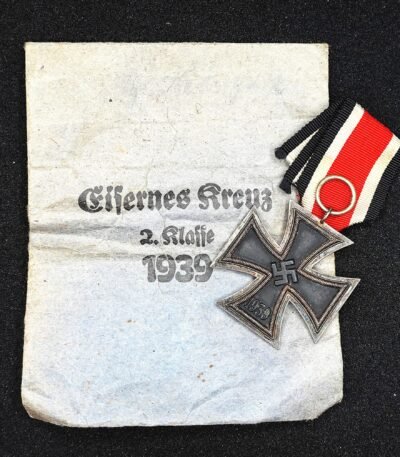
Iron Cross 2nd Class 1939 – “120” Franz Petzl, Wien + Award Packet
Original Eisernes Kreuz 2. Klasse 1939 (Iron Cross 2nd Class) by maker 120, attributed to the manufacturer Franz Petzl, Wien. The cross retains its original blackened centre, silver-coloured frame and suspension ring, which is stamped with the maker code 120.
Accompanied by its Verleihungstüte (original award packet), printed Eisernes Kreuz 2. Klasse 1939. The packet bears the retailer’s stamp Franz Petzl, Wien XV, Braunhirschengasse 22, providing an interesting connection to the original Viennese militaria trade.
The Iron Cross was reintroduced in September 1939 and awarded for acts of bravery and military merit during the Second World War.
Condition: The cross shows age-related wear, surface marks and oxidation. The award packet is present, with creasing, discolouration and general age wear. Both are shown in the photographs.
An appealing maker-marked Iron Cross with its matching award packet, suitable for a collection of German military decorations from the Second World War.
Please study all photographs carefully, as they form an integral part of the description.
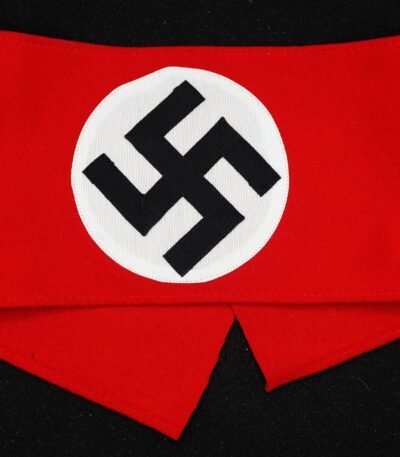
NSDAP Wool Armband with RZM Label – Unworn & Mint
Original NSDAP armband made from red wool, featuring the white circular field and black swastika emblem. This example remains full length and unstitched, complete with its original-looking RZM (Reichszeugmeisterei) label on the inside.
The label bears the manufacturer code A4/462 and serial number 497364. The Reichszeugmeisterei was responsible for regulating and identifying approved suppliers of NSDAP uniforms and equipment.
The armband retains its original construction and has not been sewn into a closed band, making it an interesting example for collectors of NSDAP political insignia and uniform accessories.
Condition: Excellent, apparently unworn, with bright red wool and no obvious major damage visible in the photographs. The RZM label remains attached. Please refer to the photographs for the exact condition.
An uncommon full-length, unstitched example with its RZM label still present.
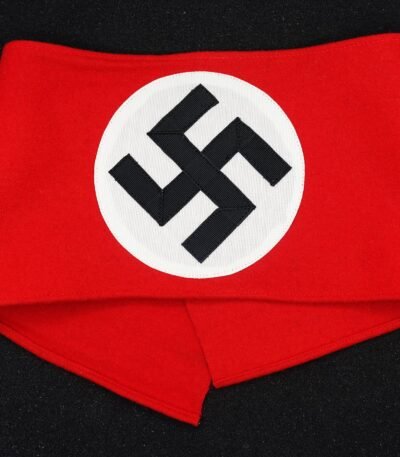
NSDAP Wool Armband with RZM Label – Unworn & Mint
Original NSDAP armband made from red wool, featuring the white circular field and black swastika emblem. This example remains full length and unstitched, complete with its original-looking RZM (Reichszeugmeisterei) label on the inside.
The label bears the manufacturer code A4/275 and serial number 397163. The Reichszeugmeisterei was responsible for regulating and identifying approved suppliers of NSDAP uniforms and equipment.
The armband retains its original construction and has not been sewn into a closed band, making it an interesting example for collectors of NSDAP political insignia and uniform accessories.
Condition: Excellent, apparently unworn, with bright red wool and no obvious major damage visible in the photographs. The RZM label remains attached. Please refer to the photographs for the exact condition.
An uncommon full-length, unstitched example with its RZM label still present.
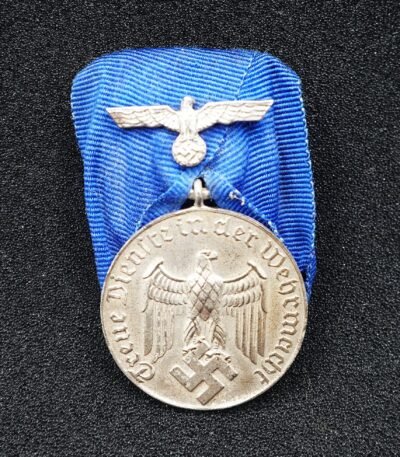
Wehrmacht-Dienstauszeichnung 4. Klasse für 4 Jahre – Mounted (Einzelspange)
Original Wehrmacht-Dienstauszeichnung 4. Klasse (4-Year Long Service Award) mounted as an Einzelspange (single medal bar), complete with its blue ribbon and silver-coloured Wehrmacht eagle attachment.
The medal features the Wehrmacht eagle and the inscription Treue Dienste in der Wehrmacht (Faithful Service in the Wehrmacht). The award was instituted to recognise long service in the German armed forces.
The medal is mounted on its original-style blue ribbon bar, with the eagle positioned above the medal.
Condition: Shows age-related wear, surface marks and oxidation. The blue ribbon has visible handling wear and some fraying around the mounting area. The reverse mounting hardware is present.
An interesting mounted Wehrmacht long-service award (Einzelspange) for collectors of German military decorations from the Second World War.
Please study the photographs carefully, as they form an integral part of the description.
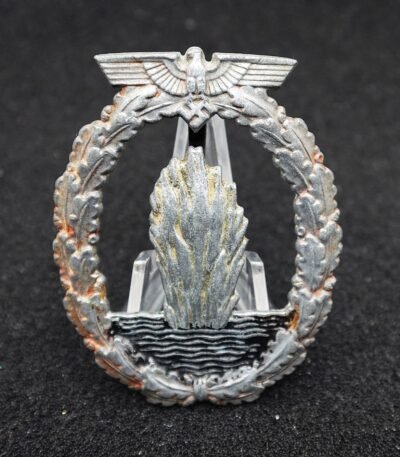
Minensucher-Kriegsabzeichen – Unmarked Steinhauer & Lück
Unmarked Minensucher-Kriegsabzeichen (Minesweeper Badge) attributed to Steinhauer & Lück, Lüdenscheid, featuring the German eagle above an oval oak-leaf wreath, with a naval mine exploding over the waves at the centre.
The badge retains its original pin, hinge and catch assembly. The silvered finish shows age-related wear, oxidation and areas of finish loss, with traces of the original gold-toned finish remaining on the mine. The reverse is unmarked.
A genuine-looking, well-worn example of a Kriegsmarine combat award from the Second World War, suitable for a collection of German naval decorations.
Condition: Used, with visible wear, oxidation and finish loss. Unmarked; maker attribution to Steinhauer & Lück is tentative.
Please study the photographs carefully, as they form an important part of the description.
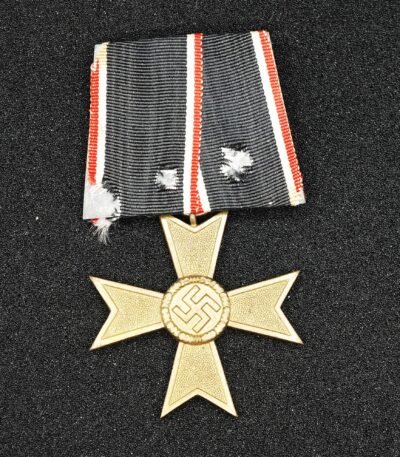
Kriegsverdienstkreuz 2. Klasse 1939 mit Schwertern – Mounted (Einzelspange)
An original Kriegsverdienstkreuz 2. Klasse 1939 mit Schwertern (War Merit Cross 2nd Class with Swords), complete with its Einzelspange (single ribbon bar).
The decoration features the characteristic four-armed cross with textured surfaces, a gilt-coloured finish and a central roundel bearing the date 1939 on the obverse and the swastika on the reverse.
The award is accompanied by its black, white and red ribbon, folded and mounted as a single ribbon bar. The ribbon shows considerable age-related wear, fraying and material loss, as visible in the photographs.
An interesting original award for collectors of German Second World War decorations, particularly those interested in ribbon-mounted examples and variations in period wear.
Condition: Please examine the photographs carefully for the precise condition of the cross, suspension ring, ribbon and Einzelspange.
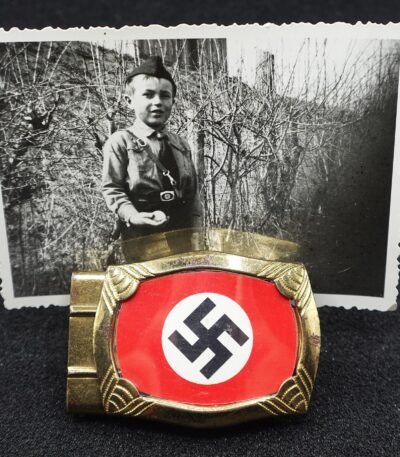
NSDAP Sympathie-Buckle – Steel, D.R.G.M. + Rare Photo of one in wear!
Original NSDAP Sympathie-Koppelschloss (NSDAP sympathiser belt buckle), manufactured with a steel base and featuring a red enamelled-style central field with a white disc and black swastika, surrounded by an ornate gilt-finished frame.
These non-standard buckles represent a less commonly encountered variation associated with private expressions of sympathy for the NSDAP. The reverse is marked D.R.G.M. (Deutsches Reichsgebrauchsmuster), indicating a registered German utility-model design.
According to the accompanying provenance information, the buckles originate from a recent hoard find and were reportedly never worn, although some storage-related wear is present. Particularly noteworthy is the rare contemporary photograph showing a similar buckle being worn, providing valuable visual documentation of this unusual type.
Condition: The buckle retains its decorative appearance, with visible surface rubbing, minor finish wear and signs of storage. The reverse shows the original fastening mechanism and the D.R.G.M. marking. The accompanying photograph has scalloped edges and visible age-related characteristics.
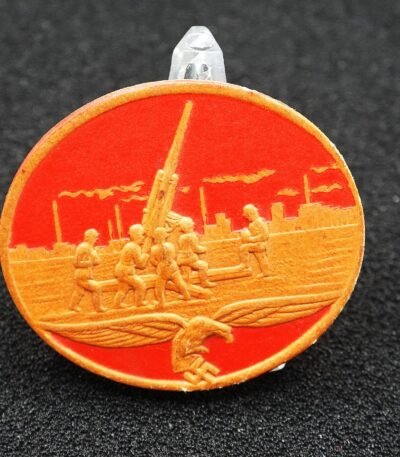
Winterhilfswerk (WHW) Pappeabzeichen – Flakstellung mit Geschützbesatzung
An original German Winterhilfswerk (WHW) donation badge, manufactured from pressed cardboard (Pappe), featuring a detailed relief depicting an anti-aircraft gun crew operating a Flakgeschütz against a dramatic red background.
The obverse displays several artillerymen serving the gun, with an industrial or urban skyline in the background and a stylised eagle motif at the bottom. The reverse retains its original horizontal metal pin attachment.
These small-format donation badges were distributed during the National Socialist Winterhilfswerk campaigns, which collected donations for social relief programmes. The WHW produced a vast variety of collectible badges in different materials, with subjects ranging from military and industrial themes to regional landmarks, folklore and historical motifs.
Condition: The badge shows age-related wear, surface rubbing, minor losses and deterioration to the reverse, including visible adhesive residue around the pin attachment. The relief and contrasting red-and-ochre colours remain clearly visible on the obverse.
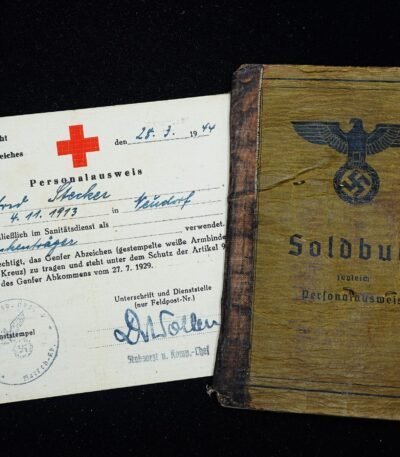
Soldbuch & Personalausweis – Grenadier-Regiment 338 & 309 – 208. Infanterie-Division (EK2, VWA & ISA)
An interesting original Second World War German military grouping belonging to Sanitäts-Stabsgefreiter Alfred Stecker, comprising his Soldbuch (pay book and military identity document) and accompanying Personalausweis (personal identity document).
The Soldbuch is an Ersatz-Soldbuch, a replacement issue, bearing the entry for its issue in 1943 (all awards were earned after issueing, so that’s positive!). It retains Stecker’s photograph, handwritten personal details, unit entries, official stamps and service annotations, providing a documented record of his military service.
Military service
Stecker served with several units during the war, including:
- 2./Grenadier-Ersatz-Bataillon 104, Landau in der Pfalz.
- Grenadier-Regiment 338.
- Grenadier-Regiment 309.
- Sanitäts-Abteilung 208, associated with the 208. Infanterie-Division.
His records document service in the infantry and medical service, with unit transfers and administrative entries preserved in the original booklet.
Wound and decorations
The Soldbuch records a wound sustained in July 1944, described as involving multiple shell fragments (Granatsplitter).
The following decorations are recorded:
- Eisernes Kreuz 2. Klasse (Iron Cross 2nd Class), dated 24 September 1944, with an entry indicating the 75. Infanterie-Division.
- Verwundetenabzeichen in Schwarz (Wound Badge in Black), dated 22 October 1944.
- Infanterie-Sturmabzeichen in Silber (Infantry Assault Badge in Silver), dated 25 October 1944.
The closely dated award entries from September and October 1944 make this an interesting document group for collectors of late-war German military service records and combat awards.
Condition
The Soldbuch shows age-related toning, foxing, staining, worn edges and creasing to the pages. The cover exhibits considerable wear, particularly along the spine. The original photographs, handwritten entries, unit stamps and administrative annotations remain present.
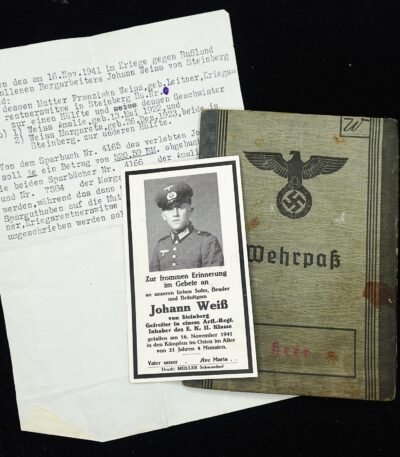
KIA Wehrpass & Death Card – Artillerie-Regiment 17 (EK2 & WIO)
An interesting original Second World War German military grouping relating to Gefreiter Johann Weiß, born on 19 July 1920 in Steinberg, in the administrative district of Oberpfalz, Bavaria.
The grouping comprises his original Wehrpass (military service book), a wartime Sterbebild (memorial card), and accompanying family documentation concerning his death and the handling of his savings.
According to the Wehrpass, Weiß served with the following artillery and replacement units:
- Artillerie-Ersatz-Abteilung 173, Amberg.
- Feld-Ersatz-Bataillon 17.
- 1. Batterie / Artillerie-Regiment 17 of the 17. Infanterie-Division.
His Wehrpass records that he was killed in action on 16 November 1941, during the German campaign in the East.
Decorations
The Wehrpass records the following awards:
- Eisernes Kreuz 2. Klasse (Iron Cross 2nd Class), awarded on 10 November 1941.
- Winterschlacht im Osten 1941/42 (Eastern Front Medal), awarded on 24 October 1942, as recorded in the document.
The latter entry is particularly noteworthy because it postdates his death. This is consistent with the medal being awarded posthumously.
Memorial card and family documentation
The accompanying memorial card commemorates Johann Weiß as a beloved son, brother and fiancé. It identifies him as a gunner serving in an artillery regiment and states that he fell in the East on 16 November 1941, aged 21 years and four months.
The typed family document refers to his mother, Franziska Weiß, née Leitner, and his sisters, Amalie and Margarete. It also discusses the transfer of savings belonging to the deceased to members of his family.
This accompanying documentation adds valuable personal and genealogical context to the military record, connecting the Wehrpass to the circumstances surrounding his death and its impact on his relatives.
Condition
The Wehrpass exhibits age-related toning, foxing, staining and wear to the cover and pages. The original photograph, handwritten entries, official stamps and award annotations remain visible. The accompanying memorial card and family document show their own period wear and handling marks.
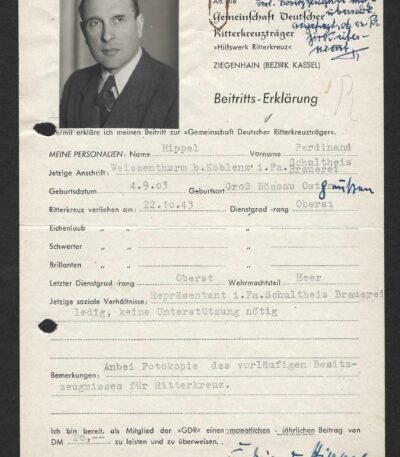
Membership Application GDR (OdR) – Ferdinand Hippel – Grenadier-Regiment 253
Original Beitritts-Erklärung (membership declaration), dated 9 June 1952, was completed for the Gemeinschaft Deutscher Ritterkreuzträger (Association of Knight’s Cross Recipients) at Ziegenhain, in the Kassel district of Germany.
The form includes an original portrait photograph of Hippel, typed personal details, his military rank and branch of service, and his handwritten signature at the bottom. It records his Knight’s Cross award date as 22 October 1943 and his last military rank as Oberst in the Heer (German Army).
The document also contains handwritten annotations in blue ink at the top and beside the birthplace entry, adding further historical character.
Ferdinand Hippel was born on 4 September 1903 and pursued a military career in the German Army, rising to the rank of Oberst (Colonel). He was awarded the Knight’s Cross of the Iron Cross while commanding Grenadier-Regiment 253, on 22 October 1943.
His wartime service is also documented in photographs preserved by the German Federal Archives. A photograph from August–September 1944 depicts Hippel alongside Generalfeldmarschall Albert Kesselring in Italy, identifying Hippel as the commander of a grenadier regiment. This provides an additional contemporary historical reference for the officer named in this document.
Condition: Original paper document with age-related discoloration, creasing, edge wear, small tears and losses, staining, and several holes or damaged areas. The photograph remains attached. Handwritten annotations and the signature are present. Please examine the photographs carefully for the exact condition.
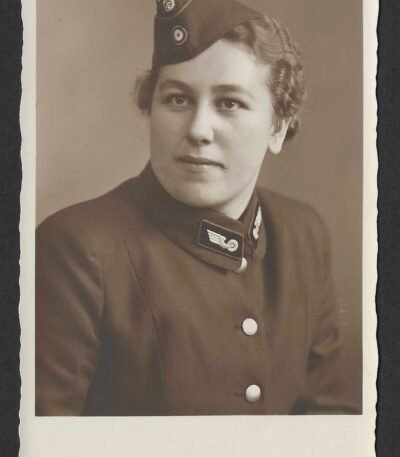
Deutsche Reichsbahn-Helferin Portrait
An attractive original wartime studio portrait of a Deutsche Reichsbahn-Helferin (German Reich Railway Auxiliary Woman), photographed in uniform during the Second World War.
The portrait depicts a young woman wearing a dark railway service uniform with a matching Schiffchen (garrison cap). The cap displays the national eagle insignia and a circular cockade-style badge. Particularly noteworthy are the Reichsbahn collar tabs (railway service collar insignia), featuring the characteristic winged-wheel emblem associated with German railway personnel.
Historical background: The Deutsche Reichsbahn (German State Railway) was central to Germany’s transport infrastructure during the Second World War, moving passengers, supplies and military traffic. Female personnel also served in railway-related auxiliary and administrative roles. This original portrait documents the uniformed appearance of a woman associated with the wartime railway service.
The reverse is printed with „Primosa“, a photographic paper or studio-related marking. No personal dedication, date or clearly legible photographer’s details are visible.
Condition: Original sepia-toned photographic portrait with attractive contrast and good detail. The photograph shows age-related discoloration, minor spotting and light handling wear. The edges are irregular, consistent with the original photographic finish. The reverse is largely blank.
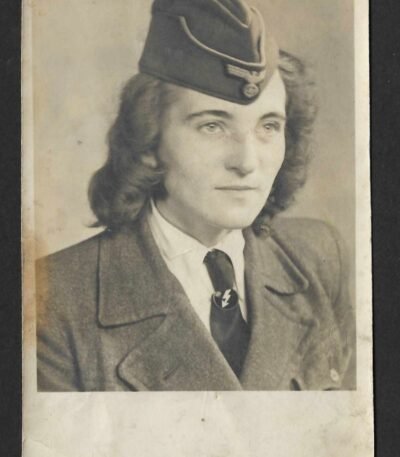
Wehrmacht Nachrichtenhelferin Portrait – Tilsit, East Prussia
An original wartime studio portrait photograph of a Wehrmacht Nachrichtenhelferin (Wehrmacht Signals Auxiliary Woman), showing a young woman in German military auxiliary uniform during the Second World War.
The portrait depicts her wearing a Schiffchen (garrison cap) with the German national eagle insignia, a uniform jacket, white shirt and dark tie. A circular Nachrichtenhelferinnen-Brosche (Signals Auxiliary Woman’s Brooch) is visible on her tie, identifying her association with the female communications auxiliaries of the German armed forces.
The reverse bears the photographic studio imprint „Foto-Atelier Groß, Tilsit, Hohe Str. 63“, identifying the studio in Tilsit, East Prussia (now Sovetsk, Kaliningrad Oblast, Russia). This provides an interesting geographical connection to a former German city in East Prussia during the wartime period.
Historical background: The Nachrichtenhelferinnen des Heeres (German Army Signals Auxiliaries) were female auxiliary personnel employed in military communications during the Second World War. Their duties included telephone and teleprinter operations, message transmission and other communications-related work. Their service helped maintain the communications networks required by the German Army.
Original portrait photographs of these women are collectible examples of the often-overlooked history of female auxiliary personnel and their roles within the wartime military system.
Condition: Original black-and-white studio photograph with attractive portrait detail. The photograph shows age-related yellowing, spotting, creasing and general handling wear. The reverse retains the printed studio address and handwritten notation. Please examine the photographs for the exact condition. Postcardsize.
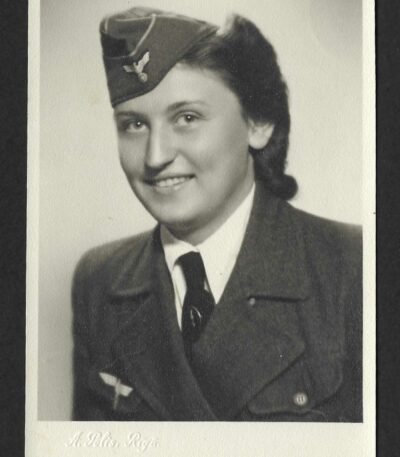
Wehrmacht Nachrichtenhelferin Portrait – Riga, Latvia
An attractive original wartime portrait photograph of a Wehrmacht Nachrichtenhelferin (Wehrmacht Signals Auxiliary Woman), showing a young woman in German military auxiliary uniform during the Second World War.
The portrait depicts her wearing a Schiffchen (garrison cap) bearing the German national eagle insignia, together with a uniform jacket, white shirt and dark tie. A small insignia is visible on the tie, characteristic of the uniform worn by female communications auxiliaries.
The photograph bears the studio imprint „A. Polis, Riga“, identifying the photographer or photographic studio in Riga, Latvia. The reverse carries a handwritten personal inscription reading „Im Russland, Januar 43. Eure Luise“.
Historical background: During the German occupation of Latvia, Riga became an important administrative and military centre. German military personnel and auxiliary staff stationed in or passing through the region sometimes had portrait photographs taken by local studios. This photograph provides a personal glimpse into the lives of female auxiliary personnel during wartime.
Condition: Original black-and-white studio photograph with good portrait detail. Shows age-related discoloration, minor spotting and light handling wear. The reverse retains the handwritten inscription and embossed studio marking. Please refer to the photographs for the exact condition.
An appealing addition to a collection of Wehrmacht Nachrichtenhelferinnen (Wehrmacht Signals Auxiliaries), German military portrait photography, or wartime photographs associated with the German occupation of Latvia.
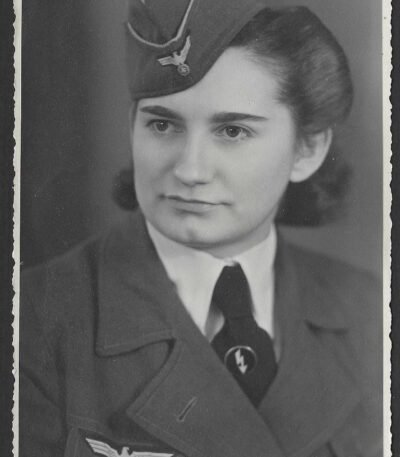
Wehrmacht Nachrichtenhelferin Portrait
An attractive original black-and-white portrait photograph of a Wehrmacht Nachrichtenhelferin (Wehrmacht Signals Auxiliary Woman) from the Second World War.
The young woman is depicted wearing a German military-style uniform jacket, white shirt, dark tie and Schiffchen (garrison cap) bearing the national eagle insignia.
Particularly noteworthy is the Nachrichtenhelferinnen-Brosche (Signals Auxiliary Woman’s Brooch) worn on her tie, identifying her association with the female communications auxiliaries of the German armed forces.
Historical background: The Nachrichtenhelferinnen des Heeres (German Army Signals Auxiliaries) were female auxiliary personnel employed in military communications during the Second World War. Their duties included telephone and teleprinter operations, message transmission and other communications-related work. Their service helped maintain the communications networks required by the German Army.
Original portrait photographs of these women are collectible examples of the often-overlooked history of female auxiliary personnel and their roles within the wartime military system.
Condition: Original black-and-white photograph with attractive contrast and good portrait detail. Shows age-related discoloration, minor spotting and light handling wear, with irregularly cut edges. The reverse bears a faint, unidentified stamp. Please refer to the photographs for the exact condition.
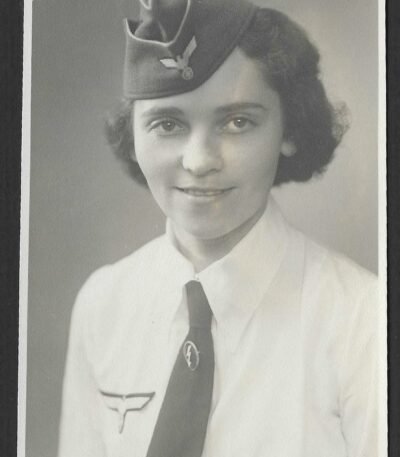
Wehrmacht Nachrichtenhelferin Portrait
An attractive original black-and-white portrait photograph of a Wehrmacht Nachrichtenhelferin (Wehrmacht Signals Auxiliary Woman) from the Second World War.
The photograph depicts a young woman wearing a white service blouse, dark tie and Schiffchen (garrison cap) bearing the German national eagle insignia. The Nachrichtenhelferin brooch is visible on her tie.
The studio portrait offers a clear view of the uniform and associated insignia worn by female auxiliary personnel serving within the German military communications system.
The reverse is blank apart from the printed D.R.G.M. marking, indicating a German utility-model registration (Deutsches Reichsgebrauchsmuster). No personal dedication, date or photographer’s details are visible.
Historical background: The Nachrichtenhelferinnen des Heeres (German Army Signals Auxiliaries) were female auxiliary personnel employed in military communications during the Second World War. Their duties included telephone and teleprinter operations, message transmission and other communications-related work. Their service helped maintain the communications networks required by the German Army.
Original portrait photographs of these women are collectible examples of the often-overlooked history of female auxiliary personnel and their roles within the wartime military system.
Condition: Good overall photographic appearance, with light age-related discoloration, minor surface marks and slight wear. The reverse is largely blank. Please refer to the photographs for the exact condition. Postcardsize.
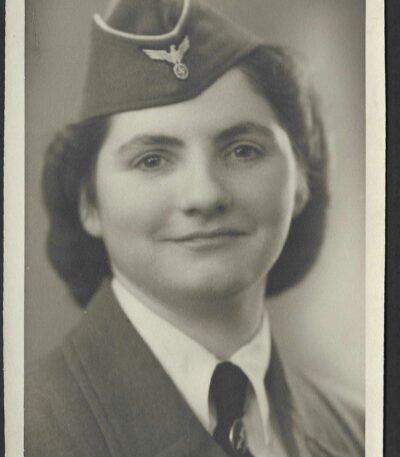
Wehrmacht Nachrichtenhelferin Portrait – Den Haag, 1942
An attractive original wartime portrait photograph of a Wehrmacht Nachrichtenhelferin (Wehrmacht Signals Auxiliary Woman), dated 22 January 1942.
The photograph depicts a young woman wearing a German military-style uniform jacket, tie and Schiffchen (garrison cap) bearing the national eagle insignia. The portrait has a classic studio-photography appearance and provides a clear view of her uniform and headgear.
Interesting original reverse: The reverse bears a handwritten personal dedication, apparently reading „Ein kleiner Gruß aus Holland. Deine Käthe.“ (A little greeting from Holland. Yours, Käthe). The exact reading of the name should be regarded as tentative due to the handwriting.
A studio imprint identifies the photographer studio as FOTO AMERICAIN, Wagenstraat 10, Den Haag (The Hague, Netherlands), accompanied by a date stamp reading 22 JAN. 1942. This provides an interesting geographical and chronological connection to the German wartime presence in the occupied Netherlands.
Historical background: The Nachrichtenhelferinnen des Heeres (German Army Signals Auxiliaries) were female auxiliary personnel employed in military communications during the Second World War. Their duties included telephone and teleprinter operations, message transmission and other communications-related work. Their service helped maintain the communications networks required by the German Army.
Original portrait photographs of these women are collectible examples of the often-overlooked history of female auxiliary personnel and their roles within the wartime military system.
Condition: Original black-and-white photograph with visible age-related wear, light discoloration and small brown spots, particularly near the lower edge of the image. The reverse retains the handwritten dedication and photographic studio imprint. Postcardsize.
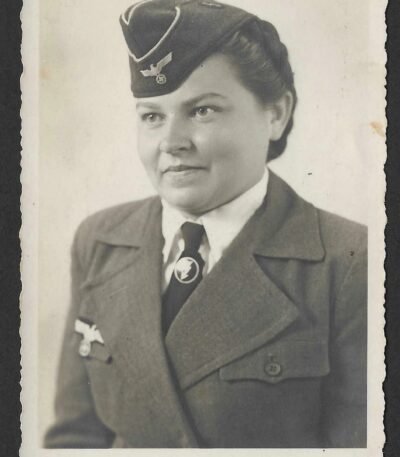
Wehrmacht Nachrichtenhelferin Portrait
An attractive original wartime portrait photograph of a Wehrmacht Nachrichtenhelferin des Heeres (German Army Signals Auxiliary), showing a young woman in her service uniform during the Second World War.
The photograph displays the characteristic Schiffchen (garrison cap) with national eagle insignia, together with a uniform jacket, tie and circular badge. The portrait provides a clear view of the uniform and its associated insignia, making it an interesting example of wartime German female auxiliary personnel photography.
The reverse carries a handwritten personal dedication in pencil, apparently beginning with „Zum Andenken“ (In remembrance). The inscription appears to refer to a fellow signals auxiliary or comrade and includes the name Betty, although the complete wording and name cannot be established with certainty from the photograph. A handwritten or pencilled reference number is also visible in the upper corner.
Historical background: The Nachrichtenhelferinnen des Heeres (German Army Signals Auxiliaries) were female auxiliary personnel employed in military communications during the Second World War. Their duties included telephone and teleprinter operations, message transmission and other communications-related work. Their service helped maintain the communications networks required by the German Army.
Original portrait photographs of these women are collectible examples of the often-overlooked history of female auxiliary personnel and their roles within the wartime military system.
Condition: Original black-and-white photograph with attractive period contrast. Shows age-related discoloration, minor spotting and handling wear, with irregularly cut or naturally rough edges. The reverse retains its handwritten dedication. Please examine the photographs for the exact condition. Postcardsize.
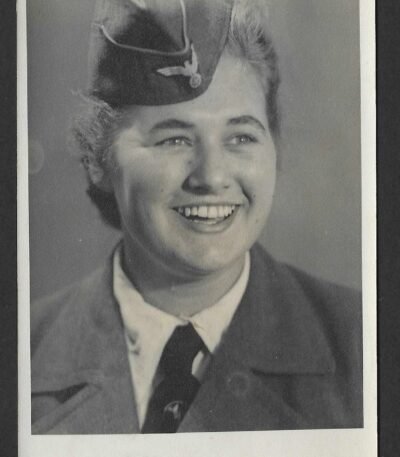
Wehrmacht Nachrichtenhelferin Portrait – 1944
An original wartime portrait photograph of a young Wehrmacht Nachrichtenhelferin (Wehrmacht Signals Auxiliary Woman), dating from the Second World War.
The photograph depicts the smiling young woman in uniform, wearing a Schiffchen (overseas cap). She is portrayed in a classic studio-style photograph, with clear facial details and an attractive period appearance.
The reverse bears a handwritten dedication in blue ink, dated 19 June 1944. This personal inscription adds an interesting contemporary element to the photograph, connecting it to the private lives and relationships of German military auxiliary personnel during the war. Parts of the handwriting remain difficult to decipher with certainty.
Historical background: The Nachrichtenhelferinnen des Heeres (German Army Signals Auxiliaries) were female auxiliary personnel employed in military communications during the Second World War. Their duties included telephone and teleprinter operations, message transmission and other communications-related work. Their service helped maintain the communications networks required by the German Army.
Original portrait photographs of these women are collectible examples of the often-overlooked history of female auxiliary personnel and their roles within the wartime military system.
Condition: Good overall vintage appearance, with minor age-related marks, light discoloration and handling wear. The original handwritten dedication remains visible on the reverse. Postcardsize.
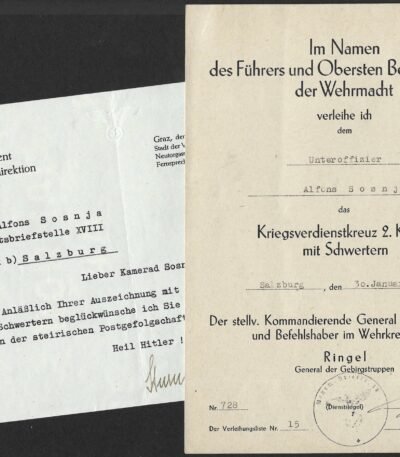
Kriegsverdienstkreuz 2. Klasse mit Schwertern Award Doc – Wehrmachtsbriefstelle XVIII – Salzburg, 30. Januar 1945 – Ringel
€95,00An interesting original two-document group belonging to Unteroffizier Alfons Sosnja, comprising his Kriegsverdienstkreuz 2. Klasse mit Schwertern (War Merit Cross 2nd Class with Swords) award certificate and a contemporary congratulatory letter from the Präsident der Reichspostdirektion Graz (President of the Graz Regional Postal Directorate).
1. Kriegsverdienstkreuz 2. Klasse mit Schwertern – Verleihungsurkunde (War Merit Cross 2nd Class with Swords – Award Certificate)
The certificate confirms the award of the Kriegsverdienstkreuz 2. Klasse mit Schwertern to Unteroffizier Alfons Sosnja, serving with Wehrmachtsbriefstelle XVIII, dated 30. Januar 1945 in Salzburg.
The issuing authority is identified as the Stellvertretender Kommandierender General des XVIII. Armeekorps und Befehlshaber im Wehrkreis XVIII (Deputy Commanding General of XVIII Army Corps and Commander of Military District XVIII). The certificate names General der Gebirgstruppen Julius Ringel and bears the official service seal (Dienstsiegel), award number 728 and award-list reference Verleihungsliste Nr. 15.
2. Congratulatory Letter from the Reichspostdirektion Graz
The accompanying letter is addressed to Unteroffizier Alfons Sosnja, serving at Wehrmachtbriefstelle XVIII, Salzburg. Written on behalf of the Graz postal administration, it congratulates him on receiving the War Merit Cross with Swords and conveys the congratulations of the Styrian postal staff.
This contemporary letter is an especially appealing addition, connecting the military decoration with the recipient’s civilian postal-service background and providing a personal context for the award.
Historical Interest
The combination of an official military award certificate and a contemporary congratulatory letter makes this group more informative than a single award document. It connects Alfons Sosnja with the Wehrmacht postal service in Salzburg and the regional postal administration in Graz during the final months of the Second World War.
The award certificate’s named issuing authority, original service seal and award-list reference provide useful starting points for further archival research.
Condition
The award certificate shows age-related toning, creasing and handling marks, with the official seal and printed details still visible. The accompanying letter has pronounced folds, some staining and paper damage at the lower-left corner. Its visible text remains largely legible.
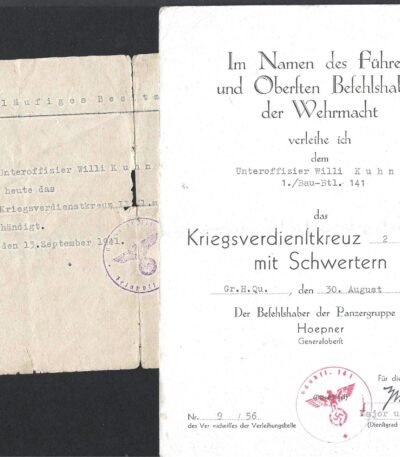
Kriegsverdienstkreuz 2. Klasse mit Schwertern Award Doc – Bau-Bataillon 141, 1941 – Hoepner, Panzergruppe 4
€95,00An interesting original two-document group relating to the award of the Kriegsverdienstkreuz 2. Klasse mit Schwertern (War Merit Cross 2nd Class with Swords) to Unteroffizier Willi Kuhn, serving with 1./Bau-Bataillon 141 (1st Company, Construction Battalion 141).
The group comprises the following documents:
- Verleihungsurkunde (Official Award Certificate): Dated 30. August 1941 at Gr. H. Qu. (Großes Hauptquartier / Great Headquarters). The certificate was issued by the Befehlshaber der Panzergruppe 4 (Commander of Panzer Group 4), identified as Generaloberst Hoepner — Generaloberst Erich Hoepner. It bears the printed commander’s name and rank, an official seal and a separate certification signature.
- Vorläufiges Besitzzeugnis (Provisional Certificate of Possession): A preliminary award document confirming that Unteroffizier Willi Kuhn had received the Kriegsverdienstkreuz II. Klasse mit Schwertern. This document is dated 13. September 1941 at O.U. (Ortsunterkunft / unit location as indicated on the document).
The association with Panzergruppe 4 and Generaloberst Erich Hoepner makes this a particularly interesting group for collectors of early-war German award documents, military construction units and the Eastern Front campaign.
The two documents should be kept together as a group. Their different dates are visible on the originals and should be retained as part of the description rather than treated as an error.
Condition
The official award certificate shows age-related toning, horizontal creasing and minor spotting, with some wear around the edges. The provisional certificate has more pronounced damage, including a substantial vertical tear, losses along the tear and creasing. The original text and relevant stamps remain largely legible on both documents.
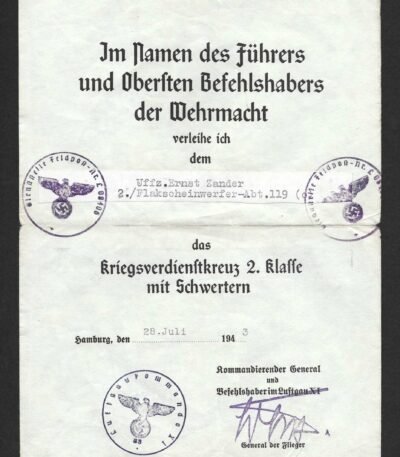
Kriegsverdienstkreuz 2. Klasse mit Schwertern Award Doc – Flakscheinwerfer-Abteilung 119, Hamburg, 1943 – Luftgau XI
€75,00Original German award certificate (Verleihungsurkunde) for Unteroffizier Ernst Zander, awarding the Kriegsverdienstkreuz 2. Klasse mit Schwertern (War Merit Cross 2nd Class with Swords), dated 28. Juli 1943 in Hamburg.
The recipient is identified as serving with 2. Batterie/ Flakscheinwerfer-Abteilung 119 (2nd Battery, Searchlight Battalion 119). The certificate was issued by the Kommandierender General und Befehlshaber im Luftgau XI (Commanding General and Commander of Luftgau XI).
The handwritten signature appears consistent with General der Flieger Ludwig Wolff, who commanded Luftgau XI during this period. The document also features the official Luftgau service seal (Dienstsiegel) and two additional unit or field-post stamps in the upper section.
The combination of a named recipient, a specific Luftwaffe searchlight unit and a dated award makes this an interesting document for collectors of Luftwaffe militaria and German wartime award certificates.
Condition
Shows age-related toning, creasing and a pronounced horizontal fold across the centre, affecting the recipient’s details and overlapping the two upper stamps. Additional folds, minor edge wear and handling marks are present. The main official seal, signature and printed award text remain visible.
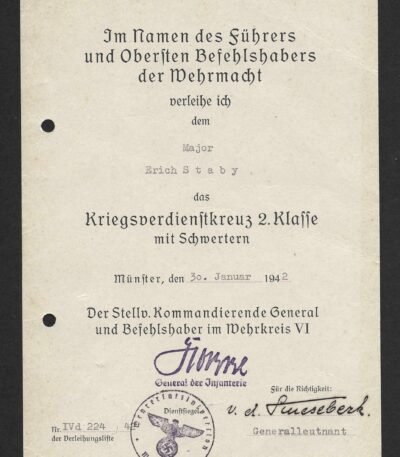
Kriegsverdienstkreuz 2. Klasse mit Schwertern Award Doc – Major, Münster, 1942 – Wehrkreis VI – Gerhard Glokke & v. d. Knesebeck
€75,00Original German award certificate (Verleihungsurkunde) for Major Erich Staby, awarding the Kriegsverdienstkreuz 2. Klasse mit Schwertern (War Merit Cross 2nd Class with Swords), dated 30. Januar 1942 in Münster, Westphalia.
Issued by the Stellvertretender Kommandierender General und Befehlshaber im Wehrkreis VI (Deputy Commanding General and Commander of Military District VI). The document bears the printed name/signature of General der Infanterie Gerhard Glokke, representing the issuing authority.
The separate handwritten certification was signed by Generalleutnant Georg von dem Knesebeck. The original military district service seal (Dienstsiegel) and award-list reference Nr. IVa 224 are also present.
Further information on Major Erich Staby: An archival record held by the Landesarchiv Nordrhein-Westfalen, accessible through the Deutsche Digitale Bibliothek, is catalogued under Entnazifizierung Erich Staby, geb. 02.07.1896. This provides an additional research reference for collectors interested in the recipient’s biography and post-war history:
View the archival record for Erich Staby – Deutsche Digitale Bibliothek
Condition
Shows age-related toning, creasing and several horizontal fold lines, with minor handling marks and small areas of surface wear. Two punched holes along the left margin are present. The printed text, signatures and official seal remain clearly visible.